By Clay Shumate
A Socratic seminar is a structured, whole-group discussion in which students question a shared text and each other while the teacher stays mostly silent. There is no winner and no correct answer to arrive at. The point is that students do the reasoning out loud, in front of each other, using evidence from something they all read.
That is the definition. What follows is the part most guides skip: what the research actually supports, what it does not, and how to run one in a real secondary class without the same five kids carrying it.
Key Takeaways
- A seminar is not a debate. Nobody is assigned a side, nobody is trying to win, and the question has to be one you cannot settle by looking something up.
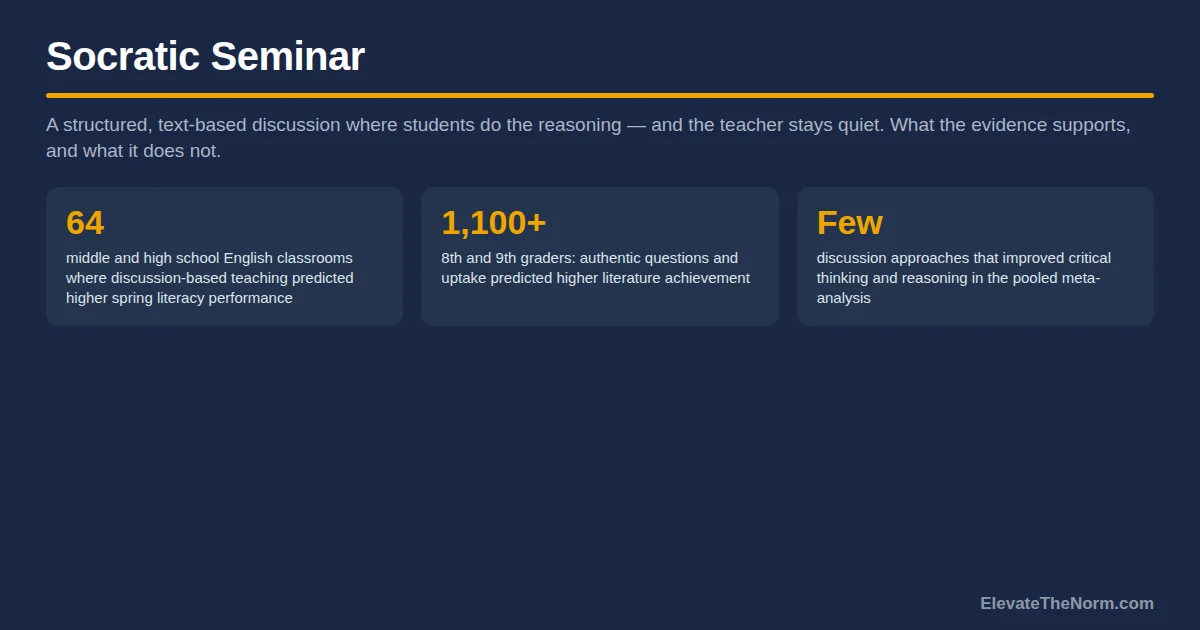
- The strongest evidence is about discussion generally, not this format specifically. A study of 64 middle and high school English classrooms found discussion-based teaching predicted higher spring literacy performance — for low-achieving students as well as high-achieving ones.
- The most honest finding is a mixed one. A meta-analysis found discussion produced big jumps in student talk and real gains in text comprehension, but few approaches moved critical thinking and reasoning.
- Preparation is the whole game. A seminar with an unread text is twenty minutes of opinions.
- Silence is not failure. The most common way a teacher wrecks a seminar is by answering the question they just asked.
Free Download · PDF
The Socratic Seminar Prep Sheet
A text-selection check, the opening-question test, the six moves in order, six norms worth posting, a turn-count tally for you, and the four-way autopsy for a seminar that died.
Free. No email address required. Designed for grades 6–12. Browse every printable in Your Free Library.
What Is a Socratic Seminar?
A Socratic seminar is a formal, text-based dialogue where students ask and answer open-ended questions with each other, and the teacher facilitates instead of teaching. The National Paideia Center — which has trained schools in this format for decades — defines it as “a collaborative intellectual dialogue facilitated with open-ended questions about a text.” That definition is doing more work than it looks like.
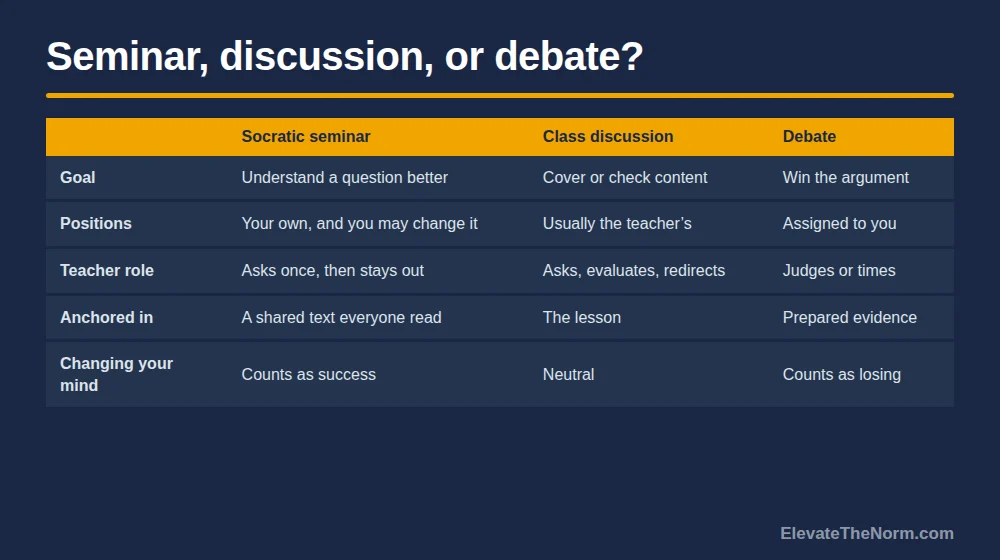
Every word in it rules something out. Collaborative rules out debate. Open-ended rules out questions with answers. About a text rules out a free-floating conversation on a topic. Take away any one and you have something else — possibly useful, but not a seminar. Here is the distinction that matters most in a secondary room, because teenagers assume it is a debate unless you tell them otherwise.
Does the Research Actually Support Discussion-Based Teaching?
Yes for discussion in general — and more cautiously than most professional development admits when it comes to thinking. Two studies point in slightly different directions, and both are worth knowing before you build a unit around this.
The strong one is squarely in our grade band. Applebee, Langer, Nystrand and Gamoran studied 64 middle and high school English classrooms across grades 7, 8, 10, 11 and 12. Controlling for fall performance and background, discussion-based approaches were significantly related to spring literacy performance. Their own summary of why: students in discussion-heavy rooms “internalize the knowledge and skills necessary to engage in challenging literacy tasks on their own.” And the finding held “for low-achieving as well as high-achieving students” — which is the opposite of what people assume about discussion, and the single best argument for not reserving it for honors sections.
An earlier study from the same research group found the mechanism. Across sixteen middle schools feeding nine high schools in eight Midwestern communities, more than 1,100 eighth and ninth graders were tested in fall and spring. Students whose teachers asked a higher proportion of authentic questions — questions the teacher did not already have an answer to — and who practiced uptake, building the next question out of what a student just said, scored significantly higher on literature achievement. Not more questions. Different questions.
There is an equity finding buried in the first study that deserves more attention than it gets. Applebee and colleagues note that their interpretation is “complicated because instruction is unequally distributed across tracks.” Translated: the discussion-based teaching that helps low-achieving students the most was not what low-achieving students were mostly getting. If a school is going to act on this research at all, the action is not “add seminars” — it is checking which sections currently get them.
Now the cautious one, and it is the reason this section exists. Murphy and colleagues ran a meta-analysis of classroom discussion approaches in the Journal of Educational Psychology. They found “strong increases in the amount of student talk and concomitant reductions in teacher talk, as well as substantial improvements in text comprehension.” Then they found this: “Few approaches to discussion were effective at increasing students’ literal or inferential comprehension and critical thinking and reasoning.”
Read that twice. The talk goes up reliably. Comprehension of the text goes up. Whether students get better at thinking is not established by the pooled evidence, and the majority of the studies in that analysis were conducted in fourth through sixth grade, not with teenagers. If someone tells you seminars teach critical thinking, that is a hope, not a result.
The same gap shows up in a study built specifically around Socratic dialogue. Mahoney and colleagues ran an eight-week Socratic dialogue series in Dutch vocational secondary education with 85 students and five teachers. Teachers found it deliverable but cognitively demanding, and all five asked for more facilitation training. The study’s own limitations section says there was “no measurement of actual critical thinking skill development.” A paper with “learning to think critically” in the title did not measure whether anyone did. The researchers said so themselves; it is a warning about how this format gets sold, not about them.
One more, because the number gets quoted at teachers without its age attached. England’s Education Endowment Foundation ran a randomised controlled trial of Dialogic Teaching across 76 schools and roughly 5,000 pupils and found two additional months’ progress in English and science, with larger gains for pupils on free school meals. Those pupils were nine and ten years old. The practices probably transfer to a secondary room. The effect size does not automatically come with them.
The defensible version: structured, text-anchored discussion with authentic questions is one of the better-evidenced things you can do with a secondary class, and the evidence for it is about comprehension and engagement rather than about producing better reasoners in eight weeks.
One implication for anyone above the classroom level: this is not a practice you mandate in August and audit in October. Every teacher in the Dutch study asked for more training in facilitation specifically, and facilitation is the whole skill. A department that runs four seminars and talks about them afterward will get further than a district that requires one per unit.
What Do You Need Before the First Seminar?
Three things: a text worth arguing about, a question with no answer, and students who have actually read it. Skip any one and the seminar fails in a predictable way.
The text. Short beats long. One or two pages that every student can hold and mark up beats a chapter half of them skimmed. It needs genuine ambiguity — a primary source with a point of view, a court opinion, a poem, a paragraph from a science paper where the authors hedge. If the text has one obvious reading, there is nothing to discuss and students will know it within four minutes.
Two constraints on that choice, both easy to miss when you are excited about a text. Every student has to be able to read it. A twelfth-grade primary source in a mixed ninth-grade class produces a conversation among the strongest readers while everyone else decodes. If the text is hard, read it aloud together or gloss the four words that will stop people — but do not let reading level decide who participates. And check the text against your own building’s ground. Ambiguity is the point; a text likely to pull a student into disclosing something personal in front of twenty-eight peers is a different situation, and it is worth a conversation with an administrator before it is worth a seminar.
The opening question. Write it down before the seminar and test it against one standard: could a well-prepared student answer this in one sentence and be finished? If yes, it is a comprehension check, not a seminar question. “What does the author claim?” is a warm-up. “Is the author being honest about what they do not know?” is a seminar. If writing them is the part you get stuck on, there are forty subject-general seminar questions and a ten-minute way to write your own.
The reading. This is what quietly kills most first attempts. The Paideia model puts multiple close readings in a pre-seminar phase before any discussion and writing in a post-seminar phase afterward. That three-part shape is the format, not an optional extra. Read the text once ten minutes before the circle forms and you get opinions instead of evidence — then conclude your class cannot handle seminars. Your class is fine. The prep was missing.
A note on when they read it. The obvious move is to send the text home the night before, and I would push back on that — not on principle, but because it decides in advance that the students who read at home get to participate and the ones who do not, do not. Read it in class. Ten minutes of everyone reading the same page in the same room is not lost time; it is the thing that makes the next twenty minutes possible.
One practical note about the room. The tables in my room are trapezoids pushed together in groups rather than desks in rows, which is closer to a discussion shape than a lecture hall — but it still is not a circle, and the furniture has to move. Build that into the clock. A seminar that starts with four minutes of scraping chairs starts four minutes late, every time, and you will feel it at the end.
How Do You Actually Run One?
Six moves, in order, and the hardest is the fifth. You can run this sequence in a single period and repeat it until it stops feeling like an event.
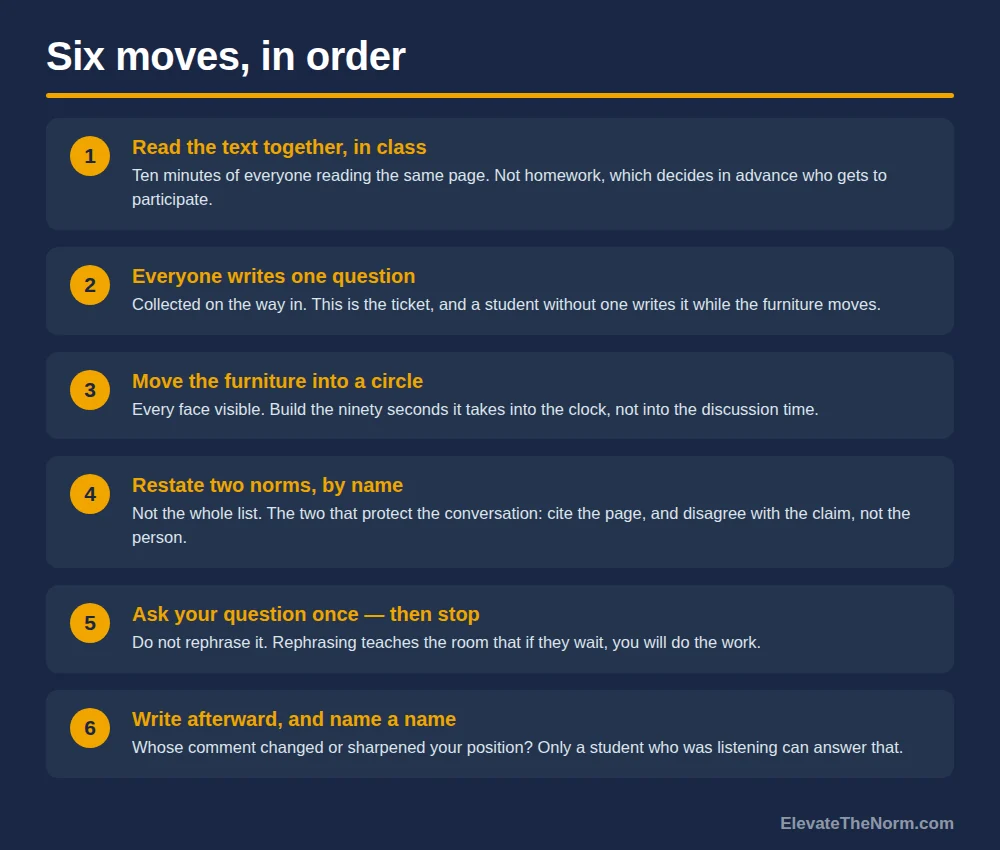
The sequence is deliberately boring in the middle. Step five is the interesting one, and the one I get wrong most often.
In my own room I have landed on roughly a fifteen-count before I respond to something that is off track — and I mean roughly. It is an average, not a rule, because real classes change day to day and a number you enforce mechanically stops being judgment. A seminar asks for that same discipline in a different situation. You ask the opening question, nobody talks, and everything in you wants to rephrase it. Rephrasing is how you teach a room that if they wait long enough, you will do the work. Ask it once. Then sit there.
The related move is refusing to evaluate. The instant you say “good point,” you have told twenty-eight teenagers that the goal is to produce points you approve of, and the conversation reorients toward you. Write the comment down instead. Nod. Look at somebody else. The Applebee study’s mechanism — authentic questions and uptake — only works if students believe you do not already have the answer, and praise is the fastest way to convince them you do.
What Are the Rules, and Who Enforces Them?
Keep the list short enough that students can hold it, and hand enforcement to them by the third seminar. Long norm lists get read aloud once and ignored. Five or six behaviors, posted, referred to by name, is enough.
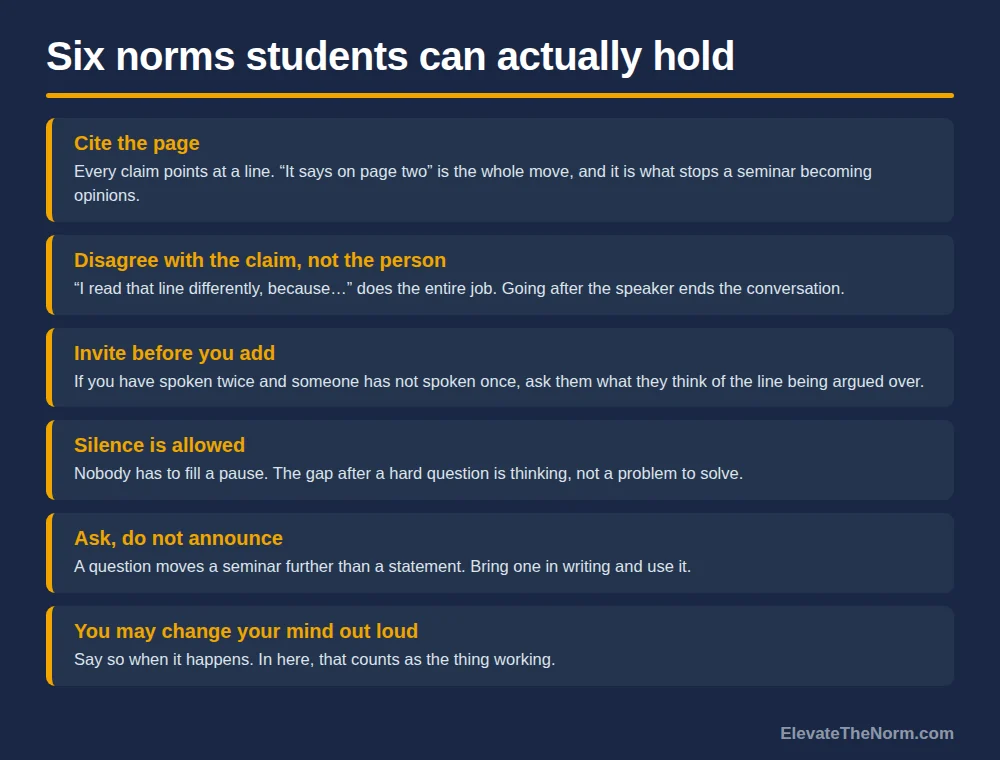
The norms that matter protect the conversation from its two failure modes: nobody talking, and three people talking. Everything else is manners.
There is one behavior worth planning for: the student who is performing for the room rather than talking to it. Do not handle that inside the circle. Naming it publicly makes it a bigger performance, and the seminar stops. Let it pass, keep the conversation moving to someone else, and take it up with the student afterward at normal volume. A seminar is a bad place to win an argument with a teenager.
Worth saying clearly, because it is where teenagers get this wrong: disagreeing with an idea is the job. A seminar where everyone agrees has not happened yet. What is off-limits is going after the person instead of the claim, and the fix is a sentence frame, not a lecture — “I read that line differently, because…” does the whole job. The broader argument for why this works in a secondary room is the same one behind holding students to an adult standard of disagreement rather than a polite one.
What About the Fishbowl Format?
A fishbowl Socratic seminar puts one group in an inner circle discussing while an outer circle observes, then swaps them. It exists to solve two real problems: a class of thirty is too big for one conversation, and students who never get observed never get feedback on how they discuss.
It works, with one condition. The outer circle needs a job. An outer ring with nothing to do is a ring of spectators with phones. Give each outer student one inner-circle partner to track, and one thing to record — how many times their partner cited the text, or the one question their partner asked that moved the conversation. Keep the record behavioral: what the partner did, not how well they did it. “You went back to the text three times” is feedback. “You seemed nervous” is not, and a fifteen-year-old should not be handed that by a classmate. Hand the note to the partner rather than reading it to the room. That feedback is usually more useful than anything I would have said, because it comes from a peer who was watching only them — but it belongs to the person it is about.
Do not make it your first seminar of the year, though. Students end up learning two unfamiliar procedures at once and the period goes to logistics.


How Do You Handle the Students Who Won’t Talk?
Stop treating silence as a single problem, because it is at least three problems with different fixes. Some students have nothing prepared. Some have something prepared and cannot find an opening. Some are genuinely afraid of the sound of their own voice in a quiet room, and no amount of encouragement touches that.
A study of quiet students by Medaille and Usinger is instructive here, with a caveat stated up front: the participants were ten undergraduates, not teenagers, so treat it as a description of an experience rather than a finding about your seventh period. Nine of the ten struggled with instructor expectations for verbal participation. Six reported physical reactions — trembling, blushing, stuttering — when speaking aloud. And one of them described the thing I now believe is the actual mechanism: “When I speak [in class] I plan out what I want to say.”
That is not shyness. That is a student who needs a draft, and the fix is not calling on them warmly — it is giving the whole room ninety seconds to write before the circle opens, so the students who need a draft have one and nobody is singled out for needing it.
Three more moves that cost nothing:
- Give the quiet student a job that is not an opinion. Tracking which page the group keeps returning to, or reporting the one question nobody answered, is a real contribution that does not require volunteering a view.
- Use written entry. A sticky note with one question on it, collected at the door and read aloud anonymously, gets a reticent student’s thinking into the room without their voice attached to it. Read them yourself before you read any of them out. Anonymous is not the same as safe — a question can identify the student who wrote it, or disclose something that should not be discussed in a circle, and the two seconds it takes to scan the stack is the whole safeguard.
- Do not grade volume. More on that next, because it is the single change that most reliably changes who talks.
I would not promise that a seminar fixes this. Some students will speak twice all year and write the best post-seminar reflection in the class. That is a real outcome, and the format should be built to catch it.
Should You Grade a Socratic Seminar?
Grade the preparation and the reflection. Do not grade how many times a student spoke. The moment participation counts, you have created an incentive to talk rather than to think, and the students who most need the practice are the ones the incentive punishes.
Count what you can defend. Did they annotate the text? Did they bring a written question? Does the post-seminar writing show they changed or sharpened a position — and can they name whose comment did it? That last one is the best assessment item this format produces, because only a student who was listening can answer it. Three comments in a circle are easy to fake. “I came in thinking X, and the point about the second paragraph is why I do not think that anymore” is not.
This is also the answer when a parent asks why their quiet child is not being penalized, or why their talkative one is not being rewarded: the grade is on the thinking you can see on paper, and it is the same standard for everyone in the room. If your school requires a participation grade, take it from the written pre- and post-work and say out loud, to the students, that the talking is not scored. There is a four-criterion rubric that scores it this way, free and printed on the page. Then hold to it. The first seminar after they believe you is a different conversation. This is the same logic behind treating ungraded checks as information rather than points — the second you attach a score, you stop learning what students actually think.
Four Ways a Seminar Goes Wrong
Every one of these is a design problem, not a student problem. If a seminar dies, the autopsy is almost always in the prep.
- The question had an answer. Students find the answer in six minutes and then sit there. Fix: write the question the night before and try to answer it yourself in one sentence. If you can, it is not the question.
- The teacher kept talking. You clarified, you rephrased, you summarized, and the conversation routed through you every time. Fix: count your own turns. More than four in a thirty-minute seminar and you are running a recitation with the chairs moved.
- Three students ran it. Not because they are hogging it — because they are the only ones who prepared. Fix: require a written question from everyone, collected as they come in. Make it an expectation, not a bar — a student who arrives without one writes it in the first two minutes while the furniture moves. Nobody gets locked out of the conversation for being unprepared; they get two minutes and then they are in it.
- It happened once. A seminar in October and a seminar in March are two events. Students never get past the awkwardness of the format itself. Fix: shorter and more often. Fifteen minutes on a half-page every other week will outperform two forty-minute showpieces.
The fourth is the one I would push hardest. Frequency turns this from a special activity into the way the class talks, and the same logic runs through any structure that hands students the thinking: the first run is about the structure, and only the fourth or fifth is about the content.
What to Do Next
Pick a one-page text you already teach — something with a hedge or a contradiction in it — and write one question you cannot answer in a sentence. Give students ten minutes in class to read it, mark two places they disagree, and write one question. Move the furniture. Ask your question once, and then do not talk for as long as you can stand.
Then do it again in two weeks. The first one will be rough, and that is not information about your students. Run four before you decide whether this works in your room.
If you want the underlying argument for why handing teenagers this much of the conversation is worth the mess, it is the same one behind giving students real decisions rather than cosmetic ones. A seminar is just the version of that argument you can run on a Tuesday.
Before you go: grab the free The Socratic Seminar Prep Sheet (PDF) — ElevateTheNorm.com branded, printable, no email required.
Frequently Asked Questions
What is a Socratic seminar in simple terms?
It is a structured discussion where students question a shared text and each other while the teacher mostly stays quiet. There is no assigned side, no winner, and no single correct answer to land on. The National Paideia Center calls it a collaborative intellectual dialogue facilitated with open-ended questions about a text. If the question has an answer, or if the teacher is doing most of the talking, it is a class discussion rather than a seminar.
How long should a Socratic seminar last?
Fifteen to thirty minutes of actual discussion is plenty for grades 6–12, and shorter is better when you are starting. A full class period sounds ambitious and usually produces twenty good minutes followed by fifteen of people repeating themselves. Frequency beats length. A fifteen-minute seminar every other week on a half-page text will build the skill faster than two long ones a year.
What is the difference between a Socratic seminar and a debate?
A debate assigns positions and produces a winner. A seminar assigns nothing and produces a better-understood question. That difference changes student behavior immediately: in a debate, changing your mind is losing, and in a seminar, changing your mind is the evidence that it worked. Tell students this explicitly before the first one, because teenagers default to debate unless you rule it out.
Do Socratic seminars actually improve student learning?
The evidence is genuinely mixed and worth knowing honestly. A study of 64 middle and high school English classrooms found discussion-based approaches significantly predicted spring literacy performance, including for low-achieving students. But a meta-analysis in the Journal of Educational Psychology found that while discussion produced strong increases in student talk and substantial gains in text comprehension, few approaches improved critical thinking and reasoning — and most of those studies were in grades 4 through 6. Discussion is well supported. The claim that it teaches thinking is not settled.
How do you get quiet students to participate in a Socratic seminar?
Give the whole class ninety seconds of writing time before the circle opens, so students who need to plan what they say have a draft and nobody is singled out for needing one. Beyond that, offer jobs that are not opinions — tracking which passage the group keeps returning to, or reporting the question nobody answered. And do not grade how often a student speaks. That single change does more than any amount of encouragement, because it removes the reason a struggling student is performing rather than thinking.
Should I grade a Socratic seminar?
Grade the preparation and the reflection, not the talking. Annotated text, a written question brought to the circle, and a post-seminar piece of writing are all defensible and all reward thinking. Counting comments rewards volume and penalizes the students who most need the practice. If a participation grade is required, pull it from the written work and tell students plainly that speaking is not scored.
What makes a good Socratic seminar question?
One you cannot answer in a sentence and cannot settle by looking something up. Test your question by trying to answer it yourself before the seminar; if you finish in one line, it is a comprehension check. Questions that work usually ask about a tension inside the text — whether the author is being honest about what they do not know, whether two of their claims can both be true, or what the text refuses to say.
How many students should be in a Socratic seminar?
Twelve to fifteen is the practical ceiling for one circle. Above that, the students at the edges stop being participants. That is what the fishbowl format is for: put half the class in an inner circle discussing and half in an outer circle observing a specific partner, then swap. Do not run a fishbowl as your first seminar though — students end up learning two unfamiliar procedures at once and the period goes to logistics.
Sources
- Applebee, Arthur N., Judith A. Langer, Martin Nystrand, and Adam Gamoran. “Discussion-Based Approaches to Developing Understanding: Classroom Instruction and Student Performance in Middle and High School English.” American Educational Research Journal, vol. 40, no. 3, 2003, pp. 685–730. 64 middle and high school English classrooms, grades 7, 8, 10, 11 and 12; discussion-based approaches significantly related to spring performance controlling for fall performance, and effective for low-achieving as well as high-achieving students. https://eric.ed.gov/?id=EJ782328
- Murphy, P. Karen, Ian A. G. Wilkinson, Anna O. Soter, Maeghan N. Hennessey, and John F. Alexander. “Examining the Effects of Classroom Discussion on Students’ Comprehension of Text: A Meta-Analysis.” Journal of Educational Psychology, vol. 101, no. 3, Aug. 2009, pp. 740–764. Strong increases in student talk and substantial improvements in text comprehension; “few approaches to discussion were effective at increasing students’ literal or inferential comprehension and critical thinking and reasoning.” Majority of included studies were conducted in grades 4–6. https://eric.ed.gov/?id=EJ861185
- Nystrand, Martin, and Adam Gamoran. Student Engagement: When Recitation Becomes Conversation. National Center on Effective Secondary Schools, 1990. ERIC ED323581. Eighth- and ninth-grade English classes in sixteen middle schools feeding nine high schools across eight Midwestern communities; over 1,100 students tested fall and spring, 1987–88 and 1988–89. Higher proportions of authentic questions and uptake predicted significantly higher literature achievement. https://files.eric.ed.gov/fulltext/ED323581.pdf
- Jay, Tim, et al. Dialogic Teaching: Evaluation Report and Executive Summary. Education Endowment Foundation, July 2017. ERIC ED581114. Three-level clustered randomised controlled trial, 38 intervention schools (2,492 pupils) and 38 control schools (2,466 pupils); +2 months English, +2 months science, +1 month maths; three-padlock security rating. Pupils were in Year 5, aged nine and ten — this is not a secondary-school result. Evaluators note 21% of pupils excluded from analysis. https://files.eric.ed.gov/fulltext/ED581114.pdf
- Mahoney, Bethany, Ron Oostdam, Hessel Nieuwelink, and Jaap Schuitema. “Learning to Think Critically Through Socratic Dialogue: Evaluating a Series of Lessons Designed for Secondary Vocational Education.” Thinking Skills and Creativity, vol. 50, 2023, article 101422. 85 students and 5 teachers, Netherlands, eight weekly lessons; teachers found the format deliverable but demanding and all five requested more facilitation training. The study states as a limitation that there was no measurement of actual critical thinking skill development. https://www.sciencedirect.com/science/article/pii/S1871187123001906
- Medaille, Ann, and Janet Usinger. “Quiet Students’ Experiences with the Physical, Pedagogical, and Psychosocial Aspects of the Classroom Environment.” Educational Research: Theory and Practice, vol. 31, no. 2, 2020, pp. 41–55. Qualitative study of ten upper-division undergraduates — not secondary students; nine of ten struggled with verbal participation expectations and six reported physical symptoms when speaking aloud. https://files.eric.ed.gov/fulltext/EJ1274336.pdf
- National Paideia Center. “Paideia Seminar.” Definition of the seminar as a collaborative intellectual dialogue facilitated with open-ended questions about a text, and the pre-seminar / seminar / post-seminar cycle. https://paideia.org/blogs/npc/paideia-socratic-seminar