By Clay Shumate
A one pager assignment asks a student to put their thinking about a text, a topic or a unit onto a single page, combining writing and drawing. Done well, it is a compact analysis task with a visual element. Done badly, it is a craft project with a quotation glued to it — and the difference is almost entirely in what you require and what you grade.
The format came out of AVID and has spread well beyond it. The spread is the problem: most of what teachers see online is the finished art, which tells you nothing about whether the student understood anything.
Key Takeaways
- Require elements, not an aesthetic. A claim written as a sentence, two cited pieces of evidence, a drawing that carries an idea, a labelled connection, a lingering question, and one line of so-what. If you can hit every requirement and still not have thought, the requirements are wrong.
- The research supports the ingredients, not the poster. Drawing to learn improved outcomes in 26 of 28 comparisons at a median effect size of 0.40; summarizing in 26 of 30 at a median of 0.50. Both come with a condition: students need to be taught how.
- Do not justify a one-pager with “visual learners.” The meshing hypothesis has been examined and found wanting. Justify it because drawing and summarizing are generative work — which is a better reason anyway.
- Grade the thinking. Four criteria: accuracy of the claim, quality of the evidence, whether the image carries an idea, and completeness. Artistic skill appears nowhere.
- A template is not a crutch. It is the thing that lets the non-artist start, and the research on drawing says explicitly that pretraining and structure improve the effect rather than diluting it.
What Is a One Pager Assignment?
It is a single page on which a student represents their understanding of something, in words and images, using a required set of elements. That is the whole definition. The page is the constraint; the elements are the assignment.
AVID developed the strategy and it is now used well outside AVID classrooms. In practice you will see it most in English and social studies — after a novel, a chapter, a documentary, a unit — but nothing about the format is subject-specific. A one-pager works anywhere a student needs to compress something large into something defensible.
What it is not is a poster. A poster communicates to an audience. A one-pager is evidence of thinking, submitted to you. Those two things want different rules, and most of the trouble with one-pagers starts when a teacher writes poster rules and grades them as analysis.

Does the Research Support One-Pagers?
Not directly — there is no body of research on “one-pagers” as such. What there is, and it is good, is evidence on the two things a one-pager makes students do: draw and summarize.
Fiorella and Mayer’s 2015 review in Educational Psychology Review is the best single place to see it. They assessed eight generative learning strategies against the experimental record. Drawing produced positive effects in 26 of 28 comparisons, with a median effect size of d = 0.40, across elementary, high school and college students — one of their strongest examples was ninth graders working on chemistry comprehension. Summarizing produced positive effects in 26 of 30 comparisons, median d = 0.50.
So far, so encouraging. Here is the part that changes how you run the assignment. For drawing, the authors are explicit that the effect improves when students receive explicit pretraining in how to draw, detailed guidance about which elements to include, partial illustrations to work from, or a chance to compare their drawing with the author’s. The thing they warn against is “extraneous cognitive load caused by the mechanics of drawing” — a student spending their working memory on composition is not spending it on the content. For summarizing, the training studies they review gave middle schoolers roughly six hours of instruction over five weeks before the summaries got good.
Read that honestly and it says something uncomfortable: handing out a blank page and saying “be creative” is the version of this assignment the research does not support.
There is a second line of evidence worth knowing. Fernandes, Wammes and Meade’s 2018 review in Current Directions in Psychological Science describes a reliable “drawing effect” on memory — drawing a word at encoding beats writing it, repeatedly, and the benefit holds for older adults and even appeared in a small group of patients with dementia. Two details matter for a classroom. The benefit arrived with as little as four seconds of drawing per item, and it applies “regardless of one’s artistic talent.” The caveat is the population: these were adults in memory experiments with word lists, not teenagers writing about a novel. It tells you the mechanism is real. It does not tell you the size of the effect on a literary analysis.
What About “Visual Learners”?
Leave it out of your rationale. It is the most common justification given for one-pagers and it is the weakest one available.
Pashler, McDaniel, Rohrer and Bjork examined the evidence for the meshing hypothesis — the idea that matching instruction to a student’s preferred style improves learning — in Psychological Science in the Public Interest in 2008. Their finding was blunt: they found “virtually no evidence for the interaction pattern” that would be required to validate the educational application, and concluded that “there is no adequate evidence base to justify incorporating learning-styles assessments into general educational practice.”
This is not a reason to stop assigning one-pagers. It is a reason to describe them accurately to students, to parents and to an administrator who asks. The honest sentence is: drawing and summarizing are generative activities with a decent evidence base, so I am asking every student to do both. That is stronger ground than a learning style, and it does not sort children into categories the research does not support.
What Should a One-Pager Actually Require?
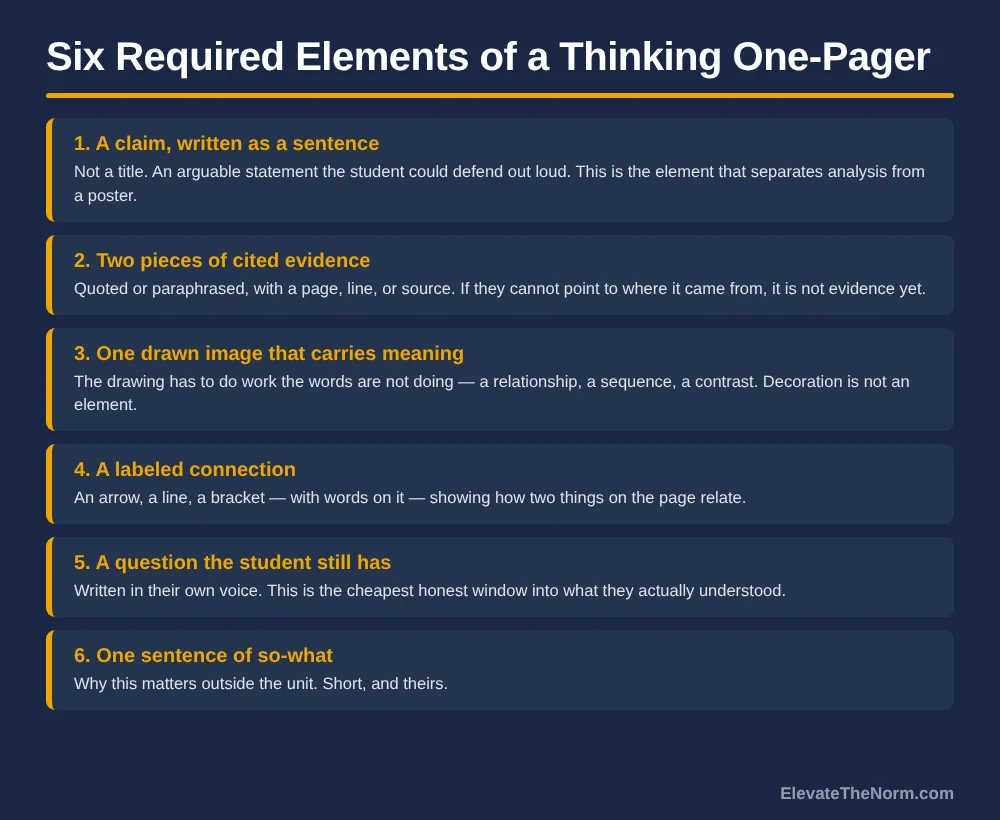
Six elements, each of which is a thinking move rather than a design choice. The test for any element you add: could a student satisfy it without understanding the material? If yes, cut it.
A claim, written as a sentence. Not a title, not a theme word. An arguable statement the student could defend out loud. This single requirement does more work than the other five combined, because it is the one that cannot be faked with a border.
Two pieces of cited evidence. Quoted or paraphrased, with a page number, a line, or a source. “Cited” is doing real work here — if a student cannot point to where it came from, it is not evidence yet.
One drawn image that carries meaning. The drawing has to do something the words are not doing: show a relationship, a sequence, a contrast, a scale. A decorative border is not an element. A badly drawn diagram that makes a comparison visible is.
A labelled connection. An arrow, a line or a bracket with words on it, showing how two things on the page relate. This is the cheapest way to force synthesis, and it is the element students most often skip.
A question the student still has. In their own voice. It is the most honest window you will get into what they actually understood, and it costs them thirty seconds. If you want a wider version of this, it is the same instinct behind asking a student to judge their own work before you do.
One sentence of so-what. Why this matters outside the unit. Short, and theirs. Most students will write something flat the first time. They get better at it the fourth time, which is an argument for assigning one-pagers more than once a year.
How Do You Grade a One-Pager Without Grading Art?
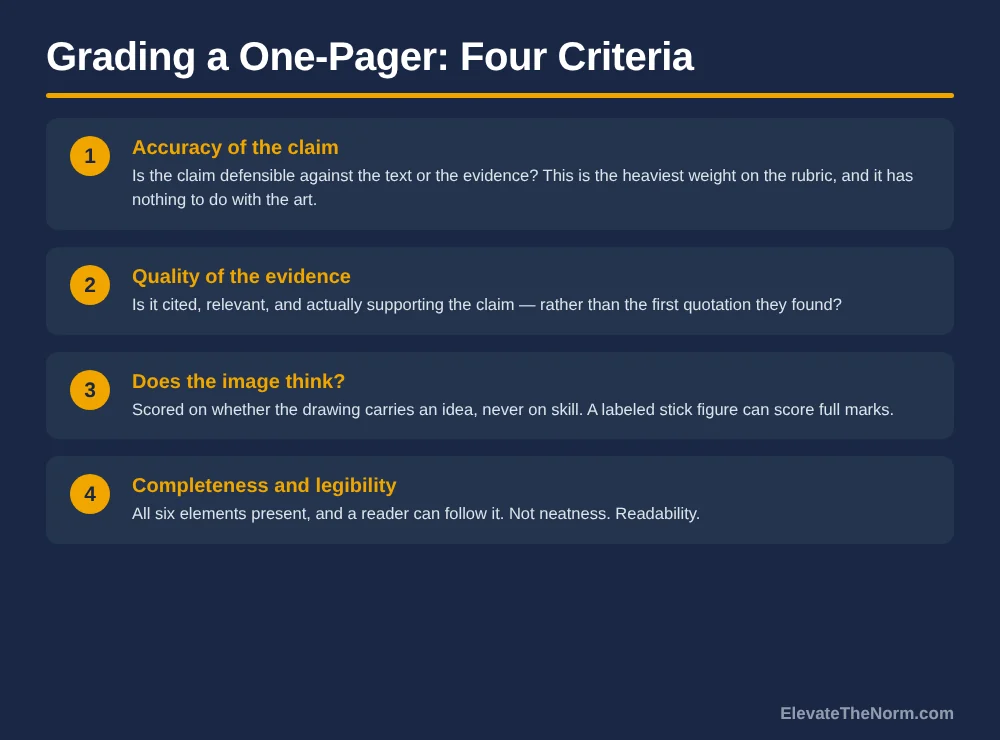
Put artistic skill nowhere on the rubric, and tell students that before they start. Four criteria will carry it.
Accuracy of the claim is the heaviest weight. Is it defensible against the text or the evidence? This has nothing to do with how the page looks. Quality of the evidence comes second: cited, relevant, and actually supporting the claim rather than being the first quotation the student found. Does the image think? — scored on whether the drawing carries an idea, never on execution. A labelled stick figure can score full marks and should. Completeness and legibility is the last and the smallest: all six elements present, and a reader can follow it. Legibility is not neatness. A page can be messy and perfectly readable.
Two things to resist. Do not add a “creativity” or “visual appeal” category — it is unscoreable, it rewards students who already had art supplies at home, and it is the single fastest way to turn this into an equity problem. And do not give points for colour. If you want the general version of this argument, the same reasoning applies to any rubric where presentation can hide thin understanding.
Three practical conditions follow from that. The assignment has to be completable with a pencil — if markers are required, you have built a supply test, so keep whatever you have in a tub on the counter and do the work in class rather than at home. Score the “question you still have” element present-or-absent, never on quality, or students will stop telling you the truth in the one place they were being honest. And tell families the rubric excludes artistic skill before the first grade goes in the book, because a parent looking at a drawing with a C on it will reasonably assume you graded the drawing.
Alternatives need to be available without a formal plan: typed and printed elements pasted down, cut images instead of drawn ones, or the whole thing explained to you verbally while you score the same four criteria. A student with a fine-motor difficulty, a visual impairment, or a hand in a cast should not have to disclose anything to get a different route.
On grading time — this is the objection every teacher with 150 students will have, and it is correct. Score in one pass, in bands rather than points, and write a comment only on the claim. If the claim is wrong, nothing downstream of it is worth your ink. Four criteria scored 1–4 with one sentence on the first of them runs about ninety seconds a page.
One more move that costs four minutes and is worth more than the rubric. Walk the room while they work and ask three or four students to defend the claim on their page out loud — not to justify the picture, just the sentence. I do a version of this constantly: circulating, pulling a student aside, and making them explain the decision they made rather than telling them whether it was right. You find the gap between a page that looks finished and a page that is understood in about twenty seconds, and you find it while there is still time to fix it. That is the same thing any good in-the-moment check is for.


What About the Student Who Says They Cannot Draw?
Give them a template and say the sentence out loud: nobody is being graded on drawing. Then mean it, because teenagers will test whether you meant it.
Betsy Potash, writing at Cult of Pedagogy, identifies the problem exactly: the one-pagers that circulate online are made by artistic students, and everybody else concludes the assignment is not for them. Her fix is a template — a page with designated spaces for each required element — which she describes as a creative constraint that paradoxically frees students up, because the paralysis is usually about placement rather than content. Students who want a blank page can flip the template over and use the back.
That is a practitioner’s recommendation rather than a research finding, and it should be read as one. But it points the same direction the research does: Fiorella and Mayer found that structure, partial illustrations and guidance about which elements to include increase the benefit of drawing rather than watering it down. The template is not a concession. It is the scaffold the evidence asks for.
Where One-Pagers Go Wrong
Four failure modes, and three of them are the teacher’s.
The first is the blank page with no requirements, which produces decoration from the artists and panic from everyone else. The second is grading the aesthetic, which teaches students that the assignment was about markers all along. The third is assigning it once, at the end of a unit, as a summative grade — the first one a student makes is always the worst one, and the research on summarizing says the skill takes weeks of instruction to develop. Run the first as practice. The fourth is the student version: filling every element with something technically present and entirely hollow. The claim sentence catches most of this, and the four-minute verbal check catches the rest.
How Do You Launch It the First Time?
Spend twenty minutes before anyone touches a page. This is the pretraining the drawing research keeps pointing at, and skipping it is why most first attempts disappoint.
Show two finished examples — one strong, one weak — and have the class score both against your four criteria before they know which is which. Make the weak one visually attractive and analytically thin, because that is the trap. Then model the hardest element: write a claim sentence in front of them, out loud, and revise it once. Then let them start, with the template on the desk and the requirements on the board.
If you want the pages to do a second job, hang them and run a structured walk around the room where students read each other’s claims and leave one question each. The reading is worth more than the display, and it makes the “question you still have” element feel like it has a purpose beyond the gradebook. Make the display opt-out without explanation — some students are genuinely uncomfortable having a drawing on the wall, and nothing about the learning requires it to be public.
Afterwards, do not just file them. Read the question column across the whole class in one sitting; it is the cheapest reteach list you will ever assemble, and it was generated by students who thought nobody was grading it.
What to Do Next
Take whatever you were going to assign as a written response this month and convert it — same content, six required elements, four grading criteria, a template on every desk, and twenty minutes of launch before the first page gets made. Run it as practice rather than as a test grade.
Then do it again inside the same semester. Almost everything useful about one-pagers shows up on the second and third attempt, once students have stopped worrying about the layout and started arguing on paper. If you need the in-between measurement, a two-minute check sorted by where it falls in a lesson will tell you more, sooner, than waiting for the pages to come in.
Frequently Asked Questions
What is a one pager assignment?
A single page on which a student represents their understanding of a text, topic or unit using both words and images, against a required set of elements. The strategy came out of AVID and is now used well beyond it, most commonly in English and social studies. The page is the constraint; the required elements are the actual assignment. It is not a poster — a poster communicates to an audience, while a one-pager is evidence of thinking submitted to a teacher, and the two want different rules.
Is there research showing one-pagers work?
Not on one-pagers as a named format. There is good evidence on the two things a one-pager makes students do. In Fiorella and Mayer’s review of generative learning strategies, drawing produced positive effects in 26 of 28 comparisons at a median effect size of d = 0.40, and summarizing in 26 of 30 at a median of d = 0.50, across elementary, high school and college students. Both come with the same condition: the effect improves when students are explicitly taught how, and the summarizing training studies gave middle schoolers roughly six hours of instruction over five weeks.
Should I say one-pagers are good for visual learners?
No. Pashler, McDaniel, Rohrer and Bjork examined the meshing hypothesis — that matching instruction to a preferred style improves learning — and found “virtually no evidence” for the interaction pattern it requires, concluding there is “no adequate evidence base” for using learning-styles assessments in general practice. Use the better justification instead: drawing and summarizing are generative activities with real support, so every student does both. That reasoning survives a conversation with an administrator, and it does not sort students into categories the evidence does not back.
How do I grade a one-pager fairly?
On four criteria, none of which is artistic skill: accuracy of the claim, quality of the cited evidence, whether the drawn image carries an idea rather than decorates, and completeness and legibility. Weight the claim heaviest. Do not add a creativity or visual-appeal category — it is unscoreable and it rewards students who own art supplies. Tell families the rubric excludes drawing before the first grade is entered, because a parent seeing a low mark on a page with a picture on it will assume you graded the picture.
What do I do about students who say they cannot draw?
Give them a template with a designated space for each element and say out loud that nobody is graded on drawing — then hold to it, because they will test whether you meant it. A labelled stick figure that makes a comparison visible should score full marks. Alternatives need to be available without a formal plan: typed elements pasted down, cut images rather than drawn ones, or explaining the page to you verbally while you score the same four criteria.
Does a template make the assignment too restrictive?
The evidence points the other way. Fiorella and Mayer found that structure, partial illustrations and guidance about which elements to include increase the benefit of drawing rather than diluting it, and the risk they name is extraneous cognitive load from the mechanics of drawing — which is exactly what a blank page creates. The template removes the paralysis about placement so the student can spend their attention on the content. Students who want the open page can use the back of it.
Should a one-pager be a test grade?
Not the first one. The first attempt is always the worst attempt, and the research on summarizing says the skill takes weeks of instruction to develop, so a summative grade on a first try is measuring unfamiliarity with the format. Run the first as practice, assign a second inside the same semester, and grade that one. Almost everything useful about one-pagers appears on the second and third attempt, once students have stopped worrying about layout and started arguing on paper.
Does handwriting the page help more than typing it?
There is no good evidence for that, and it is worth knowing because the claim gets repeated a lot. Urry and colleagues ran a direct replication of the well-known longhand-versus-laptop study with 142 undergraduates and found a negligible effect in the opposite direction on conceptual questions, and a mini meta-analysis across eight studies found no significant difference in quiz performance. Assign a one-pager because drawing and summarizing are generative, not because the student held a pen.
Sources
- Fiorella, Logan, and Richard E. Mayer. “Eight Ways to Promote Generative Learning.” Educational Psychology Review, vol. 27, 2015, pp. 1–47. Drawing: positive effects in 26 of 28 comparisons, median d = 0.40, across elementary, high school and college students; effect increases with explicit pretraining in how to draw, guidance on elements, partial illustrations or comparison with author-provided drawings, and the stated risk is extraneous cognitive load from the mechanics of drawing. Summarizing: 26 of 30 comparisons positive, median d = 0.50; middle-school training studies required roughly six hours of instruction over five weeks. https://doi.org/10.1007/s10648-015-9348-9
- Fernandes, Myra A., Jeffrey D. Wammes, and Melissa E. Meade. “The Surprisingly Powerful Influence of Drawing on Memory.” Current Directions in Psychological Science, vol. 27, no. 5, 2018, pp. 302–308. Reports a reliable recall advantage for drawn over written words, benefits arriving with as little as four seconds of drawing per item, and the authors’ statement that the benefit applies “regardless of one’s artistic talent.” Populations are younger adults, older adults and a group of 13 patients in long-term care — not secondary students, and the materials are word lists rather than academic content. Cited for mechanism, not for an effect size on classroom work. https://doi.org/10.1177/0963721418755385
- Pashler, Harold, Mark McDaniel, Doug Rohrer, and Robert Bjork. “Learning Styles: Concepts and Evidence.” Psychological Science in the Public Interest, vol. 9, no. 3, 2008, pp. 105–119. The authors found “virtually no evidence for the interaction pattern” required to validate learning-styles instruction and concluded “there is no adequate evidence base to justify incorporating learning-styles assessments into general educational practice.” https://doi.org/10.1111/j.1539-6053.2009.01038.x
- Urry, Heather L., et al. “Don’t Ditch the Laptop Just Yet: A Direct Replication of Mueller and Oppenheimer’s (2014) Study 1 Plus Mini Meta-Analyses Across Similar Studies.” Psychological Science, vol. 32, no. 10, 2021, pp. 1479–1492. Direct replication, N = 142 undergraduates. Conceptual-question performance showed a negligible effect in the opposite direction to the original (Hedges’s g = −0.13, 95% CI [−0.45, 0.20]), significantly different from the original result. A mini meta-analysis of eight studies found g = 0.04, 95% CI [−0.13, 0.20], not significant. The authors conclude results “do not support the idea that longhand note taking improves immediate learning via better encoding of information.” Cited as contrary evidence: do not justify handwritten work on the grounds that writing by hand beats typing. https://doi.org/10.1177/0956797620965541
- Potash, Betsy. “A Simple Trick for Success with One-Pagers.” Cult of Pedagogy, 26 May 2019 (updated 2026). Credits AVID with developing the strategy; describes the template as a creative constraint that helps non-artistic students start, and recommends simple rubric categories such as textual analysis, required elements and thoroughness. Cited as practitioner recommendation, not as research evidence. https://www.cultofpedagogy.com/one-pagers/