By Clay Shumate
Differentiated instruction strategies are the moves a teacher makes so that students who arrive at a lesson with different knowledge, skills and language can all reach the same standard. The standard does not move. The route to it does. Everything useful in differentiation lives in that one sentence, and most of what goes wrong is a violation of it.
The version sold in professional development usually looks like three lesson plans for one period. Nobody does that for five preps in February, and the people who tell you to do it are not currently teaching five preps in February.
Key Takeaways
- Change the route, not the destination. The learning target, the standard and the final criteria stay the same for everyone. If those move, you are running two courses in one room.
- The evidence is encouraging and genuinely thin. A systematic review of secondary differentiation found only 12 usable studies out of 1,029 screened, and its authors named “severe knowledge gaps” in the same abstract that reported a positive effect.
- Ability grouping is not differentiation. In primary education, homogeneous grouping showed a small negative effect on low-ability students and no effect on anyone else.
- Do not differentiate by learning style. There is no adequate evidence base for matching instruction to a preferred modality, and the studies designed properly to test it mostly contradict it.
- Five strategies carry most of the load: tiered questioning, scaffolds that come back, choice of product, grouping that actually changes, and pre-assessment that changes the plan. Four of the five are nearly free.
What Is Differentiated Instruction?
It is adjusting content, process, product or environment in response to what students actually need, while holding the learning goal constant. The adjustment has to be driven by evidence about this group of students, in this unit, right now — not by a label attached to a child in sixth grade.
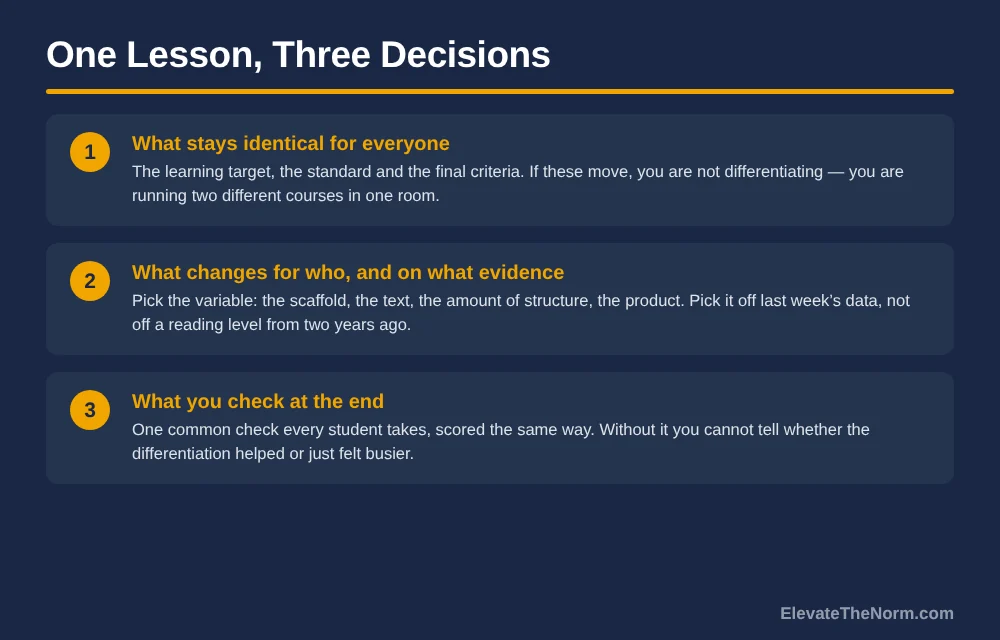
In practice, one lesson is three decisions.
One: what stays identical for everybody. The target, the standard, the criteria for good work. Nail these down first, because everything after is a variation on them.
Two: what changes, for whom, on what evidence. Pick one variable — the scaffold, the text, the amount of structure, the product. One. Then name why those students and not others, and point at the data that says so. If the only answer is “they’re my low group,” you have a track, not a differentiation plan.
Three: what you check at the end. One common check every student takes, scored the same way. Without it, you cannot distinguish a lesson that helped from a lesson that was busier.
Does Differentiated Instruction Actually Work?
Probably, somewhat, and we know less than the training implies. The best secondary-specific review found a positive average effect across a small number of mostly quasi-experimental studies, and said so alongside a warning about how thin the base is.
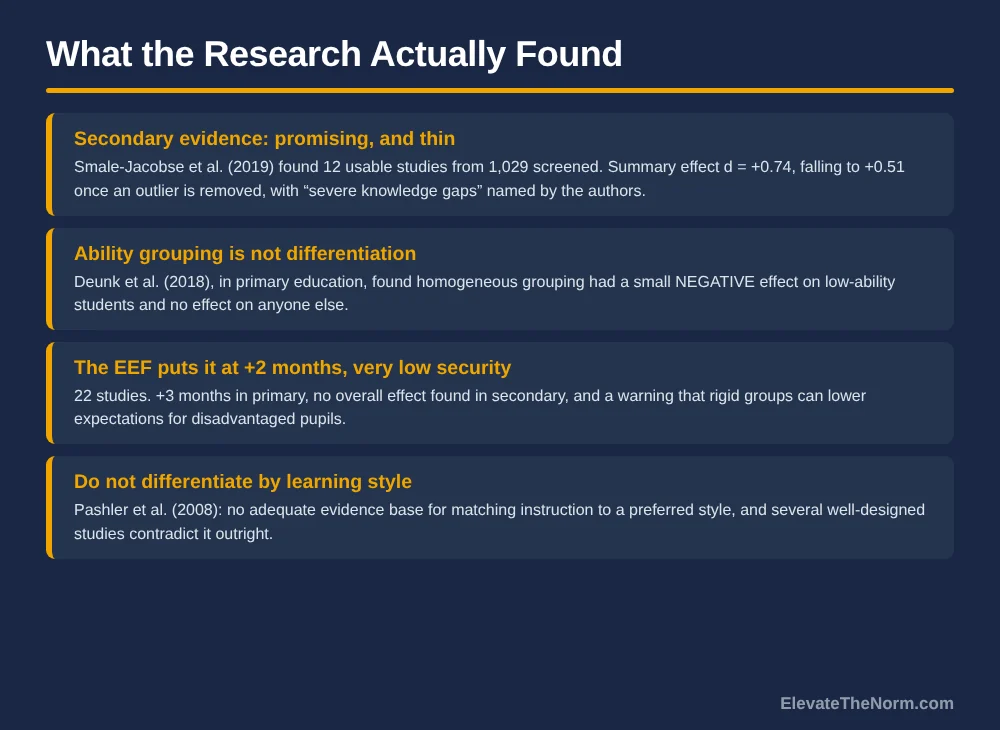
Smale-Jacobse, Meijer, Helms-Lorenz and Maulana screened 1,029 papers and ended up with 12 unique studies of differentiated instruction in secondary education, mostly in maths and science, with students roughly 11 to 17. The summary effect was d = +0.741. Remove one extreme outlier and it drops to d = +0.509. Heterogeneity was enormous (Q = 507.7), the larger studies produced the smaller effects, only two studies had at least 15 cases per condition at the randomization level, and many of the outcome tests were researcher-made. The authors’ own summary is that the findings “give some indication of the possible benefits” but “point out that there are still severe knowledge gaps.”
That is an honest finding and it is worth something. It is not a mandate.
The Education Endowment Foundation puts within-class attainment grouping at +2 months of additional progress, at very low cost, with the security of the evidence rated very low — 22 studies, few of them recent. Their breakdown matters more than the headline: about +3 months in primary, +4 in maths, no difference on average in literacy, and no overall impact found at secondary, where there are few studies to begin with.
And in primary education, Deunk, Jacobse, de Boer, Doolaard and Bosker reviewed 21 studies and 78 effect sizes. Computerized differentiation tools and differentiation embedded in a broader program produced small to moderate positive effects. Homogeneous ability grouping on its own produced a small negative effect on low-ability students and no effect on anyone else. Their conclusion is the one to carry into a department meeting: grouping by itself does not constitute differentiated instruction.
Worth saying plainly: Deunk and the EEF’s strongest results are primary findings. They do not transfer to a ninth-grade classroom automatically, and I am not going to pretend they do. What transfers is the warning.
What Differentiation Is Not
It is not teaching to learning styles
Pashler, McDaniel, Rohrer and Bjork tested what they called the meshing hypothesis — the idea that a “visual learner” learns more from visual material. Credible evidence would require grouping students by style, randomly assigning instruction methods, testing everyone the same way, and finding a crossover interaction. They found “virtually no evidence” of that pattern, and noted that several studies using an adequate method flatly contradict it. Their conclusion: there is no adequate evidence base for building learning-styles assessment into general educational practice.
If a differentiation plan starts with a learning-styles inventory, it is starting from a dead end. Vary the representation because the content calls for it — a map, a graph, a demonstration — not because a survey labelled a student kinesthetic in seventh grade.
It is not lowering the bar for some students
A shorter task with the same standard is differentiation. A simpler standard quietly substituted for one group is not, and it is the single most common failure mode. Students work out within a week whose work is being graded against what. Holding the same expectations for every student in the room is not in tension with support; support is how you make the expectation reachable.
It is not permanent groups with friendly names
The Eagles, the Falcons and the Hawks, unchanged since September, are a tracking system with a bird theme. The students know. Rigid grouping carries a documented equity risk — the EEF names lower teacher expectations for disadvantaged pupils and damage to low attainers’ belief that effort changes anything.
Differentiated Instruction Strategies, Ranked by What They Cost
Start with the ones that cost nothing. Most teachers who “cannot differentiate” have simply been handed the most expensive version first.
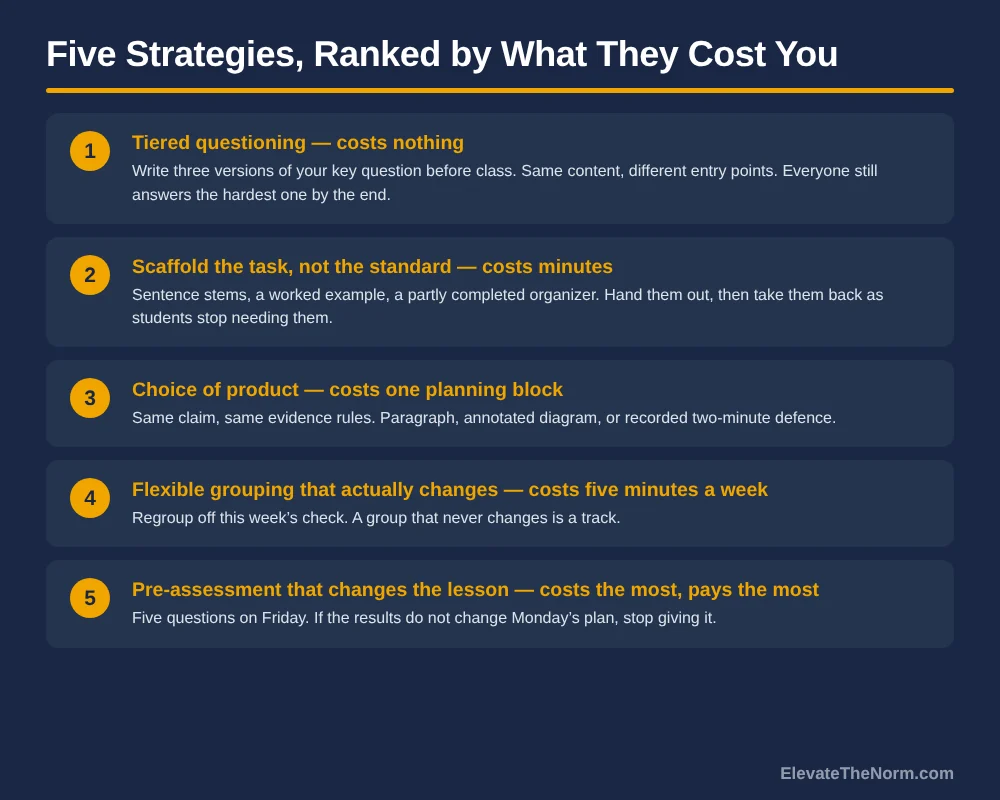
1. Tiered questioning — costs nothing
Before class, write your key question three ways: one that gets anyone in, one at grade level, one that pushes. Same content, different entry points. You are not assigning questions to students; you are making sure the discussion has a door at every height. Every student should still meet the hardest version before the period ends — that is the difference between tiering and sorting.
2. Scaffold the task, not the standard — costs minutes
Sentence stems, a worked example at the top of the page, a graphic organizer with two boxes already filled in, a word bank for the four terms that will otherwise stop a student cold. The rule that keeps this honest: scaffolds are temporary and you must plan their removal. If a student has had the same organizer since September, the organizer is now the skill.
3. Choice of product — costs one planning block
Same claim, same evidence rules, same criteria — written paragraph, annotated diagram, or a recorded two-minute defense. This is where a choice board earns its keep, as long as the options differ in form and not in difficulty. Three options is plenty. Nine is a craft fair.
4. Flexible grouping that actually changes — costs five minutes a week
Group off this week’s evidence, not last year’s. Sometimes by readiness, sometimes by interest, sometimes at random, often mixed on purpose. If your groups have not changed in a month, they are not flexible. Small-group instruction in a secondary classroom works best when the rest of the room has something genuinely worth doing, which is a planning problem before it is a grouping problem.
5. Pre-assessment that changes the lesson — costs the most, pays the most
Five questions on Friday about Monday’s content. Not graded. The point is to find out who already has it and what the two common misconceptions are. Here is the test of whether it was worth doing: if the results do not change Monday’s plan, stop giving it. A pre-assessment you collect and file is paperwork.
Any of the quick formative checks works for this. What matters is the twenty minutes afterward where you actually look.
Differentiated Instruction Examples for Grades 6–12
Each of these is one lesson, one variable changed, same standard for everybody.
- Grade 9 history, document analysis. Everyone analyzes the same three documents against the same criteria. Two students get a version with the archaic vocabulary glossed in the margin. One group that finished the skill last unit gets a fourth document that contradicts the other three.
- Grade 7 science, data claims. Same data set for the room. Some students get a claim-evidence-reasoning frame with the first sentence started; some get a blank page; the ones who have the structure cold get asked to write the strongest objection to their own claim.
- Grade 8 algebra, error analysis. Everyone finds the mistake in a solved equation. One table gets problems with the error in the first two lines; another gets it buried in line five; a third gets two errors, one of which is not actually an error.
- Grade 11 English, revision. Same paragraph, same revision criteria. Some students revise on paper with a checklist; some revise aloud to a partner first; some revise a second paragraph after the first one is done.
- Any subject, same day. The whole class gets the same exit check: one question, four minutes, scored the same way. That single common measure is what makes the rest of it defensible.
How Do You Differentiate When You Teach 150 Students?
You differentiate the lesson, not the student. Build one lesson with planned variation inside it, and let students move through the variation, rather than writing a plan per child.
Three things make this survivable.
Sample instead of reading everything. You do not need to read 150 exit tickets. Read fifteen — five you expect to be strong, five middling, five you are worried about — and sort the rest into three piles by a single criterion. That takes ten minutes and tells you nearly as much as an hour would.
Reuse the structures. The same tiered-question frame and the same CER scaffold work across a whole unit. You build them once, in August or over a weekend, and spend the rest of the semester choosing which to deploy. The planning cost is front-loaded, which is the only way it ever gets paid.
Pick one class to start. Not all five. One section, one unit, one variable. If it works there, it transfers; if it does not, you have lost a week instead of a semester.


What About the Students Who Already Got It?
They are the group most often skipped, and the evidence says so directly.
Ziernwald, Hillmayr and Holzberger reviewed 49 studies published 2000–2019 on differentiated instruction for high-achieving students in mixed-ability classrooms, spanning primary and secondary. Effects on achievement and on motivational outcomes were mostly positive but varied a great deal. The finding that should sting: teachers typically did not use differentiation for high achievers proactively or regularly, and both students and school staff reported it was rarely used. The barriers were time, resources, training, misconceptions about high-achieving students, and a focus on struggling students.
Their caution is important too. Only six studies had a pretest-posttest control group design, so they did not run a meta-analysis at all. No study met every quality criterion. Treat this as a well-documented description of practice, not a proven intervention effect.
The practical move is cheap: for the students who already have it, extend sideways rather than forward. One more document, a counter-argument, a constraint added to the problem, a request to teach the step to someone else. Sideways keeps them in the same conversation. Forward just sends them into next week alone.
Why Does Differentiation Fail in Real Schools?
Mostly for reasons that are not about teacher willingness.
Gibbs interviewed seven teachers and two school leaders at an Australian secondary school of roughly 1,250 students. Every one of the seven teachers named limited resources as a barrier. Three named student behaviour, and three named limited planning and instruction time. Leaders named their own time and administrative load, including inconsistent records arriving from feeder primary schools. Four of the seven reported no pre-service training in differentiation at all, and the training the other three described focused on inclusion and disability — which suggests differentiation is widely confused with special education provision.
It is a small, single-site qualitative study and the author says so. But the pattern is recognizable in any building.
Two of those barriers are leadership decisions rather than teacher decisions. Planning time and class size are set in a master schedule. A district that mandates differentiation without changing either has bought a slogan. If you lead a building and want to know whether this is happening, do not add a differentiation box to a walkthrough form — that produces visible differentiation and nothing else. Look at whether groups changed between September and November, and whether anyone can show you a pre-assessment that altered a plan.
It is also worth being honest that behaviour showed up in that list. Differentiation assumes a room where several things can happen at once, and that is downstream of the management work that makes multiple simultaneous activities possible. Trying to run four stations in a room that cannot hold one task is not a differentiation problem.
A Planning Checklist
- Can every student in the room name the same learning goal for today?
- Did I change exactly one variable, and can I say what evidence picked it?
- Is the final criterion identical for everyone?
- Is there one common check at the end, scored the same way?
- Do the scaffolds I handed out have a removal date?
- Have the groups changed in the last three weeks?
- If a student asked “why do I have this version?” could I answer honestly in one sentence?
That last question is the one that keeps this ethical. If the honest answer is one you would not say out loud to the student, the plan needs changing, not the phrasing.
What to Say to Students and Parents
Students know when the work is different. Pretending otherwise costs you more credibility than telling the truth does: “Everyone is being graded against the same four criteria. You’ve got the version with the vocabulary glossed because that was slowing you down last week, not because I expect less from you. It comes off the next one.” That is a sentence a fifteen-year-old can respect, and it has the advantage of being true. Giving students some say in which version they take — real student voice and choice — removes most of the sting on its own.
Parents ask a sharper version: is my kid getting the easy work? Answer it directly. Name the standard, show the common criteria, show the common end-of-unit check, and explain which support is in place and when it comes off. A parent who hears “same standard, different scaffolding, here is the removal plan” is usually satisfied. A parent who hears “we differentiate” is not, and should not be.
Differentiated Instruction Strategies: What to Do Next Week
Pick one section and one unit. Write your key question three ways. Build one scaffold and decide now which lesson it comes off at. Give one five-question pre-assessment and change something in the plan because of it. Give the same exit check to everybody and score it the same way.
That is five moves, four of them nearly free, and it is more differentiation than most buildings are actually running. If it works, add the sixth thing in November. If it does not, you will know exactly which move failed, because you only changed one.
And whatever else you cut, keep the common check at the end. Without it you are differentiating on faith, and the research base is nowhere near strong enough to carry that.
Frequently Asked Questions
What are differentiated instruction strategies?
They are the adjustments a teacher makes to content, process, product or learning environment so that students with different prior knowledge, skills and language can all reach the same standard. The standard and the criteria for good work stay constant; the route changes. The five that carry most of the load in a secondary classroom are tiered questioning, temporary scaffolds, choice of product, flexible grouping that actually changes, and pre-assessment that alters the plan.
Does differentiated instruction improve achievement?
The secondary-specific evidence is positive but thin. Smale-Jacobse, Meijer, Helms-Lorenz and Maulana (2019) screened 1,029 papers and found 12 usable studies, reporting a summary effect of d = +0.741 that falls to +0.509 once an outlier is removed. Heterogeneity was very large, most designs were quasi-experimental, and the authors named “severe knowledge gaps.” The Education Endowment Foundation rates within-class attainment grouping at +2 months with very low evidence security and found no overall impact at secondary level.
Is ability grouping the same as differentiated instruction?
No, and treating it that way can do harm. Deunk and colleagues (2018), reviewing 21 studies in primary education, found homogeneous ability grouping produced a small negative effect on low-ability students and no effect on other students. Their conclusion is that grouping by itself does not constitute differentiation and must be embedded in a broader instructional approach. Permanent groups that never change are a tracking system, whatever they are called.
Should I differentiate by learning style?
No. Pashler, McDaniel, Rohrer and Bjork (2008) concluded there is no adequate evidence base for incorporating learning-styles assessment into general educational practice. They found virtually no evidence for the crossover interaction the theory predicts, and noted that several studies using an adequate experimental method flatly contradict it. Vary how content is represented because the content calls for it, not because a survey labelled a student visual or kinesthetic.
How do you differentiate with 150 students and five preps?
Differentiate the lesson rather than the student. Build one lesson with planned variation inside it; sample student work instead of reading all of it, by marking fifteen carefully and sorting the rest into three piles on one criterion; build reusable structures like a tiered-question frame or a CER scaffold once and deploy them across the unit; and start with one section and one unit rather than all five preps at once.
What about students who already understand the material?
They are the group most often skipped. Ziernwald, Hillmayr and Holzberger (2022) reviewed 49 studies and found that teachers typically did not use differentiation for high-achieving students proactively or regularly, with students and staff both reporting it was rare. Their evidence base was weak enough that no meta-analysis was possible, so read it as a description of practice. Practically, extend sideways rather than forward: an extra contradictory source, an added constraint, the strongest objection to their own answer.
How do I explain differentiated work to a student without embarrassing them?
Say it plainly and tie it to the standard. Something like: everyone is graded against the same four criteria, you have the version with the vocabulary glossed because that slowed you down last week, and it comes off the next assignment. Students work out within a week whose work is being graded against what, so concealment costs more credibility than honesty does. Letting students choose which version to take removes most of the sting on its own.
Why does differentiated instruction fail in practice?
Usually for reasons outside a teacher’s control. In Gibbs’s (2023) interview study at an Australian secondary school, all seven teachers named limited resources as a barrier, and three each named student behaviour and limited planning time. Four reported no pre-service training in differentiation at all, and the training the others described focused on inclusion and disability. Planning time and class size are set in the master schedule, so a mandate that changes neither is a slogan.
Sources
- Smale-Jacobse, A. E., Meijer, A., Helms-Lorenz, M., & Maulana, R. (2019). Differentiated Instruction in Secondary Education: A Systematic Review of Research Evidence. Frontiers in Psychology, 10, Article 2366. 1,029 papers screened; 14 papers reporting 12 unique studies and 15 effect sizes; summary effect d = +0.741 (95% CI 0.397–1.085), falling to d = +0.509 (95% CI 0.215–0.803) with one outlier removed; Q = 507.701. Mostly quasi-experimental, only two studies with 15+ cases per condition at randomization level, many researcher-made tests; the authors name “severe knowledge gaps.” https://doi.org/10.3389/fpsyg.2019.02366
- Deunk, M. I., Smale-Jacobse, A. E., de Boer, H., Doolaard, S., & Bosker, R. J. (2018). Effective Differentiation Practices: A Systematic Review and Meta-Analysis of Studies on the Cognitive Effects of Differentiation Practices in Primary Education. Educational Research Review, 24, 31–54. 21 studies, 78 effect sizes; computerized differentiation and differentiation embedded in broader programs showed small to moderate positive effects; homogeneous ability grouping showed a small negative effect on low-ability students and no effect on others. Primary education only — these findings do not transfer automatically to grades 6–12. https://doi.org/10.1016/j.edurev.2018.02.002
- Education Endowment Foundation. Within-Class Attainment Grouping. Teaching and Learning Toolkit, last updated August 2021. Impact +2 months; cost very low; security of the evidence rated very low; 22 studies; +3 months in primary and +4 in mathematics, no average difference in literacy, and no overall impact found at secondary level, where studies are few; warns that rigid grouping may lower teacher expectations for disadvantaged pupils. https://educationendowmentfoundation.org.uk/education-evidence/teaching-learning-toolkit/within-class-attainment-grouping
- Ziernwald, L., Hillmayr, D., & Holzberger, D. (2022). Promoting High-Achieving Students Through Differentiated Instruction in Mixed-Ability Classrooms: A Systematic Review. Journal of Advanced Academics, 33(4), 540–573. 49 studies published 2000–2019, primary and secondary, mostly US and Canada; effects mostly positive but highly variable; teachers rarely used differentiation for high achievers proactively. Only six pretest-posttest control-group studies were analyzable, so no meta-analysis was conducted and no study met all quality criteria. https://doi.org/10.1177/1932202X221112931
- Pashler, H., McDaniel, M., Rohrer, D., & Bjork, R. (2008). Learning Styles: Concepts and Evidence. Psychological Science in the Public Interest, 9(3), 105–119. Found “virtually no evidence” for the crossover interaction the meshing hypothesis requires, noted that several adequately designed studies contradict it, and concluded there is no adequate evidence base for incorporating learning-styles assessment into general educational practice. https://digitalcommons.usf.edu/psy_facpub/1765/
- Gibbs, K. (2023). Voices in Practice: Challenges to Implementing Differentiated Instruction by Teachers and School Leaders in an Australian Mainstream Secondary School. The Australian Educational Researcher, 50(4), 1217–1232. Semi-structured interviews with seven teachers and two leaders at one Queensland secondary school of about 1,250 students; limited resources named by all seven teachers, behaviour and planning time by three each; four teachers reported no pre-service differentiation training. Small, single-site, convenience sample; the author notes limited generalisability. https://doi.org/10.1007/s13384-022-00551-2