By Clay Shumate
A standards based report card reports a separate mark for each learning standard in a course instead of one averaged grade for the whole class, and it reports work habits like effort and homework completion on their own scale. The point is to show what a student can actually do, and to stop behavior from hiding inside an academic grade.
That is the whole idea in two sentences. Everything else — the four-point scale, the proficiency labels, the column of standards running down the page — is machinery built to deliver it. This page covers what the marks mean, what the research supports and what it does not, what colleges do with one, and how to read a card in about five minutes without a meeting.
Key Takeaways
- A standards based report card separates two things a traditional grade blends together. Academic achievement goes in one place, work habits and behavior go in another, and neither one is allowed to quietly move the other.
- Parents who have actually received one tend to prefer it. Swan, Guskey and Jung surveyed 115 parents in a district that sent home both forms for two marking periods, and reported that parents overwhelmingly preferred the standards based form. The 383 teachers they surveyed were positive but significantly less so.
- 🔴 Traditional grades really are carrying things that are not learning. In one high school math study of 795 students, 43.2 percent of semester grades moved by 5 percent or more once homework and employability points were included, and 12.6 percent moved by a full letter grade.
- Most middle and high schools have not switched. Plenty of districts run a standards based report card in elementary school and go straight back to letter grades in grades 6 through 12.
- 🔴 The format does not fix itself. Guskey has reported that many parents simply read standards based labels as letter grades — a 4 becomes an A, a 2 becomes a D — which puts the card right back where it started.
Free Download · PDF
Standards Based Report Card Reading Sheet
A two-page printable: a worksheet for your district’s scale key, the five-minute read, a tracker for the two lowest standards, and an eight-item teacher checklist for the first card.
Free. No email address required. Designed for grades 6–12. Browse every printable in Your Free Library.
What is a standards based report card?
A standards based report card is a report card that lists the individual learning standards in a course and gives each one its own mark, rather than averaging everything into a single grade per subject. Work habits — effort, participation, homework completion, meeting deadlines — are reported on a separate scale so they never move the academic mark.
One practical limit comes with it: a course can have forty standards, and a report card that lists forty marks is unreadable. A workable card reports a short list of priority standards — the ones the course is actually built on — and leaves the rest to the gradebook. If a card is unreadable, it has failed at the one job it has.
A traditional card tells you a student earned an 84 in science. A standards based card tells you the student is proficient at analyzing data, proficient at designing an investigation, and not yet proficient at explaining a model in writing. Those are three different problems, and the 84 hides all three of them. If you want the longer version of the grading philosophy underneath this, that is covered in the guide to standards based grading.
How is a standards based report card different from a traditional one?
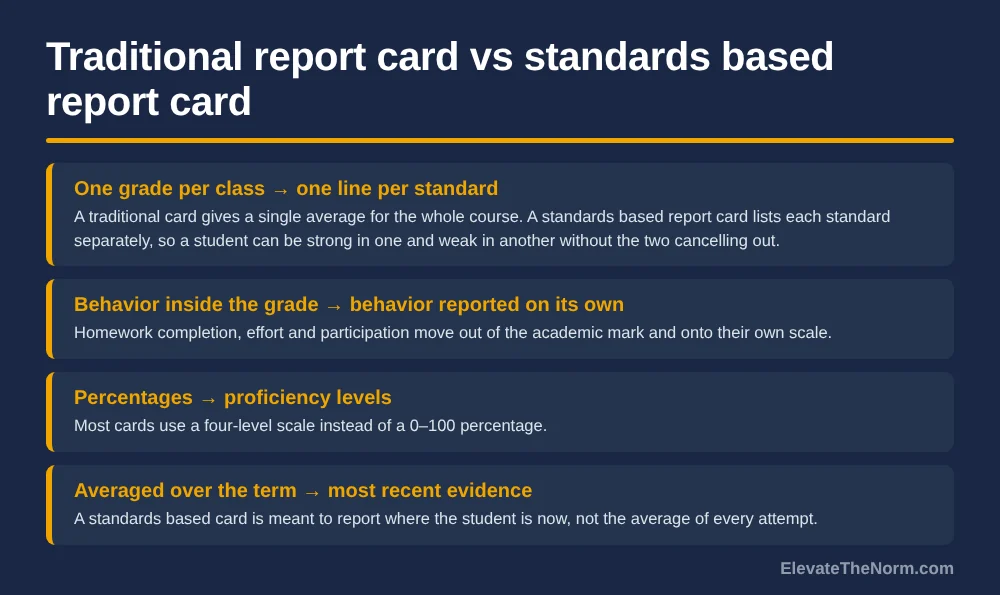
Four things change: one grade per class becomes one mark per standard, behavior moves out of the academic grade and onto its own line, percentages become proficiency levels, and the mark is meant to describe where the student is now rather than the average of every attempt across the term.
That last one is the quiet change, and it is the one that causes the most arguments. On a traditional card, a bad September follows a student through December because it sits in the average. On a standards based card it is not supposed to, because the question is whether the student can do the thing now. Whether a given district actually implements it that way is a different matter, and worth asking about directly.
| What you are looking at | Traditional report card | Standards based report card |
|---|---|---|
| Unit of reporting | One grade per course | One mark per standard within the course |
| Scale | A–F, usually from a 0–100 percentage | Usually four levels, described in words |
| Homework and effort | Folded into the academic grade as points | Reported separately, on their own scale |
| How evidence is combined | Averaged across the term | Weighted toward the most recent evidence |
| What a parent can act on | “Bring the 74 up” | “Two standards are at a 2 — here they are” |
| What it costs the teacher | Less time, less information | More time entering and defending marks |
What do the marks on a standards based report card mean?
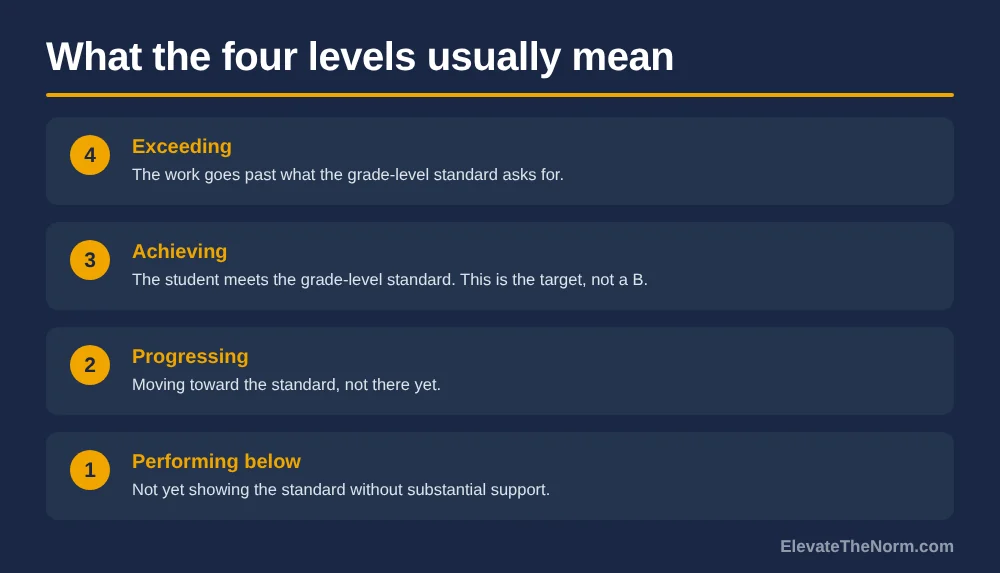
Most standards based report cards use a four-level scale where the top level means the work goes beyond the grade-level standard, the second level means the student meets it, and the bottom two mean the student is approaching it or not yet showing it. The second level is the target. It is not a B.
The exact words change from district to district, which is why the scale key is the first thing to read. One Massachusetts district’s parent guide for its sixth-grade card uses “Exceeding,” “Achieving,” “Progressing” and “Performing Below” for academics, and a separate frequency scale — “Consistently,” “Often,” “Sometimes,” “Infrequently” — for a section called Growth as a Learner (Lincoln Public Schools). Another district five miles away will use four different words for the same four ideas.
Here is the part worth saying plainly to a student: a 3 is not a consolation prize. The standard is the thing the course exists to teach, and meeting it is the job. A 4 usually requires work that goes past what the standard asks, and on a well-built card there is not a 4 available on every single line. If your district converts those levels back to percentages for a transcript, the mechanics of that are covered in the guide to the 1–4 grading scale.
Why do most middle and high schools still use letter grades?
Because the transcript, the GPA, class rank, athletic eligibility, scholarship formulas and the course catalog are all built on letter grades, and a single school changing its report card does not change any of those. The further a student gets from kindergarten, the more systems a new reporting format has to survive contact with.
You can see the split inside individual districts. Park Hill School District in Missouri, for example, states plainly that all of its elementary schools use a standards based report card on a four-point scale, while its middle and high schools use traditional letter grades. The Massachusetts guide above does something similar: a four-level academic scale in sixth grade, then letter grades in seventh and eighth with effort and participation scored separately.
There is a cost side to it too. Changing a report card is not a form change — it is a student information system reconfiguration, a training cycle for every teacher in the building, a rewrite of the family-facing key, and a new school profile for colleges. Districts that have done it describe it as multi-year work, and the teachers surveyed below said it took more of their time once it landed.
That pattern is not hypocrisy. It is a reasonable response to the fact that a sixth-grade report card has to satisfy one audience and an eleventh-grade transcript has to satisfy a dozen. It does mean that if you teach grades 6 through 12 and your school is talking about this, the conversation you are actually having is about the transcript, not the report card.
Does a standards based report card actually tell you more?
On the evidence available, yes about communication and separation of behavior from achievement, and much less clearly about achievement itself. The strongest claim the research will support is that a traditional grade is a mixture of several things, and that a standards based card at least shows you the pieces.
The mixture is well documented. The review “A Century of Grading Research” in the Review of Educational Research reports that grades correlate with standardized achievement tests at about .5 — meaning roughly a quarter of the variation in grades is shared with the tested skill and about three quarters comes from somewhere else. The review calls what teachers actually do “hodgepodge” grading: achievement mixed with effort, improvement, behavior and attitude, weighted differently by every teacher in the building.
The sharpest single number comes from a high school study. Griffin and Townsley analyzed semester math grades for 795 students at one urban high school and compared each final grade against the student’s summative assessment score. Including homework and employability points moved 43.2 percent of grades by 5 percent or more, and 12.6 percent by 10 percent or more — a full letter grade. That is one school and one subject, so do not treat it as a national rate. It is still a hard number on a claim that usually gets argued with anecdotes.
On preference, Swan, Guskey and Jung ran the cleanest test available: a district sent parents both a traditional and a standards based report card for two marking periods, then asked which they preferred. Parents overwhelmingly chose the standards based form. The 383 teachers surveyed in two neighboring districts were positive but significantly less enthusiastic, and said it took more time. Worth noting honestly: the published abstract and the ERIC record do not specify the grade levels of those students, so I would not claim this as a secondary-school result.
What does a standards based report card get wrong?
Three things, consistently: parents translate the levels back into letter grades anyway, teachers keep slipping effort into the academic mark, and the marks themselves only line up moderately with independent measures of the same learning.
The translation problem is the one nobody plans for. The same century-of-grading review notes Guskey’s finding that many parents interpreted standards based labels as letter grades — a 4 read as an A, a 2 read as a D. If that happens, the card has added a decoding step and changed nothing. The fix is not a better scale. It is the key, the first conference, and saying the words “a 3 means your kid met the standard” out loud more times than feels necessary.
The implementation problem is worse. The same review reports that teachers using standards based systems often continue mixing effort and improvement into achievement marks, and that implementation varies widely from classroom to classroom. And on alignment, eight studies comparing standards based grades with standards-based test scores found only moderate relationships, stronger in writing and math than in reading. A separate mark per standard is not automatically a more accurate mark per standard. The honest critiques of the whole model are worth reading before you argue for it; there is a full page on why standards based grading does not work for people who want the other side.
My read, as a grades 6–12 teacher: the reporting format is not the reform. Separating behavior from achievement is the reform, and you can do most of it on a traditional report card by refusing to put homework completion points inside the academic grade. The card is a way to make that honest. It is not a substitute for making it honest.


Will a standards based report card hurt a student’s college chances?
There is no evidence that it does, as long as the school sends a clear profile explaining its scale. The Great Schools Partnership collected statements from 85 public and private colleges and universities across New England saying that students with proficiency-based grades and transcripts will not be disadvantaged in any way in admissions.
Two caveats belong with that number. Those statements come from one region, gathered during a period when several New England states were moving to proficiency-based graduation, so they are not a national guarantee. And every one of them is conditional on the school explaining itself — the statements assume the program and policies are accurately presented and clearly described, which in practice means a school profile document that an admissions reader can interpret in under a minute. The exemplar transcript the same organization publishes still carries a cumulative GPA alongside the proficiency information, which tells you what the market actually required.
If you are a parent, the question to ask the counselor is not “will this hurt him.” It is “what does our school profile say, and can I see it.”
How do you read a standards based report card in five minutes?
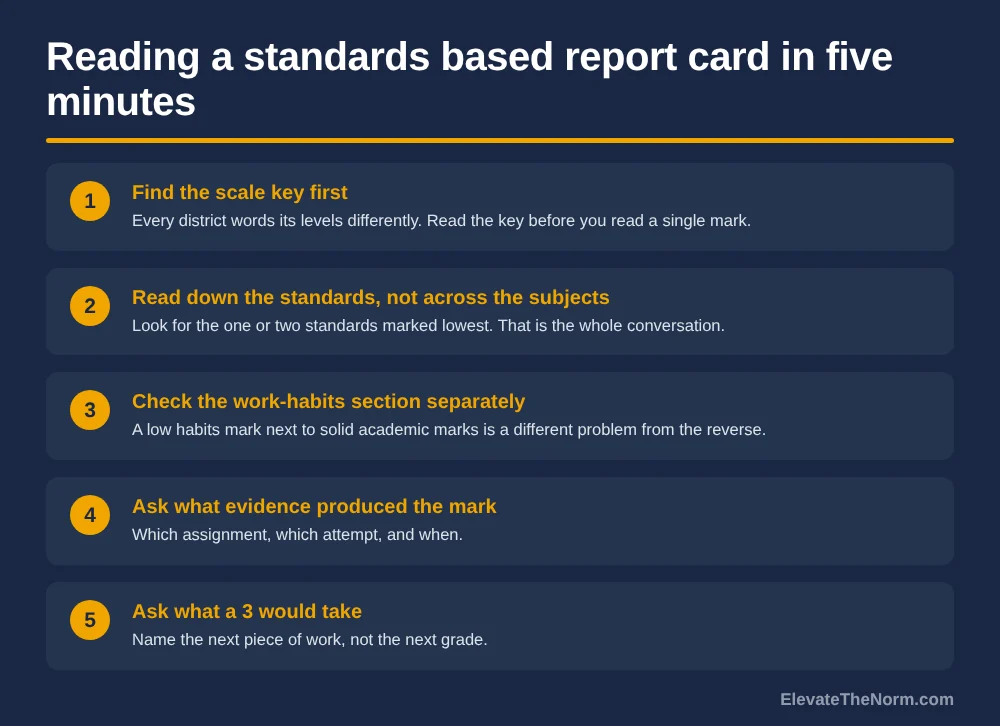
Find the scale key, read down the list of standards instead of across the subjects, check the work-habits section on its own, then ask the teacher two questions: what evidence produced the lowest mark, and what it would take to move it. That is the entire process.
- Find the scale key first. It is usually on the back or the bottom. Every district words its levels differently and the words matter more than the numbers. Do not read a single mark until you have read the key.
- Read down the standards, not across the subjects. You are not looking for an overall impression. You are looking for the one or two lines marked lowest. Those are the conversation.
- Read the work-habits section separately, and treat it as separate. Strong academic marks beside weak habits marks is a student who knows the content and is not turning things in — a completely different problem from the reverse, and it needs a completely different response. A habits mark is still a written judgment about a teenager, so it should rest on something countable like work submitted on time, not on whether the student seemed engaged.
- Ask what evidence produced the mark. Which assignment, which attempt, how recent. A mark based on one quiz in September is not the same claim as a mark based on three pieces of work in November.
- Ask what a 3 would take. Make the teacher name a specific next piece of work rather than a target number. If the answer is “study more,” the mark is not yet attached to anything the student can act on.
Teachers: those same five questions are the ones you should be able to answer before the card goes out. If you cannot say which evidence produced a mark, the mark is not defensible, and the first parent who asks will find that out.
What should a teacher do before the first standards based report card goes home?
Six things, and none of them are about software. The card fails on communication far more often than it fails on mechanics.
- Read your district’s grading policy before you change anything. Some of what follows is a local policy decision, not a classroom one, and finding that out after the card goes home is the hard way.
- Write the scale key in your own words and send it before the card, not with it. A key that arrives attached to a grade gets read as an excuse, and it should go out in the languages your families actually read.
- Say the sentence “a 3 means your student met the standard” in writing, early, and more than once. This is the Guskey translation problem and it is predictable, so pre-empt it.
- Check that nothing in your academic marks is behavior. Late penalties, participation, completion points. If they are in there, pull them out and put them in the habits section where parents can see them honestly.
- Be able to name the evidence behind every mark. Two or three pieces per standard, recent, and recorded somewhere you can find in ten seconds. The standards based gradebook guide covers how to set that up without doubling your workload.
- Decide in advance what a reassessment costs and say it out loud. “You can show me again” is only credible if the conditions are fixed before anyone needs them.
- Tell families how to reach you and what you will answer. A new report card generates questions, and a predictable reply beats a fast one. There is a full guide to parent communication if you want a system rather than an inbox.
What to do next
If you are a parent holding one of these for the first time: find the key, find the lowest two standards, and email the teacher one question — what evidence produced that mark and what would move it. That email is worth more than a conference you schedule three weeks from now.
If you are a teacher: before you argue for a new report card, look at how much of your academic grade is behavior. Check your district’s grading policy first — in some places the weighting is yours and in some places it is not — and then pull out what you are allowed to pull out. That is the part that actually changes what a grade means, and if you are not willing to do it on your current card you will not do it on a new one either. The 795-student study above is what the alternative looks like in numbers.
If you are the student holding the card: read it yourself before anyone reads it to you. This is the one format that tells you something you can actually use — not a number to feel bad about, but a short list of things you cannot do yet, with your name on it. Pick the lowest line, go ask the teacher what evidence put it there and what would move it, and ask it in person. You will get a better answer than your parents will get by email, and it is your transcript.
And if your school is in the middle of the switch, ask to see the school profile that will go to colleges. If nobody has written it yet, that is the job that is actually late.
Want this as a printable? The scale-key worksheet, the five-minute read, the two-standards tracker and the teacher checklist, on two printable pages. Download the free PDF — no email address required.
Frequently Asked Questions
What is a standards based report card?
It is a report card that gives a separate mark for each learning standard in a course instead of one averaged grade per subject, and reports work habits such as effort, participation and homework completion on their own scale. Instead of an 84 in science, a family sees which specific skills the student has met and which ones are not there yet.
What do the numbers 1, 2, 3 and 4 mean on a standards based report card?
Most four-level scales run from not yet showing the standard up to exceeding it, with the third level meaning the student meets the grade-level standard. The exact wording changes by district — one Massachusetts guide uses Exceeding, Achieving, Progressing and Performing Below. Read your district’s scale key before reading a single mark, because the words carry the meaning, not the numbers.
Is a 3 on a standards based report card the same as a B?
No, and treating it as one is the most common misread there is. On most cards the third level means the student met the grade-level standard, which is the target the course was built around. The top level usually requires work that goes beyond what the standard asks, and on a well-built card it is not available on every line.
Do standards based report cards hurt college admissions?
There is no evidence that they do when the school explains its scale. The Great Schools Partnership collected statements from 85 New England colleges and universities saying proficiency-based transcripts will not disadvantage applicants, conditional on the school presenting its program clearly. Those statements come from one region, so the practical step is to ask your counselor to show you the school profile that goes to colleges.
Why do middle and high schools still use letter grades if standards based report cards are better?
Because the transcript, GPA, class rank, athletic eligibility and scholarship formulas are all built on letter grades, and one school changing its report card does not change any of those. Many districts run standards based cards in elementary school and switch back to letter grades in grades 6 through 12 for exactly that reason. The real conversation in secondary school is about the transcript.
How do I tell how my child compares to the rest of the class?
You usually cannot, and that is deliberate. A standards based report card measures a student against the grade-level standard rather than against classmates, so there is no curve and no rank built into it. If you want a comparison, ask the teacher how many students are at each level on the standard you are worried about rather than asking where your child sits.
Do parents actually prefer standards based report cards?
The parents who have received one generally do. Swan, Guskey and Jung surveyed 115 parents in a district that sent home both a traditional and a standards based card for two marking periods and reported that parents overwhelmingly preferred the standards based form. The 383 teachers they surveyed were positive but significantly less so, and said it took more time.
Sources
- Swan, G. M., Guskey, T. R., & Jung, L. A. (2014). “Parents’ and teachers’ perceptions of standards-based and traditional report cards.” Educational Assessment, Evaluation and Accountability, 26(3), 289–299. 115 parents, 383 teachers; grade levels not specified in the published abstract or ERIC record. link.springer.com
- Brookhart, S. M., Guskey, T. R., Bowers, A. J., McMillan, J. H., Smith, J. K., Smith, L. F., Stevens, M. T., & Welsh, M. E. (2016). “A Century of Grading Research: Meaning and Value in the Most Common Educational Measure.” Review of Educational Research, 86(4). Source for the .5 correlation with achievement tests, “hodgepodge” grading, the moderate standards-based grade to test relationship, and Guskey’s finding that parents read standards-based labels as letter grades. tguskey.com
- Griffin, R., & Townsley, M. (2021). “Points, points, and more points: High school grade inflation and deflation when homework and employability scores are incorporated.” Journal of School Administration Research and Development, 6(1), 1–11. 795 students, semester math grades, one urban high school. ojed.org
- Great Schools Partnership. “College Admissions” and the collegiate statements page. Source for the 85 New England institutions and the “will not be disadvantaged in any way” language, and for the exemplar proficiency-based high school transcript carrying a cumulative GPA. greatschoolspartnership.org
- Lincoln Public Schools (MA). Middle school standards-based report card parent overview. Source for the “Exceeding / Achieving / Progressing / Performing Below” scale, the separate “Growth as a Learner” frequency scale, and the grade 7–8 return to letter grades. lincnet.org
- Park Hill School District (MO). “Standards-Based Report Cards.” Source for elementary-only use of the four-point standards-based card with traditional letter grades in middle and high school. parkhill.k12.mo.us