By Clay Shumate
A classroom rewards system for grades 6–12 works best in layers: quick, specific recognition in the moment, a weekly and monthly award for consistency and self-improvement, and one simple class-level competition for shared routines. Keep the criteria visible, the prizes small, and the rules identical in every period, and the whole thing can run on less than a hundred dollars a year.
Most reward systems fail for boring reasons. The teacher can’t keep up with the tracking, the same five kids win every time, or the prizes get expensive and quietly disappear by October. A system you design on purpose avoids all three.
This guide walks through the pieces in order: what to reward, how the individual and class layers fit together, how to set a budget, and how to fade the extras once routines stick. Fading is the step most systems skip, and it has a page of its own: when a reward helps and how to phase it out. The worked example is the Elevate setup I run with roughly 150 students across five or six World History classes.
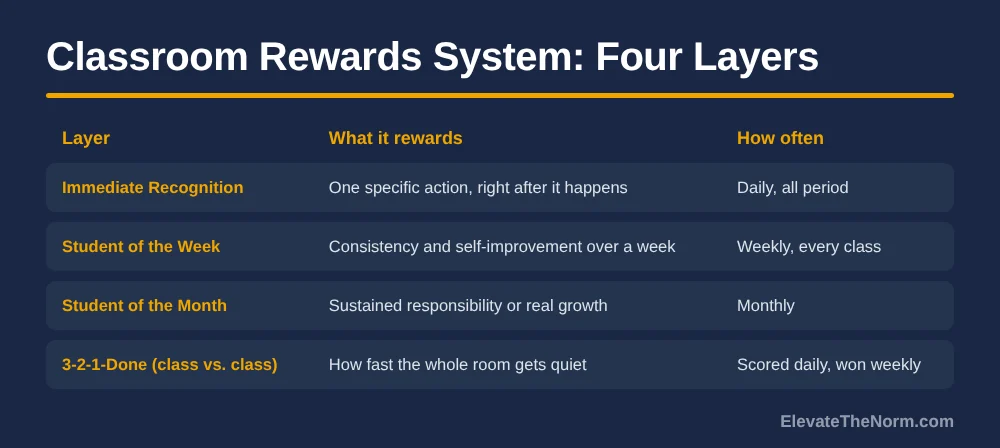
The Four Layers at a Glance
| Layer | What it rewards | How often | Typical cost |
|---|---|---|---|
| Immediate Recognition | One specific action, right after it happens | Daily, all period | Free |
| Student of the Week | Consistency and self-improvement over a week | Weekly, every class | A small prize from the bag |
| Student of the Month | Sustained responsibility or real growth | Monthly | A slightly bigger prize or certificate |
| 3-2-1-Done (class vs. class) | How fast the whole room gets quiet | Scored daily, won weekly | Snacks and free time for one class |
The first three layers are individual. The fourth belongs to the class. Keeping those separate matters: individual recognition says “I see you,” while the class layer says “we do this together.” Mixing them is how you end up with one student blamed for a lost prize.
Step 1: Decide What Earns Recognition
Start with expectations you’ve already taught. “Be responsible” means nothing until it’s attached to something you can see: starting the bell ringer without a reminder, finishing your part of a group task, putting materials back where they live. If your classroom expectations aren’t written in observable terms yet, fix that first.
When you recognize something, name the action and its effect. During a source comparison, that might sound like: “You pulled evidence from both documents, which gave your partner something real to respond to.” That’s more useful to a teenager than “good job,” and it tells everyone else what good work looks like.
Notice the Quiet Work Too
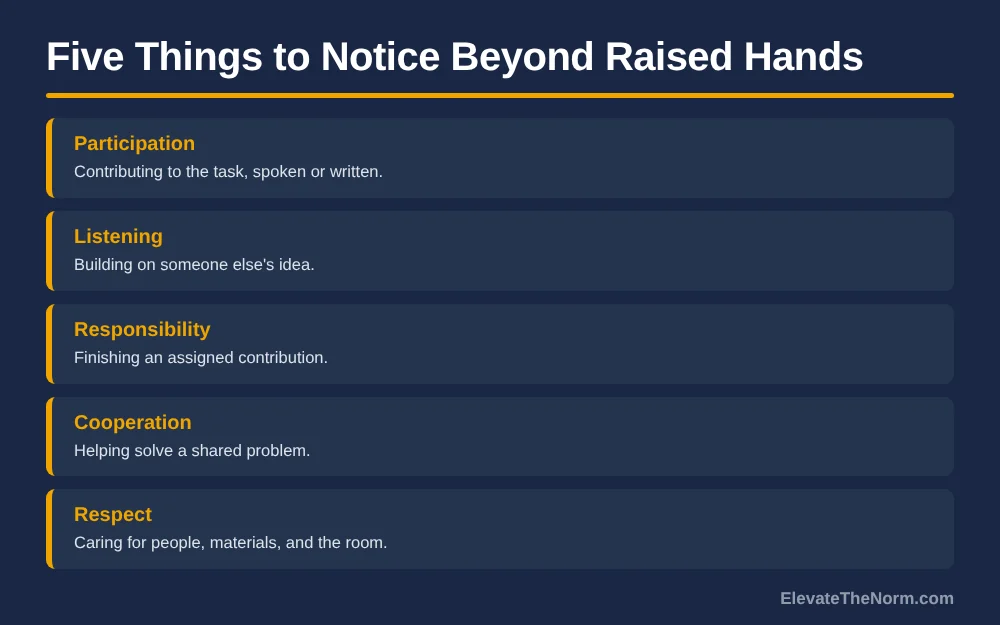
Raised hands are easy to see. Listening, helping a partner find a passage, or writing a sharp question on a sticky note are not. A short noticing list keeps you honest:
- Participation: contributing to the task, spoken or written
- Listening: building on someone else’s idea
- Responsibility: finishing an assigned contribution
- Cooperation: helping solve a shared problem
- Respect: caring for people, materials, and the room
Clear group work roles help here, because they give you specific contributions to watch for.
Reward Growth and Consistency, Not Perfection
Nobody’s perfect, and a system that only rewards flawless students teaches everyone else to stop trying. Judge improvement against where a student started, and keep a path open for kids who already meet expectations every day.
I judge Student of the Week on self-improvement and consistency, not perfection. One winner earned it by always being on time, participating, and doing his bell ringers every day. Nothing flashy, just reliable. I once told a new, tough student that simply rising to the occasion and trying was enough to put him on the shortlist.
That last part matters. A kid isn’t born “hard.” Toughness on arrival is a cause to look for, not a fixed trait, and a reward system that leaves room for a fresh start gives that student something to aim at.
Step 2: Build the Individual Layer
Immediate Recognition
This is the layer you’ll use most, and it costs nothing. Say what you saw soon after it happens: a quiet comment while you circulate, a note on a paper, a quick word at the door. Some students love public praise; others would rather sink through the floor. Learn which is which and adjust.
Student of the Week
Run it in every class, every week, with the same criteria. Keep a short record beside your roster during the week (a check or two-word note is plenty) so quieter students don’t vanish when you sit down to pick.
Presentation is half the fun. I build anticipation by walking the room with the prize bag while explaining the award.
For the full routine, see the Student of the Week guide.
Student of the Month
Look across the whole month for sustained responsibility or meaningful growth. Announce the criteria in advance, and ask winners privately whether a public announcement is okay. A certificate, a call home, or a slightly bigger prize all work.
Step 3: Add One Class-Level Layer
Whole-class rewards are great for shared routines like transitions and attention resets, and they bring out healthy competition between periods. Pick one and run it well. I use 3-2-1-Done.
How 3-2-1-Done Works
Every class starts the week at zero. When I count “three, two, one, done,” the room earns points based on when it goes quiet:
- Quiet on three: 3 points
- Quiet on two: 2 points
- Quiet on one: 1 point
- Quiet on done: 1 point
- Past done: minus 1 point per second, counted out loud (“one Mississippi, two Mississippi…”)
You can add an optional plus when everyone turns in their work and a minus for tardies, but keep negatives low. The class with the most points at the end of the week gets Pringles, a water, and 15–20 minutes of their own time, as long as they stay seated at a low murmur.
The key is a consistent reward. Same rules, same prize, every week. Buy-in usually takes about three weeks; this year’s group took closer to six. Don’t change the system just because week two looks rough.
Two guardrails keep it fair. Post class totals without names, and make it clear that scoring and corrections are your job. If students start blaming a classmate for a lost point, stop and deal with it privately. For more class-level options, see these whole-class rewards and games for classroom management.


Step 4: Set a Budget You Can Actually Keep
Decide the ceiling before you pick a single prize. Recurring rewards you can’t afford in March are worse than none, because students remember the promise.
The whole Elevate program costs me about $81 a year, self-funded.
| Reward | Cost | Watch for |
|---|---|---|
| Specific verbal or written recognition | Free | Make it accurate and specific |
| Positive call or message home | Time | Use the family’s preferred contact |
| Choice of seat for an independent task | Free | Keep accommodations and safety intact |
| Choice of an approved review activity | Planning time | Keep the learning goal |
| Printed certificate | Printing | Offer private delivery |
| Small prize from the bag | Your set budget | Have a nonfood option ready |
| Free time for the winning class | Instructional minutes | Plan where it fits in the week |
For more no-cost ideas, see the list of free classroom rewards.
What Should Never Be a Reward
Essentials stay unconditional: required accommodations, help with the work, water, bathroom access per school procedure, and basic supplies. If a fancy pen is a prize, every student still gets a regular pen when they need one.
Be careful with homework passes. If you use one, write exactly what it covers on the pass, and keep required assessments and essential practice off the list. If you can’t name work it’s safe to excuse, pick a different reward.
Step 5: Make It Consistent Across Every Period
With five or six classes, consistency is the whole game. Use one set of criteria, one schedule, and separate records for each period. For new teacher classroom management especially, a half-page written description of your system keeps your language the same at 8 a.m. and 2 p.m.
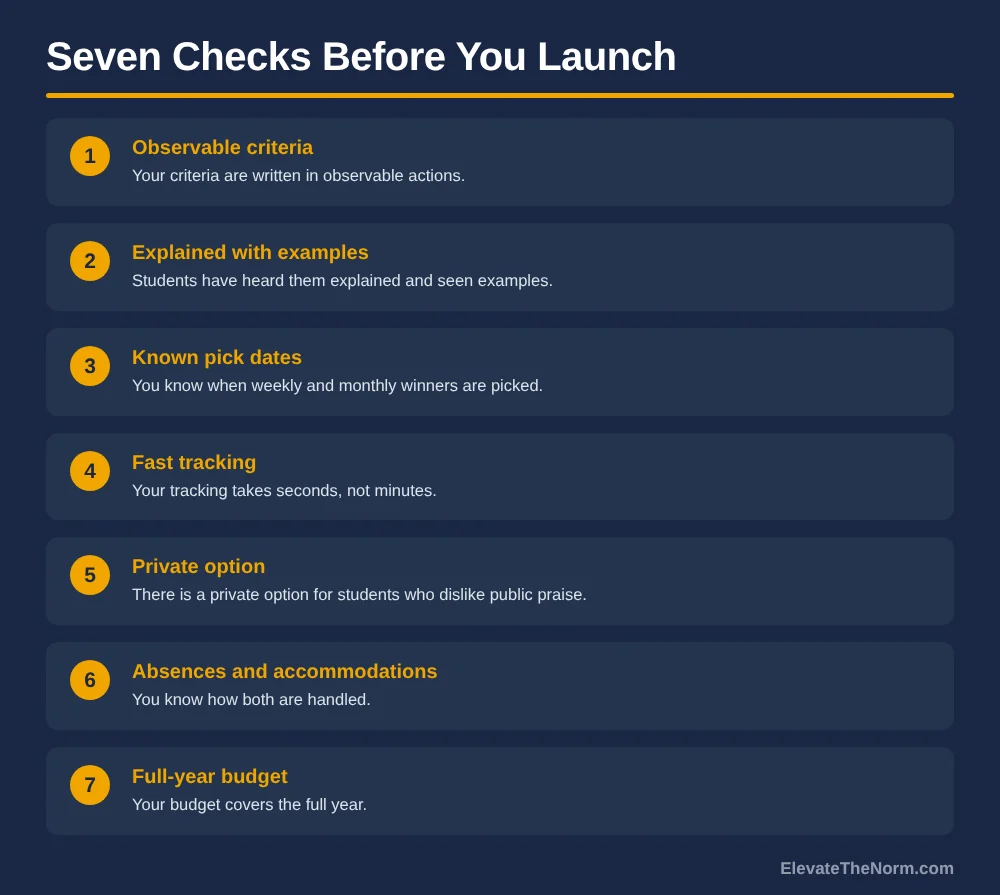
Before launch, check that:
- Your criteria are written in observable actions.
- Students have heard them explained and seen examples.
- You know when weekly and monthly winners are picked.
- Your tracking takes seconds, not minutes.
- There’s a private option for students who dislike public praise.
- You know how absences and accommodations are handled.
- Your budget covers the full year.
Teach the system like any other procedure, alongside your classroom routines and procedures. If a student thinks you missed something, they can tell you privately after class. That keeps instruction from turning into a points negotiation.
Rewards Don’t Replace Follow-Through
Positive reinforcement only works once students know kindness isn’t weakness. Follow through on exactly what you say, both the rewards and the consequences. Respect goes both ways, and a positive classroom still needs enforcement.
When the room gets loud, I’ll say “quiet down” up to three times before remediation. I say “remediation” rather than “negative reinforcement,” and serious remediation should come from administration, not the teacher. Your classroom consequences stay the same whether a competition is running or not.
It also helps not to take the bait. When a student says something to get a reaction, staying neutral (or using light sarcasm with grades 7–8 and up) shows confidence, and it keeps the reward system from becoming a power struggle.
Step 6: Review, Adjust, and Fade
Check Who’s Winning
Every few weeks, scan your records. Are you mostly noticing kids who talk a lot, finish fast, or sit near your usual walking path? For students you’ve rarely recognized, look for overlooked contributions and barriers, and ask privately whether the goal feels reachable. Fix the earning route before you raise the prize.
Keep Motivation Pointed at the Work
Self-determination theory (Deci and Ryan) suggests students stay motivated when they feel competent, connected, and in some control of their work. Rewards help when they inform (“you checked the evidence and revised your claim”) and hurt when they turn every task into a transaction. Keep prizes modest and feedback specific. For more on this, see motivating students and positive reinforcement in the classroom.
Fade the Extras
Once a routine sticks, reduce the material rewards and keep the specific praise. Score a mastered routine less often, tell students about changes ahead of time, and always honor anything already earned. The recognition tiers can stay all year; it’s the extras that should shrink.
Frequently Asked Questions
Do classroom rewards systems work in high school?
Yes, if they don’t feel babyish. Teenagers respond to specific recognition, competition between periods, and real privileges like a few minutes of their own time. Skip sticker charts and anything that singles students out against their wishes.
How much should a classroom rewards system cost?
As little as you want. Most of the strongest rewards are free: specific praise, a call home, a choice of seat. My full three-tier recognition program runs about $81 a year, out of my own pocket.
Should rewards be individual or whole-class?
Both, kept separate. Individual recognition builds personal habits; a class competition builds shared routines like quiet transitions. Never let one student’s behavior cost the whole class, or peers start policing each other.
How long until students buy in?
Usually a few weeks. Run the same rules and the same reward every week without changing course. Some groups catch on in three weeks; others take six.
Won’t rewards kill intrinsic motivation?
Not if prizes stay small and feedback stays specific. The goal is to point students at the habit, then fade the extras as the habit sticks while keeping the praise.
Start Small, Stay Consistent
Begin with immediate recognition and a weekly award. Add the monthly tier once your tracking feels easy, and introduce a class competition after you’ve taught the routine it scores. Keep the criteria visible, the promises affordable, and the follow-through identical in every period.
Want printable tools to get started? The free Elevate the Norm resource library has classroom resources built for grades 6–12. Free to download, no email required.