By Clay Shumate
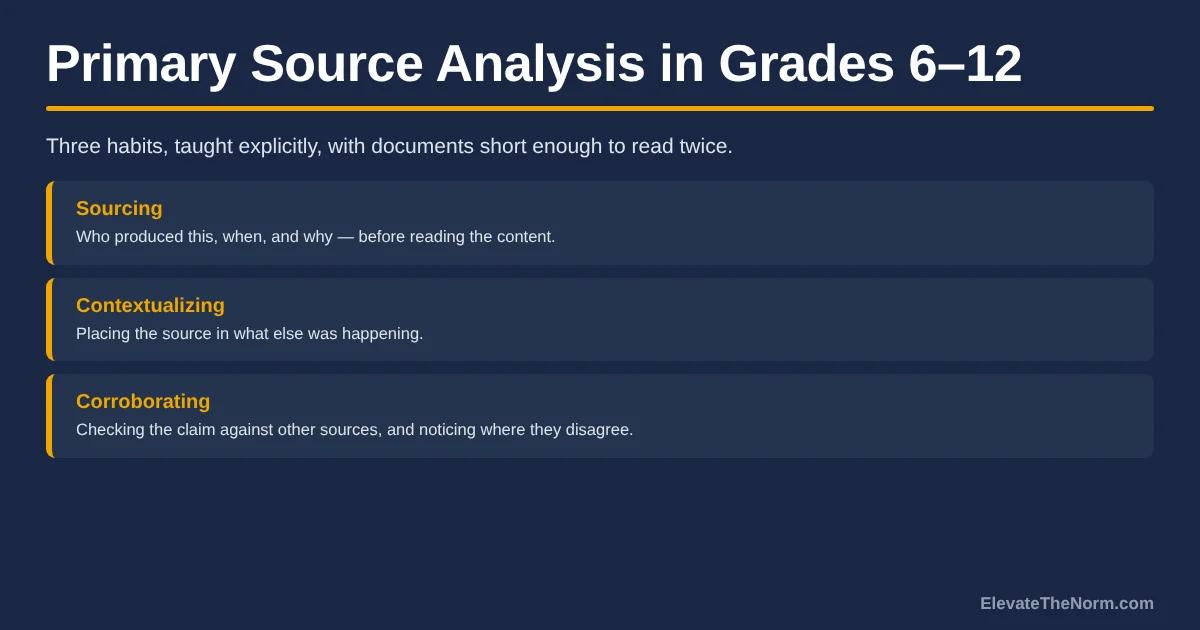
Primary source analysis is reading a document, image or object for what it reveals about whoever made it — not just for the facts it states. In grades 6–12 it means teaching three habits explicitly: sourcing, contextualizing and corroborating. Short documents, a framework students can run without you, and the same framework all year.
Key Takeaways
- Document work does not cost you content. In a study where eight history classrooms were randomly assigned, students who read multiple documents scored higher on content knowledge than students who read the textbook — and used sourcing and corroboration more often as well.
- The largest classroom test of a document-based curriculum ran six months across five urban high schools. Eleventh graders gained on historical thinking, transfer of that thinking, factual knowledge and general reading comprehension. The effects were real and modest: partial η² of .09, .08, .03 and .05.
- Students are starting from very low ground. Across 3,446 high school students, 52 percent accepted an anonymous Facebook video as strong evidence of voter fraud, and 96.8 percent scored at the lowest level when asked whether a climate website was reliable. Scores were lower for students eligible for free or reduced-price lunch and for students whose home language was not English, on an assessment administered in English.
- No framework has been tested against another. SOAPSTone, HIPP, the 6 C’s, the Library of Congress’s Observe–Reflect–Question and the National Archives’ four steps all operationalize the same habits. Pick one and use it every time; the consistency is the instruction.
- Five one-hour lessons moved 574 ninth graders from 2.24 to 3.75 out of 9 on source evaluation. Real movement, and still under half correct — with no control group. Treat this as a skill that takes years, not a unit.
The standard objection to teaching with primary sources is time. There is a curriculum to cover, a pacing guide behind it, and documents are slow. Reading one letter properly can eat a class period that was supposed to cover a decade.
The research says that objection is backwards, and it has said so since 2007. The bigger problem is not whether to teach primary source analysis. It is that most of us teach it as a worksheet rather than as a set of habits, and a worksheet filled in once in September does not survive contact with anything students read in March or on their phones.
What is primary source analysis?
Primary source analysis is the practice of reading a document, image, object or recording as evidence produced by a particular person, at a particular moment, for a particular purpose. The content of the source is one piece of information. Who made it, when, for whom, and what they stood to gain are the others, and they are the ones that distinguish analysis from reading.
Historians do this with three moves that students can learn by name:
- Sourcing — asking who produced this, when, and why, before reading the content. Who wrote it changes what it can tell you.
- Contextualizing — placing the source in what else was happening. A speech about unity in 1861 means something different from the same speech in 1961.
- Corroborating — checking the claim against other sources, and noticing where they disagree and why.
Everything below is about getting those three to stick. One warning about search results on this topic: most of what you will find for “primary source analysis” is written for college students writing an analysis essay — thesis statements, paper structure, how many pages. This is the grades 6–12 teaching version, which is a different job.
Does teaching primary source analysis actually work?
Yes, with modest effects and one large caveat about how the study was run. Abby Reisman tested the Reading Like a Historian curriculum in five San Francisco public high schools: ten eleventh-grade US History classrooms, one treatment and one control per school, 83 document-based lessons across 105 instructional days from September to March.
Worth noting before anyone writes this into a plan: the treatment teachers attended a four-day summer training plus two follow-up workshops. The curriculum is free; the professional learning around it was not, and it is part of what produced the result. A district that downloads the lessons and skips the training has not replicated the study.
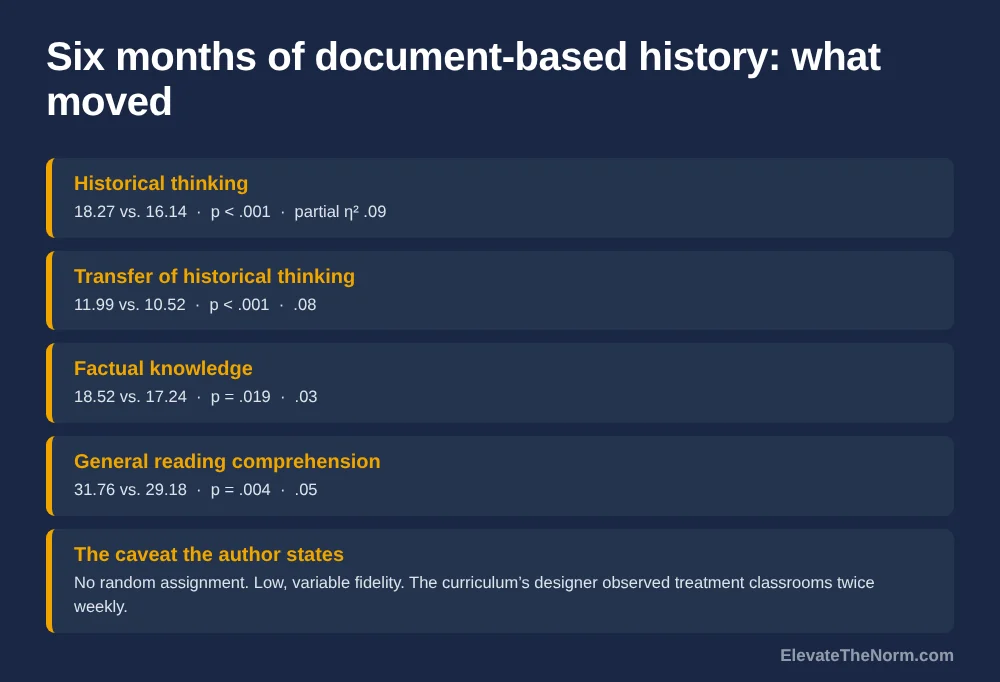
| What was measured | Treatment vs. control | Significance | Partial η² |
|---|---|---|---|
| Historical thinking | 18.27 vs. 16.14 | p < .001 | .09 |
| Transfer of historical thinking | 11.99 vs. 10.52 | p < .001 | .08 |
| Factual knowledge | 18.52 vs. 17.24 | p = .019 | .03 |
| General reading comprehension | 31.76 vs. 29.18 | p = .004 | .05 |
The result that should get a social studies department’s attention is the bottom row. Students got better at general reading comprehension in a course that never taught a reading strategy lesson. Reisman attributes that partly to the simple fact that students in those classrooms spent more time reading.
Now the caveat, because it is a serious one and the author states it plainly. Students and teachers were not randomly assigned. Fidelity of implementation was low and varied widely — whole-class discussion, which the curriculum is built around, was rare. And the researcher who designed the materials observed treatment classrooms twice weekly and sometimes assisted the teachers, while control classrooms had no outside presence at all. Curriculum effects are confounded with teaching quality and with the researcher being in the room. Reisman says so. Anyone citing this study as proof that a curriculum works is citing more than the study delivers.
Doesn’t document work cost you content coverage?
No. The one study that randomized this found the opposite. Nokes, Dole and Hacker randomly assigned eight history classrooms — 246 students aged 16 and 17 across two high schools — to four conditions crossing text type (textbook or multiple documents) with instruction type (content or explicit heuristics). After three weeks, students who read multiple documents scored higher on content knowledge than students who read traditional textbook material.
Higher. Not equal. The students who spent three weeks on documents learned more history than the students who spent three weeks on the textbook, and they also used sourcing and corroboration more often afterward.
One practical warning from the other direction, because the time objection has a real version. The cost is not class minutes; it is paper. One organizer per student across five sections is 150 pages, and a teacher who collects and marks all of them every time will stop doing this by October. Collect a sample, read the claim sentence rather than the boxes, and let most organizers stay in the notebook as thinking tools. The organizer is for the student, not for you.
The other real cost is excerpting, and the fix is to not do it yourself. The free collections below are already excerpted and already glossed for secondary students. Steal from them before you build anything.
Two things to hold onto about that study. It is three weeks and two schools, so it is a small result, not a mandate. And it tested multiple texts against a textbook, which is a different variable from explicit heuristic instruction — the design crossed both factors precisely because they are not the same thing. The honest takeaway is that putting several documents in front of students did not cost content, which is the only claim the time objection actually needs answered.
Which primary source analysis framework should you use?
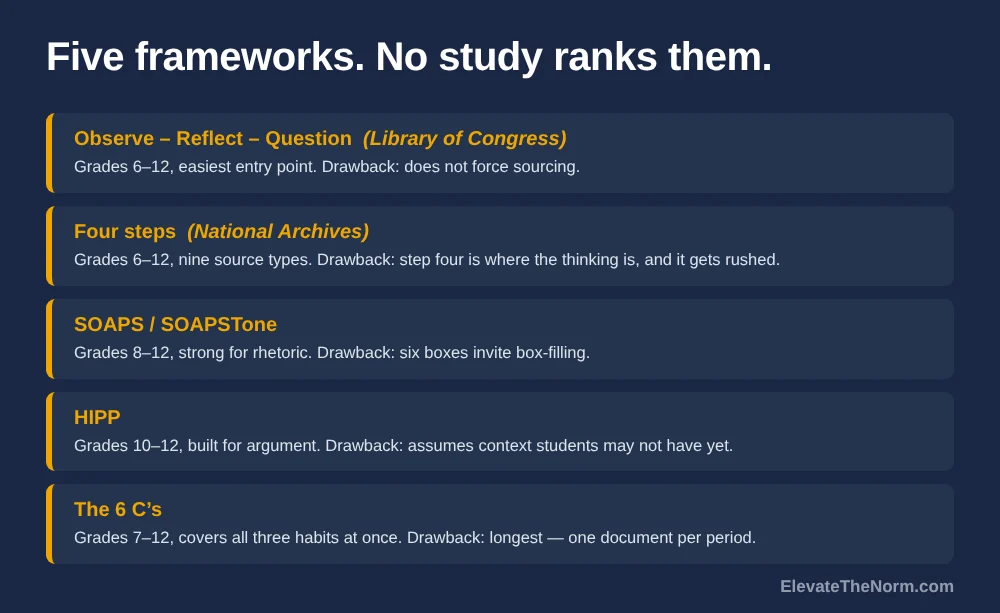
Whichever one you will still be using in April. No study has compared these frameworks against each other, so there is no evidence-based winner — and they all operationalize the same three habits. The real variable is whether students run it enough times to internalize it.
| Framework | What it stands for | Grade fit | Best for | Main drawback |
|---|---|---|---|---|
| Observe – Reflect – Question Library of Congress | What do I see? What do I already know? What do I want to know? | 6–12, and the easiest entry point | Photographs, maps, objects, first exposure | Does not force sourcing; a student can do all three without asking who made it |
| NARA four steps National Archives | Meet the document; observe its parts; try to make sense of it; use it as historical evidence | 6–12, with versions for novices and for secondary | Any source type — there are worksheets for nine of them | The fourth step is where the thinking is, and it is the step most likely to be rushed |
| SOAPS / SOAPSTone | Speaker, Occasion, Audience, Purpose, Subject (plus Tone and Style) | 8–12; strong in English and AP courses | Written text and rhetoric; pairs well with writing instruction | Six boxes invite box-filling; students complete it without arguing anything |
| HIPP | Historical context, Intended audience, Purpose, Point of view | 10–12, built for AP History sourcing | Teaching students to use a source as evidence in an argument | Assumes context knowledge students may not have yet |
| The 6 C’s | Content, Citation, Context, Connections, Communication, Conclusions | 7–12 | A single organizer that covers all three habits at once | Longest of the five; realistically one document per class period |
If you want a decision rather than a menu: start with the Library of Congress Observe–Reflect–Question in grades 6–7 because it is three questions and students can hold it in their heads, then add sourcing as a required fourth question. In grades 8–12 use SOAPS or HIPP depending on whether your assessments ask for rhetoric or for argument. Whichever you pick, print it on the wall and use the same words every time.
How do you teach primary source analysis, step by step?
Teach one habit at a time, with documents short enough to read twice in a class period. The failure mode is handing students a framework and a two-page document on the same day and getting compliance instead of thinking.
- Start with an image or object, not text. Everyone can observe a photograph, so the framework gets learned before decoding becomes the obstacle. This is also the move that keeps weaker readers in the conversation on day one.
- Teach sourcing on its own, first, and make it precede reading. Cover the document and show only the attribution line. Ask what they expect this source to say and why. Then uncover it. The gap between prediction and text is the lesson.
- Model it out loud on a document you have not scripted. Students need to hear an adult be uncertain in public — “I do not know what this word means, so here is what I am going to do.” A clean performance teaches that analysis is something other people are already good at.
- Use short documents. Excerpt hard, and gloss the words that would stop a reader. Four to six sentences, with one or two genuinely blocking words given a plain-language meaning in the margin — the same test that drives vocabulary instruction that moves comprehension. A document students can reread twice beats a complete one they get through once. And check the form of the document, not just its length: eighteenth-century handwriting, long-s spelling and faded scans are accessibility barriers that have nothing to do with historical thinking, so use the transcription alongside the image rather than making students fight the script.
- Put two documents that disagree side by side. Corroboration cannot be taught with one source. Disagreement is the whole point, and two contradictory accounts of the same twenty minutes will do more than any amount of explanation.
- End with a claim, not a completed organizer. One sentence that takes a position and names which document supports it. The organizer is scaffolding; the claim is the work.
- Then do it again, the same way, for the rest of the year. This is the step that is actually hard, and it is the one the evidence most supports.
Are primary sources reliable? What do you tell students?
Tell them bias is the data, not a reason to throw a source out. A plantation owner’s diary is an unreliable account of how enslaved people felt and an excellent source on how enslavers justified themselves. The question is never “is this biased?” — everything is. The question is “what is this a reliable source of?”
That reframing matters more than it looks, because the alternative teaches a reflex that does real damage. A student who learns that bias disqualifies a source has been handed a tool for dismissing anything they would rather not believe. That is not skepticism. It is the opposite.
Two other things worth saying out loud to a class. Primary sources are often wrong on facts — an eyewitness misremembers, a newspaper prints the early count. And the sources that survived are not a random sample: literate, wealthy and official people left far more records than everybody else, so silence in an archive is usually evidence about power rather than about what happened.
That same question — what is this a reliable source of? — is the one students need most often outside a history classroom, on a page they reached through a search result. The classroom version of it is lateral reading and eleven other activities sorted by what each one costs in class time, with the evidence for each one named instead of assumed.
What about documents that are disturbing, and sources about contested politics?
Decide before the lesson, not during it, and say the quiet part to students in advance. Primary source analysis in American history runs straight into lynching photographs, slave auction advertisements, Holocaust records, and testimony about violence against children. These are real sources and students can handle more than adults assume, but a document that a thirteen-year-old encounters cold, with no framing and no exit, is not a lesson — it is an ambush.
The working rules are simple and they are not optional. Check your district’s policy on sensitive materials and family notification before you plan the unit, not after a phone call. Preview every source in full, including the parts students will notice and you skimmed. Tell the class what they are about to see and why it is in front of them. Do not use a dehumanizing image as a hook or a shock, and do not require a student to perform the voice of a document that degrades people like them. If a source describes abuse, violence or harm to a child and a student discloses something of their own in response, that is a mandatory-reporting situation and it follows your district’s procedure immediately and completely — a document-analysis lesson does not pause for it and does not substitute for it.
Politically contested sources are a smaller and different problem. The national study above used gun control, climate and voter-fraud material because that is where the skill actually gets used, and that is also exactly the material most likely to produce a complaint. Build the habit on historical documents first. The sourcing question is identical whether the document is from 1854 or last Tuesday, and a class that has run it forty times on nineteenth-century material can run it on a live controversy without the lesson becoming an argument about the teacher’s politics. When you do reach current material, teach students to evaluate the source and leave the conclusion to them — which is also the only version of this that survives scrutiny from either direction.
How do you know students are actually getting better at it?
Score the reasoning, not the organizer, and expect slow movement. A completed worksheet tells you a student can fill boxes. What you want is whether an unprompted response mentions who produced the source and why that matters.
And grade the reasoning, not the conclusion. This is the fairness question students and parents ask first, and it has a clear answer: a student who reads two documents carefully, explains what each is reliable evidence of, and reaches a reading you disagree with has done the work. A student who reaches your conclusion by guessing has not. If your rubric rewards the second one, students will work out within a week that the task is to find the answer the teacher wants, and the whole exercise becomes the opposite of what it is for.
The honest news is that this is hard to measure and the field is still working on it. Reisman names her own historical-thinking measures as immature. The large national study of online source evaluation reports a composite reliability of α = .58, which is modest, and the authors do not claim causal findings from it. If the research instruments are shaky, your Friday exit ticket is shakier — so look for direction of travel across a semester rather than a score.
If a coach or administrator is watching for this, the observable is narrow and easy: does a student ask who made the document before being told to? Not whether an organizer is on the desk. Three things worth tracking, none of which needs a rubric: whether students ask who wrote something before you prompt them; whether they can state what a source is reliable of; and whether, given two documents that disagree, they explain the disagreement instead of picking the one they like. The same “what counts as evidence” question drives assessment for project based learning, and it is worth deciding before the unit starts, not after.
Where do you get free primary sources and analysis worksheets?
All of the best collections are free and public, and none of them requires a purchase. You do not need a paid document set to teach this.
- The National Archives document analysis worksheets — nine source types (photograph, written document, artifact, poster, map, cartoon, video, sound recording, artwork), each in a novice version and a secondary version, plus a Perspective worksheet on how a maker’s background shapes a source. Spanish versions available. Materials created by the National Archives are in the public domain.
- The Library of Congress Primary Source Analysis Tool and teacher’s guides — the Observe–Reflect–Question organizer plus guides by source type, sitting on top of a digital collection you can pull documents from directly.
- Reading Like a Historian — the curriculum from the Reisman study, described as a free downloadable curriculum. Each lesson is built on a central historical question with a document set, and it includes contextualization materials in English and Spanish. This is the only item on the list with a published classroom effect behind it.
Pair any of them with local material and the work gets better fast, because students cannot Google the answer. Teaching local history with ghost stories is one way into that; history project ideas has others that end in something students make. Everything on this site is free and nothing asks for your email address.
Clay’s take: the skill is the point, and it does not fit in a unit
I think the reason primary source analysis gets taught as a worksheet is that a worksheet can be finished. A habit cannot, and a pacing guide has no column for “still working on it in April.” So we convert a years-long skill into a three-day unit, give it a grade, and move on.
The national numbers are the argument for not doing that. Fifty-two percent of high school students treating an anonymous video as strong evidence of voter fraud is not a social studies problem; it is the thing social studies is for. And the lesson study that moved ninth graders from 2.24 to 3.75 out of nine in five hours is both encouraging and sobering — real movement, and students still answering fewer than half the questions correctly at the end.
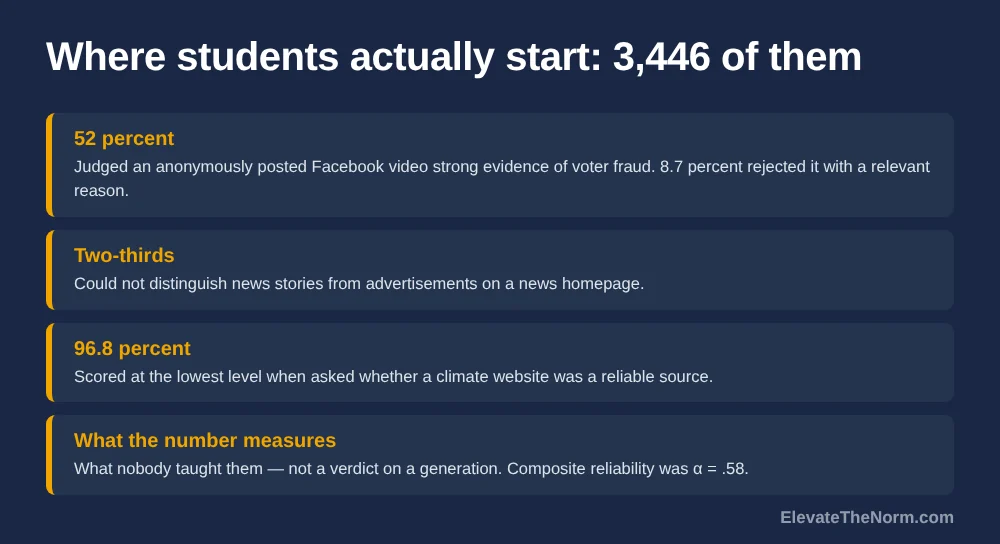
What I would resist is the version of this that treats students as the problem. The national study’s own framing is about what students were never taught, not about a generation that cannot think. And the 96.8 percent figure is a measure of what nobody taught them, not a measure of them. These are the same young people who will notice instantly if you ask them to evaluate a source while handing them a textbook you never let them question. If you want students to interrogate evidence, the classroom has to be a place where interrogating evidence is welcome — including yours. That is the same bet behind running a Socratic seminar properly: the adult gives up control of the conclusion and keeps control of the standard.
What to do next
Pick one habit — sourcing — and one short document from next week’s content. Cover everything but the attribution line, ask students what they expect it to say, then let them read it. That is one class period and it teaches the move that does the most work. Add the framework once the habit exists, not before.
If you want the version where documents drive a longer piece of work, project based learning in social studies covers how to build an inquiry around them and what the evidence on that does and does not show.
Reading one document well is the prerequisite. Putting a stack of them into a single argument is a different task with its own rubric, and that one is covered in how to teach a document based question.
Reading one document closely for what it is and who made it is a discipline-specific version of a broader protocol. The general form runs several passes over a short, hard text with a different purpose each time — the three passes, and what the federal evidence actually backs — and in history the second pass is usually about the author rather than the structure.
Before students can corroborate two sources they have to be able to say what one source is claiming. That is the central idea, and in practice it gets tangled with main idea and theme until none of the three means anything. Central idea vs main idea vs theme separates them plainly — the point a whole text makes, the point of one paragraph, and a message about life in fiction — and gives students a way to test their sentence against the entire text.
Frequently Asked Questions
What is primary source analysis?
Primary source analysis is reading a document, image, object or recording as evidence made by a particular person at a particular moment for a particular purpose. It uses three moves historians name explicitly: sourcing, which asks who made it and why before reading it; contextualizing, which places it in what else was happening; and corroborating, which checks it against other sources.
How do you teach primary source analysis in middle school?
Start with photographs or objects rather than text, so students learn the framework before decoding becomes the obstacle. Teach sourcing on its own first by covering the document and showing only the attribution line. Keep documents to four to six sentences with hard words glossed, and put two sources that disagree side by side so corroboration has something to do.
Which primary source analysis framework is best?
No study has compared SOAPSTone, HIPP, the 6 C’s, the Library of Congress Observe-Reflect-Question tool and the National Archives four steps against each other, so there is no evidence-based winner. They all operationalize the same habits. Observe-Reflect-Question is the easiest entry point for grades 6-7; HIPP and SOAPS fit grades 10-12. Consistency across the year matters more than the choice.
Does teaching with primary sources reduce content coverage?
The one study that randomized this found the opposite. Nokes, Dole and Hacker randomly assigned eight history classrooms of 246 students aged 16 and 17 to read either textbook material or multiple documents for three weeks. Students who read multiple documents scored higher on content knowledge, and used sourcing and corroboration more often.
Are primary sources reliable?
Every source is biased, so bias is not a reason to discard one. The useful question is what a source is reliable evidence of. A plantation owner’s diary is poor evidence of how enslaved people felt and strong evidence of how enslavers justified themselves. Primary sources are also often factually wrong, and the records that survived over-represent literate, wealthy and official people.
Does document-based history instruction improve reading comprehension?
In one six-month study across five urban high schools, eleventh graders in document-based classrooms scored higher on general reading comprehension than control students, with a partial eta-squared of .05, despite no reading-strategy instruction. The author attributes part of this to more time spent reading, and notes the design was quasi-experimental with low implementation fidelity.
How long does it take students to get good at analyzing sources?
Longer than a unit. Five one-hour lessons moved 574 ninth graders from 2.24 to 3.75 out of 9 on source evaluation tasks, which is real movement that still left them answering fewer than half correctly. That study had no control group. Treat source analysis as a habit built across years rather than a skill taught once.
Where can I get free primary source analysis worksheets?
The National Archives offers document analysis worksheets for nine source types in both novice and secondary versions, plus Spanish translations, and its materials are in the public domain. The Library of Congress provides its Primary Source Analysis Tool and teacher’s guides by source type. The Reading Like a Historian curriculum is described as a free downloadable curriculum.
Sources
- Reisman, A. (2012). Reading like a historian: A document-based history curriculum intervention in urban high schools. Cognition and Instruction, 30(1), 86–112. Quasi-experimental; five San Francisco Unified high schools, ten eleventh-grade US History classrooms (one treatment, one control per school), 236 students enrolled and 182 analyzed after listwise exclusion; 83 document-based lessons across 105 instructional days, September to March. Historical thinking p < .001 (partial η² .09), transfer p < .001 (.08), factual knowledge p = .019 (.03), reading comprehension p = .004 (.05); multivariate effect F(4,168) = 6.889, p < .001. Author-stated limitations: no random assignment; low and highly variable implementation fidelity with whole-class discussion rare; the curriculum’s designer observed treatment classrooms twice weekly and sometimes assisted teachers while control classrooms had no outside presence, confounding curriculum with teaching quality and researcher presence; historical-thinking measures described as immature. Full text read.
- Nokes, J. D., Dole, J. A., & Hacker, D. J. (2007). Teaching high school students to use heuristics while reading historical texts. Journal of Educational Psychology, 99(3), 492–504. 246 students aged 16–17 (128 male, 118 female) in two high schools in the western United States; eight history classrooms randomly assigned across a 2 × 2 design crossing text type (textbook vs. multiple texts) with instruction type (content vs. heuristic); three weeks. Multiple-text students scored higher on content knowledge and used sourcing and corroboration more often. Read at ERIC abstract level — the full article is paywalled, so no effect size is quoted and the abstract does not report one.
- Breakstone, J., Smith, M., Wineburg, S., Rapaport, A., Carle, J., Garland, M., & Saavedra, A. (2021). Students’ civic online reasoning: A national portrait. Educational Researcher, 50(8), 505–515. Analytic sample 3,446 high school students (grades 8–12) drawn from 6,445 students in 79 classrooms and 31 schools; districts stratified by region and locale from NCES data; six constructed-response tasks completed with a live internet connection. 52 percent judged an anonymously posted Facebook video strong evidence of voter fraud and 8.7 percent rejected it with a relevant reason; two-thirds could not distinguish news from ads on a news homepage; 96.8 percent scored at the lowest level on website evaluation and 96 percent did not consider a climate site’s fossil-fuel ties; mean composite 0.17. The report also found that students eligible for free or reduced-price lunch scored lower on all six tasks, as did students whose home language was not English — though the assessment was administered in English, which the authors name as a reason those students may have been disadvantaged in expressing their reasoning rather than in doing it. Stated caveats: districts and teachers volunteered rather than being randomly selected, regions were unevenly represented and only partly corrected by sub-sampling, missingness reached 14–18 percent on several variables, composite reliability α = .58, and no causal claims are made. Read as the Stanford report version of this dataset, hosted by Stanford Digital Repository.
- McGrew, S., & Breakstone, J. (2023). Civic online reasoning across the curriculum: Developing and testing the efficacy of digital literacy lessons. AERA Open, 9. Single-group pretest/posttest, no control group and no randomization; one suburban Midwestern high school; 574 ninth graders completing both tests; eight teachers (six biology, two geography); five hour-long lessons in biology. Mean score rose from about 2.24 to 3.75 of 9, F(1,572) = 299.91, p < .001; honors students gained more than general students; extra geography lessons produced no additional gain (F = .265, p = .61); posttest performance remained under half correct. Authors state that a randomized controlled trial would be needed for causal claims, that COVID-19 disrupted implementation, that the researcher–teacher collaboration was atypical, and that durability and transfer outside school were not measured. Full text read. The article reports no standardized effect size.
- Document analysis worksheets, National Archives and Records Administration, Educator Resources. Worksheet sets for novice and secondary students across nine source types plus a Perspective worksheet; four analysis steps (meet the document; observe its parts; try to make sense of it; use it as historical evidence); Spanish versions available; National Archives materials are in the public domain. Page read.
- Introducing primary source analysis to students, Library of Congress Teaching with the Library blog, and the Primary Source Analysis Tool and teacher’s guides it links to. Source of the Observe → Reflect → Question framework and its student prompts. Blog post read; the tool page is cited as the destination it names.
- Reading Like a Historian, American Historical Association remote teaching resources. Describes the curriculum as free and downloadable, built on lessons centred on a historical question with a document set, including contextualization materials in English and Spanish. This page does not state the lesson count or whether registration is required, and neither is claimed here.
- The five-framework comparison table is compiled for this article from the published descriptions of each framework. SOAPSTone, HIPP and the 6 C’s are widely used teaching heuristics rather than tested interventions. No source above compares any framework with another, and no effectiveness ranking is claimed. The grade-fit and drawback columns are editorial judgment, not findings.
- The seven teaching steps are written for this article to operationalize the sourcing, contextualizing and corroborating habits described in the sources above. They are recommendations, not a report of any teacher’s classroom, and no study above tests them in this sequence.