
By Clay Shumate
Extra credit ideas are defensible when the points measure the same learning the grade reports, every student can earn them during school time, and required work stays required. In-class bonus items, deeper extensions, and second chances at the same standard pass. Supplies, event attendance, and behavior points distort the grade.
Key Takeaways
- Extra credit is defensible only when its points measure the same learning the grade claims to report. Points for supplies, event attendance, signed forms, or behavior measure something else, and the grade stops meaning what families think it means.
- The research is thin and nearly all of it comes from college courses. In one introductory biology course, the students who did extra credit were already attending more and earning higher grades with the bonus points removed, which suggests extra credit mostly reached students who were already doing well.
- Three questions sort every idea: does it measure the same standard, can every student earn it in school time, and does required work stay required? Five common ideas pass and six fail.
- A retake, a correction, or a revision after relearning does what extra credit promises without trading one kind of evidence for another.
- If a school expects extra credit, write the rules before the term, cap the points, tie them to a current standard, and close the window well before grades are due.
What is extra credit, and why does it cause so many grading arguments?
Extra credit is any work that adds points to a student’s grade beyond the assigned work. The arguments start because those points can mean two different things: more evidence of learning, or payment for something unrelated to learning. What the points are for decides whether the idea is defensible.
Almost every teacher gets asked for it. A student has a 68 in late November, a parent writes an email, a colleague offers a packet, and saying yes starts to look generous. The harder question is what the grade is supposed to say once those points are in it.
That question matters because grades already carry more than most people assume. A research review of more than a century of grading studies by Susan Brookhart and seven co-authors describes grades as assessing “a multidimensional construct containing both cognitive and noncognitive factors.” In plain terms, teachers’ marks already blend achievement with effort and behavior. The review is not about extra credit, but the inference is hard to avoid: every unrelated point source added to a gradebook blurs the signal a little further. That inference is mine, not the authors’.
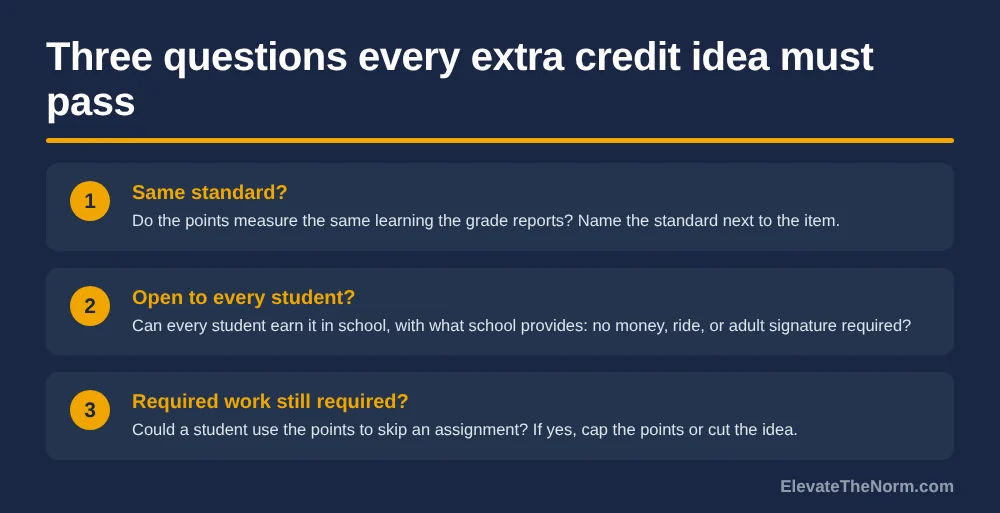
Three tests sort the ideas in the rest of this article. They are a working framework, not a research finding, built from the accuracy, bias, and motivation arguments in Joe Feldman’s Grading for Equity as summarized by the Oregon State Ecampus course-development blog, and from the conditions a middle school teacher lists in an Education Week opinion column. The first test asks whether the points measure the same standard the grade reports. The second asks whether every student can earn them, in school, with what school provides. The third asks whether required work is still required, or whether the points can quietly stand in for it.
What does the research say about extra credit?
Very little research tests extra credit directly, and none of the sources opened for this article tests it in grades 6–12. The college-level studies suggest extra credit mostly reaches students who are already doing well. None of them shows that it helps students who are behind.
Here is what each source covers, including what it cannot tell a teacher of grades 6–12.
| Source | Who was studied | What it found | What it cannot tell you |
|---|---|---|---|
| Journal of College Science Teaching, introductory science courses | One introductory biology course (the page I could read does not give the number of students) | 81 percent said they would submit extra credit; fewer than a quarter did. Those who did attended more, used optional help sessions more, and earned higher grades, even with the extra points removed. | Whether extra credit caused any improvement. The pattern looks like selection. |
| Padilla-Walker, daily extra credit quizzes | An advanced psychology course of 36 students | Performance on the daily quizzes predicted exam scores after controlling for gender, college GPA, and ACT scores. Nearly half of students said their main reason was earning points. | Cause and effect. It is a small predictive study, not an experiment. |
| Myers and Hatchel, personality and cognitive factors | 276 undergraduates in psychology and biology courses, surveyed after final exams | 79.7 percent completed at least some extra credit. Completing it showed no significant main effect on academic self-efficacy or metacognition; differences appeared only in combination with course level and final grade. | Learning gains. The extra credit was mostly easy tasks, such as attending an event with a short write-up or joining a research study. |
| Brookhart and colleagues, review of grading research | More than a century of grading studies, K–12 and higher education | Grades blend cognitive and noncognitive factors. | Anything about extra credit specifically. |
| Oregon State Ecampus course-development blog and the Education Week opinion column | Practitioner arguments; no empirical sample | Course designers and teachers argue for and against extra credit. Feldman reports that higher-achieving, better-resourced students are more likely to use it. | Anything checkable. The blog cites one book, and the column’s one research claim names no study. |
Read together, the sources point in one direction and stop short of a conclusion. The biology finding is a selection pattern: the students who completed extra credit were the students already attending class and using help sessions, and they still had higher grades without the bonus points. That fits the claim Feldman makes in Education Week, that stronger and better-resourced students use extra credit more. His claim comes with no named study, though, so it is an argument the biology finding happens to fit, not a replicated result.
There is evidence for the other side, and it deserves its weight. Padilla-Walker’s daily quizzes were tied to course content, and students who did well on them did well on exams, with gender, college GPA, and ACT scores accounted for. That is the best case for extra credit in this set: regular extra practice on the same material. But it is a prediction in 36 students, and the fact that nearly half said they were doing it for the points shows how the incentive works. It makes “more practice on the same standard” look promising. It does not show that adding points is what made the difference.
The null result from Myers and Hatchel matters for a different reason. Across 276 undergraduates, completing extra credit by itself showed no significant effect on academic self-efficacy or metacognition. Their extra credit was mostly easy tasks such as attending an event with a short write-up or taking part in a research study. One study cannot show that such extra credit does nothing, but it gives no reason to expect it to build the habits teachers hope it will.
The honest summary for a classroom in grades 6–12: the evidence does not support extra credit as a way to help students who are behind, and it does not show harm either. What it supports is narrower. Extra credit tied to the same content and done during school has the best case, and it is also the version that looks least like “extra.”
Which extra credit ideas are defensible?
Five ideas pass all three tests: bonus items built into an assessment, a deeper extension of a current standard, a reassessment after relearning, test corrections with an explanation, and a revision cycle on a project. Each ties the points to the same learning the grade reports.
Bonus items built into the assessment. One or two optional items at the end of a quiz or test ask for a harder version of the same standard. Everyone sees them, everyone has the same time, and the points are small enough that they cannot rescue a student who skipped the required work. Write the standard next to each bonus item before the test is given; if the standard cannot be named, the item fails the first test. Deliver bonus items with the same accommodations the assessment already carries, so a student with extended time or read-aloud support is not shut out of the points. A few points out of a hundred is a reasonable ceiling, though that number is a judgment call, not a research finding.
A deeper extension of a current standard. A veteran middle school reading teacher quoted in Education Week describes extra credit that analyzes literary devices in song lyrics or commercials during a figurative language unit, or critiques a real-world text during persuasive writing, and says extra credit “should extend learning, not excuse it.” The same idea works in any subject: one more step of the same skill, at a higher level, scored with the same rubric, during a work period rather than as homework only some students can finish. Letting students choose which of two standards to extend gives them a voice without changing the test.
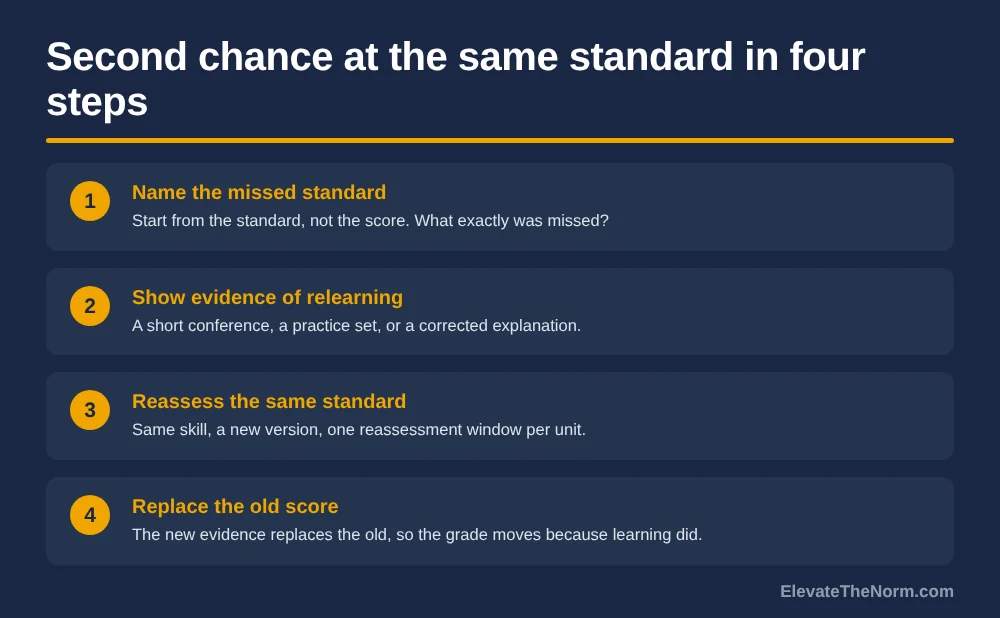
A reassessment after relearning. A student who missed a standard shows evidence of relearning, attempts it again, and the new score replaces the old one. The grade moves because the student learned something. Evidence of relearning can be a short conference, completed practice, or a corrected explanation, anything the student produces that shows what changed between attempts. Standards-based grading builds this in, and this site’s explainer on standards-based grading covers what it fixes and what the evidence shows.
Test corrections that require an explanation. A correction counts only when the student explains why the original answer was wrong and what the right reasoning is. Without the explanation, corrections hand points back. The article on making test corrections teach walks through how to set that up.
A revision cycle on a project. The Oregon State blog’s recommended replacement for extra credit is revise-and-resubmit, which supports learning from mistakes, shows growth over time, and gives students who face barriers another chance. A revision after feedback on a project draft is the strongest fit for project-based classrooms.
Each of these is better described as a second chance than as extra credit, and that is the point. The ideas that survive scrutiny are the ones that stop being extra.
| Extra credit idea | Same standard as the grade? | Every student can earn it in school? | Required work stays required? | Verdict |
|---|---|---|---|---|
| Bonus items on the assessment | Yes | Yes | Yes, if capped | Defensible |
| Deeper extension done in class | Yes | Yes | Yes | Defensible |
| Reassessment after relearning | Yes | Yes | Yes | Defensible |
| Test corrections with an explanation | Yes | Yes | Yes | Defensible |
| Revision cycle on a project | Yes | Yes | Yes | Defensible |
| Bring tissues, sanitizer, or supplies | No | No (depends on family budget) | No | Distorts |
| Attend a school or community event | No | No (transportation, time, childcare) | No | Distorts |
| Return a signed form | No | No (depends on adult responsiveness) | No | Distorts |
| Behavior or perfect-attendance points | No | No (illness, family circumstances) | No | Distorts |
| End-of-term makeup packet | Rarely | Partly | No | Distorts |
| Whole-class bonus for a group goal | No | No (one student’s absence affects everyone) | No | Distorts |
Which extra credit ideas distort the grade?
Extra credit distorts the grade when the points reward something other than learning: supplies, event attendance, signed forms, behavior, a last-week packet, or a group bonus. These ideas favor students with money, transportation, or adult support, and they let points cover gaps in required work.
Supplies. Bringing tissues, sanitizer, or classroom supplies sorts students by what a family can afford. A grade that rises with a purchase is reporting a household budget.
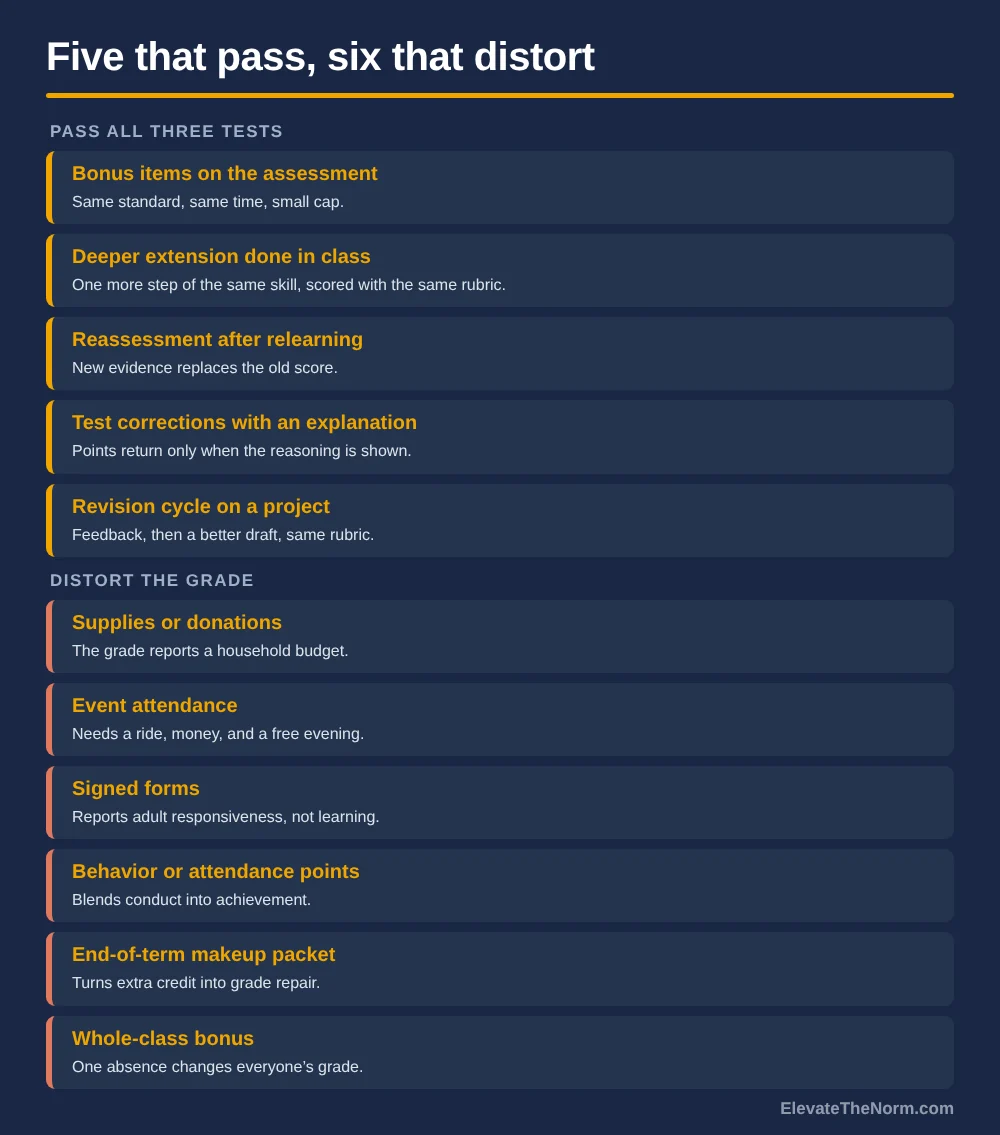
Event attendance. The Oregon State blog notes that extra credit tied to outside events can exclude students who lack money, transportation, childcare, or time. Even a free event assumes a ride home and an evening the student controls, and events off campus or after hours raise supervision and transportation questions that the school, not a fourteen-year-old, should own.
Signed forms. Points for returning a form report whether an adult was home and responsive. The student does not control that, and the grade should not depend on it.
Behavior and attendance points. Good behavior and perfect attendance may deserve recognition. They do not belong in the same number as achievement. The Brookhart review shows how much grades already mix the two, and extra points for behavior mix them again. Recognition outside the gradebook solves the same problem without blurring the grade.
End-of-term packets. The Oregon State blog describes end-of-term extra credit as shifting focus toward grades: students either chase points or use extra credit to cover a weak area, and can stop learning that material. A packet in the last week is a grade-repair tool wearing a different name.
Whole-class bonuses. A bonus for the whole class if everyone passes makes one student’s absence or bad day a cost to everyone else’s grade. If the goal is team spirit, it belongs in a reward, not in the gradebook.
In each case the points arrive for something other than showing what a student knows, and the result is a number that means less.


What works better than extra credit?
A second chance at the same standard works better: a retake after relearning, corrections that require an explanation, a revise-and-resubmit on a project, and a clear late-work policy. The grade rises only when the student shows the learning the grade was meant to report.
Feldman’s rule of thumb, quoted in the Oregon State blog, is a useful filter: “If the work is important, require it; if it’s not, don’t include it in the grade.” An extra credit activity worth doing probably belongs in the required work. One not worth requiring probably does not belong in the grade. The Maine Department of Education’s study guide for the book asks readers the same question: why are the activities offered as extra credit not simply part of the curriculum? In the Education Week column, Feldman’s alternative is to require valuable tasks, allow redos instead of substitutes, and leave unrelated tasks out of grades.
The pieces already exist on this site. The article on no-zero grading policy covers the math when a score is missing. The late work policy guide covers what the evidence supports now that the famous study behind many deadline rules has been retracted. Together with corrections and reassessment, they are the practical alternatives to extra credit for most classrooms.
Second chances cost grading time, and an honest article has to say so. Keep the workload manageable by opening one reassessment window per unit instead of accepting retakes whenever someone asks, by requiring evidence of relearning before the second attempt, and by capping the number of attempts. The evidence requirement also filters requests: a student who will not complete a practice set was not ready to retake the test anyway. A bonus item at the end of an assessment costs no extra class time at all, which is part of its appeal on an ordinary Tuesday.
Some teachers worry that students will not attempt enrichment once extra credit assignments disappear. That question is open. None of the sources opened for this article tests whether students still choose optional work when it earns nothing. A reasonable way to find out is to offer one optional challenge with feedback and no points, and see who takes it.
How do you set up extra credit if your school expects it?
Write the rules before the term, tie every opportunity to a current standard, run it during class time, cap the points, announce it to everyone at once, and close it well before grades are due. Those six steps keep extra credit attached to learning instead of negotiation.
- Write the rules before the term starts. Put what counts, how many points it can add, and when it closes in the syllabus. A policy written in December in response to one request is a favor, not a policy.
- Tie every opportunity to a current standard. The middle school teacher in the Education Week column says extra credit should be connected to the standards students are working on now, and kept short enough for busy students.
- Run it during class time. Anything done only at home or off site sorts students by circumstances. A work period gives every student the same time and the same materials.
- Cap the points. Choose a ceiling low enough that extra credit cannot replace missing required work. The ceiling is a judgment call; none of the sources opened for this article sets a number.
- Announce it to everyone at once, including families. The same teacher tells parents when she offers extra credit and has students track their own credit.
- Close it well before grades are due. A closing date several weeks before the term ends keeps extra credit from turning into last-week grade repair. The same teacher keeps deadlines firm.
Check the school’s grading policy first. Some schools and districts limit or ban extra credit, and this article describes practice, not policy. Announce any change before the term begins. Removing extra credit in the middle of a term turns a policy into a grievance, and families will reasonably ask why the rules moved.
Consistency matters at the school level too. If two teachers of the same course run different extra credit rules, a student’s grade depends on which room the student landed in. The middle school teacher in the Education Week column aligns with colleagues who teach the same content for this reason. It is also worth tracking who actually uses extra credit each term. If the same students use it every time, the policy is sorting students rather than helping them.
How is extra credit different from rewards and incentives?
Extra credit adds points to the grade. A reward does not. A free-choice day, a pass, or a note home changes the experience of class without changing what the grade reports. Keeping the two separate protects the meaning of the grade and still lets a teacher say thank you.
The guide to classroom incentives covers when incentives help and how to fade them, and the list of free classroom rewards collects twenty ideas for grades 6–12. Neither needs a gradebook entry.
A practical test: if a student is absent for the activity, does the grade change? If it does, the activity is extra credit and has to pass the three tests. If it does not, it is a reward and can be as playful as the class likes.
What should you tell students and parents about extra credit?
Tell them what extra credit counts for, when it opens and closes, and that every student gets the same chance at it. Put those three facts in writing at the start of the term so a request in December does not become a negotiation.
A written policy means no student has to ask for a favor, and it removes any suspicion that extra credit goes to whoever pushes hardest. Parents usually want to know how the grade is calculated and whether their child has a fair chance. A paragraph in the syllabus and a note home handle both. Label extra credit as its own category in the gradebook so a family can see how many points came from it. Post the opportunity, not the list of who has or has not taken it, because each student’s record is that student’s business.
Sample wording that fits on one slide: “Extra credit is a chance to show more of the same learning, in class, for every student. It is not a way around required work.” When a parent asks in December, point to the policy first, then to what is open: corrections, a retake, or a revision, with the date each closes.
Write the policy in plain language, and offer a translated copy where families need one. A student who has to decode the rules to use them is already at a disadvantage, which defeats the purpose of making extra credit open to everyone.
Clay’s take: give students a second chance at the same standard, not a bonus on a different one
My view as a teacher of grades 6–12: the best extra credit policy is the one that makes extra credit unnecessary. A student who missed a standard should get a clear path to show it later, and the grade should move only when that learning does.
I would not ban a small, in-class bonus item, because it adds evidence of the same standard. I would drop everything else on the distorting list and put the saved effort into a better retake process, one that asks for evidence of relearning before the second attempt. That requirement is the interesting part, because it turns a grade request into a learning plan.
Dignity is the part that rarely gets discussed. When a student has to ask for extra credit, the student is asking for a favor. A second-chance system with a published process lets students fix their own mistakes by following steps anyone can read, which treats them as capable of ownership instead of as petitioners.
What to do next
Start with an audit: list the extra credit ideas currently in use, run each through the three questions, and keep only the ideas that pass. Then replace the rest with a published second-chance process.
- List every current extra credit option and rate it against the three tests in the table above.
- Replace each failing idea with a retake, correction, or revision for the same standard.
- Publish the rules, the point cap, and the closing date for students and families before the next term.
Frequently Asked Questions
Is extra credit fair to students who already have an A?
Extra credit is fair when every student can earn it and the points measure the same learning as the grade. It becomes unfair when the points go mostly to students who are already doing well, the pattern one introductory biology course showed. Capping the points and tying them to a current standard keeps high grades honest.
Should extra credit ever raise a failing grade?
Extra credit should not rescue a failing grade, because it cannot replace evidence of required learning. A student who is failing needs a path back to the missed standards: relearning, then a retake or revision. If extra points can lift a failing grade to a pass, the point cap is set too high.
Is a test retake the same thing as extra credit?
A retake is not extra credit. A retake asks for the same standard again, and the new evidence replaces the old score. Extra credit adds points from a different source. That difference matters because a retake changes the grade only when the student shows learning the first attempt missed.
How do you keep second chances from burying you in grading?
Open one reassessment window per unit instead of accepting retakes at any time, require evidence of relearning before the second attempt, and cap the number of attempts. The evidence requirement filters out requests from students who have not done any new learning, and the window lets a teacher grade retakes in one batch.
What if my school or district bans or requires extra credit?
Follow the school’s grading policy first, since some schools and districts limit or ban extra credit and others expect it. Where it is allowed, use the three tests in this article to shape it: the same standard as the grade, open to every student in school, and capped so required work stays required.
Why shouldn’t students earn extra credit for supplies or events?
Points for supplies, event attendance, or signed forms depend on a family’s money, transportation, or availability, not on what the student learned. The grade then reports household circumstances. Rewards outside the gradebook, such as free-choice time or a note home, can thank students without changing what the grade says.
Do bonus items follow a student’s testing accommodations?
Bonus items built into an assessment should be given with the same accommodations the assessment already carries, such as extended time or read-aloud support, so students with documented needs can earn the points. Confirm the details with the special education team, because accommodations are set student by student.
How can families see how much of a grade came from extra credit?
Ask the teacher to label extra credit as its own category in the gradebook, with the cap and closing date in the syllabus. That lets a family see how many points came from extra credit and how many came from the required work, and it keeps one student’s record from being compared with another’s.
Sources
- Brookhart, S. M., Guskey, T. R., Bowers, A. J., McMillan, J. H., Smith, J. K., Smith, L. F., Stevens, M. T., & Welsh, M. E. “A Century of Grading Research: Meaning and Value in the Most Common Educational Measure.” Review of Educational Research 86(4), 803–848. Read at the repository-record and abstract level only. The abstract describes grades as a multidimensional construct with cognitive and noncognitive factors; it does not discuss extra credit. The full text was not opened.
- Padilla-Walker, L. M. “The Impact of Daily Extra Credit Quizzes on Exam Performance.” Teaching of Psychology 33, 236–239. Read at the abstract level. One advanced psychology course, 36 students; predictive analysis, not an experiment.
- “Research and Teaching: Who Does Extra-Credit Work in Introductory Science Courses?” Journal of College Science Teaching (NSTA). Read at the abstract level. One introductory biology course; the page does not list authors or the number of students. Shows selection, not cause.
- Myers, C. A., & Hatchel, J. M. “Personality and Cognitive Factors Related to Completing Extra Credit Assignments.” International Journal for the Scholarship of Teaching and Learning 13(2), Article 7. Abstract and results read in full. 276 undergraduates; no significant main effect of completing extra credit. Despite the title, the paper measures no personality traits.
- Naxer, M. “Assessment Design: The Case Against Extra Credit.” Oregon State University Ecampus, Inspire blog. Practitioner argument, not research. The post cites one book, Feldman’s Grading for Equity, and describes no empirical studies.
- Ferlazzo, L. “Should Teachers Offer Extra Credit? Yea or Nay?” Education Week, Classroom Q&A (opinion). Opinion column with a middle school teacher (for) and Joe Feldman (against). Feldman’s one research claim names no study; neither contributor cites data.
- Maine Department of Education. Study guide, Grading for Equity, Chapter 9. A summary of Feldman’s chapter, cited as a summary. The book itself was not opened, so Feldman’s claims are reported second-hand.
- Editorial note. the three tests, the eleven-idea ratings, the five defensible ideas, the six-step setup list, the four-step second-chance process, and the point-cap suggestions are compiled for this article and are recommendations, not a report of any teacher’s classroom. No study opened for this article tests extra credit in grades 6–12, and none tests these ideas as a set.