By Clay Shumate
Project-based learning in high schools does not require restructuring the bell schedule, eliminating teacher autonomy, or rebuilding your curriculum from scratch. It requires redesigning one unit well enough that the schedule you already have holds it. Most of the barriers teachers cite — the pacing guide, the forty-five-minute period, the standardized assessment calendar — are real constraints. None of them prevent strong PBL.
What actually blocks PBL in high schools is usually design. A project with a vague driving question, no real audience, and no individual accountability component will fail whether the period is forty-five minutes or ninety. A project with a specific question, a genuine audience, a clear rubric, and individual checkpoints throughout will work in almost any schedule. The implementation models below are sized to what actually exists in most high schools: single teachers with no extra planning time, limited administrative support, and students who have not been asked to produce public work before.
What the Schedule Obstacle Actually Is
Teachers who say “PBL won’t work in my schedule” are describing something real. Exhibition days, extended hands-on builds, and complex multi-week projects are genuinely harder to run in fifty-minute periods than in ninety-minute blocks. The concern is legitimate.
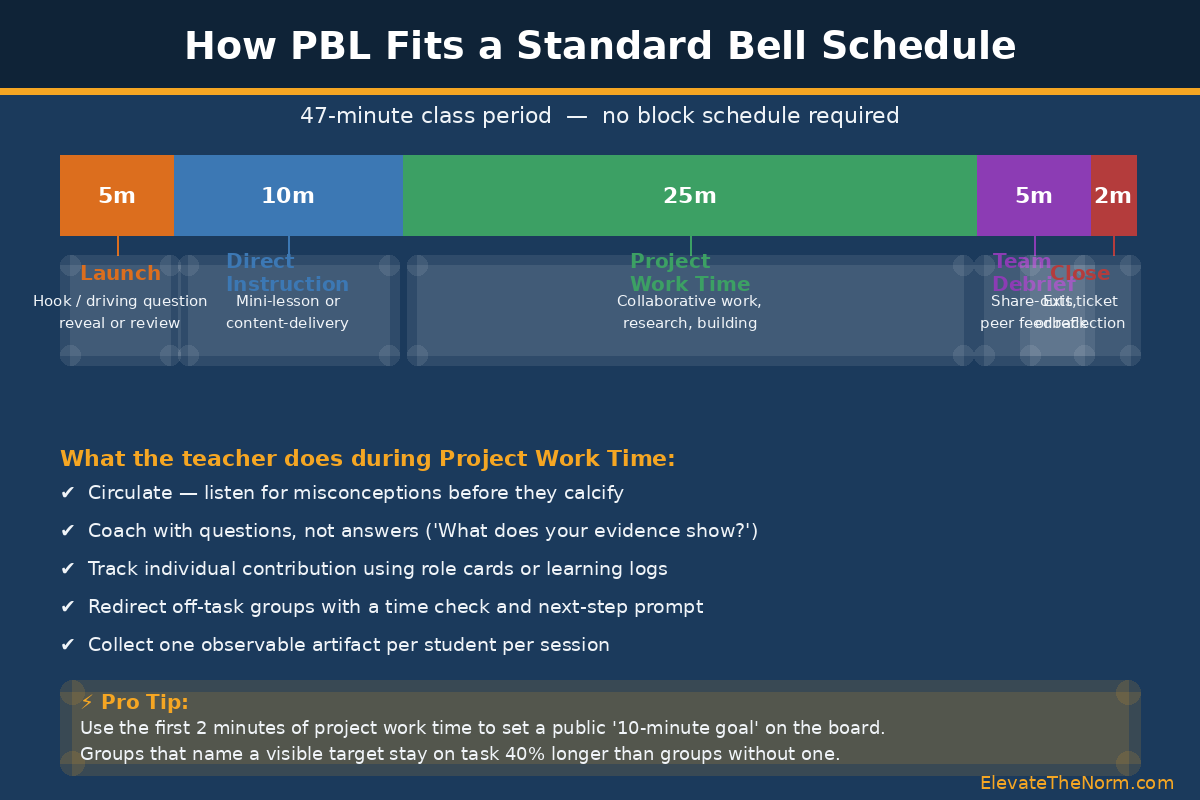
The concern is also overstated. The core operations of strong PBL — questioning, researching, drafting, conferencing, revising, presenting — happen inside conventional periods when you plan the sequence carefully. You assign each phase a number of days. A four-week project in a fifty-minute class gives you roughly twenty class periods, which is enough to run a genuine inquiry cycle if you use each day with the same specificity you would use a lesson plan.
Condliffe et al.’s 2017 MDRC literature review found that PBL improved student outcomes when it was well-implemented across a range of school structures and schedules. The schedule matters less than the implementation. A well-designed project in a conventional period outperforms a poorly designed project in a block every time.
The Single-Teacher Model
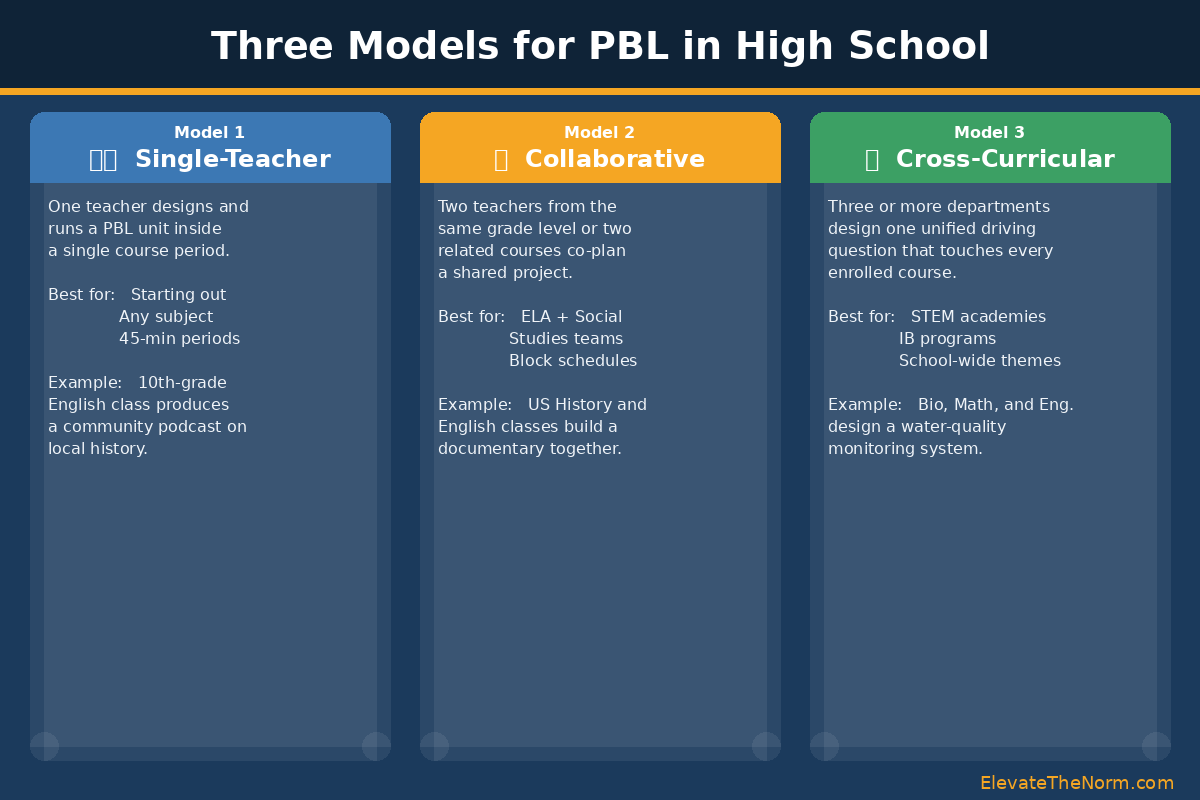
This is where most high school PBL starts, and where most of it should start. Pick one unit. Redesign it as a project. Keep everything else the same.
A single-teacher PBL unit has a driving question, a real audience, and a public product. The driving question is not a discussion prompt — it is a question worth investigating, specific enough to constrain the inquiry and open enough to produce disagreement. “Was Reconstruction a success or failure?” is a discussion prompt. “What would a just settlement for the formerly enslaved have required in 1865, and why didn’t the country build it?” is a driving question. Students produce something that answers the question for people who are not their teacher. For subject-by-subject models, see these project based learning driving question examples.
The project runs inside your existing pacing guide. You are not abandoning standards — you are choosing how one unit demonstrates them. For more on what this structure looks like from the beginning, see the seven-step PBL framework, which walks through each phase from driving question to public product.
Han, Capraro, and Capraro (2015) found in their meta-analysis of STEM PBL that the approach benefited high achievers, middle achievers, and low achievers — though the effect sizes differed. Low achievers benefited most from structured scaffolding built into the project design. That finding has a practical implication: a well-scaffolded project is more equitable than the alternative, not less.
The Coordinated Model
Two or three teachers align one project across their subjects. A junior researching water quality in a chemistry unit is also analyzing the data in statistics and writing a persuasive proposal in English. Each teacher contributes one piece; the student produces one coherent product.
This requires planning time, which most high schools do not generously provide. It does not require schedule restructuring. It requires two planning conversations — one to agree on the project and one to divide the work — and then enough coordination that you are not both assigning major due dates on the same day.
The coordinated model produces stronger student work than the single-teacher model because it shows students that the connections between subjects they already suspect are real. It also distributes the grading burden: each teacher grades only their component, rather than one teacher grading everything.
The most common coordination failure is drift — teachers agree on the project in September and diverge by October because their pacing guides pull them in different directions. The fix is a shared timeline with checkpoints that all three teachers can see. A shared document, a standing check-in once every two weeks, and an explicit agreement about which teacher owns the driving question are usually enough.
The Schoolwide Model
A schoolwide PBL commitment means dedicated exhibition days, structural schedule flexibility, and sustained administrative support. It is the model most commonly described in PBL literature because it is the most documented. It is also the model that requires the most buy-in and is the wrong place to start.
Start with one unit in one class. Document the student work. A principal who sees the evidence — real student products, real depth of engagement, real outcomes — is more persuadable than one being asked to commit time and resources to a theory. The single-teacher model is the proof of concept that earns the schoolwide model later. Do not ask for institutional support before you have something to show.
Kokotsaki, Menzies, and Wiggins (2016), reviewing the PBL implementation literature, found that teacher comfort and competence with PBL were the strongest predictors of successful outcomes — more than school structure, administrative support, or technology access. A confident teacher running a single unit in an ordinary classroom produces better outcomes than an uncertain teacher running a schoolwide model with all the resources. Build the confidence first.
What Has to Stay in Place
Standards are not optional. A PBL unit that covers interesting work without hitting the required standards is a liability for students who need those standards taught. Every project needs a clear answer to three questions: what standard does this project demonstrate, how will student work show mastery, and how does the grade reflect it? If you cannot answer all three, the unit is not ready to run.
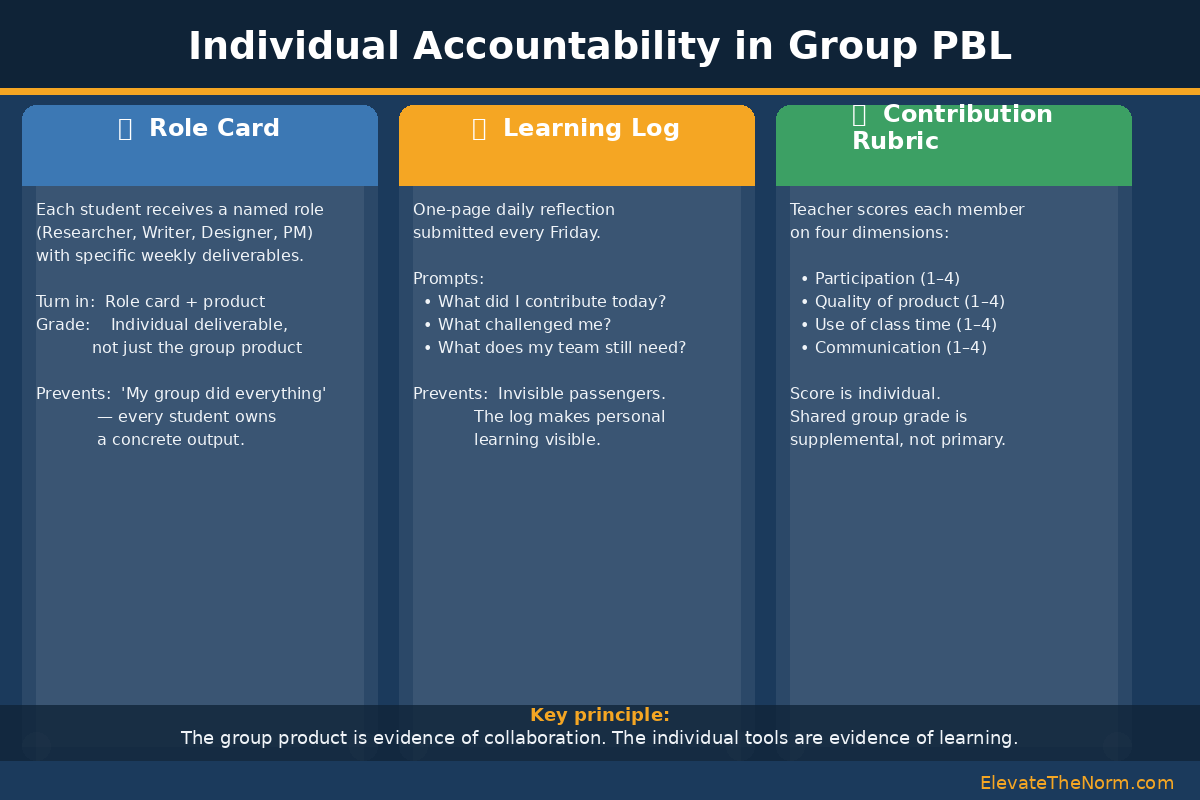
Individual accountability is not optional. Group projects in which one student does most of the work while others contribute minimally are not PBL — they are badly supervised group projects. PBL requires a component of the final grade that reflects individual student work: individual research logs, individual reflection journals, or a presentation component in which each student defends their own contribution. A project based learning rubric that separates individual contribution from group product solves the most common grading problem in PBL before it becomes a problem.
Grading standards are not optional. Students who are used to being graded on compliance — following directions, completing steps, meeting deadlines — need to be explicitly taught what quality looks like before they can produce it. Criterion-referenced rubrics with clear, student-readable descriptors do this. A rubric that says “Research is thorough and relevant” teaches nothing. A rubric that says “Research includes at least four credible sources that are directly cited in the product” teaches what thorough looks like.
Special Populations and PBL
A real high school classroom has students with IEPs, students with 504 plans, English language learners, students who are two or three grade levels behind in reading, and students who have learned that staying invisible is the safest strategy. PBL is not inherently more or less accessible than a unit test. It is differently accessible — which means you have to plan for it differently.
Every accommodation that applies to a test applies to a project. Extended time on the research and drafting phases. Alternative presentation formats when the standard permits it. Scaffolded notes and graphic organizers during the inquiry phase. A student who struggles with written expression but reasons clearly can produce a strong verbal or visual component. A student who has never raised their hand in a lecture has a better chance of contributing in a structured conference on a question they actually worked to answer.
The key is building the scaffolding before the project starts, not after the first group falls apart. Explicit instruction in the process skills the project assumes — how to evaluate a source, how to structure an argument, how to give useful feedback to a peer — must happen before students are expected to use those skills. If you have not taught these as discrete, assessable skills, you cannot grade them as discrete, assessable skills, and the students who most need the instruction will be the least prepared to produce without it.
Ertmer and Simons (2006), in their research on PBL implementation barriers for K–12 teachers, found that scaffolding decisions — specifically, how much structure to provide and when to reduce it — were the most frequently cited challenge for new PBL teachers. The answer is to start with more structure than you think you need and reduce it as students demonstrate readiness. PBL is not a launch-and-step-back model. It is a sustained presence model. The teacher is circulating, conferencing, redirecting, and adjusting throughout the project’s duration.

What Administrators Must Protect
The most common way PBL fails in high schools is not in the classroom. It is when a principal or curriculum coordinator, under pressure from test scores, eliminates the conditions that let project work develop.
Projects take longer to show results than unit tests. A class spending three weeks on one question while the pacing guide suggests five days looks inefficient from the outside. An administrator who understands what is being built — and what the research comparing project based learning vs traditional learning actually shows about depth of engagement producing stronger retention and transfer than coverage speed — can defend that choice. An administrator who does not understand it cannot, and will not.
Administrators researching this before a department meeting usually start with a search box or an AI assistant, and what comes back is shaped by whoever is selling a platform. It is worth reading what AI is telling people about project-based learning before that conversation, because the funding, staffing and curriculum answers a chatbot gives are the ones your teachers will have already seen.
What administrators must protect: the presentation or exhibition component. A project with no real audience beyond the teacher is not a public product — it is a long homework assignment. The audience changes the stakes, and the stakes change the quality of the work. Mergendoller, Maxwell, and Bellisimo (2006) found that problem-based learning produced stronger content mastery than direct instruction in their economics study, but the effect was largest when students were required to explain and defend their work — not just produce it.
What administrators must provide: protected planning time, even in small amounts. A single-teacher PBL unit can happen without any new time. A coordinated project needs one shared planning session. A schoolwide model needs a sustained structure. The level of institutional support you provide determines the level of implementation you can reasonably expect. Teachers who are asked to run PBL without any planning time will default to the version of PBL that requires the least coordination, which is rarely the version that produces the best outcomes.
The Room That Makes This Easier
In my room, partner work is the default condition, not a special activity. Tables are pushed together into groups from the moment class starts. Students sit alongside somebody as a structural fact of the room, not as a reward or a project-day configuration. The collaboration that happens inside a PBL unit builds on top of a habit students have been practicing all year.
It also raises the question every project eventually raises, which is how you see what any individual student actually contributed — a job for a short group-work self assessment rather than for the group grade. That distinction matters for high school implementation. The failure mode in project work is isolation — students who have no one to think alongside drift toward the minimum. When a class has been working in partners and small groups since September, the project’s collaborative components are not a new mode they have to learn. They are the usual mode applied to a more complex question.
You do not need my specific room setup to run effective PBL. But the arrangement of a classroom is a decision, and the default arrangement in most high school rooms — desks facing forward, students working alone — is a decision that makes project-based work harder. If you are planning to introduce PBL, consider whether your physical setup supports it. Desks can be moved. Tables can be pushed together. The collaborative condition does not require a renovation — it requires a decision. For ideas on what strong examples of project-based learning look like in practice, the examples linked there show what finished student work can look like at different grade levels.
PBL in high schools is not a school reform project unless you want it to be. It is a unit design decision you can make in any classroom, on any schedule, with any level of administrative enthusiasm, as long as you design it carefully enough that the structure of the school holds it. The schedule is not the problem. The design is the work. For a deeper look at how to structure individual student accountability within group projects, see the high expectations framework that this site returns to across multiple articles — the expectations you set for PBL are the same expectations you set for every other part of the year.
Sources
- Condliffe, B., et al. (2017). Project-Based Learning: A Literature Review. MDRC. https://www.mdrc.org/sites/default/files/Project-Based_Learning-LitRev_Final.pdf
- Han, S. Y., Capraro, R., & Capraro, M. M. (2015). How science, technology, engineering, and mathematics (STEM) project-based learning (PBL) affects high, middle, and low achievers differently. International Journal of Science and Mathematics Education, 13(5), 1089–1113. https://doi.org/10.1007/s10763-014-9526-0
- Kokotsaki, D., Menzies, V., & Wiggins, A. (2016). Project-based learning: A review of the literature. Improving Schools, 19(3), 267–277. https://doi.org/10.1177/1365480216659494
- Ertmer, P. A., & Simons, K. D. (2006). Jumping the PBL implementation hurdle: Supporting the efforts of K–12 teachers. Interdisciplinary Journal of Problem-Based Learning, 1(1), 40–54. https://doi.org/10.7771/1541-5015.1005
- Mergendoller, J. R., Maxwell, N. L., & Bellisimo, Y. (2006). The effectiveness of problem-based instruction: A comparative study of instructional methods and student characteristics. Interdisciplinary Journal of Problem-Based Learning, 1(2), 49–69. https://doi.org/10.7771/1541-5015.1026
- Krajcik, J., & Shin, N. (2014). Project-based learning. In R. K. Sawyer (Ed.), The Cambridge handbook of the learning sciences (2nd ed., pp. 275–297). Cambridge University Press.
Frequently Asked Questions
Can I do project-based learning in a forty-five-minute period?
Yes. The period length constrains certain activities — a complex hands-on build or a formal public exhibition takes more than forty-five minutes — but the core operations of PBL happen inside conventional periods when you phase the project carefully. Assign each phase a set number of days: questioning on day one, initial research on days two and three, drafting on days four through six. The period is a budget, not a prohibition. A well-phased project in a fifty-minute class produces the same learning as one in a ninety-minute block.
Does project-based learning work with state standards?
Standards are the frame, not the obstacle. Every PBL unit should answer three questions before it starts: what standard does this project demonstrate, how will student work show mastery, and how does the grade reflect it? A project that does not target a standard is an enrichment activity, not a PBL unit. Select one or two standards and build the driving question around what demonstrating those standards would look like applied to a real problem. The standards do not change; the form in which students demonstrate them does.
How do I grade a group project fairly?
Separate what you assess from who produces it. An eight-category rubric that covers process, product, research quality, collaboration, revision, presentation, individual contribution, and reflection lets you grade the final product on quality criteria while tracking each student’s individual role. The individual contribution and research-log components prevent the one-student-does-everything problem. A shared rubric introduced at the start of the project — not at the end — also teaches students what quality looks like before they are graded on it.
What about students with IEPs or 504 plans?
Every accommodation that applies to a test applies to a project. Extended time applies to the research and drafting phases, not just the final product. Alternative presentation formats apply when the standard permits them. Graphic organizers and scaffolded note-taking structures apply during the inquiry phase. The critical difference between PBL and direct instruction for students with learning differences is that PBL offers more legitimate pathways to demonstrate the standard — a student who struggles with written expression can contribute a strong verbal or visual component. Plan the accommodations before the project starts, not after the first group session falls apart.
How do I get my principal to support PBL?
Run one unit and document the student work. An administrator who sees a class’s worth of evidence-based arguments — specific, researched, revised — is more persuadable than one being asked to commit resources to a theory. The case for administrative support is a portfolio of student products, not a research summary. Start small, save the work, show what depth of engagement looks like when it works. Schoolwide support is earned through demonstrated outcomes in individual classrooms, not by leading with the institutional vision.
What is the most common reason PBL fails in high schools?
Design, not scheduling. A project with a vague driving question, no real audience, and no individual accountability component fails regardless of the period length or the level of administrative support. The driving question has to be specific enough to constrain the inquiry and open enough to produce genuine disagreement. The audience has to exist outside the classroom. Individual students have to have something at stake that cannot be carried by a partner. When those three conditions are met, most scheduling and staffing obstacles become manageable. When they are missing, no amount of institutional support compensates.
About Clay Shumate
Clay Shumate is a certified secondary Social Studies teacher in the public schools of West Alabama, with seven years of classroom experience, a B.A. in History, and an M.Ed. in Secondary Education. He writes about project-based learning, student responsibility, respect, and practical ways to hold young people to a higher standard while giving them room to learn from mistakes. He is a member of the Society of Professional Journalists and writes to its Code of Ethics; this site’s editorial standards and corrections policy are published in full. More about Clay.