A student accountability sheet is a short, structured form a student completes after something went wrong — a missed deadline, a group conflict, a behavior that affected the room. Done right, it takes about five minutes and produces a useful conversation. Done wrong, it is busywork that teaches students nothing except how to fill out busywork. This guide explains the difference, offers a free template in four versions, and shows exactly how to use it in a secondary classroom without humiliating anyone or generating a paper trail for things that do not belong on one.
Key Takeaways
- An accountability sheet supports a conversation — it is not a punishment, a replacement for a school referral, or a way to document a student for later.
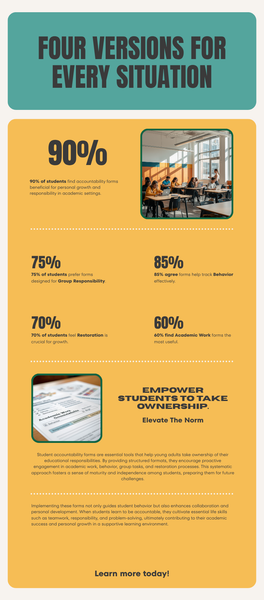
- Four versions cover the situations teachers actually face: academic work, group responsibility, behavior, and restoration after a conflict.
- Students complete the sheet themselves. That is the point. If the teacher is doing the writing, the tool is being used incorrectly.
- The sheet is not a file. Unless a required school procedure calls for documentation, it lives with the student or gets recycled after the conversation.
- Any teacher can use this the first week of school. No program, no training, and no administrator approval required.
What Most Accountability Sheets Get Wrong
Most accountability sheets found in schools — and most of the printables circulating on teacher resource sites — were designed for elementary students and scaled up by changing the font. They ask students to write “what I did wrong” in a box, then “how I will do better next time” in another box, and they expect that sequence to produce insight. It rarely does, because the sequence assumes the student already has a clear picture of what happened and why. They often do not.
The other common design flaw is that the sheet exists only as a record. A teacher hands it to a student, the student fills it out, the teacher collects it and puts it in a folder. Nothing happens as a result. The student learns that accountability means paperwork, not change — which is exactly the wrong lesson.
A well-designed student accountability sheet for grades 6–12 does three things that most forms skip. It separates facts from interpretations, so students can describe what actually happened without being led toward a particular framing. It identifies who, specifically, was affected — not just “the class” in the abstract. And it generates a next step the student can actually take, not a vague commitment to “try harder.”
When to Use an Accountability Sheet
There are four situations where a short accountability sheet is useful in a secondary classroom. Understanding the difference between them matters, because each version of the sheet asks slightly different questions.
Academic Work
A student missed a deadline, submitted incomplete work, or disengaged from a task. The goal of the sheet in this case is not to assign blame but to figure out what actually got in the way. Sometimes the answer is workload. Sometimes it is confusion about the assignment. Sometimes it is something happening at home. The sheet creates space to say so without the conversation becoming a confrontation.
Group Responsibility
A student did not hold up their part of a group project. Or a group is in conflict about who did what. The group version of the sheet is filled out individually by each member before the group meets together — which means every voice is already on paper before anyone starts defending themselves out loud. This simple sequencing change reduces the volume of these conversations significantly.
Behavior
Something happened in the room — a comment that landed wrong, a refusal, an outburst — that the teacher needs to address before moving on. This version is short by design, because a behavior conversation does not benefit from extended written reflection in the moment. The sheet gives the student a minute to collect their thoughts before speaking, which is often all that is needed to de-escalate the temperature.
One important note: if the behavior requires a school referral, disciplinary report, or any documentation under your district’s required procedures — do that. The accountability sheet is a classroom tool, not a substitute for mandated process. If you are unsure whether a situation requires official documentation, assume it does and act accordingly. The sheet goes with the student afterward, not instead of the referral.
Restoration
Something happened between students — a conflict, an unkind comment, a damaged trust — and the class needs to move forward. The restoration version is the most conversational of the four. It is the one most closely aligned with restorative approaches, and it works best when both students complete their own version before sitting down together. For more on restorative approaches in a school context, see restorative practices in schools.
The Templates
Each template below is designed to be reprinted, typed into a shared document, or read aloud and answered verbally depending on the student and the situation. The fields are short. The language is direct. None of it is condescending.
Version 1 — Academic Work
Student name: _______________ Date: _______________
The assignment or task: _______________
What was supposed to happen? (Describe the expectation — due date, format, what “complete” looked like.)
What actually happened? (Facts only. Not reasons yet.)
What got in the way? (This is where reasons belong. Be honest — including “I didn’t prioritize it” is a valid answer.)
What is one thing you can do in the next 48 hours to move this forward?
What support, if any, do you need from me?
Version 2 — Group Responsibility
Student name: _______________ Project or task: _______________ Date: _______________
What was your agreed-upon role or task in this group?
What did you actually complete?
What did your group expect from you that you did not deliver?
What happened from your perspective? (State facts and reasons separately.)
What do you owe the group at this point?
What is your next step, and when will it be done?
Version 3 — Behavior
Student name: _______________ Date: _______________ Period/class: _______________
Describe what happened. (What you said or did — not what someone else did first.)
Who was affected by it? (Name the people, not just “everyone.”)
What do you want those people to know?
What is one thing you will do differently?
Note to the teacher: this version is designed for classroom-level situations. If the incident requires a disciplinary referral, complete your school’s required documentation first. This sheet is a follow-up conversation tool, not a replacement for required procedures.
Version 4 — Restoration
Student name: _______________ Date: _______________
What happened between you and the other person? (Your account of it — not what they did, what happened between you.)
What did the other person lose or experience because of the situation? (This is a perspective-taking question. Answer it honestly even if it is uncomfortable.)
What do you want to be different going forward?
Is there something specific you are willing to do or say to move toward that?
What do you need from me or from the other person to make this work?

How to Use the Sheet
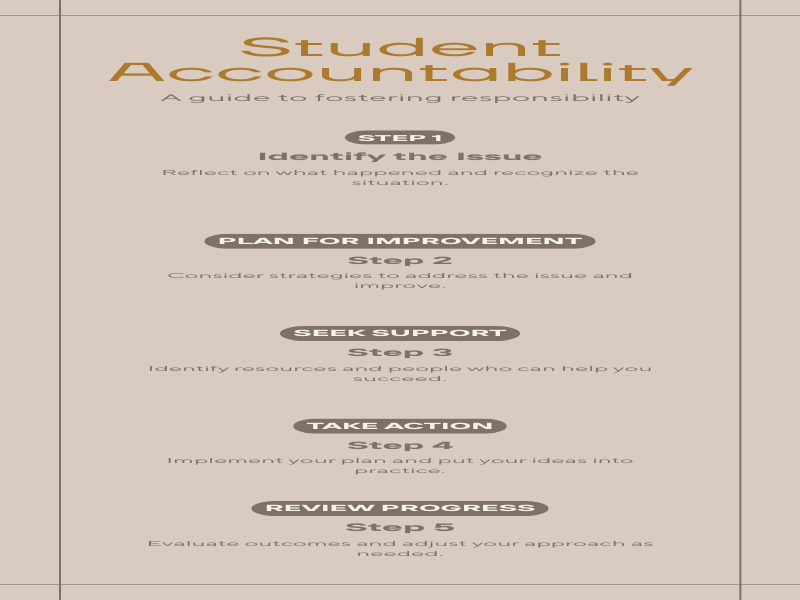
The sheet is not the conversation. It is the preparation for one. A student who fills it out in silence and hands it in has not been held accountable — they have completed a writing assignment. The point of the form is that it gives the teacher and the student a shared document to look at together, which is significantly less confrontational than looking at each other across a desk.
The sequence that works: hand the student the sheet and give them three to five minutes to complete it, without hovering. Sit down together to review it — ideally somewhere that is not the center of the room. Read it together, ask one or two follow-up questions, and agree on the next step before the student returns to work. That is the whole procedure. If it is taking longer than ten minutes, either the situation is more serious than this tool was designed for, or the conversation has turned into a lecture. Stop the lecture.
The anchor question in every version is some variation of “what is your next step?” That is the question that determines whether the sheet produced anything useful. A vague next step (“I’ll try harder,” “I’ll be better”) is not a next step. Push for something specific and time-bound: “I’ll finish the introduction section by Thursday,” or “I’ll ask Morgan what I can do to address what happened.” Specificity is what makes accountability concrete rather than performative.
A Classroom Anchor: Authority Handed and Held
The accountability sheet works best when students already understand that authority in the room is real and is held to. A clearly visible classroom expectations poster does much of this work passively — it gives students a reference point before anything goes wrong, so the accountability sheet’s first question (“what was supposed to happen?”) lands with specificity rather than guesswork. In my workshop room — where students are almost always working alongside somebody, and I move between groups rather than lecture from the front — the sheet tends to come up most often around group work, and specifically around moments where a student was trusted with a role and did not follow through on it.
When that happens, I do not announce it to the room. I slide the Version 2 sheet to the student at their table and give them four or five minutes while I circulate. Then I pull them to the whiteboard table — my small-group conferencing area with a rug, better chairs, and a lower lamp, where students know they are being seen carefully and not put on display — and we work through their answers together.
The conversation is not about catching them in something. It is about naming what happened clearly enough that we can figure out what comes next. Students who have been given real authority over something — their section of a project, their role in a group, a decision that affects others — understand why the accounting matters. It matches the weight of the responsibility they were given. What does not match it is a form that feels like it was designed for a third-grader. The template above is written at the level the student is actually operating at. That is the difference between accountability and humiliation, and it matters.
This approach connects directly to what student responsibility looks like in the classroom — real responsibility includes real accounting when things go wrong, not manufactured consequences or empty apologies. For the broader case for high expectations paired with the room to learn from mistakes, see high expectations for students.


What Happens When a Student Doesn’t Follow Through
A student completes the sheet, agrees to a next step, and then does not take it. This happens. Here is the important thing: that outcome does not mean the sheet failed. It means you now have a second conversation with more information than you had before. You know what the student said they would do. You know they did not do it. The conversation gets more specific, not more punitive.
The escalation path in this case depends on what the situation actually requires. Some students need more support than a single conversation provides — academic, social, or something else entirely. The sheet is not a substitute for identifying that need and addressing it. If a pattern emerges across multiple sheets and conversations, that is information that may need to go to a counselor, an interventionist, or a parent. At that point the sheet is one piece of a larger picture, not the whole solution.
For students whose accountability issues involve ongoing behavior challenges, the positive discipline framework for teenagers provides a more structured approach that pairs well with the sheet. For situations involving harm between students, the natural consequences framework and the restoration version of the sheet work together. And for the broader question of how to build a classroom where students actually want to hold themselves accountable, see the site’s overview of student responsibility as a developmental skill, not a character judgment.
The Research Behind It
Self-regulated learning research has consistently found that students who can reflect on their own performance — identify what went wrong, name contributing factors, and plan a corrective action — outperform students who receive only external evaluation (Zimmerman, 2002). The accountability sheet is applied self-regulated learning: it scaffolds a reflective process that students build over time.
Self-determination theory (Deci & Ryan, 2000) adds an important dimension: students are far more likely to take a next step they chose than a consequence that was imposed on them. Every version of the sheet ends with the student naming a next step. That ownership matters for what actually happens afterward. Hattie’s (2009) meta-analysis of over 800 studies identified student self-assessment — including structured reflection on what went wrong — as one of the highest-leverage interventions available to teachers. The accountability sheet is a low-cost, no-training version of exactly that.
Research on restorative approaches in schools (Morrison & Vaandering, 2012; Skiba & Peterson, 2000) supports the same conclusion from the discipline side: punitive responses to student misbehavior consistently underperform restorative ones on measures of recurrence, school climate, and relationship repair. A sheet that asks students to identify who was affected and what they are willing to do to repair it is grounded in that same framework, without requiring a school-wide program or a trained facilitator.
Printables for this
Two of mine on TPT, both built for this. Behavior Documentation Forms are the other half of the picture — the ABC data and MTSS logs you keep when a pattern does need a record, which the sheet above deliberately is not. The Makeup Work System handles the follow-through on the academic version, so “what is your next step” has a process behind it.
Frequently Asked Questions
Is a student accountability sheet the same as a disciplinary referral?
No. A disciplinary referral is a formal school document that enters a student’s record, triggers review by an administrator, and may carry consequences under district policy. An accountability sheet is a classroom tool — a short form that supports a private conversation and a next step. It is not filed, not sent to the office, and not part of the student’s disciplinary record unless you deliberately attach it to a referral as supporting documentation. If a situation requires a referral, complete the referral. The accountability sheet is for situations that do not — which is the majority of what happens in a classroom on any given day.
What if the student doesn’t fill it out honestly?
Some students will write what they think you want to hear. That is useful information, too. If the sheet reads like a performance rather than a reflection, say so directly and ask one specific follow-up question: “When you wrote you would try harder — what does that look like for you on Monday?” Most students will either give a more honest answer or reveal that they actually do not know. Both are starting points for a real conversation. The sheet is not a truth test. It is a structure for a conversation, and the conversation is where the real work happens.
Does this go in the student’s permanent file or record?
No — not unless your school’s procedures specifically require it for a given type of incident. For most classroom-level situations, the sheet lives with the student or gets recycled after the conversation. If you are using it as part of a required disciplinary process, follow your school’s documentation requirements for that process. Do not create an informal file of completed accountability sheets. That is not what this tool is for, and it can create problems if the file is ever requested.
Can parents request to see these sheets?
Parents can request records their child’s school maintains about them under FERPA. If you are collecting and storing completed accountability sheets in any systematic way, you should treat them as education records and handle them accordingly. The simplest way to avoid this issue is to not store them: use the sheet, have the conversation, and let the student keep it or discard it. A brief note in your own records of the conversation and the agreed-upon next step is sufficient documentation for your own use.
What should I do if the student refuses to fill it out?
A student who refuses to engage with the sheet is telling you something about their state in that moment. Do not escalate over the sheet itself. Give them a minute, check in quietly, and decide whether this is a moment of genuine distress, a test of your authority, or something else. If it is a test, name what you see calmly: “I’m going to give you two more minutes. I’ll come back.” If it is distress, the sheet can wait. If refusal becomes a pattern, that is a separate conversation — about engagement and trust, not about a form.
At what grade level does this work best?
The templates above are designed for grades 6–12. The language is appropriate for middle school and can be used as-is with most high school students. Students in grades 6–8 may need more scaffolding during the conversation — they often have the self-awareness but not yet the vocabulary to name what happened clearly. The teacher’s role in those grades is slightly more coaching than questioning. High school students can generally complete the sheet more independently, though the conversation afterward is equally important at both levels.
How do I use the group responsibility version fairly when students blame each other?
Have each student complete their own version of the sheet before anyone talks. This is non-negotiable: if students start talking first, they immediately start building a shared story that may not reflect what each person actually experienced. Once each student has answered the questions in writing, bring them together. Start with what each person wrote about their own contribution — not the other person’s failures. The sheet’s structure forces that sequence because the questions are framed around the student’s own actions. It does not eliminate conflict, but it changes the opening move from accusation to accounting.
Sources
- Zimmerman, B. J. (2002). Becoming a self-regulated learner: An overview. Theory Into Practice, 41(2), 64–70. https://doi.org/10.1207/s15430421tip4102_2
- Deci, E. L., & Ryan, R. M. (2000). The “what” and “why” of goal pursuits: Human needs and the self-determination of behavior. Psychological Inquiry, 11(4), 227–268. https://doi.org/10.1207/S15327965PLI1104_01
- Hattie, J. (2009). Visible Learning: A Synthesis of Over 800 Meta-Analyses Relating to Achievement. Routledge.
- Morrison, B. E., & Vaandering, D. (2012). Restorative justice: Pedagogy, praxis, and discipline. Journal of School Violence, 11(2), 138–155. https://doi.org/10.1080/15388220.2011.653322
- Skiba, R. J., & Peterson, R. L. (2000). School discipline at a crossroads: From zero tolerance to early response. Exceptional Children, 66(3), 335–346. https://doi.org/10.1177/001440290006600303