
By Clay Shumate
Classroom management styles are usually sorted into four types — authoritative, authoritarian, permissive, and indulgent or uninvolved — by crossing how much structure a teacher demands with how much warmth a teacher offers. The framework is borrowed from parenting research, and the high-structure, high-warmth style has the best support.
I find this taxonomy genuinely useful and I want to be straight with you about what it is. It is a heuristic that came out of developmental psychology about parents, got carried into teacher education, and is now repeated in professional development as though someone measured it in classrooms. Mostly, nobody did. That does not make it worthless. It makes it a map rather than a measurement, and a map is still worth having if you know what it is.
Key Takeaways
- The four styles come from crossing two dimensions, not from four separate discoveries: how demanding you are and how responsive you are.
- The framework is borrowed, not homegrown. It originates in research on parents, and the attempts to measure it on teachers have been small.
- Authoritative — high structure, high warmth — has the strongest support, and the evidence for each half of it is better than the evidence for the typology itself.
- Your style is a default under pressure, not a personality. What you do in week three when you are tired is your real style.
- Two of the four styles fail the same way. Permissive and authoritarian rooms both end up unpredictable, just for opposite reasons.
What are the four classroom management styles?
They are four combinations of two things: how much you require and how much you respond. That is the whole framework, and once you see it as a grid rather than a list of four personalities, it gets much more useful.
- Authoritative. High demands, high responsiveness. Clear non-negotiable expectations, explained reasoning, visible care, consequences that arrive as promised.
- Authoritarian. High demands, low responsiveness. Rules without reasons, compliance as the goal, correction without relationship.
- Permissive. Low demands, high responsiveness. Warm, liked, negotiable — and the floor moves depending on who is asking.
- Indulgent or uninvolved. Low demands, low responsiveness. Work assigned, grades entered, nothing much required and nothing much offered.
A note on vocabulary, because it trips people up. Different sources use “permissive” and “indulgent” as synonyms, and some use “uninvolved” or “neglectful” for the low-low cell. The names drift. The two dimensions do not, so when a PD slide confuses you, go back to the grid.
Where the classroom management styles framework actually comes from
It comes from Diana Baumrind’s research on parents, extended into a two-by-two grid by other researchers, and only later applied to teachers. Nobody set out to build a theory of classroom management.
Baumrind’s longitudinal work followed children at ages 4, 9 and 15 and found that “authoritative parents who are highly demanding and highly responsive were remarkably successful in protecting their adolescents from problem drug use, and in generating competence” — while also noting that authoritative parenting was not the only route to a competent adolescent (Baumrind, 1991). That sample was 139 adolescents from an affluent, well-educated, predominantly white population. It is a real finding on a narrow group of families.
The familiar four-cell version came later. As Nancy Darling’s summary of the literature puts it, “categorizing parents according to whether they are high or low on parental demandingness and responsiveness creates a typology of four parenting styles: indulgent, authoritarian, authoritative, and uninvolved,” a dimensional move credited to Maccoby and Martin in 1983 (Darling, “Parenting Style and Its Correlates”). So the four styles you have seen on a laminated handout are a grid built on top of a three-category typology about families, two steps removed from any classroom.

Is the parenting-to-teaching mapping measured, or just useful?
Mostly useful. The direct attempts to measure it on teachers are small enough that you should treat the typology as a thinking tool and not as a finding.
The clearest explicit attempt I can point you to applied demandingness and responsiveness to teaching practice and student engagement — and it studied three fifth-grade mathematics teachers and 45 of their students (Walker, 2008). Three teachers. Fifth grade. That is a thoughtful, honest study and it is not a basis for telling a high school teacher what their style does.
So why keep the framework? Because the two dimensions have far better evidence than the four boxes do, and the boxes are a convenient way to talk about the dimensions. That is the position I would defend. Use the labels to locate yourself; use the dimensions to decide what to change.
The two dimensions that actually matter
Structure and warmth are each independently supported in classroom research, which is the real reason the authoritative cell wins.
On the structure side, the review that screened classroom practices for genuine empirical support organized them into maximizing structure and predictability; posting, teaching, reviewing, monitoring and reinforcing expectations; actively engaging students; acknowledging appropriate behavior; and responding to inappropriate behavior along a continuum (Simonsen, Fairbanks, Briesch, Myers & Sugai, 2008). That is the demandingness axis, with practices attached.
On the warmth side, a meta-analysis of 99 studies on teacher–student relationships found medium-to-large associations with student engagement and small-to-medium associations with achievement, and reported stronger effects in the higher grades (Roorda, Koomen, Spilt & Oort, 2011). Those are correlations, and students who are easier to teach are easier to like, which could generate some of the pattern on its own. Still, if you teach grades 6–12, the warmth axis is doing more work for you than it would in a second-grade room, not less.
And warmth has a behavioral measure, not just a feeling. In 28 middle school classrooms, higher praise-to-reprimand ratios tracked linearly with better class-wide on-task behavior, and with more engagement, less disruption and better grades among students at risk for emotional and behavioral disorders (Caldarella, Larsen, Williams & Wills, 2023). Responsiveness is countable. That is how you know whether you have it.
A self-diagnostic for your classroom management style
Answer these about what you actually did last week, not about what you believe. Score each row 0, 1 or 2. Add the structure rows and the warmth rows separately, then find your cell.
| Axis | Statement | 0 — rarely | 1 — sometimes | 2 — nearly always |
|---|---|---|---|---|
| Structure | A student who arrives late knows exactly what happens next without asking me. | |||
| Structure | I did this week what I said last week I would do, including the part I did not enjoy. | |||
| Structure | My transitions have a procedure that students could run if I lost my voice. | |||
| Structure | The same behavior gets the same response from me regardless of which student it was. | |||
| Structure | My deadlines and my late-work rule held this week with no exceptions I did not announce in advance. | |||
| Warmth | I spoke to every student by name this week about something that was not their behavior or their grade. | |||
| Warmth | I explained the reason behind a rule when a student asked, instead of citing the rule. | |||
| Warmth | I acknowledged more often than I corrected, and I know that because I counted. | |||
| Warmth | A student who was struggling got a private conversation rather than a public one. | |||
| Warmth | I changed something this month because a student told me it was not working. |
Reading your score. Structure 7–10 and warmth 7–10 puts you in the authoritative cell. Structure 7–10 and warmth 0–6 is the authoritarian corner. Structure 0–6 and warmth 7–10 is permissive. Low on both is the uninvolved cell, and if you landed there and you are still reading, you are probably exhausted rather than indifferent — those look identical from the hallway and they are not the same problem.
This is not a validated instrument and I am not pretending it is one. It is ten honest questions. Its only real virtue is that every item asks about an observable action from the past week, which is harder to flatter yourself about than “I have high expectations.” Run it again in six weeks. Our material on structured teacher reflection has a longer process if you want one.

Authoritarian: high structure, low warmth
The authoritarian room usually works in September and starts leaking in November. Compliance built entirely on your presence requires your presence, and you cannot be everywhere.
The cost is specific. Students follow rules they do not understand only while they are being watched, so you spend the year watching. You also lose your best information source: a student who is afraid of you does not tell you when something is wrong, which means you find out about problems late. And the room runs on a fuel that depletes — your own vigilance.
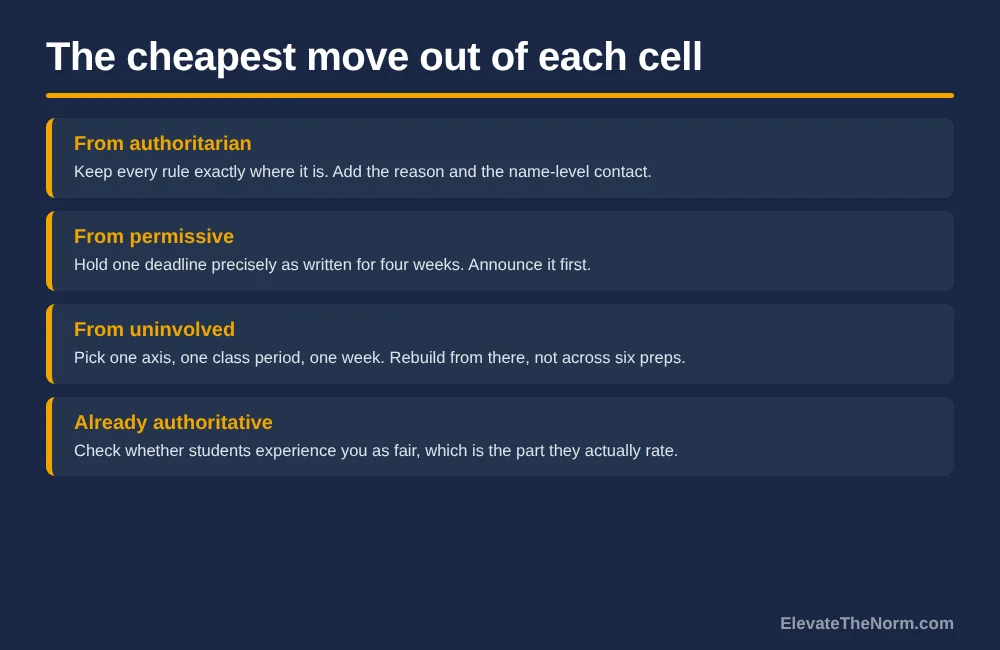
The fix is not loosening the structure. That is the mistake teachers make when they are told they are too strict. The fix is adding the reason and the relationship while the structure stays exactly where it is. That is the one-cell move, and it is the easiest of the four to make.
Permissive: high warmth, low structure
The permissive room feels good and quietly becomes unfair. It is the style I have the most sympathy for and the one I think costs students the most.
Here is the mechanism. When the floor is negotiable, the students who get the extensions, the second chances and the benefit of the doubt are the students who are comfortable asking. The confident, the articulate, the ones whose parents taught them to advocate. The quiet student who also needed the extension does not get it, because she did not know she was allowed to ask. A permissive room distributes mercy by social skill. That is not kindness. A predictable floor is the more generous system even when it feels harsher, and it is the heart of what we argue in holding a standard without becoming a hardliner.
The other cost is that warmth without structure is not actually experienced as respect. Teenagers read a teacher who requires nothing as a teacher who expects nothing of them, and they are not wrong to read it that way.
Indulgent and uninvolved: the low-low cell
Almost nobody chooses this cell, and plenty of good teachers end up in it temporarily. It is usually a symptom of being overwhelmed, not a philosophy.
Four preps, a coaching duty, a hard roster, something going wrong at home: structure and warmth are both effortful, and when you are depleted you stop producing both. I would rather name that honestly than moralize about it. If a self-diagnostic put you here, the move is not to fix your style. It is to pick one axis, one class period, and one week, and rebuild from there. Trying to become authoritative across six periods on a Monday is how people quit.


Authoritative: high structure, high warmth
This is the cell with the best support, and the mechanism is not warmth plus rules — it is that the warmth makes the structure believable and the structure makes the warmth credible.
A student in an authoritative room knows two things at once: that you mean what you say, and that you are on their side. Those are not in tension. They reinforce each other. Expectations explained are expectations more likely to be internalized, which is also what the motivation literature predicts: in a meta-analysis of 144 studies and just over 79,000 participants with a mean age of 16.5, teacher autonomy support correlated .48 with intrinsic motivation and −.32 with amotivation, and students’ sense of competence (ρ = .58) and autonomy (ρ = .57) were the strongest predictors of self-determined motivation (Bureau, Howard, Chong & Guay, 2021). Autonomy support is not the absence of demands. It is demands with reasons, and some real choice inside them — which is the argument for giving students genuine choices inside a structure you set.
One honest caveat. Baumrind herself noted that authoritative parenting was not the only path to competence, and the same is almost certainly true in classrooms. I have watched teachers who would score as authoritarian on any instrument run rooms students cared about, because the students were certain the teacher was fair. Fairness may be doing more of the work in this framework than warmth is.
Can you change your classroom management style mid-year?
You can add structure to a permissive room in about two weeks. Adding warmth to an authoritarian one takes a grading period, and it requires you to say out loud that you are changing.
The asymmetry is worth knowing. Tightening up is a policy announcement: here is the new procedure, here is when it starts, here is what happens. Students adjust fast because the change is legible. Warming up is harder because every individual kind act gets read against the record. A student who has spent nine weeks being corrected does not trust a compliment in week ten. Tell the class plainly that you got something wrong and what you are changing, and then be boringly consistent about it for six weeks. That is the whole method. Our piece on what respect actually looks like in practice covers the day-to-day version.
What your style looks like from a student desk
Students do not perceive your style as warmth and structure. They perceive it as one question: is this teacher predictable and is this teacher fair?
That reframing has done more for me than the taxonomy has. A student does not care where you sit on a grid. She cares whether the consequence she got on Tuesday is the consequence the loud kid gets on Thursday, and whether you did the thing you said you would do. Every style in the framework can be perceived as unfair, including the authoritative one, if your word and your actions come apart. The shortest route from any cell to a room that works is to do exactly what you said you would do, every time — a point we make at length in the companion piece on control, consistency and what students are actually reading.
Using classroom management styles without turning them into a personality test
Treat the classroom management styles grid as a diagnostic you run on your own behavior, not a label you wear. You are not an authoritarian teacher. You are a teacher who defaulted to low responsiveness in third period on Thursday when you were tired, and that is a fixable fact rather than an identity.
So do this. Run the ten questions. Find your weaker axis. Pick one behavior on that axis — one — and do it for four weeks. If structure is weak, the highest-value item is holding one deadline exactly as written. If warmth is weak, the highest-value item is speaking to every student by name about something other than their work. Then run the questions again and see whether anything moved. For the concrete practices to build on either axis, our list of classroom management strategies ranked by payback is the practical companion to this article, and the piece on writing expectations that hold is where the structure axis starts.
Sources
- Baumrind, D. “The Influence of Parenting Style on Adolescent Competence and Substance Use.” The Journal of Early Adolescence, vol. 11, no. 1, 1991, pp. 56–95. Supports the origin of the authoritative category as high demandingness plus high responsiveness, and the finding that it was not the only route to adolescent competence. Caveat: 139 adolescents from an affluent, well-educated, predominantly white sample of families — a parenting study, not a classroom study. https://journals.sagepub.com/doi/10.1177/0272431691111004
- Darling, N. “Parenting Style and Its Correlates.” At Health, LLC, 23 October 2013. Supports the two-dimension grid and the attribution of the four-category typology to Maccoby and Martin (1983). Caveat: this is an authoritative literature summary rather than a primary study, and it is cited here as a summary. https://athealth.com/topics/parenting-style-and-its-correlates-2/
- Walker, J. M. T. “Looking at Teacher Practices Through the Lens of Parenting Style.” The Journal of Experimental Education, vol. 76, no. 2, 2008, pp. 218–240. Supports the claim that the parenting-style dimensions have been applied directly to teaching practice and student engagement. Caveat: the study involved three fifth-grade mathematics teachers and 45 students, which is far too small and too young to generalize to grades 6–12; linked via the ERIC record. https://eric.ed.gov/?q=%22Looking+at+Teacher+Practices+Through+the+Lens+of+Parenting+Style%22
- Roorda, D. L., Koomen, H. M. Y., Spilt, J. L., & Oort, F. J. “The Influence of Affective Teacher–Student Relationships on Students’ School Engagement and Achievement: A Meta-Analytic Approach.” Review of Educational Research, vol. 81, 2011, pp. 493–529. Supports the warmth dimension and the report of stronger effects in higher grades. Caveat: correlational; students who are easier to teach are easier to have positive relationships with, which could produce part of the association. https://research.vu.nl/en/publications/the-influence-of-affective-teacher-student-relationships-on-stude/
- Simonsen, B., Fairbanks, S., Briesch, A., Myers, D., & Sugai, G. “Evidence-Based Practices in Classroom Management: Considerations for Research to Practice.” Education and Treatment of Children, vol. 31, 2008, pp. 351–380. Supports the structure dimension and the five categories of evidence-based classroom practice. Caveat: linked as a full-text reproduction hosted by a university project rather than the journal of record. https://k12engagement.unl.edu/sites/unl.edu.cehs.special-ed-communic-disorders.student-engagement-project/files/media/file/Classroom%20Management%206-8-16.pdf
- Caldarella, P., Larsen, R. A. A., Williams, L., & Wills, H. P. “Effects of Middle School Teachers’ Praise-to-Reprimand Ratios on Students’ Classroom Behavior.” Journal of Positive Behavior Interventions, vol. 25, no. 1, 2023, pp. 28–40. Supports treating responsiveness as a countable behavior rather than a disposition. Caveat: 28 middle school classrooms; high school was not studied. https://journals.sagepub.com/doi/10.1177/10983007211035185
- Bureau, J. S., Howard, J. L., Chong, J. X. Y., & Guay, F. “Pathways to Student Motivation: A Meta-Analysis of Antecedents of Autonomous and Controlled Motivations.” Review of Educational Research, vol. 91, no. 3, 2021. Supports the correlations for teacher autonomy support, competence and autonomy with self-determined motivation. Caveat: 144 studies and 79,079 participants with a mean age of 16.55, but the relationships are correlational and both sides are usually measured by student self-report. https://selfdeterminationtheory.org/wp-content/uploads/2021/09/2021_PathwaystoStudentMotiv_BureaHowardEtal.pdf
Frequently Asked Questions
Can a teacher have more than one classroom management style?
Most of us have several, sorted by class period and by how tired we are. That is normal and it is also the most useful thing the framework tells you. If you are authoritative in second period and authoritarian in sixth, the difference is almost never the students — it is your remaining energy and how the term has gone with that group. Track which periods pull you out of your intended style. The pattern usually points at a specific seam in the schedule rather than at a personality flaw.
Is the authoritative style the same thing as being strict?
No. Strictness is the structure axis only. Authoritative means high structure and high warmth at once: the deadline holds, and the student also knows you noticed they were struggling and why the deadline exists. A strict teacher with no warmth is in the authoritarian cell, which works while you are watching and leaks when you are not. The practical test is whether a student in trouble would come to you first or hide it from you. If they would hide it, you have structure without responsiveness.
Is this framework fair to teachers in difficult schools with limited support?
Only if it is used as a diagnostic rather than an evaluation, which is why I would push back hard on any observation rubric that scores teachers on a style label. Structure and warmth both cost energy, and a teacher with four preps, a duty and a hundred and sixty students has less of it than one with two preps. The low-low cell is usually a workload symptom. If a building has a lot of teachers landing there, that is a staffing and scheduling finding, not a teacher-quality finding.
What should I do if my school’s discipline policy pushes me toward an authoritarian style?
Follow the policy and change what the policy does not control, which is more than teachers assume. Mandated consequence ladders set what happens; they rarely set your tone, your explanation, whether you correct privately, or how often you acknowledge students. All of that is the warmth axis and it is yours. Where a policy genuinely requires something you think is harmful — public tracking, for example — document what you observe and raise it with your administrator as implementation feedback rather than declining to follow it.
Does changing my style confuse students mid-year?
Changing without announcing it does. Students notice inconsistency long before they notice improvement, so an unexplained shift reads as moodiness. Say it out loud: name what you are changing, when it starts, and why. Teenagers handle a teacher who admits a correction far better than most adults expect, and the admission buys you credibility you can spend later. Then be dull about it for six weeks, because a change you abandon in week three has cost you more trust than never changing at all.
How does this apply to students with IEPs or behavior plans?
An authoritative stance is compatible with individualized support and does not override it. High structure means the plan is followed precisely, not that every student receives identical treatment; a required accommodation is part of the structure, not an exception to it. Students and families sometimes read differentiation as favoritism, which is worth getting ahead of by explaining early that fair means everyone gets what they need to meet the same standard. If a plan conflicts with your usual response, the plan wins and the case manager hears about it.
Will students respect me less if I explain my reasoning instead of just stating the rule?
The opposite, in grades 6 to 12. Explaining a rule once is not negotiating it. The confusion comes from thinking reasons invite argument, when what actually invites argument is a rule that looks arbitrary. Give the reason, then hold the rule whether or not the student agrees with the reason. Students will accept a standard they think is pointless if they believe you are fair about applying it, and they will fight a standard they think is personal even when it is completely reasonable.
How often should I re-check my style?
Twice a semester is plenty, and the timing matters more than the frequency. Run it in the third or fourth week, once the honeymoon is over and before habits have set, then again a week or two after a long break, which is when structure quietly erodes. Checking it in the first week tells you about your intentions rather than your practice. Keep the scores somewhere you will find them, because the useful information is the direction of travel rather than any single number.