By Clay Shumate
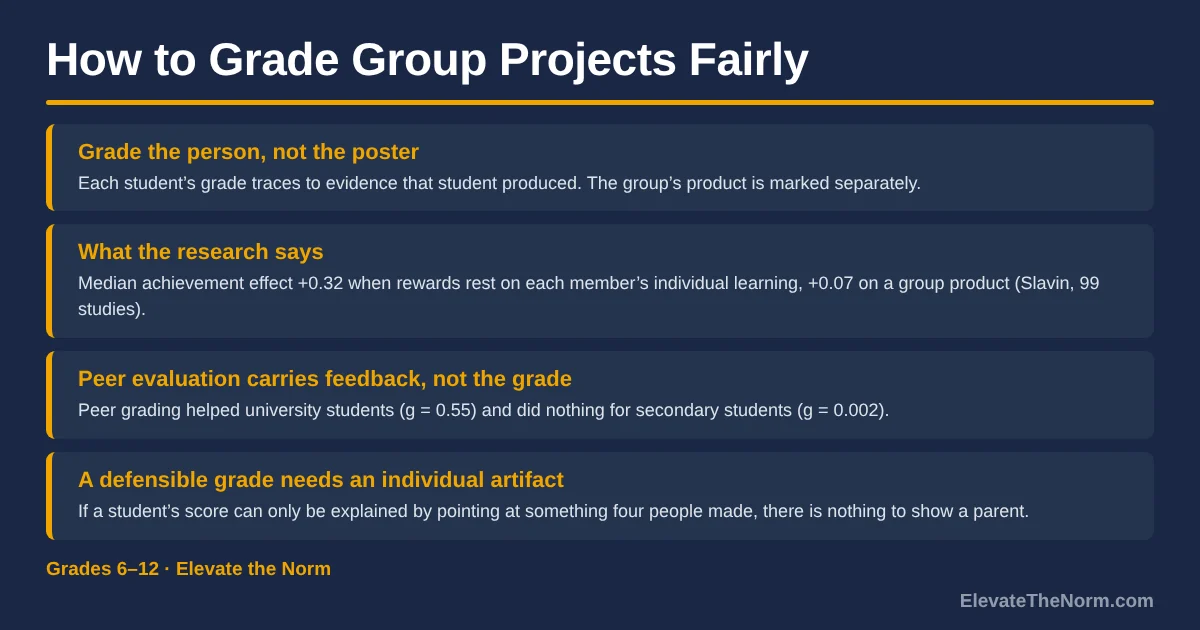
To grade group projects fairly, grade each student on evidence that student produced, and grade the group’s product separately. A single shared grade on one artifact measures the artifact, not the students who made it. The move with the best research behind it is individual accountability: every member’s performance assessed on its own and reported back.
Nobody argues about group projects until the grade posts. Then you get the email from the parent of the student who did the slide deck at midnight, the student who did nothing and took the same 92, and a teacher trying to defend a number that was never built to be defended. The fairness problem in group work is not a problem of attitude. It is a measurement problem, and it has a fix.
Key Takeaways
- A grade built on one shared product has a median achievement effect of about +0.07 standard deviations. Robert Slavin’s review of 99 cooperative learning studies found +0.32 when the group’s reward came from the sum of its members’ individual learning, against +0.07 for a group product or no reward at all.
- Peer grading does not work as a grade source in middle and high school. A 2020 meta-analysis of 55 studies found peer-assigned grades helped only university students (g = 0.55). For secondary students the effect was 0.002; for primary students it was negative.
- Peer evaluation is still useful — as information, not arithmetic. The same work shows peer feedback raises secondary achievement (g = 0.44). It is the scoring function that fails, not the practice.
- A defensible individual grade needs an individual artifact. If a student’s grade can only be explained by pointing at something four people made, there is nothing to show a parent, a counselor, or a hearing.
- Collaboration can be graded; it just cannot be graded from the product. Report it as its own mark, from that student’s observed behavior, and keep it out of the achievement grade.
What does it mean to grade group projects fairly?
Grading group projects fairly means every student’s grade traces to evidence that student generated, while the collaborative work still counts on its own terms. Fairness here is not about equal scores. It is about each score being true of the person who received it.
That rules out two popular answers at once: the shared grade, which is by construction a claim about four students based on one object, and abolishing group work, since the collaboration is often the part worth doing. What it leaves is a grading architecture with two channels — one measuring learning person by person, one measuring the team’s output and the behavior inside it.
Thomas Guskey has a name for what happens when those channels get merged. In Five Obstacles to Grading Reform he describes teachers combining “aspects of students’ achievement, attitude, responsibility, effort, and behavior into a single grade” and calls the result a hodgepodge grade — “just as confounded and impossible to interpret” as one number summarizing a patient’s physical condition. A group grade is a hodgepodge grade with extra people in it. Guskey’s fix is to report product, process and progress as separate marks, which is the structural move this whole article is making.
Why does a single shared group grade feel unfair?
A shared group grade feels unfair because it is unfair in a specific, measurable way: it assigns one measurement to several different people and hides the variance. Students notice this immediately, and the research suggests it also costs you the learning the project was supposed to produce.
The strongest evidence comes from Robert Slavin’s 2014 review in Anales de Psicología, covering 99 cooperative learning studies in elementary and secondary schools that ran at least four weeks. Of the 64 studies where the group’s reward was based on the sum of each member’s individual learning, 50 — 78 percent — found significantly positive achievement effects and none found negative ones, median effect size +0.32. Studies that instead evaluated a group product, or used no group reward, had a median effect of +0.07. Slavin’s phrasing is blunt: group rewards raise achievement “if and only if the group rewards are based on the individual learning of all group members.”
Read as a teacher, that says the grading shortcut and the pedagogical failure are the same decision. When the only thing evaluated is the poster, the rational student strategy is to get the poster made by whoever is fastest. Nobody has a reason to explain anything to anybody, and explaining is where the learning was.
David and Roger Johnson, in their 2009 Educational Researcher paper on social interdependence theory, name individual accountability as one of five elements that make cooperation work and define it plainly: “Individual accountability exists when the performance of each individual member is assessed,” with results given back to both the individual and the group. They also report that “social loafing … increases as the size of the group increases,” and argue that with high individual accountability and clearly visible contributions the loafing effect disappears. That last claim is stronger than I would make it — but the direction is well supported, and it tells you which dial to turn.
Which group grading model should you actually use?
Use a hybrid: a group mark on the product, plus a separate individual achievement grade built from each student’s own work. The four models below are the realistic options. Three of them are defensible for some purpose. Only one is defensible as a student’s academic grade.
| Model | How the grade is built | What it actually measures | What it costs you |
|---|---|---|---|
| Shared group grade | One score on the product, applied to every member | The product — and, indirectly, the output of whichever student was most willing to carry it | Nothing to defend to a parent; median achievement effect around +0.07 in Slavin’s review; removes the reason to teach each other |
| Individual-only | Each student graded solely on their own artifact; the group product is ungraded | Individual learning, cleanly | Students read the collaboration as unimportant, because nothing rides on it; the team’s actual output never gets evaluated or improved |
| Hybrid (recommended) | Group mark on the product, kept separate; individual achievement grade from each student’s own evidence; collaboration reported as its own mark | Three distinct things, each named: the product, the person’s learning, the person’s behavior | More to collect and more to explain up front; you have to design individual evidence into the task instead of adding it afterward |
| Weighted contribution | Group score multiplied or adjusted by a peer-rated contribution factor | Partly learning, partly the group’s social dynamics — the two cannot be separated after the fact | Peer scores in secondary classrooms carry no measured achievement benefit (g = 0.002) and peer–teacher agreement is weakest precisely for group work; the arithmetic looks objective and is not |
Weighted contribution is the one I would push back on hardest, because it is the most seductive. It produces a number, so it feels like it solved free-riding with mathematics. What it actually did was take a social judgment made by teenagers under peer pressure and give it the authority of a multiplier.
Two practical notes on the hybrid. The group product mark should be the minority of the weight — a quarter is plenty — because a student should not be able to lose a letter grade over work other people did, which is the same principle that rules out the shared grade. And if your gradebook holds only one category, put the individual achievement evidence there and report the product and collaboration marks as comments or a separate standard. The architecture matters more than where the software lets you type it, and none of it costs money or staffing.
If you want a rubric already built along these lines, our editable project based learning rubric separates the product rows from the individual rows and is free to copy.
How do you build an individual grade that survives a parent email?
An individual grade survives scrutiny when you can hand over a specific artifact with that student’s name on it and say what it shows. Not a participation impression, not a peer average. A thing they made, wrote, or said to you on the record.
Here is the sequence, in this order, run before the project starts rather than after it goes wrong.
- Decide what the standard is, not what the product is. “Build a museum exhibit” is a product. “Explain how two sources disagree and defend which one you trust” is a standard. Only the second can be graded on a person.
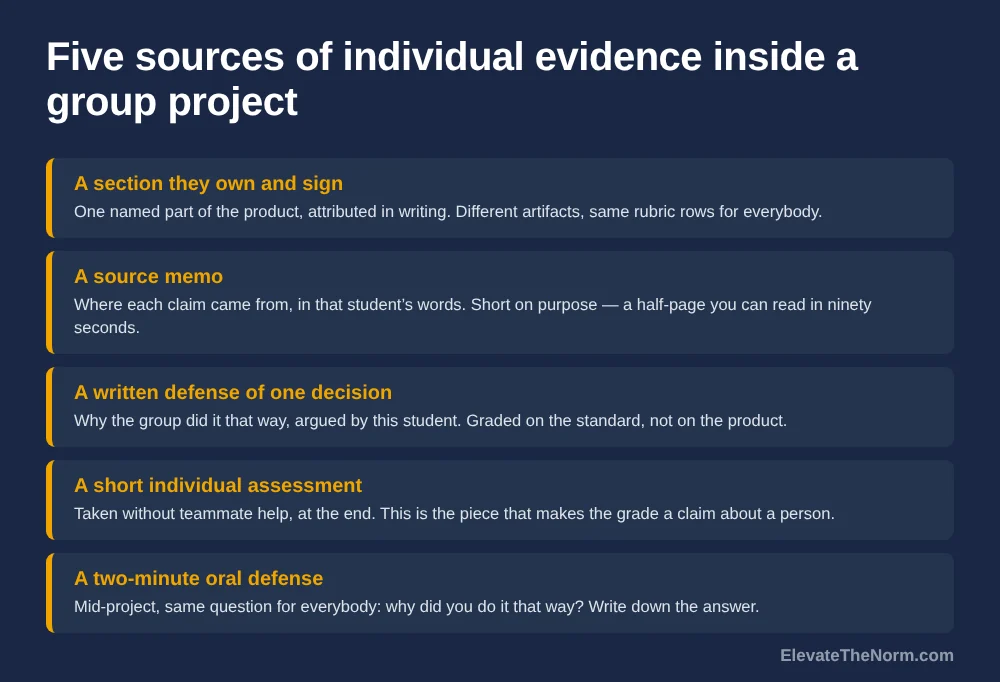
- Design one individual deliverable per student into the task itself. A section they own and sign, a source memo, a written defense of one decision, a short individual assessment at the end. Keep it short on purpose — this model does mean more pieces to grade, and a half-page you can read in ninety seconds is what makes it survivable past October. Where you can, let students choose which piece they own; that is real choice and it costs nothing.
- Tell students and families the architecture in writing, before day one. The Alberta Assessment Consortium’s guide for school leaders recommends exactly this — telling students and parents in advance that “individual student grades will not be based on the group product.” That sentence prevents most of the arguments.
- Grade the individual evidence against the same rubric rows for everybody. Different artifacts, same criteria, or you have reintroduced the variance you were trying to remove.
- Hold a check-in where each student defends their own decisions out loud. Two minutes, mid-project, same question for everybody: why did you do it that way? Write down the answer — it is formative evidence of that student’s thinking and it can legitimately feed the individual grade. Thirty students at two minutes is roughly one period’s worth of talking, spread across days the project is already running. Not an extra hour.
- Mark the group product separately and say so on the page. The team gets a real evaluation of its real output; it just does not become four identical academic grades.
- Report collaboration as its own mark, from behavior you observed — not from peer scores and not from the quality of the poster. Guskey’s product/process separation, applied to one assignment.
Step five is the one I will defend from my own room rather than from a study. Our room runs as a workshop — tables pushed into pairs and fours, nobody facing front alone, me on a wheeled stool moving between groups under lamp light instead of overheads. Partner work is the resting state, not a reward for finishing something else. In that setup, a check-in where a student defends their own decisions is not an interruption of the work; it is the most natural two minutes of the period. Everyone gets the same question, which is what keeps it from being a trap for the student who has been carried. You find out where the thinking actually lives, early enough to do something about it.
One more fairness point that has nothing to do with rubrics: keep the collaborative work inside class time. Projects that require evening meetings quietly import transportation, home internet, work schedules and younger siblings into the grade. A student who cannot get to a Saturday meeting is not a weaker student, and the grade should not say they are.
For the task-design half of this — building roles that actually produce something with a name on it — see our evidence review of what assigned group work roles do and do not accomplish.
What can peer evaluation actually carry?
Peer evaluation can carry feedback and it cannot carry the grade. That is not a philosophical position but the clearest single finding in the peer assessment literature, and the split falls almost exactly along the line between giving comments and assigning scores.
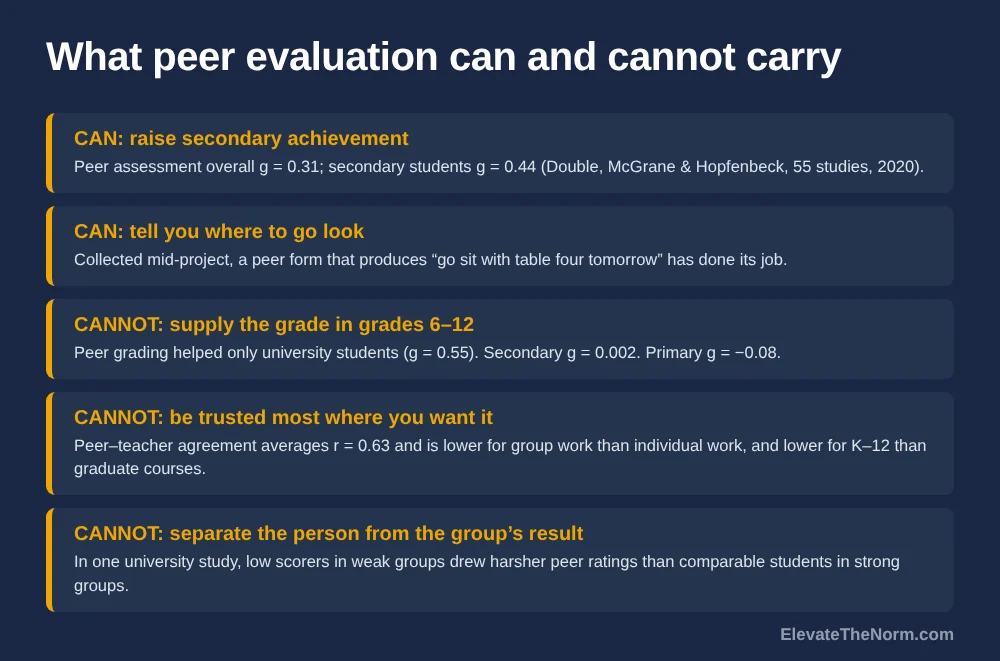
The 2020 meta-analysis by Double, McGrane and Hopfenbeck in Educational Psychology Review pooled 55 articles and 143 effect sizes. Overall, peer assessment helped: g = 0.31, 95 percent confidence interval 0.18 to 0.44. By level, secondary students showed g = 0.44 and primary 0.41, against 0.21 for tertiary — though a meta-regression found no significant difference between levels, so treat that ranking as suggestive.
The moderator analysis is the part teachers need. When the authors separated peer assessment involving grading from peer assessment that did not, grading was beneficial only for university students, at g = 0.55. For secondary students the effect of peer grading was g = 0.002. For primary students it was negative, at g = −0.08. Anonymity made no difference either way.
Three caveats are owed. Heterogeneity across the studies was large, at I² = 81 percent. Nearly all were quasi-experimental rather than randomized, and all but one failed to handle clustered data properly, which overstates precision. And because students both gave and received feedback, the authors say plainly that they “cannot adequately distinguish between the effect of assessing versus being an assessee.”
A second line points the same way. Li and colleagues’ 2016 meta-analysis in Assessment & Evaluation in Higher Education put the average correlation between peer and teacher ratings at r = 0.63. Its moderators matter more than that headline: agreement was higher for individual work than for group work, and higher for graduate courses than undergraduate or K–12 ones. Peer ratings are least trustworthy in exactly the situation teachers most want to use them. I read the published abstract and bibliographic record for this one rather than the full text, and I am reporting it at that level.
Then there is what peer evaluations look like up close. Chang and Brickman’s 2018 study in CBE—Life Sciences Education followed 246 students in 65 self-formed groups in an introductory biology course for non-science majors at a large public university — university undergraduates, not teenagers, which matters for how far you carry it. They analyzed 1,221 peer-evaluation entries and interviewed 15 students. Most interviewees reported social loafing regardless of whether their group did well, and several described a “sucker effect,” cutting their own effort to force a teammate to contribute. Comments about individual accountability were the most common theme in evaluations from both high- and low-performing groups and did not reliably distinguish between them. Students who scored low in a weak group drew harsher peer ratings than comparable students in a strong group, which the authors read as possible bias. And interviewees said peer pressure made them reluctant to criticize teammates at all.
So: use peer evaluation. Use it mid-project, where it can still change something, and use it for comments rather than scores. Read it as a signal to go look, not as a measurement to average in. A peer form that produces “go sit with table four tomorrow” has done its job.
Two rules I would treat as non-negotiable if you collect peer comments. They are not part of a student’s record and they do not go home, to any family. And you never quote a teammate back to a student — that turns your room into a place where honesty gets people in trouble, and the next form you hand out comes back blank.


What do you do about a genuine free-rider?
You grade the free-rider on what they actually produced, which the hybrid model already does automatically, and you handle the behavior separately as behavior. No group needs to be punished for one member, and no member needs to be punished twice for the same thing.
The free-rider problem looks unsolvable mostly because the shared grade makes it unsolvable. Once one number has to describe four people, every option is bad: lower it and you punish three students for the fourth, leave it and you reward the fourth. Split the channels and the problem becomes ordinary. The student who produced little individual evidence earns a low individual grade, for the same reason any student who produces little earns one. The product gets the mark it earned. Nobody is doing arithmetic on anybody else’s effort. That leaves the behavior, which is worth answering on its own.
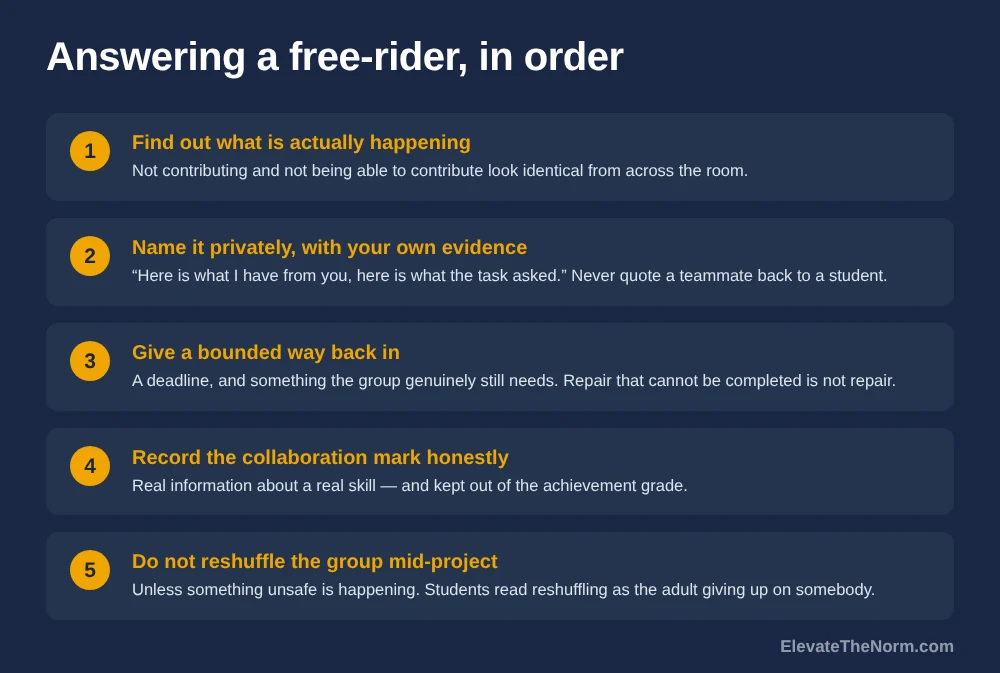
- Find out what is actually happening first. Not contributing and not being able to contribute look identical from across the room. A student who has been shut out of a group, or who cannot read the source set, is not free-riding. The step-five check-in is how you tell the difference.
- Name it privately, at close range, with your own evidence in hand. “Here is what I have from you, here is what the task asked” is a different conversation from “your group says you are not helping” — and the second one hands the student a grievance against three classmates that you then have to manage.
- Give a specific, bounded way back in, with a deadline and with something the group genuinely still needs. Repair that cannot be completed is not repair.
- Record the collaboration mark honestly and keep it out of the achievement grade. It is real information about a real skill, and it is not evidence of what the student knows.
- Do not reorganize the group mid-project unless something unsafe is happening. Students read reshuffling as the adult giving up on somebody.
Worth saying plainly: if a student can fail a group project so badly that it damages three other students’ grades, the task was built wrong and the adult was not watching. That is a planning failure, not a student outcome — and bounding what can go wrong is the teacher’s job, not the same thing as lowering expectations.
How do you answer the parent email about a group grade?
You answer it by producing the student’s own work and the criteria you applied to it. If you can do that in one reply, the conversation ends in one reply. If you cannot, the grade was never defensible and the parent found that out before you did.
The hybrid model gives you three sentences: here is the standard, here is what your child submitted against it, here are the separate marks for the team’s product and for collaboration. None of them require you to characterize anybody else’s child — which is the thing that makes these conversations go wrong. A shared grade forces you to explain one student’s score by describing their teammates.
Two things make it easier. Announcing the architecture before the project starts converts a complaint into a reminder. And reporting achievement separately from behavior — the structure behind a standards based report card — keeps the achievement number from quietly carrying a judgment about effort. If your school reports a single letter, our breakdown of the 10 point grading scale covers what that number can hold. Group presentations are where all of this goes wrong most visibly — one student talks, three stand there, everyone gets the same score — and our presentation rubric handles the scoring side.
Where does the evidence run out?
There is no randomized trial in grades 6–12 that compares group-grade models head to head. I looked for one and did not find it. Everything above is assembled from adjacent literatures, and the gaps are worth naming because they change how hard you should hold these recommendations.
- Nobody has tested the four models against each other. Slavin’s +0.32 versus +0.07 contrast is the closest thing available, and it compares reward structures inside cooperative learning programs, not grading models. The table above is a reasonable inference from that evidence. It is not a finding.
- The peer grading result has not been replicated as its own question. The secondary g = 0.002 figure comes from a moderator analysis inside a meta-analysis, with large heterogeneity and mostly quasi-experimental inputs. Moderator nulls are weaker evidence than main effects, and the authors say so themselves.
- Most peer assessment accuracy data is from university students. Li and colleagues’ r = 0.63 is drawn predominantly from higher education, and Chang and Brickman’s free-riding study is entirely undergraduates. Best available, and not measurements of teenagers.
- Slavin does not report separate secondary effect sizes. His review covers elementary and secondary schools together, and cooperative learning’s achievement effects are generally weakest at the secondary level — which our review of what cooperative learning actually is goes through in detail. Read +0.32 as probably generous for a high school room.
- None of this has been tested for students with IEPs or 504 plans. Individual accountability presumes a student can produce individual evidence. Where a documented accommodation affects written output, speaking, or processing speed, the form of the evidence has to change and the standard should not. No evidence base tells you where that line sits.
- The claim that loafing “vanishes” is theoretical. Johnson and Johnson’s own paper reports about half their corpus meeting their rigor criteria, much of it laboratory-based. A direction, not a guarantee.
What to do next
Pick the next project on your calendar and add one individual deliverable before you assign it. That single change converts a shared grade into a defensible one, and it is the only step here that cannot be added afterward.
Then write the two sentences you will send home: what the group mark covers, and what each student’s own grade is built from. Send them with the project, not with the grade. If you do nothing else from this article, those two moves get you most of the fairness and nearly all of the defensibility.
Frequently Asked Questions
How do you grade group projects fairly?
Grade each student on evidence that student produced, and grade the group’s product as a separate mark. Build at least one individual deliverable into the task itself — a section they own, a written defense of a decision, or a short individual assessment. Report collaboration as its own mark from behavior you observed. Tell students and families how the grade is built before the project starts, not after it posts.
Is it fair to give every student in a group the same grade?
No, and it also appears to cost you learning. One score on one product is a single measurement applied to several different people. Robert Slavin’s review of 99 cooperative learning studies found a median achievement effect of about +0.32 when rewards were based on each member’s individual learning, against +0.07 when they rested on a group product. The shortcut and the weak result are the same decision.
Should students grade each other’s contribution?
They can comment; they should not score. A 2020 meta-analysis of 55 peer assessment studies found peer grading benefited university students (g = 0.55) but had essentially no effect for secondary students (g = 0.002) and a negative one for primary students. Peer feedback itself did help secondary students (g = 0.44). Use peer evaluation mid-project to tell you where to look, not to adjust a number.
What do I do about a student who does nothing in a group project?
Grade them on what they actually produced, which a split grade does automatically, and handle the behavior separately. First find out whether they could not contribute rather than would not — being shut out of a group looks identical from across the room. Then name it privately with the evidence in hand, give a bounded way back in with a deadline, and record the collaboration mark honestly.
How do I defend a group project grade to a parent?
Produce the student’s own artifact and the criteria you applied to it. If the grade can only be explained by pointing at something four students made, it was never defensible. A split grade also means you never have to explain one child’s score by describing another child’s effort, which is the thing that makes these conversations go badly. Announcing the structure in advance prevents most of them entirely.
Can collaboration be part of the grade at all?
Yes, as its own mark, scored from behavior you observed rather than from the quality of the product. Thomas Guskey calls a single number mixing achievement, effort, responsibility and behavior a hodgepodge grade — confounded and impossible to interpret — and recommends reporting product, process and progress separately. Collaboration is a real skill worth reporting. It is not evidence of what a student knows.
Does weighting the group grade by peer ratings solve the free-rider problem?
It mostly disguises it. A contribution multiplier takes a social judgment made by teenagers under peer pressure and gives it the authority of arithmetic. Peer–teacher agreement is weakest precisely for group work, and in one university study students who scored low in a weak group drew harsher peer ratings than comparable students in a strong group. The group’s outcome colors the judgment of the person.
How does this work for students with IEPs or 504 plans?
Change the form of the individual evidence, not the standard. Individual accountability assumes a student can produce something of their own; where a documented accommodation affects written output, speaking, or processing speed, an oral defense, a recorded explanation, or a scribed memo can serve the same purpose as a written section. There is no research base specifying where that line sits, so coordinate it with the case manager rather than improvising it.
Sources
- Slavin, Robert E. “Cooperative Learning and Academic Achievement: Why Does Groupwork Work?” Anales de Psicología 30, no. 3 (2014): 785–791. Review of 99 cooperative learning studies of four weeks or longer in elementary and secondary schools; median effect size +0.32 where group rewards were based on the sum of members’ individual learning (50 of 64 studies significantly positive, none negative) against +0.07 for group-product or no-reward designs. Does not report separate secondary effect sizes. https://revistas.um.es/analesps/article/view/analesps.30.3.201201
- Johnson, David W., and Roger T. Johnson. “An Educational Psychology Success Story: Social Interdependence Theory and Cooperative Learning.” Educational Researcher 38, no. 5 (2009): 365–379. Names the five mediating elements including individual accountability; defines it as assessing each member’s performance and returning results to the individual and the group; reports social loafing increasing with group size and achievement effect sizes of 0.67 (cooperative vs. competitive) and 0.64 (cooperative vs. individualistic), with about half the corpus meeting the authors’ rigor criteria. Full text PDF
- Double, Kit S., Joshua A. McGrane, and Therese N. Hopfenbeck. “The Impact of Peer Assessment on Academic Performance: A Meta-analysis of Control Group Studies.” Educational Psychology Review 32 (2020): 481–509. 55 articles, 143 effect sizes; overall g = 0.31 (95% CI 0.18–0.44); secondary g = 0.44, primary 0.41, tertiary 0.21 with no significant moderation by level; peer grading beneficial only for tertiary students (g = 0.55) against 0.002 for secondary and −0.08 for primary; I² = 81.08%; nearly all studies quasi-experimental, all but one failing to account for clustering. https://link.springer.com/article/10.1007/s10648-019-09510-3
- Li, Hongli, Yao Xiong, Xiaojiao Zang, Mindy L. Kornhaber, Youngsun Lyu, Kyung Sun Chung, and Hoi K. Suen. “Peer Assessment in the Digital Age: A Meta-analysis Comparing Peer and Teacher Ratings.” Assessment & Evaluation in Higher Education 41, no. 2 (2016): 245–264. Average peer–teacher correlation r = 0.63; agreement higher for individual work than group work and higher for graduate than undergraduate or K–12 courses. Read as the published abstract and bibliographic record, not the full text; reported at that level. Publisher-indexed record
- Chang, Yunjeong, and Peggy Brickman. “When Group Work Doesn’t Work: Insights from Students.” CBE—Life Sciences Education 17, no. 3 (2018): ar52. 246 students in 65 self-formed groups in an introductory biology course for non-science majors at a large U.S. public university; 1,221 peer-evaluation entries analyzed and 15 students interviewed. University undergraduates, not secondary students. Most interviewees reported social loafing regardless of group performance; describes the “sucker effect”; peer-evaluation themes did not distinguish high- from low-performing groups; low scorers in low-performing groups drew harsher ratings than comparable students in high-performing groups. https://pmc.ncbi.nlm.nih.gov/articles/PMC6234829
- Guskey, Thomas R. “Five Obstacles to Grading Reform.” Educational Leadership 69, no. 3 (2011): 16–21. Describes the “hodgepodge grade” that combines achievement, attitude, responsibility, effort and behavior into one mark and recommends reporting product, process and progress criteria separately. Read in a course-handout compilation of the article, not on the publisher’s site. Handout PDF
- Alberta Assessment Consortium. “Meaningful Assessment within a Group Context.” In Assessment in Action, Section 3 of Supporting Professional Conversations about Assessment: An AAC Guide for School Leaders, 80–81. Professional guidance, not research: collaboration should be graded from “evidence of individual student performance within a group setting,” content outcomes from individual performance “rather than on a product created by the group,” and students and parents should be told in advance that “individual student grades will not be based on the group product.” https://aac.ab.ca/wp-content/uploads/2025/07/Meaningful_Assessment_within_a_Group_Context.pdf