Category: Templates & Printables

Free, ready-to-use classroom templates, logs, checklists, and printable packs for grades 6-12 teachers.

  • Classroom Transition Examples and Free Planning Toolkit

    Classroom Transition Examples and Free Planning Toolkit

    By Clay Shumate

    Good classroom transition examples come from measuring where time actually leaks, not guessing. This free toolkit gives secondary teachers a transition audit for timing the six moments that cost the most class time — entry to first task, mini-lesson to group work, materials out and returned, group work to independent work, discussion to writing, closing and dismissal — plus a procedure planner for designing a short, rehearsable transition, a visual and audio cue guide, and a timing-and-repair log for fixing the one step that keeps breaking.

    Free. No email address required. Built for grades 6–12. Print it, adapt it, and use it tomorrow.

    If the cue itself is what you are stuck on, transition songs and cues that work with teenagers covers how to pick a track, the six signals music competes with, and the five-second benchmark for any of them.

    Examples are the fastest way in. If you want the reasoning behind them, the guide to classroom transitions in grades 6–12 covers what the measured time loss actually is, the five steps that make a transition hold, and which signals survive contact with teenagers.

    What’s in the Pack

    Four pages, printable on US Letter paper, branded ElevateTheNorm.com on every page.

    • Transition audit covering six common transitions with current time, break point, and target
    • Transition procedure planner: trigger, three to five student actions, teacher action, what ready looks like
    • Cue and repair guide: visual timer, color card, brief audio cue, or a single naming sentence
    • Timing and repair log for isolating and fixing the exact step that fails

    Fixing Materials Transitions

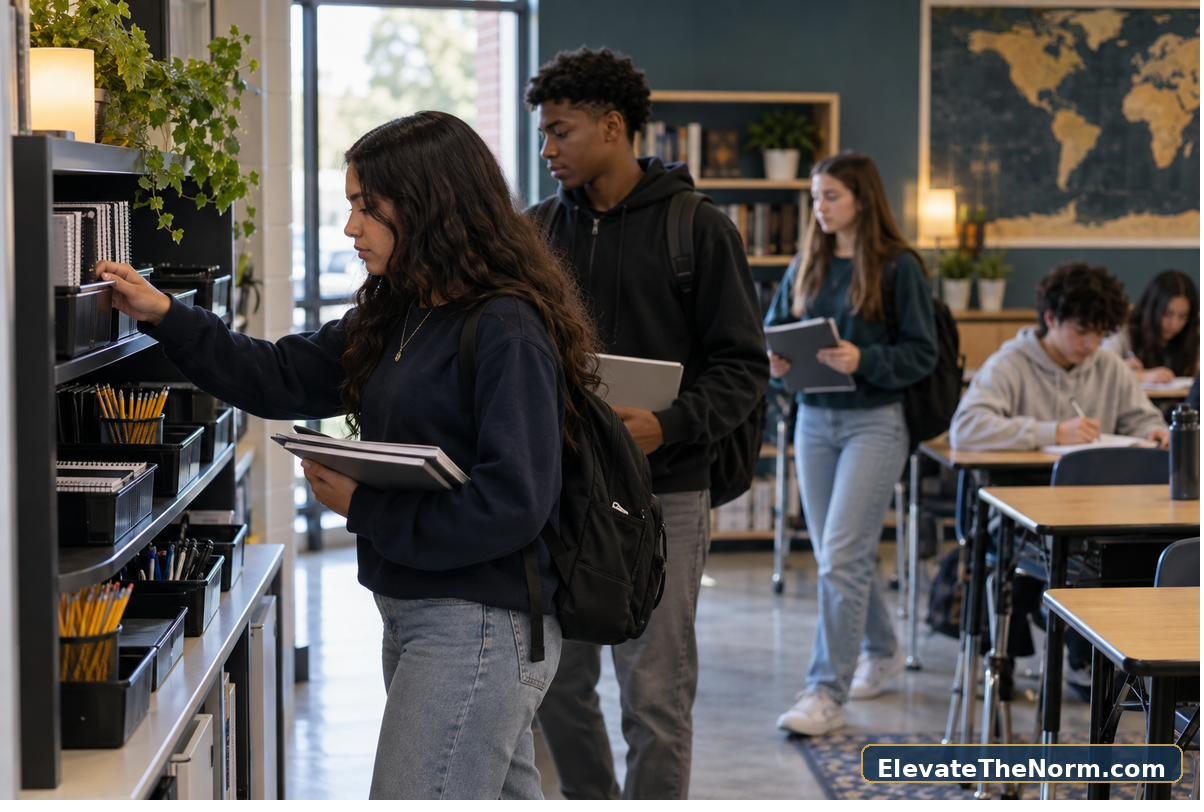
    Materials-out-and-returned is one of the six transitions the audit tracks by default, and it’s frequently the biggest hidden time cost because it happens multiple times per period in some classrooms. Use the procedure planner to define exactly where materials live, who distributes them, and what “returned” looks like before assuming the transition itself is the problem.

    Secondary students using an organized supply station during a classroom transition

    Choosing a Visual Cue

    The cue guide’s first two options — a visual timer for elapsed or remaining time, and a consistent color card or projected symbol — work well when the room is already quiet enough that a verbal cue would interrupt other groups. Use the least intrusive cue that still reliably communicates the information students need.
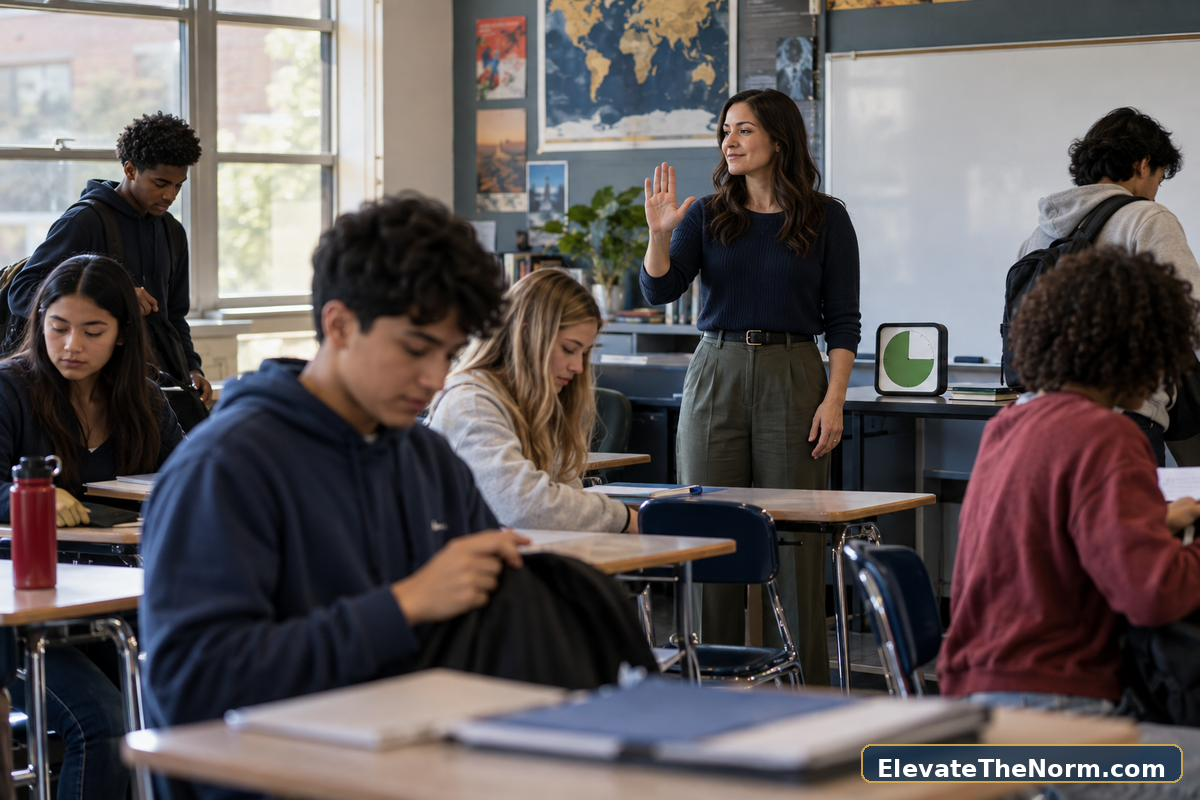
    Teacher using a simple visual cue to guide a secondary classroom transition

    A Caution Worth Repeating

    Don’t redesign every transition at once — the audit exists specifically so you fix the highest-cost transitions first instead of spreading effort across six moments evenly. These are frameworks, not scripts; the specific cues and steps need to match your room, your schedule, and your students.
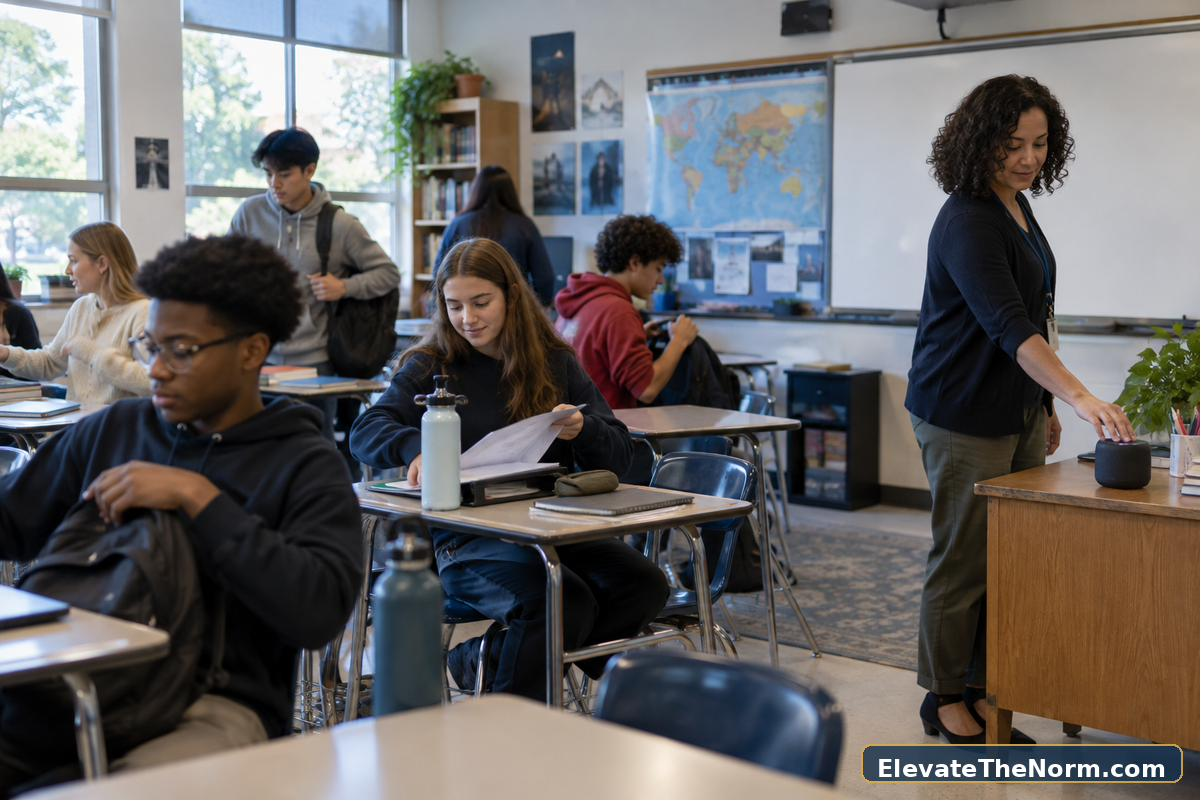
    High school class responding to a brief instrumental classroom transition cue

    For more on the ideas behind this pack, see the site’s guides to classroom management for new teachers, a practical classroom-expectations framework, and why yelling doesn’t restore order.

    Browse every free, no-email classroom download on the Elevate the Norm resource hub.

    Frequently Asked Questions

    Which classroom transition usually takes the most time?

    It varies by classroom, which is exactly why the audit measures your actual transitions rather than assuming. Materials-out-and-returned and mini-lesson-to-group-work are common high-cost transitions, but the only way to know for your room is to time them.

    How short should a classroom transition procedure be?

    Short enough to rehearse and specific enough to observe — the procedure planner caps student actions at three to five steps, since longer sequences are harder to teach cleanly and harder to diagnose when they break.

    What’s the best cue for a quiet transition?

    A visual timer or a consistent color card, since both give students the information they need without adding sound to a room that’s already quiet. Save audio cues for transitions where some ambient noise is already expected.

    How do I fix a transition that keeps breaking down?

    Use the repair process: name the exact step that’s failing, reset only that step (not the whole transition), model it in under a minute, have students practice once, and time the result to confirm the fix worked.

    Should every transition use the same cue?

    Not necessarily. The cue guide offers several options specifically because different transitions call for different levels of intrusiveness — match the cue to the transition rather than standardizing one cue for the whole room.

    How often should I re-run the transition audit?

    There’s no fixed schedule in this pack, but re-auditing after a schedule change, a room change, or a stretch of repeated breakdowns in the timing log will tell you whether a transition needs a redesign or just a rehearsal.


    About Clay Shumate

    Clay Shumate is a certified secondary Social Studies teacher in the public schools of West Alabama, now in his seventh year in the classroom, with a B.A. in History and an M.Ed. in Secondary Education. He writes about project-based learning, student responsibility, respect, and practical ways to hold young people to a higher standard while giving them room to learn from mistakes. He is a member of the Society of Professional Journalists and writes to its Code of Ethics; this site’s editorial standards and corrections policy are published in full.


  • Academic Integrity Violations: A Fair Response Process

    Academic Integrity Violations: A Fair Response Process

    By Clay Shumate

    Responding to an academic integrity violation fairly starts before the violation happens. This free pack gives secondary teachers a preventive instruction checklist for setting clear boundaries around collaboration and AI use before an assignment is due, a fact record for documenting observable evidence without diagnosing motive, a conversation guide built around facts and process rather than an accusation, and a repair-and-reassessment plan that asks what the current submission actually proves — and what has to be redone to prove real learning.

    Free. No email address required. Built for grades 6–12. Print it, adapt it, and use it tomorrow.

    Before a response is needed, it helps if everyone agrees what counts. Eighteen concrete academic honesty situations works through the cases that actually come up in a secondary room, including the ones students genuinely do not know are violations.

    Before the response comes the definition. If your students cannot state where the line falls in your class, start with what academic honesty actually means in grades 6–12 — the six values, what the cheating numbers really show, what AI did and did not change, and how to teach the line instead of only enforcing it.

    What’s in the Pack

    Four pages, printable on US Letter paper, branded ElevateTheNorm.com on every page.

    • Preventive instruction checklist covering assignment design and student clarity, including AI-use rules
    • Academic integrity fact record for observed evidence, comparison source, and student explanation
    • Conversation and repair plan structured around facts, sourcing, and what the work can currently prove
    • Repair conditions including deadline, redo requirements, and a path to restored standing

    Documenting Facts Before the Conversation

    The fact record’s fields — observed evidence, comparison source or process evidence, student explanation in their own words — are built in that order deliberately. Gather what you can observe and compare before the conversation, so the conversation itself can focus on the student’s explanation rather than becoming the moment you’re still assembling evidence.

    High school student using notes and sources to produce original work

    Setting AI-Use Rules Before Assignments Go Out

    The preventive checklist explicitly asks whether and how AI tools may be used on an assignment — state that rule in writing before the assignment is due, not after a concern surfaces. Ambiguity about AI use is one of the fastest ways a well-intentioned student ends up in a conversation that didn’t need to happen.

    Secondary teacher guiding students to identify evidence of genuine thinking

    A Caution Worth Repeating

    This pack is a process framework, not a substitute for your school or district’s academic integrity policy — follow your required reporting and notification steps alongside these forms, not instead of them. The fact record is deliberately built to avoid diagnosing motive; resist the urge to write conclusions about why a student did something into a record meant to hold only observable facts.

    Student revising work through a fair academic integrity repair process

    For more on the ideas behind this pack, see the site’s guides to accountability and a real second chance, consequences that teach instead of humiliate, student responsibility in practice, and raising the standard without removing grace.

    Browse every free, no-email classroom download on the Elevate the Norm resource hub.

    Frequently Asked Questions

    What should I document when I suspect an academic integrity violation?

    Use the fact record: the assignment, class, and date; the observed evidence that raised the concern; a comparison source or process evidence; and the student’s own explanation in their own words. Avoid writing conclusions about motive into the record.

    How should I talk to a student about a suspected violation?

    Lead with facts, not accusations. The conversation guide starts with “what happened” and moves to what help or source was used and where it entered the work, before asking what the current submission can actually prove.

    Does this pack cover AI-related academic integrity concerns?

    Yes — the preventive checklist requires naming whether and how AI tools may be used before the assignment is due, and the fact record and conversation guide both work for AI-related concerns as well as traditional ones.

    What if the student says they didn’t mean to violate the policy?

    Intent matters for the consequence, but the repair plan’s core questions — what can the current work prove, what must be redone — apply either way, since the goal is accurate evidence of the student’s own learning.

    Should parents or administrators be notified?

    Follow your school and district policy for required notification and reporting — the fact record includes a field for “policy consulted and people notified” specifically so that step isn’t skipped.

    What does a fair repair plan actually require from the student?

    Typically a clear account of what happened, redoing or newly demonstrating the learning in question, and meeting a defined deadline and conditions — ending with a defined path to restored standing rather than an open-ended consequence.

    How do I prevent violations instead of just responding to them?

    Use the preventive instruction checklist before assigning the work: name allowed collaboration, state AI-use rules, require checkpoints or process evidence, and show a real acceptable and unacceptable example so expectations are clear in advance.


    About Clay Shumate

    Clay Shumate is a certified secondary Social Studies teacher in the public schools of West Alabama, now in his seventh year in the classroom, with a B.A. in History and an M.Ed. in Secondary Education. He writes about project-based learning, student responsibility, respect, and practical ways to hold young people to a higher standard while giving them room to learn from mistakes. He is a member of the Society of Professional Journalists and writes to its Code of Ethics; this site’s editorial standards and corrections policy are published in full.

  • Teacher Reflection Template for Secondary Teachers

    Teacher Reflection Template for Secondary Teachers

    By Clay Shumate

    A teacher reflection template is only useful if it captures evidence, not just how a lesson felt. This free journal gives secondary teachers four short reflection formats: a five-minute after-lesson reflection focused on what students actually learned and where understanding broke down, a weekly pattern review that looks across several days so one hard class doesn’t distort the whole picture, a midyear reset for stepping back further, and a small-change experiment sheet for testing one variable at a time instead of overhauling everything at once.

    Free. No email address required. Built for grades 6–12. Print it, adapt it, and use it tomorrow.

    What’s in the Pack

    Four pages, printable on US Letter paper, branded ElevateTheNorm.com on every page.

    • After-lesson reflection (five minutes): what was taught, evidence of learning, where it broke down
    • Weekly pattern review: repeated evidence, repeated misconceptions, routines that leaked or protected time
    • Midyear reset covering what’s working, a problem stated as observable evidence, and one small change to test
    • Small-change experiment sheet with test dates and a keep/revise/stop decision

    Reflecting With Evidence, Not Mood

    The after-lesson reflection’s prompts — what evidence showed learning, where understanding broke down, who participated and who stayed invisible — are built to resist the pull toward a vague overall impression. “It went fine” isn’t reflection; a specific note about which students went unheard is.

    Teacher comparing student work samples while reflecting on a lesson

    Using Reflections in Collegial Conversation

    The weekly pattern review is useful on its own, but it’s also a strong starting point for a conversation with an instructional coach or a colleague — bringing a week of dated, evidence-based notes to that conversation produces a much more specific discussion than describing a general feeling about how the week went.

    Two secondary teachers discussing an instructional reflection after class

    A Caution Worth Repeating

    This journal works best as a habit, not a one-time exercise — a single after-lesson reflection rarely reveals a pattern on its own. It’s also meant to record observable evidence, not just impressions; a note like “that lesson felt rough” is less useful later than “three students couldn’t explain the term after the activity.”

    Teacher changing tomorrow's classroom setup after reflecting on instruction

    For more on the ideas behind this pack, see the site’s guides to the site’s founding philosophy, classroom management for new teachers, and checking for understanding.

    Browse every free, no-email classroom download on the Elevate the Norm resource hub.

    Frequently Asked Questions

    How long should a daily teacher reflection actually take?

    Five minutes, by design — the after-lesson reflection is built to be sustainable as a daily habit, not a lengthy journal entry. Longer reflection has its place in the weekly and midyear formats instead.

    What if I don’t have time to reflect after every lesson?

    Use it selectively — after a lesson you specifically want to remember, or one that didn’t go as planned. A partial habit built on the lessons that matter most beats an all-or-nothing standard you can’t sustain.

    How is the weekly pattern review different from the after-lesson reflection?

    The after-lesson reflection captures one class period in the moment. The weekly review looks across several days of those notes specifically so one unusually hard or easy class doesn’t distort your sense of the whole week.

    When should I do a midyear reset instead of a weekly review?

    At a natural inflection point — a semester break or grading period change — or when your weekly reviews keep surfacing the same unresolved problem without a plan to address it.

    Is this journal meant to be shared with an administrator or coach?

    That’s your choice. It’s written for personal use, but the weekly pattern review in particular translates well into a coaching conversation if you choose to bring it.

    What’s the point of only testing one small change at a time?

    So you actually know what worked. Changing several things at once after a midyear reset makes it impossible to attribute an improvement (or a lack of one) to any single change.


    About Clay Shumate

    Clay Shumate is a certified secondary Social Studies teacher in the public schools of West Alabama, now in his seventh year in the classroom, with a B.A. in History and an M.Ed. in Secondary Education. He writes about project-based learning, student responsibility, respect, and practical ways to hold young people to a higher standard while giving them room to learn from mistakes. He is a member of the Society of Professional Journalists and writes to its Code of Ethics; this site’s editorial standards and corrections policy are published in full.

  • Free Formative Assessment Strategies PDF for Grades 6-12

    Free Formative Assessment Strategies PDF for Grades 6-12

    By Clay Shumate

    A formative assessment strategies PDF is only useful if it answers a decision you actually need to make tomorrow. This free pack organizes six fast checks — one-minute retrieval, because/but/so responses, best-wrong-answer, new-scenario transfer, confidence ratings, and claim-evidence response cards — around the specific instructional decision each one supports, plus a class evidence tracker for recording patterns instead of every student’s individual sentence, four ready-to-use exit tickets, and a next-day response planner that closes the loop.

    Free. No email address required. Built for grades 6–12. Print it, adapt it, and use it tomorrow.

    What’s in the Pack

    Four pages, printable on US Letter paper, branded ElevateTheNorm.com on every page.

    • Strategy decision matrix matching six fast checks to the instructional decision each one answers
    • Class evidence tracker recording secure evidence, common gaps, and tomorrow’s response
    • Four exit-ticket formats: learning, question, evidence, and effort/transfer/next-step prompts
    • Next-day response planner for turning today’s evidence into tomorrow’s instruction

    Choosing the Right Check

    Match the check to the decision, using the matrix’s six rows. If the decision is “do I reteach terms or move to application,” use one-minute retrieval. If it’s “which misconception do I need to address,” use best-wrong-answer instead of a general check — the specific decision determines the specific tool, not the other way around.

    High school student completing a short formative assessment exit ticket

    Using Evidence in Quick Feedback Conferences

    The class evidence tracker’s “students needing immediate support” column is built to feed directly into short, targeted feedback conferences rather than a single whole-class reteach — use the tracker to identify who needs a two-minute conversation today instead of waiting for a formal grading cycle.

    Teacher holding a brief formative feedback conference with a student
    Secondary teacher reviewing anonymous class response patterns to plan instruction

    Responding to Evidence the Next Day

    The next-day response planner is what turns a quick check into actual instructional change — fill it out the same day you collect the evidence, decide whether the response is a full reteach, a small-group reteach, or a scaffolded next step, and use it before the class period where the gap will resurface if it goes unaddressed.

    A Caution Worth Repeating

    These are quick checks meant to inform the next lesson, not graded assessments — using them for a grade tends to push students toward guessing what you want to hear instead of showing you what they actually understand. Keep responses short enough to read the same day; a formative check you can’t process before the next class period isn’t formative anymore.

    For more on the ideas behind this pack, see the site’s guides to checking for understanding, practical student engagement strategies, and activities that give students real ownership.

    Browse every free, no-email classroom download on the Elevate the Norm resource hub.

    Frequently Asked Questions

    What’s the difference between formative and summative assessment?

    Formative assessment informs the next instructional move and typically isn’t graded; summative assessment measures learning at the end of a unit and usually is graded. This pack’s six checks are all formative — designed to change tomorrow’s lesson, not to produce a grade.

    Should formative assessment strategies be graded?

    Generally no. Grading a quick formative check tends to push students toward answering strategically rather than honestly, which defeats the purpose — use completion credit if you need some accountability, not accuracy-based grading.

    How do I use these checks in a large class?

    The exit-ticket formats and evidence tracker are both built to scale — the tracker records class-wide patterns rather than every individual response, so reading thirty short responses for a pattern takes a few minutes, not a full grading session.

    What if the evidence shows most students didn’t understand?

    That’s the next-day response planner’s job — use it the same day to decide whether the response is a full reteach, a smaller-group reteach, or a scaffolded next step, based on how widespread the gap actually was.

    Can these strategies work for any subject?

    Yes. The six checks — retrieval, explanation, misconception, transfer, confidence, and discussion readiness — are structural, not content-specific, so they work in math, English, science, or social studies with the prompts adjusted to your content.

    How is this different from a general exit ticket?

    A single generic exit ticket only answers one kind of question. This pack’s four exit-ticket formats and six-strategy matrix are built so you choose the specific check that matches the specific decision you need to make, rather than using the same prompt regardless of purpose.


    About Clay Shumate

    Clay Shumate is a certified secondary Social Studies teacher in the public schools of West Alabama, now in his seventh year in the classroom, with a B.A. in History and an M.Ed. in Secondary Education. He writes about project-based learning, student responsibility, respect, and practical ways to hold young people to a higher standard while giving them room to learn from mistakes. He is a member of the Society of Professional Journalists and writes to its Code of Ethics; this site’s editorial standards and corrections policy are published in full.

  • Classroom Routines and Procedures Checklist for Grades 6-12

    Classroom Routines and Procedures Checklist for Grades 6-12

    By Clay Shumate

    A classroom routines and procedures checklist works when it treats routines as something to teach, not something students should already know. This free pack gives secondary teachers a routine design sheet for building any routine around a visible start, three to five observable steps, and a clear finish; entry and closing checklists that spell out exactly what students do at the start and end of class; and a transition rehearsal-and-repair sheet for fixing the one step that’s actually causing delay instead of re-explaining the whole procedure to the whole room.

    Free. No email address required. Built for grades 6–12. Print it, adapt it, and use it tomorrow.

    The checklist tells you which routines to set. If you want the reasoning underneath it, the guide to classroom routines and procedures for grades 6–12 covers the twelve worth teaching, the four moves that make one hold, and why reminders keep a routine alive where consequences kill it.

    What’s in the Pack

    Four pages, printable on US Letter paper, branded ElevateTheNorm.com on every page.

    • Routine design sheet covering trigger, three to five observable steps, and finish condition
    • Entry checklist (greet, collect materials, begin the first task, ask private questions)
    • Closing checklist (record next responsibility, return materials, leave the space ready, exit on dismissal)
    • Transition rehearsal and repair sheet for isolating and fixing the one step that breaks

    Teaching the Entry Routine

    The entry checklist’s four items — greet without blocking the doorway, collect only what’s needed now, begin the visible first task, ask private questions without stopping the room — work as a teaching sequence, not just a poster. Model each one explicitly in the first week, then hold the line on it daily; entry is the routine most likely to erode if it isn’t reinforced.

    Secondary students collecting classroom materials through an organized entry routine

    Protecting Independent Work Time

    Use the routine design sheet to build the transition into independent work with the same rigor as entry and closing — name the trigger (what tells students it’s starting), the three to five steps, and what “ready” looks like. A vague transition here is where independent work time quietly leaks into off-task minutes.

    High school class moving into focused independent work

    A Caution Worth Repeating

    These checklists assume you’re willing to explicitly teach and rehearse routines rather than announce them once and expect compliance — that upfront investment is what makes the routines hold later in the year. They’re also generic frameworks; adapt the specific steps to your room’s actual layout, materials, and schedule before handing them to students.

    Secondary students completing an orderly end-of-class routine

    For more on the ideas behind this pack, see the site’s guides to classroom management for new teachers, a practical classroom-expectations framework, why yelling doesn’t restore order, consequences that teach instead of humiliate, and a lesson plan for the two days that bookend a three-day weekend.

    Browse every free, no-email classroom download on the Elevate the Norm resource hub.

    Frequently Asked Questions

    How long does it take to establish a new classroom routine?

    This pack doesn’t promise a fixed timeline, but plan on explicit teaching plus repeated rehearsal over the first two to three weeks, not a single explanation on day one.

    What’s the difference between a routine and a classroom expectation?

    A routine is the specific sequence of steps for a recurring task, like entering the room. An expectation is a broader standard for behavior. Keep them separate — see the site’s classroom expectations framework for the distinction in more depth.

    How do I fix a transition that keeps breaking down?

    Use the rehearsal-and-repair sheet: name the exact step causing the delay, model just that step in under a minute, have students practice it once, and time the result. Re-teaching the entire transition when only one step is broken usually makes things worse, not better.

    Should routines be different for different class periods?

    The core steps can stay the same, but the design sheet’s trigger and finish-condition fields let you adjust for a class period’s specific needs — a routine that works for a calm first-period class may need a firmer trigger for a class right after lunch.

    Can students help design a classroom routine?

    Yes, and it often improves buy-in. The design sheet’s open fields work fine as a collaborative planning tool in the first week, as long as the final steps are still observable and specific enough to teach and repeat.

    What if a routine works for most students but not all?

    Use the transition rehearsal sheet’s individual repair process for the students it isn’t working for, rather than redesigning the whole-class routine around the exception — most routines need targeted reteaching for a few students, not a full redesign.


    About Clay Shumate

    Clay Shumate is a certified secondary Social Studies teacher in the public schools of West Alabama, now in his seventh year in the classroom, with a B.A. in History and an M.Ed. in Secondary Education. He writes about project-based learning, student responsibility, respect, and practical ways to hold young people to a higher standard while giving them room to learn from mistakes. He is a member of the Society of Professional Journalists and writes to its Code of Ethics; this site’s editorial standards and corrections policy are published in full.

Teacher Emergency Toolkit — practical resources, real classroom support. Shop on TPT.Teacher Emergency Toolkit — practical resources, real classroom support. Shop on TPT.