The Elevate Blog banner: Real Classrooms. Practical Ideas. Higher Expectations. Three students climb a rocky ridge at sunrise, each pulling the next one up, toward a teacher reaching down to help.

Tag: classroom culture

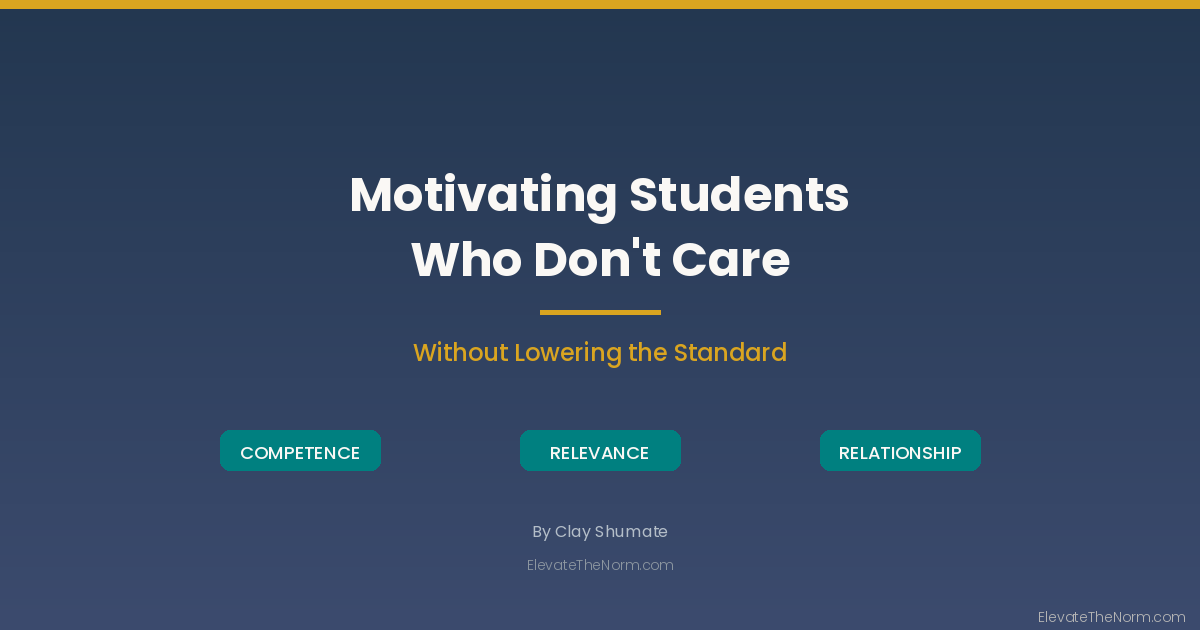
  • Motivating Students Who Don’t Care Without Lowering the Standard

    Motivating Students Who Don’t Care Without Lowering the Standard

    By Clay Shumate

    Motivating students who don’t care starts with questioning the assumption. Most students labeled “unmotivated” are not indifferent — they are protecting themselves from failure, irrelevance, or a classroom that has already told them they do not belong. The fix is not enthusiasm or entertainment. It is competence, relevance, relationship, and a standard worth rising to.

    What “Not Caring” Actually Means

    A student who puts their head down, turns in nothing, shrugs when you ask a question, or disrupts every transition looks like someone who does not care. That is what makes this problem so frustrating — the visible behavior and the internal reality rarely match. When that shows up as a flat refusal in the moment rather than a pattern across a term, what you do in the first ninety seconds matters more than anything you say afterwards.

    Research on learned helplessness, first described by Martin Seligman and now studied specifically in adolescent populations, shows that students who repeatedly experience failure without a clear path to improvement eventually stop trying — not because they lack desire, but because effort has not produced results before and they see no reason to believe it will now. A 2026 longitudinal study by Chang and colleagues, published in the Journal of Research on Adolescence, tracked this trajectory in adolescent students and found that learned helplessness increases over time when students experience controlling rather than autonomy-supportive environments.

    Carol Goodenow’s foundational 1993 research on school belonging found a direct link between students’ sense of belonging in a classroom and their academic motivation. Urban adolescents who felt they did not belong reported lower motivation and engagement strategies even when they had the ability to succeed. The research is clear: belonging is not a soft skill. It is a precondition for effort.

    So when a student looks like they do not care, start with three questions before you decide what to do:

    1. Has this student experienced enough success in your class to believe more is possible?
    2. Does this student see a connection between what you are asking them to do and anything that matters to them?
    3. Does this student believe that you — specifically you — will follow through on what you say?

    If the answer to any of those is no, you have found your starting point. And it is not a motivational speech.

    Why the Usual Fixes Make It Worse

    Rewards Lose Power

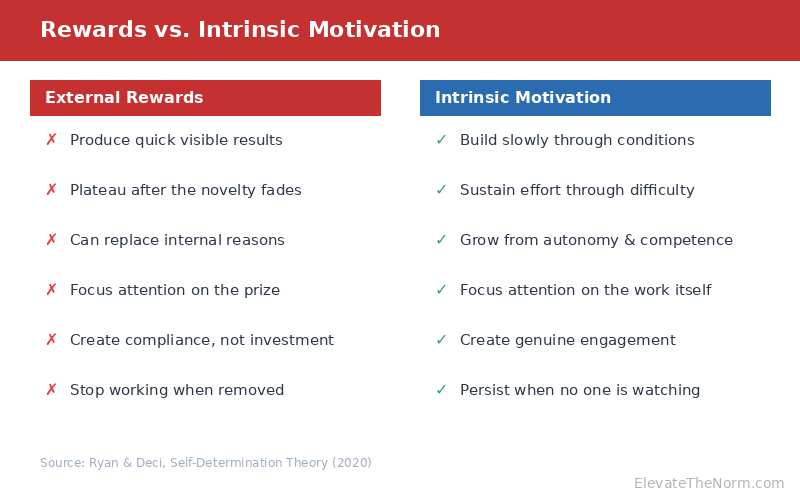
    External rewards work in the short term. A pizza party will get homework turned in for a week. But decades of research on self-determination theory, led by Edward Deci and Richard Ryan, demonstrates that extrinsic motivation follows a predictable pattern: the reward must escalate to maintain the same effect, and when it disappears, motivation drops below where it started.

    Deci and Ryan identified four types of extrinsic motivation along a continuum from fully external (doing something to avoid punishment or earn a reward) to integrated (doing something because it aligns with who you are). Most classroom reward systems never move students past the first stage. They produce compliance, not motivation. And compliance disappears the moment the reward does.
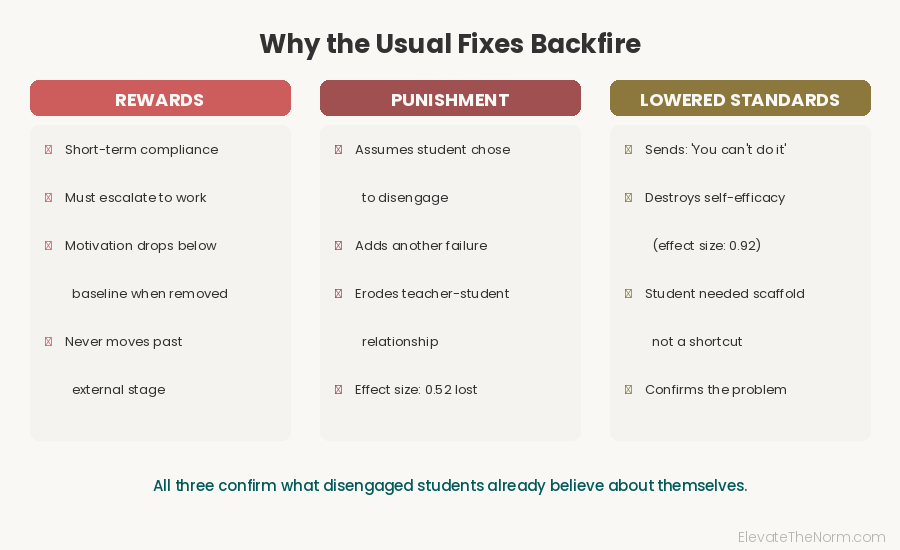
    Why rewards punishment and lowered standards backfire for disengaged students showing three columns of failed strategies
    Three common approaches to student disengagement that make the problem worse

    Punishment Backfires

    Punishing a student for not caring — zeroes, detention, calls home, public redirection — assumes the student has chosen not to engage and can be pressured into changing that choice. For a student dealing with learned helplessness, fear of failure, or a home life that makes school feel irrelevant, punishment adds another failure to the pile. John Hattie’s meta-analyses of educational research show that teacher-student relationships carry an effect size of 0.52 on student achievement — a correlation rather than a proven cause, which is how these numbers are best read. Punishment does not build relationships. It erodes them.

    Lowered Standards Confirm the Problem

    This is the trap that well-meaning teachers fall into most often. A student is struggling, so you shorten the assignment, remove the hard parts, or accept work you know is not their best. You do this out of compassion. But the student reads it differently: you do not think I can do it either.

    Hattie’s research on self-efficacy — a student’s belief in their own ability to succeed — shows an effect size of 0.92, one of the highest in the entire database. Lowering the standard does not raise self-efficacy. It destroys it. The student needed a scaffold, not a shortcut.

    What Actually Works: Competence, Relevance, and Relationship

    Eccles and Wigfield’s expectancy-value theory provides a useful framework here. Students are motivated when two conditions are met: they expect they can succeed at the task, and they value the outcome. Remove either one and effort disappears. A student who thinks they can do the work but sees no point will not try. A student who sees the point but believes they will fail will not try either.

    This means motivation is not one fix. It is at least two — and usually three.
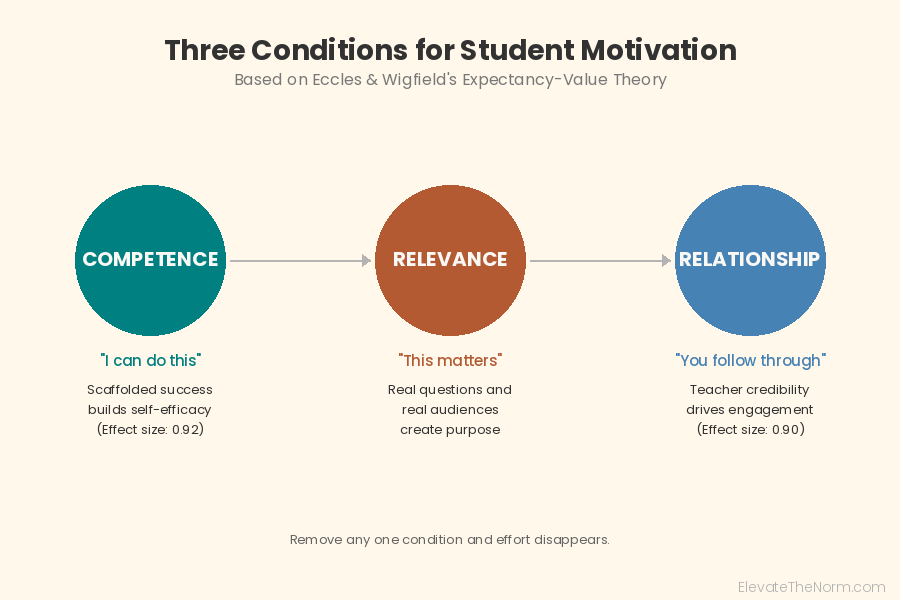
    Three conditions for student motivation based on expectancy value theory showing competence relevance and relationship
    Three conditions for student motivation based on Eccles and Wigfield’s expectancy-value theory

    Competence: They Need to Believe They Can

    This comes first because nothing else matters without it. A student who has failed repeatedly in your subject has built a story about themselves: I am not good at this. You cannot talk them out of that story. You have to give them evidence that it is wrong.

    That means:

    • Assign work they can complete successfully today, then raise the bar tomorrow. Not easier work — appropriately scaffolded work. The task stays rigorous. The entry point becomes accessible.
    • Give feedback that points forward, not backward. “This paragraph needs a stronger claim — here is what a strong one sounds like” beats “This is incomplete” every time. Hattie’s data shows feedback carries an effect size of 0.70 when it is specific, timely, and actionable.
    • Let them revise. A student who turns in weak work and gets a permanent grade has no reason to improve. A student who turns in weak work and gets a chance to make it better has a reason to try.

    Relevance: They Need a Reason

    “When will I ever use this?” is not a complaint. It is a genuine question, and if you cannot answer it, the student is right to ask.

    Relevance does not mean every lesson needs a TikTok hook. It means the work connects to something real — a question worth answering, a problem worth solving, a product someone will actually see.

    During project check-ins in my room, I pull students to the whiteboard table one group at a time. They have to show me what they have and explain why they made the choices they made. I am not grading their progress. I am asking them to defend it. And what I have noticed is that the students who checked out during a textbook reading will fight for a project they chose. Not because the project is fun — sometimes it is not — but because it is theirs. They picked the question. They have to stand behind the answer. That ownership changes the math on whether effort is worth it.

    Relationship: They Need an Adult Who Follows Through

    Teacher credibility — whether a student believes you are competent, trustworthy, and caring — carries an effect size of 0.90 in Hattie’s research. That is not a small number. It means a student’s perception of you as a teacher matters almost as much as anything you actually teach.

    But relationship does not mean being liked. It means being consistent. If you say you will look at their work, look at it. If you say there is a consequence, follow through. If you say you believe they can do it, prove it by holding them to the standard instead of quietly lowering it.

    Niemiec and Ryan’s 2009 review of self-determination theory in education found that students assigned to autonomy-supportive teachers — teachers who explained the purpose behind assignments, offered genuine choices, and acknowledged students’ perspectives — showed increased intrinsic motivation, perceived competence, and self-esteem compared to students with controlling teachers. Autonomy support is not a personality trait. It is a set of behaviors. And it can be learned.

    Five Practical Moves for Your Classroom
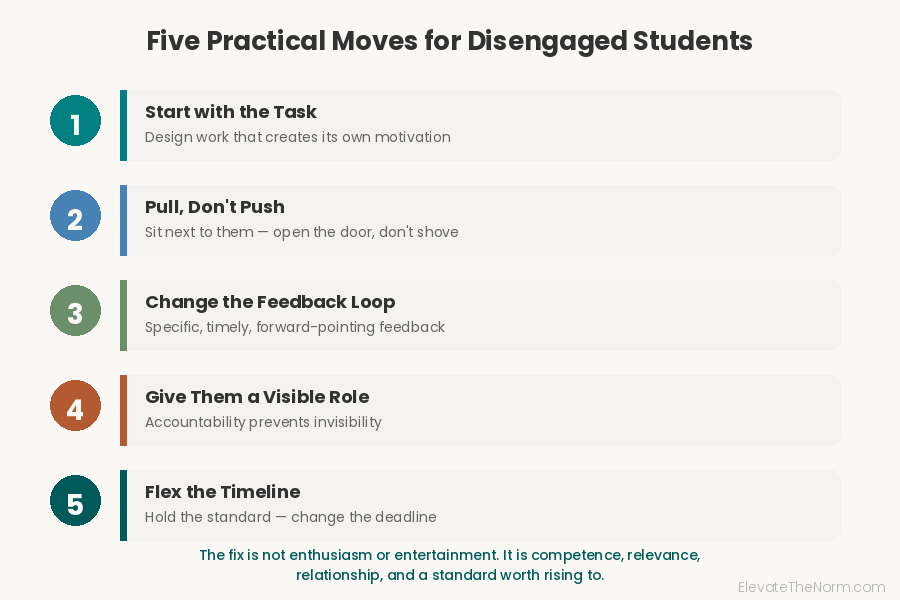
    Five practical classroom moves for motivating disengaged students including task design feedback and timeline flexibility
    Five practical moves teachers can use to re-engage students who appear not to care

    1. Start with the Task, Not the Motivation

    Stop trying to motivate students before the work begins. Instead, design work that creates its own motivation. A project with a real audience and a real deadline does not need a pep talk. A worksheet that will be graded and returned does. For ready-made versions of that, activities that fit inside one class period works through relevance hooks and choice structures that carry their own reason to start.

    2. Pull Them In — Do Not Push Them Forward

    When a student is disengaged, the instinct is to push: more reminders, louder redirections, calls home. Try pulling instead. Sit next to them. Ask what they are working on. Ask what part is confusing. Ask what they would change about the assignment if they could. You are not lowering the bar. You are opening the door.

    3. Change the Feedback Loop

    If the only feedback a disengaged student receives is a grade, they have no reason to change their behavior. Move feedback earlier in the process and make it specific:

    • “Your first two sentences set up a strong argument. The third one contradicts it — read it again and see if you catch why.”
    • “You have the right data. Your conclusion does not match it yet. Try again.”
    • “This is better than last week. Here is what will make it better than this.”

    4. Give Them a Role They Cannot Disappear From

    In group work, a disengaged student will drift to the margins unless the structure prevents it. Assign specific roles with visible accountability: the person who presents, the person who defends the data, the person who fields questions. When the work has their name on it, invisibility stops being an option.

    5. Separate the Standard from the Timeline

    Some students disengage because they have missed so much that catching up feels impossible. Let them redo work. Let them turn things in late with a conversation about what happened. Hold the quality standard. Flex the timeline. This is not lowering expectations. It is acknowledging that learning does not always follow a schedule.

    A note on this: your school likely has a grading policy, and you need to work within it. If your district has a strict late-work penalty, talk to your administrator about exceptions for specific students before you promise flexibility you cannot deliver. The principle — standard stays, timeline flexes — is sound. How much flex you have depends on your building. Do not make promises your gradebook cannot keep.

    What You Cannot Control — And Why That Matters

    Not every disengaged student is responding to something in your classroom. Poverty, trauma, food insecurity, unstable housing, family conflict, undiagnosed learning differences — these are real, and they affect motivation in ways a well-designed project cannot fix.

    You are not a therapist. You are not a social worker. You are a teacher. Your job is to make your classroom the kind of place where effort makes sense — where the standard is high, the support is real, and the relationship is honest. For some students, that will be enough. For others, it will be one piece of a much larger puzzle that involves counselors, families, community resources, and time.

    Do not blame yourself when a student does not respond. But do not stop trying either. Some turns take weeks. Some take months. Some happen long after they leave your room, and you never hear about it.

    Before You Assume Poverty Means Disengagement

    One more thing. I have worked in high-poverty schools my entire career, and I need to say this plainly: your students’ zip code does not predict their motivation. Research by Bloem and colleagues, published in Social Psychology of Education in 2024, found that teachers in lower-SES schools gave students less autonomy support and more controlling behavior — and that the gap widened among teachers who held biased attitudes toward low-income families. The problem was not the students. It was what the adults assumed about them.

    Students in a Title I school want recognition. They want to be trusted with responsibility. They want to communicate with each other and work on something that matters. The need is universal. The assumption that poor kids need control instead of relationship is not supported by the evidence, and it does real damage.

    Conclusion

    Motivating students who don’t care is not about finding the right trick. It is about diagnosing what killed the motivation in the first place — usually some combination of repeated failure, irrelevant work, and adults who did not follow through — and then rebuilding the conditions that make effort feel worth it. That means scaffolded competence, genuine relevance, honest relationships, and a standard that stays high even when the path to meeting it changes.

    Start with the student in front of you. Find out what they can do today. Show them what they could do tomorrow. And then hold them to it. And if the disengagement has already shown up as a failing grade, here is what to say in that conversation, and what to leave out of it.


    Sometimes it is not motivation, it is access. A student who cannot start often needs a support rather than a push — our guide to scaffolding strategies covers the eight that work and the one condition the research says they all depend on.

    How do I motivate a student who literally will not do any work?

    Start smaller than you think you need to. Find one task they will engage with — even a short one — and build from there. A student who completes one thing successfully is closer to completing two than a student who has completed nothing for weeks. Sit with them. Ask what the barrier is. Sometimes the answer is ‘I do not understand the directions.’ Sometimes it is bigger than that, and you need to loop in a counselor or support team.

    Is it okay to give students a choice in what they work on?

    Yes, and research supports it. Deci and Ryan’s self-determination theory shows that genuine choice — not the illusion of choice between two identical tasks — increases intrinsic motivation. The key word is genuine. Letting students choose their topic within a framework is meaningful. Letting them choose between worksheet A and worksheet B is not.

    Should I call home when a student is disengaged?

    It depends on the relationship and the home situation. For some students, a positive call home — ‘I noticed your child contributed a strong idea today’ — builds a bridge. For others, any call home triggers consequences that make school feel less safe, not more. Know your students before you pick up the phone, and lead with something they did well whenever possible.

    What about students with IEPs or 504 plans who seem disengaged?

    Some disengagement is disability-related, and the strategies here still apply — but with an additional layer. If a student has an IEP or 504, their accommodation plan may already address some of the barriers described in this article. Work with your special education team to make sure your scaffolding, timeline flexibility, and feedback approaches align with the plan rather than duplicating or contradicting it. Disengagement in a student with a learning difference may look identical to disengagement from a student without one, but the causes and appropriate responses can differ. When in doubt, consult the team before changing your approach.

    What if the student is dealing with issues outside school that I cannot fix?

    You cannot fix them, and you should not try to. But you can make your classroom a place where those issues do not get worse. Consistent routines, clear expectations, honest follow-through, and a teacher who does not give up — those things matter even when you cannot see the result immediately. Refer to counselors and support staff when you notice patterns that are beyond your scope.

    Does project-based learning help with disengaged students?

    It can, because PBL creates the conditions research shows drive motivation — autonomy, relevance, public accountability, and visible competence. But PBL alone is not a magic fix. A disengaged student placed in a group project without scaffolding and clear roles will simply disengage from the project instead of the worksheet. The structure matters as much as the format.

    How do I keep my standards high without pushing disengaged students further away?

    Separate the standard from the timeline and the entry point. The quality of work you expect stays the same. The amount of support you provide, the deadline flexibility you offer, and the way you scaffold the first attempt can all change. A student who turns in a rough draft and revises it three times has met the same standard as the student who nailed it the first time — they just took a different path to get there.

    Is student disengagement getting worse?

    National survey data suggests engagement has declined, particularly after 2020. But disengagement is not new — Goodenow was studying it in 1993, and Seligman described learned helplessness decades before that. What has changed is the visibility. Students who once sat quietly and did the minimum now have phones, social media, and more exit ramps. The underlying needs — competence, belonging, relevance — have not changed at all.


    If the student you are thinking about is a senior rather than a sophomore, the pattern has its own name and its own evidence — what actually causes senioritis covers why the last semester goes quiet and what a teacher can change about it.

    Sources

    1. Deci, E. L., & Ryan, R. M. (2000). “Intrinsic and Extrinsic Motivations: Classic Definitions and New Directions.” Contemporary Educational Psychology, 25(1), 54–67.
    2. Niemiec, C. P., & Ryan, R. M. (2009). “Autonomy, Competence, and Relatedness in the Classroom: Applying Self-Determination Theory to Educational Practice.” Theory and Research in Education, 7(2), 133–144.
    3. Goodenow, C. (1993). “The Psychological Sense of School Membership Among Adolescents: Scale Development and Educational Correlates.” Psychology in the Schools, 30(1), 79–90.
    4. Hattie, J. (2023). Visible Learning: The Sequel. Routledge.
    5. Chang, Y., et al. (2026). “The Longitudinal Trajectory of Learned Helplessness Among Adolescent Students: The Role of Parental Autonomy Support and Control.” Journal of Research on Adolescence.
    6. Bloem, N., et al. (2024). “Teachers’ Autonomy Support and Control Toward Lower- and Higher-SES Students.” Social Psychology of Education.
    7. Eccles, J. S., & Wigfield, A. (2002). “Motivational Beliefs, Values, and Goals.” Annual Review of Psychology, 53, 109–132.

    About Clay Shumate

    Clay Shumate is a certified secondary Social Studies teacher in the public schools of West Alabama, with seven years of classroom experience, a B.A. in History, and an M.Ed. in Secondary Education. He writes about project-based learning, student responsibility, respect, and practical ways to hold young people to a higher standard while giving them room to learn from mistakes. He is a member of the Society of Professional Journalists and writes to its Code of Ethics; this site’s editorial standards and corrections policy are published in full. More about Clay.
  • Why Are Classroom Expectations Important? Because Students Deserve Clarity

    Why Are Classroom Expectations Important? Because Students Deserve Clarity

    By Clay Shumate · Updated October 24, 2026

    Why are classroom expectations important? Because a room without them runs on guesswork, and guesswork is unfair to the student who can’t read your mood on a given day. Clear, taught expectations tell a class exactly what the room requires and what it promises back — protected instructional time, predictable fairness, and a real path toward independence.

    Key Takeaways

    • Clear expectations reduce discipline problems and protect instructional time — Marzano’s research found teachers with strong management practices and high-quality relationships had 31 percent fewer discipline issues over a full year.
    • Expectations are not rules posted on a wall. They are behaviors you teach, model, practice, and revisit — the same way you teach content.
    • Adolescents respond better to expectations they understand the reasoning behind. Stating a standard without explaining why it exists invites testing.
    • Consistency matters more than severity. A predictable room where small things are addressed early is calmer than a room where nothing happens until someone explodes.
    • Expectations must go both ways. If students are expected to be prepared, on time, and respectful, the adult in the room owes them the same.

    What Are Classroom Expectations?

    Classroom expectations are the specific, observable behaviors that define how a learning environment operates. They cover how students enter the room, how they participate, how they treat each other, how they handle materials, what happens when they finish early, and what happens when they need help.

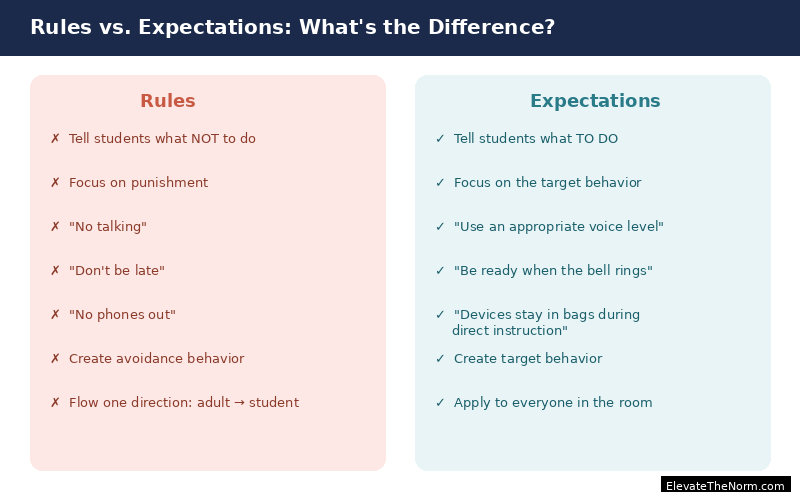
    That is different from rules. Rules tell students what not to do. Expectations tell them what to do instead — and the research consistently favors the second approach. Positively stated expectations (“Be prepared with your materials before the bell”) give students a target to hit rather than a minefield to avoid. If you are building a complete set of classroom expectations for the first time, starting with positively stated behaviors is the most important decision you will make.

    Side-by-side comparison showing the difference between classroom rules and classroom expectations, with rules focused on what not to do and expectations focused on what to do
    Rules tell students what not to do. Expectations tell them what to do instead.

    The distinction matters more than it sounds. “No talking” is a rule. “Use a voice level appropriate to the activity” is an expectation. The first one creates a room where students are trying not to get caught. The second creates a room where students are making judgments about what the moment requires — and that judgment is a skill worth developing.

    Classroom rulesClassroom expectations
    What they stateWhat not to doWhat to do instead
    Example“No talking”“Use a voice level appropriate to the activity”
    Who they apply toStudentsEveryone in the room, teacher included
    How they are learnedPosted and announcedTaught, modeled, practiced, and revisited
    What they buildAvoiding getting caughtJudgment about what the moment requires
    Classroom rules vs. classroom expectations at a glance.

    Why Are Classroom Expectations Important in Middle and High School?

    They Protect Instructional Time

    Research from the IRIS Center at Vanderbilt University is direct about this: teachers who establish and maintain clear norms for behavior spend more time teaching because less time goes to discipline (Brophy, 2000). Every minute spent restating a procedure that was never taught properly is a minute taken from the content students came to learn.

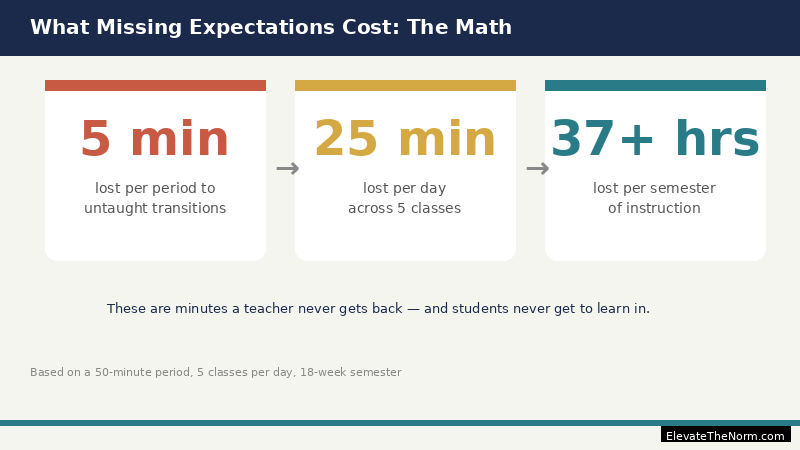
    In a secondary classroom with 50-minute periods — or in some cases, 90-minute blocks — lost minutes compound fast. If a teacher loses five minutes every period to transitions that were never practiced, that is 25 minutes a day across five classes. Over a semester, that is roughly 2,250 minutes — more than 37 hours of instruction gone.

    They Reduce Anxiety and Guesswork

    This is the part most teachers underestimate. Adolescents are performing a complicated identity negotiation every period of every day. They are testing who they are, what their peers think of them, how much authority to accept, and how much risk to take. A room with clear expectations removes one variable from that equation: they do not have to guess what the teacher wants.

    The Australian Education Research Organisation reviewed the evidence and found that when behavioral standards are transparent, “students feel more secure because they know where they stand” (DeNobile, 2021). Security does not mean softness. It means the room is predictable — and predictable rooms are calmer rooms.

    They Make Fairness Visible

    One of the fastest ways to lose a teenager’s trust is to enforce something they did not know existed. When expectations are public, taught, and consistent, a correction becomes a reference to a shared agreement rather than a personal attack. “We said prepared means materials out before the bell — grab your notebook” is a different conversation than “Why aren’t you ready?”

    The first version holds the standard. The second version questions the student. Adolescents can feel the difference, and they respond accordingly. This same principle applies to how teachers handle respect in the classroom — fairness is not about treating every moment identically, but about making every standard visible and every correction consistent.

    They Build Independence Over Time

    Here is what gets overlooked: clear expectations are not about control. They are a scaffold. When students know the procedures, they stop relying on the teacher to direct every transition, every material distribution, and every shift between activities. They run the routines themselves — and that frees the teacher to do the work that actually requires a human being: circulating, checking understanding, pulling small groups, and responding to what students need in real time.

    I spend most of my class period moving between groups, sitting down with students at the whiteboard table I built in the corner of my room. That table is the best seat in the house — low lamp, a rug, better chairs. Students ask to come there. But the only reason I can spend my time that way is because the rest of the room is running on expectations we practiced until they became automatic. If I had to stand at the front managing every transition, that table would just be furniture.

    How Do You Teach Classroom Expectations?

    Posting expectations on a wall is step one of a five-step process. Stopping there is the most common mistake secondary teachers make — and it is the reason so many give up on expectations by October. If you have already created a classroom expectations poster, that visual is useful — but it is the beginning of the work, not the end of it. A free Classroom Norms Poster Set on TPT gives you something to point to once the class agrees on what the standard is.

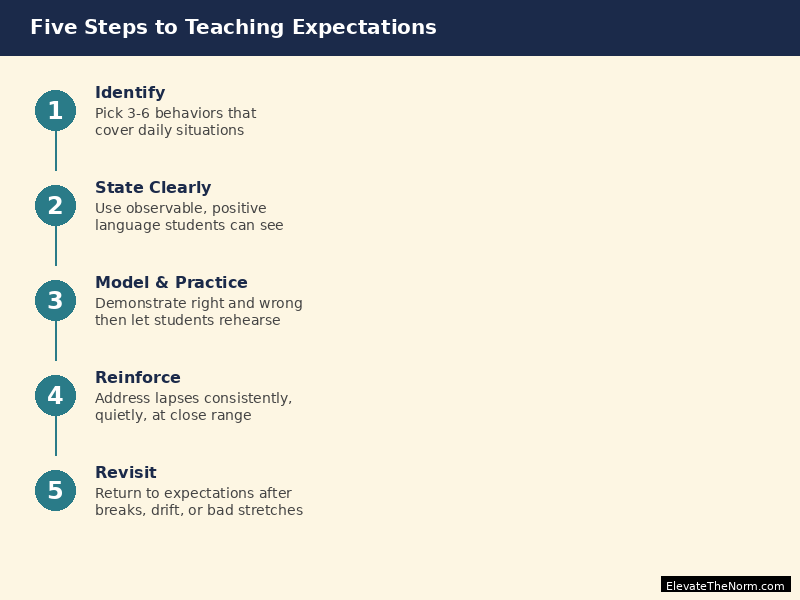
    Infographic showing the five steps to teaching classroom expectations: identify key behaviors, state them in observable language, model and practice, reinforce consistently, and revisit and adjust
    Teaching expectations requires five deliberate steps — not just posting them on a wall.

    Step 1: Identify the Behaviors That Matter Most

    You cannot have 30 expectations. You can have five or six — the ones that cover the situations your students encounter every day. Start with the moments that consistently cause problems: entering the room, transitions between activities, asking for help, working with a partner, and what to do when you finish early.

    Step 2: State Them in Observable Language

    An expectation is only useful if you can see whether someone is meeting it. “Be respectful” is not observable. “Listen without interrupting when someone is speaking to the class” is. “Be responsible” is not observable. “Turn in your work by the deadline or communicate with me before it passes” is.

    The IRIS Center recommends keeping rules few, universal, and positively stated — then linking specific procedures to each one (IRIS Center, 2003). A general expectation like “Be prepared” needs concrete procedures attached: what “prepared” looks like in this room, by this bell, for this type of activity.

    Step 3: Model and Practice

    This is where secondary teachers get uncomfortable. Modeling expectations feels elementary — and most of us skipped it. But the research is clear: students perform better when expectations are explicitly taught through demonstration, not merely announced (Archer & Hughes, 2011).

    Model what a good transition looks like. Model what asking for help looks like. Model the wrong way, too, if you can do it with humor and not sarcasm — so students see the contrast. Then let them practice. The first three days of the year are not lost instruction. They are the most important instruction you will give all year. This is especially critical if you are in your first years and still working out classroom management as a new teacher.

    Step 4: Reinforce Consistently, Not Loudly

    Marzano’s meta-analysis found that the quality of teacher-student relationships was the most important variable in effective classroom management — teachers with strong relationships and clear expectations had 31 percent fewer discipline problems across the year (Marzano et al., 2003). That finding matters because it means enforcement does not require volume. It requires consistency and connection.

    When a student does not meet an expectation, address it immediately, briefly, and at close range. A quiet redirect while you are already circulating — “Materials out, please” — costs less social capital than a public correction from across the room. And it preserves the relationship that makes the expectation stick. Strong relationships with students are not a separate initiative from classroom management — they are the mechanism that makes management work.

    Step 5: Revisit and Adjust

    Expectations are not a September activity. They need to be revisited after breaks, after schedule changes, after a stretch of bad days, and after you realize one of your expectations was unreasonable in the first place. Acknowledging that an expectation needs adjusting is not weakness. It is modeling exactly the kind of honest self-assessment you want from students.

    What Happens When Classroom Expectations Are Missing?

    The consequences of vague or absent expectations are not dramatic. They are gradual — and that is what makes them dangerous.

    Visual showing the costs of missing classroom expectations: lost instructional time, reactive discipline cycles, eroded trust, and disproportionate impact on marginalized students
    Without clear expectations, teachers spend more time managing confusion than teaching content.

    Without clear expectations, teachers tend to rely on reactive discipline: waiting for something to go wrong and then responding. That pattern creates an exhausting cycle. The teacher feels like they are constantly putting out fires. The students feel like the rules change depending on the teacher’s mood. Both sides get frustrated, and the relationship erodes. That fire-fighting cycle is one of the most reliable routes into exhaustion, and most of what prevents it is structural rather than a matter of willpower.

    Research on teacher expectations confirms this pattern. A 2024 narrative review published in the Journal of the Royal Society of New Zealand found that teachers’ expectations significantly influence student outcomes, and that inconsistent or unclear expectations disproportionately affect students from marginalized backgrounds (Rubie-Davies et al., 2024). Students who already face barriers outside of school should not have to decode a second set of hidden expectations inside it.

    For a practical look at what those belief-driven expectations actually require—the specific moves, language, and mindset that separate genuine high expectations from surface-level optimism—see holding students to high expectations in secondary classrooms.

    Expectations Go Both Ways

    This is the part that separates a set of classroom expectations from a set of classroom rules. Rules flow in one direction — from the teacher to the student. Expectations, done well, apply to everyone in the room.

    If students are expected to arrive on time, the teacher starts on time. If students are expected to be prepared, the teacher has the plan posted and the materials ready. If students are expected to listen without interrupting, the teacher does the same when a student is speaking.

    That does not mean teachers and students hold identical authority. They do not. But mutual respect for each other’s time, effort, and presence is what turns expectations from a behavior-management tool into a culture.

    Three Things Your Expectations Cannot Decide for You

    No classroom expectations list exists in isolation. Before you finalize yours, account for these:

    Your school’s behavior framework comes first. If your building uses PBIS, a schoolwide behavior matrix, or a restorative practices model, your classroom expectations must align with it — not contradict it. A classroom expectation that conflicts with the schoolwide framework confuses students who are trying to follow both, and it puts you in an awkward position with administrators when a situation escalates beyond your room.

    IEPs and 504 plans take legal precedence. A student’s documented behavior intervention plan overrides your classroom expectations for that student. This is not optional, and it is not a weakening of your standards. It is the law. Consult with the special education team before the year starts and whenever a new student with a plan enters your class.

    Families should know what you expect in week one. Send your expectations home — in writing, not just verbally through students. A parent who understands what the room requires can support it. A parent who discovers your expectations only when their child gets a consequence feels blindsided, and that damages a relationship you may need later.

    A Practical Starting Point

    If you are starting from scratch — or starting over — here is what works:

    Pick three to five expectations that cover the broadest range of daily situations. State each one in observable, positive language. On the first day, explain each one, model it, let students practice it, and explain why it exists. Then hold it — every day, every period, for every student — without exceptions that are not also explained publicly.

    It is not complicated. But it is relentless, and the relentlessness is the point. Students do not learn expectations from a poster. They learn them from a teacher who means what they say and says it every single day until the room runs on its own. The same principle applies to teaching student responsibility — it is a daily practice, not a one-time conversation.


    What are the benefits of classroom expectations?

    Clear, taught expectations protect instructional time, reduce student anxiety and guesswork, make fairness visible because corrections refer to a shared agreement, and build independence as students learn to run routines on their own. Marzano’s research links strong management and relationships to 31 percent fewer discipline problems over a school year.

    What are examples of good classroom expectations?

    Good expectations are positive and observable. Examples: “Be prepared with your materials before the bell,” “Use a voice level appropriate to the activity,” and “Listen without interrupting when someone is speaking to the class.” Most secondary classrooms need three to six that cover entering the room, transitions, asking for help, partner work, and finishing early.

    How many expectations should a secondary classroom have?

    Three to six. More than that and students cannot remember them, teachers cannot enforce them consistently, and the list starts contradicting itself. Each expectation should be broad enough to cover multiple situations but specific enough to be observable. If you need more than six, you probably need better procedures underneath fewer expectations.

    Are classroom expectations the same as classroom rules?

    Not exactly. Rules typically tell students what they cannot do and carry stated consequences. Expectations tell students what the room requires and are stated positively — what to do, not what to avoid. In practice, many teachers use a small set of expectations supported by procedures, with consequences understood but not the headline. The research favors positively stated expectations because they give students a behavior to perform, not just a behavior to suppress.

    When should expectations be introduced — the first day or after content starts?

    The first day. Marzano’s research and the IRIS Center’s synthesis both agree: explicitly teaching expectations during the first days of school produces better outcomes than announcing rules and moving to content. Time spent modeling, practicing, and discussing expectations in week one saves far more time than it costs over the remaining weeks of the semester.

    Do expectations work with students who have behavioral challenges?

    Clear expectations help every student, but they are especially important for students with behavioral challenges, including those with IEPs or 504 plans. Predictability reduces anxiety, and publicly stated expectations prevent the perception that consequences are personal or arbitrary. That said, individual behavior plans required by an IEP or 504 take legal precedence over classroom expectations — always follow the documented plan and consult with the special education team.

    How do you handle a student who refuses to follow expectations?

    Start with a private, calm conversation — not a public confrontation. Ask what happened. Restate the expectation. Give the student a clear path to meet it. If the behavior continues, follow your escalation process and document. Never abandon the expectation itself because one student resists it. The other 25 students are watching to see whether the standard is real.

    Should students help create classroom expectations?

    Research supports involving students in the process when it is genuine — not performative. A class discussion about why an expectation exists and what it should look like increases buy-in, especially with adolescents who need to understand the reasoning behind a standard. What does not work is asking students to create the expectations entirely and then overriding them when you do not like the result. If you ask for input, use it.

    Do expectations need to be revisited after the first week?

    Yes — after every long break, after a schedule change, after a substitute teacher, and after any stretch where the room has drifted. Expectations are not a contract signed and filed. They are a practice maintained through repetition and honest conversation about what is working and what is not.


    Sources


    About Clay Shumate

    Clay Shumate is a certified secondary Social Studies teacher in the public schools of West Alabama, with seven years of classroom experience, a B.A. in History, and an M.Ed. in Secondary Education. He writes about project-based learning, student responsibility, respect, and practical ways to hold young people to a higher standard while giving them room to learn from mistakes. He is a member of the Society of Professional Journalists and writes to its Code of Ethics; this site’s editorial standards and corrections policy are published in full. More about Clay.
  • Motivating Students: What Works When Rewards and Speeches Stop Working

    Motivating Students: What Works When Rewards and Speeches Stop Working

    Motivating Students: What Works When Rewards and Speeches Stop Working

    By Clay Shumate

    Motivating students does not start with a better reward system or a more inspiring speech. It starts with what research consistently confirms: students engage when they feel competent, connected to the people around them, and in control of something that matters. When the rewards and speeches stop working — and they will — what remains is the environment you built and whether it gives students a genuine reason to invest.

    Key Takeaways

    • Rewards can undermine the motivation they are supposed to build. Research on the overjustification effect has shown this for decades.
    • Autonomy, competence, and belonging are the three drivers that hold up under pressure — not points, prizes, or pep talks.
    • A student who looks unmotivated may be protecting themselves from failure, not choosing laziness.
    • Relevance means connecting work to something real, not performing enthusiasm about a worksheet.
    • The teacher’s job is not to motivate. It is to stop accidentally killing motivation and build a room where it can survive.

    Why Rewards and Motivational Speeches Have an Expiration Date

    Every teacher has tried it. The class Dojo points, the pizza party for the best-behaved table, the impassioned Monday morning speech about potential. These tools feel productive because they produce visible results — for a while. Then they stop.

    Research explains why. Ryan and Deci’s self-determination theory, refined over more than four decades, identifies a consistent pattern: when you offer an external reward for something a person was already willing to do, the reward replaces the internal reason. Psychologists call this the overjustification effect. The student who used to read because the book was interesting now reads because reading earns points — and when the points disappear, so does the reading.

    A 2024 review in Contemporary Educational Psychology reinforced this finding while adding nuance: rewards that provide informational feedback — telling a student something useful about their progress — can support motivation under the right conditions. But rewards that function as control — do this, get that — consistently erode it. The difference is whether the student walks away thinking about their work or thinking about the prize.

    Comparison of extrinsic rewards versus intrinsic motivation showing how control-based rewards undermine student engagement
    Rewards that control behavior erode motivation — rewards that inform progress can support it.

    Motivational speeches have a different shelf life but the same problem. They rely on an emotional spike that cannot sustain daily effort. A teacher who depends on inspiration is performing, not teaching. The kid who felt fired up on Monday has a bad lunch period on Tuesday and the fire is out.

    This does not mean you never celebrate, never recognize effort, and never speak with conviction. It means none of those things are your motivation strategy. They are supplements to something more durable.

    What Research Actually Says About Motivating Students

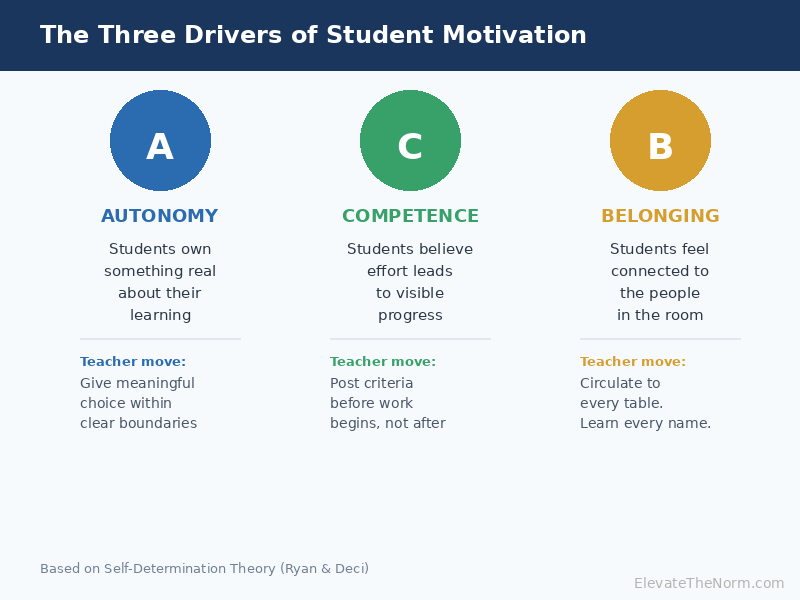
    The most widely supported framework for understanding student motivation is self-determination theory, developed by Edward Deci and Richard Ryan. The theory identifies three psychological needs that, when met, produce the kind of motivation that survives bad days and boring units:

    1. Autonomy — a sense of ownership over what you are doing and why.
    2. Competence — the belief that effort leads to growth, and that you can actually do the work in front of you.
    3. Relatedness — a genuine connection to other people in the room, especially the adult running it.
    Three drivers of student motivation — autonomy, competence, and relatedness — based on self-determination theory
    Autonomy, competence, and relatedness — the three drivers that hold up when rewards wear off.

    Harvard researcher Rhonda Bondie adds a fourth driver: meaning. Students engage when the work feels important, interesting, or useful — not because someone told them it was, but because they can see it for themselves. She also makes a point that should change how every teacher talks about this topic: “The biggest misconception about motivation is that students aren’t motivated.” Every student is motivated. The question is whether your classroom connects to what motivates them or blocks it.

    A Gallup survey of Gen Z students puts numbers on the problem. Only 18 percent of students strongly agree that teachers make their schoolwork feel important. Only 17 percent report learning something interesting in the past week. Only 11 percent say they get opportunities to do what they do best. These are not students who refuse to care. These are students telling us, clearly, that the work is not giving them a reason to.

    Research on productive failure shows that students who struggle before receiving instruction outperform those who receive direct teaching first — as long as the failure is followed by explicit teaching. A structured approach to learning from mistakes turns errors into one of the most powerful motivators available.

    Autonomy: Real Choices, Not Fake Ones

    Autonomy does not mean letting students do whatever they want. In a grades 6–12 classroom, it means giving students genuine control over some part of their learning — the topic within a standard, the format of a product, the order they tackle a set of tasks, or how they demonstrate what they know.

    The word genuine is doing work there. Asking students to choose between a blue worksheet and a green worksheet is not autonomy. Letting a student pick which historical figure to research within a unit on leadership — and then defend that choice — is. ASCD’s review of the ABC+M framework recommends curated choice: a structured set of meaningful options rather than wide-open freedom that becomes confusion.

    Where autonomy gets tricky is the boundary. Too little choice and students feel controlled. Too much choice without scaffolding and students feel abandoned — especially students who already struggle. The answer is graduated release. You start with structured choices in September and widen them as students demonstrate they can handle the responsibility — the same graduated approach behind teaching responsibility without treating teenagers like children. Some classes earn more latitude faster than others. That is not unfair. It is honest.

    Competence: Students Will Not Try What They Are Sure They Cannot Do

    This one gets misunderstood. Competence does not mean making the work easy. It means making it clear — clear enough that a student can see what good work looks like, understand the distance between where they are and where they need to be, and believe that the distance is crossable.

    Carol Dweck’s work on growth mindset gets cited so often that it has become wallpaper in some schools. The poster goes up. The language shifts. Nothing changes. The reason, according to a 2025 meta-analysis by Dweck and Yeager, is that mindset interventions only work inside classrooms that actually respond to effort with better outcomes. Telling a student “you can grow” while running a grading system that punishes first attempts is not a growth mindset environment. It is a contradiction.

    Practical competence support looks like this: visible criteria posted before students start the work, not revealed after they finish. Short-term goals that students can track themselves. Feedback that says something specific — “your claim is strong but your evidence doesn’t connect to it yet” — instead of “good job” or a letter grade with no explanation. And opportunities to revise, because competence develops through iteration, not through getting it right the first time.

    Belonging: The Motivation Driver Most Teachers Underestimate

    A student who does not feel like they belong in your room will not risk effort in it. This is not a soft claim — it is one of the most consistent findings in motivation research. Kumar and colleagues (2018) found that when students feel a genuine sense of membership in a school, it can counteract the negative effects of prejudice and discrimination on motivation and learning outcomes. Belonging is not a nice-to-have. It is a prerequisite.

    And belonging is built in small moments, not grand gestures. It is built in how you respond when a group laughs at a wrong answer. In whether you learn how to pronounce a student’s name correctly on the first day and never stop trying. In whether you circulate to every table or just the ones that are already performing. This is the daily work of building relationships with students — and it matters more than any opening-week icebreaker.

    In my room, one of my hard stops is mocking someone’s name. You do not get to make fun of how unique another person’s name is. That is not a negotiation and it is not a warning — it is a line, and everyone in the room knows where it is. I hold that line because names are identity — because respect in the classroom is built or broken in moments exactly like that one. When you let a room laugh at a kid’s name, you are telling that kid they do not belong here. And a kid who does not believe they belong will not invest in anything you are teaching.

    The workshop room helps. When students are already sitting in groups, facing each other, working alongside somebody — the default condition, not a special arrangement — belonging has a physical structure to grow in. A student who sits in a row facing the back of someone’s head for fifty minutes does not feel like a member of anything.

    Relevance Without Faking It

    When a student asks “when am I ever going to use this,” they are not being rude. They are telling you something important: they cannot see the connection between the work and anything they care about. The honest answer is sometimes “you might not use this specific skill.” The better answer is to build work where the question does not come up because the connection is visible.

    Relevance does not mean every lesson needs to tie to a career. It means the work should connect to a question worth answering, a problem worth solving, or a skill the student can see themselves using. A history lesson about primary-source analysis becomes relevant when students use those same skills to evaluate a news article that showed up on their feed that morning. A math unit on data becomes relevant when the data is about something in the school or community — not a made-up scenario about a fictional bakery.

    The Gallup data is clear on this. When asked what makes them interested in a class, 60 percent of students say “the teacher made it exciting and interesting” and 60 percent say “the topic aligned with a personal interest.” But 35 percent say “real-world connection explained.” That last number is the most actionable because it requires the least talent and the most planning. You do not have to be naturally charismatic. You have to show why the work matters.

    When Students Look Unmotivated but Are Not

    Some students have given up before your class period starts. Not because they are lazy, defiant, or indifferent — because they have learned that effort does not lead anywhere good for them. Research on learned helplessness in middle school students describes a specific pattern: after repeated experiences where effort did not produce results, students adopt a protective posture. They stop trying — not because they do not care, but because trying and failing again is worse than not trying at all.

    This is the student who puts their head down, gives one-word answers, refuses to start, or turns in blank work. The instinct is to push harder: “I know you can do this if you just try.” But for a student in this pattern, that statement confirms the problem. They have heard it before. They tried. It did not work. For the narrower version of this — the student in front of you right now who will not start — there is a calm plan for the first ninety seconds of a work refusal.

    What works instead is small, private, low-stakes evidence that effort produces a result. Not a public declaration — a quiet conversation at the table. Not a massive assignment — a single manageable step with clear criteria and honest feedback when the step is done. You are not trying to inspire them. You are trying to give them one piece of evidence that their effort connects to an outcome.

    A 2026 longitudinal study in the Journal of Research on Adolescence found that parental autonomy support — not control — reduced learned helplessness trajectories in adolescents over time. The classroom parallel is that pushing harder on a helpless student makes the helplessness worse. Supporting their autonomy — giving them a small, real choice and then honoring it — begins to reverse it.

    Environmental Barriers You Cannot Speech Your Way Past

    A student who did not eat breakfast is not unmotivated. A student who slept three hours because they share a room with a crying infant is not disengaged. A student carrying stress from an unstable home is not choosing not to care.

    Some barriers to motivation are outside your classroom. You cannot fix food insecurity with a growth mindset poster. Attendance works the same way — the reasons students give for missing school are led by illness and lost sleep, not boredom, which is why chronic absenteeism responds so poorly to engagement-only strategies. But you can acknowledge what is real, adjust your expectations for a given day without abandoning your standards permanently, and make sure the room itself is not adding to the burden. The lamps instead of overhead fluorescents. The warm light and the rug. A room that does not assault a student’s senses the moment they walk in is not a luxury — it is a basic condition for any of the motivation strategies above to work.

    What you do control: the pacing of the period, the volume of your voice, whether a student who is struggling gets a quiet check-in or a public callout, whether your consequences teach or just punish, whether the room feels safe enough to take a risk. The OECD’s 2025 data found a 40 percent student engagement strategies drop in peer environments that do not prioritize learning. You build the peer environment. That is a motivation lever you hold every day.

    What to Do Tomorrow Morning

    If you walked into your room tomorrow with nothing new except a different approach, here is what the research says will move the needle:

    Stop doing these things:

    • Publicly calling out a student who is not working. Walk over. Sit down. Ask what they need — at conversation volume, not announcement volume.
    • Rewarding compliance and calling it motivation. A quiet class is not a motivated class.
    • Assigning work without explaining why it matters, then blaming students for not caring.
    • Lecturing for thirty minutes and expecting teenagers to sit still for it.

    Start doing these things:

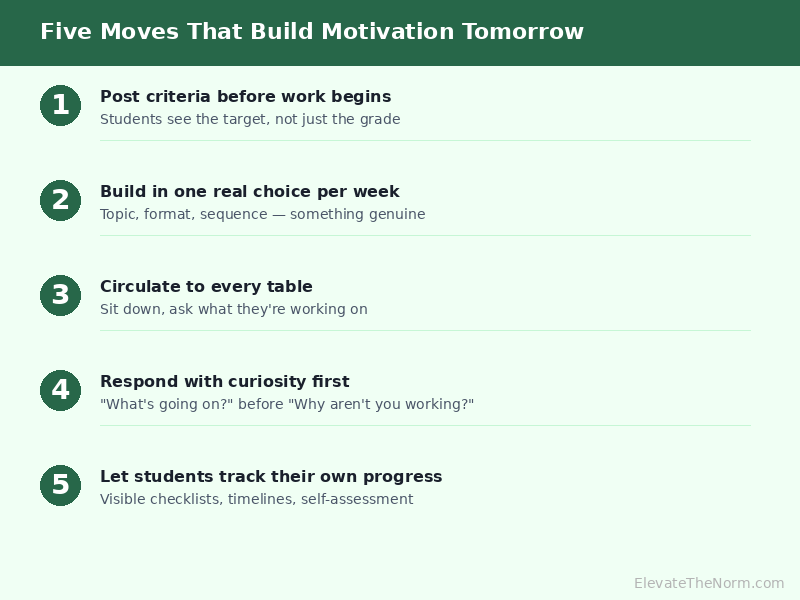
    • Post the criteria for quality work before students begin, not after they finish. Make the target visible.
    • Build in one meaningful choice per week — topic, format, sequence, or method. Real choice, not cosmetic choice.
    • Check in with every student, not just the struggling ones and not just the stars. Circulate to every table. Sit down. Ask what they are working on.
    • Respond to disengagement with curiosity before correction — the calm-over-control approach that actually works. “What’s going on today?” lands differently than “Why aren’t you working?”
    • Use progress tracking students can see — a simple checklist, a visible timeline, a self-assessment. Let them see they are moving.
    Five practical moves for motivating students tomorrow morning including visible criteria, meaningful choice, and curiosity before correction
    Five concrete shifts you can make tomorrow morning to support student motivation.

    The Room Matters More Than the Speech

    Motivating students is not a talent you either have or do not. It is not about being the inspiring teacher from a movie. It is about building a room where students feel competent enough to try, connected enough to care, and autonomous enough to own something real. When those three conditions exist, motivation does not have to be manufactured. It shows up because the room gives it a reason to.

    The rewards and speeches will always stop working. The environment never does.

    For the students who look like they have given up entirely rather than just coasting, see motivating students who don’t care, which works through what changes when disengagement looks total. Once you have found the barrier and want something to run this week, the hands-on companion to this guide collects goal setting, real choices, progress tracking and peer recognition.

    Frequently Asked Questions

    How do I motivate students who have completely shut down?

    Start small, start private, and start with something they can actually do. A student who has shut down is usually protecting themselves from failure, not refusing to work. Give them one manageable task with clear criteria, check in quietly at their table, and respond honestly when they complete it. You are not trying to fix everything in one period. You are trying to give them a single piece of evidence that their effort connects to a result. Over time, those small pieces rebuild what learned helplessness took apart.

    Are rewards always bad for student motivation?

    No — but the type of reward matters. Rewards that provide informational feedback about a student’s progress can support motivation. Rewards that function as control — do this specific thing, receive this specific prize — tend to undermine intrinsic motivation over time. The research question is not whether you ever celebrate or recognize effort. It is whether the reward system replaces the student’s internal reasons for engaging or reinforces them.

    What is the difference between engagement and motivation?

    Motivation is internal — the drive, interest, or purpose behind effort. Engagement is what it looks like from the outside — participation, focus, persistence. A student can be behaviorally engaged (sitting quietly, completing work) without being motivated. And a motivated student who lacks the right conditions can look disengaged. Effective teaching targets the motivation because the engagement follows naturally when the conditions are right.

    Does giving students choices really improve motivation?

    Yes, when the choices are meaningful and structured. Self-determination theory identifies autonomy as one of three core drivers of intrinsic motivation. But choice only works when students have enough information to choose well, when the options are genuinely different, and when the teacher provides scaffolding. Asking a student to pick between identical worksheets in different colors is not autonomy. Letting them choose which historical figure to research within a unit — and defend that choice — is.

    How do I motivate students when the content is genuinely boring?

    Not every lesson will feel exciting, and pretending otherwise insults teenagers. When the content itself is dry, connect it to a question or product that is not. A grammar unit becomes tolerable when students are editing a real piece of writing they care about. A data unit becomes relevant when the data is about something in their school. You are not making the content entertaining — you are giving it a purpose the student can see.

    What role do relationships play in student motivation?

    Relationships are the single most consistent factor in motivation research. A Gallup study found that students with access to at least one teacher who makes them excited about the future are 30 times more likely to report high engagement. But the relationship that matters is not performative warmth — it is the kind built by knowing a student’s work, checking in consistently, and responding to struggle with support instead of judgment.

    Can a teacher really control student motivation?

    No — and you should not try to. Motivation belongs to the student. What you control is the environment: the clarity of the work, the quality of the feedback, the safety of the room, whether students have meaningful choices, and whether effort leads to visible progress. Build those conditions and motivation has room to exist. Remove them and no amount of enthusiasm from the front of the room will compensate.

    Sources


    About Clay Shumate
    Clay Shumate is a certified secondary Social Studies teacher in the public schools of West Alabama, with seven years of classroom experience, a B.A. in History, and an M.Ed. in Secondary Education. He writes about project-based learning, student responsibility, respect, and practical ways to hold young people to a higher standard while giving them room to learn from mistakes. He is a member of the Society of Professional Journalists and writes to its Code of Ethics; this site’s editorial standards and corrections policy are published in full. More about Clay.
  • Respect in the Classroom: Why It Must Go Both Ways

    Respect in the Classroom: Why It Must Go Both Ways

    Respect in the Classroom: Why It Must Go Both Ways

    By Clay Shumate · Updated October 24, 2026

    Respect in the classroom means the teacher treats students with dignity and the students extend that same consideration back—but the two sides are not identical. Teachers hold authority. Students hold vulnerability. When both parties take their role seriously, the room works. When either side stops, it falls apart fast. Here is how mutual respect actually functions in a secondary classroom and what you can do when it breaks down.

    Key Takeaways

    • Mutual respect does not mean equal authority—it means equal dignity.
    • Students who feel respected by their teacher are more likely to engage, take academic risks, and follow expectations without being threatened.
    • Respect is taught through daily behavior, not posters or lectures.
    • A teacher who demands respect without modeling it will lose the room.
    • Correction and respect can coexist—if you handle correction at close range and without an audience.

    What Does Respect in the Classroom Mean?

    Respect in a secondary classroom is not everyone being nice all the time. It is a working agreement: I will take you seriously, and you will take this room seriously. That agreement only holds when the adult goes first.

    Researchers have studied this. John Hattie’s meta-analysis of over 1,800 studies found that teacher-student relationships carry an effect size of 0.52, against the 0.40 threshold he identifies as meaningful for student achievement (Visible Learning, 2023). That threshold is worth reading carefully rather than treating as a pass mark — it is an average across a database of largely correlational studies, and what an effect size can and cannot tell you is its own argument. That number does not mean “be friendly.” It means the quality of the working relationship between a teacher and a student measurably changes how much that student learns.

    A 2025 report from Estyn, the Welsh education inspectorate, surveyed secondary students about what drives classroom behavior. The students were blunt: “Behavior probably won’t get that much better unless the teachers respect us.” They valued teachers who listened, avoided shouting, and demonstrated understanding—and they distinguished those teachers from ones who simply enforced rules (Estyn, 2025).

    That matches what I see in my own classroom. The students who push back hardest are not usually the ones who dislike structure. They are the ones who feel like the structure was never for them.

    Why Equal Dignity Does Not Mean Equal Authority

    One of the fastest ways to lose credibility with teenagers is to pretend that the teacher and the student hold the same position. They do not. The teacher sets the standard, owns the pacing, manages safety, and answers to the school and the families. The student is developing, which means they are going to make mistakes that would get an adult written up.

    Mutual respect does not erase that difference. It governs how the difference gets used.

    Whitney Hegseth, writing in Educational Researcher in 2024, proposed a framework for mutual respect that directly addresses this. She argued that most classrooms carry “pervasive power asymmetries” and that respect requires disrupting those asymmetries—not by pretending they do not exist, but by treating student voices, experiences, and reasoning as genuinely worth hearing even when the teacher holds final authority (Hegseth, 2024).

    In practice, that looks like this:

    • You enforce a deadline, but you explain the reason for the deadline.
    • You redirect a student, but you do it without an audience.
    • You hold a standard, but you acknowledge when the student made progress toward it.
    • You make a decision a student disagrees with, and you let them say so—then you make the decision anyway, without punishing the disagreement.

    Authority without dignity is domination. Dignity without authority is chaos. Respect in a secondary classroom is both, running at the same time.

    What Is the Difference Between Respect and Obedience?

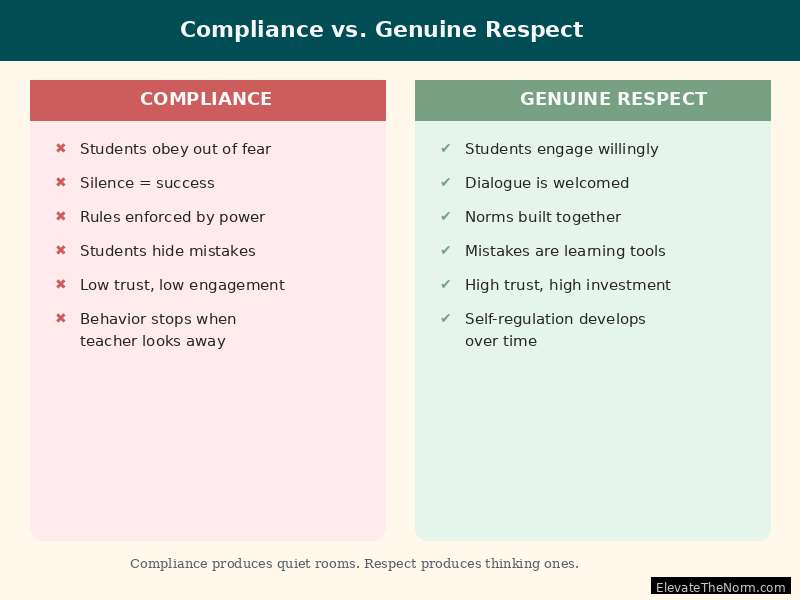
    Side-by-side comparison of compliance-based and respect-based classroom approaches showing key differences in student engagement and trust
    Compliance produces quiet rooms. Respect produces thinking ones.

    Obedience is silence. Respect is engagement.

    A quiet room is not necessarily a respectful room. A student can sit silently, produce nothing, and cause no disruptions. That student is obedient. But they are not engaged, they are not learning, and they are not in a relationship with the teacher that will survive the first real disagreement.

    Self-determination theory, developed by Edward Deci and Richard Ryan, identifies three psychological needs that drive motivation: autonomy, competence, and relatedness. When students feel their autonomy is respected—meaning they have some control over how they learn—and when they feel a genuine connection to the adult in the room, engagement rises. When those needs are frustrated, compliance may continue for a while, but motivation drops (Niemiec & Ryan, 2009).

    Respect feeds all three. A respected student is more likely to take an academic risk because they trust the teacher will not humiliate them for getting it wrong. A respected student is more likely to ask a question. A respected student is more likely to accept correction because they believe the correction is about the work, not about power.

    What Disrespect from a Teacher Looks Like

    Teachers rarely think of themselves as disrespectful. But students notice every time. Common forms of teacher disrespect in secondary classrooms include:

    Public correction. Calling out a student’s name across the room to address behavior. This turns a private mistake into a public performance. The student now has an audience, which means they have something to defend.

    Sarcasm. Using humor at a student’s expense. Teenagers can tell the difference between laughing with and laughing at. Sarcasm from a position of authority is not wit—it is a power display wrapped in a joke.

    Dismissal. Cutting off a student’s explanation, waving away a question as obvious, or responding to a wrong answer with visible frustration. Each of these teaches the student that speaking up was a mistake.

    Inconsistency. Enforcing expectations for some students but not others. The Estyn report found that perceived favoritism was one of the top complaints secondary students had about classroom discipline. When the rules bend for some and not for others, students do not see flexibility—they see unfairness (Estyn, 2025).

    Low expectations disguised as kindness. Accepting poor work without feedback, excusing repeated lateness, or never holding a student accountable because “they have a lot going on.” This feels like compassion. It communicates that you do not believe they can do better.

    What Disrespect from a Student Looks Like—and What It Usually Means

    Student disrespect is real. It happens. Pretending it does not happen helps no one. But what it means is almost never what it looks like on the surface.

    A student who rolls their eyes is not always dismissing you. They may be embarrassed. A student who talks back is not always defiant. They may be testing whether you will stay calm or escalate. A student who refuses to work is not always lazy. They may not know where to start and would rather look defiant than lost. When I need the right words in the moment, I lean on my De-escalation Strategies: 100 Scripts on TPT.

    None of this excuses the behavior. All of it changes the response.

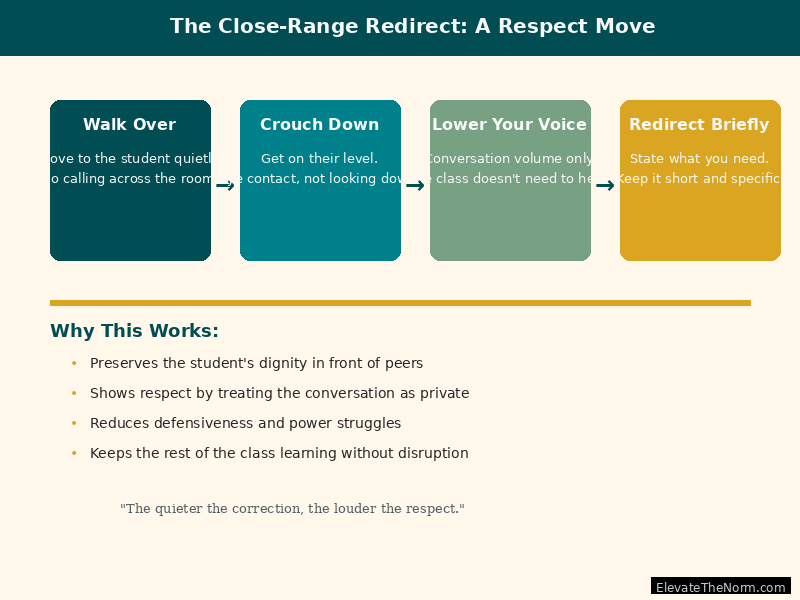
    When I see a student doing something that could derail the room, I do not announce it. I walk over. I get close. I keep my voice low enough that only the two of us can hear it. “Hey—I need you back on this. What do you need?” That question gives them an out that does not require them to perform defiance for the rest of the class. Most of the time, they take it.

    That is what I mean by close-range correction. I am not ignoring the behavior. I am addressing it in a way that does not force the student to choose between their dignity and my authority.

    The Close-Range Redirect: A Workshop-Room Practice

    Visual process showing the close-range redirect technique: walk over, crouch down, lower voice, redirect briefly for respectful classroom correction
    The quieter the correction, the louder the respect.

    In my room, students work alongside each other most of the time. They are paired up, grouped at tables, talking through problems together while I circulate. That physical setup changes how correction works.

    When a student is off track, I do not need to raise my voice across rows of desks—because there are no rows. I am already moving. I am already close. I crouch down next to the table, make eye contact with the student, and say what needs to be said at a volume that does not carry past that group.

    Sometimes it is a redirect: “You’ve been on the phone for three minutes. Put it away and finish the second question.” Sometimes it is a check-in: “You look stuck. Tell me what you have so far.” Sometimes it is both at the same time.

    The key is proximity. A correction delivered from fifteen feet away, across a room of watching peers, is a confrontation. The same correction delivered at arm’s length, at conversation volume, is coaching. Students know the difference. They respond to it differently.

    This is not a technique I read about and decided to try. This is how a teacher-led workshop room naturally works. (For more on building this kind of classroom presence, see Classroom Management for New Teachers.) When you build a room where movement and closeness are the default, correction stops being a performance and starts being a conversation.

    How Do Teachers Build Respect in the Classroom?

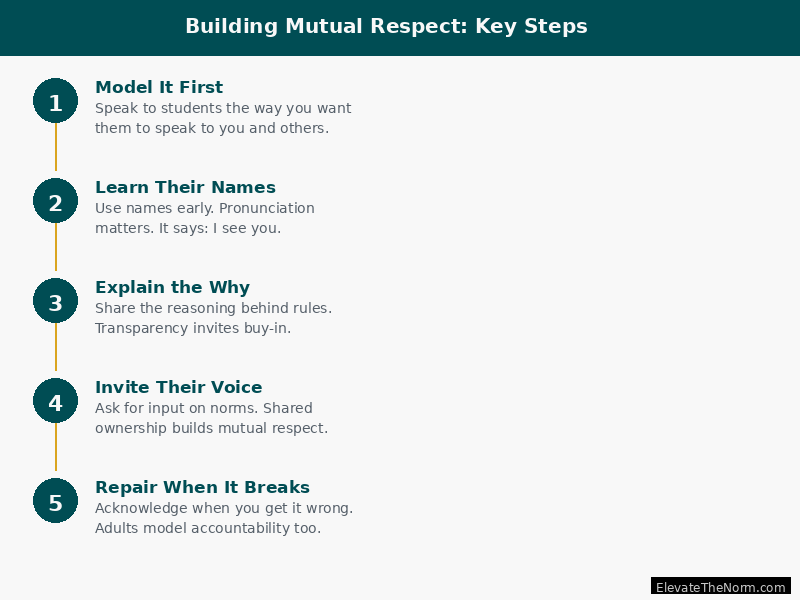
    Five key steps for building mutual respect in the classroom including modeling behavior, learning names, explaining the why, inviting student voice, and repairing when it breaks
    Five practical steps teachers can take to build mutual respect from day one.

    Respect does not appear because you demand it. It appears because you demonstrate it consistently and early enough that students learn to expect it.

    Teach expectations explicitly

    Do not assume students know what respect looks like in your room. Show them. Model it. Practice it. Name it when you see it. Research consistently shows that explicitly taught expectations are followed more consistently than assumed ones (Shumate, 2026).

    Learn names fast

    Using a student’s name is the simplest respect move available. It says: I see you specifically. You are not interchangeable.

    Follow through without escalation

    Say what will happen. Then do what you said. Do not threaten. Do not negotiate publicly. Do not make consequences bigger because you are frustrated. Consistency teaches students that the system is predictable, which is the foundation of trust.

    Admit your mistakes

    If you snap at a student unfairly, say so. If you graded something wrong, correct it openly. Students can forgive an honest mistake. They cannot forgive an adult who pretends it did not happen.

    Protect their time

    Starting class on time, ending activities when you said you would, and not wasting the period on things that do not matter—these are all respect moves. They communicate: your time in this room has value, and I take that seriously.

    How to Respond When Respect Breaks Down

    Even in well-run classrooms, respect breaks down. A student says something cutting. A teacher has a bad day and snaps. A misunderstanding escalates. What matters is what happens next.

    For teacher-to-student repair

    Apologize specifically. “I was short with you earlier, and that was not fair. You did not deserve that.” Do it privately if possible. Do it publicly if the original disrespect happened publicly. Then move on without over-explaining or making the student comfort you about it.

    For student-to-teacher repair

    Give the student space before you process it. A student who was disrespectful in front of the class is not ready to have a repair conversation thirty seconds later. Come back to it when both of you are calm. Ask what happened. State what the impact was. State what you expect going forward. Then let them re-enter the room without a grudge. If the wording is the part that deserts you in the moment, I give away five de-escalation scripts you can use today as a free sample.

    For classroom-wide breakdowns

    If the entire room is off, stop. Name what you see without blaming specific students. Reset the expectation. Give a short, clear direction. Resume. Do not lecture. A ten-minute speech about respect after the room fell apart teaches students exactly one thing: when things go wrong, the teacher talks for ten minutes.

    Respect Across Cultures and Backgrounds

    Respect is not culturally neutral. What looks respectful in one community may look passive or even disrespectful in another.

    Eye contact is the classic example. In many Western classrooms, teachers interpret direct eye contact as a sign of attention and respect. In many Indigenous, East Asian, and African American communities, sustained eye contact with an authority figure can be a sign of disrespect or defiance. A teacher who punishes a student for “not looking at me when I’m talking to you” may be punishing culturally appropriate behavior (Weinstein, Curran, & Tomlinson-Clarke, 2003).

    Volume is another. Some students come from homes and communities where loud, direct communication is normal and expected. A teacher who interprets volume as aggression may be misreading cultural norms as behavioral problems.

    None of this means teachers should abandon expectations. It means teachers should examine whether their version of respect is a universal standard or a cultural preference. If a student’s behavior is not disruptive, harmful, or unsafe, the teacher should question whether it truly needs correcting or whether it simply does not match the teacher’s personal comfort.

    Why Is Respect in the Classroom Important?

    The evidence on respect and relationships in the classroom is not ambiguous. It consistently points in one direction.

    A 2025 longitudinal systematic review published in Social Psychology of Education examined decades of research on teacher-student relationships and school outcomes. The review found that positive relationships predicted better academic achievement, stronger engagement, and fewer behavioral problems—and that these effects held for both typical and vulnerable student populations (Van der Aar et al., 2025).

    A meta-analysis published in Frontiers in Psychology in 2026 synthesized 18 studies involving over six million students and found a statistically significant negative association between teacher punishment and student academic achievement (r = −0.183, p < 0.001). The relationship was consistent across grade levels and strengthened as the proportion of male students increased (Wang et al., 2026).

    Teacher credibility—students’ perception that their teacher is competent, trustworthy, and caring—carries an even larger effect size of 0.90 in Hattie’s research, making it one of the strongest influences on learning in the entire database. Respect is the foundation of that credibility. Without it, nothing else the teacher does lands the way it should.

    A Practical Framework for Mutual Respect

    Here is a simple framework for how respect functions in a secondary classroom. This is not a poster. It is a decision-making guide for everyday interactions.

    SituationRespectful ResponseDisrespectful Response
    Student gives a wrong answer“That’s not quite it, but you’re thinking in the right direction. Let’s look at it again.”“No. Did you even read the material?”
    Student is off taskWalk over, lower your voice, redirect specifically.Call their name across the room: “Are you working or just sitting there?”
    Student challenges a decision“I hear you. Here’s why I’m doing it this way. We can talk more after class.”“Because I said so. That’s why.”
    Student misses a deadline“This was due yesterday. What happened, and when can you get it in?”“I guess you decided this wasn’t important to you.”
    Student is visibly upset“Do you need a minute? I’ll check back with you shortly.”“You need to pull it together. This is class.”
    Teacher makes a mistake“I was wrong about that. Here’s the correction.”Pretend it didn’t happen and move on.

    Conclusion

    Respect in the classroom is not a mood or a personality trait. It is a set of daily decisions. You decide to learn names. You decide to correct behavior privately instead of publicly. You decide to enforce a standard without attacking the person who fell short of it. You decide to apologize when you are wrong.

    None of this makes you soft. Teachers who respect their students are not pushovers—they are the ones students take most seriously. The research confirms this: when students feel respected, they engage more, learn more, and cause fewer problems. When they feel disrespected, they disengage, resist, or leave.

    Respect goes both ways, but the teacher goes first. That is not a burden. That is the job. And when students feel respected, they are far more likely to accept the responsibility teachers ask of them.

    Frequently Asked Questions

    Respect and student responsibility reinforce each other. Students who feel respected take ownership of their behavior and their commitments. This is also the foundation of positive discipline for teens — firm standards delivered with dignity. One small, concrete way to practise it in both directions is a structured noticing routine, where students name a specific person and a specific thing that person did.

    Why is respect important in the classroom?

    Because the quality of the teacher-student relationship measurably changes how much students learn. Hattie’s synthesis puts teacher-student relationships at an effect size of 0.52, and a 2025 systematic review found positive relationships predicted better achievement, stronger engagement, and fewer behavior problems for both typical and vulnerable students. Respected students take more academic risks and accept correction more readily.

    How do teachers show respect to students?

    Through daily behavior: learning names quickly, correcting behavior privately at close range instead of across the room, explaining the reason behind decisions, following through without escalating, admitting and correcting their own mistakes, and protecting class time by starting and ending when they said they would.

    Does mutual respect mean I let students do whatever they want?

    No. Mutual respect means you enforce clear expectations while treating students with dignity. You still hold standards, set deadlines, and address behavior. The difference is in how you do it—privately, consistently, and without humiliation.

    What if a student is openly disrespectful in front of the whole class?

    Address it briefly and calmly in the moment—just enough to stop the disruption. Then follow up privately when both of you are calm. Public confrontations give the student an audience, and audiences make everything worse. The real conversation happens one-on-one.

    How do I earn respect from students who have been mistreated by other teachers?

    Consistency over time. Students who have learned not to trust adults will not change their minds because of one good interaction. (This is related to what I call the three-week turn in relationship building.) Show up reliably, follow through on what you say, admit mistakes, and do not take their testing personally. Trust builds slowly.

    Is it unprofessional to apologize to a student?

    No. It is unprofessional to pretend you did not make a mistake. A specific, brief apology—”I was unfair to you earlier, and I’m sorry”—models exactly the kind of accountability teachers expect from students.

    How do I handle cultural differences in what “respect” looks like?

    Examine whether the behavior you are correcting is actually disruptive or simply unfamiliar. Eye contact, tone of voice, and communication style vary across cultures. If a student’s behavior is not unsafe or disruptive, question whether it needs correcting or just makes you personally uncomfortable.

    What if I feel like students only respect me when I’m strict?

    Strictness and respect are not the same thing. Students may comply out of fear without respecting the teacher at all. Genuine respect comes from consistency, fairness, and competence—not volume or severity. The strictest teacher in the building is often the least respected behind their back.

    Can you have respect in the classroom without good relationships?

    You can have basic courtesy without deep relationships, but real respect—the kind that survives a disagreement or a bad day—requires some degree of relationship. Students need to believe the teacher sees them as a person, not just a seat number. That does not require being friends. It requires being human.

    Sources


    About Clay Shumate
    Clay Shumate is a certified secondary Social Studies teacher in the public schools of West Alabama, with seven years of classroom experience, a B.A. in History, and an M.Ed. in Secondary Education. He writes about project-based learning, student responsibility, respect, and practical ways to hold young people to a higher standard while giving them room to learn from mistakes. He is a member of the Society of Professional Journalists and writes to its Code of Ethics; this site’s editorial standards and corrections policy are published in full. More about Clay.
Teacher Emergency Toolkit — practical resources, real classroom support. Shop on TPT.Teacher Emergency Toolkit — practical resources, real classroom support. Shop on TPT.