By Clay Shumate
What to do when a student refuses to work: lower your voice, move close, and ask for one step instead of the whole assignment. Find out whether the work is too hard, the directions are unclear, or something outside class is in the way. Then fix that, privately, and hold the standard.
Key Takeaways
- Work refusal is almost always an escape from something specific, so the first job is finding out what, not increasing the pressure.
- Public confrontation turns a one-student problem into a whole-class problem; a quiet redirect at close range keeps the audience out.
- Nearly 40 percent of U.S. high school students reported persistent sadness or hopelessness in 2023, and teachers spot severe distress far better than moderate distress, so refusal that looks like a mood change belongs with a counselor rather than a consequence ladder.
- Most behavior research on task avoidance used elementary students or students with disabilities in single-case designs, so a grades 6–12 teacher is applying it by analogy, not by direct evidence.
Every teacher I know has had the same ninety seconds. You hand out the work. Twenty-nine students start. One doesn’t. The head goes down, the laptop closes, or you get a flat “I’m not doing it” loud enough that the room hears it. Now you have two problems: the assignment, and the twenty-nine kids watching to see what you do.
This is about those ninety seconds and the week after. It’s narrower than the broader pieces on students who seem not to care at all and consequences that teach instead of humiliate. Those are about the pattern. This is about the moment.
What does it mean when a student refuses to work?
Work refusal is a student declining to start or continue an academic task. In behavior terms it is usually escape behavior: the refusal works because it removes the demand. Geiger, Carr, and LeBlanc put it plainly — “escape from instructional activities is a common maintaining variable for problem behavior.”
That reframes the situation. If the refusal is working, repeating the instruction more firmly doesn’t change the math. It raises the cost of complying without lowering the cost of the thing being avoided. You can win that exchange with volume and still lose the week.
Which is why the first federal recommendation here is not a script. The Institute of Education Sciences practice guide on behavior problems leads with “identify the specifics of the problem behavior and the conditions that prompt and reinforce it,” at a moderate level of evidence. Diagnose, then act.
What should you do in the first ninety seconds?
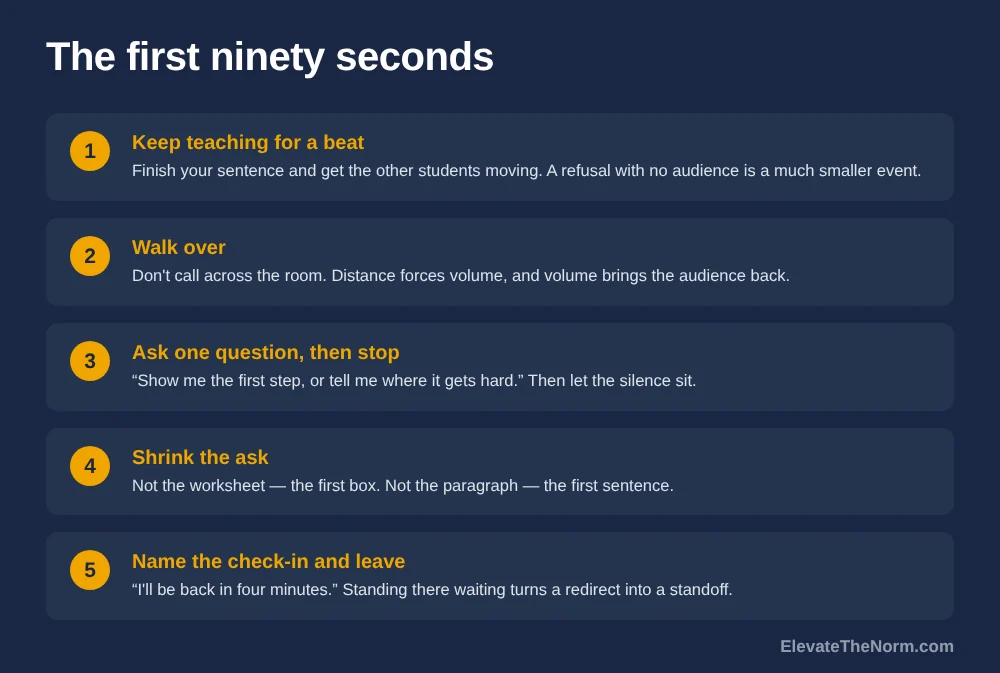
Get quiet, get close, and ask for one step. Don’t negotiate the whole assignment in front of the room, don’t issue an ultimatum you’d have to enforce publicly, and don’t fill the silence. Five moves:
- Keep teaching for a beat. Finish your sentence and get the other students moving. A refusal with no audience is a much smaller event.
- Walk over. Don’t call across the room. Distance forces volume, and volume brings the audience back. Stand or crouch beside the desk, at the student’s level.
- Ask one question, then stop talking. “Show me the first step, or tell me where it gets hard.” It accepts that the student may not be refusing out of defiance, and gives them a way to say so without admitting anything in public.
- Shrink the ask to something they’ll do right now. Not the worksheet — the first box. Not the paragraph — the first sentence. You want any movement at all, because the second step is far easier to get than the first.
- Name the next check-in and leave. “I’ll be back in four minutes.” Then come back in four minutes. Standing there waiting turns a redirect into a standoff, and a standoff has a loser.
On the pause in step three: I give it roughly fifteen seconds before I respond, and I want to be precise about that number because it gets quoted as a rule and it isn’t one. Fifteen is an average. Some days it’s five. Some students need thirty, and some need me to say nothing and come back next period. A fixed count applied to a kid having a bad morning is just a slower version of the wrong response. What the pause buys is a choice, because responding instantly means responding to the volume rather than the cause.
Why do students refuse to work?
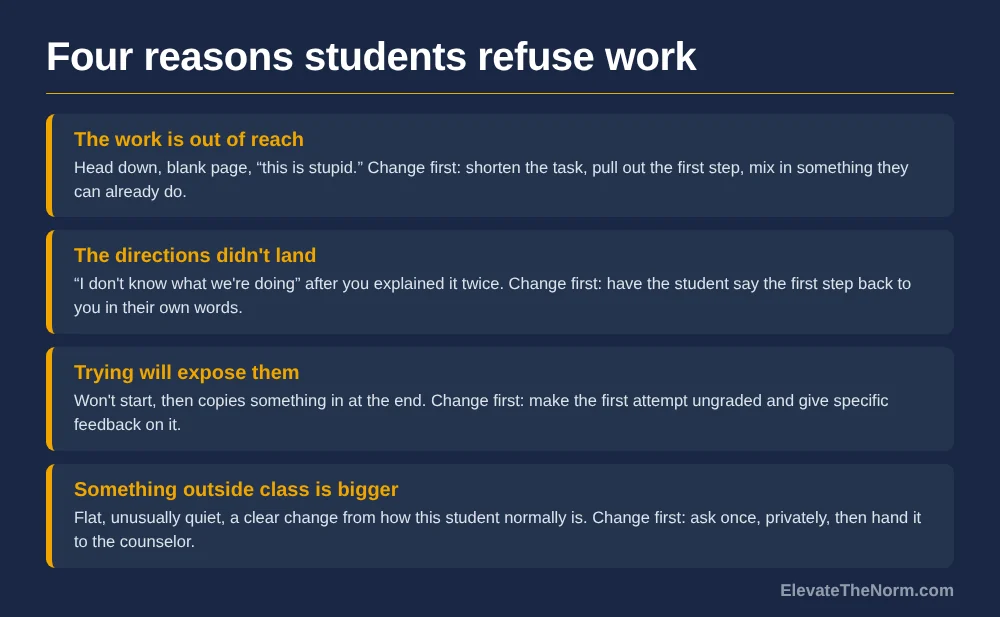
Four causes cover most refusals in a secondary classroom: the work is out of reach, the directions didn’t land, the student has decided trying will expose them, or something outside the room is bigger than the assignment. Each needs a different response, and treating all four as defiance is how teachers burn a relationship over a worksheet.
One caution before the table. These are categories to ask about, not verdicts to hand down. A teenager can tell when an adult has already decided what is wrong with them, and concluding from across the room that a student is avoiding embarrassment is exactly the move that ends the conversation. Ask, then let the student’s answer outrank your guess. If they say the directions were fine and the work is boring, that is information too.
| What’s driving it | What it looks like in class | What to change first | What makes it worse |
|---|---|---|---|
| The work is out of reach | Head down, blank page, “this is stupid” | Shorten the task, pull out the first step, mix in something they can already do | Repeating the same direction louder |
| The directions didn’t land | “I don’t know what we’re doing” after you explained it twice | Have the student say the first step back to you in their own words | Telling them to just read the instructions |
| Trying will expose them | Won’t start, then copies something in at the end | Make the first attempt ungraded and give specific feedback on it | Grading the first attempt |
| Something outside class is bigger | Flat, unusually quiet, a clear change from how this student normally is | Ask once, privately, then hand it to the counselor | Treating it as defiance |
The first row has the strongest research behind it. Kern and Clemens, reviewing antecedent strategies for classroom behavior, write that “assigning work that exceeds students’ skill level is a common cause for off-task and problem behaviors,” and say the original finding “has been replicated numerous times across various populations and ages.” Be honest about that original study: 15 boys aged 8 to 12 identified with behavior disorders, and the replication claim is the reviewers’ summary of a literature, not a secondary-classroom trial.
The same review points to the one finding here actually run on high schoolers. Cates and Skinner gave remedial math students in grades 9 through 12 worksheets with brief, easy problems interspersed among the harder ones. Task performance went up, disruptive behavior went down, and — this is the part worth stealing — students rated those worksheets as less difficult even though they had more problems on them. Perceived difficulty is not difficulty, and you can move it.
Kern and Clemens also put a fence around their own conclusions, and I’d rather quote it than paper over it: antecedent strategies work, but “alone they are seldom sufficient.” Redesigning the task is step one. It pairs with teaching the missing skill and with consequences that actually follow from the behavior.
How do you tell ordinary refusal from a student in distress?
Look for change rather than intensity. A student who argues about every assignment and argued about this one is being consistent. A student who normally works and has gone flat, quiet or tearful is telling you something different, and that is not a classroom-management problem.
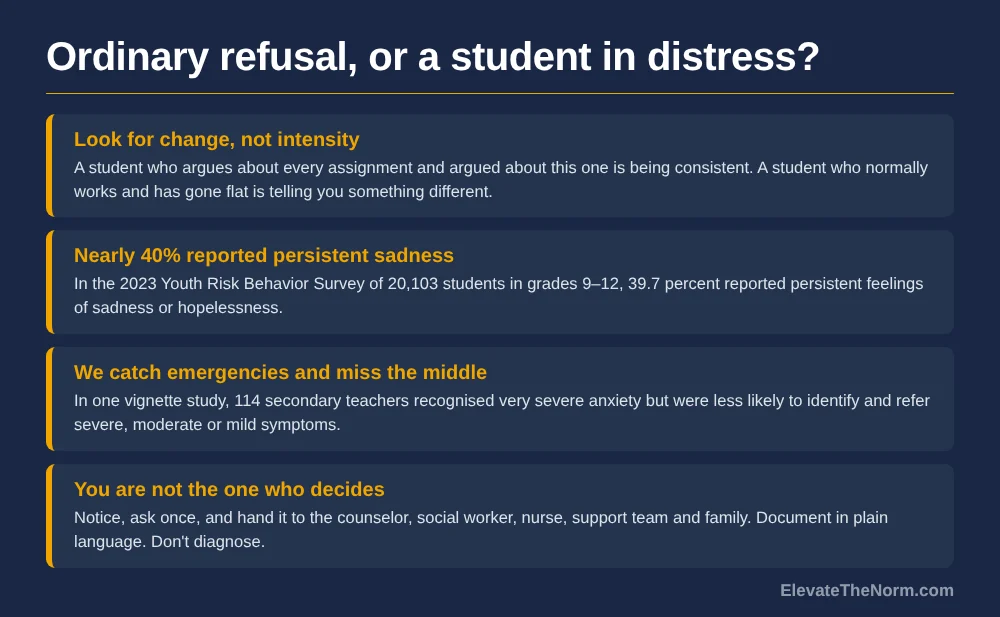
The scale is not small. In the 2023 Youth Risk Behavior Survey — a nationally representative sample of 20,103 U.S. students in grades 9 through 12 — 39.7 percent reported persistent feelings of sadness or hopelessness: 52.6 percent of female students, 27.7 percent of male students, and 65.7 percent of LGBQ+ students against 31.4 percent of heterosexual students. In a class of thirty, roughly a dozen kids. Not all of them refuse work. Some of the ones who do are in that group.
And here is the part teachers should hear even though it isn’t flattering. Missenden and Campbell gave 114 secondary teachers vignettes describing students with different levels of anxiety. The teachers recognized the need to refer very severe symptoms. They were “less likely to correctly identify and refer students with severe, moderate or mild anxiety symptoms.” That was an Australian vignette study, not real students, so don’t overread it. We catch the emergencies. We miss the middle.
Which leads to the only honest rule I can give: you are not the person who decides what is wrong with a student. Your job is to notice, ask once, and hand it to the people whose actual job it is — the counselor, the social worker, the nurse, the student support or MTSS team, and the family. The IES guide names this too, recommending that teachers “draw on relationships with professional colleagues and students’ families for continued guidance and support,” at a moderate level of evidence. Document what you saw in plain language. Don’t diagnose, don’t speculate in writing, and don’t sit on it for a week because you want to be sure first. Being sure is somebody else’s job.
If a refusal comes with a disclosure about harm to themselves or anyone else, that stops being a judgment call. Follow your district’s mandatory reporting procedure that day.
One honest caveat, and it is the part this advice usually skips: “refer it” assumes there is somewhere to refer it to. Plenty of schools have one counselor for several hundred students, and a referral can sit for weeks. That doesn’t change what you should do — it changes what you should expect. Put the referral in writing so there is a dated record, tell an administrator when nothing comes back, and keep the academic plan running in the meantime. A teacher waiting on a counselor is still the adult in the room.
What do you do when the same student refuses every day?
Stop improvising and collect information for one week. A repeated refusal is a pattern with a trigger in it, and you will find the trigger faster by writing down four things than by trying five new strategies. Change the conditions before you change the consequences.
One student, four columns, thirty seconds at the end of the period — if it needs more than a sticky note it won’t survive to Wednesday. For five school days, note: what the task was, what time it happened, what you had just said, and what the student got out of it. That last column explains the pattern. If the refusal reliably ends in the hallway, the hallway is the payoff. If it ends with you sitting beside them for ten minutes, your attention is the payoff — not a character flaw, just a kid who found the one reliable way to get an adult’s full attention in a room of thirty.
Then run the changes in this order, cheapest first:
- Change the task. Shorter, chunked, with something they can already do at the front. Kern and Clemens report that shortening tasks or adding breaks helped where the work was matched but too long.
- Add a real choice inside the same learning target. Which two of these four questions, written or recorded, this partner or alone. The review describes class-wide choice working with adolescents, closer to our population than most of this literature gets.
- Raise the rate of specific, quiet praise for the work they do start. O’Handley and colleagues tested praise rates in four secondary classrooms: behavior-specific praise about once every two minutes produced large, immediate improvements in classwide engagement and reductions in disruption, while once every four minutes gave mixed results. Four classrooms is four classrooms. And nobody sustains a two-minute rate for six periods; use it in the ten minutes where the work actually starts.
- Build in a planned break the student can ask for. If escape is what the refusal is buying, selling it at a lower price in a form you both agreed to beats pretending the demand will go away. Name the place and the length in advance — a seat at the back for three minutes, or a supervised spot an adult has agreed to — because an unsupervised student in a hallway is a different problem you just created.
- Call home before it becomes a discipline matter. Not to report the student — to say what you’re seeing and ask what they’re seeing. A family that hears about a pattern early is a partner; a family that first hears about it in a referral is an opponent you made.
- Write it down together. At that point you are in the territory of a student behavior contract — short, specific, signed by the student, reviewed on a date you both know.
- Bring in the team. Counselor, case manager, administrator. If the student has an IEP or a 504 plan, this goes through that team and the plan, not around it.
- Ask somebody who has taught this kid. An instructional coach or another teacher on your hall has almost certainly seen the same refusal, and may already know what works. Keeping your ears open helps. Asking outright helps more, and it is the cheapest item on this list.
Nothing on that list lowers the standard. The work still gets done. What changes is the size of the first step, the choice inside it, and how much of the exchange happens in front of an audience.


Does letting a student take a break just teach them to quit?
It can, and that is the real tension in this topic. If refusing produces escape, every unearned escape makes refusing a slightly better bet. Teachers who say so are not being harsh. But the alternative has a hidden cost: a public standoff teaches the rest of the room that the way to get your undivided attention is to stop working, and it treats the student who genuinely couldn’t do the task identically to the one who didn’t feel like it.
What resolves it is whether the escape is planned or won. A break the student asks for, on terms you set in advance, with the work still owed afterward, is a tool. A break the student takes by outlasting you is a lesson, and not the one you wanted. Geiger and colleagues’ abstract carries the right caution: these treatments have “characteristics that make them optimal for certain environments and clients, but less optimal for others.”
What I won’t do is let a student fail to make a point. If a kid in my room can go far enough off the rails for it to seriously damage them, that’s poor planning on my part, and it raises the question of what the adult was doing the whole time. Real responsibility means a student can struggle, do it badly, need help, and still be held to the standard afterward. It does not mean walking them to the edge of a cliff I built and calling the drop a learning experience. That sits underneath everything on how students actually learn from mistakes.
What should you never do when a student refuses to work?
Don’t make it a public contest, don’t make it about you, and don’t attach a consequence you can’t follow through on. Four things to cut:
- Announcing the refusal to the room. “Everyone’s working except one person” recruits an audience for the behavior you want to end and gives the student something to defend.
- Threatening something you won’t do. A consequence you don’t deliver costs more than the refusal did. Respecting students is mostly doing exactly what you said you’d do, every time — which means saying less and meaning it.
- Making compliance a condition of being treated decently. A student who isn’t working still gets a civil tone and the benefit of the doubt on the first ask.
- Letting a zero do your job. A zero records that work is missing. It doesn’t find out why and it doesn’t get the work done. See what the evidence actually supports on late work.
Where does the evidence on work refusal run out?
There is no good study of what a grades 6–12 content teacher should say in the next ninety seconds. The advice here is extrapolated from research on adjacent questions, mostly with younger students. Four gaps:
- The population mismatch is large. The IES practice guide states it is for “U.S. elementary schools — those serving students in kindergarten through 5th grades.” Its two strong-evidence recommendations — modify the classroom learning environment, and teach and reinforce new skills — were rated strong for K–5, not for a tenth-grade classroom. The strategies in Kern and Clemens come largely from students aged 8 to 12 and students with disabilities, in single-case designs with a handful of participants.
- The secondary evidence is thin. The clearest classwide praise finding at this level is four classrooms; the clearest task-design finding is one interspersal study. Useful signals from small samples, not settled practice.
- The engagement research is correlational. Jang, Reeve, and Deci observed 133 high school classrooms across nine Midwestern public high schools, with 2,523 students in grades 9 through 11 and self-reports from 1,584 of them. Autonomy support and structure correlated at r = .60; both predicted raters’ scores of behavioral engagement, but only autonomy support uniquely predicted what students said about their own engagement. The authors are explicit that the design cannot establish which way the causal arrow points. One number is worth keeping: differences between teachers accounted for 93 percent of the variance in observed behavioral engagement.
- Nobody has studied the combination. Every source here tests one lever. Real classrooms pull several at once, with 150 students and no control group, and no trial says which order works best for a disengaged fourteen-year-old in a required course.
What this looks like in my room
Two things in my classroom do most of the work on refusal before it happens, and neither is a behavior strategy. The first is that students are almost always working next to somebody. Tables are pushed together in pairs and fours, there are no rows, and I’m on a wheeled stool moving between groups. A student who stalls has a partner mid-task beside them and a teacher three feet away, so the refusal gets caught while it’s still a stall. A room where everyone works alone facing forward gives a stuck kid a long time to go quiet in.
The second is the whiteboard table I built for small-group work. It sits under a lower lamp, with a rug and better chairs than the rest of the room, and students ask to go there. That was deliberate. The failure mode of any pull-aside spot is that it becomes the table where the kids who are behind get sent, and then nobody will go. If the best seat in the room is where you do the hardest work with me, “come sit with me and we’ll do the first part together” isn’t a punishment.
What to do tomorrow
Pick the student you’re already thinking about. Tomorrow, when the refusal shows up, do three things: let the room get to work first, walk over and ask for the first step only, and name a time you’ll come back. Don’t add a consequence and don’t try all five moves at once.
Then start the five-day log. By Friday you’ll know which of the four causes you’re dealing with — more than a month of escalating consequences would have told you.
If the log says the work is out of reach, that’s a planning fix and it’s yours. If the student has gone flat in a way that isn’t like them, that’s a referral and it goes out today. If the refusal is a habit that’s been working, you have a short, private conversation about what responsibility actually looks like in practice rather than about attitude.
Frequently Asked Questions
What do you say to a student who refuses to work?
Say one thing, quietly, standing next to them: “Show me the first step, or tell me where it gets hard.” Then stop talking. That question gives the student a way to admit the work is too hard without announcing it to the room, and it asks for a piece of the task small enough that saying yes costs them almost nothing.
Should a student who refuses to work be sent out of the room?
Rarely, and almost never as the first move. If the refusal is buying escape from the task, sending the student out delivers exactly what the behavior was for and makes the next refusal more likely. Removal is for safety and for genuine disruption to everyone else’s learning, not for a head on a desk.
How do I handle a student who refuses to work without disrupting the whole class?
Keep teaching for a beat, get the other students started, then deal with it privately at close range. Most of the damage from a refusal comes from the audience, not the refusal. A quiet thirty-second exchange beside the desk costs the class nothing; a public negotiation costs you the next ten minutes and gives the student something to defend.
When should I involve the school counselor instead of handling it myself?
When the refusal is a change from how that student normally is — flat affect, unusual quiet, tearfulness, a sudden drop across all classes — or when it comes with anything about harm. Research on secondary teachers suggests we reliably spot severe distress and miss moderate distress, so refer earlier than feels necessary and let the counselor make the call.
Does giving a student an easier assignment lower the standard?
Changing the size or the entry point of a task is not the same as changing the learning target. Shortening a task, pulling out the first step, or mixing in problems a student can already do all keep the standard intact. One study with grades 9–12 remedial math students found that worksheets with easy problems mixed in were rated as less difficult even though they had more problems on them.
What if the student refuses to work because of something at home?
You still ask once and you still refer, but you do not try to fix it. Note what you observed in plain factual language, pass it to the counselor or support team the same day, and keep the academic expectation in place with a smaller first step. A teacher who takes on a home situation alone usually ends up helping less, later.
How long should I wait before responding to a refusal?
Long enough to choose a response instead of reacting to the volume. I use roughly fifteen seconds as an average, not a rule — some days it is five, some students need thirty, and some need nothing from me until next period. Any fixed count applied to every student is just a slower version of the wrong response.
What should I tell a parent whose child refuses to work in my class?
Call before it becomes a discipline matter, and lead with what you have seen rather than what you have concluded: which assignments, how often, and what you have already changed. Then ask what they are seeing at home. Keep speculation about causes out of it, say what the plan is, and name a date you will check back in.
Sources
- Epstein, M., Atkins, M., Cullinan, D., Kutash, K., & Weaver, R. (2008). Reducing Behavior Problems in the Elementary School Classroom: A Practice Guide (NCEE 2008-012). National Center for Education Evaluation and Regional Assistance, Institute of Education Sciences, U.S. Department of Education. Explicitly scoped to kindergarten through grade 5.
- Kern, L., & Clemens, N. H. (2007). Antecedent strategies to promote appropriate classroom behavior. Psychology in the Schools, 44(1), 65–75. A narrative overview rather than a systematic review; it reports no effect sizes.
- Jang, H., Reeve, J., & Deci, E. L. (2010). Engaging students in learning activities: It is not autonomy support or structure but autonomy support and structure. Journal of Educational Psychology, 102(3), 588–600. Observational and correlational; 133 high school classrooms, grades 9–11.
- O’Handley, R. D., Olmi, D. J., Dufrene, B. A., Radley, K. C., & Tingstrom, D. H. (2022). The effects of different rates of behavior-specific praise in secondary classrooms. Journal of Positive Behavior Interventions. Single-case multiple baseline design across four secondary classrooms.
- Verlenden, J. V., Fodeman, A., Wilkins, N., et al. (2024). Mental health and suicide risk among high school students and protective factors — Youth Risk Behavior Survey, United States, 2023. MMWR Supplements, 73(Suppl-4), 79–86. Nationally representative sample of 20,103 students in grades 9–12.
- Missenden, N., & Campbell, M. (2019). Secondary school teachers’ ability to recognise and refer students with differing levels of anxiety. The Educational and Developmental Psychologist, 36(2), 51–59. A vignette study with 114 secondary teachers; the abstract and study details were read, not the full text.
- Geiger, K. B., Carr, J. E., & LeBlanc, L. A. (2010). Function-based treatments for escape-maintained problem behavior: A treatment-selection model for practicing behavior analysts. Behavior Analysis in Practice, 3(1), 22–32. Only the abstract and keyword list were reachable; both quotations used in this article come from the abstract, and nothing here is attributed to the full text.