Tag: secondary teaching

  • One Pager Assignment: How to Make It Think Instead of Decorate

    One Pager Assignment: How to Make It Think Instead of Decorate

    By Clay Shumate

    A one pager assignment asks a student to put their thinking about a text, a topic or a unit onto a single page, combining writing and drawing. Done well, it is a compact analysis task with a visual element. Done badly, it is a craft project with a quotation glued to it — and the difference is almost entirely in what you require and what you grade.

    The format came out of AVID and has spread well beyond it. The spread is the problem: most of what teachers see online is the finished art, which tells you nothing about whether the student understood anything.

    Key Takeaways

    • Require elements, not an aesthetic. A claim written as a sentence, two cited pieces of evidence, a drawing that carries an idea, a labelled connection, a lingering question, and one line of so-what. If you can hit every requirement and still not have thought, the requirements are wrong.
    • The research supports the ingredients, not the poster. Drawing to learn improved outcomes in 26 of 28 comparisons at a median effect size of 0.40; summarizing in 26 of 30 at a median of 0.50. Both come with a condition: students need to be taught how.
    • Do not justify a one-pager with “visual learners.” The meshing hypothesis has been examined and found wanting. Justify it because drawing and summarizing are generative work — which is a better reason anyway.
    • Grade the thinking. Four criteria: accuracy of the claim, quality of the evidence, whether the image carries an idea, and completeness. Artistic skill appears nowhere.
    • A template is not a crutch. It is the thing that lets the non-artist start, and the research on drawing says explicitly that pretraining and structure improve the effect rather than diluting it.

    What Is a One Pager Assignment?

    It is a single page on which a student represents their understanding of something, in words and images, using a required set of elements. That is the whole definition. The page is the constraint; the elements are the assignment.

    AVID developed the strategy and it is now used well outside AVID classrooms. In practice you will see it most in English and social studies — after a novel, a chapter, a documentary, a unit — but nothing about the format is subject-specific. A one-pager works anywhere a student needs to compress something large into something defensible.

    What it is not is a poster. A poster communicates to an audience. A one-pager is evidence of thinking, submitted to you. Those two things want different rules, and most of the trouble with one-pagers starts when a teacher writes poster rules and grades them as analysis.

    Three-row research graphic: drawing to learn supported with 26 of 28 comparisons positive and median effect size 0.40, summarizing supported with 26 of 30 positive and median 0.50 but requiring training, and visual learners not supported
    Two of the three claims people make about one-pagers hold up. The third does not.

    Does the Research Support One-Pagers?

    Not directly — there is no body of research on “one-pagers” as such. What there is, and it is good, is evidence on the two things a one-pager makes students do: draw and summarize.

    Fiorella and Mayer’s 2015 review in Educational Psychology Review is the best single place to see it. They assessed eight generative learning strategies against the experimental record. Drawing produced positive effects in 26 of 28 comparisons, with a median effect size of d = 0.40, across elementary, high school and college students — one of their strongest examples was ninth graders working on chemistry comprehension. Summarizing produced positive effects in 26 of 30 comparisons, median d = 0.50.

    So far, so encouraging. Here is the part that changes how you run the assignment. For drawing, the authors are explicit that the effect improves when students receive explicit pretraining in how to draw, detailed guidance about which elements to include, partial illustrations to work from, or a chance to compare their drawing with the author’s. The thing they warn against is “extraneous cognitive load caused by the mechanics of drawing” — a student spending their working memory on composition is not spending it on the content. For summarizing, the training studies they review gave middle schoolers roughly six hours of instruction over five weeks before the summaries got good.

    Read that honestly and it says something uncomfortable: handing out a blank page and saying “be creative” is the version of this assignment the research does not support.

    There is a second line of evidence worth knowing. Fernandes, Wammes and Meade’s 2018 review in Current Directions in Psychological Science describes a reliable “drawing effect” on memory — drawing a word at encoding beats writing it, repeatedly, and the benefit holds for older adults and even appeared in a small group of patients with dementia. Two details matter for a classroom. The benefit arrived with as little as four seconds of drawing per item, and it applies “regardless of one’s artistic talent.” The caveat is the population: these were adults in memory experiments with word lists, not teenagers writing about a novel. It tells you the mechanism is real. It does not tell you the size of the effect on a literary analysis.

    What About “Visual Learners”?

    Leave it out of your rationale. It is the most common justification given for one-pagers and it is the weakest one available.

    Pashler, McDaniel, Rohrer and Bjork examined the evidence for the meshing hypothesis — the idea that matching instruction to a student’s preferred style improves learning — in Psychological Science in the Public Interest in 2008. Their finding was blunt: they found “virtually no evidence for the interaction pattern” that would be required to validate the educational application, and concluded that “there is no adequate evidence base to justify incorporating learning-styles assessments into general educational practice.”

    This is not a reason to stop assigning one-pagers. It is a reason to describe them accurately to students, to parents and to an administrator who asks. The honest sentence is: drawing and summarizing are generative activities with a decent evidence base, so I am asking every student to do both. That is stronger ground than a learning style, and it does not sort children into categories the research does not support.
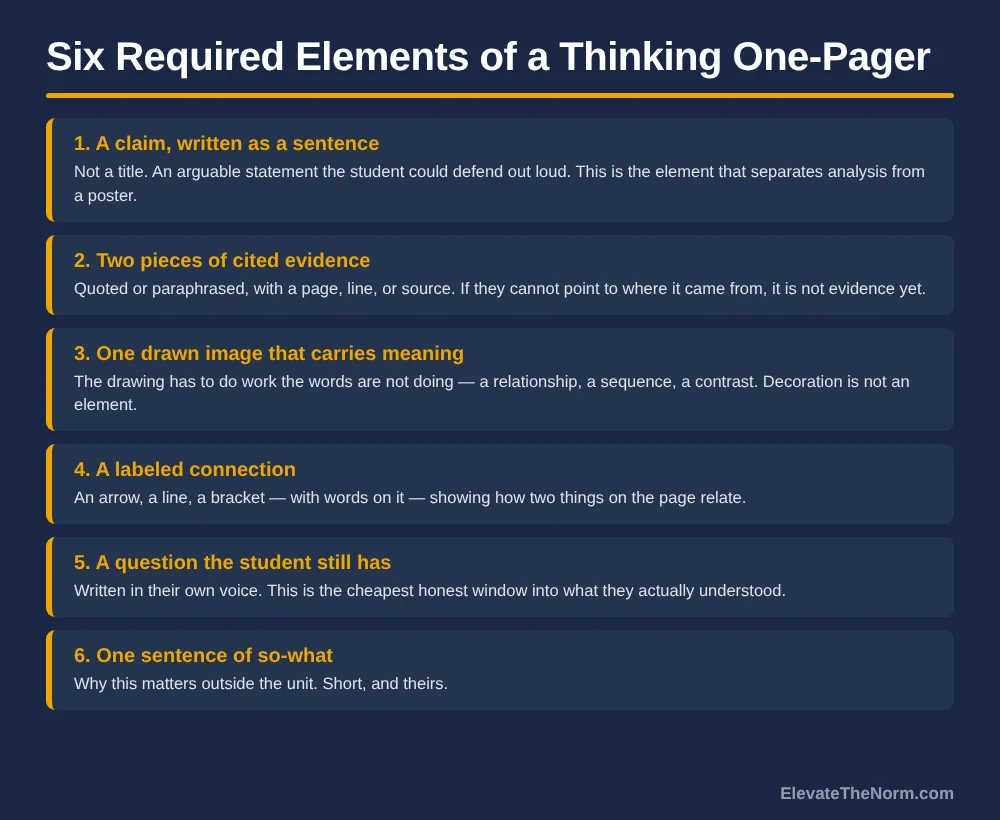
    Six-row graphic listing required elements of a one pager assignment: a claim written as a sentence, two pieces of cited evidence, one drawn image that carries meaning, a labeled connection, a question the student still has, and one sentence of so-what
    Six required elements. Every one of them is thinking, not decoration.

    What Should a One-Pager Actually Require?

    Six elements, each of which is a thinking move rather than a design choice. The test for any element you add: could a student satisfy it without understanding the material? If yes, cut it.

    A claim, written as a sentence. Not a title, not a theme word. An arguable statement the student could defend out loud. This single requirement does more work than the other five combined, because it is the one that cannot be faked with a border.

    Two pieces of cited evidence. Quoted or paraphrased, with a page number, a line, or a source. “Cited” is doing real work here — if a student cannot point to where it came from, it is not evidence yet.

    One drawn image that carries meaning. The drawing has to do something the words are not doing: show a relationship, a sequence, a contrast, a scale. A decorative border is not an element. A badly drawn diagram that makes a comparison visible is.

    A labelled connection. An arrow, a line or a bracket with words on it, showing how two things on the page relate. This is the cheapest way to force synthesis, and it is the element students most often skip.

    A question the student still has. In their own voice. It is the most honest window you will get into what they actually understood, and it costs them thirty seconds. If you want a wider version of this, it is the same instinct behind asking a student to judge their own work before you do.

    One sentence of so-what. Why this matters outside the unit. Short, and theirs. Most students will write something flat the first time. They get better at it the fourth time, which is an argument for assigning one-pagers more than once a year.
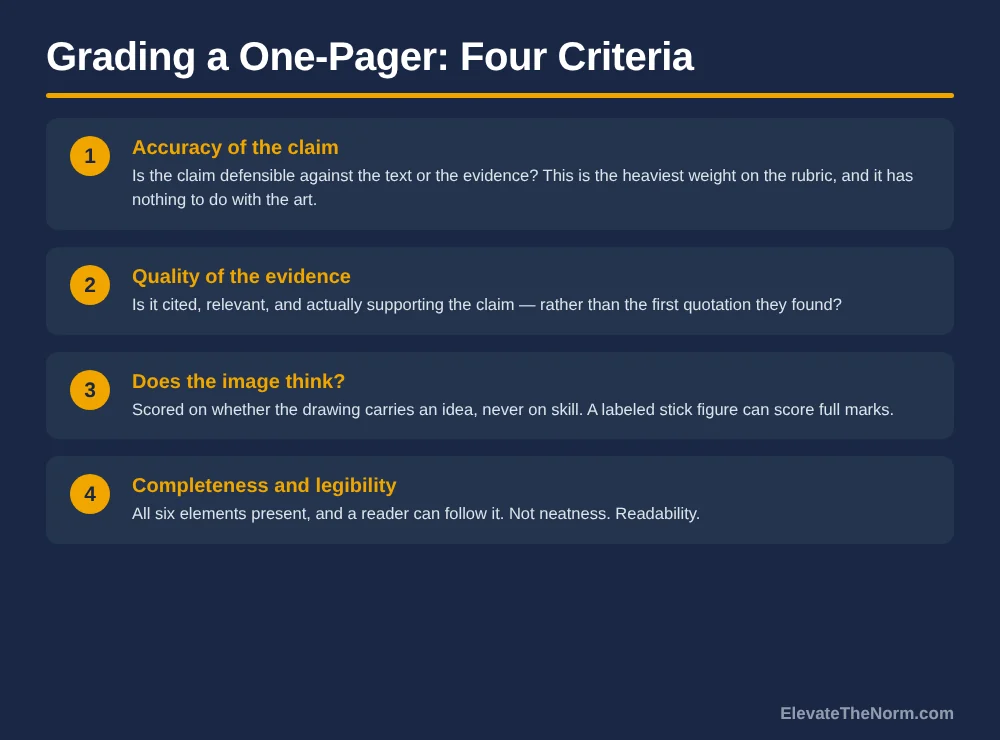
    Numbered four-criteria grading graphic for a one pager assignment: accuracy of the claim, quality of the evidence, whether the image carries an idea, and completeness and legibility rather than neatness
    Four criteria, none of which is artistic skill.

    How Do You Grade a One-Pager Without Grading Art?

    Put artistic skill nowhere on the rubric, and tell students that before they start. Four criteria will carry it.

    Accuracy of the claim is the heaviest weight. Is it defensible against the text or the evidence? This has nothing to do with how the page looks. Quality of the evidence comes second: cited, relevant, and actually supporting the claim rather than being the first quotation the student found. Does the image think? — scored on whether the drawing carries an idea, never on execution. A labelled stick figure can score full marks and should. Completeness and legibility is the last and the smallest: all six elements present, and a reader can follow it. Legibility is not neatness. A page can be messy and perfectly readable.

    Two things to resist. Do not add a “creativity” or “visual appeal” category — it is unscoreable, it rewards students who already had art supplies at home, and it is the single fastest way to turn this into an equity problem. And do not give points for colour. If you want the general version of this argument, the same reasoning applies to any rubric where presentation can hide thin understanding.

    Three practical conditions follow from that. The assignment has to be completable with a pencil — if markers are required, you have built a supply test, so keep whatever you have in a tub on the counter and do the work in class rather than at home. Score the “question you still have” element present-or-absent, never on quality, or students will stop telling you the truth in the one place they were being honest. And tell families the rubric excludes artistic skill before the first grade goes in the book, because a parent looking at a drawing with a C on it will reasonably assume you graded the drawing.

    Alternatives need to be available without a formal plan: typed and printed elements pasted down, cut images instead of drawn ones, or the whole thing explained to you verbally while you score the same four criteria. A student with a fine-motor difficulty, a visual impairment, or a hand in a cast should not have to disclose anything to get a different route.

    On grading time — this is the objection every teacher with 150 students will have, and it is correct. Score in one pass, in bands rather than points, and write a comment only on the claim. If the claim is wrong, nothing downstream of it is worth your ink. Four criteria scored 1–4 with one sentence on the first of them runs about ninety seconds a page.

    One more move that costs four minutes and is worth more than the rubric. Walk the room while they work and ask three or four students to defend the claim on their page out loud — not to justify the picture, just the sentence. I do a version of this constantly: circulating, pulling a student aside, and making them explain the decision they made rather than telling them whether it was right. You find the gap between a page that looks finished and a page that is understood in about twenty seconds, and you find it while there is still time to fix it. That is the same thing any good in-the-moment check is for.

    What About the Student Who Says They Cannot Draw?

    Give them a template and say the sentence out loud: nobody is being graded on drawing. Then mean it, because teenagers will test whether you meant it.

    Betsy Potash, writing at Cult of Pedagogy, identifies the problem exactly: the one-pagers that circulate online are made by artistic students, and everybody else concludes the assignment is not for them. Her fix is a template — a page with designated spaces for each required element — which she describes as a creative constraint that paradoxically frees students up, because the paralysis is usually about placement rather than content. Students who want a blank page can flip the template over and use the back.

    That is a practitioner’s recommendation rather than a research finding, and it should be read as one. But it points the same direction the research does: Fiorella and Mayer found that structure, partial illustrations and guidance about which elements to include increase the benefit of drawing rather than watering it down. The template is not a concession. It is the scaffold the evidence asks for.

    Where One-Pagers Go Wrong

    Four failure modes, and three of them are the teacher’s.

    The first is the blank page with no requirements, which produces decoration from the artists and panic from everyone else. The second is grading the aesthetic, which teaches students that the assignment was about markers all along. The third is assigning it once, at the end of a unit, as a summative grade — the first one a student makes is always the worst one, and the research on summarizing says the skill takes weeks of instruction to develop. Run the first as practice. The fourth is the student version: filling every element with something technically present and entirely hollow. The claim sentence catches most of this, and the four-minute verbal check catches the rest.

    How Do You Launch It the First Time?

    Spend twenty minutes before anyone touches a page. This is the pretraining the drawing research keeps pointing at, and skipping it is why most first attempts disappoint.

    Show two finished examples — one strong, one weak — and have the class score both against your four criteria before they know which is which. Make the weak one visually attractive and analytically thin, because that is the trap. Then model the hardest element: write a claim sentence in front of them, out loud, and revise it once. Then let them start, with the template on the desk and the requirements on the board.

    If you want the pages to do a second job, hang them and run a structured walk around the room where students read each other’s claims and leave one question each. The reading is worth more than the display, and it makes the “question you still have” element feel like it has a purpose beyond the gradebook. Make the display opt-out without explanation — some students are genuinely uncomfortable having a drawing on the wall, and nothing about the learning requires it to be public.

    Afterwards, do not just file them. Read the question column across the whole class in one sitting; it is the cheapest reteach list you will ever assemble, and it was generated by students who thought nobody was grading it.

    What to Do Next

    Take whatever you were going to assign as a written response this month and convert it — same content, six required elements, four grading criteria, a template on every desk, and twenty minutes of launch before the first page gets made. Run it as practice rather than as a test grade.

    Then do it again inside the same semester. Almost everything useful about one-pagers shows up on the second and third attempt, once students have stopped worrying about the layout and started arguing on paper. If you need the in-between measurement, a two-minute check sorted by where it falls in a lesson will tell you more, sooner, than waiting for the pages to come in.

    Frequently Asked Questions

    What is a one pager assignment?

    A single page on which a student represents their understanding of a text, topic or unit using both words and images, against a required set of elements. The strategy came out of AVID and is now used well beyond it, most commonly in English and social studies. The page is the constraint; the required elements are the actual assignment. It is not a poster — a poster communicates to an audience, while a one-pager is evidence of thinking submitted to a teacher, and the two want different rules.

    Is there research showing one-pagers work?

    Not on one-pagers as a named format. There is good evidence on the two things a one-pager makes students do. In Fiorella and Mayer’s review of generative learning strategies, drawing produced positive effects in 26 of 28 comparisons at a median effect size of d = 0.40, and summarizing in 26 of 30 at a median of d = 0.50, across elementary, high school and college students. Both come with the same condition: the effect improves when students are explicitly taught how, and the summarizing training studies gave middle schoolers roughly six hours of instruction over five weeks.

    Should I say one-pagers are good for visual learners?

    No. Pashler, McDaniel, Rohrer and Bjork examined the meshing hypothesis — that matching instruction to a preferred style improves learning — and found “virtually no evidence” for the interaction pattern it requires, concluding there is “no adequate evidence base” for using learning-styles assessments in general practice. Use the better justification instead: drawing and summarizing are generative activities with real support, so every student does both. That reasoning survives a conversation with an administrator, and it does not sort students into categories the evidence does not back.

    How do I grade a one-pager fairly?

    On four criteria, none of which is artistic skill: accuracy of the claim, quality of the cited evidence, whether the drawn image carries an idea rather than decorates, and completeness and legibility. Weight the claim heaviest. Do not add a creativity or visual-appeal category — it is unscoreable and it rewards students who own art supplies. Tell families the rubric excludes drawing before the first grade is entered, because a parent seeing a low mark on a page with a picture on it will assume you graded the picture.

    What do I do about students who say they cannot draw?

    Give them a template with a designated space for each element and say out loud that nobody is graded on drawing — then hold to it, because they will test whether you meant it. A labelled stick figure that makes a comparison visible should score full marks. Alternatives need to be available without a formal plan: typed elements pasted down, cut images rather than drawn ones, or explaining the page to you verbally while you score the same four criteria.

    Does a template make the assignment too restrictive?

    The evidence points the other way. Fiorella and Mayer found that structure, partial illustrations and guidance about which elements to include increase the benefit of drawing rather than diluting it, and the risk they name is extraneous cognitive load from the mechanics of drawing — which is exactly what a blank page creates. The template removes the paralysis about placement so the student can spend their attention on the content. Students who want the open page can use the back of it.

    Should a one-pager be a test grade?

    Not the first one. The first attempt is always the worst attempt, and the research on summarizing says the skill takes weeks of instruction to develop, so a summative grade on a first try is measuring unfamiliarity with the format. Run the first as practice, assign a second inside the same semester, and grade that one. Almost everything useful about one-pagers appears on the second and third attempt, once students have stopped worrying about layout and started arguing on paper.

    Does handwriting the page help more than typing it?

    There is no good evidence for that, and it is worth knowing because the claim gets repeated a lot. Urry and colleagues ran a direct replication of the well-known longhand-versus-laptop study with 142 undergraduates and found a negligible effect in the opposite direction on conceptual questions, and a mini meta-analysis across eight studies found no significant difference in quiz performance. Assign a one-pager because drawing and summarizing are generative, not because the student held a pen.

    Sources

    1. Fiorella, Logan, and Richard E. Mayer. “Eight Ways to Promote Generative Learning.” Educational Psychology Review, vol. 27, 2015, pp. 1–47. Drawing: positive effects in 26 of 28 comparisons, median d = 0.40, across elementary, high school and college students; effect increases with explicit pretraining in how to draw, guidance on elements, partial illustrations or comparison with author-provided drawings, and the stated risk is extraneous cognitive load from the mechanics of drawing. Summarizing: 26 of 30 comparisons positive, median d = 0.50; middle-school training studies required roughly six hours of instruction over five weeks. https://doi.org/10.1007/s10648-015-9348-9
    2. Fernandes, Myra A., Jeffrey D. Wammes, and Melissa E. Meade. “The Surprisingly Powerful Influence of Drawing on Memory.” Current Directions in Psychological Science, vol. 27, no. 5, 2018, pp. 302–308. Reports a reliable recall advantage for drawn over written words, benefits arriving with as little as four seconds of drawing per item, and the authors’ statement that the benefit applies “regardless of one’s artistic talent.” Populations are younger adults, older adults and a group of 13 patients in long-term care — not secondary students, and the materials are word lists rather than academic content. Cited for mechanism, not for an effect size on classroom work. https://doi.org/10.1177/0963721418755385
    3. Pashler, Harold, Mark McDaniel, Doug Rohrer, and Robert Bjork. “Learning Styles: Concepts and Evidence.” Psychological Science in the Public Interest, vol. 9, no. 3, 2008, pp. 105–119. The authors found “virtually no evidence for the interaction pattern” required to validate learning-styles instruction and concluded “there is no adequate evidence base to justify incorporating learning-styles assessments into general educational practice.” https://doi.org/10.1111/j.1539-6053.2009.01038.x
    4. Urry, Heather L., et al. “Don’t Ditch the Laptop Just Yet: A Direct Replication of Mueller and Oppenheimer’s (2014) Study 1 Plus Mini Meta-Analyses Across Similar Studies.” Psychological Science, vol. 32, no. 10, 2021, pp. 1479–1492. Direct replication, N = 142 undergraduates. Conceptual-question performance showed a negligible effect in the opposite direction to the original (Hedges’s g = −0.13, 95% CI [−0.45, 0.20]), significantly different from the original result. A mini meta-analysis of eight studies found g = 0.04, 95% CI [−0.13, 0.20], not significant. The authors conclude results “do not support the idea that longhand note taking improves immediate learning via better encoding of information.” Cited as contrary evidence: do not justify handwritten work on the grounds that writing by hand beats typing. https://doi.org/10.1177/0956797620965541
    5. Potash, Betsy. “A Simple Trick for Success with One-Pagers.” Cult of Pedagogy, 26 May 2019 (updated 2026). Credits AVID with developing the strategy; describes the template as a creative constraint that helps non-artistic students start, and recommends simple rubric categories such as textual analysis, required elements and thoroughness. Cited as practitioner recommendation, not as research evidence. https://www.cultofpedagogy.com/one-pagers/
    About Clay Shumate

    Clay Shumate is a certified secondary Social Studies teacher in the public schools of West Alabama, with seven years of classroom experience, a B.A. in History, and an M.Ed. in Secondary Education. He writes about project-based learning, student responsibility, respect, and practical ways to hold young people to a higher standard while giving them room to learn from mistakes. He is a member of the Society of Professional Journalists and writes to its Code of Ethics; this site’s editorial standards and corrections policy are published in full. More about Clay.

  • Free Teacher Printables for Grades 6-12: What Is Worth Printing, and How to Tell

    Free Teacher Printables for Grades 6-12: What Is Worth Printing, and How to Tell

    By Clay Shumate

    Free teacher printables are classroom-ready documents — primary source sets, data tables, reading guides, rubrics, trackers — that you can download and print without paying. For grades 6–12 the best ones come from federal agencies, museums, archives, universities and public media rather than worksheet mills. The hard part is not finding them. The hard part is telling which ones are worth the paper.

    Most search traffic for free printables lands in elementary territory: coloring pages, letter tracing, bulletin board sets. This article stays in middle and high school, where the useful material looks completely different. A good secondary printable is usually a document, a data set, a structured protocol or a rubric — not a fill-in-the-blank page. Below are the quality criteria first, then the places that actually have the goods, with links I opened in October 2026.

    Key Takeaways

    • Judge the task, not the design. A clean-looking page that asks students to copy definitions is worse than an ugly page that asks them to explain something.
    • Federal material is usually public domain. U.S. copyright law states that copyright protection is not available for any work of the U.S. Government, which is why National Archives and Library of Congress material is so adaptable.
    • Free is not the same as unrestricted. Marketplace downloads typically carry single-classroom licenses and explicit bans on reposting, even when the file cost nothing.
    • Worksheets have one strong, narrow use. Retrieval practice and spaced review are the two study techniques rated high utility in the major cognitive-psychology review. Most other worksheet uses are not supported.
    • Check the reading level before you print thirty copies. A primary source at a grade 14 reading level is an accessibility decision, not a rigor decision.
    • Everything on this site is free and ungated. All 53 printables in our library download directly, with no email, account or sign-up.

    What are free teacher printables, really?

    They are any document you can print and put in front of students without paying for it, which covers an enormous range of quality. That range is the whole problem. The phrase lumps together a declassified cable from the National Archives and a crossword of vocabulary words, and search engines cannot tell them apart.

    For grades 6–12, useful printables tend to fall into five types. Primary and secondary source documents. Data sets, tables and charts students have to interpret. Structured protocols — discussion formats, peer review sheets, lab procedures, project planners. Rubrics and checklists. And practice sets, where the point is repeated retrieval rather than discovery.

    Notice what is missing from that list: anything whose main function is to occupy time. That is not a moral judgment about busywork, it is a practical one. Paper that occupies time without producing evidence of thinking gives you nothing to grade honestly and gives students nothing to be proud of.

    What is a worksheet actually good for?

    A worksheet has one strong use: structured, repeated retrieval of things students need fast and automatic. Vocabulary, formulas, dates, conjugations, equation forms, map features. That use is well supported and worth defending.

    The large review by Dunlosky, Rawson, Marsh, Nathan and Willingham rated ten common learning techniques for utility. Only two earned a high rating: practice testing and distributed practice. They write that these “received high utility assessments because they benefit learners of different ages and abilities.” Rereading and highlighting were both rated low utility — highlighting, which students lean on heavily, “does not consistently boost students’ performance.” Summarization and keyword mnemonics also came in low, and elaborative interrogation and self-explanation came in moderate, partly because they “have not been adequately evaluated in educational contexts” (Dunlosky et al., Psychological Science in the Public Interest, 14(1), 4–58, 2013).

    That review covers a wide age range and a lot of laboratory work, not only secondary classrooms, so take it as a guide to which direction the evidence points rather than a prescription. But the direction is clear. A printable that functions as a short retrieval quiz, returned to a week later, is doing something the research supports. A printable that asks students to find and highlight the definitions is doing something the research rates poorly.

    So: use worksheets for retrieval and spacing. Do not use them to introduce concepts, to substitute for reading, or to fill a Friday. That is the narrow good use, stated plainly.

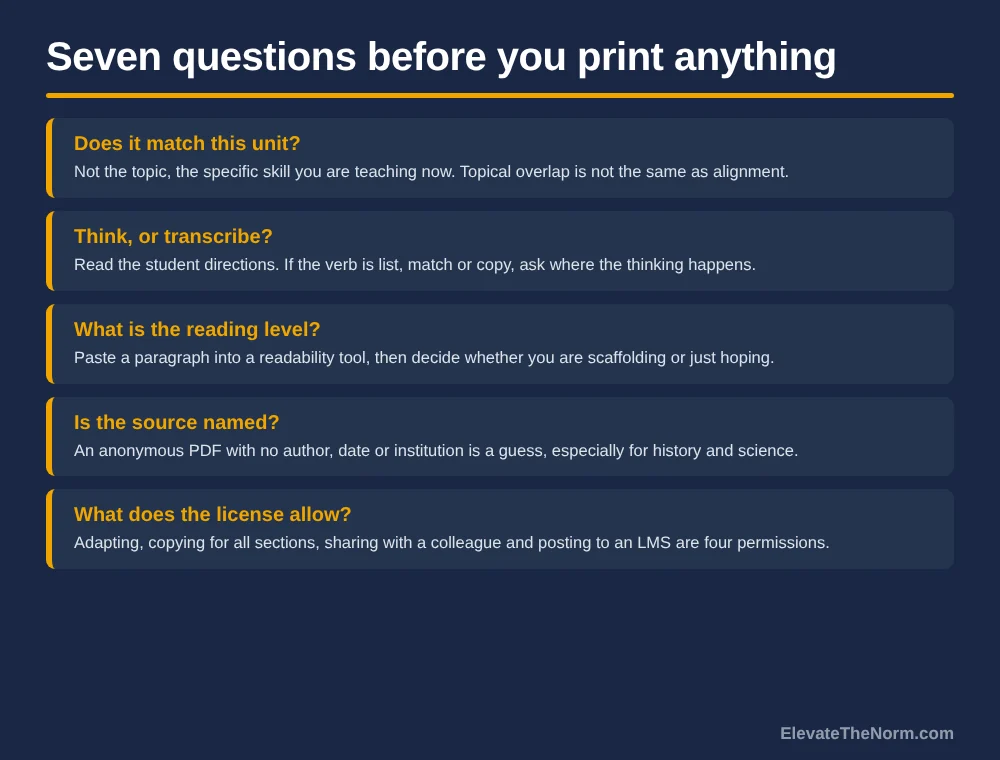
    Five of the seven screening questions for evaluating a free classroom printable before copying it
    Two minutes of screening rejects most of what a search turns up.

    Seven questions to ask before you print

    Run any candidate printable through these seven questions. It takes about two minutes and will reject most of what you find.

    1. Does it match what I am actually teaching? Not the topic — the specific skill or standard in this unit. Topical overlap is not alignment.
    2. Does it ask students to think, or to transcribe? Read the directions on the student page. If the verb is “list,” “match,” or “copy,” ask what the thinking is.
    3. What is the reading level, and who gets left out? Paste a paragraph into a readability tool. Then decide whether you are scaffolding the text or just hoping.
    4. Is the source credible and named? An anonymous PDF with no author, date or institution is a guess. Historical and scientific content from an unnamed source is a particular risk.
    5. Is it accurate? Spot-check two factual claims. Free content is not peer reviewed, and errors in dates, units and attributions are common.
    6. What does the license allow? Can you adapt it, copy it for all your sections, share it with a colleague, post it to your LMS? These are four different permissions.
    7. Does it produce something I can look at? If finished student work would not tell you anything you did not already know, skip it.

    Question three deserves one more sentence. A document written for adults in 1863 is not automatically rigorous for a ninth grader; it is simply hard. Either you excerpt it, gloss it, chunk it, and build a scaffold, or you are handing out an obstacle. Checking whether the text landed matters more than the text’s prestige.

    What may I legally adapt, copy and share?

    Three separate things govern a free file: copyright, the license, and your district’s policy. Free to download tells you nothing about any of them.

    The most permissive category is federal government work. Section 105 of U.S. copyright law states that “Copyright protection under this title is not available for any work of the United States Government,” while noting the government may hold copyrights transferred to it (17 U.S.C. § 105). In practice that is why you can crop, excerpt, retype and remix a National Archives document or a federal data table freely. Two cautions: material a federal site hosts may still be owned by someone else, and some agency logos and seals carry separate restrictions.

    Openly licensed material is the next tier. OER Commons, which has been curating open materials since 2007, labels resources so you can tell adaptation rights at a glance — the site states that “each resource has one of four conditions of use labels” that “help you quickly distinguish whether a resource can be changed or shared without further permission required” (OER Commons). Read the label. Share-alike and non-commercial conditions are real conditions.

    Then there are free files with restrictive licenses, which is most of a teacher marketplace. A free download from Teachers Pay Teachers typically comes with a single-classroom license and explicit instructions not to repost. Browsing the free section, you will find terms like “PLEASE DO NOT POST THIS PRODUCT ANYWHERE. Not on your classroom website, not online for your friends, nowhere” and resources marked “for personal use only” (TPT free resources). Those terms are not unreasonable, but they mean a free file can still be one you may not put in a shared department drive.

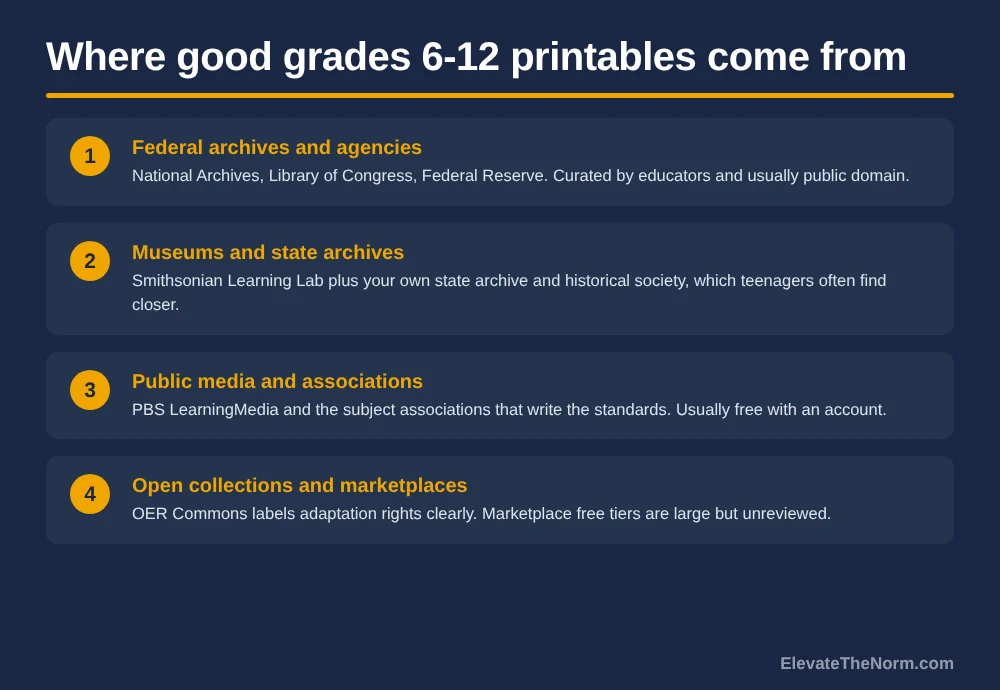
    Federal sources, and why they are the best starting point

    Start with the National Archives and the Library of Congress. These are the two highest-value free sources for secondary social studies, English and anything document-based, and both are built by people who understand classrooms.

    DocsTeach, run with support from the National Archives Foundation, offers “thousands of primary sources — letters, photographs, speeches, posters, maps, videos, and other document types — spanning the course of American history.” When I checked in October 2026 the site listed 13,639 primary source documents and 294 activities available without registering, and states plainly: “It’s completely free!” A free account adds more teacher-built activities and lets you build and save your own (DocsTeach).

    The Library of Congress publishes classroom materials “Created by teachers for teachers” — primary source sets organized by topic, many with teacher’s guides, covering the Civil War, the American Revolution, the civil rights movement and dozens more (Library of Congress classroom materials).

    For economics and personal finance, the Federal Reserve’s education site describes itself as “A FREE platform with economics and personal finance resources for classrooms and communities,” with middle school, high school and college levels, and lessons, readings, modules and infographic posters. Browsing is open; saving resources and getting answer keys requires a free teacher account (Federal Reserve Education).

    Museums, libraries and archives

    The Smithsonian Learning Lab is the strongest single museum source for grades 6–12. It describes itself as “Free to discover,” holding “millions of Smithsonian digital images, recordings, texts, and videos in history, art and culture, and the sciences” plus “thousands of examples of resources organized and structured for teaching and learning,” with collections filterable by grade band (Smithsonian Learning Lab). Browsing is open; saving and assigning requires an account.

    Your state archive and your state historical society are underused. Nearly every state has digitized local newspapers, maps, census records and photographs, and local documents are frequently more interesting to teenagers than national ones. Your county or city public library system often has free database access with a library card, which is a genuinely free resource most teachers never mention to students.

    Four categories of free classroom material sources for middle and high school teachers
    Institutions beat worksheet mills, especially above grade six.

    Public media, associations and universities

    Public media is reliable but usually gated behind a free account. PBS LearningMedia offers videos, interactives and lesson plans and is free, stating plainly “Register Now It’s free!” — which does mean an account (PBS LearningMedia). That is a reasonable trade, but it is a gate and I am not going to pretend otherwise.

    Subject-matter professional associations are the most reliable source of standards-aligned secondary material, because they write the standards. The national councils and associations for English, mathematics, science, social studies and world languages all publish free classroom material alongside their member-only content. Check what is open before paying for membership for that reason alone.

    University centers publish free curriculum too, and the quality is usually high because it is tied to research programs. These sources often require a free account, and the material is frequently narrow — one skill, done thoroughly. That is a feature.

    A warning about link rot from this same category. When I verified sources for this article in October 2026, the deep links for the National Endowment for the Humanities’ EDSITEment lesson plans — recommended in teacher materials for over two decades — redirected to a single NEH project page rather than the lesson library. Any list of free resources older than about a year will contain dead ends. Open the link before you plan around it.

    Teacher marketplaces and their free tiers

    Marketplaces have enormous free sections and wildly variable quality, and the filter has to be yours. Teachers Pay Teachers lists hundreds of thousands of free resources across all grades and subjects, and an account is required to download them.

    Two honest cautions. First, marketplace material is not reviewed for accuracy or alignment by anyone except the buyer, so questions four and five in the checklist above matter most here. Second, the volume skews heavily elementary, so grade 6–12 searching takes patience and tight filters. When it works, it works well for exactly one thing: a structure someone else already built that you would otherwise spend an evening making.

    Our own free teacher printables, and what we charge for

    Every printable on this site is free and downloads directly — no email, no account, no sign-up. As of October 2026 the resource library holds 53 free printable PDFs, organized into classroom management, assessment and grading, instruction and discussion, families and conferences, integrity and responsibility, and teacher wellbeing and reflection.

    Concretely, that includes seating chart planners, transition cues, formative assessment checks, standards-based grading templates, Socratic seminar protocols, project planners, bell ringers, parent communication logs, student-led conference templates, academic integrity materials and reflection journals. All grades 6–12. All ungated.

    We also sell some packaged versions of this material on Teachers Pay Teachers. Those are paid. Stating that plainly is the point: nothing that is free here will ever move behind a purchase, and if you only ever use the free files, that is the intended outcome, not a loss.

    Five common ways free printables fail with middle and high school students
    Secondary students will do hard work with a visible purpose and resist easy work without one.

    Where free printables go wrong in middle and high school

    The failure mode is almost always age mismatch dressed up as differentiation. A few patterns to watch for.

    • Elementary material relabeled. Clip art, large fonts, one-word answers. Teenagers read this instantly as being talked down to, and they are right.
    • Volume substituted for difficulty. Forty problems at the same level is not more rigorous than eight at increasing levels. It is longer.
    • The reading level nobody checked. An unexcerpted primary source handed out cold, with no glossary and no chunking.
    • Answers in the directions. Graphic organizers so prescriptive that filling them in requires no decisions.
    • No visible purpose. If a student asks why they are doing this and the honest answer is “to have something to turn in,” do not print it.

    That last one is the test I would apply above all others. Secondary students will do difficult work if the purpose is legible to them, and they will resist easy work whose purpose is not. Treating them as developing young adults means the paper has to be able to justify itself, which is also the argument for giving them real choices inside an assignment rather than more pages of it.

    A quick comparison of source types

    Source typeTypical qualityAccount needed?Adaptation rightsBest for
    Federal agencies and archivesHigh; curated by educatorsUsually no for browsingBroadest — federal works are not copyrightable under § 105Primary sources, data sets, document-based tasks
    Museums and librariesHighBrowsing open; saving usually requires oneVaries by item; check eachImages, objects, curated collections by grade band
    Public mediaHighUsually yes, freeClassroom use; redistribution restrictedVideo-anchored lessons, interactives
    Professional associationsHigh, standards-alignedMixed; some member-onlyVaries; frequently classroom-use onlyStandards alignment, assessment design
    Open education collectionsVariable but labeledUsually noExplicitly labeled; often adaptableFull units, textbooks, remixable material
    Teacher marketplacesVery variableYes, to downloadUsually single classroom, no repostingReady-made structures and templates

    Free teacher printables: a short plan for this week

    Pick the one unit coming up where you are least happy with your materials, and spend forty minutes on free teacher printables for that unit only. General browsing produces a folder you never open. A specific hunt produces something you use on Thursday.

    Start at the National Archives or the Library of Congress if the unit is document-based, the Federal Reserve if it is economics, the Smithsonian if it is object- or image-based. Run every candidate through the seven questions, especially reading level and what the task asks students to do. Check the license before you put anything in a shared drive. And if what you need is a protocol, a tracker or a rubric rather than content, start with our free printable library, which downloads directly with no email required.

    One more thing worth saying. Hunting for materials is legitimate professional work, and it counts. If you are building a growth goal you will actually revisit or logging hours toward your state’s license renewal requirement, improving your materials is a real place to point that effort — as long as the test stays the same: does this paper produce thinking I can look at?

    Sources

    1. John Dunlosky, Katherine A. Rawson, Elizabeth J. Marsh, Mitchell J. Nathan and Daniel T. Willingham, “Improving Students’ Learning With Effective Learning Techniques,” Psychological Science in the Public Interest, 14(1), 4–58, 2013. Supports the high utility ratings for practice testing and distributed practice and the low ratings for rereading, highlighting and summarization. Caveat: the review spans a wide age range and relies substantially on laboratory studies rather than secondary classrooms; the authors note some techniques are rated moderate precisely because they “have not been adequately evaluated in educational contexts.” https://journals.sagepub.com/doi/10.1177/1529100612453266
    2. U.S. Copyright Law, Title 17, Section 105, “Subject matter of copyright: United States Government works,” U.S. Copyright Office. Supports the statement that copyright protection is not available for works of the U.S. Government. Caveat: this covers works authored by the federal government, not everything hosted on a federal website, and agency seals and logos may carry separate restrictions. https://www.copyright.gov/title17/92chap1.html
    3. DocsTeach, National Archives, accessed October 2026. Supports the document and activity counts, the “completely free” statement, and the distinction between browsing without an account and the additional activities a free account adds. https://www.docsteach.org/
    4. Library of Congress, “Classroom Materials,” accessed October 2026. Supports the description of teacher-built primary source sets with teacher’s guides organized by historical topic. Caveat: the landing page does not itself state grade bands, so check each set. https://www.loc.gov/classroom-materials/
    5. Smithsonian Learning Lab, accessed October 2026, and Federal Reserve Education, accessed October 2026. Support the quoted descriptions of holdings, the grade-band filtering, the “FREE platform” description, and the statement that a free teacher account is needed to save resources and access answer keys. https://learninglab.si.edu/
    6. OER Commons, accessed October 2026. Supports the four conditions-of-use labeling system and the 2007 founding date used to describe the collection. https://www.oercommons.org/
    7. Teachers Pay Teachers, free resources browse page, accessed October 2026. Supports the existence of a large free tier, the requirement to log in to download, and the quoted single-classroom and no-reposting terms that individual sellers attach. Caveat: licensing terms are set per resource by sellers, so read the terms on the specific file rather than assuming. https://www.teacherspayteachers.com/Browse/Price-Range/Free

    Frequently Asked Questions

    Are worksheets bad for middle and high school students?

    No, but they have one narrow good use: structured, repeated retrieval of things students need fast and automatic, revisited after a gap. That use lines up with the only two techniques rated high utility in the major review of learning strategies — practice testing and distributed practice. What is not supported is using a worksheet to introduce a concept, to replace reading, or to fill a period. The question to ask is not whether a page is a worksheet, but whether finished student work on it would tell you something you did not already know.

    If a printable is free, can I change it and share it with my department?

    Not automatically, and these are separate permissions. Works authored by the U.S. federal government are not protected by copyright, which is why National Archives and Library of Congress material can be cropped, excerpted and remixed freely. Openly licensed material carries explicit labels you should read, including share-alike and non-commercial conditions. Free marketplace downloads usually carry single-classroom licenses and explicit bans on reposting, even though the file cost nothing. Before anything goes into a shared drive or an LMS, read the terms attached to that specific file.

    How do I check whether a document is too hard for my students?

    Paste a representative paragraph into a readability tool and look at the grade estimate, then make a deliberate decision rather than hoping. A document written for adults in 1863 is not automatically rigorous for a ninth grader; it is simply hard. If you keep it, excerpt it, chunk it, gloss the vocabulary and build a scaffold. If you cannot do that work before Thursday, pick a different text. Handing out an unmodified hard source and calling it rigor mostly produces students who learn that reading is futile.

    Why do so many free printable sites skew elementary?

    Because that is where the demand volume is, and because elementary material is faster to produce. The practical consequence for secondary teachers is that general searches waste time and you should go to specific institutions instead. Federal archives, museums, the Federal Reserve, professional subject associations and university centers all produce genuinely secondary-level material. On marketplaces, use tight grade and subject filters from the start. And be suspicious of anything with clip art and one-word answer lines, which is usually elementary material relabeled.

    Do I have to create an account to get free materials?

    It depends on the source, and it is worth knowing before you plan a lesson around something. Browsing the National Archives, Library of Congress, OER Commons and the Smithsonian Learning Lab works without an account, though saving and assigning on the Smithsonian site requires one. PBS LearningMedia and the Federal Reserve both ask you to register for free. Teachers Pay Teachers requires an account even for free downloads. Everything in this site’s own library downloads directly with no email, account or sign-up, which is a deliberate choice.

    Is paid material from a marketplace better than free material?

    Not reliably. Price is a signal about packaging and the seller’s time, not about accuracy or alignment. Marketplace material of either kind is not reviewed by anyone except the buyer, so a paid file and a free file from the same marketplace deserve the same scrutiny. Where paying can genuinely be worth it is for a complete, coherent structure you would otherwise spend several evenings building. Where it is rarely worth it is for single pages, which free institutional sources usually provide at equal or better quality.

    How often do free resource links break?

    Often enough that you should open every link before planning around it. While checking sources for this article in October 2026, I found that the deep links for a federal humanities agency’s long-recommended lesson plan library now redirect to a single project page rather than the lessons themselves. That resource had been recommended in teacher materials for over two decades. If a federal site can move out from under its own URLs, any roundup list older than a year will contain dead ends. Download the files you rely on rather than bookmarking them.

    How should I decide what to look for in the first place?

    Start from a unit, never from a browse. Pick the one upcoming unit where you are least happy with your materials, name the specific gap — a text, a data set, a protocol, a rubric — and spend forty focused minutes on that gap only. General browsing produces a folder of downloads you never open again. A targeted hunt produces something in students’ hands on Thursday. Then run each candidate through the alignment, task, reading level, credibility, accuracy, license and evidence questions before it goes near a copier.

    About Clay Shumate

    Clay Shumate is a certified secondary Social Studies teacher in the public schools of West Alabama, with seven years of classroom experience, a B.A. in History, and an M.Ed. in Secondary Education. He writes about project-based learning, student responsibility, respect, and practical ways to hold young people to a higher standard while giving them room to learn from mistakes. He is a member of the Society of Professional Journalists and writes to its Code of Ethics; this site’s editorial standards and corrections policy are published in full. More about Clay.

  • The Teacher as a Professional: Autonomy, Judgment, and Trust

    The Teacher as a Professional: Autonomy, Judgment, and Trust

    By Clay Shumate

    Treating the teacher as a professional means trusting a trained person to exercise judgment in situations nobody can script in advance, and holding them accountable for the quality of that judgment rather than for compliance with a procedure. Teaching has the standards and the knowledge base for that status. What it often lacks is the discretion.

    This is not a complaint about paperwork. It is an argument about what kind of work teaching is, and it has consequences in classrooms. A teacher who is handed a script and checked against it learns that correct process is the point. A teacher trusted with judgment learns that outcomes and students are the point. Those two teachers run very different rooms, and students can tell which one they are sitting in within a week.

    Key Takeaways

    • Professional status is about discretion, not prestige. The defining feature of a profession is the authority to decide what this situation requires, under standards the profession itself holds.
    • Teaching already has the standards. The InTASC core standards and the National Board’s five core propositions both make judgment and self-evaluation explicit professional obligations.
    • Teachers report far less control than the standards assume. In federal survey data, about a quarter of teachers reported a great deal of control over textbooks and instructional materials, and under 30 percent over content and topics.
    • The comparison to medicine holds in some places and breaks in others. Teachers do diagnostic work under uncertainty; they do not control entry to the field, caseload, or the conditions of practice.
    • Pressure travels downhill. One study of 254 teachers across grades 1–12 found that teachers who felt more pressure from above became less self-determined and more controlling with students.
    • Trust is the connection. This is my professional opinion rather than a finding: teachers trusted with judgment are the ones most likely to extend judgment to a sixteen-year-old.

    What does it mean to talk about the teacher as a professional?

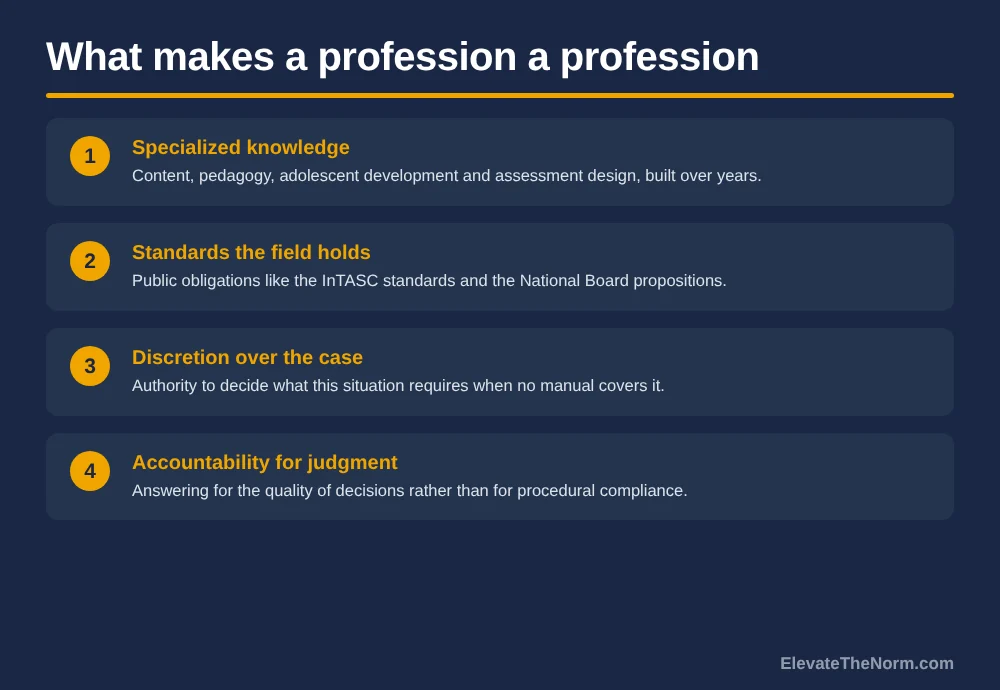
    It means three things together: a body of specialized knowledge, standards the field holds itself to, and the discretion to apply both to a particular case. Drop the third and you do not have a profession. You have a trained workforce following instructions, which is a respectable thing to be and a different thing.

    The word gets used loosely. “Be professional” is often said to teachers when what is meant is “dress appropriately,” “do not argue in front of parents,” or “submit the form on time.” Those are workplace conduct expectations. They apply to any job. They are not what makes a profession, and conflating the two is how a staff ends up with the obligations of professional status and none of the authority.

    The real test is simpler than any definition: when a situation arises that the manual does not cover, who decides? If the answer is the person in the room with the relevant training, that is a profession operating. If the answer is that someone must be called, the job is being treated as something else.

    Where does the comparison to medicine and law actually hold?

    It holds on the structure of the work: diagnosis under uncertainty, with incomplete information, on a case that will not wait. A teacher looking at a student who has stopped turning in work is doing diagnostic reasoning. Is this a skill gap, a comprehension gap, a motivation problem, a home situation, a scheduling conflict, a conflict with another student, or a reasonable protest against a bad assignment? The correct response differs completely depending on the answer, and no policy document distinguishes among them.

    It also holds on the knowledge base. Content knowledge, pedagogical content knowledge, adolescent development, assessment design, reading in the discipline — that is specialized expertise that takes years to build and that a smart outsider cannot improvise.

    And it holds in the formal standards, which read like professional standards rather than job descriptions. The InTASC Model Core Teaching Standards, published by the Council of Chief State School Officers, make judgment explicit. Standard 9 states that the teacher “engages in ongoing professional learning and uses evidence to continually evaluate his/her practice, particularly the effects of his/her choices and actions on others,” and adapts practice to meet the needs of each learner (CCSSO, InTASC 1.0, 2013). That sentence assumes a teacher has choices to evaluate.

    The National Board for Professional Teaching Standards is even more direct. Its third and fourth core propositions are that teachers “are responsible for managing and monitoring student learning” and that teachers “think systematically about their practice and learn from experience” (NBPTS, five core propositions, originally released 1989 and updated 2016). Responsibility and systematic thinking are both discretion words.

    Four cards naming specialized knowledge, professional standards, discretion and accountability for judgment as the elements of professional status.
    Drop the third element and what remains is a trained workforce following instructions.

    Where does the comparison break down?

    On control of the conditions of practice, which is most of what distinguishes a profession from a credentialed job. I would be doing you a disservice if I pushed the doctor analogy too hard, because the places it fails are the places teachers feel the problem.

    • Caseload. A physician’s panel size is a contested professional issue. A secondary teacher’s roster is handed down, and 150 students is normal.
    • Entry to the field. Medicine and law control licensure through their own bodies. Teacher certification is set by states and routinely altered by legislatures, including emergency routes created during shortages.
    • Tools of practice. A surgeon is not told which instruments to use by a purchasing committee. A teacher often is.
    • Time to think. Professional judgment requires time for it. One planning period against six classes is not a schedule built for deliberation.
    • Who evaluates. Peer review by qualified colleagues is central to the other professions. Teacher evaluation is usually done by an administrator who may not share the subject.

    There is also a real counterargument to the whole analogy, and it deserves airing rather than dismissing. Public schools serve every child by law, funded by taxpayers, under elected boards. That creates legitimate public claims on what gets taught that do not exist in private medical practice. A teacher does not get to decide the standards any more than a doctor gets to invent a treatment protocol. The question is not whether constraints are legitimate. It is where the constraint should stop and the judgment should begin.

    How much control do teachers actually report having?

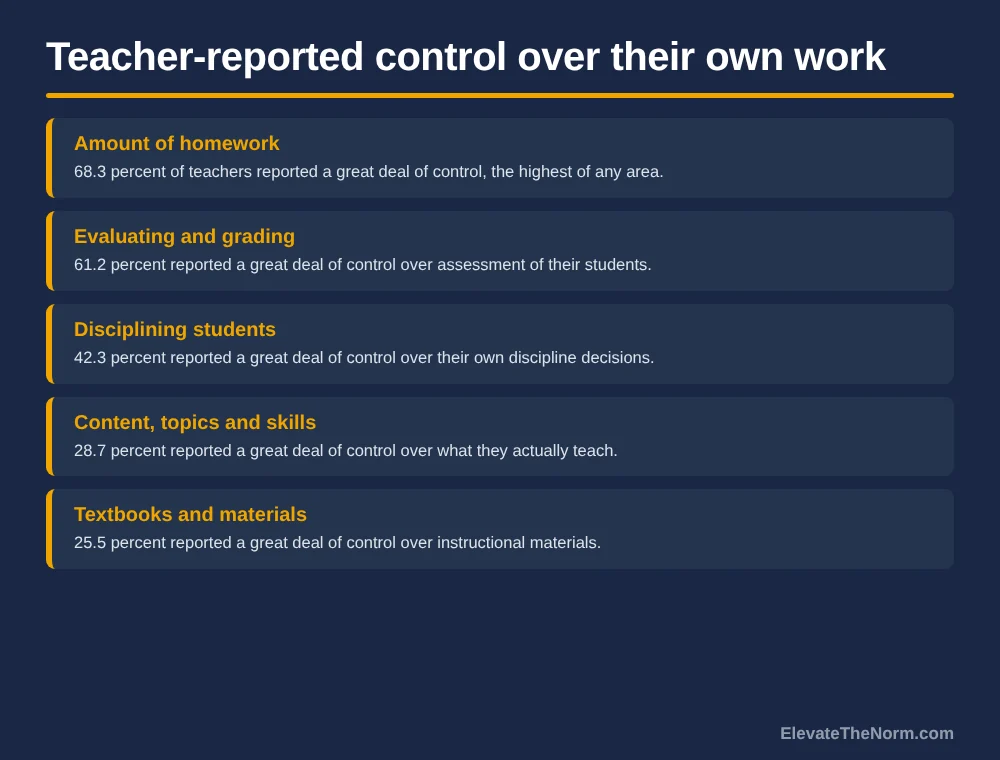
    Much less than the standards assume, and the gap is largest exactly where expertise matters most. Drawing on 2015–16 National Teacher and Principal Survey data, the Economic Policy Institute reported the share of teachers who said they had a great deal of control over each area of their planning and teaching: 68.3 percent for determining the amount of homework, 61.2 percent for evaluating and grading students, 42.3 percent for disciplining students, 28.7 percent for selecting content, topics and skills, and 25.5 percent for selecting textbooks and instructional materials (García & Weiss, EPI, May 2019).

    Look at the shape of that. Teachers control homework volume and grading — the administrative end of the work. Fewer than three in ten report real control over what is taught. The report also notes that larger shares of teachers who quit reported having little influence over school policy or over what they teach in class, though that is an association in survey data rather than a demonstrated cause of attrition.

    A fair reading cuts both ways. Shared curriculum decisions are not inherently an insult; a department choosing materials together is a professional act even when an individual teacher is outvoted. “A great deal of control” is also a high bar, and the survey does not distinguish a collaborative adoption from a mandate. But a quarter is a low number, and it is the number teachers are reacting to when they say they do not feel trusted.

    Is a scripted curriculum incompatible with professional status?

    A strong common curriculum is not the problem. A script that forecloses in-the-moment judgment is. These get conflated constantly, usually by people arguing for one extreme or the other.

    Good shared materials are a professional asset. They save planning time nobody has, they make coherence across sections possible, and they give a new teacher something better than whatever they can build alone at 11 p.m. Arguing against common curriculum in the name of autonomy usually means arguing for every teacher to reinvent the course from scratch, which is neither efficient nor good for students who change sections.

    The problem is a different thing: materials delivered as a compliance instrument, with pacing enforced to the slide and no latitude to respond to what the room is doing. A 2025 report from the National Education Union surveyed 1,655 teachers and interviewed 40 more across England and Wales on standardized curricula. It found that when such materials function as rigid scripts — specifying in detail how tasks are to be performed — teachers describe a loss of professional expertise, and that more than a third of primary teachers using them reported little or no influence over the content of individual lessons (NEU, 2025). That is a union-published study in a different country’s school system, and the primary-school figure is not about our grade band — take it as corroborating testimony rather than as American evidence.

    The useful distinction is between a floor and a ceiling. A curriculum that says “every student will write an evidence-based argument this unit” is a floor. A curriculum that says “on day four you will be on slide eight” is a ceiling, and a ceiling is where judgment goes to die.

    Five rows showing the percentage of teachers reporting a great deal of control over homework, grading, discipline, content and materials, from federal survey data.
    Teacher self-reports from 2015-16 federal survey data, as compiled by the Economic Policy Institute.

    What is the difference between a guardrail and a script?

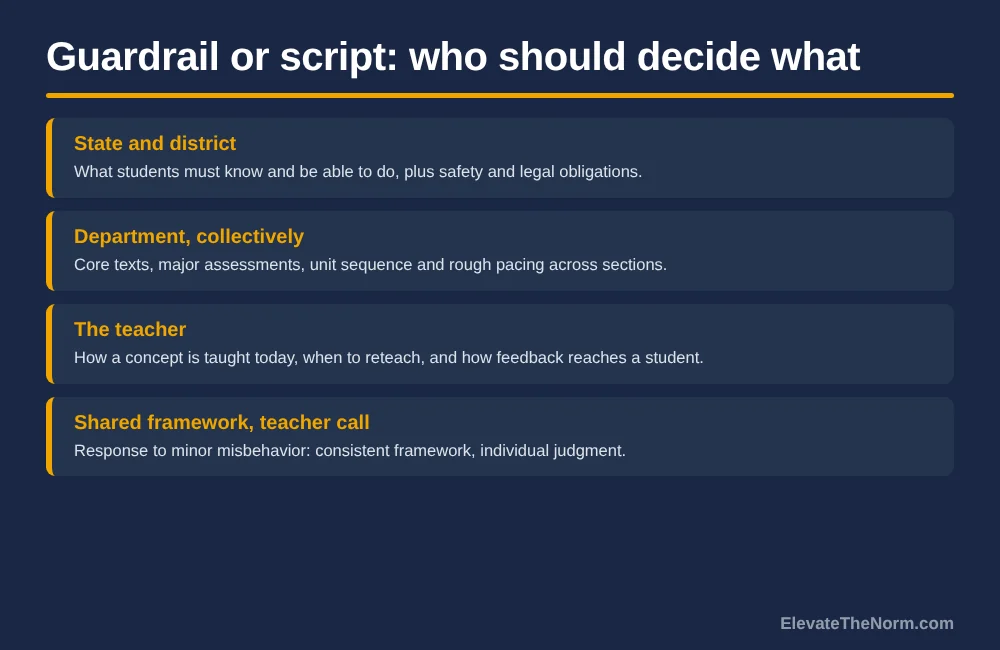
    A guardrail specifies the outcome and the non-negotiables; a script specifies the moves. Most arguments about teacher autonomy would get shorter if people named which of the two they were defending.

    Here is how I would sort the common decisions. This is my professional judgment, offered as a starting point for a department conversation rather than as research.

    DecisionWhere it belongsWhy
    What students must know and be able to doState and districtPublic standards are a legitimate public claim; coherence across schools matters
    Core texts and major assessmentsDepartment, collectivelyEquity across sections requires common anchors; teachers hold the expertise
    Unit sequence and rough pacingDepartment, with flexibilityStudents transfer between sections; rigid daily pacing serves no one
    How a concept is taught on a given dayThe teacherOnly the person in the room knows what this group already understands
    When to reteach and when to move onThe teacherThis is the central diagnostic judgment of the job
    How feedback is delivered to a specific studentThe teacherDepends on a relationship nobody outside the room can see
    Safety, reporting duties, legal obligationsNon-negotiable, districtDiscretion here is not professional judgment, it is risk
    Response to a minor misbehaviorThe teacher, inside a known frameworkConsistency matters, but so does knowing the kid

    If your school can agree on a table like that one and write it down, most of the autonomy argument resolves. The fights are rarely about whether standards should exist. They are about whether row four and row five belong to the teacher, and when a district quietly takes those rows, it is taking the profession with them. Related to row eight: whether a school lets teachers judge small misbehavior inside a shared framework shapes nearly everything about how consequences actually land.

    Why does compliance culture produce worse teaching?

    Because the thing that makes teaching work is responsiveness, and compliance systems reward predictability instead. Mary Kennedy’s review of 28 rigorous studies of professional development found that many of the design features we assume matter were not associated with effectiveness, while the way programs supported teachers in actually enacting a practice varied sharply in impact (Kennedy, 2016). Enactment is judgment work. It is the part a specification cannot carry.

    There is also evidence that pressure on teachers changes how they treat students. Pelletier, Séguin-Lévesque and Legault studied 254 teachers of students in grades 1 through 12 and found that the more teachers perceived pressure from above — curriculum compliance, performance standards, colleagues — the less self-determined they were about teaching, and that lower self-determination predicted a more controlling style with students (Pelletier, Séguin-Lévesque & Legault, 2002). That is a structural equation model on self-report data from 2002, not a randomized trial, and it spans elementary through high school rather than isolating secondary teachers. I will not claim more than it shows.

    What it shows is still worth knowing: controlling conditions correlate with controlling teaching. That is not a surprising result, but it is the mechanism behind a complaint teachers make constantly and rarely get believed about.

    How does trusting teachers connect to trusting students?

    This is the center of my argument, and I am labeling it as argument rather than evidence. I have seven years of classroom experience in the public schools of West Alabama, and the pattern I would defend is this: the posture a school takes toward its teachers is the posture those teachers tend to take toward their students.

    Consider what the two stances actually model. A school that assumes teachers will cut corners unless monitored builds monitoring. The teacher who lives inside that assumption has been taught, daily, that trust is something you earn by compliance and that verification is what care looks like. It takes real deliberate effort not to pass that along — to turn around and hand a fifteen-year-old a genuine choice, accept that some of them will handle it badly, and treat the mishandling as information rather than as proof the choice was a mistake.

    The reverse holds too. A teacher who is trusted to decide how to teach Tuesday has direct personal experience of being treated as capable before they had proven it in that instance. That experience is what makes it possible to extend the same thing to students — to build in real decisions students actually get to make rather than a menu with one correct answer, and to treat respect as something offered first rather than withheld pending good behavior.

    I am not claiming research proves this chain. The Pelletier study is suggestive on one link of it and that is all. But if you are going to ask teachers to treat teenagers as developing young adults capable of judgment, it is worth noticing whether anyone treats the teachers that way.

    Four rows sorting instructional decisions by the level at which they belong, from state standards down to individual teacher judgment.
    A starting point for a department conversation about where constraint ends and judgment begins.

    What can a teacher do when autonomy is limited?

    Work the discretion you do have, and document the judgment you are exercising. Most teachers have more latitude in the small moves than in the large ones, and the small moves are where students live.

    • Own the parts nobody has specified. Even a tightly paced curriculum rarely dictates how you open class, how you respond to a wrong answer, or what you say to a student who is behind.
    • Make your reasoning visible. “I slowed the unit by two days because the exit tickets showed half the class could not do the inference step” is a professional sentence. It converts a pacing deviation into a documented judgment.
    • Use the collective route. Individual deviation gets read as noncompliance; a department proposal gets read as professional input. The data says curriculum decisions are mostly made above the individual teacher, so work at the level where they are made.
    • Keep the evidence. Student work samples are the strongest argument any teacher has. They are also what Standard 9 asks you to be using anyway.
    • Build the reflective habit. Systematic thinking about practice is literally the fourth core proposition. Keeping a real record of what you tried and what happened is both the professional obligation and your best protection.

    What should school and district leaders do?

    Specify outcomes and non-negotiables tightly; leave the moves to the people in the rooms. This costs nothing and is harder than it sounds, because it requires tolerating variation that looks like inconsistency from a hallway.

    Three concrete moves. First, write down which decisions belong at which level and publish it, so teachers are not guessing where the line is this month. Second, evaluate reasoning rather than conformity — ask a teacher why they did what they did, and treat a good answer as a good answer even when it departs from the plan. Third, give judgment somewhere to live: common planning time, peer observation that is not evaluation, and fewer simultaneous initiatives so there is room to think about any of them. For how professional learning intersects with this, see what the evidence says about developing teachers, and for the narrower case of one-off sessions, the workshop format on its own terms.

    What treating the teacher as a professional asks of us

    It asks for discretion matched to accountability, and it asks for it in both directions. Treating the teacher as a professional is not a request for less oversight. It is a request for oversight of the right thing: the quality of the judgment, demonstrated in student work and in reasoning a teacher can defend, rather than conformity to a sequence somebody wrote in July.

    If you teach, start by naming the discretion you already have and using it deliberately, and by making your reasoning explicit enough that it reads as judgment rather than drift. If you lead, publish the decision table for your building and then actually hold the line on the rows you assigned to teachers. And if you are weighing a new mandate, ask what it takes off teachers’ plates, not just what it adds — because every script you hand down arrives in a room where somebody is deciding whether to hand a teenager a real choice.

    Sources

    1. Council of Chief State School Officers, InTASC Model Core Teaching Standards and Learning Progressions for Teachers 1.0, April 2013. Source for the ten core teaching standards and the quoted text of Standard 9 on using evidence to continually evaluate one’s own practice and adapt it to each learner. Caveat: these are model standards voluntarily adopted and adapted by states; they describe aspiration, not what any given district permits in practice. https://www.ksde.gov/Portals/0/TLA/Educator%20Eval/InTASC%20Standards%20-%202013.pdf
    2. National Board for Professional Teaching Standards, Five Core Propositions, originally released 1989 and updated 2016. Source for the five propositions, including that teachers are responsible for managing and monitoring student learning and think systematically about their practice. Caveat: this is the position of a certifying body with an interest in defining teaching as a profession, not an independent research finding. https://nbpts.org/five-core-propositions
    3. García, E., & Weiss, E., Challenging working environments (‘school climates’), especially in high-poverty schools, play a role in the teacher shortage, Economic Policy Institute, May 30, 2019. Source for the teacher-reported control figures — 25.5 percent for textbooks and instructional materials, 28.7 percent for content and topics, 42.3 percent for discipline, 61.2 percent for grading, 68.3 percent for homework — drawn from 2015–16 National Teacher and Principal Survey data. Caveat: these are teacher self-reports of “a great deal of control,” a high bar that does not distinguish collaborative department decisions from top-down mandates, and the link to attrition is an association, not a demonstrated cause. https://files.epi.org/pdf/162910.pdf
    4. Pelletier, L. G., Séguin-Lévesque, C., & Legault, L., “Pressure from above and pressure from below as determinants of teachers’ motivation and teaching behaviors,” Journal of Educational Psychology, 94(1), 186, 2002. Source for the finding that teachers perceiving more pressure from above were less self-determined about teaching and in turn more controlling with students. Caveat: a structural equation model on self-report data from 254 teachers spanning grades 1–12, from 2002; it demonstrates association, not causation, and does not isolate secondary teachers. https://bearworks.missouristate.edu/articles-chhs/224
    5. National Education Union, Are you on slide 8 yet? The impact of standardised curricula on teacher professionalism, March 25, 2025. Source for teachers’ accounts of de-skilling under rigidly scripted curricula and for the finding that over a third of primary teachers using such materials reported little or no influence over individual lesson content; based on 1,655 survey responses and 40 interviews. Caveat: a union-published study of primary and secondary schools in England and Wales; the cited figure is for primary teachers and the policy context is not the American one. https://neu.org.uk/latest/library/are-you-slide-8-yet
    6. Kennedy, M. M., “How Does Professional Development Improve Teaching?” Review of Educational Research, 86(4), 945–980, 2016. Source for the finding across 28 rigorous studies that many popular design features are not associated with effectiveness while the support for enactment varies sharply in impact — used here as evidence that judgment in application, rather than specification, carries the weight. Caveat: this is a review of professional development programs, not a direct study of teacher autonomy. https://journals.sagepub.com/doi/abs/10.3102/0034654315626800

    Frequently Asked Questions

    Does professional autonomy mean teachers can ignore the standards?

    No, and that is not what anyone serious is arguing for. Public schools serve every child under state standards set through an elected process, and those standards are a legitimate public claim on what gets taught. Professional discretion applies to how a concept is taught, when to reteach, and how a specific student is given feedback — not to whether the standard gets covered. The useful question is never whether constraints exist. It is whether they stop at the outcome or extend to the moves.

    How is a school supposed to stay consistent if every teacher decides differently?

    By separating what must be common from what should not be. Core texts, major assessments, unit sequence and safety obligations can and usually should be shared, because students move between sections and equity depends on common anchors. Daily instructional decisions cannot be made consistent without making them worse, since the whole point is responsiveness to a particular group. A school that writes down which decisions sit at which level gets coherence where it matters and stops fighting about the rest.

    Is this an argument against using a common curriculum?

    It is the opposite. Strong shared materials are a professional asset: they save planning time nobody has, create coherence across sections, and give a new teacher something better than what they can build alone late at night. The objection is narrower — materials enforced to the slide, with no latitude to respond to what the room is doing. A curriculum that sets a floor supports judgment. One that sets a daily ceiling replaces it.

    How can parents tell whether teachers at their child’s school have real professional latitude?

    Ask the teacher a diagnostic question and listen to the answer. “What are you going to do differently for my child based on what you have seen?” A teacher with latitude gives a specific answer about their own next steps. A teacher without it describes a program or refers you upward. Neither answer makes anyone a bad teacher, and the second is often a constraint rather than a choice — but it tells you something true about how the school is run.

    Does trusting teachers more create risk for students?

    Some categories of decision should carry no discretion at all: mandatory reporting, safety procedures, legal obligations, and anything involving a student’s physical wellbeing. Those are not professional judgment calls and should not be treated as any. The discretion being argued for here is instructional — pacing, explanation, reteaching, feedback. Conflating the two is how autonomy debates go badly, and a school can hold the safety floor absolutely rigid while loosening the instructional ceiling considerably.

    What about a first-year teacher who does not yet have the judgment?

    Discretion should grow with demonstrated capacity, and that is true in every profession. A new teacher reasonably starts with more structure: shared materials, a clear framework for responding to behavior, and someone to check reasoning with. The mistake is leaving them there. If the structure never loosens, what you have built is not an on-ramp, it is a permanent condition, and the teacher learns that competence does not change anything about how they are treated.

    Is there research proving that trusting teachers leads to trusting students?

    No, and I will not pretend otherwise. One 2002 study of 254 teachers across grades 1 to 12 found that perceived pressure from above predicted lower self-determination and a more controlling style with students, which is suggestive of one link in the chain. That is a correlational model on self-report data, not causal evidence, and it does not isolate secondary teachers. The broader claim in this article is my professional argument, offered as an argument, not dressed up as a finding.

    What can a student do if their teacher clearly has no room to move?

    Ask about the reasoning rather than the rule. “Is the deadline something you set, or is it a department thing?” is a fair question, and most teachers will answer it honestly. Knowing which constraints belong to the teacher and which came from above tells you where a request has any chance of landing, and it is a more useful habit than assuming every rule is a personal choice. It also treats the teacher as what they are: a professional working inside limits.

    About Clay Shumate

    Clay Shumate is a certified secondary Social Studies teacher in the public schools of West Alabama, with seven years of classroom experience, a B.A. in History, and an M.Ed. in Secondary Education. He writes about project-based learning, student responsibility, respect, and practical ways to hold young people to a higher standard while giving them room to learn from mistakes. He is a member of the Society of Professional Journalists and writes to its Code of Ethics; this site’s editorial standards and corrections policy are published in full. More about Clay.

  • Continuing Education for Teachers: How to Find the Rule That Actually Applies to You

    Continuing Education for Teachers: How to Find the Rule That Actually Applies to You

    By Clay Shumate

    Continuing education for teachers is the ongoing coursework, clock hours, and professional learning a state requires you to complete to keep your teaching license valid. There is no national requirement. Every state sets its own renewal cycle, its own unit of measurement, and its own list of providers it will accept — so the only requirement that matters is the one your state board publishes today.

    That last sentence is the whole article, and it is the part most writing on this topic gets wrong. You will find plenty of pages promising to tell you “how many hours teachers need.” They cannot, because the answer changes at the state line and sometimes changes again when the legislature meets. What an article can honestly do is teach you the vocabulary, show you how different the rules really are, and walk you through finding and reading your own state’s actual rule. That is what this one does.

    Key Takeaways

    • There is no national number. Licensure is a state function, so the requirement, the cycle length, and the unit of measurement are all set state by state.
    • Clock hours, CEUs, and graduate credit are different units. Ohio treats 18 CEUs as 180 contact hours and as the equivalent of six semester hours, which means one “hour” can mean ten hours or fifteen depending on who is counting.
    • Who provides the learning can matter as much as what you learn. New York only counts hours from sponsors the department has approved, and Texas publishes its own provider categories.
    • Some states require nothing at all. California renews a Clear credential without any additional coursework.
    • The research on whether this improves teaching is not flattering. Large-scale district spending on teacher development has repeatedly failed to show up as measurable improvement.
    • Verify everything yourself. Requirements change, pages move, and an article — including this one — is not a legal authority on your license.

    What does continuing education for teachers actually mean?

    It means the professional learning your state counts toward keeping your license, measured in a unit your state defines, provided by someone your state will accept. Those three conditions are separate, and failing any one of them can leave you with a stack of certificates that do not count.

    In practice the phrase covers a lot of ground. Graduate coursework counts in most states. District in-service days usually count. Conference sessions, online modules, book studies, curriculum writing, and mentoring another teacher count in some places and not others. The same workshop can be worth renewal credit in one state and worth nothing in the next.

    You will also see the term written several ways. “Continuing education credits for teachers,” “CEUs for teachers,” and “teacher continuing ed” all point at the same idea, but they are not interchangeable as units. A CEU is a specific measurement. A credit is usually a college credit. A clock hour is sixty minutes in a seat. Mixing them up is the most common way teachers miscount.

    Why is there no national answer?

    Because teacher licensure has never been a federal function. Each state board of education or professional standards commission writes its own rules, and those rules are amended by state boards and state legislatures on their own schedules.

    New America’s 2018 review of relicensure policy looked at all fifty states and the District of Columbia and found that the vast majority require some form of professional learning for renewal, but that only eleven states articulate why — what the requirement is actually supposed to accomplish. The report’s blunt summary of the typical system is worth sitting with: “whether a teacher grows considerably while fulfilling her state’s renewal requirements or does not improve at all is of no consequence under most renewal systems” (New America, August 2018).

    That is a policy critique, not an excuse to skip your hours. But it explains why the rules look arbitrary from the inside. They often are.

    Chart comparing clock hours, CEUs, semester credits and inservice points as units used in teacher license renewal
    The same amount of learning converts to very different numbers depending on which unit your state uses.

    Clock hours, CEUs, and graduate credit are not the same unit

    Before you count anything, find out which unit your state uses, because the conversion factors are large. Ohio publishes a conversion chart stating that “one CEU equals 10 contact hours” and that “3 CEUs equal one semester hour” (Ohio State Board of Education conversion chart). Texas, by contrast, treats one semester credit as fifteen CPE hours.

    So a single semester of graduate coursework is worth 30 contact hours in Ohio’s accounting and 15 CPE hours in Texas’s. Neither is wrong. They are different measuring systems, and the only number that matters is the one your state applies to your transcript.

    The three units, plainly

    • Clock hour or contact hour. One hour of actual instruction time. The most common unit for workshops and in-service.
    • CEU (continuing education unit). A bundled unit. Commonly ten contact hours, but confirm — the definition is set by whoever issues it.
    • Semester credit. College coursework, converted into hours at a rate your state publishes.

    Four states, four different rules

    The fastest way to understand the variation is to look at real requirements side by side. Everything in this table was read directly from the state’s own page in October 2026. Treat it as an illustration of how different the rules are, not as current advice for your license.

    StateRequirement per cycleCycleNotable condition
    New York100 clock hours of approved CTLEFive-year registration periodHours must come from a CTLE sponsor approved by the department; one requirement per educator regardless of how many certificates are held
    Texas150 CPE hours for classroom teachers; 200 for principals, counselors, librarians, diagnosticians, and reading specialistsFive yearsIndependent study is capped at 20 percent of total hours; all educators must include training on educating students with disabilities, including dyslexia
    OhioSix semester hours of coursework, or 18 CEUs (180 contact hours)Five yearsA Local Professional Development Committee must approve your Individual Professional Development Plan; filing after October 1 of the expiration year raises the requirement to nine semester hours
    FloridaSix college credits or 120 inservice points, or a combinationFive yearsAt least three credits in each retained specialization area, plus a minimum of one credit in teaching students with disabilities
    CaliforniaNo additional courseworkFive calendar yearsA Clear credential “may be renewed without the completion of additional course work or service requirements”

    Sources for each row, in order: NYSED CTLE requirements; Texas Education Agency CPE information; Ohio State Board of Education renewal page; Florida Statutes § 1012.585; California CTC leaflet CL-494.

    Look at the spread. A Texas classroom teacher owes 150 hours. A California teacher with a Clear credential owes none. An Ohio teacher owes a number that is only meaningful after a local committee signs off on a plan. New York’s CTLE credits — the state example most people have heard of — are 100 hours, but only from approved sponsors, which is a constraint Texas and Florida handle very differently. Five states, five genuinely different systems.

    What counts, and who is allowed to provide it?

    The provider question trips up more teachers than the hour count does. New York is explicit that acceptable CTLE must come from a sponsor the department has approved, and that activities have to target content area, pedagogy, or language acquisition for English learners. A good webinar from an unapproved provider is still a good webinar. It is not 100 hours of CTLE.

    Texas publishes provider categories instead of an approval list — the agency itself, accredited universities, education service centers, districts, and tax-exempt professional associations. It also recognizes activity types beyond sitting in a session: curriculum development and mentoring other educators count, and mental health first aid, trauma-informed care, and suicide prevention training count up to sixteen hours. Independent study of professional materials counts, but only up to twenty percent of the total.

    That twenty percent cap is a useful signal. States are telling you they will tolerate self-directed reading as a slice of your renewal and not as the whole thing. If your plan for 150 hours is “read a lot of books,” the plan fails on arithmetic before it fails on philosophy.

    How do I find my own state’s actual requirement?

    Go to the state agency that issues the license, not to a blog, a university continuing-education department, or a vendor selling hours. Vendors have a reason to describe requirements loosely. Here is the sequence I would use.

    1. Search the agency name, not the question. Try “[state] department of education educator licensure renewal.” You are looking for a .gov domain belonging to the state board, department of education, or professional standards commission.
    2. Find your exact license type. Requirements differ by tier. Ohio’s rules for a Resident Educator license are not its rules for a Professional license. New York treats Initial, Professional, and Teaching Assistant certificates differently.
    3. Write down the unit and the number. Hours, CEUs, or credits — and the conversion chart if the state publishes one.
    4. Write down the cycle and the deadline. Note whether the deadline is your expiration date or an earlier filing date. Ohio’s October 1 cutoff raises the requirement by three semester hours if you miss it. That is the kind of detail that costs money.
    5. Find the approved-provider rule. Approved sponsor list, provider categories, or no restriction at all. Save the page.
    6. Find the mandated topics. Many states now require specific content — students with disabilities, dyslexia, reading science, child abuse reporting. These are usually buried below the headline number.
    7. Screenshot the page with the date visible, and set a calendar reminder to re-check annually. Rules change between your renewals. Pages move. Having dated evidence of what the rule said when you planned is worth the thirty seconds.

    One more thing: call or email the licensing office with your specific question and keep the reply. A state employee’s written answer about your license is worth more than any article.

    Five-step sequence for locating a state teaching license renewal requirement on an official state agency page
    Thirty minutes once a year replaces most of the anxiety around license renewal.

    Does any of this make teachers better?

    Honestly, the large-scale evidence is weak, and pretending otherwise would be dishonest. TNTP’s 2015 study The Mirage examined three large public school districts and one midsize charter network, surveying more than 10,000 teachers and 500 school leaders. The districts spent roughly “$18,000 per teacher, per year on development efforts,” and teachers reported spending about nineteen full school days a year on development activities — close to ten percent of the school year. The finding: “The evaluation ratings of nearly seven out of 10 teachers remained constant or declined over the last two to three years,” and researchers found “no type, amount or combination of development activities appears more likely than any other to help teachers improve substantially” (TNTP, 2015).

    That study is a decade old now and covered four systems, not a national sample. It does not prove that professional learning cannot work. What it shows is that volume and spending alone have not reliably produced improvement, which is precisely what an hours-based renewal requirement measures.

    There is better news on the other side. A 2017 Learning Policy Institute review of 35 studies that used experimental, quasi-experimental, or appropriately modeled designs identified seven features of professional development that showed effects: it is content focused, incorporates active learning, supports collaboration, uses models and modeling, provides coaching and expert support, offers feedback and reflection, and is of sustained duration (Darling-Hammond, Hyler, and Gardner, 2017).

    Read that list against your last compliance module and you will see the problem. A 45-minute asynchronous video with a quiz at the end hits roughly none of the seven. It still counts toward your hours. If you get to choose how you spend renewal hours, spend them on the things on that list. Sustained work with colleagues on something specific to your content beats a scavenger hunt for the cheapest hours every time — which is part of why a staff that believes it can move student outcomes together tends to get more out of the same calendar.

    What does it cost, in money and in time?

    The cost is real and it is unevenly distributed, which is worth saying out loud. The U.S. results from the 2018 TALIS survey of lower secondary teachers — grades 7 through 9 — found that 49 percent of American teachers named conflict with their work schedule as a barrier to professional development, 47 percent named a lack of incentives, 42 percent named family responsibilities, and 38 percent named cost (NCES, TALIS 2018).

    Those four numbers describe the actual experience of meeting a renewal requirement. The hours are not the hard part. Finding them inside a schedule that is already full, without a stipend, while paying for them, is the hard part. If you are a department chair or an administrator reading this, those percentages are a to-do list: fund it, schedule it inside contract time, and stop treating the renewal cycle as a private problem.

    What happens if I move to another state?

    Your hours do not automatically travel, and neither does your license. Reciprocity agreements usually get you a license in the new state, often a provisional or initial one, but the renewal clock and the renewal requirement reset to the new state’s rules. Coursework completed under an old state’s system may or may not be accepted.

    Practical advice: before you move, request an official transcript and a printed record of completed hours from your current state and your district. Do it while you are still an employee. Reconstructing nine years of in-service credit from another state, after you have left, is a miserable job.

    Four cards naming common errors teachers make when meeting license renewal requirements
    Most renewal problems are clerical, not academic.

    A renewal cycle you plan instead of survive

    Spread the requirement across the cycle and tie it to something you actually want to get better at. The teachers who hate this process are usually the ones doing 150 hours in the final eighteen months.

    A simple structure that fits most state systems:

    • Year one. Read the rule, record the unit and deadline, pick one instructional problem you genuinely want to solve. Start a running log with dates, provider names, hour counts, and certificate files.
    • Years two through four. Take roughly a quarter of the requirement each year, weighted toward the seven features above — sustained, collaborative, content-specific work. Knock out mandated topics early; they are usually the cheapest and the easiest to schedule.
    • Year five. File early. Re-read the rule before you file, because it may have changed since year one. Confirm every provider was approved at the time you completed the hours.

    Keep the log in a single place you will still be able to find in four years, with the certificates attached. A folder in cloud storage beats a drawer. The log is also useful for a reason that has nothing to do with compliance: it is a record of what you chose to learn, which makes honest reflection on your own practice considerably easier than trying to remember it.

    Common ways teachers get burned

    • Unapproved providers. Hours completed with a provider the state does not accept. Check before you pay, not after.
    • Unit confusion. Logging CEUs as clock hours, or assuming a three-credit course is worth more hours than your state says it is.
    • Missing the mandated topic. Hitting the total and missing the required disabilities, dyslexia, or reading component.
    • Filing-date surprises. Deadlines that precede the expiration date, with penalties attached.
    • Lost documentation. Certificates in an email account you no longer have access to. Download them the day you earn them.
    • Trusting a vendor’s summary of your state’s rule. Including, I will say again, this article.

    Link rot is a real hazard too. While checking sources for this piece in October 2026, I found that the deep links to the National Endowment for the Humanities’ EDSITEment lesson plans — a resource recommended in teacher materials for decades — now redirect to a single project page. If a federal humanities site can move out from under its own URLs, a state licensure page certainly can. Open the link. Do not trust the summary.

    Where continuing education meets the work you actually care about

    The requirement is a floor, not a plan. Hours get your license renewed. They do not make Tuesday better. The useful question is whether the learning you are already paying for in hours is pointed at a problem you can see in your own students’ work.

    If you teach grades 6–12 and you want the hours to do double duty, pick a problem narrow enough to observe. Students not reading the primary source before the discussion. Groups where one kid does everything. Feedback that students never act on. Then look for sustained, collaborative learning aimed at that, rather than whatever module is cheapest. Building a goal that is observable and revisited on a schedule turns a compliance cycle into something you would have done anyway. And if the materials you need to try something new are the barrier, free classroom materials worth printing exist in more places than most teachers realize — our own classroom resource library downloads directly with no email required.

    Continuing education for teachers: what to do this week

    Spend thirty minutes doing three things, and continuing education for teachers stops being a background anxiety. First, open your state licensing agency’s page for your exact license type and write down the unit, the number, the cycle, the filing deadline, and the provider rule. Second, start a log with every hour you have already earned, with provider names and dates, and attach the certificates. Third, pick the one instructional problem you want the next cycle to address.

    Then verify what you wrote down. Requirements change, and the only authority on your license is the agency that issued it. If something in this article conflicts with what your state board publishes today, your state board is right.

    Sources

    1. New York State Education Department, “Registration and Continuing Teacher and Leader Education (CTLE),” Office of the Professions / Higher Education, accessed October 2026. Supports the 100 clock-hour CTLE requirement, the five-year registration period, and the one-requirement-per-educator rule. Caveat: the language-acquisition portion of the requirement is described on a separate departmental page and is not quantified here. https://www.highered.nysed.gov/tcert/resteachers/ctle.html
    2. Texas Education Agency, “Standard Certificate Renewal and Continuing Professional Education (CPE) Information,” accessed October 2026. Supports the 150-hour and 200-hour figures, the 20 percent independent-study cap, the 1 semester credit = 15 CPE hours conversion, and the disabilities and dyslexia content requirement. https://www.tea.texas.gov/texas-educators/certification/certification-renewals/standard-certificate-renewal-and-continuing-professional-education-cpe-information
    3. Ohio State Board of Education, “Renew an Advanced, Associate or Professional License,” and the State Board’s professional development conversion chart, accessed October 2026. Supports the six semester hours / 18 CEUs / 180 contact hours figures, the LPDC and IPDP approval requirement, the October 1 filing date, and the CEU conversions. https://sboe.ohio.gov/educator-licensure/renew-a-license/renew-an-advanced-associate-or-professional-license
    4. Florida Statutes § 1012.585, “Process for renewal of professional certificates,” 2025 edition, Florida Senate. Supports the six college credits or 120 inservice points requirement, the three-credit specialization rule, and the one-credit students-with-disabilities requirement. https://www.flsenate.gov/Laws/Statutes/2025/1012.585
    5. California Commission on Teacher Credentialing, Leaflet CL-494, “Renewal and Reissuance of Credentials,” accessed October 2026. Supports the statement that Clear teaching credentials renew without additional coursework, and the five-calendar-year term. https://www.ctc.ca.gov/credentials/leaflets/cl-494/
    6. TNTP, The Mirage: Confronting the Hard Truth About Our Quest for Teacher Development (executive summary), 2015. Supports the $18,000 per teacher per year figure, the 19 school days figure, and the finding that nearly seven in ten teachers’ evaluation ratings held constant or declined. Caveat: three large districts and one midsize charter network, not a national sample, and now a decade old; the summary does not report grade levels. https://tntp.org/wp-content/uploads/2023/02/TNTP_Mirage_Executive_Summary_2015.pdf
    7. Linda Darling-Hammond, Maria E. Hyler, and Madelyn Gardner, Effective Teacher Professional Development, Learning Policy Institute, 2017. Supports the seven features of effective professional development and the 35-study review base. Also: U.S. Department of Education, National Center for Education Statistics, TALIS 2018 U.S. Highlights, for the barrier percentages among grade 7–9 teachers. https://learningpolicyinstitute.org/sites/default/files/product-files/Effective_Teacher_Professional_Development_REPORT.pdf

    Frequently Asked Questions

    Is there a national number of continuing education hours teachers need?

    No. Teacher licensure is a state function, so the hour count, the unit, the cycle length and the list of acceptable providers are all set state by state. Texas asks classroom teachers for 150 CPE hours across five years. New York asks for 100 clock hours of approved CTLE across a five-year registration period. Ohio asks for six semester hours or 18 CEUs. California renews a Clear credential with no additional coursework at all. Any page that gives you a single national figure is wrong, and the only authority on your license is the agency that issued it.

    What is the difference between a clock hour, a CEU and a college credit?

    A clock hour or contact hour is one hour of actual instruction. A CEU is a bundled unit, commonly ten contact hours, but the definition belongs to whoever issues it. A college credit is coursework converted into hours at a rate your state publishes. The conversions are not small. Ohio states that one CEU equals ten contact hours and that three CEUs equal one semester hour, while Texas treats one semester credit as fifteen CPE hours. Record which unit your state uses before you count anything, because mixing units is the most common way teachers miscount.

    Will hours from any provider count toward renewal?

    Often not. New York requires that acceptable CTLE come from a sponsor the department has approved, which means a genuinely good workshop from an unapproved provider earns you nothing toward renewal. Texas publishes provider categories instead — the agency, accredited universities, education service centers, districts and tax-exempt professional associations. It also caps independent study at twenty percent of the total. Check the provider rule before you pay, save the page you checked, and keep the certificate the day you earn it rather than hoping the provider still has records in four years.

    Who is supposed to pay for this, and when am I supposed to do it?

    That depends entirely on your district contract, and the survey data says it is a genuine problem. Among U.S. grade 7 through 9 teachers in the 2018 TALIS survey, 49 percent named conflict with their work schedule as a barrier to professional development, 47 percent named a lack of incentives, 42 percent named family responsibilities and 38 percent named cost. If you lead a department or a building, those numbers are an argument for funding renewal and scheduling it inside contract time rather than treating the cycle as each teacher’s private expense.

    Does meeting a renewal requirement actually make someone a better teacher?

    The large-scale evidence is not encouraging. TNTP’s 2015 study of three large districts and one charter network found roughly $18,000 per teacher per year spent on development, about nineteen school days a year of teacher time, and no type or amount of activity that reliably produced substantial improvement. That is four systems rather than a national sample, and it is now a decade old. The 2017 Learning Policy Institute review is more useful: professional learning that is content focused, collaborative, coached, sustained and tied to feedback does show effects. Hours alone do not.

    What should I do if I move to a different state?

    Assume nothing transfers automatically. Reciprocity agreements usually get you licensed in the new state, frequently at a provisional or initial tier, but the renewal clock and the renewal requirement reset to the new state’s rules, and hours earned under the old system may not be accepted. Before you leave, request official transcripts and a printed record of completed in-service hours from both your current state agency and your district, while you are still an employee. Reconstructing years of credit from a state you no longer work in is a genuinely miserable job.

    How often should I re-check my state’s requirement?

    Once a year, and again immediately before you file. Requirements get amended by state boards and legislatures on their own schedules, mandated topics get added, and the pages themselves move. When I checked sources for this article in October 2026, deep links to a long-recommended federal humanities teaching resource redirected to a single project page. If that can happen to a federal site, a state licensure page can certainly move. Screenshot the rule with the date visible when you plan your cycle, and set a calendar reminder.

    Can I use this article as documentation of my requirement?

    No, and please do not try. Everything in the state comparison here was read directly from official state pages in October 2026 and is accurate to those pages as of that date, but it is an illustration of how much the rules vary, not a legal authority on your license. Open your own state agency’s page for your exact license type, confirm the unit, the number, the cycle, the filing deadline, the provider rule and the mandated topics, and keep that page. If your state board contradicts this article, your state board is right.

    About Clay Shumate

    Clay Shumate is a certified secondary Social Studies teacher in the public schools of West Alabama, with seven years of classroom experience, a B.A. in History, and an M.Ed. in Secondary Education. He writes about project-based learning, student responsibility, respect, and practical ways to hold young people to a higher standard while giving them room to learn from mistakes. He is a member of the Society of Professional Journalists and writes to its Code of Ethics; this site’s editorial standards and corrections policy are published in full. More about Clay.

  • Teacher Professional Development Workshops: When They Work and When They Are Theater

    Teacher Professional Development Workshops: When They Work and When They Are Theater

    By Clay Shumate

    Teacher professional development workshops are single sessions, usually one to six hours, in which a presenter introduces a practice to a group. A workshop can do three things well: introduce an idea, demonstrate what it looks like, and give a staff shared language for it. It cannot install the practice. That requires follow-up, and most workshops are never funded for any.

    I want to be careful here, because “workshops do not work” has become the kind of thing people say to sound informed, and it is not quite true. The format has a job. The problem is that the job it can do is small, and we keep asking it to do a much bigger one. This piece is about the single session specifically — what the delivery format can and cannot carry, and how to tell the difference before you sit down.

    Key Takeaways

    • A workshop is an introduction, not an installation. Explaining a practice and getting it running in a classroom are different jobs, and only the first fits in one session.
    • Under roughly 14 total hours, the studies stop finding student effects. In the federal review that applied What Works Clearinghouse standards, the three programs with 5 to 14 hours showed no statistically significant achievement effects.
    • Follow-up is the whole variable. The one delivery model with strong causal evidence — coaching — is essentially “someone comes back,” and it produced a 0.49 SD effect on instruction across 60 studies.
    • Design features are not the same as effectiveness. Reviews that catalog the features of good PD studied programs that already worked, which is a different claim than the one most workshop agendas imply.
    • Teacher workshops are not theater because teachers are cynical. They are theater when nobody is accountable for what happens after, and the people booking them usually know this.
    • A good one-off tells you the truth about itself. “Today is awareness, implementation starts in October with these three supports” is a defensible sentence. “You have now been trained” is not.

    What is a professional development workshop supposed to do?

    Change what a teacher knows and believes, so that a later change in practice becomes possible. That is the honest job description. A session can put a practice in front of forty people who had never considered it, show it working, name its parts, and answer the first round of objections. That is real value and it is not nothing.

    The trouble starts when a workshop gets described as training. Training implies that someone can now do the thing. After one session, almost nobody can. They can describe it. The gap between describing a practice and executing it at 9:15 on a Tuesday with twenty-eight teenagers is the entire problem of professional learning, and the single-session format does not touch it.

    So when you look at an agenda, read it for what it is claiming. A session that promises awareness and delivers awareness has done its job. A session that promises implementation in ninety minutes has made a claim nobody can keep.

    What can a workshop genuinely accomplish?

    Four things, all of them upstream of practice. I would rate them in this order.

    • Existence. Teachers cannot adopt a practice they have never heard of. A workshop is a cheap, fast way to put something on the table.
    • Demonstration. Watching a practice done well — live, modeled, or on video with real students — resolves questions no handout answers. The Learning Policy Institute’s review of 35 rigorous studies found modeling of effective practice among the features common to programs that worked (Darling-Hammond, Hyler & Gardner, 2017).
    • Shared vocabulary. When a whole department leaves with the same words for the same move, the hallway conversations afterward get cheaper. This is a genuinely underrated function.
    • Content knowledge. A workshop can teach subject matter. A randomized federal study delivered 80 hours of summer mathematics content work and measurably improved teachers’ mathematical knowledge and the quality of their in-class explanations — so sessions can move knowledge, and reliably (Garet et al., NCEE 2016–4010).

    Note the word “upstream” in all four. Existence, demonstration, vocabulary and knowledge are preconditions. None of them is a changed lesson.

    Four cards distinguishing what a one-off teacher workshop can accomplish from what it cannot do without follow-up.
    The format has a real job; the trouble starts when it is asked to do the installation too.

    What can a workshop not do on its own?

    It cannot get a new practice past the second attempt, and the second attempt is where practices die. The first try of anything new is usually rough. A teacher who has nobody to debrief that rough first try with reads the roughness as evidence the practice does not work in their room, and goes back to what was working well enough. That is a rational response to no feedback.

    The same federal study that raised teacher knowledge with 93 total hours of PD found no positive impact on student achievement. The teachers knew more math and gave better explanations, and the students’ scores did not move within the study window. Worth naming the population: over 200 fourth-grade mathematics teachers across six districts in five states. This site is about grades 6–12 and I am not going to pretend a fourth-grade math result transfers directly. The structural lesson does transfer: knowledge gain is not the finish line, and a workshop that delivers knowledge has delivered a middle step.

    A workshop also cannot solve the problems that are actually blocking the practice — no planning time, a grading load that eats the weekend, a schedule with no common prep, a class where the basic routines are not yet reliable. If the obstacle is time or structure, more explanation does not help.

    Why do teacher workshops keep getting booked anyway?

    Because the workshop is the only PD format that scales to an entire staff on one calendar day at a known price. I think it is worth being generous about this rather than cynical. A principal with one professional day and a fixed budget can reach every adult in the building for the cost of a presenter and a cafeteria. Nothing else does that.

    There is also an accountability logic. When a district needs to demonstrate that staff were informed of something — a policy change, a legal requirement, a new platform — a session with a sign-in sheet produces a record. For genuinely informational content, that is the right tool. Nobody needs coaching cycles to learn where the new incident report lives.

    The failure is not booking the workshop. The failure is booking a workshop for an instructional change and then reporting attendance as if it were implementation. TNTP’s widely cited 2015 report estimated teachers spent the equivalent of about 19 school days a year on development activities in the districts it studied, at roughly $18,000 per teacher, without finding a pattern that separated the teachers who improved (TNTP, 2015). That report has serious methodological critics and I would not lean on its conclusions, but the time estimate is the part worth sitting with. Nineteen days is a lot of days.

    How many hours before a workshop shows up in student learning?

    The best available threshold is about 14 total contact hours, and below it the evidence goes quiet. The federal regional lab review by Yoon and colleagues screened more than 1,300 studies and found nine that met What Works Clearinghouse evidence standards. Programs above 14 hours showed positive, significant effects on student achievement; the three programs with the least time — 5 to 14 hours total — showed no statistically significant effects (Yoon et al., REL 2007–033).

    Be careful with that number. Nine studies is a thin base, the review is from 2007, and all nine ran in elementary grades. It is not a law. What it is good for is arithmetic. A single three-hour session is a fifth of the way to the floor. Three such sessions across a year, with nothing between them, still does not clear it. If your professional learning plan for a priority consists of two half-days, you now have a defensible reason to say the plan is under-resourced rather than the teachers under-committed.

    And hours alone are plainly insufficient — the 93-hour study above had the hours and no student effect. Duration is a floor, not an engine.

    Five-row checklist of elements that distinguish a workshop likely to change practice from one that will not.
    Five of the ten checklist items from the article; six or more unchecked means plan for awareness only.

    What makes the difference between a workshop that transfers and one that does not?

    Follow-up, and specifically follow-up in which somebody sees the teacher teach. This is the closest thing to a clean finding in the whole literature. Kraft, Blazar and Hogan’s meta-analysis of 60 causal studies of teacher coaching found a pooled effect of 0.49 standard deviations on instructional practice and 0.18 on student achievement (Kraft, Blazar & Hogan, 2018). An effect of 0.49 on instruction is large for education research.

    Read what coaching actually consists of and it is unglamorous: someone watches a real lesson, talks about that specific lesson, and comes back. The workshop supplies the idea; the return visit supplies the installation.

    The same paper carries the caution that matters for a school planning this. Effects from effectiveness trials of larger programs were only a fraction of the effects in efficacy trials of smaller programs. A coaching model with one coach for sixty teachers is not the intervention the meta-analysis measured. Ratio and protected time are the program.

    Mary Kennedy’s review of 28 rigorous studies points the same direction from another angle: sorting programs by their theory of action rather than their design features, she found many popular design features were not associated with effectiveness, while the pedagogy used to help teachers enact the practice varied sharply in impact (Kennedy, 2016). In plain terms: what the session does to help you do it matters more than how the session is shaped.

    Does choice matter, or is that just a morale concern?

    It is both, and the research does not settle it. I will separate what I can support from what I believe. What I can support: the feature lists that mention active learning and relevance are correlational, and Sims and Fletcher-Wood argued in a critical review that those lists rest on inappropriate inclusion criteria and cannot bear the weight placed on them (Sims & Fletcher-Wood, 2021). So I cannot tell you that choice causes transfer.

    What I believe, as a professional judgment: a teacher who chose the session arrives having already decided the problem is worth solving, which is most of the work of adoption. A twenty-year veteran and a first-year teacher sitting through the identical required session on questioning technique are not in the same room. Required compliance content should be required. Instructional learning does not have to be uniform, and departments that offer two or three strands instead of one usually do not pay much for it.

    A checklist for evaluating teacher professional development workshops

    Run the session against these ten items; six or more unchecked means you are looking at an awareness event, and should plan accordingly. This works equally well as a design tool if you are the one building it.

    ElementWhat to look for
    Stated purposeThe agenda says whether this is awareness, knowledge-building, or implementation — and does not confuse them
    Total hoursThe session is part of a sequence with enough combined time to clear roughly 14 hours
    Return visitA named person and a scheduled date for someone to see the practice attempted
    ModelingThe practice is demonstrated with students in a comparable grade band and subject, not described
    RehearsalParticipants actually try the move during the session, on a real lesson they teach next week
    Artifact out the doorEveryone leaves with something usable: a planned opening, a rewritten prompt, a scored exemplar
    Something removedA named task comes off the plate to make room, rather than the new practice being purely additive
    ChoiceMore than one strand, or a path for people who already do this well
    Success evidenceA specified observable change or student-work artifact that would indicate it worked
    Honest follow-up planIf there is no follow-up, the organizers say so out loud instead of calling it training

    I would add one informal test. Ask whoever is running it: “What are you going to look at in six weeks to know whether this landed?” A good answer exists in about one case in five, and the answer tells you almost everything about how the session was planned.

    Five-row sequence showing three short workshop sessions wrapped around two paired classroom visits across five weeks.
    Under five hours of seat time, built backward from the second classroom attempt.

    How should a department lead design a series that is worth the time?

    Build backward from the second attempt. Most workshop planning starts with content and a date. Start instead with the question of who will be in whose room in week three, and build the session to serve that visit.

    A sequence that fits an ordinary school calendar, roughly:

    1. Session one, 90 minutes. One narrow practice. Modeled, not described. Everyone leaves having planned where it goes in a specific lesson next week.
    2. Week two, protected 20 minutes. Paired teachers trade a short visit or a recording of one class. No form, no rating. One question: what happened at the moment you tried it?
    3. Session two, 60 minutes. Bring student work. Troubleshoot the three failures that actually came up, which will not be the three you predicted.
    4. Week five, second visit. Same pairs. The second attempt is the one that decides whether this becomes a habit.
    5. Session three, 45 minutes. Decide together what the department keeps, what it drops, and what it will not pretend to be doing.

    That is under five hours of seat time and it will outperform a full day, because the seat time is wrapped around two real classroom attempts. The expensive part is not the sessions. It is the twenty protected minutes in weeks two and five, which is a scheduling fight somebody has to be willing to have.

    Pick the narrow practice carefully. A single move with a visible student behavior attached works best — something like a specific way of checking what students actually understood rather than a broad commitment to engagement.

    What does an honest one-off look like?

    One that names itself accurately and gives people something they can use tomorrow without any further support. Not every session needs a coaching cycle behind it. Some content genuinely is informational, and some practices are small enough to adopt from a single demonstration.

    An honest one-off: announces that it is awareness or a tool handoff, runs ninety minutes rather than a day, ends with a concrete artifact in hand, and does not appear in anyone’s evaluation as evidence of training. If a presenter says “this is one idea, here is the one-page version, and nobody is going to check whether you used it” — that is an honest session, and teachers respond to that honesty.

    The dishonest version is the day-long session on an instructional change, followed by nothing, followed in spring by an observation rubric that references it. That sequence teaches staff that professional learning is a compliance performance, and it is hard to un-teach. It also corrodes the shared belief that a staff can actually move students together, which is its own thread worth reading about.

    How should a teacher handle a workshop they did not choose?

    Decide in the first twenty minutes what the session can give you, take that, and stop grading it against what it was never going to do. This is not resignation. It is calibration, and it protects the energy you need for the class you teach the next morning.

    Concretely: look for one usable thing — a phrasing, a template, one example you can steal. Ask the two operational questions out loud, because they are polite and they surface the truth: how many sessions is this, and is anyone coming by to see us try it? Write down the one thing you will actually attempt, and when. If the answer to both questions is nothing, you have learned that this is awareness, and you can give it awareness-level attention without guilt.

    And then do the part the workshop cannot do for you. A short structured reflection after your own first attempt is the cheapest available substitute for a coach. The evidence base for self-reflection is much weaker than for coaching, and I will not oversell it — but it does not require anyone else’s budget or calendar.

    What to do next with teacher professional development workshops

    Keep the format, shrink its claims, and spend the saved money on the return visit. That is the recommendation, and it follows directly from the evidence rather than from anybody’s preference about meetings.

    If you are a teacher: run the checklist, take the one usable thing, and ask the two questions. If you lead a department: book the follow-up before you book the session, and if the calendar cannot hold the follow-up, run a ninety-minute honest one-off instead of a day you cannot support. If you are a principal: stop letting attendance count as implementation in your own reporting, even internally, because that is the habit that makes every other problem invisible.

    For the broader question of which professional learning models have real evidence behind them, I laid that out in the wider look at what actually changes teaching. And for why teachers should be treated as people capable of judging these offers in the first place, see the case for professional judgment over scripts.

    Sources

    1. Yoon, K. S., Duncan, T., Lee, S. W.-Y., Scarloss, B., & Shapley, K. L., Reviewing the evidence on how teacher professional development affects student achievement, REL Southwest, REL 2007–No. 033, October 2007. Source for the roughly 14-hour contact threshold, the nine studies that met What Works Clearinghouse standards out of more than 1,300 screened, and the finding that programs of 5 to 14 hours showed no statistically significant achievement effects. Caveat: all nine qualifying studies were conducted in elementary grades, so the threshold is an orientation for grades 6–12 rather than a finding about them. https://files.eric.ed.gov/fulltext/ED498548.pdf
    2. Kraft, M. A., Blazar, D., & Hogan, D., “The Effect of Teacher Coaching on Instruction and Achievement: A Meta-Analysis of the Causal Evidence,” Review of Educational Research, 2018. Source for the pooled coaching effects of 0.49 SD on instruction and 0.18 SD on achievement across 60 causal studies, and for the finding that larger programs produced only a fraction of smaller programs’ effects. Caveat: coaching programs in the pool differ widely in design, dosage and grade level. https://annenberg.brown.edu/publications/effect-teacher-coaching-instruction-and-achievement-meta-analysis-causal-evidence
    3. Garet, M. S., et al., Focusing on Mathematical Knowledge: The Impact of Content-Intensive Teacher Professional Development, NCEE 2016–4010, September 2016. Source for the randomized study in which 80 hours of summer content workshop plus 13 hours of meetings and coaching raised teacher knowledge and explanation quality but produced no positive impact on student achievement. Caveat: the population was over 200 fourth-grade mathematics teachers, not secondary teachers. https://ies.ed.gov/use-work/resource-library/report/evaluation-report/focusing-mathematical-knowledge-impact-content-intensive-teacher-professional-development
    4. Darling-Hammond, L., Hyler, M. E., & Gardner, M., Effective Teacher Professional Development, Learning Policy Institute, June 2017. Source for the seven common features of effective programs, including modeling of practice and sustained duration, drawn from 35 rigorous studies. Caveat: the authors state they cannot draw conclusions about individual components and could not examine PD that produced no positive results. https://learningpolicyinstitute.org/sites/default/files/product-files/Effective_Teacher_Professional_Development_REPORT.pdf
    5. Kennedy, M. M., “How Does Professional Development Improve Teaching?” Review of Educational Research, 86(4), 945–980, 2016. Source for the finding across 28 rigorous studies that many popular design features are not associated with effectiveness while the pedagogy supporting enactment varies sharply in impact. Caveat: the theory-of-action classification is the author’s own framework. https://journals.sagepub.com/doi/abs/10.3102/0034654315626800
    6. Sims, S., & Fletcher-Wood, H., “Identifying the characteristics of effective teacher professional development: a critical review,” School Effectiveness and School Improvement, 32(1), 47–63, 2021. Source for the argument that influential feature lists rest on inappropriate inclusion criteria and flawed inference, and for the caution against treating those features as causal. Caveat: this is a methodological critique, not evidence that collaborative or sustained formats fail. https://discovery.ucl.ac.uk/id/eprint/10101575/
    7. TNTP, The Mirage: Confronting the Hard Truth About Our Quest for Teacher Development (executive summary), 2015, with Hill, H. C., Review of The Mirage, National Education Policy Center, September 2015. Source for the estimate of roughly 19 school days and $18,000 per teacher per year on development in the districts studied. Caveat: Hill’s review argues the study relied on unstable evaluation ratings and measured PD by format rather than quality, making its broad conclusions unsupported. https://www.nepc.colorado.edu/sites/default/files/ttr_hill_tntp_mirage.pdf

    Frequently Asked Questions

    Are workshops a waste of money?

    No, but they are frequently mispriced. A ninety-minute session that puts a practice on the table, demonstrates it, and sends people out with a usable artifact is cheap and worth doing. A full day booked as an instructional change, with no follow-up and no protected implementation time, costs a great deal and predictably produces little. The spending problem is not workshops existing. It is buying a format designed for awareness and then expecting it to deliver changed practice.

    What if our school genuinely cannot afford coaching?

    Then build the return visit out of the people you already have. Paired peer visits cost release time rather than consultant fees: twenty protected minutes in week two and again in week five, with no form and no rating. That is not the coaching the meta-analysis measured and I would not claim the same effect size. It is, however, the same mechanism — somebody sees the real lesson and talks about it afterward — and it is available to a department with no budget at all.

    Does peer observation make teachers feel watched or judged?

    It can, and that is a design problem worth taking seriously rather than dismissing. The fix is separating it completely from evaluation: no form, no rating, no report to an administrator, pairs chosen by teachers where possible, and a single agreed question rather than a general critique. If a principal needs observation data, that is a different activity with a different name. Mixing the two kills the honest conversation that makes the visit useful in the first place.

    How do I object to a badly designed workshop without damaging my standing?

    Ask about logistics instead of value. “How many sessions is this across the term?” and “Will anyone be coming by to see us try it?” are operational questions with clean answers, and they expose the follow-up gap without putting the presenter on trial. If the answers are none and nobody, you have learned what the session is for rather than criticized anyone. Save the design argument for whoever actually builds the calendar, and bring the checklist instead of a complaint.

    Should new teachers be in the same workshops as veterans?

    Often not, and the mismatch is one of the most common complaints about staff development for teachers. A first-year teacher usually needs classroom systems before content pedagogy; a fifteen-year veteran may already run the practice being introduced. Required compliance content should stay universal, but instructional strands can reasonably split, and offering two or three paths rarely costs more than one. Where splitting is impossible, giving veterans a facilitation role is better than seating them through an introduction.

    Is there any evidence that choice in professional development improves outcomes?

    Not clean causal evidence, and I would rather say so than imply otherwise. Relevance and active learning appear on the correlational feature lists, and those lists have been criticized for methodology that cannot support causal claims. My position on choice is professional judgment, not research: a teacher who selected the session has already decided the problem matters, which removes the largest barrier to trying anything. Treat choice as a reasonable design principle, not a proven lever.

    Does any of this change what happens to students?

    Indirectly, and more slowly than most plans assume. The chain runs from what a teacher learns, to what they try, to whether the attempt survives, to whether students do something different with their thinking. A single workshop reaches the first link. Students notice the later links — a clearer explanation, a better question, feedback that arrives while the work still matters. If a professional learning plan cannot describe the student-facing change it is aiming at, it probably will not produce one.

    What should a school report after a workshop instead of attendance numbers?

    Name the practice, the number of teachers who attempted it in a specific class, what was seen on the follow-up visits, and what the department decided to keep or drop. If none of that is known yet, the honest report is that the session was awareness and implementation has not begun. Reporting “forty staff trained” is reporting an input as an outcome, and once that habit sets in, nobody in the building can tell which initiatives are real.

    About Clay Shumate

    Clay Shumate is a certified secondary Social Studies teacher in the public schools of West Alabama, with seven years of classroom experience, a B.A. in History, and an M.Ed. in Secondary Education. He writes about project-based learning, student responsibility, respect, and practical ways to hold young people to a higher standard while giving them room to learn from mistakes. He is a member of the Society of Professional Journalists and writes to its Code of Ethics; this site’s editorial standards and corrections policy are published in full. More about Clay.

Teacher Emergency Toolkit — practical resources, real classroom support. Shop on TPT.Teacher Emergency Toolkit — practical resources, real classroom support. Shop on TPT.