Tag: secondary teaching

  • Online Professional Development for Teachers: What Changes When the Course Is on a Screen

    Online Professional Development for Teachers: What Changes When the Course Is on a Screen

    By Clay Shumate

    Online professional development for teachers is any structured course, workshop or cohort delivered over the internet rather than in a room. The format is not the problem people assume it is — the few head-to-head studies find outcomes roughly comparable to in-person delivery. The real differences are who is sitting next to you, who notices if you quit, and whether anybody checks that you tried it.

    This is not an article about how to judge a course in general. That one is separate. This is about what specifically changes when the course moves onto a screen: what the evidence does and does not support, which design choices matter, and how to keep an asynchronous course from dying quietly in a browser tab.

    Key Takeaways

    • Head-to-head comparisons are rare, and the ones that exist mostly find no meaningful difference. The honest summary is not “online works just as well” but “online has not been shown to work worse, on a thin evidence base.”
    • Much of the comparative research predates 2020, which means it describes a world where online PD was a deliberate choice rather than a mass default.
    • Cohorts beat solo self-pacing. A 2025 meta-analysis of more than 100 studies found online PD where several teachers participated together and at the same time had particularly strong effects.
    • Completion is the format’s real weakness. Across 221 MOOCs the median completion rate was 12.6 percent, and the first two weeks decide most of it.
    • Online wins on access. For a singleton teacher, a small school or a rural district, online PD is often the only subject-specific option that exists.
    • Online loses on accountability. Nobody is in the doorway asking whether you used the thing, so you have to build that yourself before you start.

    Is online professional development for teachers as effective as in person?

    On the available evidence, roughly comparable — but the evidence base is thin, mixed and older than most people assume. Three studies are worth knowing specifically.

    The largest recent synthesis is a 2025 meta-analysis in Computers & Education by Fatlinda Morina, Tim Fütterer, Nicolas Hübner, Steffen Zitzmann and Christian Fischer, covering more than 100 studies of working teachers in grades 1 through 12 and their students. It found positive effects on both teachers and students, with the effects on teachers themselves larger than those on student outcomes. The feature that stood out was collaboration: according to the authors’ own summary of the work, online courses “in which several teachers were able to participate together and simultaneously had a particularly strong impact” (institutional summary of Morina et al., 2025, published by the authors’ research network). That is a summary, not the paper, which sits behind a paywall; I am naming it as such.

    For a direct comparison, a 2017 study by David Webb, Hilarie Nickerson and Jeffrey Bush looked at computer science PD delivered online or blended versus face to face, covering 75 teachers and survey responses from 4,832 K-12 students collected between 2014 and 2016. With one exception, they found no negative student outcomes for teachers who took the online version; students of face-to-face participants reported more interest in making games at home on their own, which was the only statistically significant edge either way (Webb, Nickerson & Bush, SIGCSE 2017).

    Earlier, a research team led by Barry Fishman compared 48 hours of face-to-face workshops against self-paced online coursework covering the same high school environmental science curriculum. Both groups came out with increased confidence, taught the materials as the designers intended, and their students learned comparable amounts. The detail I find most useful: online participants spent anywhere from 3 to 52 hours on the same material and still reached similar results (reported by Education Week, June 2013). Fishman’s own caution in that coverage is the one to keep: “There are no shortcuts in professional development.” His online condition was not a video library. It was structured coursework with facilitator contact and physical materials.

    Why is the evidence thinner than it looks?

    Because almost nobody runs the study that would settle it. Randomized comparisons of PD delivery models are, as Learning Forward’s René Islas put it in that same 2013 coverage, “few and far between.”

    Three specific problems with the literature you should know before anyone quotes it at you:

    • Timing. A large share of the head-to-head work was done before 2020. Teachers’ baseline comfort with video platforms, and the share of PD delivered online, changed enormously after that. Old studies compared a novelty against the default. That is not the choice you are making now.
    • What “online” means. The label covers a facilitated eight-week cohort with assignments and a recorded webinar you half-watch while grading. Lumping those together produces averages that describe nothing.
    • Outcome drift. Many studies measure teacher satisfaction or self-reported confidence, which are easier to collect and much weaker than measured knowledge or student learning. When a provider cites research, check which of those it measured.

    None of that means the format is suspect. It means the confident claims on both sides are overreaching, and the sensible stance is that delivery matters less than design — which is roughly what the comparison studies keep finding.
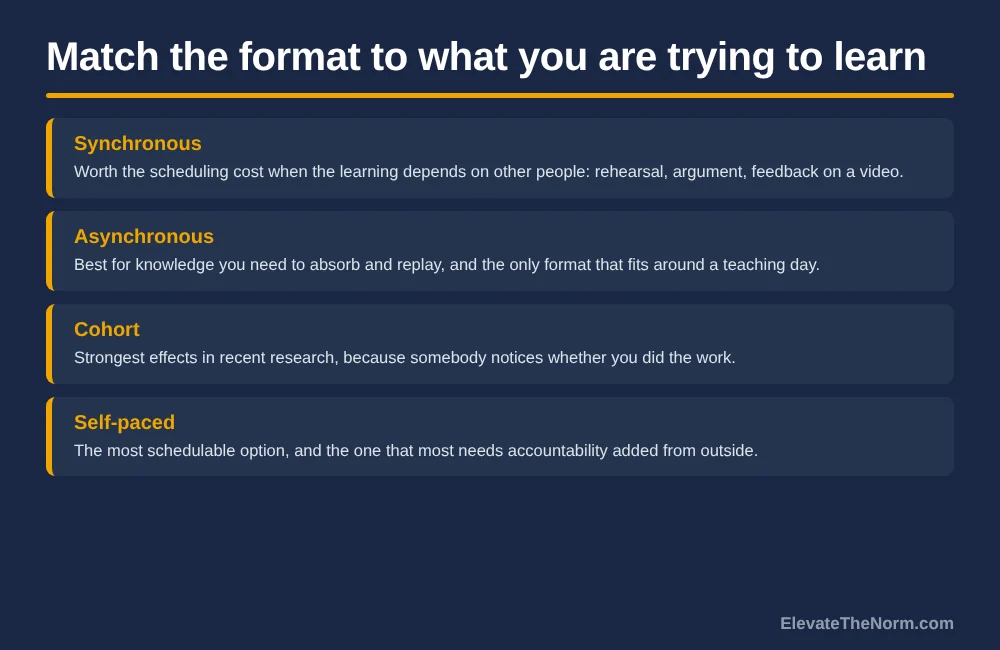
    Four-row graphic comparing synchronous, asynchronous, cohort and self-paced online professional development formats and what each is best suited to.
    The format question is really a question about what you need from other people.

    Synchronous or asynchronous: which should you pick?

    Synchronous for anything requiring rehearsal, discussion or discomfort. Asynchronous for anything requiring knowledge, reading or repetition.

    Synchronous sessions earn their scheduling cost when the learning depends on other people being there: role-playing a conversation with a family, arguing about where a student’s reasoning broke down, watching somebody else’s lesson video and having to say something about it. You cannot get that from a recording, because the thing being learned is the exchange.

    Asynchronous works well for the parts you need to absorb rather than negotiate: subject content you do not know well enough, a research base, a worked example you need to pause and rewind. It is also the only format that respects the fact that teachers are not free between 8:00 and 3:30.

    The mixed version is usually the best buy: asynchronous content, synchronous practice. If a course is entirely synchronous, you are paying for scheduling you may not be able to keep. If it is entirely asynchronous with no live component at all, assume you will have to manufacture the discussion yourself.

    Self-paced or cohort?

    Cohort, if the option exists and the schedule is survivable. This is the one place the recent evidence points somewhere fairly clearly.

    The 2025 meta-analysis found the strongest effects where teachers participated together and at the same time, and the authors concluded that effective online training “requires time and space for collaborative activities.” That lines up with what we know from outside the online literature: Matthew Kraft, David Blazar and Dylan Hogan’s meta-analysis of 60 causal studies found teacher coaching produced effects of 0.49 standard deviations on instruction and 0.18 on student achievement, with effects shrinking as programs scaled (Kraft, Blazar & Hogan, 2018). What coaching and cohorts share is a person who notices.

    Self-paced has one genuine advantage worth naming: it is the only format that fits around a teaching schedule without negotiation. If a cohort meets Tuesdays at 4:15 and you coach, tutor or have your own kids at 4:15, the cohort is not a better option for you. It is a better option in general. Pick self-paced and then build in the accountability the format left out.

    What are the completion rates for online courses?

    Low, and the format is a large part of why. Katy Jordan’s 2015 analysis in the International Review of Research in Open and Distributed Learning collected enrollment and completion data for 221 massive open online courses and found completion rates ranging from 0.7 percent to 52.1 percent, with a median of 12.6 percent. Longer courses had lower completion. The first and second weeks were decisive for engagement (Jordan, 2015).

    Name the population before you use that number: those are open MOOCs with general audiences, mostly free, with no employer attached. A paid, facilitated PD course with a district behind it is a different animal, and you should not expect 12 percent.

    Teachers do look better than average in that world. An analysis of four years of open online courses run by two large research universities on the edX platform — 290 courses, 4.5 million participants, 245,000 certificates — was reported by Education Week to show that 32 percent of participants said they work or had worked as teachers, and that 16 percent of teachers earned a certificate, twice the rate of the average participant (Education Week on Chuang & Ho, 2017). The underlying report is Chuang and Ho’s Year 4 report. Twice a bad rate is still 16 percent.

    Here is the part I would actually act on. If the first two weeks decide it, then the first two weeks are where you should put your effort, not the middle. Clear the first two modules fast, even sloppily, and your odds change.
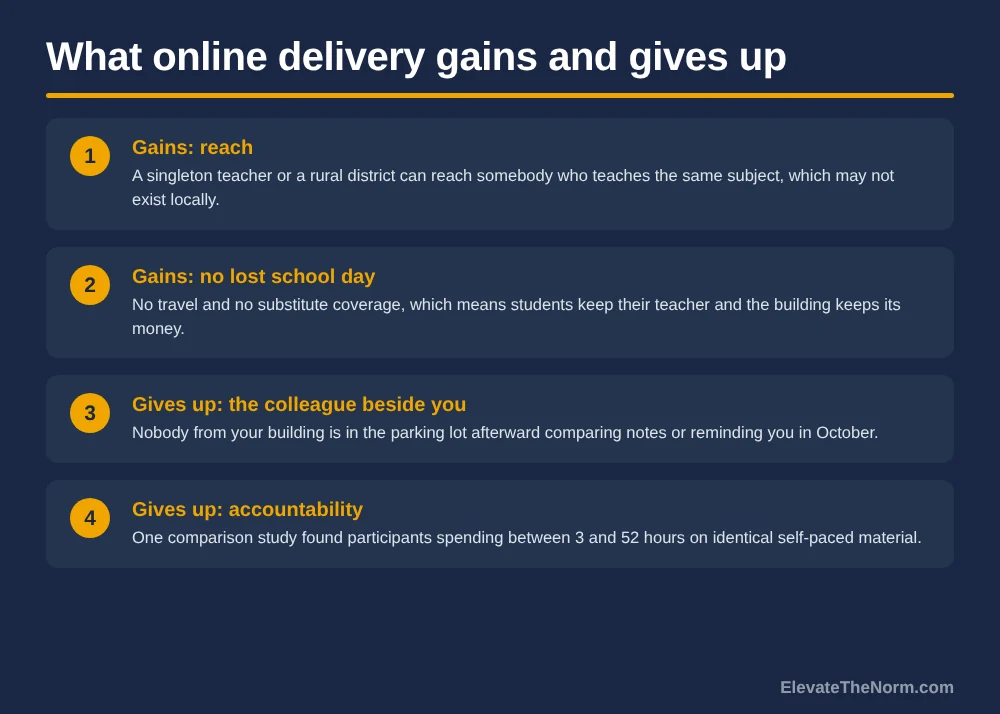
    Four cards contrasting the advantages of online teacher professional development, including reach and no lost school days, against its losses in collegial support and accountability.
    Online PD trades proximity for access. Both sides of that are real.

    What does online PD do better than a workshop?

    Access, mostly, and that is not a small thing — it is an equity issue.

    Consider who actually benefits. The only chemistry teacher in a small high school has no department to collaborate with and no local workshop aimed at her. A teacher in a rural district may be a three-hour drive from the nearest content-specific institute, with no substitute available to cover the day. A teacher in a small school system has whatever the system can afford to bring in, which may be one consultant for all content areas. Online delivery is frequently the only way those teachers reach somebody who teaches what they teach.

    Other real advantages:

    • Replay. You can rewatch the part you did not follow. In a workshop, the moment is gone.
    • No travel or sub coverage. Which means no lost instructional day for your students, and no cost to the building.
    • Scheduling around a teaching day. Asynchronous content can be done at 5:30 in the morning, which is when some of us are actually sharp.
    • Materials that stay. Transcripts, slides and readings remain available when you teach the unit again in February.
    • Reach across districts. A cohort drawn from eight states will challenge your assumptions more than one drawn from your own faculty.

    For a small school running vertical teams or shared preps, online PD can be the thing that lets two teachers who share one subject work with somebody outside the building. The research on collective teacher efficacy is worth reading alongside this, because the mechanism is similar: the belief that your group can move outcomes is itself associated with results, and a cohort can supply that when a building cannot.

    What does online PD do worse?

    It strips out the two things that most reliably turn a course into changed practice: a colleague beside you and somebody who notices if you quit.

    In a workshop, the person next to you is likely to teach in your building. You compare notes in the parking lot, you remind each other, and in October somebody asks whether you ever used that thing. Online cohorts can replicate some of that, but it takes deliberate design — small groups, assigned partners, scheduled check-ins — and most courses do not bother.

    The accountability gap is worse. Nobody takes attendance in your living room. The Fishman comparison found online participants spending between 3 and 52 hours on identical material, which tells you how wide the effort range is when the clock is yours. And because completion is self-certified in many courses, it is easy to finish without implementing anything.

    Two smaller losses worth naming. First, online PD rarely includes observation of your actual teaching, which is the part of coaching that does the work. Second, screen-based sessions make it easy to multitask, and a session you half-attend while entering grades is a session you did not take.

    How do you make an asynchronous course actually stick?

    This is the practical core of the article. Treat an asynchronous course like a unit you are teaching yourself: it needs a calendar, an audience and a product.

    WhenWhat you doWhy it matters
    Before you startWrite one sentence: “By [date] I will have [artifact] ready for [class period].”Gives the course a product. Without one, completion becomes the goal and nothing reaches students.
    Before you startRecruit one person — a colleague, a department partner, a teacher friend in another district — and tell them your deadline.Replaces the accountability the format removed. One person who will ask is enough.
    Week 1Block two fixed hours on your calendar and finish modules 1 and 2, even roughly.Jordan’s MOOC analysis found the first two weeks decide engagement. Front-load deliberately.
    Each moduleKeep a two-column log: left, what the module claims; right, what it would mean in your room.Forces translation. Notes that only restate the video produce nothing on Monday.
    Mid-courseTry one small thing with one class and write down what happened in three sentences.Implementation during the course, not after it. After the course, the energy is gone.
    Mid-courseSend your partner the artifact in progress and ask one specific question about it.Creates the feedback the course did not provide.
    Final weekFinish the artifact and schedule the class period you will use it in.A date on a calendar is the difference between a plan and a folder.
    Six weeks afterLook at student work from that lesson and decide: keep, fix or drop.This is the only honest evaluation of whether the course was worth it.

    None of that requires the course to cooperate. It is all on your side of the screen, which is the point: the format’s weaknesses are the ones you can personally patch.
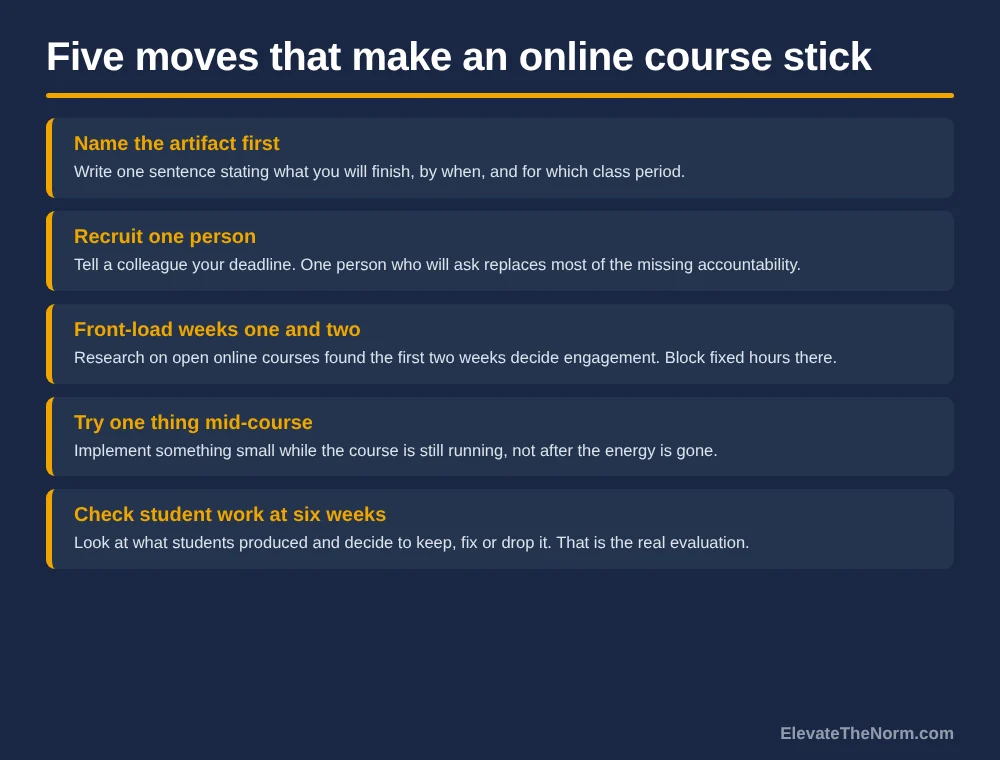
    Five-row graphic listing steps for completing and applying an asynchronous online professional development course, from naming an artifact to reviewing student work after six weeks.
    Every one of these is on your side of the screen, which is why they work.

    What should you ask before enrolling in an online course?

    1. “Is this facilitated by a person, or is it a recorded library?”
    2. “Are there live sessions, and what times are they held?” — then check that against your actual week, including anything you coach or sponsor.
    3. “Is there a cohort, and how large are the working groups?”
    4. “What do I submit, and who reads it?”
    5. “How long do I keep access to the materials after the course ends?”
    6. “What is the completion rate, and what counts as completion?”
    7. “Does this include any look at my actual teaching — video, lesson artifacts, student work?”
    8. “Which states have confirmed these hours for renewal, and who do I contact to verify?”

    Question five matters more online than in person. Materials you can still reach in February, when you finally teach that unit, are worth considerably more than materials that vanish at the end of the term. Question eight you verify yourself with your state licensing office, not with the provider.

    Is online PD worth it for a teacher paying out of pocket?

    Sometimes, and the deciding factor is usually whether anyone on the other end will respond to your work. That is my opinion, and I will label it as such rather than dress it as a finding.

    The reasoning is simple. Recorded content is abundant and much of it is free. What is scarce — and therefore what is actually worth money — is a person who will look at your unit, your assessment or your student work and tell you something true about it. If a paid online course does not include that, you are paying for curation and convenience. Those have value. They just do not have much value, and you should not pay a lot for them.

    Before you spend anything, work through the criteria for judging whether any PD course is worth your time and money, which applies the same scoring to online and in-person options. And check the genuinely free offerings and what free actually costs first, because a surprising amount of serious content-focused material from federal agencies and museums is online, free and better than things people pay for.

    Where online professional development for teachers actually fits

    Use online PD for access to content and people you cannot otherwise reach, and build the accountability it leaves out before you start. That is the whole recommendation.

    Concretely: pick a cohort over self-paced when the schedule allows, front-load the first two weeks, name an artifact and a class period, and recruit one person who will ask you about it in six weeks. If you do those four things, the delivery format mostly stops mattering, which is what the comparison studies have been saying for over a decade.

    Do not let anyone tell you the evidence here is settled in either direction. It is not. After seven years of classroom experience I am comfortable saying the format is far less important than whether somebody is waiting for your work — and that if a course has nobody waiting, you should plan to be that person yourself.

    Sources

    1. Morina, F., Fütterer, T., Hübner, N., Zitzmann, S., & Fischer, C., “Effects of online teacher professional development on teacher-, classroom-, and student-level outcomes: A meta-analysis,” Computers & Education, 228 (2025), 105247. Source of the finding that online PD shows positive effects on teachers and students, larger for teachers, with the strongest effects where teachers participated together and simultaneously. Caveat: the paper is paywalled; the figures and quotations here come from an institutional summary published by the authors’ research network, which is a summary rather than the study. https://uni-tuebingen.de/en/research/core-research/lead-graduate-school-research-network/newsfullview/article/enable-online-training-for-teachers-it-works
    2. Webb, D. C., Nickerson, H., & Bush, J. B., “A Comparative Analysis of Online and Face-to-Face Professional Development Models for CS Education,” SIGCSE ’17, March 2017. Source of the 75-teacher, 4,832-student comparison finding no negative student outcomes from online or blended PD. Caveat: computer science PD specifically, with a much smaller online sample (479 student respondents) than face-to-face (4,353). https://par.nsf.gov/servlets/purl/10095644
    3. Heitin, L., “Benefits of Online, Face-to-Face Professional Development Similar, Study Finds,” Education Week, June 2013. Reporting on Barry Fishman and colleagues’ comparison of 48 hours of face-to-face workshops against self-paced online coursework for a high school environmental science curriculum, including the 3-to-52-hour range of online time. Caveat: this is press coverage of the study, not the Journal of Teacher Education paper itself. https://www.edweek.org/teaching-learning/benefits-of-online-face-to-face-professional-development-similar-study-finds/2013/06
    4. Jordan, K., “Massive open online course completion rates revisited: Assessment, length and attrition,” International Review of Research in Open and Distributed Learning, 16(3), 2015. Source of the 221-course sample, the 0.7 to 52.1 percent range, the 12.6 percent median and the finding that weeks one and two are decisive. Caveat: open MOOCs with general-public audiences, not teacher PD courses with employers attached. https://www.irrodl.org/index.php/irrodl/article/view/2112/0
    5. Chuang, I., & Ho, A., Four Years of Open Online Courses, Fall 2012-Summer 2016 (institutional report on edX courses), December 2016. Source of the scale figures: 290 courses, 4.5 million participants, 245,000 certificates. The teacher-specific figures (32 percent of participants, 16 percent certificate rate) are as reported by Education Week in January 2017. https://papers.ssrn.com/sol3/papers.cfm?abstract_id=2889436
    6. Kraft, M. A., Blazar, D., & Hogan, D., “The Effect of Teacher Coaching on Instruction and Achievement: A Meta-Analysis of the Causal Evidence,” Review of Educational Research, 2018. Supports the claim that a responsive expert is the active ingredient, with 0.49 SD on instruction and 0.18 SD on achievement across 60 causal studies. Caveat: effects from large-scale programs are a fraction of those from small efficacy trials. https://annenberg.brown.edu/publications/effect-teacher-coaching-instruction-and-achievement-meta-analysis-causal-evidence
    7. Yoon, K. S., Duncan, T., Lee, S. W.-Y., Scarloss, B., & Shapley, K. L., Reviewing the Evidence on How Teacher Professional Development Affects Student Achievement, REL Southwest, October 2007. Supports the duration floor referenced here: studies offering 5-14 total hours showed no statistically significant effects. Caveat: only nine of more than 1,300 studies met the evidence standards, and all nine were conducted with elementary teachers. https://files.eric.ed.gov/fulltext/ED498548.pdf

    Frequently Asked Questions

    Is online PD taken less seriously than in-person training?

    By some administrators, yes, though that is changing. What matters for renewal is whether your state recognizes the provider and the hours, which has nothing to do with delivery format in most states. If you are worried about how it will be perceived, the fix is to bring back something visible: a unit you redesigned, student work from a lesson you built in the course, or a short share-out at a department meeting. Perception follows evidence of use.

    Can online PD really work for subjects that depend on hands-on practice?

    Partly. The comparison studies that found equivalent outcomes used online conditions that included facilitator contact and, in at least one case, physical materials shipped to participants. A recorded video library will not teach you to run a lab or a shop safely. If the practice is physical, look for a hybrid: online content for the knowledge and a live or local component for the hands-on part. Be suspicious of any course that claims the physical piece is unnecessary.

    How much time should I expect an online course to take?

    More than the advertised hours, and the spread is wide. In one comparison study, participants working through identical self-paced material spent anywhere from 3 to 52 hours on it. Plan for the advertised contact hours plus implementation time, which is usually where the real cost sits. If a course claims a fixed small number with no implementation work attached, it is probably measuring seat time only, and seat time is not the part that changes your teaching.

    What if the live sessions conflict with coaching, tutoring or my own kids?

    Then pick the self-paced version and build the accountability back in deliberately. Cohorts show the strongest effects in the research, but a cohort you cannot attend is worse than self-paced work you actually finish. Replace the missing piece with one named person who knows your deadline and will ask about your artifact, plus a fixed two-hour block on your own calendar in week one. That costs nothing and addresses the format’s real weakness.

    Does the low completion rate for online courses mean they do not work?

    No, it means finishing is the hard part. The 12.6 percent median figure comes from open MOOCs with general public audiences and no employer attached, which is a very different setting from a paid or district-sponsored PD course. What transfers from that research is the timing finding: the first two weeks decide engagement. If you clear the opening modules quickly, you are in a different group than the one that produces those averages.

    Is online PD a way for districts to save money on teacher learning?

    It can be, and that is a fair thing to watch for. Online delivery removes travel, substitute coverage and lost instructional days, which are real savings and real benefits to students. The risk is that savings become the point and the expensive parts get cut first, which means coaching, feedback and follow-up. If a district moves PD online, the question worth asking is whether anyone is still paid to respond to teachers’ work. That is the part that carries the evidence.

    Will an online course give me anything I can show students?

    It should, and that is a reasonable test of whether it was worth taking. Students do not experience your course, they experience what came out of it: a clearer assignment, a better rubric, a project with a real audience, feedback that arrives faster. If you cannot point at something in your classroom six weeks after the course ends, the course gave you material rather than practice. Name the artifact before you start to avoid that outcome.

    Are free online courses worse than paid ones?

    Not reliably. A good deal of serious, content-specific material from federal agencies and museums is online at no cost, and some of it is better than commercial courses. What money usually buys is a person who responds to your work, extended access to materials, and documented hours for renewal. If a paid course offers none of those three things, price is not telling you anything about quality, and the free option is the better bet.

    About Clay Shumate

    Clay Shumate is a certified secondary Social Studies teacher in the public schools of West Alabama, with seven years of classroom experience, a B.A. in History, and an M.Ed. in Secondary Education. He writes about project-based learning, student responsibility, respect, and practical ways to hold young people to a higher standard while giving them room to learn from mistakes. He is a member of the Society of Professional Journalists and writes to its Code of Ethics; this site’s editorial standards and corrections policy are published in full. More about Clay.

  • Classroom Management Styles: Find Your Default and What It Costs You

    Classroom Management Styles: Find Your Default and What It Costs You

    By Clay Shumate

    Classroom management styles are usually sorted into four types — authoritative, authoritarian, permissive, and indulgent or uninvolved — by crossing how much structure a teacher demands with how much warmth a teacher offers. The framework is borrowed from parenting research, and the high-structure, high-warmth style has the best support.

    I find this taxonomy genuinely useful and I want to be straight with you about what it is. It is a heuristic that came out of developmental psychology about parents, got carried into teacher education, and is now repeated in professional development as though someone measured it in classrooms. Mostly, nobody did. That does not make it worthless. It makes it a map rather than a measurement, and a map is still worth having if you know what it is.

    Key Takeaways

    • The four styles come from crossing two dimensions, not from four separate discoveries: how demanding you are and how responsive you are.
    • The framework is borrowed, not homegrown. It originates in research on parents, and the attempts to measure it on teachers have been small.
    • Authoritative — high structure, high warmth — has the strongest support, and the evidence for each half of it is better than the evidence for the typology itself.
    • Your style is a default under pressure, not a personality. What you do in week three when you are tired is your real style.
    • Two of the four styles fail the same way. Permissive and authoritarian rooms both end up unpredictable, just for opposite reasons.

    What are the four classroom management styles?

    They are four combinations of two things: how much you require and how much you respond. That is the whole framework, and once you see it as a grid rather than a list of four personalities, it gets much more useful.

    • Authoritative. High demands, high responsiveness. Clear non-negotiable expectations, explained reasoning, visible care, consequences that arrive as promised.
    • Authoritarian. High demands, low responsiveness. Rules without reasons, compliance as the goal, correction without relationship.
    • Permissive. Low demands, high responsiveness. Warm, liked, negotiable — and the floor moves depending on who is asking.
    • Indulgent or uninvolved. Low demands, low responsiveness. Work assigned, grades entered, nothing much required and nothing much offered.

    A note on vocabulary, because it trips people up. Different sources use “permissive” and “indulgent” as synonyms, and some use “uninvolved” or “neglectful” for the low-low cell. The names drift. The two dimensions do not, so when a PD slide confuses you, go back to the grid.

    Where the classroom management styles framework actually comes from

    It comes from Diana Baumrind’s research on parents, extended into a two-by-two grid by other researchers, and only later applied to teachers. Nobody set out to build a theory of classroom management.

    Baumrind’s longitudinal work followed children at ages 4, 9 and 15 and found that “authoritative parents who are highly demanding and highly responsive were remarkably successful in protecting their adolescents from problem drug use, and in generating competence” — while also noting that authoritative parenting was not the only route to a competent adolescent (Baumrind, 1991). That sample was 139 adolescents from an affluent, well-educated, predominantly white population. It is a real finding on a narrow group of families.

    The familiar four-cell version came later. As Nancy Darling’s summary of the literature puts it, “categorizing parents according to whether they are high or low on parental demandingness and responsiveness creates a typology of four parenting styles: indulgent, authoritarian, authoritative, and uninvolved,” a dimensional move credited to Maccoby and Martin in 1983 (Darling, “Parenting Style and Its Correlates”). So the four styles you have seen on a laminated handout are a grid built on top of a three-category typology about families, two steps removed from any classroom.

    Four rows naming the four classroom management styles with the level of structure and warmth each one combines.
    Four cells, two dimensions — not four separate theories.

    Is the parenting-to-teaching mapping measured, or just useful?

    Mostly useful. The direct attempts to measure it on teachers are small enough that you should treat the typology as a thinking tool and not as a finding.

    The clearest explicit attempt I can point you to applied demandingness and responsiveness to teaching practice and student engagement — and it studied three fifth-grade mathematics teachers and 45 of their students (Walker, 2008). Three teachers. Fifth grade. That is a thoughtful, honest study and it is not a basis for telling a high school teacher what their style does.

    So why keep the framework? Because the two dimensions have far better evidence than the four boxes do, and the boxes are a convenient way to talk about the dimensions. That is the position I would defend. Use the labels to locate yourself; use the dimensions to decide what to change.

    The two dimensions that actually matter

    Structure and warmth are each independently supported in classroom research, which is the real reason the authoritative cell wins.

    On the structure side, the review that screened classroom practices for genuine empirical support organized them into maximizing structure and predictability; posting, teaching, reviewing, monitoring and reinforcing expectations; actively engaging students; acknowledging appropriate behavior; and responding to inappropriate behavior along a continuum (Simonsen, Fairbanks, Briesch, Myers & Sugai, 2008). That is the demandingness axis, with practices attached.

    On the warmth side, a meta-analysis of 99 studies on teacher–student relationships found medium-to-large associations with student engagement and small-to-medium associations with achievement, and reported stronger effects in the higher grades (Roorda, Koomen, Spilt & Oort, 2011). Those are correlations, and students who are easier to teach are easier to like, which could generate some of the pattern on its own. Still, if you teach grades 6–12, the warmth axis is doing more work for you than it would in a second-grade room, not less.

    And warmth has a behavioral measure, not just a feeling. In 28 middle school classrooms, higher praise-to-reprimand ratios tracked linearly with better class-wide on-task behavior, and with more engagement, less disruption and better grades among students at risk for emotional and behavioral disorders (Caldarella, Larsen, Williams & Wills, 2023). Responsiveness is countable. That is how you know whether you have it.

    A self-diagnostic for your classroom management style

    Answer these about what you actually did last week, not about what you believe. Score each row 0, 1 or 2. Add the structure rows and the warmth rows separately, then find your cell.

    AxisStatement0 — rarely1 — sometimes2 — nearly always
    StructureA student who arrives late knows exactly what happens next without asking me.
    StructureI did this week what I said last week I would do, including the part I did not enjoy.
    StructureMy transitions have a procedure that students could run if I lost my voice.
    StructureThe same behavior gets the same response from me regardless of which student it was.
    StructureMy deadlines and my late-work rule held this week with no exceptions I did not announce in advance.
    WarmthI spoke to every student by name this week about something that was not their behavior or their grade.
    WarmthI explained the reason behind a rule when a student asked, instead of citing the rule.
    WarmthI acknowledged more often than I corrected, and I know that because I counted.
    WarmthA student who was struggling got a private conversation rather than a public one.
    WarmthI changed something this month because a student told me it was not working.

    Reading your score. Structure 7–10 and warmth 7–10 puts you in the authoritative cell. Structure 7–10 and warmth 0–6 is the authoritarian corner. Structure 0–6 and warmth 7–10 is permissive. Low on both is the uninvolved cell, and if you landed there and you are still reading, you are probably exhausted rather than indifferent — those look identical from the hallway and they are not the same problem.

    This is not a validated instrument and I am not pretending it is one. It is ten honest questions. Its only real virtue is that every item asks about an observable action from the past week, which is harder to flatter yourself about than “I have high expectations.” Run it again in six weeks. Our material on structured teacher reflection has a longer process if you want one.

    Five cards each posing a question a secondary teacher can answer about last week to identify their default management style.
    Ask about last week’s actions, not about your intentions.

    Authoritarian: high structure, low warmth

    The authoritarian room usually works in September and starts leaking in November. Compliance built entirely on your presence requires your presence, and you cannot be everywhere.

    The cost is specific. Students follow rules they do not understand only while they are being watched, so you spend the year watching. You also lose your best information source: a student who is afraid of you does not tell you when something is wrong, which means you find out about problems late. And the room runs on a fuel that depletes — your own vigilance.

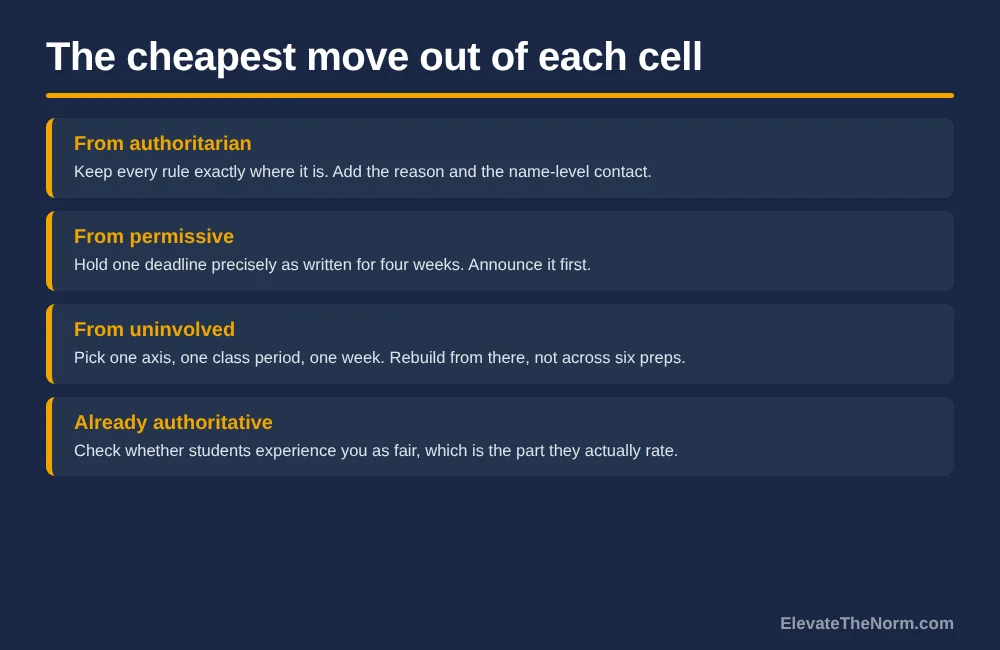
    The fix is not loosening the structure. That is the mistake teachers make when they are told they are too strict. The fix is adding the reason and the relationship while the structure stays exactly where it is. That is the one-cell move, and it is the easiest of the four to make.

    Permissive: high warmth, low structure

    The permissive room feels good and quietly becomes unfair. It is the style I have the most sympathy for and the one I think costs students the most.

    Here is the mechanism. When the floor is negotiable, the students who get the extensions, the second chances and the benefit of the doubt are the students who are comfortable asking. The confident, the articulate, the ones whose parents taught them to advocate. The quiet student who also needed the extension does not get it, because she did not know she was allowed to ask. A permissive room distributes mercy by social skill. That is not kindness. A predictable floor is the more generous system even when it feels harsher, and it is the heart of what we argue in holding a standard without becoming a hardliner.

    The other cost is that warmth without structure is not actually experienced as respect. Teenagers read a teacher who requires nothing as a teacher who expects nothing of them, and they are not wrong to read it that way.

    Indulgent and uninvolved: the low-low cell

    Almost nobody chooses this cell, and plenty of good teachers end up in it temporarily. It is usually a symptom of being overwhelmed, not a philosophy.

    Four preps, a coaching duty, a hard roster, something going wrong at home: structure and warmth are both effortful, and when you are depleted you stop producing both. I would rather name that honestly than moralize about it. If a self-diagnostic put you here, the move is not to fix your style. It is to pick one axis, one class period, and one week, and rebuild from there. Trying to become authoritative across six periods on a Monday is how people quit.

    Four rows describing the single lowest-cost change a teacher can make from each of the four management style positions.
    One behavior, four weeks — not a new philosophy.

    Authoritative: high structure, high warmth

    This is the cell with the best support, and the mechanism is not warmth plus rules — it is that the warmth makes the structure believable and the structure makes the warmth credible.

    A student in an authoritative room knows two things at once: that you mean what you say, and that you are on their side. Those are not in tension. They reinforce each other. Expectations explained are expectations more likely to be internalized, which is also what the motivation literature predicts: in a meta-analysis of 144 studies and just over 79,000 participants with a mean age of 16.5, teacher autonomy support correlated .48 with intrinsic motivation and −.32 with amotivation, and students’ sense of competence (ρ = .58) and autonomy (ρ = .57) were the strongest predictors of self-determined motivation (Bureau, Howard, Chong & Guay, 2021). Autonomy support is not the absence of demands. It is demands with reasons, and some real choice inside them — which is the argument for giving students genuine choices inside a structure you set.

    One honest caveat. Baumrind herself noted that authoritative parenting was not the only path to competence, and the same is almost certainly true in classrooms. I have watched teachers who would score as authoritarian on any instrument run rooms students cared about, because the students were certain the teacher was fair. Fairness may be doing more of the work in this framework than warmth is.

    Can you change your classroom management style mid-year?

    You can add structure to a permissive room in about two weeks. Adding warmth to an authoritarian one takes a grading period, and it requires you to say out loud that you are changing.

    The asymmetry is worth knowing. Tightening up is a policy announcement: here is the new procedure, here is when it starts, here is what happens. Students adjust fast because the change is legible. Warming up is harder because every individual kind act gets read against the record. A student who has spent nine weeks being corrected does not trust a compliment in week ten. Tell the class plainly that you got something wrong and what you are changing, and then be boringly consistent about it for six weeks. That is the whole method. Our piece on what respect actually looks like in practice covers the day-to-day version.

    What your style looks like from a student desk

    Students do not perceive your style as warmth and structure. They perceive it as one question: is this teacher predictable and is this teacher fair?

    That reframing has done more for me than the taxonomy has. A student does not care where you sit on a grid. She cares whether the consequence she got on Tuesday is the consequence the loud kid gets on Thursday, and whether you did the thing you said you would do. Every style in the framework can be perceived as unfair, including the authoritative one, if your word and your actions come apart. The shortest route from any cell to a room that works is to do exactly what you said you would do, every time — a point we make at length in the companion piece on control, consistency and what students are actually reading.

    Using classroom management styles without turning them into a personality test

    Treat the classroom management styles grid as a diagnostic you run on your own behavior, not a label you wear. You are not an authoritarian teacher. You are a teacher who defaulted to low responsiveness in third period on Thursday when you were tired, and that is a fixable fact rather than an identity.

    So do this. Run the ten questions. Find your weaker axis. Pick one behavior on that axis — one — and do it for four weeks. If structure is weak, the highest-value item is holding one deadline exactly as written. If warmth is weak, the highest-value item is speaking to every student by name about something other than their work. Then run the questions again and see whether anything moved. For the concrete practices to build on either axis, our list of classroom management strategies ranked by payback is the practical companion to this article, and the piece on writing expectations that hold is where the structure axis starts.

    Sources

    1. Baumrind, D. “The Influence of Parenting Style on Adolescent Competence and Substance Use.” The Journal of Early Adolescence, vol. 11, no. 1, 1991, pp. 56–95. Supports the origin of the authoritative category as high demandingness plus high responsiveness, and the finding that it was not the only route to adolescent competence. Caveat: 139 adolescents from an affluent, well-educated, predominantly white sample of families — a parenting study, not a classroom study. https://journals.sagepub.com/doi/10.1177/0272431691111004
    2. Darling, N. “Parenting Style and Its Correlates.” At Health, LLC, 23 October 2013. Supports the two-dimension grid and the attribution of the four-category typology to Maccoby and Martin (1983). Caveat: this is an authoritative literature summary rather than a primary study, and it is cited here as a summary. https://athealth.com/topics/parenting-style-and-its-correlates-2/
    3. Walker, J. M. T. “Looking at Teacher Practices Through the Lens of Parenting Style.” The Journal of Experimental Education, vol. 76, no. 2, 2008, pp. 218–240. Supports the claim that the parenting-style dimensions have been applied directly to teaching practice and student engagement. Caveat: the study involved three fifth-grade mathematics teachers and 45 students, which is far too small and too young to generalize to grades 6–12; linked via the ERIC record. https://eric.ed.gov/?q=%22Looking+at+Teacher+Practices+Through+the+Lens+of+Parenting+Style%22
    4. Roorda, D. L., Koomen, H. M. Y., Spilt, J. L., & Oort, F. J. “The Influence of Affective Teacher–Student Relationships on Students’ School Engagement and Achievement: A Meta-Analytic Approach.” Review of Educational Research, vol. 81, 2011, pp. 493–529. Supports the warmth dimension and the report of stronger effects in higher grades. Caveat: correlational; students who are easier to teach are easier to have positive relationships with, which could produce part of the association. https://research.vu.nl/en/publications/the-influence-of-affective-teacher-student-relationships-on-stude/
    5. Simonsen, B., Fairbanks, S., Briesch, A., Myers, D., & Sugai, G. “Evidence-Based Practices in Classroom Management: Considerations for Research to Practice.” Education and Treatment of Children, vol. 31, 2008, pp. 351–380. Supports the structure dimension and the five categories of evidence-based classroom practice. Caveat: linked as a full-text reproduction hosted by a university project rather than the journal of record. https://k12engagement.unl.edu/sites/unl.edu.cehs.special-ed-communic-disorders.student-engagement-project/files/media/file/Classroom%20Management%206-8-16.pdf
    6. Caldarella, P., Larsen, R. A. A., Williams, L., & Wills, H. P. “Effects of Middle School Teachers’ Praise-to-Reprimand Ratios on Students’ Classroom Behavior.” Journal of Positive Behavior Interventions, vol. 25, no. 1, 2023, pp. 28–40. Supports treating responsiveness as a countable behavior rather than a disposition. Caveat: 28 middle school classrooms; high school was not studied. https://journals.sagepub.com/doi/10.1177/10983007211035185
    7. Bureau, J. S., Howard, J. L., Chong, J. X. Y., & Guay, F. “Pathways to Student Motivation: A Meta-Analysis of Antecedents of Autonomous and Controlled Motivations.” Review of Educational Research, vol. 91, no. 3, 2021. Supports the correlations for teacher autonomy support, competence and autonomy with self-determined motivation. Caveat: 144 studies and 79,079 participants with a mean age of 16.55, but the relationships are correlational and both sides are usually measured by student self-report. https://selfdeterminationtheory.org/wp-content/uploads/2021/09/2021_PathwaystoStudentMotiv_BureaHowardEtal.pdf

    Frequently Asked Questions

    Can a teacher have more than one classroom management style?

    Most of us have several, sorted by class period and by how tired we are. That is normal and it is also the most useful thing the framework tells you. If you are authoritative in second period and authoritarian in sixth, the difference is almost never the students — it is your remaining energy and how the term has gone with that group. Track which periods pull you out of your intended style. The pattern usually points at a specific seam in the schedule rather than at a personality flaw.

    Is the authoritative style the same thing as being strict?

    No. Strictness is the structure axis only. Authoritative means high structure and high warmth at once: the deadline holds, and the student also knows you noticed they were struggling and why the deadline exists. A strict teacher with no warmth is in the authoritarian cell, which works while you are watching and leaks when you are not. The practical test is whether a student in trouble would come to you first or hide it from you. If they would hide it, you have structure without responsiveness.

    Is this framework fair to teachers in difficult schools with limited support?

    Only if it is used as a diagnostic rather than an evaluation, which is why I would push back hard on any observation rubric that scores teachers on a style label. Structure and warmth both cost energy, and a teacher with four preps, a duty and a hundred and sixty students has less of it than one with two preps. The low-low cell is usually a workload symptom. If a building has a lot of teachers landing there, that is a staffing and scheduling finding, not a teacher-quality finding.

    What should I do if my school’s discipline policy pushes me toward an authoritarian style?

    Follow the policy and change what the policy does not control, which is more than teachers assume. Mandated consequence ladders set what happens; they rarely set your tone, your explanation, whether you correct privately, or how often you acknowledge students. All of that is the warmth axis and it is yours. Where a policy genuinely requires something you think is harmful — public tracking, for example — document what you observe and raise it with your administrator as implementation feedback rather than declining to follow it.

    Does changing my style confuse students mid-year?

    Changing without announcing it does. Students notice inconsistency long before they notice improvement, so an unexplained shift reads as moodiness. Say it out loud: name what you are changing, when it starts, and why. Teenagers handle a teacher who admits a correction far better than most adults expect, and the admission buys you credibility you can spend later. Then be dull about it for six weeks, because a change you abandon in week three has cost you more trust than never changing at all.

    How does this apply to students with IEPs or behavior plans?

    An authoritative stance is compatible with individualized support and does not override it. High structure means the plan is followed precisely, not that every student receives identical treatment; a required accommodation is part of the structure, not an exception to it. Students and families sometimes read differentiation as favoritism, which is worth getting ahead of by explaining early that fair means everyone gets what they need to meet the same standard. If a plan conflicts with your usual response, the plan wins and the case manager hears about it.

    Will students respect me less if I explain my reasoning instead of just stating the rule?

    The opposite, in grades 6 to 12. Explaining a rule once is not negotiating it. The confusion comes from thinking reasons invite argument, when what actually invites argument is a rule that looks arbitrary. Give the reason, then hold the rule whether or not the student agrees with the reason. Students will accept a standard they think is pointless if they believe you are fair about applying it, and they will fight a standard they think is personal even when it is completely reasonable.

    How often should I re-check my style?

    Twice a semester is plenty, and the timing matters more than the frequency. Run it in the third or fourth week, once the honeymoon is over and before habits have set, then again a week or two after a long break, which is when structure quietly erodes. Checking it in the first week tells you about your intentions rather than your practice. Keep the scores somewhere you will find them, because the useful information is the direction of travel rather than any single number.

    About Clay Shumate

    Clay Shumate is a certified secondary Social Studies teacher in the public schools of West Alabama, with seven years of classroom experience, a B.A. in History, and an M.Ed. in Secondary Education. He writes about project-based learning, student responsibility, respect, and practical ways to hold young people to a higher standard while giving them room to learn from mistakes. He is a member of the Society of Professional Journalists and writes to its Code of Ethics; this site’s editorial standards and corrections policy are published in full. More about Clay.

  • Professional Development Courses for Teachers: How to Tell If One Is Worth Your Time

    Professional Development Courses for Teachers: How to Tell If One Is Worth Your Time

    By Clay Shumate

    Professional development courses for teachers are usually judged by what they hand out: a certificate, a transcript line, a count of clock hours. Judge them instead by what they change. A course worth your time is focused on the subject you actually teach, long enough to let you practice, built around something you can carry into class, and recognized by whoever renews your license.

    Teachers get plenty of advice about which course to take and almost none about how to judge one. That gap matters, because the research on teacher learning is far less flattering than the brochures. Well-funded, well-attended, well-reviewed programs have repeatedly produced no measurable change in what teachers know or what students learn. What follows is the criteria, not the catalogue.

    Key Takeaways

    • The features that predict good PD are known, but the evidence behind them is softer than it is usually presented. Content focus, active learning, modeling, coaching, feedback and sustained duration show up across reviews — and the most careful critiques say those reviews were built on weak inference.
    • Hours are a floor, not a guarantee. Short one-off sessions almost never move student outcomes, but a rigorous federal trial delivered 77 hours of middle school math PD and measured no impact on teacher knowledge or student achievement.
    • Ask what happens after the last session. Follow-up coaching has the strongest causal evidence of any PD format, and its effects shrink sharply when programs scale.
    • Apply the Monday test. If you cannot name the artifact you will walk out with — a task, a rubric, a sequence, a set of questions — the course is selling a feeling.
    • Check credit before you pay, not after. Renewal rules are set by your state, and a course can be excellent and still count for nothing.
    • The honest trade-off: the best-evidenced PD is expensive in the one resource teachers have least of. Depth costs hours, and nobody is giving you those hours back.

    What makes professional development courses for teachers actually work?

    The most cited answer is a list of seven features: content focus, active learning, collaboration, models and modeling, coaching and expert support, feedback and reflection, and sustained duration. That list comes from a 2017 review by Linda Darling-Hammond, Maria Hyler and Madelyn Gardner at the Learning Policy Institute, which examined 35 studies of PD programs with positive, statistically significant effects on student achievement (report, p. 2).

    Read that sentence again, because the method is the catch. The review deliberately selected programs that had already worked, then described what they had in common. The authors are upfront that they “do not seek to draw conclusions about the efficacy of individual program components,” since real programs bundle several at once, and they note that six well-designed studies in their scan found no impact on student learning at all. So the seven features are a reasonable description of what effective programs look like. They are not proof that adding a feature will make your course effective.

    That distinction is not academic nitpicking. In 2021, Sam Sims and Harry Fletcher-Wood published a critical review in School Effectiveness and School Improvement arguing that the whole international consensus on PD characteristics — sustained, collaborative, subject-specific, expert-supported, practice-based — rests on reviews with “inappropriate inclusion criteria” that “depend on an invalid inference method,” and is therefore “likely to be inaccurate” (critical review, open access). Their point is not that collaboration is bad. It is that nobody has established these features are the active ingredients.

    So use the features as a screen, not a scorecard. A course that has all seven can still be a waste. A course that has three of them, aimed hard at a problem you actually have, can be the best thing you do this year.

    Why does so much teacher PD fail anyway?

    Because districts buy formats instead of outcomes, and almost nobody checks afterward. TNTP’s 2015 study The Mirage surveyed more than 10,000 teachers and 500 school leaders across three large districts and one mid-size charter network. It found those systems spent an average of nearly $18,000 per teacher per year on development, that teachers reported roughly 19 school days a year on it — about a tenth of the school year — and that nearly seven in ten teachers’ evaluation ratings stayed flat or declined over two to three years (executive summary).

    That report got hit hard, and the criticism is worth knowing. Heather Hill, an education researcher who studies teacher learning, reviewed it for the National Education Policy Center in September 2015 and argued the cost figure was inflated by rolling in salary bumps for advanced degrees, that teacher evaluation ratings are an unreliable outcome measure, and that the study examined PD formats rather than content or quality. She concluded the descriptive findings deserve attention but the analytic conclusions were “overly broad and not supported by the study’s methods” (NEPC review).

    Fair. But the more uncomfortable evidence comes from a randomized trial, not a survey. The Institute of Education Sciences funded a two-year study of a professional development program for seventh-grade math teachers focused on rational numbers. Treatment teachers received an average of 77 hours. After two years, the measured impact on total teacher knowledge was an effect size of 0.05 (p = 0.79), and the impact on student achievement in rational numbers was -0.01 (p = 0.94) (Garet et al., NCEE 2011-4024). Seventy-seven hours. Content-focused. Expert-delivered. Nothing.

    I take that study seriously because it is middle school, it is the subject, and it is the design that can actually tell you something. It does not prove PD cannot work. It proves that hitting the recommended features is not enough, and that anyone promising you results from a course should be asked how they know.

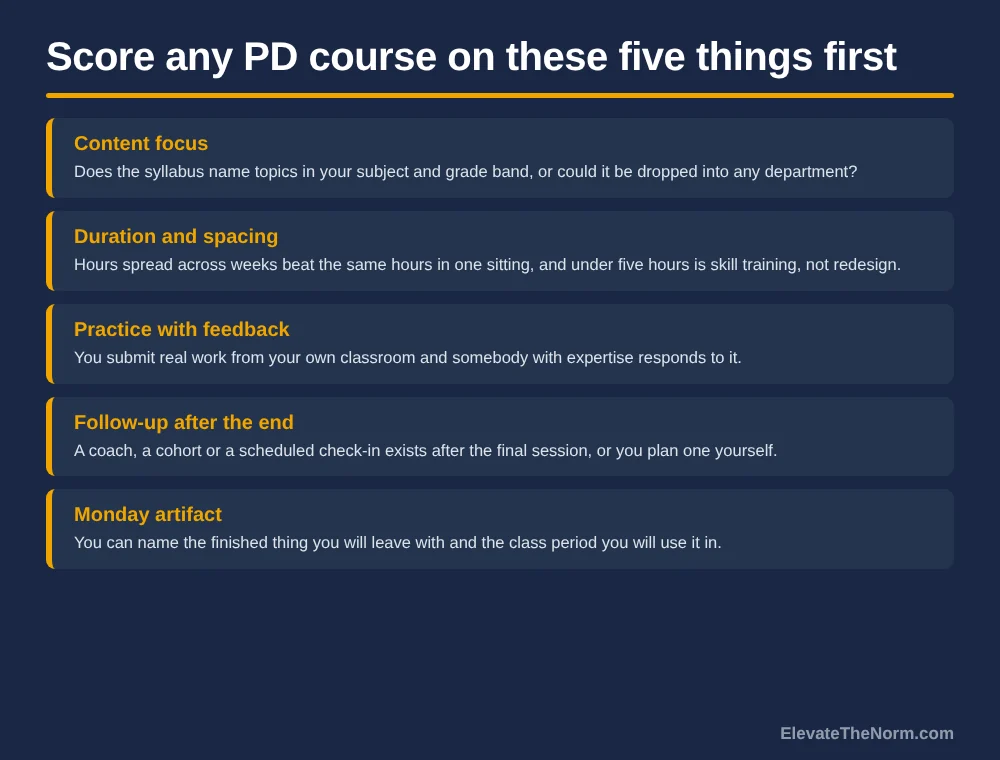
    Five-row graphic listing criteria for scoring a teacher professional development course: content focus, duration and spacing, practice with feedback, follow-up, and a usable artifact.
    The five rows that carry the most weight when scoring a course.

    Does course length matter?

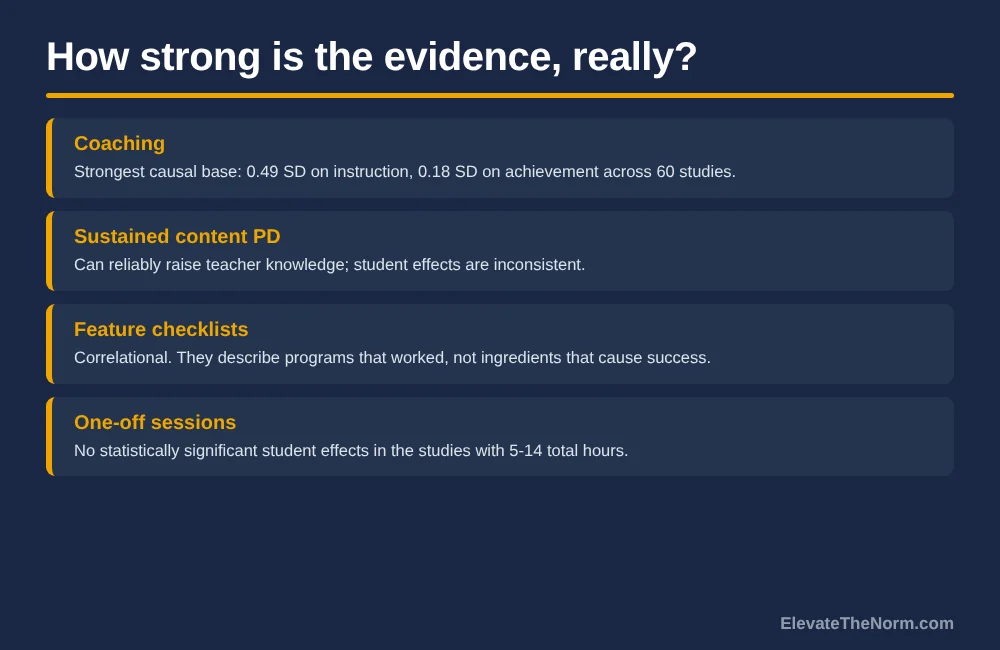
    Length is a floor you have to clear and nothing more. The most quoted number in this field comes from a 2007 review by Kwang Suk Yoon and colleagues for the Regional Educational Laboratory Southwest. They screened more than 1,300 studies; nine met What Works Clearinghouse evidence standards. Teachers in those nine received an average of 49 contact hours, ranging from 5 to 100. The three studies with the least PD — 5 to 14 hours total — showed no statistically significant effects (Yoon et al., 2007).

    Two caveats that rarely travel with that statistic. First, 12 of the 20 measured effects across those nine studies were not statistically significant, and the authors call their own findings “only a preliminary marker.” Second, and this matters a great deal on a grades 6-12 site: all nine studies were conducted with elementary school teachers. The 14-hour threshold you see quoted in secondary school PD catalogs was never measured on secondary teachers.

    Practically, treat it this way. A 90-minute webinar can legitimately teach you a technique. It will not change how you teach a unit. If a course is promising transformation in two hours, it is promising something no study in this literature has delivered.

    Is the course about your subject or about teaching in general?

    Content focus is the feature with the most consistent support, and it is the easiest one to check from the course description. A course on “student engagement” can be filled with anything. A course on how students misread primary sources, or where they get lost in proportional reasoning, or how to sequence a lab so the inquiry is real, has to commit to something.

    Here is a fast test. Open the syllabus and count how many of the session titles could be swapped into any subject without editing. If most of them could, you are buying generic pedagogy. Generic pedagogy is not worthless — a new teacher drowning in behavior needs it, and that is a different problem than needing better questions about the Dust Bowl. Just know which one you are buying. If you need the behavior side, our walkthrough of building a classroom management plan from scratch is free and will cost you an afternoon instead of a semester.

    Will you practice, or just listen?

    Active learning in a PD course means you produce something and get a response to it, not that the facilitator asked you to turn and talk. The distinction is whether your work is the object of instruction.

    Signals that the course involves real practice:

    • You bring your own unit, roster or assessment data into the sessions and leave with it changed.
    • Somebody with expertise reads your work and tells you what is wrong with it.
    • You watch a model — video, live, annotated transcript — of the practice being done well, not just described.
    • You rehearse the hard part before you do it with students.
    • There is an assignment between sessions that requires you to try it and report back.

    Signals that it is a lecture wearing a lanyard: breakout rooms with no product, a shared slide deck as the main artifact, a facilitator who has never seen your classroom and does not ask about it, and a final “reflection” that nobody reads.

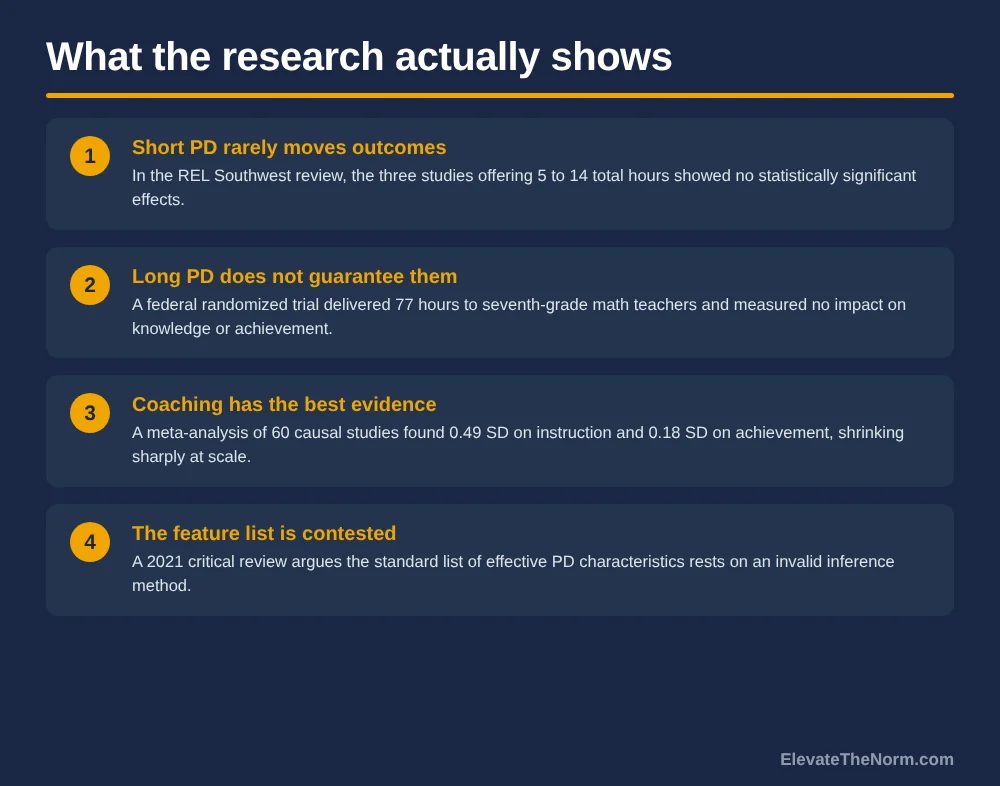
    Four cards summarizing research findings on teacher professional development, including null results from a federal randomized trial and effect sizes from a coaching meta-analysis.
    Four findings that complicate the usual pitch for teacher PD.

    What happens after the course ends?

    Follow-up is where the strongest causal evidence lives. Matthew Kraft, David Blazar and Dylan Hogan’s 2018 meta-analysis of 60 studies with causal designs found teacher coaching produced a pooled effect of 0.49 standard deviations on instruction and 0.18 on student achievement (Kraft, Blazar & Hogan, 2018).

    Those are good numbers by education research standards. But the authors also report that average effects from effectiveness trials of larger programs are only a fraction of those found in efficacy trials of small ones. Coaching works best when it is small, close and well-run, which is exactly the version a mass-market online course cannot sell you.

    So ask the blunt question: after the final session, does anything happen? Is there a cohort that still meets? A coach who will watch a lesson? A facilitator who will read a student work sample in November? If the honest answer is no, you are buying input only, and you will have to build the follow-up yourself. That is doable — a colleague who agrees to watch you teach one period and talk afterward is the cheapest coaching there is — but it only happens if you plan it before the course ends. A structured reflection habit is the minimum version.

    Can you use it on Monday?

    The Monday test: name the artifact you will walk out with and the class period you will use it in. If you cannot do both in one sentence, the course has not been designed for implementation.

    An artifact is concrete. A driving question you will actually launch. A rubric with your standards in it. A set of ten exit-ticket prompts for the unit you teach in February. A revised lab sequence. A conference protocol. An artifact survives the drive home. Inspiration does not.

    This is also the part of PD that most often fails on grounds of plain workload. A course that hands you a beautiful framework requiring twelve hours of redesign per unit has handed you a second job. When you evaluate a course, estimate the implementation cost, not just the seat time, and decide whether you are willing to pay it. If the answer is no, do not enroll and then feel guilty in July. Pick the smaller thing you will finish. Our writeup on formative assessment strategies that fit a normal class period exists because that is usually where the smaller thing lives.

    Does it count for anything your state recognizes?

    Check the credit question before you pay, because an excellent course can count for nothing. Nearly every state requires periodic license renewal tied to some form of continuing education, but the rules, the accepted providers, the hour-to-credit conversions and the documentation differ state by state. A 2018 New America report on relicensure found that most state systems are built around credit accumulation rather than demonstrated growth, so that “whether a teacher grows considerably while fulfilling her state’s renewal requirements or does not improve at all is of no consequence” as long as the credits clear (Rethinking Relicensure).

    That cuts both ways, and you should be honest with yourself about which way you are using it. Sometimes you need hours and you need them cheap, and there is no shame in that. Sometimes you need to actually get better at something, and the hours are incidental. Trouble starts when you tell yourself you are doing the second thing while shopping for the first.

    Three things to verify in writing, from your own state’s certification office rather than from the provider: whether the provider is on an approved list, how the course’s hours or graduate credits convert for renewal, and what documentation you must keep. Do not accept “most states accept this” as an answer.

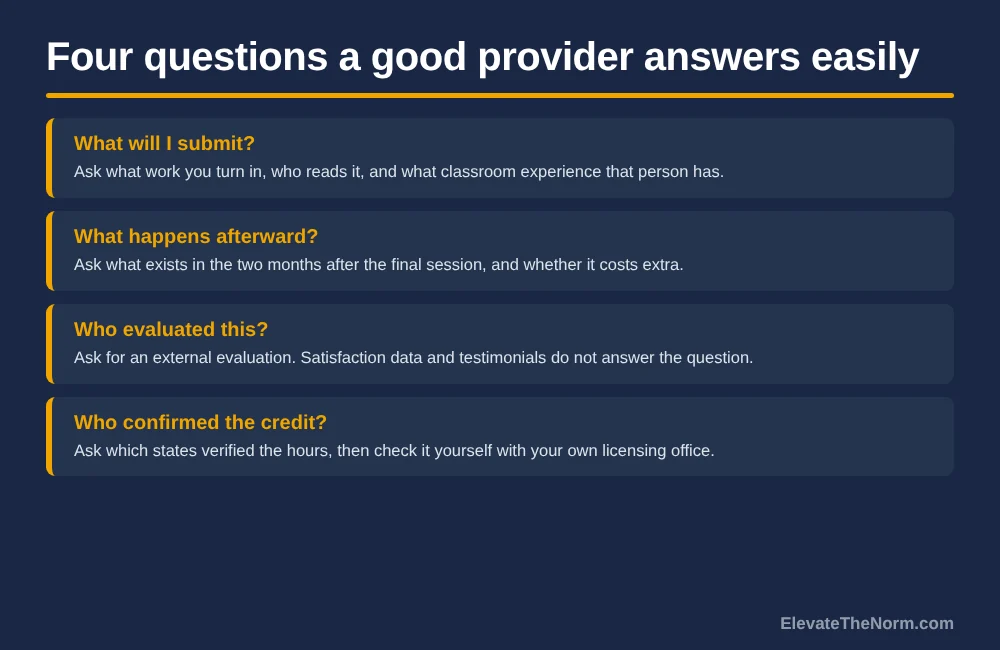
    Four-row graphic listing questions to email a professional development provider before enrolling, covering submitted work, follow-up, external evaluation and credit verification.
    Send these four before you pay. The answers are the real syllabus.

    A scoring checklist for any PD course

    Run this before you register. Score each row 0, 1 or 2. It takes about ten minutes with the course description and one email to the provider.

    Criterion0 points1 point2 points
    Content focusGeneric pedagogy, any subjectSubject-adjacent, examples from elsewhereYour subject and grade band, specific topics named
    Duration and spacingUnder 5 hours, single sittingRoughly 15-30 hours, or spaced over weeks40+ hours spread across a term or more
    Active practiceWatch and discuss onlyOne assignment, no feedbackYou submit work and an expert responds
    ModelingPractice described in slidesOne demonstration videoMultiple annotated models, including ones that go wrong
    Follow-upEnds at the last sessionOptional forum or office hoursScheduled coaching, observation or cohort check-ins
    Monday artifactNothing nameableTemplates you still have to fillA finished, usable product built on your own materials
    Implementation costUnclear or enormousHeavy but definedStated honestly and sized to one unit
    Evidence offeredTestimonials onlyInternal satisfaction dataExternal evaluation or a named study, with limits acknowledged
    Recognized creditProvider is vagueHours offered, conversion unverifiedConfirmed by your state licensing office
    Who is teaching itNo classroom background statedFormer teacher, different grade bandPractitioner or researcher in your grade band and subject

    How to read the total. Sixteen to twenty: strong, enroll. Ten to fifteen: probably worth it if the gaps are ones you can fill yourself, which usually means follow-up. Below ten: you are buying hours. That can be a legitimate purchase. Just name it.

    Questions to ask the provider before you pay

    Email these. How a provider answers tells you more than the syllabus does, and a good one will not mind.

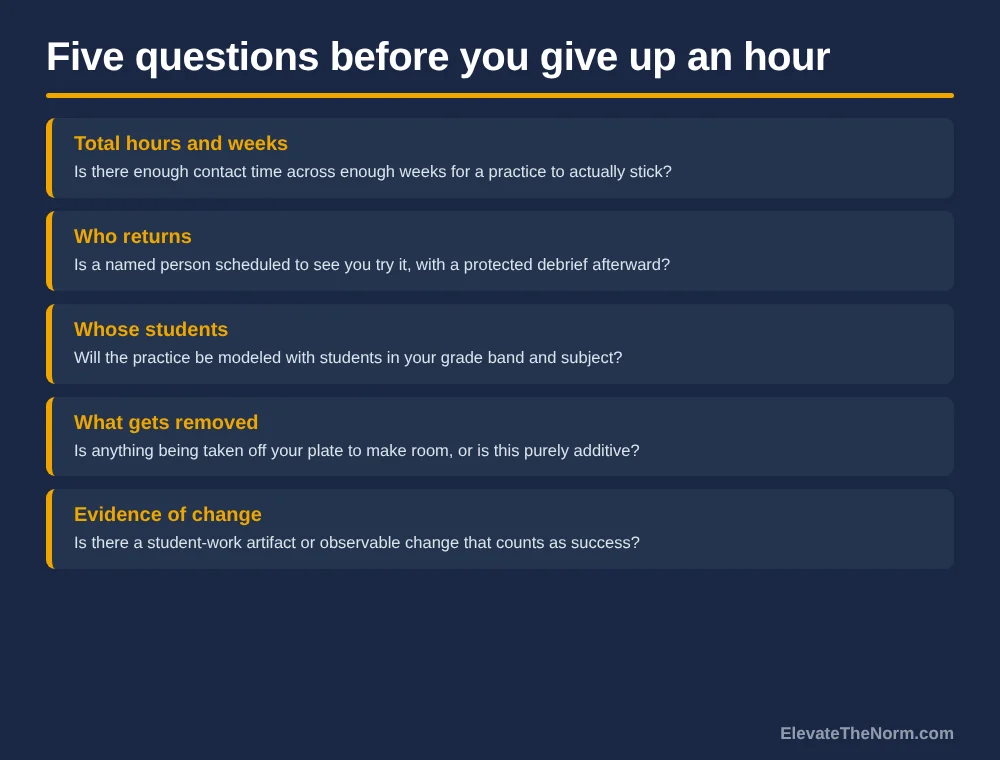
    1. “How many contact hours, and across how many weeks?”
    2. “What will I submit for feedback, who reads it, and what is their classroom background?”
    3. “What finished materials will I leave with that use my own curriculum?”
    4. “What happens in the two months after the course ends?”
    5. “Has this course ever been evaluated by anyone outside your organization? May I see it?”
    6. “What is the typical completion rate, and what counts as completion?”
    7. “Which states have confirmed these hours for renewal, and who do I contact to verify?”
    8. “What is the refund policy if the first two sessions are not what was described?”

    Vague answers on questions four, five and six are the ones I would treat as disqualifying. Those are the three a provider with real results can answer in a paragraph.

    The honest trade-off nobody puts in the brochure

    The features with the best evidence behind them are all expensive in time, and time is the resource teachers have least of. There is no way around this and I am not going to pretend there is.

    Look at the numbers together. The reviews point toward dozens of hours, spaced, with coaching attached. Teachers in the TNTP districts were already giving up around 19 school days a year to development they largely did not rate as a good use of time — two-thirds reported being satisfied with it, but only 40 percent called it a good use of time. The hours exist. They are mostly already spent, and spent badly, and you do not control that calendar.

    Which leads to a position I will own as opinion rather than finding. If your district already consumes nineteen days of your year, your personal PD budget should go toward depth in one thing, not breadth across five. One course in your subject, long enough to matter, with a colleague doing it alongside you so somebody asks whether you tried it. Everything else should be free, short and immediately usable. On that point, what the research says about collective teacher efficacy is the most encouraging reading in this area: the belief that your faculty can move outcomes together is itself associated with results, and it is not something you buy.

    If the budget is the binding constraint rather than the calendar, start with the genuinely free options and what free actually costs. If the constraint is geography or scheduling, the specific strengths and weaknesses of online delivery are worth reading before you commit to a platform.

    How to choose professional development courses for teachers this year

    Pick one problem you can name, then find the longest, most subject-specific course that addresses it and has something happening after the last session. Score it with the checklist above. Verify the credit question with your state before paying. Recruit one colleague so there is somebody to answer to in six weeks.

    And set the bar where it belongs. Professional development courses for teachers are worth judging by one question in April: what do you do differently now, and can you point at it in a student’s work? If you cannot, the course was entertainment with paperwork. That is not a disaster. It is just information, and it should change what you buy next year. After seven years of classroom experience, the thing I am most confident about is that the sessions I remember are the ones that gave me something to carry out the door.

    Sources

    1. Darling-Hammond, L., Hyler, M. E., & Gardner, M., Effective Teacher Professional Development, Learning Policy Institute, June 2017. Source of the seven features of effective PD. Caveat: the review deliberately selected 35 studies that already showed positive effects and states it does not draw conclusions about individual components. https://learningpolicyinstitute.org/sites/default/files/product-files/Effective_Teacher_Professional_Development_REPORT.pdf
    2. Yoon, K. S., Duncan, T., Lee, S. W.-Y., Scarloss, B., & Shapley, K. L., Reviewing the Evidence on How Teacher Professional Development Affects Student Achievement, REL Southwest / Institute of Education Sciences, October 2007. Source of the 49-hour average, the 21-percentile-point figure and the finding that 5-14 hours produced no significant effects. Caveat: only nine of more than 1,300 studies met the evidence standards, 12 of 20 effects were not statistically significant, and all nine studies were conducted with elementary teachers. https://files.eric.ed.gov/fulltext/ED498548.pdf
    3. Sims, S., & Fletcher-Wood, H., “Identifying the characteristics of effective teacher professional development: a critical review,” School Effectiveness and School Improvement, 32(1), 2021, pp. 47-63. Supports the argument that the consensus list of PD characteristics rests on weak inference. https://discovery.ucl.ac.uk/id/eprint/10101575/
    4. Garet, M. S., et al., Middle School Mathematics Professional Development Impact Study: Findings After the Second Year of Implementation, NCEE 2011-4024, May 2011. Source of the 77 hours delivered and the null effects on teacher knowledge (0.05, p = 0.79) and student achievement (-0.01, p = 0.94). Caveat: one program, one content area, six districts in year two. https://air.org/sites/default/files/downloads/report/IES_PD_Math_Exec_20114025_0.pdf
    5. Kraft, M. A., Blazar, D., & Hogan, D., “The Effect of Teacher Coaching on Instruction and Achievement: A Meta-Analysis of the Causal Evidence,” Review of Educational Research, 2018. Source of the 60-study count and the 0.49 and 0.18 standard deviation effects. Caveat: the authors report that effects from larger-scale programs are only a fraction of those from small efficacy trials. https://annenberg.brown.edu/publications/effect-teacher-coaching-instruction-and-achievement-meta-analysis-causal-evidence
    6. TNTP, The Mirage: Confronting the Hard Truth About Our Quest for Teacher Development (executive summary), August 2015. Source of the $18,000 per teacher figure, the 19 school days, and the finding that nearly seven in ten teachers’ ratings were flat or declining. Caveat: three districts and one charter network, with an outcome measure (evaluation ratings) that Heather Hill’s NEPC review argues is unreliable for this purpose. https://tntp.org/wp-content/uploads/2023/02/TNTP_Mirage_Executive_Summary_2015.pdf
    7. Hill, H. C., Review of The Mirage, National Education Policy Center, September 15, 2015. The critique of TNTP’s cost calculation, outcome measures and generalizability. https://www.nepc.colorado.edu/sites/default/files/ttr_hill_tntp_mirage.pdf

    Frequently Asked Questions

    How many hours of professional development actually make a difference?

    There is no reliable threshold, only a floor. The REL Southwest review found that studies offering 5 to 14 total hours showed no statistically significant effects, while the nine studies that met evidence standards averaged 49 contact hours. But all nine of those studies were conducted with elementary teachers, and a federal randomized trial delivered 77 hours of middle school math PD with no measurable impact. Treat anything under about 15 hours as skill-level training, and do not assume that clearing 40 hours guarantees anything.

    Is a cheap course automatically worse than an expensive one?

    No, and price carries almost no information here. Some of the most content-rich PD available is federally funded or museum-run and costs nothing, while some expensive courses are a slide deck and a certificate. What price does predict is whether anyone is paid to follow up with you, since coaching and feedback are labor and labor costs money. Score the course on the criteria, then ask whether the price is buying follow-up or just access to a recording.

    My district chooses my PD. Does any of this help me?

    Yes, in two ways. First, you can use the criteria to decide where to invest your own attention inside required sessions, which is a real choice even when attendance is not. Second, the questions in this article are the ones to bring to whoever schedules PD at your school. Asking what teachers will walk out with, and what happens in the two months after, is a reasonable question from a staff member and tends to improve the answer over time.

    Does a course that counts for license renewal have to be good?

    No. Most state renewal systems are built around accumulating approved credits rather than demonstrating growth, which means a course can clear your renewal requirement without changing your teaching. That is not an argument for ignoring credit. Hours are a real obligation with a real deadline. It is an argument for being clear with yourself about which purchase you are making, and for verifying the credit question with your own state licensing office rather than trusting a provider’s marketing.

    What if I only have a few hours this semester?

    Then buy depth in something small rather than breadth across a topic. A short, specific course on one technique you will use in a unit you already teach is a defensible use of three hours. A broad survey course is not, because surveys need the implementation time that short courses do not include. The other high-value option for a few hours is arranging to watch a colleague teach and talk afterward, which costs nothing and has better follow-up built into it than most paid courses.

    How do I know whether a provider’s evidence claims are real?

    Ask who evaluated the course and whether anyone outside the organization did it. Satisfaction surveys are not evidence of learning, and testimonials are not evidence of anything. A provider with real results can name an external evaluation, describe its design and tell you its limits without getting defensive. If the only evidence offered is enthusiasm from past participants, treat the course as unevaluated and price it accordingly.

    Should students or families care which PD their teacher takes?

    They will see the consequences rather than the course. Good PD tends to show up as clearer assignments, better feedback and assessments that match what was taught, which are the things students notice. The fairness question families sometimes raise is whether PD time pulls teachers out of the room. That is a scheduling decision made above the classroom, but it is a legitimate thing to ask a principal about, and depth in one area usually means fewer disruptions than scattered one-day sessions.

    Is there any PD worth taking that is not about my subject?

    Yes, in specific cases. Early-career teachers usually need classroom systems before they need subject-specific depth, because nothing content-focused survives a room that is not functioning. Teachers moving into a new role, grade band or program also need the general version first. The caution is that generic PD is the easiest kind to repeat forever, since it never gets hard enough to expose what you do not know. Once systems are stable, move toward content.

    About Clay Shumate

    Clay Shumate is a certified secondary Social Studies teacher in the public schools of West Alabama, with seven years of classroom experience, a B.A. in History, and an M.Ed. in Secondary Education. He writes about project-based learning, student responsibility, respect, and practical ways to hold young people to a higher standard while giving them room to learn from mistakes. He is a member of the Society of Professional Journalists and writes to its Code of Ethics; this site’s editorial standards and corrections policy are published in full. More about Clay.

  • Classroom Control Techniques That Work — and the Room You Actually Want

    Classroom Control Techniques That Work — and the Room You Actually Want

    By Clay Shumate

    The classroom control techniques that actually hold are quiet ones: proximity, a private word, a predictable consequence delivered exactly as promised, and a room structured so there is little to disrupt. Volume, public correction and removal buy you the current minute and cost you the next nine weeks.

    You probably typed the word “control” into a search bar, and I am not going to lecture you about it. You asked a real question and you deserve a real answer, so the techniques below come first. But I will make an argument along the way, because I think the thing you actually want is not control. It is a room that runs without you holding it up. Those are different goals and they need different work.

    Key Takeaways

    • Proximity and a quiet word handle most of it. The loudest tool available is almost never the right rung on the ladder.
    • Standing by your word is the whole mechanism. Doing exactly what you said you would do, every time, is what makes a room predictable — and predictability is what students read as fairness.
    • Escalation is expensive. Removal-based discipline has a poor evidence record: suspension predicts more future misbehavior, not less.
    • Volume and audience both backfire. Harsh verbal discipline was associated with worse adolescent outcomes in the parenting research, and warmth did not buffer it.
    • Control is scaffolding, not the goal. If the room only works while you are standing in it, you have not built anything yet.

    What are the most effective classroom control techniques?

    The effective ones are low-volume, early, and specific: scan and move, stand near, name the behavior quietly, offer a choice between two acceptable things, and deliver the consequence you already announced without adding a speech.

    That list is unglamorous on purpose. The most reliable classroom control techniques do not look like control from the back of the room, which is exactly why they work on teenagers. A fifteen-year-old will accept a correction and will not accept being made an example of in front of twenty-nine peers, and the difference between those two experiences is almost entirely volume and audience.

    The evidence-based practice reviews back the shape of this even where the specific tools are hard to isolate. The review that screened classroom practices for genuine empirical support sorted them into maximizing structure and predictability; posting, teaching, reviewing, monitoring and reinforcing expectations; actively engaging students; acknowledging appropriate behavior; and using a continuum of strategies to respond to inappropriate behavior (Simonsen, Fairbanks, Briesch, Myers & Sugai, 2008). The word continuum is doing a lot of work there. The technique is not the response; it is having five rungs and starting on the first one.

    Nine techniques, from cheapest to most costly

    Work down this list in order, and only go as far as you have to. The cost column is what the technique takes out of your relationship with the class, which is the currency people forget to count.

    RungTechniqueWhat it looks likeRelationship cost
    1Scan and moveYou are never in the same place for two minutes; your eyes reach every desk every minute.None
    2ProximityYou teach the next two sentences standing three feet from the problem, saying nothing about it.None
    3Nonverbal signalA look, a tap on the desk, a hand on a closed laptop. No words, no audience.Almost none
    4Private redirectSix words at the desk, naming the behavior and the next action. Then you walk away.Low
    5Two acceptable choices“You can work here quietly or at the table by the window. Your call.”Low
    6Doorway conversationThirty seconds in the hall, the class working, no raised voice, specific next step.Low to moderate
    7The announced consequenceThe thing you already told the class happens, happening, with no additional commentary.Low if it was announced; high if it was improvised
    8Contact homeA call before the referral, describing behavior rather than character.Moderate, and lower if you have called with good news before
    9Removal or referralOffice, in-school placement, suspension — the system takes over.High, and the evidence for it is poor

    Most teachers who feel out of control are skipping rungs one through five. That is not a character flaw; it is what stress does. But a room where every correction arrives at rung seven has taught students that nothing matters until it is serious, which guarantees you will spend your year at rung seven.

    Five rows listing graduated classroom response techniques from scanning the room through delivering a previously announced consequence.
    Most teachers who feel out of control are skipping the first four.

    Standing by your word is the whole mechanism

    Here is my actual position, stated as opinion rather than research: respecting students is easy, and the way you do it is by doing exactly what you said you would do, every single time.

    That is it. That is the technique the whole article is built around. Not consistency as a vague virtue — consistency as a literal practice. If you said the quiz is Friday, the quiz is Friday. If you said the next time it happens you call home, you call home, including on the day you are tired and the student is one you like. If you said you would read their draft by Monday, you read it by Monday. Students are keeping score on this far more carefully than on anything in your syllabus, and what they are really measuring is whether your words predict your actions.

    A teacher whose word is reliable does not need much else. The consequence does not have to be severe; it has to be certain. Certainty is what makes a room calm, because a student who knows what happens next does not have to test you to find out. Severity without certainty produces a room full of gamblers. Certainty without severity produces a room that mostly runs itself. Our longer argument about this is in the piece on consequences that are predictable rather than harsh, and the companion on letting the real consequence do the work.

    One thing I will not tell you is to let a student fail to teach them a lesson. If a student can wreck something badly enough in my room for that to be instructive, I planned the thing badly. Build the assignment so that the honest consequence of not doing the work is having to do the work, not a permanent mark on a transcript.

    What escalation actually costs

    Removal-based discipline has the weakest evidence record of any technique in common use, and the research on it is unusually clear for education research.

    The American Psychological Association’s task force review of zero tolerance concluded that after two decades of implementation, “data tended to contradict the presumptions made in applying a zero tolerance approach.” Suspension predicted higher future misbehavior rather than deterring it; there was a negative relationship between school use of suspension and expulsion and school-wide academic achievement; and suspended students showed higher dropout and lower graduation rates. The task force also made a developmental argument that matters for grades 6–12 specifically: adolescents are still immature in impulse control, risk perception and resistance to peer influence, so inflexible punishment can worsen the very behaviors it targets (Reynolds, Skiba, Graham, Sheras, Conoley & Garcia-Vazquez, 2008). They recommended graduated consequences matched to the severity of the infraction, prevention, restorative approaches, and better teacher preparation in classroom management.

    Two honest qualifications. First, that review is about school-level and district-level policy, not about whether you personally should write a referral — sometimes you should, and some behavior belongs with an administrator. Second, much of the underlying evidence is correlational: students who get suspended differ in many ways from students who do not. The directional consistency across the literature is what makes it persuasive, not any single study.

    Volume and audience are weapons, and they backfire

    Raising your voice works once. After that you have established that nothing in your room happens until an adult is shouting, and you have made yourself the loudest thing a student has to beat.

    The closest thing to hard evidence here comes from parenting research rather than classrooms, and I want to be careful about the gap. A two-year longitudinal study of 967 two-parent families found that harsh verbal discipline at ages 13 to 14 — defined as using psychological force to cause emotional pain or discomfort in order to correct behavior, ranging from yelling to insulting and humiliating language — was associated with increases in both depressive symptoms and conduct problems, including misbehavior at school. The relationship ran both ways: adolescents with conduct problems drew more harsh verbal discipline. And parental warmth did not buffer it; the researchers concluded harsh verbal discipline appeared detrimental regardless of the strength of the bond (Wang & Kenny, 2013, via the Society for Research in Child Development summary).

    Those were parents, not teachers, and the sample was mostly middle-class. You cannot read it as a measured finding about your sixth period. What it does do is undercut the most common defense of shouting at teenagers, which is that it is fine if they know you care about them. In that data, knowing you care did not help. We go further into this in our piece on what yelling actually buys a teacher.

    Audience is the other half. A public correction forces a student to choose between complying and keeping their standing with peers, and for a fourteen-year-old that is not a close call. You have manufactured a confrontation that did not need to exist. Almost every technique in rungs one through six exists to avoid exactly that choice.

    What to do instead of raising your voice

    Use a script. Not because scripts are elegant, but because your judgment is worse than usual at the exact moment you need it.

    Here is one that holds up. Say it quietly, at the desk, in under twenty seconds, and then leave.

    1. Name the behavior, not the person. “The phone is out.” Not “you always.”
    2. State the next action. “It goes in the bag until the bell.”
    3. Offer the exit. “Do that and we are done, nothing else happens.”
    4. Leave. Walk away before they respond. Standing there demands a reaction and the only one available to them is a performance.
    5. If it continues, go to the doorway, not to volume. “Step out with me for thirty seconds.”
    6. Close the loop later, privately. One sentence at the end of class that is not about the incident: “Good work on the second half. See you tomorrow.”

    Step six is the one people skip and it is the one that matters most. A correction that ends with the relationship intact can be repeated. A correction that ends with a grudge can only escalate. Our material on repair after a mistake is the longer version of step six.

    Five cards laying out a short script a teacher can use to redirect a student quietly without raising their voice.
    Use a script, because your judgment is worst exactly when you need it.

    Behaviour management strategies: what the search term gets right

    Teachers searching the British phrase “behaviour management strategies” are usually asking a better question than teachers searching for control, because management implies a system and control implies a contest.

    A system can be handed to a substitute, written down, taught to students, and repaired when it breaks. A contest can only be won or lost, and it has to be won again every period. If you take one framing away from this article, take that one. Everything that survives in a secondary classroom is a system: the entry routine, the materials procedure, the way late work is handled, the ladder in the table above. None of it depends on you being intimidating.

    The flip side is that a system you built and do not run is worse than no system, because it has told students your word is decorative. Fewer rules, held exactly, beats a comprehensive code enforced by mood.

    Does removing the student work?

    Sometimes it is necessary and it is almost never productive, which are two different claims and both are true.

    Necessary: a student who is unsafe, or who has escalated past the point where anything you say will land, needs to be somewhere else for a while. That is not a failure. Unproductive: removal does not teach the behavior you wanted, it costs instructional time the student usually could not afford, and at scale it correlates with the outcomes the APA review described. The practical test I would use is whether the removal has a plan attached. “Go to the office” is a transfer of custody. “Go cool off at the table in the back for five minutes, then come talk to me at the end” is a technique.

    Do restorative approaches work better?

    They are promising, they are not a cure, and the best-designed study of them produced a genuinely mixed result that I think teachers should know about.

    A randomized controlled trial of a whole-school restorative practices program in a mid-sized urban district found that participating schools had greater reductions in overall suspension rates, including for African American students and students from low-income families, which narrowed disparities, and that teacher ratings of school climate improved. It also found that academic outcomes did not improve — and actually worsened in grades 6 through 8 — and that arrest rates did not fall (Augustine et al., RAND Corporation, 2018).

    I would not use that to dismiss restorative work; I would use it to set expectations. The middle-grades academic result is a real finding and the honest interpretation is probably about implementation cost: a program that takes instructional time has to be worth the time it takes. Read our overview of restorative practices and where they fit alongside that caveat rather than instead of it.

    Four rows naming high-volume or removal-based responses alongside the specific cost each one carries in a secondary classroom.
    Each of these buys the current minute at the price of the next nine weeks.

    Class room control when you are new or covering someone else’s room

    With no history and no relationship, the only techniques available to you are structural ones — so use the structure and skip everything that depends on standing.

    Plenty of people search for class room control as two words, and a disproportionate number of them are substitutes, first-year teachers, or someone covering a planning period in a room they have never seen. If that is you: get the names, give a task that can start without instructions, stand at the door, state the two things you will hold and nothing else, and do not make a single threat you cannot personally carry out before the bell. The fastest way to lose a borrowed room is to announce a consequence you have no authority to deliver. Our guide for substitutes covers the hour-by-hour version.

    How do you regain control of a class you have already lost?

    You reset publicly, narrow what you are asking for, and then be relentlessly boring about the one or two things you chose.

    Say it out loud to the class: this has not been working, here is what I got wrong, here are the two things that change starting Monday, and here is exactly what happens when they do not. Then hold those two things for four weeks without adding a third. The temptation is to announce a complete overhaul, which fails because you cannot sustain it and the failure proves your word is unreliable all over again.

    Pair it with the two cheapest positive moves available. A randomized study in middle school classrooms found that teachers who greeted students positively at the door saw improved academic engaged time and reduced disruptive behavior, and rated the strategy as feasible and reasonable to run (Cook et al., 2018). And in 28 middle school classrooms, higher praise-to-reprimand ratios tracked linearly with better class-wide on-task behavior and with better engagement and grades among students at risk for emotional and behavioral disorders (Caldarella, Larsen, Williams & Wills, 2023). Both of those are free, both were measured in middle school, and both are the opposite of control.

    Why a room that runs itself beats a room you control

    Control is scaffolding. It is sometimes necessary and it is never the finished building, and the difference shows up the first day you are absent.

    There is also a motivational reason to aim past compliance. A meta-analysis of 144 studies with just over 79,000 participants, mean age 16.5, found teacher autonomy support correlated .48 with intrinsic motivation and −.32 with amotivation, and that students’ sense of competence (ρ = .58) and autonomy (ρ = .57) were the strongest predictors of self-determined motivation (Bureau, Howard, Chong & Guay, 2021). Those are correlations from self-report measures, so hold them loosely. But autonomy support is not permissiveness — it is demands with reasons attached and real choice inside them. A room built that way does not need as much controlling, which is the only durable solution to wanting control.

    Where to start with classroom control techniques this week

    Pick the lowest rung you are currently skipping, and pick one promise you will keep exactly. Those two things, together, are most of what people mean by classroom control techniques that work.

    Concretely: for one week, handle everything with proximity and a private word, and refuse to use volume at all. You will find out quickly how much of your room was running on noise. In the same week, choose one thing you have announced and been loose about — a deadline, a phone rule, a seat — and hold it precisely, with the student you least want to hold it with. That is the whole intervention. If you want the broader toolkit it sits inside, our ranked list of classroom management strategies for grades 6–12 is the place to go next, and the piece on identifying your own management style will tell you which rung you default to when you are tired.

    Sources

    1. Reynolds, C. R., Skiba, R. J., Graham, S., Sheras, P., Conoley, J. C., & Garcia-Vazquez, E. “Are Zero Tolerance Policies Effective in the Schools? An Evidentiary Review and Recommendations.” American Psychologist, vol. 63, no. 9, 2008, pp. 852–862. Supports the findings that suspension predicts higher future misbehavior, the negative relationship with school-wide achievement, the dropout and graduation findings, and the developmental argument about adolescents. Caveat: a policy-level review resting substantially on correlational evidence; it addresses district and school policy rather than individual referral decisions. https://www.scstatehouse.gov/CommitteeInfo/SchoolSafetyTaskForce/October282014Meeting/zero-tolerance.pdf
    2. Wang, M.-T., & Kenny, S. “Longitudinal Links Between Fathers’ and Mothers’ Harsh Verbal Discipline and Adolescents’ Conduct Problems and Depressive Symptoms.” Child Development, 2013. Supports the definition of harsh verbal discipline, the association with conduct problems and depressive symptoms at ages 13–14, the bidirectional relationship, and the finding that parental warmth did not buffer it. Caveat: this studied parents and not teachers, in 967 mostly middle-class two-parent families, and is cited here through the Society for Research in Child Development’s summary of the study rather than the paywalled article. https://www.srcd.org/sites/default/files/resources/pr_2013_09_04_wang.pdf
    3. Simonsen, B., Fairbanks, S., Briesch, A., Myers, D., & Sugai, G. “Evidence-Based Practices in Classroom Management: Considerations for Research to Practice.” Education and Treatment of Children, vol. 31, 2008, pp. 351–380. Supports the five categories of evidence-based practice and specifically the use of a continuum of responses to inappropriate behavior. Caveat: linked as a full-text reproduction hosted by a university project rather than the journal of record. https://k12engagement.unl.edu/sites/unl.edu.cehs.special-ed-communic-disorders.student-engagement-project/files/media/file/Classroom%20Management%206-8-16.pdf
    4. Augustine, C. H., Engberg, J., Grimm, G. E., Lee, E., Wang, E. L., Christianson, K., & Joseph, A. A. Can Restorative Practices Improve School Climate and Curb Suspensions? RAND Corporation, RR-2840-DOJ, 2018. Supports the suspension reductions, the narrowing of disparities, the improved teacher climate ratings, and the finding that academic outcomes did not improve and worsened in grades 6–8. Caveat: one randomized trial in one mid-sized urban district; the middle-grades academic result is a real negative finding and should not be omitted when the program is recommended. https://www.rand.org/pubs/research_reports/RR2840.html
    5. Cook, C. R., Fiat, A., Larson, M., Daikos, C., Slemrod, T., Holland, E. A., Thayer, A. J., & Renshaw, T. “Positive Greetings at the Door: Evaluation of a Low-Cost, High-Yield Proactive Classroom Management Strategy.” Journal of Positive Behavior Interventions, vol. 20, no. 3, 2018, pp. 149–159. Supports the door-greeting effects on academic engaged time and disruptive behavior in middle school classrooms. Caveat: a single randomized trial; the specific percentage figures widely quoted online do not appear in the published abstract and are not repeated here. https://experts.umn.edu/en/publications/positive-greetings-at-the-door-evaluation-of-a-low-cost-high-yiel/
    6. Caldarella, P., Larsen, R. A. A., Williams, L., & Wills, H. P. “Effects of Middle School Teachers’ Praise-to-Reprimand Ratios on Students’ Classroom Behavior.” Journal of Positive Behavior Interventions, vol. 25, no. 1, 2023, pp. 28–40. Supports the linear relationship between praise-to-reprimand ratios and on-task behavior, engagement and grades. Caveat: 28 middle school classrooms; high school classrooms were not studied. https://journals.sagepub.com/doi/10.1177/10983007211035185
    7. Bureau, J. S., Howard, J. L., Chong, J. X. Y., & Guay, F. “Pathways to Student Motivation: A Meta-Analysis of Antecedents of Autonomous and Controlled Motivations.” Review of Educational Research, vol. 91, no. 3, 2021. Supports the correlations between teacher autonomy support, competence, autonomy and self-determined motivation in a sample with a mean age of 16.55. Caveat: 144 studies and 79,079 participants, but correlational and largely self-reported on both sides. https://selfdeterminationtheory.org/wp-content/uploads/2021/09/2021_PathwaystoStudentMotiv_BureaHowardEtal.pdf

    Frequently Asked Questions

    Is wanting control of my classroom a bad thing to want?

    No. A room that is chaotic is a room where nobody learns and some students are genuinely unsafe, so the instinct is sound. The argument here is about the target, not the motive. Control is a means, and the kind you get by being intimidating has to be re-established every period and collapses the week you are absent. The kind you get from taught routines, a predictable response ladder and a reputation for keeping your word holds without you. Same goal, far cheaper to maintain.

    What if a student escalates after I use a quiet redirect?

    Then you stop trying to win the moment. Drop your volume rather than raising it, give the class something to do so they stop being an audience, and move the conversation to the doorway or defer it entirely: “We’ll talk at the bell.” A student who is escalated is not processing your reasoning, so reasoning harder makes it worse. If there is any safety concern, follow your building’s procedure immediately — de-escalation technique is not a substitute for a safety protocol, and no article should tell you otherwise.

    Doesn’t this just mean being soft on students who need firm boundaries?

    It means the opposite. Nothing here says to lower a standard; it says to deliver the standard quietly and without fail. The firmest thing in a classroom is not a raised voice — it is a consequence that arrives exactly as announced, including on the day you would rather not. Students experience certainty as firmness and volume as instability. If anything, this approach is harder on teachers than shouting is, because it requires you to follow through on days when nobody would blame you for letting it slide.

    How do I explain my approach to a parent who expects tougher discipline?

    Lead with predictability rather than philosophy. Tell them the sequence in order: expectations are taught in the first week, a problem gets a signal, then a private word, then a conversation with you, then a call home before anything is written up, and the same behavior gets the same response for every student. Most parents asking for toughness are really asking whether their child is safe and whether rules are applied evenly. Answer those two questions concretely and the disagreement about method usually disappears.

    What does this cost a school to implement?

    The classroom techniques cost nothing: proximity, private correction, a response ladder and keeping your word require no purchase and no release time. The real cost is coaching time, because teachers cannot see their own volume or their own praise-to-correction rate without someone counting. Twenty minutes of a colleague’s planning period does that. Whole-school restorative programs are a different financial question entirely, and the randomized evidence on those is mixed enough that a district should pilot before scaling.

    Does this work with students who have behavior plans or significant trauma histories?

    The low-rung techniques are generally a better fit for these students, not a worse one, because they reduce public exposure and surprise. Predictability and private correction are protective. What this article cannot do is replace an individualized plan: if a student’s IEP or behavior intervention plan specifies a response, that document governs, and you bring what you are observing to the case manager rather than improvising. Universal technique is the floor underneath individualized support, never a substitute for it.

    I teach five classes and I am exhausted. Where do I start?

    One period and one week. Choose the class that is hardest, and for five days handle every correction with proximity and a quiet word only — no volume, no public callouts. In the same week pick one promise you have been loose about and keep it exactly. That is two changes in one class, which is sustainable on a bad Tuesday. Trying to overhaul all five periods is the version of this that fails, and the failure costs you more credibility than never starting would have.

    What if my administrator wants to see me being stricter?

    Ask what observable behavior they want to see more of, because “stricter” usually turns out to mean something specific and achievable — fewer students out of seats, phones away, a faster start. Those are structure problems with structural solutions, and you can show progress on them without raising your voice once. Keep a short record of what you changed and what happened. An administrator watching a room start on time with everyone working is not going to insist you shout about it.

    About Clay Shumate

    Clay Shumate is a certified secondary Social Studies teacher in the public schools of West Alabama, with seven years of classroom experience, a B.A. in History, and an M.Ed. in Secondary Education. He writes about project-based learning, student responsibility, respect, and practical ways to hold young people to a higher standard while giving them room to learn from mistakes. He is a member of the Society of Professional Journalists and writes to its Code of Ethics; this site’s editorial standards and corrections policy are published in full. More about Clay.

  • Teacher Professional Development: What Actually Changes Teaching

    Teacher Professional Development: What Actually Changes Teaching

    By Clay Shumate

    Teacher professional development is any structured learning a teacher does to get better at the job — workshops, coaching, course work, collaborative planning, book studies, graduate hours. The research is clearer about what fails than what works. Sustained, content-focused, coached programs beat one-off sessions, but even the best-studied versions produce modest, uneven effects on students.

    That is an uncomfortable thing to write on an education site. It would be easier to hand you seven features of effective PD and let you rearrange the faculty meeting calendar. But the honest version is more useful, because once you know where the evidence is thin you can stop blaming yourself for a session that changed nothing. It was probably never going to. What follows is what the studies found, where they disagree, and how to tell whether an hour is worth giving away.

    Key Takeaways

    • Short PD does not show measurable student effects. In the federal review that applied What Works Clearinghouse standards, the three studies with the least contact time — 5 to 14 hours total — produced no statistically significant effect on student achievement.
    • Coaching is the best-evidenced delivery model, and it shrinks when scaled. A meta-analysis of 60 causal studies found large effects on instruction and smaller effects on achievement, with large programs producing only a fraction of the effects seen in small ones.
    • The famous “features of effective PD” lists are correlational. The reviews that produced them generally studied programs that already worked, so they cannot tell you which ingredient did the work.
    • PD can raise teacher knowledge and still not move students. A randomized federal study delivered 93 hours of math content PD, measurably improved teacher knowledge and explanations, and found no positive impact on student achievement.
    • Spending is not the constraint. One large district study estimated roughly $18,000 per teacher per year on development, with no common thread distinguishing the teachers who improved — though that study has real methodological critics.
    • You are allowed to evaluate the offer. Professional judgment includes judging professional learning. A teacher who can say why a session will not transfer is doing the job, not avoiding it.

    What counts as teacher professional development?

    Anything structured and intentional that is meant to improve a teacher’s practice counts, which is exactly why the category is so hard to study. A ninety-minute compliance briefing on a new attendance module and a two-year content-and-coaching partnership both get logged as professional development for educators. They share a line on a spreadsheet and almost nothing else.

    The usual buckets are workshops and conferences, in-district training days, instructional coaching, professional learning communities and collaborative planning, lesson study, mentoring for new teachers, graduate course work, and self-directed reading or online modules. Staff development for teachers in most American districts leans heavily on the first two, because they are the cheapest way to reach every adult in a building on the same afternoon.

    Keep that mess in mind whenever somebody says “PD does not work.” That claim is about as precise as “meetings do not work.” The question is which, under what conditions, and for how long.

    Why does most professional development fail to change teaching?

    Because the typical session ends at the moment the hard part begins. A presenter explains a practice, the room nods, everyone goes back to a classroom where the old routine is already running, and nobody ever returns to see whether the new thing was attempted. Explaining a practice and installing a practice are different jobs, and most PD is only funded for the first one.

    There is a structural reason for this. Follow-up is expensive and invisible. A district can report that 400 teachers received training on formative assessment; it cannot easily report that 90 of them changed a lesson. So the metric collected is attendance, and the thing funded is whatever produces attendance.

    TNTP’s 2015 report The Mirage put numbers on the scale of the investment. Surveying more than 10,000 teachers and 500 school leaders across three large districts and a mid-size charter network, it estimated roughly $18,000 per teacher per year on development and about 19 school days’ worth of time, and reported that evaluation ratings for close to 70 percent of teachers stayed flat or declined over two to three years, with no identifiable pattern separating the improvers (TNTP, 2015).

    That report deserves its caveat, and it is a serious one. Heather Hill’s review for the National Education Policy Center argued that the study leaned on teacher evaluation ratings that are unreliable year to year, measured PD by format rather than by topic, fit or quality, and never established whether the development teachers received was even aimed at the things they scored poorly on. She called the sweeping conclusions “overly broad and not supported by the study’s methods” (Hill, NEPC, 2015). Both things can be true: the spending is enormous, and we do not have clean evidence about what it bought.

    Four-row graphic comparing the strength of research evidence for coaching, sustained content professional development, feature checklists, and one-off sessions.
    The evidence is uneven across professional development models, and the differences are worth knowing before you spend a day.

    What does the research actually say about effective teacher professional development?

    The most-cited synthesis identifies seven features, and its own authors say they cannot tell you which feature mattered. The Learning Policy Institute’s 2017 review of 35 methodologically rigorous studies found that effective programs tended to be content focused, to use active learning, to support collaboration, to model the practice being taught, to include coaching and expert support, to build in feedback and reflection, and to be sustained over time (Darling-Hammond, Hyler & Gardner, 2017).

    Those seven features are the reason your district’s PD plan says “sustained, collaborative, job-embedded.” They are a reasonable starting point. But read the report’s own limitations section. Because the studies examined whole programs with many elements bundled together, the authors state plainly that they cannot draw conclusions about the efficacy of individual components, and that they were unable to comment on studies of PD that did not produce positive results.

    That is not a technicality. It means the list describes programs that worked. It does not demonstrate that adding collaboration or duration to a weak program will make it work. Sims and Fletcher-Wood made this argument directly in a critical review in School Effectiveness and School Improvement, concluding that the influential feature lists rest on methodological weaknesses — chiefly inappropriate inclusion criteria — and that the field would do better to build on basic learning science than on those syntheses (Sims & Fletcher-Wood, 2021).

    Mary Kennedy reached a related conclusion by a different route. Sorting 28 rigorous studies by the theory of action behind each program rather than by its design features, she found that many popular design features were not associated with program effectiveness, and that programs with similar content differed sharply in impact depending on how they supported teachers in enacting it (Kennedy, 2016).

    How strong is the evidence for instructional coaching?

    Coaching has the strongest causal evidence of any professional development model, and it still has a scale problem. Kraft, Blazar and Hogan reviewed 60 studies using causal designs and found pooled effects of 0.49 standard deviations on instructional practice and 0.18 standard deviations on student achievement (Kraft, Blazar & Hogan, 2018).

    An effect of 0.49 on instruction is large for anything in education research. It is the one model where watching a teacher teach, talking about that lesson, and coming back next week reliably changes the lesson.

    The caution is in the same paper. Average effects from effectiveness trials of larger programs were only a fraction of the effects found in efficacy trials of smaller programs. Small, carefully run, well-staffed coaching works. The district-wide rollout with one coach for 60 teachers is a different intervention wearing the same name. If your school is adding coaching, the ratio and the protected time are the program — not the job title.

    Does more time automatically mean more learning?

    No, but below a floor of about 14 contact hours the studies stop finding effects at all. The federal regional lab review by Yoon and colleagues screened more than 1,300 studies and found only nine that met What Works Clearinghouse evidence standards. Across those nine the average effect size was 0.54, and the three studies with the least professional development — 5 to 14 hours total — showed no statistically significant effects on student achievement (Yoon et al., REL 2007–033).

    Two honest notes. Nine studies out of 1,300 is a thin base for a field this large, and the review is from 2007. And all nine were in elementary grades, so applying the 14-hour floor to a secondary department is an inference, not a finding. I still think it is the most useful number in the literature for a classroom teacher, because it reframes the question from “was the workshop good?” to “is there enough of this, over enough weeks, for anything to stick?”

    And duration alone clearly is not sufficient, which brings us to the most sobering study in this whole area.

    Four cards showing the chain from teacher learning to student outcomes, with notes on which links commonly fail.
    Most professional development is funded for the first link and evaluated on the last one.

    Can professional development raise teacher knowledge and still not move students?

    Yes, and a randomized federal study showed exactly that. Garet and colleagues delivered an 80-hour summer math content workshop plus 13 hours of collaborative meetings and observation-based coaching to over 200 fourth-grade teachers across six districts in five states, randomly assigned. The PD improved teachers’ mathematical knowledge and the use and quality of their mathematical explanations in class. It did not have a positive impact on student achievement (Garet et al., NCEE 2016–4010).

    That study was content focused, sustained, collaborative, modeled and coached — six of the seven features. The teachers learned. The students did not show it on the test within the study window.

    Note the population: fourth-grade mathematics. This site is about grades 6–12, and I am not going to pretend a fourth-grade math result transfers cleanly to a tenth-grade history classroom. What does transfer is the logic of the chain. PD has to change teacher knowledge, then change instruction, then change what students do with their minds, then show up on a measure somebody chose. Every link can break, and the last two are the ones programs almost never plan for.

    Why do the “features of effective PD” lists deserve skepticism?

    Because a list of features is a description of winners, not a recipe. If you study only programs that raised achievement and then catalog what they had in common, you will find they were long, collaborative and content-focused — and you will have no idea how many long, collaborative, content-focused programs did nothing, because those were never in your sample.

    It is why a district can faithfully implement every feature on the list — stretch the training across the year, put teachers in teams, anchor it in content — and get nothing. The features are present; the mechanism is absent. The Education Endowment Foundation’s 2021 systematic review of randomized trials, by Sims, Fletcher-Wood, O’Mara-Eves, Cottingham, Stansfield, Van Herwegen and Anders, reframed the field around mechanisms rather than surface features for exactly this reason (EEF, 2021). That review and its companion guidance are UK-based; the funding and staffing context is not ours, but the argument about mechanisms is.

    The practical translation: stop asking whether a professional learning plan has the right shape and start asking what it is supposed to do to a teacher’s head and hands, and how anyone would know.

    How should a teacher judge whether a professional development offer is worth their time?

    Ask five questions before the first slide, and judge the answers against what the research found. You usually cannot decline required training, and I am not suggesting you try. But you can decide how much of your limited attention and your optional time to invest, and you can ask these out loud without being difficult about it.

    Question to askAnswer that predicts transferWarning sign
    How many hours total, across how many weeks?Multiple sessions spread over a term, totaling well past the 14-hour floor“It’s a one-off, but it’s a really good one”
    Who is coming back to see me try it?A named person, a scheduled visit, a protected debriefNobody, or “your evaluator will look for it”
    Will I see the practice done with students like mine?Modeled or filmed in a comparable grade band and subjectModeled with compliant volunteers or with elementary students
    What am I expected to stop doing to make room for this?Something named and removedNothing — it is added on top
    What would count as evidence this worked, and who checks?A student-work artifact or a specific observable changeAn exit survey about satisfaction

    If four of five answers land in the warning column, you are at an awareness session. Awareness sessions are not worthless — they can introduce a vocabulary and tell you something exists. Just do not expect your practice to move, and do not let anyone tell you later that you were trained.

    Five-row checklist of questions a teacher can ask to judge whether a professional development offer is likely to change practice.
    Ask these before the first slide; four warning-column answers means you are at an awareness session.

    What should schools and districts stop doing?

    Stop buying reach when you can only afford depth, and stop counting attendance as implementation. A principal with a fixed budget faces a real trade-off: one day of training for ninety teachers, or a year of coaching for twelve. The coaching evidence says the second is more likely to change instruction. The optics say the first is more equitable. That tension is genuine and I do not think it resolves cleanly.

    What does resolve: a few defensible moves that cost little.

    • Protect the follow-up before you book the session. If the calendar cannot hold a return visit, the session is awareness-only — label it that way honestly.
    • Narrow the number of initiatives per year. Three well-supported changes beat nine announced ones, and teachers can tell the difference immediately.
    • Give choice where choice is possible. Required compliance training is required. Instructional learning does not have to be identical for a first-year teacher and a twenty-year veteran.
    • Use the people already in the building. Peer observation and lesson study cost release time rather than consultant fees, and build the collective capacity a one-day visitor cannot.
    • Report honestly. “Forty teachers trained” is an input. Say what changed in classrooms, or say you do not know yet.

    For schools trying to build that kind of shared capacity, the research on what happens when a staff believes it can move students together is worth reading alongside this. It is also correlational, and I would hold it loosely for the same reasons.

    What does professional learning look like when it is actually working?

    It is specific, it is about your students, and somebody sees your actual teaching more than once. The common thread in the programs with real effects is not a format. It is proximity to the work.

    In practice that looks like a small cycle: pick one narrow problem of practice, learn one technique that addresses it, try it in a named class on a named day, bring back a piece of student work or a short recording, and have one honest conversation about what happened. Then do it again. That cycle costs almost nothing in materials and a great deal in scheduling, which is why it is rare.

    It also pairs with the kind of reflective habit a teacher can run alone. Structured reflection on your own practice is not a substitute for coaching — the evidence base is much weaker — but it is the part that does not require anyone else’s budget.

    Where does PD fit with treating students as young adults?

    How adults are trained tends to show up in how students are treated. This is the part where I am giving you my professional opinion rather than a research finding, so I will mark it as such.

    Development that hands teachers a script and checks for compliance teaches a lesson about what learning is: do the steps, get the credit. Development that gives teachers a real problem, some room to solve it, and someone to think with teaches a different lesson. Teachers who are treated as capable adults with judgment are, in my experience and in my argument, more likely to extend the same thing to a sixteen-year-old. There is at least suggestive evidence in this direction — a study of 254 teachers of grades 1 through 12 found that teachers who perceived more pressure from above were less self-determined about teaching and in turn more controlling with students (Pelletier, Séguin-Lévesque & Legault, 2002). That is one correlational model from 2002, not proof, and I will not oversell it.

    If you want the fuller version of that argument, I wrote it up separately in what it means to treat teaching as a profession. And if you want the narrower question of when a single session is worth running at all, that is the workshop format on its own terms.

    What to do next with teacher professional development

    Pick one thing, get enough hours behind it, and arrange for someone to come back. That is the whole recommendation, and it is supported about as well as anything in this literature is supported.

    If you are a classroom teacher: choose one narrow problem this semester — openings, questioning, feedback turnaround, whatever is actually costing you — and spend your discretionary learning time there instead of spreading it across five interests. Ask a colleague to watch twice. If you are leading a department, protect the second visit before you book the first session. If you are a principal or a district leader, be willing to serve fewer teachers more deeply, and be honest in your reporting about what you did and did not measure.

    And hold the evidence the way it deserves to be held. The strongest finding in teacher professional development is that short, unsupported sessions do not show up in student outcomes. The second strongest is that coaching helps and gets weaker as it scales. Everything past that is more contested than the slide decks suggest, and you are allowed to say so.

    Sources

    1. Kraft, M. A., Blazar, D., & Hogan, D., “The Effect of Teacher Coaching on Instruction and Achievement: A Meta-Analysis of the Causal Evidence,” Review of Educational Research, 2018. Source for the pooled coaching effects of 0.49 SD on instruction and 0.18 SD on achievement across 60 causal studies, and for the finding that large-scale programs show only a fraction of small-program effects. Caveat: a meta-analysis pools programs of widely differing design, and the included studies span grade levels and subjects. https://annenberg.brown.edu/publications/effect-teacher-coaching-instruction-and-achievement-meta-analysis-causal-evidence
    2. Darling-Hammond, L., Hyler, M. E., & Gardner, M., Effective Teacher Professional Development, Learning Policy Institute, June 2017. Source for the seven features of effective PD and for the review’s 35-study base. Caveat: the authors state they cannot draw conclusions about individual program components and could not comment on PD studies that did not yield positive results. https://learningpolicyinstitute.org/sites/default/files/product-files/Effective_Teacher_Professional_Development_REPORT.pdf
    3. Sims, S., & Fletcher-Wood, H., “Identifying the characteristics of effective teacher professional development: a critical review,” School Effectiveness and School Improvement, 32(1), 47–63, 2021. Source for the argument that influential feature lists rest on inappropriate inclusion criteria and flawed inference. Caveat: this is a critique of method, not evidence that sustained or collaborative PD fails. https://discovery.ucl.ac.uk/id/eprint/10101575/
    4. Kennedy, M. M., “How Does Professional Development Improve Teaching?” Review of Educational Research, 86(4), 945–980, 2016. Source for the finding that many popular design features are not associated with program effectiveness across 28 rigorous studies. Caveat: the classification by theory of action is the author’s own framework rather than a standard taxonomy. https://journals.sagepub.com/doi/abs/10.3102/0034654315626800
    5. Yoon, K. S., Duncan, T., Lee, S. W.-Y., Scarloss, B., & Shapley, K. L., Reviewing the evidence on how teacher professional development affects student achievement, REL Southwest, REL 2007–No. 033, October 2007. Source for the 14-hour threshold finding, the nine qualifying studies out of more than 1,300 screened, and the average effect size of 0.54. Caveat: all nine qualifying studies were in elementary grades, so the hour threshold is an inference for grades 6–12, not a finding. https://files.eric.ed.gov/fulltext/ED498548.pdf
    6. Garet, M. S., et al., Focusing on Mathematical Knowledge: The Impact of Content-Intensive Teacher Professional Development, NCEE 2016–4010, September 2016. Source for the randomized study of 80 hours of summer content PD plus 13 hours of meetings and coaching that improved teacher knowledge and explanations but produced no positive impact on student achievement. Caveat: the population was over 200 fourth-grade mathematics teachers, not secondary teachers. https://ies.ed.gov/use-work/resource-library/report/evaluation-report/focusing-mathematical-knowledge-impact-content-intensive-teacher-professional-development
    7. TNTP, The Mirage: Confronting the Hard Truth About Our Quest for Teacher Development (executive summary), 2015, together with Hill, H. C., Review of The Mirage, National Education Policy Center, September 2015. Source for the roughly $18,000 per teacher per year estimate and the flat-or-declining ratings finding, and for the methodological critique of both. Caveat: Hill argues the study’s reliance on unstable evaluation ratings and format-only PD measures makes its sweeping conclusions unsupported. https://www.nepc.colorado.edu/sites/default/files/ttr_hill_tntp_mirage.pdf

    Frequently Asked Questions

    Is all short professional development a waste of time?

    No. A short session can introduce something, give a staff shared language, or deliver information that genuinely only needs to be delivered once. What the evidence does not support is expecting a short session to change classroom practice on its own. The federal review that applied What Works Clearinghouse standards found no statistically significant student effects in the studies with 5 to 14 total hours. So treat a one-off as awareness, not training, and judge it by whether you learned something true — not by whether your teaching changed.

    If the evidence is this mixed, should districts cut professional development spending?

    That is not the conclusion I would draw. The weak evidence is mostly about short, unsupported formats, and the strongest evidence — coaching — is the most expensive model. Cutting the budget would most likely cut the deep work first and leave the cheap compliance days standing. The more defensible move is reallocation: fewer initiatives, fewer teachers served at once, protected follow-up time, and honest reporting about what was measured. That is a harder political argument than a budget line, which is partly why it rarely happens.

    Is coaching fair if only some teachers get it?

    This is a real equity problem and it deserves a straight answer: no, not automatically. Coaching capacity is finite, so somebody decides who gets it, and those decisions can quietly track seniority, favor, or who is in trouble. If a school runs coaching, the selection rule should be written down and visible, the purpose should be stated as growth rather than remediation, and the rotation should eventually reach everyone. A coaching program nobody can explain the entry criteria for will be read as surveillance.

    How does a teacher raise concerns about weak PD without sounding like a complainer?

    Ask about logistics rather than value. “How many sessions is this across the semester?” and “Will anyone be coming by to see us try it?” are operational questions with clean answers, and they surface the transfer problem without putting the presenter on trial. If the answer is that there is no follow-up, you have not criticized anyone — you have learned what the session is for, and you can calibrate your effort honestly. Save the broader argument for whoever actually builds the calendar.

    Does this apply to middle and high school the same way it applies to elementary?

    Not identically, and the research base is honestly thinner for secondary. Several of the key studies — including all nine that met evidence standards in the 2007 federal review, and the randomized content-PD study with no achievement effect — were conducted in elementary grades. The structural logic still holds for grades 6 through 12: departmentalized teaching, 120 or more students per teacher, and a single planning period make follow-up harder to schedule, not easier. Treat the hour thresholds as orientation rather than as settled secondary findings.

    What should a first-year teacher prioritize when everything is offered at once?

    Classroom systems first, content pedagogy second, everything else later. A new teacher who stabilizes openings, transitions and response-to-misbehavior buys back the attention needed to learn anything else. Decline nothing that is required, but spend discretionary learning time narrowly, and find one colleague who will let you watch them and will watch you. That informal arrangement has more in common with the coaching evidence than most official programs do, and it costs nothing but nerve.

    How can parents tell whether a school’s professional development is serious?

    Ask what the school is working on this year and how many things are on the list. A school that can name two or three specific instructional priorities, say how teachers are being supported on them, and describe what they expect to see change is doing something real. A school that lists nine initiatives and reports how many staff attended training is reporting attendance. Neither answer tells you about any individual teacher, but the first indicates a leadership team that understands depth beats coverage.

    Does teacher professional development affect how students are treated day to day?

    There is suggestive evidence that it does, though I would call this the least settled claim in the article. A 2002 study of 254 teachers across grades 1 to 12 found that teachers who felt more pressure from above were less self-determined about their work and tended toward more controlling behavior with students. That is a correlational model, not proof. My own position is plainer: adults who are handed scripts and checked for compliance tend to pass that posture along, and adults trusted with judgment tend to extend it.

    About Clay Shumate

    Clay Shumate is a certified secondary Social Studies teacher in the public schools of West Alabama, with seven years of classroom experience, a B.A. in History, and an M.Ed. in Secondary Education. He writes about project-based learning, student responsibility, respect, and practical ways to hold young people to a higher standard while giving them room to learn from mistakes. He is a member of the Society of Professional Journalists and writes to its Code of Ethics; this site’s editorial standards and corrections policy are published in full. More about Clay.

Teacher Emergency Toolkit — practical resources, real classroom support. Shop on TPT.Teacher Emergency Toolkit — practical resources, real classroom support. Shop on TPT.