Teacher reflection examples are worth reading for one reason: the difference between a reflection that changes Monday and a reflection that just records Friday is visible on the page. It is not depth of feeling. It is whether the writing names evidence, names a cause, and names one thing that will be different.
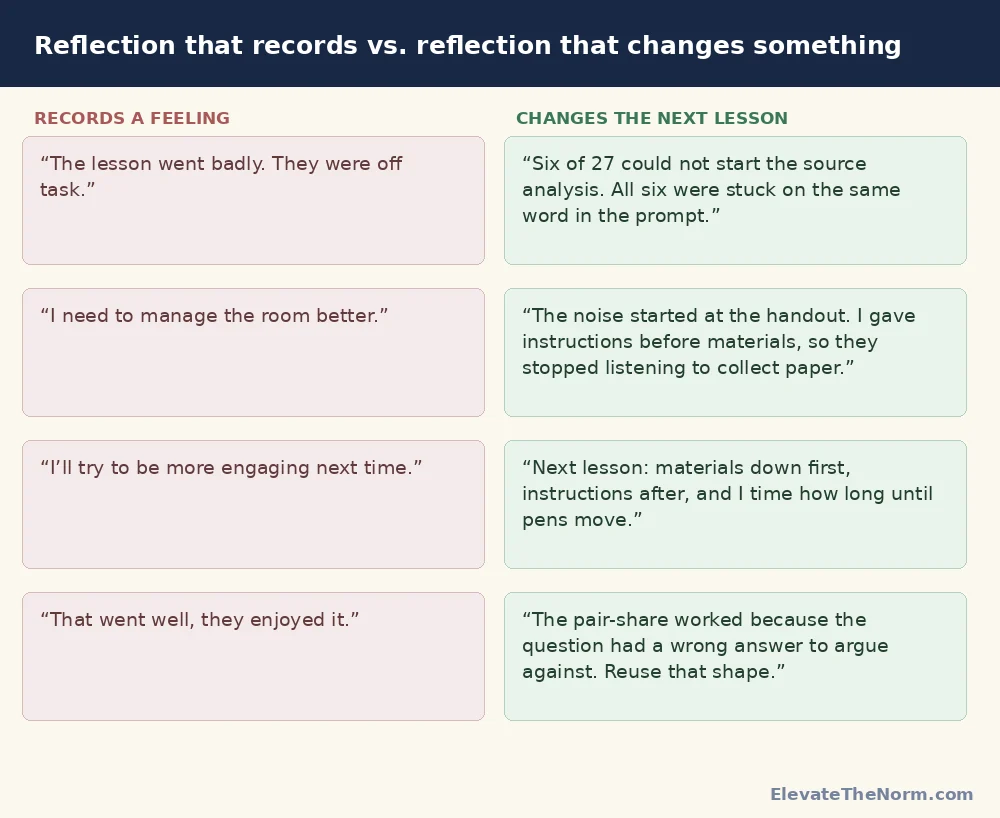
Most published examples do not clear that bar. They are prompts — what went well, what would I change, how did the students respond — and prompts produce answers like “the lesson went badly, they were off task,” which is a description of a mood and cannot be acted on.
Below are seven reflections written out twice: the version that comes naturally, and the version that is actually useful. Then what the evidence says about whether any of this works, including the part that does not support it.
Key Takeaways
- A reflection is usable when it names evidence, cause, change and check. Missing any one of the four and it stops short of a decision.
- Write the number, not the feeling. “Six of 27 could not start” tells you where to go; “they struggled” does not.
- Assume the plan before you assume the students. Most of what looks like behaviour is a sequencing problem in the lesson.
- Reflect on the lessons that went well. Nobody does, and it is where the transferable design decisions are.
- Coaching that is built on structured reflection has real but modest effects — pooled at 0.49 SD on instruction and 0.18 SD on achievement across 60 causal studies, and much smaller when programmes scale up.
- Reflection required for assessment tends to become performative. Researchers have documented pre-service teachers writing what will mark well, and some faking it outright.
- One variable at a time. A change you cannot check is a resolution, not a reflection.
Free Download · Printable PDF
Teacher Reflection Journal
Four short formats — a five-minute after-lesson reflection, a weekly pattern review, a midyear reset, and a small-change experiment sheet. The printable version of the structure in this article.
Free. No email address required. Designed for grades 6–12. See what is inside on the teacher reflection template page.
What Separates a Useful Reflection From a Performative One
A reflection is useful when a colleague could read it and know what you are going to do differently. That is the whole test, and most reflective writing fails it.
The research community has been blunt about this for a long time. A review of reflective practice in teacher education opens by conceding that reflection is a concept that can be “too big, too vague, and too general for everyday application” — quoting Korthagen and Wubbels, who wrote that in 1995. Thirty years on it is still the honest summary.
The same review documents what happens when reflection is required and graded. Pre-service teachers learn to include the classroom evidence they know will mark well, and the authors note that some “may even fake their reflection” to satisfy a supervisor. Reflective journals fill up with “long, simple descriptions of classroom routines without producing deep reflection” — writing the authors call unproductive. If you have ever sat through a mandated reflection exercise and felt it was theatre, that instinct is supported by the literature.
So the problem is not that teachers do not think about their teaching. Teachers think about their teaching constantly, usually in the car. The problem is that the written form we have been handed rewards narration, and narration does not survive contact with next week.
Four questions fix most of it.
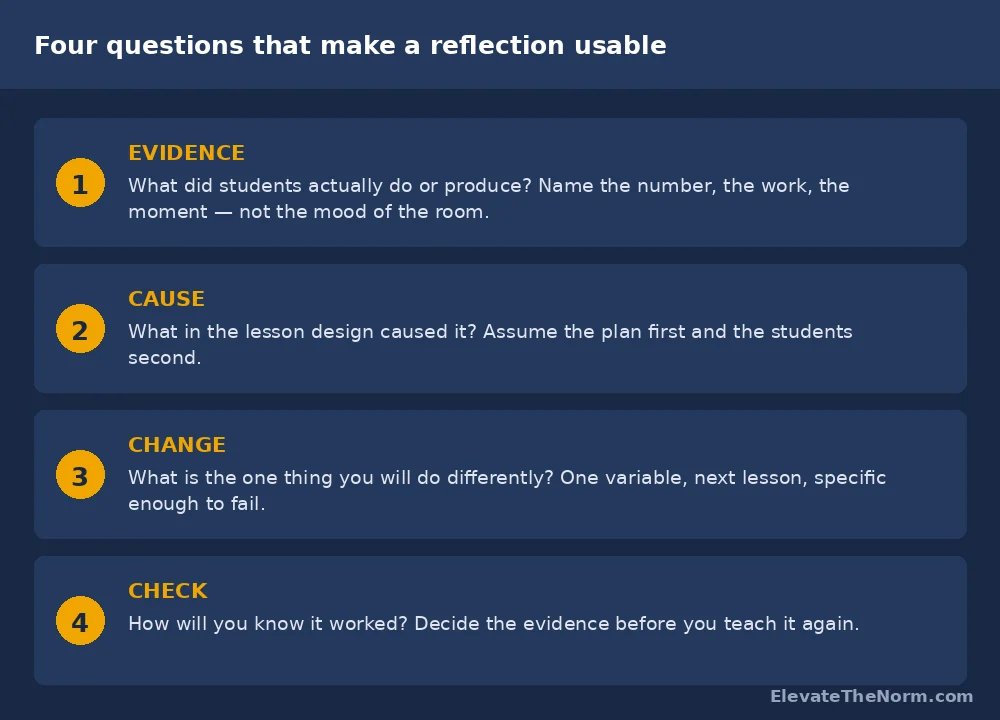
Evidence. What did students actually do or produce? A count, a piece of work, a specific moment with a time on it. Not the temperature of the room.
Cause. What in the lesson design produced that? Assume the plan first and the students second — not out of humility, but because the plan is the part you control.
Change. One thing, next lesson, specific enough that it could visibly fail.
Check. How will you know? Decide the evidence before you teach it again, because deciding afterwards means deciding whether you feel it worked.
Seven Teacher Reflection Examples, Written Out
Each of these is a real situation in a secondary classroom, written the way it usually gets written and then written the way it earns its five minutes. Read the second version of each and notice how much of it is simply more specific.
1. A lesson that fell flat
What most of us write: Today’s lesson did not go well. The kids were off task and I had to keep redirecting. I need to work on engagement.
What is worth writing: Six of 27 could not begin the source analysis. I checked their papers at the end and all six had stopped at the same word in the prompt. The task was not too hard; the prompt was. Next lesson I read the prompt aloud once and ask one student to say it back before anyone starts. I will know it worked if I can walk the room in two minutes and see every pen moving.
The first version blames the room. The second locates a single word on a single page, which is a problem small enough to fix.
2. A lesson that went well
What most of us write: That went really well. They enjoyed it and the discussion was great.
What is worth writing: The pair-share worked because the question had a defensible wrong answer in it — they were arguing against something rather than producing an opinion from nothing. That is the transferable part, not the topic. Next unit I write the discussion question as a claim I do not believe and see whether the same thing happens.
Almost nobody reflects on a good lesson, and it is the most expensive habit in the profession. A lesson that worked contains a design decision you could reuse for years, and if you do not name it within a day you will remember only that the topic went down well.
3. An assessment whose results surprised you
What most of us write: The test results were disappointing. They clearly did not revise.
What is worth writing: Question 4 was missed by 19 of 27, and 14 of those gave the same wrong answer. That is not a revision problem, it is a misconception I taught. Looking back at my slides I introduced the term in a caption and never said it aloud. Re-teach Thursday with the term spoken, defined and used three times, then re-ask question 4 as an exit ticket.
A shared wrong answer is the single most useful thing in a set of marks. Scattered wrong answers mean students did not know; the same wrong answer means somebody taught it, and that somebody is usually in the room at the front. This is also the clearest example of why checking for understanding during the lesson beats discovering it on the test.
4. A behaviour moment you handled badly
What most of us write: I lost my patience with a student today. I need to be more consistent.
What is worth writing: I corrected a student across the room instead of walking over, and the room turned to look. The correction was fair and the delivery made it a public event, which is why it escalated. The trigger was that I was mid-sentence and did not want to stop. Next time I stop the sentence. It costs four seconds.
Note what the better version does not do: it does not moralise, and it does not promise to be a better person. It identifies the mechanism — not wanting to interrupt myself — and prices the fix. Four seconds is a cost you can actually agree to pay. “Be more consistent” is not. Most of what gets filed under classroom management dissolves this way under a specific enough question.
5. A student who has quietly disengaged
What most of us write: I am worried about one student. They seem checked out lately and I am not sure what is going on.
What is worth writing: One student has not volunteered in three weeks and handed in two of the last four tasks. Going back through my seating notes, it started the week I moved them to the group by the window. I do not know whether that is the cause. Next week I move them back, say nothing about it, and count contributions for five days.
Reflection about a specific student is where teachers are most likely to drift into speculation about home life, which is both unknowable and not actionable. The better version stays inside the four walls you control, tests one change, and refuses to diagnose. It also carries an honest I do not know whether that is the cause, which more reflective writing should.
One caveat on this example, and it is the one this site would insist on. Quietly running an experiment on a teenager is a reasonable second move, not a reasonable first one. The first move is usually to ask them — briefly, privately, without making an event of it. Students generally know why they stopped, they are rarely asked, and a reflection that begins “I asked and they said” is better evidence than anything you can infer from a seating chart.
6. A small-change experiment
What most of us write: I am going to try to make my starters better this term.
What is worth writing: For two weeks the starter is on the board before the bell and I say nothing until every pen is moving. Everything else stays the same. I am timing from bell to first instruction, every period, and writing the number down. If it has not moved by the end of week two, the starter is not the variable.
This is the format worth building a habit around, and it is the one most reflection templates miss. One variable, everything else held still, a number written down. It is also the only version of “I want to improve my practice” that can be wrong — which is what makes it worth doing. The same discipline is what makes a classroom routine hold rather than drift.
7. A reflection written for an observation or evaluation
What most of us write: I felt the lesson met the standard. Students were engaged throughout and the objective was clear on the board.
What is worth writing: The objective was on the board and I did not refer to it after minute three, so I cannot claim it shaped the lesson. What did work was the mid-lesson check — I stopped at minute 22, took three answers, and changed the second task because two of the three were wrong. If you are assessing responsiveness, that is the moment to look at. The starter was weak and I would cut it.
The instinct in an evaluation reflection is to defend the lesson. It is a bad instinct and experienced observers can see it from the doorway. A reflection that concedes a weak starter and points the observer at the strongest ninety seconds reads as a teacher who watches their own room — which is the thing being assessed. This sits alongside what we ask students to do after a mistake, and the asymmetry is worth noticing.
That advice assumes an evaluator acting in good faith, and it would be dishonest not to say so. If you are untenured, on an improvement plan, or working for someone who collects admissions rather than uses them, candour on an evaluation document is a different calculation and you are entitled to make it differently. Write the unguarded version for yourself. Decide separately how much of it goes on a form that lands in a personnel file.


What the Evidence Actually Supports
Here is where most articles on this topic overclaim, so it is worth being careful. There is no good body of evidence that keeping a reflective journal, on its own, improves student outcomes. What there is evidence for is structured reflection with another person attached to it — which is coaching.
Kraft, Blazar and Hogan pooled 60 studies using causal designs and found effects of 0.49 standard deviations on instruction and 0.18 on student achievement. Those are meaningful numbers for professional development, which mostly produces nothing measurable at all.
Read the second half of their finding too. Average effects from effectiveness trials of larger programmes are, in the authors’ words, only a fraction of the effects found in efficacy trials of smaller ones. Coaching works best in the conditions of a well-run study and degrades as it scales, which is a caution for any district planning to roll it out to everyone in August.
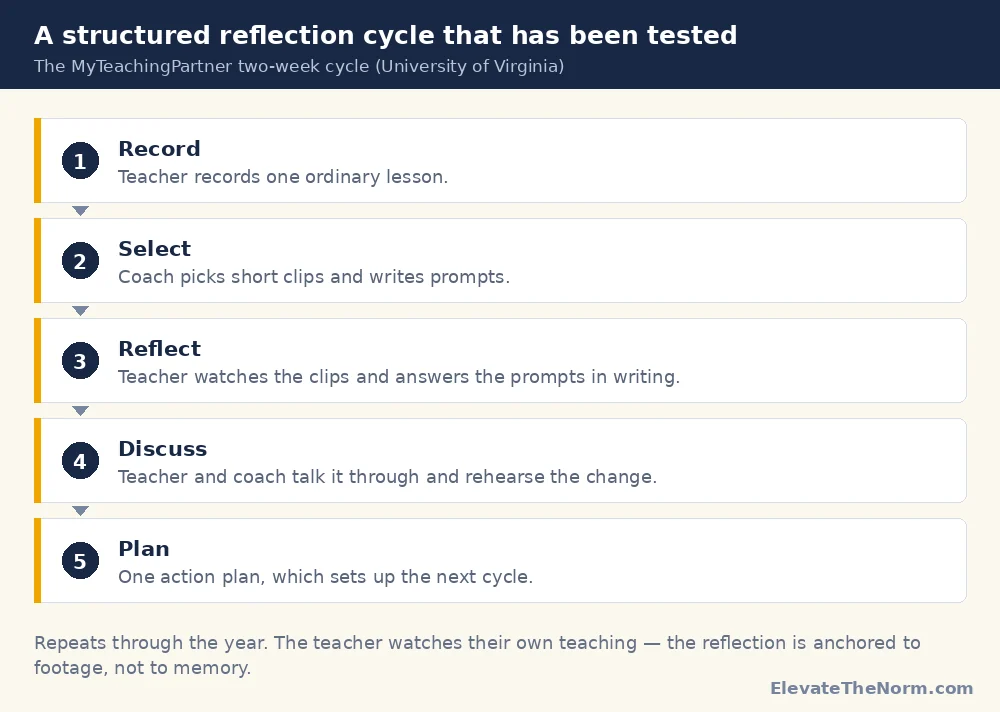
The most-cited structured version is MyTeachingPartner, developed at the University of Virginia and used in secondary classrooms. The cycle runs every two weeks: the teacher records an ordinary lesson, a coach selects short clips and writes prompts, the teacher watches and responds in writing, the two of them discuss and rehearse, and it closes with one action plan that sets up the next cycle. The coach deliberately selects clips showing what the teacher did well rather than cataloguing faults.
And the honest counterweight, which belongs here. A more recent randomised controlled trial of MyTeachingPartner-Secondary run by the American Institutes for Research found no significant impact on student achievement in the first year or after two. The one statistically significant result was teachers’ enthusiasm about teaching. The researchers note the trial began in 2021, that pandemic disruption cut enrolment and implementation, and that this made the study less sensitive to impacts — so it is not a clean refutation. It is a reminder that this is a contested area and that a teacher who reflects diligently and sees no change in their results has not done it wrong.
The defensible position: structured reflection reliably changes what teachers do, improves how they feel about the job, and moves student outcomes modestly and inconsistently. That is enough to justify five minutes after a lesson. It is not enough to justify a mandated journal.
Worth separating the two costs, because they are not remotely alike. Coaching is the version with the evidence behind it and it is expensive — trained coaches, release time, recording equipment, and a scheduling problem in every building that adopts it. The four lines described in this article cost a pen and five minutes. A district deciding what to fund should know that the cheap version is the one with the thinner evidence, and that buying the expensive version at scale is precisely where the measured effects have historically shrunk.
The Reflection That Cost Me Nine Minutes
The most useful reflection I have written came out of the worst five minutes I have spent in front of a class.
I had laid out the plan and stopped talking, which is the whole method — organisation to the minute, then the pause — and I waited. I have never been more uncomfortable at work. It went past a minute, then past three. When the room finally came round, that section finished nine minutes behind my other classes, and I assigned homework to close the gap. It is the only time I have ever assigned homework.
The reflection that mattered was not the pause works. It was the nine minutes. A technique with a price tag written next to it is a technique you can make a real decision about: I know what it costs, I know what it bought, and I can tell you the conditions under which I would pay again. Almost everything written about waiting students out leaves the number off, and leaving the number off is how advice becomes useless.
That is what a good reflection does that a good instinct cannot. The instinct remembers that it worked. The written version remembers what it cost.
Making This Take Five Minutes
The realistic objection is time, and it is correct. Here is the version that survives a teaching week.
- Do not reflect after every lesson. Pick one class and one week. Reflecting on everything produces the shallow descriptions the research warns about.
- Write four lines, not four paragraphs. Evidence, cause, change, check. If it runs longer you are narrating.
- Do it inside ten minutes of the lesson ending — the specific detail is gone by the drive home, and the specific detail is the entire value. If the next class is already walking in, which is most of the time, put three words in your phone and write it properly at planning.
- Keep the good lessons in the same place as the bad ones. Most teachers only write when something hurt, which produces a record that reads like a problem list.
- Reread last month before you plan next month. One reflection is a note; twelve are a pattern, and the pattern is usually not what you would have guessed.
If you want the four formats already laid out — after-lesson, weekly pattern review, midyear reset and small-change experiment — they are in the free journal, and the teacher reflection template page explains what each one is for.
Reflection has a limit worth naming, though. When the workload itself is the problem, rethinking how you carry 120 students instead of five separate classes does more than any journal entry will.
Before you go: grab the free Teacher Reflection Journal (PDF) — ElevateTheNorm.com branded, printable, no email required.
Frequently Asked Questions
What is a good example of a teacher reflection?
One that names evidence, a cause, a change and a way to check it. “Six of 27 could not start the task, and all six stopped at the same word in the prompt — next lesson I read the prompt aloud and have a student say it back, and I will know it worked if every pen is moving within two minutes.” Compare that with “the lesson went badly, they were off task.” Both describe the same hour. Only the first one tells you what to do.
How long should a teacher reflection be?
Four lines and about five minutes, written within ten minutes of the lesson ending. Length is not a virtue here — research on reflective journals in teacher education found them filling with long descriptions of classroom routines that produced no actual reflection, and the authors described that writing as unproductive. If your reflection is running to paragraphs, you are almost certainly narrating the lesson rather than deciding anything.
Should I reflect after every lesson?
No, and trying to is the most common way teachers give this up in October. Pick one class and one week at a time. Reflecting on five lessons a day guarantees the shallow, dutiful writing that makes the practice feel pointless. One class, four lines, for a fortnight will tell you more than a term of doing it everywhere.
Does teacher reflection actually improve student outcomes?
Modestly and inconsistently, and the honest answer depends on what is attached to it. There is no strong evidence that a private journal alone moves student results. Structured reflection with a coach does better — a meta-analysis of 60 causal studies found 0.49 SD on instruction and 0.18 SD on achievement — but the same analysis found effects shrink sharply when programmes scale, and a recent randomised trial of a leading video-coaching programme found no significant achievement impact at all. Reflect because it changes your decisions. Do not promise yourself a test-score jump.
What should I write in a reflection after an observation?
Concede the weakest part and point the observer at the strongest ninety seconds. The instinct is to defend the lesson, and experienced observers read that instantly. Saying “the starter was weak and I would cut it, but the mid-lesson check at minute 22 is where I changed the second task” demonstrates the thing being assessed — that you watch your own room — far better than a paragraph explaining why everything went to plan.
Why should I reflect on lessons that went well?
Because that is where the reusable design decisions are, and nobody looks. A lesson that worked usually worked for a structural reason — the question had a defensible wrong answer in it, the materials went down before the instructions — and if you do not name that reason within a day, all you will retain is that the topic went down well. Writing only after difficult lessons also builds a record that reads like a list of failures, which is discouraging and inaccurate.
Is it a problem to write reflections that mention individual students?
It can be, and it is worth thinking about before you fill a notebook. A written note about an identifiable student sits closer to a record than most teachers assume, and depending on where you work and where it is stored it may be something a parent can ask to see, or something that surfaces in a dispute. None of that makes it wrong — it makes it worth writing as though someone might read it. Describe the behaviour and the work rather than the child, leave speculation about home out of it entirely, and if a reflection is really about a concern rather than your own practice, it probably belongs in your school’s actual documented channel instead. Your district almost certainly has a policy on this; it is worth ten minutes to find out what it says.
Is it worth reflecting if nobody reads it?
Yes, but change what you write. Reflection written for a supervisor drifts towards what marks well — researchers have documented pre-service teachers selecting evidence to please an assessor, and some fabricating reflections outright. Writing that nobody will grade is free to record the thing that actually went wrong, which is the only version with any diagnostic value. If you do want another reader, a trusted colleague who teaches the same students is worth more than a form.
Sources
- Kraft, M. A., Blazar, D., & Hogan, D. (2018). The effect of teacher coaching on instruction and achievement: A meta-analysis of the causal evidence. Review of Educational Research, 88(4), 547–588. Read the record — 60 studies with causal designs; pooled 0.49 SD on instruction and 0.18 SD on achievement. Figures here are taken from the ERIC abstract, which also states that effects from larger effectiveness trials are only a fraction of those from smaller efficacy trials.
- Sayed, A. (2022). Reflective practice in teacher education: Issues, challenges and considerations. Read the paper (PDF) — source for the “too big, too vague” characterisation (quoting Korthagen & Wubbels, 1995), for faked and strategically written reflections, and for journals filling with unproductive description. This is a review of the literature in pre-service teacher education, not a study of practising secondary teachers.
- Center for Advanced Study of Teaching and Learning, University of Virginia. MyTeachingPartner. Read the programme description — source for the five-step, two-week video reflection cycle described above.
- American Institutes for Research. MyTeachingPartner-Secondary: Scaling and sustaining research-based teacher professional development. Read the project page — randomised trial beginning 2021; no significant impacts on student achievement in year one or after two years; teachers’ enthusiasm about teaching was the one significant result. AIR states that pandemic disruption reduced enrolment and implementation and made the trial less sensitive to impacts.
Every link above was checked on September 17, 2026. Where a primary paper was not reachable, the source actually read is the one cited — the Kraft meta-analysis figures come from the ERIC record rather than the journal PDF, and are labelled as such.