By Clay Shumate
The first year is harder because you are doing the job without the things that make it doable later, not because you are weaker than the people around you. A fifth-year teacher opens a folder that already works. You are building that folder in real time, while the bell keeps ringing. Year one is a resource problem before it is a character problem.
This page is about what is specifically different about year one. If you want the definition and the three dimensions of the word itself, start with the groundwork the rest of this series is built on. For the demand side at classroom resolution, what the loads actually consist of and how good the evidence is covers it and this page does not repeat it. This one answers a narrower question: what does a first-year teacher not have yet, and what can be done about it before June?
Key takeaways
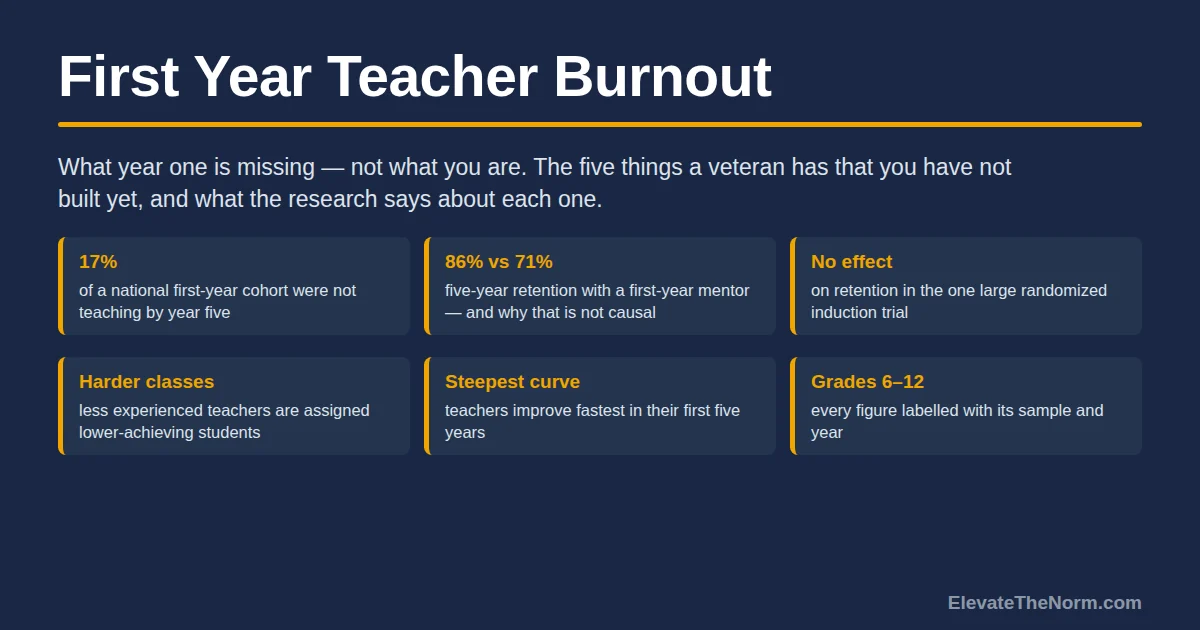
- Most first-year teachers do not leave. In the federal study that followed a national cohort of about 1,990 first-year public school teachers, 10 percent were not teaching in year two and 17 percent were not teaching by year five. The line about half of new teachers quitting inside five years does not come from that data.
- Year one is a resource problem more than a demand problem. The job is not heavier than it will be in year five. Your side of the ledger is emptier.
- Five things a veteran has are accumulated, not innate: a bank of materials, a read on which behavior matters, relationships with families, a settled routine set, and somebody they can ask.
- First-year teachers who had a mentor stayed at higher rates — about 86 percent against 71 percent at year five — but that is a correlation. The one large randomized trial of a full induction program found no effect on retention at all.
- New teachers are often handed lower-achieving classes than colleagues in the same building. In a large district study covering grades 4–11, time at that particular school predicted a better assignment more than teaching experience elsewhere did.
- Teachers improve fastest in their first few years. Year one is the steep part of a learning curve, not a verdict.
- Burnout is an occupational condition, not a diagnosis you can give yourself from a web page. Nothing here is a screening instrument.
The Year-One Inventory
Two printable pages. A write-in sheet for the five things a first-year teacher has not built yet, plus the request that goes with each one and who to take it to. It is a sorting sheet, not a screening instrument, and it returns no score. Free. No email address required. Designed for grades 6–12.
Download the free PDFWhy is the first year harder than the years after it?
Because almost everything a veteran teacher runs on was built over time, and you are building yours while teaching full time.
Think of it as stock and flow. The flow — five classes a day, the grading, the emails, the duty — is roughly the same for you as for the teacher across the hall. The stock is not. They have four years of lessons that already survived contact with actual teenagers. You have a syllabus and a pacing guide. Every single thing you teach this year is a first draft written the night before, and first drafts take three times as long as revisions.
The same gap shows up in decisions. A veteran walking into a room where two students are arguing has seen that exact shape of argument forty times and knows in a second whether to say anything. You have not, so you think about it. Multiply that by every small call you make in a day and the same job is genuinely more tiring for you than for the person next door.
None of that is a statement about your ability. It is a statement about elapsed time.
The research on how teachers get better says the same thing from the other direction. Papay and Kraft tracked more than 3,500 teachers in one large urban district over nine years and found improvement is fastest early — roughly 0.08 standard deviations in math and 0.05 in reading across the first five years, then continuing afterward at 45 to 60 percent of that rate. Label it properly: grades 4 through 8, one district, test scores only. But the shape is the point. Year one sits at the steep part of a curve, struggling there is what that curve looks like from inside it, and it is also where practice and coaching pay back fastest.
Do most first-year teachers burn out and quit?
No. The federal data says most of them stay.
The National Center for Education Statistics followed a national cohort of roughly 1,990 first-year public school teachers who started in 2007 or 2008, and checked on them every year for five years. Ten percent were not teaching in year two. Twelve percent were not teaching in year three, 15 percent in year four, and 17 percent in year five.
Read the limits with the number. That is one cohort, and it ran from 2007–08 through 2011–12, so it is not a report on this year’s teachers. NCES also notes that people leave and come back, so the year-by-year figures are not a simple running total of departures. And it measures leaving, which is not the same thing as burning out — plenty of people stay in the classroom and are not all right. that is a different question with its own answer.
Still, the myth matters. New teachers get told the half-quit-in-five-years version constantly, usually by someone who means it kindly. What it tells somebody having a bad October is that failure is the normal outcome. It is not.
What does a first-year teacher not have that a fifth-year teacher does?
Five things, and all five are accumulated rather than innate.

- A bank of materials. Lessons, readings, slides, assessments and rubrics that have already been run once and fixed. This is the biggest single one, and it is the reason your evenings are longer than theirs.
- A read on behavior. Knowing which behavior needs a response right now, which is a student having a bad morning and will pass on its own, and which never needed one. That is a judgment about situations, not about which students are worth your time, and it is learned by seeing a few hundred of them.
- Relationships with families. A fifth-year teacher has often taught an older sibling. The families are not the problem here; the cold start is. That first phone call is simply a different call when the name on the other end already means something.
- A settled routine set. Entry, transitions, materials, closing. A veteran runs these without thinking. You are inventing and revising them at the same time you are enforcing them. the mechanics of building those is most of the work of a first semester.
- Somebody to ask. A specific person who will answer a question in 40 seconds without it turning into a meeting or a referral. This is the one most often missing entirely.
Notice what is not on that list: talent, toughness, or how much you care. Every item is something a person acquires by being somewhere for a while. That is also why the year-one money problem is real — with no accumulated classroom stock you buy more of it, and teachers in RAND’s 2026 national survey reported spending a little over $600 out of pocket on school supplies. that spending is part of a wider pattern and it lands hardest on the person who has nothing in the cupboard yet.
Does having a mentor actually keep new teachers in the job?
The correlational evidence says yes. The one large randomized trial says no. The honest answer depends on what the word mentor means in your building.

Start with the association. In that same federal cohort, first-year teachers who were assigned a mentor were still teaching at year five about 86 percent of the time, against about 71 percent of those who were not. That is a fifteen-point gap and it is not nothing. It is also not an experiment: nobody assigned mentors by coin flip, and schools that bother to assign mentors differ from schools that do not in a dozen other ways.
Two more studies point the same way. Ronfeldt and McQueen, using three rounds of the federal Schools and Staffing and Teacher Follow-Up surveys plus that same beginning-teacher cohort, found induction supports in the first year predicted less migration and less attrition among nationally representative samples of first-year teachers. Ingersoll and Strong’s review of 15 empirical studies found most reported positive associations between induction and commitment, retention, practice and achievement.
Then there is the experiment. The Institute of Education Sciences randomly assigned 1,009 beginning teachers across 418 schools in 17 urban districts and 13 states either to a comprehensive induction program — a full-time mentor, structured observation, ongoing professional development — or to whatever their district already did. The finding, in the report’s own words, was that there was no impact on teacher retention over the first four years of the teachers’ careers. Trained observers also found no significant differences in classroom practice. Districts that ran two years of the program showed a student achievement gain in the third year, 0.11 standard deviations in reading and 0.20 in math, but that result shrank away when the sample was widened.
Two things have to be said about that trial rather than around it. The schools in it were elementary schools, so it is the best-designed study in the pile and it is not a grades 6–12 result. And what it tested was a program, delivered at district scale, which is not the same object as the person two doors down who actually answers your questions.
The summary that survives all four studies: a real mentor is worth asking for, and a mentor on paper is not the thing that will save your year. If yours is nominal, that is a fact about the assignment, not a fact about you, and it is worth naming to somebody with a title rather than absorbing.
There is a district-level reading of that null result too, and it is not that induction is pointless. It is that buying an induction program is not the same transaction as buying retention. The trial spent real money on full-time mentors and structured observation and moved no retention needle in four years, which suggests the thing that keeps a new teacher is closer to the daily conditions of the job than to the program wrapped around it.
Are you being handed a harder schedule than the teacher across the hall?
Often, yes, and it usually reflects standing inside the building rather than any judgment about your teaching.
Kalogrides and Loeb looked at 67,697 teacher-year records in one of the largest districts in the country, covering grades 4 through 11 from 2003–04 through 2010–11. Less experienced teachers were assigned lower-achieving students. A ten-year increase in experience was associated with roughly a third of a standard deviation increase in the average prior achievement of a teacher’s students, and teachers with 10 to 20 years had classes whose prior achievement ran .10 to .20 standard deviations above their first-year colleagues in the same school.
The detail that matters most is which kind of experience did the work. Time at that school predicted a better assignment; experience at other schools in the district did not. That pattern points at seniority and standing rather than at skill, which is the honest reading and also the uncomfortable one.
Read it carefully, though. It is one district, it is observational, and the authors say outright that they cannot fully separate deliberate preference from habit, though they report similar patterns in two other large districts. What it gives you is permission to stop treating your schedule as evidence about your ability. If your day really is harder than your neighbor’s, you may simply be right — and a schedule is one of the few things somebody with a title can change in an afternoon.
It is worth saying the other half of that finding out loud, because it is not really about teachers at all. If the least experienced staff systematically get the lowest-achieving classes, then the students with the furthest to go are the ones most often taught by somebody in their first draft of the job. That is a scheduling decision made building by building, usually without anyone intending it, and it is a fairness problem that belongs to whoever builds the master schedule rather than to the new teacher standing in front of the room.
What can you change in year one without anyone’s permission?
Less than the advice books promise, but not nothing — and the useful moves all build stock rather than spend energy.
- Pick three routines and run them identically every day. Entry, transitions, closing. Consistency is cheaper than improvisation and it buys back more minutes than any app. the new-teacher version of that is the place to start.
- Stop building what already exists. Ask your department for last year’s unit files before you write a single slide. Most people hand them over and are mildly insulted nobody asked. Ask rather than help yourself — some of it is the district’s and some of it is that person’s own work — and adapt what you get to your students instead of running it blind. Inherited materials save you the blank page, not the thinking.
- Make one thing reusable per week. One lesson cleaned up and saved properly. By May that is thirty-odd pieces of stock you did not have in August, which is the entire mechanism by which year two is easier.
- Write down what happened, not how it felt. Two lines after the class that went wrong: what you did, what the room did. kept this way it is a record you can act on, and in a month it is data rather than a mood. Write the situation, never a student’s name. A private notebook about your own teaching is a useful thing; a running file on individual teenagers is a different object with rules attached to it, and you do not want to have made one by accident.
What is not on the list is pushing through. Nobody in your building gets credit for outlasting a badly resourced year, and treating exhaustion as a rite of passage is how a fixable first year becomes a much longer problem to climb back out of.


What should you ask for, and who should you ask?
Ask one named person for one specific, small thing, and expect to hear no or not this year sometimes.
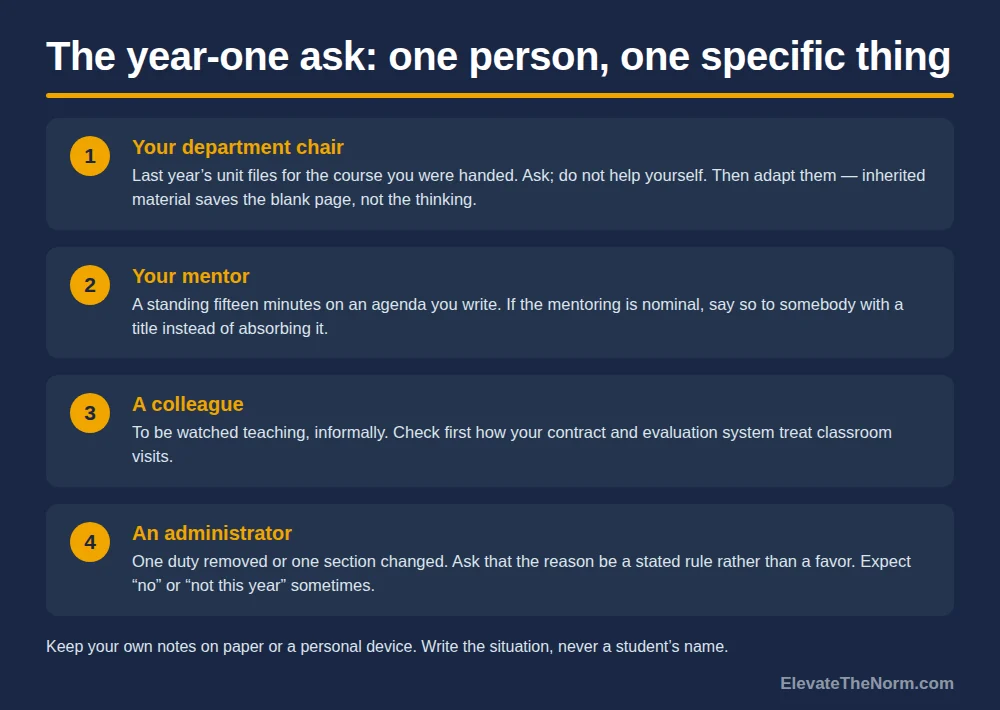
Vague requests get vague answers. “I’m drowning” is true and unanswerable. “Can I have the unit files for the course I picked up in August” is answerable in ten seconds. Four requests worth making, roughly in order of how easy they are to say yes to: existing materials from your department chair; a standing fifteen minutes with your mentor on an agenda you write; one colleague willing to be watched teaching, informally; and, from an administrator, one duty removed or one section changed. Check how your contract and evaluation system treat classroom visits before you set the informal one up, since in some places an observation is a defined thing with paperwork behind it.
That list assumes a department to ask, and plenty of secondary teachers do not have one. If you are the only person in the building teaching your course — which happens constantly in electives, in small schools, and in any position that turned over in July — the request changes shape rather than disappearing. Ask whoever taught the course last, if they are still on staff. Ask your state department or subject association, which usually publish sequenced units for free. Ask a teacher of the same course at another school in the district; people say yes to that more often than new teachers expect. The goal is the same either way: do not write from a blank page if a page already exists.
Go through the normal chain first — chair, then assistant principal, then principal. And if a duty does come off your plate, it is fair to ask that the reason be a rule rather than a favor, because a public criterion protects you from resentment down the hall more than quiet special treatment does.
One practical caution. Keep your own notes about how the year is going on paper, or on a personal device. A district laptop and a district account are not private places to write down that you are not coping.
When is this bigger than a first-year problem?
When it stops lifting on weekends and breaks, or when it is showing up in your sleep, your body or your health.
Burnout is an occupational condition — something that happens to a person in a job, described by how the job is going. It is not a diagnosis, and nothing on this page or any page can tell you whether you have one. That is also why this site publishes no burnout quiz: a score would imply a threshold, and there is no clinically validated cutoff to put a threshold on.
So the honest answer here is the unglamorous one. If the exhaustion is not lifting when you are away from the building, or if you are seeing it in your sleep, your appetite or your health, talk to your doctor or a counselor. That is a conversation with a person, not a result from a page.
What to do this week
Three things, in order. Ask one person for one existing set of materials — that is the single highest-return hour available to you right now. Pick the one routine that is costing you the most minutes and run it the same way five days running. And save one lesson properly, cleaned up, where you will find it next year.
Then write down what the week actually took, so that when you ask for something bigger you have specifics instead of a feeling. The inventory below is that, on two printed pages. Year one is short of stock, not short of you, and most of that gap closes by simply still being there in September.
Want the inventory as a printable? Download The Year-One Inventory (2 pages, free, no email required) and fill it in before your next conversation with your chair.
Frequently asked questions
Is first year teacher burnout normal?
Finding year one exhausting is close to universal, and it is not the same thing as burnout. The first year is harder because you have none of the accumulated stock a fourth or fifth year runs on — materials that already work, a read on behavior, relationships with families, settled routines, and a person you can ask. Burnout is a specific occupational condition with three dimensions, and a hard first year is not automatically it. If the exhaustion does not lift on weekends and school breaks, that is the signal worth paying attention to, and the next step is a conversation with a person rather than a checklist.
Do half of new teachers really quit within five years?
No. That figure does not come from the federal data. The National Center for Education Statistics followed a national cohort of about 1,990 first-year public school teachers who started in 2007 or 2008 for five years: 10 percent were not teaching in year two, 12 percent in year three, 15 percent in year four and 17 percent in year five. Three caveats belong with it. It is a single cohort, it ran from 2007–08 to 2011–12 rather than today, and NCES notes that teachers leave and return, so the yearly figures are not a running total of permanent departures.
Does having a mentor stop new teachers from burning out?
The evidence is genuinely mixed and it is worth knowing why. In the federal cohort, first-year teachers assigned a mentor were still teaching at year five about 86 percent of the time against about 71 percent of those who were not — but nobody assigned mentors at random, so that is an association, not a cause. The one large randomized trial, which assigned 1,009 beginning teachers across 17 urban districts to a comprehensive induction program or to business as usual, found no impact on retention over four years and no measurable difference in classroom practice. Those schools were elementary schools. The practical reading: a mentor who actually answers your questions is worth asking for, and a mentor who exists only on a form is not the thing that will carry your year.
Is my child worse off with a first-year teacher?
On average, less experienced teachers are somewhat less effective on test-score measures, and it is fair to want to know that. The size matters, though: the research on how teachers improve finds gains of roughly 0.08 standard deviations in math across the first five years, which is real but modest, and improvement continues well past year five. The larger fairness question is not about any individual teacher. It is that assignment is systematic — in a large district study covering grades 4 through 11, the least experienced teachers were consistently given the lowest-achieving classes, with time at that particular school predicting a better assignment more than teaching experience did. That is a scheduling decision, and it is a reasonable thing to ask a principal about.
Are students to blame when a new teacher struggles?
No. A first-year teacher is doing the job without materials, without a read on which behavior matters, and often without anyone to ask, and those gaps would make the year hard with any group of students in the room. Behavior shows up as a workload in the research, and that is a statement about how much of the job is unstructured, not about who is sitting in the desks. Nothing a student does makes them responsible for how a school resourced someone’s first year.
What should a first-year teacher ask for, and from whom?
One named person, one specific request, small enough to say yes to. Existing unit files from your department chair, a standing fifteen minutes with your mentor on an agenda you write, one colleague willing to be watched teaching informally, and from an administrator one duty removed or one section changed. Work the normal chain — chair, then assistant principal, then principal — and expect “no” or “not this year” sometimes without reading it as a verdict. If a duty does come off your plate, it is fair to ask that the reason be a stated rule rather than a favor.
What if there is no department to ask for materials?
This is common in secondary schools — electives, small buildings, and any position that turned over in July can leave one person teaching a course alone. The request changes shape rather than disappearing. Ask whoever taught the course last if they are still on staff. Your state department of education and your subject association usually publish sequenced units for free. Teachers of the same course at other schools in the district say yes more often than new teachers expect. The principle holds either way: do not write from a blank page when a page already exists.
Is a bad first year a sign I chose the wrong career?
Not on its own, and the timing makes that judgment unreliable. Year one sits at the steepest part of the improvement curve and at the emptiest point of your resources, which is the worst possible moment to evaluate a long-term fit. That is not an argument for staying no matter what, and there are good reasons people leave. It is an argument for making the call with better information — after you have asked for what is missing and seen what the answer is — rather than in February of a year you were under-equipped for.
Sources
- Gray, L., & Taie, S. (2015). Public School Teacher Attrition and Mobility in the First Five Years: Results From the First Through Fifth Waves of the 2007–08 Beginning Teacher Longitudinal Study (NCES 2015-337). National Center for Education Statistics. Approximately 1,990 first-year public school teachers, followed 2007–08 through 2011–12. 10, 12, 15 and 17 percent not teaching in years two through five; first-year mentor associated with 85.5 percent versus 71.4 percent still teaching at year five. The report notes that teachers may leave and later return, so the annual figures are not cumulative departures. nces.ed.gov (PDF)
- Glazerman, S., Isenberg, E., Dolfin, S., Bleeker, M., Johnson, A., Grider, M., & Jacobus, M. (2010). Impacts of Comprehensive Teacher Induction: Final Results From a Randomized Controlled Study (NCEE 2010-4027). Institute of Education Sciences. 1,009 beginning teachers in 418 schools across 17 urban districts in 13 states, randomly assigned. “There was no impact on teacher retention over the first four years of the teachers’ careers.” No significant differences in observed classroom practice. A third-year student achievement impact in two-year districts (0.11 reading, 0.20 math) did not hold when the analytic sample was broadened. The schools were elementary schools, which this article states in the text. files.eric.ed.gov (PDF)
- Ingersoll, R. M., & Strong, M. (2011). The impact of induction and mentoring programs for beginning teachers: A critical review of the research. Review of Educational Research, 81(2), 201–233. A review of 15 empirical studies since the mid-1980s across three outcomes — commitment and retention, classroom practice, and student achievement — with most reporting positive associations, and the large randomized trial above noted as the exception. Abstract read via ERIC; the full text sits behind a publisher paywall and is cited here as a review rather than as a source of effect sizes. eric.ed.gov
- Ronfeldt, M., & McQueen, K. (2017). Does new teacher induction really improve retention? Journal of Teacher Education, 68(4). Drawing on the three most recent administrations of the Schools and Staffing and Teacher Follow-Up Surveys plus the Beginning Teacher Longitudinal Study, receiving induction supports in the first year predicted less migration and less attrition among nationally representative samples of first-year teachers. Predictive, not experimental. Abstract read via ERIC. eric.ed.gov
- Kalogrides, D., & Loeb, S. (with Béteille, T.) (2013). Systematic sorting: Teacher characteristics and class assignments. Sociology of Education, 86(2). 67,697 teacher-year observations in Miami-Dade County Public Schools, 2003–04 through 2010–11, grades 4–11. A ten-year increase in experience was associated with about a third of a standard deviation increase in students’ average prior achievement; teachers with 10–20 years had classes .10 to .20 standard deviations higher than first-year colleagues. School-specific experience predicted assignment where district experience did not. Limitations stated by the authors: a single district (with similar patterns reported in Milwaukee and San Francisco), limited teacher characteristics, and no way to fully separate preference from bias. edpolicyinca.org (PDF)
- Papay, J. P., & Kraft, M. A. (2015). Productivity returns to experience in the teacher labor market: Methodological challenges and new evidence on long-term career improvement. Journal of Public Economics, 130, 105–119. More than 3,500 teachers and over 200,000 student-year records in one large urban southern district, 2000–01 to 2008–09, grades 4–8. Improvement of roughly 0.08 standard deviations in mathematics and 0.05 in reading over the first five years, continuing afterward at 45 to 60 percent of that rate in mathematics. Limitations stated by the authors: a single district, insufficient statistical power for later-career estimates, four modeling approaches producing different estimates, and test scores as “only one important educational outcome.” matthewakraft.com (PDF)
- Steiner, E. D., Levine, R. S., & Doan, S. (2026). Teacher Well-Being, Pay, and Intentions to Leave in 2026: Selected Findings From the 2026 State of the American Teacher Survey (RR-A4404-2). RAND. American Teacher Panel, nationally weighted. Teachers reported spending a little more than $600 out of pocket on school supplies, and 18 percent intended to leave their jobs. Teachers have been more likely than similar working adults to report poor well-being on every indicator since 2021. rand.org
Every source above was opened and read for this article. Where a figure could not be confirmed in the original, it is not on this page.
About Clay Shumate
Clay Shumate is a certified secondary Social Studies teacher in the public schools of West Alabama, with seven years of classroom experience, a B.A. in History, and an M.Ed. in Secondary Education. He writes about project-based learning, student responsibility, respect, and practical ways to hold young people to a higher standard while giving them room to learn from mistakes.