Substitute teacher classroom management is not the same job as classroom management. A regular teacher builds authority over weeks. A substitute has to borrow it in the first four minutes, from a room that already has its own rules, its own seating, and its own sense of what is normal — none of which they wrote. The work is not installing your system. It is running theirs well enough that the day holds.
Most advice on this subject is written as though the substitute controls the outcome. They control some of it. The rest was decided before they ever walked in, by the teacher who wrote the plans — which is the half of this that almost nobody writes about, and the half I can speak to directly.
This page covers what the person walking in actually has to work with, what they can control on the day, and what the regular teacher owes them before leaving.
Key Takeaways
- A substitute’s authority is borrowed, not built. The fastest way to lose a room is to replace its norms with your own on day one. Run the room that exists.
- The person walking in may have twenty hours of training. In Missouri, a substitute certificate requires either 36 semester hours of college or 20 clock hours of approved training. That is the floor in one state, and it is worth knowing before you judge how a day went.
- The first four minutes decide most of it. A visible plan, stated out loud, followed by a pause — not a raised voice.
- Teacher absence is measurable and it is not small. Ten additional days of teacher absence are associated with a decline of roughly 1.7% to 3.3% of a standard deviation in math achievement. The sub day is not a throwaway day.
- Half of substitute classroom management is written the week before, by someone else. Plans that assume the sub knows the room are the single most common failure, and they are entirely preventable.
- A class that tests a substitute is usually not scheming. Nobody knows their name, the day reads as a holding pattern, and the adult has no history with them. Using names and making the work visibly real addresses all three.
The job is not “teach the lesson.” It is “keep the room intact.”
This is the reframe that makes the rest of it workable. A substitute who measures the day by how much content got delivered will almost always finish feeling like they failed. A substitute who measures it by whether the room is handed back in the condition it was handed over — work attempted, norms intact, nobody humiliated, an honest note left behind — has done the actual job.
That is not a lowered standard. It is the correct one. The regular teacher can reteach a lesson. What they cannot easily undo is a room that learned, over one day, that the expectations it runs on are negotiable when a stranger is standing there.
What the person walking in actually has
It is worth being precise about the preparation the job actually requires, because a lot of staffroom commentary about substitutes assumes a level of training that the credential does not demand.
Missouri, as one published example, issues a Content Substitute Certificate to an applicant who has completed either a minimum of 36 semester hours from an accredited college or university, or twenty clock hours of department-approved substitute teacher training. Requirements vary by state and some are higher. But twenty clock hours is a real, current, published floor in at least one state — and the person it describes is expected to walk into a room of thirty teenagers and hold it.
Two things follow. If you are the substitute: the gap you feel between what you were trained for and what the day demands is real, and it is structural rather than personal — the same gap first-year teachers describe in their own rooms. If you are the regular teacher: the plans you leave are not a courtesy. For some of the people who will use them, they are the entire preparation.
A third thing follows for anyone who sets policy. Nothing in the rest of this article is a substitute for a district actually orienting the people it puts in front of students — a building walkthrough, the safety procedures, where the office is, what the behavior system is called. Most of what gets written about substitute classroom management, including everything below, is individuals compensating for a system that hired someone and pointed at a door. The individual workarounds are worth knowing. They are not the fix.
The first four minutes: organization to the minute, and then the pause
The method I use in my own room transfers to a substitute almost unchanged, and it is the one piece of this I would put above everything else: taking control of a room is done by organization to the minute, and then you pause.
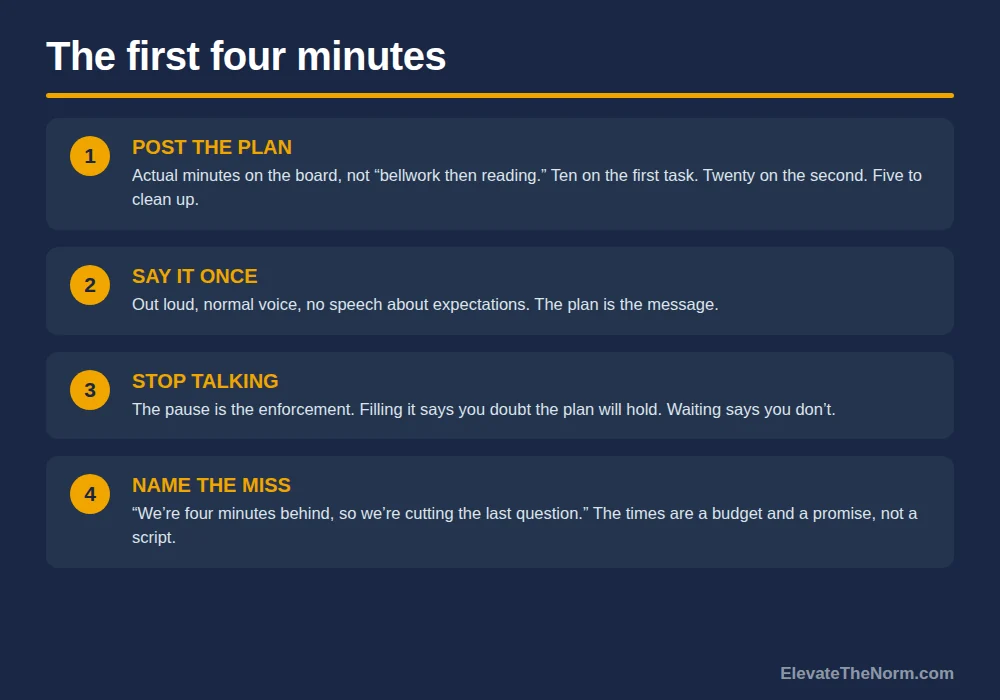
Put the plan where they can see it before the bell. Not “bellwork, then reading” — actual minutes. Ten minutes on the first task. Twenty on the second. Five to clean up. Write it on the board you found it on. Then say it out loud, once, in a normal voice.
Then stop talking.
The pause is the part people skip, and it is the part that works. You have laid out a plan that is visibly organized, and then you let the silence do the enforcement instead of your volume. The instinct is to fill it — to repeat yourself, to add a threat, to get louder. Filling it tells the room you are not sure the plan will hold. Waiting tells them you are.
I should be honest about what that costs, because most versions of “just wait them out” leave the price out. I once held a pause for more than five minutes. It was one of the most awkward moments of my life, that section finished nine minutes behind my other classes, and it is the only time I have ever assigned homework. It worked. It also cost nine minutes and a homework assignment I did not want to give. A substitute will rarely have nine minutes to spend, which is exactly why the posted plan matters — it shortens the pause you need.
One clarification, since this gets misread: the posted times are a budget and a promise, not a script. When you miss them, say so out loud and give the reason. A substitute who announces “we are four minutes behind, so we are cutting the last question” has just demonstrated that the plan is real. That is worth more than hitting the times.
Run their room, not yours
This is where most substitute days are quietly lost, and it rarely looks like a discipline problem. It looks like a reasonable adult correcting something that was never wrong.
In my room, students are almost always working alongside somebody. Partner work is the resting state, not a reward and not a special occasion — the tables are literally grouped that way and there are no rows to return to. A substitute who walks in, sees students talking, and reads it as the room falling apart will spend the period fighting the room’s actual design. They will separate students who were doing exactly what they were supposed to do, and by second period they will have spent all their credibility on a rule that does not exist in that room.
The same goes for the lights. I do not turn the overhead fluorescents on — the room runs on floor lamps around the perimeter. It is a deliberate choice about sensory load, and it helps far more students than the ones who would ever have asked for an accommodation. A substitute’s first instinct on walking into a dim room is to find the switch. Flipping it is a small thing that changes the room the students walked into.
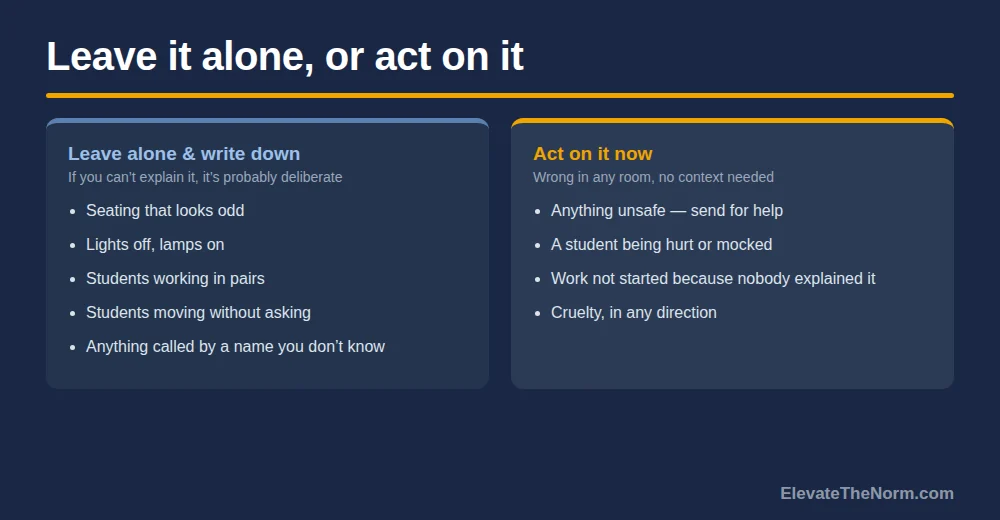
So the working rule is: anything you cannot explain, leave alone and write down. If the seating looks odd, it is probably deliberate. If the lights are off, someone turned them off. If four students get up without asking, there is probably an established procedure for that. Note it, ask afterward, and do not spend your authority correcting a room’s design.
Reserve your authority for the things that are wrong in any room: cruelty, danger, and a flat refusal to engage with work that has been made doable.
That last one needs its qualifier. A student who will not start a worksheet nobody explained is not defying you — they are stuck, and “refusal” is the wrong word for it. Check whether the task is actually doable before you treat not-doing-it as a behavior problem. Most of the time on a substitute day, it is not defiance. It is an instruction gap.
The one line that overrides all of this: if something is unsafe, or a student is being hurt, you do not need permission or context. Send for the neighboring teacher or the office immediately. Knowing where the phone is and who is next door is a two-minute check when you arrive, and it is the only part of this you should never improvise.
Substitute teacher classroom management: five things you can actually control
- Where you stand. Circulating beats presiding. A redirect delivered quietly at close range, to one student, does the work without announcing the problem to twenty-nine other people — and it does not give the room a performance to react to.
- What you say first. Names if you have them, the plan if you do not. “Here is what we are doing and how long it takes” outperforms any version of “I expect you to behave for me today.”
- Your volume. It is the one resource that only decreases. Every notch you spend is gone for the rest of the day.
- What you write down. An honest, specific, unemotional note is the most valuable thing you leave behind. “Third period did not start the reading; two students, seated front left, were the reason” is useful. “Terrible class” is not, and it will be read by someone who has to work with those students tomorrow.
- Whether anybody gets humiliated. This one is not negotiable and it is entirely within your control. You will be gone tomorrow. They will not.
What the regular teacher owes the substitute
If you are reading this as the teacher who is going to be out, this is the section that changes your sub’s day, and it takes about fifteen minutes to write once and reuse all year.
Write it assuming it will be read in five minutes, standing up, by someone who was called at six that morning and has never been in your building. That is the realistic case, not the exception. Put the timed plan and the three things a stranger would misread on the first page, in that order. Everything else can be on page two, where it may or may not get read.
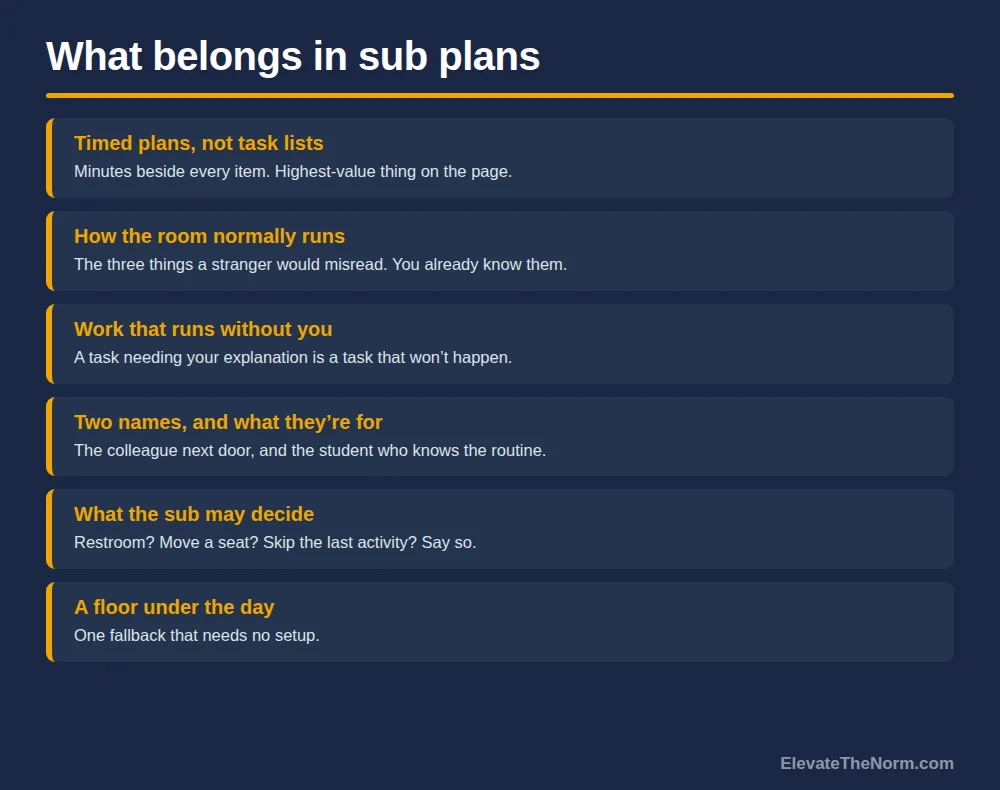
- Timed plans, not task lists. Minutes next to every item. It is the single highest-value thing on the page, for exactly the reason in the section above.
- A one-paragraph description of how your room normally runs. Partner work is expected. The lights stay off. Students may get water without asking. Write the three things a stranger would most likely misread — you already know what they are.
- Work that can actually be done without you. A task that depends on your explanation is a task that will not happen, and the gap gets filled with whatever the room decides to do instead.
- Two names, and what they are for. The colleague next door and the student who genuinely knows the routine. Not a list of “problem” students — a list of doors to knock on.
- What a substitute is allowed to decide. Can they let a student use the restroom? Move a seat? Skip the last activity? Say so, or you have left someone to guess and then be wrong.
- Where the day goes if it falls apart. One genuinely usable fallback that requires no setup. Every sub plan should have a floor under it.
One thing that does not belong in sub plans: a discipline ladder invented for the occasion. Your substitute cannot enforce consequences that do not already exist in the room, and asking them to try is how a day gets worse rather than better. Tell them what the room already does.


Why the day is worth taking seriously
There is a habit of treating substitute days as time that does not count. The measured picture disagrees, though it needs stating carefully.
Analysis published by Brookings reports that roughly 29% of teachers were chronically absent — missing ten or more school days — in the 2015–16 federal civil rights data, and that ten additional days of teacher absence are associated with a decline of between 1.7% and 3.3% of a standard deviation in math achievement. Substitute costs run to roughly 1% of all public education spending.
Two honest caveats. These are associations drawn from observational data, not the result of an experiment, and the effect sizes are modest per unit. And the federal absence figures are from 2015–16, which is the most recent comparable collection but is now several years old. What the numbers support is a modest claim, and the modest claim is enough: sub days are frequent, they cost real money, and they are associated with measurably less learning. They are not a rounding error, and the room deserves a plan.
What the students are doing, and why
Almost everything written about substitute teaching treats the students as weather — a condition to be survived. It is worth saying plainly what is actually happening on their side of it, because it changes what you do.
A class that tests a substitute is usually not running a scheme. Three ordinary things are true at once: nobody in the room knows their name, the day has been signalled to them as a holding pattern, and the adult in front of them has no history with them in either direction — no credit built up, and no relationship to damage. Teenagers read all three accurately and respond to them rationally. If the day looks like it does not count, some of them will treat it as though it does not count.
Which means the two highest-leverage moves are both about signalling the opposite. Learn some names and use them — from a seating chart, from their work, by asking. And make the work visibly real: something that gets collected, that the regular teacher will see, that connects to what they did yesterday. “Your teacher is going to read these tomorrow” is a true sentence that changes a room, and it costs nothing.
Students are also owed something on these days, and it is not complicated: to know what they are doing and how long it takes, to not be punished as a group for individuals, to not be talked about as a category in a note they will never see, and to be able to ask a question and get a real answer rather than “I’m just the sub.” That last one is worth retiring. You are the teacher in that room today. Not knowing an answer is fine. Saying you do not count is not, and they will believe you.
Should a substitute actually teach?
Sometimes, and the honest answer depends on what the plans ask for rather than on how confident you feel.
If the plan is practice, review, reading or a project work session — which is the large majority of well-written sub plans — then teaching it is mostly circulating, answering, and keeping the work moving. Do that, and do it properly. If the plan introduces genuinely new content in a subject you do not know, delivering it badly is worse than not delivering it: students will learn it wrong, and the regular teacher will have to undo that before they can teach it. Run the practice portion, write down exactly where the class stopped, and say so.
One small tool worth borrowing from special-education practice, where it is standard: a visible timer. Putting the remaining minutes somewhere the whole room can see them makes an abstract instruction concrete, and it takes the countdown out of your voice — the clock says it instead of you. It is a phone on the document camera, and it works for far more students than the ones it was designed for.
The part that is actually hard
Everything above is manageable on a normal day. The genuinely hard version is the room that has decided, collectively and before you said a word, that today is a day off. No single student is doing anything you could name. The work is simply not starting.
There is no technique that fixes that in thirty seconds, and any article that tells you otherwise is selling something. What works is narrow and unglamorous: get one table started. Not the room — one table. Sit down next to them, at their height, and do the first item with them. A room that is entirely not working is very hard to move. A room where one group is visibly working is a different room, and the second group is much easier than the first.
And if it does not turn: finish the period without making it worse, write the honest note, and hand the room back. That is not defeat. On some days that is competence, and a teacher who has been out sick will understand the difference between a sub who lost a room and a sub who protected one.
Which is the whole of it, really. Substitute teacher classroom management is not a set of tricks for controlling somebody else’s students — it is the practice of running a room you did not build, on borrowed authority, without spending down what the regular teacher has spent months constructing. Post the plan. Pause instead of getting louder. Leave the room’s own rules alone. Use names. Make the work real. Write the honest note.
And if you are the one writing the plans: fifteen minutes on a page that assumes nothing will do more for that day than anything the substitute can do once they are standing in it.
Sources
- Brookings Institution. We should be focusing on absenteeism among teachers, not just students. Read the analysis — source for the 29% chronic-absence figure (U.S. Department of Education Office for Civil Rights, 2015–16), the 1.7–3.3% of a standard deviation math association, and the ~1% of public education spending figure. These are observational associations, not causal estimates, and the federal absence data is from 2015–16.
- Missouri Department of Elementary and Secondary Education. Substitute Teachers — certification requirements. Read the requirements — source for the 36 semester hours / 20 clock hours standard. One state’s rule, cited because it is current and published; requirements vary considerably by state and your own state’s rule governs.
- Substitute teaching: evidence-based practices for inclusive classrooms. Helen: The Journal of Human Exceptionality, April 2024. Read the guide — consulted for the visual-schedule and visual-timer practices. Cited as practitioner guidance, not as research: the article describes itself as drawing on evidence-based practice but names no studies and reports no data.
Every link above was checked on September 20, 2026. The classroom practices described in the first person — the timed plan and the pause, partner work as the room’s resting state, and the lamps — are my own and are used across this site.
Frequently Asked Questions
What is the single most important thing a substitute teacher should do first?
Put a timed plan where the room can see it, say it out loud once in a normal voice, and then stop talking. The visible plan does most of the work and the pause does the rest. What does not work is opening with a speech about expectations — it spends authority before anything has happened and invites the room to test it.
Should a substitute enforce their own rules or the regular teacher’s?
The regular teacher’s, with three exceptions that apply in any room: cruelty, danger, and refusal to attempt the work. A substitute’s authority is borrowed from the room’s existing norms, and replacing those norms is what burns it. If something looks wrong but you cannot explain it, the odds are good that it is deliberate — leave it alone, write it down, and ask afterward.
How much training do substitute teachers actually have?
Less than most people assume, and it varies a great deal by state. Missouri, as one published example, issues a substitute certificate to applicants with either 36 semester hours of college credit or 20 clock hours of approved training. Some states require more. The practical point for administrators and teachers is that sub plans are, for some of the people using them, the entire preparation for the day.
What should a substitute do when the whole class refuses to start work?
Get one table started rather than trying to move the room. Sit down at their height and do the first item with them. A room in which nothing is happening is very hard to shift; a room in which one group is visibly working is a different problem and a much easier one. If it does not turn, finish the period without making it worse and leave an honest, specific note. Protecting a room is not the same as losing it.
What belongs in sub plans for a middle or high school class?
Timed plans rather than task lists, a short paragraph on how the room normally runs, work that can be completed without the regular teacher’s explanation, the name of a colleague next door and a student who knows the routine, an explicit statement of what the substitute is allowed to decide, and one genuinely usable fallback activity. Leave out any discipline ladder invented for the occasion — a substitute cannot enforce consequences the room does not already have.
Does it actually matter how a substitute day goes, or is it a lost day either way?
It matters, though the evidence supports a modest claim rather than a dramatic one. Brookings reports that ten additional days of teacher absence are associated with a decline of roughly 1.7% to 3.3% of a standard deviation in math achievement, and that substitute costs approach 1% of public education spending. Those are observational associations from older federal data, not experimental results. Read together they support something narrow and sufficient: these days are frequent, expensive, and associated with less learning.
How should a substitute write the note they leave behind?
Specifically, honestly, and without adjectives about character. Name what happened, when, and what was or was not completed. “Third period did not start the reading; two students seated front left were the reason” gives the regular teacher something to act on. “Terrible class” does not, and it will be read by an adult who has to face those students the next morning. Report behavior, not verdicts about people.
Why do students behave differently for a substitute?
Usually because three things are true at once and teenagers read all three correctly: nobody in the room knows their name, the day has been signalled to them as a holding pattern, and the adult in front of them has no history with them in either direction. That is a rational response to the situation rather than a character flaw, and it points at the fix. Use names, and make the work visibly real — something that gets collected and that the regular teacher will actually see. Telling a class truthfully that their teacher will read this tomorrow changes a room and costs nothing.