By Clay Shumate
Student goal setting is the practice of having students name a specific, near-term target for their own learning, plan how they will hit it, and check whether they did. It is cheap, it is popular, and the federal evidence review rates it “promising” rather than strong — which is a more useful place to start than the version you got in a faculty meeting.
What follows is what the research supports, the large trial that found nothing, and the part that actually moves the needle: the plan, not the goal.
Key Takeaways
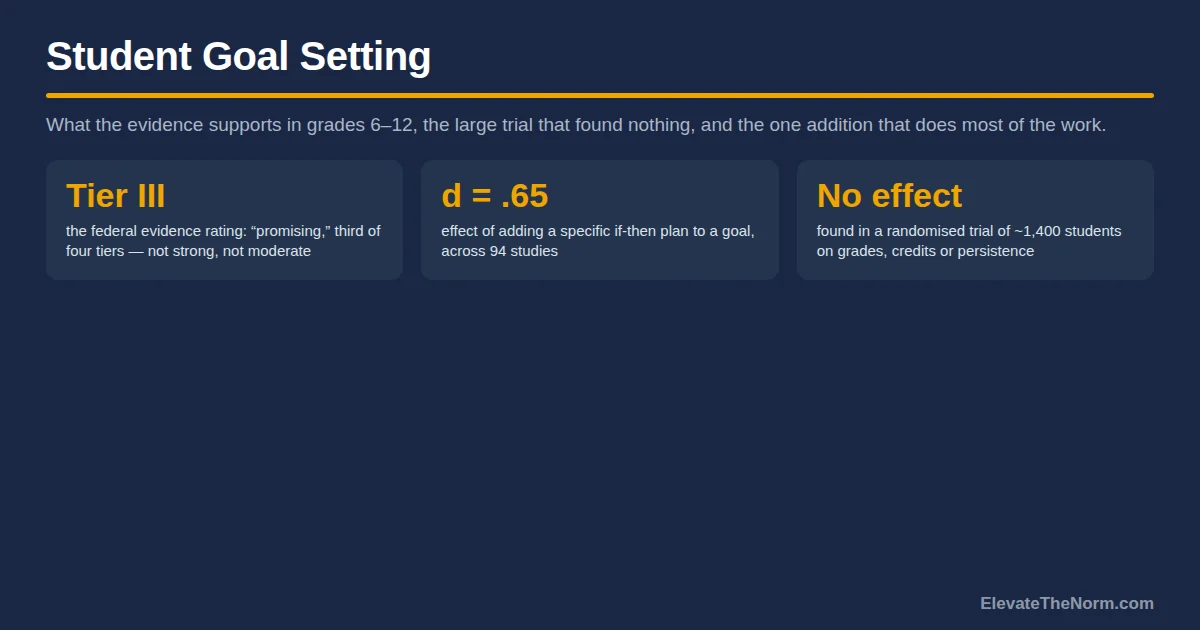
- The official rating is Tier III, “promising evidence.” That is the third-highest tier, below strong and moderate. Anyone selling this as settled is overselling it.
- The best secondary study is correlational. 1,273 high school students over five years showed a significant relationship between goal writing and proficiency — with no control group, so causation is not established.
- A large randomised trial found nothing. About 1,400 first-year college students, precisely estimated null on grades, credits and persistence — and it was a failed replication of a pilot that had reported more than half a standard deviation.
- The plan beats the goal. Across 94 studies, forming a specific “if X, then I will Y” plan had a medium-to-large effect on goal attainment (d = .65). Wanting it more is not the mechanism.
- Goal setting alone is not an intervention. The federal review says so outright: it “cannot be assumed to produce positive outcomes for students” on its own.
Free Download · PDF
The Student Goal and If-Then Plan Sheet
Student-facing: five tests for a goal worth setting, the if-then plan frame, four worked examples by subject, and a two-week check-back log.
Free. No email address required. Designed for grades 6–12. Browse every printable in Your Free Library.
What Is Student Goal Setting?
Student goal setting is a short cycle, not a form. The student names a specific target for their own learning, decides what they will actually do to reach it, does it, gathers some evidence, and judges honestly whether they got there. Then the cycle runs again.
The word doing the work in that definition is own. A target a teacher assigns and a student copies onto a sheet is not goal setting; it is an objective with a student’s handwriting on it. The federal practice guide is specific that letting students set their own goals is one of the components associated with better outcomes, alongside goals that are proximal (near-term rather than end-of-year), specific rather than general, and optimally challenging — hard enough to require something, not so hard the student has already lost.
It is also the forward-facing half of a pair. Student self-assessment asks a teenager to judge work they have already done. Goal setting asks the same student to aim at work they have not done yet. Neither one works well without the other — a goal set by a student with no accurate read on where they currently stand is a guess.
Does Student Goal Setting Actually Work?
The honest answer is “promising, conditional, and less certain than the training implies.” Three pieces of evidence, and they do not all point the same way.
The official rating. The Regional Educational Laboratory Midwest reviewed student goal setting for the Institute of Education Sciences and rated it Tier III, “promising evidence” under the federal evidence standards. Tier III is the third-highest of four. It means there is correlational research with statistical controls behind the practice — not that it has been shown to cause anything in a well-controlled trial.
The best secondary-school study. Moeller, Theiler and Wu followed 1,273 high school students across five years, 21 teachers and 23 Nebraska schools, using a portfolio system built on self-assessment, goal writing and evidence collection. Goal writing and action-plan writing both showed statistically significant relationships with language proficiency scores, independent of teacher effects. It is a large, long, genuinely secondary study, and the authors say plainly that there was no control group and causation cannot be established. Goals like these also fit naturally into a student led conference template.
The trial that found nothing. Dobronyi, Oreopoulos and Petronijevic randomly assigned about 1,400 first-year university students to a structured goal-setting exercise, with or without follow-up reminders, against a control group. They found “no evidence of an effect of treatment” on grades, credits taken, credits failed, or second-year persistence — and their sample was large enough to have detected a 7 percent standardised effect. Their study was an attempt to replicate an earlier pilot that had reported a treatment effect on GPA of more than half a standard deviation. It did not replicate.
Those students were undergraduates, not teenagers, and a one-off written exercise is not a classroom routine. Both of those are real reasons the null might not transfer. But it is exactly the kind of result that quietly disappears from professional development, and it is the reason the federal review ends up at “promising” instead of “strong.”
What the review actually concludes is the sentence to keep: goal setting “in isolation cannot be assumed to produce positive outcomes for students.” It works when it is attached to planning, self-evaluation, regular feedback and reflection. Handed out as a September worksheet, it is a September worksheet.
Why Do Most Classroom Goal-Setting Systems Die by October?
Because the goal gets set and nothing after it is scheduled. Every failure I have watched has the same shape: a strong launch, a folder, and then nothing on the calendar that forces anyone to look at the folder again.
Four specific failure modes, and each one has a cheap fix.
- The goal is too far away. “Raise my grade this semester” gives a student nothing to do on Tuesday. Proximal beats distal in the research and in the room. Two weeks is a good default.
- The goal is a wish, not a behavior. “Try harder in this class” cannot be checked by anybody, including the student. If you cannot tell from the outside whether it happened, it is not a goal.
- Nobody scheduled the review. This is the big one. If the goal review is not a thing that happens on a specific day, it does not happen. Put it in the plan the same way you would put in a quiz.
- The teacher owns it. The moment students believe the goal sheet is for you — for a binder check, for a walkthrough, for the folder an administrator might ask about — they write what looks good. You will get twenty-eight reasonable-sounding goals and zero information.
There is a version of the fourth failure that no teacher can fix alone. If a district requires the goal sheet as a walkthrough artifact or a PLC deliverable, it has made the sheet an adult document by design, and students will read that correctly within a week. Goal setting is cheap enough to mandate and fragile enough that mandating it is usually how it dies. If it has to be collected, collect the evidence that the review happened — a date, a count — and leave the goals themselves with the student.
The fourth one is the one worth guarding hardest, and it connects to something this site keeps coming back to: a choice that is really a compliance task in disguise teaches students to produce the appearance of the thing instead of the thing.
What Makes a Goal Worth Setting?
Five tests, and a goal that fails any of them will not survive two weeks. Run a student’s draft against these before it goes in the folder.
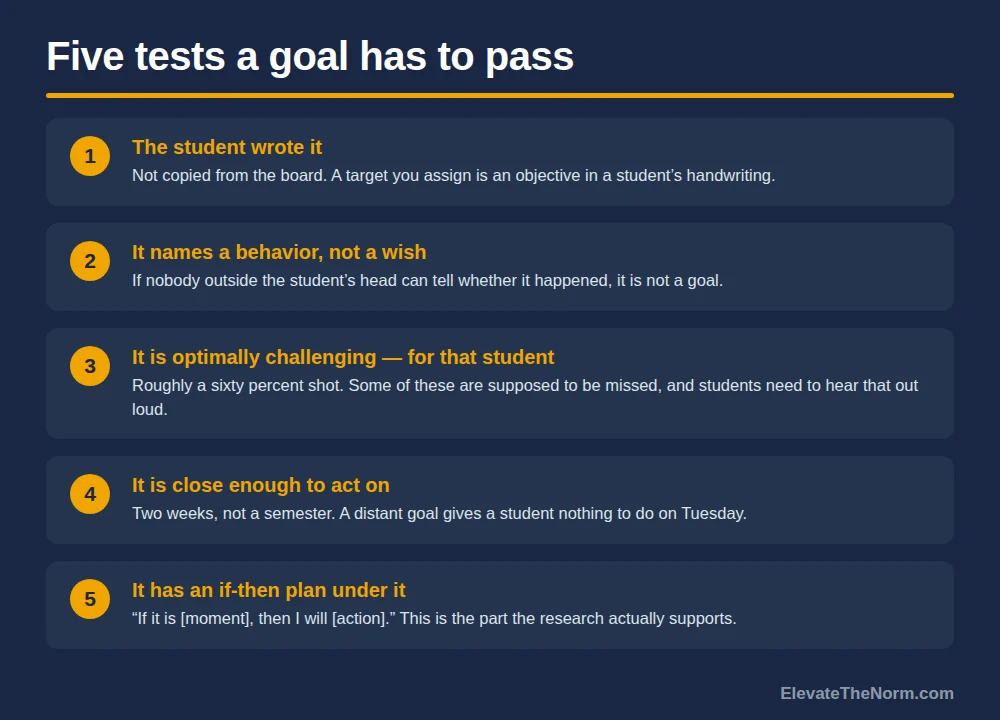
The hardest of the five is the third. “Optimally challenging” sounds like jargon, and in practice it means a goal a student has maybe a sixty percent chance of hitting — which means some goals are supposed to be missed. Say that to the students in those words, on day one: you are supposed to miss some of these, and missing one is not a problem you will be in trouble for. If you do not say it, they will write goals they are certain of, and the whole system drifts toward targets everybody hits and nobody learns anything from. Say it to whoever reads the folder too, for the same reason.
And “optimally challenging” is calibrated to the student, not to the class. A goal that is a genuine stretch for one student is a formality for the one beside them, which means the whole point breaks the moment you set a common goal and call it differentiated. It also means a student who has spent years being told they are behind may aim absurdly low the first time. That is information, not defiance, and the move is to negotiate one notch up rather than to reject the goal. The same argument sits underneath holding a standard high while making the path to it real: a target nobody misses was never a target.
Are SMART Goals the Right Format?
They are a reasonable checklist and a weak intervention, and it is worth knowing which one you are using. Specific and measurable are supported by the research on goal specificity. What SMART does not contain is the part that most predicts whether a goal gets reached.
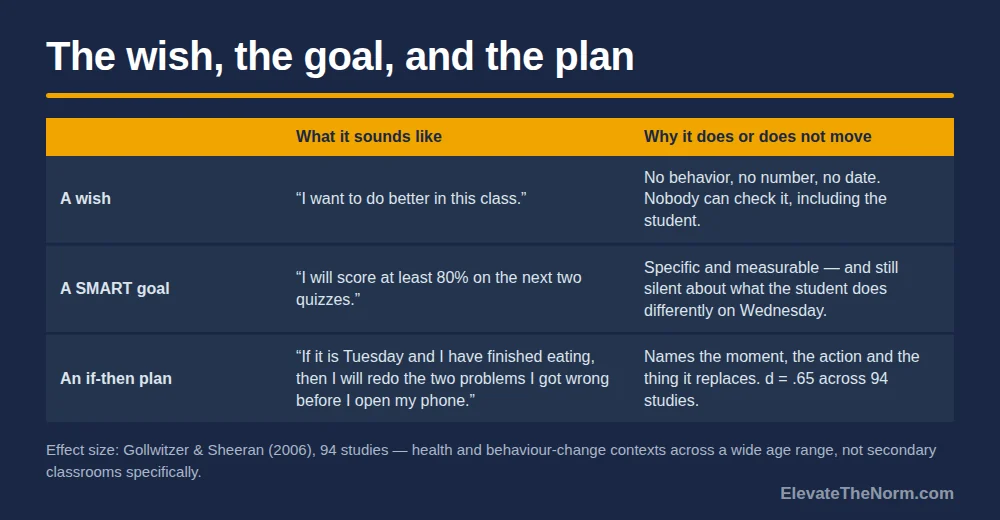
Look at what a SMART goal actually produces: a well-formed description of a destination. “I will score at least 80 percent on the next two vocabulary quizzes.” Specific, measurable, achievable, relevant, time-bound — and it contains no information about what the student will do differently on Wednesday. A student who could already answer that question did not need the acronym.
I am not telling anyone to throw the format out. If your school uses it, use it. Just do not stop there, because the next section is where the evidence is.
The If-Then Plan That Does the Work
Adding a specific “if X happens, then I will do Y” plan to a goal had a medium-to-large effect on whether the goal got reached — d = .65 across 94 studies. Psychologists call these implementation intentions. Students can call them if-then plans and use them in about ninety seconds.
Gollwitzer and Sheeran’s meta-analysis describes them as “if-then plans that link situational cues… with responses that are effective in attaining goals.” The effect split two ways that map exactly onto what teenagers struggle with: d = .61 for getting started and d = .77 for getting derailed. The larger of the two is the one about staying on track after something goes wrong, which is the failure mode for most students, most of the time.
Two honest limits from the same paper. If there are few real barriers to a goal, the if-then plan is superfluous — a student who was going to do it anyway does not need one. And the strong effects showed up “predominantly when the underlying goal intention was strong.” An if-then plan attached to a goal the student does not care about does nothing. That is not a flaw in the technique; it is the reason the student has to write the goal.
Here is the frame students actually use, and it is worth writing on the board: “If it is [a specific time or trigger], then I will [a specific action].” The test is whether a stranger could tell from the outside that it happened. Watch a real one get fixed: “I will review my notes more” is not a plan. “If it is Tuesday and I have finished eating, then I will redo the two problems I got wrong before I open my phone” is one, because it names the moment, the action and the thing it replaces. Most student first drafts are missing the moment. That is the only edit you usually have to make.
Worth saying about the population too: this meta-analysis spans health, behavior change and academic contexts across a wide age range, not a set of secondary classrooms. The mechanism is general. The classroom result is a reasonable inference, not a measured one.


Student Goal Setting Examples for Grades 6–12
A usable goal names a behavior, a number and a date, and is followed by a plan that names a moment. Here is the difference in practice, by subject.
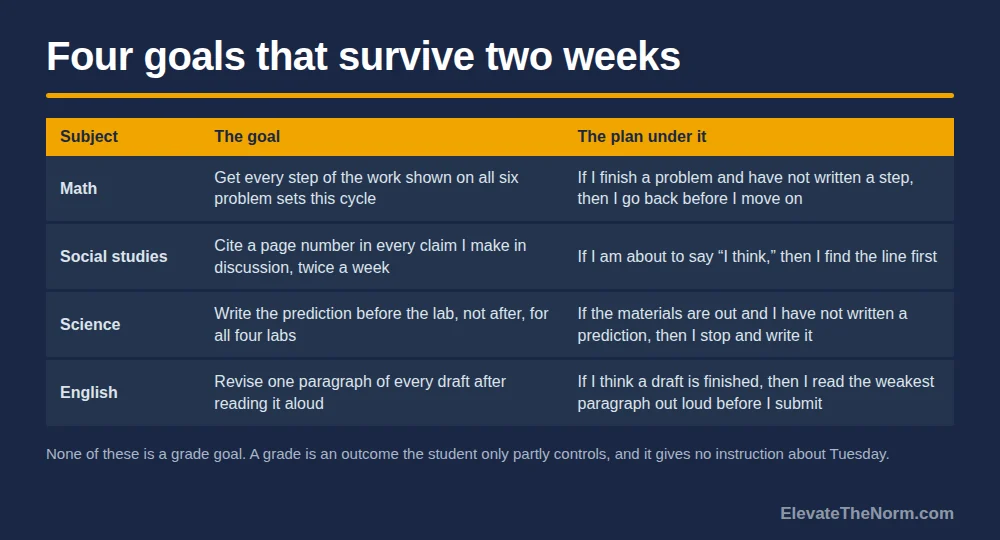
Notice what every one of the good versions has that the bad version does not: a specific when. Not “I will study more” but “when I sit down Tuesday after practice.” The when is the whole mechanism. Without it the student has written a wish with a deadline attached.
One more thing about the examples above: none of them is about a grade. Grade goals are the ones students reach for first, and they are the least useful, because a grade is an outcome the student only partly controls and it gives no instruction about behavior. “Get a B” tells you nothing to do Tuesday. If a student insists on a grade goal, ask the follow-up: what would have to be different in your week for that to happen? The answer is the actual goal.
What Teachers Should Not Do With Student Goals
Three things, and all three are common.
Do not grade the goal. A graded goal is a goal a student sets low, which destroys the only thing a goal is for. Grade the work; the goal is instrumentation. If you need a grade out of the process, grade whether the reflection is honest and specific — a student who writes “I did not do this and here is why” has done the assignment correctly.
Do not post them. Goal walls, goal charts and public trackers look like accountability and function as ranking. A student setting a goal is disclosing what they are not good at yet, in front of everyone they eat lunch with. Some students can carry that and some cannot, and you will not know which is which until it goes wrong. Keep goals in a folder, a document, or a conversation.
Do not let a classroom goal collide with an IEP goal. If a student has goals written into an IEP or a 504 plan, those are legal documents with their own review cycle and their own people attached. A classroom goal that restates them turns your folder into a parallel record of a student’s disability, and one that pulls against them creates a conflict the student has to resolve. Ask the case manager first. Usually the answer is simple — keep the classroom goal about something the IEP does not cover — but it should be a decision rather than an accident.
And tell families what this is before they hear about it secondhand. One sentence in a syllabus or an email does it: students set a short-term learning goal every two weeks, the goals are not graded and are not a judgment about the student, and a missed goal is a normal part of how the routine works. Parents who learn about a goal folder from a worried fourteen-year-old will assume it is an evaluation, and they will be reasonable to assume it.
Do not let a goal become a record. If a student’s goal sheet contains anything about their home life, their diagnosis, their family or their mental health — and if you ask an open enough question, eventually one will — then you are holding a document you did not plan to hold. Keep the prompts academic and behavioral, say clearly what you do and do not do with the sheets, and know your school’s policy before you build a system that collects them. A goal-setting routine is a data-collection routine whether you designed it as one or not.
How Often Should Students Revisit a Goal?
Every two weeks, on a date that is already on the calendar, and in writing. Anything longer and the goal stops being operative; anything shorter and you are spending class time on the system instead of the work.
The review is three questions and it takes six minutes. Did you do the thing you said you would do? What is the evidence? What is the goal for the next two weeks — the same one, or a different one? A student who missed and says why has not failed the routine. A student who quietly rewrites history has, and the way you prevent that is by making it clearly safe to have missed.
The version I trust most is not a form at all. I pull students over one at a time and ask them to defend their own decisions out loud — why this goal, why that plan, what the evidence is. It takes longer than collecting sheets and it is harder to fake. A student who has to say it to your face either has a reason or discovers on the spot that they do not, and both of those outcomes are more useful than a folder.
The arithmetic does not work at scale, and pretending otherwise is how this advice gets ignored. Six minutes times a hundred and forty students is not a thing anyone is doing every two weeks. So rotate: five or six conversations per cycle, everybody else writes, and every student gets a real check-in roughly once a quarter. Choose the five deliberately rather than by who volunteers — the students who most need to say it out loud are rarely the ones raising a hand.
One thing to watch for across cycles: a student who misses every goal is not a student who is failing at goal setting. It is a miscalibration, and the calibration is the adult’s job. Sit down, cut the goal in half, and let them hit one. A student who has never once hit a target they set has learned only that setting targets is pointless, which is worse than not having asked. When these check-ins feed a conversation with families, they are also most of the preparation for a conference the student actually leads.
What to Do Next
Pick one class. Have every student write one two-week goal that names a behavior and a number, and then — this is the part that matters — have them write one sentence underneath it in the form “If [specific moment], then I will [specific action].” Put the review date in your plans before the students leave the room.
Then run it twice before you judge it. The first cycle teaches them the format. The second one is the first real data you will get, and it will tell you more about your class than the goals themselves do.
And set your expectations where the evidence sets them. This is a promising practice that works as part of something — planning, feedback, honest self-assessment, a conversation — and does very little on its own. A worksheet in September is not a goal-setting system. A date on the calendar is.
Before you go: grab the free The Student Goal and If-Then Plan Sheet (PDF) — ElevateTheNorm.com branded, printable, no email required.
Frequently Asked Questions
What is student goal setting?
It is a short repeating cycle in which a student names a specific, near-term target for their own learning, plans what they will actually do to reach it, gathers evidence, and judges honestly whether they got there. The key word is “own” — a target the teacher assigns and the student copies onto a sheet is an objective in the student’s handwriting, not a goal.
Does student goal setting improve achievement?
The federal evidence review rates it Tier III, “promising evidence” — the third-highest of four tiers. A five-year study of 1,273 high school students found a significant relationship between goal writing and proficiency, but it had no control group. A randomised trial of about 1,400 first-year college students found no effect at all on grades, credits or persistence. The honest summary is that it helps when it is attached to planning and feedback and does little by itself.
Are SMART goals good for students?
They are a reasonable checklist for describing a destination and a weak intervention on their own. Specific and measurable are genuinely supported by the research on goal specificity. What SMART does not include is any statement of what the student will do differently, and that is the part that predicts whether the goal gets reached. Use it if your school uses it, then add an if-then plan underneath.
What is an if-then plan and why does it matter more than the goal?
It is a sentence in the form “if [specific situation], then I will [specific action]” — researchers call it an implementation intention. Across 94 studies it had a medium-to-large effect on goal attainment, d = .65, with d = .61 for getting started and d = .77 for getting back on track after getting derailed. A goal describes where you want to end up. The if-then plan names the moment you will act.
How often should students revisit their goals?
About every two weeks, on a date that is already in your plans. Longer than that and the goal stops being operative; shorter and you spend class time on the system instead of the work. The review is three questions and takes six minutes: did you do it, what is the evidence, and what is the goal for the next two weeks.
Should student goals be graded?
No. A graded goal is a goal the student sets low, which removes the only thing a goal is useful for. If you need a grade from the process, grade whether the reflection is honest and specific. A student who writes “I did not do this, and here is why” has done the assignment correctly.
Should I post student goals on the wall?
No. A public goal chart looks like accountability and functions as a ranking, because a student setting a goal is disclosing what they are not good at yet in front of everyone they eat lunch with. Keep goals in a folder, a document or a conversation. Visibility is not the mechanism; the plan and the review date are.
Why do goal-setting systems stop working after a few weeks?
Almost always because nothing after the goal was scheduled. The four usual causes are a goal that is too far away, a goal that describes a wish rather than a behavior, a review that never got a date, and a system students correctly perceive as being for the teacher’s binder. Only the last one is about motivation, and it is fixed by keeping the goals out of anything that gets inspected.
Sources
- U.S. Department of Education, Institute of Education Sciences, Regional Educational Laboratory Midwest. Student Goal Setting: An Evidence-Based Practice. 2018. ERIC ED589978. Rates student goal setting Tier III, “promising evidence,” under federal evidence standards; identifies optimally challenging, proximal, specific, self-set and mastery-oriented goals as the supported components; and states that goal setting “in isolation cannot be assumed to produce positive outcomes for students.” https://files.eric.ed.gov/fulltext/ED589978.pdf
- Moeller, Aleidine J., Janine M. Theiler, and Chaorong Wu. “Goal Setting and Student Achievement: A Longitudinal Study.” The Modern Language Journal, vol. 96, no. 2, 2012, pp. 153–169. Five-year quasi-experimental study, 1,273 high school students, 21 teachers, 23 Nebraska schools; goal writing and action-plan writing significantly related to proficiency scores independent of teacher effects. No control group; the authors state causation cannot be established. https://www.ncssfl.org/wp-content/uploads/2017/11/MLJ.2012.GoalSettingandStudentAchievementLongitudinalStudy.pdf
- Dobronyi, Christopher R., Philip Oreopoulos, and Uros Petronijevic. “Goal Setting, Academic Reminders, and College Success: A Large-Scale Field Experiment.” Journal of Research on Educational Effectiveness, vol. 12, no. 1, 2019, pp. 38–66. Randomised trial, approximately 1,400 first-year university students; “no evidence of an effect of treatment” on grades, credits or persistence, precise enough to detect a 7 percent standardised effect. A failed replication of a pilot reporting more than half a standard deviation on GPA. Population: undergraduates, not secondary students. https://oreopoulos.faculty.economics.utoronto.ca/wp-content/uploads/2020/05/dobronyi-et-al-goal-setting-academic-reminders-and-college-success-jree-2019.pdf
- Gollwitzer, Peter M., and Paschal Sheeran. “Implementation Intentions and Goal Achievement: A Meta-Analysis of Effects and Processes.” Advances in Experimental Social Psychology, vol. 38, 2006, pp. 69–119. 94 studies; overall d = .65, with d = .61 for getting started and d = .77 for getting derailed. Notes that effects are reduced when few barriers exist and that strong effects appeared “predominantly when the underlying goal intention was strong and activated.” Spans health and behaviour-change contexts across a wide age range, not secondary classrooms specifically. https://cancercontrol.cancer.gov/sites/default/files/2020-06/goal_intent_attain.pdf