
By Clay Shumate
Professional growth as a teacher means getting measurably better at something you chose, on purpose, over a stretch of time long enough to see it in student work. It is not the same as the goal you typed into an evaluation form in August. A real growth goal is narrow, observable, revisited on a schedule, and owned by the teacher rather than assigned to them.
Most teacher goal-setting fails for a boring reason. The goal is written once, for someone else, in language vague enough to be safe, and then nobody looks at it until spring. That is not a flaw in teachers. It is what happens when a system asks you to produce a document instead of change a practice. This article is about the difference, and about what a goal has to look like to survive October.
Key Takeaways
- A growth goal and a compliance goal are different objects. One is designed to change your practice; the other is designed to be submitted. Writing one when you needed the other wastes a year.
- Narrow beats ambitious. Goals that name a specific student behavior you can see in student work get revisited. Goals about “rigor” or “engagement” do not.
- Goal-setting theory is strong evidence, mostly from outside classrooms. Locke and Latham’s research base is enormous, but it is largely workplace and laboratory task performance, not teaching practice. Say so rather than overselling it.
- Feedback is not optional. In the goal-setting research, goals plus feedback outperform goals alone. A goal with no check-in is a wish.
- Complex work weakens the effect. The same research shows goal effects shrink as tasks get more complex, and teaching is about as complex as work gets.
- The features that make professional learning work are known. Content focus, collaboration, coaching, modeling, feedback and sustained duration. Build the goal so those are possible.
What is professional growth as a teacher?
It is the deliberate improvement of one part of your practice, chosen by you, tracked against evidence you can actually look at. That definition deliberately excludes three things people often mean by the phrase: accumulating credentials, accumulating hours, and being rated higher.
Credentials and hours are inputs. They might produce growth and they might not. Ratings are a judgment made by someone else using an instrument that may not detect the thing you were working on. The growth itself is the change in what students do, and the only honest way to know whether it happened is to look at student work from October and student work from February and tell the truth about the difference. That is a higher bar than most goal forms ask for, and the only version worth your time.
Why do most teacher goals die in October?
Because they were written to be filed, not used. Three failure patterns account for most of it.
The goal is unobservable. “I will increase student engagement in my classes” has no moment at which you can check. There is no artifact. There is no number. There is nothing to be wrong about, which feels safe in August and useless in January.
The goal is too large. “I will implement project-based learning across all my units” is a year of curriculum rewriting disguised as a goal. It gets abandoned, and the abandonment feels like a personal failure rather than a scoping error.
The goal has no schedule. Nothing in the calendar says “look at this.” If a goal does not appear in your week, it does not exist. This is the most fixable of the three and the most commonly skipped.
There is a system-level version of this too. New America’s 2018 review of relicensure policy in all fifty states and the District of Columbia found that only eleven states articulate the purpose of relicensure at all, and summarized the typical system this way: “whether a teacher grows considerably while fulfilling her state’s renewal requirements or does not improve at all is of no consequence under most renewal systems” (New America, August 2018). When the structure above you is indifferent to whether you improved, the paperwork becomes the point. The mechanics of license renewal are worth understanding on their own terms, but they will not generate a goal for you.
What does the evidence on goal-setting actually say?
Goal-setting is one of the better-supported findings in applied psychology, and almost none of that research ran in classrooms. Both halves of that sentence matter.
Locke and Latham’s 2002 summary in American Psychologist reports a research base of “well over 100 different tasks involving more than 40,000 participants in at least eight countries,” in laboratory, simulation and field settings, over time spans from one minute to twenty-five years. The core findings are consistent. Specific, difficult goals outperform telling people to do their best, with effect sizes reported from .42 to .80. Goal difficulty relates positively and roughly linearly to performance, with effect sizes from .52 to .82. And “goals plus feedback is more effective than goals alone” (Locke and Latham, American Psychologist, 57(9), 705–717, 2002).
Now the caveats, because they are the useful part. The participants were overwhelmingly workers and students performing bounded tasks, not teachers changing instructional practice. I am extrapolating when I apply this to your professional goal, and I want that said plainly rather than buried. The same paper also reports that task complexity moderates the effect downward: effect sizes for goal difficulty fell from .67 on simple tasks to .48 on complex ones, and the advantage of specific difficult goals over “do your best” fell from .77 to .41. Teaching a class of thirty adolescents is not a simple task. We should expect the smaller number, not the larger one.
What survives translation is the mechanism, not the effect size: specificity helps, difficulty helps up to a point, feedback is required, and commitment depends on whether you think the goal matters and whether you believe you can hit it.
Growth goal or compliance goal?
You often need both, and the mistake is submitting one and believing you wrote the other. Write the compliance goal in the form your district asks for. Then write the real one for yourself, in plain language, somewhere you will see it.
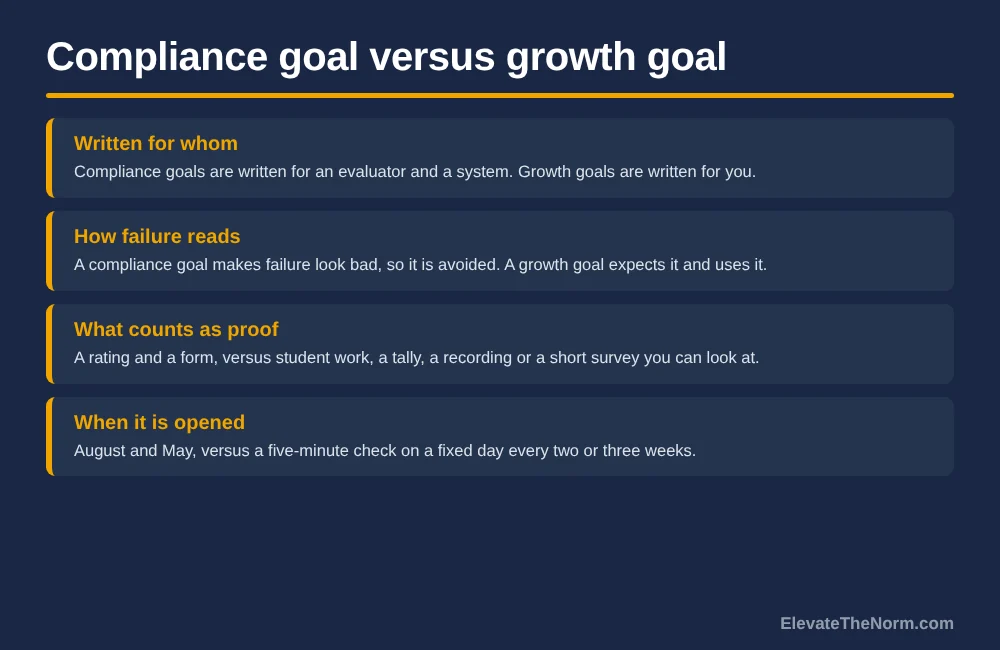
| Feature | Compliance goal | Growth goal |
|---|---|---|
| Audience | Evaluator, district system | You, and anyone you have asked to check on you |
| Scope | Broad enough to be defensible | Narrow enough to observe in one class period |
| Evidence | A rating, a form, a summative number | Student work, a tally, a recording, a short survey |
| Timeline | Written in August, revisited in May | Checked on a named schedule, often every two or three weeks |
| Language | “Increase student engagement and rigor” | “Every student speaks in whole-class discussion at least once a week” |
| Failure | Looks bad, so it is avoided | Expected, informative, and the reason to revise |
| Ownership | Often assigned or heavily steered | Chosen by the teacher from a problem they can see |
If your district’s system lets you set your own goal, use it for the real one. Many do. The compliance version is frequently a habit rather than a requirement, so check whether the form actually prohibits what you want.
Where do you find a goal worth setting?
In the pile of student work that bothers you. Not in a professional-learning catalog, and not in the standards document.
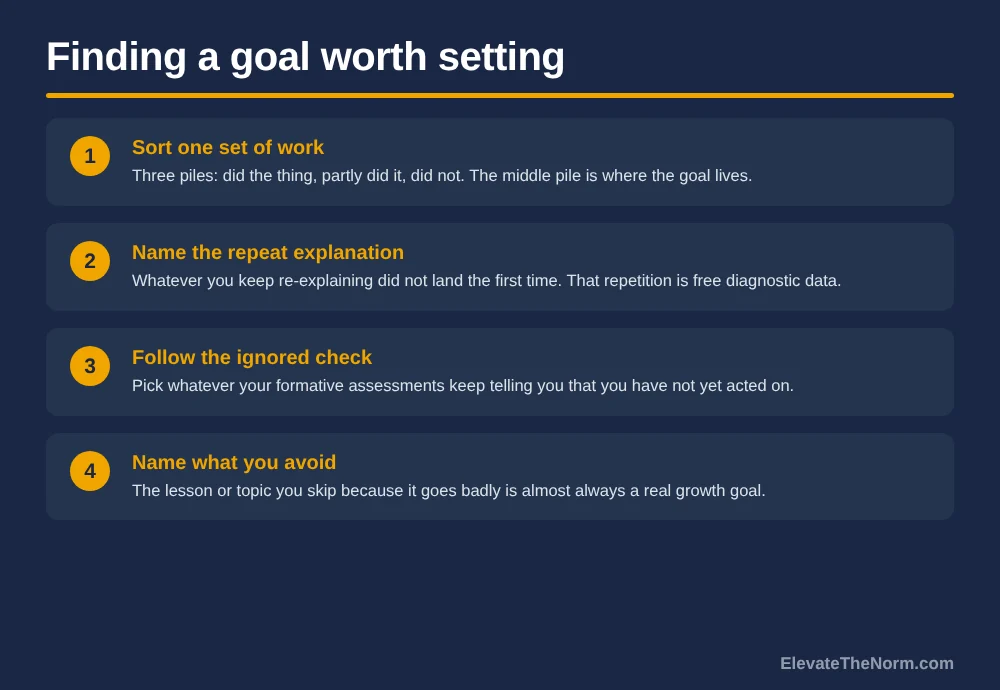
Try this. Take one set of recent student work — a short answer, an exit ticket, a lab writeup, a draft. Sort it into three piles: did the thing, partly did the thing, did not do the thing. Then look at the middle pile and ask what specifically is missing. That is your goal territory, and it will be smaller and more concrete than whatever you would have written from memory.
The honest version is uncomfortable, which is the point. Reflection that does not risk finding something wrong is not reflection. A good diagnostic question: what do I keep explaining again because it did not land the first time? That repetition is data, and it is free.
Two other reliable sources of goals. First, whatever your formative checks keep telling you and you keep not acting on. Second, the thing you avoid teaching because it goes badly. Neither will appear on a district priority list.
What makes a goal narrow enough to work?
You should be able to tell, by Friday, whether this week counted. That is the test. If you cannot, the goal is too broad or the evidence is too vague.
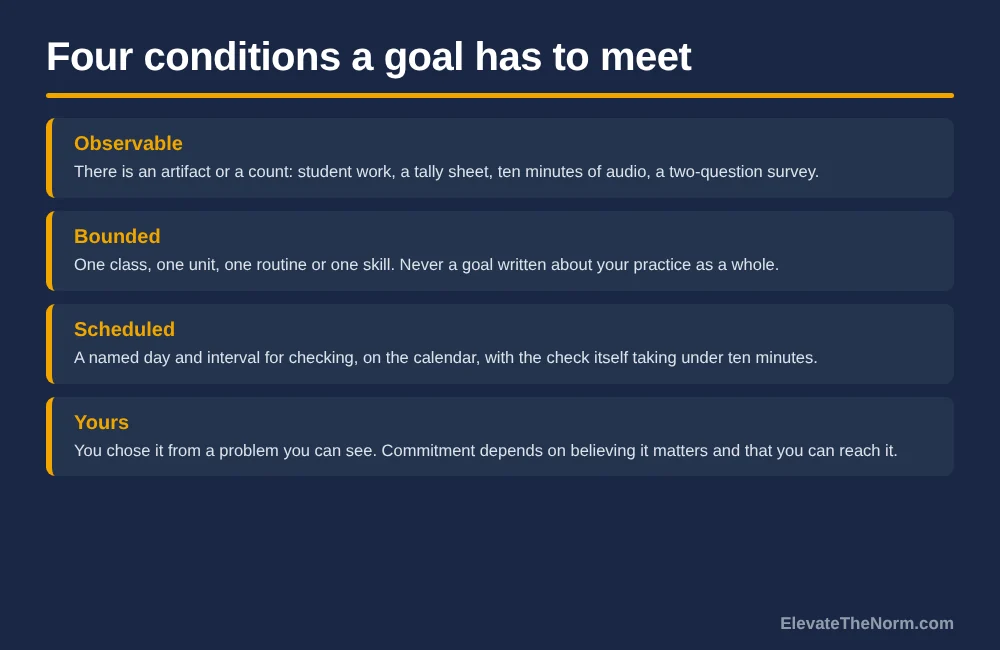
Four conditions
- Observable. There is an artifact or a count. Student work, a tally sheet, a seating chart with marks on it, a two-question survey, a recording of ten minutes of class.
- Bounded. One class, one unit, one routine, or one skill. Not “my practice.”
- Scheduled. A named day and interval for checking. On the calendar, with the check itself under ten minutes.
- Yours. You picked it. Commitment in the goal-setting research depends on whether you think the outcome matters and whether you believe you can reach it — and an assigned goal fails both tests more often than an assigned goal’s author expects.
One more condition, not from the research literature: the goal has to be survivable on a bad week. If the check takes twenty minutes and needs a quiet room, it will not happen in November. Design for the worst week of the semester.
Ten professional goals for teachers you can copy and adapt
These are written in usable form: a specific change, a specific piece of evidence, and an interval. Steal the shape, swap in your own content and class.
Instruction
- Participation breadth. In my third-period class, every student contributes to whole-class discussion at least once per week. Evidence: a marked seating chart, tallied Friday. Check: weekly, and I rotate which class I track every six weeks.
- Wait time. After I ask an open question, I wait at least five seconds before taking an answer or rephrasing. Evidence: audio of ten minutes of class, timed, twice a month. Check: biweekly.
- Who does the thinking. In each unit, at least two tasks require students to produce an explanation rather than retrieve an answer. Evidence: the two task sheets, filed with the unit. Check: at unit close.
- Front-loading less. I cut my opening direct instruction to twelve minutes or less in three lessons a week, with the remainder spent on student work I circulate through. Evidence: lesson timings noted on the plan. Check: Friday, five minutes.
Assessment and feedback
- Feedback students act on. On two assignments per unit, students make a documented revision in response to my comments before a grade is final. Evidence: the revised drafts. Check: at unit close. Related: a structured correction process makes this considerably easier to sustain.
- Shorter cycle. No major assignment goes more than five school days without returned feedback. Evidence: a dated log of returns. Check: weekly, two minutes.
- Checking before moving on. I collect a one-question check at the end of every lesson in one unit and read them before planning the next day. Evidence: the stack. Check: nightly for one unit, then stop and evaluate whether it was worth it.
Classroom culture
- Named repair. When a student and I have a conflict, I hold a two-minute private conversation within twenty-four hours before any consequence is finalized. Evidence: a running count of conversations held versus conflicts that occurred. Check: biweekly.
- Non-academic contact. I have a conversation unrelated to coursework with at least five students a week, prioritizing the ones I talk to least. Evidence: a class list I mark through. Check: Friday. This is the mechanism behind most advice about building relationships with students, reduced to something countable.
Workload
- A hard stop. I do no school work after 6:30 p.m. on three named weeknights, and I plan the week assuming it. Evidence: an honest tally on the calendar. Check: Sunday.
Notice what these have in common. Each names a behavior, an artifact and an interval. Each can be checked in under ten minutes. And each can fail in a way that tells you something, which is the whole point of writing it down.
How often should a goal be revisited?
Often enough that you cannot forget it, rarely enough that checking is not a second job. For most of the goals above, every two weeks is about right, with a longer review at each grading period.
The structure I would recommend: a five-minute check on a fixed day, a fifteen-minute review each grading period, and one decision point at the semester break — keep, revise, or retire. Carrying a dead goal for five more months because abandoning it would look bad is the actual failure.
Put the check in the same slot as something you already do reliably: grade entry, the Friday email. A goal attached to an existing habit survives; a goal that needs its own new habit usually does not.


Does self-assessment work, or do we just flatter ourselves?
Self-assessment is useful when it is anchored to evidence and unreliable when it is anchored to memory. This is why every goal above names an artifact.
The Learning Policy Institute’s 2017 review of 35 studies with experimental, quasi-experimental or appropriately modeled designs found that high-quality professional development “frequently provides built-in time for teachers to think about, receive input on, and make changes to their practice” (Darling-Hammond, Hyler and Gardner, 2017). Note the three verbs: think, receive input, change. Reflection without input, and reflection that changes nothing, are not the thing the research describes.
So build in a second set of eyes, even informally. Hand a colleague one piece of evidence and ask one question about it. That is a small enough ask that people say yes, and it converts self-assessment from a private opinion into something checkable.
What about the goal my evaluator assigns?
Treat it as a constraint to satisfy honestly, not as your growth plan, and do not pretend the two are the same. An assigned goal can be a perfectly reasonable goal. It is just unlikely to carry the commitment that the goal-setting research says you need, because you did not pick it.
Two practical moves. First, see if the assigned goal and your real goal can overlap. They often can with a sentence of rewriting, because district goals are usually written broadly enough to contain something specific. Second, if they genuinely cannot, do both and keep them separate. Satisfy the form on the form’s terms. Do the real work on yours.
If you are the person assigning goals, the implication is uncomfortable but worth hearing. A goal you wrote for a teacher is a directive, and directives are a legitimate tool. Just do not call it professional growth and expect it to behave like a goal the teacher owns. The more useful move is to help them narrow the goal they already have, which is most of what a staff that trusts its own collective capacity does for each other.
What does coaching add, and what are the limits of that evidence?
Coaching has the strongest causal evidence of any professional development format, and the evidence comes mostly from grade levels that are not ours. Both things are true and the second gets left out constantly.
Kraft, Blazar and Hogan’s 2018 meta-analysis in Review of Educational Research pooled the causal evidence and found coaching improved instruction by 0.49 standard deviations across 43 studies and raised student achievement by 0.18 SD across 31 studies. It also found a sharp scale effect: smaller programs improved instruction by 0.63 SD and achievement by 0.28 SD, roughly twice and three times the effects of larger programs, which came in at 0.34 SD and 0.10 SD (Kraft, Blazar and Hogan, Review of Educational Research, 88(4), 547–588, 2018).
The caveat is substantial. Fifty-one of the sixty studies included teachers working in pre-kindergarten centers or elementary schools, and nearly all content-specific coaching targeted reading and literacy. If you teach grade 9 chemistry, those numbers are suggestive, not a forecast. The scale finding is also a warning about district-wide rollouts: the thing that worked small got weaker when it got big. A single colleague who looks at one piece of your evidence every few weeks is closer to the version that worked, and you can arrange that yourself, this month, for free.
The time problem nobody writes into the goal
If a goal does not account for the hours you do not have, it is a fantasy. In the U.S. results of the 2018 TALIS survey of lower secondary teachers — grades 7 through 9, squarely our population — 49 percent named conflict with their work schedule as a barrier to professional development and 42 percent named family responsibilities (NCES, TALIS 2018).
That is why goal ten is about workload. Design the check to take five minutes, inside the school day. If you cannot, shrink the goal until you can.
Professional growth as a teacher: what to do in the next three weeks
Professional growth as a teacher starts with one narrow goal and a five-minute check on a named day, not with a better form. Here is the whole plan.
This week, pull one set of student work and sort it into three piles. Look at the middle pile and name what is missing in one sentence. Next week, turn that sentence into a goal with an artifact and an interval, and write the check into your calendar on a day you are already reliable. The week after, do the check and hand one piece of the evidence to a colleague with a single question attached.
Then keep going to the semester break and make an honest call: keep, revise, or retire. If what you need is materials rather than another framework, free classroom materials worth printing are easier to find than most teachers think, and everything in our own resource library downloads directly with no email required. Write the small goal and look at it.
Sources
- Edwin A. Locke and Gary P. Latham, “Building a Practically Useful Theory of Goal Setting and Task Motivation: A 35-Year Odyssey,” American Psychologist, 57(9), 705–717, 2002. Supports the effect-size ranges for goal specificity and difficulty, the goals-plus-feedback finding, the commitment mechanism, and the task-complexity moderation. Caveat: the research base is over 100 tasks and more than 40,000 participants in laboratory, simulation and workplace field settings — not teachers changing instructional practice. Applying it to teacher goal-setting is an extrapolation, and the complexity moderator predicts smaller effects for work as complex as teaching. https://home.ubalt.edu/tmitch/642/articles%20syllabus/locke%20pract%20goal%20setting%202002%20am%20psy.pdf
- Matthew A. Kraft, David Blazar and Dylan Hogan, “The Effect of Teacher Coaching on Instruction and Achievement: A Meta-Analysis of the Causal Evidence,” Review of Educational Research, 88(4), 547–588, 2018. Supports the 0.49 SD instruction and 0.18 SD achievement effects and the small-versus-large program comparison. Caveat: 51 of the 60 studies involved pre-kindergarten or elementary teachers, and nearly all content-specific coaching targeted reading and literacy, so these figures do not transfer cleanly to grades 6–12. https://education.umd.edu/sites/default/files/uploads/inline-files/Kraft%20Blazar%20Hogan_2018_The%20Effect%20of%20Teacher%20Coaching_Review%20of%20Educational%20Research.pdf
- Linda Darling-Hammond, Maria E. Hyler and Madelyn Gardner, Effective Teacher Professional Development, Learning Policy Institute, 2017. Supports the seven features of effective professional development and the quoted description of built-in reflection time, drawn from a review of 35 studies using experimental, quasi-experimental or appropriately modeled designs. https://learningpolicyinstitute.org/sites/default/files/product-files/Effective_Teacher_Professional_Development_REPORT.pdf
- TNTP, The Mirage: Confronting the Hard Truth About Our Quest for Teacher Development (executive summary), 2015. Supports the finding that no type, amount or combination of development activity reliably produced substantial improvement, alongside roughly $18,000 per teacher per year in spending and about 19 school days of teacher time. Caveat: three large districts and one midsize charter network, not a national sample, and the summary does not report grade levels. https://tntp.org/wp-content/uploads/2023/02/TNTP_Mirage_Executive_Summary_2015.pdf
- New America, Rethinking Relicensure: Promoting Professional Learning Through Teacher Licensure Renewal Policies, August 2018. Supports the finding that only eleven states articulate the purpose of relicensure and the quoted critique of compliance-oriented renewal systems, from a review of all fifty states and the District of Columbia. https://newamerica.org/education-policy/policy-papers/rethinking-relicensure
- U.S. Department of Education, National Center for Education Statistics, TALIS 2018 U.S. Highlights. Supports the barrier percentages — 49 percent work schedule, 47 percent lack of incentives, 42 percent family responsibilities, 38 percent cost. Caveat: these are self-reported barriers from U.S. lower secondary teachers in grades 7–9 in 2018, not a measure of outcomes. https://nces.ed.gov/surveys/talis/talis2018/TALIS2018_compiled.pdf
Frequently Asked Questions
How many professional goals should I set at once?
One real one. Possibly two if they are genuinely small and share a check-in. The temptation is to set four, because four looks serious on a form, but four goals means none of them gets a scheduled look and all of them quietly expire. If your district form demands several, write them, then pick the one you actually intend to pursue and treat the rest as documentation. A single narrow goal that gets checked every two weeks for a semester will change more about your teaching than five goals read twice a year.
Is it a problem if my goal and my evaluation goal are different?
Not if you satisfy the evaluation goal honestly. District goals are usually written broadly enough that a specific personal goal fits inside one with a sentence of rewriting, so try the overlap first. When they genuinely cannot overlap, do both and keep them separate in your own mind. Meet the form on the form’s terms, and keep your real goal somewhere you will see it weekly. What does not work is writing one document, calling it both, and then being surprised in May that neither the growth nor the paperwork went well.
How strong is the evidence that goal-setting actually improves teaching?
Weaker than the general goal-setting literature suggests. Locke and Latham’s research base is enormous — over 100 tasks and more than 40,000 participants — but it is overwhelmingly workplace and laboratory task performance, not teachers changing practice. Their own data also show the effect shrinking as tasks get more complex, and teaching is extremely complex. What transfers is the mechanism rather than the effect size: be specific, make it hard enough to matter, get feedback, and pick it yourself. Treat anyone promising a particular gain from teacher goal-setting with suspicion.
What counts as evidence if I do not teach a tested subject?
Almost anything you can look at twice. A marked seating chart showing who spoke. Two student drafts, before and after your feedback. Ten minutes of audio from your own class. A tally of how many students brought the reading. A two-question survey. None of that requires a standardized test, and all of it is more honest about instructional change than a score would be. The requirement is not measurement precision, it is that the evidence exists outside your memory and that you could be wrong about it.
Does my goal have to be shared with my principal or my family community?
Your district decides what gets submitted, and that is a real constraint you should check rather than assume. Beyond the required paperwork, a growth goal is professional work in progress and does not need an audience. There is one caution worth naming: if a goal involves recording your class, collecting student survey responses, or sharing student work with a colleague, follow your district’s policy on student privacy and recording before you start. Those policies exist for good reasons and they vary considerably between districts.
What if the goal is not working by November?
Then you have learned something in November instead of May, which is the entire reason to check on a schedule. Ask whether the goal was too broad, whether the evidence was too vague, or whether the check itself was too expensive to sustain. Any of the three can be fixed by shrinking the goal. Retiring a goal that is not working is a legitimate decision and should be recorded as one. Carrying a dead goal for five more months because abandoning it would look bad is the actual failure.
Should students know what I am working on?
Often yes, and in grades 6 through 12 it tends to go better than teachers expect. Telling a class that you are trying to make sure everyone gets heard this semester, and asking them whether it is working, treats them as people with useful information about their own classroom. It also makes the goal harder to abandon quietly. Keep it specific and keep it about your practice rather than their deficits. What does not work is a vague announcement about engagement, which students correctly read as noise.
Is coaching worth asking for, given the evidence?
Yes, with realistic expectations. The Kraft, Blazar and Hogan meta-analysis found coaching improved instruction by 0.49 standard deviations, the strongest causal evidence for any professional development format. But 51 of the 60 studies involved pre-kindergarten or elementary teachers, mostly in literacy, and effects were roughly halved in large-scale programs compared with small ones. The practical read is that one colleague looking at one piece of your evidence every few weeks resembles the version that worked better than a district-wide rollout does. You can arrange that yourself.