By Clay Shumate
The classroom control techniques that actually hold are quiet ones: proximity, a private word, a predictable consequence delivered exactly as promised, and a room structured so there is little to disrupt. Volume, public correction and removal buy you the current minute and cost you the next nine weeks.
You probably typed the word “control” into a search bar, and I am not going to lecture you about it. You asked a real question and you deserve a real answer, so the techniques below come first. But I will make an argument along the way, because I think the thing you actually want is not control. It is a room that runs without you holding it up. Those are different goals and they need different work.
Key Takeaways
- Proximity and a quiet word handle most of it. The loudest tool available is almost never the right rung on the ladder.
- Standing by your word is the whole mechanism. Doing exactly what you said you would do, every time, is what makes a room predictable — and predictability is what students read as fairness.
- Escalation is expensive. Removal-based discipline has a poor evidence record: suspension predicts more future misbehavior, not less.
- Volume and audience both backfire. Harsh verbal discipline was associated with worse adolescent outcomes in the parenting research, and warmth did not buffer it.
- Control is scaffolding, not the goal. If the room only works while you are standing in it, you have not built anything yet.
What are the most effective classroom control techniques?
The effective ones are low-volume, early, and specific: scan and move, stand near, name the behavior quietly, offer a choice between two acceptable things, and deliver the consequence you already announced without adding a speech.
That list is unglamorous on purpose. The most reliable classroom control techniques do not look like control from the back of the room, which is exactly why they work on teenagers. A fifteen-year-old will accept a correction and will not accept being made an example of in front of twenty-nine peers, and the difference between those two experiences is almost entirely volume and audience.
The evidence-based practice reviews back the shape of this even where the specific tools are hard to isolate. The review that screened classroom practices for genuine empirical support sorted them into maximizing structure and predictability; posting, teaching, reviewing, monitoring and reinforcing expectations; actively engaging students; acknowledging appropriate behavior; and using a continuum of strategies to respond to inappropriate behavior (Simonsen, Fairbanks, Briesch, Myers & Sugai, 2008). The word continuum is doing a lot of work there. The technique is not the response; it is having five rungs and starting on the first one.
Nine techniques, from cheapest to most costly
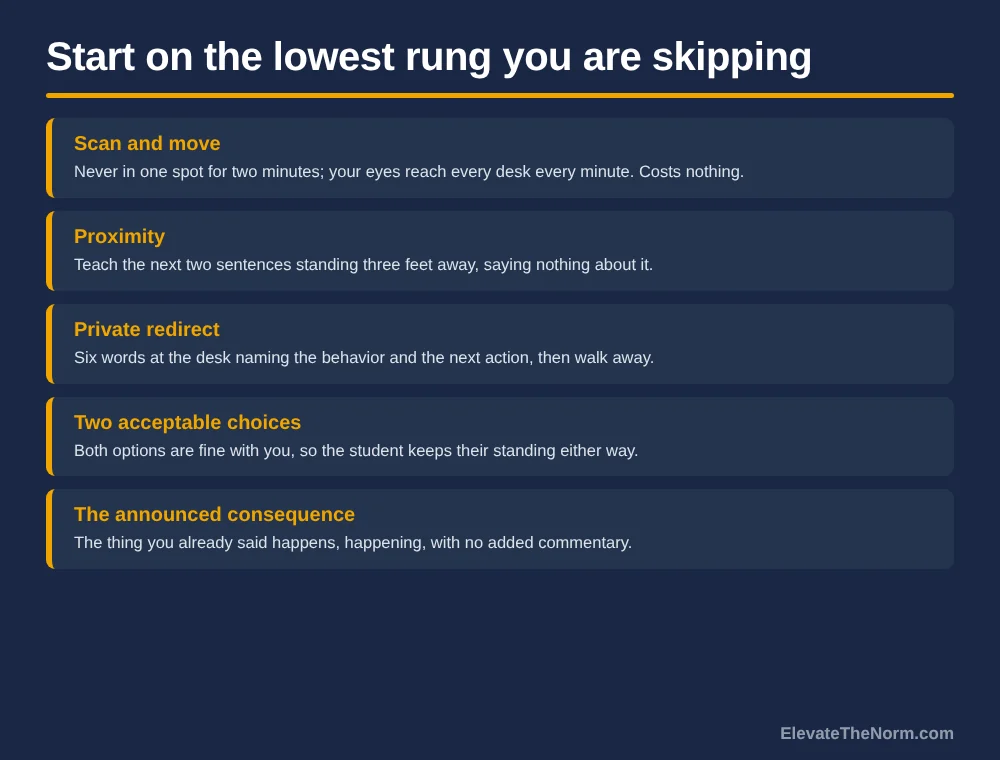
Work down this list in order, and only go as far as you have to. The cost column is what the technique takes out of your relationship with the class, which is the currency people forget to count.
| Rung | Technique | What it looks like | Relationship cost |
|---|---|---|---|
| 1 | Scan and move | You are never in the same place for two minutes; your eyes reach every desk every minute. | None |
| 2 | Proximity | You teach the next two sentences standing three feet from the problem, saying nothing about it. | None |
| 3 | Nonverbal signal | A look, a tap on the desk, a hand on a closed laptop. No words, no audience. | Almost none |
| 4 | Private redirect | Six words at the desk, naming the behavior and the next action. Then you walk away. | Low |
| 5 | Two acceptable choices | “You can work here quietly or at the table by the window. Your call.” | Low |
| 6 | Doorway conversation | Thirty seconds in the hall, the class working, no raised voice, specific next step. | Low to moderate |
| 7 | The announced consequence | The thing you already told the class happens, happening, with no additional commentary. | Low if it was announced; high if it was improvised |
| 8 | Contact home | A call before the referral, describing behavior rather than character. | Moderate, and lower if you have called with good news before |
| 9 | Removal or referral | Office, in-school placement, suspension — the system takes over. | High, and the evidence for it is poor |
Most teachers who feel out of control are skipping rungs one through five. That is not a character flaw; it is what stress does. But a room where every correction arrives at rung seven has taught students that nothing matters until it is serious, which guarantees you will spend your year at rung seven.
Standing by your word is the whole mechanism
Here is my actual position, stated as opinion rather than research: respecting students is easy, and the way you do it is by doing exactly what you said you would do, every single time.
That is it. That is the technique the whole article is built around. Not consistency as a vague virtue — consistency as a literal practice. If you said the quiz is Friday, the quiz is Friday. If you said the next time it happens you call home, you call home, including on the day you are tired and the student is one you like. If you said you would read their draft by Monday, you read it by Monday. Students are keeping score on this far more carefully than on anything in your syllabus, and what they are really measuring is whether your words predict your actions.
A teacher whose word is reliable does not need much else. The consequence does not have to be severe; it has to be certain. Certainty is what makes a room calm, because a student who knows what happens next does not have to test you to find out. Severity without certainty produces a room full of gamblers. Certainty without severity produces a room that mostly runs itself. Our longer argument about this is in the piece on consequences that are predictable rather than harsh, and the companion on letting the real consequence do the work.
One thing I will not tell you is to let a student fail to teach them a lesson. If a student can wreck something badly enough in my room for that to be instructive, I planned the thing badly. Build the assignment so that the honest consequence of not doing the work is having to do the work, not a permanent mark on a transcript.
What escalation actually costs
Removal-based discipline has the weakest evidence record of any technique in common use, and the research on it is unusually clear for education research.
The American Psychological Association’s task force review of zero tolerance concluded that after two decades of implementation, “data tended to contradict the presumptions made in applying a zero tolerance approach.” Suspension predicted higher future misbehavior rather than deterring it; there was a negative relationship between school use of suspension and expulsion and school-wide academic achievement; and suspended students showed higher dropout and lower graduation rates. The task force also made a developmental argument that matters for grades 6–12 specifically: adolescents are still immature in impulse control, risk perception and resistance to peer influence, so inflexible punishment can worsen the very behaviors it targets (Reynolds, Skiba, Graham, Sheras, Conoley & Garcia-Vazquez, 2008). They recommended graduated consequences matched to the severity of the infraction, prevention, restorative approaches, and better teacher preparation in classroom management.
Two honest qualifications. First, that review is about school-level and district-level policy, not about whether you personally should write a referral — sometimes you should, and some behavior belongs with an administrator. Second, much of the underlying evidence is correlational: students who get suspended differ in many ways from students who do not. The directional consistency across the literature is what makes it persuasive, not any single study.
Volume and audience are weapons, and they backfire
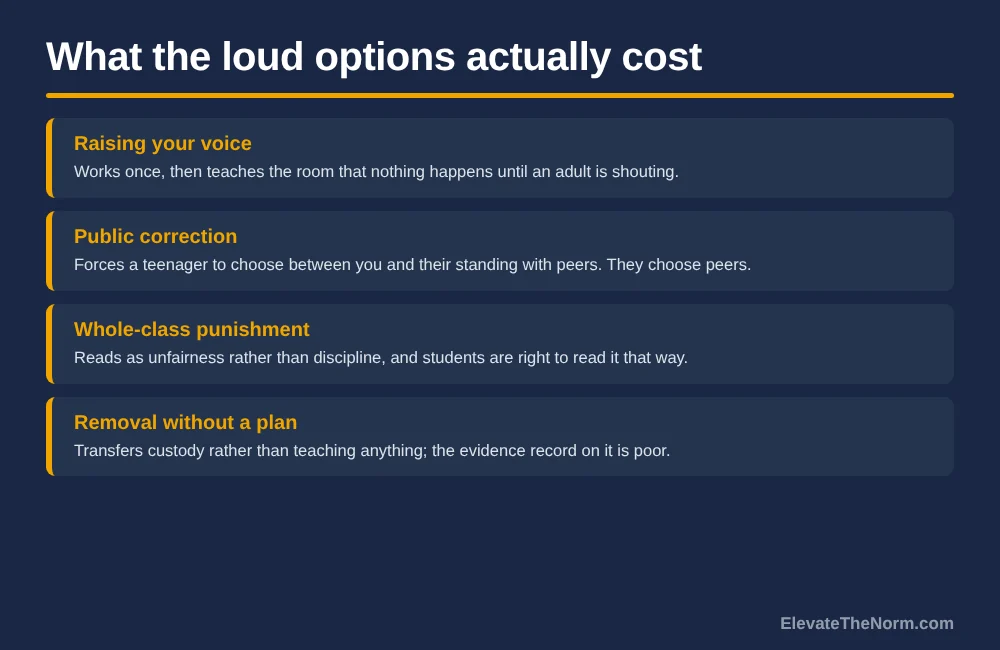
Raising your voice works once. After that you have established that nothing in your room happens until an adult is shouting, and you have made yourself the loudest thing a student has to beat.
The closest thing to hard evidence here comes from parenting research rather than classrooms, and I want to be careful about the gap. A two-year longitudinal study of 967 two-parent families found that harsh verbal discipline at ages 13 to 14 — defined as using psychological force to cause emotional pain or discomfort in order to correct behavior, ranging from yelling to insulting and humiliating language — was associated with increases in both depressive symptoms and conduct problems, including misbehavior at school. The relationship ran both ways: adolescents with conduct problems drew more harsh verbal discipline. And parental warmth did not buffer it; the researchers concluded harsh verbal discipline appeared detrimental regardless of the strength of the bond (Wang & Kenny, 2013, via the Society for Research in Child Development summary).
Those were parents, not teachers, and the sample was mostly middle-class. You cannot read it as a measured finding about your sixth period. What it does do is undercut the most common defense of shouting at teenagers, which is that it is fine if they know you care about them. In that data, knowing you care did not help. We go further into this in our piece on what yelling actually buys a teacher.
Audience is the other half. A public correction forces a student to choose between complying and keeping their standing with peers, and for a fourteen-year-old that is not a close call. You have manufactured a confrontation that did not need to exist. Almost every technique in rungs one through six exists to avoid exactly that choice.
What to do instead of raising your voice
Use a script. Not because scripts are elegant, but because your judgment is worse than usual at the exact moment you need it.
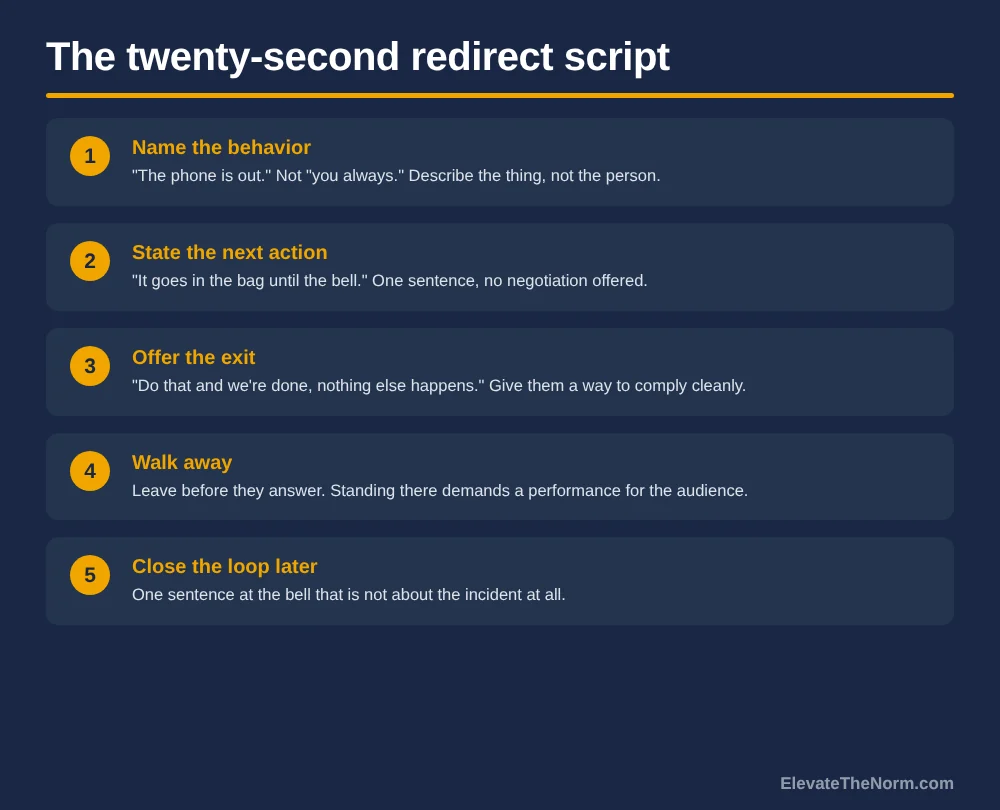
Here is one that holds up. Say it quietly, at the desk, in under twenty seconds, and then leave.
- Name the behavior, not the person. “The phone is out.” Not “you always.”
- State the next action. “It goes in the bag until the bell.”
- Offer the exit. “Do that and we are done, nothing else happens.”
- Leave. Walk away before they respond. Standing there demands a reaction and the only one available to them is a performance.
- If it continues, go to the doorway, not to volume. “Step out with me for thirty seconds.”
- Close the loop later, privately. One sentence at the end of class that is not about the incident: “Good work on the second half. See you tomorrow.”
Step six is the one people skip and it is the one that matters most. A correction that ends with the relationship intact can be repeated. A correction that ends with a grudge can only escalate. Our material on repair after a mistake is the longer version of step six.
Behaviour management strategies: what the search term gets right
Teachers searching the British phrase “behaviour management strategies” are usually asking a better question than teachers searching for control, because management implies a system and control implies a contest.
A system can be handed to a substitute, written down, taught to students, and repaired when it breaks. A contest can only be won or lost, and it has to be won again every period. If you take one framing away from this article, take that one. Everything that survives in a secondary classroom is a system: the entry routine, the materials procedure, the way late work is handled, the ladder in the table above. None of it depends on you being intimidating.
The flip side is that a system you built and do not run is worse than no system, because it has told students your word is decorative. Fewer rules, held exactly, beats a comprehensive code enforced by mood.
Does removing the student work?
Sometimes it is necessary and it is almost never productive, which are two different claims and both are true.
Necessary: a student who is unsafe, or who has escalated past the point where anything you say will land, needs to be somewhere else for a while. That is not a failure. Unproductive: removal does not teach the behavior you wanted, it costs instructional time the student usually could not afford, and at scale it correlates with the outcomes the APA review described. The practical test I would use is whether the removal has a plan attached. “Go to the office” is a transfer of custody. “Go cool off at the table in the back for five minutes, then come talk to me at the end” is a technique.
Do restorative approaches work better?
They are promising, they are not a cure, and the best-designed study of them produced a genuinely mixed result that I think teachers should know about.
A randomized controlled trial of a whole-school restorative practices program in a mid-sized urban district found that participating schools had greater reductions in overall suspension rates, including for African American students and students from low-income families, which narrowed disparities, and that teacher ratings of school climate improved. It also found that academic outcomes did not improve — and actually worsened in grades 6 through 8 — and that arrest rates did not fall (Augustine et al., RAND Corporation, 2018).
I would not use that to dismiss restorative work; I would use it to set expectations. The middle-grades academic result is a real finding and the honest interpretation is probably about implementation cost: a program that takes instructional time has to be worth the time it takes. Read our overview of restorative practices and where they fit alongside that caveat rather than instead of it.


Class room control when you are new or covering someone else’s room
With no history and no relationship, the only techniques available to you are structural ones — so use the structure and skip everything that depends on standing.
Plenty of people search for class room control as two words, and a disproportionate number of them are substitutes, first-year teachers, or someone covering a planning period in a room they have never seen. If that is you: get the names, give a task that can start without instructions, stand at the door, state the two things you will hold and nothing else, and do not make a single threat you cannot personally carry out before the bell. The fastest way to lose a borrowed room is to announce a consequence you have no authority to deliver. Our guide for substitutes covers the hour-by-hour version.
How do you regain control of a class you have already lost?
You reset publicly, narrow what you are asking for, and then be relentlessly boring about the one or two things you chose.
Say it out loud to the class: this has not been working, here is what I got wrong, here are the two things that change starting Monday, and here is exactly what happens when they do not. Then hold those two things for four weeks without adding a third. The temptation is to announce a complete overhaul, which fails because you cannot sustain it and the failure proves your word is unreliable all over again.
Pair it with the two cheapest positive moves available. A randomized study in middle school classrooms found that teachers who greeted students positively at the door saw improved academic engaged time and reduced disruptive behavior, and rated the strategy as feasible and reasonable to run (Cook et al., 2018). And in 28 middle school classrooms, higher praise-to-reprimand ratios tracked linearly with better class-wide on-task behavior and with better engagement and grades among students at risk for emotional and behavioral disorders (Caldarella, Larsen, Williams & Wills, 2023). Both of those are free, both were measured in middle school, and both are the opposite of control.
Why a room that runs itself beats a room you control
Control is scaffolding. It is sometimes necessary and it is never the finished building, and the difference shows up the first day you are absent.
There is also a motivational reason to aim past compliance. A meta-analysis of 144 studies with just over 79,000 participants, mean age 16.5, found teacher autonomy support correlated .48 with intrinsic motivation and −.32 with amotivation, and that students’ sense of competence (ρ = .58) and autonomy (ρ = .57) were the strongest predictors of self-determined motivation (Bureau, Howard, Chong & Guay, 2021). Those are correlations from self-report measures, so hold them loosely. But autonomy support is not permissiveness — it is demands with reasons attached and real choice inside them. A room built that way does not need as much controlling, which is the only durable solution to wanting control.
Where to start with classroom control techniques this week
Pick the lowest rung you are currently skipping, and pick one promise you will keep exactly. Those two things, together, are most of what people mean by classroom control techniques that work.
Concretely: for one week, handle everything with proximity and a private word, and refuse to use volume at all. You will find out quickly how much of your room was running on noise. In the same week, choose one thing you have announced and been loose about — a deadline, a phone rule, a seat — and hold it precisely, with the student you least want to hold it with. That is the whole intervention. If you want the broader toolkit it sits inside, our ranked list of classroom management strategies for grades 6–12 is the place to go next, and the piece on identifying your own management style will tell you which rung you default to when you are tired.
Sources
- Reynolds, C. R., Skiba, R. J., Graham, S., Sheras, P., Conoley, J. C., & Garcia-Vazquez, E. “Are Zero Tolerance Policies Effective in the Schools? An Evidentiary Review and Recommendations.” American Psychologist, vol. 63, no. 9, 2008, pp. 852–862. Supports the findings that suspension predicts higher future misbehavior, the negative relationship with school-wide achievement, the dropout and graduation findings, and the developmental argument about adolescents. Caveat: a policy-level review resting substantially on correlational evidence; it addresses district and school policy rather than individual referral decisions. https://www.scstatehouse.gov/CommitteeInfo/SchoolSafetyTaskForce/October282014Meeting/zero-tolerance.pdf
- Wang, M.-T., & Kenny, S. “Longitudinal Links Between Fathers’ and Mothers’ Harsh Verbal Discipline and Adolescents’ Conduct Problems and Depressive Symptoms.” Child Development, 2013. Supports the definition of harsh verbal discipline, the association with conduct problems and depressive symptoms at ages 13–14, the bidirectional relationship, and the finding that parental warmth did not buffer it. Caveat: this studied parents and not teachers, in 967 mostly middle-class two-parent families, and is cited here through the Society for Research in Child Development’s summary of the study rather than the paywalled article. https://www.srcd.org/sites/default/files/resources/pr_2013_09_04_wang.pdf
- Simonsen, B., Fairbanks, S., Briesch, A., Myers, D., & Sugai, G. “Evidence-Based Practices in Classroom Management: Considerations for Research to Practice.” Education and Treatment of Children, vol. 31, 2008, pp. 351–380. Supports the five categories of evidence-based practice and specifically the use of a continuum of responses to inappropriate behavior. Caveat: linked as a full-text reproduction hosted by a university project rather than the journal of record. https://k12engagement.unl.edu/sites/unl.edu.cehs.special-ed-communic-disorders.student-engagement-project/files/media/file/Classroom%20Management%206-8-16.pdf
- Augustine, C. H., Engberg, J., Grimm, G. E., Lee, E., Wang, E. L., Christianson, K., & Joseph, A. A. Can Restorative Practices Improve School Climate and Curb Suspensions? RAND Corporation, RR-2840-DOJ, 2018. Supports the suspension reductions, the narrowing of disparities, the improved teacher climate ratings, and the finding that academic outcomes did not improve and worsened in grades 6–8. Caveat: one randomized trial in one mid-sized urban district; the middle-grades academic result is a real negative finding and should not be omitted when the program is recommended. https://www.rand.org/pubs/research_reports/RR2840.html
- Cook, C. R., Fiat, A., Larson, M., Daikos, C., Slemrod, T., Holland, E. A., Thayer, A. J., & Renshaw, T. “Positive Greetings at the Door: Evaluation of a Low-Cost, High-Yield Proactive Classroom Management Strategy.” Journal of Positive Behavior Interventions, vol. 20, no. 3, 2018, pp. 149–159. Supports the door-greeting effects on academic engaged time and disruptive behavior in middle school classrooms. Caveat: a single randomized trial; the specific percentage figures widely quoted online do not appear in the published abstract and are not repeated here. https://experts.umn.edu/en/publications/positive-greetings-at-the-door-evaluation-of-a-low-cost-high-yiel/
- Caldarella, P., Larsen, R. A. A., Williams, L., & Wills, H. P. “Effects of Middle School Teachers’ Praise-to-Reprimand Ratios on Students’ Classroom Behavior.” Journal of Positive Behavior Interventions, vol. 25, no. 1, 2023, pp. 28–40. Supports the linear relationship between praise-to-reprimand ratios and on-task behavior, engagement and grades. Caveat: 28 middle school classrooms; high school classrooms were not studied. https://journals.sagepub.com/doi/10.1177/10983007211035185
- Bureau, J. S., Howard, J. L., Chong, J. X. Y., & Guay, F. “Pathways to Student Motivation: A Meta-Analysis of Antecedents of Autonomous and Controlled Motivations.” Review of Educational Research, vol. 91, no. 3, 2021. Supports the correlations between teacher autonomy support, competence, autonomy and self-determined motivation in a sample with a mean age of 16.55. Caveat: 144 studies and 79,079 participants, but correlational and largely self-reported on both sides. https://selfdeterminationtheory.org/wp-content/uploads/2021/09/2021_PathwaystoStudentMotiv_BureaHowardEtal.pdf
Frequently Asked Questions
Is wanting control of my classroom a bad thing to want?
No. A room that is chaotic is a room where nobody learns and some students are genuinely unsafe, so the instinct is sound. The argument here is about the target, not the motive. Control is a means, and the kind you get by being intimidating has to be re-established every period and collapses the week you are absent. The kind you get from taught routines, a predictable response ladder and a reputation for keeping your word holds without you. Same goal, far cheaper to maintain.
What if a student escalates after I use a quiet redirect?
Then you stop trying to win the moment. Drop your volume rather than raising it, give the class something to do so they stop being an audience, and move the conversation to the doorway or defer it entirely: “We’ll talk at the bell.” A student who is escalated is not processing your reasoning, so reasoning harder makes it worse. If there is any safety concern, follow your building’s procedure immediately — de-escalation technique is not a substitute for a safety protocol, and no article should tell you otherwise.
Doesn’t this just mean being soft on students who need firm boundaries?
It means the opposite. Nothing here says to lower a standard; it says to deliver the standard quietly and without fail. The firmest thing in a classroom is not a raised voice — it is a consequence that arrives exactly as announced, including on the day you would rather not. Students experience certainty as firmness and volume as instability. If anything, this approach is harder on teachers than shouting is, because it requires you to follow through on days when nobody would blame you for letting it slide.
How do I explain my approach to a parent who expects tougher discipline?
Lead with predictability rather than philosophy. Tell them the sequence in order: expectations are taught in the first week, a problem gets a signal, then a private word, then a conversation with you, then a call home before anything is written up, and the same behavior gets the same response for every student. Most parents asking for toughness are really asking whether their child is safe and whether rules are applied evenly. Answer those two questions concretely and the disagreement about method usually disappears.
What does this cost a school to implement?
The classroom techniques cost nothing: proximity, private correction, a response ladder and keeping your word require no purchase and no release time. The real cost is coaching time, because teachers cannot see their own volume or their own praise-to-correction rate without someone counting. Twenty minutes of a colleague’s planning period does that. Whole-school restorative programs are a different financial question entirely, and the randomized evidence on those is mixed enough that a district should pilot before scaling.
Does this work with students who have behavior plans or significant trauma histories?
The low-rung techniques are generally a better fit for these students, not a worse one, because they reduce public exposure and surprise. Predictability and private correction are protective. What this article cannot do is replace an individualized plan: if a student’s IEP or behavior intervention plan specifies a response, that document governs, and you bring what you are observing to the case manager rather than improvising. Universal technique is the floor underneath individualized support, never a substitute for it.
I teach five classes and I am exhausted. Where do I start?
One period and one week. Choose the class that is hardest, and for five days handle every correction with proximity and a quiet word only — no volume, no public callouts. In the same week pick one promise you have been loose about and keep it exactly. That is two changes in one class, which is sustainable on a bad Tuesday. Trying to overhaul all five periods is the version of this that fails, and the failure costs you more credibility than never starting would have.
What if my administrator wants to see me being stricter?
Ask what observable behavior they want to see more of, because “stricter” usually turns out to mean something specific and achievable — fewer students out of seats, phones away, a faster start. Those are structure problems with structural solutions, and you can show progress on them without raising your voice once. Keep a short record of what you changed and what happened. An administrator watching a room start on time with everyone working is not going to insist you shout about it.