Tag: high school

  • Sub Plans for Middle and High School: What to Leave So the Day Actually Runs

    Sub Plans for Middle and High School: What to Leave So the Day Actually Runs

    Sub plans are the instructions you leave so someone else can run your class for a day. Good ones do three jobs: they keep students safe, they keep students doing real work, and they tell a stranger what normal looks like in a room they have never seen. Most sub plans only try to do the second job, and that is why most sub days go sideways.

    This guide covers what to put in sub plans for grades 6–12, how to write the day so a substitute can actually follow it, the difference between emergency sub plans and the ones you write for a planned absence, and what to do about the days no substitute shows up at all. If you want the other side of the door — what the person walking in can and cannot control — that is in the guide to running a room that isn’t yours.

    Key Takeaways

    • Sub plans are written for a stranger, not for you. Anything that only makes sense if you know the room has to be spelled out.
    • Write the day in minutes. Start and stop times for each task turn a vague plan into one a substitute can enforce.
    • Emergency sub plans are a different document. They stand alone, they are built at the start of the year, and anyone in the building can run them.
    • Report the absence early. In one large district’s data, substitute coverage rose sharply for every hour a job was posted ahead of time through the first day.
    • Plan for no sub at all. When an absence goes uncovered, students are often split into other rooms or a colleague gives up a planning period. The plan has to work for them too.
    • Make the work count. Students can tell a holding pattern from a real assignment, and they act accordingly.

    What Should Sub Plans Include?

    Sub plans should include the schedule written in minutes, a seating chart and roster, how the room normally runs, the exact location of every copy, answer keys, the names of people to call, the health and safety information your school requires you to share, and a sheet for the substitute to write back on. That is the binder. The lesson is only one part of it.
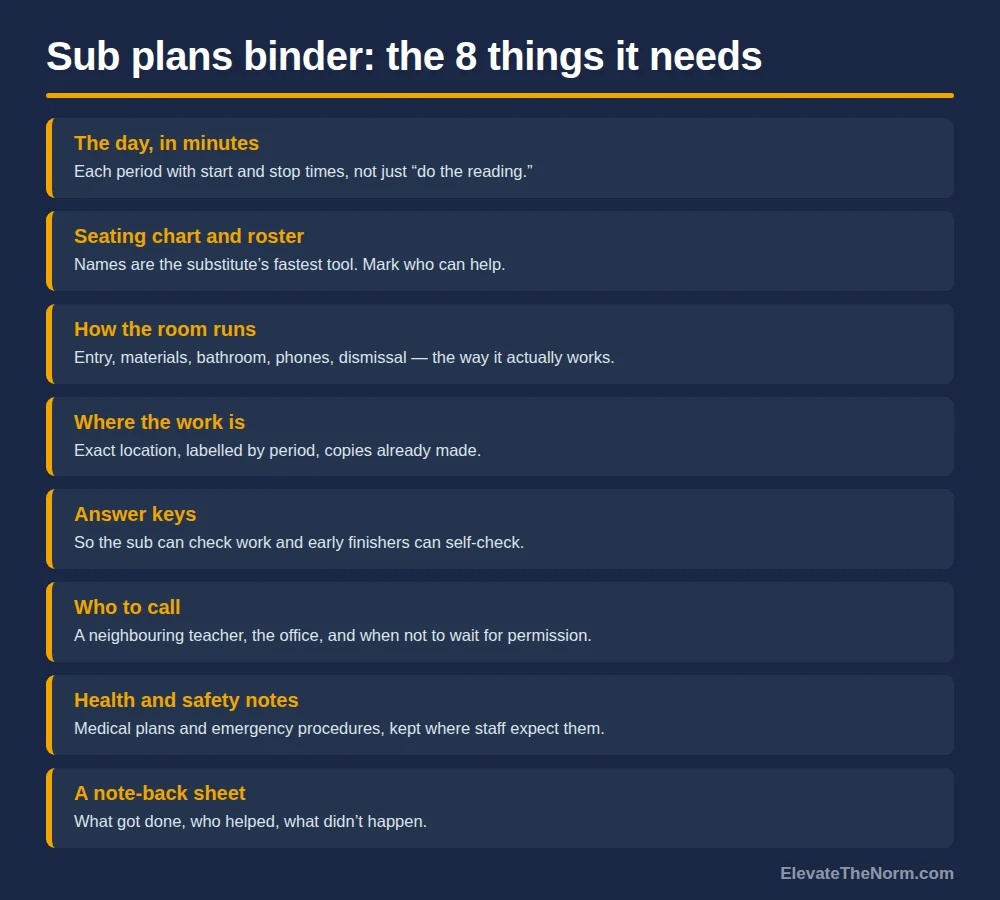
    Checklist of eight items for a sub plans binder: the day in minutes, seating chart and roster, how the room runs, where the work is, answer keys, who to call, health and safety notes, and a note-back sheet
    The lesson is one part of the binder. The other seven are what a stranger needs at 7:40 a.m.

    Think about what a substitute actually needs at 7:40 in the morning. Not your philosophy of teaching. They need to know where the copies are, what happens when the bell rings, and who to send for when something goes wrong. A plan that says “students will continue their reading” tells them nothing about any of that.

    The day, in minutes

    Each period gets a start time and a stop time for every task. “8:05–8:15: bell work on the board. 8:15–8:40: reading and questions 1–6. 8:40–8:50: turn in to the tray by the door.” Times give the substitute something to point at. A posted time is easier to hold students to than an adult’s opinion about when they should be done.

    Seating chart and roster

    A substitute who can use names is in a different room than one who can’t. Keep the seating chart current and mark two or three students per class who can answer a question about where things are. Pick them for reliability, not for being your favorites. A seating chart built for the room you actually have does double duty here.

    How the room runs

    Entry, materials, phones, restroom passes, dismissal. Write down how these work in your room, not how they work in the handbook. If students pick up their own folders at the door, say so. If phones go in a pocket chart, say where it is. Most of what a substitute reads as students “getting away with something” is students following a routine nobody told the sub about. Your routines and procedures are the thing being handed over.

    Where the work is, and the keys

    Copies made, labeled by period, in one place, named in the plan. Answer keys in the same folder. Keys let the substitute check work and let students who finish early check their own, which keeps the last fifteen minutes from turning into the loudest fifteen minutes of the day.

    Who to call, and the private information

    Name the teacher next door and the number for the office. Say plainly that if something is unsafe, the substitute does not need anyone’s permission to call for help. Health plans and emergency procedures belong in the binder only in the form your school requires. Do not leave copies of individual student plans loose on a desk; follow your building’s procedure for what a substitute is given and where it is kept.

    Write Sub Plans to the Minute

    My own rule for running a room is short: “Taking control of a classroom is done by organization to the minute and then you pause. Be confident.” The posted times are the setup. The pause is the enforcement. You lay out the plan, stop talking, and let the silence do its job.

    A substitute cannot borrow your confidence, and they do not have your history with the class. What they can borrow is your organization. If the plan is written to the minute, the substitute does not have to invent authority. They read the time, point at the board, and wait. The plan carries the weight a stranger’s voice cannot.

    That is also why vague plans fail even with a strong substitute. “Work on the project” leaves the adult in the room arguing about what counts as working. “Draft paragraph two, due in the tray at 9:20” does not. If you have never written the room down this way, a written classroom management plan is the document to start from.

    Emergency Sub Plans vs. Planned-Absence Sub Plans

    Emergency sub plans are the ones you build before you need them. They stand alone, they do not depend on yesterday’s lesson, and anyone in the building can run them cold. Planned-absence sub plans are written the week you know you’ll be out and continue the unit students are already in.
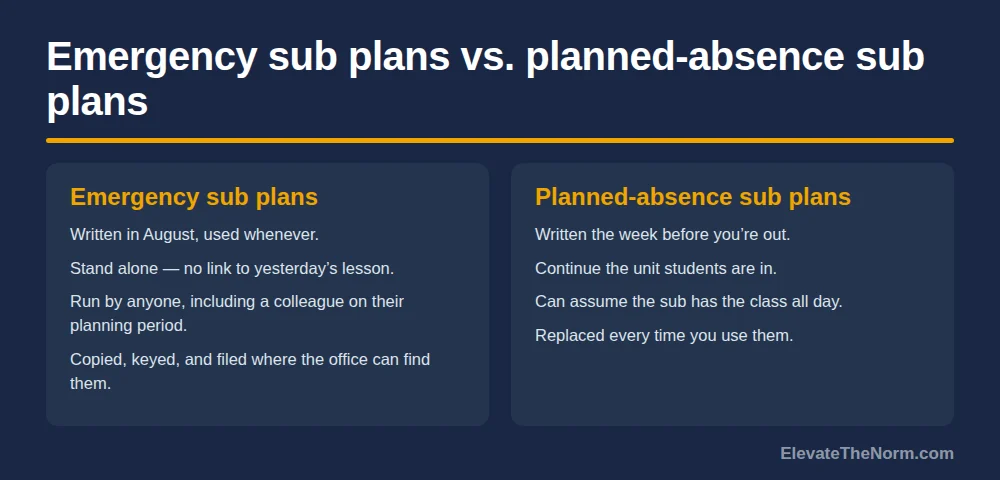
    Two-column comparison: emergency sub plans are written in advance, stand alone, can be run by anyone and are filed where the office can find them; planned-absence sub plans are written the week before, continue the current unit, and are replaced each time
    Emergency sub plans are the ones you can’t write when you need them.

    The emergency folder is the one that matters most, because it is the one you can’t write when you need it. You wake up sick at 5:30. Your kid has a fever. There is a family emergency two hours away. Nobody is writing a lesson plan in those moments, and nobody should have to.

    Three rules make emergency sub plans work:

    • Standalone. No reference to “where we left off.” The work makes sense on any day of the year.
    • Keyed and copied. A full class set for each day, with an answer key, already in the folder.
    • Findable. The office knows where the folder is. So does the teacher next door. Tell them both.

    Three days is the right number for most secondary teachers. One day runs out the first time you’re out twice in a month, and five days is a lot to build before the year has started.

    I write these for my own room and put them on TPT. The Any-Day Emergency Sub Plan Card is free: one page any adult can run, in any subject. If you teach social studies, Emergency Sub Plans World History is five strange-but-true readings with questions and answer keys, written so a substitute can hand them out without knowing the content. The same format covers Civics Sub Plans Vol. 1 for government classes and Renaissance Sub Plans. For a full ancient-to-medieval sequence, the Ancient & Medieval Sub Plans Bundle covers Egypt, Greece, Rome, and the Middle Ages in one folder.

    Out the week of Halloween? Halloween Sub Plans are five spooky history readings a substitute can run cold, so the sub day isn’t a word search.

    Subject-Neutral Sub Plans That Still Count

    Not every emergency day can be a content day. Sometimes the substitute is covering three different preps, or the class is being split into other rooms. That is when subject-neutral work earns its place. The test is simple: would a reasonable student see it as real work, and would you actually look at it when you got back?

    Work that passes that test:

    What fails the test: a movie with no task, a word search, or a packet nobody collects. Students read those as a day off, and the substitute pays for it.

    Behavior and Logistics: What the Substitute Needs to Know

    Tell the substitute what normal looks like, so they can tell when something isn’t. If partner talk is how your room works, say so, or a quiet-room substitute will spend the day fighting your design. If one class needs a seating change after lunch, write it down. If a student has a plan for stepping out when they need to, put it in the binder the way your school requires.

    Then give them something to say when a student pushes back. Most substitutes have a few phrases they lean on; it helps to leave a few that match how your room already talks. The free 5 De-escalation Scripts You Can Use Today fit on one page in the binder. If you want the full set for yourself, De-escalation Strategies for Teachers has 100 scripts for middle and high school.

    Finally, leave clear limits. Name the two or three things a substitute should write down and leave for you, rather than handle on the spot. That protects students from a stranger making a big call on a single day, and it protects the substitute from having to.

    When to Write Sub Plans, and When to Report the Absence
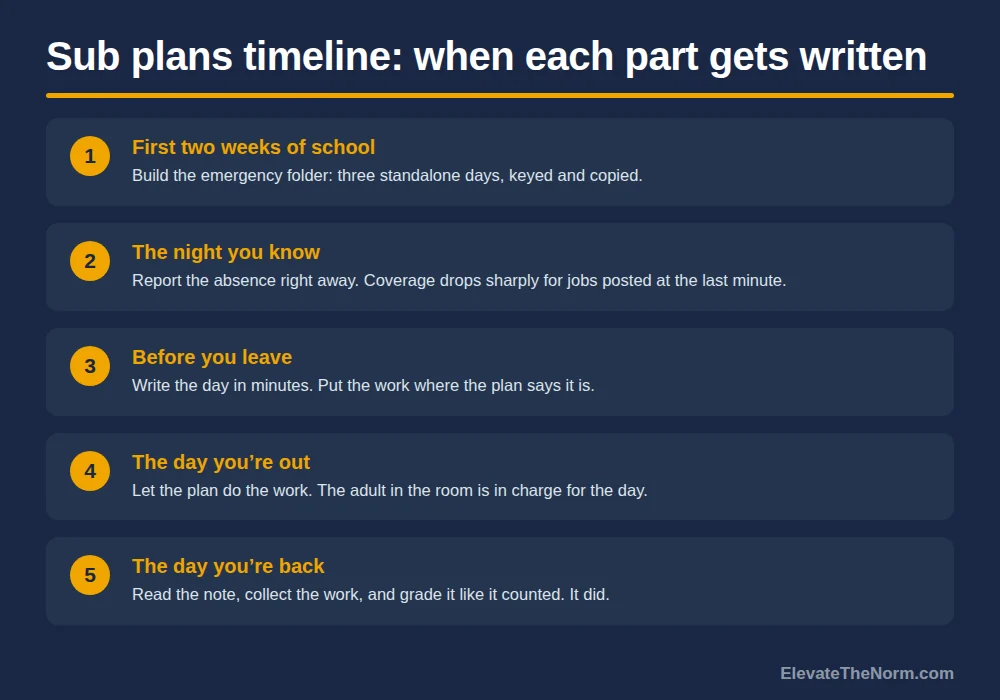
    Five-step timeline for sub plans: build the emergency folder in the first two weeks, report the absence right away, write the day in minutes before you leave, let the plan do the work, and grade the work when you return
    Report the absence early. Coverage drops for jobs posted at the last minute.

    Build the emergency folder in the first two weeks of school, while you still have the energy and before you need it. Look at it again at the start of each grading period and swap anything that has gone stale.

    When you know you’ll be out, report it right away. In a study of a large West Coast district, Brookings researcher Jing Liu and colleagues found that how early a substitute job was posted was one of the strongest predictors of whether it got filled. Coverage climbed quickly for each hour of notice through the first 24 hours, and jobs posted at the last minute were the least likely to be covered. A plan that never gets a substitute to read it is a plan for whoever ends up in your room instead.

    Plan for the Day No Substitute Comes

    Uncovered absences are not rare. In the same district data, teachers were out about 11.8 days a year, and roughly one of those days went without a substitute. When that happened, students were split into other classrooms about 37 percent of the time, a teacher gave up a planning period about 35 percent of the time, and an administrator covered about 12 percent of the time.

    The same study found that schools serving more disadvantaged students had systematically lower substitute coverage, and that substitutes often cited student behavior when they named the schools they avoided. Reporting from 2024 citing federal survey data put the share of public schools that had difficulty finding substitutes at 35 percent in 2023–24. Read honestly, that is not a reason to blame anyone. It is a reason to write plans that a colleague can run in another room, with your students sitting in the back of a class that isn’t theirs.

    That means one more rule for emergency sub plans: they have to work for 25 minutes in someone else’s room. A one-page reading with questions does. A lab, a discussion, or anything that needs your projector does not.

    What Students Should Be Doing, and Why It Matters

    Students behave differently on a sub day for reasons that make sense. The adult is new, the routine is off, and the day looks like it might not count. Responding to that isn’t a character flaw. It’s a reasonable read of what they’ve been handed.

    The fix is on our end. Leave work that is clearly real, collect it, and tell them in the plan that you will read it. Then do. If the work is graded, grade it the way you would on any other day. Don’t punish a whole class for what the substitute’s note says a few students did; deal with those students individually, the way you would if you had been there.

    Families notice this too. If a sub day turns into a grade, a student should be able to explain to a parent what the assignment was and why it counted. If you get questions, clear parent-teacher communication is easier when the work was clearly worth doing.

    Review Sub Plans Like the Person Reading Them

    Before you file it, read the plan as a stranger would. Could someone who has never been in your building find the copies? Could they start class without asking anyone? Could a colleague run the same pages in their room? Could a student tell what they are being graded on? If any answer is no, that is the line to fix.

    Build Sub Plans Once

    The point of all this is that the hard thinking happens once. A good emergency folder is built in August and keeps paying for itself every time life gets in the way. A good binder template means the planned-absence day takes twenty minutes to write instead of an evening.

    If you would rather start with everything already built, The Teacher Emergency Kit Ultimate Bundle puts 64 resources for grades 6–12 in one download. If you’re buying during a sitewide sale, the TPT sale guide explains how the discounts stack. Free printables for the rest of the classroom are in the free resource library.

    Frequently Asked Questions

    What should be included in sub plans?

    A minute-by-minute schedule for each period, a seating chart and roster, how routines like entry, phones, and dismissal work, where the copies and answer keys are, who to call for help, the health and safety information your school requires, and a sheet for the substitute to leave notes on. The lesson itself is only one part.

    What are emergency sub plans?

    Emergency sub plans are standalone lessons you prepare before you need them, usually at the start of the year. They don’t depend on where the class left off, they come copied with answer keys, and they are kept where the office and a neighboring teacher can find them. Three days is a practical number for most secondary teachers.

    How detailed should sub plans be?

    Detailed enough that someone who has never been in your building could run the day without asking anyone. Use start and stop times for each task, name exactly where materials are, and spell out routines that students already know but a substitute doesn’t.

    Should sub plan work be graded?

    If you want students to take it seriously, yes. Collect it, read it, and grade it the way you would on any other day. Work that is never collected teaches students that sub days don’t count.

    What if no substitute is available?

    Plan for it. When an absence goes uncovered, students are often split into other classrooms or a colleague covers on a planning period. Emergency sub plans should work in 25 minutes in someone else’s room, which means short readings with questions rather than labs or discussions.

    Can a substitute show a movie?

    Only with a task attached and only if your school allows it. A video with a set of questions that gets collected is work. A movie with nothing attached tells students the day doesn’t count, and the substitute usually pays for that.

    How early should I report an absence?

    As early as you can. In one large district’s data, coverage rose sharply with each hour of notice through the first 24 hours, and last-minute postings were the least likely to be filled.

    Sources

    • Liu, J. (2020). America faces a substitute teacher shortage—and disadvantaged schools are hit hardest. Brookings Institution, Brown Center Chalkboard. Read the analysis — source for the 11.8 days of average absence, the share of uncovered absences and how they were covered, the effect of posting time on coverage, and the lower coverage rates in disadvantaged schools. Data from one large urban district on the West Coast, 2011–12 to 2017–18; it describes associations in that district, not a national rate.
    • DiFurio, D. (2024). Substitute teachers keep schools running. Here are the best ways schools can attract more amid the shortage. Stacker, with HeyTutor. Read the article — source for the 35% of public schools reporting difficulty finding substitutes in 2023–24 (attributed there to NCES School Pulse Panel data) and for the finding that substitutes rank solid lesson plans highest when choosing an assignment (from Red Rover’s 2023 survey of about 4,000 substitutes). This is a secondary summary; the NCES and Red Rover figures are cited as reported there.
    About Clay Shumate

    By Clay Shumate — Clay Shumate is a certified secondary Social Studies teacher in the public schools of West Alabama, with seven years of classroom experience, a B.A. in History, and an M.Ed. in Secondary Education. He writes about project-based learning, student responsibility, respect, and practical ways to hold young people to a higher standard while giving them room to learn from mistakes. He is a member of the Society of Professional Journalists and writes to its Code of Ethics; this site’s editorial standards and corrections policy are published in full.

  • Formative Assessment Strategies for Writing: Checks That Fit a Real Week

    Formative Assessment Strategies for Writing: Checks That Fit a Real Week

    By Clay Shumate

    Formative assessment strategies for writing are the checks a teacher runs while a piece is still being written, so the information can still change the draft. Exit tickets and comprehension checks do not transfer here. Writing has its own set, because the thing being assessed takes days, gets revised, and is too long to read thirty times a week. The equivalents for reading work on a different clock and are collected separately.

    That last constraint is the real problem. Almost every writing-feedback system that gets abandoned was abandoned because it required reading every draft. What follows is what the research supports, the number that should worry you, and a set of checks that fit an ordinary secondary schedule.

    Key Takeaways

    • Feedback works, and the size depends on who gives it. A meta-analysis found adult feedback at an effect size of 0.87, self-evaluation at 0.62 and peer feedback at 0.58 — but that study covered grades 1–8.
    • Two popular practices showed no meaningful effect in the same analysis. Teacher progress monitoring and the 6+1 Trait Writing model did not improve writing quality.
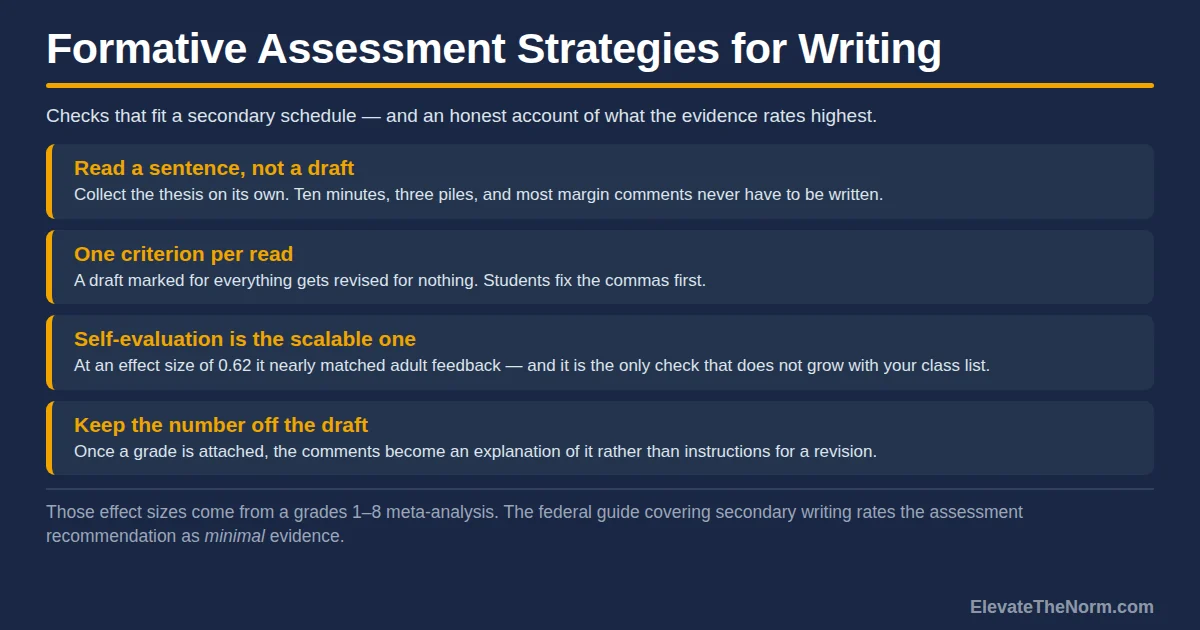
    • The federal practice guide rates the assessment recommendation as its weakest. Of three recommendations for teaching secondary writing, “use assessments to inform instruction and feedback” carries minimal evidence. That is worth knowing before anyone sells you a system.
    • Assess one thing at a time. A draft marked for everything gets revised for nothing. Pick the criterion the lesson taught and check only that.
    • Never put a grade on a draft you want revised. Self-assessment that counts toward a mark stops being honest, and the same logic applies to a draft.

    Free Download · PDF

    Formative Assessment Quick-Use Pack

    A strategy decision matrix, an evidence tracker, four exit-ticket formats, and a next-day response planner — four pages built around changing the next instructional move.

    Download the free PDF

    Free. No email address required. Designed for grades 6–12. Browse every printable in Your Free Library.

    What Makes a Writing Check Formative?

    Timing and use. A check is formative if it happens while the piece can still change and if somebody acts on it. Both conditions. A rubric applied to a final draft, however detailed, is a grade with extra steps.

    That rules out more of the standard toolkit than teachers expect. Marking a finished essay is summative no matter how much you write in the margin. A reading quiz is not a writing check. A participation grade for peer editing measures compliance with a procedure, not the quality of anything. The general versions of these checks are covered in the general version, twenty techniques sorted by lesson phase; this page is about the ones built for a text that takes a week.

    What is distinctive about writing is that the product has stages. A thesis exists before the paragraph does, an outline before the draft, a draft before the revision. Each stage is a place to check something cheaply, while it is still cheap to fix. The whole art is checking the earliest stage at which the problem is visible — because a thesis fixed on Monday saves five paragraphs that never had to be written.

    What Does the Research Actually Show?

    That feedback on writing works, that two popular practices do not, and that the evidence for the whole assessment-driven approach is weaker than its popularity suggests. All three are worth having straight.

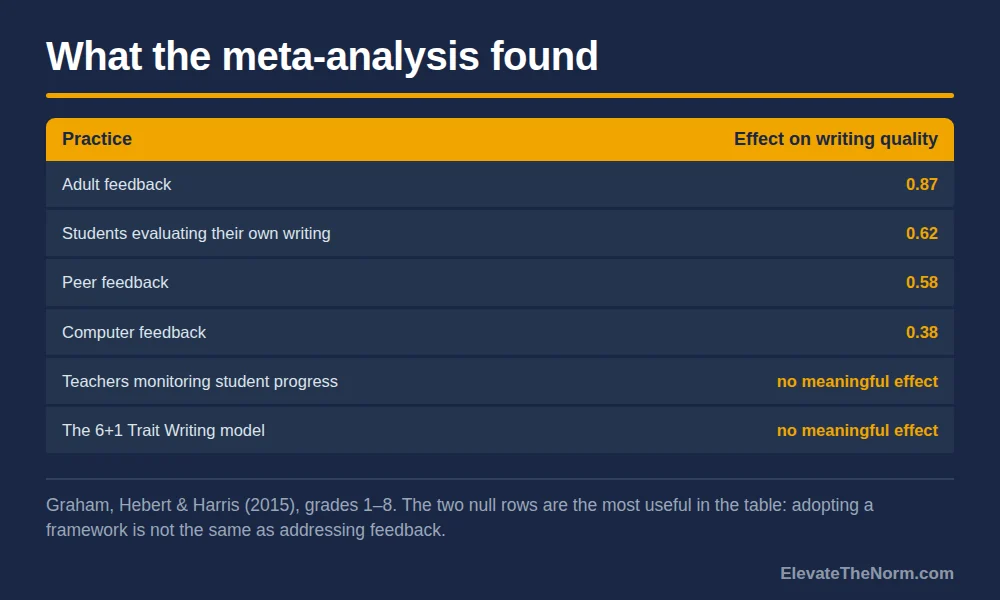
    The central study is Graham, Hebert and Harris’s 2015 meta-analysis in the Elementary School Journal, which pooled experimental studies of formative writing assessment and reported effect sizes by who does the assessing:

    PracticeEffect on writing quality
    Adult feedback0.87
    Students evaluating their own writing0.62
    Peer feedback0.58
    Computer feedback0.38
    Teachers monitoring student progressno meaningful improvement
    The 6+1 Trait Writing modelno meaningful improvement

    Three things to notice. First, the grade band is 1 through 8. Only the top three grades of that range are secondary, and none of it is high school. The practices are reasonable to carry upward; the numbers do not travel with them.

    Second, the two null results are the most useful rows in the table. Progress monitoring — tracking writing scores over time to inform instruction — showed no meaningful improvement, and neither did 6+1 Trait, which is a widely adopted framework. That does not make either worthless, but it does mean a department should not treat adopting them as having addressed writing feedback.

    Third, student self-evaluation at 0.62 nearly matched adult feedback and beat peer feedback. For a teacher with 120 students, that is the most consequential number in the table, because it is the only one that does not scale with your reading time.

    Now the part most articles omit. The What Works Clearinghouse practice guide on teaching secondary students to write effectively, written by a panel including Steve Graham, Jill Fitzgerald, Linda Friedrich, Katie Greene, James Kim and Carol Booth Olson, makes three recommendations and rates the evidence behind each. Explicitly teaching writing strategies through a model–practice–reflect cycle is rated strong. Integrating writing and reading using exemplar texts is rated moderate. Using assessments to inform instruction and feedback is rated minimal.

    Minimal is the lowest rating in that system, and it is attached to the recommendation this article is about. Read it as a statement about proportion rather than a reason to stop. If you have a fixed amount of energy for improving writing in your classroom, the guide says to spend it first on explicitly teaching strategies and modeling them — and the assessment practices below are what you run inside that, not instead of it.

    Table of effect sizes on writing quality from a formative assessment meta-analysis: adult feedback 0.87, student self-evaluation 0.62, peer feedback 0.58, computer feedback 0.38, and no meaningful effect for teacher progress monitoring or the 6+1 Trait Writing model
    Graham, Hebert and Harris (2015), grades 1-8. The two null rows are the most useful in the table.

    Which Checks Fit a Secondary Schedule?

    The ones that read a sentence rather than a draft. Every strategy below is designed around the fact that you cannot read 120 full drafts and still have a weekend.

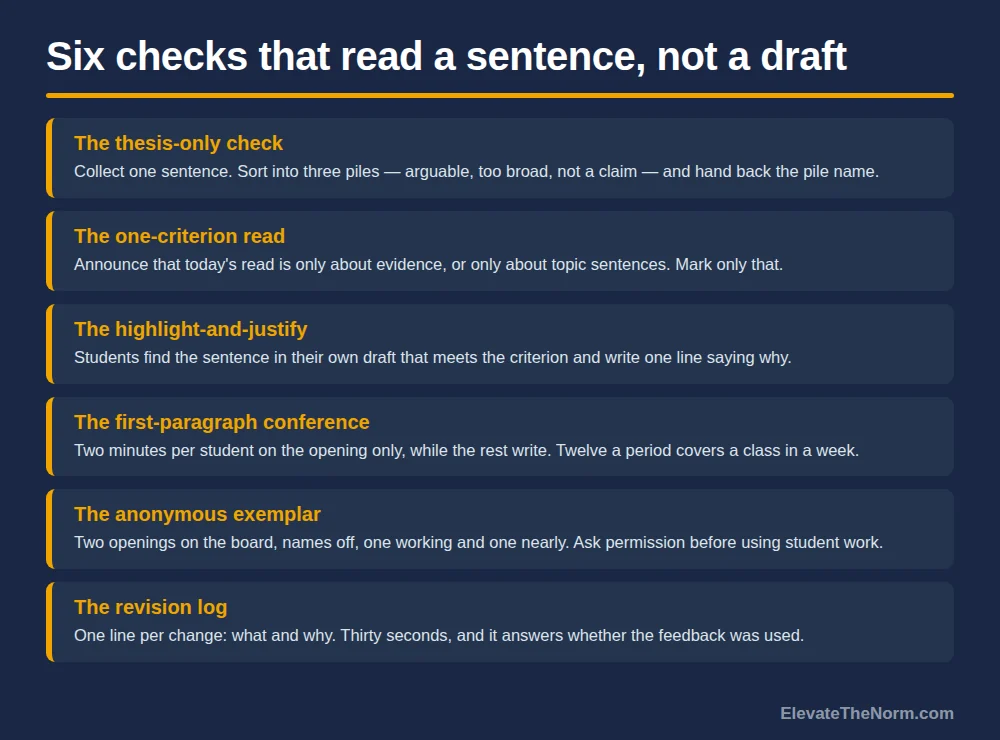
    • The thesis-only check. Collect one sentence. Read all of them in ten minutes, sort into three piles — arguable, too broad, not a claim — and hand them back with the pile name. Fixing this on day one prevents most of what you would otherwise write in margins on day six.
    • The one-criterion read. Announce that today’s read is only about evidence, or only about topic sentences. Mark only that. A draft marked for everything gets revised for nothing, because a student facing thirty marks does not know where to start and usually starts with the commas.
    • The highlight-and-justify. Students highlight the sentence in their own draft that meets a specific criterion, and write one line explaining why. If they cannot find it, that is the check — and they have found it themselves, which is the part that matters.
    • The first-paragraph conference. Two minutes per student, on the opening paragraph only, while the rest write. Twelve students a period, everybody covered across a week.
    • The anonymous exemplar. Put two short pieces of writing on the board with names removed — one that does the thing, one that nearly does it — and have the class say which and why. This is the model–practice–reflect cycle the WWC rates as strong evidence, run as a five-minute check. Ask before you use a student’s work, even anonymized, because the writer always recognizes their own sentences and so do the people sitting next to them. Asking takes ten seconds, almost nobody says no, and the ones who do have a reason. Writing your own two versions, or using last year’s with permission, works just as well.
    • The revision log. One line per revision: what changed, and why. It takes a student thirty seconds and tells you whether feedback was used, which is the only question a progress tracker was ever trying to answer.

    Notice what is missing: reading every draft, writing extended comments, and any system requiring a spreadsheet. Those are the things that get abandoned in October, and abandonment is the real failure mode — not choosing the second-best check. If you would rather start from something printed, the free formative assessment quick-use pack has a general version to adapt.

    Graphic listing six formative writing checks: the thesis-only check, the one-criterion read, the highlight-and-justify, the first-paragraph conference, the anonymous exemplar, and the revision log
    Every one of these reads a sentence rather than a draft. That is what makes them survive past October.

    How Do You Make Self-Evaluation Work?

    Give the criteria first, keep it out of the gradebook, and ask for evidence rather than a rating. At 0.62 this is the best return per minute of teacher time in the whole table, and all three conditions matter.

    Heidi Andrade’s 2019 critical review in Frontiers in Education supplies the design rules. Criterion-referenced self-assessment showed main effects on every criterion assessed, and concrete task-specific criteria outperformed vague competence-based ones — a result she attributes to Fastré and colleagues. In writing terms, “every claim is followed by a quotation and an explanation of it” is checkable. “Uses evidence effectively” is not.

    The decisive rule is about grading. Andrade cites Tejeiro and colleagues, where self-assessment counted toward the final grade: overestimation rose dramatically and no correlation remained between the instructor’s assessment and the student’s. Run formatively, agreement improved substantially, and all twenty studies in her review that used self-assessment formatively showed a positive association with learning.

    Andrade makes one more point worth carrying. There is little evidence that inaccurate self-assessment produces worse learning, and students act on their predictions regardless of accuracy. You are not trying to make a student’s judgment match yours. You are trying to make them read their own draft as a reader. The broader version of the practice is in the student self assessment guide; writing only changes what sits in the criteria.

    Is Peer Feedback Worth the Class Time?

    Yes at 0.58, and only if you narrow what you ask for. Unstructured peer review produces “I liked it, maybe add more detail,” which is the outcome most teachers have seen and correctly concluded is a waste of twenty minutes.

    There is a useful finding from an adjacent literature. Falchikov and Goldfinch’s meta-analysis of 48 higher-education studies comparing peer marks with teacher marks found that agreement was closest when students made a global judgment against well-understood criteria, and worse when asked to break the judgment into many separate dimensions and score each. Those were undergraduates marking work, not teenagers giving revision advice, so treat it as a design hint rather than a transferred result — but the hint points somewhere useful: the twelve-box peer editing checklist is probably the worst available format.

    What works better is narrower and more concrete:

    • Ask for a location, not a judgment. “Underline the sentence where the argument actually starts.” A reader can do that honestly; “rate the organization” they cannot.
    • Ask what the reader could not follow. This is the one thing a peer knows that you do not, because they read it without already knowing what the writer meant.
    • Ask for one question, not one suggestion. Suggestions are advice from a novice. A genuine question — “is this the same person as in paragraph two?” — is information the writer can act on without deferring to anyone.

    Two cautions. Peer feedback has a social cost that teacher feedback does not. A fifteen-year-old asked to critique a classmate’s writing is managing a relationship as well as a text, and most will resolve that tension by being vague. Asking for locations and questions rather than evaluations removes the tension rather than asking students to override it. And decide who reads what before you start. Writing is personal in a way a math worksheet is not; a student writing about something that matters to them should know in advance whether a classmate will see it, and should have a way out.

    A One-Week Routine That Does Not Require Reading Every Draft

    Four checks across a week, none of which takes you more than fifteen minutes.

    1. Day one — collect the thesis only. One sentence per student. Sort into three piles, hand back with the pile name, and give the “not a claim” pile five minutes to try again.
    2. Day two — the anonymous exemplar. Two openings on the board, names off, one working and one nearly working. The class names the difference. This is the modeling step, and it is the one with the strongest evidence behind it.
    3. Day three — highlight and justify. Students find the sentence in their own draft that meets today’s single criterion and write one line saying why. Walk the room and read over shoulders; collect nothing.
    4. Day four — peer question round. Swap drafts. Each reader underlines where the argument starts and writes one genuine question. Ten minutes, no checklist.

    Then the revision log on day five: one line per change, what and why. That log is the whole assessment record, and unlike a score tracker it answers the question that actually matters, which is whether any of this changed the draft.

    Two adjustments. First, differentiate the container rather than the criterion — a student who cannot produce the written justification quickly can say it to you in the last minute of class, and a student working in a second language can highlight and point. The judgment against criteria is what has to survive. Second, if a student’s draft has a problem that is not today’s criterion, note it for yourself and leave it. You will get to organization on the week you are checking organization, and a student who receives one correctable thing at a time actually corrects it. For the general version of this discipline, see what actually counts as evidence that a class understood something.

    Four Ways Writing Feedback Fails

    All four are common, and all four are about the system rather than the student.

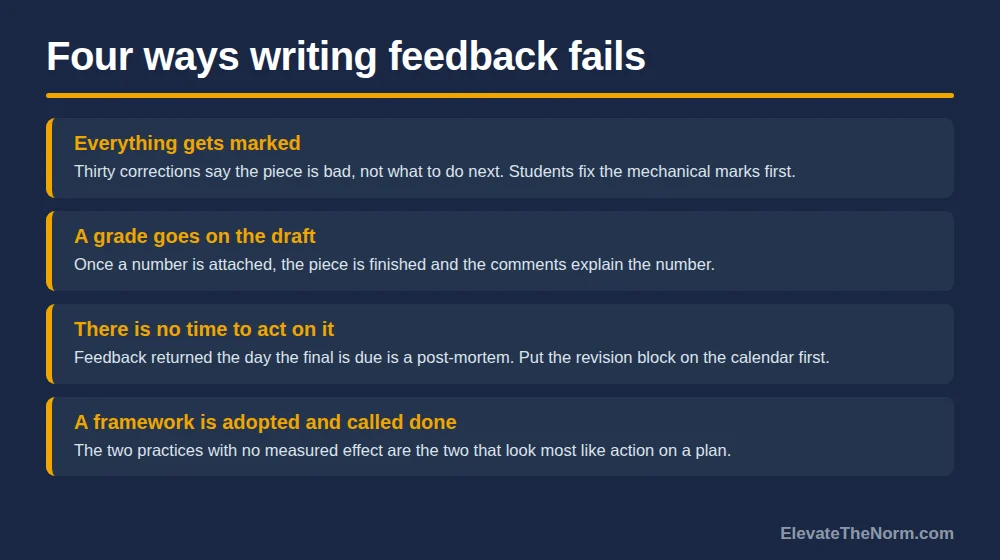
    Everything gets marked. A draft returned with thirty corrections communicates that the piece is bad, not what to do next. Students respond by fixing the easiest marks, which are almost always the mechanical ones. One criterion per read is not a compromise — it is what makes revision possible.

    A grade goes on the draft. Once a number is attached, the piece is finished in the student’s mind, and the comments underneath it become an explanation of the number rather than instructions for a revision. If you need the draft in the gradebook, grade completion rather than quality, and say which you are doing.

    The one-criterion rule is also the thing families most often ask about, usually in the form of why the teacher did not correct all the errors. It deserves a straight answer rather than a defensive one: every error was noticed, and marking all of them is what produces a draft a student fixes the commas in and hands back otherwise unchanged. The errors get their turn, one at a time, on the assignment where that is the thing being taught. Said in advance, in a sentence on the assignment sheet, that lands as a deliberate method. Said after a parent email, it sounds like an excuse.

    There is no time to act on it. Feedback returned the day the final is due is a post-mortem. If the schedule does not contain a revision block after the feedback, the feedback is decorative, and it is more honest to admit that than to keep writing comments into a void.

    Graphic listing four ways writing feedback fails: everything gets marked, a grade goes on the draft, there is no time to act on it, and a framework is adopted and called done
    All four are about the system rather than the student.

    The department adopts a framework and calls it done. This is where the two null results earn their keep. Adopting 6+1 Trait or installing a progress-monitoring spreadsheet is a visible action that showed no meaningful effect on writing quality in the meta-analysis. The things that did work — someone reads a piece of writing and responds to it, or a student reads their own against criteria — are less visible on a plan, and are the ones worth protecting time for.

    What to Try on the Next Assignment

    Take the next piece of writing you have already assigned. Collect the thesis on its own, before anything else exists, and sort the sentences into three piles. That single move costs you ten minutes and changes more drafts than any set of margin comments you will write later.

    Then pick one criterion for the whole assignment and check only that — in the exemplar, in the self-evaluation, in the peer round, in your own read. Put a revision block on the calendar before you give any feedback, and keep a number off the draft.

    None of this is a system, and that is deliberate. The evidence for assessment-driven writing instruction is rated minimal by the people best placed to judge it, while explicit strategy instruction and modeling are rated strong. The checks here are worth running because they are cheap and they surface problems early. They are not a substitute for teaching students how to write, and any resource presenting them as one has the proportions backwards.

    Before you go: grab the free Formative Assessment Quick-Use Pack (PDF) — ElevateTheNorm.com branded, printable, no email required.

    Frequently Asked Questions

    Do these effect sizes apply to high school students?

    Not directly, and it matters. The meta-analysis behind the headline numbers — adult feedback 0.87, self-evaluation 0.62, peer feedback 0.58 — covered grades 1 through 8, so only its top three grades are secondary at all and none is high school. The practices are reasonable to carry upward because the mechanisms are not age-specific, but the numbers should not be quoted as a high school result. The federal practice guide that does cover secondary writing rates the assessment recommendation as having minimal evidence.

    Should I put a grade on a draft?

    Not if you want it revised. Once a number is attached, most students treat the piece as finished and read the comments as justification for the mark rather than instructions for a revision. The self-assessment research points the same way: when self-evaluation counted toward a grade, overestimation rose sharply and agreement with the instructor disappeared. If a draft has to appear in the gradebook, grade completion rather than quality and tell students that is what you are doing.

    Is 6+1 Trait Writing a waste of time?

    That is stronger than the evidence supports. What the meta-analysis found is that 6+1 Trait showed no meaningful improvement in writing quality, and the same was true of teachers monitoring student progress over time. That is a real finding and a department should not treat adopting the framework as having addressed writing feedback. It is not a finding that a shared vocabulary for talking about writing is harmful — it is a finding that the vocabulary alone does not move the writing.

    How do I give feedback to 120 students without losing every weekend?

    Stop reading whole drafts. Collect one sentence rather than one essay; mark one criterion rather than everything; run two-minute conferences on opening paragraphs while the rest write; and lean on self-evaluation, which came in at 0.62 and is the only practice in the table that does not scale with your reading time. A teacher who reads every draft thoroughly in September and nothing at all by November has given less useful feedback than one who reads one paragraph from everybody every week.

    Does peer feedback actually help, or is it busywork?

    It helped at an effect size of 0.58, which is real — but what most classrooms run is not what was studied. Unstructured peer review produces “I liked it, add more detail.” Narrow the ask instead: have readers underline where the argument starts, say what they could not follow, and write one genuine question rather than one suggestion. Those ask for information a peer actually has. Also settle who reads what before you begin, because writing is more personal than a worksheet and a student should know in advance.

    What if a student’s draft has problems that are not this week’s criterion?

    Note them for yourself and leave them alone. A student who receives one correctable thing at a time usually corrects it; a student who receives thirty fixes the commas. Keep your own running list and let it decide what the criterion is for the next assignment — that list is more useful as a planning document than as margin notes, and it means the pattern across the class shapes what you teach next rather than disappearing into thirty separate drafts.

    How is this different from just marking essays carefully?

    Timing and use. Marking a finished essay is summative however detailed it is, because nothing about that piece can change afterwards. A formative check happens while the writing is still in progress and is followed by time to act on it. The practical test is simple: if there is no revision block on the calendar after the feedback goes back, what you did was grading, and calling it formative assessment does not make it function like one.

    Where should I spend my energy if I can only change one thing?

    Not here, according to the people who reviewed the evidence. The What Works Clearinghouse panel rates explicitly teaching writing strategies through a model–practice–reflect cycle as strong evidence, integrating reading and writing with exemplar texts as moderate, and using assessments to inform instruction and feedback as minimal. If you have one change in you this year, make it the modeling. The checks on this page are cheap enough to run inside that work, and they are not a replacement for it.

    Sources

    1. Graham, Steve, Michael Hebert, and Karen R. Harris. “Formative Assessment and Writing: A Meta-Analysis.” Elementary School Journal, vol. 115, no. 4, 2015, pp. 523–547. https://eric.ed.gov/?id=EJ1068976
    2. Graham, Steve, Jill Fitzgerald, Linda D. Friedrich, Katie Greene, James S. Kim, and Carol Booth Olson. “Teaching Secondary Students to Write Effectively” (practice guide summary). What Works Clearinghouse, Institute of Education Sciences, U.S. Department of Education. https://ies.ed.gov/ncee/wwc/Docs/PracticeGuide/wwc_secwrit_summary_053117.pdf
    3. Andrade, Heidi L. “A Critical Review of Research on Student Self-Assessment.” Frontiers in Education, vol. 4, art. 87, 2019. https://www.frontiersin.org/journals/education/articles/10.3389/feduc.2019.00087/full (The Tejeiro et al. 2012 and Fastré et al. 2010 findings are reported in this review; the primary papers were not read directly.)
    4. Falchikov, Nancy, and Judy Goldfinch. “Student Peer Assessment in Higher Education: A Meta-Analysis Comparing Peer and Teacher Marks.” Review of Educational Research, vol. 70, no. 3, 2000, pp. 287–322. https://eric.ed.gov/?id=EJ630369

    About Clay Shumate

    Clay Shumate is a certified secondary Social Studies teacher in the public schools of West Alabama, with seven years of classroom experience, a B.A. in History, and an M.Ed. in Secondary Education. He writes about project-based learning, student responsibility, respect, and practical ways to hold young people to a higher standard while giving them room to learn from mistakes. He is a member of the Society of Professional Journalists and writes to its Code of Ethics; this site’s editorial standards and corrections policy are published in full. More about Clay.

  • Visual Classroom Transitions: Cues Students Can Actually See

    Visual Classroom Transitions: Cues Students Can Actually See

    By Clay Shumate

    Visual classroom transitions use something students can see — a projected timer, a posted sequence, a slide, a hand signal — to carry the instructions for moving from one activity to the next, instead of your voice carrying them. The point is not decoration. It is that a visible instruction stays available after you have stopped talking, and a spoken one does not.

    That distinction is the whole article. Most transition advice tells you to be clearer. Visual cues are a structural fix rather than a delivery fix: they change where the instruction lives, so a student who missed it, tuned out for ten seconds, or is still finishing a sentence can recover without asking you or asking the person next to them.

    Key Takeaways

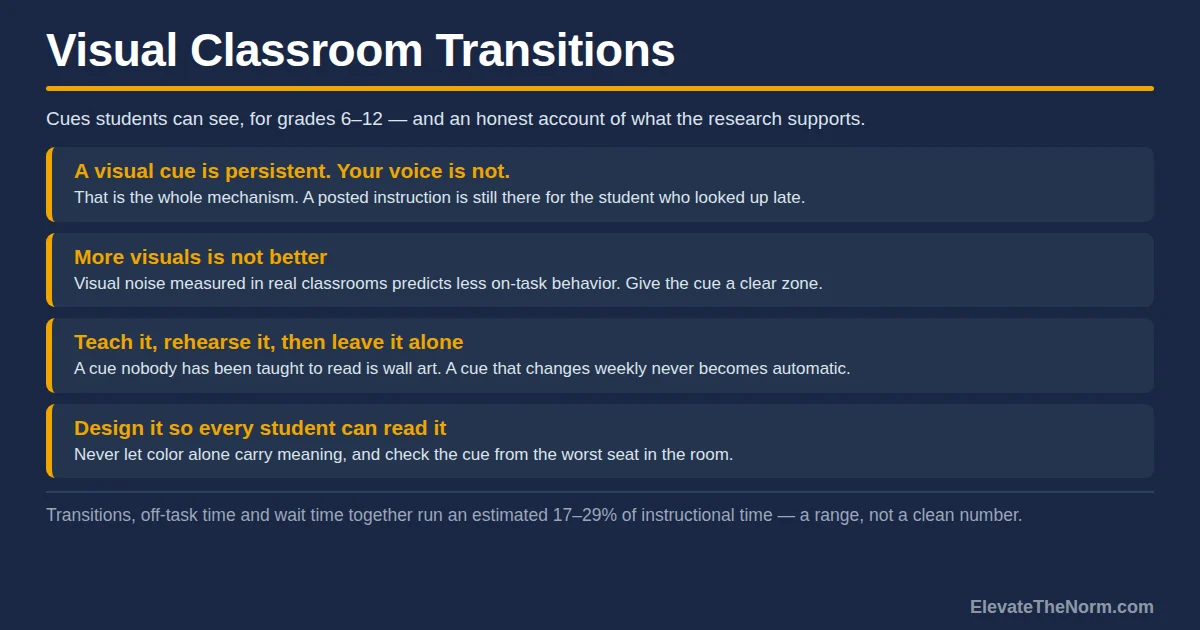
    • A visual cue is persistent; your voice is not. That is the entire mechanism. Anything a student can look back at removes a reason to ask a neighbor, and asking a neighbor is how a thirty-second transition becomes ninety.
    • Transitions are a real time cost, and the honest number is a range. Estimates put off-task behavior, transitions and wait time at somewhere between 17 and 29 percent of instructional time.
    • More visuals is not better. The same literature that supports visual cues also finds that visual clutter predicts less on-task behavior — and that finding has a published reanalysis you should know about.
    • The evidence base is strong for some students and thin for whole classrooms. Visual schedules are well supported for students with intellectual disability and autism. Nobody has shown a general secondary-classroom effect.
    • One permanent cue beats five clever ones. The cue only works once it is automatic, and a cue that changes weekly never becomes automatic.

    Free Download · PDF

    Classroom Transitions Planning Toolkit

    A transition audit sheet, a cue-type guide, and a planning template for building and timing the three moves that cost you the most.

    Download the free PDF

    Free. No email address required. Designed for grades 6–12. Browse every printable in Your Free Library.

    What Counts as a Visual Classroom Transition?

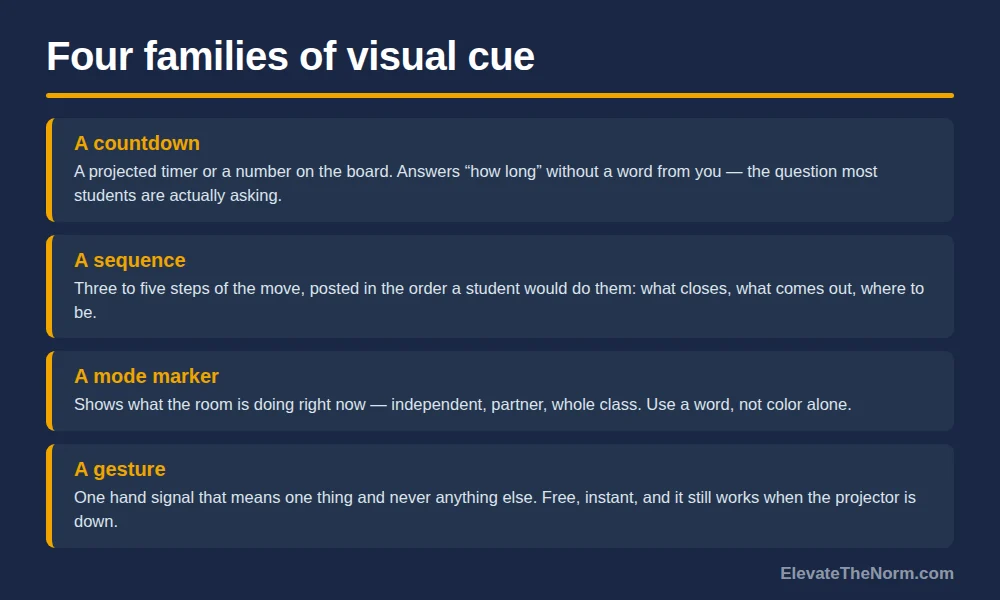
    Anything a student can look at that tells them what happens next, where to be, and how long they have. Four families cover almost everything worth using in a secondary room:

    • A countdown. A projected timer, or a number on the board you change. It answers “how long” without a single word from you, and “how long” is the question most students are actually asking.
    • A sequence. The steps of the move, posted or projected: what to close, what to get, where to sit. Three to five steps, in order, in the order a student would do them.
    • A state signal. Something that shows what mode the room is in right now — a colored slide, a magnet on the board, a word in the corner of the projection. Silent work, partner talk, whole class.
    • A gesture. A hand signal that means one specific thing and never means anything else. Free, instant, and the only one that works when the projector is down.

    What does not count: a decorative poster nobody reads, a slide so crowded that finding the instruction takes longer than hearing it, and a sign that has been up since August and has therefore become furniture.

    Graphic describing four families of visual classroom transition cue: a countdown, a posted sequence of steps, a mode marker showing what the room is doing, and a hand gesture
    Four families cover almost everything worth using in a secondary room. Most teachers need two of them, used consistently.

    Visual cues sit inside the broader practice of running the four moments where a lesson actually loses time, and they are one signal among several. They pair naturally with an audio cue — the music and sound cue guide covers that half — and the pairing is often better than either alone, because one catches the student who is looking up and the other catches the student who is not.

    How Much Time Do Transitions Actually Cost?

    Enough to matter, and less precisely than most articles claim. Anyone quoting you a clean figure is rounding somebody else’s estimate.

    The most careful recent synthesis is Kraft and Novicoff’s 2024 paper on time in school. Reviewing the available studies, they report that estimates of off-task behavior, transitions and wait time together occupy between 17 and 29 percent of instructional time — a range, drawn from several different measurement methods, and covering three things at once rather than transitions alone.

    Their own district analysis is more concrete and more sobering. In Providence Public Schools they found instructional time lost running at 16 percent in elementary, 21 percent in middle school and 25 percent in high school. The largest single contributor was unexcused absence, followed by outside interruptions and teacher absence; interruptions and teacher absence alone cost the average high school student 97.3 hours a year. My free First 10 Days Procedures Checklist on TPT walks through which routine to teach on which day.

    Read that honestly. Those Providence figures are not a transition statistic. They count absence and building-level interruption, and the authors explicitly call the estimate a lower bound that does not capture how usable hours are further eroded by disruptions inside the classroom. The transition number lives inside the 17-to-29 percent range, and that range is wide because the measurement is hard.

    What you can say without overstating: transitions are a nontrivial recurring cost, they are one of the few losses a single teacher can act on without anyone’s permission, and a room that moves in thirty seconds instead of ninety recovers real minutes across a semester. That is a good enough reason. It does not need inflating.

    Why Does a Visual Cue Work Better Than Saying It Again?

    Because it is still there after you stop talking. A spoken instruction exists for about four seconds and then only in the memory of whoever was listening. A projected one is available to the student who looks up late.

    That sounds small. It is the entire difference, and you can watch it happen: the student who missed the instruction turns to a neighbor, the neighbor stops working to answer, and one missed instruction has now taken two students off task and generated the noise that pulls a third. A visible instruction gives that student a way to recover without recruiting anyone.

    It also tells you who benefits most, and it is not the student you were picturing. It is the one who was absent yesterday and does not know the routine, the one who needs a few extra seconds to process a spoken instruction, and the one who will not ask you a question in front of the room under any circumstances. All three are students a voice-only transition leaves behind, and none of them will tell you so.

    There is a second effect, harder to see. Instructions delivered only by voice make you the sole source of the answer, so every uncertainty routes through you. That is what makes a transition feel like crowd control. Moving the instruction onto the wall or the screen means the room can answer its own question, which is the same principle behind writing down the routines a class is expected to run without prompting rather than re-explaining them.

    The research on the cueing side is worth being precise about, because it is frequently overstated. Visual activity schedules have a real evidence base: van Dijk and Gage’s 2019 meta-analysis in the Journal of Intellectual & Developmental Disability pooled 13 single-case studies and found a meaningful effect on independent skills, across middle school, high school and adult participants. Milam and Sutton’s 2024 article in Beyond Behavior extends the practice to students with emotional and behavioral disorders as a proactive transition strategy, at the elementary and middle school level.

    Notice what that evidence is and is not. It is single-case research with students who have identified disabilities. It is good evidence that visual schedules help those students become more independent. It is not evidence that adding a projected timer raises achievement in a general-education eleventh-grade classroom, and nobody should tell you it is. The honest case for visual cues in a mainstream secondary room is mechanical and modest: it costs nothing, it removes a known friction point, and the practice it generalizes from is well supported for the students who need it most.

    There is one adjacent evidence-based practice worth naming, because it is cheap and it pairs with every cue on this page. Ennis, Royer, Lane and Griffith’s 2017 systematic review in Education and Treatment of Children applied Council for Exceptional Children standards to precorrection — telling students what is about to be expected, before the moment arrives — and concluded it qualifies as an evidence-based practice. A visual cue is a precorrection you did not have to say.

    Does More Visual Support Make a Room Work Better?

    No, and this is the part most articles about classroom visuals leave out. The same research tradition that supports targeted visual cues also finds that a visually busy room costs attention.

    Godwin, Seltman, Scupelli and Fisher observed 58 elementary classrooms with a structured on-task protocol and analyzed panoramic photographs of each room’s visual environment. Students were on task 72.7 percent of the time. Greater visual noise significantly predicted less on-task behavior — each standard deviation increase in visual noise was associated with roughly a 10 percent reduction in the odds of being on task. Adherence to design-composition principles predicted nothing. Peer distraction, incidentally, accounted for 46.4 percent of all off-task behavior, which is worth remembering the next time a seating decision seems minor.

    The better-known version of this finding comes from Fisher, Godwin and Seltman’s 2014 study in Psychological Science, where kindergarteners in a heavily decorated room were more distracted and scored lower than the same children in a sparse one. It is quoted constantly. It also has a published reanalysis that you should know about before you quote it. Imuta and Scarf, writing in Frontiers in Psychology the same year, reanalyzed the data and found that children’s distraction in the decorated room decreased considerably across lessons — habituation. Their argument is that the study conflated novelty with irrelevance, and that 45 minutes total across two weeks is nowhere near enough time to habituate the way students do to a real classroom they sit in daily.

    So the strong claim — decorations harm learning — does not survive contact with the reanalysis. Two weaker claims do survive, and both are useful: visual noise measured in real classrooms predicts less on-task behavior, and novel visual material draws attention. Both point the same direction for transitions. If everything on your walls is competing, the one thing you actually need students to look at is competing too. And because novelty is what draws the eye, a cue that appears only at transitions has an advantage over one that is always up. My Brain Breaks for Middle and High School on TPT give you 60 quick resets that do not feel childish to teenagers.

    The caveat on all of it: these are K–4 samples. A sixteen-year-old is not a kindergartener, and no equivalent study of secondary classrooms turned up here. Treat this as a reason to keep the signal clean, not as a proven high school effect.

    How Do You Build a Visual Cue That Actually Gets Used?

    Five steps, and step four is the one that decides whether it works.

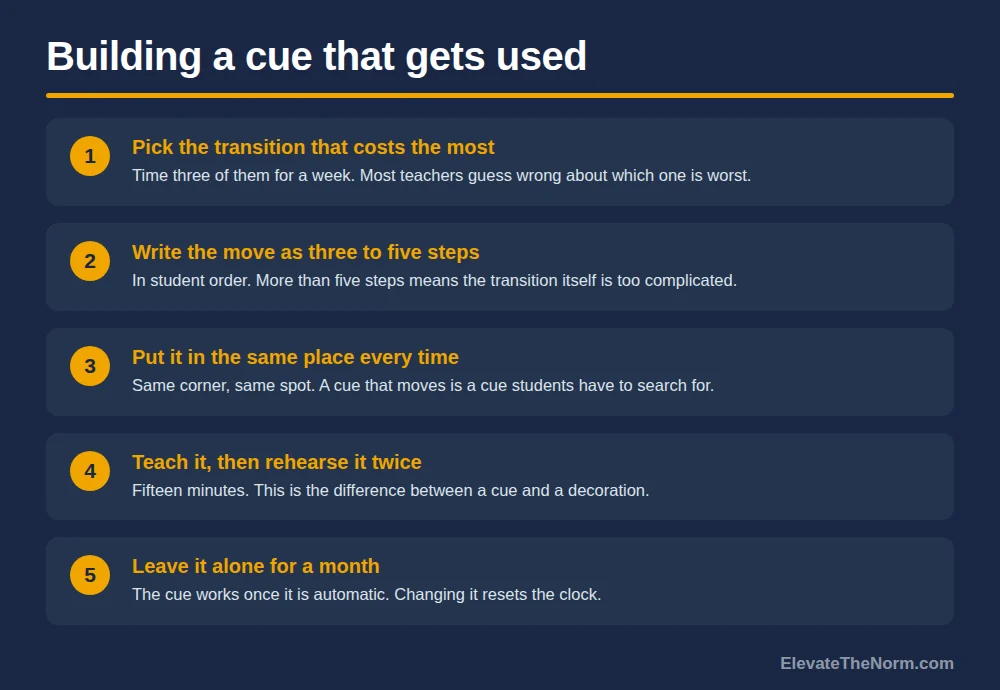
    1. Pick the transition that costs you the most. Not all of them. Time three of them with your phone for a week — entry, the move into group work, and the last five minutes — and fix the worst one first. Most teachers guess wrong about which one it is.
    2. Write the move as three to five steps, in student order. What closes, what comes out, where people go. If it takes more than five steps, the transition itself is too complicated and no cue will save it.
    3. Put the steps and a countdown in the same place every time. Same corner of the slide, same spot on the board. A cue that moves is a cue students have to search for, and searching is the cost you were trying to remove.
    4. Teach it, then rehearse it twice. Show the cue, walk the steps, do it once badly and name what went wrong, do it again. This is fifteen minutes and it is the entire difference between a cue and a decoration. A visual nobody has been taught to read is wall art.
    5. Leave it alone for a month. The cue works when it is automatic, and automatic takes repetition. Changing it because you thought of a better version resets the clock.
    Numbered five-step graphic for building a visual classroom transition cue: pick the costliest transition, write the move as three to five steps, put it in the same place every time, teach and rehearse it twice, and leave it alone for a month
    Step four is the one that decides whether it works. A visual nobody has been taught to read is wall art.

    Two practical notes. Make the cue legible from the worst seat in the room — back corner, at an angle, with the lights on. Text that reads fine on your laptop frequently does not survive the projector, and a student who cannot read the cue will ask a neighbor, which is the exact behavior you were trying to prevent. Check it from that seat once.

    And have a version that works when the technology does not. Projectors fail, and plenty of secondary teachers float between rooms or share a space where the board is not theirs to write on. A hand signal plus three steps on a half sheet at each table, or on a single laminated card you carry, covers the same ground and needs no bulb and no wall. If your whole transition system depends on a screen you do not control, you have built a system that breaks on the morning the network is down — which is the same reason a room needs a procedure a substitute could run without you in the building.

    What Do Visual Cues Look Like in a Secondary Classroom?

    Plainer than the internet suggests. Most published visual-transition material is built for elementary rooms, and a fourteen-year-old reads a cartoon carpet-time card as an insult. The design rule for grades 6–12 is that the cue should look like something adults use.

    Worth using:

    • A full-screen countdown for any move with a deadline. No decoration, large numerals, visible from the back.
    • A three-line slide that appears only during a transition and shows what closes, what opens, and where to be.
    • A mode marker in a fixed corner of the slide — independent, partner, whole class. Use a word, not a color alone. Roughly one boy in twelve has a red–green color vision deficiency, so a red-versus-green block is a cue a few students in every section cannot read. A colored block with the word on it works for everyone, and it ends the “can we talk?” question permanently.
    • A two-finger signal that means one thing: thirty seconds left. One gesture, one meaning, used every day.
    • A materials diagram for any recurring setup with a physical arrangement — lab stations, a debate layout, group clusters. Drawn once, reused all year.

    Worth skipping: animated slide transitions, anything with a cartoon character, a different cue for every activity, and a countdown with sound effects. All of them add novelty to a moment that needs predictability.

    One more: the cue should not require you to be at the front of the room. The value of a visual signal is that it frees you to move — to be next to the group that always stalls, instead of at the board narrating. If your system requires you to stand somewhere and press something, you have built a cue that costs you the thing it was supposed to buy.

    Where Visual Transitions Break Down

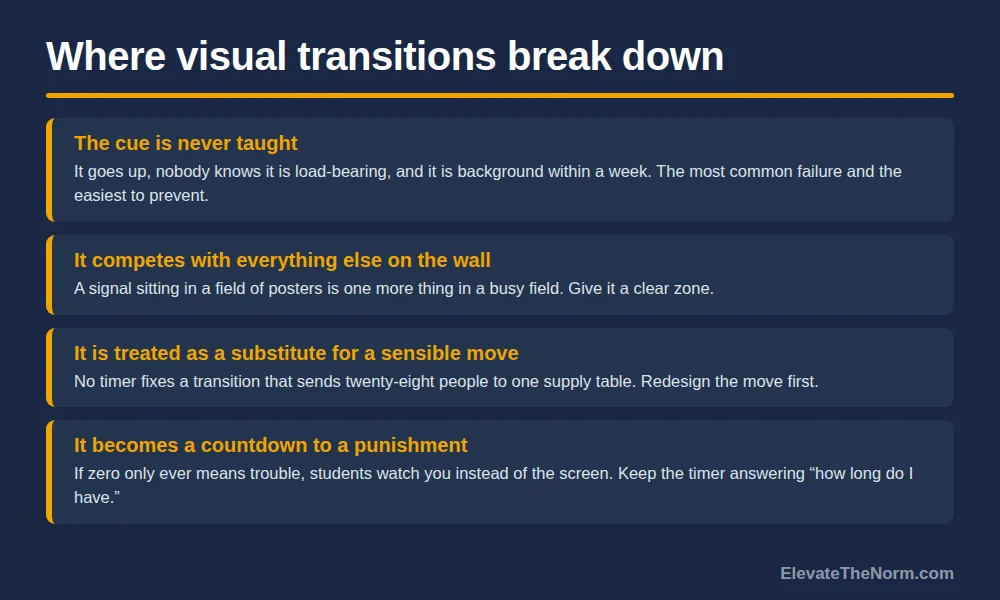
    Four failure modes, all predictable, all cheaper to avoid than to fix.

    The cue is never taught. It goes up, students do not know it is load-bearing, and it becomes background within a week. This is the most common failure and the easiest to prevent: fifteen minutes of explicit instruction and two rehearsals.

    The cue competes with everything else on the wall. This is the visual-noise finding applied to your own room. If the signal sits in a field of posters, student work and reference charts, it is one more thing in a busy field. Give it a clear zone with nothing around it.

    The cue is treated as a substitute for the transition being sensible. No timer fixes a move that requires twenty-eight people to cross the room to a single supply table. Redesign the move first. A visual cue makes a good procedure faster; it cannot make a bad one work.

    The cue becomes a countdown to a punishment. If the timer’s only meaning is that something unpleasant happens at zero, students learn to watch you rather than the screen, and the cue has acquired a tone you did not intend. The timer answers “how long do I have,” which is a fair question a student is entitled to ask. Keep it answering that.

    Graphic listing four failure modes for visual classroom transitions: the cue is never taught, it competes with wall clutter, it substitutes for redesigning a bad move, and it becomes a countdown to a punishment
    All four are predictable, and all four are cheaper to avoid than to fix.

    What to Do This Week

    Time your three worst transitions for a week and write the numbers down. Pick the slowest one. Write that move as four steps in the order a student would do them, put those steps plus a countdown in one fixed spot, and spend fifteen minutes teaching it with two rehearsals. Then leave it alone for a month and time it again.

    While you are at it, look at the wall behind the cue and take down anything that is not doing work. That is the one piece of advice in this article with direct classroom observation behind it, even if the classrooms were younger than yours.

    Visual classroom transitions will not transform a room. What they do is remove one specific friction — the gap between when you said the instruction and when a student needed it — and hand students a way to solve their own problem without asking anybody. That is worth fifteen minutes and a slide. For the concrete versions, the transition examples and free planning toolkit includes a cue guide and an audit sheet for timing the moments that leak the most.

    Before you go: grab the free Classroom Transitions Planning Toolkit (PDF) — ElevateTheNorm.com branded, printable, no email required.

    Frequently Asked Questions

    Do visual transition cues work with high school students, or are they an elementary thing?

    The design has to change; the mechanism does not. A sixteen-year-old reads a cartoon cue card as condescension and will treat it accordingly. A full-screen countdown, a three-line slide and a hand signal are the same tool in a form that looks like something adults use. Be aware that the research base is mostly elementary and mostly students with identified disabilities — there is no study here showing a general effect in a mainstream high school classroom. The case for using them at this level is that they cost nothing and remove a known friction, not that they are proven.

    Isn’t a timer just pressure? Some of my students get anxious about it.

    A timer is pressure when zero means something bad happens. It is information when zero means the next thing starts. Two things keep it on the information side: say what happens at zero before you start it, and make sure what happens at zero is a transition rather than a consequence. If a particular student finds a visible countdown genuinely difficult, a posted sequence without a clock does most of the same work — the persistence of the instruction is the part that matters, not the ticking.

    How many visual cues should a classroom have?

    Fewer than you think. One for time, one for the sequence, one for mode, and one gesture is a complete system, and most rooms would do better with two of those used consistently than four used occasionally. The observational research on visual noise points the same way: more visual material in a room predicts less on-task behavior, so every additional cue is competing with the ones you actually need.

    Does this mean I should take everything off my classroom walls?

    No, and the study that gets quoted for that claim has a published reanalysis worth knowing about. Fisher, Godwin and Seltman found kindergarteners more distracted in a decorated room — but Imuta and Scarf reanalyzed the data and showed the distraction dropped considerably across lessons, which points to novelty rather than decoration as the cause, in a setting where children never had time to habituate. The defensible version is narrower: keep a clear zone around the cue you need students to read, and take down what is genuinely doing no work. Student work on the walls is doing work.

    What do I do when the projector dies mid-transition?

    Have the analog version ready before it happens, because it will. A hand signal that means thirty seconds and four steps written on the board in marker do the same job and never need a bulb. Teach the backup at the same time you teach the main cue so it is not a novelty on the day you need it. Any transition system that only works when the technology works is a system that fails on exactly the mornings that are already going badly.

    Should students help design the cue?

    It is worth asking them which transition is worst and what the current cue does not tell them. They are the ones experiencing the ambiguity and they will name things you cannot see from the front — the slide is unreadable from the back row, or nobody knows whether the move includes getting a laptop. Take their information and keep the design decision. A cue that changes because of student preference every few weeks never becomes automatic, and automatic is the whole point.

    How do I make sure a visual cue is readable for every student?

    Three checks, none of which takes long. Sit in the worst seat in the room — back corner, off angle, lights on — and read the cue yourself; projector contrast is much worse than laptop contrast. Never let color alone carry meaning, because a red-versus-green signal is unreadable for the students in every section with a color vision deficiency; put the word on the block. And say the cue out loud the first few times you use it, which covers a student with low vision and costs you four seconds. A cue that a few students cannot read is worse than no cue, because those students now have to ask someone.

    How long before a new visual cue actually starts saving time?

    Expect a few weeks, and expect the first several days to look worse rather than better, because students are learning a new routine on top of doing the old one. Time the transition before you start so you have a real baseline, then time it again after a month. If nothing has improved after a month of consistent use, the problem is almost certainly the transition itself rather than the cue — a move with too many steps or a physical bottleneck will not be fixed by putting a timer on it.

    Sources

    1. Kraft, Matthew A., and Sarah Novicoff. “Time in School: A Conceptual Framework, Synthesis of the Causal Research, and Empirical Exploration.” EdWorkingPaper, February 2024. https://edworkingpapers.com/sites/default/files/Kraft Novicoff – Time In School – Feb 2024_1.pdf
    2. Godwin, Karrie E., Howard Seltman, Peter Scupelli, and Anna V. Fisher. “Attentional Competition in Genuine Classrooms.” Proceedings of the 42nd Annual Meeting of the Cognitive Science Society, 2020. https://cognitivesciencesociety.org/cogsci20/papers/0524/0524.pdf
    3. Imuta, Kana, and Damian Scarf. “When too much of a novel thing may be what’s ‘bad’: commentary on Fisher, Godwin, and Seltman (2014).” Frontiers in Psychology, vol. 5, art. 1444, 2014. https://www.frontiersin.org/journals/psychology/articles/10.3389/fpsyg.2014.01444/full (The Fisher, Godwin and Seltman 2014 Psychological Science study is described here as reported in this commentary and in the Godwin et al. 2020 paper above; the original article was not read directly.)
    4. van Dijk, Wilhelmina, and Nicholas A. Gage. “The effectiveness of visual activity schedules for individuals with intellectual disabilities: A meta-analysis.” Journal of Intellectual & Developmental Disability, vol. 44, no. 4, 2019, pp. 384–395. https://eric.ed.gov/?id=EJ1234224
    5. Milam, Molly E., and Kimberly Kode Sutton. “Using Visual Activity Schedules to Improve Transitioning for Students With Emotional and Behavioral Disorders.” Beyond Behavior, vol. 33, no. 3, 2024. https://journals.sagepub.com/doi/10.1177/10742956241276003
    6. Ennis, Robin Parks, David James Royer, Kathleen Lynne Lane, and Claire E. Griffith. “A Systematic Review of Precorrection in PK-12 Settings.” Education and Treatment of Children, vol. 40, no. 4, 2017, pp. 465–495. https://eric.ed.gov/?id=EJ1157923

    About Clay Shumate

    Clay Shumate is a certified secondary Social Studies teacher in the public schools of West Alabama, with seven years of classroom experience, a B.A. in History, and an M.Ed. in Secondary Education. He writes about project-based learning, student responsibility, respect, and practical ways to hold young people to a higher standard while giving them room to learn from mistakes. He is a member of the Society of Professional Journalists and writes to its Code of Ethics; this site’s editorial standards and corrections policy are published in full. More about Clay.

  • Substitute Teacher Classroom Management: Running a Room That Isn’t Yours

    Substitute Teacher Classroom Management: Running a Room That Isn’t Yours

    Substitute teacher classroom management is not the same job as classroom management. A regular teacher builds authority over weeks. A substitute has to borrow it in the first four minutes, from a room that already has its own rules, its own seating, and its own sense of what is normal — none of which they wrote. The work is not installing your system. It is running theirs well enough that the day holds.

    Most advice on this subject is written as though the substitute controls the outcome. They control some of it. The rest was decided before they ever walked in, by the teacher who wrote the plans — which is the half of this that almost nobody writes about, and the half I can speak to directly. If the room a substitute walks into has no written system behind it, the document a stranger is actually handed is where that work starts.

    This page covers what the person walking in actually has to work with, what they can control on the day, and what the regular teacher owes them before leaving.

    Key Takeaways

    • A substitute’s authority is borrowed, not built. The fastest way to lose a room is to replace its norms with your own on day one. Run the room that exists.
    • The person walking in may have twenty hours of training. In Missouri, a substitute certificate requires either 36 semester hours of college or 20 clock hours of approved training. That is the floor in one state, and it is worth knowing before you judge how a day went.
    • The first four minutes decide most of it. A visible plan, stated out loud, followed by a pause — not a raised voice.
    • Teacher absence is measurable and it is not small. Ten additional days of teacher absence are associated with a decline of roughly 1.7% to 3.3% of a standard deviation in math achievement. The sub day is not a throwaway day.
    • Half of substitute classroom management is written the week before, by someone else. Plans that assume the sub knows the room are the single most common failure, and they are entirely preventable.
    • A class that tests a substitute is usually not scheming. Nobody knows their name, the day reads as a holding pattern, and the adult has no history with them. Using names and making the work visibly real addresses all three.

    The job is not “teach the lesson.” It is “keep the room intact.”

    This is the reframe that makes the rest of it workable. A substitute who measures the day by how much content got delivered will almost always finish feeling like they failed. A substitute who measures it by whether the room is handed back in the condition it was handed over — work attempted, norms intact, nobody humiliated, an honest note left behind — has done the actual job.

    That is not a lowered standard. It is the correct one. The regular teacher can reteach a lesson. What they cannot easily undo is a room that learned, over one day, that the expectations it runs on are negotiable when a stranger is standing there.

    What the person walking in actually has

    It is worth being precise about the preparation the job actually requires, because a lot of staffroom commentary about substitutes assumes a level of training that the credential does not demand.

    Missouri, as one published example, issues a Content Substitute Certificate to an applicant who has completed either a minimum of 36 semester hours from an accredited college or university, or twenty clock hours of department-approved substitute teacher training. Requirements vary by state and some are higher. But twenty clock hours is a real, current, published floor in at least one state — and the person it describes is expected to walk into a room of thirty teenagers and hold it.

    Two things follow. If you are the substitute: the gap you feel between what you were trained for and what the day demands is real, and it is structural rather than personal — the same gap first-year teachers describe in their own rooms. If you are the regular teacher: the plans you leave are not a courtesy. For some of the people who will use them, they are the entire preparation.

    A third thing follows for anyone who sets policy. Nothing in the rest of this article is a substitute for a district actually orienting the people it puts in front of students — a building walkthrough, the safety procedures, where the office is, what the behavior system is called. Most of what gets written about substitute classroom management, including everything below, is individuals compensating for a system that hired someone and pointed at a door. The individual workarounds are worth knowing. They are not the fix.

    The first four minutes: organization to the minute, and then the pause

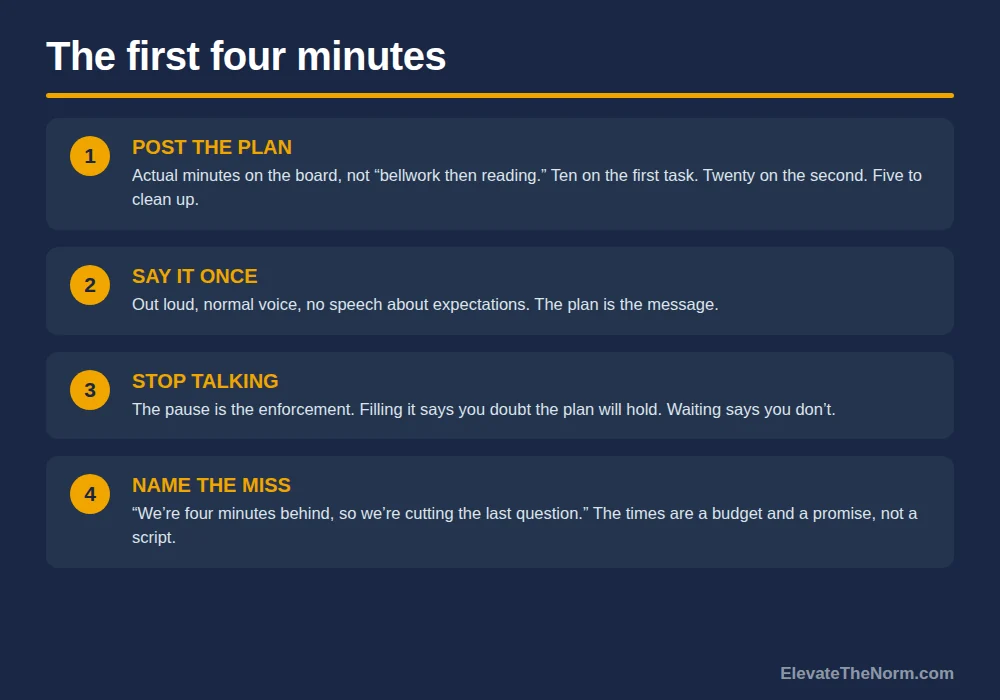
    The method I use in my own room transfers to a substitute almost unchanged, and it is the one piece of this I would put above everything else: taking control of a room is done by organization to the minute, and then you pause.

    Four numbered steps for a substitute’s first four minutes: post the plan, say it once, stop talking, name the miss
    The pause is the enforcement. Filling it says you doubt the plan will hold.

    Put the plan where they can see it before the bell. Not “bellwork, then reading” — actual minutes. Ten minutes on the first task. Twenty on the second. Five to clean up. Write it on the board you found it on. Then say it out loud, once, in a normal voice.

    Then stop talking.

    The pause is the part people skip, and it is the part that works. You have laid out a plan that is visibly organized, and then you let the silence do the enforcement instead of your volume. The instinct is to fill it — to repeat yourself, to add a threat, to get louder. Filling it tells the room you are not sure the plan will hold. Waiting tells them you are.

    I should be honest about what that costs, because most versions of “just wait them out” leave the price out. I once held a pause for more than five minutes. It was one of the most awkward moments of my life, that section finished nine minutes behind my other classes, and it is the only time I have ever assigned homework. It worked. It also cost nine minutes and a homework assignment I did not want to give. A substitute will rarely have nine minutes to spend, which is exactly why the posted plan matters — it shortens the pause you need.

    One clarification, since this gets misread: the posted times are a budget and a promise, not a script. When you miss them, say so out loud and give the reason. A substitute who announces “we are four minutes behind, so we are cutting the last question” has just demonstrated that the plan is real. That is worth more than hitting the times.

    Run their room, not yours

    This is where most substitute days are quietly lost, and it rarely looks like a discipline problem. It looks like a reasonable adult correcting something that was never wrong.

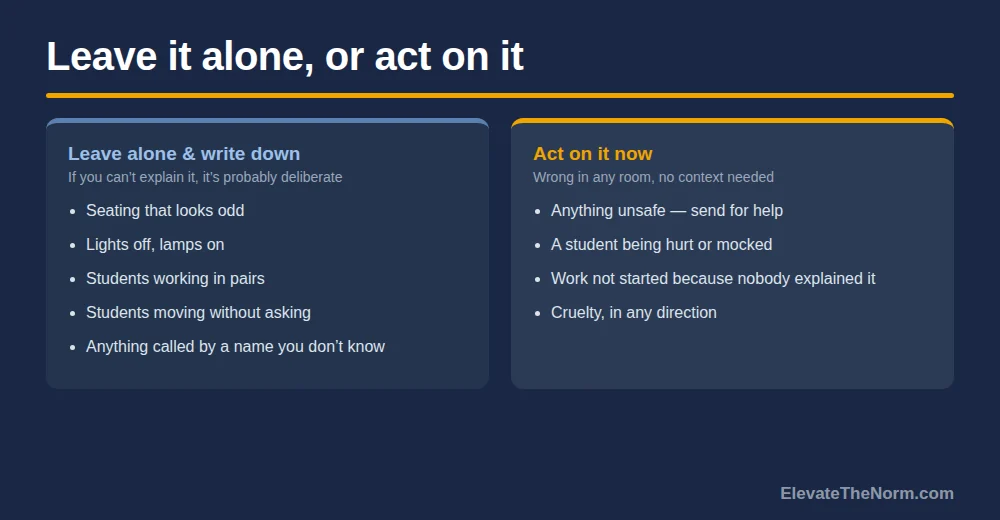
    Two-column comparison of classroom things a substitute should leave alone and write down beside things that require immediate action
    If you can’t explain it, it’s probably deliberate.

    In my room, students are almost always working alongside somebody. Partner work is the resting state, not a reward and not a special occasion — the tables are literally grouped that way and there are no rows to return to. A substitute who walks in, sees students talking, and reads it as the room falling apart will spend the period fighting the room’s actual design. They will separate students who were doing exactly what they were supposed to do, and by second period they will have spent all their credibility on a rule that does not exist in that room.

    The same goes for the lights. I do not turn the overhead fluorescents on — the room runs on floor lamps around the perimeter. It is a deliberate choice about sensory load, and it helps far more students than the ones who would ever have asked for an accommodation. A substitute’s first instinct on walking into a dim room is to find the switch. Flipping it is a small thing that changes the room the students walked into.

    So the working rule is: anything you cannot explain, leave alone and write down. If the seating looks odd, it is probably deliberate. If the lights are off, someone turned them off. If four students get up without asking, there is probably an established procedure for that. Note it, ask afterward, and do not spend your authority correcting a room’s design.

    Reserve your authority for the things that are wrong in any room: cruelty, danger, and a flat refusal to engage with work that has been made doable.

    That last one needs its qualifier. A student who will not start a worksheet nobody explained is not defying you — they are stuck, and “refusal” is the wrong word for it. Check whether the task is actually doable before you treat not-doing-it as a behavior problem. Most of the time on a substitute day, it is not defiance. It is an instruction gap.

    The one line that overrides all of this: if something is unsafe, or a student is being hurt, you do not need permission or context. Send for the neighboring teacher or the office immediately. Knowing where the phone is and who is next door is a two-minute check when you arrive, and it is the only part of this you should never improvise.

    Substitute teacher classroom management: five things you can actually control

    1. Where you stand. Circulating beats presiding. A redirect delivered quietly at close range, to one student, does the work without announcing the problem to twenty-nine other people — and it does not give the room a performance to react to.
    2. What you say first. Names if you have them, the plan if you do not. “Here is what we are doing and how long it takes” outperforms any version of “I expect you to behave for me today.”
    3. Your volume. It is the one resource that only decreases. Every notch you spend is gone for the rest of the day.
    4. What you write down. An honest, specific, unemotional note is the most valuable thing you leave behind. “Third period did not start the reading; two students, seated front left, were the reason” is useful. “Terrible class” is not, and it will be read by someone who has to work with those students tomorrow.
    5. Whether anybody gets humiliated. This one is not negotiable and it is entirely within your control. You will be gone tomorrow. They will not.

    What the regular teacher owes the substitute

    If you are reading this as the teacher who is going to be out, this is the section that changes your sub’s day, and it takes about fifteen minutes to write once and reuse all year.

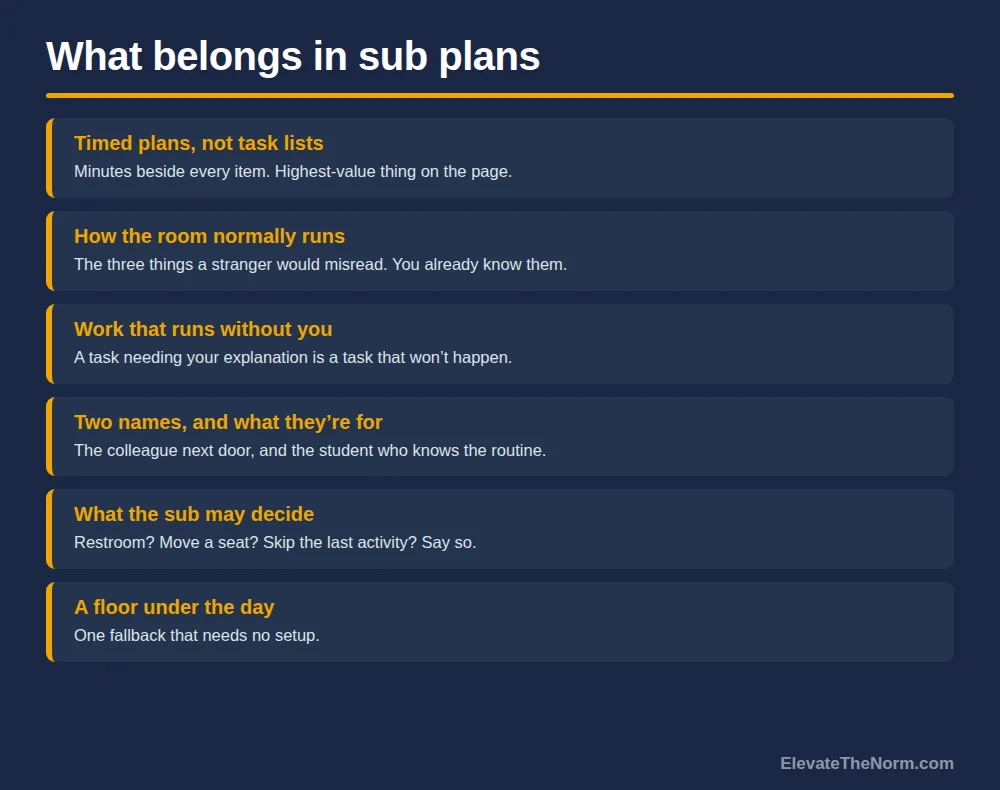
    Six items that belong in substitute teacher plans, including timed plans, how the room runs, and a fallback activity
    Fifteen minutes to write once, and it changes every sub day that follows.

    Write it assuming it will be read in five minutes, standing up, by someone who was called at six that morning and has never been in your building. That is the realistic case, not the exception. Put the timed plan and the three things a stranger would misread on the first page, in that order. Everything else can be on page two, where it may or may not get read.

    • Timed plans, not task lists. Minutes next to every item. It is the single highest-value thing on the page, for exactly the reason in the section above.
    • A one-paragraph description of how your room normally runs. Partner work is expected. The lights stay off. Students may get water without asking. Write the three things a stranger would most likely misread — you already know what they are.
    • Work that can actually be done without you. A task that depends on your explanation is a task that will not happen, and the gap gets filled with whatever the room decides to do instead.
    • Two names, and what they are for. The colleague next door and the student who genuinely knows the routine. Not a list of “problem” students — a list of doors to knock on.
    • What a substitute is allowed to decide. Can they let a student use the restroom? Move a seat? Skip the last activity? Say so, or you have left someone to guess and then be wrong.
    • Where the day goes if it falls apart. One genuinely usable fallback that requires no setup. Every sub plan should have a floor under it.

    One thing that does not belong in sub plans: a discipline ladder invented for the occasion. Your substitute cannot enforce consequences that do not already exist in the room, and asking them to try is how a day gets worse rather than better. Tell them what the room already does.

    Why the day is worth taking seriously

    There is a habit of treating substitute days as time that does not count. The measured picture disagrees, though it needs stating carefully.

    Analysis published by Brookings reports that roughly 29% of teachers were chronically absent — missing ten or more school days — in the 2015–16 federal civil rights data, and that ten additional days of teacher absence are associated with a decline of between 1.7% and 3.3% of a standard deviation in math achievement. Substitute costs run to roughly 1% of all public education spending.

    Two honest caveats. These are associations drawn from observational data, not the result of an experiment, and the effect sizes are modest per unit. And the federal absence figures are from 2015–16, which is the most recent comparable collection but is now several years old. What the numbers support is a modest claim, and the modest claim is enough: sub days are frequent, they cost real money, and they are associated with measurably less learning. They are not a rounding error, and the room deserves a plan.

    What the students are doing, and why

    Almost everything written about substitute teaching treats the students as weather — a condition to be survived. It is worth saying plainly what is actually happening on their side of it, because it changes what you do.

    A class that tests a substitute is usually not running a scheme. Three ordinary things are true at once: nobody in the room knows their name, the day has been signalled to them as a holding pattern, and the adult in front of them has no history with them in either direction — no credit built up, and no relationship to damage. Teenagers read all three accurately and respond to them rationally. If the day looks like it does not count, some of them will treat it as though it does not count. A spoken routine a substitute has never run will not hold either, which is why cues a stranger can read off the wall survive your absence when verbal ones do not.

    Which means the two highest-leverage moves are both about signalling the opposite. Learn some names and use them — from a seating chart, from their work, by asking. And make the work visibly real: something that gets collected, that the regular teacher will see, that connects to what they did yesterday. “Your teacher is going to read these tomorrow” is a true sentence that changes a room, and it costs nothing.

    Students are also owed something on these days, and it is not complicated: to know what they are doing and how long it takes, to not be punished as a group for individuals, to not be talked about as a category in a note they will never see, and to be able to ask a question and get a real answer rather than “I’m just the sub.” That last one is worth retiring. You are the teacher in that room today. Not knowing an answer is fine. Saying you do not count is not, and they will believe you.

    Should a substitute actually teach?

    Sometimes, and the honest answer depends on what the plans ask for rather than on how confident you feel.

    If the plan is practice, review, reading or a project work session — which is the large majority of well-written sub plans — then teaching it is mostly circulating, answering, and keeping the work moving. Do that, and do it properly. If the plan introduces genuinely new content in a subject you do not know, delivering it badly is worse than not delivering it: students will learn it wrong, and the regular teacher will have to undo that before they can teach it. Run the practice portion, write down exactly where the class stopped, and say so.

    One small tool worth borrowing from special-education practice, where it is standard: a visible timer. Putting the remaining minutes somewhere the whole room can see them makes an abstract instruction concrete, and it takes the countdown out of your voice — the clock says it instead of you. It is a phone on the document camera, and it works for far more students than the ones it was designed for.

    The part that is actually hard

    Everything above is manageable on a normal day. The genuinely hard version is the room that has decided, collectively and before you said a word, that today is a day off. No single student is doing anything you could name. The work is simply not starting.

    There is no technique that fixes that in thirty seconds, and any article that tells you otherwise is selling something. What works is narrow and unglamorous: get one table started. Not the room — one table. Sit down next to them, at their height, and do the first item with them. A room that is entirely not working is very hard to move. A room where one group is visibly working is a different room, and the second group is much easier than the first.

    And if it does not turn: finish the period without making it worse, write the honest note, and hand the room back. That is not defeat. On some days that is competence, and a teacher who has been out sick will understand the difference between a sub who lost a room and a sub who protected one.

    Which is the whole of it, really. Substitute teacher classroom management is not a set of tricks for controlling somebody else’s students — it is the practice of running a room you did not build, on borrowed authority, without spending down what the regular teacher has spent months constructing. Post the plan. Pause instead of getting louder. Leave the room’s own rules alone. Use names. Make the work real. Write the honest note.

    And if you are the one writing the plans: fifteen minutes on a page that assumes nothing will do more for that day than anything the substitute can do once they are standing in it.

    Printables for this

    I write these for my own room and put them on TPT. The Any-Day Emergency Sub Plan Card is free — one page a stranger can run cold, in any subject. If you teach history, World History Emergency Sub Plans is five full days of strange-but-true readings with questions and answer keys, written so a sub can hand them out without knowing the content.

    Out the week of Halloween? A Halloween sub day does not have to be a word search. Halloween Sub Plans is five strange-but-true spooky history readings a sub can run cold. For math, the free Halloween color by number samplers for middle school and high school check themselves, so the sub never needs the answer key.

    If you are buying during a sitewide sale, the TPT sale guide walks through how the discounts stack and what is actually worth the money.

    Sources

    • Brookings Institution. We should be focusing on absenteeism among teachers, not just students. Read the analysis — source for the 29% chronic-absence figure (U.S. Department of Education Office for Civil Rights, 2015–16), the 1.7–3.3% of a standard deviation math association, and the ~1% of public education spending figure. These are observational associations, not causal estimates, and the federal absence data is from 2015–16.
    • Missouri Department of Elementary and Secondary Education. Substitute Teachers — certification requirements. Read the requirements — source for the 36 semester hours / 20 clock hours standard. One state’s rule, cited because it is current and published; requirements vary considerably by state and your own state’s rule governs.
    • Substitute teaching: evidence-based practices for inclusive classrooms. Helen: The Journal of Human Exceptionality, April 2024. Read the guide — consulted for the visual-schedule and visual-timer practices. Cited as practitioner guidance, not as research: the article describes itself as drawing on evidence-based practice but names no studies and reports no data.

    Every link above was checked on September 20, 2026. The classroom practices described in the first person — the timed plan and the pause, partner work as the room’s resting state, and the lamps — are my own and are used across this site.

    Worth saying plainly: a day covered by a substitute is not a day lost, and taking the day you need before you badly need it is one of the few moves a teacher fully controls. It is also a small part of what climbing back out of exhaustion actually asks of you.

    Frequently Asked Questions

    What is the single most important thing a substitute teacher should do first?

    Put a timed plan where the room can see it, say it out loud once in a normal voice, and then stop talking. The visible plan does most of the work and the pause does the rest. What does not work is opening with a speech about expectations — it spends authority before anything has happened and invites the room to test it.

    Should a substitute enforce their own rules or the regular teacher’s?

    The regular teacher’s, with three exceptions that apply in any room: cruelty, danger, and refusal to attempt the work. A substitute’s authority is borrowed from the room’s existing norms, and replacing those norms is what burns it. If something looks wrong but you cannot explain it, the odds are good that it is deliberate — leave it alone, write it down, and ask afterward.

    How much training do substitute teachers actually have?

    Less than most people assume, and it varies a great deal by state. Missouri, as one published example, issues a substitute certificate to applicants with either 36 semester hours of college credit or 20 clock hours of approved training. Some states require more. The practical point for administrators and teachers is that sub plans are, for some of the people using them, the entire preparation for the day.

    What should a substitute do when the whole class refuses to start work?

    Get one table started rather than trying to move the room. Sit down at their height and do the first item with them. A room in which nothing is happening is very hard to shift; a room in which one group is visibly working is a different problem and a much easier one. If it does not turn, finish the period without making it worse and leave an honest, specific note. Protecting a room is not the same as losing it.

    What belongs in sub plans for a middle or high school class?

    Timed plans rather than task lists, a short paragraph on how the room normally runs, work that can be completed without the regular teacher’s explanation, the name of a colleague next door and a student who knows the routine, an explicit statement of what the substitute is allowed to decide, and one genuinely usable fallback activity. Leave out any discipline ladder invented for the occasion — a substitute cannot enforce consequences the room does not already have.

    Does it actually matter how a substitute day goes, or is it a lost day either way?

    It matters, though the evidence supports a modest claim rather than a dramatic one. Brookings reports that ten additional days of teacher absence are associated with a decline of roughly 1.7% to 3.3% of a standard deviation in math achievement, and that substitute costs approach 1% of public education spending. Those are observational associations from older federal data, not experimental results. Read together they support something narrow and sufficient: these days are frequent, expensive, and associated with less learning.

    How should a substitute write the note they leave behind?

    Specifically, honestly, and without adjectives about character. Name what happened, when, and what was or was not completed. “Third period did not start the reading; two students seated front left were the reason” gives the regular teacher something to act on. “Terrible class” does not, and it will be read by an adult who has to face those students the next morning. Report behavior, not verdicts about people.

    Why do students behave differently for a substitute?

    Usually because three things are true at once and teenagers read all three correctly: nobody in the room knows their name, the day has been signalled to them as a holding pattern, and the adult in front of them has no history with them in either direction. That is a rational response to the situation rather than a character flaw, and it points at the fix. Use names, and make the work visibly real — something that gets collected and that the regular teacher will actually see. Telling a class truthfully that their teacher will read this tomorrow changes a room and costs nothing.


    About Clay Shumate

    By Clay Shumate — Clay Shumate is a certified secondary Social Studies teacher in the public schools of West Alabama, with seven years of classroom experience, a B.A. in History, and an M.Ed. in Secondary Education. He writes about project-based learning, student responsibility, respect, and practical ways to hold young people to a higher standard while giving them room to learn from mistakes. He is a member of the Society of Professional Journalists and writes to its Code of Ethics; this site’s editorial standards and corrections policy are published in full.

  • History Project Ideas: 10 Classroom-Tested Units for Grades 7–12

    History Project Ideas: 10 Classroom-Tested Units for Grades 7–12

    By Clay Shumate

    These are ten history projects I have actually run with middle and high school students, written for the teacher who has to plan them. Each one includes the driving question, the grade band, how long it takes, what students produce, and the part most project lists leave out — where it goes wrong and what to do about it.

    Every one of them is free to use and adapt. Nothing here requires a field trip, a budget, or a schedule change.

    Key Takeaways

    • A history project is worth the time when students cannot complete it without learning the content — not when it decorates content they already covered.
    • Every project below starts from a real question with more than one defensible answer.
    • Project-based learning does not replace direct instruction. Most of these units start with it.
    • The checkpoint that saves a project is almost always the one in the middle, where students have facts but not yet an argument.
    • Group size is not the problem teachers think it is. Preparation is.

    What Makes a History Project Worth the Time

    Most lists of history project ideas are lists of activities. Build a model. Make a poster. Do a timeline. Those can be fine, but they are usually assigned after the teaching is finished, which makes them a reward rather than a method.

    Comparison of a history activity and a history project, showing an activity is assigned after the teaching while a project is assigned before the content is delivered
    The difference is not the product. It is when you assign it and what students need the content for.

    The projects below are built the other way around. The content is what students need in order to finish, which means they go looking for it. That is the difference between a project and project-based learning, and it is worth being precise about, because the two get used interchangeably and they are not the same thing. The definition of project based learning covers that distinction in more detail.

    One thing I want to be clear about up front, because it is the objection I hear most: none of this means abandoning direct instruction. I start almost every unit with it, and it often comes back in the middle. Direct instruction and project work should be working together, not competing for the same minutes.

    If you want the structure behind these before you pick one, the 7 steps of project based learning walks the process from driving question to public product, and there are more driving question examples if you want to write your own.

    World History Project Ideas

    These five world history project ideas work in a survey course and do not depend on where you are in the sequence. Two of them are period-specific; three will adapt to almost any unit.

    Numbered list of ten history project ideas split into five World History units and five U.S. History units
    Five for world history, five for U.S. history. Most of them move between courses with small changes.

    1. Industrial Revolution: Design a Better City

    Driving question: How could an industrial city grow without sacrificing the lives of its workers?
    Grades 8–10 · 2–3 weeks

    Hand students a fictional industrial city with real problems — overcrowding, pollution, child labor, unsafe factories, disease, housing nobody should live in. They are the reformers. They build a plan covering housing, sanitation, transportation, worker protections, and factory regulation.

    The design constraint is what does the teaching: students cannot propose a fix until they can explain the problem. Want a sewer system? Show why disease spread. Want a child labor law? Show what children were actually doing. The content stops being something to study for a test and becomes something they need to finish the work.

    Where it goes wrong: groups jumping to solutions on day one. The fix is a hard checkpoint — problems only, with a historical cause attached to each, before any solution is allowed on paper.

    2. World War I Memorial Design

    Driving question: How should future generations remember a war?
    Grades 7–10 · 2 weeks

    Students investigate the war through soldiers, civilians, technology, casualties, and propaganda, then design a memorial and defend every major choice in writing.

    A memorial forces students to decide what matters. There is room for one, and it cannot hold everything. If you have space for five ideas about this war, which five deserve to survive? One pair centers the soldiers. Another centers civilians, or what the new technology did to the human body. The products look nothing alike and they hit exactly the same standards.

    Where it goes wrong: grading the art. The written defense is the assessment, and students need to hear that on day one or your strongest historians will panic about their drawing.

    3. Cold War Crisis Simulation

    Driving question: How do national leaders make decisions when every option carries serious consequences?
    Grades 9–10 · 1–2 weeks

    Students become a presidential advisory team during a fictional crisis modeled on something real. Intelligence arrives in stages. They decide whether to negotiate, blockade, use force, or gather more information — and they log why, every time.

    The Cold War makes sense once students feel the uncertainty. We teach these events knowing how they ended. The people in the room did not. So the information comes in pieces, and students decide without knowing what comes next.

    What I am actually measuring is not whether they pick the historically correct option. It is whether they change a decision when new evidence arrives. That is not indecisiveness. That is exactly what we want.

    Where it goes wrong: releasing all the intelligence at once, which destroys the whole mechanism. Also write the third packet so it genuinely undercuts a reasonable conclusion from the first two — if nothing ever contradicts, you teach students that first instincts are always right.

    4. Create a Newspaper From the Past

    Driving question: What would this event have looked like to people living through it?
    Grades 7–9 · 1–2 weeks

    Students produce a newspaper dated to one specific day in the period you are teaching. The rule that makes it work: nothing in the paper can reference anything that had not happened yet. A student writing about the Boston Tea Party cannot mention the Constitutional Convention. It has not happened.

    That single constraint teaches chronology, point of view, and sourcing at once, and it teaches them by making students enforce it on each other. Because a newspaper has different jobs — reporter, editor, cartoonist, advertisement designer — every student has a way in.

    This one is a group of four to six, and that is fine. Do not be afraid of that size. If you have taken the time to understand where the project goes and where the questions will come from, you have control of the room. I call that controlled chaos, and it is the good kind.

    Where it goes wrong: modern voice. Show one real front page from the period and have a student read a paragraph out loud. They hear it immediately.

    5. Should This Historical Monument Stay?

    Driving question: Who should we memorialize, and how should communities remember the past?
    Grades 8–10 · 1–2 weeks

    Teams investigate a monument and recommend what a community should do with it: keep it, remove it, relocate it, or leave it up with new signage that reinterprets it. They present to a mock city council that asks questions back.

    The point is not the verdict. Students arrive with an opinion already formed and are required to investigate before they are allowed to decide. That order is the entire design. It forces them into conflicting evidence and competing perspectives, which is where the gray area lives — and history is not black and white, which is genuinely hard for students who think in straight lines.

    A fictional monument works as well as a real one and lowers the temperature, which some rooms need. Invent a mill owner who founded the town, employed half of it, and broke a strike in 1913. All four recommendations become defensible.

    Where it goes wrong: the teacher’s own position leaking. Do not tell students what side you are on, not once. Decide in advance how you will deflect the question and use the same move every time. The room only argues honestly if they cannot read you.

    U.S. History Project Ideas

    These five U.S. history project ideas map onto standard survey units. The first and last will work in a world history course too, with different content.

    6. Constitutional Convention 2.0

    Driving question: If we had to design a government from scratch, what powers should it have?
    Grades 8–10 · 1–2 weeks

    Students represent fictional states with different populations, economies, and interests, then negotiate representation, taxation, executive power, voting, rights, and the line between federal and state authority — and draft a constitution they all have to live under.

    The Constitution makes sense when students live the problem that produced it. Otherwise it is a piece of paper they are told is important. Instead of memorizing the Great Compromise, they sit in a room where large states and small states actually disagree about representation, and suddenly compromise has a purpose, because they need one.

    Participation climbs in this unit, and not because I asked better questions. Students are not answering the teacher. They are defending their state.

    Where it goes wrong: state profiles that let one bloc win every vote. Rebalance them before you run it. And when the first session deadlocks, let it sit — that frustration is what makes the compromise land two days later.

    7. Great Depression Family Survival Challenge

    Driving question: How would an ordinary family survive an economic crisis?
    Grades 9–10 · 1–2 weeks

    Each student gets a fictional family with jobs, savings, housing costs, and a location. Then history happens to them — unemployment, a bank failure, drought, illness, a wage cut, a New Deal program. They decide, and they write down why.

    Students usually learn the Depression as a list. Bank failures. Unemployment. Dust Bowl. New Deal. That is four disconnected facts. This makes them interact: lose a job and housing is at risk, lose housing and you migrate, a bank fails and the savings are simply gone. So when a New Deal program appears, students already understand the problem it was built to solve.

    That is a mental model. Memorizing ten acronyms is not.

    Where it goes wrong: students treating it as a game to win. Say on day one that some families do not recover, and that this is not a failing grade. Then mean it.

    8. Civil Rights Community Walking Tour

    Driving question: How did ordinary people and local communities contribute to the Civil Rights Movement?
    Grades 8–10 · 2–3 weeks

    Students research Civil Rights history in their own state or region and build a walking tour of five to eight stops, each with photographs, a map, quotations, biographies, and an explanation of why that spot earned its place.

    This one destroys the idea that history happened somewhere else. Students find out that national history took place a few miles from where they live. It also widens the story past the handful of names that make the textbook — the organizers, the drivers, the people who housed marchers, the teachers who lost jobs, the students who walked out.

    The tour can be entirely digital. No buses, no permission slips, no budget.

    Where it goes wrong: students defaulting to the national figures they already know. Build in a checkpoint that requires three local participants by name, with what each one did.

    9. Immigration and Migration Story Map

    Driving question: Why do people leave one place and build a life somewhere else?
    Grades 7–10 · 2 weeks

    Students trace a real migration — westward expansion, the Great Migration, Ellis Island, the Dust Bowl, a modern movement — and map it, annotating push factors at the origin, pull factors at the destination, obstacles along the way, and consequences in both places.

    What makes this one work is that cause and effect becomes visible. I am not handing students a definition of push and pull factors to memorize. They follow actual people across actual distance and explain why the movement happened, and the map shows the answer. Where geography and history are taught together, this is the unit that justifies it.

    Where it goes wrong: routes too vague to research. “Immigration” is not a route. “Sicilian families through Ellis Island, 1900 to 1914” is. Lock the group, the origin, the destination, and the years before anyone starts.

    10. Build a Local History Museum

    Driving question: How can we preserve and explain the history of our community?
    Grades 7–10 · 2–3 weeks

    Students research a local person, building, business, school, event, or tradition and build a museum-style exhibit — artifact, photographs, captions, a map, and a written historical interpretation. The class combines them into one museum, physical or digital.

    Instead of me telling students what happened in their community, they become the historians. They locate the evidence, decide what is important, and explain it to somebody else. The museum label format does a lot of the teaching on its own, because being short, accurate, and clear at the same time is harder than writing a page.

    Where it goes wrong: topics that are too big, and one website used as the only source. A required source log, checked early rather than at the due date, fixes the second one. Forcing every group to one specifically named subject fixes the first.

    How to Pick One

    If you have never run a project like this, start with the newspaper or the memorial. Both have clear products, both forgive a rough first attempt, and neither depends on a simulation staying under control.

    Decision guide matching three classroom situations to the history projects that suit them best
    Pick for the room you actually have, not the one you wish you had.

    If your room responds to competition and movement, start with the Constitutional Convention or the Cold War simulation — or, if an election is anywhere near, the mock election that grew into a school-wide vote, which is written up start to finish.

    If you want the one that changes how students see the subject, it is the local museum or the walking tour, because both end with a student realizing history happened where they are standing.

    Whichever you pick, build the rubric before you assign it — there is a free editable PBL rubric if you want a starting point, and more planning tools and templates alongside it.

    The Part That Matters Most

    Every one of these projects asks students to do something historians actually do. Use evidence. Defend a decision. Hold two perspectives at once. Revise an argument when the evidence changes. Those are also, not coincidentally, the things people who do well in life tend to be good at.

    And for the student who struggles in a traditional history class, a project gives them a reason to read the source, learn the vocabulary, and know the content — because they need it to build the thing.

    The project is not what students do after they learn the history. The project is how they learn the history.

    Teaching the week of Halloween? The holiday is a good small history unit in its own right: Samhain, souling and guising, turnip lanterns, and the Irish and Scottish immigrants who brought it to America. I wrote five-day Halloween Week Units for middle school and high school, each with a nonfiction article, a comparison of fall traditions around the world, and a writing project.

    What is a good history project for high school students?

    The best history projects give students a real question with more than one defensible answer and require them to use evidence to answer it. A monument recommendation, a Cold War crisis simulation, and a memorial design all work well at the high school level because students cannot complete them without understanding the content first.

    How long should a history project take?

    Most of these run one to three weeks. Anything shorter than about a week does not allow for the research, feedback, and revision that make a project worth doing. A single class period activity is a good activity, but it is not project-based learning.

    Do history projects replace lectures and notes?

    No. Almost every project here starts with direct instruction, and several bring it back in the middle when students hit a skill they are missing. Project work and direct instruction should be working together. The project changes when and why the content is delivered, not whether it is.

    How do you grade a history project fairly?

    Grade the thinking, not the craftsmanship. On a memorial design, the written defense of the design choices carries the weight, not the drawing. Build the rubric before you assign the project, share it with students at the start, and keep the criteria tied to evidence use, reasoning, and historical accuracy.

    What if students just divide the work and never collaborate?

    Assign specific roles with specific deliverables and check individual work at a midpoint rather than group output at the end. On the newspaper project, every student has a different job. On the migration map, one student owns the source log. The checkpoint in the middle is what catches an uneven group while there is still time to fix it.

    Can these history projects work in a middle school classroom?

    Most of them are written for grades 7 through 10. The newspaper, the local history museum, the migration story map, and the memorial design all work well in middle school. The Cold War simulation and the Great Depression challenge are better suited to grades 9 and 10 because they depend on sustained decision-making.

    How do you handle controversial topics in a history project?

    Do not tell students where you stand, and require investigation before they are allowed to reach a conclusion. Using a fictional example instead of a real local one lowers the temperature without lowering the rigor. The goal is that students’ reasoning becomes more sophisticated, not that their opinions move in a particular direction.


    About Clay Shumate
    Clay Shumate is a certified secondary Social Studies teacher in the public schools of West Alabama, with seven years of classroom experience, a B.A. in History, and an M.Ed. in Secondary Education. He writes about project-based learning, student responsibility, respect, and practical ways to hold young people to a higher standard while giving them room to learn from mistakes. He is a member of the Society of Professional Journalists and writes to its Code of Ethics; this site’s editorial standards and corrections policy are published in full. More about Clay.

Teacher Emergency Toolkit — practical resources, real classroom support. Shop on TPT.Teacher Emergency Toolkit — practical resources, real classroom support. Shop on TPT.