By Clay Shumate
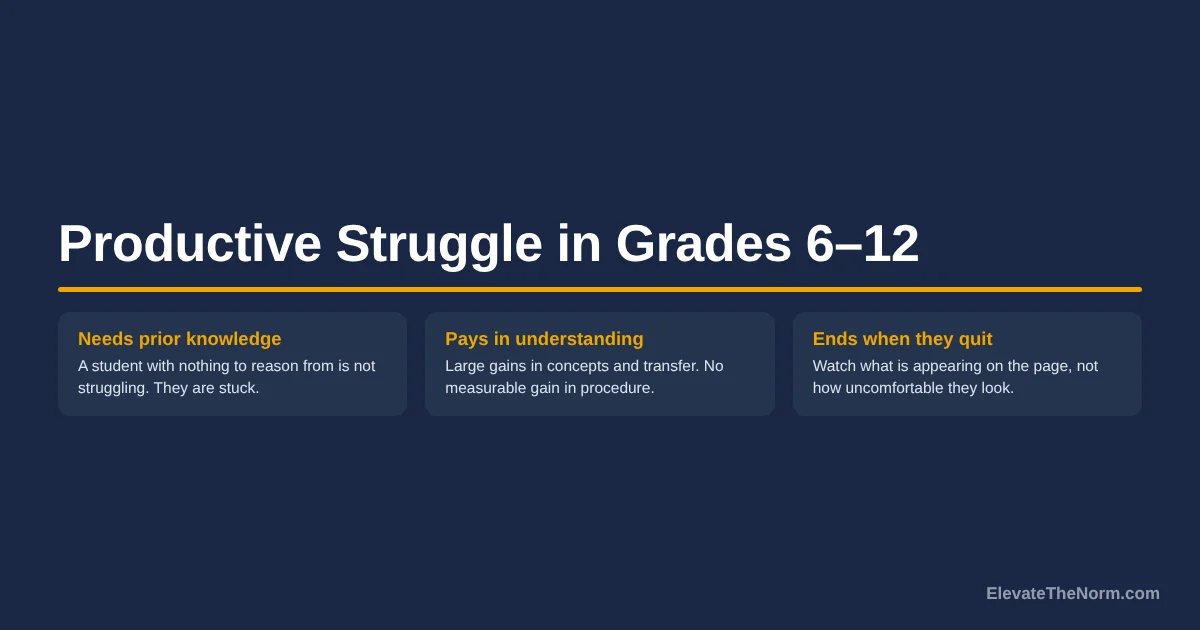
Productive struggle is the effort a student spends on a task they don’t yet know how to do but can get started on. The research most consistently shows gains in conceptual understanding and transfer, not procedural fluency. It depends on enough prior knowledge to begin, and it stops being productive the moment a student quits.
Key Takeaways
- Productive struggle buys conceptual understanding, not speed. In two randomized trials with ninth graders, Kapur (2014) found students who wrestled with a problem before any instruction scored far higher on conceptual understanding and transfer and no better at all on procedural questions. If you want faster, cleaner computation, this is not the tool.
- It needs prior knowledge to work, and that is the single most common reason it fails. The IES practice guide on algebra reports that studies using students with no prior algebra knowledge produced mixed or negative results. A student with nothing to reason from is not struggling productively. They are just stuck.
- There is real disagreement here, not a settled consensus. Cognitive load researchers argue that making a hard task harder for a novice is an undesirable difficulty, and they have replication problems of their own to point at. Anybody selling you productive struggle as established science is overselling it.
- Most of the evidence is mathematics, and some of it is not even students. The big meta-analysis excluded reading, writing, humanities and social studies outright. A lot of the classroom-observation work was done on pre-service teachers doing math tasks. Teachers outside math are extrapolating, and should say so.
- The teacher move that matters is the one you make while a student is stuck. Asking a question that helps a student find their own sticking point keeps the difficulty. Answering the question removes it. Both feel like helping.
What Is Productive Struggle?
Productive struggle is the intellectual effort a student spends trying to make sense of something they do not yet understand, on a task that is hard but reachable.
The phrase traces back to Hiebert and Grouws, who described struggle as the effort students expend to make sense of concepts — a definition quoted in most of the literature that followed, including Zeybek (2016).
It is not the same thing as frustration, and it is not the same thing as a task being too hard. A recent content analysis of twenty-eight studies on the term (Young, Sanders, Bevan & Amin, 2025) found that all twenty-eight offered a conceptual definition and only nine — thirty-two percent — offered an operational one. That is worth sitting with. The most common features across the studies were cognitive demand, deeper understanding, and effortful engagement. The authors are blunt that struggle is not needless frustration or an overly difficult problem, and that the task has to be within reach.
So the term is widely used and loosely defined. That is not a reason to ignore it. It is a reason to be specific about what you are actually doing in your room.
Productive struggle, productive failure, and plain old being stuck
Three things get mixed together, and separating them is most of the work.
- Productive struggle is the general idea: students working hard at something they cannot yet do, with the teacher present and the task within reach.
- Productive failure is a specific designed sequence from the research literature: students attempt a problem before being taught the method, generate their own partial approaches, fail to reach the standard solution, and then get the instruction. The failure is planned and it has no consequences attached.
- Being stuck is what happens when a student has no entry point, no prior knowledge to reason from, and no idea what to try next. It produces nothing except a bad afternoon.
Does Productive Struggle Actually Work?
For conceptual understanding and transfer in grades 6–12 mathematics, yes, with large effects in controlled studies. For procedural fluency, no measurable benefit. For subjects outside math and science, the evidence base does not really exist yet.
The cleanest evidence comes from Kapur (2014), two randomized controlled trials with ninth graders aged fourteen and fifteen at a private school in India, teaching standard deviation. Study 1 had seventy-five students; Study 2 had a hundred and eleven. In the productive failure condition students worked on an unfamiliar problem first and generated as many approaches as they could. In the direct instruction condition they were taught the method first and then practised it.
What happened is specific enough to be useful:
- Nobody in the struggle condition found the formula. Zero percent reached the canonical solution. Every student in the direct instruction condition had it. The struggling students generated about six different approaches each; the taught students produced fewer than three.
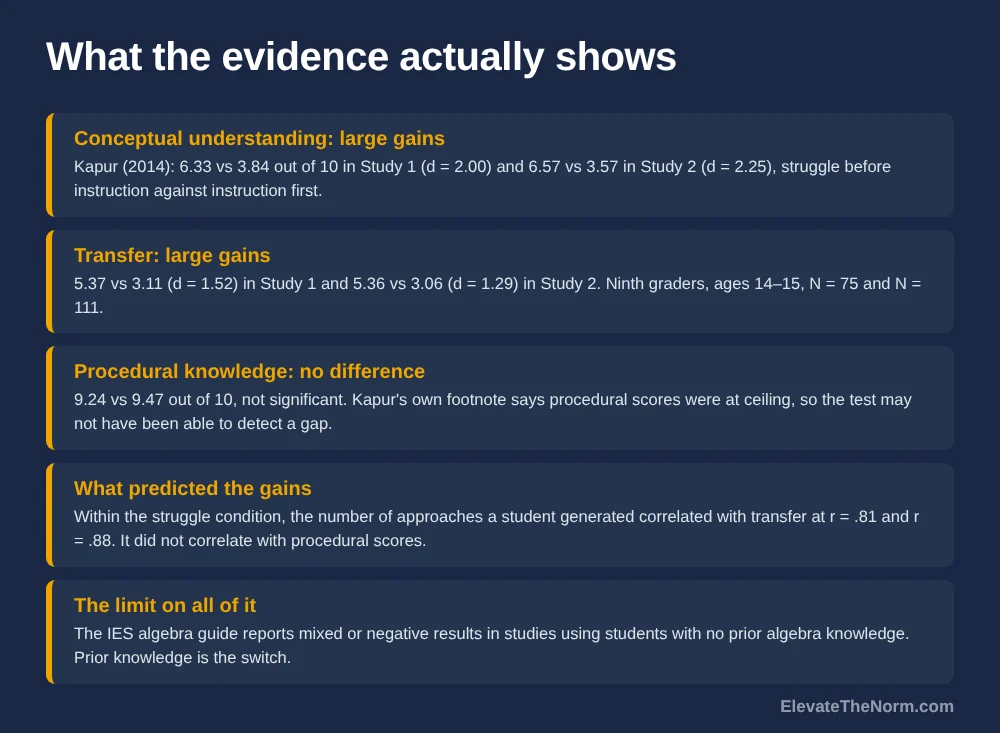
- Procedural knowledge came out identical. In Study 1, 9.24 out of 10 for the struggle group against 9.47 for the taught group — no significant difference. Kapur’s own footnote says procedural performance was at ceiling, so the test may simply not have been able to detect a gap. Either way, struggling first bought nothing here.
- Conceptual understanding and transfer came out far apart. Conceptual understanding was 6.33 against 3.84 in Study 1 (d = 2.00) and 6.57 against 3.57 in Study 2 (d = 2.25). Transfer was 5.37 against 3.11 (d = 1.52) and 5.36 against 3.06 (d = 1.29). Those are very large effects by the standards of education research.
- It cost the students something. Self-reported mental effort was much higher in the struggle condition in both the problem-solving phase and the instruction phase that followed (d values from 0.84 to 1.70). Reported engagement did not differ. Harder, not more fun.
- The number of approaches a student generated predicted their scores. Within the struggle condition, solutions generated correlated with transfer at r = .81 in Study 1 and r = .88 in Study 2, and with conceptual understanding at r = .65 and r = .82. It did not correlate with procedural scores. In the taught condition nothing correlated with anything.
That last finding is the practical one. The payoff tracked how much the student actually produced during the struggle, not how long they sat there. A student generating five wrong approaches is doing the thing. A student staring at the page for the same eleven minutes is not.
What the larger review adds, and what it does not
Sinha and Kapur published a meta-analysis in Review of Educational Research covering fifty-three studies and a hundred and sixty-six comparative analyses. I could not get into the paper itself. What follows comes from ETH Zurich’s own write-up of it, and I am naming it as a summary rather than pretending otherwise.
Two things in that summary matter for a secondary classroom. First, the benefit was reported as larger for secondary students and undergraduates than for primary students, with the authors attributing the weaker primary result to students having too little domain knowledge to reason from. That is the right direction for this site’s audience. Second, the studies covered mathematics, physics, chemistry, biology and medicine, and explicitly excluded reading and writing proficiency and problems from the humanities and social sciences.
The release also claims the approach was “nearly twice as efficient as receiving a year of instruction from an outstanding teacher” and in places up to three times better. I am not repeating those as findings. No standardized effect size is attached to either comparison in the release, and I did not read the paper, so I have no way to check what is being compared to what. Treat the study count and the secondary-versus-primary moderation as the usable parts.
What Is the Evidence Against Productive Struggle?
The strongest objection is cognitive load theory: for a novice working on material with many interacting parts, adding difficulty does not produce learning, it produces overload. On that view a struggling beginner needs explicit instruction and worked examples, not a harder problem.
Paul Kirschner’s summary of Sweller’s account of cognitive load theory makes the case directly. What counts as one thing to hold in mind depends on what the learner already knows — an equation is a dozen moving parts to a beginner and a single chunk to an expert. That produces the expertise reversal effect, where worked examples help novices and start to get in the way of experts. The claim about difficulty is narrow and specific: desirable difficulties help with low-interactivity material and are harmful with high-interactivity material, where making a struggling learner’s problem harder simply does not work. He calls that an undesirable difficulty, which is a better phrase than most of what gets written on this topic. I am citing his summary rather than Sweller’s paper, which I did not read.
The honest thing to say is that this is a live argument between research camps and not a case of one side having the evidence. Bill McCallum, who worked on the IES algebra guide, accepts that working memory is limited and that worked examples help novices, and then argues that the direct-instruction case overreaches — that it moves its definition of “minimal guidance” around and that the national reports it cites actually support a mix of approaches. His own summary is that a well-designed pair of worked examples is itself a form of productive struggle. He also names the real classroom failure mode: taking something that works sometimes and turning it into “never tell, always ask,” which stops teachers giving students information they need.
And the single most concrete warning comes from the government’s own review. The IES and What Works Clearinghouse practice guide on algebra for middle and high school has three recommendations. Two carry a minimal evidence rating and one carries moderate. On the moderate one — teaching students to choose intentionally among alternative strategies — the guide says the benefits appeared mainly for procedural flexibility and only after students already had some procedural algebra knowledge, and that studies using students with no prior algebra knowledge showed mixed or negative results.
Read that next to the meta-analysis summary blaming the weak primary-school result on thin domain knowledge and you get the same finding twice from opposite directions. Prior knowledge is the switch. Below some threshold, struggle is not productive at any duration.
That finding has an edge to it that rarely gets said out loud in a staff meeting. If the method works above a prior-knowledge threshold and does nothing or worse below it, then mandating it across a department or a district will help the students who arrived with the background and spend the time of the students who did not. The same lesson would widen the gap between two classes in the same building. That is not an argument against using it. It is an argument against rolling it out as a blanket expectation without checking, class by class, whether the entry knowledge is actually there.
How Do You Tell Productive Struggle From a Student Who Is Just Stuck?
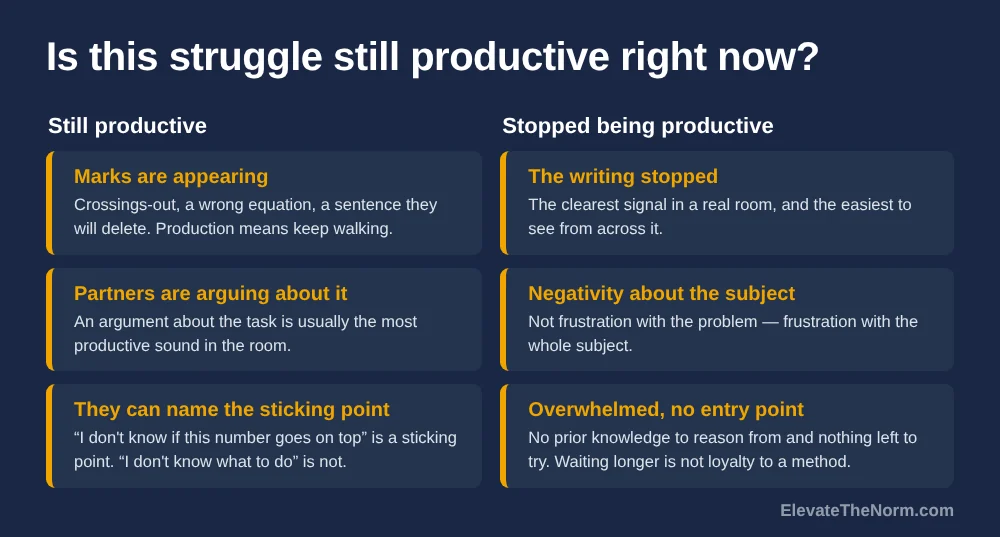
Watch what the student is producing, not how uncomfortable they look. A student writing down wrong approaches, arguing with a partner, or crossing things out is struggling productively. A student who has stopped writing, gone quiet, or started talking about how much they hate the subject has crossed over.
Young and colleagues summarize the unproductive markers from the literature as students becoming overwhelmed, expressing negativity toward the subject, or stopping work altogether. That third one is the clearest signal in a real room and the easiest to see from a stool.
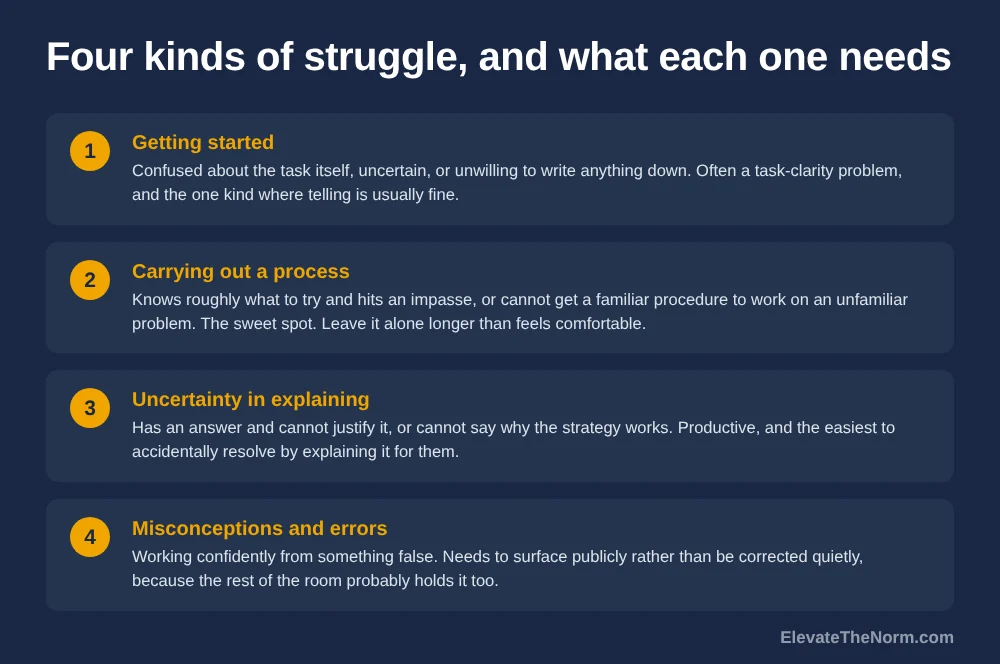
The most useful framework for what the struggle actually looks like comes from Warshauer, applied in a classroom study by Zeybek (2016). It names four kinds, and they call for different responses:
- Getting started. The student is confused about the task itself, uncertain, or unwilling to write anything down. This is often a task-clarity problem rather than a thinking problem, and it is the one kind where telling is usually fine.
- Carrying out a process. The student knows roughly what to try and hits an impasse, or cannot get a familiar procedure to work on an unfamiliar problem. This is the sweet spot. Leave it alone longer than feels comfortable.
- Uncertainty in explaining and sense-making. The student has an answer and cannot justify it, or cannot say why their strategy works. Also productive, and the easiest to accidentally resolve by explaining it for them.
- Expressing misconceptions and errors. The student is working confidently from something false. In Zeybek’s study the misconception that blocked progress was refusing to accept a square as a rectangle. This one needs to surface publicly rather than be corrected quietly, because the rest of the room probably holds it too.
A caveat on that study, because it matters: the participants were forty-eight third-year pre-service middle-grades teachers in Turkey working on a geometry task, not grades 6–12 students. The framework is the useful part. The findings are about adults learning math.
How Long Should You Wait Before Stepping In?
Long enough for the student to produce something, which is a judgment rather than a number. The research gives no duration. The question is not how many seconds have passed but whether anything is appearing on the page.
I hold a deliberate pause before I respond to most things in my room — roughly a count of fifteen, on average. It is not a rule and I do not run a stopwatch. It moves with the room, the day, and the student. The point of it is not the number. It is that my first instinct is almost always to step in too early, and a pause I have decided on in advance beats an instinct I have not. The same logic applies to a question asked out loud, which is why waiting before you call on anybody changes who answers.
The professional organizations are clear about which direction the error runs. NCTM lists “support productive struggle in learning mathematics” as one of eight effective teaching practices, and its own warning is about teachers rescuing students — which, it says, undermines students’ efforts and lowers the cognitive demand of the task. Worth knowing that the definition most people attribute to NCTM actually comes from Warshauer, and that NCTM’s passage on struggle cites Reinhart and Stein and colleagues rather than reporting new evidence.
In practice I use three questions instead of a timer, and I can answer all three while walking:
- Is anything appearing on the page? Marks, crossings-out, a wrong equation, a sentence they will delete. Production means keep walking.
- Are they talking to each other about the problem? Partner work is the default in my room, so an argument about the task is usually the most productive sound in it.
- Have they named their own sticking point? “I don’t know what to do” is not a sticking point. “I don’t know whether this number goes on top” is, and a student who can say it is close to solving it.
If the answer to all three is no for more than a minute or two, the struggle has stopped being productive and waiting longer is not loyalty to a method. It is just watching a kid sink. That is usually the moment for a scaffold rather than an answer, and which scaffold is its own question — I have written separately about which scaffolds actually hold weight and how to take them away again.
Which Teacher Responses Keep the Struggle Going?
Probing guidance and giving students more time maintain productive struggle. Telling and directed guidance resolve it — sometimes appropriately, often too early. Warshauer’s four-response framework, as applied in Zeybek’s classroom analysis, is the most practical thing in this whole literature.
| Response | What you actually do | Effect on the difficulty | When it is the right call |
|---|---|---|---|
| Telling | Answer the question. “You need six pieces.” | Removes it. Cognitive demand drops to zero on that step. | Task-clarity confusion, a stuck student about to quit, or information they could not have derived. |
| Directed guidance | Steer toward a specific next step. “Draw the shape first.” “Check that value.” | Lowers it. Useful, but Zeybek notes it can reduce the task’s cognitive level if overused. | Getting-started struggle, and students who need a route back in after a long stall. |
| Probing guidance | Ask a question that makes the student locate their own problem. “Is a square a rectangle?” | Maintains it. Keeps demand high while giving the student something to work with. | Almost always the first move, and the only one that works on misconceptions. |
| Affordance | Give more time and leave it alone. Say you will come back. | Maintains it — while anything is still being produced. | Carrying-out-a-process struggle, where the student has traction and just needs room. |
Zeybek’s honest footnote on affordance is the one teachers need: it sometimes lost momentum when students could not get past the struggle without more support. Leaving a group alone is a real instructional decision with a real failure mode, not a safe default.
How Do You Design a Task Worth Struggling With?
Pick something students can start without the method you are about to teach, make the method the thing they cannot reach, and plan the instruction that follows the struggle. The struggle is not the lesson. It is the first half of one.
- Check that the prior knowledge is actually there. This is the step people skip and it is the step the evidence keeps pointing at. For the standard deviation task in Kapur’s studies, students already understood the mean. Pick your task so the entry ticket is something you have already taught and can verify — which is a job for a quick formative check before the lesson, not a hunch.
- Make the problem intuitively graspable but not solvable with what they have. Students should be able to say what the question is asking and have several plausible-looking approaches. If they cannot describe the problem, you have a reading task, not a thinking one.
- Build in more than one entry point. A class is not uniform in prior knowledge. McCallum’s recommendation is to design problems with multiple ways in so students with different starting points can all engage — which is the same logic as differentiating without writing five separate lesson plans.
- Ask for multiple approaches, not the answer. “Find as many ways as you can” is the instruction that produced six approaches per student in the research, and the number of approaches was what correlated with learning. Asking for the answer produces one attempt and a stall.
- Tell students what you are doing and why. This matters more than any other step on this list. A teacher who quietly withholds help is, from a student’s seat, a teacher playing a game with them. Say it plainly: this is hard on purpose, you are not expected to finish it, I am going to make you work before I explain it, and here is why that helps. Teenagers will go along with almost anything if you tell them the reason. They will resist almost anything if you do not.
- Do not grade it. Zero percent of students in the struggle condition reached the formula, and the design assumed that. The struggle phase is not an assessment and should not be in the gradebook in any form, including completion points. If students think they are being assessed, you have manufactured stakes instead of a learning sequence.
- Teach the method afterward, properly. In the research the instruction phase is not optional and not a debrief — it is where the knowledge gets assembled. Students in the struggle condition reported working harder during the instruction than the taught students did, which is the whole point. Skip this and you have run a frustrating activity.
- Surface the wrong approaches by name. Put two or three student attempts up and compare them. This is where a misconception the whole room holds gets dealt with, and it is also what the IES guide recommends independently — analysing solved problems, including incorrect ones.
What Does Productive Struggle Cost a Teacher to Run?
More planning time than a normal lesson and about the same amount of class time. The expensive part is writing a task students can genuinely start and genuinely not finish.
That is an hour of real work the first time you do it for a topic, and close to free every year after, because the task does not expire.
The cost nobody mentions is behavioral. Ten or twelve minutes of a room full of teenagers not knowing what they are doing is not a neutral event. In a class that already drifts, it is an invitation. Three things make that manageable, and none of them is a trick:
- Students work with somebody. Partner work is the default condition in my room rather than a special arrangement, and a pair that is arguing about a problem is not a pair looking for something else to do.
- You are moving the entire time. This sequence does not work from a desk. The whole reason to run it is that you get to see what thirty students actually think before you teach them, and you only get that by walking.
- The time is budgeted out loud. I post the plan to the minute and I say what the block is for. “Twelve minutes, as many approaches as you can find, nobody is expected to finish” is a different instruction from “work on this.”
If your room is not there yet, run the sequence for five minutes instead of twelve and build up. A short struggle that holds is worth more than a long one that falls apart, and a class that has never been asked to sit in not-knowing will need practice at it before the method can do anything.
Does Productive Struggle Work Outside of Math?
Nobody has shown that it does, and the main review deliberately did not look. The meta-analysis summary says it covered mathematics, physics, chemistry, biology and medicine and excluded reading, writing, humanities and social science problems.
I teach social studies. That means I am extrapolating, and I am going to say so rather than pretend the research covers me.
What the content analysis adds is that the literature is almost entirely mathematics education, twenty-six of twenty-eight studies were based in the United States, and only six of the twenty-eight involved K–12 students on their own — the rest were pre-service teachers, in-service teachers, or mixed groups. So the base is narrower than the confidence with which the term gets used in staff meetings.
My read, as a teacher and not as a researcher: the mechanism the research describes — activating what you already know, finding out where the gap is, then getting the explanation — is not obviously math-specific. Handing students three conflicting primary accounts before teaching them how historians weigh evidence has the same shape as handing them a spread of numbers before teaching standard deviation. But shape is not evidence. If somebody tells you productive struggle is proven in English or history, ask them for the study.
Is Productive Struggle Worth It? My Take
Yes, for conceptual work, if you are in the room while it happens and you have planned the instruction that comes after. No, as a philosophy of letting kids fail.
I want to be plain about where I split from a lot of writing on this. There is a version of this idea that romanticizes failure — give them real stakes, let them fall, that is how they learn. I do not buy it. If a student in my room can mess up badly enough for it to really matter, that is a planning problem and it is mine. It means the task was badly scoped, the entry knowledge was not there, or the adult was not paying attention.
That is not an argument against difficulty. It is an argument about what kind of difficulty. Kapur’s students failed completely — not one of them found the formula — and nothing bad happened to any of them, because the failure was designed, ungraded, and followed by teaching. That is the distinction worth holding onto: not knowing yet is not the same as being allowed to fail. The first is a lesson structure. The second is usually an excuse for a task nobody checked.
The other thing I would say to anybody being handed this in a professional development session: the burden of proof sits with the person making the claim. Two of the three recommendations in the federal algebra guide carry a minimal evidence rating. A third of the studies using the term bother to define it operationally. The strongest single result in the field comes from two classes of ninth graders in one school in one country learning one topic. That is genuinely promising and it is not a mandate. Treat it the way you would treat any claim about raising expectations — useful when it comes with support, harmful when it is just pressure with a research citation attached.
And the part that gets left out: struggle only pays if the student is allowed to be wrong out loud. That is a culture question before it is an instructional one, and it is the same work as making a mistake survivable in your room. A class that has learned wrong answers get you corrected in front of everybody will not generate six approaches. They will wait for you to say it.
Which brings me to the thing I would want said if I were sitting in the desk. Deliberately not helping a student who has asked for help is a strange thing to do to somebody, and if you never explain it, it reads as the teacher being difficult on purpose. Tell them. “I am going to make you work on this before I explain it, you are not expected to finish, and here is why I think that helps you” costs twenty seconds and changes the whole meaning of the next twelve minutes. Students in grades 6–12 are old enough to be let in on the method being used on them. Running it on them without saying so is the version of this I would object to as a parent.
What to Do Next
Pick one lesson where students currently get the method first, and flip it. Choose a topic where the entry knowledge is something you have already taught and can check in two minutes.
Write the task so students can start it and cannot finish it. Ask for as many approaches as they can find, tell them plainly that nobody is expected to get the answer and that none of it is graded, and give it ten or twelve minutes while you walk and watch what is appearing on paper.
Then teach the method properly, using two or three of their wrong approaches as the way in. That is the whole sequence. Run it once, on one topic, and judge it on whether students could explain the idea a week later — not on whether the room looked comfortable while it happened.
Sources
- Kapur, M. (2014). “Productive Failure in Learning Math.” Cognitive Science, 38(5), 1008–1022 — the two randomized controlled trials with ninth graders, and the source of every effect size and posttest mean quoted above. Read in full as a PDF copy hosted by IIT Kanpur.
- ETH Zurich (2021). “Those who fail productively are all the wiser.” — the institution’s own write-up of Sinha & Kapur’s meta-analysis in Review of Educational Research (2021, 91(5), 761–798). The paper itself was not reachable; this is a summary and is cited as one. Source of the fifty-three-study count, the secondary-over-primary moderation, and the excluded subject areas. Its “twice as efficient” comparison is not repeated here because no effect size is attached to it.
- Star, J. R., et al. “Teaching Strategies for Improving Algebra Knowledge in Middle and High School Students” (summary). Institute of Education Sciences / What Works Clearinghouse — the three recommendations, their evidence ratings, and the finding that students without prior algebra knowledge showed mixed or negative results. Read in full.
- Zeybek, Z. (2016). “Productive Struggle in a Geometry Class.” International Journal of Research in Education and Science, 2(2), 396–415 — source of Warshauer’s four struggle types and four teacher responses, and of the finding that probing guidance and affordance maintained struggle while telling and directed guidance risked lowering demand. Participants were pre-service teachers, not school students. Read in full.
- Young, J. R., Sanders, M., Bevan, D., & Amin, S. (2025). “What Exactly is the Productive Struggle?” International Journal of Education in Mathematics, Science, and Technology, 13(5), 1040–1063 — the content analysis of twenty-eight studies, the definition counts, the unproductive-struggle markers, and the teacher-move list. Read in full.
- National Council of Teachers of Mathematics (2021). Supporting Productive Struggle virtual workshop slide deck — NCTM’s own PDF, confirming that “support productive struggle in learning mathematics” is one of its eight effective teaching practices, carrying the caution about rescuing students, and attributing the working definition to Warshauer rather than to NCTM itself. Read in full.
- Kirschner, P. (2025). “When Failure Feeds the Flame.” — a summary of Sweller’s account of cognitive load theory in Educational Psychology Review (2023), and the source of the expertise-reversal and undesirable-difficulty argument used above. Sweller’s own paper was not read; this is cited as a summary.
- McCallum, B. “What if the struggle isn’t productive?” Mathematical Musings — the middle position, the “never tell, always ask” failure mode, and the multiple-entry-points recommendation. Personal commentary from a mathematics educator who worked on the IES algebra guide, not peer-reviewed research, and treated as such here.
Mixed practice is the same bargain as productive struggle, in worksheet form. Accuracy falls while students are working and rises weeks later, which means the signals available on the day all point the wrong way. What interleaving costs in the first fortnight covers how to read a dip that is supposed to happen, and how to tell students why it is happening to them.
The argument for moving the explanation out of the room is that it buys back the minutes where students struggle in front of you. That is only an argument if the freed period is spent on the struggling rather than on a second lecture. The flipped classroom, read honestly reports what happens when the class period is left unchanged, and the finding that flipped classes which cut face-to-face time performed worse than the ones that did not.
There is a difference between difficulty that sits in the thinking and difficulty that sits in the layout. One is the lesson. The other is a handout problem wearing the lesson’s clothes. Which kind of load to cut, and which to leave alone sets out the distinction cognitive load theory draws, along with the honest state of the evidence behind it: worked examples pool at g = 0.43, and most of the research was run on adults rather than teenagers.
What is productive struggle in simple terms?
Students working hard at something they do not yet know how to do, on a task that is difficult but within reach. The teacher stays present and resists answering. It is different from a task being too hard: if a student has no prior knowledge to reason from and nothing to try, that is not productive struggle, it is just being stuck.
How long should I let a student struggle before helping?
There is no research-backed number, so watch production instead of the clock. If marks are appearing on the page, partners are arguing about the problem, or the student can name their own sticking point, keep walking. If none of those is true for a minute or two, step in with a scaffold rather than an answer.
Does productive struggle improve test scores?
It depends which test. In Kapur’s two randomized trials with ninth graders, students who struggled first scored no better on procedural questions and far higher on conceptual understanding and transfer, with effect sizes above d = 1.2. If your assessment is mostly computation, expect no gain from this.
What is the difference between productive struggle and productive failure?
Productive struggle is the broad idea of students working at the edge of what they can do. Productive failure is a specific designed sequence: students attempt a problem before being taught the method, generate partial approaches, fail to reach the standard solution, and then receive the instruction. The failure is planned, ungraded, and followed by teaching.
Does productive struggle work for students who are behind?
Not reliably, and prior knowledge is the reason. The IES algebra practice guide reports that studies using students with no prior algebra knowledge showed mixed or negative results, and the meta-analysis summary blames the weaker primary-school effect on thin domain knowledge. Check the entry knowledge first, or the struggle produces nothing.
Is there research on productive struggle outside mathematics?
Very little. The large meta-analysis covered mathematics, physics, chemistry, biology and medicine and explicitly excluded reading, writing, humanities and social science problems. A content analysis of twenty-eight studies on the term found them almost entirely in mathematics education. Teachers in other subjects are extrapolating.
What should I say to a student who is stuck without giving away the answer?
Ask a question that makes them locate their own problem rather than one that steps them through it. In the research framework this is called probing guidance, and it was the only response that maintained cognitive demand while still helping. Directing a student to a specific next step helps too, but it lowers the difficulty of the task.
Do parents and administrators object to productive struggle?
Sometimes, and usually for a fair reason: from outside the room, a class that looks confused looks like a class that is not being taught. The answer is to be explicit that the struggle is a planned first half, that it is not graded, and that direct instruction on the method follows in the same lesson.