By Clay Shumate
Project based learning is a teaching method where students gain knowledge and skills by investigating and responding to an authentic, complex question or problem over an extended period of time—typically a week to a full semester. The project is the unit of instruction, not something tacked on at the end. Students conduct sustained inquiry, make real decisions, receive feedback, revise their work, and present a product to an audience beyond the teacher. That last clause is what separates authentic work from work that is merely hands-on.
That definition is straightforward, but it gets misapplied constantly. Posters, dioramas, and end-of-chapter activities get called “PBL” every day in schools across the country. They are not. Understanding what project based learning actually is—and where the line falls—matters more than any acronym. For the specific templates and protocols that make implementation practical, see this guide to project based learning tools.
Key Takeaways
- Project based learning means the project is the instruction, not a reward after the instruction is finished.
- PBL requires sustained inquiry, a driving question, student voice, critique and revision, and a public product.
- Regular classroom projects, problem-based learning, inquiry-based learning, and hands-on activities overlap with PBL but are not the same thing.
- Strong PBL does not mean the teacher disappears. The teacher plans the structure, circulates during work, and holds students to a standard.
- Research consistently shows PBL improves achievement, critical thinking, and engagement—especially at the secondary level—when implemented well.
The Formal Definition of Project Based Learning, Broken Down
PBLWorks, the organization most associated with project based learning research and professional development, defines PBL as “a teaching method in which students gain knowledge and skills by working for an extended period of time to investigate and respond to an authentic, engaging, and complex question, problem, or challenge” (PBLWorks, “What Is PBL?”).
Every word in that definition does work. Pull one out and you lose PBL:
Extended period of time. A single class period activity is not PBL. The sustained nature of the work is what forces students to plan, manage themselves, get stuck, ask for help, revise, and persist. A one-day project cannot produce any of that.
Investigate and respond. Students are not executing a set of teacher-written steps. They are figuring things out—reading, researching, interviewing, testing, analyzing, and deciding. The thinking belongs to them.
Authentic, engaging, and complex. The question has to matter to somebody beyond the classroom. If the only audience is the teacher’s gradebook, it is an assignment, not PBL.
The Seven Essential Design Elements of PBL
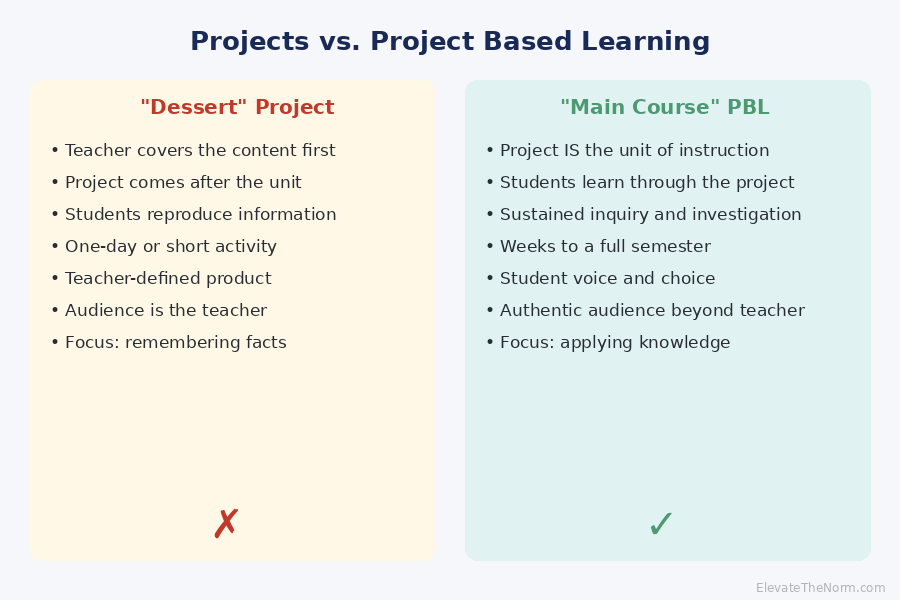
PBLWorks identifies seven essential design elements that separate genuine PBL from projects that just look busy (PBLWorks, “Gold Standard PBL”):
1. A Challenging Problem or Question. The project starts with a driving question—open-ended, standards-connected, and worth answering. “What happened in the American Revolution?” is a topic. “How should our community remember the people history forgot?” is a driving question.
2. Sustained Inquiry. Students spend days or weeks researching, testing, building, and analyzing. The inquiry is not a warm-up before the real work. It is the real work.
3. Authenticity. The project connects to the real world. That can mean a real audience, a real problem, professional tools, or a question students actually care about. A poster about water pollution for a bulletin board is not authentic. A water-quality report presented to a city council is.
4. Student Voice and Choice. Students make meaningful decisions—about their question, their approach, their product, or how they organize their work. This does not mean they choose whether to do the project. It means they have genuine ownership within the structure the teacher has built.
5. Reflection. Students and teachers think about what they have learned, what is working, and what they would change. Reflection is built into the process, not bolted on at the end.
6. Critique and Revision. Students give and receive feedback and use it to improve their work. First drafts are not final drafts. In my room, when a group brings me what they think is a finished product, I ask them to walk me through it at the whiteboard table. Most of the time, they find the gap before I do—and that is exactly the point.
7. A Public Product. Students share their work with an audience outside the classroom—parents, community members, experts, younger students, or a public platform. The audience raises the standard. Nobody wants to present bad work to a room full of strangers.
These seven elements work together. Remove one and the project weakens. Remove three and you have a regular assignment with a new label.
What Project Based Learning Is Not
This is where most confusion lives. Here are four things that get called PBL but are not.
It Is Not a Project After the Lesson
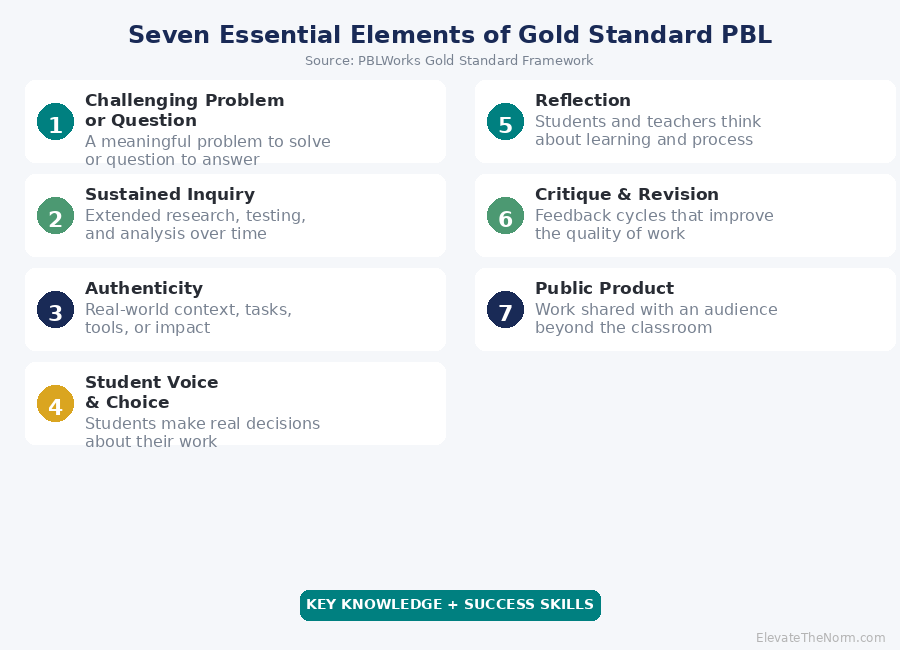
John Larmer and John Mergendoller of PBLWorks call this the “dessert project”—a short, intellectually light project served up after the teacher covers the content (Larmer & Mergendoller, “Seven Essentials for Project-Based Learning,” ASCD). Build a model of a cell after learning about cells. Make a brochure about Ancient Rome after the unit test. These are projects. They are not PBL.
That distinction is the heart of the project based learning versus traditional learning debate, and the research reads very differently depending on which version a study actually measured. In PBL, the project is the unit. Students learn the content through the project, not before it. The project is the main course, not the dessert.
It Is Not Problem-Based Learning
Problem-based learning and project-based learning share an acronym, but they are not the same. Problem-based learning follows a more structured process: students receive an open-ended problem, define it, identify what they know and what they need to learn, investigate, and propose solutions. It originated in medical education and tends to follow a formalized set of steps (Edutopia, “Project-Based Learning vs. Problem-Based Learning vs. X-BL”).
Project-based learning is broader. It includes designing products, investigating questions, and solving problems. A problem can drive a PBL project, but PBL is not limited to problems. The two approaches share DNA, but they are not identical.
It Is Not Inquiry-Based Learning
Inquiry-based learning emphasizes student questions and investigation. PBL includes inquiry—sustained inquiry is one of the seven design elements—but PBL adds structure, a public product, and often a tangible deliverable that inquiry alone does not require. Inquiry is an ingredient. PBL is the recipe.
It Is Not a Hands-On Activity
Building a bridge from popsicle sticks is hands-on. It is not PBL unless there is a driving question, sustained inquiry, student decision-making, feedback, and a purpose beyond the activity itself. Hands-on work is a tool. PBL is a method. The two overlap, but a hands-on activity without intellectual demand is just craft time with a content label.
A Strong Example and a Weak Example of PBL
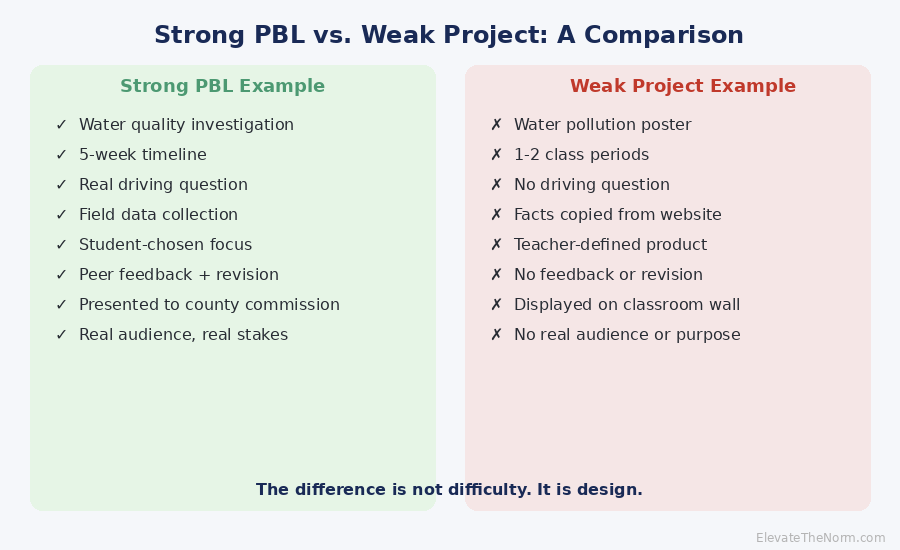
Strong PBL: Eighth-grade students investigate water quality in a local creek after noticing runoff from a nearby construction site. They collect samples, learn testing procedures, analyze data, research water safety standards, and write a formal report. They present findings and recommendations at a county environmental commission meeting. The project takes five weeks. Students choose which aspect of water quality to focus on, how to present their data, and which solution to recommend.
This is PBL because it has a real question, sustained inquiry, authenticity, student voice, feedback from the teacher and from peers, and a public product delivered to a real audience.
Weak example: Students make a poster about water pollution for a classroom display. They copy facts from a website, add clip art, and present to the class for a grade.
This is a project. It is not PBL. There is no driving question, no inquiry, no authentic audience, no revision based on feedback, and no student decision-making beyond color choices.
What the Research Says About Project Based Learning
A 2026 multi-study analysis published in Humanities and Social Sciences Communications examined 54 quantitative studies on PBL effectiveness. The overall effect size was large (Hedges’ g = 1.11), meaning PBL had a substantial positive impact on student achievement compared to traditional instruction. The effect was strongest at the high school level (g = 1.45) and somewhat lower in mathematics (g = 0.68), suggesting PBL in abstract subjects requires deliberate scaffolding (Chen et al., “Project-based learning in schools,” Humanities and Social Sciences Communications, 2026).
Beyond test scores, the research identified positive effects on critical thinking, collaboration, communication skills, and student engagement. These findings matter because they match what PBL is designed to develop—not just content knowledge, but the ability to use that knowledge in real situations.
The research also flagged real limitations: PBL requires teacher training, adequate resources, and careful planning. Without those, the method does not automatically outperform direct instruction. Good PBL is not magic. It is planned, structured, and supported.
For an evaluation of specific tools that support that planning—templates, rubrics, critique protocols, and driving-question resources—see project based learning resources on this site.
What the Teacher Actually Does in Project Based Learning
One of the most damaging myths about PBL is that the teacher steps back and lets students figure it out. That is not PBL. That is neglect in an educational costume.
In my room, students are almost always working alongside somebody—partner work is the default, not a special reward for finishing something early. I am not standing at the front of the room watching. I am circulating, listening, pulling up a chair, asking a group what they have found so far. When two students are building an argument and the logic falls apart, I do not announce it to the room. I sit down next to them and ask them to walk me through it.
The whiteboard table in my room is not a remediation corner. It is the best seat in the house—low lamp, a rug, better chairs, a table I built myself. Students ask to go there. When a group needs direct instruction on a skill they are missing midproject, that is where we go. Three or four students at a time, working through exactly the thing they need, while the rest of the class continues.
PBL requires more teaching, not less. The teacher designs the project, writes the driving question, builds the checkpoints, plans the feedback loops, manages the pacing, and holds students to the standard. The difference is that the teaching happens at close range—next to students while they work—instead of from a podium before they start.
How PBL Connects to Student Responsibility
PBL and student responsibility are inseparable. A project that asks students to make real decisions, manage their time, collaborate with a team, present to an audience, and revise their work after honest feedback is a responsibility machine. Students cannot hide behind compliance in PBL because there is nothing to comply with—no worksheet to fill in, no notes to copy. They have to produce something that works.
That is also what makes PBL hard. Students who have spent years in compliance-based classrooms do not automatically know how to handle freedom. The teacher’s job is to build that capacity deliberately—clear classroom expectations, structured check-ins, honest feedback, room to make mistakes, and support after the mistake happens.
The connection runs both ways. Teaching responsibility becomes more concrete when students have genuine ownership of their work. And respect in the classroom—the mutual kind—creates the trust students need to take risks, ask for help, and accept feedback without defensiveness.
Conclusion
The definition of project based learning is clear: students learn by working on a meaningful, extended project driven by a real question. The confusion comes from calling other things by the same name. Projects after the lesson, problem-solving exercises, inquiry activities, and hands-on crafts all have value—but they are not PBL unless they include the essential elements that make PBL work.
If you are considering PBL for your classroom, start with a genuine driving question, give students real decisions to make, build in feedback and revision, and plan for a public product. Then stay close. Circulate. Teach at the whiteboard table. Hold the standard.
PBL does not mean less teaching. It means better teaching, delivered where students need it most—right next to them while they work.
Once the definition is clear, the natural next step is sequencing it: 7 steps of project based learning walks through the process from driving question to public product.
What is the simplest definition of project based learning?
Project based learning is a teaching method where students learn by working on a meaningful project over an extended period. The project is the unit of instruction—not an add-on after the lesson. Students investigate a real question, make decisions, receive feedback, revise their work, and present a finished product to an authentic audience.
How is PBL different from a regular classroom project?
A regular project is usually assigned after the teacher has already taught the content. In PBL, students learn the content through the project itself. PBL also requires a driving question, sustained inquiry, student decision-making, critique and revision, and a public product—elements most regular projects do not include.
Does the teacher just step back and let students figure it out?
No. PBL requires more teaching, not less. The teacher designs the project, builds the structure, circulates during work time, provides direct instruction when students need it, and holds everyone to a clear standard. The teaching happens at close range—next to students—instead of from the front of the room.
Can PBL work in tested subjects like math?
Yes, but it requires careful planning. Research shows PBL improves achievement in math, though the effect is smaller than in other subjects. Teachers need to ensure the math is essential to the project—not decorative—and build in explicit instruction and practice alongside the project work.
What does the research say about PBL effectiveness?
A 2026 multi-study analysis found a large positive effect on student achievement (Hedges’ g = 1.11), with the strongest results at the high school level. PBL also improved critical thinking, collaboration, and engagement. However, the research is clear that implementation quality matters—PBL without adequate planning and teacher support does not automatically outperform traditional instruction.
Is problem-based learning the same as project-based learning?
They are related but not identical. Problem-based learning follows a more structured process focused on solving an open-ended problem, originally developed for medical education. Project-based learning is broader—it can include problem-solving, but also designing products, investigating questions, and creating performances for real audiences.
How long should a PBL project last?
Most PBL projects run from one week to a full semester, depending on the scope. The key is that the timeline allows sustained inquiry—students need enough time to research, get stuck, get feedback, revise, and produce quality work. A one-day activity cannot deliver that experience.
Sources
- PBLWorks, “What is Project Based Learning?” PBLWorks.org. https://www.pblworks.org/what-is-pbl
- PBLWorks, “Gold Standard PBL: Essential Project Design Elements.” PBLWorks.org. https://www.pblworks.org/what-is-pbl/gold-standard-project-design
- John Larmer and John Mergendoller, “Seven Essentials for Project-Based Learning.” Educational Leadership, ASCD. https://www.ascd.org/el/articles/seven-essentials-for-project-based-learning
- John Larmer, “Project-Based Learning vs. Problem-Based Learning vs. X-BL.” Edutopia. https://www.edutopia.org/blog/pbl-vs-pbl-vs-xbl-john-larmer
- Chen et al., “Project-based learning in schools: a multi-complementary study of its effectiveness.” Humanities and Social Sciences Communications, Nature, 2026. https://www.nature.com/articles/s41599-026-06684-4
- Larmer, Mergendoller, and Boss, Setting the Standard for Project Based Learning. ASCD, 2015.
- Innovations Academy, “Inquiry-Based Vs Project-Based Learning, What’s the Difference?” 2025. https://innovationsacademy.org/blog/2025/04/inquiry-based-vs-project-based-learning-whats-the-difference/
- High Quality PBL Framework, HQPBL.org. https://hqpbl.org
About Clay Shumate
Clay Shumate is a certified secondary Social Studies teacher in the public schools of West Alabama, with seven years of classroom experience, a B.A. in History, and an M.Ed. in Secondary Education. He writes about project-based learning, student responsibility, respect, and practical ways to hold young people to a higher standard while giving them room to learn from mistakes. He is a member of the Society of Professional Journalists and writes to its Code of Ethics; this site’s editorial standards and corrections policy are published in full. More about Clay.