By Clay Shumate
Treating the teacher as a professional means trusting a trained person to exercise judgment in situations nobody can script in advance, and holding them accountable for the quality of that judgment rather than for compliance with a procedure. Teaching has the standards and the knowledge base for that status. What it often lacks is the discretion.
This is not a complaint about paperwork. It is an argument about what kind of work teaching is, and it has consequences in classrooms. A teacher who is handed a script and checked against it learns that correct process is the point. A teacher trusted with judgment learns that outcomes and students are the point. Those two teachers run very different rooms, and students can tell which one they are sitting in within a week.
Key Takeaways
- Professional status is about discretion, not prestige. The defining feature of a profession is the authority to decide what this situation requires, under standards the profession itself holds.
- Teaching already has the standards. The InTASC core standards and the National Board’s five core propositions both make judgment and self-evaluation explicit professional obligations.
- Teachers report far less control than the standards assume. In federal survey data, about a quarter of teachers reported a great deal of control over textbooks and instructional materials, and under 30 percent over content and topics.
- The comparison to medicine holds in some places and breaks in others. Teachers do diagnostic work under uncertainty; they do not control entry to the field, caseload, or the conditions of practice.
- Pressure travels downhill. One study of 254 teachers across grades 1–12 found that teachers who felt more pressure from above became less self-determined and more controlling with students.
- Trust is the connection. This is my professional opinion rather than a finding: teachers trusted with judgment are the ones most likely to extend judgment to a sixteen-year-old.
What does it mean to talk about the teacher as a professional?
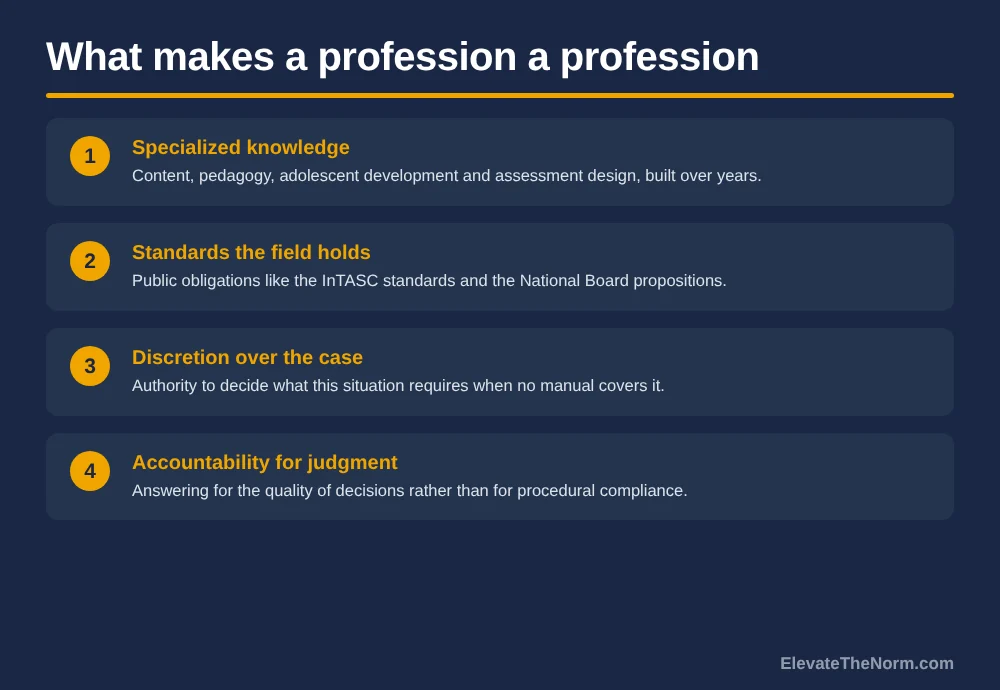
It means three things together: a body of specialized knowledge, standards the field holds itself to, and the discretion to apply both to a particular case. Drop the third and you do not have a profession. You have a trained workforce following instructions, which is a respectable thing to be and a different thing.
The word gets used loosely. “Be professional” is often said to teachers when what is meant is “dress appropriately,” “do not argue in front of parents,” or “submit the form on time.” Those are workplace conduct expectations. They apply to any job. They are not what makes a profession, and conflating the two is how a staff ends up with the obligations of professional status and none of the authority.
The real test is simpler than any definition: when a situation arises that the manual does not cover, who decides? If the answer is the person in the room with the relevant training, that is a profession operating. If the answer is that someone must be called, the job is being treated as something else.
Where does the comparison to medicine and law actually hold?
It holds on the structure of the work: diagnosis under uncertainty, with incomplete information, on a case that will not wait. A teacher looking at a student who has stopped turning in work is doing diagnostic reasoning. Is this a skill gap, a comprehension gap, a motivation problem, a home situation, a scheduling conflict, a conflict with another student, or a reasonable protest against a bad assignment? The correct response differs completely depending on the answer, and no policy document distinguishes among them.
It also holds on the knowledge base. Content knowledge, pedagogical content knowledge, adolescent development, assessment design, reading in the discipline — that is specialized expertise that takes years to build and that a smart outsider cannot improvise.
And it holds in the formal standards, which read like professional standards rather than job descriptions. The InTASC Model Core Teaching Standards, published by the Council of Chief State School Officers, make judgment explicit. Standard 9 states that the teacher “engages in ongoing professional learning and uses evidence to continually evaluate his/her practice, particularly the effects of his/her choices and actions on others,” and adapts practice to meet the needs of each learner (CCSSO, InTASC 1.0, 2013). That sentence assumes a teacher has choices to evaluate.
The National Board for Professional Teaching Standards is even more direct. Its third and fourth core propositions are that teachers “are responsible for managing and monitoring student learning” and that teachers “think systematically about their practice and learn from experience” (NBPTS, five core propositions, originally released 1989 and updated 2016). Responsibility and systematic thinking are both discretion words.
Where does the comparison break down?
On control of the conditions of practice, which is most of what distinguishes a profession from a credentialed job. I would be doing you a disservice if I pushed the doctor analogy too hard, because the places it fails are the places teachers feel the problem.
- Caseload. A physician’s panel size is a contested professional issue. A secondary teacher’s roster is handed down, and 150 students is normal.
- Entry to the field. Medicine and law control licensure through their own bodies. Teacher certification is set by states and routinely altered by legislatures, including emergency routes created during shortages.
- Tools of practice. A surgeon is not told which instruments to use by a purchasing committee. A teacher often is.
- Time to think. Professional judgment requires time for it. One planning period against six classes is not a schedule built for deliberation.
- Who evaluates. Peer review by qualified colleagues is central to the other professions. Teacher evaluation is usually done by an administrator who may not share the subject.
There is also a real counterargument to the whole analogy, and it deserves airing rather than dismissing. Public schools serve every child by law, funded by taxpayers, under elected boards. That creates legitimate public claims on what gets taught that do not exist in private medical practice. A teacher does not get to decide the standards any more than a doctor gets to invent a treatment protocol. The question is not whether constraints are legitimate. It is where the constraint should stop and the judgment should begin.
How much control do teachers actually report having?
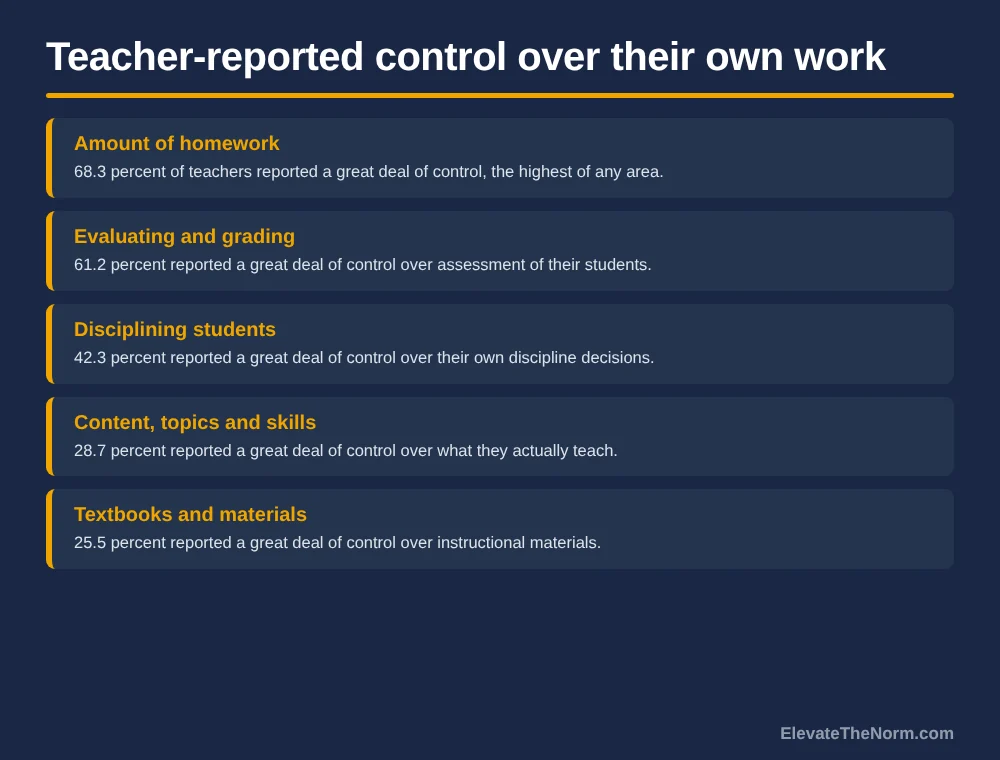
Much less than the standards assume, and the gap is largest exactly where expertise matters most. Drawing on 2015–16 National Teacher and Principal Survey data, the Economic Policy Institute reported the share of teachers who said they had a great deal of control over each area of their planning and teaching: 68.3 percent for determining the amount of homework, 61.2 percent for evaluating and grading students, 42.3 percent for disciplining students, 28.7 percent for selecting content, topics and skills, and 25.5 percent for selecting textbooks and instructional materials (García & Weiss, EPI, May 2019).
Look at the shape of that. Teachers control homework volume and grading — the administrative end of the work. Fewer than three in ten report real control over what is taught. The report also notes that larger shares of teachers who quit reported having little influence over school policy or over what they teach in class, though that is an association in survey data rather than a demonstrated cause of attrition.
A fair reading cuts both ways. Shared curriculum decisions are not inherently an insult; a department choosing materials together is a professional act even when an individual teacher is outvoted. “A great deal of control” is also a high bar, and the survey does not distinguish a collaborative adoption from a mandate. But a quarter is a low number, and it is the number teachers are reacting to when they say they do not feel trusted.
Is a scripted curriculum incompatible with professional status?
A strong common curriculum is not the problem. A script that forecloses in-the-moment judgment is. These get conflated constantly, usually by people arguing for one extreme or the other.
Good shared materials are a professional asset. They save planning time nobody has, they make coherence across sections possible, and they give a new teacher something better than whatever they can build alone at 11 p.m. Arguing against common curriculum in the name of autonomy usually means arguing for every teacher to reinvent the course from scratch, which is neither efficient nor good for students who change sections.
The problem is a different thing: materials delivered as a compliance instrument, with pacing enforced to the slide and no latitude to respond to what the room is doing. A 2025 report from the National Education Union surveyed 1,655 teachers and interviewed 40 more across England and Wales on standardized curricula. It found that when such materials function as rigid scripts — specifying in detail how tasks are to be performed — teachers describe a loss of professional expertise, and that more than a third of primary teachers using them reported little or no influence over the content of individual lessons (NEU, 2025). That is a union-published study in a different country’s school system, and the primary-school figure is not about our grade band — take it as corroborating testimony rather than as American evidence.
The useful distinction is between a floor and a ceiling. A curriculum that says “every student will write an evidence-based argument this unit” is a floor. A curriculum that says “on day four you will be on slide eight” is a ceiling, and a ceiling is where judgment goes to die.
What is the difference between a guardrail and a script?
A guardrail specifies the outcome and the non-negotiables; a script specifies the moves. Most arguments about teacher autonomy would get shorter if people named which of the two they were defending.
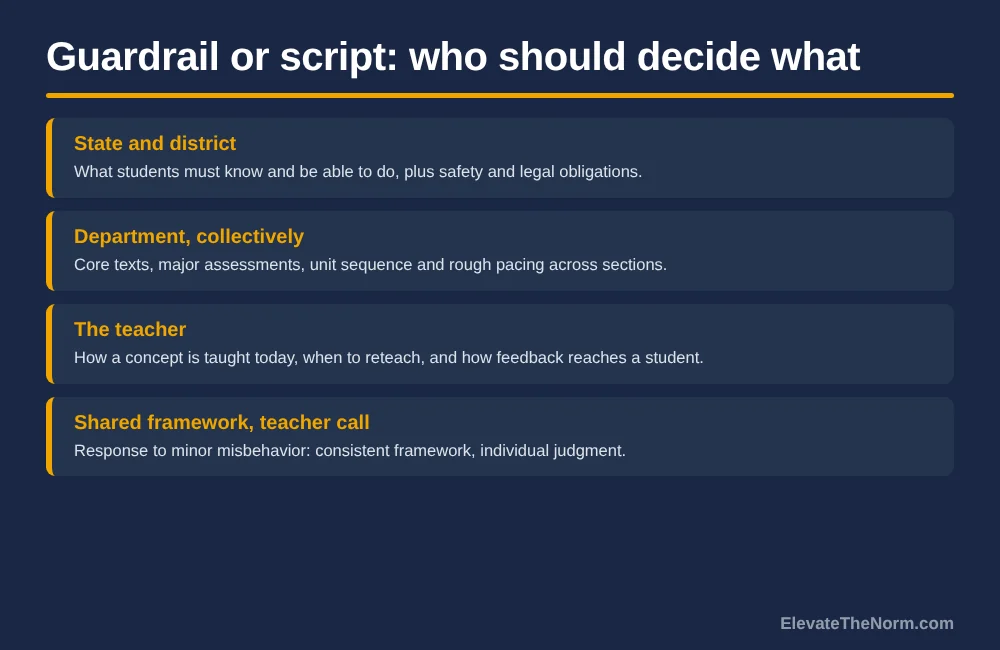
Here is how I would sort the common decisions. This is my professional judgment, offered as a starting point for a department conversation rather than as research.
| Decision | Where it belongs | Why |
|---|---|---|
| What students must know and be able to do | State and district | Public standards are a legitimate public claim; coherence across schools matters |
| Core texts and major assessments | Department, collectively | Equity across sections requires common anchors; teachers hold the expertise |
| Unit sequence and rough pacing | Department, with flexibility | Students transfer between sections; rigid daily pacing serves no one |
| How a concept is taught on a given day | The teacher | Only the person in the room knows what this group already understands |
| When to reteach and when to move on | The teacher | This is the central diagnostic judgment of the job |
| How feedback is delivered to a specific student | The teacher | Depends on a relationship nobody outside the room can see |
| Safety, reporting duties, legal obligations | Non-negotiable, district | Discretion here is not professional judgment, it is risk |
| Response to a minor misbehavior | The teacher, inside a known framework | Consistency matters, but so does knowing the kid |
If your school can agree on a table like that one and write it down, most of the autonomy argument resolves. The fights are rarely about whether standards should exist. They are about whether row four and row five belong to the teacher, and when a district quietly takes those rows, it is taking the profession with them. Related to row eight: whether a school lets teachers judge small misbehavior inside a shared framework shapes nearly everything about how consequences actually land.
Why does compliance culture produce worse teaching?
Because the thing that makes teaching work is responsiveness, and compliance systems reward predictability instead. Mary Kennedy’s review of 28 rigorous studies of professional development found that many of the design features we assume matter were not associated with effectiveness, while the way programs supported teachers in actually enacting a practice varied sharply in impact (Kennedy, 2016). Enactment is judgment work. It is the part a specification cannot carry.
There is also evidence that pressure on teachers changes how they treat students. Pelletier, Séguin-Lévesque and Legault studied 254 teachers of students in grades 1 through 12 and found that the more teachers perceived pressure from above — curriculum compliance, performance standards, colleagues — the less self-determined they were about teaching, and that lower self-determination predicted a more controlling style with students (Pelletier, Séguin-Lévesque & Legault, 2002). That is a structural equation model on self-report data from 2002, not a randomized trial, and it spans elementary through high school rather than isolating secondary teachers. I will not claim more than it shows.
What it shows is still worth knowing: controlling conditions correlate with controlling teaching. That is not a surprising result, but it is the mechanism behind a complaint teachers make constantly and rarely get believed about.


How does trusting teachers connect to trusting students?
This is the center of my argument, and I am labeling it as argument rather than evidence. I have seven years of classroom experience in the public schools of West Alabama, and the pattern I would defend is this: the posture a school takes toward its teachers is the posture those teachers tend to take toward their students.
Consider what the two stances actually model. A school that assumes teachers will cut corners unless monitored builds monitoring. The teacher who lives inside that assumption has been taught, daily, that trust is something you earn by compliance and that verification is what care looks like. It takes real deliberate effort not to pass that along — to turn around and hand a fifteen-year-old a genuine choice, accept that some of them will handle it badly, and treat the mishandling as information rather than as proof the choice was a mistake.
The reverse holds too. A teacher who is trusted to decide how to teach Tuesday has direct personal experience of being treated as capable before they had proven it in that instance. That experience is what makes it possible to extend the same thing to students — to build in real decisions students actually get to make rather than a menu with one correct answer, and to treat respect as something offered first rather than withheld pending good behavior.
I am not claiming research proves this chain. The Pelletier study is suggestive on one link of it and that is all. But if you are going to ask teachers to treat teenagers as developing young adults capable of judgment, it is worth noticing whether anyone treats the teachers that way.
What can a teacher do when autonomy is limited?
Work the discretion you do have, and document the judgment you are exercising. Most teachers have more latitude in the small moves than in the large ones, and the small moves are where students live.
- Own the parts nobody has specified. Even a tightly paced curriculum rarely dictates how you open class, how you respond to a wrong answer, or what you say to a student who is behind.
- Make your reasoning visible. “I slowed the unit by two days because the exit tickets showed half the class could not do the inference step” is a professional sentence. It converts a pacing deviation into a documented judgment.
- Use the collective route. Individual deviation gets read as noncompliance; a department proposal gets read as professional input. The data says curriculum decisions are mostly made above the individual teacher, so work at the level where they are made.
- Keep the evidence. Student work samples are the strongest argument any teacher has. They are also what Standard 9 asks you to be using anyway.
- Build the reflective habit. Systematic thinking about practice is literally the fourth core proposition. Keeping a real record of what you tried and what happened is both the professional obligation and your best protection.
What should school and district leaders do?
Specify outcomes and non-negotiables tightly; leave the moves to the people in the rooms. This costs nothing and is harder than it sounds, because it requires tolerating variation that looks like inconsistency from a hallway.
Three concrete moves. First, write down which decisions belong at which level and publish it, so teachers are not guessing where the line is this month. Second, evaluate reasoning rather than conformity — ask a teacher why they did what they did, and treat a good answer as a good answer even when it departs from the plan. Third, give judgment somewhere to live: common planning time, peer observation that is not evaluation, and fewer simultaneous initiatives so there is room to think about any of them. For how professional learning intersects with this, see what the evidence says about developing teachers, and for the narrower case of one-off sessions, the workshop format on its own terms.
What treating the teacher as a professional asks of us
It asks for discretion matched to accountability, and it asks for it in both directions. Treating the teacher as a professional is not a request for less oversight. It is a request for oversight of the right thing: the quality of the judgment, demonstrated in student work and in reasoning a teacher can defend, rather than conformity to a sequence somebody wrote in July.
If you teach, start by naming the discretion you already have and using it deliberately, and by making your reasoning explicit enough that it reads as judgment rather than drift. If you lead, publish the decision table for your building and then actually hold the line on the rows you assigned to teachers. And if you are weighing a new mandate, ask what it takes off teachers’ plates, not just what it adds — because every script you hand down arrives in a room where somebody is deciding whether to hand a teenager a real choice.
Sources
- Council of Chief State School Officers, InTASC Model Core Teaching Standards and Learning Progressions for Teachers 1.0, April 2013. Source for the ten core teaching standards and the quoted text of Standard 9 on using evidence to continually evaluate one’s own practice and adapt it to each learner. Caveat: these are model standards voluntarily adopted and adapted by states; they describe aspiration, not what any given district permits in practice. https://www.ksde.gov/Portals/0/TLA/Educator%20Eval/InTASC%20Standards%20-%202013.pdf
- National Board for Professional Teaching Standards, Five Core Propositions, originally released 1989 and updated 2016. Source for the five propositions, including that teachers are responsible for managing and monitoring student learning and think systematically about their practice. Caveat: this is the position of a certifying body with an interest in defining teaching as a profession, not an independent research finding. https://nbpts.org/five-core-propositions
- García, E., & Weiss, E., Challenging working environments (‘school climates’), especially in high-poverty schools, play a role in the teacher shortage, Economic Policy Institute, May 30, 2019. Source for the teacher-reported control figures — 25.5 percent for textbooks and instructional materials, 28.7 percent for content and topics, 42.3 percent for discipline, 61.2 percent for grading, 68.3 percent for homework — drawn from 2015–16 National Teacher and Principal Survey data. Caveat: these are teacher self-reports of “a great deal of control,” a high bar that does not distinguish collaborative department decisions from top-down mandates, and the link to attrition is an association, not a demonstrated cause. https://files.epi.org/pdf/162910.pdf
- Pelletier, L. G., Séguin-Lévesque, C., & Legault, L., “Pressure from above and pressure from below as determinants of teachers’ motivation and teaching behaviors,” Journal of Educational Psychology, 94(1), 186, 2002. Source for the finding that teachers perceiving more pressure from above were less self-determined about teaching and in turn more controlling with students. Caveat: a structural equation model on self-report data from 254 teachers spanning grades 1–12, from 2002; it demonstrates association, not causation, and does not isolate secondary teachers. https://bearworks.missouristate.edu/articles-chhs/224
- National Education Union, Are you on slide 8 yet? The impact of standardised curricula on teacher professionalism, March 25, 2025. Source for teachers’ accounts of de-skilling under rigidly scripted curricula and for the finding that over a third of primary teachers using such materials reported little or no influence over individual lesson content; based on 1,655 survey responses and 40 interviews. Caveat: a union-published study of primary and secondary schools in England and Wales; the cited figure is for primary teachers and the policy context is not the American one. https://neu.org.uk/latest/library/are-you-slide-8-yet
- Kennedy, M. M., “How Does Professional Development Improve Teaching?” Review of Educational Research, 86(4), 945–980, 2016. Source for the finding across 28 rigorous studies that many popular design features are not associated with effectiveness while the support for enactment varies sharply in impact — used here as evidence that judgment in application, rather than specification, carries the weight. Caveat: this is a review of professional development programs, not a direct study of teacher autonomy. https://journals.sagepub.com/doi/abs/10.3102/0034654315626800
Frequently Asked Questions
Does professional autonomy mean teachers can ignore the standards?
No, and that is not what anyone serious is arguing for. Public schools serve every child under state standards set through an elected process, and those standards are a legitimate public claim on what gets taught. Professional discretion applies to how a concept is taught, when to reteach, and how a specific student is given feedback — not to whether the standard gets covered. The useful question is never whether constraints exist. It is whether they stop at the outcome or extend to the moves.
How is a school supposed to stay consistent if every teacher decides differently?
By separating what must be common from what should not be. Core texts, major assessments, unit sequence and safety obligations can and usually should be shared, because students move between sections and equity depends on common anchors. Daily instructional decisions cannot be made consistent without making them worse, since the whole point is responsiveness to a particular group. A school that writes down which decisions sit at which level gets coherence where it matters and stops fighting about the rest.
Is this an argument against using a common curriculum?
It is the opposite. Strong shared materials are a professional asset: they save planning time nobody has, create coherence across sections, and give a new teacher something better than what they can build alone late at night. The objection is narrower — materials enforced to the slide, with no latitude to respond to what the room is doing. A curriculum that sets a floor supports judgment. One that sets a daily ceiling replaces it.
How can parents tell whether teachers at their child’s school have real professional latitude?
Ask the teacher a diagnostic question and listen to the answer. “What are you going to do differently for my child based on what you have seen?” A teacher with latitude gives a specific answer about their own next steps. A teacher without it describes a program or refers you upward. Neither answer makes anyone a bad teacher, and the second is often a constraint rather than a choice — but it tells you something true about how the school is run.
Does trusting teachers more create risk for students?
Some categories of decision should carry no discretion at all: mandatory reporting, safety procedures, legal obligations, and anything involving a student’s physical wellbeing. Those are not professional judgment calls and should not be treated as any. The discretion being argued for here is instructional — pacing, explanation, reteaching, feedback. Conflating the two is how autonomy debates go badly, and a school can hold the safety floor absolutely rigid while loosening the instructional ceiling considerably.
What about a first-year teacher who does not yet have the judgment?
Discretion should grow with demonstrated capacity, and that is true in every profession. A new teacher reasonably starts with more structure: shared materials, a clear framework for responding to behavior, and someone to check reasoning with. The mistake is leaving them there. If the structure never loosens, what you have built is not an on-ramp, it is a permanent condition, and the teacher learns that competence does not change anything about how they are treated.
Is there research proving that trusting teachers leads to trusting students?
No, and I will not pretend otherwise. One 2002 study of 254 teachers across grades 1 to 12 found that perceived pressure from above predicted lower self-determination and a more controlling style with students, which is suggestive of one link in the chain. That is a correlational model on self-report data, not causal evidence, and it does not isolate secondary teachers. The broader claim in this article is my professional argument, offered as an argument, not dressed up as a finding.
What can a student do if their teacher clearly has no room to move?
Ask about the reasoning rather than the rule. “Is the deadline something you set, or is it a department thing?” is a fair question, and most teachers will answer it honestly. Knowing which constraints belong to the teacher and which came from above tells you where a request has any chance of landing, and it is a more useful habit than assuming every rule is a personal choice. It also treats the teacher as what they are: a professional working inside limits.