By Clay Shumate
A student behavior contract is a short written agreement between a student and a teacher that names two or three specific behaviors, what the student commits to, what the teacher commits to in return, how progress gets checked, and when the agreement ends. It works best when the student helps write it and both people sign it.
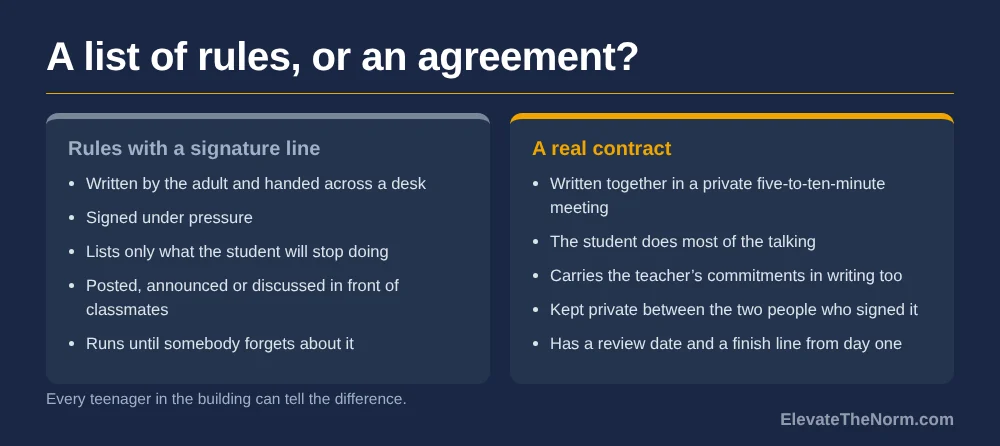
Most behavior contracts fail for a reason that has nothing to do with the student. They are written by the adult, handed across a desk, and signed under pressure. That is not a contract. That is a list of rules with a signature line at the bottom, and every teenager in the building can tell the difference. A real agreement has two sides, and the teacher’s side is the part most templates leave out.
Key Takeaways
- Two sides or it is not a contract. The teacher’s commitments — a cue, a check-in, a seat change, a private signal — belong on the page in writing, right next to the student’s.
- Three behaviors, maximum. Every behavior should be observable and stated as something the student will do, not something they will stop doing.
- The evidence is real but modest. A meta-analysis of single-case studies found a moderate overall effect, with the strongest results for reducing problem behavior.
- Keep it private. A contract that is posted, announced, or discussed in front of classmates stops being an agreement and becomes a public label.
- Plan the ending on day one. A contract should have a review date and a finish line, not run forever.
Free Download · PDF
Student Behavior Contract Template for Grades 6–12
A two-page printable: a contract with space for student and teacher commitments, plus a weekly check-in tracker with an end-of-week conversation guide. No email required.
Free. No email address required. Designed for grades 6–12. Browse every printable in Your Free Library.
What is a student behavior contract?
It is a planning document that both the student and the teacher agree to, describing specific behaviors, how they will be tracked, and what happens when the student meets them. The IRIS Center at Vanderbilt calls it “a simple positive-reinforcement intervention that is widely used by teachers to change student behavior,” and lists its core parts as the behaviors to increase or reduce, the conditions for earning recognition, and signature blocks for everyone involved (IRIS Center, “Behavior Contracts”).
Notice the word agree. A student behavior contract is not a punishment and it is not a warning letter. It sits in the space between “a quick private conversation” and “a formal referral” — the point where a pattern has shown up, you have already talked about it, and you both want something more structured than another reminder.
It is also not an IEP behavior plan or a formal Behavior Intervention Plan. Those are legal documents built by a team. A classroom contract can support one, but it never replaces one. If a student already has a plan, the plan wins and the contract has to match it.
Does a behavior contract actually work?
The research says yes, moderately, and more reliably for reducing problem behavior than for building new habits. That is an honest answer, and it is better than the workshop version.
The most useful summary is a meta-analysis of 18 single-case experiments covering 58 students between the ages of 5 and 21. It found an overall moderate effect (ES = .57, with individual studies ranging from .27 to 1.00) and concluded that behavior contracts were beneficial “regardless of grade level, gender, or disability status.” It also found contracts were more effective at reducing inappropriate behavior than at increasing appropriate behavior, and that they had positive effects on academic outcomes overall (Bowman-Perrott et al., 2015).
Two caveats matter for a secondary classroom. First, 58 students is a small number, and single-case research tells you a strategy can work for individuals rather than how often it works across a whole school. Second, that age range starts at five. The finding that grade level did not change the result is encouraging for grades 6–12, but it is not a high school study. Treat a contract as a well-supported tool for one student at a time, not as a schoolwide system.
When to use a student behavior contract (and when not to)
Use one when a specific behavior keeps repeating after you have already had a real conversation about it. Not on the first incident, and not as the opening move with a new student.
Good fits:
- A student who keeps starting work late and has told you they want to fix it.
- Repeated phone use after the classroom expectation has been taught and re-taught.
- A pattern of leaving the room, side conversations during direct instruction, or missing materials that you have both noticed.
- A student returning after a suspension or a restorative conference who wants a clear, written path forward.
Poor fits:
- A one-time incident. A single bad day deserves a conversation and a repair, not paperwork.
- A safety issue. Threats, violence, and anything involving harm go through your administration and school policy, not a classroom agreement.
- A behavior with an obvious outside cause. A student who sleeps in class because they work nights or care for siblings needs a counselor and a conversation, not a contract.
- A whole class. If eight students have the same problem, the problem is probably the procedure. Fix the routine; do not write eight contracts.
Before any contract, the groundwork is usually clear classroom expectations that have actually been taught. A contract cannot hold a student to a standard nobody ever explained.
What goes in a student behavior contract
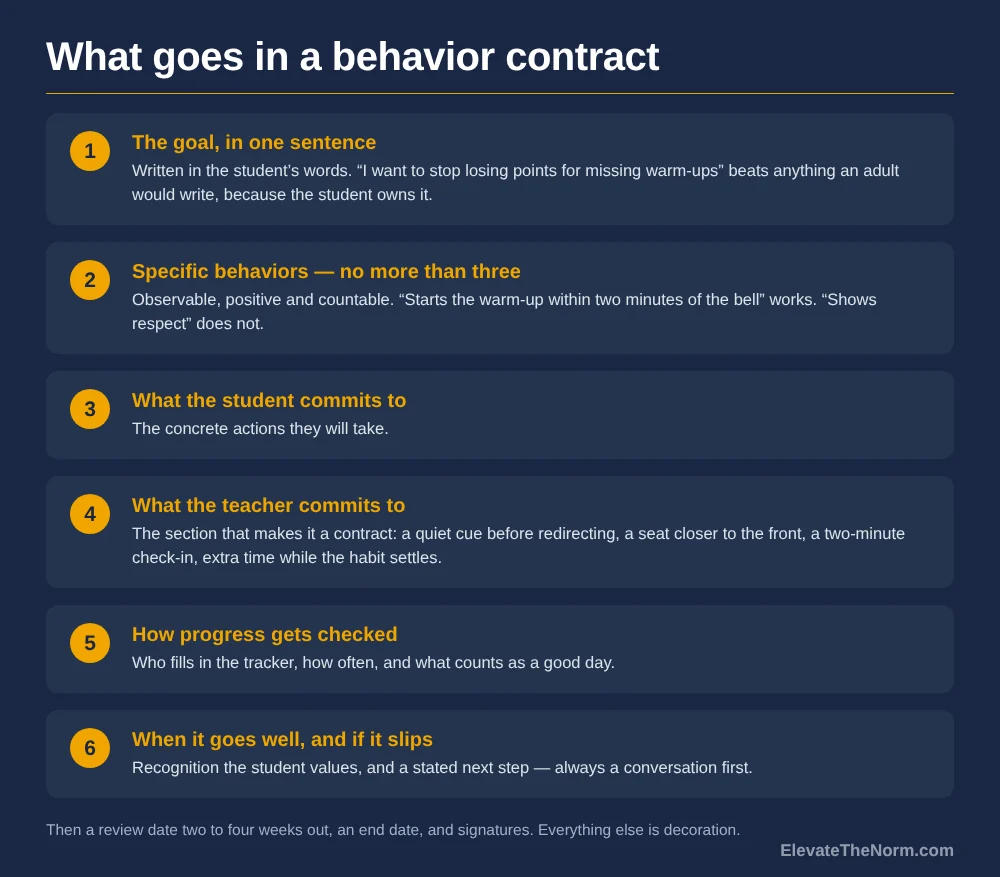
Six parts: a goal, specific behaviors, the student’s commitments, the teacher’s commitments, a check-in plan, and what happens next. Everything else is decoration.
- The goal, in one sentence. Written in the student’s words. “I want to stop losing points for missing warm-ups” is better than anything an adult would write, because the student owns it.
- Specific behaviors — no more than three. Observable, positive, and countable. “Starts the warm-up within two minutes of the bell” works. “Shows respect” does not, because nobody can agree on whether it happened.
- What the student commits to. The concrete actions they will take.
- What the teacher commits to. This is the section that makes it a contract. A quiet cue before redirecting. A seat closer to the front. A two-minute check-in at the end of class. Extra time on one assignment while the habit settles.
- How progress gets checked. Who fills in the tracker, how often, and what counts as a good day.
- When it goes well, and if it slips. Recognition the student actually values, and a stated next step if things slide — always a conversation first.
Add a review date two to four weeks out and an end date. Then signatures. A family signature is useful when the family wants to be involved, but it should be optional; a contract between a teacher and a young adult should be able to stand on the student’s word.
How to write a behavior contract with a student, step by step
Write it together, in a private five-to-ten-minute meeting, with the student doing as much of the talking as possible. The IRIS Center names minimal student input as one of the common problems that keep a contract from working, and that matches what any teacher would predict.
1. Start with what the student wants
Ask what they want to be different. Not what you want — what they want. Most students already know exactly what is going wrong and are tired of hearing about it. Letting them name it first changes the whole meeting.
2. Agree on the behaviors
Translate the goal into two or three observable actions. If the student proposes something vague, ask the follow-up question: “What would I see you doing on a day when that went right?”
3. Ask what would help
Then ask the question most contracts skip: “What could I do that would make this easier?” Students will tell you. Sometimes it is a seat away from a friend. Sometimes it is a signal instead of being called out. Write their answer into the teacher section, as long as it is something you can really do every day.
4. Decide how you will check in
A daily two-minute rating works for most secondary students. Have the student rate first, then you rate, then compare. Our guide to student self-assessment of behavior covers why comparing ratings works better than correcting them.
5. Set the review date and the finish line
Two to four weeks is long enough to see a pattern and short enough to stay motivating. Decide now what “done” looks like — for example, eight good days out of ten.
6. Sign it and keep it private
Both of you sign. The student keeps a copy. It does not go on the wall, it is not mentioned in front of the class, and the tracker lives in a folder, not on a desk where classmates can read it.
If a student is coming back from a conflict, a contract pairs naturally with the repair conversation in restorative practices in schools. If you want a scripted structure for that conversation, my Restorative Conversation Scripts lay out the follow-up talk word for word (see them here).


A sample student behavior contract
Here is what a filled-in middle school or high school contract can look like. The student and situation are illustrative, not a real student.
| Section | Example entry |
|---|---|
| Goal | “I want to stop getting zeros on warm-ups because I’m on my phone at the start of class.” |
| Behavior 1 | Phone is in my bag before the bell rings. |
| Behavior 2 | Warm-up started within two minutes of the bell. |
| Student commits to | Putting my phone away at the door and asking for help instead of waiting if I don’t understand the warm-up. |
| Teacher commits to | Posting the warm-up before students arrive, giving a quiet hand signal instead of a verbal reminder, and doing a 30-second check at the end of class. |
| Check-in | Daily 0–2 rating, student first. Friday five-minute conversation. |
| Goes well | Eight of ten days met: contract finishes, and a positive call or message home. |
| If it slips | Private conversation first, then we revise the contract together. |
| Review / end | Review in two weeks. Ends after three weeks or when the goal is met. |
That “positive call home” line is worth keeping. My first call to any family is always a genuine compliment, and a call that says “your kid set a goal and hit it” is one of the best calls you will ever make. If you want a system for those calls, the parent-teacher communication plan walks through it.
Tracking progress without turning it into surveillance
Track the two or three behaviors on the contract and nothing else, for two minutes a day. The second page of the free template is a weekly tracker built for exactly that.
The student rates each behavior 0, 1, or 2. You rate the same period. Then you compare. Where you disagree, ask why before you say anything else — sometimes the student saw something you missed. At the end of the week, use four questions: What went better than last week? Which day was hardest, and what was going on? Is there anything I should do differently? Do we keep the contract, adjust it, or finish it?
That third question is not a formality. If the student says your quiet signal is not working, change the signal. A teacher who keeps their side of the agreement and adjusts when asked is teaching the most important thing a contract can teach: that commitments go both ways. The research on structure and student autonomy points the same direction — students engage more when expectations come with reasons and a real voice, which is the whole argument behind student voice and choice.
What to do when a student breaks the contract
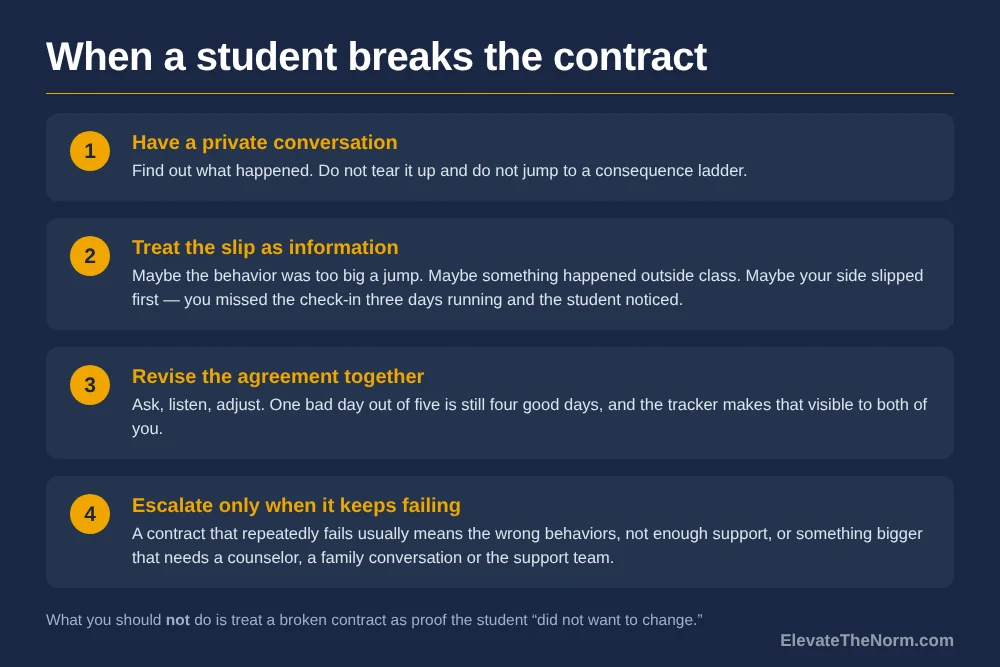
Have a private conversation, find out what happened, and revise the agreement together. Do not tear it up and do not jump straight to a consequence ladder.
A slip is information. Maybe the behavior was too big a jump. Maybe something happened outside class. Maybe your side of the contract slipped first — you forgot the check-in three days running, and the student noticed. Ask, listen, and adjust. One bad day out of five is still four good days, and the tracker makes that visible to both of you.
What you should not do is treat a broken contract as proof the student “did not want to change.” If the same contract keeps failing, that usually means the behaviors were the wrong ones, the support was not enough, or something bigger is going on that needs a counselor, a family conversation, or a referral to your school’s support team. If you need a paper trail at that point, my Behavior Documentation Forms are built for MTSS-style logs (details here).
Ending the contract on purpose
Most student behavior contracts should finish, not renew forever. The point is for the habit to become the student’s, not to keep the student on paper for a semester.
When the goal is met, say so plainly and mark it. Retire the tracker. Tell the student what you noticed. If it fits, make the positive call home. Then fade the support you added — the signal, the check-in — gradually, so the student is doing it without the scaffold. A student who finishes a contract should walk away with proof they can set a goal and meet it, which is a better outcome than three weeks of quieter mornings. For the bigger picture on building that kind of ownership, see positive discipline for teens.
The student behavior contract, in one paragraph
Write a student behavior contract with the student, not for them. Keep it to three observable behaviors, put your own commitments in writing next to theirs, check in for two minutes a day, keep it private, and decide on day one how it ends. The evidence supports contracts as a moderate, reliable tool for one student at a time. What makes them work in a secondary classroom is that they treat the student as someone capable of keeping their word — and they require the teacher to keep theirs. Download the free template and use it with the next student who tells you they want something to change.
Sources
- Bowman-Perrott, L., Burke, M. D., de Marin, S., Zhang, N., & Davis, H. “A Meta-Analysis of Single-Case Research on Behavior Contracts: Effects on Behavioral and Academic Outcomes Among Children and Youth.” Behavior Modification, vol. 39, no. 2, 2015, pp. 247–269. Supports the moderate overall effect (ES = .57), the finding that results held regardless of grade level, gender, or disability status, and the stronger effect for reducing inappropriate behavior. Caveat: 18 single-case experiments with 58 participants aged 5–21; single-case designs show a strategy can work for individuals, not how often it works across a school, and the sample is not limited to secondary students. https://doi.org/10.1177/0145445514551383
- IRIS Center, Vanderbilt University. “Behavior Contracts” (information brief). Supports the definition of a behavior contract as a positive-reinforcement planning document, its core components, and the common failure points, including minimal student input. Caveat: a practitioner brief rather than a research study; it does not report effect sizes. https://iris.peabody.vanderbilt.edu/information-brief/behavior-contracts/
Frequently Asked Questions
Is a student behavior contract legally binding?
No. A classroom behavior contract is a planning tool and a good-faith agreement, not a legal document. It does not change school policy, override a discipline code, or replace an IEP, a 504 plan, or a formal Behavior Intervention Plan. If a student already has one of those, the classroom contract has to match it, and the student’s case manager should see it before you use it.
Should parents sign a student behavior contract?
It helps when the family wants to be involved, but make it optional. The agreement is between you and the student, and a contract that only counts once an adult at home signs it tells a teenager their own word is not enough. Do let families know a contract exists and what it says. A short positive message when the student meets the goal is often the most useful part of the family connection.
How long should a behavior contract last?
Two to four weeks for the first review, with a clear end point written in from the start, such as eight good days out of ten. Long enough to show a pattern, short enough to stay motivating. A contract that runs all semester usually means the behaviors were too broad or the support was not working, and it is time to revise rather than renew.
What rewards work for middle and high school students?
Ask the student. Older students usually care less about prizes and more about things like a positive call or message home, a choice of seat, a pass on one homework assignment, or simply having the contract finished and off their record. Recognition they chose is worth more than a reward you picked. Keep it modest and keep it private.
Isn’t a behavior contract unfair to the rest of the class?
Fair means everyone gets what they need to meet the same standard, not identical treatment. The contract does not lower the expectation for one student. It adds structure and support so that student can meet the same expectation everyone else is held to. Because the contract is private, classmates generally never know it exists, which also protects the student’s dignity.
How much time does a behavior contract take?
About ten minutes to write it with the student, roughly two minutes a day to check in, and five minutes at the end of each week. That is far less time than repeated redirections, referrals, and parent phone calls about the same behavior. If you cannot commit to the daily check-in, do not write the contract yet, because a skipped check-in tells the student the agreement only goes one way.
What if a student refuses to sign the contract?
Do not force it. A signature given under pressure is meaningless. Ask what part they disagree with and whether they would change something about it. Often the objection is to wording that feels like a label, and rewriting it in their own words solves it. If they still decline, keep using your normal classroom procedures and offer again later. The offer itself tells them you think they can change.
Can I use a behavior contract for a whole class?
A whole-class version is really a set of classroom expectations or norms, and it works differently. Individual behavior contracts are built for one student and one specific pattern. If many students are struggling with the same thing, the fix is usually the routine or the procedure itself, not a stack of individual contracts.