The Elevate Blog banner: Real Classrooms. Practical Ideas. Higher Expectations. Three students climb a rocky ridge at sunrise, each pulling the next one up, toward a teacher reaching down to help.

Tag: teacher-student relationships

  • Affective Statements in Restorative Practices: What They Are and What the Evidence Shows

    Affective Statements in Restorative Practices: What They Are and What the Evidence Shows

    By Clay Shumate

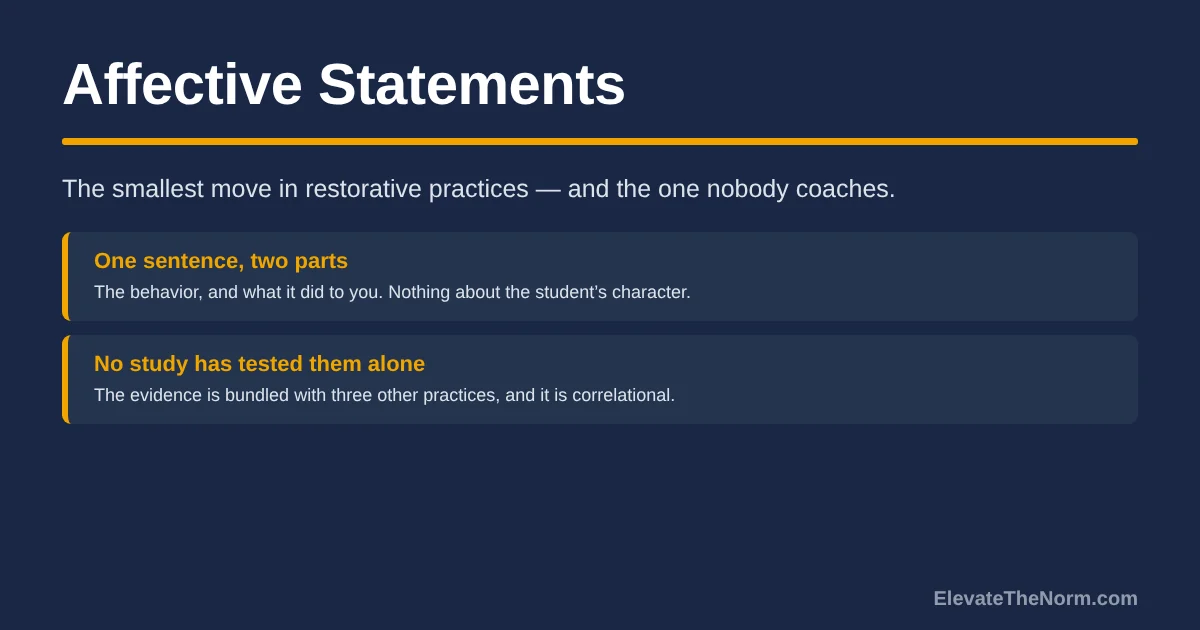
    Affective statements are the smallest move in restorative practices: one sentence naming how a specific behavior affected you, with no judgment of the student attached. They sit at the informal end of the restorative continuum, below questions, conversations, circles and conferences. No study has ever tested them on their own, so treat the evidence as bundled.

    Key Takeaways

    • An affective statement names a behavior and its impact, not a character trait. The example the practice’s own originators use is “I’m uncomfortable when I hear you tease Sandy” — a feeling, a specific action, nothing about the student as a person.
    • No study has measured affective statements by themselves. The study teachers cite for them combined four practices into a single score, and the affective-statement scale had a reliability of α = .59, which the authors themselves call only fair.
    • In 29 high school classrooms and 412 students, student-reported use of restorative practices predicted teacher respect (β = .12, p < .01) while teacher-reported use predicted nothing (β = .05, not significant) — and the two ratings were unrelated to each other. Teachers’ sense of how often they do this does not match what students notice.
    • In the same study, the racial referral gap was 1.69 versus 9.13 referrals for teachers using fewer restorative practices and 0.77 versus 2.92 for those using more. The gap narrowed. It did not close, and the design cannot show the practices caused the narrowing.
    • The one randomized district trial found suspensions fell 36 percent in restorative-practice schools against 18 percent in control schools — but in grades 6–8, suspension rates did not change and academic outcomes worsened. That result belongs in any honest middle-school conversation about this.

    Most restorative training starts at the circle. Twenty chairs, a talking piece, a ninety-minute block nobody has. Teachers leave the professional development impressed and implement none of it, because the smallest thing they were shown costs more than a class period.

    Affective statements are the opposite problem. They cost one sentence, they are the bottom rung of the whole framework, and almost nobody coaches them. Below: what they are, where they sit, what they sound like, what the research actually supports, and the middle-school finding that cuts against the sales pitch.

    What are affective statements in restorative practices?

    An affective statement is a short sentence in which an adult expresses their own emotional reaction to something a student did, naming the specific behavior and its impact rather than labeling the student. The International Institute for Restorative Practices describes the term as “another way of saying ‘expressing your feelings’ or ‘sharing impact’”.

    They work in both directions, which is the part people miss. The research definition covers reactions to “both positive and negative events”. A sentence naming what a student’s work did for the room is an affective statement too, and it is not the same thing as praise, for reasons worth being precise about further down.

    Where do affective statements sit on the restorative continuum?

    Affective statements are the first and most informal element of the restorative practices continuum, which runs in five steps from a single sentence to a formal conference. Every step above them costs more time, more people, or both.

    ElementWhat it isTime it costsWho is involved
    Affective statementsOne sentence naming a behavior and its impactSecondsTeacher and one student
    Affective questionsQuestions that surface impact, such as “What impact has this incident had on you and others?”A minute or twoTeacher and one or two students
    Small impromptu conversationsA short exchange in the hallway or after the bellSeveral minutesTeacher and those involved
    CirclesStructured group discussion with a protocolA class periodThe whole class
    Formal conferencesFacilitated meeting after serious harmAn hour or more, plus schedulingStudents, families, staff, a facilitator
    The continuum as the IIRP sets it out, informal to formal.

    The structure explains the implementation failure. A school that trains only circles and conferences has trained the two most expensive items on the list, and the PACE implementation guidance names that exact pattern as a sticking point: some schools end up “implementing conflict-resolution practices only”. The cheap rung gets skipped because it does not look like a program.
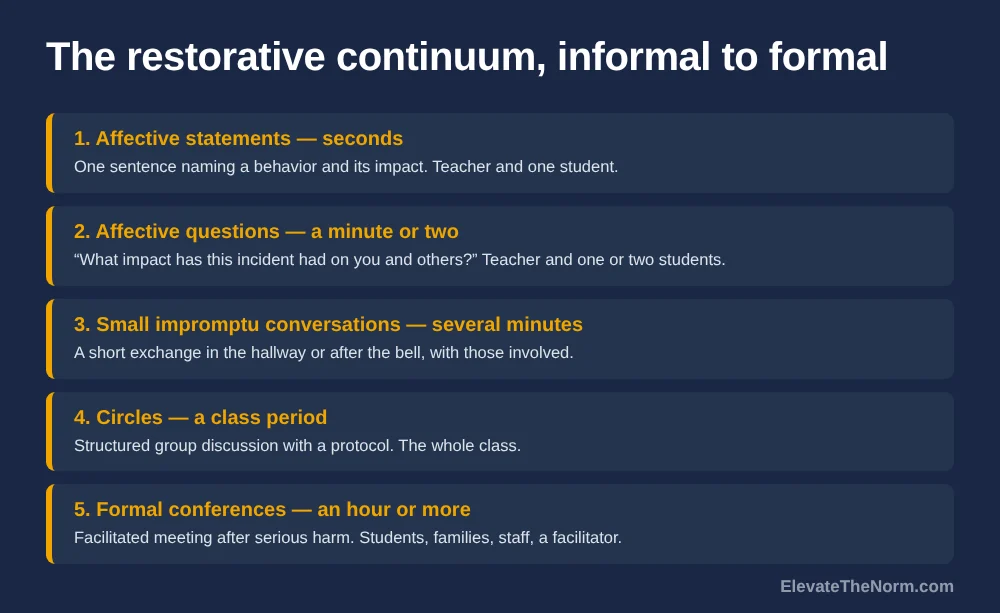
    Graphic of the five-element restorative practices continuum from informal to formal: affective statements costing seconds, affective questions, small impromptu conversations, circles costing a class period, and formal conferences costing an hour or more.
    Five rungs. Schools train the top two and skip the bottom one.

    What does an affective statement actually sound like?

    An affective statement has two parts: the specific behavior, and what it did to you or to the room. It has no third part about the student’s character, motives or future. The IIRP’s own worked example — “I’m uncomfortable when I hear you tease Sandy” — contains exactly those two parts and nothing else.

    Here is the same pattern applied to five situations that actually happen in grades 6–12. The left column is the version that comes out when a teacher is tired. The right column keeps the standard identical and moves the subject of the sentence.

    What usually gets saidThe same moment as an affective statement
    “You are being disrespectful.”“It bothers me when someone talks over an answer while a classmate is still giving it.”
    “Why can’t you ever be ready?”“I get frustrated starting the same lesson twice because half the room is still finding a pencil.”
    “You clearly do not care about this class.”“I am worried, because three weeks ago you were arguing with me about sources and this week you have not turned anything in.”
    “Great job, buddy.”“I appreciated that you asked the question nobody else wanted to ask. It changed what the rest of the period was about.”
    “That is not how we treat people here.”“I felt uncomfortable hearing that comment, and I do not think the person it was about laughed.”
    Same standard, different subject. The behavior is still named.

    Two rules keep these from going wrong. First, name the behavior, not the person. “I am frustrated that you are so lazy” is an insult with the word “I” stapled to the front. Second, stop talking. The sentence is the whole intervention. A teenager given three seconds of silence usually fills it, and what they fill it with is more useful than anything else you had planned to say.

    Affective questions are the natural next rung when the statement is not enough. The IIRP treats any question that elicits feelings and addresses impact as a usable affective question, and offers forms like “What impact has this incident had on you and others?” That is the move when two students are involved and you do not yet know what happened.
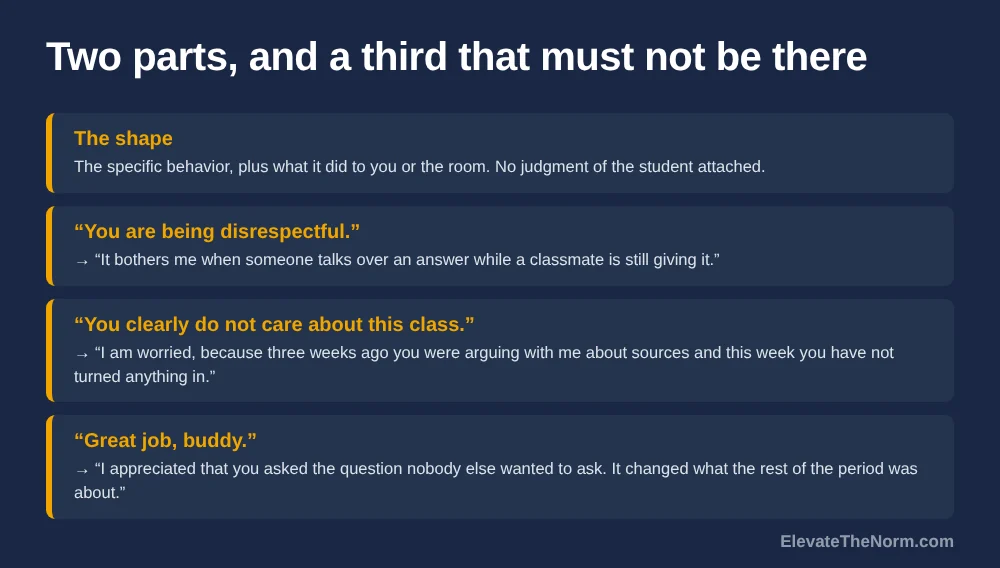
    Graphic showing the two-part structure of an affective statement, the specific behavior plus its impact with no character judgment, followed by three before-and-after rewrites of common teacher lines.
    Two parts, and a third part that must not be there.

    What does the research on affective statements actually show?

    There is no study of affective statements on their own. The study everyone cites bundled them with three other practices into one score, and it was correlational. Gregory, Clawson, Davis and Gerewitz surveyed 412 students in 29 high school classrooms across two large, diverse East Coast high schools in their first year of restorative implementation.

    Students and teachers both rated how often the teacher used four things: affective statements, restorative questions, proactive circles and fair process. Those four were combined into a single factor score per rater. So every number below describes the bundle, not the sentence.

    What it found. Student-reported use of the practices correlated with student-reported teacher respect at r = .58, p < .01, and held in a multilevel model at β = .12, p < .01, accounting for 17 percent of the between-teacher variance in respect. Teachers’ use of the practices also tracked the racial referral gap: for Latino and African American students, β = .44, p < .05. Across all 29 teachers, Asian and white students received an average of 1.28 referrals against 6.34 for Latino and African American students, t(29) = 3.63, p = .001. Split at the mean, teachers using fewer restorative practices issued 1.69 against 9.13; teachers using more issued 0.77 against 2.92.

    Now the three findings that should change how you read all of that.

    • Teacher self-report predicted nothing. Teacher-reported use of the practices came in at β = .05, not significant, and teacher ratings were not significantly related to student ratings at all. Only what students noticed mattered.
    • The affective-statement scale was the weakest one in the study. α = .59 for the student version, which the authors describe as fair; the teacher version reached .80. The scales were newly developed with no prior validation.
    • It cannot show causation and says so. The authors state the design “cannot support causal conclusions,” and flag shared method variance, because the same students rated both the practices and the respect. Students who like a teacher may simply report both more generously.

    The wider literature is no more settled. The broadest review of quantitative research on restorative justice in US K–12 schools concludes that “available evidence suggests that RJ programs can improve school climates and reduce student misbehavior and school discipline” while results for bullying, absenteeism and academic performance are “more mixed,” and that there is “still relatively little quantitative research regarding its effectiveness.” I read that review’s abstract and metadata; the full text sits behind a paywall, so I am citing it at that level and saying so.

    And the measurement guidance written for districts is blunt about the gap that matters most here. The PACE brief lists affective statements as a measurable teacher behavior — “Teachers using/modeling affective statements (‘I feel …’)” — and then declines to claim any practice-level result. It raises the question of which practices carry the effect and does not answer it, and notes the survey scales it recommends still “require future psychometric testing.”

    Does any of this improve achievement in middle school?

    In the one randomized district-wide trial, no — and in grades 6–8 the academic results went the wrong way. The RAND evaluation of restorative practices in Pittsburgh Public Schools randomized 44 of the district’s schools and ran for two years.

    Days lost to suspension fell 36 percent in the program schools against 18 percent in control schools, and the suspension gap between African American and white students narrowed. Teachers reported a safer environment and better conduct management. Then the part that gets left out of the slide deck: “Restorative practices did not improve academic outcomes, nor did they reduce suspensions for middle school students”, and in grades 6–8 academic outcomes “actually worsened in the treatment schools.” There was also no reduction in suspensions for violent offenses, for male students, or for students with IEPs.

    Read that carefully before you discount it or over-read it. The trial tested a two-year district rollout of a whole program, not a teacher using one sentence well. It does not show that affective statements lower test scores. What it does show is that the grade band this site writes for is the band where the program results are weakest, and that anyone promising a middle school both fewer suspensions and better scores is promising something this trial did not deliver.
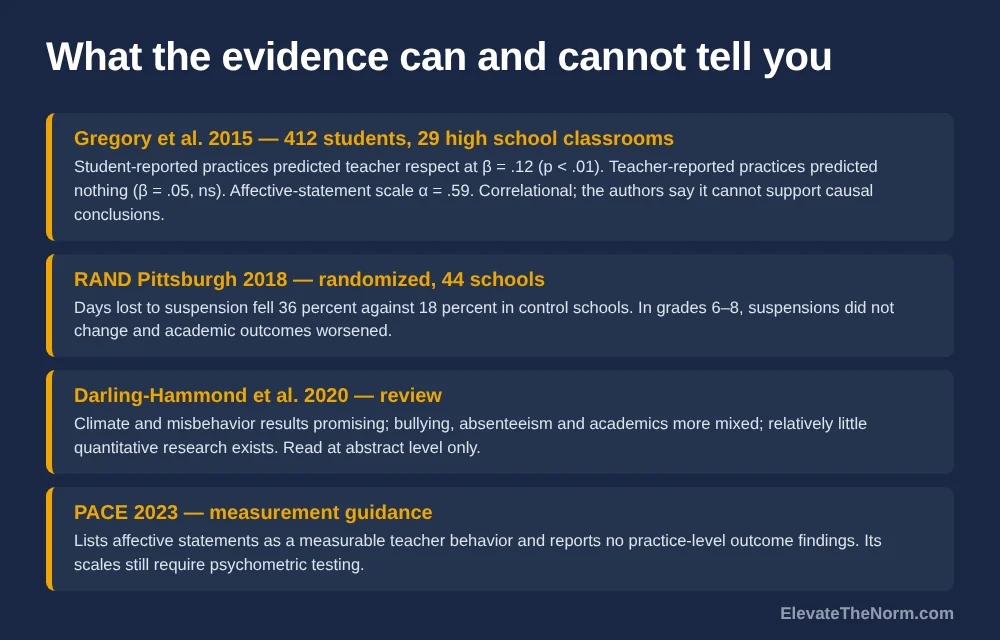
    Four rows naming the evidence on affective statements and restorative practices and what each sample can and cannot show: Gregory and colleagues' 412 students in 29 high school classrooms, the RAND Pittsburgh randomized trial of 44 schools, the Darling-Hammond review read at abstract level, and the PACE measurement brief.
    Every sample named, including the middle-school result that cuts the other way.

    What are affective statements not?

    An affective statement is not a consequence, not a substitute for one, and not praise. Confusing it with any of the three is how the practice gets a bad reputation in a building within one semester.

    It is not a consequence because nothing happens to the student as a result of it. If a situation calls for a consequence that actually follows from the behavior, the sentence goes before the consequence and does not replace it. A school that tells teachers to use affective statements instead of their discipline ladder has not adopted restorative practices; it has removed a ladder. That distinction is also what you tell a parent who has heard that the teacher “just talked about their feelings” instead of handling something: the sentence was the opening, the consequence still applied, and here is what it was.

    And it is never the response to conduct that triggers a reporting duty or a safety protocol. Threats, harassment, weapons, anything that reaches a mandatory-reporting standard, anything involving suspected harm to a student — those follow your district’s procedure immediately and completely. An affective statement is a tool for the ordinary friction of a school day. Using one where a protocol applies is not restorative practice; it is a failure to report, and no framework on the continuum changes that.

    It is not praise because praise evaluates the student and an affective statement reports an effect. “You are such a strong writer” is a verdict. “Your second paragraph made me change my mind about the question” is information the student can do something with. The distinction matters more in grades 6–12 than it does with younger students, who have not yet learned to discount an adult’s verdict.

    It is also not a conversation-ender for serious harm. The continuum has four rungs above it for a reason, and the research on where restorative practice does and does not hold up is clear that a half-implemented version is barely different from none at all.

    How do you use affective statements without sounding fake?

    Say true things in your own words and keep them short. Teenagers detect scripted emotion instantly, and a sentence that sounds workshopped reads as manipulation rather than honesty. If you are not actually frustrated, do not say you are frustrated.

    Four things keep it credible. Use a feeling word you would use off the clock. Use them for the good events too, or the practice becomes a tell that someone is in trouble. Say it quietly and near the student rather than across the room, which is the same logic behind close-range private redirection with teenagers. And do not run three in a row on the same student in one period, because at that point you are not sharing impact, you are campaigning.

    There is one more thing the Gregory study implies and nobody says out loud: your own count does not matter. Teacher self-report predicted nothing in that data. The only version of this practice that showed up in the results was the version students noticed. If you want to know whether you are doing it, the people to ask are sitting in the room.

    Two honest objections, because they come up every time this gets presented to a staff. The first is that some students will mock it, and in grades 6–12 a few of them will. The answer is volume and setting: said quietly, to one student, about one specific thing, there is nothing to perform against. Said to a whole room as an announcement, it invites exactly the reaction teachers fear. The second is that not every adult wants to disclose feelings at work, and that is a legitimate position rather than a deficiency. The practice tolerates a narrow emotional range — “that bothered me,” “I appreciated that” — and does not require anyone to open a vein in third period.

    The line that matters most is the one between sharing impact and applying pressure. Telling a student once that something bothered you is information. Returning to your own disappointment repeatedly, with the same student, until they manage your feelings to get out of the conversation, is leverage. Teenagers are extremely good at spotting the difference, and the second version costs you the first one permanently.

    What should a school decide before putting this on a walkthrough form?

    Decide whether you are measuring a frequency or a relationship, because the evidence only supports the second. Counting affective statements during a twenty-minute observation measures the one informant whose rating predicted nothing in the research.

    Four practical cautions for anyone leading this. First, a scale built on a reliability of .59 is not an evaluation instrument; the PACE brief recommends its survey items for implementation support and says they still need psychometric testing. Second, if you are rolling this out in a middle school, go in holding the RAND result rather than discovering it later from a board member. Third, train the cheap rung first. A building where every adult can say one honest sentence about impact has more restorative capacity than a building with a circle protocol nobody uses, and the teachers who most need it are the ones with the hardest rosters. Fourth, be careful what you require. A district can require that staff name behavior rather than character; requiring an employee to disclose a feeling on demand is a different thing, and it is the version that produces the scripted sentences students see straight through.

    For a coach, the usable implication of the Gregory finding is a change of instrument rather than a change of effort. Tallying affective statements during an observation measures the informant whose ratings predicted nothing. Asking four students in that class whether their teacher talks to them about how things affect people, and whether they feel respected, measures the one that did. It is a harder data collection and it is the only one with a result attached.

    The cost argument is worth stating plainly to a board, because it is unusual. This is the only rung on the continuum with no budget line: no curriculum, no substitute coverage, no facilitator, no scheduling. That is a genuine advantage and it is also why it gets skipped, since a practice with no invoice attached is hard to point at in a board report.

    Clay’s take

    I think this is the most undersold item in the whole restorative toolkit, and the reason is unflattering to all of us. It cannot be turned into a program. There is nothing to purchase, no protocol to laminate, no two-day training to send four people to. It is one sentence, said honestly, by an adult who is willing to be a person in front of a sixteen-year-old.

    What I will not tell you is that it fixes a hard class. The evidence does not support that and the middle-school finding above argues against it. What it does is change what a correction is about. “You are disrespectful” is a claim about who a student is, and a teenager has to defend themselves against it. “That bothered me” is a fact about me, and there is nothing to defend against.

    And the finding I keep coming back to is that teacher self-report predicted nothing. That is a useful piece of humility to carry into any practice we are told to adopt.

    What to do next

    Pick one sentence you say often that starts with the word “you” and is really about how a behavior affects the room. Rewrite it once, on paper, into the two-part shape above. That is the entire first step, and it takes less time than reading this paragraph.

    Then use it for a week on the good events as well as the bad ones, and do not count how many times you did it, because that number does not predict anything. From here, the full picture of what restorative practice does and does not deliver is the next thing worth reading, and the consequence side is what this practice sits beside rather than replaces. Everything on this site is free and nothing asks for your email address.

    An affective statement is the cheapest rung on the continuum; the circle is several rungs up and costs real time. Most teachers should get fluent at the first before convening the second. When the thing you need is the group rather than one student, the seven rounds of a circle and the 80/20 split are the practical version, including when a circle is the wrong tool.

    Frequently Asked Questions

    What is an affective statement in restorative practices?

    An affective statement is one short sentence in which an adult names a specific behavior and the effect it had on them, without judging the student’s character. The International Institute for Restorative Practices describes it as expressing your feelings or sharing impact, and offers the example “I’m uncomfortable when I hear you tease Sandy.” It is the most informal element of the restorative continuum.

    What are some examples of affective statements for middle and high school?

    Keep two parts and drop the third. Instead of “you are being disrespectful,” try “it bothers me when someone talks over an answer while a classmate is still giving it.” Instead of “you clearly do not care,” try “I am worried, because three weeks ago you were arguing with me about sources and this week nothing has come in.” Use them for good events too.

    Is there research proving affective statements work?

    Not on their own. The study most often cited combined affective statements with restorative questions, proactive circles and fair process into one score across 412 students and 29 high school classrooms, and the affective-statement scale had a reliability of only .59. The design was correlational and the authors state it cannot support causal conclusions.

    Do restorative practices improve academic achievement?

    The randomized evaluation of a two-year district rollout in Pittsburgh found they did not. Suspensions fell 36 percent in program schools against 18 percent in control schools, but academic outcomes did not improve overall and in grades 6 through 8 they worsened. The broadest review of the research calls academic results mixed and the quantitative evidence base small.

    What is the difference between an affective statement and an I-statement?

    They share a grammar but not a purpose. An I-statement is a general communication technique for owning your own perspective in any conflict. An affective statement is specifically about sharing the impact of a behavior as the lowest rung of the restorative continuum, which runs upward through affective questions, impromptu conversations, circles and formal conferences.

    Do affective statements replace classroom consequences?

    No. Nothing happens to a student as a result of an affective statement, so it is not a consequence and cannot stand in for one. The sentence goes before a consequence that follows from the behavior, not instead of it. A school that tells teachers to use these in place of a discipline ladder has removed the ladder rather than adopted restorative practice.

    How do you know if you are actually using affective statements well?

    Ask students, not yourself. In the Gregory study, teacher-reported use of restorative practices predicted nothing, student-reported use predicted teacher respect, and the two ratings were not significantly related to each other. Your own count of how often you do this has no demonstrated relationship to whether students experience it.

    Sources

    • Gregory, A., Clawson, K., Davis, A., & Gerewitz, J. (2015). The promise of restorative practices to transform teacher-student relationships and achieve equity in school discipline. Journal of Educational and Psychological Consultation, 25, 1–29. 412 students, 29 teachers with one randomly selected focal classroom each, two large diverse East Coast high schools in their first implementation year. Affective statements measured as one of four combined scales (α = .59 student, .80 teacher). Student-reported practices and teacher respect r = .58, β = .12 (p < .01), 17 percent of between-teacher variance; teacher-reported practices β = .05, not significant, and unrelated to student ratings. Referral gap 1.28 vs 6.34 overall; 1.69 vs 9.13 (low use) and 0.77 vs 2.92 (high use). Correlational; the authors state it cannot support causal conclusions, and flag shared method variance, unvalidated scales and a small teacher sample.
    • Augustine, C. H., Engberg, J., Grimm, G. E., Lee, E., Wang, E. L., Christianson, K., & Joseph, A. A. (2018). Restorative practices help reduce student suspensions (RB-10051-DOJ; full report RR-2840-DOJ). RAND Corporation. Randomized controlled trial, 44 of 54 Pittsburgh Public Schools, K–12, June 2015 to June 2017. Days lost to suspension fell 36 percent in treatment schools against 18 percent in control schools; disparities narrowed; gains concentrated in elementary grades. Middle-grade suspension rates did not change and grades 6–8 academic outcomes worsened in treatment schools. No reduction for violent offenses, male students or students with IEPs. The brief reports no effect sizes.
    • Darling-Hammond, S., Fronius, T. A., Sutherland, H., Guckenburg, S., Petrosino, A., & Hurley, N. (2020). Effectiveness of restorative justice in US K-12 schools: a review of quantitative research. Contemporary School Psychology, 24(3), 295–308. Finds evidence that restorative programs can improve school climate and reduce misbehavior and discipline, with results on bullying, absenteeism and academic performance “more mixed,” and notes there is “still relatively little quantitative research regarding its effectiveness.” Read at abstract and metadata level only; the full text is paywalled, so study counts, designs and grade bands are not reported here.
    • Restorative practices in the classroom (Chapter 1 excerpt). International Institute for Restorative Practices. Sets out the five-element continuum from informal to formal: affective statements, affective questions, small impromptu conversations, circles, formal conferences. Source of the definition (“expressing your feelings” / “sharing impact”), the worked example “I’m uncomfortable when I hear you tease Sandy,” and the affective-question form “What impact has this incident had on you and others?” The excerpt does not state a publication year.
    • Darling-Hammond, S., & Gregory, A. (2023). Measuring restorative practices to support implementation in K–12 schools. Policy Analysis for California Education. Lists “teachers using/modeling affective statements (‘I feel …’)” as a measurable practice and supplies teacher and student survey items. Names the pattern of schools “implementing conflict-resolution practices only.” Reports no practice-level outcome findings and states its adapted scales “require future psychometric testing.”
    • Center for Dispute Resolution, University of Maryland Francis King Carey School of Law (2022). Restorative approaches lesson 9: affective statements and questions. Supports the point that these tools are for everyday interactions and that not every conflict requires a circle. Cited as practitioner training material; the page’s sample statements live in a slide deck that is not included, so no examples are quoted from it.
    • The before-and-after rewrites in the table are my own worked examples built on the two-part shape the IIRP excerpt demonstrates. They are not quotations from any source and are not transcripts of real classroom exchanges.
    About Clay Shumate

    Clay Shumate is a certified secondary Social Studies teacher in the public schools of West Alabama, with seven years of classroom experience, a B.A. in History, and an M.Ed. in Secondary Education. He writes about project-based learning, student responsibility, respect, and practical ways to hold young people to a higher standard while giving them room to learn from mistakes. He is a member of the Society of Professional Journalists and writes to its Code of Ethics; this site’s editorial standards and corrections policy are published in full. More about Clay.

  • How to Talk to a Student Who Is Failing: What to Say, and When

    How to Talk to a Student Who Is Failing: What to Say, and When

    By Clay Shumate

    Talk to a student who is failing privately, early, and about one specific thing rather than the whole grade. Name what is missing, ask what is getting in the way, say plainly that you expect them to reach the standard, and leave with one task and one date. Then check back when you said you would.

    Key Takeaways

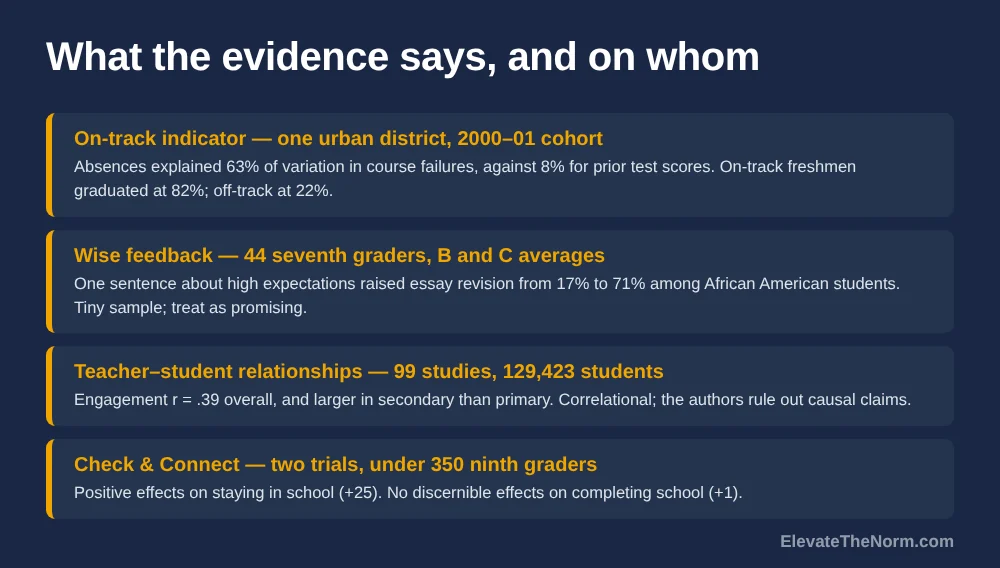
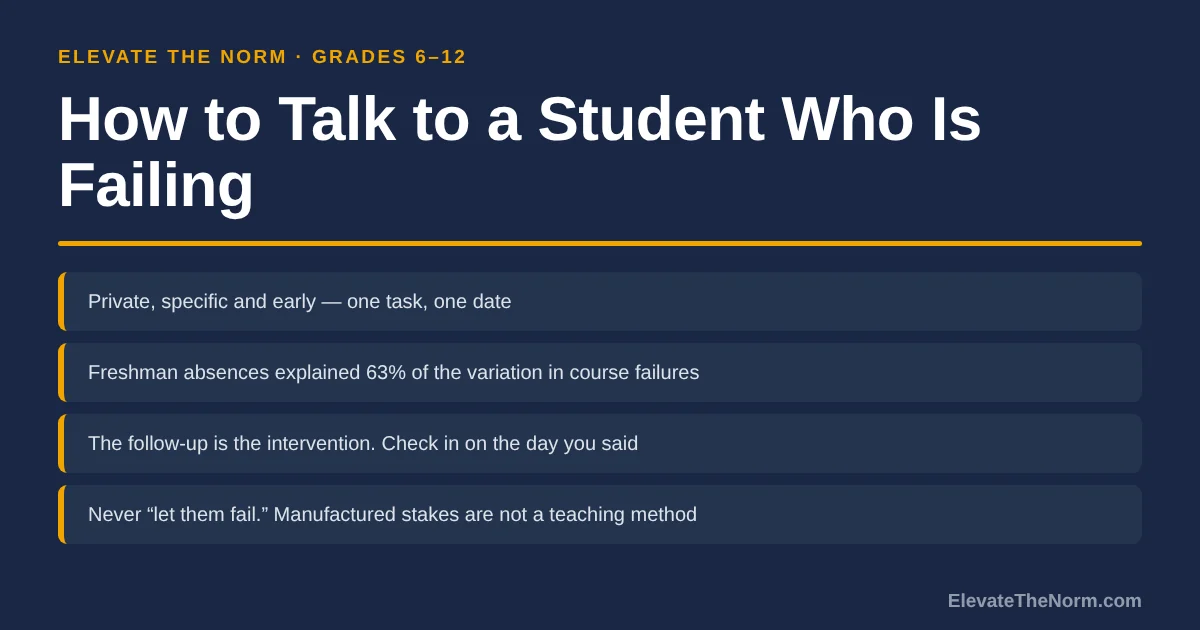
    • A failing grade is usually the last signal, not the first. In Chicago Public Schools, freshman absences alone explained 63 percent of the variation in course failures, against 8 percent for eighth-grade test scores.
    • Private, specific and early beats comprehensive. One behaviour, one question, one task, one date. A conversation that covers nine problems gives the student nothing to do tonight.
    • In a randomized study of 44 seventh graders, attaching one sentence to critical feedback — high expectations, and I know you can reach them — raised essay revision among African American students from 17 to 71 percent. A 44-student study is promising, not settled.
    • Ask what is getting in the way, not what is wrong at home. The American School Counselor Association states that even school counselors do not diagnose; a teacher notices and routes.
    • Structured follow-up has the clearest evidence and the clearest limit: in the two randomized trials the What Works Clearinghouse accepted on Check & Connect, the programme had positive effects on staying in school and no discernible effects on completing school.

    Most of these conversations go wrong in the first thirty seconds, and almost never because the teacher was unkind. It is because the teacher opened with the grade. A 41 on a progress report is an aggregate of a dozen decisions a student has already made and mostly cannot undo, so leading with it hands a teenager a number they cannot act on and a feeling they will act on instead.

    What follows is the structure that holds up: when to have the conversation, the six things it needs, the four very different situations a failing grade can mean, the sentences to leave out, and the honest research on all of it — including the part that found no effect on graduation.

    What should you say to a student who is failing?

    Say one specific thing that is missing, ask one open question about what is getting in the way, state that you expect them to reach the standard, and agree one task with a date on it. Six moves, in order, and the whole thing fits in four minutes.

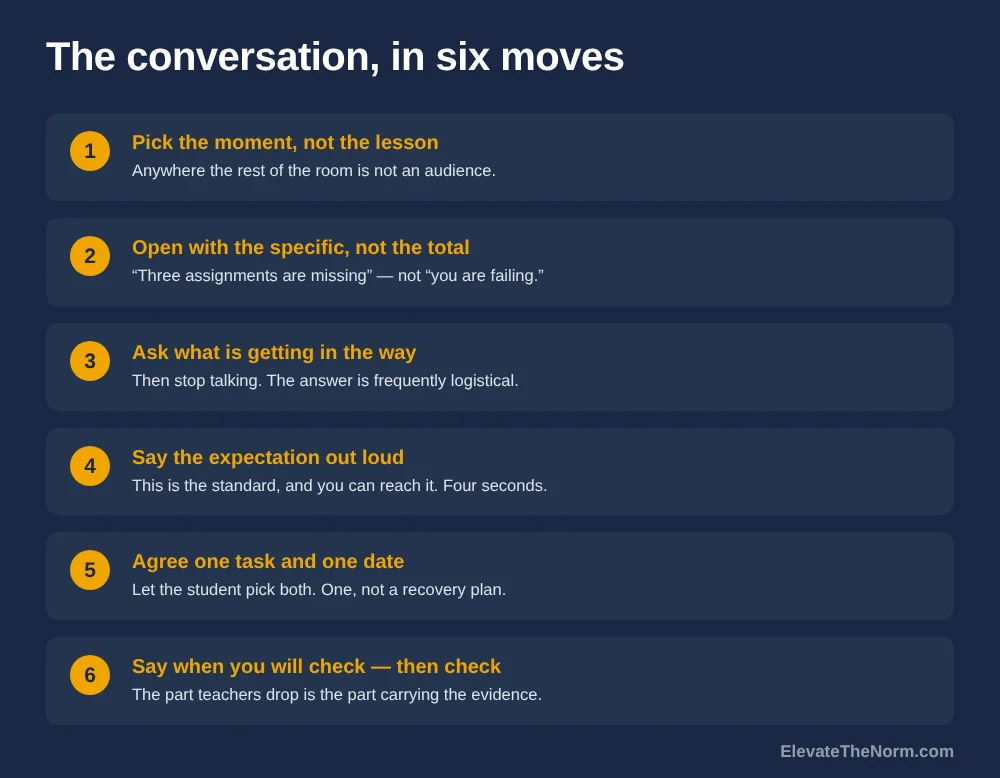
    1. Pick the moment, not the lesson. After class, at your table, during independent work — anywhere the rest of the room is not an audience. A conversation about a failing grade held within earshot of twenty-eight people is a performance, and the student will play their part in it.
    2. Open with the specific, not the total. “You have three missing assignments and two of them are the ones the unit test is built on.” Not “you are failing my class.” The first sentence is a problem with an edge on it. The second is a verdict.
    3. Ask what is getting in the way, then stop talking. This is the question most teachers skip because they already have a theory. Ask it anyway. The answer is frequently logistical — a shared laptop, a shift that ends at eleven, a folder lost in a locker change — and logistical problems have fixes.
    4. Say the expectation out loud. Not a pep talk. One sentence: this standard is the standard, and you can reach it. The research below suggests that sentence does real work, particularly with students who have reason to wonder whether the adult in front of them has already written them off.
    5. Agree one task and one date — and let the student pick them. Ask which one they want to start with and when it will be done. A teenager who names the date is holding their own deadline; one who is handed it is complying with yours. The student who owes eleven assignments needs the first one back, not a recovery plan.
    6. Say when you will check, and then check. A follow-up that does not happen teaches the student that the conversation was for your records. That is the part teachers drop, and it is the part that carries the evidence.
    Numbered graphic of six moves in a conversation with a failing student: pick the moment, open with the specific, ask what is getting in the way, say the expectation out loud, agree one task and one date, and say when you will check.
    Six moves, in order. The whole thing fits in four minutes.

    When is the right time to have this conversation?

    Before the grade is failing. The warning signs that predict a failed course are attendance and missing work, and both are visible weeks earlier than the average on a progress report.

    The clearest evidence on this is still Elaine Allensworth and John Easton’s on-track study of Chicago Public Schools freshmen, and the numbers are blunt. Fifty-three percent of CPS freshmen failed at least one semester course. Students who ended ninth grade on-track graduated in four years at about 82 percent; students who were off-track graduated at about 22 percent. And freshman absences alone explained 63 percent of the variation in course failures, against 8 percent for eighth-grade test scores.

    Their sentence on absence is the one worth pinning above a gradebook: “Just one week of absence per semester indicates problems with students’ grades.” Not two weeks. One. Students with the lowest eighth-grade test scores who missed one week averaged fewer Fs (1.3) than top-scoring students who missed two (2.1).

    That is one large urban district and a cohort that entered high school in 2000–01, so the percentages are not national facts. The ordering has held up well enough that most early-warning systems use the same signals, and the lesson for a teacher is simple: check the attendance column before building a theory about motivation. The reasons behind a pattern of absence are mostly outside your room, which is a separate problem with its own evidence base.

    Does telling a student you believe in them actually help?

    One sentence of it, attached to critical feedback, has measurable support. Open-ended encouragement that is not attached to anything does not. The distinction matters more than the sentiment.

    David Yeager and colleagues ran a set of field experiments on what they called wise feedback. Seventh graders handed back a marked-up essay received one of two notes. The control note read: “I’m giving you these comments so that you’ll have feedback on your paper.” The other read: “I’m giving you these comments because I have very high expectations and I know that you can reach them.”

    Seventy-one percent of African American students who got the second note revised their essay, against 17 percent who got the first. For White students the difference — 87 against 62 percent — was not statistically significant. Among African American students who had reported low trust in the school, none of the control group revised and 82 percent of the treated group did. A second study the following year found treated students incorporated 5.54 of the teacher’s edits against 2.19.

    The caveats are large. Each study had 44 students, and only students carrying B or C averages were eligible — which the authors say limits how far this travels to the students a teacher would call failing. The race-by-condition interaction was not significant, and the authors call the trust findings tentative. It is a reason to say the sentence, not proof that saying it fixes a grade.

    What it does explain is why the sentence is not flattery. The mechanism is attribution: a student handed hard criticism has to decide whether it means the teacher thinks they can do better or thinks they cannot. Most teachers mean the first and say neither.

    Four rows naming each study behind the article and who it was run on: the Chicago on-track indicator, a 44-student wise-feedback experiment, a 99-study relationships meta-analysis, and two Check and Connect trials.
    Every finding, with the population it came from.

    It is also worth knowing that the relationship itself matters more in high school than most people assume, not less. Debora Roorda and colleagues’ meta-analysis of 99 studies and 129,423 students found positive teacher–student relationships associated with engagement at r = .39 overall, and the secondary-school estimates were larger than the primary ones — r = .30 to .40 for engagement across 23 studies. The authors flag that as unexpected, and they state plainly that the design “does not permit conclusions about causality,” since most of the underlying studies are cross-sectional. The modest, useful read: a student rarely takes hard feedback from an adult they have decided is not on their side. That does not mean being liked. It means being predictable.

    Which conversation does this student actually need?

    Four different problems produce the same failing grade, and each needs a different opening line. Working out which one you have in front of you takes about ninety seconds in the gradebook and saves the entire conversation.

    The categories are for your diagnosis, not for the student’s ears — say the question out loud, never the label, and be ready to be wrong when they answer. One caution on the third row: “I’ve missed you” only works if it is true, and a teenager can tell.

    What the grade actually isHow you can tellHow to openWhat success looks like in two weeks
    Missing work, not failed workScores are mostly zeros; the attempts that exist are passing“You can do this — three of these were never turned in. Let’s pick one.”One assignment in, and the student knows the window for the rest
    Attempted and not learnedWork is submitted and scoring low; quiz and test scores agree“You’re doing the work. Something in the middle isn’t landing. Show me where it stops making sense.”Reteaching or a reassessment scheduled, not more of the same practice
    Not in the roomAbsences or tardies cluster; grade drop tracks them“I’ve missed you. What’s making it hard to get here?”An attendance plan with someone other than you in it
    Something outside the classA sudden change in a student who was fine; across several subjects“Something’s changed. I’m not going to pry. Who in the building do you trust?”The student has talked to a counsellor; you have adjusted one deadline

    Most teachers’ default script is written for the second row while most failing grades belong to the first. Missing work is a logistics problem in a motivation costume, and it responds to a clear window and a short list better than to a conversation about caring — which is the same argument behind a late work policy with a floor instead of a zero.

    For the second row, “show me where it stops making sense” is not a figure of speech. Have the student work one problem out loud, or read you their notes from the lesson in question. The breakdown is usually three steps earlier than either of you assumed, and you cannot scaffold a gap you have not located. Check the student’s accommodations or IEP before you design any of it — the case manager may already know the answer, and an agreement that cuts across a plan on file is worse than no agreement.

    What should you never say to a student who is failing?

    Anything that asks the student to account for their character rather than their work. The four sentences below are all well-intentioned and all of them end the useful part of the conversation.

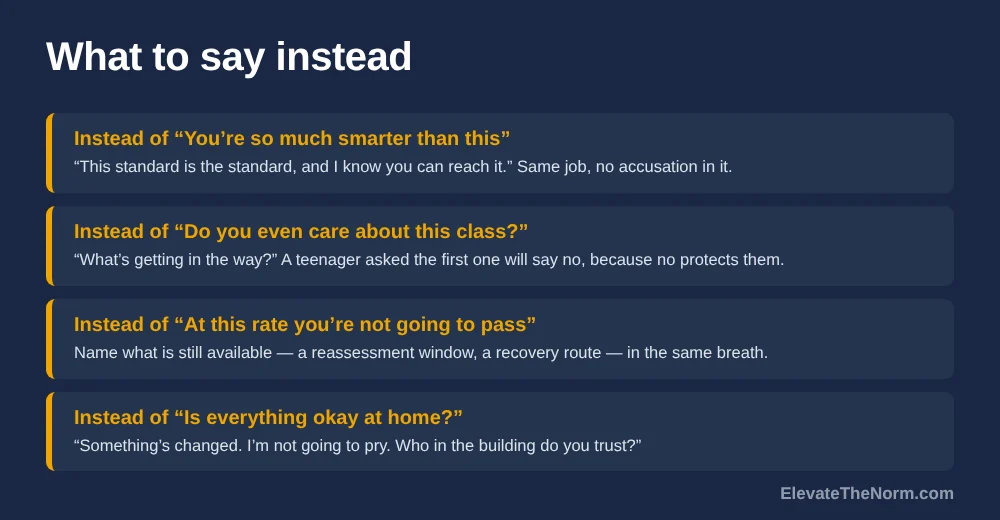
    • “You’re so much smarter than this.” It sounds like a compliment and lands as a charge: the student now has to explain why they are a disappointment. Replace it with the expectation sentence, which does the same job without the accusation.
    • “Do you even care about this class?” A teenager asked this in front of a grade they are ashamed of will say no, because no is the only answer that protects them. Then both of you are stuck with it. What not caring usually turns out to mean is a different problem entirely.
    • “At this rate you’re not going to pass.” Probably true and entirely useless. A student who already knows the number needs the next step, not the forecast. If the mathematics genuinely no longer works, say what is still available — credit recovery, a summer option, a reassessment window — in the same breath.
    • “Is everything okay at home?” Well meant, and not yours to ask cold. It invites a disclosure you are not trained or authorised to handle and it can read as an assumption about the student’s family. “What’s getting in the way?” gets you the same information and leaves the student in charge of how much they say.

    One more guardrail, and it is an administrator’s point: only offer what your school actually permits. A reassessment window, a late-work floor or a credit-recovery route is school policy before it is your policy, and a promise you cannot keep does more damage than the original grade. If you are not certain what is allowed, ask before the conversation rather than walking it back afterward.

    And one structural rule: do not make this conversation the consequence. A failing grade is already a consequence. Layering a lecture on top of it teaches the student that coming to you with a problem costs them something, which is the opposite of what the next six weeks require. The distinction between a consequence and a punishment is worth being precise about.

    What if the problem is clearly bigger than your class?

    Route it, immediately, and do not try to handle it yourself. Notice, name that you have noticed, hand the student to someone whose job this is, and follow the referral path your school already has.

    The boundary here is not a matter of taste. The American School Counselor Association’s position statement on student mental health states that “school counselors do not diagnose” and that providing long-term therapeutic counselling in school is inappropriate even for a counsellor who holds a therapy licence; their role is brief counselling, crisis intervention, and referral to school and community providers. If that is the limit on a licensed counsellor, a social studies teacher’s limit is considerably tighter.

    What ASCA does list as warning signs is squarely in a teacher’s field of view: changes in grades or attendance, shifts in mood, school avoidance. You are well placed to see those and badly placed to interpret them. So the move is three sentences long — something has changed, I am not going to pry, here is who I think you should talk to — followed by a walk to the counsellor’s office or an email to them the same day.

    That assumes a counsellor who is reachable, and in a lot of schools the counselling caseload makes that optimistic. If yours is carrying hundreds of students, find out now — not in the moment — who the route actually is: a school social worker, a nurse, an administrator, a named point of contact for a district programme. The referral path existing on paper is not the same as you knowing it.

    If a student says something that makes you worry about their immediate safety, that is not a conversation to finish alone or to leave until tomorrow. Follow your school’s reporting procedure that day and tell your administrator.

    Four rows pairing a sentence to avoid with a replacement, covering you are smarter than this, do you even care, at this rate you will not pass, and is everything okay at home.
    Four well-meant sentences, and what to say in their place.

    What happens after the conversation?

    The follow-up is the intervention. Structured, repeated contact with one named adult has the strongest evidence in this area — and a clear ceiling.

    Check & Connect is the tested version: a named monitor who tracks attendance, behaviour and grades, intervenes when a signal trips, and coordinates with the family. The What Works Clearinghouse intervention report accepted two randomized trials without reservations and rated it positive effects on staying in school (improvement index +25), potentially positive effects on progressing in school (+30), and no discernible effects on completing school (+1).

    That last row is the honest headline: the programme kept students enrolled and did not demonstrably get them to a diploma. Both trials ran in Minneapolis with fewer than 350 students in total, all ninth graders receiving special education services for learning, emotional or behavioural disabilities, and the WWC rates the extent of evidence small in every domain.

    The scaled-down version a teacher can actually run is one adult, one signal, and a check-in that happens on the day it was promised. Not a case plan — a thirty-second question on Thursday because Thursday is when you said. It is the same reason test corrections only work when the student has to produce thinking rather than the right answer: the structure does the work, not the sentiment.

    Contacting home belongs in this stage rather than the first one, and it belongs after you have told the student. To be clear about what that means for a family: telling the student first is a matter of hours, not weeks, and it is not a reason to delay contact. It is so the student hears it from you rather than at the dinner table. Send it in a language the family reads, say how they can reach you, and keep every other student out of it — including the one whose grade the parent asks to compare. If the next step is a conference instead of a message, these are the questions actually worth the fifteen minutes.

    Where does the evidence run out?

    Sooner than any of the above implies. There is no randomized trial of the teacher–student conversation itself, and every study cited here was run on a population that is not quite yours.

    • Nobody has tested the conversation. What has been tested is a written note on feedback, a monitoring programme, and a correlation. The four-minute talk is assembled from those, not validated as a unit.
    • The wise-feedback studies had 44 participants each, were limited to students with B and C averages, and the authors call the trust moderation tentative. Treat the sentence as low-cost and promising, not as an established lever.
    • The on-track figures are one district, one era — Chicago Public Schools in the early 2000s. The ordering of the signals has replicated widely; the numbers are not national facts.
    • Check & Connect’s trials were ninth graders with disabilities in one city, and the completing-school result was no discernible effect. Anyone selling monitoring as a graduation strategy is quoting the first row and skipping the third.

    Clay’s take: the grade is information about the plan too

    My position here is unfashionable and I will defend it: if a student in my room could fail badly enough for it to matter, that is mostly a planning problem.

    If a kid can screw up that badly in a classroom, what was the teacher doing the entire time? I am moving between tables most of the period. A grade that collapses without my noticing is a grade I stopped looking at.

    So I read a failing grade as two pieces of information. One is about the student, and it is usually attendance or a stack of untouched work rather than anything about character. The other is about me — where the scaffolding was thin, which day the class lost the thread, what I posted and then quietly let slide. The second half is what I can fix this week.

    Where I will not go is “let them fail so they learn.” Manufactured stakes are not a teaching method. Students can struggle, do a thing badly, need help and still be held to the standard afterward; what they should not be able to do is walk off a cliff an adult built and then watched them approach. The article on when to let students wrestle and when to step in walks through where that line sits.

    So I keep the conversation small and keep my word about it. A teenager who has been failing for a month has usually had plenty of adults be disappointed at them and very few be specific with them. Specific, and then back on Thursday like you said, is most of the job.

    What to do tomorrow

    1. Sort your gradebook by missing assignments rather than by average. The list you get is the list of conversations worth having, in order.
    2. Pick the top three students. With 120 or 150 on a roster you are not having thirty of these this week, and three conversations you finish beat ten you start. Sorting by missing work rather than by who worries you keeps the choice honest.
    3. For each one, work out which of the four rows above you are looking at before you say a word.
    4. Hold it somewhere private, in four minutes, with one task and one date out of it. Private rarely means an empty room — the doorway as the bell goes, your table during independent work, and the two minutes while everyone else packs up all count.
    5. Write the check-in date where you will see it, and set the due dates on a schedule you can actually mark — twelve recovery assignments landing the same Friday helps nobody. Then check in on the day, even if nothing has changed, because that is the part the student is actually measuring.

    If the student’s problem turns out to be refusal in the moment rather than a quiet backlog, that is a different ninety seconds and it comes first. Everything on this site is free and nothing asks for your email address.

    Frequently Asked Questions

    How do you start a conversation with a student who is failing?

    Start with one specific missing piece of work rather than the grade, and start somewhere private. “You have three missing assignments and two of them are what the test is built on” gives a student something to do. “You are failing my class” gives them a verdict to react to. Then ask what is getting in the way and let them answer.

    Should you tell a student they are failing?

    Yes, and earlier than most teachers do. A student who learns it from a report card has lost the weeks when it was fixable. Say it plainly, say it in private, and pair it with the one task that starts the recovery. Attendance and missing work show the problem coming long before the average does.

    Does telling a student you have high expectations actually work?

    There is real but small-scale evidence for it. In a randomized study of 44 seventh graders, a note saying the teacher had high expectations and believed the student could reach them raised essay revision among African American students from 17 to 71 percent. The sample was tiny and limited to B and C students, so treat the sentence as low-cost and promising rather than proven.

    What should you not say to a failing student?

    Avoid “you’re smarter than this,” “do you even care,” and “at this rate you won’t pass.” All three ask the student to defend their character instead of fixing their work. Also avoid opening with “is everything okay at home?” — “what’s getting in the way?” gets the same information and leaves the student deciding how much to share.

    Should I contact the parents before or after talking to the student?

    After. A student who finds out at dinner that you emailed home has learned that you go around them. Telling them first, at the end of class, costs twenty seconds and keeps them a party to their own situation. The exception is anything involving immediate safety, which goes to your administrator the same day.

    What if a failing grade seems to be about something outside school?

    Notice it, say you have noticed, and route it. Do not probe and do not offer a theory about what is happening. The American School Counselor Association states that school counselors do not diagnose, which puts a teacher’s limit well short of that. Three sentences and a walk to the counselor’s office is the whole move.

    How often should I follow up after the conversation?

    On the day you said, and briefly. Thirty seconds on the agreed date does more than a long meeting a fortnight later, because the student is measuring whether you meant it. Structured follow-up with one named adult has the best evidence in this area, though the strongest trials showed it kept students enrolled without demonstrably improving graduation.

    Sources

    • Allensworth, E. M., & Easton, J. Q. (2007). What Matters for Staying On-Track and Graduating in Chicago Public High Schools. Consortium on Chicago School Research, University of Chicago. Chicago Public Schools freshmen, 2000–01 entering cohort and surrounding years; a single large urban district. The 63 percent / 8 percent variance comparison, the 82 / 22 percent graduation figures and the one-week-of-absence sentence all come from this report.
    • Yeager, D. S., Purdie-Vaughns, V., Garcia, J., Apfel, N., Brzustoski, P., Master, A., Hessert, W. T., Williams, M. E., & Cohen, G. L. Breaking the cycle of mistrust: Wise interventions to provide critical feedback across the racial divide. Journal of Experimental Psychology: General. Studies 1 and 2 each used 44 seventh graders at one suburban northeastern middle school, restricted to students with B or C averages; Study 3 used about 76 mostly tenth graders at an urban New York City high school. The authors describe the trust moderation findings as tentative.
    • Roorda, D. L., Koomen, H. M. Y., Spilt, J. L., & Oort, F. J. (2011). The influence of affective teacher–student relationships on students’ school engagement and achievement: A meta-analytic approach. Review of Educational Research, 81(4), 493–529. 99 studies, 129,423 students, preschool to high school. The secondary estimates quoted here rest on 23 studies for engagement and 17 for achievement. The authors state the design does not permit causal conclusions.
    • What Works Clearinghouse (2015). Check & Connect intervention report. Institute of Education Sciences, U.S. Department of Education. Two randomized trials in Minneapolis high schools, fewer than 350 students in total, all ninth graders receiving special education services for learning, emotional or behavioural disabilities. Positive effects on staying in school; no discernible effects on completing school.
    • American School Counselor Association. The School Counselor and Student Mental Health (position statement; adopted 2009, revised 2015, 2020 and 2025). Source of the “school counselors do not diagnose” language and of the warning-sign list. This article is not legal, medical or clinical advice, and district policy sits on top of all of it.

    About Clay Shumate

    Clay Shumate is a certified secondary Social Studies teacher in the public schools of West Alabama, with seven years of classroom experience, a B.A. in History, and an M.Ed. in Secondary Education. He writes about project-based learning, student responsibility, respect, and practical ways to hold young people to a higher standard while giving them room to learn from mistakes. He is a member of the Society of Professional Journalists and writes to its Code of Ethics; this site’s editorial standards and corrections policy are published in full. More about Clay.

  • What to Do When a Student Refuses to Work: A Calm Plan for Grades 6–12

    What to Do When a Student Refuses to Work: A Calm Plan for Grades 6–12

    By Clay Shumate

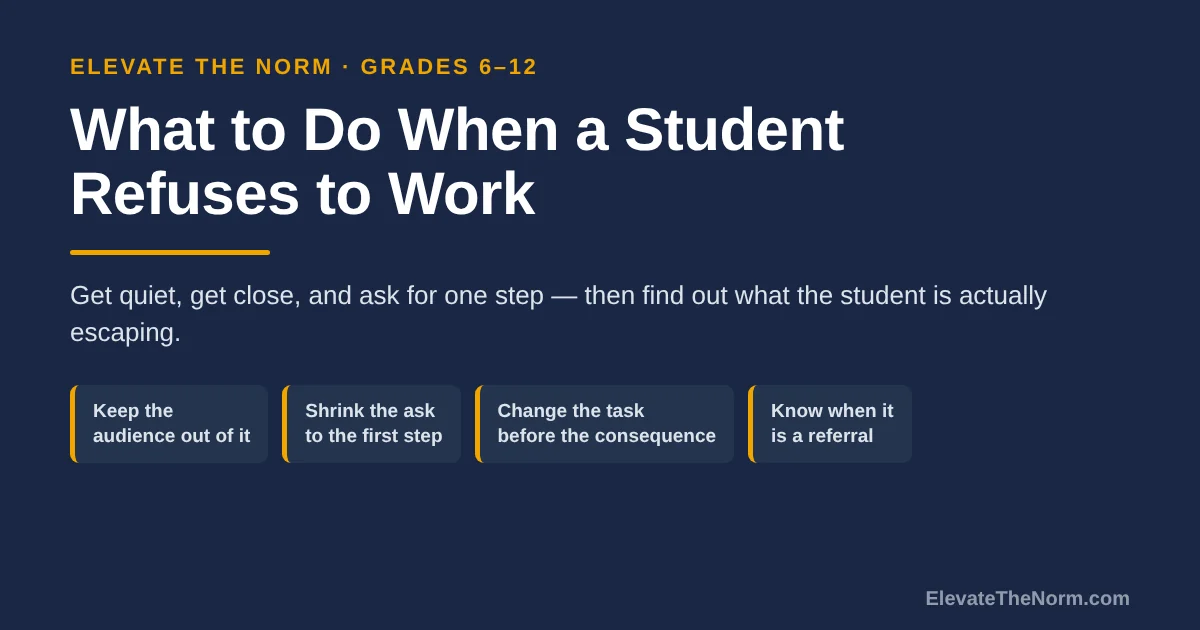
    What to do when a student refuses to work: lower your voice, move close, and ask for one step instead of the whole assignment. Find out whether the work is too hard, the directions are unclear, or something outside class is in the way. Then fix that, privately, and hold the standard.

    Key Takeaways

    • Work refusal is almost always an escape from something specific, so the first job is finding out what, not increasing the pressure.
    • Public confrontation turns a one-student problem into a whole-class problem; a quiet redirect at close range keeps the audience out.
    • Nearly 40 percent of U.S. high school students reported persistent sadness or hopelessness in 2023, and teachers spot severe distress far better than moderate distress, so refusal that looks like a mood change belongs with a counselor rather than a consequence ladder.
    • Most behavior research on task avoidance used elementary students or students with disabilities in single-case designs, so a grades 6–12 teacher is applying it by analogy, not by direct evidence.

    Every teacher I know has had the same ninety seconds. You hand out the work. Twenty-nine students start. One doesn’t. The head goes down, the laptop closes, or you get a flat “I’m not doing it” loud enough that the room hears it. Now you have two problems: the assignment, and the twenty-nine kids watching to see what you do.

    This is about those ninety seconds and the week after. It’s narrower than the broader pieces on students who seem not to care at all and consequences that teach instead of humiliate. Those are about the pattern. This is about the moment.

    What does it mean when a student refuses to work?

    Work refusal is a student declining to start or continue an academic task. In behavior terms it is usually escape behavior: the refusal works because it removes the demand. Geiger, Carr, and LeBlanc put it plainly — “escape from instructional activities is a common maintaining variable for problem behavior.”

    That reframes the situation. If the refusal is working, repeating the instruction more firmly doesn’t change the math. It raises the cost of complying without lowering the cost of the thing being avoided. You can win that exchange with volume and still lose the week.

    Which is why the first federal recommendation here is not a script. The Institute of Education Sciences practice guide on behavior problems leads with “identify the specifics of the problem behavior and the conditions that prompt and reinforce it,” at a moderate level of evidence. Diagnose, then act.

    What should you do in the first ninety seconds?

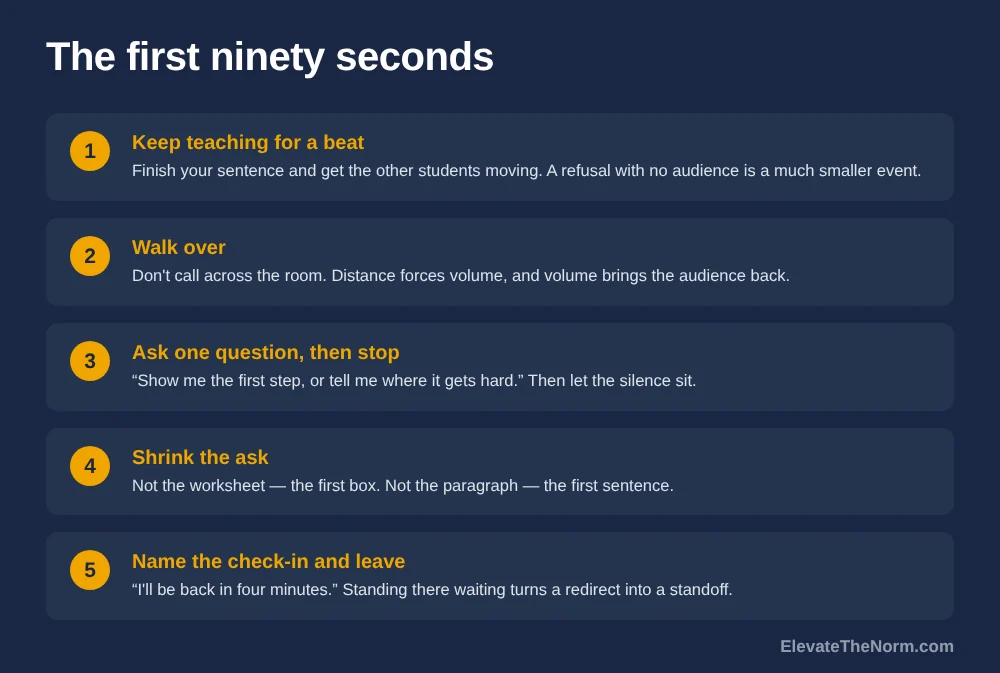
    Get quiet, get close, and ask for one step. Don’t negotiate the whole assignment in front of the room, don’t issue an ultimatum you’d have to enforce publicly, and don’t fill the silence. Five moves:

    1. Keep teaching for a beat. Finish your sentence and get the other students moving. A refusal with no audience is a much smaller event.
    2. Walk over. Don’t call across the room. Distance forces volume, and volume brings the audience back. Stand or crouch beside the desk, at the student’s level.
    3. Ask one question, then stop talking. “Show me the first step, or tell me where it gets hard.” It accepts that the student may not be refusing out of defiance, and gives them a way to say so without admitting anything in public.
    4. Shrink the ask to something they’ll do right now. Not the worksheet — the first box. Not the paragraph — the first sentence. You want any movement at all, because the second step is far easier to get than the first.
    5. Name the next check-in and leave. “I’ll be back in four minutes.” Then come back in four minutes. Standing there waiting turns a redirect into a standoff, and a standoff has a loser.
    Five numbered steps for the first ninety seconds of a work refusal: keep teaching for a beat, walk over, ask one question then stop, shrink the ask, name the check-in and leave.
    The five moves that keep a work refusal from becoming a standoff.

    On the pause in step three: I give it roughly fifteen seconds before I respond, and I want to be precise about that number because it gets quoted as a rule and it isn’t one. Fifteen is an average. Some days it’s five. Some students need thirty, and some need me to say nothing and come back next period. A fixed count applied to a kid having a bad morning is just a slower version of the wrong response. What the pause buys is a choice, because responding instantly means responding to the volume rather than the cause.

    Why do students refuse to work?

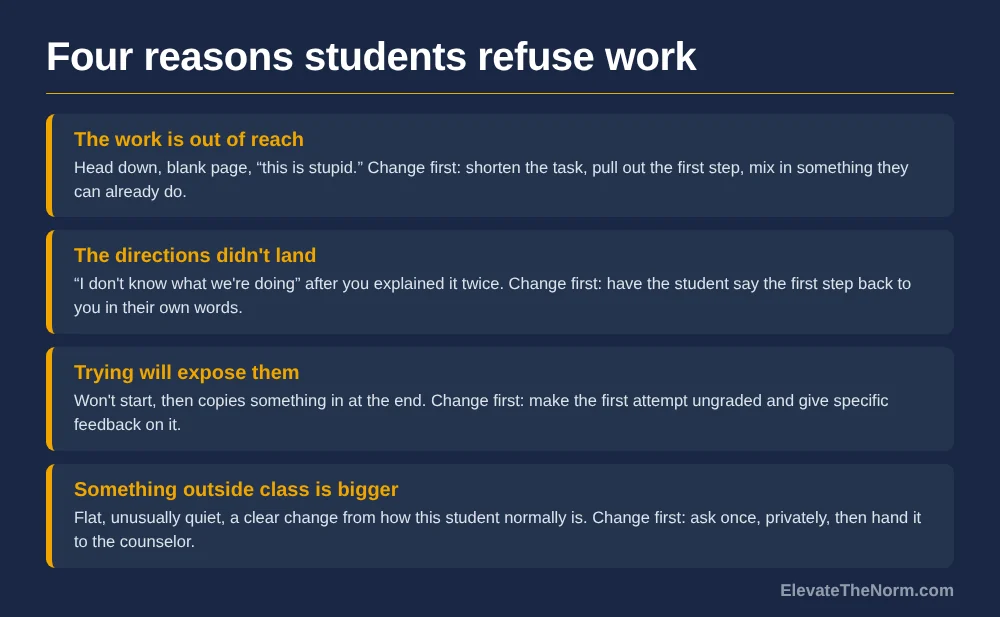
    Four causes cover most refusals in a secondary classroom: the work is out of reach, the directions didn’t land, the student has decided trying will expose them, or something outside the room is bigger than the assignment. Each needs a different response, and treating all four as defiance is how teachers burn a relationship over a worksheet.

    One caution before the table. These are categories to ask about, not verdicts to hand down. A teenager can tell when an adult has already decided what is wrong with them, and concluding from across the room that a student is avoiding embarrassment is exactly the move that ends the conversation. Ask, then let the student’s answer outrank your guess. If they say the directions were fine and the work is boring, that is information too.

    What’s driving itWhat it looks like in classWhat to change firstWhat makes it worse
    The work is out of reachHead down, blank page, “this is stupid”Shorten the task, pull out the first step, mix in something they can already doRepeating the same direction louder
    The directions didn’t land“I don’t know what we’re doing” after you explained it twiceHave the student say the first step back to you in their own wordsTelling them to just read the instructions
    Trying will expose themWon’t start, then copies something in at the endMake the first attempt ungraded and give specific feedback on itGrading the first attempt
    Something outside class is biggerFlat, unusually quiet, a clear change from how this student normally isAsk once, privately, then hand it to the counselorTreating it as defiance

    The first row has the strongest research behind it. Kern and Clemens, reviewing antecedent strategies for classroom behavior, write that “assigning work that exceeds students’ skill level is a common cause for off-task and problem behaviors,” and say the original finding “has been replicated numerous times across various populations and ages.” Be honest about that original study: 15 boys aged 8 to 12 identified with behavior disorders, and the replication claim is the reviewers’ summary of a literature, not a secondary-classroom trial.

    Four reasons students refuse work with what to change first for each: the work is out of reach, the directions did not land, trying will expose them, and something outside class is bigger.
    Each cause of work refusal needs a different first move.

    The same review points to the one finding here actually run on high schoolers. Cates and Skinner gave remedial math students in grades 9 through 12 worksheets with brief, easy problems interspersed among the harder ones. Task performance went up, disruptive behavior went down, and — this is the part worth stealing — students rated those worksheets as less difficult even though they had more problems on them. Perceived difficulty is not difficulty, and you can move it.

    Kern and Clemens also put a fence around their own conclusions, and I’d rather quote it than paper over it: antecedent strategies work, but “alone they are seldom sufficient.” Redesigning the task is step one. It pairs with teaching the missing skill and with consequences that actually follow from the behavior.

    How do you tell ordinary refusal from a student in distress?

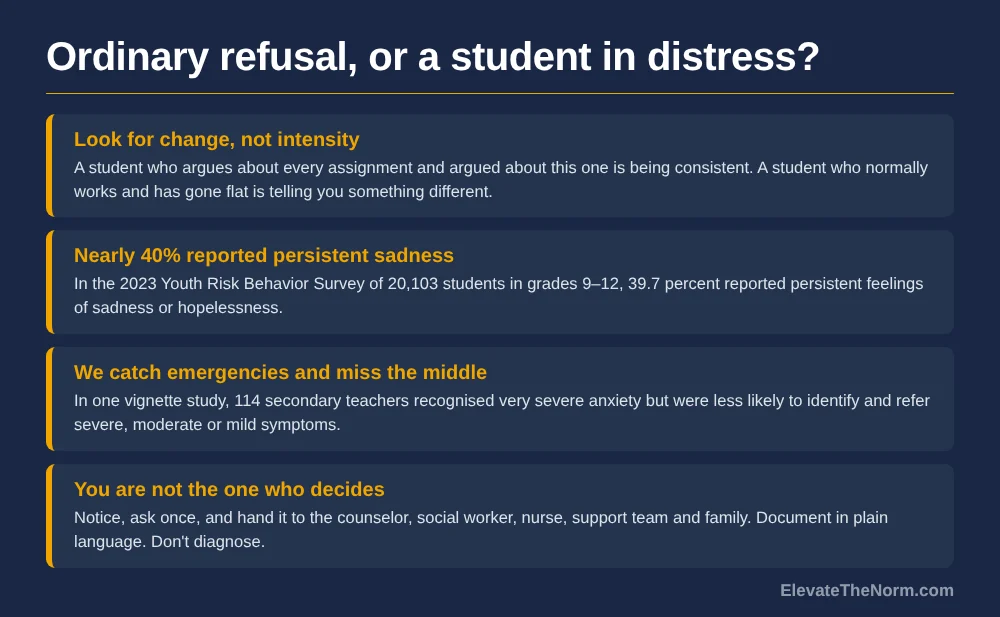
    Look for change rather than intensity. A student who argues about every assignment and argued about this one is being consistent. A student who normally works and has gone flat, quiet or tearful is telling you something different, and that is not a classroom-management problem.

    Four points on telling ordinary work refusal from distress: look for change not intensity; nearly 40 percent of high school students reported persistent sadness in the 2023 Youth Risk Behavior Survey; teachers catch emergencies and miss the middle; you are not the one who decides.
    Refusal that is a change from how a student normally is belongs with a counselor.

    The scale is not small. In the 2023 Youth Risk Behavior Survey — a nationally representative sample of 20,103 U.S. students in grades 9 through 12 — 39.7 percent reported persistent feelings of sadness or hopelessness: 52.6 percent of female students, 27.7 percent of male students, and 65.7 percent of LGBQ+ students against 31.4 percent of heterosexual students. In a class of thirty, roughly a dozen kids. Not all of them refuse work. Some of the ones who do are in that group.

    And here is the part teachers should hear even though it isn’t flattering. Missenden and Campbell gave 114 secondary teachers vignettes describing students with different levels of anxiety. The teachers recognized the need to refer very severe symptoms. They were “less likely to correctly identify and refer students with severe, moderate or mild anxiety symptoms.” That was an Australian vignette study, not real students, so don’t overread it. We catch the emergencies. We miss the middle.

    Which leads to the only honest rule I can give: you are not the person who decides what is wrong with a student. Your job is to notice, ask once, and hand it to the people whose actual job it is — the counselor, the social worker, the nurse, the student support or MTSS team, and the family. The IES guide names this too, recommending that teachers “draw on relationships with professional colleagues and students’ families for continued guidance and support,” at a moderate level of evidence. Document what you saw in plain language. Don’t diagnose, don’t speculate in writing, and don’t sit on it for a week because you want to be sure first. Being sure is somebody else’s job.

    If a refusal comes with a disclosure about harm to themselves or anyone else, that stops being a judgment call. Follow your district’s mandatory reporting procedure that day.

    One honest caveat, and it is the part this advice usually skips: “refer it” assumes there is somewhere to refer it to. Plenty of schools have one counselor for several hundred students, and a referral can sit for weeks. That doesn’t change what you should do — it changes what you should expect. Put the referral in writing so there is a dated record, tell an administrator when nothing comes back, and keep the academic plan running in the meantime. A teacher waiting on a counselor is still the adult in the room.

    What do you do when the same student refuses every day?

    Stop improvising and collect information for one week. A repeated refusal is a pattern with a trigger in it, and you will find the trigger faster by writing down four things than by trying five new strategies. Change the conditions before you change the consequences.

    One student, four columns, thirty seconds at the end of the period — if it needs more than a sticky note it won’t survive to Wednesday. For five school days, note: what the task was, what time it happened, what you had just said, and what the student got out of it. That last column explains the pattern. If the refusal reliably ends in the hallway, the hallway is the payoff. If it ends with you sitting beside them for ten minutes, your attention is the payoff — not a character flaw, just a kid who found the one reliable way to get an adult’s full attention in a room of thirty.

    Then run the changes in this order, cheapest first:

    • Change the task. Shorter, chunked, with something they can already do at the front. Kern and Clemens report that shortening tasks or adding breaks helped where the work was matched but too long.
    • Add a real choice inside the same learning target. Which two of these four questions, written or recorded, this partner or alone. The review describes class-wide choice working with adolescents, closer to our population than most of this literature gets.
    • Raise the rate of specific, quiet praise for the work they do start. O’Handley and colleagues tested praise rates in four secondary classrooms: behavior-specific praise about once every two minutes produced large, immediate improvements in classwide engagement and reductions in disruption, while once every four minutes gave mixed results. Four classrooms is four classrooms. And nobody sustains a two-minute rate for six periods; use it in the ten minutes where the work actually starts.
    • Build in a planned break the student can ask for. If escape is what the refusal is buying, selling it at a lower price in a form you both agreed to beats pretending the demand will go away. Name the place and the length in advance — a seat at the back for three minutes, or a supervised spot an adult has agreed to — because an unsupervised student in a hallway is a different problem you just created.
    • Call home before it becomes a discipline matter. Not to report the student — to say what you’re seeing and ask what they’re seeing. A family that hears about a pattern early is a partner; a family that first hears about it in a referral is an opponent you made.
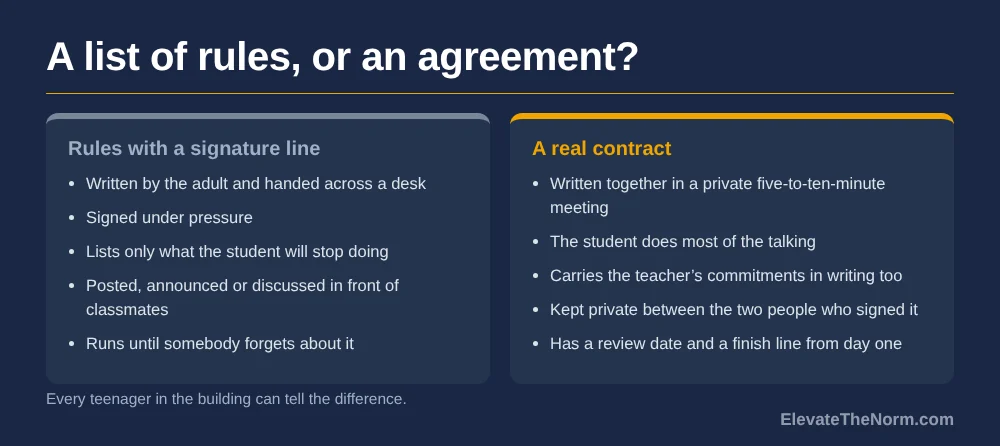
    • Write it down together. At that point you are in the territory of a student behavior contract — short, specific, signed by the student, reviewed on a date you both know.
    • Bring in the team. Counselor, case manager, administrator. If the student has an IEP or a 504 plan, this goes through that team and the plan, not around it.
    • Ask somebody who has taught this kid. An instructional coach or another teacher on your hall has almost certainly seen the same refusal, and may already know what works. Keeping your ears open helps. Asking outright helps more, and it is the cheapest item on this list.

    Nothing on that list lowers the standard. The work still gets done. What changes is the size of the first step, the choice inside it, and how much of the exchange happens in front of an audience.

    Does letting a student take a break just teach them to quit?

    It can, and that is the real tension in this topic. If refusing produces escape, every unearned escape makes refusing a slightly better bet. Teachers who say so are not being harsh. But the alternative has a hidden cost: a public standoff teaches the rest of the room that the way to get your undivided attention is to stop working, and it treats the student who genuinely couldn’t do the task identically to the one who didn’t feel like it.

    What resolves it is whether the escape is planned or won. A break the student asks for, on terms you set in advance, with the work still owed afterward, is a tool. A break the student takes by outlasting you is a lesson, and not the one you wanted. Geiger and colleagues’ abstract carries the right caution: these treatments have “characteristics that make them optimal for certain environments and clients, but less optimal for others.”

    What I won’t do is let a student fail to make a point. If a kid in my room can go far enough off the rails for it to seriously damage them, that’s poor planning on my part, and it raises the question of what the adult was doing the whole time. Real responsibility means a student can struggle, do it badly, need help, and still be held to the standard afterward. It does not mean walking them to the edge of a cliff I built and calling the drop a learning experience. That sits underneath everything on how students actually learn from mistakes.

    What should you never do when a student refuses to work?

    Don’t make it a public contest, don’t make it about you, and don’t attach a consequence you can’t follow through on. Four things to cut:

    • Announcing the refusal to the room. “Everyone’s working except one person” recruits an audience for the behavior you want to end and gives the student something to defend.
    • Threatening something you won’t do. A consequence you don’t deliver costs more than the refusal did. Respecting students is mostly doing exactly what you said you’d do, every time — which means saying less and meaning it.
    • Making compliance a condition of being treated decently. A student who isn’t working still gets a civil tone and the benefit of the doubt on the first ask.
    • Letting a zero do your job. A zero records that work is missing. It doesn’t find out why and it doesn’t get the work done. See what the evidence actually supports on late work.

    Where does the evidence on work refusal run out?

    There is no good study of what a grades 6–12 content teacher should say in the next ninety seconds. The advice here is extrapolated from research on adjacent questions, mostly with younger students. Four gaps:

    • The population mismatch is large. The IES practice guide states it is for “U.S. elementary schools — those serving students in kindergarten through 5th grades.” Its two strong-evidence recommendations — modify the classroom learning environment, and teach and reinforce new skills — were rated strong for K–5, not for a tenth-grade classroom. The strategies in Kern and Clemens come largely from students aged 8 to 12 and students with disabilities, in single-case designs with a handful of participants.
    • The secondary evidence is thin. The clearest classwide praise finding at this level is four classrooms; the clearest task-design finding is one interspersal study. Useful signals from small samples, not settled practice.
    • The engagement research is correlational. Jang, Reeve, and Deci observed 133 high school classrooms across nine Midwestern public high schools, with 2,523 students in grades 9 through 11 and self-reports from 1,584 of them. Autonomy support and structure correlated at r = .60; both predicted raters’ scores of behavioral engagement, but only autonomy support uniquely predicted what students said about their own engagement. The authors are explicit that the design cannot establish which way the causal arrow points. One number is worth keeping: differences between teachers accounted for 93 percent of the variance in observed behavioral engagement.
    • Nobody has studied the combination. Every source here tests one lever. Real classrooms pull several at once, with 150 students and no control group, and no trial says which order works best for a disengaged fourteen-year-old in a required course.

    What this looks like in my room

    Two things in my classroom do most of the work on refusal before it happens, and neither is a behavior strategy. The first is that students are almost always working next to somebody. Tables are pushed together in pairs and fours, there are no rows, and I’m on a wheeled stool moving between groups. A student who stalls has a partner mid-task beside them and a teacher three feet away, so the refusal gets caught while it’s still a stall. A room where everyone works alone facing forward gives a stuck kid a long time to go quiet in.

    The second is the whiteboard table I built for small-group work. It sits under a lower lamp, with a rug and better chairs than the rest of the room, and students ask to go there. That was deliberate. The failure mode of any pull-aside spot is that it becomes the table where the kids who are behind get sent, and then nobody will go. If the best seat in the room is where you do the hardest work with me, “come sit with me and we’ll do the first part together” isn’t a punishment.

    What to do tomorrow

    Pick the student you’re already thinking about. Tomorrow, when the refusal shows up, do three things: let the room get to work first, walk over and ask for the first step only, and name a time you’ll come back. Don’t add a consequence and don’t try all five moves at once.

    Then start the five-day log. By Friday you’ll know which of the four causes you’re dealing with — more than a month of escalating consequences would have told you.

    If the log says the work is out of reach, that’s a planning fix and it’s yours. If the student has gone flat in a way that isn’t like them, that’s a referral and it goes out today. If the refusal is a habit that’s been working, you have a short, private conversation about what responsibility actually looks like in practice rather than about attitude.

    Frequently Asked Questions

    What do you say to a student who refuses to work?

    Say one thing, quietly, standing next to them: “Show me the first step, or tell me where it gets hard.” Then stop talking. That question gives the student a way to admit the work is too hard without announcing it to the room, and it asks for a piece of the task small enough that saying yes costs them almost nothing.

    Should a student who refuses to work be sent out of the room?

    Rarely, and almost never as the first move. If the refusal is buying escape from the task, sending the student out delivers exactly what the behavior was for and makes the next refusal more likely. Removal is for safety and for genuine disruption to everyone else’s learning, not for a head on a desk.

    How do I handle a student who refuses to work without disrupting the whole class?

    Keep teaching for a beat, get the other students started, then deal with it privately at close range. Most of the damage from a refusal comes from the audience, not the refusal. A quiet thirty-second exchange beside the desk costs the class nothing; a public negotiation costs you the next ten minutes and gives the student something to defend.

    When should I involve the school counselor instead of handling it myself?

    When the refusal is a change from how that student normally is — flat affect, unusual quiet, tearfulness, a sudden drop across all classes — or when it comes with anything about harm. Research on secondary teachers suggests we reliably spot severe distress and miss moderate distress, so refer earlier than feels necessary and let the counselor make the call.

    Does giving a student an easier assignment lower the standard?

    Changing the size or the entry point of a task is not the same as changing the learning target. Shortening a task, pulling out the first step, or mixing in problems a student can already do all keep the standard intact. One study with grades 9–12 remedial math students found that worksheets with easy problems mixed in were rated as less difficult even though they had more problems on them.

    What if the student refuses to work because of something at home?

    You still ask once and you still refer, but you do not try to fix it. Note what you observed in plain factual language, pass it to the counselor or support team the same day, and keep the academic expectation in place with a smaller first step. A teacher who takes on a home situation alone usually ends up helping less, later.

    How long should I wait before responding to a refusal?

    Long enough to choose a response instead of reacting to the volume. I use roughly fifteen seconds as an average, not a rule — some days it is five, some students need thirty, and some need nothing from me until next period. Any fixed count applied to every student is just a slower version of the wrong response.

    What should I tell a parent whose child refuses to work in my class?

    Call before it becomes a discipline matter, and lead with what you have seen rather than what you have concluded: which assignments, how often, and what you have already changed. Then ask what they are seeing at home. Keep speculation about causes out of it, say what the plan is, and name a date you will check back in.

    Sources

    About Clay Shumate

    Clay Shumate is a certified secondary Social Studies teacher in the public schools of West Alabama, with seven years of classroom experience, a B.A. in History, and an M.Ed. in Secondary Education. He writes about project-based learning, student responsibility, respect, and practical ways to hold young people to a higher standard while giving them room to learn from mistakes. He is a member of the Society of Professional Journalists and writes to its Code of Ethics; this site’s editorial standards and corrections policy are published in full. More about Clay.

  • Student Behavior Contract: How to Write One Students Actually Respect (Free Template)

    Student Behavior Contract: How to Write One Students Actually Respect (Free Template)

    By Clay Shumate

    A student behavior contract is a short written agreement between a student and a teacher that names two or three specific behaviors, what the student commits to, what the teacher commits to in return, how progress gets checked, and when the agreement ends. It works best when the student helps write it and both people sign it.

    Most behavior contracts fail for a reason that has nothing to do with the student. They are written by the adult, handed across a desk, and signed under pressure. That is not a contract. That is a list of rules with a signature line at the bottom, and every teenager in the building can tell the difference. A real agreement has two sides, and the teacher’s side is the part most templates leave out.

    Key Takeaways

    • Two sides or it is not a contract. The teacher’s commitments — a cue, a check-in, a seat change, a private signal — belong on the page in writing, right next to the student’s.
    • Three behaviors, maximum. Every behavior should be observable and stated as something the student will do, not something they will stop doing.
    • The evidence is real but modest. A meta-analysis of single-case studies found a moderate overall effect, with the strongest results for reducing problem behavior.
    • Keep it private. A contract that is posted, announced, or discussed in front of classmates stops being an agreement and becomes a public label.
    • Plan the ending on day one. A contract should have a review date and a finish line, not run forever.

    Free Download · PDF

    Student Behavior Contract Template for Grades 6–12

    A two-page printable: a contract with space for student and teacher commitments, plus a weekly check-in tracker with an end-of-week conversation guide. No email required.

    Download the free PDF

    Free. No email address required. Designed for grades 6–12. Browse every printable in Your Free Library.

    What is a student behavior contract?

    It is a planning document that both the student and the teacher agree to, describing specific behaviors, how they will be tracked, and what happens when the student meets them. The IRIS Center at Vanderbilt calls it “a simple positive-reinforcement intervention that is widely used by teachers to change student behavior,” and lists its core parts as the behaviors to increase or reduce, the conditions for earning recognition, and signature blocks for everyone involved (IRIS Center, “Behavior Contracts”).

    Notice the word agree. A student behavior contract is not a punishment and it is not a warning letter. It sits in the space between “a quick private conversation” and “a formal referral” — the point where a pattern has shown up, you have already talked about it, and you both want something more structured than another reminder.

    It is also not an IEP behavior plan or a formal Behavior Intervention Plan. Those are legal documents built by a team. A classroom contract can support one, but it never replaces one. If a student already has a plan, the plan wins and the contract has to match it.

    Two-column comparison of a list of rules with a signature line against a real behavior contract, covering who writes it, whether the teacher's commitments appear, privacy, and whether it has an end date.
    Every teenager in the building can tell the difference.

    Does a behavior contract actually work?

    The research says yes, moderately, and more reliably for reducing problem behavior than for building new habits. That is an honest answer, and it is better than the workshop version.

    The most useful summary is a meta-analysis of 18 single-case experiments covering 58 students between the ages of 5 and 21. It found an overall moderate effect (ES = .57, with individual studies ranging from .27 to 1.00) and concluded that behavior contracts were beneficial “regardless of grade level, gender, or disability status.” It also found contracts were more effective at reducing inappropriate behavior than at increasing appropriate behavior, and that they had positive effects on academic outcomes overall (Bowman-Perrott et al., 2015).

    Two caveats matter for a secondary classroom. First, 58 students is a small number, and single-case research tells you a strategy can work for individuals rather than how often it works across a whole school. Second, that age range starts at five. The finding that grade level did not change the result is encouraging for grades 6–12, but it is not a high school study. Treat a contract as a well-supported tool for one student at a time, not as a schoolwide system.

    When to use a student behavior contract (and when not to)

    Use one when a specific behavior keeps repeating after you have already had a real conversation about it. Not on the first incident, and not as the opening move with a new student.

    Good fits:

    • A student who keeps starting work late and has told you they want to fix it.
    • Repeated phone use after the classroom expectation has been taught and re-taught.
    • A pattern of leaving the room, side conversations during direct instruction, or missing materials that you have both noticed.
    • A student returning after a suspension or a restorative conference who wants a clear, written path forward.

    Poor fits:

    • A one-time incident. A single bad day deserves a conversation and a repair, not paperwork.
    • A safety issue. Threats, violence, and anything involving harm go through your administration and school policy, not a classroom agreement.
    • A behavior with an obvious outside cause. A student who sleeps in class because they work nights or care for siblings needs a counselor and a conversation, not a contract.
    • A whole class. If eight students have the same problem, the problem is probably the procedure. Fix the routine; do not write eight contracts.

    Before any contract, the groundwork is usually clear classroom expectations that have actually been taught. A contract cannot hold a student to a standard nobody ever explained.

    What goes in a student behavior contract

    Six parts: a goal, specific behaviors, the student’s commitments, the teacher’s commitments, a check-in plan, and what happens next. Everything else is decoration.

    1. The goal, in one sentence. Written in the student’s words. “I want to stop losing points for missing warm-ups” is better than anything an adult would write, because the student owns it.
    2. Specific behaviors — no more than three. Observable, positive, and countable. “Starts the warm-up within two minutes of the bell” works. “Shows respect” does not, because nobody can agree on whether it happened.
    3. What the student commits to. The concrete actions they will take.
    4. What the teacher commits to. This is the section that makes it a contract. A quiet cue before redirecting. A seat closer to the front. A two-minute check-in at the end of class. Extra time on one assignment while the habit settles.
    5. How progress gets checked. Who fills in the tracker, how often, and what counts as a good day.
    6. When it goes well, and if it slips. Recognition the student actually values, and a stated next step if things slide — always a conversation first.

    Add a review date two to four weeks out and an end date. Then signatures. A family signature is useful when the family wants to be involved, but it should be optional; a contract between a teacher and a young adult should be able to stand on the student’s word.

    Six numbered parts of a student behavior contract: the goal in one sentence, no more than three specific behaviors, the student's commitments, the teacher's commitments, how progress gets checked, and what happens when it goes well or slips.
    The six parts. Everything else is decoration.

    How to write a behavior contract with a student, step by step

    Write it together, in a private five-to-ten-minute meeting, with the student doing as much of the talking as possible. The IRIS Center names minimal student input as one of the common problems that keep a contract from working, and that matches what any teacher would predict.

    1. Start with what the student wants

    Ask what they want to be different. Not what you want — what they want. Most students already know exactly what is going wrong and are tired of hearing about it. Letting them name it first changes the whole meeting.

    2. Agree on the behaviors

    Translate the goal into two or three observable actions. If the student proposes something vague, ask the follow-up question: “What would I see you doing on a day when that went right?”

    3. Ask what would help

    Then ask the question most contracts skip: “What could I do that would make this easier?” Students will tell you. Sometimes it is a seat away from a friend. Sometimes it is a signal instead of being called out. Write their answer into the teacher section, as long as it is something you can really do every day.

    4. Decide how you will check in

    A daily two-minute rating works for most secondary students. Have the student rate first, then you rate, then compare. Our guide to student self-assessment of behavior covers why comparing ratings works better than correcting them.

    5. Set the review date and the finish line

    Two to four weeks is long enough to see a pattern and short enough to stay motivating. Decide now what “done” looks like — for example, eight good days out of ten.

    6. Sign it and keep it private

    Both of you sign. The student keeps a copy. It does not go on the wall, it is not mentioned in front of the class, and the tracker lives in a folder, not on a desk where classmates can read it.

    If a student is coming back from a conflict, a contract pairs naturally with the repair conversation in restorative practices in schools. If you want a scripted structure for that conversation, my Restorative Conversation Scripts lay out the follow-up talk word for word (see them here).

    A sample student behavior contract

    Here is what a filled-in middle school or high school contract can look like. The student and situation are illustrative, not a real student.

    SectionExample entry
    Goal“I want to stop getting zeros on warm-ups because I’m on my phone at the start of class.”
    Behavior 1Phone is in my bag before the bell rings.
    Behavior 2Warm-up started within two minutes of the bell.
    Student commits toPutting my phone away at the door and asking for help instead of waiting if I don’t understand the warm-up.
    Teacher commits toPosting the warm-up before students arrive, giving a quiet hand signal instead of a verbal reminder, and doing a 30-second check at the end of class.
    Check-inDaily 0–2 rating, student first. Friday five-minute conversation.
    Goes wellEight of ten days met: contract finishes, and a positive call or message home.
    If it slipsPrivate conversation first, then we revise the contract together.
    Review / endReview in two weeks. Ends after three weeks or when the goal is met.

    That “positive call home” line is worth keeping. My first call to any family is always a genuine compliment, and a call that says “your kid set a goal and hit it” is one of the best calls you will ever make. If you want a system for those calls, the parent-teacher communication plan walks through it.

    Tracking progress without turning it into surveillance

    Track the two or three behaviors on the contract and nothing else, for two minutes a day. The second page of the free template is a weekly tracker built for exactly that.

    The student rates each behavior 0, 1, or 2. You rate the same period. Then you compare. Where you disagree, ask why before you say anything else — sometimes the student saw something you missed. At the end of the week, use four questions: What went better than last week? Which day was hardest, and what was going on? Is there anything I should do differently? Do we keep the contract, adjust it, or finish it?

    That third question is not a formality. If the student says your quiet signal is not working, change the signal. A teacher who keeps their side of the agreement and adjusts when asked is teaching the most important thing a contract can teach: that commitments go both ways. The research on structure and student autonomy points the same direction — students engage more when expectations come with reasons and a real voice, which is the whole argument behind student voice and choice.

    Four numbered steps for when a student breaks a behavior contract: have a private conversation, treat the slip as information, revise the agreement together, and escalate only when it keeps failing.
    A slip is information, not proof the student did not want to change.

    What to do when a student breaks the contract

    Have a private conversation, find out what happened, and revise the agreement together. Do not tear it up and do not jump straight to a consequence ladder.

    A slip is information. Maybe the behavior was too big a jump. Maybe something happened outside class. Maybe your side of the contract slipped first — you forgot the check-in three days running, and the student noticed. Ask, listen, and adjust. One bad day out of five is still four good days, and the tracker makes that visible to both of you.

    What you should not do is treat a broken contract as proof the student “did not want to change.” If the same contract keeps failing, that usually means the behaviors were the wrong ones, the support was not enough, or something bigger is going on that needs a counselor, a family conversation, or a referral to your school’s support team. If you need a paper trail at that point, my Behavior Documentation Forms are built for MTSS-style logs (details here).

    Ending the contract on purpose

    Most student behavior contracts should finish, not renew forever. The point is for the habit to become the student’s, not to keep the student on paper for a semester.

    When the goal is met, say so plainly and mark it. Retire the tracker. Tell the student what you noticed. If it fits, make the positive call home. Then fade the support you added — the signal, the check-in — gradually, so the student is doing it without the scaffold. A student who finishes a contract should walk away with proof they can set a goal and meet it, which is a better outcome than three weeks of quieter mornings. For the bigger picture on building that kind of ownership, see positive discipline for teens.

    The student behavior contract, in one paragraph

    Write a student behavior contract with the student, not for them. Keep it to three observable behaviors, put your own commitments in writing next to theirs, check in for two minutes a day, keep it private, and decide on day one how it ends. The evidence supports contracts as a moderate, reliable tool for one student at a time. What makes them work in a secondary classroom is that they treat the student as someone capable of keeping their word — and they require the teacher to keep theirs. Download the free template and use it with the next student who tells you they want something to change.

    Sources

    1. Bowman-Perrott, L., Burke, M. D., de Marin, S., Zhang, N., & Davis, H. “A Meta-Analysis of Single-Case Research on Behavior Contracts: Effects on Behavioral and Academic Outcomes Among Children and Youth.” Behavior Modification, vol. 39, no. 2, 2015, pp. 247–269. Supports the moderate overall effect (ES = .57), the finding that results held regardless of grade level, gender, or disability status, and the stronger effect for reducing inappropriate behavior. Caveat: 18 single-case experiments with 58 participants aged 5–21; single-case designs show a strategy can work for individuals, not how often it works across a school, and the sample is not limited to secondary students. https://doi.org/10.1177/0145445514551383
    2. IRIS Center, Vanderbilt University. “Behavior Contracts” (information brief). Supports the definition of a behavior contract as a positive-reinforcement planning document, its core components, and the common failure points, including minimal student input. Caveat: a practitioner brief rather than a research study; it does not report effect sizes. https://iris.peabody.vanderbilt.edu/information-brief/behavior-contracts/

    Frequently Asked Questions

    Is a student behavior contract legally binding?

    No. A classroom behavior contract is a planning tool and a good-faith agreement, not a legal document. It does not change school policy, override a discipline code, or replace an IEP, a 504 plan, or a formal Behavior Intervention Plan. If a student already has one of those, the classroom contract has to match it, and the student’s case manager should see it before you use it.

    Should parents sign a student behavior contract?

    It helps when the family wants to be involved, but make it optional. The agreement is between you and the student, and a contract that only counts once an adult at home signs it tells a teenager their own word is not enough. Do let families know a contract exists and what it says. A short positive message when the student meets the goal is often the most useful part of the family connection.

    How long should a behavior contract last?

    Two to four weeks for the first review, with a clear end point written in from the start, such as eight good days out of ten. Long enough to show a pattern, short enough to stay motivating. A contract that runs all semester usually means the behaviors were too broad or the support was not working, and it is time to revise rather than renew.

    What rewards work for middle and high school students?

    Ask the student. Older students usually care less about prizes and more about things like a positive call or message home, a choice of seat, a pass on one homework assignment, or simply having the contract finished and off their record. Recognition they chose is worth more than a reward you picked. Keep it modest and keep it private.

    Isn’t a behavior contract unfair to the rest of the class?

    Fair means everyone gets what they need to meet the same standard, not identical treatment. The contract does not lower the expectation for one student. It adds structure and support so that student can meet the same expectation everyone else is held to. Because the contract is private, classmates generally never know it exists, which also protects the student’s dignity.

    How much time does a behavior contract take?

    About ten minutes to write it with the student, roughly two minutes a day to check in, and five minutes at the end of each week. That is far less time than repeated redirections, referrals, and parent phone calls about the same behavior. If you cannot commit to the daily check-in, do not write the contract yet, because a skipped check-in tells the student the agreement only goes one way.

    What if a student refuses to sign the contract?

    Do not force it. A signature given under pressure is meaningless. Ask what part they disagree with and whether they would change something about it. Often the objection is to wording that feels like a label, and rewriting it in their own words solves it. If they still decline, keep using your normal classroom procedures and offer again later. The offer itself tells them you think they can change.

    Can I use a behavior contract for a whole class?

    A whole-class version is really a set of classroom expectations or norms, and it works differently. Individual behavior contracts are built for one student and one specific pattern. If many students are struggling with the same thing, the fix is usually the routine or the procedure itself, not a stack of individual contracts.

    About Clay Shumate

    Clay Shumate is a certified secondary Social Studies teacher in the public schools of West Alabama, with seven years of classroom experience, a B.A. in History, and an M.Ed. in Secondary Education. He writes about project-based learning, student responsibility, respect, and practical ways to hold young people to a higher standard while giving them room to learn from mistakes. He is a member of the Society of Professional Journalists and writes to its Code of Ethics; this site’s editorial standards and corrections policy are published in full. More about Clay.

  • Classroom Management Styles: Find Your Default and What It Costs You

    Classroom Management Styles: Find Your Default and What It Costs You

    By Clay Shumate

    Classroom management styles are usually sorted into four types — authoritative, authoritarian, permissive, and indulgent or uninvolved — by crossing how much structure a teacher demands with how much warmth a teacher offers. The framework is borrowed from parenting research, and the high-structure, high-warmth style has the best support.

    I find this taxonomy genuinely useful and I want to be straight with you about what it is. It is a heuristic that came out of developmental psychology about parents, got carried into teacher education, and is now repeated in professional development as though someone measured it in classrooms. Mostly, nobody did. That does not make it worthless. It makes it a map rather than a measurement, and a map is still worth having if you know what it is.

    Key Takeaways

    • The four styles come from crossing two dimensions, not from four separate discoveries: how demanding you are and how responsive you are.
    • The framework is borrowed, not homegrown. It originates in research on parents, and the attempts to measure it on teachers have been small.
    • Authoritative — high structure, high warmth — has the strongest support, and the evidence for each half of it is better than the evidence for the typology itself.
    • Your style is a default under pressure, not a personality. What you do in week three when you are tired is your real style.
    • Two of the four styles fail the same way. Permissive and authoritarian rooms both end up unpredictable, just for opposite reasons.

    What are the four classroom management styles?

    They are four combinations of two things: how much you require and how much you respond. That is the whole framework, and once you see it as a grid rather than a list of four personalities, it gets much more useful.

    • Authoritative. High demands, high responsiveness. Clear non-negotiable expectations, explained reasoning, visible care, consequences that arrive as promised.
    • Authoritarian. High demands, low responsiveness. Rules without reasons, compliance as the goal, correction without relationship.
    • Permissive. Low demands, high responsiveness. Warm, liked, negotiable — and the floor moves depending on who is asking.
    • Indulgent or uninvolved. Low demands, low responsiveness. Work assigned, grades entered, nothing much required and nothing much offered.

    A note on vocabulary, because it trips people up. Different sources use “permissive” and “indulgent” as synonyms, and some use “uninvolved” or “neglectful” for the low-low cell. The names drift. The two dimensions do not, so when a PD slide confuses you, go back to the grid.

    Where the classroom management styles framework actually comes from

    It comes from Diana Baumrind’s research on parents, extended into a two-by-two grid by other researchers, and only later applied to teachers. Nobody set out to build a theory of classroom management.

    Baumrind’s longitudinal work followed children at ages 4, 9 and 15 and found that “authoritative parents who are highly demanding and highly responsive were remarkably successful in protecting their adolescents from problem drug use, and in generating competence” — while also noting that authoritative parenting was not the only route to a competent adolescent (Baumrind, 1991). That sample was 139 adolescents from an affluent, well-educated, predominantly white population. It is a real finding on a narrow group of families.

    The familiar four-cell version came later. As Nancy Darling’s summary of the literature puts it, “categorizing parents according to whether they are high or low on parental demandingness and responsiveness creates a typology of four parenting styles: indulgent, authoritarian, authoritative, and uninvolved,” a dimensional move credited to Maccoby and Martin in 1983 (Darling, “Parenting Style and Its Correlates”). So the four styles you have seen on a laminated handout are a grid built on top of a three-category typology about families, two steps removed from any classroom.

    Four rows naming the four classroom management styles with the level of structure and warmth each one combines.
    Four cells, two dimensions — not four separate theories.

    Is the parenting-to-teaching mapping measured, or just useful?

    Mostly useful. The direct attempts to measure it on teachers are small enough that you should treat the typology as a thinking tool and not as a finding.

    The clearest explicit attempt I can point you to applied demandingness and responsiveness to teaching practice and student engagement — and it studied three fifth-grade mathematics teachers and 45 of their students (Walker, 2008). Three teachers. Fifth grade. That is a thoughtful, honest study and it is not a basis for telling a high school teacher what their style does.

    So why keep the framework? Because the two dimensions have far better evidence than the four boxes do, and the boxes are a convenient way to talk about the dimensions. That is the position I would defend. Use the labels to locate yourself; use the dimensions to decide what to change.

    The two dimensions that actually matter

    Structure and warmth are each independently supported in classroom research, which is the real reason the authoritative cell wins.

    On the structure side, the review that screened classroom practices for genuine empirical support organized them into maximizing structure and predictability; posting, teaching, reviewing, monitoring and reinforcing expectations; actively engaging students; acknowledging appropriate behavior; and responding to inappropriate behavior along a continuum (Simonsen, Fairbanks, Briesch, Myers & Sugai, 2008). That is the demandingness axis, with practices attached.

    On the warmth side, a meta-analysis of 99 studies on teacher–student relationships found medium-to-large associations with student engagement and small-to-medium associations with achievement, and reported stronger effects in the higher grades (Roorda, Koomen, Spilt & Oort, 2011). Those are correlations, and students who are easier to teach are easier to like, which could generate some of the pattern on its own. Still, if you teach grades 6–12, the warmth axis is doing more work for you than it would in a second-grade room, not less.

    And warmth has a behavioral measure, not just a feeling. In 28 middle school classrooms, higher praise-to-reprimand ratios tracked linearly with better class-wide on-task behavior, and with more engagement, less disruption and better grades among students at risk for emotional and behavioral disorders (Caldarella, Larsen, Williams & Wills, 2023). Responsiveness is countable. That is how you know whether you have it.

    A self-diagnostic for your classroom management style

    Answer these about what you actually did last week, not about what you believe. Score each row 0, 1 or 2. Add the structure rows and the warmth rows separately, then find your cell.

    AxisStatement0 — rarely1 — sometimes2 — nearly always
    StructureA student who arrives late knows exactly what happens next without asking me.
    StructureI did this week what I said last week I would do, including the part I did not enjoy.
    StructureMy transitions have a procedure that students could run if I lost my voice.
    StructureThe same behavior gets the same response from me regardless of which student it was.
    StructureMy deadlines and my late-work rule held this week with no exceptions I did not announce in advance.
    WarmthI spoke to every student by name this week about something that was not their behavior or their grade.
    WarmthI explained the reason behind a rule when a student asked, instead of citing the rule.
    WarmthI acknowledged more often than I corrected, and I know that because I counted.
    WarmthA student who was struggling got a private conversation rather than a public one.
    WarmthI changed something this month because a student told me it was not working.

    Reading your score. Structure 7–10 and warmth 7–10 puts you in the authoritative cell. Structure 7–10 and warmth 0–6 is the authoritarian corner. Structure 0–6 and warmth 7–10 is permissive. Low on both is the uninvolved cell, and if you landed there and you are still reading, you are probably exhausted rather than indifferent — those look identical from the hallway and they are not the same problem.

    This is not a validated instrument and I am not pretending it is one. It is ten honest questions. Its only real virtue is that every item asks about an observable action from the past week, which is harder to flatter yourself about than “I have high expectations.” Run it again in six weeks. Our material on structured teacher reflection has a longer process if you want one.

    Five cards each posing a question a secondary teacher can answer about last week to identify their default management style.
    Ask about last week’s actions, not about your intentions.

    Authoritarian: high structure, low warmth

    The authoritarian room usually works in September and starts leaking in November. Compliance built entirely on your presence requires your presence, and you cannot be everywhere.

    The cost is specific. Students follow rules they do not understand only while they are being watched, so you spend the year watching. You also lose your best information source: a student who is afraid of you does not tell you when something is wrong, which means you find out about problems late. And the room runs on a fuel that depletes — your own vigilance.

    The fix is not loosening the structure. That is the mistake teachers make when they are told they are too strict. The fix is adding the reason and the relationship while the structure stays exactly where it is. That is the one-cell move, and it is the easiest of the four to make.

    Permissive: high warmth, low structure

    The permissive room feels good and quietly becomes unfair. It is the style I have the most sympathy for and the one I think costs students the most.

    Here is the mechanism. When the floor is negotiable, the students who get the extensions, the second chances and the benefit of the doubt are the students who are comfortable asking. The confident, the articulate, the ones whose parents taught them to advocate. The quiet student who also needed the extension does not get it, because she did not know she was allowed to ask. A permissive room distributes mercy by social skill. That is not kindness. A predictable floor is the more generous system even when it feels harsher, and it is the heart of what we argue in holding a standard without becoming a hardliner.

    The other cost is that warmth without structure is not actually experienced as respect. Teenagers read a teacher who requires nothing as a teacher who expects nothing of them, and they are not wrong to read it that way.

    Indulgent and uninvolved: the low-low cell

    Almost nobody chooses this cell, and plenty of good teachers end up in it temporarily. It is usually a symptom of being overwhelmed, not a philosophy.

    Four preps, a coaching duty, a hard roster, something going wrong at home: structure and warmth are both effortful, and when you are depleted you stop producing both. I would rather name that honestly than moralize about it. If a self-diagnostic put you here, the move is not to fix your style. It is to pick one axis, one class period, and one week, and rebuild from there. Trying to become authoritative across six periods on a Monday is how people quit.

    Four rows describing the single lowest-cost change a teacher can make from each of the four management style positions.
    One behavior, four weeks — not a new philosophy.

    Authoritative: high structure, high warmth

    This is the cell with the best support, and the mechanism is not warmth plus rules — it is that the warmth makes the structure believable and the structure makes the warmth credible.

    A student in an authoritative room knows two things at once: that you mean what you say, and that you are on their side. Those are not in tension. They reinforce each other. Expectations explained are expectations more likely to be internalized, which is also what the motivation literature predicts: in a meta-analysis of 144 studies and just over 79,000 participants with a mean age of 16.5, teacher autonomy support correlated .48 with intrinsic motivation and −.32 with amotivation, and students’ sense of competence (ρ = .58) and autonomy (ρ = .57) were the strongest predictors of self-determined motivation (Bureau, Howard, Chong & Guay, 2021). Autonomy support is not the absence of demands. It is demands with reasons, and some real choice inside them — which is the argument for giving students genuine choices inside a structure you set.

    One honest caveat. Baumrind herself noted that authoritative parenting was not the only path to competence, and the same is almost certainly true in classrooms. I have watched teachers who would score as authoritarian on any instrument run rooms students cared about, because the students were certain the teacher was fair. Fairness may be doing more of the work in this framework than warmth is.

    Can you change your classroom management style mid-year?

    You can add structure to a permissive room in about two weeks. Adding warmth to an authoritarian one takes a grading period, and it requires you to say out loud that you are changing.

    The asymmetry is worth knowing. Tightening up is a policy announcement: here is the new procedure, here is when it starts, here is what happens. Students adjust fast because the change is legible. Warming up is harder because every individual kind act gets read against the record. A student who has spent nine weeks being corrected does not trust a compliment in week ten. Tell the class plainly that you got something wrong and what you are changing, and then be boringly consistent about it for six weeks. That is the whole method. Our piece on what respect actually looks like in practice covers the day-to-day version.

    What your style looks like from a student desk

    Students do not perceive your style as warmth and structure. They perceive it as one question: is this teacher predictable and is this teacher fair?

    That reframing has done more for me than the taxonomy has. A student does not care where you sit on a grid. She cares whether the consequence she got on Tuesday is the consequence the loud kid gets on Thursday, and whether you did the thing you said you would do. Every style in the framework can be perceived as unfair, including the authoritative one, if your word and your actions come apart. The shortest route from any cell to a room that works is to do exactly what you said you would do, every time — a point we make at length in the companion piece on control, consistency and what students are actually reading.

    Using classroom management styles without turning them into a personality test

    Treat the classroom management styles grid as a diagnostic you run on your own behavior, not a label you wear. You are not an authoritarian teacher. You are a teacher who defaulted to low responsiveness in third period on Thursday when you were tired, and that is a fixable fact rather than an identity.

    So do this. Run the ten questions. Find your weaker axis. Pick one behavior on that axis — one — and do it for four weeks. If structure is weak, the highest-value item is holding one deadline exactly as written. If warmth is weak, the highest-value item is speaking to every student by name about something other than their work. Then run the questions again and see whether anything moved. For the concrete practices to build on either axis, our list of classroom management strategies ranked by payback is the practical companion to this article, and the piece on writing expectations that hold is where the structure axis starts.

    Sources

    1. Baumrind, D. “The Influence of Parenting Style on Adolescent Competence and Substance Use.” The Journal of Early Adolescence, vol. 11, no. 1, 1991, pp. 56–95. Supports the origin of the authoritative category as high demandingness plus high responsiveness, and the finding that it was not the only route to adolescent competence. Caveat: 139 adolescents from an affluent, well-educated, predominantly white sample of families — a parenting study, not a classroom study. https://journals.sagepub.com/doi/10.1177/0272431691111004
    2. Darling, N. “Parenting Style and Its Correlates.” At Health, LLC, 23 October 2013. Supports the two-dimension grid and the attribution of the four-category typology to Maccoby and Martin (1983). Caveat: this is an authoritative literature summary rather than a primary study, and it is cited here as a summary. https://athealth.com/topics/parenting-style-and-its-correlates-2/
    3. Walker, J. M. T. “Looking at Teacher Practices Through the Lens of Parenting Style.” The Journal of Experimental Education, vol. 76, no. 2, 2008, pp. 218–240. Supports the claim that the parenting-style dimensions have been applied directly to teaching practice and student engagement. Caveat: the study involved three fifth-grade mathematics teachers and 45 students, which is far too small and too young to generalize to grades 6–12; linked via the ERIC record. https://eric.ed.gov/?q=%22Looking+at+Teacher+Practices+Through+the+Lens+of+Parenting+Style%22
    4. Roorda, D. L., Koomen, H. M. Y., Spilt, J. L., & Oort, F. J. “The Influence of Affective Teacher–Student Relationships on Students’ School Engagement and Achievement: A Meta-Analytic Approach.” Review of Educational Research, vol. 81, 2011, pp. 493–529. Supports the warmth dimension and the report of stronger effects in higher grades. Caveat: correlational; students who are easier to teach are easier to have positive relationships with, which could produce part of the association. https://research.vu.nl/en/publications/the-influence-of-affective-teacher-student-relationships-on-stude/
    5. Simonsen, B., Fairbanks, S., Briesch, A., Myers, D., & Sugai, G. “Evidence-Based Practices in Classroom Management: Considerations for Research to Practice.” Education and Treatment of Children, vol. 31, 2008, pp. 351–380. Supports the structure dimension and the five categories of evidence-based classroom practice. Caveat: linked as a full-text reproduction hosted by a university project rather than the journal of record. https://k12engagement.unl.edu/sites/unl.edu.cehs.special-ed-communic-disorders.student-engagement-project/files/media/file/Classroom%20Management%206-8-16.pdf
    6. Caldarella, P., Larsen, R. A. A., Williams, L., & Wills, H. P. “Effects of Middle School Teachers’ Praise-to-Reprimand Ratios on Students’ Classroom Behavior.” Journal of Positive Behavior Interventions, vol. 25, no. 1, 2023, pp. 28–40. Supports treating responsiveness as a countable behavior rather than a disposition. Caveat: 28 middle school classrooms; high school was not studied. https://journals.sagepub.com/doi/10.1177/10983007211035185
    7. Bureau, J. S., Howard, J. L., Chong, J. X. Y., & Guay, F. “Pathways to Student Motivation: A Meta-Analysis of Antecedents of Autonomous and Controlled Motivations.” Review of Educational Research, vol. 91, no. 3, 2021. Supports the correlations for teacher autonomy support, competence and autonomy with self-determined motivation. Caveat: 144 studies and 79,079 participants with a mean age of 16.55, but the relationships are correlational and both sides are usually measured by student self-report. https://selfdeterminationtheory.org/wp-content/uploads/2021/09/2021_PathwaystoStudentMotiv_BureaHowardEtal.pdf

    Frequently Asked Questions

    Can a teacher have more than one classroom management style?

    Most of us have several, sorted by class period and by how tired we are. That is normal and it is also the most useful thing the framework tells you. If you are authoritative in second period and authoritarian in sixth, the difference is almost never the students — it is your remaining energy and how the term has gone with that group. Track which periods pull you out of your intended style. The pattern usually points at a specific seam in the schedule rather than at a personality flaw.

    Is the authoritative style the same thing as being strict?

    No. Strictness is the structure axis only. Authoritative means high structure and high warmth at once: the deadline holds, and the student also knows you noticed they were struggling and why the deadline exists. A strict teacher with no warmth is in the authoritarian cell, which works while you are watching and leaks when you are not. The practical test is whether a student in trouble would come to you first or hide it from you. If they would hide it, you have structure without responsiveness.

    Is this framework fair to teachers in difficult schools with limited support?

    Only if it is used as a diagnostic rather than an evaluation, which is why I would push back hard on any observation rubric that scores teachers on a style label. Structure and warmth both cost energy, and a teacher with four preps, a duty and a hundred and sixty students has less of it than one with two preps. The low-low cell is usually a workload symptom. If a building has a lot of teachers landing there, that is a staffing and scheduling finding, not a teacher-quality finding.

    What should I do if my school’s discipline policy pushes me toward an authoritarian style?

    Follow the policy and change what the policy does not control, which is more than teachers assume. Mandated consequence ladders set what happens; they rarely set your tone, your explanation, whether you correct privately, or how often you acknowledge students. All of that is the warmth axis and it is yours. Where a policy genuinely requires something you think is harmful — public tracking, for example — document what you observe and raise it with your administrator as implementation feedback rather than declining to follow it.

    Does changing my style confuse students mid-year?

    Changing without announcing it does. Students notice inconsistency long before they notice improvement, so an unexplained shift reads as moodiness. Say it out loud: name what you are changing, when it starts, and why. Teenagers handle a teacher who admits a correction far better than most adults expect, and the admission buys you credibility you can spend later. Then be dull about it for six weeks, because a change you abandon in week three has cost you more trust than never changing at all.

    How does this apply to students with IEPs or behavior plans?

    An authoritative stance is compatible with individualized support and does not override it. High structure means the plan is followed precisely, not that every student receives identical treatment; a required accommodation is part of the structure, not an exception to it. Students and families sometimes read differentiation as favoritism, which is worth getting ahead of by explaining early that fair means everyone gets what they need to meet the same standard. If a plan conflicts with your usual response, the plan wins and the case manager hears about it.

    Will students respect me less if I explain my reasoning instead of just stating the rule?

    The opposite, in grades 6 to 12. Explaining a rule once is not negotiating it. The confusion comes from thinking reasons invite argument, when what actually invites argument is a rule that looks arbitrary. Give the reason, then hold the rule whether or not the student agrees with the reason. Students will accept a standard they think is pointless if they believe you are fair about applying it, and they will fight a standard they think is personal even when it is completely reasonable.

    How often should I re-check my style?

    Twice a semester is plenty, and the timing matters more than the frequency. Run it in the third or fourth week, once the honeymoon is over and before habits have set, then again a week or two after a long break, which is when structure quietly erodes. Checking it in the first week tells you about your intentions rather than your practice. Keep the scores somewhere you will find them, because the useful information is the direction of travel rather than any single number.

    About Clay Shumate

    Clay Shumate is a certified secondary Social Studies teacher in the public schools of West Alabama, with seven years of classroom experience, a B.A. in History, and an M.Ed. in Secondary Education. He writes about project-based learning, student responsibility, respect, and practical ways to hold young people to a higher standard while giving them room to learn from mistakes. He is a member of the Society of Professional Journalists and writes to its Code of Ethics; this site’s editorial standards and corrections policy are published in full. More about Clay.

Teacher Emergency Toolkit — practical resources, real classroom support. Shop on TPT.Teacher Emergency Toolkit — practical resources, real classroom support. Shop on TPT.