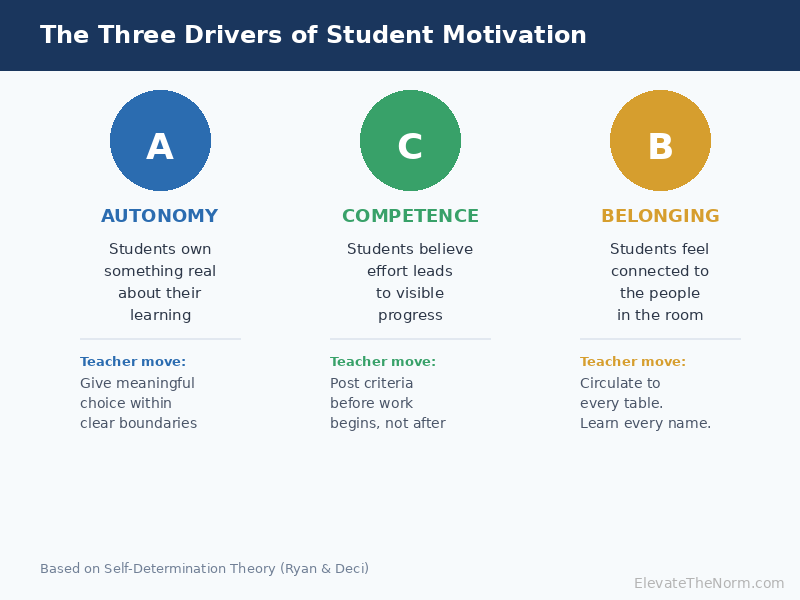
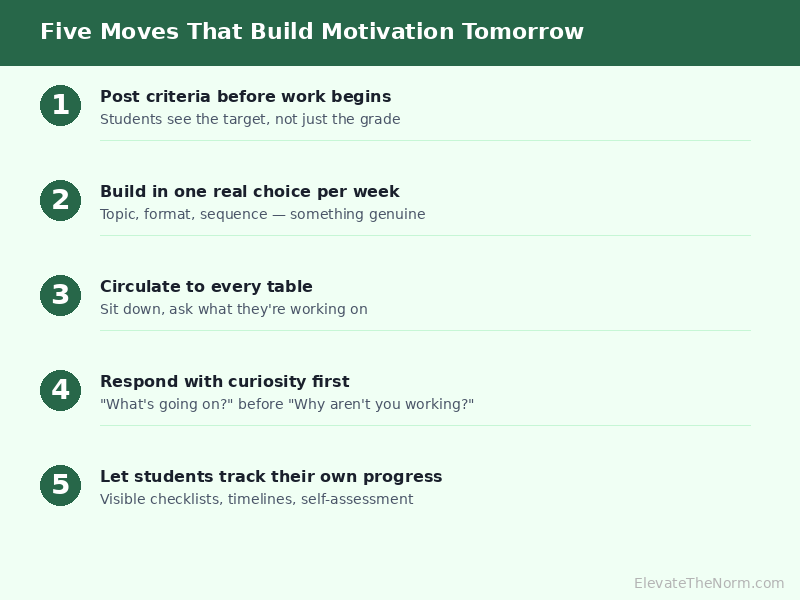
Tag: self-determination theory

  • Choice Boards: How to Give Students a Real Choice Instead of a Decorative One

    Choice Boards: How to Give Students a Real Choice Instead of a Decorative One

    By Clay Shumate

    A choice board is a grid of options that all assess the same learning target, letting students pick how they show what they know. The format varies; the thinking does not. Built well, it is a small, well-evidenced motivational lever. Built badly, it is nine squares of unequal busywork wearing the word “choice” as a costume.

    The research on student choice is better than most classroom practices can claim and smaller than most people quoting it assume. Both halves matter, so the numbers come before the grid.

    Key Takeaways

    • Choice has a real but modest effect. Across 41 studies, offering choice raised intrinsic motivation by d = 0.30 to 0.36. On subsequent learning the same meta-analysis found d = 0.10 with a confidence interval crossing zero.
    • Two to four options, not nine. The effect was strongest with 2–4 successive choices. A full tic-tac-toe grid is usually three squares of real options and six of filler.
    • Merely offering a choice is not motivating. It has to connect to something the student cares about, sit inside what they can do, and not cost them standing with their family or community.
    • Do not justify a choice board with learning styles. The matching hypothesis has been tested and does not hold. You have a better reason available — use it.
    • One target, one rubric. If two squares need different criteria to grade, you have two assignments, not one board.

    What Is a Choice Board?

    It is a set of options — usually displayed as a grid — that each assess the same standard through a different product or route. A student picks one, or sometimes picks a path of three. The teacher sets the target and the criteria. The student sets the format.

    That definition is narrower than how the term usually gets used. A board where one square asks for a written argument, another a poster and a third a “creative response” is not a choice board. It is three different assignments printed on the same page, and no rubric fixes that.

    Choice boards sit inside a larger family of practices. The broader question of how much control students should have, and where adults keep it, belongs to student voice and choice; the gradual-release version is student autonomy. This article is about one tool: the board itself, how to build it, and how to grade it.

    What the Research on Choice Actually Shows

    Choice raises motivation by a modest, real amount and does not by itself improve later learning.

    The anchor study is a 2008 Psychological Bulletin meta-analysis by Erika Patall, Harris Cooper and Jorgianne Civey Robinson. Across 41 studies, 46 samples and 91 effect sizes, choice raised intrinsic motivation by d = 0.30 (fixed effects) to d = 0.36 (random effects). Accounting for publication bias, the effect stayed positive and significant but shrank by about a third.

    Then the part nobody quotes. On subsequent learning, the same meta-analysis found d = 0.10, with a 95 percent confidence interval of −0.02 to 0.21. That interval contains zero. Choice made students more willing; it did not, in this body of work, make them learn more afterwards.
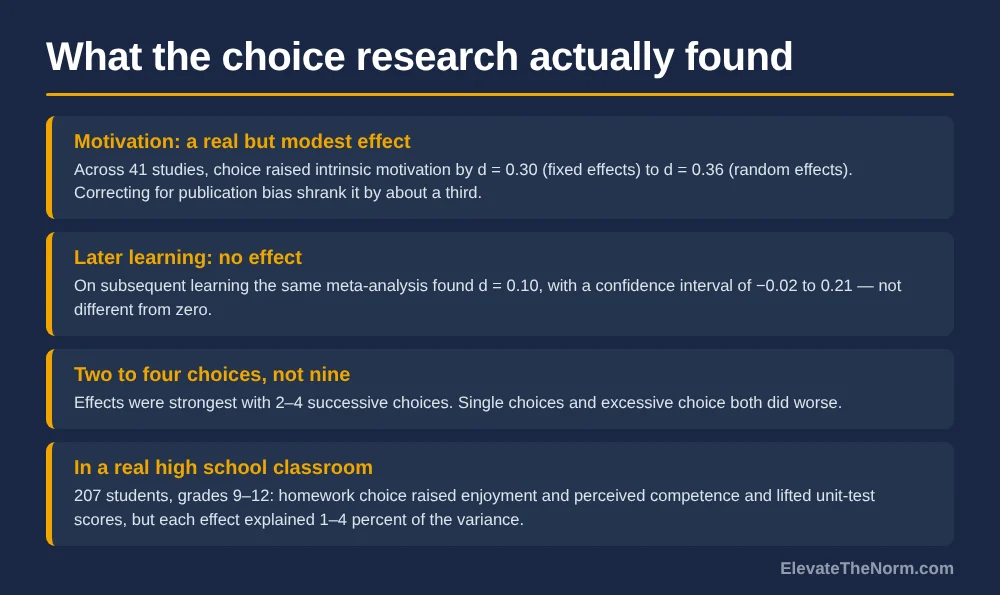
    Four-row research graphic: choice raised intrinsic motivation d equals 0.30 to 0.36 across 41 studies, had no effect on subsequent learning at d equals 0.10, worked best with two to four choices, and in a 207-student high school study explained one to four percent of variance
    What the choice research supports, and what it does not.

    Three of their moderator findings change how you build a board. Choice worked best with two to four successive choices rather than a single choice or an overwhelming array. The benefit shrank when rewards were involved — so stapling a points bonus onto the “fun” square works against you. And the effect was stronger for children than adults, which is a caution for a grades 6–12 audience sitting between those categories rather than a license.

    There is one finding here that ought to make every choice-board advocate uncomfortable, including me. The authors report that instructionally irrelevant choices — picking a game icon, choosing which pen to use — produced stronger effects than choices between task versions or activities. The motivational lift may be coming from the act of deciding rather than from the educational substance of what was decided. That does not mean choice boards are worthless. It does mean the honest claim is “this is a cheap way to raise willingness,” not “this is how students learn better.”

    What Happened When Someone Tried It in a Real High School

    Modest gains across the board, including on the unit test, with each effect explaining one to four percent of the variance.

    Patall, Cooper and Susan Wynn ran a within-subjects experiment in the Journal of Educational Psychology in 2010: 207 students, 14 classrooms, two urban high schools, with homework choice for two units and no choice for two others, conditions reversed. The results:

    • Interest and enjoyment rose in the choice condition (β = 0.22, p < .01), accounting for about 4.3 percent of the variance.
    • Perceived competence rose (β = 0.19, p < .05), about 2.2 percent of variance.
    • Unit test scores rose (β = 2.56, p < .05), about 1.3 percent of variance.
    • Homework completion was only marginal (β = 4.80, p < .10), about 1 percent.
    • No significant effect on perceived effort, task value, or pressure.

    Real high school students doing real homework, which makes it unusually relevant here. It is also a study where the biggest effect explained under five percent of the variation between students. Treat choice as a worthwhile adjustment rather than a turnaround strategy and you are reading it correctly.

    The Three Conditions a Choice Has to Meet

    Idit Katz and Avi Assor put it plainly in their review: merely offering choice is not in itself motivating, and in some cases it can even reduce motivation. They distinguish choosing, which involves a preference, from picking, which is just selecting. A board full of options a student has no preference among produces picking.
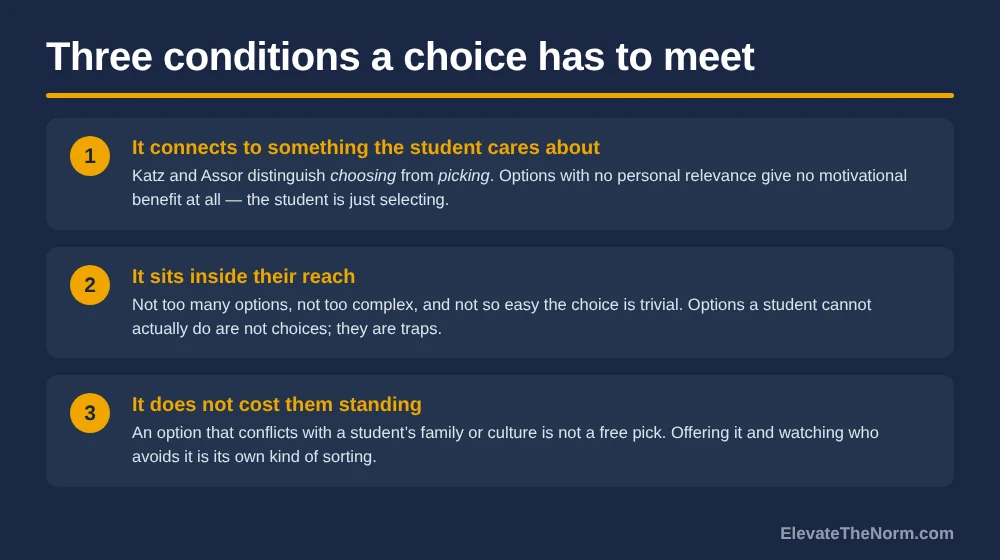
    Three-card graphic listing the conditions a choice must meet to motivate: it connects to something the student cares about, it sits inside their reach, and it does not cost them standing with family or culture
    Katz and Assor’s three conditions, applied to a choice board.

    Their three conditions map directly onto board design.

    1. Relevance to the student’s interests and goals. If every square is a format the student is indifferent about, you have given them a menu in a language they do not read. The fix is usually fewer, better squares built from what you know about the class in front of you — not a template downloaded in August.
    2. Options that fit their competence. Not too numerous, not too complex, not so easy the choice is trivial. Katz and Assor cite the choice-overload work showing people are more satisfied choosing from a small array than a large one. A student who cannot realistically do four of your six squares has a two-option board that you have made them feel bad about.
    3. Congruence with the student’s family and culture. This one gets skipped in American classrooms and it should not be. An option that conflicts with a student’s home values is not a free pick; it is a square they must avoid in front of everyone. The fix is in the design, not in the assigning. Build squares that require no student to disclose or perform anything personal — and never pre-assign a student to a square because of what you assume about their background. That is not accommodation, it is sorting with good intentions.

    Do Not Justify a Choice Board With Learning Styles

    Because the matching hypothesis has been tested and it does not hold.

    Rogowsky, Calhoun and Tallal tested the matching hypothesis directly in a study published in Frontiers in Psychology in 2020 and found no support for it: matching instruction to a student’s auditory or visual preference had no effect on achievement, with no sign of the crossover interaction the hypothesis requires. Their sample was 125 fifth graders in one rural Pennsylvania public school, which is below the grade band this site writes for, so read it as consistent with the wider literature rather than as the last word on teenagers. They also cite survey work finding that 93 percent of UK teachers and 96 percent of Dutch teachers agreed that individuals learn better when taught in their preferred style. Nearly everyone believes it. That is why saying it out loud in a meeting feels safe.

    You have a better justification sitting right there and it costs you nothing to switch to it: offering a real choice raises willingness by a measured amount, and all the routes assess the same standard. That argument survives contact with a skeptical administrator. “Visual learners” does not, and it sorts students into categories the evidence does not support.

    How to Build a Choice Board That Holds Its Shape

    One target, three to six options, equal intellectual load, nothing that has to be bought, and a single shared rubric.
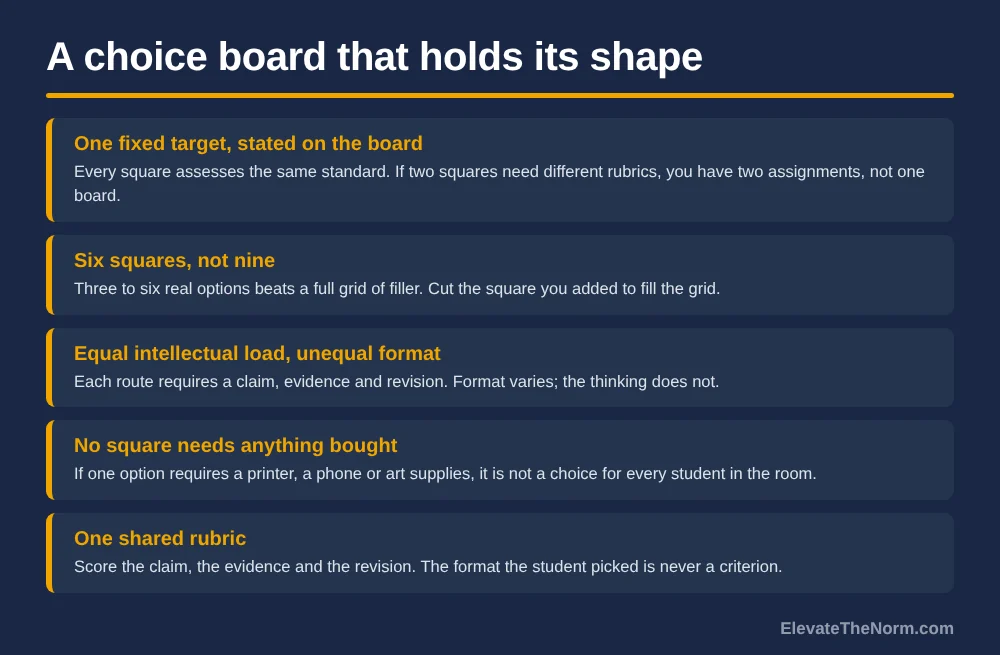
    Five-row graphic on choice board structure: one fixed target stated on the board, six squares rather than nine, equal intellectual load with unequal format, no square requiring anything bought, and one shared rubric
    Five structural rules that keep a choice board from becoming a menu of busywork.

    Work in this order.

    1. Write the target first, as a sentence, and put it on the board. “You will explain how two causes of the same event competed, using evidence from at least two sources.” Every square now has to serve that sentence.
    2. Write the rubric second — before the squares. If you can write one rubric that fairly scores every option you are imagining, the board is coherent. If you cannot, you have multiple assignments and you should pick one.
    3. Generate more squares than you need, then cut to six. The square you added to complete a 3×3 grid is almost always the weak one. Cut it. Nobody has ever complained about a board with five good options.
    4. A choice board does not replace an accommodation. If a student has a documented plan, that plan still governs, and “they could have picked a different square” is not compliance. Build the board, then check it against the plans you are responsible for. The same goes for multilingual learners: a choice of format is not a substitute for language support.
    5. Check every square for a hidden cost. Printing, poster board, a phone with a working camera, software at home, a quiet place to record. Any square carrying one of those is not a choice for every student in your room, and the students it excludes will not tell you.
    6. If a square involves recording, check the policy first. A video of a minor is not ordinary student work. Confirm your district’s rules, keep the file out of shared drives, and give students a non-recorded route that scores identically.
    7. Check that every route requires the same hard part. If the essay square demands a claim with evidence and the infographic square demands six facts in a nice layout, the board is a trap with a difficulty gradient and the students will find it before you do.

    Is a Choice Board the Same Thing as Differentiation?

    Not quite, and the difference is worth getting straight before a coach asks you about it.

    Differentiating by readiness means deliberately varying the difficulty of the work so students are each working at the edge of what they can do. A choice board as described here does the opposite — it holds difficulty constant and varies only the route. Those are two different designs and they pull against each other. If you build a board where one square is clearly easier, you have differentiated by readiness while calling it choice, and the predictable result is that the students who most need the hard version select the easy one.

    You can do both, but do them separately and say which you are doing. Vary the scaffolding — a sentence stem, a partially completed organizer, a model paragraph — while keeping the target and the criteria identical. That gets you readiness support without turning a choice into a difficulty setting. What you should not do is let a choice board quietly become the mechanism by which some students are assessed on less.

    Choice Board Examples for Grades 6–12

    These are structures rather than worksheets. Each row holds the target fixed and varies only the route.

    SubjectFixed targetOptions (pick one)Shared rubric scores
    Social studiesExplain how two causes of one event competed, using two sourcesWritten argument · recorded three-minute explanation · annotated timeline with a written claim · letter in the voice of a named historical figure, with a source noteClaim, use of evidence, accuracy, revision after feedback
    ELAArgue how one character’s choice changes the meaning of the endingEssay · podcast-style script · annotated passage set with commentary · alternate-ending scene plus a paragraph defending itClaim, textual evidence, reasoning, revision
    ScienceUse your data to make a recommendation and defend it against one objectionLab report · a chart plus a written interpretation · three-minute explanation to a non-scientist · a one-page brief for a named decision-makerClaim, data use, handling the objection, accuracy
    MathModel a real situation, then explain where your model breaks downWorked solution with written commentary · recorded walkthrough · comparison of two models with a recommendation · a problem you wrote plus its solutionCorrect modelling, reasoning, naming the limitation, precision
    Four choice boards for grades 6–12. One target per row, one rubric per row, format free.

    Notice what is absent: no square asks for a collage, a diorama, a song or a poster with a quotation on it. Those are not banned because they are creative. They are absent because none of them requires a claim defended with evidence, which is the fixed target in every row.

    What It Actually Costs You

    More prep the first time, more grading every time, and a real constraint if your department runs common assessments.

    I am not going to pretend this is free. Six different products take longer to grade than thirty copies of the same essay, because your eye never settles into a rhythm. Budget for that, or run choice boards on formative work and keep the common summative assessment uniform — which is also the answer if your department or district requires a common assessment for a unit. A pacing guide and a shared test are not obstacles to work around quietly; if the summative is fixed, put the choice earlier in the unit where it belongs anyway.

    The prep cost is front-loaded and non-recurring. Writing the target and the rubric before the squares takes one planning period. Piloting each square for time takes another. After that the board is reusable, and the second board for the same course takes about twenty minutes because you already have the shape.

    Grading a Choice Board Without Writing Nine Rubrics

    Score the target, not the product. Three to five criteria, identical across every option: the claim, the evidence, the reasoning, and the revision after feedback. The format the student picked is never a criterion.

    Say this to the class on the day you hand out the board, in these words: every square is graded on the same four things, so no option is an easier grade. Students assume the written square is safest because it is the one teachers usually reward. Until you say otherwise out loud, half the room will pick on grading superstition rather than on preference, and you will have measured nothing.

    Two failure modes worth naming. The first is scoring effort or creativity, which quietly rewards whoever had time and materials. The second is letting the format carry points — an infographic that looks professional scoring above an unformatted but sharper written argument. If a criterion cannot be applied to all six squares, delete it.

    The individual-and-group grading problem, which choice boards run into whenever students pick a collaborative option, is worked through in the project based learning rubric. The same rule applies: a criterion can describe collaboration, but it cannot rescue a grade from weak content.

    Where Choice Boards Go Wrong

    The most common failure is not a bad square. It is the teacher stepping back after handing out the board.

    Johnmarshall Reeve and Sung Hyeon Cheon, reviewing 38 randomized controlled trials of autonomy-supportive teaching, warn specifically that autonomy support gets misapplied as a laissez-faire style. The difference shows up at the moment a student struggles: an autonomy-supportive teacher takes the student’s perspective and supplies resources, while a laissez-faire teacher leaves them to figure it out. Their review reports that students of laissez-faire teachers show high amotivation and poor self-regulation. Giving choice and then going quiet is not the practice. It is the absence of it.

    Four more ways boards fail, all fixable:

    • The novelty square. Half the class picks the option that looks most fun and least like school, then discovers it is the hardest one. Pilot each square yourself for time before you offer it.
    • Choice paralysis. Students who spend a class period deciding have been given a decision without criteria. Say out loud which square is fastest and which goes deepest.
    • Same pick every time. A student who selects the written option for the ninth straight board is not exercising choice, they are avoiding risk. Require a different route once per quarter — that is still choice, with a floor.
    • The board instead of the teaching. A choice board is a delivery format. It does not teach a student how to write a claim. If nobody in the room can do the fixed target yet, the board is premature and you need the lesson first. The cheapest bridge is one worked exemplar — show a finished example on one route, and name which parts of it are the target rather than the format. Students transfer that to the other squares faster than they transfer a rubric.

    If engagement rather than format is the actual problem you are solving, the board may be the wrong tool entirely. Motivating students covers what tends to work when rewards and speeches have stopped working, and the choice-board-sized version of that answer is usually relevance, not more options.

    What to Do Next

    Take an assignment you already give, write its target as one sentence, and build three alternate routes to it that your existing rubric could score unchanged. Three. Not nine. Offer it once, watch which square gets picked and which gets avoided, and ask two students who picked the same square why.

    Send one line home with it, too: “Students chose how to present this; every option was graded on the same four criteria, and the standard did not change.” That sentence answers the only question a parent actually has when their kid submits a recording instead of an essay, and it answers it before they have to ask.

    Then keep the honest claim in your pocket for when someone asks: this raises willingness by a measured and modest amount, every route assesses the same standard, and it costs nothing. That is a good enough reason. It does not need “visual learners” propping it up.

    If you want the wider set of practices this sits inside — inquiry stations, seminars, peer critique, project roles — the guide to activities for student centered learning covers the whole family, with choice boards as one member of it.

    Frequently Asked Questions

    What is a choice board?

    A set of options, usually laid out as a grid, that each assess the same learning target through a different product or route. The teacher fixes the target and the criteria; the student picks the format. A board where the squares require different kinds of thinking is not a choice board — it is several different assignments printed on one page, and no single rubric will grade it fairly.

    Do choice boards actually improve learning?

    The evidence supports a motivation effect, not a learning effect. Patall, Cooper and Robinson’s meta-analysis of 41 studies found choice raised intrinsic motivation at d = 0.30 to 0.36. On subsequent learning the same analysis found d = 0.10 with a confidence interval of −0.02 to 0.21, which contains zero. A separate high school study did find a small unit-test gain, but it explained about 1.3 percent of the variance. Treat choice as a cheap way to raise willingness, not as an achievement strategy.

    How many options should a choice board have?

    Three to six. The meta-analysis found the strongest effects with two to four successive choices, with both single choices and excessive arrays doing worse. A nine-square grid is almost always three good options and six added to fill the shape. Cut the squares you invented for symmetry — nobody has ever complained about a board with five real choices.

    Are choice boards good for visual learners?

    Do not use that justification. Rogowsky, Calhoun and Tallal tested the learning-styles matching hypothesis directly and found no support for it — matching instruction to an auditory or visual preference had no effect on achievement. Their sample was 125 fifth graders in one school, so read it alongside the wider literature rather than as the final word. Use the better argument: a real choice raises willingness by a measured amount, and every route assesses the same standard. That one survives a conversation with an administrator.

    How do you grade a choice board?

    With one rubric that applies identically to every square: typically the claim, the evidence, the reasoning, and the revision after feedback. The format the student chose is never a criterion. If a criterion cannot be applied to all the options, delete it. And tell the class out loud that every square is graded on the same things, or students will pick on grading superstition rather than preference.

    Is a choice board the same thing as differentiation?

    No, and they can work against each other. Differentiating by readiness varies the difficulty of the work; a choice board holds difficulty constant and varies only the route. If one square is visibly easier, the students who most need the harder version will choose the easier one. Do both if you want, but keep them separate: vary the scaffolding — sentence stems, partial organizers, a worked model — while the target and the criteria stay identical.

    What if a student picks the same option every time?

    That is usually risk avoidance rather than preference, and it is worth naming without punishing. Requiring a different route once a quarter is still choice, just with a floor under it. It also tells you something: a student who will only write may need a low-stakes rehearsal of another format before they will risk it on a graded one.

    Do choice boards take more work than a normal assignment?

    Yes, and it is worth being honest about where. Six different products take longer to grade than thirty copies of the same essay because your eye never settles into a rhythm. The prep cost — writing the target and the rubric before the squares, then timing each option yourself — is front-loaded and does not recur; the second board for the same course takes about twenty minutes. If your department runs a common summative assessment, put the choice earlier in the unit rather than working around the shared test.

    Sources

    1. Patall, E. A., Cooper, H., & Robinson, J. C. (2008). The Effects of Choice on Intrinsic Motivation and Related Outcomes: A Meta-Analysis of Research Findings. Psychological Bulletin, 134(2), 270–300. 41 studies, 46 samples, 91 effect sizes; intrinsic motivation d = 0.30 (fixed) / 0.36 (random); subsequent learning d = 0.10, 95% CI −0.02 to 0.21 — not different from zero; strongest with 2–4 successive choices; weaker when rewards were present; stronger for children than adults; instructionally irrelevant choices produced stronger effects than choices between task versions. https://selfdeterminationtheory.org/wp-content/uploads/2019/10/2008_PatallCooperRobinson_PsychBulletin.pdf
    2. Patall, E. A., Cooper, H., & Wynn, S. R. (2010). The Effectiveness and Relative Importance of Choice in the Classroom. Journal of Educational Psychology. Within-subjects experiment, 207 students, 14 classrooms, two urban high schools. Interest/enjoyment β = 0.22 (p < .01); perceived competence β = 0.19 (p < .05); unit test β = 2.56 (p < .05); homework completion marginal (p < .10). No significant effect on perceived effort, task value or pressure, and each significant effect explained 1–4.3 percent of variance. https://selfdeterminationtheory.org/wp-content/uploads/2019/10/2010_PatallCooperWynn_JEP.pdf
    3. Katz, I., & Assor, A. (2007). When Choice Motivates and When It Does Not. Educational Psychology Review, 19(4), 429–442. Choice supports motivation only when options are relevant to students’ interests and goals, fit their competence (not too numerous or complex, not too easy), and are congruent with family and cultural values. “Merely offering choice is not in itself motivating. In fact, in some cases it can even reduce motivation.” https://selfdeterminationtheory.org/wp-content/uploads/2014/04/2006_Katz-et-al_when-choice.pdf
    4. Reeve, J., & Cheon, S. H. (2021). Autonomy-Supportive Teaching: Its Malleability, Benefits, and Potential to Improve Educational Practice. Educational Psychologist. Review of 38 randomized controlled trials. Warns explicitly that autonomy support is mis-applied as a laissez-faire style, and that students of laissez-faire teachers report high amotivation and poor self-regulation. Reported student effect sizes ranged widely, from d = 0.18 to d = 2.92. https://selfdeterminationtheory.org/wp-content/uploads/2021/05/2021_ReeveCheon_AutonomySupportive.pdf
    5. Rogowsky, B. A., Calhoun, B. M., & Tallal, P. (2020). Providing Instruction Based on Students’ Learning Style Preferences Does Not Improve Learning. Frontiers in Psychology, 11:164. No support for the matching hypothesis. Sample: 125 fifth graders (ages 10–11) in one rural Pennsylvania public school — below this site’s grades 6–12 band. Cites Dekker et al. (2012) finding 93 percent of UK and 96 percent of Dutch teachers endorsed the learning-styles claim. https://www.frontiersin.org/journals/psychology/articles/10.3389/fpsyg.2020.00164/pdf
    About Clay Shumate

    Clay Shumate is a certified secondary Social Studies teacher in the public schools of West Alabama, with seven years of classroom experience, a B.A. in History, and an M.Ed. in Secondary Education. He writes about project-based learning, student responsibility, respect, and practical ways to hold young people to a higher standard while giving them room to learn from mistakes. He is a member of the Society of Professional Journalists and writes to its Code of Ethics; this site’s editorial standards and corrections policy are published in full. More about Clay.

  • Motivating Students Who Don’t Care Without Lowering the Standard

    Motivating Students Who Don’t Care Without Lowering the Standard

    By Clay Shumate

    Motivating students who don’t care starts with questioning the assumption. Most students labeled “unmotivated” are not indifferent — they are protecting themselves from failure, irrelevance, or a classroom that has already told them they do not belong. The fix is not enthusiasm or entertainment. It is competence, relevance, relationship, and a standard worth rising to.

    What “Not Caring” Actually Means

    A student who puts their head down, turns in nothing, shrugs when you ask a question, or disrupts every transition looks like someone who does not care. That is what makes this problem so frustrating — the visible behavior and the internal reality rarely match.

    Research on learned helplessness, first described by Martin Seligman and now studied specifically in adolescent populations, shows that students who repeatedly experience failure without a clear path to improvement eventually stop trying — not because they lack desire, but because effort has not produced results before and they see no reason to believe it will now. A 2026 longitudinal study by Chang and colleagues, published in the Journal of Research on Adolescence, tracked this trajectory in adolescent students and found that learned helplessness increases over time when students experience controlling rather than autonomy-supportive environments.

    Carol Goodenow’s foundational 1993 research on school belonging found a direct link between students’ sense of belonging in a classroom and their academic motivation. Urban adolescents who felt they did not belong reported lower motivation and engagement strategies even when they had the ability to succeed. The research is clear: belonging is not a soft skill. It is a precondition for effort.

    So when a student looks like they do not care, start with three questions before you decide what to do:

    1. Has this student experienced enough success in your class to believe more is possible?
    2. Does this student see a connection between what you are asking them to do and anything that matters to them?
    3. Does this student believe that you — specifically you — will follow through on what you say?

    If the answer to any of those is no, you have found your starting point. And it is not a motivational speech.

    Why the Usual Fixes Make It Worse

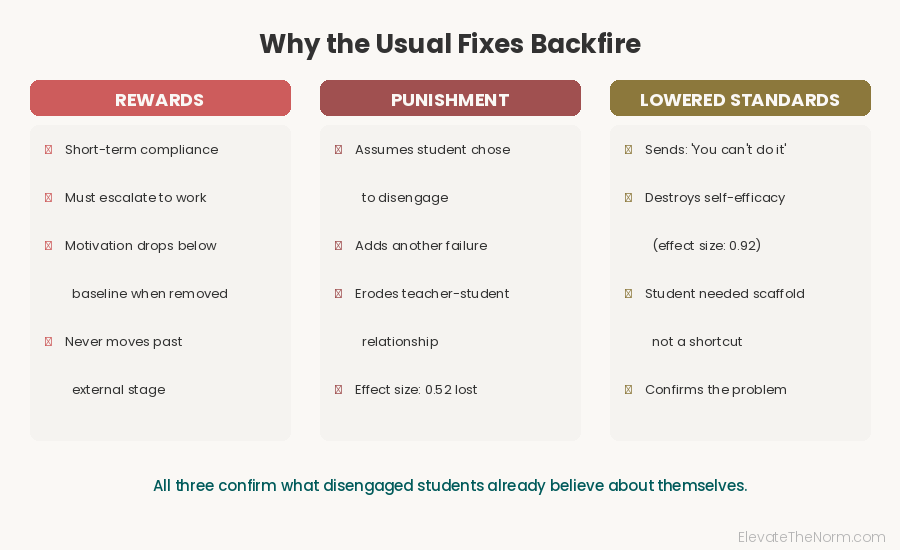
    Rewards Lose Power

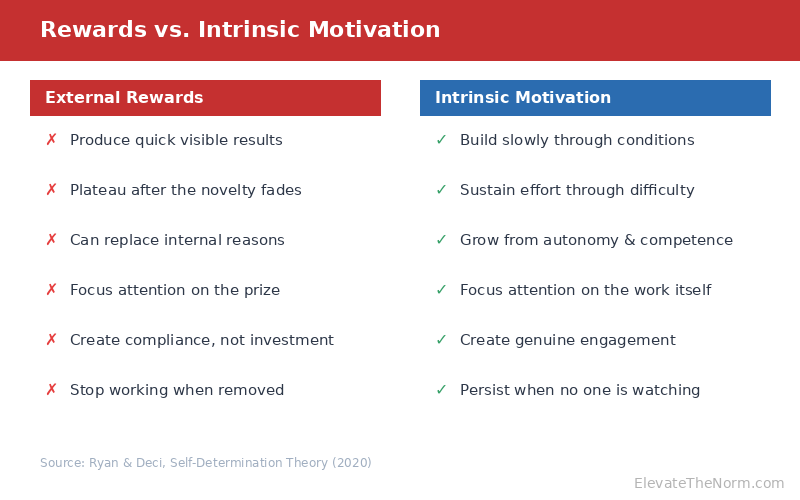
    External rewards work in the short term. A pizza party will get homework turned in for a week. But decades of research on self-determination theory, led by Edward Deci and Richard Ryan, demonstrates that extrinsic motivation follows a predictable pattern: the reward must escalate to maintain the same effect, and when it disappears, motivation drops below where it started.

    Deci and Ryan identified four types of extrinsic motivation along a continuum from fully external (doing something to avoid punishment or earn a reward) to integrated (doing something because it aligns with who you are). Most classroom reward systems never move students past the first stage. They produce compliance, not motivation. And compliance disappears the moment the reward does.

    Why rewards punishment and lowered standards backfire for disengaged students showing three columns of failed strategies
    Three common approaches to student disengagement that make the problem worse

    Punishment Backfires

    Punishing a student for not caring — zeroes, detention, calls home, public redirection — assumes the student has chosen not to engage and can be pressured into changing that choice. For a student dealing with learned helplessness, fear of failure, or a home life that makes school feel irrelevant, punishment adds another failure to the pile. John Hattie’s meta-analyses of educational research show that teacher-student relationships carry an effect size of 0.52 on student achievement — a correlation rather than a proven cause, which is how these numbers are best read. Punishment does not build relationships. It erodes them.

    Lowered Standards Confirm the Problem

    This is the trap that well-meaning teachers fall into most often. A student is struggling, so you shorten the assignment, remove the hard parts, or accept work you know is not their best. You do this out of compassion. But the student reads it differently: you do not think I can do it either.

    Hattie’s research on self-efficacy — a student’s belief in their own ability to succeed — shows an effect size of 0.92, one of the highest in the entire database. Lowering the standard does not raise self-efficacy. It destroys it. The student needed a scaffold, not a shortcut.

    What Actually Works: Competence, Relevance, and Relationship

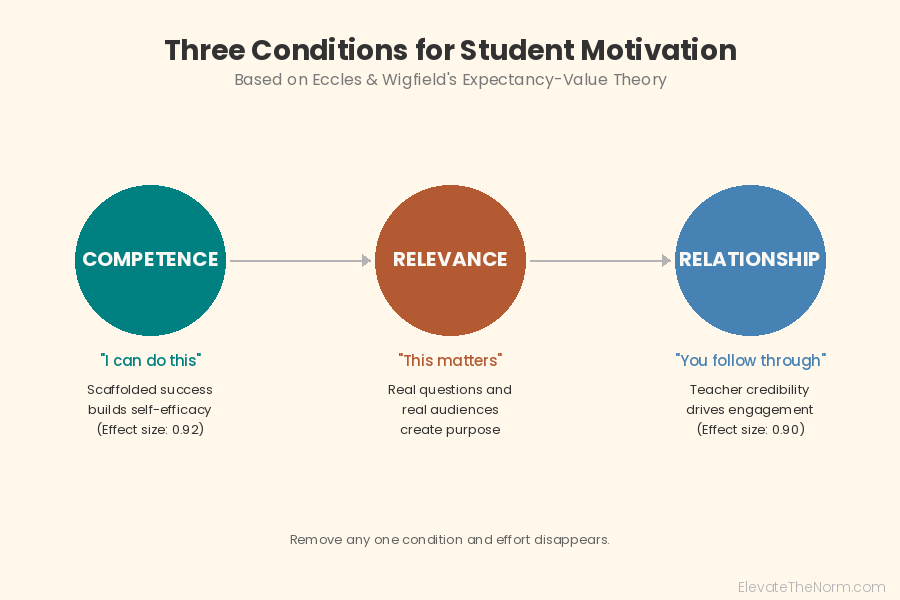
    Eccles and Wigfield’s expectancy-value theory provides a useful framework here. Students are motivated when two conditions are met: they expect they can succeed at the task, and they value the outcome. Remove either one and effort disappears. A student who thinks they can do the work but sees no point will not try. A student who sees the point but believes they will fail will not try either.

    This means motivation is not one fix. It is at least two — and usually three.

    Three conditions for student motivation based on expectancy value theory showing competence relevance and relationship
    Three conditions for student motivation based on Eccles and Wigfield’s expectancy-value theory

    Competence: They Need to Believe They Can

    This comes first because nothing else matters without it. A student who has failed repeatedly in your subject has built a story about themselves: I am not good at this. You cannot talk them out of that story. You have to give them evidence that it is wrong.

    That means:

    • Assign work they can complete successfully today, then raise the bar tomorrow. Not easier work — appropriately scaffolded work. The task stays rigorous. The entry point becomes accessible.
    • Give feedback that points forward, not backward. “This paragraph needs a stronger claim — here is what a strong one sounds like” beats “This is incomplete” every time. Hattie’s data shows feedback carries an effect size of 0.70 when it is specific, timely, and actionable.
    • Let them revise. A student who turns in weak work and gets a permanent grade has no reason to improve. A student who turns in weak work and gets a chance to make it better has a reason to try.

    Relevance: They Need a Reason

    “When will I ever use this?” is not a complaint. It is a genuine question, and if you cannot answer it, the student is right to ask.

    Relevance does not mean every lesson needs a TikTok hook. It means the work connects to something real — a question worth answering, a problem worth solving, a product someone will actually see.

    During project check-ins in my room, I pull students to the whiteboard table one group at a time. They have to show me what they have and explain why they made the choices they made. I am not grading their progress. I am asking them to defend it. And what I have noticed is that the students who checked out during a textbook reading will fight for a project they chose. Not because the project is fun — sometimes it is not — but because it is theirs. They picked the question. They have to stand behind the answer. That ownership changes the math on whether effort is worth it.

    Relationship: They Need an Adult Who Follows Through

    Teacher credibility — whether a student believes you are competent, trustworthy, and caring — carries an effect size of 0.90 in Hattie’s research. That is not a small number. It means a student’s perception of you as a teacher matters almost as much as anything you actually teach.

    But relationship does not mean being liked. It means being consistent. If you say you will look at their work, look at it. If you say there is a consequence, follow through. If you say you believe they can do it, prove it by holding them to the standard instead of quietly lowering it.

    Niemiec and Ryan’s 2009 review of self-determination theory in education found that students assigned to autonomy-supportive teachers — teachers who explained the purpose behind assignments, offered genuine choices, and acknowledged students’ perspectives — showed increased intrinsic motivation, perceived competence, and self-esteem compared to students with controlling teachers. Autonomy support is not a personality trait. It is a set of behaviors. And it can be learned.

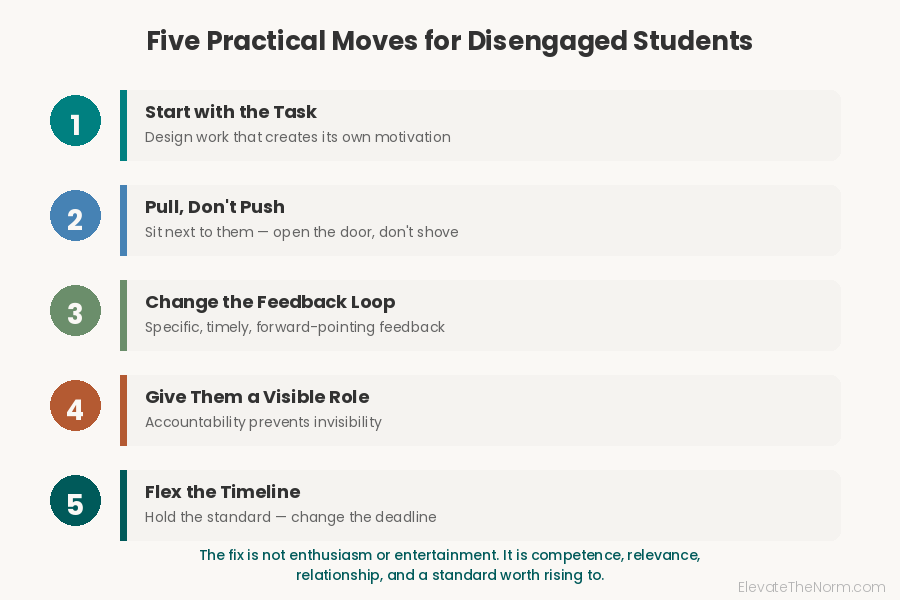
    Five Practical Moves for Your Classroom

    Five practical classroom moves for motivating disengaged students including task design feedback and timeline flexibility
    Five practical moves teachers can use to re-engage students who appear not to care

    1. Start with the Task, Not the Motivation

    Stop trying to motivate students before the work begins. Instead, design work that creates its own motivation. A project with a real audience and a real deadline does not need a pep talk. A worksheet that will be graded and returned does.

    2. Pull Them In — Do Not Push Them Forward

    When a student is disengaged, the instinct is to push: more reminders, louder redirections, calls home. Try pulling instead. Sit next to them. Ask what they are working on. Ask what part is confusing. Ask what they would change about the assignment if they could. You are not lowering the bar. You are opening the door.

    3. Change the Feedback Loop

    If the only feedback a disengaged student receives is a grade, they have no reason to change their behavior. Move feedback earlier in the process and make it specific:

    • “Your first two sentences set up a strong argument. The third one contradicts it — read it again and see if you catch why.”
    • “You have the right data. Your conclusion does not match it yet. Try again.”
    • “This is better than last week. Here is what will make it better than this.”

    4. Give Them a Role They Cannot Disappear From

    In group work, a disengaged student will drift to the margins unless the structure prevents it. Assign specific roles with visible accountability: the person who presents, the person who defends the data, the person who fields questions. When the work has their name on it, invisibility stops being an option.

    5. Separate the Standard from the Timeline

    Some students disengage because they have missed so much that catching up feels impossible. Let them redo work. Let them turn things in late with a conversation about what happened. Hold the quality standard. Flex the timeline. This is not lowering expectations. It is acknowledging that learning does not always follow a schedule.

    A note on this: your school likely has a grading policy, and you need to work within it. If your district has a strict late-work penalty, talk to your administrator about exceptions for specific students before you promise flexibility you cannot deliver. The principle — standard stays, timeline flexes — is sound. How much flex you have depends on your building. Do not make promises your gradebook cannot keep.

    What You Cannot Control — And Why That Matters

    Not every disengaged student is responding to something in your classroom. Poverty, trauma, food insecurity, unstable housing, family conflict, undiagnosed learning differences — these are real, and they affect motivation in ways a well-designed project cannot fix.

    You are not a therapist. You are not a social worker. You are a teacher. Your job is to make your classroom the kind of place where effort makes sense — where the standard is high, the support is real, and the relationship is honest. For some students, that will be enough. For others, it will be one piece of a much larger puzzle that involves counselors, families, community resources, and time.

    Do not blame yourself when a student does not respond. But do not stop trying either. Some turns take weeks. Some take months. Some happen long after they leave your room, and you never hear about it.

    Before You Assume Poverty Means Disengagement

    One more thing. I have worked in high-poverty schools my entire career, and I need to say this plainly: your students’ zip code does not predict their motivation. Research by Bloem and colleagues, published in Social Psychology of Education in 2024, found that teachers in lower-SES schools gave students less autonomy support and more controlling behavior — and that the gap widened among teachers who held biased attitudes toward low-income families. The problem was not the students. It was what the adults assumed about them.

    Students in a Title I school want recognition. They want to be trusted with responsibility. They want to communicate with each other and work on something that matters. The need is universal. The assumption that poor kids need control instead of relationship is not supported by the evidence, and it does real damage.

    Conclusion

    Motivating students who don’t care is not about finding the right trick. It is about diagnosing what killed the motivation in the first place — usually some combination of repeated failure, irrelevant work, and adults who did not follow through — and then rebuilding the conditions that make effort feel worth it. That means scaffolded competence, genuine relevance, honest relationships, and a standard that stays high even when the path to meeting it changes.

    Start with the student in front of you. Find out what they can do today. Show them what they could do tomorrow. And then hold them to it.


    How do I motivate a student who literally will not do any work?

    Start smaller than you think you need to. Find one task they will engage with — even a short one — and build from there. A student who completes one thing successfully is closer to completing two than a student who has completed nothing for weeks. Sit with them. Ask what the barrier is. Sometimes the answer is ‘I do not understand the directions.’ Sometimes it is bigger than that, and you need to loop in a counselor or support team.

    Is it okay to give students a choice in what they work on?

    Yes, and research supports it. Deci and Ryan’s self-determination theory shows that genuine choice — not the illusion of choice between two identical tasks — increases intrinsic motivation. The key word is genuine. Letting students choose their topic within a framework is meaningful. Letting them choose between worksheet A and worksheet B is not.

    Should I call home when a student is disengaged?

    It depends on the relationship and the home situation. For some students, a positive call home — ‘I noticed your child contributed a strong idea today’ — builds a bridge. For others, any call home triggers consequences that make school feel less safe, not more. Know your students before you pick up the phone, and lead with something they did well whenever possible.

    What about students with IEPs or 504 plans who seem disengaged?

    Some disengagement is disability-related, and the strategies here still apply — but with an additional layer. If a student has an IEP or 504, their accommodation plan may already address some of the barriers described in this article. Work with your special education team to make sure your scaffolding, timeline flexibility, and feedback approaches align with the plan rather than duplicating or contradicting it. Disengagement in a student with a learning difference may look identical to disengagement from a student without one, but the causes and appropriate responses can differ. When in doubt, consult the team before changing your approach.

    What if the student is dealing with issues outside school that I cannot fix?

    You cannot fix them, and you should not try to. But you can make your classroom a place where those issues do not get worse. Consistent routines, clear expectations, honest follow-through, and a teacher who does not give up — those things matter even when you cannot see the result immediately. Refer to counselors and support staff when you notice patterns that are beyond your scope.

    Does project-based learning help with disengaged students?

    It can, because PBL creates the conditions research shows drive motivation — autonomy, relevance, public accountability, and visible competence. But PBL alone is not a magic fix. A disengaged student placed in a group project without scaffolding and clear roles will simply disengage from the project instead of the worksheet. The structure matters as much as the format.

    How do I keep my standards high without pushing disengaged students further away?

    Separate the standard from the timeline and the entry point. The quality of work you expect stays the same. The amount of support you provide, the deadline flexibility you offer, and the way you scaffold the first attempt can all change. A student who turns in a rough draft and revises it three times has met the same standard as the student who nailed it the first time — they just took a different path to get there.

    Is student disengagement getting worse?

    National survey data suggests engagement has declined, particularly after 2020. But disengagement is not new — Goodenow was studying it in 1993, and Seligman described learned helplessness decades before that. What has changed is the visibility. Students who once sat quietly and did the minimum now have phones, social media, and more exit ramps. The underlying needs — competence, belonging, relevance — have not changed at all.


    Sources

    1. Deci, E. L., & Ryan, R. M. (2000). “Intrinsic and Extrinsic Motivations: Classic Definitions and New Directions.” Contemporary Educational Psychology, 25(1), 54–67.
    2. Niemiec, C. P., & Ryan, R. M. (2009). “Autonomy, Competence, and Relatedness in the Classroom: Applying Self-Determination Theory to Educational Practice.” Theory and Research in Education, 7(2), 133–144.
    3. Goodenow, C. (1993). “The Psychological Sense of School Membership Among Adolescents: Scale Development and Educational Correlates.” Psychology in the Schools, 30(1), 79–90.
    4. Hattie, J. (2023). Visible Learning: The Sequel. Routledge.
    5. Chang, Y., et al. (2026). “The Longitudinal Trajectory of Learned Helplessness Among Adolescent Students: The Role of Parental Autonomy Support and Control.” Journal of Research on Adolescence.
    6. Bloem, N., et al. (2024). “Teachers’ Autonomy Support and Control Toward Lower- and Higher-SES Students.” Social Psychology of Education.
    7. Eccles, J. S., & Wigfield, A. (2002). “Motivational Beliefs, Values, and Goals.” Annual Review of Psychology, 53, 109–132.

    About Clay Shumate

    Clay Shumate is a certified secondary Social Studies teacher in the public schools of West Alabama, with seven years of classroom experience, a B.A. in History, and an M.Ed. in Secondary Education. He writes about project-based learning, student responsibility, respect, and practical ways to hold young people to a higher standard while giving them room to learn from mistakes. He is a member of the Society of Professional Journalists and writes to its Code of Ethics; this site’s editorial standards and corrections policy are published in full. More about Clay.

  • Activities for Teaching Responsibility to Middle and High School Students

    Activities for Teaching Responsibility to Middle and High School Students

    By Clay Shumate

    The best activities for teaching responsibility to middle and high school students give students something to actually own, not a lecture about character. Below are ten activities built around real ownership, structured reflection, and clear repair after mistakes, sequenced from ones you can add to a class you already run to ones that take more trust to pull off. Before selecting activities, it helps to clarify what you are building—the article on what is student responsibility offers a definition that distinguishes genuine ownership from simple compliance.

    Key Takeaways

    • Responsibility is a practiced behavior, not a character trait you either have or lack. Adolescents develop it through repeated opportunities to own tasks, meet deadlines, and deal honestly with what happens when they fall short.
    • The best responsibility activities for secondary students involve real stakes within safe boundaries — meaning the work matters, but a failure does not destroy a student’s standing or grade.
    • Self-regulation research confirms that adolescents benefit most from structured responsibility practice paired with warm, responsive adult relationships (Murray & Rosanbalm, 2017).
    • Reflection is where responsibility actually grows. An activity without a reflection step is just compliance — the student did the thing but never examined why it mattered.
    • Repair after mistakes is the hardest part to teach and the most important. It requires activities that go beyond “say sorry” and into “what do you owe, to whom, and by when?”

    Why Activities — Not Lectures — Teach Responsibility

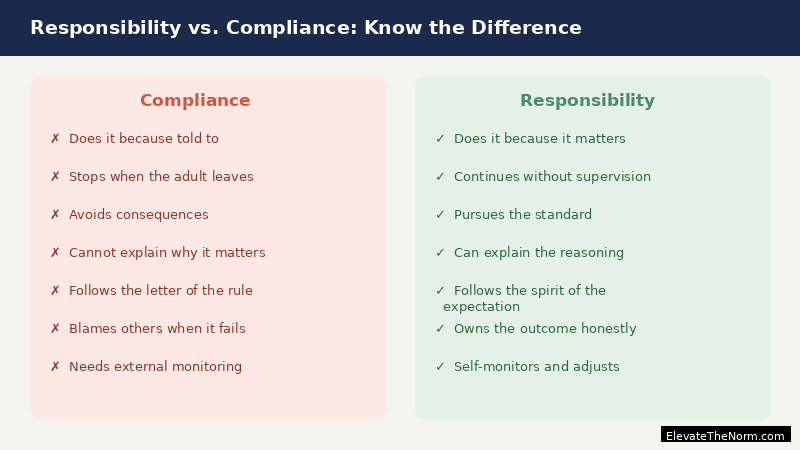
    Most educators agree that responsibility matters. The disagreement is about how it develops. One approach treats responsibility as a character trait: talk about it, model it, hope students absorb it. The other approach treats responsibility as a skill: design situations where students practice it, receive feedback, and try again.

    Comparison showing the difference between teaching responsibility and teaching compliance, with responsibility involving genuine choice and self-assessment while compliance involves following rules without reflection
    Responsibility internalizes through genuine choice and honest reflection — not through compliance alone.

    The research supports the second approach. Self-determination theory, developed by Deci and Ryan and applied extensively in educational settings, identifies autonomy, competence, and relatedness as the three psychological needs that drive internalized motivation (Ryan & Deci, 2020). Responsibility does not internalize through compliance — it internalizes when students experience genuine choice, see evidence of their own competence, and feel connected to the people holding them accountable. Understanding what actually motivates students is the foundation for designing responsibility activities that work.

    That is what the activities below are designed to create. Each one gives students something real to own, a clear standard to meet, a structure for reflection when they fall short, and a path back after a mistake.

    Activities That Build Responsibility Through Real Ownership

    1. The Deadline Choice Contract

    Instead of assigning a single due date, give students a planning window. They choose when to submit — within a defined range — and commit to that date in writing. If they meet their chosen deadline, the work is graded normally. If they miss it, they complete a brief reflection: what happened, what they would change, and what their revised deadline is.

    Why it works: It shifts the locus of control. The teacher is no longer the person imposing the deadline — the student chose it. Missing it becomes a broken commitment to themselves, not just a rule violation.

    What to watch: Some students will choose the latest possible date every time. That is fine. The skill is making a plan and keeping it, not choosing the earliest date to impress the teacher.

    2. The Group Role Rotation

    Assign clear, named roles within group work — timekeeper, recorder, quality checker, presenter — and rotate them across projects. Each role comes with specific deliverables. After each project, every student writes a one-paragraph self-assessment of how they handled their role, and the group writes a brief evaluation of how the rotation worked.

    Why it works: Named roles with deliverables make responsibility visible. A student who was the quality checker either caught errors or did not — there is evidence. The rotation prevents students from hiding in the same comfortable role every time. The same logic scales past group work: a role is only worth assigning when the student controls something real.

    What to watch: Do not let the “quality checker” role become a way for strong students to redo weak students’ work. The role checks quality and identifies problems — it does not fix them for the other person.

    Naming what the role is meant to develop keeps that line clear. Our breakdown of what a leadership skill is, as opposed to a personality trait gives you the observable behaviour for each one, which is also the fairest way to grade a role.

    3. The Missing-Work Conversation

    When a student misses an assignment, replace the zero-and-move-on approach with a structured conversation. The student answers three questions in writing before the conversation: What was the assignment? What got in the way? What is your plan to complete it?

    This is not optional and it is not a punishment. It is the practice of taking responsibility for an incomplete obligation.

    Why it works: It requires the student to acknowledge the gap honestly and propose a solution — two components of genuine responsibility that a zero on a gradebook never teaches.

    What to watch: Keep it brief and private. This is a five-minute conversation at the whiteboard table, not a public interrogation. The goal is a plan, not a confession. And account for circumstances beyond the student’s control — transportation problems, family obligations, lack of internet access at home, or a job that keeps them up late. The conversation should distinguish between a student who chose not to do the work and a student who could not. Both need a plan. Only the first needs a conversation about choices.

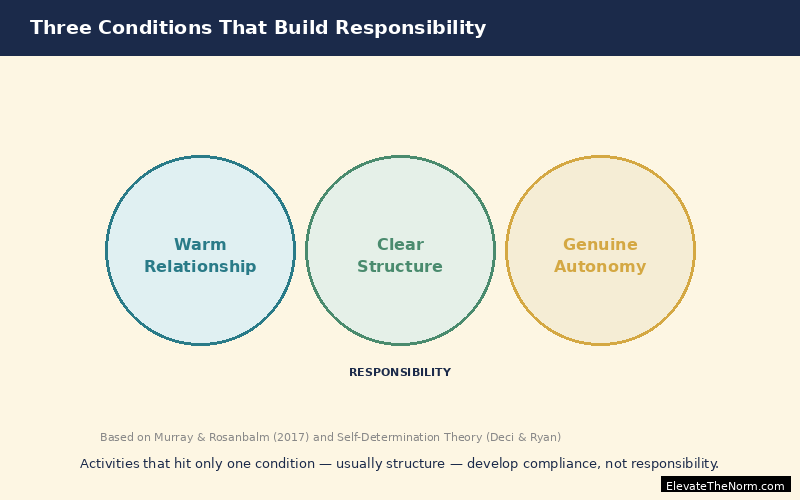
    Diagram showing the three conditions research identifies for building adolescent responsibility: warm adult relationships, structured environment with clear expectations, and genuine autonomy within structures
    Self-regulation research identifies three conditions that help adolescents build genuine responsibility.

    4. The Repair Letter

    After a significant behavioral incident — not every small disruption, but the ones that damage trust or affect other students — ask the student to write a letter addressing three things: what happened (facts, not excuses), who was affected and how, and what they will do differently. The letter is not graded. It is reviewed by the teacher, discussed, and then the incident is considered addressed.

    I use this after repair conversations in my room. When something goes wrong — when a student lets a group down, or says something they should not have — we sit down and talk about what is owed, to whom, and by when. The letter is the student’s record of that conversation. It matters because writing it requires them to articulate what they are taking responsibility for, not just nod and leave. The repair process connects directly to the broader idea of helping students learn from their mistakes rather than simply penalizing them.

    Why it works: It connects behavior to impact. Most adolescents are not trying to cause harm — they are impulsive, reactive, or unaware. The letter forces awareness without humiliation.

    What to watch: Never require a forced apology. The letter should be honest. If a student genuinely believes they were not wrong, the conversation that follows the letter is more useful than the letter itself. And be clear: a repair letter does not replace required school discipline documentation. If your school policy requires an incident report, a referral, or a parent contact for the behavior in question, complete those first. The repair letter is an addition to the process, not a substitute for it.

    5. The Project Check-In Protocol

    For any multi-day assignment or project, build in structured check-ins where the student — not the teacher — reports on progress. The format is simple: What have I done? What is next? What am I stuck on?

    During check-ins, the student explains their choices and defends their decisions. “I chose to focus on the primary source analysis first because…” is more useful than a teacher looking over a shoulder and saying “You’re behind.”

    Why it works: It practices the professional skill of giving a progress report — something adults do constantly and students almost never practice. It also creates a record: if a student says “I’m on track” at the check-in and then is not on track at the deadline, the gap between their self-assessment and their output becomes the teaching moment.

    What to watch: Do not turn check-ins into micromanagement. The point is for the student to report and reflect, not for the teacher to direct every decision.

    6. The Self-Assessment Before the Grade

    Before returning a graded assignment, have students assess their own work against the rubric. They predict their score, identify their strongest section, and name one area where they fell short. Then they receive the actual grade and compare.

    Why it works: Self-assessment accuracy is a metacognitive skill directly tied to responsibility. Students who consistently overestimate their work are not being arrogant — they are not seeing their own gaps. Students who consistently underestimate may not be recognizing their own competence. Either pattern is worth a conversation.

    What to watch: This works best with a clear, student-friendly rubric distributed before the assignment. If students do not know what “proficient” looks like in advance, the self-assessment is just guessing.

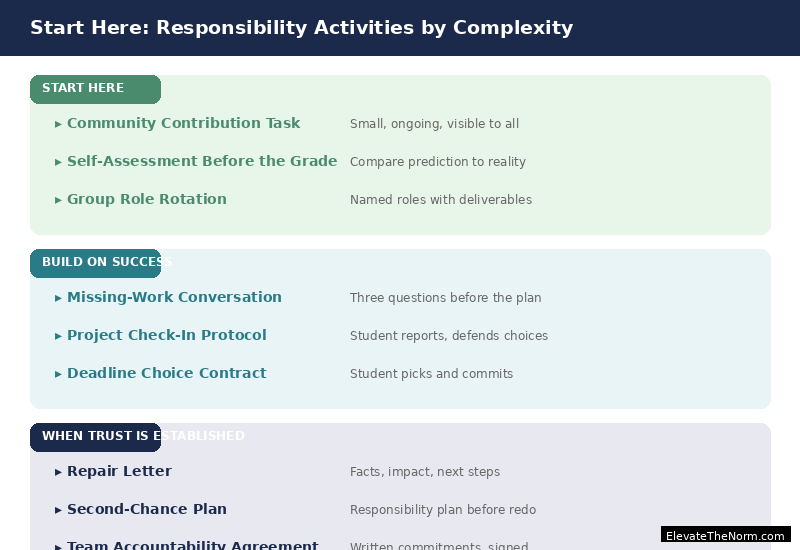
    Chart organizing ten responsibility activities by complexity level from simple to advanced, showing which work best for middle school versus high school students
    Start with two or three activities and add more as you and your students get comfortable.

    7. The Responsibility Debrief

    At the end of a unit, project, or quarter, students write a responsibility reflection: What commitment did I keep this unit? What commitment did I break? What did I learn about how I work? What will I do differently next time?

    Why it works: It normalizes honest self-evaluation. Most schools give students grades but never ask them to reflect on the habits that produced those grades. The debrief is where students connect effort to outcome — or more importantly, connect avoidance to outcome.

    What to watch: Students will write what they think you want to hear unless you make it clear that honesty is valued more than optimism. Share your own example if you can: a time this semester when you planned poorly, fell behind, and had to adjust.

    8. The Team Accountability Agreement

    Before any group project, each team writes a brief agreement: what each person is responsible for, when each piece is due, what happens if someone does not deliver, and how the group will handle conflict. The agreement is signed and kept by the teacher.

    Why it works: It front-loads responsibility instead of back-loading blame. When a group falls apart — and some will — the agreement provides a reference point for a conversation that is about commitments, not feelings.

    What to watch: Do not let the “what happens if someone does not deliver” section become punitive. The healthiest answer is usually “We have a conversation and make a plan” — not “They get a zero.” Effective classroom consequences are always about what comes next, not just what went wrong.

    9. The Community Contribution Task

    Assign each student a real, ongoing responsibility that serves the class: maintaining the supply station, updating the assignment board, organizing returned work, or keeping the shared digital folder clean. The task is small, consistent, and visible.

    Why it works: It gives students a piece of the room to own. Not a pretend ownership — an actual, ongoing responsibility where others notice if it does not get done. The student is not doing it for a grade. They are doing it because the room needs it done.

    What to watch: Rotate tasks quarterly so the same students do not get stuck with the least appealing jobs. And acknowledge it when it is done well — not with a reward, but with a thank-you that names what they contributed.

    10. The Second-Chance Plan

    When a student bombs an assignment or test, offer a structured second attempt. The catch: before they can redo the work, they must complete a responsibility plan. What happened the first time? What will they do differently? What specific support do they need? They submit the plan, the teacher approves it, and then they redo the work.

    Why it works: It separates the failure from the identity. “You failed this assignment” is a fact. “You are a failure” is a conclusion students draw when there is no path forward. The second-chance plan keeps the standard high — you still have to meet it — while making the path back visible.

    What to watch: Set a clear window for the redo. “Whenever you get around to it” is not a plan — it is an invitation to never complete it. A deadline on the redo teaches the same skill as the original deadline.

    How Responsibility Activities Fail (and How to Prevent It)

    The most common failure is not the activities themselves — it is the gap between the activity and the follow-through.

    Responsibility activities fail when teachers assign them but do not follow up on the reflections. They fail when the consequences for not completing a responsibility task are identical to the consequences for not completing any other assignment — a zero in the gradebook. And they fail when the activities are age-inappropriate, making teenagers feel like they are being managed rather than developed.

    Research on adolescent self-regulation confirms that young people build responsibility most effectively when three conditions are present: a warm relationship with the adult holding them accountable, a structured environment where classroom expectations are clear, and genuine autonomy within those structures (Murray & Rosanbalm, 2017). Activities that check all three boxes develop responsibility. Activities that hit only one — usually structure — develop compliance.

    Before You Start: Tell Families What You Are Doing

    Responsibility activities work best when families understand the framework. Early in the year — ideally before the first missed assignment or behavioral conversation — communicate to parents and guardians what your classroom responsibility process looks like: that students will be asked to reflect on missed work rather than simply receive zeros, that repair conversations focus on what is owed rather than punishment, and that second chances come with plans attached. A family that understands the system can reinforce it. A family that encounters it only when their child is in trouble will question it.

    What Teaching Responsibility Actually Looks Like Day to Day

    It looks like follow-through. It looks like a teacher who says “I will check your progress on Thursday” and then checks on Thursday. It looks like a room where a student who missed a deadline has a conversation — not a lecture, not a zero entered silently — about what happened and what comes next.

    It also looks like grace. Not the kind of grace that eliminates standards, but the kind that maintains them while holding the door open. A student who writes an honest responsibility reflection about why they did not finish a project — and then finishes it — has learned more about responsibility than a student who met every deadline without ever having to recover from a miss.

    The goal is not to produce students who never fail. It is to produce students who know what they owe when they do. For a deeper look at how teaching responsibility connects to broader classroom culture, and the research behind why student responsibility is a skill rather than a trait, those articles explore the framework in more detail.


    At what age should responsibility activities start in school?

    Responsibility activities should be developmentally appropriate at every grade, but the version described here — involving self-assessment, planning, written reflection, and repair — is designed for grades 6–12. Middle schoolers can handle simpler versions (the community contribution task, the group role rotation). High schoolers can handle the full range, including the deadline choice contract and the second-chance plan. The key is matching the complexity of the activity to the student’s capacity for abstract thinking and self-reflection.

    How do you teach responsibility without making it feel like a punishment?

    By separating the activity from consequences. A repair letter is not a punishment — it is a process for honest self-examination. A second-chance plan is not a penalty — it is a structured path to improvement. The tone of the teacher matters more than the structure of the activity. If you approach a responsibility conversation with curiosity (“What happened?”) rather than judgment (“Why didn’t you…?”), students are more likely to engage honestly.

    What if a student refuses to participate in a responsibility activity?

    Start with a private conversation. Ask what is getting in the way. Sometimes refusal is about the activity; sometimes it is about something else entirely. If the student still refuses after the conversation, document the refusal and follow your classroom or school procedure — but do not abandon the expectation. The activity stands. The student may need more time, a different format, or a different adult to have the conversation with.

    Do responsibility activities work for students with IEPs or behavioral plans?

    Yes, with modifications. Consult the IEP or 504 plan first — some students have specific accommodations around deadlines, reflection activities, or self-assessment that must be followed. The principles of responsibility still apply: students with behavioral plans deserve the same expectation of honest self-assessment, repair, and follow-through. The accommodations adjust the how, not the whether.

    How do you grade responsibility?

    Most of these activities should not carry a traditional grade. Grading a reflection on what went wrong creates an incentive to lie. The activities that are graded — the project, the assignment, the group work — carry grades based on the quality of the academic work. The responsibility activities support the academic work but are evaluated through conversation, not points.

    Can these activities backfire?

    Yes, if they are applied inconsistently. If one student writes a repair letter and another student who did the same thing does not, the first student learns that the system is arbitrary. Consistency across students is non-negotiable. The activities also backfire if the teacher does not follow through — assigning a responsibility reflection and then never reading it teaches students that the activity is busywork.

    How many of these activities should a teacher use at once?

    Start with two or three. The deadline choice contract, the self-assessment before the grade, and the project check-in protocol are a strong starting combination because they integrate into work you are already assigning. Add the repair letter and the responsibility debrief as you get comfortable. Trying all ten at once will overwhelm you and your students.


    Sources


    About Clay Shumate

    Clay Shumate is a certified secondary Social Studies teacher in the public schools of West Alabama, with seven years of classroom experience, a B.A. in History, and an M.Ed. in Secondary Education. He writes about project-based learning, student responsibility, respect, and practical ways to hold young people to a higher standard while giving them room to learn from mistakes. He is a member of the Society of Professional Journalists and writes to its Code of Ethics; this site’s editorial standards and corrections policy are published in full. More about Clay.

  • Student Responsibility: How to Raise the Standard Without Removing Grace

    Student Responsibility: How to Raise the Standard Without Removing Grace

    By Clay Shumate

    Student responsibility is what happens when a young person owns their preparation, effort, deadlines, collaboration, and mistakes — not because an adult is standing over them, but because the standard is clear and the student believes it applies to them. Raising that standard in grades 6–12 requires both firmness and a genuine path back when students fall short. Neither half works alone.

    Key Takeaways

    • Responsibility is practiced, not preached — students learn it by doing it, not by hearing about it.
    • What students, teachers, families, and schools each control is different, and mixing those up creates most of the conflict.
    • High standards without support create failure. Support without standards creates dependence.
    • Responsibility has four dimensions: academic, behavioral, interpersonal, and community. Most schools only measure the first two.
    • Grace and accountability are not opposites. They are the same system working correctly.

    What Student Responsibility Actually Means

    Student responsibility means a student can answer three questions honestly: What is expected of me? Am I doing it? If not, what am I going to do about it? Those three questions are unpacked at length in the plain-language definition.

    There is a format built almost entirely around making a student answer those three questions out loud. Student-led conferences put the student in front of their own work and their own family, which is a far harder audience than a teacher and a much better test of whether the responsibility is real.

    That sounds simple. It is not simple at all for a fourteen-year-old who has spent years in systems that either removed their choices or removed the consequences of their choices. Responsibility requires practice the same way reading requires practice — and like motivation, it develops when conditions support it — you do not get better at it by listening to someone talk about it.

    Self-determination theory, developed by Edward Deci and Richard Ryan, identifies three psychological needs that drive motivation and responsible behavior: autonomy (some genuine control over choices), competence (belief that effort leads to improvement), and relatedness (connection to people who matter). When those three conditions are present, students are far more likely to internalize the standards around them rather than comply because they’ve been forced to (Ryan & Deci, 2000; Guay, 2022).

    This is not a soft finding. It is one of the most replicated results in motivational psychology. And it means that the first job in building student responsibility is structural: does your classroom give students real choices, achievable challenges, and relationships worth protecting?

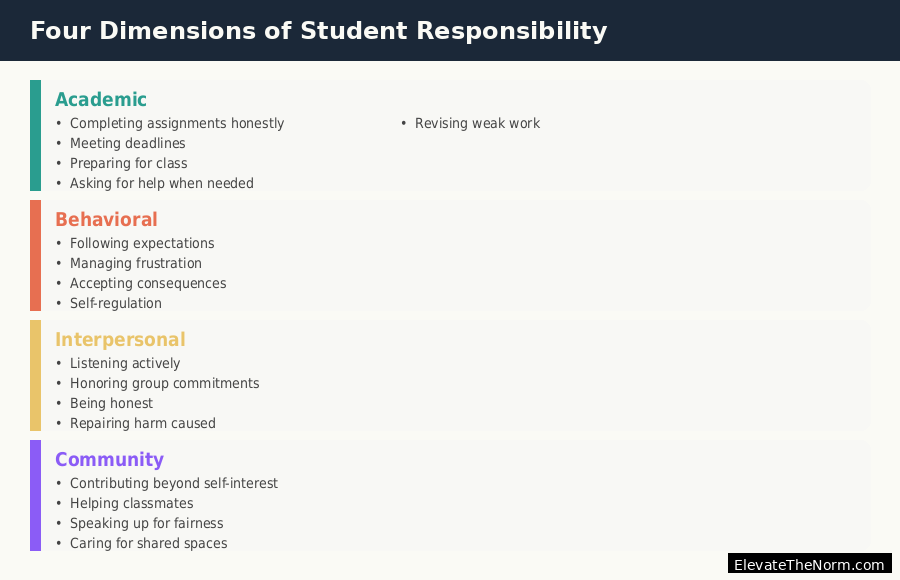
    The Four Dimensions of Student Responsibility

    Most schools define responsibility narrowly — turn in your work, follow the rules. That covers two dimensions and misses two others that matter just as much.

    Infographic showing four dimensions of student responsibility: academic, behavioral, interpersonal, and community
    Four dimensions of student responsibility most schools need to measure

    Academic Responsibility

    This is the one schools measure most: completing assignments, meeting deadlines, preparing for class, doing honest work, and asking for help when needed. Academic responsibility means the student treats their own learning as their job.

    What this looks like in practice: a student who doesn’t understand the assignment asks for clarification instead of guessing. A student whose first draft is weak revises it. A student who misses a deadline explains why and finishes the work.

    What this does not look like: a student who turns in someone else’s work. A student who consistently arrives unprepared and shrugs. A student who does the minimum to avoid a zero.

    Behavioral Responsibility

    Following classroom expectations, treating shared spaces with care, managing frustration without harming others, and accepting consequences when behavior falls short. Behavioral responsibility is the hardest dimension for adolescents because it requires impulse control that is still developing neurologically.

    This is where the pause matters. When a student pushes back — argues a deadline, refuses a task, challenges a grade — my first move is not to respond. I pause. It runs roughly a fifteen count, on average, but that number changes with the student, the day, and what just happened. The pause is not a technique from a book. It is a habit I built because the first thing I want to say is almost never the most useful thing I can say.

    That pause does two things. It gives me time to think. And it shows the student that their behavior did not control my response. Both of those outcomes are lessons in responsibility — mine and theirs.

    Interpersonal Responsibility

    How a student treats the people around them: listening, following through on commitments to a group, being honest, handling disagreement without personal attacks, and repairing harm when they cause it. This dimension is where responsibility becomes relational — it is no longer about the student and the standard. It is about the student and other people.

    Schools that treat interpersonal responsibility as a bonus rather than a requirement produce students who can pass tests and follow rules but cannot collaborate, resolve conflict, or maintain trust. Those skills do not develop on their own. They develop when teachers name them, model them, and hold students to them.

    Community Responsibility

    The broadest dimension: contributing to the classroom, the school, and eventually the community beyond school. Picking up something that isn’t yours. Helping a classmate who is lost. Speaking up when something unfair is happening. Community responsibility is the hardest to teach because it requires students to act on behalf of someone other than themselves.

    This is also where responsibility intersects with leadership. A student who takes community responsibility seriously is already leading — they just may not have the title. Closing that gap between doing the work and holding the role is the whole point of giving teenagers genuine authority in the building.

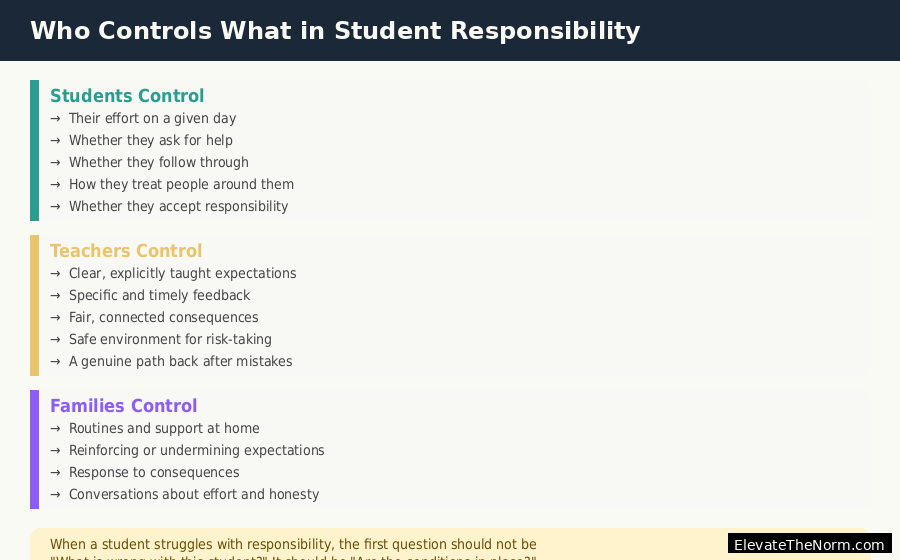
    What Students Control, What Teachers Control, What Families Control

    Most conflict around student responsibility comes from blurring these lines.

    Graphic breaking down what students, teachers, and families each control in building student responsibility
    Responsibility works when everyone knows what they control

    Students Control

    • Their effort on a given day
    • Whether they ask for help
    • Whether they follow through on commitments
    • How they treat the people around them
    • Whether they accept responsibility when they fall short

    Teachers Control

    • Whether expectations are clear and explicitly taught
    • Whether feedback is specific and timely
    • Whether consequences are fair and connected to the behavior
    • Whether the classroom feels safe enough to take risks
    • Whether there is a genuine path back after a mistake
    • Whether the standard stays consistent or quietly shifts based on the student

    Families Control

    • The routines and support available at home
    • Whether they reinforce or undermine the school’s expectations
    • How they respond when their child faces consequences
    • The conversations they have about effort, honesty, and responsibility

    Schools Control

    • Whether policies support responsibility or undermine it (a grading system that averages a zero with later scores teaches learned helplessness, not responsibility)
    • Whether teachers have the time, training, and backing to follow through
    • Whether the culture treats mistakes as learning opportunities or permanent marks

    When a student is struggling with responsibility, the first question should not be “What is wrong with this student?” It should be “Are the conditions for responsibility actually in place?” If the expectations are unclear, the feedback is absent, the consequences are disconnected, or the path back doesn’t exist, then the system is failing — not the student.

    What High Standards Actually Look Like

    High standards are not the same as high pressure. A teacher with high standards believes every student can meet the expectation and builds the structure to make that possible. A teacher with high pressure demands performance without building the structure.

    The difference shows up in how you handle the student who falls short.

    High standards: “This isn’t at the level we discussed. Here’s specifically what needs to change. You have until Thursday to revise it. I’m available Tuesday during advisory if you need help.”

    High pressure: “This is unacceptable. You should know better by now. I’m very disappointed.”

    The first response holds the standard and provides a path. The second response holds the standard and provides shame. Both sound firm. Only one teaches responsibility.

    Research on teacher expectations consistently shows that what teachers believe about students’ capabilities shapes student outcomes. Rosenthal and Jacobson’s classic 1968 study on teacher expectancy effects — where students whose teachers were told they were “intellectual bloomers” showed greater IQ gains — has been replicated and refined across decades. The finding holds: high expectations, communicated through specific support rather than general pressure, produce better results (Rosenthal & Jacobson, 1968; Jussim & Harber, 2005).

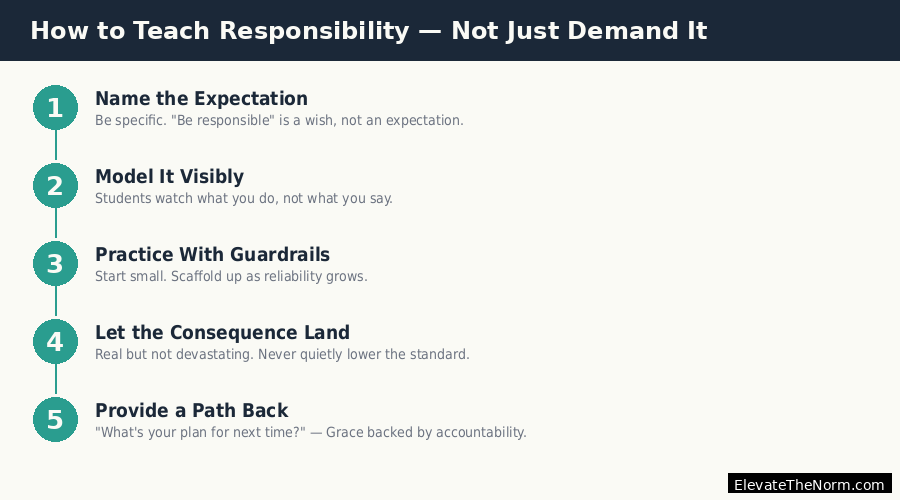
    How to Teach Responsibility — Not Just Demand It

    Responsibility is a set of behaviors, and behaviors can be taught. Here is a practical sequence for building responsibility in grades 6–12.

    Five-step sequence for teaching student responsibility: name expectations, model it, practice with guardrails, let consequences land, provide a path back
    Five steps to teach responsibility instead of just demanding it

    1. Name the Expectation Specifically

    “Be responsible” is not an expectation. It is a wish. Clear classroom expectations sound different. An expectation sounds like: “When you arrive, your materials are out and you’re looking at the board for the first task within two minutes.” Specificity removes guesswork and gives students a clear target to hit.

    2. Model It Visibly

    Students watch what you do, not what you say. This is one reason classroom management starts with the teacher, not the student. If you expect them to meet deadlines, meet yours. If you expect them to admit mistakes, admit yours publicly. If you expect them to prepare, show them what your preparation looks like. Responsibility is taught as much by example as by instruction.

    3. Practice It With Guardrails

    Give students real responsibility in small doses with scaffolding. A student who has never managed a deadline doesn’t need a month-long project on day one. They need a three-day task, a check-in at the midpoint, and a clear consequence for missing the end date. As they demonstrate reliability, extend the timeline and reduce the check-ins. My Makeup Work System on TPT puts the tracking on the student, which is where the responsibility belongs.

    This is not coddling. This is what teaching actually looks like. You do not hand a student a novel and say “read it” if they have never finished a chapter book. You scaffold. Responsibility deserves the same approach.

    4. Let the Consequence Land

    When a student doesn’t meet the expectation, the consequence has to be real. Not devastating. Not humiliating. But real. A student who doesn’t prepare for a group presentation should feel that — through honest feedback from peers, through a required individual follow-up, through the visible gap between what they delivered and what was expected.

    The worst thing you can do is quietly lower the standard. The student learns nothing. The other students learn that the standard is fake.

    5. Provide a Path Back

    After the consequence, the conversation should end with a question: “What’s your plan for next time?” Not a lecture. Not a threat. A question that places the responsibility back where it belongs — with the student.

    The path back is where grace lives. It is also where learning from mistakes actually happens — not in the consequence itself, but in the moment after, when the student decides what to do next. It does not erase the consequence. It says: the standard is still here, I still believe you can meet it, and here is your chance to prove it.

    Common Mistakes Teachers Make With Student Responsibility

    Confusing Responsibility With Obedience

    Obedience is doing what you’re told because someone told you. Responsibility is doing what needs to be done because you understand why it matters. A classroom full of obedient students looks orderly. A classroom full of responsible students looks orderly and keeps running when the teacher steps out.

    If your system requires your constant presence and enforcement to function, you have built obedience. If your system runs because students have internalized the standard, you have built responsibility. The difference matters because obedience does not transfer. Responsibility does.

    Rescuing Students From Consequences

    When a student fails to meet a deadline and the teacher extends it without conversation, the teacher has just taught the student that deadlines are negotiable. When a parent calls to argue a grade and the teacher changes it, the student learns that consequences can be outsourced. When an administrator overrides a classroom consequence to avoid a complaint, the student learns that persistence beats integrity.

    Each of these moments, individually, seems small. Together, they build a system where responsibility is optional.

    Punishing Without Teaching

    A detention for missing homework teaches a student to sit in a room. It does not teach them to manage their time, prioritize their work, or ask for help before the deadline passes. If the consequence doesn’t include a conversation about what went wrong and what the student will do differently, it is punishment, not accountability.

    Applying Standards Unevenly

    Students have a ruthless eye for inconsistency. If one student gets a pass and another doesn’t, every student in the room notices. Responsibility flourishes in systems that are predictable, fair, and built on mutual respect. It collapses in systems where the rules depend on who you are or how the teacher is feeling that day.

    A Responsibility Framework for the Classroom

    DimensionWhat It Looks LikeWhat the Teacher DoesWhat It Doesn’t Look Like
    AcademicPrepared, on time, honest work, asks for helpClear expectations, specific feedback, revision opportunitiesPlagiarism, chronic unpreparedness, helplessness
    BehavioralFollows expectations, manages frustration, accepts consequencesConsistent follow-through, private correction, a path backDisruption without accountability, forced compliance without understanding
    InterpersonalListens, follows through on group commitments, repairs harmModels respect, names expectations, holds students to themPersonal attacks, broken commitments with no consequence
    CommunityContributes beyond self-interest, helps others, speaks upCreates opportunities, recognizes contribution, makes it visibleTreating shared spaces or people as someone else’s problem

    If you want specific classroom activities that put this framework into practice, activities for teaching responsibility walks through ten structured approaches — from deadline choice contracts to repair letters — designed for grades 6–12. And because none of these activities work without a predictable room, understanding why classroom expectations are important is the foundation everything else sits on. When a student has stopped engaging with responsibility altogether, motivating students who don’t care addresses that harder starting point directly. And when the pattern traces back to missed class time rather than a change in effort, chronic absenteeism is the first thing worth ruling out.


    What is the difference between student responsibility and student accountability?

    Responsibility is internal — it is the student’s sense of ownership over their preparation, effort, and behavior. Accountability is external — it is the system of expectations, feedback, and consequences that supports responsibility. A student needs both. Accountability without internal motivation produces compliance. Responsibility without external accountability can drift into good intentions with no follow-through.

    How do you teach responsibility to a student who has never been held to a standard?

    Start small, be explicit, and be patient. Name one expectation clearly. Practice it. Follow through when the student misses it — with a consequence that teaches, not one that punishes. Then add the next expectation. A student who has spent years in systems without standards needs time to adjust. That is not a reason to lower the standard. It is a reason to scaffold the path to it.

    What do you do when a student says they do not care?

    Take it seriously but do not take it literally. A student who says they do not care usually means one of three things: they care but are protecting themselves from failure, they do not see the relevance, or they are overwhelmed and shutting down. The response is not a motivational speech — it is a specific question: “What part of this is getting in the way?” That question respects their intelligence and opens a conversation instead of closing one.

    How do you handle responsibility in group projects?

    Structure the group so individual responsibility is visible. Each student should have a defined role, a personal deliverable, and a moment where they present or defend their own contribution. When a group member does not follow through, the consequence falls on that individual — not the group. Group grades that allow one student to carry others teach the wrong lesson about both effort and fairness.

    Should families be involved in building student responsibility?

    Yes, but with clear boundaries. Families can reinforce expectations, support routines, and have honest conversations about effort. They should not do the student’s work, argue consequences down, or remove the productive struggle that builds responsibility. The most useful family partnership is one where the school’s expectations and the family’s expectations align — and where both adults agree that the student is the one who needs to do the work.

    What if the school’s grading system undermines responsibility?

    Many do. A system that averages a zero with later scores can make it mathematically impossible for a student to recover from one missing assignment. A system that gives points for compliance — bringing a pencil, sitting quietly — measures obedience, not learning. If your grading system punishes honest effort and rewards strategic gaming, the system needs to change before student responsibility can improve. Advocate for grading policies that reflect actual mastery and allow recovery.

    For a detailed breakdown of what each domain looks like in practice—preparation, participation, deadlines, collaboration, mistakes, help-seeking, and repair—see student responsibility in the classroom.


    Sources

    1. Ryan, R. M., & Deci, E. L. (2000). Self-determination theory and the facilitation of intrinsic motivation, social development, and well-being. American Psychologist, 55(1), 68–78. https://selfdeterminationtheory.org/SDT/documents/2000_RyanDeci_SDT.pdf
    2. Guay, F. (2022). Applying self-determination theory to education: Regulations types, psychological needs, and autonomy supporting behaviors. Canadian Journal of School Psychology, 37(1), 75–92. https://journals.sagepub.com/doi/10.1177/08295735211055355
    3. Responsive Classroom. (2025). Secondary practices (Grades 6–12). https://www.responsiveclassroom.org/secondary-practices/
    4. Rosenthal, R., & Jacobson, L. (1968). Pygmalion in the Classroom: Teacher Expectation and Pupils’ Intellectual Development. Holt, Rinehart and Winston. https://psycnet.apa.org/record/1968-08876-000
    5. Jussim, L., & Harber, K. D. (2005). Teacher expectations and self-fulfilling prophecies: Knowns and unknowns, resolved and unresolved controversies. Personality and Social Psychology Review, 9(2), 131–155. https://journals.sagepub.com/doi/10.1207/s15327957pspr0902_3
    6. González-Villora, S., et al. (2017). Program to promote personal and social responsibility in the secondary classroom. Frontiers in Psychology, 8, 809. https://www.frontiersin.org/journals/psychology/articles/10.3389/fpsyg.2017.00809/full
    7. Niemiec, C. P., & Ryan, R. M. (2009). Autonomy, competence, and relatedness in the classroom: Applying self-determination theory to educational practice. Theory and Research in Education, 7(2), 133–144. https://selfdeterminationtheory.org/SDT/documents/2009_NiemiecRyan_TRE.pdf
    8. Edutopia. (2023). Perceptions of mistakes in the classroom. https://www.edutopia.org/article/perceptions-mistakes-classroom/

    About Clay Shumate
    Clay Shumate is a certified secondary Social Studies teacher in the public schools of West Alabama, with seven years of classroom experience, a B.A. in History, and an M.Ed. in Secondary Education. He writes about project-based learning, student responsibility, respect, and practical ways to hold young people to a higher standard while giving them room to learn from mistakes. He is a member of the Society of Professional Journalists and writes to its Code of Ethics; this site’s editorial standards and corrections policy are published in full. More about Clay.

  • Motivating Students: What Works When Rewards and Speeches Stop Working

    Motivating Students: What Works When Rewards and Speeches Stop Working

    Motivating Students: What Works When Rewards and Speeches Stop Working

    By Clay Shumate

    Motivating students does not start with a better reward system or a more inspiring speech. It starts with what research consistently confirms: students engage when they feel competent, connected to the people around them, and in control of something that matters. When the rewards and speeches stop working — and they will — what remains is the environment you built and whether it gives students a genuine reason to invest.

    Key Takeaways

    • Rewards can undermine the motivation they are supposed to build. Research on the overjustification effect has shown this for decades.
    • Autonomy, competence, and belonging are the three drivers that hold up under pressure — not points, prizes, or pep talks.
    • A student who looks unmotivated may be protecting themselves from failure, not choosing laziness.
    • Relevance means connecting work to something real, not performing enthusiasm about a worksheet.
    • The teacher’s job is not to motivate. It is to stop accidentally killing motivation and build a room where it can survive.

    Why Rewards and Motivational Speeches Have an Expiration Date

    Every teacher has tried it. The class Dojo points, the pizza party for the best-behaved table, the impassioned Monday morning speech about potential. These tools feel productive because they produce visible results — for a while. Then they stop.

    Research explains why. Ryan and Deci’s self-determination theory, refined over more than four decades, identifies a consistent pattern: when you offer an external reward for something a person was already willing to do, the reward replaces the internal reason. Psychologists call this the overjustification effect. The student who used to read because the book was interesting now reads because reading earns points — and when the points disappear, so does the reading.

    A 2024 review in Contemporary Educational Psychology reinforced this finding while adding nuance: rewards that provide informational feedback — telling a student something useful about their progress — can support motivation under the right conditions. But rewards that function as control — do this, get that — consistently erode it. The difference is whether the student walks away thinking about their work or thinking about the prize.

    Comparison of extrinsic rewards versus intrinsic motivation showing how control-based rewards undermine student engagement
    Rewards that control behavior erode motivation — rewards that inform progress can support it.

    Motivational speeches have a different shelf life but the same problem. They rely on an emotional spike that cannot sustain daily effort. A teacher who depends on inspiration is performing, not teaching. The kid who felt fired up on Monday has a bad lunch period on Tuesday and the fire is out.

    This does not mean you never celebrate, never recognize effort, and never speak with conviction. It means none of those things are your motivation strategy. They are supplements to something more durable.

    What Research Actually Says About Motivating Students

    The most widely supported framework for understanding student motivation is self-determination theory, developed by Edward Deci and Richard Ryan. The theory identifies three psychological needs that, when met, produce the kind of motivation that survives bad days and boring units:

    1. Autonomy — a sense of ownership over what you are doing and why.
    2. Competence — the belief that effort leads to growth, and that you can actually do the work in front of you.
    3. Relatedness — a genuine connection to other people in the room, especially the adult running it.
    Three drivers of student motivation — autonomy, competence, and relatedness — based on self-determination theory
    Autonomy, competence, and relatedness — the three drivers that hold up when rewards wear off.

    Harvard researcher Rhonda Bondie adds a fourth driver: meaning. Students engage when the work feels important, interesting, or useful — not because someone told them it was, but because they can see it for themselves. She also makes a point that should change how every teacher talks about this topic: “The biggest misconception about motivation is that students aren’t motivated.” Every student is motivated. The question is whether your classroom connects to what motivates them or blocks it.

    A Gallup survey of Gen Z students puts numbers on the problem. Only 18 percent of students strongly agree that teachers make their schoolwork feel important. Only 17 percent report learning something interesting in the past week. Only 11 percent say they get opportunities to do what they do best. These are not students who refuse to care. These are students telling us, clearly, that the work is not giving them a reason to.

    Research on productive failure shows that students who struggle before receiving instruction outperform those who receive direct teaching first — as long as the failure is followed by explicit teaching. A structured approach to learning from mistakes turns errors into one of the most powerful motivators available.

    Autonomy: Real Choices, Not Fake Ones

    Autonomy does not mean letting students do whatever they want. In a grades 6–12 classroom, it means giving students genuine control over some part of their learning — the topic within a standard, the format of a product, the order they tackle a set of tasks, or how they demonstrate what they know.

    The word genuine is doing work there. Asking students to choose between a blue worksheet and a green worksheet is not autonomy. Letting a student pick which historical figure to research within a unit on leadership — and then defend that choice — is. ASCD’s review of the ABC+M framework recommends curated choice: a structured set of meaningful options rather than wide-open freedom that becomes confusion.

    Where autonomy gets tricky is the boundary. Too little choice and students feel controlled. Too much choice without scaffolding and students feel abandoned — especially students who already struggle. The answer is graduated release. You start with structured choices in September and widen them as students demonstrate they can handle the responsibility — the same graduated approach behind teaching responsibility without treating teenagers like children. Some classes earn more latitude faster than others. That is not unfair. It is honest.

    Competence: Students Will Not Try What They Are Sure They Cannot Do

    This one gets misunderstood. Competence does not mean making the work easy. It means making it clear — clear enough that a student can see what good work looks like, understand the distance between where they are and where they need to be, and believe that the distance is crossable.

    Carol Dweck’s work on growth mindset gets cited so often that it has become wallpaper in some schools. The poster goes up. The language shifts. Nothing changes. The reason, according to a 2025 meta-analysis by Dweck and Yeager, is that mindset interventions only work inside classrooms that actually respond to effort with better outcomes. Telling a student “you can grow” while running a grading system that punishes first attempts is not a growth mindset environment. It is a contradiction.

    Practical competence support looks like this: visible criteria posted before students start the work, not revealed after they finish. Short-term goals that students can track themselves. Feedback that says something specific — “your claim is strong but your evidence doesn’t connect to it yet” — instead of “good job” or a letter grade with no explanation. And opportunities to revise, because competence develops through iteration, not through getting it right the first time.

    Belonging: The Motivation Driver Most Teachers Underestimate

    A student who does not feel like they belong in your room will not risk effort in it. This is not a soft claim — it is one of the most consistent findings in motivation research. Kumar and colleagues (2018) found that when students feel a genuine sense of membership in a school, it can counteract the negative effects of prejudice and discrimination on motivation and learning outcomes. Belonging is not a nice-to-have. It is a prerequisite.

    And belonging is built in small moments, not grand gestures. It is built in how you respond when a group laughs at a wrong answer. In whether you learn how to pronounce a student’s name correctly on the first day and never stop trying. In whether you circulate to every table or just the ones that are already performing. This is the daily work of building relationships with students — and it matters more than any opening-week icebreaker.

    In my room, one of my hard stops is mocking someone’s name. You do not get to make fun of how unique another person’s name is. That is not a negotiation and it is not a warning — it is a line, and everyone in the room knows where it is. I hold that line because names are identity — because respect in the classroom is built or broken in moments exactly like that one. When you let a room laugh at a kid’s name, you are telling that kid they do not belong here. And a kid who does not believe they belong will not invest in anything you are teaching.

    The workshop room helps. When students are already sitting in groups, facing each other, working alongside somebody — the default condition, not a special arrangement — belonging has a physical structure to grow in. A student who sits in a row facing the back of someone’s head for fifty minutes does not feel like a member of anything.

    Relevance Without Faking It

    When a student asks “when am I ever going to use this,” they are not being rude. They are telling you something important: they cannot see the connection between the work and anything they care about. The honest answer is sometimes “you might not use this specific skill.” The better answer is to build work where the question does not come up because the connection is visible.

    Relevance does not mean every lesson needs to tie to a career. It means the work should connect to a question worth answering, a problem worth solving, or a skill the student can see themselves using. A history lesson about primary-source analysis becomes relevant when students use those same skills to evaluate a news article that showed up on their feed that morning. A math unit on data becomes relevant when the data is about something in the school or community — not a made-up scenario about a fictional bakery.

    The Gallup data is clear on this. When asked what makes them interested in a class, 60 percent of students say “the teacher made it exciting and interesting” and 60 percent say “the topic aligned with a personal interest.” But 35 percent say “real-world connection explained.” That last number is the most actionable because it requires the least talent and the most planning. You do not have to be naturally charismatic. You have to show why the work matters.

    When Students Look Unmotivated but Are Not

    Some students have given up before your class period starts. Not because they are lazy, defiant, or indifferent — because they have learned that effort does not lead anywhere good for them. Research on learned helplessness in middle school students describes a specific pattern: after repeated experiences where effort did not produce results, students adopt a protective posture. They stop trying — not because they do not care, but because trying and failing again is worse than not trying at all.

    This is the student who puts their head down, gives one-word answers, refuses to start, or turns in blank work. The instinct is to push harder: “I know you can do this if you just try.” But for a student in this pattern, that statement confirms the problem. They have heard it before. They tried. It did not work.

    What works instead is small, private, low-stakes evidence that effort produces a result. Not a public declaration — a quiet conversation at the table. Not a massive assignment — a single manageable step with clear criteria and honest feedback when the step is done. You are not trying to inspire them. You are trying to give them one piece of evidence that their effort connects to an outcome.

    A 2026 longitudinal study in the Journal of Research on Adolescence found that parental autonomy support — not control — reduced learned helplessness trajectories in adolescents over time. The classroom parallel is that pushing harder on a helpless student makes the helplessness worse. Supporting their autonomy — giving them a small, real choice and then honoring it — begins to reverse it.

    Environmental Barriers You Cannot Speech Your Way Past

    A student who did not eat breakfast is not unmotivated. A student who slept three hours because they share a room with a crying infant is not disengaged. A student carrying stress from an unstable home is not choosing not to care.

    Some barriers to motivation are outside your classroom. You cannot fix food insecurity with a growth mindset poster. Attendance works the same way — the reasons students give for missing school are led by illness and lost sleep, not boredom, which is why chronic absenteeism responds so poorly to engagement-only strategies. But you can acknowledge what is real, adjust your expectations for a given day without abandoning your standards permanently, and make sure the room itself is not adding to the burden. The lamps instead of overhead fluorescents. The warm light and the rug. A room that does not assault a student’s senses the moment they walk in is not a luxury — it is a basic condition for any of the motivation strategies above to work.

    What you do control: the pacing of the period, the volume of your voice, whether a student who is struggling gets a quiet check-in or a public callout, whether your consequences teach or just punish, whether the room feels safe enough to take a risk. The OECD’s 2025 data found a 40 percent student engagement strategies drop in peer environments that do not prioritize learning. You build the peer environment. That is a motivation lever you hold every day.

    What to Do Tomorrow Morning

    If you walked into your room tomorrow with nothing new except a different approach, here is what the research says will move the needle:

    Stop doing these things:

    • Publicly calling out a student who is not working. Walk over. Sit down. Ask what they need — at conversation volume, not announcement volume.
    • Rewarding compliance and calling it motivation. A quiet class is not a motivated class.
    • Assigning work without explaining why it matters, then blaming students for not caring.
    • Lecturing for thirty minutes and expecting teenagers to sit still for it.

    Start doing these things:

    • Post the criteria for quality work before students begin, not after they finish. Make the target visible.
    • Build in one meaningful choice per week — topic, format, sequence, or method. Real choice, not cosmetic choice.
    • Check in with every student, not just the struggling ones and not just the stars. Circulate to every table. Sit down. Ask what they are working on.
    • Respond to disengagement with curiosity before correction — the calm-over-control approach that actually works. “What’s going on today?” lands differently than “Why aren’t you working?”
    • Use progress tracking students can see — a simple checklist, a visible timeline, a self-assessment. Let them see they are moving.
    Five practical moves for motivating students tomorrow morning including visible criteria, meaningful choice, and curiosity before correction
    Five concrete shifts you can make tomorrow morning to support student motivation.

    The Room Matters More Than the Speech

    Motivating students is not a talent you either have or do not. It is not about being the inspiring teacher from a movie. It is about building a room where students feel competent enough to try, connected enough to care, and autonomous enough to own something real. When those three conditions exist, motivation does not have to be manufactured. It shows up because the room gives it a reason to.

    The rewards and speeches will always stop working. The environment never does.

    For the students who look like they have given up entirely rather than just coasting, see motivating students who don’t care, which works through what changes when disengagement looks total.

    Frequently Asked Questions

    How do I motivate students who have completely shut down?

    Start small, start private, and start with something they can actually do. A student who has shut down is usually protecting themselves from failure, not refusing to work. Give them one manageable task with clear criteria, check in quietly at their table, and respond honestly when they complete it. You are not trying to fix everything in one period. You are trying to give them a single piece of evidence that their effort connects to a result. Over time, those small pieces rebuild what learned helplessness took apart.

    Are rewards always bad for student motivation?

    No — but the type of reward matters. Rewards that provide informational feedback about a student’s progress can support motivation. Rewards that function as control — do this specific thing, receive this specific prize — tend to undermine intrinsic motivation over time. The research question is not whether you ever celebrate or recognize effort. It is whether the reward system replaces the student’s internal reasons for engaging or reinforces them.

    What is the difference between engagement and motivation?

    Motivation is internal — the drive, interest, or purpose behind effort. Engagement is what it looks like from the outside — participation, focus, persistence. A student can be behaviorally engaged (sitting quietly, completing work) without being motivated. And a motivated student who lacks the right conditions can look disengaged. Effective teaching targets the motivation because the engagement follows naturally when the conditions are right.

    Does giving students choices really improve motivation?

    Yes, when the choices are meaningful and structured. Self-determination theory identifies autonomy as one of three core drivers of intrinsic motivation. But choice only works when students have enough information to choose well, when the options are genuinely different, and when the teacher provides scaffolding. Asking a student to pick between identical worksheets in different colors is not autonomy. Letting them choose which historical figure to research within a unit — and defend that choice — is.

    How do I motivate students when the content is genuinely boring?

    Not every lesson will feel exciting, and pretending otherwise insults teenagers. When the content itself is dry, connect it to a question or product that is not. A grammar unit becomes tolerable when students are editing a real piece of writing they care about. A data unit becomes relevant when the data is about something in their school. You are not making the content entertaining — you are giving it a purpose the student can see.

    What role do relationships play in student motivation?

    Relationships are the single most consistent factor in motivation research. A Gallup study found that students with access to at least one teacher who makes them excited about the future are 30 times more likely to report high engagement. But the relationship that matters is not performative warmth — it is the kind built by knowing a student’s work, checking in consistently, and responding to struggle with support instead of judgment.

    Can a teacher really control student motivation?

    No — and you should not try to. Motivation belongs to the student. What you control is the environment: the clarity of the work, the quality of the feedback, the safety of the room, whether students have meaningful choices, and whether effort leads to visible progress. Build those conditions and motivation has room to exist. Remove them and no amount of enthusiasm from the front of the room will compensate.

    Sources


    About Clay Shumate
    Clay Shumate is a certified secondary Social Studies teacher in the public schools of West Alabama, with seven years of classroom experience, a B.A. in History, and an M.Ed. in Secondary Education. He writes about project-based learning, student responsibility, respect, and practical ways to hold young people to a higher standard while giving them room to learn from mistakes. He is a member of the Society of Professional Journalists and writes to its Code of Ethics; this site’s editorial standards and corrections policy are published in full. More about Clay.

Teacher Emergency Toolkit — practical resources, real classroom support. Shop on TPT.Teacher Emergency Toolkit — practical resources, real classroom support. Shop on TPT.