By Clay Shumate
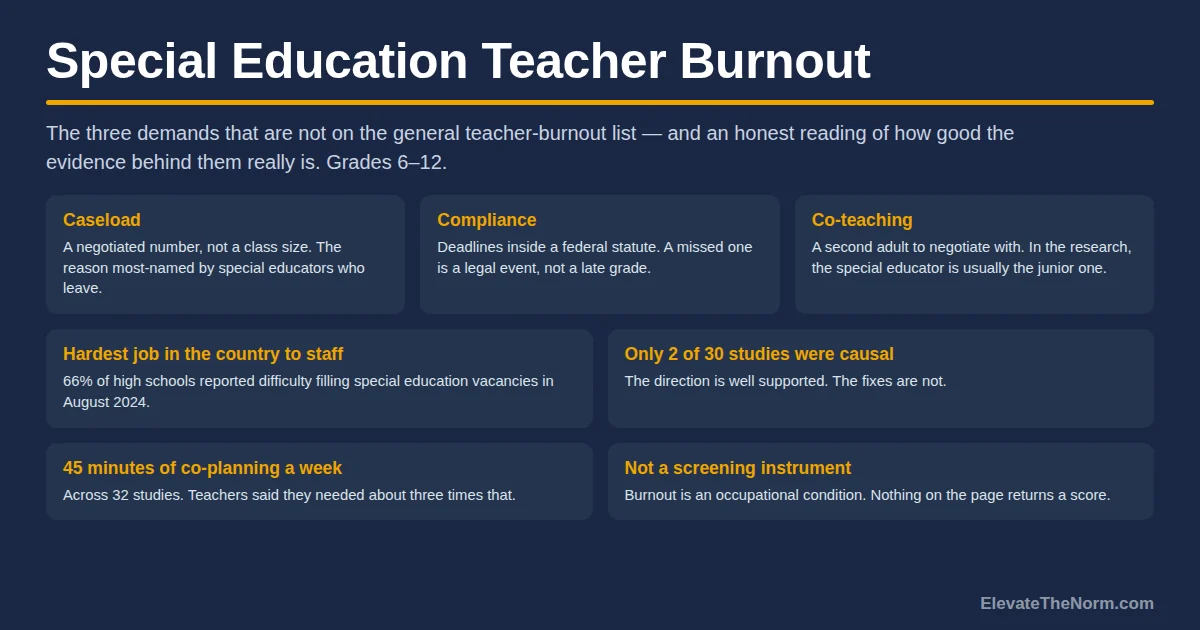
Teacher burnout in special education runs on a set of demands that does not appear on the general list at all. A caseload is a negotiated number, not a class roster. The paperwork carries statutory deadlines. The second adult in the room is a relationship to manage rather than a resource to use. The research on all three is consistent in direction and thinner in quality than you would hope.
This page does not restate the general list. The general demand ledger every teacher is working from already covers behavior, hours and out-of-pocket spending, and all of it applies here too. For the word itself, start with the three dimensions the word is actually made of. What follows is narrower: the demands belonging to this job specifically, in grades 6–12, and how good the evidence behind them really is.
Key takeaways
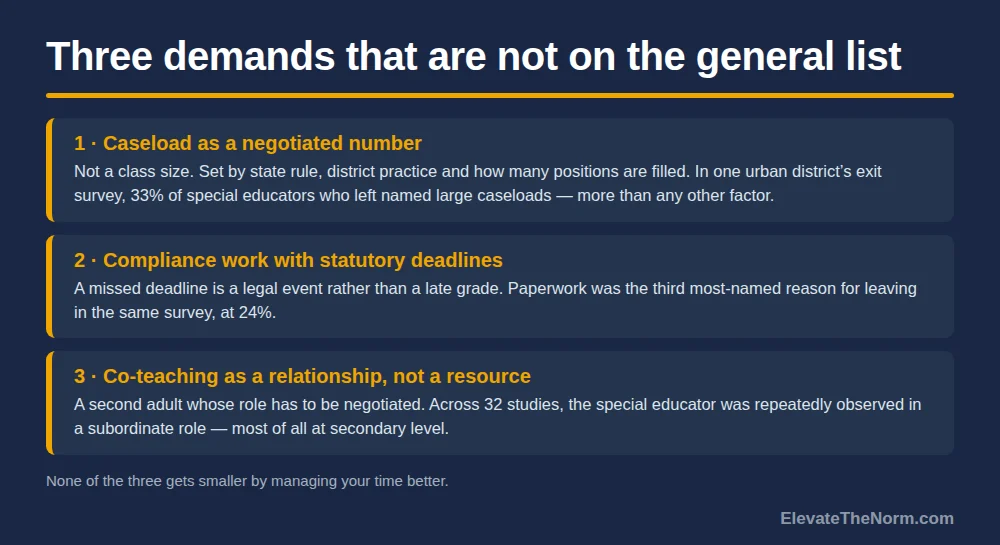
- Three demands separate this job from the general one: caseload as a negotiated number, compliance work with statutory deadlines, and co-teaching as a relationship rather than a resource. None gets smaller by managing your time better.
- Caseload is the most-named reason in the retention research: 33 percent of leavers in one urban district’s exit survey, more than any other factor — though that is 99 people in one district, not a national rate.
- Paperwork was third in the same survey, at 24 percent, and lands differently because a missed deadline is a legal event rather than a late grade. The system behind it is large and mostly never touches individual teachers: 29,490 due process complaints filed nationally in 2021–22, 2,645 fully adjudicated.
- In the co-teaching research the special educator is repeatedly observed in a subordinate role, most of all at secondary level. Across 32 studies, teachers reported roughly 45 minutes a week of joint planning and said they needed about three times that.
- Special education is the hardest area in the country to staff: in August 2024, 66 percent of high schools reported difficulty filling it, and only 77 percent of those vacancies went to a fully certified teacher.
- The evidence is directionally consistent and methodologically weak — of 30 studies in the major review, only two used designs supporting causal claims. The familiar “75 percent leave within five years” figure is one state’s data from 1987 to 2001, not a current rate.
- None of these numbers is a statement about you, and none is a diagnosis. Burnout is an occupational condition; nothing here is a screening instrument and nothing returns a score.
The Special Education Workload Audit
Two printable pages. A write-in grid for the four things on this page — caseload and where the number came from, compliance events counted by week, co-planning scheduled versus actual, and unfilled positions — plus how to read the four answers together and who to take them to. Counts and dates only, never a student’s name. It is not a screening instrument and it returns no score. Free. No email address required. Designed for grades 6–12.
Download the free PDFWhat makes special education a different burnout problem?
Three demands a general education teacher never meets, none of which you control the shape of. A caseload is set by somebody else, a compliance calendar by federal statute, a co-teaching partnership by a master schedule you did not build. Time-management advice is aimed at demands whose shape you can change, which is why it does not land here — and being told to work smarter about something you do not control is a reliable way to feel worse about it.
One thing to settle before the numbers start. Special educators report heavier loads and leave at higher rates, and it is easy to read that as a statement about the people who do the job. It is not. Every figure below is an average across thousands of teachers in very differently resourced buildings, and an average says nothing about any individual in it. Reading it as a verdict on yourself is statistically wrong, and it is the self-blame that makes a hard year harder.
How many students is a special education caseload?
Nobody can tell you, and that is the problem. A caseload is not a class size. It is a number produced by state rule, district practice, how many positions are filled, and what got decided in a meeting in July. Two teachers with the same title in the same state can be carrying very different loads.
It is also what special educators name first. In a survey of teachers who left or moved out of one large urban district, 33 percent named large caseloads as an important reason — more than any other single factor. A teacher quoted in the same research put it plainly: “I currently see well over 75 students a day with little support.”
Label that number before you carry it anywhere. It comes from 99 special educators, one district, three years. It is not national, and it does not tell you what a reasonable caseload is — no study does. It tells you what people say on the way out, and they have been saying it for a long time.
The useful consequence: because a caseload is negotiated rather than given, it is one of the few demands here that somebody with a title can change in a scheduling meeting. That is not easy, but the conversation has a right address.
Why does special education paperwork land differently?
Because a missed deadline is a legal event rather than a late grade. Every teacher has paperwork. Very little of it sits inside a federal statute with a dispute-resolution process attached to the far end.
Paperwork was third in that same district survey, at 24 percent. One teacher described it in terms any teacher will recognise: the IEPs ate up much of the time previously spent on students. The complaint is not that the documents are pointless, but that the documents and the students compete for the same hours.
The system behind those deadlines is genuinely large. In 2021–22, states and outlying areas reported 29,490 due process complaints filed nationally, 6,160 written state complaints and 10,806 requests for mediation — up from 17,118 due process filings a decade earlier, with the share still pending at year end rising from 12 percent to 43 percent.
Two qualifications, because this is the kind of number used to frighten people. Most of that volume never reaches a hearing — 2,645 were fully adjudicated — and the overwhelming majority of special education teachers finish a career without being personally involved in any of it. The point is not that you are about to be sued. It is that the deadlines are not negotiable the way a grading deadline is, which makes the pressure attached to them rational rather than something to talk yourself out of.
What does co-teaching do to the job?
In the research it repeatedly turns the special educator into the junior adult in somebody else’s room, and it does this most at secondary level. That is not a complaint about colleagues; it is what falls out of a structure where one adult owns the content and the other is assigned to the students.
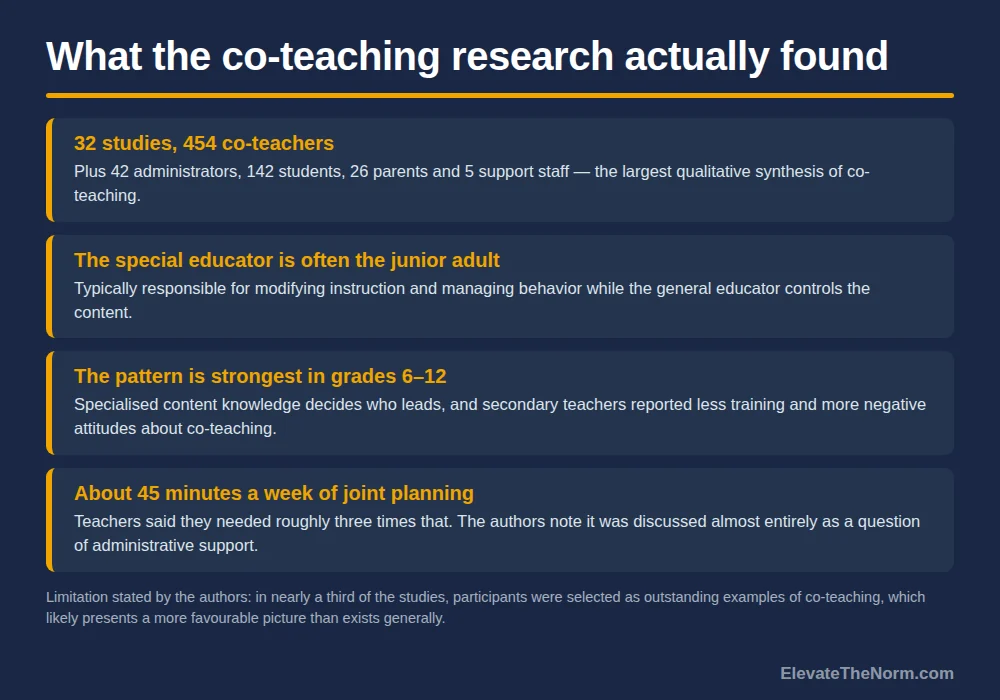
The largest qualitative synthesis of co-teaching covered 32 studies, 454 co-teachers, 42 administrators, 142 students, 26 parents and 5 support staff. Its central finding: the special education teacher was often observed to play a subordinate role, typically responsible for modifying instruction and managing behavior while the general educator controlled the content. One special educator described the job as being an aide sometimes, an interpreter sometimes, and sometimes a teacher.
The pattern sharpened at secondary level, where specialised content knowledge decides who leads and teachers reported less training and more negative attitudes about co-teaching than elementary counterparts. If you teach grades 6–12, that is your setting, not a footnote.
The pressure point is planning time. Teachers reported about 45 minutes a week of joint planning and said they needed close to three times that — and the authors note it was discussed almost entirely as a question of administrative support. That is the right framing, because planning time is a scheduling decision somebody signs off on, not a personal organisational failing.
This is the one item on the page that genuinely responds to coaching. The subordinate pattern is produced by defaults — who stands where, whose name is on the gradebook, who the class looks at when directions are given — and an explicit division of roles, said out loud in front of students in the first week, changes what the room assumes for the year. If you are the general education teacher in that room, most of that fix is yours. Though a coaching cycle offered instead of staffing relief will be read as exactly what it is.
Does the staffing shortage make all three worse?
Yes, and it is the mechanism connecting them. Every unfilled special education position is a caseload that gets distributed, a compliance calendar absorbed, and a co-teaching assignment covered by whoever is available.
The federal survey data is unambiguous about where the shortage bites. In a national panel of 1,392 public schools surveyed in August 2024, special education was the hardest teaching area in the country to staff: 66 percent of high schools and 74 percent of middle and combined schools reported difficulty filling those vacancies, and only 77 percent of the ones filled went to a fully certified teacher — eleventh of thirteen subject areas, against 89 percent for social studies.
Read that last figure the right way. It is no judgement on people hired under emergency credentials, who are usually doing a hard job with less preparation than they deserved. It is a statement about what the building asks of everyone else, because an under-prepared colleague needs support that comes out of somebody’s week — usually the experienced special educator already carrying the largest caseload. A first-year special educator is short of both at once: short of the stock every new teacher lacks, and short of specialised knowledge the role needs on day one.
What the data does not tell us is where inside a district those gaps land. The major review notes that few studies examined school poverty or student demographics at all. It is reasonable to suspect the shortfall concentrates in the schools least able to absorb it — but that has not been established, and a district that wants to know should look at its own vacancy and caseload numbers by school rather than assume either way.
How good is the evidence behind any of this?
Consistent in direction, weak in design, and worth knowing before you quote it at anybody. This literature has a myth problem, and a number that falls apart under scrutiny costs more than it gains.
The major review of special educator attrition covers 30 studies from 2002 to 2017, and its accounting of itself is blunt. Only two of the 30 used methods permitting causal inference. Only 13 examined teachers actually leaving; the rest measured intent to leave or administrator perceptions, which are related but not the same. Mentoring, which teachers called valuable in the qualitative studies, showed insignificant direct effects on retention in the quantitative ones.
The most recent burnout synthesis, covering 29 studies from 2013 to 2023, describes its own base as predominantly cross-sectional analyses of convenience samples — a snapshot of whoever responded, not a study over time.
The co-teaching synthesis carries a limitation its authors state outright: in nearly a third of the studies, participants were selected as outstanding examples of co-teaching, which they say likely presents a more favourable picture than exists generally. That cuts in an unusual direction — it suggests the real picture is worse, not better — and that is a reason to hold the finding loosely, not a licence to assume the worse version.
The number to stop repeating. “Seventy-five percent of special educators leave within five years” is a real finding — Illinois administrative data on teachers who entered between 1987 and 2001, 42 percent leaving teaching and 34 percent moving schools. One state, and a cohort that started work before most teachers now in classrooms were born. It is not a current national rate. The nearest national figure in the same review is older than it sounds too: 17.1 percent of special educators left their schools in 2012–13.
And one finding that cuts against the simple story. A study of novice teachers in their first three years found, as expected, that special educators rated their workloads significantly less manageable than general educators did, and that workload manageability predicted emotional exhaustion, which predicted whether they meant to keep teaching. But the effects were stronger for the novice general educators. One reading is that special educators arrive expecting an unmanageable workload and are less shaken when they get one, which is not comforting. Another is that the measure misses what is heavy about this job. That study sampled elementary and middle school novices in two states, so it is not a high school result either.
The honest summary: the direction is well supported and the fixes are not. Special educators consistently report heavier, less manageable workloads, name caseload and paperwork first when they leave, and are harder to replace than anyone in the building. What almost nothing here establishes is that any particular intervention fixes it.


What can you actually check, and who do you take it to?
Four things, all facts about the job rather than judgements about you. The point is to turn a feeling of being underwater into four numbers somebody with a title can act on. Short on time, which is the whole premise? Do items one and three only — five minutes, and the pair most likely to produce a change.
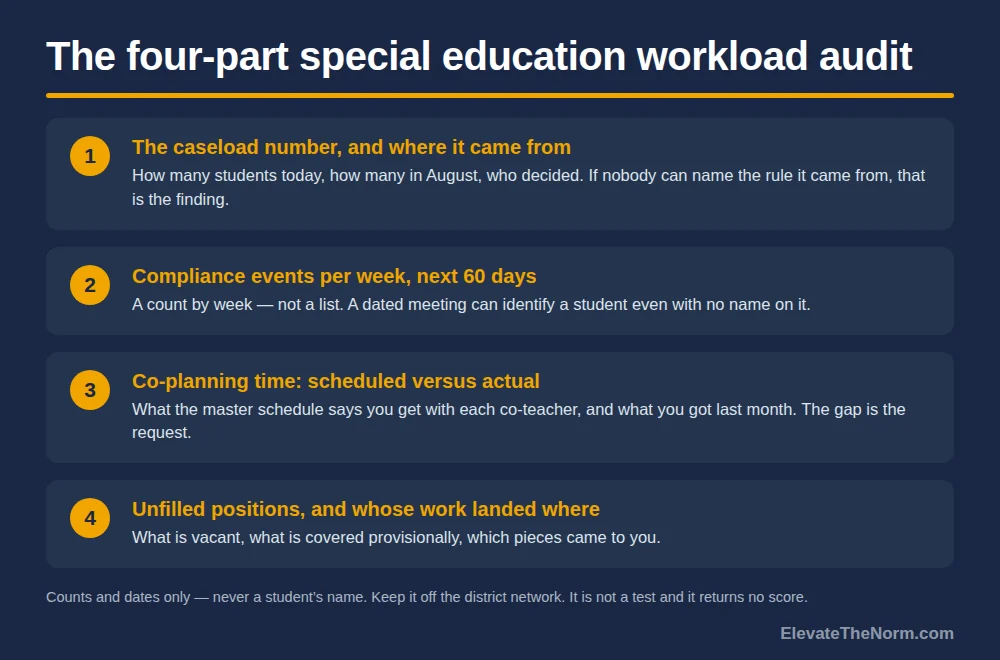
- The caseload number, and where it came from. How many students today, how many in August, who decided. If nobody in the building can name the rule it came from, that is itself the finding.
- Compliance events per week for the next 60 days. A count by week — meetings, evaluations, reviews. Not to panic about; to see whether the load is spread or stacked into two weeks that were always going to break.
- Co-planning time, scheduled versus actual. What the master schedule says you get with each co-teacher, and what you got last month. The gap is the request.
- Unfilled positions, and whose work landed where. What is vacant, what is covered provisionally, which pieces came to you.
Three rules for keeping it. Write counts and dates, never names or initials — item two can identify a student with no name on it at all, because a dated meeting is traceable, which is why it is a count per week rather than a list. Keep it somewhere that is yours; a district device is not a private place to write that you are not coping. And keep it separate from compliance itself: this is a record of workload, not a log of deadlines you expect to be missed. If you believe a legal deadline is about to be blown, that goes to your coordinator today, on its own, in writing.
It goes to the special education coordinator or department chair first, then whoever builds the master schedule. Open it as a question rather than a case — “here is what I am carrying, can we look at whether this is the intended distribution” lands differently from a document handed over in silence. Ask for the criterion rather than the favour: the conditions worth asking to have changed work better when the rule for who qualifies is written down first. A load lightened by private arrangement creates a fairness problem down the hall.
If you are the only special educator in your building — common in small secondary schools — there is no department to take this to. The chain then runs to the district’s special education director, and sideways to a counterpart at another school or your state’s technical assistance center. Do not skip the step because the usual person does not exist.
One thing this sheet is not. It is not a test, it produces no score, and it cannot tell you whether you are burned out. There is no validated cutoff that turns numbers into a finding about a person. If what you are carrying has stopped being about the job — if it follows you home, into the weekend, into how you feel about yourself — that is a conversation with your doctor or a counsellor, not with a worksheet. A short weekly record you can actually keep beats any one-off audit, because it shows a direction instead of a verdict.
Are the students the reason?
No. This needs saying directly, because “special education is exhausting” slides easily into “these students are exhausting,” and that is both untrue and corrosive.
A caseload is a staffing decision. A compliance calendar is a federal statute. An unfilled position is a labour market. A co-teaching structure is a master schedule. Every load on this page came from an adult decision, and a student with an IEP is who those decisions exist to serve. Where the research finds this job heavy, it is heavy because of how it was resourced.
And if you have an IEP and you have noticed your teacher is stretched: none of it is yours to carry. The services on your plan are yours by law regardless of how the building is staffed, asking for them is not making trouble, and a staffing shortage is never a reason to ask for less than you are owed.
This matters practically as well as decently. A teacher who quietly concludes the students are the problem starts lowering the bar, and that is the one response that makes everything worse for everyone. Holding the bar where it belongs while the supports do their job is the whole design.
What to do next
Fill in the audit this week, or just items one and three. Most of it is already in your email and the master schedule. Then take the two biggest gaps to the person who can change them, in writing, as a question about the criterion rather than about you.
If the answer is no, you have still done something useful: a written record of a load and a dated request is what makes a pattern visible when somebody finally asks why the position turned over again. And if the honest answer is that this job cannot be made survivable where you are, that is a real answer, not a failure of nerve. Nobody gets credit for absorbing a staffing shortfall until it breaks them.
Want the audit as a printable? Download The Special Education Workload Audit (2 pages, free, no email required) and fill in items one and three before your next scheduling conversation.
Frequently asked questions
What causes burnout in special education teachers specifically?
Three demands that do not appear on the general teacher-burnout list. Caseload is a negotiated number rather than a class size, set by state rule, district practice and how many positions are filled — and in one urban district’s exit survey, 33 percent of special educators who left named large caseloads as an important reason, more than any other factor. Paperwork was third in the same survey at 24 percent, and it lands differently because the deadlines sit inside a federal statute rather than a gradebook. And co-teaching is a relationship to negotiate rather than a resource to use: across 32 qualitative studies the special educator was repeatedly observed in a subordinate role, most of all at secondary level. The general demands — behavior, hours, out-of-pocket spending — apply on top of all three.
Is special education teacher burnout worse than general education teacher burnout?
The direction of the evidence says special educators carry more, but the size of the gap is not settled. Special educators report heavier and less manageable workloads, name caseload and paperwork first when they leave, and are the hardest group in the country to replace. Against that, a study of novice teachers in their first three years found that although special educators rated their workloads significantly less manageable, the link running from workload manageability through emotional exhaustion to career intentions was actually stronger for the novice general educators. That study sampled elementary and middle school novices in two states, so it is not a high school result. The honest answer is that the job is differently loaded, and that anyone claiming a precise multiplier is going beyond what the research supports.
Do 75 percent of special education teachers really quit within five years?
Not as a current national figure. That number is real but it comes from Illinois administrative data on teachers who entered the profession between 1987 and 2001 — 42 percent leaving teaching and 34 percent moving schools. One state, and a cohort that started work before most teachers now in classrooms were born. It should not be quoted as today’s rate. The nearest national figure in the same literature review is also older than it sounds: 17.1 percent of special educators left their schools in 2012–13. Leaving is also not the same thing as burning out; people move for pay, family, geography and promotion.
How big should a special education caseload be?
No study answers that, and no national standard sets it. Caseload limits, where they exist at all, are set by state rule and vary widely, and the actual number a teacher carries also depends on district practice and how many positions are currently filled. What the research establishes is that caseload is what special educators name first when they leave, not what a defensible ceiling would be. The practical move is not to argue for a number but to ask what rule your building used to arrive at yours — if nobody can name one, that is itself worth putting in writing.
What can a principal or district actually change about this?
Three things, all of them scheduling or staffing decisions rather than encouragement. Co-planning time is the clearest: in the co-teaching research teachers reported about 45 minutes a week and said they needed roughly three times that, and the authors note it was discussed almost entirely as a question of administrative support. Caseload distribution is the second, and it is negotiated in a scheduling meeting. The third is how the work of unfilled or provisionally covered positions gets allocated, which currently tends to land on whoever is most experienced. Whatever is changed, write the criterion for who qualifies before applying it to anybody — a load lightened by private arrangement creates a fairness problem down the hall.
I am a parent and my child’s special education teacher seems overwhelmed. What should I do?
Ask the school about staffing rather than about the teacher. The useful questions are whether the position is fully staffed, what the caseload is, and whether the services on your child’s plan are being delivered as written — those are answerable and they are the school’s responsibility. Your child’s entitlement to the services on the plan does not depend on how the building is staffed, so raising a gap in delivery is entirely reasonable. What is worth avoiding is treating an individual teacher’s apparent state as the subject, both because a teacher’s wellbeing is not a matter for the class group chat and because the loads described on this page are almost entirely produced by decisions made above the classroom.
I am a student with an IEP. Is my teacher stressed because of me?
No. A caseload is a staffing decision, a compliance calendar is a federal statute, an unfilled position is a labour market and a co-teaching structure is a master schedule. Every load described on this page came from an adult decision, and none of it is yours to carry or to fix. The services on your plan are yours by law regardless of how your school is staffed, asking for them is not making trouble, and a staffing shortage is never a reason to ask for less than you are owed. If you are worried about a teacher, talk to a counselor about the class rather than about the person.
Is there a test that tells you whether you have special education teacher burnout?
No, and this site does not publish one. Burnout is an occupational condition rather than a clinical diagnosis, and the research instruments used to measure it lack a clinically validated cutoff, which means there is no threshold that turns a set of answers into a finding about an individual person. A checklist can tell you useful things about your job — how big the caseload is, how the compliance load is distributed, how much co-planning time you actually get — and that is what the audit on this page does. If what you are carrying has stopped being about the job, that is a conversation with your doctor or a counsellor, not with a worksheet.
Sources
- Billingsley, B., & Bettini, E. (2019). Special education teacher attrition and retention: A review of the literature. Review of Educational Research, 89(5), 697–744. A systematic review of 30 studies published between 2002 and 2017. Source of the 33 percent caseload and 24 percent paperwork figures (from Billingsley, 2007 — 99 special educators who left or moved from one large urban district over three years), the 17.1 percent national attrition figure for 2012–13 (Goldring, Taie & Riddles, 2014), and the “75 percent within five years” figure (DeAngelis & Pressley, 2011 — Illinois administrative data, 1987–2001). Limitations stated by the authors: only two of the 30 studies used methods permitting causal inference, only 13 examined teachers actually leaving rather than intent to leave, and few studies examined school poverty or student demographics. journals.sagepub.com
- Brunsting, N. C., Morin, L. E., Gómez, L. R., Jones, B., Bettini, E., Cumming, M. M., Garwood, J. D., & Ruble, L. A. (2026). Burnout and occupational wellbeing of special education teachers: Recent research synthesized. Review of Educational Research. A synthesis of 29 studies published between 2013 and 2023, extending the 2014 Brunsting, Sreckovic & Lane synthesis. The authors describe the evidence base as predominantly cross-sectional analyses of convenience samples and call for longitudinal and intervention designs. journals.sagepub.com
- Scruggs, T. E., Mastropieri, M. A., & McDuffie, K. A. (2007). Co-teaching in inclusive classrooms: A metasynthesis of qualitative research. Exceptional Children, 73(4), 392–416. 32 qualitative reports covering 454 co-teachers, 42 administrators, 142 students, 26 parents and 5 support personnel. Source of the subordinate-role finding, the secondary-level intensification, and the 45.5 minutes of weekly joint planning against a stated need of roughly three times that. Limitation stated by the authors: in nearly a third of the investigations participants were selected as outstanding examples of co-teaching, which they say likely presents a more favourable picture of co-teaching than exists in general. ncipp.education.ufl.edu (PDF)
- Bettini, E., Jones, N., Brownell, M., Conroy, M., Park, Y., Leite, W., Crockett, J., & Benedict, A. (2017). Workload manageability among novice special and general educators: Relationships with emotional exhaustion and career intentions. Remedial and Special Education, 38(4), 246–256. Novice teachers in their first three years, drawn from the Michigan–Indiana Early Career Teacher Study. Special educators rated workload manageability significantly lower than general educators; workload manageability predicted emotional exhaustion, which mediated the relationship with intentions to keep teaching. Effects were stronger for novice general educators, and the sample was elementary and middle school teachers in two states — not a high school result. journals.sagepub.com
- National Center for Education Statistics (2024). School Pulse Panel, hiring and vacancies collection. 1,392 participating public K–12 schools, surveyed 13–27 August 2024. Special education was the hardest teaching area to staff: 74 percent of elementary and of middle and combined schools and 66 percent of high schools reported difficulty filling those vacancies, and only 77 percent of filled special education vacancies went to a fully certified teacher — eleventh of thirteen subject areas, against 89 percent for social studies. ies.ed.gov
- CADRE (Center for Appropriate Dispute Resolution in Special Education). IDEA dispute resolution data summary for U.S. and outlying areas. Data for the 2021–22 school year, reported by states under IDEA Section 618: 29,490 due process complaints filed, 2,645 fully adjudicated, 6,160 written state complaints filed and 10,806 mediation requests; due process filings rose from 17,118 in 2011–12, and the share still pending at year end rose from 12 percent to 43 percent over the same decade. A more recent summary covering 2023–24 exists but could not be opened from this session, so only the 2021–22 figures are used here. cadreworks.org (PDF)
Every source above was opened and read for this article. Where a figure could not be confirmed in the original, it is not on this page.
About Clay Shumate
Clay Shumate is a certified secondary Social Studies teacher in the public schools of West Alabama, with seven years of classroom experience, a B.A. in History, and an M.Ed. in Secondary Education. He writes about project-based learning, student responsibility, respect, and practical ways to hold young people to a higher standard while giving them room to learn from mistakes.