By Clay Shumate
Student leadership skills are the specific, teachable abilities a teenager uses to move a group forward — listening, explaining, planning, deciding, delegating, taking feedback, handling conflict, following through, and knowing what is not theirs to decide. They are not personality traits. They are behaviours you can name, practise and check, which is the only reason a school can teach them at all.
The twelve below are chosen because each one has an observable behaviour attached. If you cannot describe what it looks like from across the room, it does not belong on a skills list.
Key Takeaways
- A skill is not a trait. “Confident,” “natural leader” and “takes initiative” cannot be taught or fairly assessed. “Restates the other person’s point before answering it” can.
- School-based skill programs do move these outcomes, and implementation is the variable that decides it. A meta-analysis of 213 programs and 270,034 K–12 students found improved social and emotional skills, attitudes, behaviour and academic performance — an 11-percentile-point achievement gain — with implementation problems moderating the result.
- Do not grade these on a student’s self-rating. In the one cluster randomized trial of a school leadership program, teachers rated leaders markedly more effective while the leaders’ own self-ratings moved by exactly zero.
- Feedback is not automatically good for you. The landmark meta-analysis of 607 effect sizes found feedback improved performance on average (d = 0.41) and made it worse in over a third of cases — which is why “receives feedback well” is a skill and not a courtesy.
- Teaching is the cheapest practice ground you have. Peer tutoring shows moderate-to-large academic benefits across grades 1–12, and the student doing the explaining is practising four of these twelve skills at once.
Free Download · PDF
The 12 Student Leadership Skills Observation Sheet (2 pages)
Page 1 is a blank observation sheet carrying the observable behaviour for all twelve skills. Page 2 gives one way to practise each skill inside a lesson you were already going to run, and a check two adults could agree on.
Free. No email address required. Designed for grades 6–12. Browse every printable in Your Free Library.
What Are Student Leadership Skills?
A student leadership skill is a repeatable behaviour that makes a group’s work go better, which a student can get visibly worse or better at. That last clause does the filtering.
Most published lists fail it. “Vision,” “charisma,” “integrity” and “confidence” are either traits, values, or descriptions of how a student comes across — none of them tells a fourteen-year-old what to do differently on Thursday, and none of them can be assessed without turning into a popularity judgement in a rubric costume.
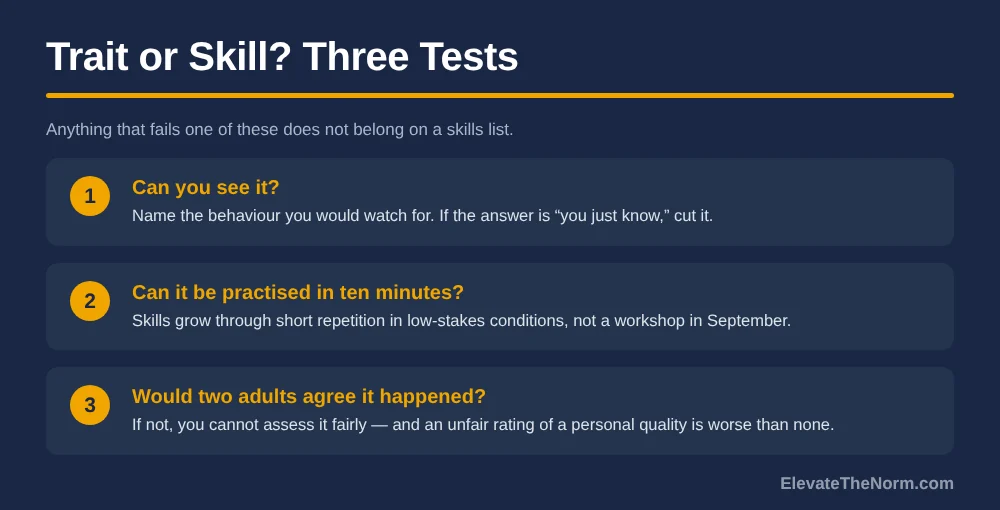
Three tests for anything you want to put on a skills list:
- Can you see it? Name the behaviour you would watch for. If the answer is “you just know,” cut it.
- Can it be practised in ten minutes? Skills get better by repetition in low-stakes conditions, not by a workshop in September.
- Would two different adults agree on whether it happened? If not, you cannot assess it fairly, and an unfair assessment of a personal quality is worse than no assessment at all.
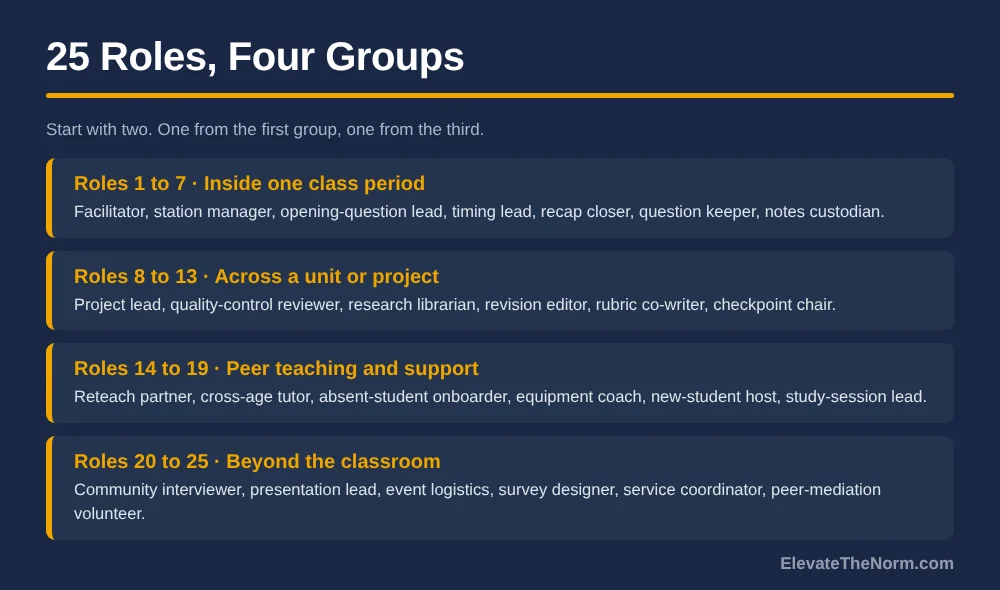
These skills are the what. The roles students hold while practising them are the where — there are 25 of those in the companion guide to student leadership activities for grades 6–12, and the broader argument about what real responsibility requires is in the guide to giving teenagers authority that carries weight. This article stays on the abilities themselves.

Can Leadership Skills Actually Be Taught?
Yes, with two honest qualifications: the strongest evidence is for structured skill programs rather than leadership programs, and the quality of delivery moves the result more than the curriculum does.
The broadest evidence comes from Durlak, Weissberg, Dymnicki, Taylor and Schellinger’s 2011 meta-analysis in Child Development — 213 school-based universal social and emotional learning programs covering 270,034 students from kindergarten through high school. Participants showed significantly improved social and emotional skills, attitudes, behaviour and academic performance, “that reflected an 11-percentile-point gain in achievement.” Two details matter more than the headline. School staff ran the programs successfully, so this is not a specialist-only result. And the authors report that the use of four recommended skill-development practices and the presence of implementation problems moderated outcomes. Translation: a well-run ordinary program beats a badly run excellent one.
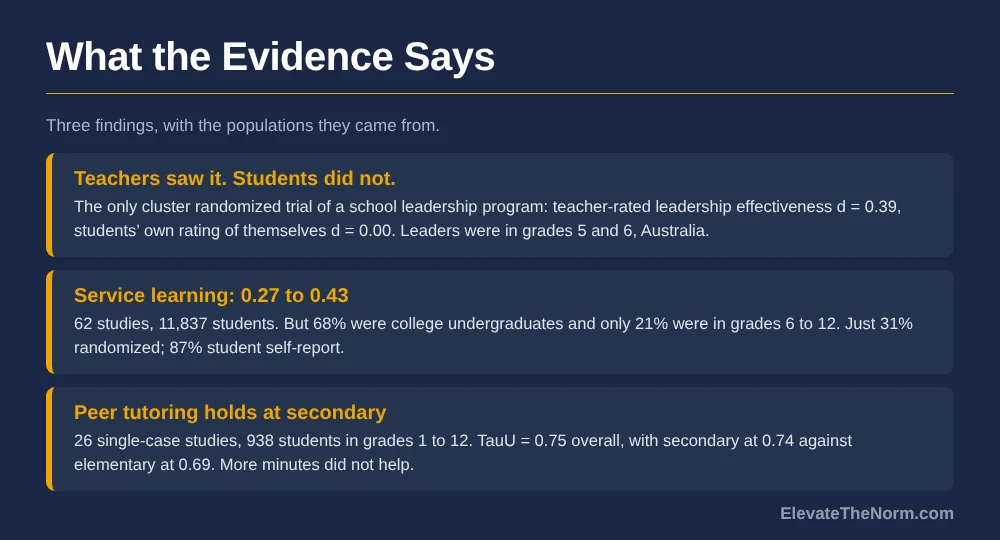
Leadership-specific evidence is thinner. The Learning to Lead cluster randomized controlled trial (Contemporary Educational Psychology, 2026) ran across 20 schools and 1,898 students. Teachers rated the trained student leaders significantly more effective afterwards (d = 0.39) and their classroom time on task rose seven percentage points. Those leaders were in grades 5 and 6, in Australia — it is not a secondary result, and the effect sizes do not transfer automatically. The design lesson does: the leaders spent twelve sessions actually teaching younger students, not sitting in leadership lessons.
That matches the peer-tutoring evidence, which is the best-evidenced vehicle for this grade band. Bowman-Perrott and colleagues (2013) synthesized 26 single-case studies covering 938 students in grades 1 through 12 and reported moderate-to-large academic benefits (TauU = 0.75), with secondary students at 0.74 slightly ahead of elementary at 0.69. Dosage made no difference — twelve focused minutes beat forty vague ones.
And service work carries a wider but weaker signal. Celio, Durlak and Dymnicki’s 2011 meta-analysis of 62 studies and 11,837 students found effects of 0.27 to 0.43 across attitudes, civic engagement, social skills and achievement — but 68% of that sample was college undergraduates and only 21% was in grades 6–12, with 87% of studies relying entirely on student self-report. Useful direction, soft numbers.

The 12 Student Leadership Skills Schools Should Actually Develop
Four groups of three. Each row names the behaviour you would watch for, one way to practise it inside an ordinary lesson, and a check that two adults could agree on.
Being in the Room
| Skill | What you would see | One way to practise it | A fair check |
|---|---|---|---|
| 1. Listening to understand | Restates the other person’s point, in their terms, before answering it | Two-minute paired protocol: you may not reply until you have summarised and the other person agrees your summary is right | The partner confirms the summary was accurate |
| 2. Explaining one thing clearly | Picks an entry point, checks for understanding, stops when the other person has it | Reteach one skill to two or three classmates after you have checked they hold it themselves | A short check on the students who were taught, not on the explainer |
| 3. Giving usable feedback | Names one specific change, tied to the criteria, with the reason | Fixed critique protocol with a sentence frame and a cap of two items | The receiver can state what to change without asking a follow-up |
Getting Work Done
| Skill | What you would see | One way to practise it | A fair check |
|---|---|---|---|
| 4. Planning backwards | Starts at the due date and works back to today, with dates attached | Build the team timeline on day one of a project, on paper, before any work starts | The written timeline against what actually happened |
| 5. Deciding without complete information | Makes a call, states the reason, names what would change their mind | Forced-choice rounds: two defensible options, ninety seconds, one sentence of reasoning | Was a reason given, and was it about the task rather than about who suggested it |
| 6. Delegating and asking for help | Hands off a piece of work with the standard attached, or asks a direct question early | Rule the group to a hard split — nobody may do more than their share — and require one question asked outside the group | Whether the work was actually distributed, and whether the question got asked before the deadline |
Skill 6 is the one adults quietly model badly. I learned a review format I still use from another teacher on my hall, in my first year, because I asked — she had noticed I was short on engaging review games and I went and asked her how hers worked. Keeping your ears open helps. Asking questions helps more. That is a usable thing to say out loud to a fifteen-year-old who thinks a leader is supposed to already know.
When It Goes Sideways
| Skill | What you would see | One way to practise it | A fair check |
|---|---|---|---|
| 7. Taking feedback | Asks a clarifying question instead of defending or going silent | Receive-only drill: the receiver may ask questions but may not explain themselves for sixty seconds | Did the next draft change in the direction of the feedback |
| 8. Navigating a disagreement | Separates the issue from the person; proposes something rather than repeating a position | Rehearsed scripts for the three disputes your room actually produces — workload, credit, and a missed deadline | Did the group keep working, and did an adult have to intervene |
| 9. Following through and repairing | Says in advance that it will be late; names what is owed, to whom, by when | A standing one-line repair sentence any student can use, modelled by you first | The repair happened, on the date the student named |
Skill 8 is worth money and worth caution in equal measure. School-based conflict resolution education is rated “promising” by the U.S. Office of Justice Programs, whose profile cites a meta-analysis of 36 studies in which participating students reported fewer antisocial behaviours (effect size 0.26), with fights falling from roughly 14% to 9.5%. Those are trained programs with adults running them. Teaching a student to de-escalate their own group’s argument about workload is a reasonable thing to do; handing a student somebody else’s serious conflict is not. If you want prewritten language to teach from, there are a hundred of them in the De-escalation Scripts set in my store.
Judgement
| Skill | What you would see | One way to practise it | A fair check |
|---|---|---|---|
| 10. Knowing what is not yours to decide | Stops and hands something to an adult instead of ruling on it | Sorting exercise: ten situations, three piles — mine, ours, not mine | Did the student escalate the ones that belonged to an adult |
| 11. Running a short meeting | Keeps to an agenda, closes with who does what by when | Five-minute checkpoint with a fixed four-item agenda you supply | Meeting notes listing decisions and owners |
| 12. Reflecting so it changes the next attempt | Names one thing to do differently and then actually does it | Two questions after any role: what worked, what you will change next time | Compare this reflection to the previous one — did the named change appear |
Skill 10 carries more weight than its position suggests, and it is mostly your job rather than theirs. My position on this is blunt: if a student can wreck something badly enough to matter, that is poor planning and the adult was not paying attention. Teaching a teenager to recognise the edge of their own authority is part of the skill. Building a room where the edge is a long way from anything catastrophic is the other part, and it is the part you own. For skill 12, a two-question routine at the end of a role is enough — the mechanics of making that stick are the same ones in the guide to student self-assessment as a routine rather than an event, and the Daily Bell Ringers I sell are built around that kind of short prompt.
How Do You Assess a Leadership Skill Fairly?
Assess the behaviour, not the student, and never let a self-rating be the measure. Those two rules remove most of the ways this goes wrong.
The self-rating problem is not a hunch. In the Learning to Lead trial, teacher-rated leadership effectiveness rose significantly while the leaders’ own self-reported effectiveness moved by exactly nothing — d = 0.00, p = 0.999 — and their leadership self-efficacy did not reach significance either. The adults saw growth the students did not feel. If your rubric is a student rating themselves out of four, you are measuring how a teenager feels about themselves that week, which is a real thing but is not the skill.
Use self-report for one purpose only: as the student’s own evidence to discuss, next to yours. “You rated yourself a 2 on taking feedback. Here are the two drafts. Talk me through it.” That conversation is worth more than either rating.
The second trap is feedback itself. Kluger and DeNisi’s 1996 meta-analysis in Psychological Bulletin — 607 effect sizes across 23,663 observations — found feedback improved performance on average (d = 0.41) and made performance worse in over a third of cases. Their explanation is that effectiveness drops as attention moves away from the task and toward the self. For a skills rubric that is a direct instruction: say “the summary missed her second point” and not “you are not a good listener.” The first is a task. The second is an identity, and identity feedback is the kind that backfires.
Three practical rules that follow:
- Assess one skill at a time. A twelve-row rubric read in one sitting becomes a general impression of the student with numbers attached.
- Score the artifact, not the performance. A written timeline, a set of meeting notes, a partner’s confirmation that the summary was accurate. Those exist after the fact and two adults can read them the same way.
- Keep it out of the course grade unless your standards actually include it and your district’s grading policy allows it. Most do not, and a leadership score smuggled into an academic grade is a fairness problem waiting for a parent email.
- Sample rather than collect. With 150 students you cannot read an artifact from everyone every week. Read six a week, rotate, and tell students that is what you are doing.
Two more things, both about being open about it. Put the observable behaviours on a sheet students can read — a skill you are watching for in secret is a trap, not a lesson. And when a family asks, the honest answer is short: these are behaviours we practise and talk about, they are not in the course grade, and they do not replace the school’s discipline policy. Skill 9 is about repairing a missed deadline inside a group project. It is not an alternative to whatever your handbook already requires.
What This Looks Like Over a Semester
Do not try to teach twelve skills. Pick three.
A workable semester: skill 1 and skill 3 in the first six weeks, because listening and feedback make everything else cheaper; skill 4 when the first long project starts; skill 9 whenever the first deadline is missed, which it will be. Teach each one the way you would teach anything — model it, name it while you are doing it, give a short low-stakes rep, then use it for real.
Scope the rep, not the standard. The paired listening protocol is hard for a student who is new to the language, and the receive-only feedback drill is hard for a student who finds being looked at difficult. Written versions of both work — summarise in two sentences on paper, pass it back, let the partner mark it accurate or not. Same skill, same evidence, different load.
Two things to expect. The first reps will be stilted, because a sentence frame always is, and a fifteen-year-old restating somebody’s point out loud feels ridiculous for about a week. The second is that students will not report feeling more capable even when they are visibly better — that is the L2L finding again, and it is the main reason teachers abandon this work too early. Tell them plainly what you saw them do. Do not wait for them to look pleased about it.
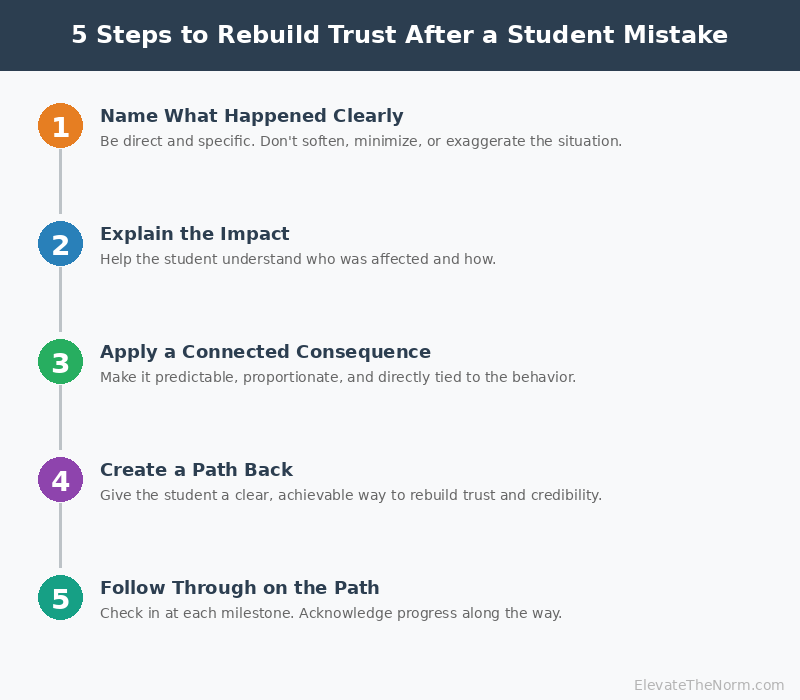
If you want the specific roles to practise these in, every one of the twelve maps onto something in the 25 leadership roles — the facilitator job is skills 1 and 11, the reteach partner is 2 and 3, the project lead is 4, 6 and 9. And when a role goes badly, that is skill 9 territory, which is the same ground as holding a student accountable and giving them a way back.
What to Do Next
Pick three skills from the twelve. Write the observable behaviour for each on one sheet and put it where you plan, not where you display. Teach the first one inside a lesson you were already going to run — the paired listening protocol fits in two minutes of any discussion. Then collect one artifact per skill per student, and resist building a rubric until you have read a dozen of them.
The check that tells you it is working is not a score. It is whether a student uses the behaviour when you did not ask for it — the day somebody restates a classmate’s point before disagreeing with it, without a sentence frame on the board.
Before you go: grab the free 12 Student Leadership Skills Observation Sheet (2 pages) (PDF) — ElevateTheNorm.com branded, printable, no email required.
Frequently Asked Questions
What is the difference between a leadership skill and a leadership trait?
A skill is a behaviour a student can get visibly better at; a trait is a description of the student. “Confident,” “charismatic” and “natural leader” cannot be taught on a Thursday and cannot be assessed without turning into a popularity judgement with a rubric around it. “Restates the other person’s point before answering it” can be taught, practised in two minutes, and checked by asking the partner whether the summary was accurate.
Can student leadership skills be graded?
They can be assessed; they usually should not be graded. Keep them out of the course grade unless your standards genuinely include them and your district’s grading policy allows it — a leadership score smuggled into an academic grade is a fairness problem waiting to happen. Assess one skill at a time, score the artifact rather than the performance, and tell students and families plainly what you are watching for.
Why should I not use a student self-rating?
Because the evidence says it will not track what you are trying to measure. In the only cluster randomized trial of a school leadership program, teacher-rated leadership effectiveness rose significantly while the students’ own self-ratings moved by exactly zero. Self-report still has a use — put the student’s rating next to your evidence and talk about the gap. That conversation is worth more than either number.
Which three skills should I start with?
Listening to understand, giving usable feedback, and planning backwards from a deadline. The first two make every group task cheaper to run, and the third is the one that prevents the week-before panic on a long project. Add following through and repairing when the first deadline gets missed, because it will, and the lesson lands best right then.
Do these skills work the same in middle school and high school?
The skills are identical; the scope changes. In middle school, keep each rep inside one class period and use sentence frames openly. In high school, the planning, delegating and meeting skills become realistic over a multi-week project, and the frames can come off the board. In both bands the first few repetitions feel stilted, and that is normal rather than a sign it is not working.
What about students who find the speaking protocols hard?
Scope the repetition, not the standard. Written versions of the listening and feedback drills carry the same skill and the same evidence: summarise in two sentences on paper, pass it back, let the partner mark it accurate or not. A student new to the language or uncomfortable being looked at can do the identical thinking with a different load.
Does any of this actually raise achievement?
Partly, and the honest version has caveats. A meta-analysis of 213 school-based social and emotional learning programs covering 270,034 students found improved skills, attitudes, behaviour and academic performance amounting to an 11-percentile-point achievement gain, with implementation problems moderating the result. Peer tutoring has solid grades 6–12 evidence. The leadership-specific trial measured leadership and time on task, not grades. Treat achievement as a plausible side effect of doing this well, not as the reason to do it.
Sources
- Durlak, Joseph A., Roger P. Weissberg, Allison B. Dymnicki, Rebecca D. Taylor, and Kriston B. Schellinger. “The Impact of Enhancing Students’ Social and Emotional Learning: A Meta-Analysis of School-Based Universal Interventions.” Child Development, vol. 82, no. 1, 2011, pp. 405–432. 213 programs, 270,034 students from kindergarten through high school; improved social and emotional skills, attitudes, behaviour and academic performance “that reflected an 11-percentile-point gain in achievement”; school staff ran the programs successfully; four recommended skill practices and the presence of implementation problems moderated outcomes. Abstract read via the U.S. Office of Justice Programs NCJRS record rather than the publisher, and cited accordingly; the record states no limitations. https://www.ojp.gov/ncjrs/virtual-library/abstracts/impact-enhancing-students-social-and-emotional-learning-meta
- Kluger, Avraham N., and Angelo DeNisi. “The Effects of Feedback Interventions on Performance: A Historical Review, a Meta-Analysis, and a Preliminary Feedback Intervention Theory.” Psychological Bulletin, vol. 119, no. 2, 1996, pp. 254–284. 607 effect sizes, 23,663 observations. Feedback interventions improved performance on average (d = .41) but “over 1/3 of the FIs decreased performance,” with effectiveness falling as attention moved from the task toward the self. Not a school-only sample; it spans workplace and laboratory studies as well as education. https://cris.huji.ac.il/en/publications/the-effects-of-feedback-interventions-on-performance-a-historical/
- Wade, Levi, Mark R. Beauchamp, Nicole Nathan, Jordan J. Smith, Angus A. Leahy, Ran Bao, Sarah G. Kennedy, Jed Boyer, Thierno M. O. Diallo, Sam Beacroft, and David R. Lubans. “Effects of a School-Based Leadership Program on Student Leaders and Their Peers: The Learning to Lead Cluster Randomized Controlled Trial.” Contemporary Educational Psychology, vol. 84, 2026, article 102444. 20 schools, 1,898 students. Teacher-rated leadership effectiveness d = 0.39; self-rated effectiveness d = 0.00 (p = 0.999); leadership self-efficacy not significant; on-task time +7 percentage points. Leaders were in grades 5–6 and peers in grades 3–4, in New South Wales, Australia — not a secondary-school result. https://www.sciencedirect.com/science/article/pii/S0361476X26000020
- Bowman-Perrott, Lisa, Heather Davis, Kimberly Vannest, Lauren Williams, Charles Greenwood, and Richard Parker. “Academic Benefits of Peer Tutoring: A Meta-Analytic Review of Single-Case Research.” School Psychology Review, vol. 42, no. 1, 2013, pp. 39–55. 26 studies, 938 students in grades 1–12; TauU = 0.75 overall; secondary 0.74 against elementary 0.69; no dosage effect above or below the 480-minute median. Single-case research designs, not group randomized trials. https://cdd.tamu.edu/wp-content/uploads/sites/33/2019/11/BowmanPerrott_SPRAcademicMeta.pdf
- Celio, Christine I., Joseph Durlak, and Allison Dymnicki. “A Meta-Analysis of the Impact of Service-Learning on Students.” Journal of Experiential Education, vol. 34, no. 2, 2011, pp. 164–181. 62 studies, 11,837 students; mean effects 0.27 to 0.43 across five outcomes. 68% of participants were college undergraduates, 16% high school and 5% middle school; only 31% of studies randomized and 87% relied entirely on student self-report. https://www.tamiu.edu/profcenter/documents/Meta-AnalysisoftheImpactofSLonStudentts_2011.pdf
- “Practice Profile: School-Based Conflict Resolution Education.” CrimeSolutions, National Institute of Justice, U.S. Office of Justice Programs. Rated Promising; draws on Garrard and Lipsey’s 2007 meta-analysis of 36 studies, reporting an effect size of 0.26 on self-reported antisocial behaviour and fights falling from about 14% to 9.5%. Cited as a federal practice profile summarising a meta-analysis, not as the meta-analysis itself; the profile states no cautions on study quality or publication bias. https://crimesolutions.ojp.gov/ratedpractices/48