By Clay Shumate
A homework policy for grades 6–12 should set how often you assign, not how many minutes it should take. Frequency is the part of homework that holds up once research controls for effort, help at home and prior achievement. Time spent does not, and the minutes-per-grade rule most teachers quote has no traceable source.
Key Takeaways
- Homework looks very different above and below seventh grade. The standard synthesis of 32 studies found a correlation of .25 for grades 7–12 and one that was not significantly different from zero for K–6. If you teach secondary, the evidence is on your side; it is not an argument for elementary homework.
- Frequency survives the controls. Quantity and time do not. In a study of 7,725 Spanish 13-year-olds, how often homework was assigned kept a positive, significant effect through every model. How much was assigned, and how long students spent, did not.
- The strongest individual factor was working without help. A student who needed help took 41 more minutes in maths, and 50 more in science, to reach the same score. Whether help is available at a kitchen table is not a measure of a teenager’s effort.
- Parents and students do not report the same homework. In the Cooper synthesis, student-reported time correlated with achievement at .25 while parent-reported time correlated at −.03. Any policy built on reported minutes is built on a number that changes depending on who you ask.
- The ten-minutes-per-grade rule could not be verified. It is not in the readable text of the 2006 synthesis, and no source crediting it to a named organisation was reachable. What is on record is older: junior-high achievement improved until assignments ran one to two hours a night, and stopped improving beyond that.
What should a homework policy actually say?
Five things, in writing, before the first assignment goes out: how often homework comes, what it is for, what happens when it is late, whether it counts toward the grade, and what a student does who cannot do it at home. Everything else is detail.
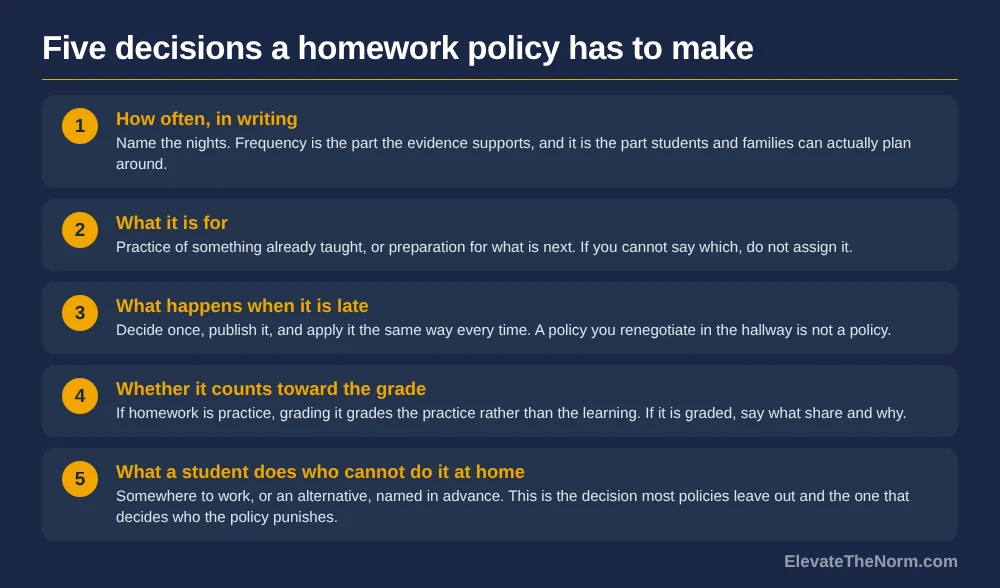
The fifth is the one that decides who your policy punishes. A teenager with a quiet room, a charged laptop and an adult who can explain a quadratic is being asked to do something different from a teenager sharing a room, working a shift, or minding a sibling. Both get the same assignment and the same deadline. If the policy has nothing to say about that, it is measuring their homes and recording the result as effort.
That is not a soft-hearted objection, it is what the data says. The strongest individual-level variable in the Spanish study was autonomy — doing homework without needing help. The gap it produced was large: on the same amount of nightly homework, a student who needed help sat at the 50th percentile where an autonomous student sat at the 70th. A student who needs help is not working less hard. They are working with a slower exchange rate.
Does homework work in middle and high school?
Yes, modestly, and the grade split is the most important finding in the literature. The 2006 synthesis of research from 1987 to 2003 found a homework–achievement correlation of .25 in grades 7–12 and one indistinguishable from zero in K–6, with the difference significant at p < .0001.
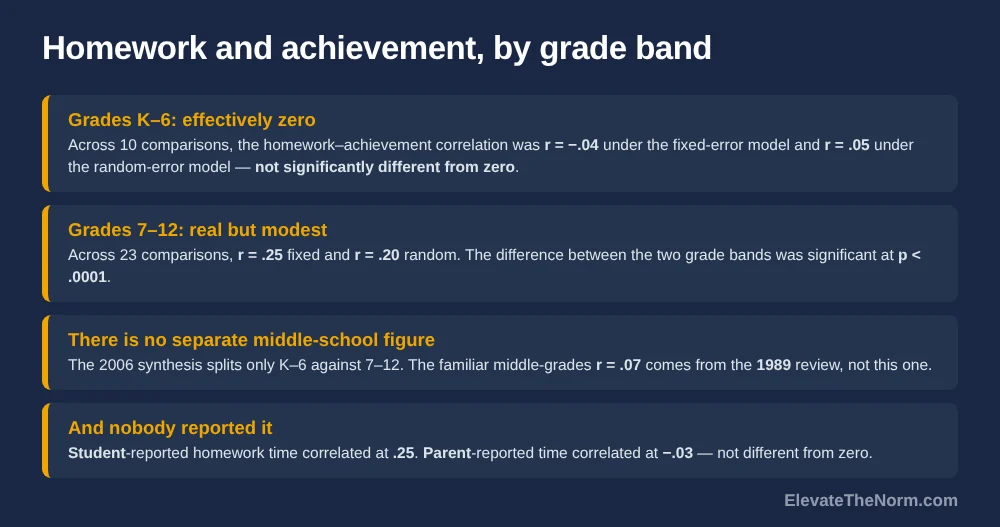
Keep the size of that in proportion. A correlation of .25 is a real relationship and a long way from a guarantee; 50 of the 69 correlations in the synthesis were positive, which means 19 were negative. The overall figure across all grades was .24 under one model and .16 under another, and the authors say plainly that all of the studies had design flaws.
The experimental evidence — the kind that could actually establish cause — is thinner than the correlational pile suggests. The synthesis located six experiments, none of which had been published, pooling to d = .60. The authors note that assigning a single classroom to each condition cannot remove confounded classroom differences even when the assignment is random. Six unpublished studies is not a foundation; it is a placeholder where a foundation should be.
How much homework should you assign?
Less than the rule you have heard, and the honest answer is that the research gives a range rather than a number. The clearest finding is about efficiency: beyond roughly 70 minutes a night across all subjects, extra time buys almost nothing.
The Spanish study is worth reading carefully here, because it disagrees with itself in a way that is instructive. Its abstract says the optimum duration was one hour a day. Its results section says the top of the curve sits between 90 and 100 minutes per day for all subjects combined. Its efficiency analysis says assigning more than 70 minutes a day “does not seem very efficient,” because going from 70 to 90 minutes gains barely 3% of a standard deviation. And its discussion settles on 60 minutes as reasonable and effective.
Those are four numbers in one paper, which tells you how soft this measurement is. The time figure was a self-reported band — students picked from four ranges covering all subjects at once — and the peak comes from the model with no background controls. Once background was controlled, the paper reports the relationship between results and homework time turning negative.
So here is the number you can defend to a department head: somewhere around an hour a night, total, across every class a student takes. In a seven-period day that is eight or nine minutes per subject, which is a much smaller assignment than most secondary teachers picture when they say they assign a reasonable amount.
Where does the ten-minute rule come from?
Nobody could show me. The guideline that students should get ten minutes per night per grade level is repeated in handbooks, newsletters and district policies, and three attempts to trace it to a named organisation or a published finding came back empty.
It is not in the readable text of the 2006 synthesis it is usually attached to. Pages that might carry it from parent and teacher organisations either did not load or did not contain it. That is not proof the rule is baseless — it may well sit in a document behind a login or in print. But a rule that governs how much work thirty million teenagers take home should be easier to source than this, and until it is, it should be described as a convention rather than a finding.
What is on the record, from the earlier 1989 review quoted inside the 2006 paper: junior-high achievement continued to improve as assignments lengthened until they lasted between one and two hours a night, and more than that was no longer associated with higher achievement. For young children the line of progress was flat. That is a real finding with a real citation, it is coarser than the ten-minute rule, and it is the one worth quoting.
Should homework be graded?
If homework is practice, grading it grades the practice rather than the learning, and it converts a student’s home circumstances into a permanent number. If you do count it, keep the weight small and say what it is for — completion, accuracy, or evidence of a specific skill.
| Approach | What it rewards | Main risk | Works best when |
|---|---|---|---|
| Not graded at all | Doing the work for its own sake | Completion collapses unless the work visibly matters the next day | Homework is checked, discussed or used in the opening of the next lesson |
| Completion only, small weight | Showing up having tried | Rewards copying; tells you nothing about accuracy | You want a low-stakes record without grading thirty sets of answers |
| Accuracy graded | Getting it right first time | Penalises the student practising a skill they have not learnt yet, which is the point of practice | The task is review of something already mastered |
| Graded, retakes allowed | Getting it right eventually | Heavy on your time | Homework is genuinely formative and you have the capacity |
Whichever you choose, the research point stands: in the Cooper synthesis the correlations were higher for class grades (.27) than for standardized tests (.24), and class grades are partly a record of homework completion. Some of what looks like homework raising achievement is homework raising the thing homework is counted in. The multivariate studies that controlled for other factors produced betas between .05 and .28, and the authors note those estimates refer to high school students only. If you are moving toward separating practice from proficiency, this is one of the cleaner arguments for it.
What does the evidence actually support assigning?
Regular, short, and connected to the next lesson. Frequency was the only homework variable in the Spanish study that kept a positive, significant effect after controlling for effort, help at home, social background and prior achievement.
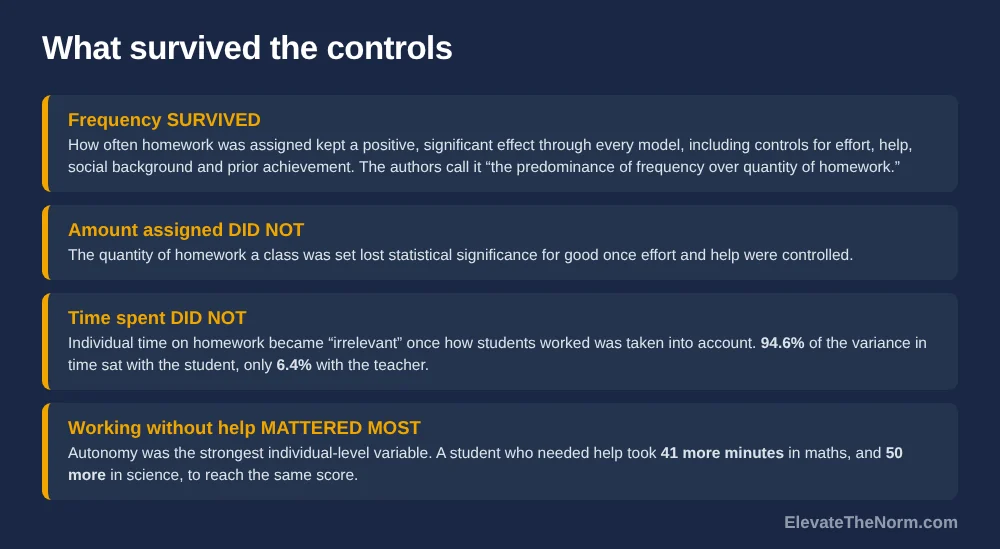
The practical reading is that two twenty-minute assignments a week beat one forty-minute assignment, and that a policy saying “homework on Monday and Wednesday” is doing more work than a policy saying “about thirty minutes a night.” The first is a commitment you can keep and students can plan around. The second is a guess about how long your assignment takes someone else, and the same study found that 94.6% of the variance in homework time sat with the student rather than the teacher.
The study also recommends against work that aims only at repetition or revision of content, reporting lower effort and lower results for it. That lines up with the wider practice literature: if you want the homework itself to teach, mixing problem types across assignments and spacing practice out do more than another twenty of the same question. And one honest caveat on all of it — the paper measured 13-year-olds in northern Spain, it is correlational, and the authors say directly that the direction of the association cannot be determined.
What about students who do not do it?
Find out why before deciding what it means. In the Spanish sample only 2.4% of students never did homework at all, which means the student in front of you who stopped doing it is far more likely to be dealing with a condition than to be refusing on principle.
The usual reasons, in rough order of how often they turn up: the student could not do it and had nobody to ask, which the autonomy finding says costs them 40 to 50 minutes a night; there was nowhere to work; something at home took priority; or they did not think it counted for anything. Only the last of those is addressed by a tougher late policy, and the other three get worse under one.
A policy that names what a student does instead — a lunchtime room, a free period, an alternative that demonstrates the same skill — costs you almost nothing and removes the excuse in both directions. It also keeps the consequence attached to the work rather than to the student’s circumstances, which is the distinction worth protecting.
How do you write a homework policy students will actually read?
Short, on one page, in sentences a fourteen-year-old can repeat back. A homework policy that runs to four paragraphs of conditions will be read by nobody and enforced inconsistently, which is worse than having none.
- Lead with the nights. “Homework goes out Monday and Wednesday and is due the next class.” That one sentence carries the variable the evidence supports and it is the only part a family needs to plan around.
- Say what it is for in one line. Practice of something already taught, or preparation for the next lesson. Students work differently when they know which.
- State the grade weight as a number, or say plainly that it is not graded. Ambiguity here is where the arguments come from.
- Name the backstop by place and time. Not “see me if you have trouble” — a room, a day, and a start time. A teenager who has to negotiate the backstop will not use it.
- Say what late looks like, once. Whatever you decide, the value is in applying it the same way to the student you like and the student you do not.
Then test it the way you would test a worksheet: hand it to a student in your second-period class and ask them what happens if they cannot finish something on a Tuesday. If they cannot answer from the page, the page is not finished. This costs five minutes and catches the gap that otherwise shows up in October as a disagreement about expectations that was really a drafting problem.
Clay’s take: write the frequency, not the clock
Most homework policies I have read, including ones I have written, legislate the wrong variable. They specify minutes, which the teacher cannot observe, cannot verify, and which the research says is mostly a property of the student rather than the assignment. Then they go quiet on frequency, which is the one thing the teacher fully controls and the one thing that survived every statistical control in the study that tested it.
The second thing I would change is subtracting rather than adding. If an hour a night across all subjects is a defensible ceiling, then in a building where a student takes six or seven classes, my share is under ten minutes. Almost nothing I have ever set took under ten minutes, and I doubt many teachers reading this would say otherwise. Nobody in the building is doing that arithmetic, and every department sets its homework as though it were the only one.
And the part that is not really about evidence: a homework policy is a promise about how you will treat people. The evidence says homework in secondary school is worth something real and modest, that it works best assigned often and small, and that its biggest single predictor is whether a teenager has help at home. A policy that ignores that last part is not neutral. It is quietly grading the household, and the students who lose are the ones we already describe as unmotivated.
What to do next
Open your syllabus and find the sentence about homework. If it gives a number of minutes, replace it with the nights homework will be set. If it does not say what happens when a student cannot do it at home, add that sentence, and name a real place and a real time.
Then do the subtraction once, honestly. Count the classes your students take, divide an hour by that number, and time your own assignment by doing it yourself at the pace of a middle-of-the-class student. Most teachers who run that check find their homework is two to three times longer than they thought. That number, not the policy wording, is what actually lands on a teenager’s evening.
Frequently Asked Questions
How much homework should middle and high school students get?
Around an hour a night in total, across every subject. One large study of 13-year-olds found that assigning more than about 70 minutes a day was not efficient, with the gain from 70 to 90 minutes barely reaching 3 percent of a standard deviation. In a seven-period day, an hour total means roughly eight or nine minutes per class.
Is the 10 minutes per grade level rule real?
It could not be verified. The rule is repeated widely, but it does not appear in the readable text of the 2006 research synthesis it is usually attached to, and no reachable page from a named organisation stated it. Treat it as a convention rather than a finding. The traceable figure is older and coarser: junior-high achievement improved until assignments ran one to two hours a night.
Does homework actually improve achievement?
In secondary school, modestly. The standard synthesis found a correlation of .25 for grades 7 to 12 and one not significantly different from zero for kindergarten through grade 6. But 19 of its 69 correlations were negative, the authors say every study had design flaws, and only six experiments existed, none of them published.
Should homework count toward a student’s grade?
If homework is practice, grading its accuracy penalises students for not yet knowing something you assigned them to learn. Keep any weight small and say what it measures. Note that in the research the homework correlation was higher for class grades than for standardized tests, which suggests part of the effect is homework raising the thing homework is counted in.
Is it better to assign homework more often or in bigger chunks?
More often, in smaller pieces. Frequency was the only homework variable that kept a positive, significant effect after controlling for student effort, help at home, social background and prior achievement. The amount assigned and the time spent both lost significance. Two short assignments a week beat one long one.
What should a homework policy say about students without support at home?
It should name a specific alternative: a room and a time where the work can be done at school, or a different task that demonstrates the same skill. Research found that needing help was the strongest individual-level factor, costing a student roughly 41 extra minutes in maths and 50 in science to reach the same score as a peer working alone.
Why do parents and students report different homework times?
They consistently do, and it matters for any policy built on reported minutes. In the 2006 synthesis, student-reported homework time correlated with achievement at .25 while parent-reported time correlated at minus .03, which was not significantly different from zero. The same homework produces two different numbers depending on who is asked.
Sources
- Cooper, H., Robinson, J. C., & Patall, E. A. Does Homework Improve Academic Achievement? A Synthesis of Research, 1987–2003. Review of Educational Research, Vol. 76, No. 1 (Spring 2006), pp. 1–62. Full text (PDF). Source of the K–6 correlations (−.04 fixed, .05 random, not significantly different from zero, 10 comparisons) and the grades 7–12 correlations (.25 fixed, .20 random, 23 comparisons) with Q(1) = 710.68, p < .0001; the overall weighted r of .24 fixed and .16 random; the split of 50 positive and 19 negative correlations among 69; the student-reported .25 against parent-reported −.03; the class-grade .27 against standardized-test .24; the six unpublished experiments pooling to d = .60 and the authors’ caveat about confounded classroom differences; the multivariate betas of .05 to .28 referring to high school students only; the statement that all studies had design flaws; and the Cooper (1989) finding, quoted inside this paper, that junior-high achievement improved until assignments lasted one to two hours a night while the line of progress was flat in young children. The copy read was truncated before the Discussion section, so no recommendation from that section is quoted here.
- Fernández-Alonso, R., Suárez-Álvarez, J., & Muñiz, J. Adolescents’ Homework Performance in Mathematics and Science: Personal Factors and Teaching Practices. Journal of Educational Psychology, Vol. 107, No. 4 (2015), pp. 1075–1085. Full text (PDF). Source of the sample of 7,725 students with a mean age of 13.78 in 353 classes and 148 schools in Asturias, Spain, 2010–2011; the finding of “the predominance of frequency over quantity of homework” and that only frequency kept a positive significant effect through the full models; the four different optimum-time figures the paper gives (one hour in the abstract, 90–100 minutes at the top of the curve, more than 70 minutes as inefficient, 60 minutes in the discussion) and the 3%-of-a-standard-deviation gain from 70 to 90 minutes; the autonomy findings of 41 extra minutes in mathematics and 50 in science and the 50th-versus-70th percentile comparison; the 94.6% student against 6.4% teacher split in homework-time variance; the 2.4% of students who never do homework; and the recommendation against work aiming only at repetition. The authors state the data are correlational and the direction of the association cannot be determined.
- Two things this article could not verify, recorded rather than smoothed over. First, the ten-minutes-per-grade-level rule: it is absent from the readable text of the 2006 synthesis, and pages from parent and teacher organisations that might state it either failed to load or did not contain it. Second, the Education Endowment Foundation’s homework entry, which would have added a UK secondary estimate, was not reachable. Neither gap is filled with a remembered figure.