The Elevate Blog banner: Real Classrooms. Practical Ideas. Higher Expectations. Three students climb a rocky ridge at sunrise, each pulling the next one up, toward a teacher reaching down to help.

Tag: middle school

  • Close Reading in Grades 6–12: The Three Passes, and the Research Nobody Ran

    Close Reading in Grades 6–12: The Three Passes, and the Research Nobody Ran

    By Clay Shumate

    Close reading means reading a short, difficult text more than once, with a different job each time: what it says, how it is built, what it means. That is the whole protocol. What it lacks is controlled evidence that it beats ordinary good teaching in grades 6–12, and the researcher most associated with it says so himself.

    Key Takeaways

    • It is several passes over one short, hard text, not one slow read with a highlighter. The questions are the method, not the count.
    • The researcher whose three-pass version everyone was trained on says the comparison studies do not exist. Timothy Shanahan calls close reading “more of a desired outcome, a curricular goal” than a method.
    • The mechanism has federal backing; the brand name does not. The What Works Clearinghouse guide for grades 4–9 recommends practice with “stretch text” and a routine set of comprehension-building practices, listed with 15 and 34 supporting studies. None of its four recommendations is called close reading.
    • The only published head-to-head comparison lost. Boudreaux-Johnson, Mooney and Lastrapes found a validated alternative ahead for all six students — six fourth graders, six weeks, no statistics. It settles nothing, but it is what exists.
    • Whether to front-load background knowledge is genuinely unsettled. Shanahan says leave it out; a UCLA guide quotes Catherine Snow warning that a cold read of too-hard text produces “destructive frustration”; a Berkeley study in high school classrooms found pre-reading helped.

    What is close reading?

    Close reading is the intensive analysis of a short, challenging text across repeated readings, each set to a different purpose. Shanahan’s formal definition is “an intensive analysis of a text with the purpose of determining what it says, how it says it, and what it means.” His shorter one is better: “to make sense of a text – to figure it out, to solve it like a problem.”

    Two facts about the term explain most of the confusion around it. It came out of literary criticism, not reading research — in her Berkeley dissertation on close reading in secondary classrooms, Amy Koehler Catterson writes that “the phrase close reading originated with the New Criticism, a literary school most active from the 1930s through the 1970s.” And it is in your building because of standards policy: Shanahan says the Common Core State Standards “introduced the idea of ‘close reading,’ in elementary reading instruction.” A practice that arrives through a standards document rather than a trial never had to prove anything.

    What do the three passes actually ask students to do?

    Three readings, three different questions: what the text says, how it worked, and what it means. A practitioner guide from UCLA’s CRESST describes Shanahan as recommending “at least three readings of a text,” each aligned to one of the three main categories of the reading anchor standards.

    Here is what most training leaves out: he does not mean three literal trips every time. “The idea of multiple readings is metaphorical,” he writes, then gives the exemption outright — “One may read a text only once – and in some cases that would be sufficient.” If your department has turned close reading into a required three-read worksheet, it has standardized the one part of this its own author calls a metaphor.

    PassThe question it answersWhat students put on paperWhat it is not
    FirstWhat does the text say?A plain restatement — the claim, the sequence, who is speaking. Ungraded.Not a summary written from the headline or from what they already assumed.
    SecondHow is the text built?Marked structure: the move the writer makes, the word doing the work, the evidence that is missing.Not colouring in every line that looks important.
    ThirdWhat does the text mean?A claim about significance, with the line numbers that force it.Not an opinion about the topic that the text never touched.
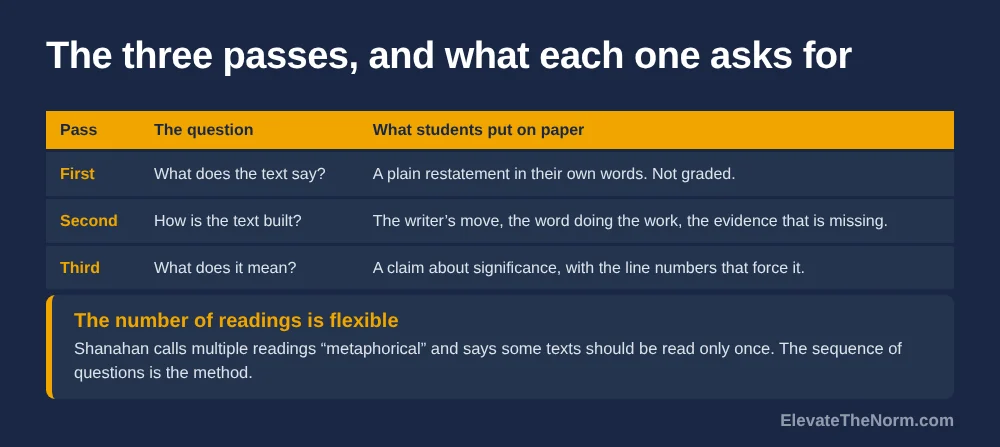
    The three purposes Shanahan assigns to repeated readings. The count is flexible; the sequence of questions is not.
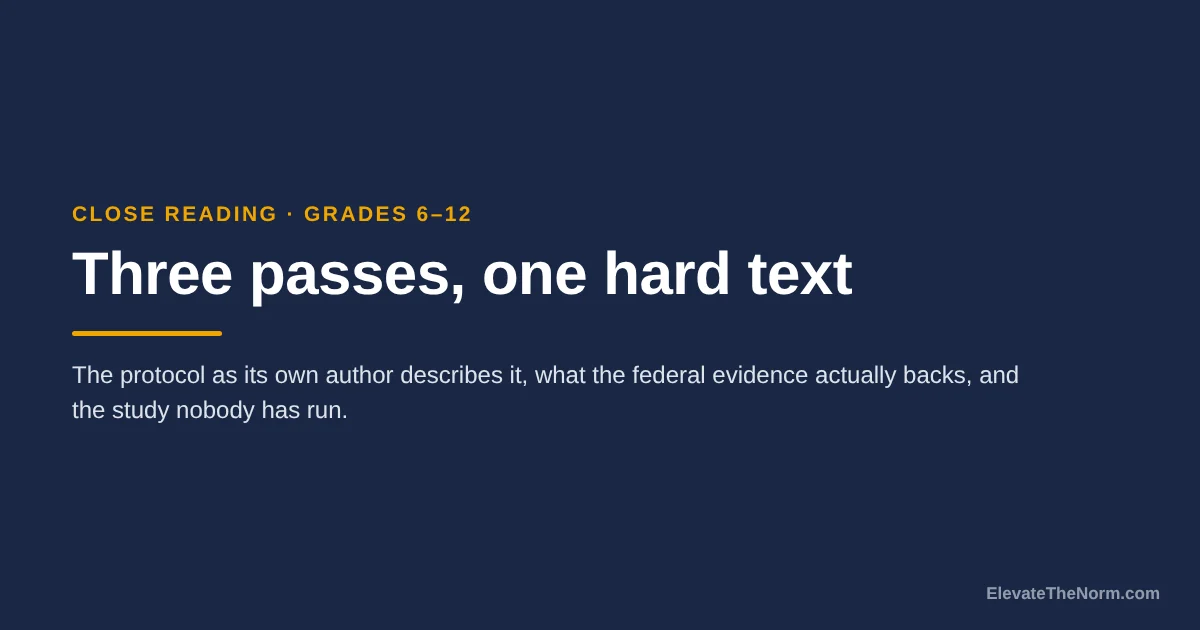
    Chart of the three close reading passes: the first read asks what the text says and produces an ungraded restatement, the second asks how the text is built, the third asks what it means and requires line numbers.

    Does close reading improve reading comprehension?

    There is no controlled secondary-classroom evidence that it does. Shanahan, who wrote the three-pass version most teachers were trained on, puts it in his own words: “there are not studies comparing close reading with traditional ways of guiding students’ reading comprehension.”

    He still thinks it belongs in a curriculum. He just will not promise it does anything measurable — “I don’t know whether practicing these activities will have a sufficient impact to guarantee those outcomes.” A researcher saying that about his own recommendation is the most useful sentence here. Catterson reached the same place from the other side, finding “very few empirical tests of particular approaches to adolescent close reading instruction.”

    The one head-to-head test went against it. Boudreaux-Johnson, Mooney and Lastrapes ran close reading against Collaborative Strategic Reading, which already had an evidence base, in The Journal of At-Risk Issues: “in all six cases … the Daze score for CSR was higher than that for close reading by intervention’s end.” Close reading ran at 95 percent fidelity and the comparison at 75.6, so the worse-implemented condition still came out ahead. Their verdict is that “the present body of evidence supporting implementation of close reading practices is lacking.”

    The caveats are big enough that nobody should use that study to kill close reading in a department meeting. The participants were six fourth graders in a Tier 2 programme at a rural public school, over six weeks, in a single-subject design read by eye with no statistical testing and no effect sizes. Six nine-year-olds in an intervention group are not a secondary classroom, and this site will not pretend otherwise.

    Those authors do name one experiment in our grade band, calling it “the lone experimental study” of its kind: by their description, 438 students in grades 7 and 8 in an afterschool programme, 100 randomly assigned across five intervention classrooms, with gains in attendance, reader self-perception and state reading scores. I could not open that paper, so that is another team’s account, cited that way below — and by that account the treatment bundled close reading with independent reading and small-group instruction, so even if every number holds it cannot say which of the three did the work.

    What does the federal evidence actually support?

    The machinery underneath close reading, not the label on it. The What Works Clearinghouse guide Providing Reading Interventions for Students in Grades 4–9, chaired by Sharon Vaughn, makes four recommendations. Two are the engine of any close reading lesson, and neither is called close reading.

    Recommendation 3 is to “routinely use a set of comprehension-building practices to help students make sense of the text,” listed with 34 supporting studies. Recommendation 4 is to “provide students with opportunities to practice making sense of stretch text (i.e., challenging text) that will expose them to complex ideas and information,” listed with 15. For scale, the guide gives its decoding recommendation “a strong level of evidence … based on 32 studies” — a tier it defines as “consistent evidence that meets WWC standards.”

    Limits, stated rather than buried: the guide covers grades 4 through 9, so a high school junior sits outside its scope, and I read roughly its first third in full, so you are getting study counts and exact wording rather than a tier for Recommendations 3 and 4 that I did not see.

    One passage deserves reading aloud in every secondary building. Writing about older students who need decoding help, the panel tells teachers to use real linguistic terms rather than the cute elementary ones “to ensure that the students do not feel like they are being treated like early-elementary students,” because “the goal is only for students to feel self-assured and respected as more mature learners.” Teenagers notice being talked down to, and they stop working when it happens.
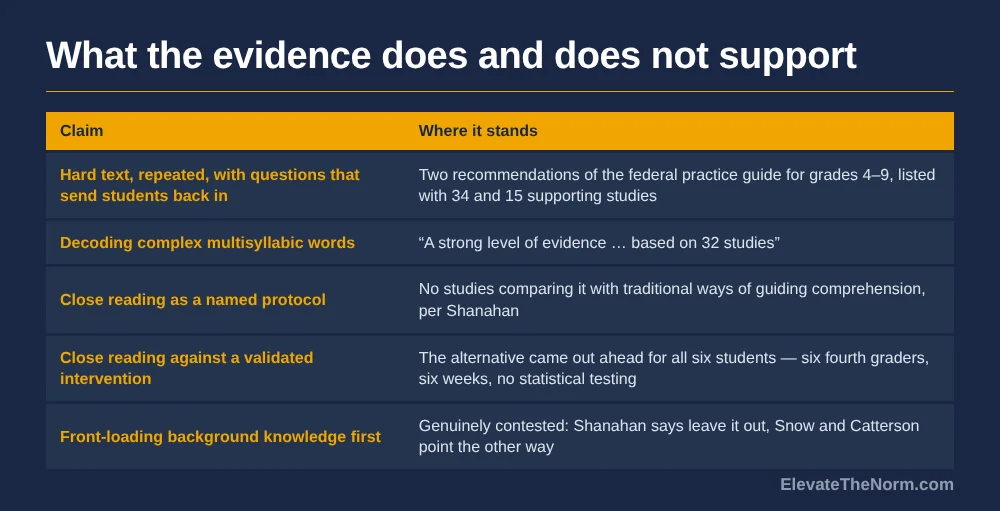
    Table comparing close reading claims against the evidence, separating the practices with federal research support from the named protocol, which has no comparison studies.

    Should I build background knowledge before a close reading?

    This is the one piece where the evidence disagrees with itself, so decide on purpose rather than by whichever training you happened to get. Shanahan says leave prior-knowledge activation out. A UCLA guide quotes Catherine Snow warning that a cold read of a too-hard text produces frustration rather than struggle. A Berkeley study in high school classrooms found pre-reading helped.

    Shanahan’s position is narrower than the slogan version. On previews: “No, you probably should not provide much of a preview.” On prior knowledge: “it would be better for a close reading lesson for the teacher to leave that out” — and, in the same breath, “it is reasonable to provide prior knowledge preparation often.” He is saying that on the day you teach students to wring meaning out of the page itself, handing them the meaning first defeats the lesson. The CRESST guide describes that same minimal-preview practice and prints the objection beside it, recording that Snow “cautions against what she calls cold close reading”: reading a text too hard “often results, not in productive struggle, but in destructive frustration.” That quotation reached me through the UCLA guide rather than Snow’s own article, and is credited that way below.

    Catterson ran the question instead of arguing it, in a high school chemistry classroom: 28 students aged 14 to 17, one teacher, one semester, with randomized comparisons inside a mixed-methods design. She found that “students who had their background knowledge activated with pre-reading activities prior to closely reading an article wrote more argument-generating questions than students who did not.” Weigh it at its real strength: an unpublished dissertation whose author says her design is “less concerned about establishing specific causal relations.”

    In a real room the cold read is defensible when the text is inside reach and the lesson is about reading strategy. It is indefensible when students have never met the topic, because then you are not watching them solve a problem, you are watching them drown politely. If the topic is new, spend two minutes on the words that actually unlock the passage, or get their position on the table with a short set of arguable statements they commit to before reading. Neither tells them what the text says.

    If the barrier is the words themselves, more passes will not fix it — which is why the federal guide treats decoding as its own recommendation. Pre-teach the words, pair students for the first pass, or give the same three questions against a shorter excerpt of the same source; not a different, easier topic, which quietly tells a student they are in the group that does not get the real thing. And when a child comes home saying they did not understand the reading at all, that is information about the text, not a verdict on the reader.

    Which texts are worth reading closely?

    Short ones that resist you. Shanahan is blunt about the filter — “not all texts are worth the trouble of close reading” — and what he asks for is “high-quality texts, texts with a lot of depth,” because “challenging texts do not give up their meanings easily.”
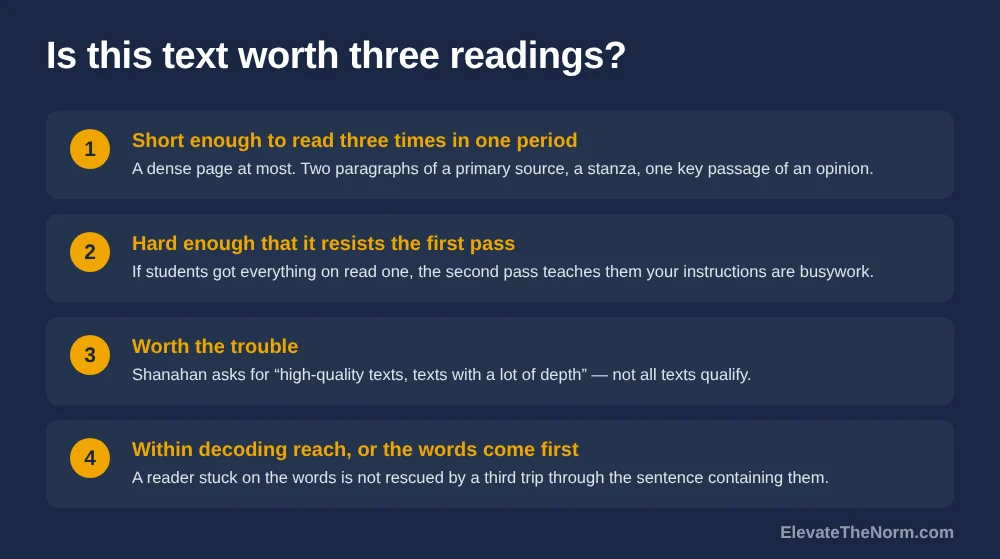
    Four-point checklist for choosing a close reading text: short enough for three readings, hard enough to resist the first pass, worth the trouble, and within decoding reach.

    The practical filter is arithmetic: if students read a text three times and discuss it inside one period, each reading has to cost a few minutes. A dense page is plenty — two paragraphs of a primary source, a stanza, one court opinion’s key passage, a methods section. A chapter is a reading assignment, and treating it as a close reading is how this becomes a week nobody enjoyed. The other half of the filter is whether the text rewards the second trip. If students get everything on the first pass, the second teaches them your instructions are busywork, and they are right.

    Subject matters too, and Shanahan warns the single-protocol version is too narrow: historians read “author centered” while scientists read across texts to compare them, so “there are other kinds of reading that students should also be exposed to.” In history the second pass is usually about the author rather than the structure, which is its own sequence — working a single historical document for what it is and who made it. Once the task becomes comparing several documents under time pressure, you have arrived at the document-based question as an assessment task, with its own rubric and failure modes.

    How do I run a close reading in one fifty-minute period?

    Pick a text short enough to read three times, give each read a different question, and spend the back half of the period arguing about the third. The sequence below assembles what the sources above describe into one period — the protocol as the research and the practitioner guides lay it out, not a recipe anybody has tested end to end in this form.

    1. Decide the pre-reading question before the bell. New topic or a text at the top of their range: two minutes on context and the words that gate the passage. Familiar topic, text inside reach: go in cold, and say out loud that you are doing it on purpose.
    2. Give the general purpose and nothing else. “Find out what this says” is a purpose. “Find the three ways the author builds sympathy” is the answer, handed over before they read a word.
    3. First read for what it says, and do not grade it. Score the first attempt and the unsure student writes nothing or copies a neighbour, and you have lost the one honest reading of the three.
    4. Second read for how it is built. This is where marking the page earns its keep, and the only pass where it should happen. One question, not nine.
    5. Walk the room, and do not correct what you overhear. Fix a misreading with a question — “read me the sentence that makes you think that” — not with a correction. A student told they are wrong in front of the two people they were talking to learns to say nothing during the second pass, which destroys the only reason you were listening.
    6. Third read for meaning, in the open. Ask questions that cannot be answered without going back into the text, and require line numbers in every answer. That requirement is the mechanism: it makes the conversation about the page rather than about opinions.
    7. End with something written and short. One claim, two pieces of text evidence, one sentence on what the author did to make it work. If you cannot read the class set in twenty minutes, you assigned too much.

    Two omissions are deliberate: no reading it aloud first, because that replaces their first read with yours, and no vocabulary quiz at the end, because the close reading is the lesson. Finding the text is the prep; the three questions take about a quarter of an hour, and there is nothing to buy. If the room dies halfway through the second pass, that usually means the text was too long for three trips, or gave everything up on the first.

    Is annotation the point of close reading?

    No, and the person most associated with the protocol thinks schools have this backwards. Shanahan says annotation’s “use has been overblown in lots of classrooms”: “too often the notetaking seemed to be the point of the reading, rather than accomplishing those goals.”

    Students agree, for what it is worth: in the Boudreaux-Johnson comparison the lowest-rated element of the close reading condition was “the annotating/note taking component,” at 5.5 on a nine-point scale. Neither that study nor Shanahan measured what annotation does to comprehension, so this is not evidence that marking a text is useless — it is evidence that students can tell when the marking has become the assignment. Marking well is its own skill, and there is a whole separate discipline to marking up a text while you read. Inside a close reading, confine it to the second pass and give it one job.

    This matters most to whoever is doing walkthroughs, because a marked-up page is easy to count and so it is what gets looked for — precisely the failure Shanahan names. Listen instead for whether students’ answers point back at specific lines. A silent room full of highlighted paper is the version that does nothing.

    Doesn’t this site say rereading is a weak strategy?

    It does, and both are true, because they are different acts. Rereading your own notes alone at a kitchen table the night before a test is one of the weakest ways to study. Reading a hard source a second time with a specific question attached, in a room with a teacher in it, is an instructional move.

    I flag it because someone will eventually quote this site against itself. Our page on which study strategies actually survive scrutiny rates passive rereading poorly, and it is right to. The difference is the question and the audience: solo rereading has no purpose attached and nobody to catch the misreading, which is exactly what the second and third passes supply. If a student asks why the teacher who said rereading does not work just asked them to read it three times, that is the answer — and it is a good question.

    Clay’s take: use it, but stop selling it

    Close reading is a good thing to do two or three times a unit with a text that deserves it, and a bad thing to make into a weekly ritual. That is my read of the evidence above, not a finding from it.

    What keeps me doing it is the second pass. I run a workshop room — tables in groups, no rows, me on a stool moving between them rather than talking at the front — and the most useful thirty seconds of any reading lesson is overhearing a group confidently build on a sentence they have misread. On a one-pass assignment I never hear it; it turns up a week later in an essay, by which point it is theirs and load-bearing. What you do with those thirty seconds decides whether you keep getting them. Correct the table and you have taught them that thinking out loud is how you get caught being wrong. Ask which sentence gave them that, and they fix it themselves while you walk away.

    What I would refuse: adopting close reading as a department-wide intervention for struggling readers, because the evidence for that use does not exist and the one published head-to-head went the other way; and putting it in an improvement plan as a way to raise reading scores, because anybody claiming that is extrapolating from studies that did not measure it. As a shared habit in content classrooms it is a different proposition — no purchase, no licence, no platform, just a passage, three questions and a teacher. If your school already paid for the training, Shanahan’s own advice is to retain it and “expand the focus to some other approaches to text.”

    And teenagers can be told the truth about this. “We are reading this three times because it is hard and I think it is worth it” is a sentence a fifteen-year-old can respect. “Because this is how we do close reading” is not.

    What to do next

    Pick one text in your next unit that you have always wished students understood better and that fits on a single page. Write three questions for it — what it says, how it is built, what it means — and run one close reading lesson, deciding in advance whether you are front-loading the context or going in cold. Then judge it on what you learned about your readers, not on whether it felt like a strategy. That is a fair test, and the only one available until somebody runs the study nobody has run.

    A second pass through a passage is one way to slow students down; handing them four jobs and letting them run the discussion is another. What the reciprocal teaching evidence shows once you separate the tests reports the finding that has held for thirty years: about .87 on comprehension tests the researchers wrote themselves, and about .32 on standardized reading tests, from the same pool of studies.

    By the third pass, the question students are usually reaching for is what the whole thing is about — and that is the one they have the least language for. Theme is not a topic word; it is a full sentence that says something about people or life, which the story earns through its characters, conflict and outcome. What theme is, in a definition students can actually use covers the topic-versus-theme distinction, the two questions that get students there, and how to stop “greed” being handed in as an answer.

    The second pass asks what the text says. Naming it in one sentence is harder than it sounds. The central idea is the claim every section of the text supports — not the topic, and not a theme, which is a different thing that belongs to fiction. How students find the central idea, and how it differs from main idea and theme covers the distinction, the test for a good central-idea sentence, and where the classroom vocabulary gets muddled.

    Frequently Asked Questions

    What is close reading?

    Close reading is the intensive analysis of a short, challenging text across repeated readings, with each reading set to a different purpose: what the text says, how it is built, and what it means. The term comes from literary criticism rather than reading research, and it reached most American classrooms through the Common Core standards rather than through a trial.

    What are the three reads in close reading?

    The first read establishes what the text says, as a plain restatement. The second looks at how the text is built: the writer’s moves, the words doing the work, the evidence offered or missing. The third asks what the text means, answered with specific lines. Timothy Shanahan, who set out this sequence, stresses that the three readings are metaphorical and that some texts need only one.

    Does close reading improve reading comprehension?

    There is no controlled secondary-classroom evidence that it does. Shanahan states that no studies compare close reading with traditional ways of guiding comprehension. The only published head-to-head comparison, involving six at-risk fourth graders, favoured a validated alternative intervention. The underlying practices of working with challenging text do have federal evidence behind them; the named protocol does not.

    How long should a close reading text be?

    Short enough to read three times and discuss inside one class period, which in practice means a dense page at most. Two paragraphs of a primary source, a single stanza, or one key passage of a court opinion all work. A full chapter is a reading assignment, not a close reading, and treating it as one is how the lesson collapses on the second pass.

    Should students be given background knowledge before a close reading?

    This is genuinely contested, so decide deliberately. Shanahan advises leaving prior-knowledge activation out of a close reading lesson, while agreeing it is reasonable to build knowledge often. A UCLA guide records Catherine Snow warning that a cold read of too-hard text produces destructive frustration rather than productive struggle, and a Berkeley study in high school classrooms found pre-reading helped.

    Is close reading the same as annotating a text?

    No. Annotation is one tool inside the second pass, and Shanahan argues its use "has been overblown in lots of classrooms," with notetaking becoming the point of the reading instead of a means to it. In the one comparison study available, students rated the annotation component the lowest-scoring part of the whole close reading condition.

    Does close reading work for struggling readers?

    Not if the barrier is decoding. A student who cannot read the words on the page will not get there through additional passes, and the federal practice guide for grades 4 to 9 treats decoding complex multisyllabic words as a separate recommendation carrying a strong evidence rating from 32 studies. Pre-teach the words, pair the first read, or shorten the excerpt rather than reassigning an easier topic.

    Is close reading only for English class?

    No, but it looks different by subject and should not be the only approach. Shanahan notes that historians read in an author-centred way and scientists read across texts to compare them, concluding that students need exposure to other kinds of reading too. In history the second pass is usually about who wrote the document and why, rather than about its structure.

    Sources

    • Shanahan, T. Should We Still Teach Close Reading? Shanahan on Literacy. Post. Source of the three purposes, the “metaphorical” status of multiple readings, the statements that no comparison studies exist, the position that close reading is a curricular goal rather than a method, the judgment that annotation has been overblown, the advice to schools to retain and expand, and the text-selection filter. An opinion essay by a reading researcher, not a study; it reports no data of its own.
    • Boudreaux-Johnson, M., Mooney, P., & Lastrapes, R. E. An Evaluation of Close Reading With At-Risk Fourth-Grade Students in Science Content. The Journal of At-Risk Issues, 20(1). Full text via ERIC. Source of the head-to-head comparison against Collaborative Strategic Reading, the fidelity figures, the 5.5 annotation rating, and the authors’ conclusion that the evidence base is lacking. Six fourth-grade students in a Tier 2 programme at a rural public school, six weeks, single-subject alternating treatments design read by visual inspection, with no statistical testing and no effect sizes. It is also the source for this article’s description of Fisher and Frey’s grades 7–8 study, which is reported here as their account of it because the original could not be opened.
    • Vaughn, S., Gersten, R., Dimino, J., Taylor, M. J., Newman-Gonchar, R., Krowka, S., Kieffer, M. J., McKeown, M., Reed, D., Sanchez, M., St. Martin, K., Wexler, J., Morgan, S., Yañez, A., & Jayanthi, M. (2022). Providing Reading Interventions for Students in Grades 4–9. WWC 2022007. National Center for Education Evaluation and Regional Assistance, Institute of Education Sciences, U.S. Department of Education. Full guide. Source of the four recommendations and their wording, the 32/34/15 study counts, the strong-evidence tier definition and its assignment to the decoding recommendation, the multisyllabic-word passage, the instruction to use formal linguistic terms so older students feel respected, and the “not a cookbook” caveat. Roughly the first third of the guide was readable in full for this article, which is why the evidence tiers for Recommendations 3 and 4 are not quoted here.
    • Jones, B., Chang, S., Heritage, M., Tobiason, G., & Herman, J. Supporting Students in Close Reading. National Center for Research on Evaluation, Standards, and Student Testing (CRESST), UCLA. Full text via ERIC. Source of the alignment between the three readings and the reading anchor standards, the description of minimal pre-reading, and the Catherine Snow caution against “cold close reading,” including the “destructive frustration” quotation. A practitioner guide with no study population, design or results, and the Snow quotation is cited here as this guide reproduces it, because Snow’s own article could not be opened.
    • Catterson, A. K. (2017). Close Reading in Secondary Classrooms: A 21st-Century Update for a 20th-Century Practice. Doctoral dissertation, University of California, Berkeley. Full text via eScholarship. Source of the New Criticism origin, the assessment that there is very little research on close reading instruction, and the finding that activating background knowledge before a close read produced more argument-generating questions. A doctoral dissertation rather than a peer-reviewed trial; the empirical chapter covers 28 students aged 14 to 17 with one teacher in four non-AP chemistry sections, and the author states her design is less concerned with establishing causal relations. Her question counts are not quoted here because they could not be verified against the document.
    • Named but not cited as evidence, because they could not be opened for this article: Bogaerds-Hazenberg, Droop and van Steensel’s literature review of close reading interventions in grades 3–9, Still too close to call, published in Reading Psychology and referenced above only as Shanahan cites it; and Fisher and Frey’s grades 7–8 study, described above through Boudreaux-Johnson and colleagues. Neither is quoted here beyond those attributions.
    About Clay Shumate

    Clay Shumate is a certified secondary Social Studies teacher in the public schools of West Alabama, with seven years of classroom experience, a B.A. in History, and an M.Ed. in Secondary Education. He writes about project-based learning, student responsibility, respect, and practical ways to hold young people to a higher standard while giving them room to learn from mistakes. He is a member of the Society of Professional Journalists and writes to its Code of Ethics; this site’s editorial standards and corrections policy are published in full. More about Clay.

  • Anticipation Guide: How to Build One and What the Evidence Shows

    Anticipation Guide: How to Build One and What the Evidence Shows

    By Clay Shumate

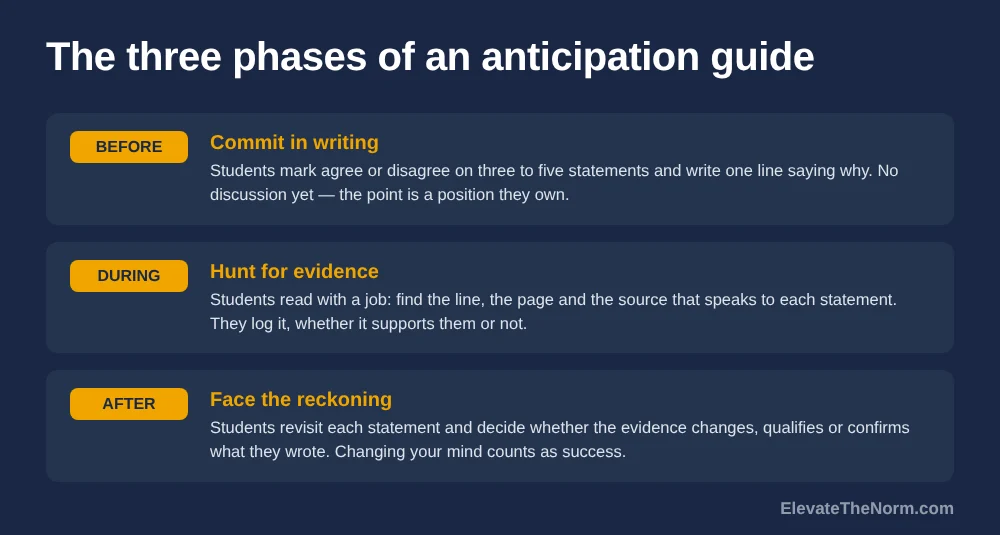
    An anticipation guide is a short list of statements students agree or disagree with before they read, then revisit afterward with evidence from the text. It sets a purpose for reading and surfaces what students already believe. Three to five opinion statements work better than true-or-false facts.

    Key Takeaways

    • The statements have to be arguable, not factual. The IRIS Center at Vanderbilt is explicit that statements should be phrased “as opinions rather than true-false facts,” because opinions give students somewhere to stand.
    • The after column is the whole point. A guide that never gets revisited is a warm-up. The learning sits in making students face what the text did to their first answer.
    • The mechanism has strong evidence; the worksheet does not. the federal What Works Clearinghouse practice guide for grades 4–9 gives strong evidence, from 34 studies, to building topic knowledge and word meanings before reading — the thing an anticipation guide is a container for. The container itself has almost no controlled evidence at this grade band.
    • The one experiment that measured learning found none. Valle, Antonenko, Wang and Luo (2020) randomly assigned 17 adults and found no significant difference in learning (p = 0.1), with the control group scoring numerically higher on the transfer test.
    • Do not grade the before column. Score the first guess and students write what they think you want, which destroys the only data the instrument produces.

    What is an anticipation guide?

    An anticipation guide is a pre-reading tool: three to five statements about a text’s big ideas, which students agree or disagree with before reading and then return to after. It gives students a position to defend and a reason to look for evidence.

    Chart of the three phases of an anticipation guide: before reading students commit in writing to agree or disagree on three to five statements, during reading they log textual evidence for each statement, and after reading they revisit each one and decide whether the evidence changes their position.

    It is sometimes called an anticipation-reaction guide or an opinionnaire, and the second word in that first name matters. The IRIS Center at Vanderbilt builds the template around six columns: the statement, agree, disagree, the reader’s perspective before reading, textual evidence with a source and page number, and the reader’s perspective after reading. The evidence column is what separates this from a show of hands.

    The practitioner trail for the modern version runs back to a 1994 article by Frederick Duffelmeyer in the Journal of Reading, which is the citation AdLit, the adolescent literacy service of public broadcaster WETA, gives for its own steps. Who invented the format originally is not something the major teaching references agree on, and this article is not going to pretend otherwise.

    How do I make an anticipation guide?

    Pick the three to five ideas the text actually argues, turn each into a sentence a reasonable person could disagree with, and build a place for students to record evidence. The whole job is about twenty minutes the first time and under ten after that.

    1. Read the text and find what it argues, not what it covers. The IRIS Center at Vanderbilt calls this identifying key concepts or themes. A chapter on industrialization covers dates; it argues that the trade-offs were uneven. Write toward the argument.
    2. Write three to five statements. Not ten. Students have to produce a before answer, an evidence line and an after answer for each one, so every statement you add costs three pieces of work.
    3. Phrase each one as an opinion. The IRIS Center at Vanderbilt warns against true-false facts and recommends statements that allow for competing perspectives, specifically so more than one reading becomes defensible.
    4. Say no to the topics that will not survive the room. The IRIS guidance is to consider somewhat controversial statements but avoid politically or emotionally charged ones the class has already handled badly. That is a judgment about your room, and you are the one qualified to make it.
    5. Add the evidence column and require a source. Page number, paragraph, speaker. Without it students will report a vibe and call it textual support.
    6. Decide now when the after column happens. Put it on the lesson plan with a time. The single most common failure of this strategy is that the class runs out of period before the reckoning and the guide quietly becomes a worksheet.
    7. Print one line at the top saying what the sheet is for. Something like: there are no wrong answers in the first column; changing your mind after reading is the point. It costs nothing, it settles the question for the student who is anxious about guessing, and it means the sheet explains itself if it ends up on a kitchen table.

    One differentiation move is worth building in from the start, because retrofitting it mid-lesson never works: for students who need it, write the page or paragraph range next to each statement. They still have to find the evidence and decide what it means, which is the thinking the guide is for. What you have removed is the search, which is not.

    What makes a good anticipation guide statement?

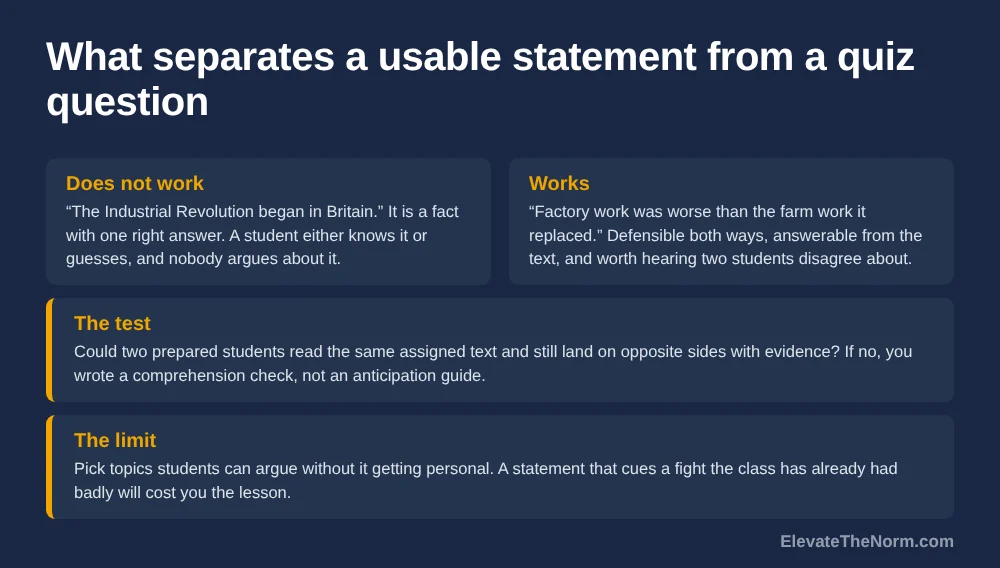
    A good statement is one two prepared students could read the same text about and still land on opposite sides, with evidence. If the text settles it in one line, you have written a comprehension check.

    Comparison graphic contrasting a factual statement that does not work in an anticipation guide with an opinion statement that does, plus a test for whether two prepared students could disagree with evidence and a caution about emotionally charged topics.

    Compare two statements for the same chapter. “The Industrial Revolution began in Britain” is a fact. There is one right answer, a student either knows it or guesses, and after reading there is nothing to revisit. “Factory work was worse than the farm work it replaced” is arguable, answerable from the same chapter, and will split a class — which is exactly the condition that makes the after column worth doing.

    There is a second test worth applying, and it catches the statements that look arguable and are not. Ask yourself what evidence in this text would move a student from one side to the other. If you cannot name it, students cannot find it, and the evidence column will come back empty with the opinions unchanged. That is also where this differs from reading a single source closely: there you interrogate one document; here you test a claim against whatever the reading offers.

    What does a finished anticipation guide look like?

    Four columns and four rows fits on half a page. Below is the shape, using example statements for a unit on industrialization — these are illustrations of the format, not a recommended reading list.

    StatementBefore readingEvidence from the textAfter reading
    Factory work was worse than the farm work it replaced.Agree / Disagree, plus one line saying why.Page and quote. Wage data, hours, accounts from workers.Changed, qualified or confirmed — and what did it.
    New technology mostly helps the people who already have money.Agree / Disagree, one line.Who owned the machinery; who was paid what.Same three options, in a sentence.
    A country is better off when it industrializes quickly.Agree / Disagree, one line.Comparison of two countries or two decades in the chapter.Same.
    Child labor ended because people decided it was wrong.Agree / Disagree, one line.What the text says actually changed the law.Same.

    The after column should take a sentence, not a paragraph. “I still agree, but only for the first twenty years” is a better outcome than a tidy reversal, and it is the kind of answer worth reading aloud.

    Does the research say anticipation guides work?

    Honestly: the evidence for the underlying move is strong, and the evidence for this specific worksheet is thin. No controlled trial in a secondary classroom shows that anticipation guides raise comprehension. That is worth knowing before a department adopts one.

    Start with what is solid. the federal What Works Clearinghouse practice guide for grades 4–9, published in 2022 as WWC 2022007, assigns a strong level of evidence — its highest — to routinely using a set of comprehension-building practices, based on 34 studies, 23 of which met the Clearinghouse’s standards without reservations. The first part of that recommendation is building topic knowledge and word meanings before reading, roughly three to five minutes on each. An anticipation guide is one way to spend those minutes. The practice is evidenced; the format is a choice.

    Now the specific studies, which are small and mostly not about teenagers. Valle, Antonenko, Wang and Luo (2020) ran the only randomized comparison we could find that measured learning: 17 adults aged 18 to 61, 8 with a guide and 9 without, watching a professional development video. Eye tracking showed the guide group made significantly more transitions between the text and the images — about 18 more in each direction, p = 0.002. Learning showed no significant difference (p = 0.1), and the control group scored numerically higher on the knowledge transfer test, 4.11 against 3.37. The authors are careful about it, writing that in the absence of a learning difference “it would be irresponsible to claim” the extra eye movement was integration rather than split attention.

    Modjanggo (2019) is the study usually cited as the win: 25 university students in a Reading 1 course went from a 55.6 pretest mean to an 89 posttest mean after three sessions. But it is a single-group pre-post design with no control group, the participants are university students learning English rather than secondary readers, and the write-up reports two different degrees of freedom for the same test. A 33-point gain with nothing to compare it against cannot separate the strategy from three more weeks of practice.

    Evans, Kodela and Khan (2022) is the most interesting of the three and the least like a classroom: 47 internal medicine residents used guides before and after five teaching conferences, and 35 of them — about 74 percent — showed a change in knowledge or thinking. It is a qualitative case study with no statistical test, and the authors say plainly that studies of guides in their field are scarce. What it does show is the mechanism working: the instructors used what residents got wrong to change what they taught next.

    So the fair summary is this. Anticipation guides are a reasonable container for a practice with strong federal evidence behind it. They are not themselves a proven intervention, and anyone telling you they raise reading scores is extrapolating from studies that did not measure that.

    There is one limit worth naming before you build the first one. The guide assumes students have enough footing on the topic to hold an opinion. A student who has never encountered the subject is not activating prior knowledge; they are flipping a coin in public, and if the class then discusses the split, they are flipping it in front of everyone. The federal guide pairs before-reading work on topic knowledge with word meanings for exactly this reason. If a class is coming in cold, spend two minutes establishing the ground first, then hand out the guide. If you are not sure which it is, a KWL chart used as a diagnostic will show you what the room actually brings to the topic before you commit a lesson to it.

    Should I grade an anticipation guide?

    Grade completion, never correctness, and never the before column. The instrument runs on an honest first guess. The moment a wrong guess costs points, students stop guessing and start predicting what the teacher wants.

    If you need it in the gradebook, score the evidence column — did the student find a real line with a real page number — and the after column, where the question is whether they engaged with what they found. Both are things a student controls through effort. The before column is not.

    This is also the place to say something to students out loud, because they will not assume it: changing your mind on this sheet is the success condition, not an admission you were dumb. Teenagers read a graded before-and-after as a trap unless you tell them it is not one. Say that the only wrong answer in the after column is the one that ignores the evidence.

    One adjustment on that, and it is the kind of thing that only shows up from a desk. Reading a good reversal aloud is worth doing, and it should be read without the name unless the student has said yes first. Praised or not, being held up as the person who was wrong at the start of the period is still being held up as the person who was wrong, and the quiet lesson a fifteen-year-old takes from it is to write the safe answer in the before column next time. Read the reasoning, keep the author out of it, and the honest first guesses keep coming.

    How does this fit in a fifty-minute period?

    Five minutes to commit, the bulk of the period to read and log evidence, and eight to ten minutes at the end for the reckoning. If the reading will not fit, split the guide across two days rather than cutting the after column.

    The front end works well as the opening routine it has to fit inside: students are writing within ninety seconds of the bell and they have a reason to care about the reading before you have said anything. The residents in the medical study completed theirs in about five minutes and revisited them in about five, which is the right order of magnitude.

    One structural pairing is worth knowing. If you want discussion in the middle, a structure that makes everyone commit before anyone talks is the natural partner, because the guide has already done the committing step for you. And if vocabulary is what will stop students from reading the evidence at all, handle that first — pre-teaching the words that would otherwise stop them is the other half of the practice the federal guide describes.

    What goes wrong with anticipation guides?

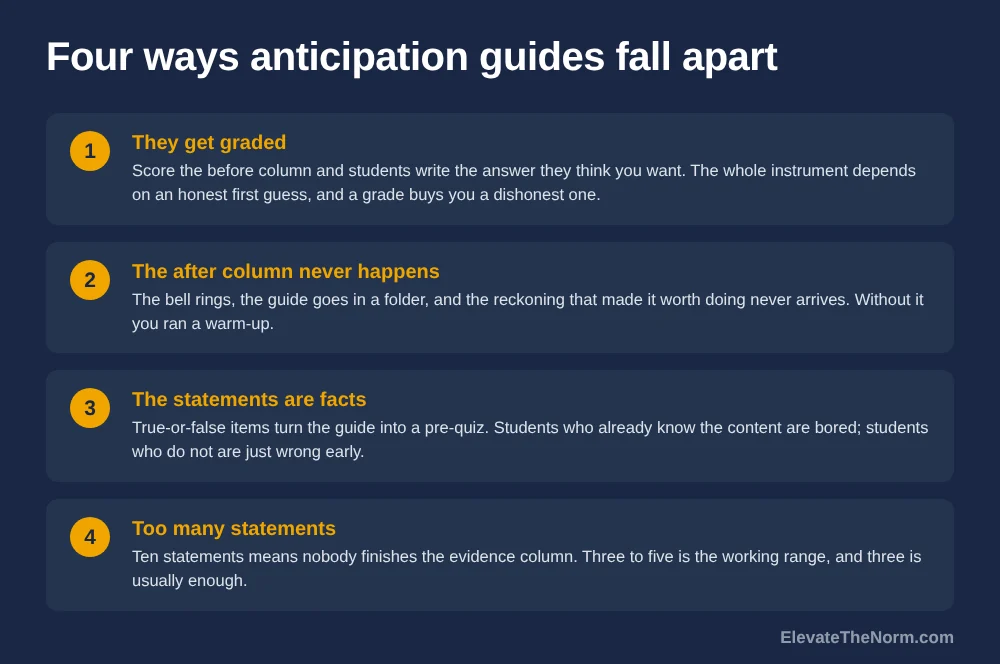
    Four failures account for most of it: grading the first guess, never running the after column, writing facts instead of arguable claims, and using too many statements. All four are avoidable in the planning, not in the moment.

    Numbered graphic listing four common failures of anticipation guides: grading the before column, never completing the after column, writing factual statements instead of arguable ones, and using too many statements.

    The missing after column is the one that happens to good teachers on busy days, and it is the one that costs the most. Without it students have made a prediction and never found out what happened, which is not a learning experience in any form. If the period is going badly, cut the number of statements you discuss rather than skipping the discussion.

    The fourth failure — too many statements — is usually enthusiasm. Ten statements looks thorough on paper and produces thirty pieces of student work, none of them finished. Three good statements beat eight mediocre ones, and the IRIS guidance of three to five is a ceiling worth respecting.

    There is a quieter failure too, which is the guide that duplicates work students are already doing. If your class already does marking up a text while they read, the evidence column may just be annotation with extra steps. Use the guide when you want students to arrive at the text with a position; use annotation when you want them to track one as it develops.

    What to do next

    Take the next reading you already planned to assign and write three statements about what it argues. Put ten minutes at the end of that lesson on the plan, in writing, for the after column. Then run it once before you decide anything about whether it belongs in your rotation.

    And hold it at the right strength. Clay’s read, as a grades 6–12 teacher: this is a cheap, sensible way to do a thing the federal evidence says is worth doing, and it is not a reading intervention. If a department adopts it as one, the research will not back the claim, and the first year of flat scores will get blamed on the teachers rather than on the promise.

    Frequently Asked Questions

    What is an anticipation guide used for?

    An anticipation guide is used before reading to activate what students already believe about a topic and give them a purpose for reading. Students mark agree or disagree on three to five statements, read while collecting textual evidence about each one, then revisit their positions. It is also called an anticipation-reaction guide or an opinionnaire, and the reaction half is where the learning sits.

    How many statements should an anticipation guide have?

    Three to five. The IRIS Center at Vanderbilt recommends that range, and the arithmetic supports it: each statement requires a before answer, an evidence line with a source, and an after answer, so ten statements produce thirty pieces of work that no class period can finish. Three strong arguable statements are more useful than eight weak ones.

    Should anticipation guide statements be true or false?

    Neither. They should be opinions a reasonable person could argue either way using the assigned text. The IRIS Center specifically advises phrasing statements as opinions rather than true-false facts, because factual items turn the guide into a pre-quiz with one right answer and leave nothing to revisit afterward.

    Do anticipation guides improve reading comprehension?

    There is no controlled secondary-classroom evidence that they do. The strongest related finding is from the federal What Works Clearinghouse guide for grades 4 to 9, which gives strong evidence to building topic knowledge before reading in general. The one randomized study measuring learning, by Valle and colleagues, found no significant difference between guide and no-guide groups.

    Should I grade an anticipation guide?

    Grade completion of the evidence and after columns if you need a grade, but never grade the before column for correctness. The instrument depends on students recording what they honestly think before reading. Once a wrong first guess costs points, students write what they expect the teacher wants and the guide stops producing useful information for anyone.

    What is the difference between an anticipation guide and a KWL chart?

    An anticipation guide asks students to take a position on specific claims the text addresses, which they then test against evidence. A KWL chart asks what students know and want to know about a topic in open form. The guide is narrower and more argumentative by design, which is what makes the after-reading comparison concrete rather than general.

    How long does an anticipation guide take in class?

    About five minutes at the start and eight to ten at the end, with the reading in between. The residents in the PRiMER study completed theirs roughly five minutes before instruction and revisited them about five minutes after, which is a realistic benchmark. If the reading will not fit in one period, split the guide across two days rather than cutting the after column.

    Can anticipation guides be used outside English class?

    Yes, and the published examples skew that way. The IRIS Center’s worked example is a middle school science lesson on rainforests and natural resources, and the PRiMER study used guides in medical education. Any subject with assigned reading that makes a claim will work, including science, history, health and career and technical courses.

    Sources

    • The IRIS Center, Peabody College, Vanderbilt University. Introduction to Anticipation-Reaction Guide, from the Secondary Reading Instruction module. Page. Source of the six-column template, the instruction to phrase statements as opinions rather than true-false facts, the three-to-five range, and the caution about emotionally charged topics. Note that this page cites no studies; it is authoritative guidance, not evidence.
    • Vaughn, S., Gersten, R., Dimino, J., and colleagues (2022). Providing Reading Interventions for Students in Grades 4–9. WWC 2022007. Institute of Education Sciences, What Works Clearinghouse. Full text. Source of the strong evidence rating for Recommendation 3, the 34 supporting studies with 23 meeting standards without reservations, and the three-to-five minutes each on topic knowledge and word meanings before reading. This guide evaluates the practice, not the anticipation guide format.
    • Valle, N., Antonenko, P., Wang, J., & Luo, W. (2020). Effects of Anticipation Guide Use on Visual Attention Distribution in a Multimedia Environment: An Eye Tracking Study. The Excellence in Education Journal, 9(3). Full text. Source of the null learning result (p = 0.1), the transition findings (p = 0.002), and the 4.11 against 3.37 transfer scores. The sample is 17 adults aged 18 to 61 — childcare providers and early childhood education majors — not secondary students, and the authors describe the work as exploratory. No effect sizes are reported.
    • Modjanggo, V. K. (2019). The Effect of Anticipation Guide Strategy in Teaching Reading. sintuwumarosoJET, 5(1), 24–29. Full text. Source of the 55.6 to 89 pre-post gain. Single-group pre-post design with no control group, 25 university students in an English education program, selected purposively. The paper reports conflicting degrees of freedom and no effect sizes, and its causal framing goes beyond what the design supports.
    • Evans, D. R., Kodela, J., & Khan, A. (2022). Anticipation Guides: A Tool to Highlight Knowledge and Promote Reflection on Learning. PRiMER, 6:20. Full text. Source of the 35-of-47 figure and the five-minutes-before, five-minutes-after timing. A qualitative case study of internal medicine residents at a single program, with no statistical tests and no effect sizes; the authors note that studies of guides in medical education are scarce.
    • AdLit, an education service of WETA, Washington, D.C. Anticipation Guides. Page. Source of the Duffelmeyer (1994) attribution for the strategy’s steps and of the middle-and-high-school framing. AdLit cites no reference list beyond that single in-text citation.

    About Clay Shumate

    Clay Shumate is a certified secondary Social Studies teacher in the public schools of West Alabama, with seven years of classroom experience, a B.A. in History, and an M.Ed. in Secondary Education. He writes about project-based learning, student responsibility, respect, and practical ways to hold young people to a higher standard while giving them room to learn from mistakes. He is a member of the Society of Professional Journalists and writes to its Code of Ethics; this site’s editorial standards and corrections policy are published in full. More about Clay.

  • Interactive Read Aloud: How to Plan, Pause and Get Students Talking in Any Grade

    Interactive Read Aloud: How to Plan, Pause and Get Students Talking in Any Grade

    By Clay Shumate

    An interactive read aloud is a planned lesson in which the teacher reads a text to the class, stops at chosen points to model thinking, and has students talk about what they hear. It works in any grade. The planning takes minutes: pick one purpose, mark three or four stops, and end with a question worth answering.

    Interactive read aloud guide title card showing the before, during and after stages

    Key Takeaways

    • An interactive read aloud differs from a plain read aloud in one way: students do thinking and talking during the reading, not only after it.
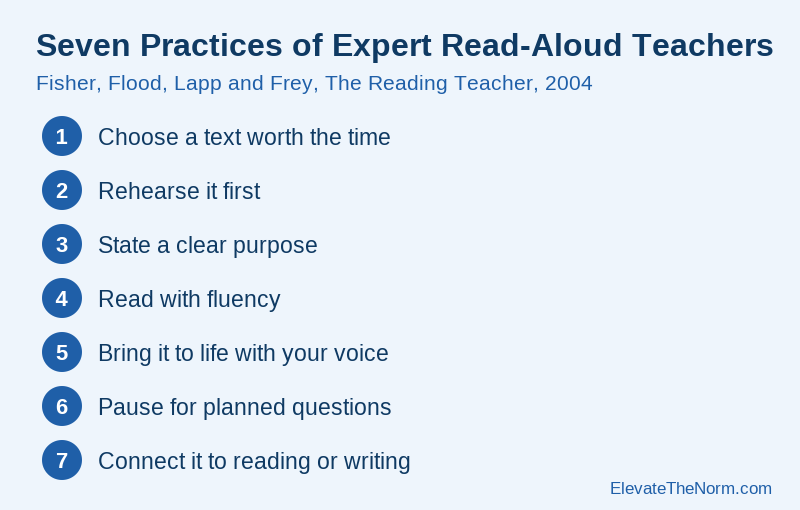
    • A study of expert teachers found seven shared practices, starting with text choice and rehearsal and ending with a link to student reading or writing.
    • Three or four planned stops are enough. Stopping on every page breaks the story and tires students out.
    • Reading aloud is not only for young children. A 12-week study of 12- and 13-year-olds reported strong gains for poorer readers when teachers read whole novels aloud at a quicker pace.
    • Sharing a whole book in a public video is a copyright question, not a teaching one. Ask the publisher first.

    Most teachers already read aloud. Fewer plan for what students are doing while the words go by. That gap decides whether a read aloud becomes a lesson or a quiet break with a book in it.

    This guide covers how to do a read aloud from choosing the text to the closing question. It includes a lesson plan outline, question stems, classroom management moves, and what changes from kindergarten through high school. Most of this site is written for grades 6–12, so the older grades get real attention here, because that is where the read aloud tends to disappear.

    What is an interactive read aloud?

    An interactive read aloud is a teacher-led reading of a text with planned pauses for questions, connections, and student responses, while the teacher models fluent reading and thinking. That is close to how Douglas Fisher and Nancy Frey describe it in ASCD’s Educational Leadership.

    If you are asking the simpler question, what is a read aloud, it is any time an adult reads a text out loud to students. The word interactive adds a job for the listeners. Students predict, explain, argue, and turn to a partner, so the teacher is no longer the only person thinking in the room.

    The text does not have to be a picture book. It can be a novel chapter, a news article, a speech, or a primary source. What makes it interactive is the talk, not the format of the book.

    How is it different from shared reading or a plain read aloud?

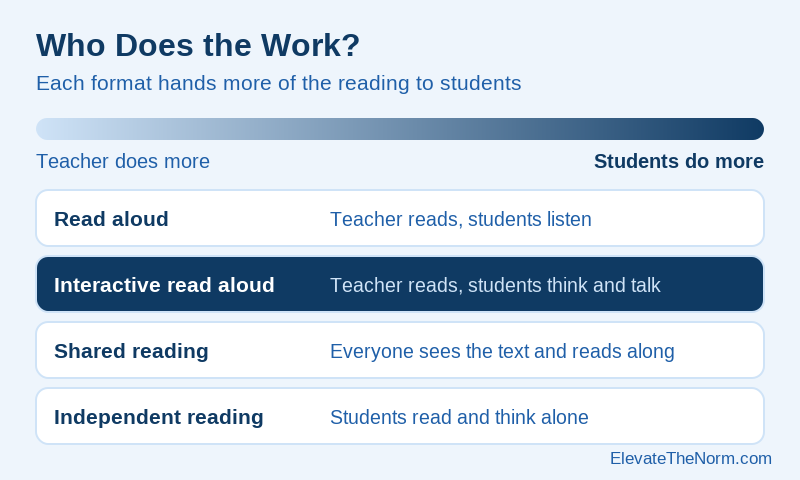
    The difference is who does the work. In a plain read aloud, students mostly listen. In an interactive read aloud, the teacher still does the reading, but students share the thinking. In shared reading, students also see the text and read along.

    Chart comparing read aloud, interactive read aloud, shared reading and independent reading by how much of the work students do
    An interactive read aloud sits between listening and reading alone.
    FormatWho readsCan students see the text?Best used for
    Plain read aloudTeacherSometimesEnjoyment and hearing a fluent reader
    Interactive read aloudTeacherSometimesComprehension, vocabulary and discussion on a text above reading level
    Shared readingTeacher and studentsYesFluency, print skills and close study of a short text
    Independent readingStudentYesStamina, choice and practice

    None of these replaces the others. An interactive read aloud lets a whole class work on a text that many could not yet read alone, which is a form of scaffolding that you can remove over time.

    What are the benefits of reading aloud?

    The benefits of reading aloud include exposure to more words, a model of fluent reading, background knowledge, and shared access to harder texts. The gains are tied to how the text is discussed, not only to the reading itself.

    The 1985 report Becoming a Nation of Readers called reading aloud to children “the single most important activity” for building the knowledge needed for reading success, as Fisher and Frey recount. The word interactive matters here. Lea McGee and Judith Schickedanz summarize the research plainly: growth is linked to how often children take part in analytic talk, so simply reading aloud is not enough.

    Two pieces of data are worth knowing, and each has limits.

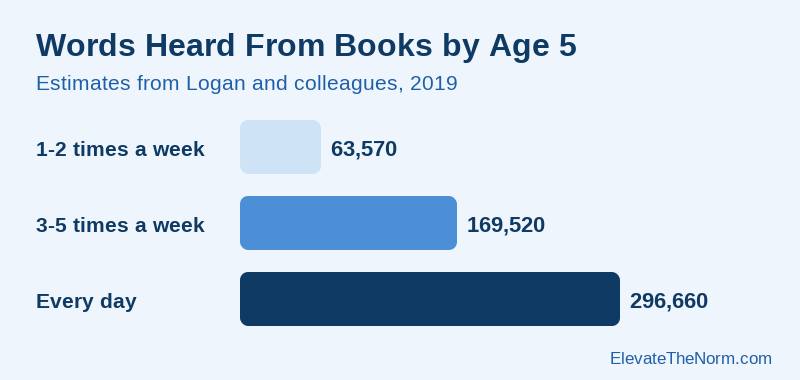
    Young children hear far more book words when they are read to often. Jessica Logan and colleagues at Ohio State counted the words in popular children’s books and estimated how many words a child would hear by age 5. These are calculations from word counts, not measures of what any one child learned.

    Benefits of reading aloud bar chart of estimated words heard by age five: 63,570 at one to two times a week, 169,520 at three to five times a week and 296,660 every day
    Daily reading adds up, based on the study’s word-count estimates.

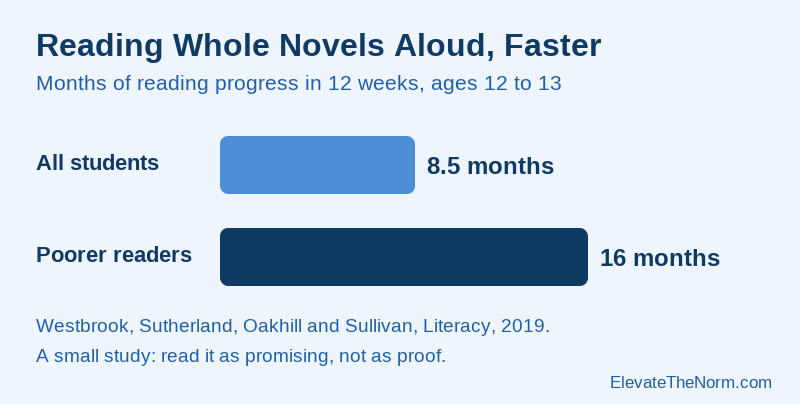
    Older students can gain too. In the “Just Reading” study, published in Literacy, 20 English teachers in southern England read two whole challenging novels aloud at a quicker pace over 12 weeks with students aged 12 and 13. Students made an average of 8.5 months of progress on standardized comprehension tests, and poorer readers made about 16 months. It is one small study, so read it as promising, not as proof.

    Bar chart from the Just Reading study showing 8.5 months of reading progress for all students and 16 months for poorer readers over 12 weeks
    The reported gains from reading whole novels aloud in 12 weeks.

    For very young children, the What Works Clearinghouse rated a related method, dialogic reading, as having potentially positive effects on oral language for children with disabilities. That rating rests on a small evidence base of 52 children aged three to six, so it should not be stretched to older grades.

    How do you do an interactive read aloud?

    To do an interactive read aloud, choose a text, read it yourself first, set a purpose, teach a few words, read with expression, stop at planned points, and finish with discussion and a short written response. The steps below build on the practices found in expert classrooms.

    The seven practices of expert read-aloud teachers: choose a text, rehearse, state a purpose, read fluently, use your voice, pause for planned questions and connect to reading or writing
    Seven practices drawn from a study of expert teachers.

    Those seven come from Fisher, Flood, Lapp and Frey’s 2004 study in The Reading Teacher, which observed 25 teachers recommended as experts and then 120 other teachers. Here is how to turn them into a plan.

    1. Choose a text worth the time. Pick something that fits your students and your unit, and that gives them something to argue about. A read aloud text can sit above their independent reading level, because you are carrying the decoding.
    2. Read it yourself first. Rehearsal is what lets you look up from the page. It also shows you where students will get lost.
    3. Name one purpose. Say it out loud: “Today, listen for how the narrator’s opinion changes.” One purpose beats four.
    4. Teach two or three words. Choose words the text depends on. Use a sentence, a gesture, or a picture, and keep moving. A fuller vocabulary routine can come later, and a Frayer Model suits the one concept the unit leans on.
    5. Read with expression. Change your pace and volume. Slow down for what matters. Fluent reading is part of the lesson, not decoration.
    6. Stop at planned points. Think aloud first, then ask. A think-aloud can be one sentence: “I’m thinking she said that because she’s scared.”
    7. Get every student talking. A quick think-pair-share at a stop gives everyone a turn, not only the three students who always raise a hand.
    8. End with a task. Ask students to apply what they heard in a short piece of writing, a discussion, or a comparison with another text.
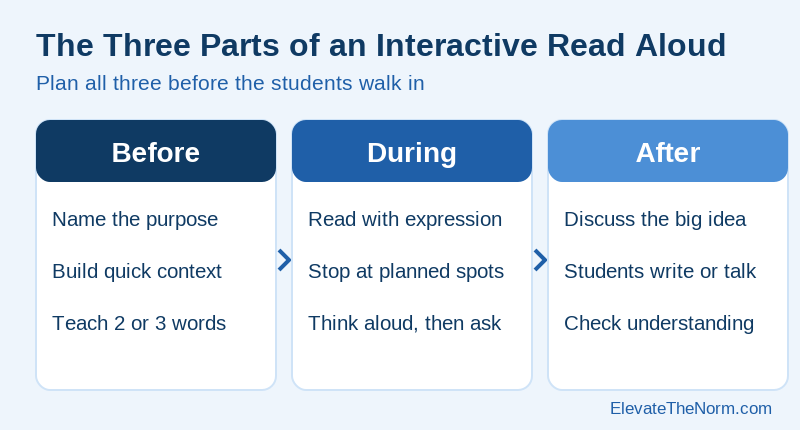
    How to do a read aloud in three parts: before, during and after reading, with three teacher moves in each part
    The same three parts work with a picture book or a speech.

    What goes in a read aloud lesson plan?

    A read aloud lesson plan needs the text, one purpose, two or three vocabulary words, three or four marked stops with a question for each, and a closing task. It should fit on one page. If it takes more than that, the plan is doing too much.

    Use this outline as a starting point. The minutes are a suggestion for a 20-minute block, so adjust them for your class.

    PartMinutesTeacherStudents
    Hook and purpose2Connects to the unit, states what to listen forPredict in a sentence
    Words2Teaches two or three key wordsRepeat and use one word
    Reading with stops10Reads, thinks aloud and asksTurn and talk at each stop
    Big question3Poses one open questionDiscuss with evidence from the text
    Exit task3Collects responsesWrite one short answer
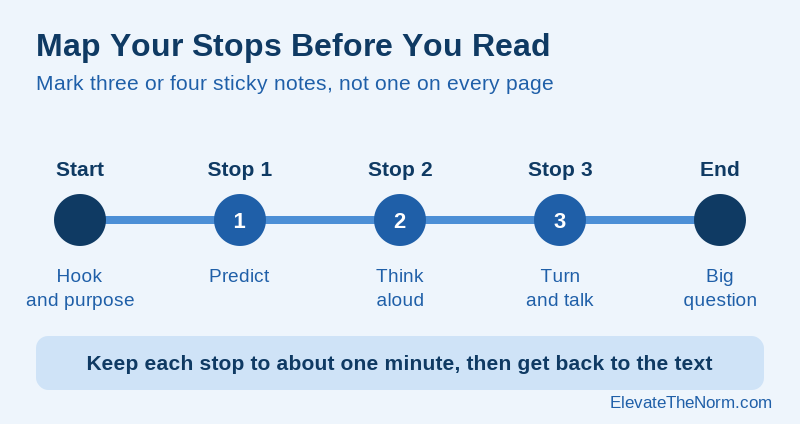
    Read aloud lesson plan map with an opening hook, three stops to predict, think aloud and turn and talk, and a closing big question
    Put a sticky note on each stop so the plan lives inside the text.

    Here is how the same outline looks with real texts.

    GradesTextPurposeSample stopClosing task
    K–3Duck for President by Doreen CroninFollow how a character’s goal changes“Is this job what Duck expected? How do you know?”Draw and label the job Duck likes least
    6–8A short news article on a local issueSeparate facts from opinions“Who is being quoted here? Who is missing?”One-sentence summary in your own words
    9–12The Gettysburg AddressTrack why Lincoln repeats key words“Why start with 1776 instead of the battle?”Write a claim about Lincoln’s purpose

    Reading a picture book more than once can pay off with younger students. McGee and Schickedanz describe a three-read routine for preschool and kindergarten: introduce the story’s problem on the first read, go deeper on characters’ thoughts on the second, and let children help reconstruct the story on the third. Their claims for it rest mostly on classroom experience, so treat it as a useful routine rather than a tested one.

    Which read aloud strategies get the best discussion?

    The read aloud strategies that build discussion are the think-aloud, the wait after a question, partner talk before whole-class talk, and open questions that move from noticing to judging. Yes-or-no questions usually end the conversation they were meant to start.

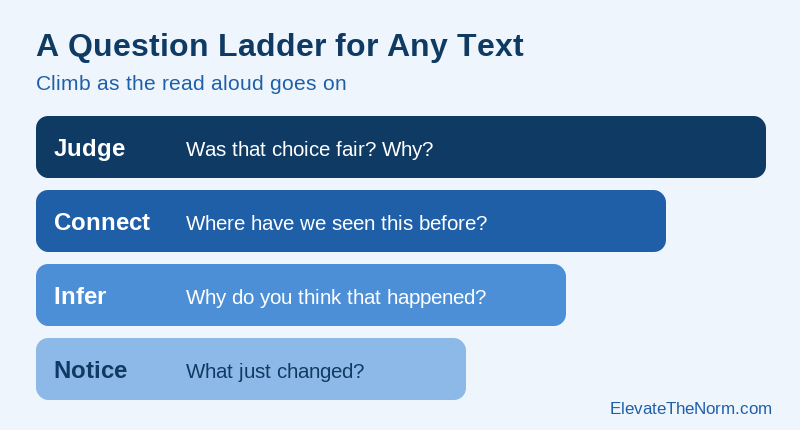
    Interactive read aloud question stems arranged as a ladder from notice to infer to connect to judge
    Start low on the ladder, then climb as the reading goes on.

    Plan your questions the way you plan your stops. A good set usually includes one for each rung, and the closing question should have more than one defensible answer. Questions like that are also the heart of strong student discourse, and they make the jump to a Socratic seminar feel natural with older students.

    Calling on students matters as much as the question. Cold calling done kindly keeps everyone listening, especially when students have just rehearsed with a partner. If you want more ideas, Bell to Bell has a low-pressure version that fits this kind of stop.

    How do you keep a read aloud from falling apart?

    Give students a listening job, teach the routine before you need it, and keep each stop to about a minute. Most read aloud behavior problems come from students having nothing to do.

    What are good read aloud activities for after the reading?

    Good read aloud activities ask students to use what they heard. An exit ticket, a one-pager, a gallery walk, or a short written claim all work, and each should take less time than the reading itself.

    ActivityTimeWhat it shows you
    ELA exit ticket3 minutesWhether students caught the main point
    One-pager20 minutesHow students connect ideas, quotes and images
    Gallery walk15 minutesHow the class responds to several ideas
    Choice boardVariesWhat students choose to do with a text

    A listening task is also a chance to gather real data. These formative assessment strategies for listening pair well with a read aloud, and these quick listening checks take almost no prep. For a next-day warm-up, pull from the free ELA bell ringer library or build one around your text with the Bell Ringer Creator. For a broader look at the options, the guide to checking for understanding covers more.

    How does an interactive read aloud change by grade?

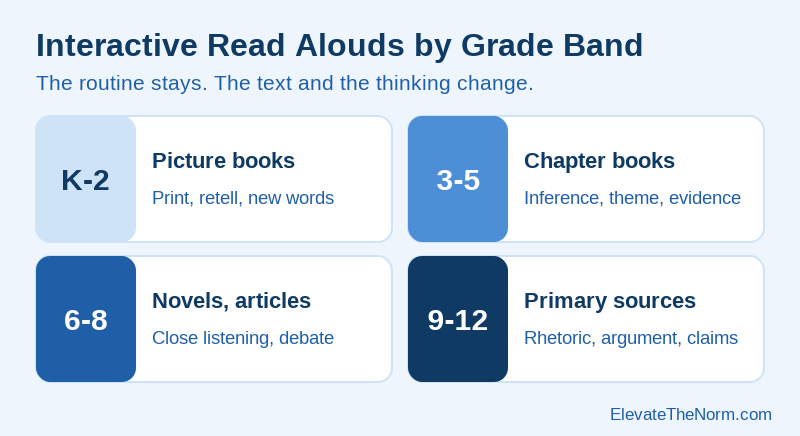
    The routine stays the same from kindergarten through high school. What changes is the text, the length of the reading, and the kind of thinking you ask for.

    Interactive read aloud by grade band, from picture books in K-2 and chapter books in 3-5 to novels and articles in 6-8 and primary sources in 9-12
    Same routine, different texts and thinking.

    Interactive read aloud in K–2

    Keep the book visible and the turns short. Fisher and Frey also recommend print referencing for primary students, such as pointing out a word, a letter, or the direction of print. Retelling and new words are the main goals.

    Interactive read aloud in grades 3–5

    Move into chapter books and nonfiction. Ask students to back up an answer with something they heard, and carry a question from one day’s reading to the next.

    Interactive read aloud in middle school

    Reading aloud does not make the lesson childish. It gives every student the same text at the same time, including students who read below grade level. For English learners, add a word bank and sentence frames, and use exit tickets built for English learners. The guide to differentiated instruction strategies has more options.

    Interactive read aloud in high school

    Read the hard opening of a novel, a court opinion, or a speech aloud, then release students to continue. In history, a teacher’s voice can make an old document clear enough for students to question it. That fits naturally with primary source analysis and leads into teaching a document-based question. For a ready warm-up, try these primary source bell ringers. You can then check what stuck with a unit test from the free Midterm Maker.

    Can a read aloud work on a sub day?

    Yes, if the plan is written out. Give the substitute the text, the marked stops, and the exact questions, and keep the closing task simple.

    A scripted read aloud is one of the calmer options for a day you are out. Pair the steps in this guide with the sub plans template or the ready-made ELA sub plans and social studies sub plans on SubstitutePlans.com. For anything unplanned, keep emergency sub plans in the folder. The guide on writing sub plans that hold up covers the rest.

    What are the most common read aloud mistakes?

    The most common mistakes are stopping too often, asking too many low-level questions, skipping the rehearsal, and ending when the text ends.

    • Too many stops. McGee and Schickedanz warn against turning a read aloud into a barrage of questions. Protect the flow of the text.
    • Asking only recall questions. “What color was the barn?” tells you little. Ask why.
    • Reading cold. You will miss the best stops and stumble on hard words.
    • Answering your own question. Wait longer than feels comfortable, and let a partner conversation carry some of the load.
    • No follow-up. Without a closing task, you cannot tell who understood.

    Can you post a read aloud video online?

    Reading a book live to your own class is one thing. Recording a whole copyrighted book and posting it publicly is another, so get written permission from the publisher first.

    Some publishers offered temporary permissions in the past, and those may have ended. For example, Simon & Schuster’s online read aloud guidelines state that the permission was valid through June 30, 2023, and they banned monetizing the videos. Check the publisher’s current policy for your specific book. This is general information, not legal advice. Public domain texts, like the Gettysburg Address, avoid this problem.

    What to do next

    Pick one text you already plan to teach next week. Read it once, write one purpose, and mark three stops with sticky notes. Then add one closing question and one short task. That is a complete interactive read aloud, and the second one will take half the time.

    When you want more, the free Elevate the Norm resource library has ungated classroom tools, and the Bell to Bell library gathers free guides in one place. You can grab 1,000 free bell ringers, swap ideas in the Daily Bell Ringers Facebook group, or browse ready-to-print resources in the Teacher Emergency Toolkit store, including Duck for President activities for grades K–3. Students who finish early can reread the text with a task from these early finisher activities.

    Frequently Asked Questions

    What is an interactive read aloud?

    An interactive read aloud is a lesson in which a teacher reads a text out loud and stops at planned points to model thinking and get students talking. Students predict, explain and discuss during the reading, not only after it.

    How long should an interactive read aloud last?

    No set length is required. About 15 to 20 minutes is a workable plan for many classes, with younger students needing shorter sessions. Keep each stop to about a minute so the text keeps moving.

    How many stops should a read aloud have?

    Three or four planned stops work well for most texts. No research sets a fixed number, but too many questions can break up the story. Choose the moments where students need to think, not every page.

    Are read alouds good for middle and high school?

    Yes. Reading aloud gives a whole class access to a hard text and models fluent reading. One 12-week study of students aged 12 and 13 reported strong gains for poorer readers when teachers read whole novels aloud, though it was a small study.

    What is the difference between a read aloud and shared reading?

    In a read aloud, the teacher does the reading and students listen and respond. In shared reading, students can see the text and read along with the teacher, so they practice the reading itself.

    What makes a good interactive read aloud book?

    A good book fits your students, ties to your purpose, and gives them something to discuss. It can sit above their independent reading level because the teacher handles the decoding. Read it yourself first to be sure.

    Can I post a video of myself reading a book?

    Get written permission from the publisher before you post a whole copyrighted book publicly. Past permissions may have ended, so check the current policy for that book. Public domain texts avoid this problem. This is general information, not legal advice.

    Sources

    About Clay Shumate

    Clay Shumate is a certified secondary Social Studies teacher in the public schools of West Alabama, with seven years of classroom experience, a B.A. in History, and an M.Ed. in Secondary Education. He writes about project-based learning, student responsibility, respect, and practical ways to hold young people to a higher standard while giving them room to learn from mistakes. This site’s editorial standards and corrections policy are published in full. More about Clay.

  • Teaching Current Events in the Classroom: A Routine for Grades 6–12 That Lasts the Whole Year

    Teaching Current Events in the Classroom: A Routine for Grades 6–12 That Lasts the Whole Year

    By Clay Shumate

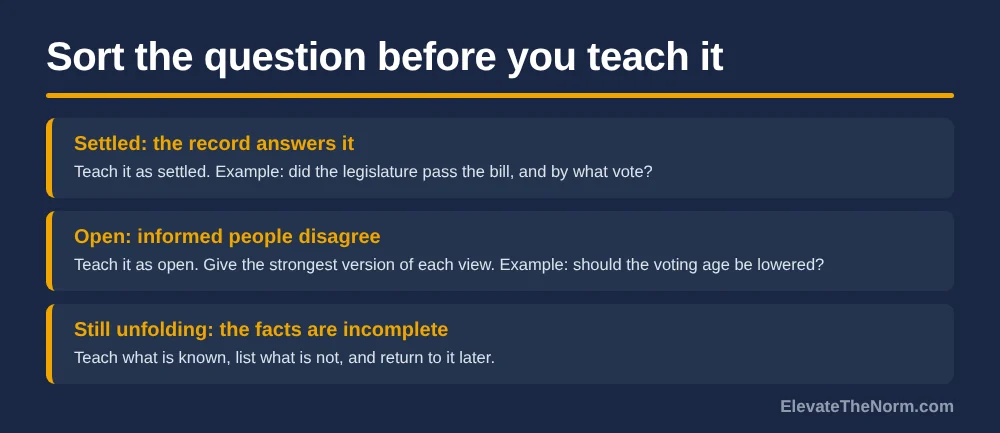
    Teaching current events in the classroom works best as a short, repeatable routine, not a reaction to every headline. In grades 6–12, choose events that connect to your course, teach settled facts as settled and open questions as open, tell families the plan before the first hard topic, and grade the reasoning rather than the opinion.

    Key Takeaways

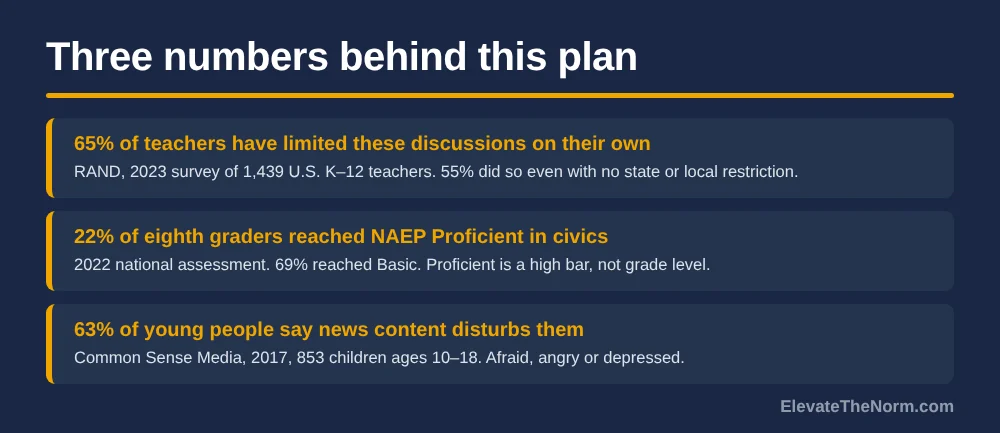
    • In a national survey of 1,439 U.S. K–12 teachers, 65 percent had limited political and social discussion on their own, including 55 percent with no state or local restriction. The top reason was doubt that leaders would back them.
    • In a study of nearly 90,000 14-year-olds in 28 countries, an open classroom climate for discussion went with higher civic knowledge. The link is correlational.
    • In a four-year study of 1,001 high school students, the teachers who did this well taught settled questions as settled and open questions as open. Students disliked being pushed toward one view.
    • In the latest NAEP civics assessment, only 22 percent of students tested in grade 8 reached Proficient.
    • A weekly fifteen-minute slot costs about nine 60-minute class hours over a 36-week year, an illustrative estimate.

    Most advice about teaching current events starts with the news and works backward. The harder problem is upstream: how often to do it, how to pick topics, what to say when a parent emails, and how to keep it from eating the unit you are supposed to be teaching.

    This article takes the planning view for grades 6–12. It is a set of recommendations compiled from the research below, not a report of any one teacher’s classroom, and it says so where the evidence is thin. Checking whether a particular source is trustworthy is a separate skill, so it appears here only in passing.

    What does teaching current events in the classroom involve?

    Teaching current events in the classroom means using real, recent events as material for skills students already need: reading closely, weighing evidence, explaining a position, and listening to a different one. The event is the material. The lesson is the thinking.

    That rules out two things that often get called current events: the news recap, where students report headlines and nothing changes in how they think, and the free-for-all reaction, where the loudest opinion wins the room. Neither builds a skill you can assess.

    A current event earns its minutes when it connects to the course: a vote that echoes a unit on representation, a trade dispute that echoes a unit on economics. If it does not connect, it is a different kind of conversation and may not belong in the lesson.

    Does teaching current events work, and what does the research say?

    The research is encouraging but mostly associational. Open classroom discussion is linked to higher civic knowledge and a stronger intent to vote, yet few studies isolate current-events instruction itself. Treat it as a well-supported habit rather than a proven program, and watch what happens with your own students.

    The largest body of evidence is the IEA Civic Education Study, which surveyed nearly 90,000 14-year-olds in 28 countries. In most of them, students who reported an open classroom climate for discussion scored higher on civic knowledge and were more likely to expect to vote. Many students did not perceive their classrooms as open at all.

    Two cautions apply. The finding is correlational, and the voting outcome is intended behavior, not actual voting. A research summary published by CIRCLE adds a third: state policies encouraging explicit news discussion showed promise when students had to use news sources, but state policies overall had very few effects on student knowledge, activities or values. Mandating the topic is not the same as teaching it well.

    The most detailed look at skilled teachers comes from Diana Hess and Paula McAvoy’s study of political discussion in high school classrooms, described in an NPR interview about their book. It followed 1,001 students over four years in schools that were political but not partisan. The teachers who did it well treated settled questions as settled and open questions as open. The researchers found no evidence of deliberate indoctrination, and students valued hearing different views but disliked being pushed toward one.

    Why do so many teachers avoid current events, and what do students need?

    Mostly because of support, not skill. In a national RAND survey, 65 percent of teachers said they had limited political and social discussion on their own, and a leading reason was doubt that leaders would back them if parents complained. Students, meanwhile, report that news can be disturbing.

    The survey asked 1,439 K–12 teachers whether they had ever decided on their own, without direction from leaders, to limit these discussions. Sixty-five percent said yes, including 55 percent of teachers with no state or local restriction. In that group, 47 percent were unsure leaders would support them if parents complained, 39 percent feared altercations with upset parents, and 33 percent lacked guidance.

    Three-row graphic: 65 percent of U.S. K-12 teachers have limited political discussion on their own (RAND); 22 percent of grade 8 students reached NAEP Proficient in civics; 63 percent of children ages 10 to 18 say news content disturbs them (Common Sense Media).

    Read that carefully. It is self-reported, covers every grade from kindergarten up, and cannot say what teachers actually did or whether the question meant the same thing to everyone. What it suggests is that the barrier teachers name most is not a shortage of ideas but a shortage of backup, which is a planning problem you can partly solve.

    The student side is mixed. On the NAEP civics assessment, 22 percent of eighth graders scored at or above Proficient and 69 percent at or above Basic, three points lower than the previous assessment. NAEP cautions that Proficient does not represent grade-level proficiency. Lower-scoring students were far less likely to agree that civics schoolwork helps them understand the world: 30 percent, versus 62 percent of higher scorers.

    A Common Sense Media survey of 853 children ages 10 to 18 found that 63 percent said news content left them afraid, angry or depressed, yet 70 percent said it made them feel smart and knowledgeable. The sample includes children younger than secondary age. One reasonable reading is that students need help making sense of the news more than protection from it, but the surveys do not test that directly.

    How often should you teach current events?

    For most secondary classrooms, a fixed weekly slot of about fifteen minutes is the most sustainable starting point. It is predictable for students and parents, cheap to plan, and easy to protect. Daily openers, event-triggered pauses and monthly deep dives also work, with different trade-offs.

    RoutineTimeBest forMain drawback
    Weekly slotAbout 15 minutes a weekBuilding a habit that fits most schedulesCan feel disconnected if the topic does not match the unit
    Daily openerAbout 5 minutes a dayShort-attention classes and light, low-stakes exposureLittle time for depth; easy to slide into a recap
    Event-triggered pause20–40 minutes as neededMajor events students are already talking aboutDepends on your judgment in the moment; facts may still be incomplete
    Monthly deep dive40–50 minutes a monthConnecting one event to a unit through a full discussion or short productLong gaps between practice; routines fade
    Compiled for this article as planning options. These are recommendations, not findings; none of the studies cited here compares these four routines.

    Many teachers combine two: a weekly slot as the default and an event-triggered pause for the rare event students cannot ignore. A bell ringer format keeps a daily opener short; the bell ringer ideas on this site show how. If you run project-based units, a monthly deep dive can feed a project, as the page on project-based learning in social studies shows. Whatever you pick, put it on the calendar.

    How do you choose which current events to teach?

    Choose events that connect to your course, rest on reasonably settled facts, and support a question students can reason about without needing a team. Skip anything you cannot teach without graphic detail. If you could not explain the choice to a parent in one calm sentence, pick another event.

    The five questions in the graphic are the working filter, and the first matters most. Hess and McAvoy note that breaking events are harder to teach because the information is incomplete and changes by the hour. Waiting a few days can produce a better lesson than racing the news cycle.

    Numbered five-card checklist: are the facts settled enough, does it connect to your course, can students reason without picking a team, can you teach it without graphic detail, could you explain the choice in one calm sentence.

    Let students nominate events, but run every nomination through the same filter. A short form with two prompts, what happened and how it connects to what we are studying, keeps the choice with students while keeping you in charge of the plan. Glance at your list each term: if every event leans the same way, the filter is not working.

    How do you handle contested or upsetting topics?

    Sort the question first. Teach settled questions as settled, open questions as open, and unfolding events as unfolding. Then set ground rules before the topic arrives, avoid graphic material, and give students with a personal connection a way to take part without being put on the spot.

    The sorting step comes from Hess and McAvoy: presenting a settled question as open is dishonest, and presenting an open one as settled shuts down the discussion. The third bin, still unfolding, is the one the news cycle produces most. The honest move there is to list what is known, what is not, and when you will return to it.

    Three-row graphic sorting current-event questions into settled, open and still unfolding, with how to teach each one.

    Keep ground rules short and set them early: critique ideas, not people; give a reason for any claim; no sarcasm. Hess and McAvoy warn about political seepage, the sarcasm and partisan humor that signal which side the room is supposed to be on. It is easy to do without noticing.

    Upsetting topics need extra care. With 63 percent of the young people in the Common Sense survey reporting disturbing news content, assume some students in any room are carrying something. Give advance notice, describe events without graphic detail, offer a written reflection as an alternative to speaking, and talk privately with any student who has a direct connection. Hess and McAvoy consider a blanket opt-out hard to defend, though serious personal reasons can justify one.

    Should you share your own view on a current event?

    Not by default. Hess and McAvoy found effective teachers on both sides of this question, so the research does not settle it. The safer plan is to decide in advance, check your school’s policy, and make sure students can see that every view got the same serious treatment.

    Two risks apply. Parents can misread a teacher’s shared view as recruiting, even when nothing of the kind was meant. And a teacher who assumes the students all think alike is almost sure to be wrong, according to Hess’s account in that interview, so a discussion that ends with the teacher’s position tells part of the room the conversation is over.

    A workable rule: when students ask what you think, answer the evidence question first, say which parts are open, and then decide whether to share. Apply whatever you decide to every topic, not only the ones where your view is popular in the room. Staying nonpartisan is mostly symmetry: give each view the strongest version its own defenders would give, and ask every student the same kind of follow-up.

    How do you connect current events to standards and course content?

    Treat the event as an application of a skill or concept you already teach. The C3 Framework’s fourth dimension covers discussion and informed action on real problems, and the research behind it finds students learn best through active methods, including discussion of real issues in the classroom.

    Croddy and Levine’s overview in Social Education describes that dimension as covering debate and discussion in a plural democracy, framing real problems, deliberating, and taking civic action. It is written by people who support the framework, so read it as guidance, not as a test of effectiveness.

    Anchor the event to context first; Hess and McAvoy recommend placing events in historical context rather than asking for reactions alone. A fifteen-minute lesson can follow a fixed pattern:

    1. Two minutes: state the event in two sentences and say what is confirmed.
    2. Three minutes: connect it to the unit with a short background fact or earlier case.
    3. Three minutes: students write a claim and one piece of evidence on their own.
    4. Four minutes: pairs compare, then the class discusses one open question.
    5. Two minutes: list what is still unknown and what would change the answer.
    6. One minute: an exit slip with one claim, one reason and one question.

    The same shape works outside social studies, for example with a local environmental decision in science or an editorial in English. For step four, the guides to student discourse and Socratic seminars show discussion structures, and the primary source analysis frameworks suit step two when the event echoes a historical document.

    How do you assess current events discussions fairly?

    Grade the reasoning, never the position. Score whether students state facts accurately, support claims with evidence, address the strongest opposing point, and follow the ground rules. Keep it low-stakes at first, and let students argue an assigned side so nobody is graded on their own beliefs.

    A four-line rubric is enough: accuracy of facts, use of evidence, engagement with another view, and respectful discussion. Share it before the first lesson. The exit slip from the last step doubles as the evidence of learning an instructional coach would ask to see.

    Keep stakes low until the routine is stable, and do not grade participation by volume. Some students reason best in writing, so offer a written and a spoken option for the same credit, plus the usual accommodations: sentence frames, extra time, a shortened reading.

    What do parents and administrators need to know?

    Tell them the plan before the first hard topic. A one-page overview covering purpose, routine, how topics are chosen, ground rules and how to raise a concern answers most objections in advance, and it gives an administrator something concrete to support.

    The RAND reasons were doubt about leadership support, fear of altercations with parents, and lack of guidance. Each has a planning answer. Ask your administrator to read the one-pager and confirm the plan fits district policy, since rules differ by state and district. Show parents the same page. And ask a colleague who has taught the course to read your first three topics; that takes ten minutes and is ordinary professional practice.

    Offer parents a way to see what was taught: a short note after a lesson that names the question and the skill, not students’ comments. Never share anything from a discussion that could identify the speaker.

    How do you keep current events fair for every student?

    Plan for unequal starting points. Students differ in news exposure, reading level, language, home devices and how close an event is to their own lives. Provide print options, plain-language summaries and vocabulary support, and build in a written route so participation does not depend on who talks fastest.

    Access is a documented gap. The CIRCLE summary reports that students in higher-income districts were more than one and a half times as likely to report political debates and panel discussions, and the NAEP lower scorers were less likely to find civics useful, 30 percent versus 62 percent. Neither figure proves cause, but both are reasons not to assume every student arrives ready to join in.

    Practical supports are inexpensive: a one-paragraph summary at two reading levels, a short glossary of three to five terms, printed copies for students without reliable devices, and sentence starters for disagreement. Rotate who facilitates so the most confident speakers do not set the pace every week.

    How much class time does teaching current events actually take?

    A weekly fifteen-minute slot over a 36-week year takes 540 minutes, about nine 60-minute class hours. That is an illustrative estimate, not a measured figure. Your calendar, period length and testing windows will change it.

    On the same assumptions, a five-minute daily opener across 180 days is 900 minutes, or fifteen class hours; a monthly 45-minute deep dive across nine months is 405 minutes; four event-triggered 40-minute lessons add 160. Small slots add up, so tie each one to a skill you already assess, and the minutes come out of your unit rather than on top of it.

    Clay’s take: students are ready for structure, not shielding

    What strikes me most in this literature is how little of it is about shielding students from the news. The young people surveyed found it disturbing and said it made them feel knowledgeable. Both can be true, and neither is solved by silence.

    My position is the one this site takes everywhere: treat students as developing young adults. That means high expectations for the quality of their reasoning, clear structure so they can meet them, and fair consequences when a discussion breaks its ground rules. It does not mean leaving them alone with a headline, or telling them what to conclude.

    It also means being straight with the adults. Many teachers limit discussion without being told to because expectations are unclear and backup is uncertain, not because of a character flaw. Write the plan down, share it, and ask a colleague to read it first. For a longer-form route into the same skills, the civics project ideas on this site include a mock election.

    What to do next

    To start teaching current events in the classroom, pick the weekly slot and put it on the calendar for the whole term, not just the next two weeks. Draft the one-page plan this week and show it to an administrator before you teach a single hard topic.

    Then run the first lesson on an event that is settled, connected to your unit, and low on emotional heat. Use the six-step pattern, score the exit slips with the rubric, and adjust. If a major event interrupts the plan, use one pause lesson, then return to the weekly rhythm.

    Frequently Asked Questions

    Can I teach current events if my state or district restricts political topics?

    Possibly, but check before you plan. Rules differ by state and district, and RAND noted that teachers may not know what their own state’s rules say. Read the actual policy text, ask an administrator to confirm in writing, and choose events tied to your required standards. This is general information, not legal advice.

    What if a student says something offensive or one-sided in discussion?

    Respond to the statement, not the student. Pause, restate the ground rule, and ask for the evidence behind the claim or for the strongest opposing view. If it targeted a classmate, follow your school’s discipline process and speak with the student privately afterward. The goal is repair and a clearer expectation, not public embarrassment.

    Can students opt out of a current events lesson?

    Hess and McAvoy consider a blanket opt-out hard to defend, but they accept that serious reasons, such as a direct personal connection to an event, can justify one. Talk privately first, offer a written or observer role, and check your school’s policy on parent requests. Sitting out one topic should not mean sitting out the routine.

    What should I say when students ask for my opinion?

    Answer the evidence question first: what is known, what is disputed, and where you are unsure. Then decide, ahead of time and for every topic, whether you will share a view. Research on skilled teachers shows both choices can work, but parents can misread a shared view as recruiting, so consistency and transparency matter.

    What if an event is too recent for reliable information?

    Teach the uncertainty. List what is confirmed, what is claimed but unverified, and what nobody knows yet, then return to the event after a few days. Hess and McAvoy note that breaking events are harder because information is incomplete. Waiting costs little, and the follow-up lesson shows students how reporting improves.

    How do I explain a current events routine to parents?

    Send a one-page overview before the first lesson: why you do it, how often, how topics are chosen, the ground rules, how work is graded, and whom to contact with a concern. Describe the question and the skill, not student comments. Offer a phone call or meeting, and give your administrator a copy.

    Sources

    • Woo, A., Diliberti, M. K., & Steiner, E. D. (2024). Policies Restricting Teaching About Race and Gender Spill Over into Other States and Localities: Findings from the 2023 State of the American Teacher Survey Research Report RR-A1108-10, RAND Corporation. Teachers nationally representative, 1,439 K–12 teachers, surveyed in early 2023. 65 percent had limited discussion on their own; 55 percent with no restriction; reasons 47, 39 and 33 percent. Limits: self-report, K–12 rather than secondary only, item interpretation unclear, descriptive not causal, only a minority gave interpretable open-ended reasons.
    • National Center for Education Statistics. NAEP 2022 Civics, Grade 8 achievement results, with the 2022 civics highlights. 22 percent at or above Proficient, 69 percent at or above Basic, 30 versus 62 percent on civics schoolwork helping understand the world. Limits: eighth graders only; NAEP states that Proficient does not represent grade-level proficiency; the 30 and 62 percent figures are agreement rates, not causal estimates.
    • Torney-Purta, J., et al. Civic Education Study, chapter 10 (IEA). Nearly 90,000 14-year-olds in 28 countries. Open classroom climate for discussion was associated with higher civic knowledge and expected voting in most countries. Limits: associational, voting measured as expectation, no effect sizes in the portion read, 14-year-olds only.
    • Center for Information and Research on Civic Learning and Engagement. Research Roundup, Around the Circle (April 2010). Secondary summary of working papers by Hess, Syvertsen, Flanagan and Stout, Kahne and Middaugh, and Lopez and colleagues. Higher-income districts more than 1.5 times as likely to report debates and panels; state policies encouraging news discussion showed promise but had very few overall effects. Limits: summary of other researchers’ papers, which were not read in full here.
    • Hess, D., & McAvoy, P. (2015). The Political Classroom, as discussed in an NPR interview with the authors, Politics In The Classroom: How Much Is Too Much? Study of political issue discussion in high school classrooms, 1,001 students over four years. Settled versus open questions, political seepage, opt-outs, breaking events. Limits: read through the NPR interview and the publisher description, not the full book.
    • Common Sense Media. News and America’s Kids (2017). Online, nationally representative survey of 853 children ages 10–18. 63 percent found news content disturbing; 70 percent felt smart and knowledgeable from news. Limits: includes elementary-age children, self-report, older survey.
    • Croddy, M., & Levine, P. (2014). The C3 Framework: A Powerful Tool for Preparing Future Generations for Informed and Engaged Civic Life Social Education, 78(6), 282–285. Describes Dimension 4 (debate, discussion, deliberation, civic action) and civic education research on active methods. Limits: an overview by framework supporters, not an effectiveness study; indicator wording was not read.
    • The routine options, the fifteen-minute lesson pattern, the four-line rubric, the time arithmetic and the five-question event filter are compiled and written for this article from the sources above. They are recommendations, not a report of any teacher’s classroom, and no study above tests them as a set. Time figures assume a 36-week year, 180 school days and 60-minute class hours, which are this article’s assumptions.

    About Clay Shumate

    Clay Shumate is a certified secondary Social Studies teacher in the public schools of West Alabama, with seven years of classroom experience, a B.A. in History, and an M.Ed. in Secondary Education. He writes about project-based learning, student responsibility, respect, and practical ways to hold young people to a higher standard while giving them room to learn from mistakes. More about Clay.

  • How to Run a Classroom Debate in Grades 6–12: A Step-by-Step Format

    How to Run a Classroom Debate in Grades 6–12: A Step-by-Step Format

    By Clay Shumate

    To run a classroom debate, pick a resolution with two defensible sides, assign sides by lot, give students a short source packet and prep time, then run timed speeches and cross-examination in small pods while classmates judge reasoning on a rubric. End by switching sides or writing a synthesis. Plan about four class periods.

    Key Takeaways

    • A classroom debate needs fixed structure: a resolution with two defensible sides, assigned sides, a shared source packet, timed speeches, cross-examination, a rubric and a debrief. Without them, a debate tends to reward whoever talks fastest.
    • The evidence for debate in ordinary classrooms is thin. The strongest classroom study followed one urban middle school for three years: 48 students in a dialogue program, 23 taught conventionally. The program group did better, but the summary I could read gives no statistics.
    • League debate shows an association, not a proven effect. Among at-risk Chicago students, debaters were 3.1 times as likely to graduate as non-debaters (95% CI 2.7 to 3.5), in an observational study of a sustained league.
    • Structured disagreement beat debate in its own authors’ meta-analysis: an effect size of 0.40 on achievement across six comparisons. The authors designed the method, and the article’s examples come from college courses.
    • Build the switch into any debate. A switch round, a concession statement or a synthesis paragraph has students state the other side’s best argument, which both structured-controversy methods require.

    Debate is easy to start and hard to run well. With no structure, a few confident students do all of the talking while everyone else waits for the bell. The fix is the format, not the topic: who speaks, for how long, from what evidence, and who is judging. For a lighter-weight format built on the same principle, running philosophical chairs in grades 6–12 needs one debatable statement and one rule: summarize the last speaker before you answer them.

    This guide shows how to run a classroom debate in grades 6–12 and is honest about what the research shows. The evidence for debate in everyday classrooms is thinner than the enthusiasm around it, and the format below is compiled from the sources at the end, so treat it as a recommendation rather than a record of any one classroom. For open discussion with no sides and no winner, a Socratic seminar is the better tool.

    What Is a Classroom Debate, and When Should You Use One?

    A classroom debate is a structured, timed exchange in which students argue assigned sides of a resolution using evidence, while classmates judge the reasoning. Use one when a question has two defensible answers and the goal is evidence-based argument. Use a discussion format when the goal is open exploration.

    Three related formats are worth telling apart. In constructive controversy and structured academic controversy, students defend assigned sides but then switch or concede and build a shared position. In a Socratic seminar, no one is assigned a side. The format below is a debate that borrows the switch from the other two. The student discourse guide covers the everyday talk that all three depend on.

    Does Classroom Debate Actually Work? What the Research Says

    The evidence for classroom debate is limited. One multi-year middle school program favored structured dialogue, and one observational study favored competitive league debate, but neither tested a single classroom unit. The longest research line, largely by its own developers, supports structured disagreement that ends in a shared position.

    The most relevant classroom study is Deanna Kuhn and Amanda Crowell’s multiyear intervention. According to the Association for Psychological Science’s summary, it took place at an urban middle school beginning in sixth grade: two intervention classes totaling 48 students and a comparison group of 23 taught conventionally. Over three years, each quarter ran a 13-class segment on a social issue. Students chose sides, prepared in groups, anticipated the other side’s arguments, debated opposing pairs on a computer, and wrote individual essays. The comparison group held teacher-led discussions and wrote more essays, 14 a year against four.

    The published abstract reports that the intervention groups wrote stronger arguments on new topics and showed greater awareness of the relevance of evidence. Two cautions apply. This was a multicomponent, three-year program, not a one-period debate. And the summary gives no statistics; the full paper is behind a login, so I could not check how students were assigned to groups.

    Competitive debate has a larger but weaker record. Anderson and Mezuk’s analysis of urban debate participation among at-risk students in Chicago Public Schools, over a ten-year period, found that debaters were 3.1 times as likely to graduate as non-debaters (95% confidence interval 2.7 to 3.5) and more likely to meet ACT college-readiness benchmarks in English, reading and science. It is observational, and it concerns a sustained league rather than a classroom unit. The federal CrimeSolutions site rates the practice “Promising” on one study.

    The research with the longest history comes from David Johnson, Roger Johnson and Karl Smith. They compare constructive controversy, in which students argue assigned sides, switch, and then write a joint position, against debate, concurrence-seeking and individual work. In their article, the authors cite their own meta-analysis and report an effect size of 0.40 on achievement and decision quality against debate (six comparisons) and 0.68 against concurrence-seeking (15 comparisons). The authors designed the method, and the article does not say how many studies involved school-age students; its examples are college courses.

    Structured academic controversy, the classroom adaptation, has sides present, argue freely, pick the other side’s strongest argument, concede it, and seek consensus, as the Arizona State University description lays out. That page says research supports the method but cites no study. For contested political questions, Diana Hess and Paula McAvoy’s large mixed-method study of discussion in high school classrooms offers detailed cases and a framework, not an effect size for debate.

    Taken together, the sources support a modest recommendation. Run debate as a structured, repeated format rather than a one-off event, because the strongest classroom evidence comes from a program that ran for three years. Build in a switch or a synthesis, because that is the feature the longest research line favors. And treat debate as one tool for teaching argument, not a proven fix. Nothing cited here tests a single classroom debate unit, so the unit described below is a reasoned design built from these sources, and your own ballots and student writing will be better evidence about it than anything above.

    Standards are one reason to try it anyway. Kuhn and Crowell open their abstract by noting that argumentive reasoning is featured in the K–12 Common Standards, which say little about how to build it. Check your own state’s argument and discussion standards for the specific expectations. The ballots and the written synthesis described below can serve as the evidence of learning.

    Five-stage graphic for how to run a classroom debate: choose a resolution and source packet, prepare with sides drawn by lot, debate in pods of six, judge with a rubric, then switch sides and write a synthesis.

    How Do You Run a Classroom Debate Step by Step?

    Run it in five stages: choose a resolution and source packet, assign sides and prepare, hold timed rounds in pods, score the reasoning with a rubric, then switch sides and write a synthesis. A first unit fits about four class periods.

    1. Choose one resolution and build a packet. Write one sentence students can affirm or reject. Collect four to six short sources, balanced across both sides, so evidence quality does not depend on what students find at home.
    2. Draw sides by lot and form pods. Pods of six are a workable default: two teams of two debaters, one timekeeper and one judge. Say plainly that an assigned side is a thinking exercise, not a statement of belief.
    3. Prepare for one full period. Each team lists three claims, evidence from the packet for each, and the strongest argument the other side will make, with a reply. Kuhn and Crowell’s program built in the same prepare-and-anticipate work.
    4. Run timed rounds. Use the times in the table below. Judges and timekeepers take notes with one column per speech.
    5. Judge on reasoning, in writing. Each judge scores the rubric criteria and finishes one sentence: “The most convincing point was ___ because ___.” Ballots are feedback. The teacher sets the grade.
    6. Switch or concede. In a short second round, teams argue the other side for two minutes, or each states the other side’s strongest argument and what would change its mind.
    7. Write and debrief. Each student writes an individual position that uses evidence from both sides. Then the class discusses what moved anyone and what evidence was missing.
    PeriodWhat students doWhat the teacher does
    1Read the resolution and packet, draw sides, begin preparingExplains the rules and models one short speech
    2Finish preparing and rehearse speeches in pairsChecks each team’s claims and evidence
    3Debate in timed pod rounds and write ballotsCirculates and notes one rubric line per student
    4Switch round, individual synthesis, debriefCollects ballots and writing and returns feedback
    Assumes standard class periods. Compiled for this guide and untested in any study.

    How Do You Choose a Resolution Students Can Actually Debate?

    Choose a resolution with two defensible sides, enough readable evidence for both, and stakes that are real but not personal. Phrase it as one sentence students can affirm or reject. Avoid questions with settled factual answers and questions about students’ own identities, families or safety.

    • Two defensible sides. You can name a credible source for each side before you assign anything.
    • Readable evidence. Students can read a source in minutes and pull out a claim.
    • Real stakes, not personal ones. Choose questions about policy, interpretation or design, not about who students are.
    • Not already settled. If a quick search ends it, it is a research question.

    Examples that meet those tests: “Industrialization improved ordinary workers’ lives more than it harmed them” (social studies); “Victor Frankenstein is more responsible than his creature for the harm in the story” (English); “Nuclear power should be expanded to cut carbon emissions” (science); “Our school day should start later” (school policy).

    Build the packet the same week you pick the resolution. Aim for sources that disagree on the facts and not only on the conclusion, so students have something real to weigh. Trim each source to the passages students need and number the paragraphs, so a speaker can cite “source two, paragraph three” and the other team can find it. A one-page claims sheet, with a row for each claim, its evidence and its source, makes the preparation period visible to you and keeps teams from arriving with nothing but opinions.

    Before running a charged topic, read your school’s policy on controversial issues and tell an administrator the topic and format. Send families a short note naming the resolution, saying sides are assigned by lot, and explaining how grades work. Hess and McAvoy’s framework centers on questions about how people should live together, a useful test for whether a political question is worth a class period.

    Should Students Argue Sides They Disagree With, and Should They Switch?

    Draw sides by lot and tell students plainly that an assigned side is a thinking exercise, not a belief. Then add a switch or a concession, because both structured-controversy methods end that way. Offer a researcher or judge role to any student whose family or identity the topic touches.

    The research does not settle who should choose sides. Kuhn and Crowell’s students chose theirs, while Johnson, Johnson and Smith’s pairs and structured academic controversy assign them, and no source read for this guide compares the two. A random draw removes the social cost of picking a side in front of friends.

    The switch matters more than the draw. Johnson and colleagues’ procedure has pairs reverse perspectives and then drop advocacy to write a joint position, and structured academic controversy ends with each side conceding the other’s strongest argument. In a debate, a switch round, a concession or a synthesis paragraph does the same work and shows whether students understood the other side.

    You can give students a voice without losing quality control. Offer three resolutions that you have already checked against the tests above and let the class vote. Students get a real say in what they argue about, and you keep the packets balanced and the topics safe.

    How Long Should Each Speech Be?

    For a pod round, use two minutes for each opening and second speech, two-minute crossfires, one-minute final statements, and two minutes of prep per team. That is about 14 minutes of speaking. The times are adapted from NSDA Public Forum limits and have not been tested in classrooms.

    SegmentNSDA Public Forum pilot rulesPod round (adapted for this guide)
    Opening speeches4:00 each2:00 each
    Crossfire3:002:00
    Second speeches4:00 each2:00 each
    Crossfire3:002:00
    Summaries3:00 eachSkipped
    Grand crossfire3:00Skipped
    Final statements (final focus)2:00 each1:00 each
    Prep time3:00 per team2:00 per team
    Total speaking time35 minutes14 minutes
    NSDA times are from its Public Forum pilot rules; the pod column compresses them for a classroom.

    Logistics decide whether a pod round runs on time. The timekeeper holds a visible clock, calls time without commentary and stops a speech at the limit, and teams spend prep minutes between speeches, not during them. Rotate roles so every student debates once and judges once, and stagger the pods so a round finishes inside one class period with time left for ballots. If a pod falls behind, drop the second crossfire before shortening any speech.

    No study tests the compression or the pod format, which were adapted for this guide, so treat the times as a starting point and adjust after the first round.

    Timing graphic for a classroom debate pod round: two-minute opening speeches, two-minute crossfire, two-minute second speeches, two-minute crossfire, one-minute final statements, and two minutes of prep per team, about 14 minutes of speaking.

    How Do You Grade a Classroom Debate Fairly?

    Grade the reasoning each student shows, not who wins and not how confident they sound. Score individual contributions on a short rubric covering claims, evidence, response to the other side, listening and conduct, and grade the written synthesis separately so quieter students have another way to show what they learned.

    Treat judges’ ballots as feedback and keep the grade in the teacher’s hands, since a student’s grade should not depend on which classmate held the pen, and return ballots to teams privately rather than posting scores. The presentation rubric guide makes the same point about separating delivery from content.

    Rubric graphic listing what to score in a classroom debate: claims and reasoning, use of evidence, response to the other side, listening and notes, and respectful conduct, with a reminder that winning is not on the rubric.
    • Claims and reasoning. Is each claim clear, and does the reasoning connect it to the evidence?
    • Use of evidence. Does the speaker cite the packet accurately and say where a fact came from?
    • Response to the other side. Does the speaker answer a specific claim the other team actually made?
    • Listening and notes. Do the notes show what the other team said?
    • Respectful conduct. Does the speaker attack arguments rather than people?

    A workable synthesis prompt has four parts: state your position in one sentence, give two pieces of evidence, state the strongest argument against you, and answer it. Grade it on the same rubric lines. A quiet student can then earn full marks on reasoning, evidence and response without speaking in front of the class.

    To keep your workload manageable, grade from the written ballots and the synthesis instead of scoring live. One rubric line per student per round is enough.

    What About Students Who Do Not Want to Speak?

    Give every student a role with real work: debater, researcher, timekeeper, note-taker or judge. Offer written crossfire as an alternative to speaking aloud, and rotate roles so no one sits on the sidelines. Anxiety about speaking is a design problem, not a participation grade to subtract.

    Roles can carry real weight. A researcher can scan the packet during prep and hand the team a one-line summary of each source. A note-taker can build the record of what each side claimed, which becomes raw material for the written synthesis. A judge learns the rubric from the inside, which makes the criteria concrete before that student is graded on them.

    The group work roles guide covers giving each role a visible product so it counts as work. A debate also gives a quiet student a prepared turn with a known slot, easier than a surprise. If you use cold calling elsewhere, the cold calling guide explains how to keep it from feeling like a gotcha.

    How Do You Keep a Classroom Debate Respectful and Safe?

    Set the rules before the first round: attack arguments, not people; cite the packet; interrupt only in crossfire; and let any judge or the teacher stop a round that turns personal. Post sentence frames for disagreeing, and apply the same rules to every student every time.

    • Sentence frames on the desk. “The source says ___, but it leaves out ___.” “I agree with ___ about ___. Where I would push back is ___.”
    • A stop rule. Any judge or the teacher can pause a round, restate the rule and resume.

    End every round out of role. Name that the assigned sides were exercises, then ask each student to say one thing they learned from the other side’s case. That closing step keeps students from carrying a position that was never theirs and gives you a quick read on whether the switch worked.

    Debate rules work best as an extension of expectations the room already has. If you are building those, the classroom expectations framework is a good place to start.

    What Goes Wrong in a Classroom Debate, and How Do You Fix It?

    The usual failures are lopsided sources, one dominant speaker per team, memorized speeches that ignore the other side, and winner-takes-all grading. Fix them with balanced packets, assigned speaking turns, a required response to one opposing claim, and rubric grades that ignore who won.

    Most failures trace back to design rather than to students. A packet that favors one side decides the round before it starts, so check that both sides hold comparable evidence. A team with one strong speaker lets that student carry the work, so assign each speech to a named student and require both teammates to speak. Memorized speeches that never touch the other side are fixed by requiring every second speech to answer one specific claim from the opening.

    Two failures need a different fix. When students quit because they are losing, the switch round helps, because it hands everyone a fresh start on the opposite argument. When grades follow the ballots, grade from the rubric and the written synthesis and treat ballots as feedback only.

    How Should the Format Change for Different Grade Bands?

    Shorten speeches and add sentence frames for grades 6–8, use the full pod timings for grades 9–10, and add summaries and a longer final statement for grades 11–12. These are starting points, not tested settings, so adjust them after the first round.

    Grade bandSpeech lengthSupport to add
    6–81:00 to 1:30Sentence frames on every desk, a packet of three short sources, teams of two
    9–10Full pod timings (2:00)Packet of four to six sources, one source students find with teacher approval
    11–12Pod timings plus a 3:00 summary roundStudents choose the resolution from a short list and write their own ballots
    Recommendations compiled for this guide. No source tests speech length by age, though the one multi-year study found began in sixth grade.

    Can a Department or School Use This Format at Scale?

    Yes, because the cost is mostly teacher time. A department can share vetted resolutions, balanced packets and one rubric so each teacher is not rebuilding from scratch. Start with one pilot unit in one course, then adjust the packet, times and rubric before others adopt it.

    The main costs are printing the packets and the planning time to build them, and the main risk is topic selection. Agree on a short approved list of resolutions, a common rubric and a shared family note, so a parent or administrator hears the same explanation from every classroom. Keep the pilot’s ballots and syntheses as evidence, since nothing in the research above shows how this format performs across a whole school.

    The Short Version: How to Run a Classroom Debate This Month

    If you only change one thing about how you run a classroom debate, build in the switch. Choose a resolution with two real sides, draw sides by lot, give every student a prepared role, grade the reasoning, and end by asking each team to state the other side’s best argument.

    Run the format once, then change the times, packet or topic based on what your ballots and student writing show. Because the evidence is thin, your own results are the best data you will have.

    Frequently Asked Questions

    Does classroom debate improve student learning?

    The evidence is limited. A three-year middle school dialogue program produced stronger arguments than conventional discussion, and a Chicago study linked league debate to higher graduation rates. Neither tested a single classroom unit, and the second was observational. Treat debate as one useful tool for teaching argument, not a proven fix for achievement.

    How many students should be on each debate team?

    Two per team is a sound default in pods of six: two debaters per side plus a timekeeper and a judge, with roles rotating each round. Larger teams let one student carry the work. In a single whole-class debate, three per side is workable if every student has a defined speech or task.

    How long does a classroom debate take?

    A first unit fits about four class periods: introduce the resolution and packet, prepare, run timed rounds with written ballots, then switch sides, write a synthesis and debrief. A pod round runs about 14 minutes of speaking plus prep time. Later debates in a familiar format can usually be shorter.

    Should students have to argue a position they disagree with?

    Drawing sides by lot is reasonable if you say plainly that an assigned side is a thinking exercise, not a belief, and if students can take a researcher or judge role when a topic touches their family or identity. Kuhn and Crowell’s students chose sides, while the structured-controversy methods assign them.

    How do you grade a debate without rewarding the loudest student?

    Grade each student’s reasoning, not the winner and not the volume. Score claims, evidence, response to the other side, listening and conduct on a short rubric, and grade a written synthesis separately so students who speak less can still show their thinking.

    Can you debate political or controversial topics in class?

    Often yes, with preparation. Read your school’s policy on controversial issues, tell an administrator and families the topic and format in advance, use balanced source packets, and choose questions on which informed people really disagree. Hess and McAvoy’s framework centers on questions about how people should live together.

    What is the difference between a debate and a Socratic seminar?

    A debate assigns sides, sets time limits and judges reasoning. A Socratic seminar assigns no side, has no winner and asks open questions about a shared text. Choose a debate for a question with two defensible answers; choose a seminar when you want students to explore a text together.

    Sources

    About Clay Shumate

    Clay Shumate is a certified secondary Social Studies teacher in the public schools of West Alabama, with seven years of classroom experience, a B.A. in History, and an M.Ed. in Secondary Education. He writes about project-based learning, student responsibility, respect, and practical ways to hold young people to a higher standard while giving them room to learn from mistakes. He is a member of the Society of Professional Journalists and writes to its Code of Ethics; this site’s editorial standards and corrections policy are published in full. More about Clay.

Teacher Emergency Toolkit — practical resources, real classroom support. Shop on TPT.Teacher Emergency Toolkit — practical resources, real classroom support. Shop on TPT.