Motivating Students: What Works When Rewards and Speeches Stop Working
By Clay Shumate
Motivating students does not start with a better reward system or a more inspiring speech. It starts with what research consistently confirms: students engage when they feel competent, connected to the people around them, and in control of something that matters. When the rewards and speeches stop working — and they will — what remains is the environment you built and whether it gives students a genuine reason to invest.
Key Takeaways
- Rewards can undermine the motivation they are supposed to build. Research on the overjustification effect has shown this for decades.
- Autonomy, competence, and belonging are the three drivers that hold up under pressure — not points, prizes, or pep talks.
- A student who looks unmotivated may be protecting themselves from failure, not choosing laziness.
- Relevance means connecting work to something real, not performing enthusiasm about a worksheet.
- The teacher’s job is not to motivate. It is to stop accidentally killing motivation and build a room where it can survive.
Why Rewards and Motivational Speeches Have an Expiration Date
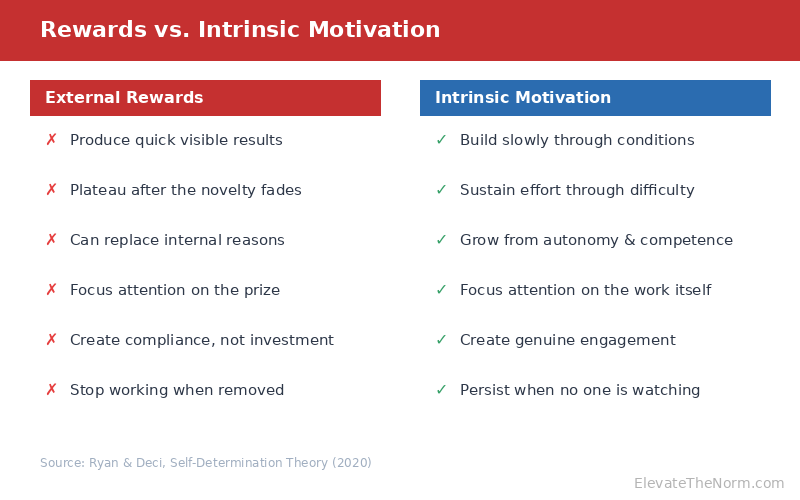
Every teacher has tried it. The class Dojo points, the pizza party for the best-behaved table, the impassioned Monday morning speech about potential. These tools feel productive because they produce visible results — for a while. Then they stop.
Research explains why. Ryan and Deci’s self-determination theory, refined over more than four decades, identifies a consistent pattern: when you offer an external reward for something a person was already willing to do, the reward replaces the internal reason. Psychologists call this the overjustification effect. The student who used to read because the book was interesting now reads because reading earns points — and when the points disappear, so does the reading.
A 2024 review in Contemporary Educational Psychology reinforced this finding while adding nuance: rewards that provide informational feedback — telling a student something useful about their progress — can support motivation under the right conditions. But rewards that function as control — do this, get that — consistently erode it. The difference is whether the student walks away thinking about their work or thinking about the prize.
Motivational speeches have a different shelf life but the same problem. They rely on an emotional spike that cannot sustain daily effort. A teacher who depends on inspiration is performing, not teaching. The kid who felt fired up on Monday has a bad lunch period on Tuesday and the fire is out.
This does not mean you never celebrate, never recognize effort, and never speak with conviction. It means none of those things are your motivation strategy. They are supplements to something more durable.
What Research Actually Says About Motivating Students
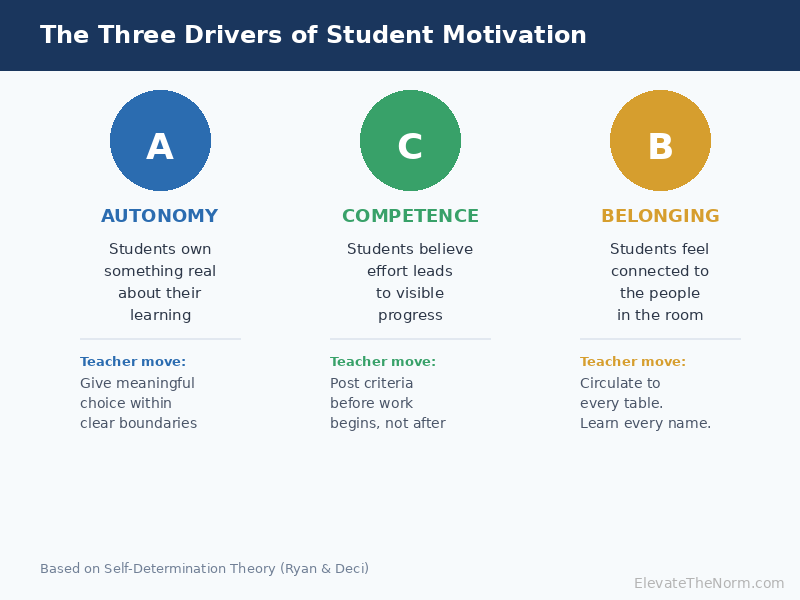
The most widely supported framework for understanding student motivation is self-determination theory, developed by Edward Deci and Richard Ryan. The theory identifies three psychological needs that, when met, produce the kind of motivation that survives bad days and boring units:
- Autonomy — a sense of ownership over what you are doing and why.
- Competence — the belief that effort leads to growth, and that you can actually do the work in front of you.
- Relatedness — a genuine connection to other people in the room, especially the adult running it.
Harvard researcher Rhonda Bondie adds a fourth driver: meaning. Students engage when the work feels important, interesting, or useful — not because someone told them it was, but because they can see it for themselves. She also makes a point that should change how every teacher talks about this topic: “The biggest misconception about motivation is that students aren’t motivated.” Every student is motivated. The question is whether your classroom connects to what motivates them or blocks it.
A Gallup survey of Gen Z students puts numbers on the problem. Only 18 percent of students strongly agree that teachers make their schoolwork feel important. Only 17 percent report learning something interesting in the past week. Only 11 percent say they get opportunities to do what they do best. These are not students who refuse to care. These are students telling us, clearly, that the work is not giving them a reason to.
Research on productive failure shows that students who struggle before receiving instruction outperform those who receive direct teaching first — as long as the failure is followed by explicit teaching. A structured approach to learning from mistakes turns errors into one of the most powerful motivators available.
Autonomy: Real Choices, Not Fake Ones
Autonomy does not mean letting students do whatever they want. In a grades 6–12 classroom, it means giving students genuine control over some part of their learning — the topic within a standard, the format of a product, the order they tackle a set of tasks, or how they demonstrate what they know.
The word genuine is doing work there. Asking students to choose between a blue worksheet and a green worksheet is not autonomy. Letting a student pick which historical figure to research within a unit on leadership — and then defend that choice — is. ASCD’s review of the ABC+M framework recommends curated choice: a structured set of meaningful options rather than wide-open freedom that becomes confusion.
Where autonomy gets tricky is the boundary. Too little choice and students feel controlled. Too much choice without scaffolding and students feel abandoned — especially students who already struggle. The answer is graduated release. You start with structured choices in September and widen them as students demonstrate they can handle the responsibility — the same graduated approach behind teaching responsibility without treating teenagers like children. Some classes earn more latitude faster than others. That is not unfair. It is honest.
Competence: Students Will Not Try What They Are Sure They Cannot Do
This one gets misunderstood. Competence does not mean making the work easy. It means making it clear — clear enough that a student can see what good work looks like, understand the distance between where they are and where they need to be, and believe that the distance is crossable.
Carol Dweck’s work on growth mindset gets cited so often that it has become wallpaper in some schools. The poster goes up. The language shifts. Nothing changes. The reason, according to a 2025 meta-analysis by Dweck and Yeager, is that mindset interventions only work inside classrooms that actually respond to effort with better outcomes. Telling a student “you can grow” while running a grading system that punishes first attempts is not a growth mindset environment. It is a contradiction.
Practical competence support looks like this: visible criteria posted before students start the work, not revealed after they finish. Short-term goals that students can track themselves. Feedback that says something specific — “your claim is strong but your evidence doesn’t connect to it yet” — instead of “good job” or a letter grade with no explanation. And opportunities to revise, because competence develops through iteration, not through getting it right the first time.
Belonging: The Motivation Driver Most Teachers Underestimate
A student who does not feel like they belong in your room will not risk effort in it. This is not a soft claim — it is one of the most consistent findings in motivation research. Kumar and colleagues (2018) found that when students feel a genuine sense of membership in a school, it can counteract the negative effects of prejudice and discrimination on motivation and learning outcomes. Belonging is not a nice-to-have. It is a prerequisite.
And belonging is built in small moments, not grand gestures. It is built in how you respond when a group laughs at a wrong answer. In whether you learn how to pronounce a student’s name correctly on the first day and never stop trying. In whether you circulate to every table or just the ones that are already performing. This is the daily work of building relationships with students — and it matters more than any opening-week icebreaker.
In my room, one of my hard stops is mocking someone’s name. You do not get to make fun of how unique another person’s name is. That is not a negotiation and it is not a warning — it is a line, and everyone in the room knows where it is. I hold that line because names are identity — because respect in the classroom is built or broken in moments exactly like that one. When you let a room laugh at a kid’s name, you are telling that kid they do not belong here. And a kid who does not believe they belong will not invest in anything you are teaching.
The workshop room helps. When students are already sitting in groups, facing each other, working alongside somebody — the default condition, not a special arrangement — belonging has a physical structure to grow in. A student who sits in a row facing the back of someone’s head for fifty minutes does not feel like a member of anything.
Relevance Without Faking It
When a student asks “when am I ever going to use this,” they are not being rude. They are telling you something important: they cannot see the connection between the work and anything they care about. The honest answer is sometimes “you might not use this specific skill.” The better answer is to build work where the question does not come up because the connection is visible.
Relevance does not mean every lesson needs to tie to a career. It means the work should connect to a question worth answering, a problem worth solving, or a skill the student can see themselves using. A history lesson about primary-source analysis becomes relevant when students use those same skills to evaluate a news article that showed up on their feed that morning. A math unit on data becomes relevant when the data is about something in the school or community — not a made-up scenario about a fictional bakery.
The Gallup data is clear on this. When asked what makes them interested in a class, 60 percent of students say “the teacher made it exciting and interesting” and 60 percent say “the topic aligned with a personal interest.” But 35 percent say “real-world connection explained.” That last number is the most actionable because it requires the least talent and the most planning. You do not have to be naturally charismatic. You have to show why the work matters.
When Students Look Unmotivated but Are Not
Some students have given up before your class period starts. Not because they are lazy, defiant, or indifferent — because they have learned that effort does not lead anywhere good for them. Research on learned helplessness in middle school students describes a specific pattern: after repeated experiences where effort did not produce results, students adopt a protective posture. They stop trying — not because they do not care, but because trying and failing again is worse than not trying at all.
This is the student who puts their head down, gives one-word answers, refuses to start, or turns in blank work. The instinct is to push harder: “I know you can do this if you just try.” But for a student in this pattern, that statement confirms the problem. They have heard it before. They tried. It did not work. For the narrower version of this — the student in front of you right now who will not start — there is a calm plan for the first ninety seconds of a work refusal.
What works instead is small, private, low-stakes evidence that effort produces a result. Not a public declaration — a quiet conversation at the table. Not a massive assignment — a single manageable step with clear criteria and honest feedback when the step is done. You are not trying to inspire them. You are trying to give them one piece of evidence that their effort connects to an outcome.
A 2026 longitudinal study in the Journal of Research on Adolescence found that parental autonomy support — not control — reduced learned helplessness trajectories in adolescents over time. The classroom parallel is that pushing harder on a helpless student makes the helplessness worse. Supporting their autonomy — giving them a small, real choice and then honoring it — begins to reverse it.
Environmental Barriers You Cannot Speech Your Way Past
A student who did not eat breakfast is not unmotivated. A student who slept three hours because they share a room with a crying infant is not disengaged. A student carrying stress from an unstable home is not choosing not to care.
Some barriers to motivation are outside your classroom. You cannot fix food insecurity with a growth mindset poster. Attendance works the same way — the reasons students give for missing school are led by illness and lost sleep, not boredom, which is why chronic absenteeism responds so poorly to engagement-only strategies. But you can acknowledge what is real, adjust your expectations for a given day without abandoning your standards permanently, and make sure the room itself is not adding to the burden. The lamps instead of overhead fluorescents. The warm light and the rug. A room that does not assault a student’s senses the moment they walk in is not a luxury — it is a basic condition for any of the motivation strategies above to work.
What you do control: the pacing of the period, the volume of your voice, whether a student who is struggling gets a quiet check-in or a public callout, whether your consequences teach or just punish, whether the room feels safe enough to take a risk. The OECD’s 2025 data found a 40 percent student engagement strategies drop in peer environments that do not prioritize learning. You build the peer environment. That is a motivation lever you hold every day.
What to Do Tomorrow Morning
If you walked into your room tomorrow with nothing new except a different approach, here is what the research says will move the needle:
Stop doing these things:
- Publicly calling out a student who is not working. Walk over. Sit down. Ask what they need — at conversation volume, not announcement volume.
- Rewarding compliance and calling it motivation. A quiet class is not a motivated class.
- Assigning work without explaining why it matters, then blaming students for not caring.
- Lecturing for thirty minutes and expecting teenagers to sit still for it.
Start doing these things:
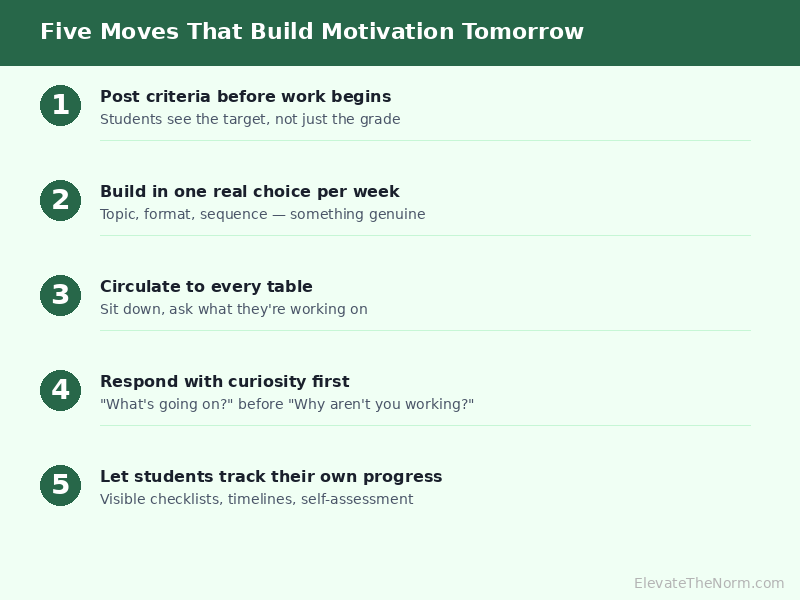
- Post the criteria for quality work before students begin, not after they finish. Make the target visible.
- Build in one meaningful choice per week — topic, format, sequence, or method. Real choice, not cosmetic choice.
- Check in with every student, not just the struggling ones and not just the stars. Circulate to every table. Sit down. Ask what they are working on.
- Respond to disengagement with curiosity before correction — the calm-over-control approach that actually works. “What’s going on today?” lands differently than “Why aren’t you working?”
- Use progress tracking students can see — a simple checklist, a visible timeline, a self-assessment. Let them see they are moving.
The Room Matters More Than the Speech
Motivating students is not a talent you either have or do not. It is not about being the inspiring teacher from a movie. It is about building a room where students feel competent enough to try, connected enough to care, and autonomous enough to own something real. When those three conditions exist, motivation does not have to be manufactured. It shows up because the room gives it a reason to.
The rewards and speeches will always stop working. The environment never does.
For the students who look like they have given up entirely rather than just coasting, see motivating students who don’t care, which works through what changes when disengagement looks total. Once you have found the barrier and want something to run this week, the hands-on companion to this guide collects goal setting, real choices, progress tracking and peer recognition.
Frequently Asked Questions
How do I motivate students who have completely shut down?
Start small, start private, and start with something they can actually do. A student who has shut down is usually protecting themselves from failure, not refusing to work. Give them one manageable task with clear criteria, check in quietly at their table, and respond honestly when they complete it. You are not trying to fix everything in one period. You are trying to give them a single piece of evidence that their effort connects to a result. Over time, those small pieces rebuild what learned helplessness took apart.
Are rewards always bad for student motivation?
No — but the type of reward matters. Rewards that provide informational feedback about a student’s progress can support motivation. Rewards that function as control — do this specific thing, receive this specific prize — tend to undermine intrinsic motivation over time. The research question is not whether you ever celebrate or recognize effort. It is whether the reward system replaces the student’s internal reasons for engaging or reinforces them.
What is the difference between engagement and motivation?
Motivation is internal — the drive, interest, or purpose behind effort. Engagement is what it looks like from the outside — participation, focus, persistence. A student can be behaviorally engaged (sitting quietly, completing work) without being motivated. And a motivated student who lacks the right conditions can look disengaged. Effective teaching targets the motivation because the engagement follows naturally when the conditions are right.
Does giving students choices really improve motivation?
Yes, when the choices are meaningful and structured. Self-determination theory identifies autonomy as one of three core drivers of intrinsic motivation. But choice only works when students have enough information to choose well, when the options are genuinely different, and when the teacher provides scaffolding. Asking a student to pick between identical worksheets in different colors is not autonomy. Letting them choose which historical figure to research within a unit — and defend that choice — is.
How do I motivate students when the content is genuinely boring?
Not every lesson will feel exciting, and pretending otherwise insults teenagers. When the content itself is dry, connect it to a question or product that is not. A grammar unit becomes tolerable when students are editing a real piece of writing they care about. A data unit becomes relevant when the data is about something in their school. You are not making the content entertaining — you are giving it a purpose the student can see.
What role do relationships play in student motivation?
Relationships are the single most consistent factor in motivation research. A Gallup study found that students with access to at least one teacher who makes them excited about the future are 30 times more likely to report high engagement. But the relationship that matters is not performative warmth — it is the kind built by knowing a student’s work, checking in consistently, and responding to struggle with support instead of judgment.
Can a teacher really control student motivation?
No — and you should not try to. Motivation belongs to the student. What you control is the environment: the clarity of the work, the quality of the feedback, the safety of the room, whether students have meaningful choices, and whether effort leads to visible progress. Build those conditions and motivation has room to exist. Remove them and no amount of enthusiasm from the front of the room will compensate.
Sources
- Ryan, R. M., & Deci, E. L. (2020). “Intrinsic and Extrinsic Motivation from a Self-Determination Theory Perspective.” Contemporary Educational Psychology. https://www.sciencedirect.com/science/article/abs/pii/S0361476X20300254
- American Psychological Association. “Self-Determination Theory: A Quarter Century of Human Motivation Research.” https://www.apa.org/research-practice/conduct-research/self-determination-theory
- Bondie, R. “Tapping the Power of Intrinsic Motivation.” Harvard Graduate School of Education, Usable Knowledge. https://www.gse.harvard.edu/ideas/usable-knowledge/19/10/tapping-power-intrinsic-motivation
- Gallup. “K-12 Schools Struggle to Engage Gen Z Students.” (2024). https://news.gallup.com/poll/648896/schools-struggle-engage-gen-students.aspx
- Turner, J. C. (2014). “The Secrets to Motivation: Autonomy, Belonging, Competence, and Meaning.” ASCD Educational Leadership. https://www.ascd.org/el/articles/the-secrets-to-motivation-autonomy-belonging-competence-and-meaning
- Chang, C. (2026). “The Longitudinal Trajectory of Learned Helplessness Among Adolescent Students.” Journal of Research on Adolescence. https://onlinelibrary.wiley.com/doi/10.1111/jora.70160
- “The Role of Rewards in Motivation — Beyond Dichotomies.” Contemporary Educational Psychology (2024). https://www.sciencedirect.com/science/article/pii/S095947522400183X
- Research.com. “Increasing Student Motivation and Engagement for 2026: The Science & Strategy Behind It.” https://research.com/education/motivating-and-engaging-students
About Clay Shumate
Clay Shumate is a certified secondary Social Studies teacher in the public schools of West Alabama, with seven years of classroom experience, a B.A. in History, and an M.Ed. in Secondary Education. He writes about project-based learning, student responsibility, respect, and practical ways to hold young people to a higher standard while giving them room to learn from mistakes. He is a member of the Society of Professional Journalists and writes to its Code of Ethics; this site’s editorial standards and corrections policy are published in full. More about Clay.