By Clay Shumate
Proactive classroom management strategies prevent problems before you have to correct them: teach expectations as skills in the first weeks, build routines for the moments that usually go sideways, set up the room so the right move is the easy one, and recognize good behavior on purpose. In grades 6–12, most of the work happens before a student ever calls out.
Correction will always be part of the job. But every minute you spend on prevention is a minute you don’t spend in a hallway conversation or a public standoff. The opening task on the board, where the supplies live, and how you answer the first confused question all shape how a class behaves.
This guide focuses on that front end. For the full picture, including what to do once behavior has already gone wrong, see our main guide to classroom management strategies.
Proactive vs. Reactive: What’s the Difference?
Reactive management waits for a problem and responds to it. Proactive management asks where problems usually start and fixes the setup.
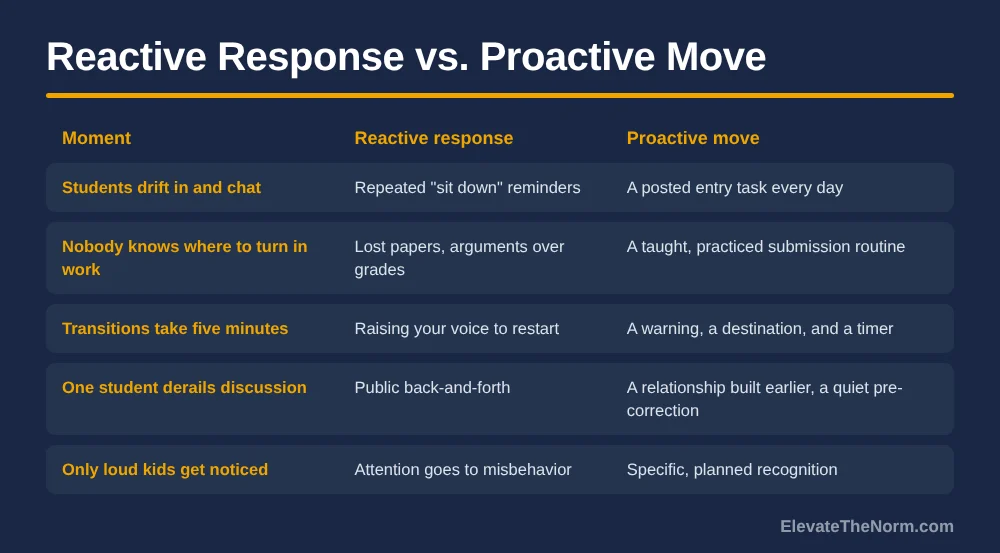
| Moment | Reactive response | Proactive move |
|---|---|---|
| Students drift in and chat | Repeated “sit down” reminders | A posted entry task every single day |
| Nobody knows where to turn in work | Lost papers, arguments over grades | A taught, practiced submission routine |
| Transitions take five minutes | Raising your voice to restart | A warning, a destination, and a timer |
| One student derails discussion | Public back-and-forth | A relationship built earlier, a quiet pre-correction |
| Only loud kids get noticed | Attention goes to misbehavior | Specific, planned recognition |
Both matter. The goal is to make the right column do so much of the work that the left column gets rare.
Teach Expectations Early, Like Any Other Skill
Teach expectations the way you teach content: explain, model, practice, give feedback. Students can’t follow a rule they’ve only heard once in a syllabus.
Turn Broad Rules Into Observable Actions
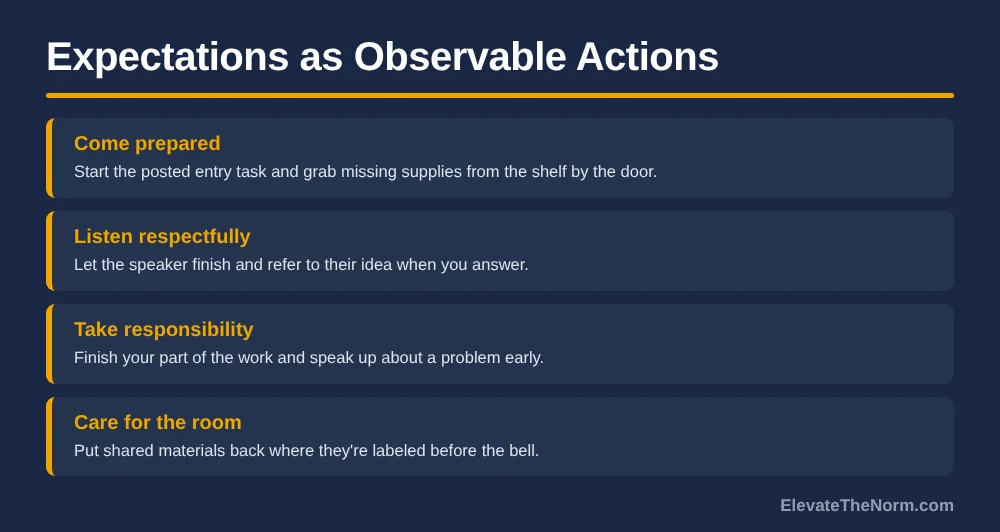
“Be respectful” leaves teenagers guessing what you mean. “Let the speaker finish, then respond to the idea” gives everyone the same picture. Write each of your classroom expectations as an action you could point to:
- Come prepared: start the posted entry task and grab missing supplies from the shelf by the door.
- Listen respectfully: let the speaker finish and refer to their idea when you answer.
- Take responsibility: finish your part of the work and speak up about a problem early.
- Care for the room: put shared materials back where they’re labeled before the bell.
Before you read an unfamiliar behavior as defiance, ask yourself whether you actually taught that expectation and whether the student’s accommodations are in place.
Model and Rehearse the Routines That Break Down Most
Build your classroom routines and procedures around three moments: entry, getting help, and turning in work. Show students where the task is posted, what to do while they wait for help, and how to confirm a digital upload actually went through.
Then let them practice with something low-stakes, like a sample assignment, so a mistake costs nothing. If several students miss the same step, reteach that step before you add consequences. That’s the heart of new teacher classroom management: when a routine fails, find the missed step and rehearse it again.
Pre-Correct Right Before the Tricky Moment
Pre-correction means reminding students of the expectation just before the moment they usually miss it. “When the timer ends, finish your sentence, leave your notebook open, and turn to your partner” works better than fixing the transition after it falls apart.
Plan your classroom transitions with a clear destination and a materials plan. Watch the first try for bottlenecks, like a crowded supply table, and fix the setup instead of repeating the reminder.
Set Up the Room to Prevent Problems
Room setup is management you only have to do once.
Put Cues Where Students Make Decisions
Post submission directions beside the turn-in spot. Keep the current task visible from every seat. When the information lives where students need it, you stop being the only source of answers.
Start With Assigned Seats, Then Earn Choice
Build your first seating chart around access: sight lines, hearing, mobility, clear walking paths, and your ability to reach every desk. Explain seat changes privately and in terms of learning (“you’ll see the board better here”). Once procedures are solid, open up flexible seating in short trials with clear expectations and keep required accommodations in place throughout.
Plan the Work So There’s Always a Next Step
A lot of off-task behavior is really “I don’t know how to start” or “I’m done, now what?” Give every task an accessible first step, like a vocabulary preview or a chunked primary source, while keeping the thinking demanding.
Post an early finisher activity before independent work begins, and make it deepen the lesson rather than fill time. For group tasks, assign group work roles with clear jobs and require some individual evidence of learning so nobody can coast.
Build Relationships Before You Need Them
Redirection lands better coming from someone a student trusts. Building relationships with students is prevention, not a bonus.
Greet at the Door
A quick greeting at the door doubles as a readiness check. Say names correctly, keep the line moving, and notice who might need a quiet “Do you have what you need to start?” Don’t try to diagnose a mood from a face; just offer the support.
Reset Every Day
Welcome each student without carrying yesterday into your voice. You still document what needs documenting and follow any behavior plan. But a fresh, straightforward start (“Your materials are ready, start with the question on the board”) keeps one bad day from becoming a bad month.
A kid isn’t born “hard.” When a student arrives guarded or tough, treat that as a cause worth looking for, not a fixed trait.
Keep Respect Two-Way and Stay Neutral
Respect goes both ways, and so does follow-through: do exactly what you say you’ll do. When a student says something to bait you, don’t react. Staying neutral, or using a little light sarcasm with older students in grades 7–8 and up, shows confidence and takes the audience away.
Make Positive Family Contact Manageable
I teach about 150 students across five or six World History classes. At that scale, positive calls home won’t happen by memory. Keep a rotating list, note the date and the specific contribution you mentioned, and make sure families hear from you before there’s a problem. See our guide to effective parent-teacher communication for message templates.


Use Positive Reinforcement to Make Good Behavior Visible
Positive reinforcement in the classroom works best when it’s specific and planned, not saved for the obvious standouts.
Praise the Action, Not the Kid
“You checked the document before you challenged that claim, and it kept the discussion on evidence” tells a student exactly what to repeat. Look for the easy-to-miss contributions: listening, revising after feedback, sharing materials fairly. Ask students whether they prefer public or private recognition.
Three Tiers of Recognition
Elevate has three recognition tiers: Immediate Recognition, Student of the Week, and Student of the Month. The whole program costs me about $81 a year, and I pay for it myself.
I run Student of the Week in all my classes. It’s judged on self-improvement and consistency, not perfection, because nobody’s perfect. One winner earned it by always being on time, participating, and doing bell ringers. Publish your criteria ahead of time and keep short notes so quieter students don’t disappear. For more, see our full guide to Student of the Week.
A Class-vs-Class Quiet Countdown
3-2-1-Done gives each class a weekly score that starts at zero. Quiet on three, two, one, or done earns 3, 2, 1, or 1 point; after “done,” the class loses a point for every second, counted “one Mississippi.” Optional extras include a plus for all work turned in and a minus for tardies, but keep negatives low.
The winning class each week gets Pringles, a water, and 15–20 minutes of their own time if they stay seated at a low murmur. The key is a consistent reward. In my classes, buy-in usually takes about three weeks; this year’s group took about six. Keep scoring adult-managed so no student can be blamed for a class loss. More ideas live in our guide to whole-class rewards.
Kindness Still Needs Enforcement
Positive reinforcement only works once students know kindness isn’t weakness. A positive classroom still needs enforcement, and your classroom consequences should be posted, predictable, and used the same way every time.
When Prevention Isn’t Enough
Even the best setup won’t stop every problem. Keep a short, predictable response so a small issue doesn’t grow an audience.
I say “quiet down” up to three times before moving to remediation, and I call it remediation rather than negative reinforcement. Serious remediation should come from administration, not the teacher. In between, keep corrections brief and private, give processing time, and get the class back to work. If a student challenges you publicly, try: “You’ll get a chance to explain privately. Your next step is the opening question.”
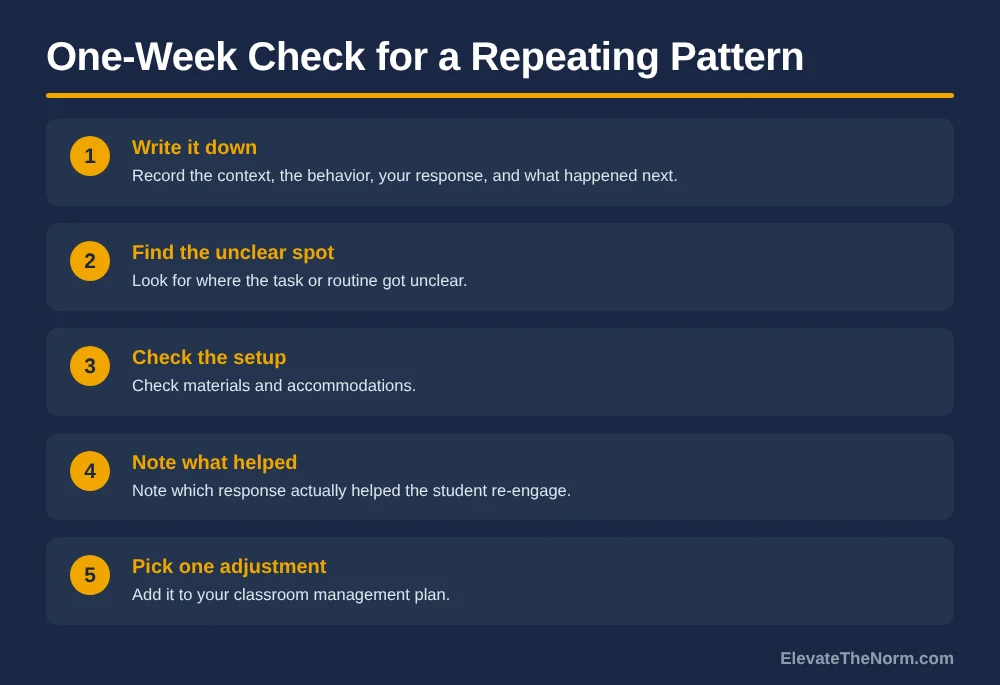
When a pattern keeps repeating, run a one-week check:
- Write down the context, the behavior, your response, and what happened next.
- Look for where the task or routine got unclear.
- Check materials and accommodations.
- Note which response actually helped the student re-engage.
- Pick one adjustment and add it to your classroom management plan.
Always follow IEPs and behavior intervention plans, and bring in your school’s support team when a pattern persists. For tougher cases, see our guide to classroom management strategies for difficult students. And if you are wondering whether the room really has changed since 2019, we went through what the national data says about student behavior, including the measures that cut against the premise.
Frequently Asked Questions
What are proactive classroom management strategies?
They’re the things you do before problems happen: teaching expectations as skills, practicing routines, arranging the room, building relationships, pre-correcting before tricky moments, and recognizing good behavior on purpose. The idea is prevention before correction.
When should I start teaching expectations?
On the first day, and keep practicing through the first few weeks. Then reteach whenever a routine starts slipping, such as after a long break or when a new student joins the class.
What is pre-correction?
Pre-correction is a short reminder of the expected behavior right before the moment students usually struggle with it, like a transition or a group task. It’s cheaper than fixing the problem afterward and keeps you out of public corrections.
Do proactive strategies work with high school students?
Yes. Teenagers respond to clear expectations, consistent follow-through, and respect. Skip anything that feels babyish, give them real responsibility, and lean on class-vs-class competition and specific recognition instead of sticker charts.
Does proactive management mean no consequences?
No. Prevention reduces how often you need consequences, but a positive classroom still needs enforcement. Keep consequences predictable and follow through on exactly what you say.
Start With One Routine
Pick the one moment that costs your class the most time, whether that’s entry, getting help, or turning in work. Write the expectation as an action, model it, let students practice it, and recognize it when you see it. Then do the same for the next one.
Want printable tools to get started? The free Elevate the Norm resource library has classroom management resources built for grades 6–12. Free to download, no email required.