Author: Clay Shumate

  • Ideas for Student Led Conferences: 16 Formats That Fit Grades 6–12

    Ideas for Student Led Conferences: 16 Formats That Fit Grades 6–12

    By Clay Shumate

    The best ideas for student led conferences in grades 6–12 are formats, not decorations. Pick one thing the student has to defend — a single piece of work, a growth pair, a data pattern, a goal that failed — and build the conference around it. Sixteen formats are below, sorted by what the student defends, how long each takes, and when to use it.

    Key Takeaways

    • A format is a decision about evidence. Every idea on this page answers one question: what does the student have to put on the table and explain?
    • Ten minutes is not enough when the student is talking. Budget twenty. A student who has never defended their own work needs room to be slow.
    • Pick the format that survives your calendar, not the one that looks best in a staff meeting. Stations, advisory slots, recordings, and rolling conferences all work; a ninety-minute evening event for 140 students does not.
    • The research supports the parts, not the package. Self-assessment has a small, real effect on self-regulated learning and a larger but probably inflated effect on self-efficacy. Nobody has run a large randomized trial of the conference itself.
    • Half of high school families will not come. Federal survey data puts high school conference attendance at 54%. A format that only works in person is a format that reaches half your roster.

    Free Download · Student-Led Conference Toolkit

    The readiness checklist, portfolio planner, student script and follow-up agreement

    Four printable parts that work with any format on this page. Use the checklist and planner for prep, then let the student choose which format they are ready to run.

    Download the free PDF

    Free. No email address required. Designed for grades 6–12. Browse every printable in Your Free Library.

    What are some good ideas for student led conferences?

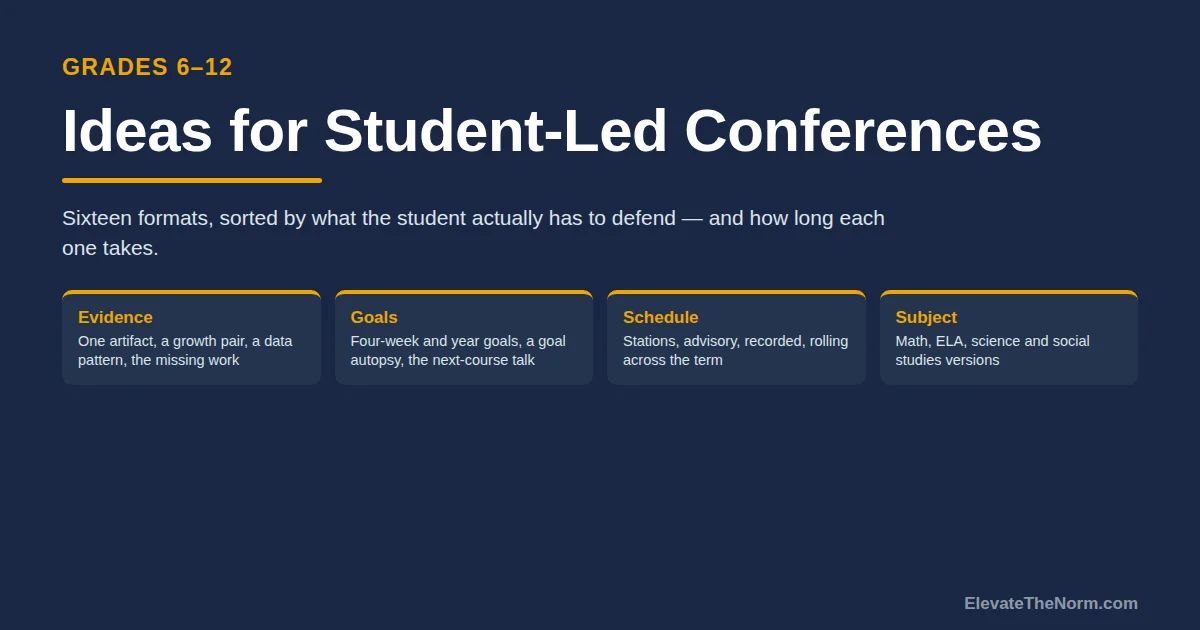
    Good ideas for student led conferences fall into four families: evidence formats, where the student defends a piece of work; goal formats, where the student defends a decision; schedule formats, which bend the event to fit a real calendar; and subject formats, which change what counts as evidence depending on the room. Almost every conference idea you will find online is a variation inside one of those four.

    That framing matters because it stops you from shopping for activities. The question is not “what cute thing can students do at the conference.” The question is what the student has to be able to explain out loud to an adult who is not their teacher. Everything else — the binder, the slides, the sign-in sheet — is packaging around that one moment. If you want the full case for why the event works and where it comes from, that is covered in the main guide to student-led conferences. This page is the catalogue of formats.
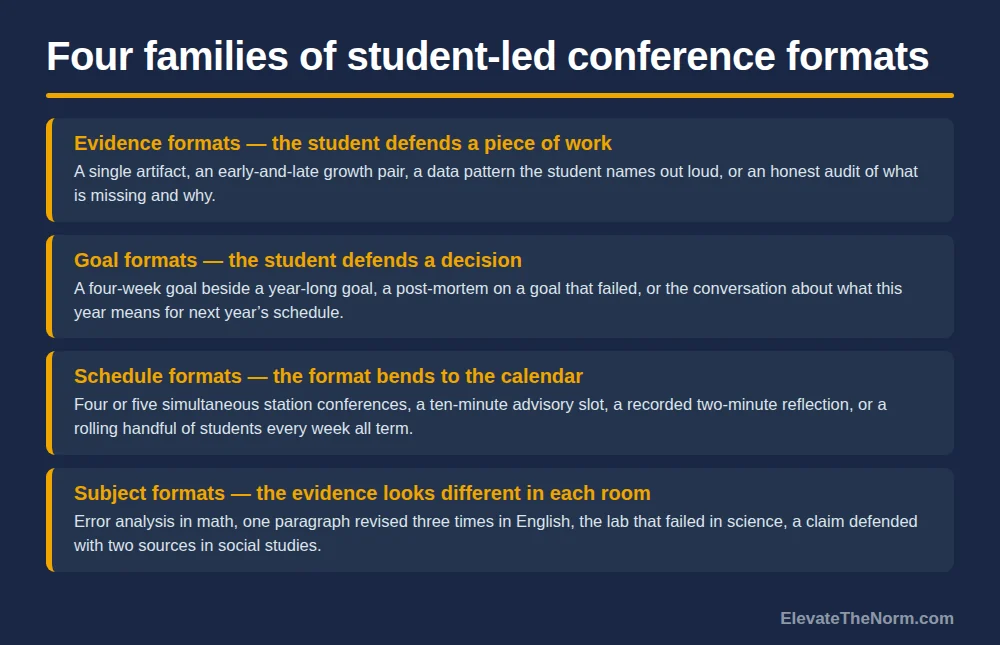
    Four labeled rows describing evidence formats, goal formats, schedule formats, and subject formats for student-led conferences.
    The four families every student-led conference format falls into.

    Sixteen ideas for student led conferences, by what the student defends

    Each format below lists what the student brings, roughly how long it runs, and the situation it is built for. None of them require a schoolwide program. Most can be run by one teacher in one course.

    Evidence formats: the student defends a piece of work

    1. The single-artifact defense. One assignment. Three questions: what is this, what does it show about what you can do, and what would you change. Ten to fifteen minutes. This is the format to start with if you have never done this before, because it fails gracefully — a student who freezes still has the paper in front of them.
    2. The growth pair. The earliest and latest version of the same skill, side by side. The student names the specific difference, not “it got better.” Fifteen minutes. Works best in a course with recurring tasks — writing, problem sets, lab reports, studio work.
    3. The data walk. The student reads their own assessment data out loud and names the pattern in it before any adult does. Fifteen to twenty minutes. This is the most uncomfortable format and the most honest one. It also requires that your gradebook actually shows patterns rather than a single running average, which is its own argument for grading by standard. Do not run this one in a station setup — a student reading their own failing scores aloud within earshot of three other families is not a format, it is an exposure.
    4. The missing-work audit. The student accounts for what is not there. Peter Neeves, a middle school principal writing in Edutopia in December 2025, describes exactly this: for incomplete assignments, students write a reflection and build an “assistance plan” for finishing. Fifteen minutes. Use it when the gap between a student’s ability and their grade is mostly a gap in turned-in work.

    Goal formats: the student defends a decision

    1. The four-week goal beside the year goal. The Missouri State Teachers Association’s practical guide recommends a four-week goal, a year-long goal, and one “whole-self” goal. The four-week goal is the useful one, because it is close enough to check. Fifteen minutes.
    2. The goal autopsy. The student revisits a goal they set and did not hit, and says why — not as an apology, as a diagnosis. Twenty minutes, because this one takes real talking. Use it at the second conference of the year, never the first.
    3. The next-course conversation. An eleventh or twelfth grader explains what this year’s evidence means for next year’s schedule, and what they would need to be true to take the harder course. Twenty minutes, and worth pulling a counselor in if you can.

    Schedule formats: the format bends to the calendar
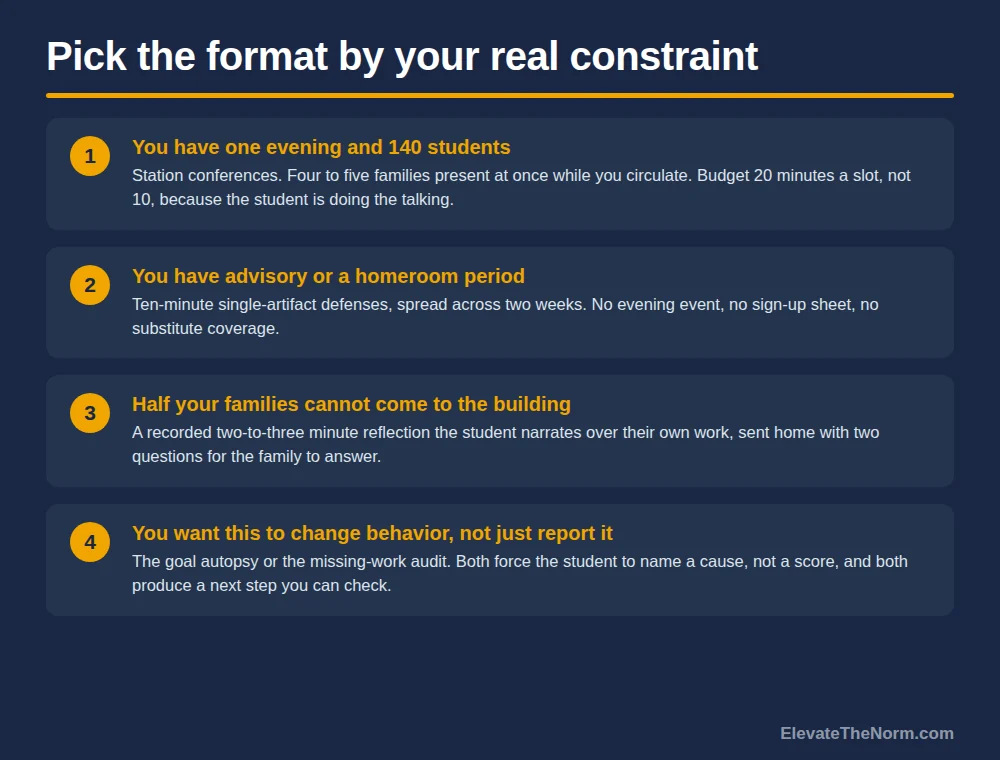
    Four numbered cards matching a teaching constraint to a student-led conference format: one evening with 140 students, an advisory period, families who cannot attend, and wanting behavior change.
    Match the student-led conference format to the constraint you actually have.
    1. Station conferences. Four or five families present simultaneously in one room while you circulate. This is the standard secondary workaround and the MSTA guide describes it directly. Twenty-minute slots. The trade-off is privacy: anything a family might not want overheard has to happen somewhere else.
    2. The advisory conference. Ten-minute single-artifact defenses run during advisory or homeroom across two weeks. No evening event, no coverage, no sign-up system. The weakest format on the list and the one most likely to actually happen.
    3. The recorded conference. A two-to-three minute screen recording in which the student narrates their own work, sent home with two questions for the family to answer and return. The MSTA guide lists this as an option; it is also the only format on this page that reaches a family working a second shift. Three practical guardrails: use whatever recording tool your district has already approved, make sure no other student appears or is named in the recording, and give a student with no reliable device at home a written narration or a phone-audio version instead. The format is the point, not the video.
    4. The rolling conference. Four or five students a week, every week, all term. Nobody schedules an event. By May every student has defended their work twice. This is the format that changes a course culture rather than adding a night to the calendar.

    Subject formats: the evidence looks different in each room

    1. Math — error analysis. The student brings one wrong answer, explains what they believed when they made the mistake, states the correct method, and shows a second problem they got right using it. Fifteen minutes. This format does more for a math student than any portfolio of correct work.
    2. English — one paragraph, three versions. First draft, post-feedback draft, final. The student reads the sentence that changed the most and explains the change. Fifteen minutes.
    3. Science — the lab that did not work. Data that refused to cooperate, the likely reason, and what the student would change in the procedure. Fifteen minutes, and it teaches more about science than a poster of a successful experiment.
    4. Social studies — defend a claim with two sources. The student states a claim, names both sources, and answers one hard question about the source they trust less. Twenty minutes.

    One more, for the hardest case

    1. The repair conference. After an integrity incident or a serious behavior problem, the student explains to their family what happened, who it affected, and what they are doing about it — with you in the room and the school’s formal process already finished, not instead of it. Twenty to thirty minutes. This one is not for everybody and it is not a substitute for required procedure. It is voluntary for the student and the family, it never replaces a mandated report or a discipline process, and your administrator should know it is happening before it happens. It works when a student has already accepted responsibility and needs a way to come back from the mistake rather than carry it. If any of those conditions are missing, skip it.
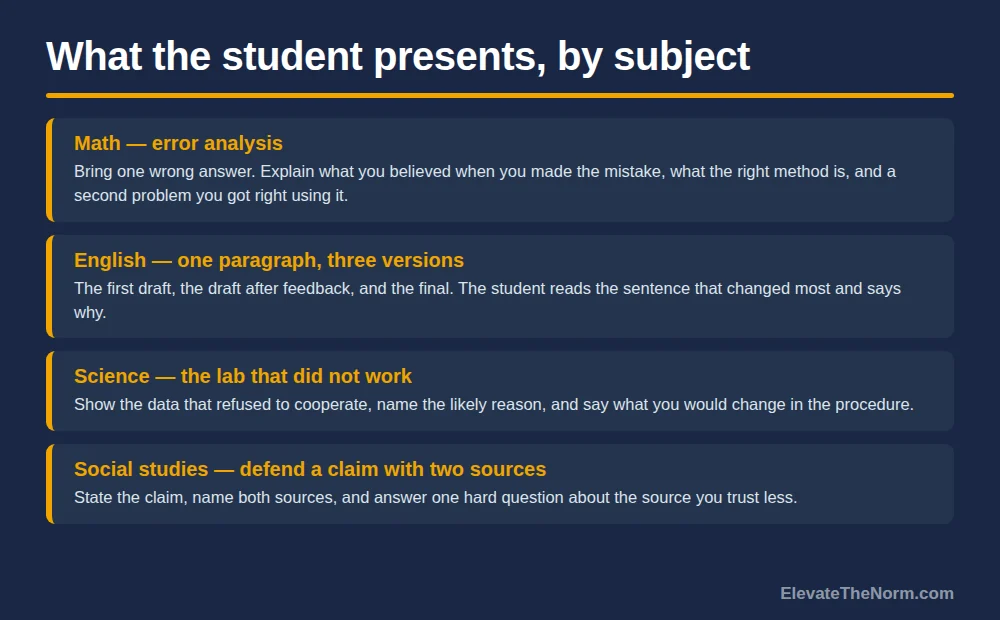
    Four rows describing what a student presents in math, English, science, and social studies at a student-led conference.
    What the student brings to the table in each subject.

    Do student-led conferences actually do anything?

    The short answer: the parts have evidence behind them and the package does not. Self-assessment and goal-setting — the two things a student-led conference forces — have been studied. The conference as an event has not been tested at scale, and anyone telling you otherwise is stretching. The goal-setting half is worth reading on its own terms too: what the evidence does and does not support about student goal setting is more mixed than most professional development admits.

    The best available evidence on the underlying mechanism is Panadero, Jonsson and Botella’s 2017 set of four meta-analyses in Educational Research Review. Across 2,305 students with a mean age of 17.5, self-assessment interventions produced a small effect on self-regulated learning (d = 0.23) and a large effect on self-efficacy (d = 0.73). Ten of the studies were in secondary schools, so this is not elementary research being stretched upward. But read the authors’ own caution: they state plainly that for self-efficacy “there might exist some over-estimation of the magnitude of the effect” because of publication bias, and that the studies do not clarify the mechanism. A d of 0.73 that the authors themselves flag as probably inflated is not a number to build a school improvement plan on.

    On the conference itself, the most-cited piece of research is Sherri Nauss’s 2010 study in the ERIC database, covering 90 students in grades 6–8, 90 parents and six teachers. It reports that 59 of 90 students said the conferences “consistently” or “usually” made them take responsibility for their learning, and 64 of 90 said the conferences helped them focus on grades. Those are real numbers, and they are also self-reported survey responses from a single school, from students in a narrow 2.5–3.5 GPA band, with no achievement data and no data from families who did not participate. Nauss says all of that herself in the limitations section. It is a useful signal. It is not proof.

    So the honest version is this: if you run one of these formats, you are on solid ground saying that it makes students assess their own work, and reasonable ground expecting that to help a little with how they manage their learning. You are not on solid ground promising a grade bump. Say the first thing to your administrator and skip the second.

    Which format should you pick?

    Pick by constraint, not by preference. The format that fits your worst scheduling problem is the one that will still be running in March.

    If this is your situationUseTime per student
    One evening, 140 studentsStation conferences (#8)20 min
    You have advisory or homeroomAdvisory conference (#9)10 min
    Families work shifts or lack transportRecorded conference (#10)2–3 min of video
    You want a culture change, not an eventRolling conference (#11)15 min, 4–5 a week
    First time ever doing thisSingle-artifact defense (#1)10–15 min
    The problem is missing work, not abilityMissing-work audit (#4)15 min
    Second conference of the yearGoal autopsy (#6)20 min
    Juniors and seniors picking coursesNext-course conversation (#7)20 min

    Whatever you choose, the preparation is the same shape: the student selects evidence, annotates it, and rehearses. The free conference template pack has the readiness checklist and portfolio planner that do that work, and the self-assessment guide explains why the annotation step is the part you cannot skip.

    What do you do about the families who do not come?

    Plan for roughly half of them, and build a format that does not require a body in a chair. This is not pessimism. It is the federal data.

    The National Center for Education Statistics tracks this in the National Household Education Surveys Program. In the 2018–19 survey, the share of parents who attended a regularly scheduled parent-teacher conference was 90% in kindergarten through second grade, 88% in grades 3–5, 72% in grades 6–8, and 54% in grades 9–12. The drop is not a failure of any one school. It is what happens when a child goes from one teacher to seven and the conference stops feeling like the only channel. The 2023 survey puts overall conference attendance across all grades at 72%.

    Three things follow from that. First, a recorded conference is not the consolation prize; for half a high school roster it is the primary format. Second, the family who does not come is often the family you most need to hear from, which is an argument for the short, regular, individual contact that actually has trial evidence behind it. Third, do not grade the student on whether an adult showed up. That is the one design mistake that turns a good idea into a punishment for being poor.

    What about students and families who need accommodations?

    Every format on this page assumes a student can talk about their work for fifteen minutes, and that assumption is wrong for some of your students. Fix it before the conference, not during it.

    For a student with a communication-related disability, the defense is a mode, not a speech. A written narration read by the student, a slide deck the student points to, a recorded version, or a peer-supported walkthrough all satisfy the same purpose. Check the IEP or 504 plan first and follow it — this is an instructional activity, and accommodations apply to it the same way they apply to a presentation in any other class. For an emergent bilingual student, let the conference happen in the language the family speaks, and request the interpreter through whatever process your school already has for conferences. If your school does not have one, that is worth raising before you pick a format, because a conference the family cannot follow is worse than the form letter it replaced.

    Five ways these ideas go wrong

    • The student reads a script and nobody learns anything. A script is scaffolding for a nervous kid, not the product. If a student can deliver the whole thing without looking up, you have built a performance.
    • Only the successful work goes in the folder. A portfolio of A’s is a brag book. The growth pair, the missing-work audit and the error analysis all exist to prevent this.
    • The time slot assumes an adult is talking. Ten minutes is a teacher-led conference. A fifteen-year-old explaining their own reasoning to their mother takes longer, and the silences are part of it.
    • It becomes an eighth grading event. Grade the preparation if you must grade something. Do not put a number on how convincingly a teenager talked about themselves in front of their parent.
    • Nobody follows up. A goal named in October that nobody mentions again in November teaches students that the conference was theater. Put the four-week check on your own calendar before the conference happens.

    What to do next

    Pick one format and one class period. Not the department, not the grade level — one section. The single-artifact defense (#1) run during advisory (#9) is the lowest-risk combination on this page, and it takes one week of prep: students choose the artifact on Monday, annotate it Tuesday, rehearse with a partner Wednesday, and defend it Thursday and Friday.

    Then write down what actually happened — who could explain their own work and who could only describe it. That distinction is the whole point of the exercise, and it is the thing you will want in front of you the next time someone asks whether this is worth the class time. It is. But argue it with what your students did, not with a number from a study that was run somewhere else.

    Before you go: grab the free Student-Led Conference Toolkit (PDF) — ElevateTheNorm.com branded, printable, no email required.

    Frequently Asked Questions

    What are some good ideas for student led conferences in middle and high school?

    Start with a format rather than an activity. The four that work best in grades 6-12 are the single-artifact defense (one assignment, three questions), the growth pair (earliest and latest version of the same skill side by side), the missing-work audit (the student accounts for what is not there and writes an assistance plan), and the goal autopsy (the student explains why a goal they set did not happen). Each runs in ten to twenty minutes and none of them require a schoolwide program.

    How long should a student-led conference be?

    Budget twenty minutes, not ten. Ten minutes is the length of a teacher-led conference, where an adult who has said the same thing six times that night is doing the talking. A fifteen-year-old explaining their own reasoning to their parent is slower, and the pauses are part of the work. If your schedule only allows ten, use the single-artifact defense, which is built to fit.

    Do student-led conferences improve grades?

    There is no good evidence that they do, and you should not promise it. What has been studied is self-assessment, the mechanism underneath the conference. Panadero, Jonsson and Botella’s 2017 meta-analyses found a small effect on self-regulated learning (d = 0.23) and a larger effect on self-efficacy (d = 0.73) across 2,305 students with a mean age of 17.5 – but the authors themselves warn that the self-efficacy figure is probably inflated by publication bias. The most-cited study of the conference itself, Nauss (2010), is 90 students in one middle school reporting on themselves, with no achievement data at all.

    What if the parent disagrees with how the student assessed their own work?

    That disagreement is useful, and it is one of the few things a student-led conference produces that a traditional conference does not. Let it happen, then anchor it to the evidence on the table: the paper, the data, the two drafts. Your job is not to referee who is right about the student’s character. It is to point at the artifact and ask what it shows. If the conversation is heading somewhere a student should not have to sit through, end the conference and schedule a separate one with the adults.

    How do you handle families who do not come to conferences?

    Assume about half of them will not, and build a format that does not require attendance. Federal survey data from 2018-19 puts parent attendance at regularly scheduled conferences at 54% in grades 9-12 and 72% in grades 6-8, down from 90% in the earliest elementary grades. The recorded conference – a two- to three-minute narration the student makes over their own work, sent home with two questions for the family to answer – is the format built for this, and for half a high school roster it is the primary format, not a backup. Never grade a student on whether an adult showed up.

    Should student-led conferences be graded?

    Grade the preparation if you need a grade: the artifact selection, the annotation, the written reflection. Do not put a number on how convincingly a teenager talked about themselves in front of their parent. That turns a format built on honesty into a performance, and the students who most need to say something uncomfortable are exactly the ones a grade will silence.

    Do these formats work for students with IEPs or students learning English?

    Yes, with the accommodations those students already have. The defense is a purpose, not a speech: a written narration the student reads, a slide deck the student points to, a recorded version, or a peer-supported walkthrough all satisfy it. Check the IEP or 504 plan and follow it, the same as you would for any presentation. For a family that speaks another language, request an interpreter through the process your school already uses for conferences, and hold the conference in the language the family actually speaks.

    How is this different from a regular parent-teacher conference?

    In a traditional conference the teacher reports and the family listens. In a student-led conference the student presents evidence of their own learning and the adults ask questions about it. The teacher is still in the room and still responsible for accuracy – this is not the teacher stepping out. What changes is who has to be able to explain the work, which is the entire point.

    Sources

    • McQuiggan, Meghan, and Mahi Megra. Parent and Family Involvement in Education: Results from the National Household Education Surveys Program of 2019 (NCES 2020-076). National Center for Education Statistics, U.S. Department of Education, 2019. Conference attendance by grade band appears in Table 2. Full report (PDF).
    • Parent and Family Involvement in Education: 2023 (NCES 2024-113). National Center for Education Statistics, U.S. Department of Education, 2024. Sample of 19,562 students; overall conference attendance 72%. Summary (PDF). This edition does not disaggregate by grade band, which is why the 2019 report is cited for that figure.
    • Panadero, Ernesto, Anders Jonsson, and Juan Botella. “Effects of self-assessment on self-regulated learning and self-efficacy: Four meta-analyses.” Educational Research Review, vol. 22, 2017, pp. 74–98. Journal listing; open-access author copy at the Universidad Autónoma de Madrid repository (PDF), which is the version read for this article.
    • Nauss, Sherri A. Student Led Conferences: Students Taking Responsibility. 2010. ERIC document ED516784. Full text (PDF). 90 students in grades 6–8 with GPAs between 2.5 and 3.5, self-reported survey data, no achievement measures — limitations stated by the author.
    • Neeves, Peter. “How to Successfully Institute Student-Led Conferences at Your School.” Edutopia, George Lucas Educational Foundation, 3 December 2025. Article.
    • “A Practical Guide to Student-Led Conferences.” Missouri State Teachers Association. Guide.

    A note on the evidence. Two of the six sources are federal survey reports, one is a peer-reviewed set of meta-analyses, and one is a small single-school study whose limitations are stated in the text above rather than buried. The two practitioner sources are cited for format details, not for outcomes. Nobody has run a large randomized trial of student-led conferences at the secondary level, and this article does not pretend otherwise.

    About Clay Shumate

    By Clay Shumate — Clay Shumate is a certified secondary Social Studies teacher in the public schools of West Alabama, with seven years of classroom experience, a B.A. in History, and an M.Ed. in Secondary Education. He writes about project-based learning, student responsibility, respect, and practical ways to hold young people to a higher standard while giving them room to learn from mistakes. He is a member of the Society of Professional Journalists and writes to its Code of Ethics; this site’s editorial standards and corrections policy are published in full.

  • Student Self Assessment for Parent Teacher Conferences: A Grades 6–12 Guide

    Student Self Assessment for Parent Teacher Conferences: A Grades 6–12 Guide

    By Clay Shumate

    Student self assessment for parent teacher conferences is a short written judgment a student makes about their own work — against stated criteria, with evidence attached — that goes into the conference and gets talked about there. It is one page. Its job is to stop the meeting being a conversation about a teenager conducted without the teenager.

    That is the entire idea, and it works in a traditional conference where the parent and the teacher are the ones talking. The student does not have to run the meeting for their own assessment to change what happens in it.

    Key Takeaways

    • The sheet is not a feelings inventory. Every rating on it points at a specific piece of work. “I try hard in this class” is not evidence. “My last two lab write-ups had no analysis section” is.
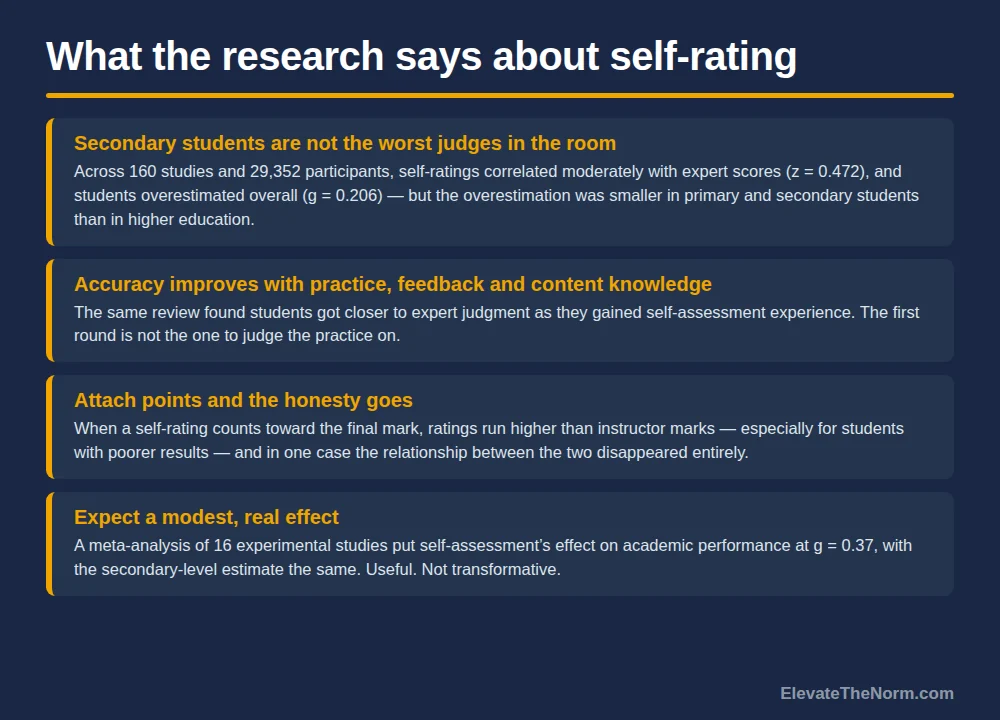
    • Secondary students are better at this than people assume. A 2023 meta-analysis of 160 studies found students overestimate their own work on average — but that the overestimation is smaller in primary and secondary students than in university students.
    • Never let the rating count for points. The moment a self-rating carries a grade, it inflates, and the research on that is consistent enough to treat as settled.
    • What families do with the information matters more than the meeting. Across 50 studies of middle-school parental involvement, the form most strongly tied to achievement was academic socialization — talking about expectations, plans and strategies. Helping with homework was the one form that was not.
    • Expect a modest, real effect. A meta-analysis of self-assessment interventions puts the secondary-level effect at about g = 0.37. Useful. Not transformative.

    What Is Student Self Assessment for Parent Teacher Conferences?

    It is a one-page document a student completes in class, in the week before conferences, in which they rate their own work against criteria you have taught, name the evidence for each rating, and write one thing they intend to do about it. The student keeps a copy. A copy goes to the conference. The adults read it before anyone starts talking.

    Three things it is not, because each of them is a version teachers accidentally build.

    It is not a progress report in the student’s handwriting. If the sheet just restates grades the parent can already see in the portal, it has added nothing and cost a class period. The value is in the judgment, not the numbers.

    It is not a behavior confession. A sheet whose questions are all about effort, attitude and talking in class turns the conference into a disciplinary meeting with extra steps. Some of that may belong in the conversation. It does not belong on this document.

    It is not a student-led conference. A student-led conference is a format in which the student runs the meeting. This is an artifact, and it works inside either format. If your school runs ten-minute traditional conferences down a cafeteria table, this still works. It might work better there, because it is the only thing in the room written by the person everyone is discussing. If you are weighing which conference format to run in the first place, the sixteen formats sorted by time and constraint lay out which ones survive a single evening and which need a full class period.

    If you want the broader practice this sits inside — what self-assessment is, and the evidence behind it generally — that is in the guide to the general grades 6–12 guide to the practice. This page is about the conference version specifically. If conduct is what the meeting is really about, the behavior version of the same four-step routine is the better sheet to start from. If you do run the student-led format, pair this sheet with a free student-led conference template so the student has a structure for the meeting itself.

    Why Bring a Student Self Assessment to a Conference at All?

    Because the research on what families actually do with school information points away from monitoring and toward conversation — and a self-assessment gives them something to have a conversation about.

    Nancy Hill and Diana Tyson’s meta-analysis of 50 studies of parental involvement in middle school found that involvement was positively associated with achievement across almost every form they measured, with one exception: parental help with homework. The form with the strongest positive association was what they call academic socialization — communicating expectations, discussing strategies, connecting schoolwork to a future the student can picture.1 That is a correlational finding across a mixed body of studies, and it should not be read as proof that a particular conversation causes a grade to move. But it tells you what to aim a conference at. Not “here is the number.” Closer to “here is what your kid thinks is hard, and here is what they plan to do.”

    The federal family-engagement framework used by many districts lands in the same place from a policy direction. The Dual Capacity-Building Framework for Family-School Partnerships lists the essential conditions for engagement that works, and the first two are that it is “relational: built on mutual trust” and “linked to learning and development.”2 A conference built around a student’s own account of their work is both of those by construction. A conference built around a gradebook printout is neither.

    There is a plainer reason too. A conference is a meeting about a fifteen-year-old’s work, held between two adults, often while the fifteen-year-old sits in the hallway or at home. If you believe teenagers are developing young adults, that arrangement is hard to defend. The self-assessment is the cheapest available fix — it puts their judgment in the room even when they are not.

    Will a Teenager Rate Themselves Honestly?

    More honestly than most adults expect, and less honestly the moment you attach points to it. Those two findings are the whole design brief for the sheet.

    Four-row evidence graphic on student self-assessment accuracy, covering the moderate correlation with expert scores, improvement with practice and feedback, inflation when ratings are graded, and a modest overall effect size
    Secondary students self-rate better than the staffroom assumes — until you attach points to it.

    Start with accuracy. Sam P. León, Ernesto Panadero and Inmaculada García-Martínez pooled 160 articles covering 29,352 participants to ask how close student self-ratings come to expert scores. The average correlation was moderate — z = 0.472 — and students did overestimate on the whole, with a small overall effect of g = 0.206. The part worth knowing, because it runs against the staffroom assumption, is that the overestimation was smaller in primary and secondary students than in higher education.3 Your ninth graders are not the worst judges in the building.

    The same review found that accuracy improves with feedback, with content knowledge, and with experience of self-assessing. That is not a reason to skip it in October because they are bad at it. It is a reason to do it more than once.

    Now the part that is closer to settled. Heidi Andrade’s critical review of the field is direct about what happens when self-assessment becomes summative: in one study she cites, students’ self-assessments ran higher than the marks given by their instructors, “especially for students with poorer results,” and when the self-grade counted toward the final mark, “no relationship was found” between the two sets of judgments at all.4 Her own position is stated flatly: “My commitment to keeping self-assessment formative is firm,” and “if there is no opportunity for adjustment and correction, self-assessment is almost pointless.”

    Read together, those give you three non-negotiables for a conference sheet:

    • No points. Not for accuracy, not for completion, not extra credit. The instant it is worth something, it stops being information.
    • Criteria the student has actually been taught. A rating against a rubric nobody explained is a guess with a number on it.
    • Somewhere to go afterwards. If the conference ends and nothing the student wrote can be acted on, you have run a ceremony.

    And keep the expected size of the effect honest. Pinar Karaman’s meta-analysis of 16 experimental and quasi-experimental studies — 46 effect sizes, 7,654 participants — found an overall effect of self-assessment interventions on academic performance of g = 0.37, with the secondary-level estimate also at 0.37.5 That is a real, small-to-moderate effect from a small body of studies. It is not a reason to promise a parent anything.

    What Actually Goes On the Sheet?

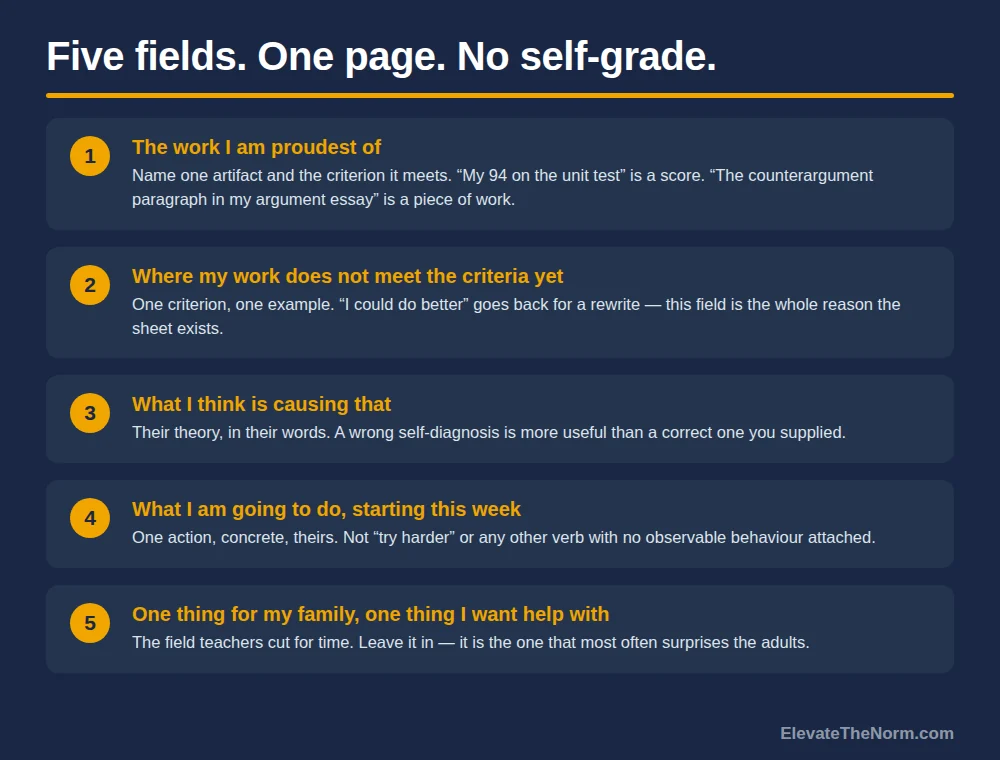
    Five fields, one page, no more. Anything longer gets filled in during homeroom on the morning of, which is the failure mode this format exists to prevent.

    Numbered graphic listing the five fields of a student self assessment sheet for parent teacher conferences, from the work the student is proudest of through to what they want their family to know
    Five fields, one page. No numeric self-grade, no effort rating, no behavior self-report.

    Here is what each field is asking for, and the common way each one gets ruined.

    1. The work I am proudest of, and why it meets the criteria. The student names one artifact — an essay, a lab, a project, a problem set — and points at the specific criterion it satisfies. Ruined by: letting them name a grade instead of a piece of work. “My 94 on the unit test” is a score. “The counterargument paragraph in my argument essay” is a piece of work.

    2. Where my work does not meet the criteria yet. One criterion, one example. Ruined by: accepting “I could do better.” Send it back. This field is the entire reason the sheet exists, and vagueness here is almost always a sign the criteria were never concrete enough to apply.

    3. What I think is causing that. Their theory, in their words. Time, confusion about the task, not knowing where to start, a skill gap, not asking. Ruined by: leading them to the answer you want. A wrong self-diagnosis is more useful than a correct one you supplied — it is the thing the conference can actually correct.

    4. What I am going to do about it, starting this week. One action, concrete, theirs. Ruined by: “try harder,” “focus more,” and every other verb with no observable behavior attached.

    5. One thing I want my family to know, and one thing I want help with. This is the field that changes the temperature of the meeting, and it is the one teachers cut for time. Leave it in. It is also the field that most often surprises the adults in the room.

    Notice what is not on the list: a numeric self-grade, an effort rating, and a behavior self-report. The first two inflate, and the third turns the page into something a student would be foolish to answer honestly.

    If you want a ready-made version rather than building your own, the free student self-assessment forms on this site cover the same structure and print on one page — no email address required.

    How Do You Prepare Students Without Losing a Week?

    Three class periods, spread across the week before conferences, totalling about forty-five minutes. Less than that and the sheets come back empty. More than that and it will not survive contact with a pacing guide.

    Three-step graphic showing a forty-five minute preparation sequence before conference week: reading the criteria, completing fields one to four with the work in hand, and writing the family field with a read-back
    About forty-five minutes total, spread across the week before conferences.

    Day one, fifteen minutes — read the criteria. Put the rubric or standards list in front of them and read it aloud while they follow. Then take one piece of anonymous work — last year’s, or one you wrote badly on purpose — and have the class rate it together against one criterion. Judging someone else’s work first is substantially easier than judging your own, and it is how students learn what the criterion actually means.

    Day two, twenty minutes — fill in fields one to four with the work in front of them. Not from memory. Folders open, portal open, papers on the desk. A self-assessment written from memory is a self-assessment about how the semester felt. Circulate and ask one question of anyone who has written a vague line in field two: which assignment, and which sentence in it?

    Day three, ten minutes — field five and a read-back. They write what they want their family to know and what they want help with, then reread the whole sheet once and change anything they would not want said out loud. That last instruction matters. A student who knows they can edit before it leaves the room writes more honestly in the first place, not less.

    Two practical notes. Do this on paper even if your school is one-to-one — a sheet you can hand across a table is doing a different job than a document you have to open. And make a copy before the conference, because a meaningful number of them will not come back.

    On the obvious objection: if you teach 140 students, you are not reading 140 sheets closely. You do not have to. Read field two and field five on all of them — that is genuinely about fifteen seconds each, call it thirty-five minutes — and read the full page only for the students whose conference is actually scheduled. The rest of the sheets did their work in the writing, which is where most of the value sits anyway.

    What Do You Do With the Sheet Once Everyone Is in the Room?

    Read it first, out loud or silently, before anyone gives an opinion. The sequence is the whole technique. If the teacher speaks first, the sheet becomes a document that gets evaluated. If the sheet goes first, it becomes the agenda.

    A workable ten-minute shape, whether or not the student is present:

    1. Minute 1 — everyone reads the sheet. Hand the parent a copy. Say nothing while they read it. This is more uncomfortable than it sounds and it is worth sitting through.
    2. Minutes 2–4 — confirm or complicate field two. Your job here is to say whether you see the same gap the student named. Agreeing is useful. So is “I actually see something different, and here it is.” What it is not is a correction. When your read and the student’s read disagree, both stay on the table and you say why you see it differently. A student whose judgment gets overruled the first time they offer it has learned exactly what the sheet is worth.
    3. Minutes 5–7 — talk about field three, the cause. This is where a parent usually knows something you do not. It is the most valuable three minutes in the meeting and the ones most often spent on grade arithmetic instead.
    4. Minutes 8–9 — make field four specific enough to check. Turn the student’s intention into something with a day attached. “Come to tutoring Tuesday” beats “get more help.”
    5. Minute 10 — name the follow-up. Who checks, when, and how the family will hear. Then actually do it, because a conference with no follow-up teaches everyone that the meeting was the point.

    If the student is in the room, they read field one aloud and you stay quiet. If they are not, read their words rather than paraphrasing them — “here is what she wrote” carries a weight that “she feels like” does not. The broader ground rules for these conversations are set out in the guide to talking with families all year, not just at the meeting.

    How Do You Make This Work for Every Student and Every Family?

    Fix the criteria first. Almost every access problem with self-assessment turns out to be a reading problem in the rubric.

    Rubric language is some of the densest prose in a school building — multi-clause, comparative, written for teachers marking rather than students applying. Before you reach for accommodations, rewrite each criterion as one short present-tense sentence naming something you could point at in the work. Cut the list to three. That single move does more for students with IEPs, 504 plans and English learners than any scaffold you add on top of a bad rubric.

    Beyond that:

    • Sentence stems, printed on the sheet. My evidence for this is on page ___. I still need to ___. The part I get stuck on is ___.
    • Translation of the sheet itself, not just the conference. If your district provides interpretation for conferences, the one-page document is a far easier translation job than a live conversation, and a family that reads it beforehand arrives ready.
    • Say up front who will see it. Students calibrate their honesty to the audience. Tell them the audience before they write, not after — and tell them plainly that it is going home, because field five occasionally surfaces something a student would not have chosen to send to a parent. If something a student writes triggers your mandatory-reporting duty or your counseling referral process, that duty runs first and the conference sheet is not the venue. Know what your school’s process is before you hand the pages out, not while you are holding one.
    • For families who do not attend — and there will be some — the sheet still has a job. Send it home with a two-sentence note naming field four and one way to reply. That is not a substitute for a conference. It is the version that costs you four minutes and reaches people a scheduled evening meeting never will.

    Three Ways This Goes Wrong

    It becomes a grade recap. The sheet fills with scores and percentages, the conference becomes a reading of the portal, and everybody leaves having learned nothing. The fix is field two: if the student cannot name a specific criterion their work does not meet, the sheet is not finished.

    Somebody attaches points to it. Usually with good intentions — a completion grade, to get them turned in. The result is predictable and documented: ratings go up, and the relationship between self-assessment and teacher judgment weakens, most for the students who are struggling most.4 If you need them submitted, use a deadline, not a grade.

    Nothing happens afterwards. The sheets go in a folder, the follow-up never runs, and next year the students fill them in exactly as carefully as the process deserves. Teenagers are good at working out which school rituals are real. If you can only protect one part of this, protect the follow-up.

    What to Do Before the Next Conference Window

    Pick one class. Take the rubric you already use and rewrite three criteria in plain sentences. Build the five-field page — or print the existing form — and give it the three short periods above in the week before conferences. Do not grade it. Read it first in the room.

    Then, at the next conference cycle, do it again with the same students. The accuracy research is clear that this gets better with repetition and feedback, and almost nothing in the first round will be as good as the third.3 The honest promise is a modest one: a meeting that is about the student’s actual work rather than their average, and a teenager who was treated as a participant in a conversation about their own life. That is worth forty-five minutes of class time on its own.

    Frequently Asked Questions

    What is student self assessment for parent teacher conferences?

    It is a one-page document the student completes in class before conferences, rating their own work against criteria the teacher has taught, naming the evidence for each rating, and writing one thing they intend to do about it. A copy goes into the conference and the adults read it before anyone gives an opinion. It works in a traditional conference as well as a student-led one — the student does not have to run the meeting for their own assessment to change what happens in it.

    Should the self-assessment count toward the student’s grade?

    No. This is the closest thing to a settled finding in the area. When a self-rating carries points, ratings inflate, most sharply among the students who are struggling most, and in at least one study the relationship between student and instructor judgments disappeared entirely. If you need the sheets submitted, use a deadline rather than a grade.

    Won’t students just say what they think the adults want to hear?

    Some will, at first. Three things reduce it: tell them plainly who will read the sheet before they write it, give them a read-back step where they can edit anything they would not want said aloud, and never attach points. The accuracy research also suggests this improves with repetition — students get closer to expert judgment as they gain experience self-assessing, so the first round is not the one to judge the practice on.

    What if the student’s self-assessment disagrees with my assessment?

    Say so, and say why, and leave both on the table. That disagreement is usually the most useful thing in the meeting — it tells you the criteria were not concrete enough, or that the student cannot yet see the gap, and either of those is worth more than agreement. What it is not is an occasion to correct them. A student whose judgment is overruled the first time they offer it has learned exactly what the sheet is worth.

    I teach 140 students. How am I supposed to read all of these?

    You are not. Read field two and field five on every sheet — about fifteen seconds each, call it thirty-five minutes — and read the full page only for students whose conference is actually scheduled. The rest of the sheets did most of their work in the writing.

    What if a student writes something concerning on the sheet?

    Know your school’s counseling referral and mandatory reporting process before you hand the pages out, not while you are holding one. If something a student writes triggers that duty, the duty runs first and the conference is not the venue. Tell students up front that the sheet is going home, so nobody is surprised by where their words end up.

    Should a district require every teacher to use the same form?

    Be careful. The value of this comes from criteria students have actually been taught in a specific course, and a district-wide form tends to drift toward generic effort-and-attitude questions that produce nothing usable. Requiring that students bring a self-assessment is reasonable. Dictating its contents usually is not.

    Does this actually improve achievement?

    Modestly, on current evidence, and you should not promise a family more than that. A meta-analysis of 16 experimental and quasi-experimental studies put the effect of self-assessment interventions on academic performance at about g = 0.37, with the same figure at secondary level, drawn from a small body of studies. The stronger argument for doing it is not the effect size. It is that a meeting about a teenager’s work should include the teenager’s account of it.

    Sources

    1. Hill, Nancy E., and Diana F. Tyson. “Parental Involvement in Middle School: A Meta-Analytic Assessment of the Strategies That Promote Achievement.” Developmental Psychology, vol. 45, no. 3, 2009, pp. 740–763. https://pubmed.ncbi.nlm.nih.gov/19413429/
    2. Mapp, Karen L., and Eyal Bergman. Dual Capacity-Building Framework for Family-School Partnerships (Version 2), 2019. Retrieved from www.dualcapacity.org
    3. León, Samuel P., Ernesto Panadero, and Inmaculada García-Martínez. “How Accurate Are Our Students? A Meta-analytic Systematic Review on Self-assessment Scoring Accuracy.” Educational Psychology Review, vol. 35, no. 4, art. 106, 2023. https://link.springer.com/article/10.1007/s10648-023-09819-0
    4. Andrade, Heidi L. “A Critical Review of Research on Student Self-Assessment.” Frontiers in Education, vol. 4, art. 87, 2019. https://www.frontiersin.org/journals/education/articles/10.3389/feduc.2019.00087/full
    5. Karaman, Pinar. “The Impact of Self-assessment on Academic Performance: A Meta-analysis Study.” International Journal of Research in Education and Science, vol. 7, no. 4, 2021, pp. 1151–1166. https://files.eric.ed.gov/fulltext/EJ1319061.pdf

    Every source above was opened and read on September 22, 2026. One figure was deliberately left out: the NCES Parent and Family Involvement in Education: 2023 tables on conference attendance by grade level could not be transcribed reliably from the published PDF in this session, so no attendance percentage is quoted here rather than quoting one that could not be checked.

    About Clay Shumate

    Clay Shumate is a certified secondary Social Studies teacher in the public schools of West Alabama, with seven years of classroom experience, a B.A. in History, and an M.Ed. in Secondary Education. He writes about project-based learning, student responsibility, respect, and practical ways to hold young people to a higher standard while giving them room to learn from mistakes. He is a member of the Society of Professional Journalists and writes to its Code of Ethics; this site’s editorial standards and corrections policy are published in full. More about Clay.

  • Teacher Reflection Journal: What to Write, How Often, and What to Skip

    Teacher Reflection Journal: What to Write, How Often, and What to Skip

    By Clay Shumate

    A teacher reflection journal is a running written record of what you tried in the classroom, what happened, and what you decided to do differently. It is not a diary and it is not a feelings log. Its value is not in any single entry — it is in what twenty entries show you about your own teaching that no single lesson ever could.

    That is the whole case for keeping one, and it is a narrower case than most professional development sells you. The evidence that reflective writing changes teaching is thinner than the enthusiasm for it. What follows is the honest version: what a teacher reflection journal is good for, what it is not, and a ten-minute routine that survives past October.

    Key Takeaways

    • The pattern is the product. One entry tells you about one lesson. Fifteen entries tell you that third period falls apart every time you open with silent reading, which is a thing you would never have noticed on a Tuesday.
    • Most reflective writing never gets past description. In a 2024 study of 198 reflective texts, exactly one reached a critical level. Writing it down is not the same as thinking about it.
    • The evidence is real but modest, and mostly indirect. Nobody has shown that journaling by itself raises student achievement. What the research supports is feedback and reflection as one ingredient inside sustained, content-focused professional learning.
    • Ten minutes a week beats forty minutes in August. Teachers already work about 49 hours a week. A journal that costs more than ten minutes will be the first thing you drop.
    • Write for the version of you that reads it in March. Not for an evaluator, not for a supervisor, and not for posterity.

    What Is a Teacher Reflection Journal?

    A teacher reflection journal is a dated, ongoing record in which a teacher writes down a specific thing that happened in their classroom, what they think caused it, and what they intend to change. Three parts. Take away the specific event and you have a mood ring. Take away the intended change and you have a diary.

    The word “journal” does a lot of damage here, because it imports the wrong picture — leather cover, evening, a cup of tea, long paragraphs about your calling. A teacher reflection journal is closer to a maintenance log. A mechanic writes down the noise, the suspected cause, and the part they replaced. You are doing the same thing with a fourth-period lesson.

    It is also worth separating the journal from two neighbors. It is not an individual reflection, though it is made of them — a reflection is one unit of thinking, a journal is the container that keeps them next to each other. And it is not an evaluation artifact, even though entries can feed one. The moment a journal exists to be read by an administrator, it stops being a place where you can write “I lost the room and I know exactly why.”

    What Does a Journal Give You That a One-Off Reflection Doesn’t?

    Patterns. That is the short answer, and it is the only thing a journal does that a good conversation in the hallway cannot.

    Any teacher can tell you what went wrong in the lesson they just taught. That is not hard, and it does not need writing down. What is genuinely hard — what memory is actively bad at — is noticing that the same thing has gone wrong eleven times since September, always on the same day of the week, always with the same kind of task. Human memory reconstructs. It keeps the vivid and drops the routine, which means the slow, boring, recurring failure is precisely the one you will never recall unprompted.

    A dated record does not have this problem. In February you can read October. Three things tend to show up when teachers actually do this:

    • Recurring conditions. The same period, the same day, the same task structure, the same twenty minutes of the block.
    • Your own repeated fixes. You will find that you have written “I need to model this first” six times and modeled it twice. That gap is more useful than any single entry.
    • What actually stuck. A change you made in September and forgot you made, still running in January because it worked.

    None of that requires deep insight in the moment. It requires the entries to exist and to be dated. That is a lower bar than “reflect critically,” and it is the bar most teachers can actually clear in a working week.

    Does Keeping a Teacher Reflection Journal Actually Work?

    The honest answer: the evidence supports reflection as part of a larger structure, and it does not support journaling on its own as a lever on student achievement. Anyone telling you otherwise is selling a notebook.

    Start with the most uncomfortable finding. A 2024 mixed-methods study by Michaela Gläser-Zikuda and colleagues analyzed 198 reflective texts written by 100 pre-service teachers, coded against Hatton and Smith’s four levels of reflection. Thirty-seven were purely descriptive. One hundred twenty-nine were descriptive-reflective. Thirty-one reached a dialogic level. One reached critical reflection.1 Those were novices writing for a course, which is not the same population as a working secondary teacher writing for themselves — but the direction is clear enough. Left alone, reflective writing defaults to retelling.

    Elizabeth Jaeger reviewed the field and reached a similar place from a different angle. Journal writing, she notes, is “the most frequently used means of professional reflection in teacher education,” and yet “gaps in the research make it difficult to claim that reflection is a transferrable skill… and that it will produce the desired result of improved student learning.” Her specific complaint about journals is that they run “too confessional in tone” rather than staying on teaching behavior and decisions.2 That is a fixable problem, and most of the practical advice below is aimed at it.

    There is a harsher version in the literature too. Pariwat Suphasri and Sumalee Chinokul, reviewing reflective practice in teacher education, describe journals that become “recipe-following” compliance — teachers who “focus on the quantity of the written journals rather than the quality,” writing “long, simple descriptions of classroom routines,” and some who “fake their reflection in order to get approval from their supervisors.”3 If your district has ever mandated reflection logs, you have seen this happen in real time.

    So where is the support? It is structural rather than direct. The Learning Policy Institute’s review of 35 methodologically rigorous professional development studies — studies with experimental or comparison-group designs — found seven shared features of PD that moved student outcomes. One of them is “offers feedback and reflection.” The others are content focus, active learning, collaboration, models of effective practice, coaching and expert support, and sustained duration.4 The authors are careful to say what that does and does not mean: because these studies evaluate whole programs, the review “cannot assess individual component effectiveness.” Reflection is in the recipe. Nobody has weighed it separately.

    The nearest thing to a clean number comes from coaching, which is reflection with another adult in the room. Matthew Kraft, David Blazar and Dylan Hogan’s meta-analysis of 60 causal studies found pooled effects of 0.49 standard deviations on instructional practice and 0.18 on student achievement — and, importantly, those effects shrank badly at scale, to 0.34 and 0.10 in programs with 100 or more teachers.5 That is worth holding onto for two reasons. It shows structured reflection with feedback does move practice. And it shows the effect is fragile enough that a district rollout can wring most of it out.

    A journal is the cheapest, weakest version of that structure. It is one person, no feedback, no expert. Expect it to do proportionally less, and it will still be worth ten minutes.

    What Goes In a Single Entry?

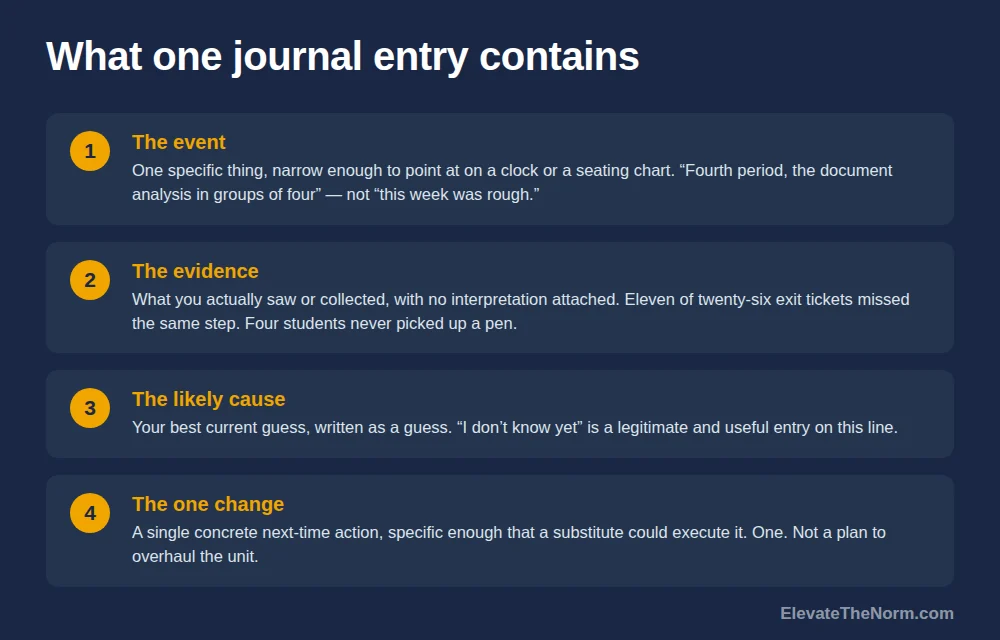
    Four lines: the event, the evidence, the likely cause, and the one change. If an entry has all four, it is doing its job. If it has three, it is probably missing the change, and an entry with no decision in it is a paragraph about your day.

    Numbered graphic showing the four parts of a teacher reflection journal entry: the event, the evidence, the likely cause, and the one change, each with a short explanation
    Four lines. An entry missing the last one is a paragraph about your day.

    Here is what each line is actually asking for.

    The event is one specific thing, not a summary of the week. “Fourth period, the document analysis in groups of four” is an event. So is “the lab write-up, second block, the twelve minutes after I handed back the rubric.” “This week was rough” is not. Narrow it until you could point at it on a seating chart or a clock.

    The evidence is what you actually saw or collected, stated without interpretation. Eleven of twenty-six exit tickets missed the same step. Four students never picked up a pen. The room went quiet at minute six and never came back. This is the line teachers skip most often, and skipping it is how a journal turns into a mood log. Interpretation without evidence is just how you felt at 2:40.

    The likely cause is your best current guess, written as a guess. “Probably because I gave the directions once, orally, while they were still unpacking” is honest. So is “I don’t know yet.” Writing down that you do not know is genuinely useful — it is the entry you come back to when the same thing happens again and the cause becomes obvious.

    The one change is a single, concrete, next-time action. One. Not a plan to overhaul the unit. “Next time, written directions on the board and one student restates them before anyone moves” is a change. “Be clearer” is a wish.

    That is the whole format. Four lines, and the last one is the only one that is non-negotiable, because a journal full of observations with no decisions attached is the exact confessional drift Jaeger warns about.2 If you want a longer worked set of entries written out in full, the companion guide collects seven of them, including the awkward ones.

    How Often Should You Write In It?

    Once a week, at a fixed time, for about ten minutes. Daily is a trap and monthly is not a journal.

    The argument for weekly is arithmetic, not philosophy. RAND’s 2025 State of the American Teacher survey found teachers reporting an average of 49 hours of work per week — about ten hours beyond what they are contracted for — while remaining more likely than comparable working adults to report poor well-being on every indicator measured.6 Any professional habit that assumes you have spare capacity is a habit that will not survive a bad October.

    Weekly also happens to be the right grain for the thing a journal is actually for. Daily entries produce volume, and volume is the documented failure mode — long descriptions of routine, written to prove the log was kept.3 Weekly forces selection. You have to pick the one thing from five days that was worth writing about, and the picking is itself a piece of thinking.

    Two practical notes. Put it on the calendar at a specific time, not “Fridays.” Last twelve minutes of your planning period on Friday, or the ten minutes before you leave the building. And write in the building, not at home. An entry written from your couch four hours later has already lost the evidence line.

    One exception is worth making. When something big happens — a lesson that genuinely failed, a conflict with a student you handled badly, an assessment whose results blindsided you — write it that day, while you still have the details. Those entries are the ones you will reread.

    Paper, Document, or Phone — What Format Actually Survives?

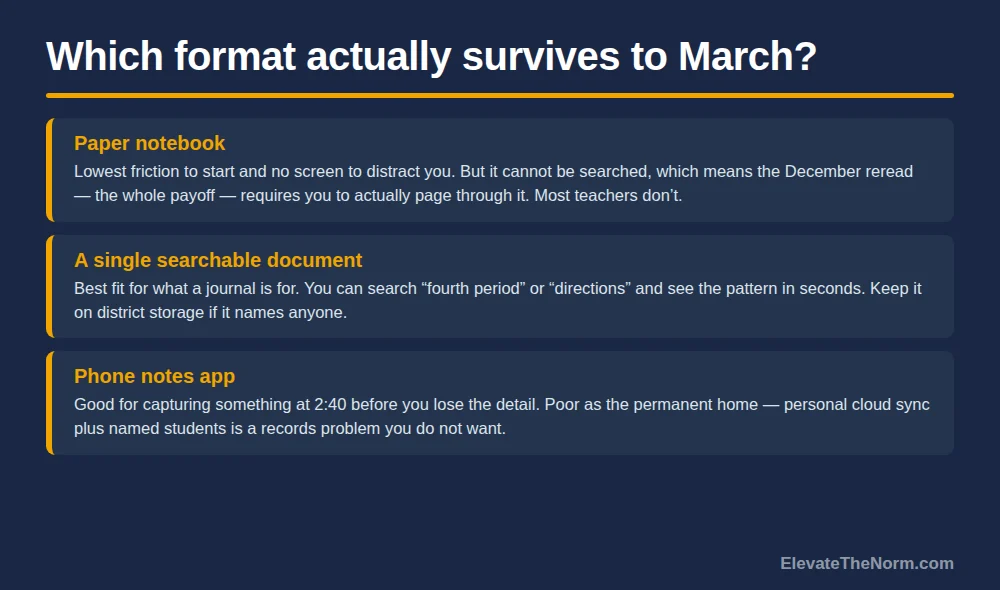
    The one you will still be using in March. That is not a dodge; the format question is almost entirely a friction question, and the trade-offs are real.

    Comparison graphic of three teacher reflection journal formats - a paper notebook, a single searchable document, and a phone notes app - listing the trade-offs of each
    Searchability is the whole argument. A pattern you cannot find is a pattern you do not have.

    A few things worth knowing before you pick.

    Searchability matters more than it sounds like it does. The entire payoff of a journal is finding the pattern, and finding a pattern in a paper notebook means rereading it. Realistically, you will not. A document you can search for “fourth period” or “directions” turns a stack of entries into something you can actually interrogate.

    Student names change what the document legally is. Under federal law, a teacher’s private notes fall outside the definition of an “education record” only if they meet all three conditions in 34 CFR 99.3: records “kept in the sole possession of the maker, are used only as a personal memory aid, and are not accessible or revealed to any other person except a temporary substitute for the maker of the record.”7 Share one entry with a colleague, a coach or an administrator and that entry has arguably left the exception. This is not a reason to panic, and it is not legal advice — check your district’s records policy, because districts routinely set stricter rules than the federal floor. It is a reason to do the simple thing: keep student names out. “A student in third period” carries every bit of the meaning you need, and a journal written that way can be shared, quoted in a coaching conversation, or left open on your desk without a second thought.

    Decide up front who can read it. If the answer is “only me,” the journal can be honest. If the answer is “me and my evaluator,” it will quietly become a performance document, and the research on that is not ambiguous.3 There is nothing wrong with keeping a second, shorter record for evaluation purposes. There is a lot wrong with pretending one file can be both.

    A Ten-Minute Weekly Routine That Survives October

    Five steps, in order, once a week. The order matters more than the timing: evidence before interpretation, and one decision at the end.

    Five-step graphic of a ten-minute weekly teacher reflection journal routine, running from picking one thing through writing evidence, guessing the cause, naming one change, and looking back four entries
    Ten minutes, once a week, in the building. Step five is the one people skip.
    1. Minute 1 — Pick one thing. Scan the week and choose a single lesson, moment or result. Prefer the one you have been avoiding thinking about.
    2. Minutes 2–4 — Write the evidence first. What you saw, counted, or collected. No causes yet. Numbers if you have them: how many exit tickets, how many students, what minute it turned.
    3. Minutes 5–7 — Guess at the cause, in writing. Then ask one follow-up of your own guess: what would I expect to see if that were true? This single question is what moves an entry off the description level.
    4. Minutes 8–9 — Write one change. Concrete enough that a substitute could execute it. If you cannot make it that concrete, the change is really a question, so write it as one.
    5. Minute 10 — Look back four entries. Not the whole journal. Four. Ask whether this week’s entry rhymes with any of them, and if it does, note that at the top.

    Step five is the one people skip, and it is the step that converts a pile of entries into a journal. Four entries back is roughly a month. A month is long enough for a pattern to show and short enough to reread in ninety seconds.

    If you would rather work from a prepared format than build your own, the site’s free teacher reflection journal and template pack is a printable version of this same structure — no email required, no form to fill in.

    What Do You Do With a Term’s Worth of Entries?

    Read them in one sitting, twice a year, with a pen. December and May are the natural windows. The reading is the point of the writing.

    Give it forty minutes and do three passes.

    First pass — circle repeats. Any condition that shows up three or more times. A period, a day, a task type, a transition, a time of the block. Do not interpret yet, just mark.

    Second pass — find the promises you did not keep. Read only the “one change” lines. Which ones did you actually do? The gap between what you decided and what you implemented is usually the single most useful thing in the whole document, and it is invisible week to week.

    Third pass — write one page forward. Not a reflection on the term. A short list of what you are carrying into the next one: two changes that worked and are now permanent, one recurring problem you have decided to actually solve, one thing you are going to ask someone for help with.

    If you are the coach or the administrator rather than the teacher, the useful move here is narrow: ask to hear about one entry the teacher chooses, and ask the follow-up question rather than the evaluative one — what would you expect to see if that guess were right? What does not work is asking to read the journal. A journal you can be asked to produce is a journal nobody writes honestly in, and the fastest way to kill the practice across a building is to require it.

    That last item is where a journal stops being a solitary exercise, which is the thing Jaeger flags as a core weakness of reflective practice — reflection that stays isolated tends not to go anywhere.2 The coaching evidence points the same direction: the versions of reflection with the strongest causal support are the ones with another adult involved.5 Bring one entry to a colleague. Bring one to your instructional coach if you have one. A journal is a good place to think and a bad place to stay.

    Three Ways a Teacher Reflection Journal Goes Wrong

    It turns confessional. Entries drift from teaching decisions to how you felt about the day, and eventually to how you feel about the job. This is the documented failure — Jaeger names the confessional tone directly as the problem with journals in practice.2 There is a second version of this drift that is worse, and it is worth naming: the journal quietly becomes a file of complaints about teenagers. If your entries are mostly a record of what students did to you, the document has inverted — a reflection journal is a record of your decisions, and the students in it are conditions you are responding to, not defendants. The fix for both versions is mechanical: if an entry has no evidence line and no change line, it is not an entry. Feeling terrible about fourth period is real and worth taking seriously; it is just not what this document is for. If the journal keeps pulling that direction week after week, that is information about workload and burnout, not about the lesson.

    It becomes compliance. Someone requires it, so it gets written for them. The reviewed literature is blunt about what happens next — volume over quality, descriptions of routine, and in some cases reflection written to secure approval rather than to figure anything out.3 If your journal is mandated, keep a private one anyway. The mandated one is a work product. The private one is the one that is any use to you.

    It never gets reread. This is the quiet one, and it is the most common. The entries are fine, the cadence holds, and nobody ever opens the file again. A journal that is only ever written is a very slow way of doing nothing. If you are going to skip something, skip an entry — never skip the December reading.

    Where to Start This Week

    Open one document. Title it with the school year. Put next Friday on your calendar with twelve minutes blocked and the word journal on it.

    Then write one entry, four lines, about something that already happened this week: the event, what you actually saw, your best guess at why, and one thing you will do differently. Do not try to make it good. The first twenty entries are not the product — they are the raw material for the forty minutes in December that will actually tell you something about your teaching.

    That is a modest promise, and it is the one the evidence will support. A journal will not raise your test scores. It will make you harder to fool about your own classroom, which is worth more over a career than most of what gets called professional development. The closest student-side analogue is student self assessment — criteria, evidence, gap, action — and it works for the same unglamorous reason: you cannot fix what you have not looked at squarely.

    Frequently Asked Questions

    Can my principal require me to hand over my reflection journal?

    Check your district policy and your contract, because this varies and this is not legal advice. What is worth knowing is that under federal law a teacher’s private notes sit outside the definition of an education record only when they are kept in the sole possession of the maker, used only as a personal memory aid, and not revealed to anyone except a temporary substitute (34 CFR 99.3). The practical answer is simpler than the legal one: keep student names out of the journal and the question mostly stops mattering. If your school mandates a reflection log, treat that as a separate work product and keep your own journal alongside it.

    Do parents have a right to see what I wrote about their child?

    If the entry names or identifies a student and you have shared it with anyone else, it may no longer qualify as a sole-possession record, and your district’s records policy takes over. The cleaner practice is to write “a student in third period” rather than a name. You lose nothing — you are writing about your own instructional decisions, not building a file on a teenager — and you avoid the whole question.

    How is this different from the reflection I already write for my evaluation?

    Audience, and it changes everything. An evaluation reflection is written to be read by someone who rates you, so it tends toward the defensible. A journal is written for the version of you who reads it in March, so it can say “I lost the room and I know exactly why.” There is nothing wrong with keeping both. There is a lot wrong with pretending one file can do both jobs.

    I have tried journaling before and quit by October. What should I do differently?

    Three things. Make it weekly rather than daily — volume is the documented failure mode, not the goal. Put it on the calendar at a specific time in the building, not at home. And cap it at ten minutes with a timer. Most abandoned journals were abandoned because they were designed for a version of the job that has more free time in it than the real one does.

    Does a teacher reflection journal actually improve student learning?

    There is no good evidence that journaling on its own moves student achievement, and you should be skeptical of anyone who tells you otherwise. Reviews of reflective practice describe the research base as thin, and reflective writing left unstructured mostly stays descriptive. What the research does support is reflection and feedback as one feature of sustained professional learning, and structured reflection with another adult — coaching — which shows pooled effects of about 0.49 SD on instructional practice and 0.18 SD on achievement, shrinking substantially at scale.

    What should a coach or administrator do with this?

    Ask about one entry the teacher chooses, and ask the follow-up question rather than the evaluative one: what would you expect to see if that guess were right? Do not ask to read the journal, and do not mandate it building-wide. Mandated reflection reliably produces compliance writing — long descriptions of routine, written for approval rather than for figuring anything out.

    Should I write about specific students or only about lessons?

    Write about your decisions. Students appear in a good entry as conditions you were responding to — four students never picked up a pen, eleven exit tickets missed the same step — not as subjects of a running file. If your entries are mostly a record of what teenagers did to you, the document has inverted, and it has stopped being useful for the thing it is for.

    Handwriting or typing — does it matter?

    Only in terms of whether you will still be doing it in March, with one real exception: you cannot search a notebook. The entire payoff of a journal is finding a pattern across months, and finding it in paper means rereading the whole thing, which almost nobody does. Start on paper if that is what gets you writing, but plan to end up somewhere searchable.

    Sources

    1. Gläser-Zikuda, Michaela, Chaoran Zhang, Florian Hofmann, Lisa Plößl, Lea Pösse, and Michaela Artmann. “Mixed methods research on reflective writing in teacher education.” Frontiers in Psychology, vol. 15, art. 1394641, 2024. https://pmc.ncbi.nlm.nih.gov/articles/PMC11496957
    2. Jaeger, Elizabeth L. “Teacher Reflection: Supports, Barriers, and Results.” Issues in Teacher Education, vol. 22, no. 1, Spring 2013, pp. 89–104. https://files.eric.ed.gov/fulltext/EJ1014037.pdf
    3. Suphasri, Pariwat, and Sumalee Chinokul. “Reflective Practice in Teacher Education: Issues, Challenges, and Considerations.” PASAA, vol. 62, 2021, pp. 237–264. https://files.eric.ed.gov/fulltext/EJ1334998.pdf
    4. Darling-Hammond, Linda, Maria E. Hyler, and Madelyn Gardner. Effective Teacher Professional Development. Learning Policy Institute, June 2017. ERIC ED606743. https://files.eric.ed.gov/fulltext/ED606743.pdf
    5. Kraft, Matthew A., David Blazar, and Dylan Hogan. “The Effect of Teacher Coaching on Instruction and Achievement: A Meta-Analysis of the Causal Evidence.” Review of Educational Research, vol. 88, no. 4, 2018, pp. 547–588. Full text (University of Maryland)
    6. Steiner, Elizabeth D., Phoebe Rose Levine, Sy Doan, and Ashley Woo. Teacher Well-Being, Pay, and Intentions to Leave in 2025: Findings from the State of the American Teacher Survey. RAND Corporation, RR-A1108-16, June 2025. https://www.rand.org/pubs/research_reports/RRA1108-16.html
    7. U.S. Code of Federal Regulations. “Education records” definition, 34 CFR § 99.3 (Family Educational Rights and Privacy Act). https://www.ecfr.gov/current/title-34/subtitle-A/part-99/subpart-A/section-99.3

    About Clay Shumate

    Clay Shumate is a certified secondary Social Studies teacher in the public schools of West Alabama, with seven years of classroom experience, a B.A. in History, and an M.Ed. in Secondary Education. He writes about project-based learning, student responsibility, respect, and practical ways to hold young people to a higher standard while giving them room to learn from mistakes. He is a member of the Society of Professional Journalists and writes to its Code of Ethics; this site’s editorial standards and corrections policy are published in full. More about Clay.

  • Teacher Burnout Quiz: What a Score Can Tell You, and What It Can’t

    Teacher Burnout Quiz: What a Score Can Tell You, and What It Can’t

    By Clay Shumate

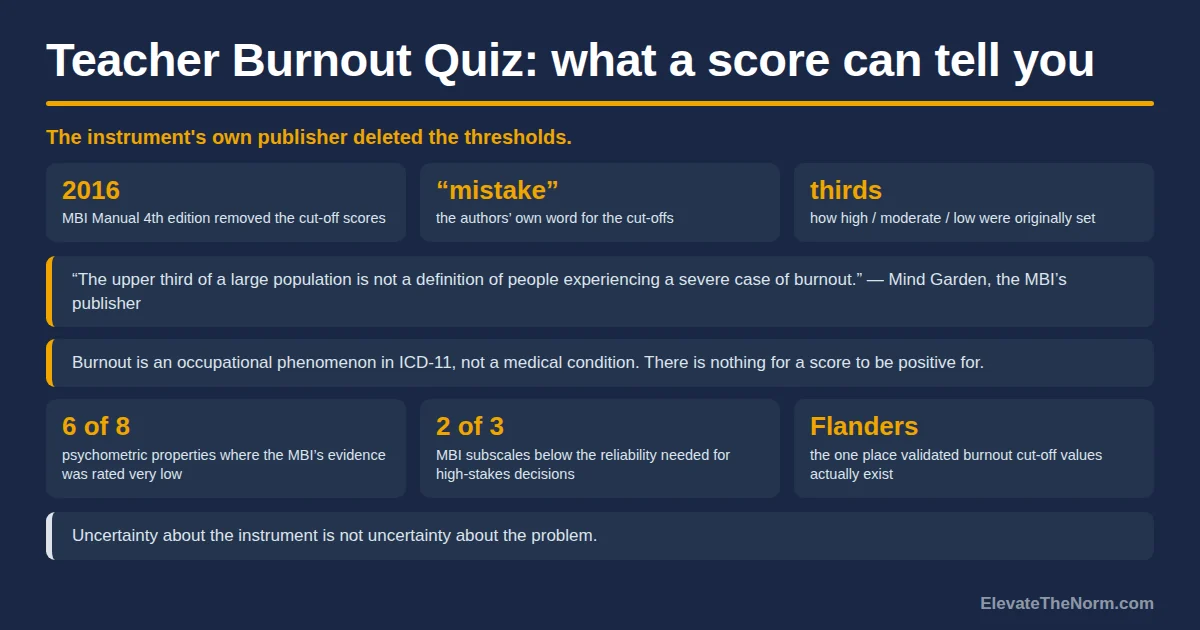
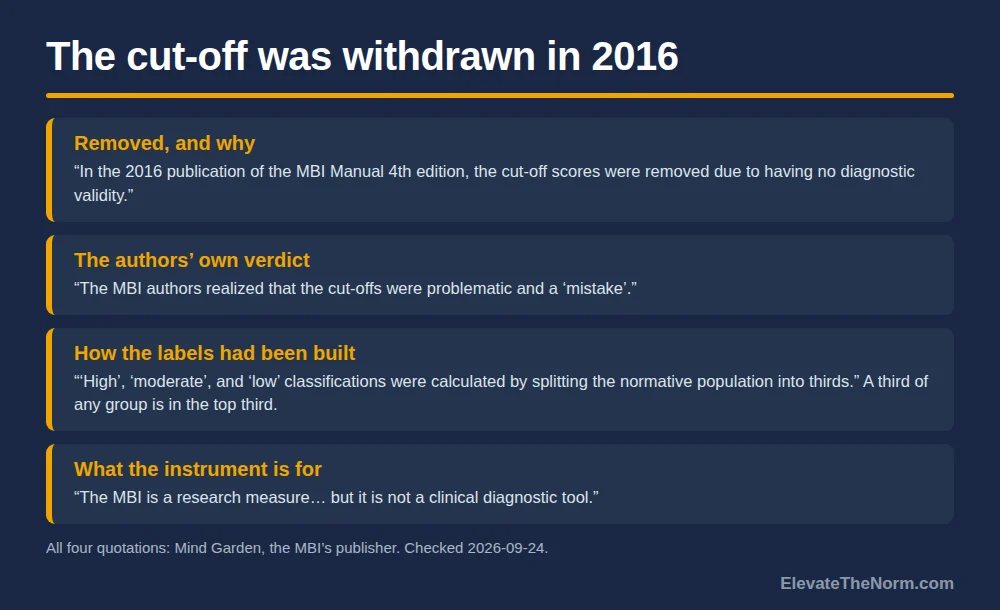
    No online teacher burnout quiz can tell you whether you have burnout. The best-known instrument in the field, the Maslach Burnout Inventory, removed its cut-off scores in 2016 because they had no diagnostic validity, and its publisher says outright that it is not a clinical diagnostic tool. What is worth doing instead is describing the job rather than scoring yourself.

    If you typed the question at eleven at night and wanted a number, that is a reasonable thing to want. A number feels like permission. The problem is not that you wanted one — it is that nobody has built one that works on a person.

    This page is about the instruments. For the word itself, start with what the word covers, and the three dimensions every instrument is trying to catch; for what the three symptoms look like in a 6–12 room, the symptom picture, described rather than scored. What follows is the measurement question, and it ends in a reflection sheet that returns no score on purpose.

    Key takeaways

    • The Maslach Burnout Inventory deleted its cut-off scores in 2016. Its publisher says they went “due to having no diagnostic validity” and that the authors came to see them as a mistake.
    • The original “high / moderate / low” labels were population thirds. You were “high” in exhaustion if you landed in the top third of a sample. A third of any group is in the top third.
    • Burnout is not a medical diagnosis. The World Health Organization calls it an occupational phenomenon rather than a condition, so there is nothing for a score to be positive for.
    • Measurement is not hopeless. Cut-offs do exist for one newer instrument — validated on Belgian workers, not American teachers.
    • Uncertainty about the measure is not uncertainty about the problem. A weak instrument is no evidence that nothing is wrong.
    • A self-report survey hears least from the staff with least security. Anyone whose renewal is a live question answers their employer carefully.
    • Use five questions about the job instead. No rating scale, no total, no names. It ends with one sentence and one person to ask, not a result.
    Free download

    The Teacher Burnout Job Check

    Two printable pages. Page one is the five write-in questions — load, control, recovery, support and direction — with room to answer in sentences and a boxed rule about what never goes on it. Page two is how to read the five answers together, the one sentence and one name they are supposed to produce, and the two rules for any school thinking about handing these out. It is not a screening instrument, there is nothing to add up, and it returns no score. Free. No email address required. Designed for grades 6–12.

    Download the free PDF

    Is there a real teacher burnout quiz?

    Yes. It runs to 22 questions, it costs money, and it will not tell you whether you have burnout.

    The instrument teachers are looking for is the Maslach Burnout Inventory — Educators Survey, the version written for people who work in schools. Twenty-two items, ten to fifteen minutes, sold by Mind Garden — $20 for a self-report version, $50 for the manual, $2.75 a head to administer it with a fifty-person minimum.

    So the free quiz you found is not the MBI. It cannot be. What it usually is instead is somebody’s paraphrase of the MBI’s items with a scoring rule bolted on, and the scoring rule is the invented part.

    Then there is what the publisher says about its own product. Mind Garden’s page states that the MBI “is a research measure… but it is not a clinical diagnostic tool,” developed “to assess burnout as a continuum.” A continuum has no line on it that you cross.

    Why did the Maslach Burnout Inventory remove its cut-off scores?

    Graphic headed The cut-off was withdrawn in 2016, summarising what the Maslach Burnout Inventory's publisher says about cut-off scores: that they were removed from the 2016 MBI Manual fourth edition due to having no diagnostic validity, that the authors came to regard them as a mistake, that high moderate and low were calculated by splitting a normative population into thirds, and that the MBI is a research measure and not a clinical diagnostic tool.
    The publisher’s own account of why the thresholds went. Source: Mind Garden, Cut-Off Scores for the Maslach Burnout Inventory.

    Because the people who built it decided the cut-offs were a mistake.

    Mind Garden publishes a short document about it, worth reading in the publisher’s own words. “In the 2016 publication of the MBI Manual 4th edition, the cut-off scores were removed due to having no diagnostic validity” — and “the MBI authors realized that the cut-offs were problematic and a ‘mistake’.”

    Here is how the original categories were built. “‘High’, ‘moderate’, and ‘low’ classifications were calculated by splitting the normative population into thirds — where a person was considered ‘high’ in emotional exhaustion simply because they scored in the upper third percentile of the population.” Then the line that should end the argument: “The upper third of a large population is not a definition of people experiencing a severe case of burnout.”

    Read it as arithmetic and it gets clearer. A third of any group is in the top third of that group. Score a thousand teachers, label the top third “high burnout,” and you will label a third of them every time — in a brutal year and in a good one. The label tells you where somebody sits in a queue, not whether anything is wrong.

    That is the machinery underneath most burnout quizzes online: a convenience the instrument’s own authors withdrew a decade ago, kept anyway.

    How well can burnout be measured at all?

    Graphic headed What the measurement research found, with four rows: a 2021 COSMIN review of nineteen studies and five instruments rated the Maslach Burnout Inventory very low quality of evidence on six of eight psychometric properties despite having the most validation studies; the same review reported that the absence of an accepted diagnostic standard prevented any sensitivity or specificity being calculated; a meta-analysis of 221 studies found depersonalisation and personal accomplishment reliabilities well below levels recommended for high-stakes decisions; and cut-off scores do exist for the newer Burnout Assessment Tool but only for Flanders.
    Four findings, including the one that cuts the other way. Sources: Shoman et al. 2021; Wheeler et al. 2011; BAT Manual 2.0.

    Better than nothing, worse than you would hope, and not well enough to draw a line.

    The most systematic answer is a 2021 review in Epidemiology and Psychiatric Sciences that put five burnout instruments through COSMIN, a standard framework for rating measurement quality. The MBI had more validation studies behind it than any of the others and still came out with “very low quality of evidence on validity for six psychometric properties out of eight.” Only the Copenhagen and, less so, the Oldenburg inventory met the reviewers’ bar for valid medical use.

    The same review explains why no quiz can honestly claim a threshold: “the absence of an accepted diagnostic standard precluded measuring sensitivity and specificity” for any of them. You cannot work out how often a test catches the thing, or cries wolf, when there is no agreed definition to check it against.

    A second problem sits inside the MBI itself. A meta-analysis of 221 studies, 84 supplying usable reliability figures, found emotional exhaustion holding up reasonably well while the other two subscales did not: depersonalization and personal accomplishment were “well below recommended levels for high-stakes decisions, such as the diagnosis of burnout syndrome.” Two of the three scores a quiz hands back are the least reliable two.

    One warning about how to read that. Uncertainty about the instrument is not uncertainty about the problem. Nothing here says teachers are fine, and none of it is a reason to answer a teacher who says the job has become unmanageable with a note about psychometrics. Correcting a measurement is not answering a complaint. For the size of the thing rather than the quality of the ruler, the same question asked of the national numbers.

    So does any burnout score mean anything?

    Yes, and this is the part a debunk usually skips.

    In 2001 a team led by Wilmar Schaufeli tested the MBI on people who had actually sought psychological treatment, rather than on working adults well enough to be at work: 71 employees with work-related neurasthenia under ICD-10 criteria against 68 without. The three-factor structure held up, burnout was partly distinguishable from anxiety and depression, and two of the three scales — emotional exhaustion and depersonalization — discriminated between the groups. It measures something real, and it tracks a clinical distinction.

    Cut-off scores exist too, for a newer instrument. The Burnout Assessment Tool’s manual reports norms against the Flemish and Dutch workforce, representative samples of 1,500 each, and states that “based on a group that suffers from serious burnout cut-off scores have been calculated. To date, such cut-off values are only available for Flanders.”

    So the honest summary is narrower than either headline. Burnout can be measured, and for one instrument, in one region of Belgium, there are cut-offs built on a clinical sample. None of that describes a free web page scoring an American teacher against a threshold nobody validated here. The BAT norms are Belgian and Dutch workers across all occupations, not teachers. And the 2001 sample was people already in treatment — the opposite end of the pipeline from somebody searching at eleven at night.

    Is burnout even a diagnosis?

    No, and that is not a technicality.

    The World Health Organization includes burn-out in ICD-11, but under “Factors influencing health status or contact with health services,” and states plainly that it is not classified as a medical condition. Its definition names the three dimensions the research uses: “feelings of energy depletion or exhaustion,” “increased mental distance from one’s job, or feelings of negativism or cynicism,” and “reduced professional efficacy.” It also “should not be applied to describe experiences in other areas of life.” It is a relationship with a job.

    Two things follow. When a quiz reports “you have moderate burnout,” it is borrowing the grammar of diagnosis for something that is not one — there is no condition to be positive for, so nothing for the result to be right or wrong about. And the things nearby that are diagnosable — depression, anxiety, a thyroid problem, sustained sleep loss — get diagnosed by a person who can ask you a follow-up question. The overlap with depression in particular is real and unsettled, and the symptom page goes through what is and is not distinguishable.

    What to use instead: five questions about the job

    Graphic headed Five questions about the job, listing load, control, recovery, support and direction as write-in prompts, followed by four rules: no rating scale and nothing to add up; question five compares the job to itself rather than you to other teachers; no student or colleague names on the sheet; and keep it on paper rather than a district device. A closing note states that the output is one sentence and one name, not a score.
    The sheet is a job description, not a self-rating. There is nothing on it to total up.

    Stop measuring yourself and start describing the job.

    That switch is not a way of dodging the question you came with. It is that between you and the job, the job is the part that can change. Every instrument above tries to detect a state inside a person; the research keeps pointing at the position instead — the demands loaded onto it, the resources attached to it. That is the Job Demands–Resources frame, and it makes the useful exercise a job description rather than a self-rating. Five questions, answered in sentences rather than scores.

    • Load. What is on my plate this year that was not on it last year?
    • Control. Which of those did I choose?
    • Recovery. In a normal week, when am I off the clock and actually off?
    • Support. Who do I ask when something goes wrong, and did I ask them this month?
    • Direction. Is this heavier, lighter, or about the same as three months ago?

    Four rules are the difference between this and a quiz.

    • No rating scale and no total. No one to five, no counting, no “if you answered yes to three.” Everything above about invented cut-offs applies to one you invent for yourself at the kitchen table.
    • Question five is the only comparison, and it compares the job to itself — not you to other teachers. Direction is the honest version of what a score was pretending to give you.
    • No names on it. Not a student’s and not a colleague’s; describe the situation. A sheet with a student’s name on it stops being private reflection and becomes a record about a child.
    • Paper, and off the district network. A work device is not a private place to write down that you are not coping.

    You should end with two things: one sentence describing the job, and the name of one person who could change one item on it. That is the output — not a number, not a category, not a verdict on whether you are the kind of teacher who copes. For which of your answers is even addressable, which items on that list somebody with a title can actually lift; to write it somewhere built for it, a blank page built for exactly this kind of writing.

    Question four most often has a fixable answer, and it is the one worth taking to a coach or a department chair, because knowing who to ask is learnable rather than a personality trait. But keep the categories straight: a coaching cycle offered in place of removing an item from question one will be read as exactly that. And take one item to that person, not the sheet — a completed sheet handed across a desk reads as the opening of a grievance, which is not what you were doing.

    If the honest answer to question four is that there is nobody — you are the only person teaching your course, the chair is the problem, the building is between principals — write the item down anyway. A written description of the job is what you need for every conversation after this one, including the one about whether to stay.

    A note for the people in a school who get scored most, which is the students. The question this page turns on is worth owning — what was this cut-off built from, and who decided where it went? — and it applies to a reading-level band or a benchmark percentile too. Sometimes the answer is solid. Sometimes somebody split a population into thirds. That is a fair thing for a sixteen-year-old to ask about a number attached to their name.

    What a school should never do with this

    Turn it into a threshold.

    The failure mode is easy to walk into with good intentions. A district likes the five questions, prints them for a faculty meeting, and adds one line at the bottom: three or more flagged, refer for follow-up. It has now built the kind of cut-off the MBI’s own authors withdrew in 2016 for having no diagnostic validity — except this one has no normative sample behind it at all, and it is attached to somebody’s employment.

    The second rule is do not collect them. A reflection sheet is honest precisely because nobody is going to read it; ask teachers to hand it in and what comes back is the set of answers people give their employer. Harder version of the same point: a collected sheet is a record, records can be requested, and a district holding staff-written statements that the workload is unmanageable has documented its own notice. If you are going to ask, intend to act — and the records a district already keeps are better material than a survey. Sections, preps, duties, coverage days and time-to-fill are facts, not self-reports.

    There is a constructive version of the five questions for an administrator, and it is not screening: ask them of a role rather than a person. Take one position on paper, before anybody is in it, and answer load, control, recovery and support about the job as written. That is a scheduling conversation, it belongs to whoever builds the master schedule, and it can be answered in August while something can still be done.

    One more reason to be careful with self-report, and it is not about psychometrics. The staff most likely to give a careful, unrevealing answer to a workplace questionnaire are the ones with the least security — anyone new, anyone whose renewal is a live question. A survey does not just measure the job imprecisely; it hears least clearly from the people whose jobs are hardest to refuse.

    What to do next

    Take the five questions onto any piece of paper, or print the sheet above. Answer question five first, because it is the one that tells you something. Write your sentence about the job, name the person who could change one item, and ask for that one thing.

    Then keep the two questions apart, because that is this page’s whole argument. “Is this job too heavy?” is answered by describing the job. “Am I all right?” is not, and if the honest answer is that something is wrong in a way a schedule change would not touch, that is a conversation with your doctor or a counselor — and if you are not sure who that would be, the checked list of who that person could be. A person who can ask you a follow-up question, not a page that hands back a score.

    Want it as a printable? Download The Teacher Burnout Job Check (2 pages, free, no email required) — five questions, no scale, and nothing to total up.

    Frequently asked questions

    Is there a free teacher burnout quiz that actually works?

    Not in the sense you are hoping for, and the reason is not that the free ones are cheap imitations of a good paid one. The paid instrument does not do it either. The Maslach Burnout Inventory’s publisher removed its cut-off scores from the 2016 manual “due to having no diagnostic validity” and states that the MBI “is a research measure… but it is not a clinical diagnostic tool.” A free quiz that hands you a category is using a threshold the instrument’s own authors withdrew. What a free page can honestly give you is a set of questions about the job and no score, which is what the sheet on this page is.

    Can I take the Maslach Burnout Inventory myself?

    You can buy access to it. Mind Garden sells a self-report version for $20 and the manual for $50, and the Educators Survey is the 22-item version written for people who work in schools. What you will not get is a verdict. You will get three subscale scores on a continuum with no cut-offs, because the cut-offs were deleted. Worth knowing before you spend the money: a 2011 meta-analysis of 221 studies found the depersonalization and personal accomplishment reliabilities “well below recommended levels for high-stakes decisions, such as the diagnosis of burnout syndrome.” Two of your three numbers are the shaky ones.

    Why does this site not publish a burnout quiz?

    Because a quiz implies a threshold and there is no validated threshold in this literature for a person to cross. A 2021 COSMIN review of five burnout instruments reported that “the absence of an accepted diagnostic standard precluded measuring sensitivity and specificity” for any of them — meaning nobody can say how often a burnout test is right, because there is no agreed definition of the condition to check it against. Publishing a scored quiz anyway would mean inventing a line and putting this site’s name on it. The five questions on this page return no score on purpose.

    Can a quiz tell burnout apart from depression?

    No. The one study that tried the clinical version of this question — testing the MBI on 71 employees in treatment for work-related neurasthenia against 68 who were not — found burnout could be partly distinguished from anxiety and depression, with two of three subscales discriminating between the groups. Partly, in a clinical sample, by researchers. That is a long way from a web page sorting the two from twenty questions. If the distinction matters to you right now, it matters enough for a doctor or a counselor rather than a page.

    My school wants to give the staff a burnout survey. Is that a good idea?

    It can be, with two conditions. Do not attach a threshold to it and do not tie it to any individual. A scoring line invented for a faculty meeting is the same mistake the MBI’s authors corrected in 2016, with no normative sample behind it and employment attached. And be realistic about what a survey hears: the staff with the least job security give the most careful answers, so the people whose workloads are hardest to refuse are the ones you will hear from least. Counting what the district already records — sections, preps, duties, coverage days, time-to-fill — is usually better material, and it is fact rather than self-report.

    If the measures are this shaky, is teacher burnout even real?

    Yes, and that inference is the one misuse of this page worth naming. Uncertainty about a ruler is not uncertainty about the thing being measured. The World Health Organization defines burn-out in ICD-11 as an occupational phenomenon with three dimensions; what it declines to do is call it a medical condition. Weak instruments make the rate hard to pin down. They say nothing about whether a particular job has become unmanageable, and answering a teacher who says so with a note about psychometrics is not a reply.

    I am a parent and I think my child’s teacher is burned out. What should I do?

    Start from the same place this page ends: you cannot score a person from outside, and a validated instrument administered by researchers struggles to do it from inside. What you can do is describe what you have actually seen — work coming back slowly, a class that seems to have lost its shape — and raise it with the school as a question about the class rather than a judgment about the adult. Two things to avoid: do not ask your child to report on how their teacher seems, which puts a kid in the middle of an adult problem, and keep it out of the class group chat. A teacher’s apparent state is not community information.

    I am a student and my teacher seems exhausted. Is that because of us?

    No. How many classes a teacher has, how many students are in each one, how many duties come with the job and whether there is any time in the day to recover are decisions made by adults, before you walked in. Nothing on this page measures a student and none of the research behind it asked one anything. You are allowed to notice that a class has gone flat, and if it is affecting your work the person to tell is a counselor or another teacher you trust — describe the class, not the person. What is not yours is fixing an adult’s workload.


    Sources

    • Mind Garden. Cut-Off Scores for the Maslach Burnout Inventory. The publisher’s statement that the cut-off scores were removed from the 2016 MBI Manual 4th edition “due to having no diagnostic validity,” that the authors regarded them as a “mistake,” and that high / moderate / low “were calculated by splitting the normative population into thirds.” mindgarden.com
    • Mind Garden. Maslach Burnout Inventory — Educators Survey (MBI-ES). 22 items, three subscales; prices as listed 2026-09-24. States the MBI “is a research measure… but it is not a clinical diagnostic tool.” mindgarden.com
    • World Health Organization. Burn-out an “occupational phenomenon” (ICD-11, QD85). Listed under “Factors influencing health status or contact with health services” and not classified as a medical condition. who.int
    • Shoman, Y., Marca, S. C., Bianchi, R., Godderis, L., van der Molen, H. F., & Guseva Canu, I. (2021). Psychometric properties of burnout measures: a systematic review. Epidemiology and Psychiatric Sciences, 30, e8. 19 studies, 5 instruments, COSMIN-rated. Read in full via KU Leuven Lirias. doi.org
    • Wheeler, D. L., Vassar, M., Worley, J. A., & Barnes, L. L. B. (2011). A reliability generalization meta-analysis of coefficient alpha for the Maslach Burnout Inventory. Educational and Psychological Measurement, 71(1), 231–244. 221 studies, 84 usable alphas. doi.org
    • Schaufeli, W. B., Bakker, A. B., Hoogduin, K., Schaap, C., & Kladler, A. (2001). On the clinical validity of the Maslach Burnout Inventory and the Burnout Measure. Psychology & Health, 16(5), 565–582. 71 employees in treatment for work-related neurasthenia (ICD-10) against 68 without. Read via the PubMed abstract; the full text was not reachable from this session and nothing beyond the abstract is claimed. pubmed.ncbi.nlm.nih.gov
    • Schaufeli, W. B., De Witte, H., & Desart, S. (2020). Manual Burnout Assessment Tool (BAT), version 2.0. Norms on representative Flemish and Dutch workforce samples, N = 1,500 each; workers across occupations, not teachers, and not a United States sample. burnoutassessmenttool.be
    • Hawrot, A., & Koniewski, M. (2018). Factor structure of the Maslach Burnout Inventory–Educators Survey in a Polish-speaking sample. Journal of Career Assessment, 26(3), 515–530. 1,206 teachers. The three-factor model did not fit well; a bifactor model fit best, so the MBI-ES behaves more like one overall measure than three independent dimensions. Polish primary school teachers — not a United States secondary result, cited for the structural finding only. doi.org

    Every source above was opened and read on 2026-09-24. Where one could not be opened in full, the list says which abstract was read instead. No figure on this page went unchecked against the document that produced it.


    About Clay Shumate

    Clay Shumate is a certified secondary Social Studies teacher in the public schools of West Alabama, with seven years of classroom experience, a B.A. in History, and an M.Ed. in Secondary Education. He writes about project-based learning, student responsibility, respect, and practical ways to hold young people to a higher standard while giving them room to learn from mistakes.

  • Teacher Burnout Support Groups: What Actually Exists, and What Each One Is For

    Teacher Burnout Support Groups: What Actually Exists, and What Each One Is For

    By Clay Shumate

    There is no free, national, teacher-only burnout support group you can look up and walk into this week. What exists is five different things that all get called support, and they answer different problems. The most useful one for most teachers is already paid for, sitting in a benefits packet nobody opens.

    If you have already spent an evening on this and turned up nothing but listicles, that is not a failure on your part. The help is genuinely not indexed, and knowing that in advance saves the evening.

    Every organisation below was checked before it was listed: what it is, who it is for, what it costs, where it stops. If you want the word defined first, start with what the word actually covers before you go looking for a room. If you want the work of getting back on your feet rather than a place to go, what recovery consists of once you have found the right room. One thing up front: a support group is not treatment. It is a room with people in it — worth a lot, and not the same as care.

    Key takeaways

    • The one route almost every teacher already has is the employee assistance programme — free, confidential, short-term counselling and referral, already bought by the employer. Most teachers do not know the number.
    • The largest teacher-specific support network in the country does not publish where its meetings are and says so outright. Its free national video meetings run quarterly.
    • The free 24/7 confidential helpline for education staff does exist — in the United Kingdom. Not here. That absence is a funding decision, not a fact of nature.
    • In the one randomised trial behind any of this, the employer gave people an hour on the clock every two weeks. Protected paid time was part of the intervention, not a nicety.
    • Across 23 controlled trials of teacher-burnout interventions the pooled effect was small — d = 0.18, and essentially nothing on depersonalisation. Nobody should promise you more.
    • Sort by the problem, not the label. Talking privately, talking to a peer, changing the job and getting clinical help are four needs, and only two are answered by a group.
    Free download

    The Teacher Burnout Support Finder

    Two printable pages. Page one is a write-in contact sheet for the four different needs that all get called support — talking privately, talking to a peer, getting something about the job changed, and getting clinical help — with room to fill in the real names and numbers for your own district. Page two is the checked national list: what each option actually is, what it costs, and where it stops. It is not a screening instrument and it returns no score. Free. No email address required. Designed for grades 6–12.

    Download the free PDF

    Is there a teacher burnout support group I can actually join?

    Probably not a local one you can find by searching. A national one by video, yes, four times a year. That gap is the real answer, and worth knowing before you spend an evening looking for something that is not indexed.

    The best-known teacher-specific network in the country is Happy Teacher Revolution, a Baltimore-founded organisation built on trained facilitators running peer meetings inside their own schools. It is real and active, and its own FAQ states that “HTR meetings are kept within their own communities and are not publicly listed. This is by design.” There is a decent reason for it — a room where staff talk honestly about a hard year is not something you advertise — but for a teacher searching at ten at night the network is invisible.

    What is open: the same organisation runs free quarterly Zoom meetings open to everyone, with sign-up on its site. What costs money: leading meetings at your own school requires its certification course, listed at $597 for twelve hours of asynchronous training. No certification is needed to attend a meeting. It is needed to run one.

    What are the five kinds of support, and what does each one cost?

    Five categories, three of them free at the point of use. They are not interchangeable. An employment route, a peer route and a clinical route answer different questions, and the common mistake is taking a problem to the wrong one.

    Graphic listing five kinds of teacher burnout support with the cost of each: an employee assistance programme, free, offering free and confidential assessments, short-term counseling and referrals per the US Office of Personnel Management; a teacher peer group, free quarterly with a $597 certification to lead one; a union or association, varying by state, where the NEA's own educator mental-health page lists no dedicated support group; a general peer support group, free, naming NAMI Connection as peer-led for adults 18 and over and DBSA online groups as free with registration required; and a referral line, free, naming the SAMHSA National Helpline at 1-800-662-HELP and 988. A closing note states that a peer group is not treatment and that none of the five diagnoses anything.
    Three of the five are free at the point of use. Only one of them is teacher-specific.

    1. Your employer’s employee assistance programme

    Check this one first. The federal Office of Personnel Management defines an employee assistance programme as “a voluntary, work-based program that offers free and confidential assessments, short-term counseling, referrals, and follow-up services to employees who have personal and/or work-related problems.” Free to you, already bought. Usually a number on the benefits page, the back of an insurance card, or one email to whoever handles benefits.

    It is not long-term therapy. Short-term means a set number of sessions, then a referral onward. It is still the fastest route most teachers have to actually talking to somebody.

    If you are reading this from a district office, the cheapest item on this page is making that number easier to find — on the staff landing page, in the first email of the year, on the back of the badge. Every teacher who cannot find the number is a service you are paying for and not delivering.

    2. A teacher-specific peer group

    Happy Teacher Revolution, above: free quarterly national video meetings, local meetings unlisted, $597 to certify to lead one. Alongside it, the informal version — a department, a grade-level team, a counterpart teaching the same course elsewhere. That is a peer group whether anyone calls it one — and if you are the only person in the building teaching your course, which plenty of secondary teachers are, it may not exist for you at all. That is the situation the free quarterly video meeting is actually for, along with your subject association and a counterpart at another school. In year one it is also most of the support that exists.

    3. Your union or professional association

    This varies so much by state that no page can tell you what yours has. What can be said is what the largest one publishes. The National Education Association’s own educator mental-health page lists AbleTo, a digital programme through member benefits, then points readers outward — a federal helpline, a mindfulness trainer, a state affiliate’s webinars, a third-party list. It does not list a dedicated support group for educators. Worth knowing before assuming your dues cover one. Ask your local rep; some state affiliates do more than the national page shows.

    4. A general peer support group

    Free, national, and not about teaching. NAMI Connection is a peer-led group for adults 18 and over living with mental health conditions, “free of cost to participants,” led by people with mental health conditions, and explicit that “no specific medical therapy or treatment is endorsed.” Many meet virtually and are open nationwide; NAMI runs a locator. DBSA runs online groups for people living with depression or bipolar disorder and states “all DBSA online support groups are free of charge” — registration required.

    Read the eligibility honestly: both are for people with a mental health condition. Burnout as the research uses the word is occupational rather than a diagnosis, so whether these are the right room is a question for somebody who can assess it — not for a web page.

    5. A referral line

    The SAMHSA National Helpline, 1-800-662-HELP (4357), is a free, confidential treatment referral and information service, 24 hours a day, 365 days a year, in English and Spanish. It does not counsel you; it tells you what exists near you. 988, the Suicide and Crisis Lifeline, is free and confidential by call, text or chat around the clock, and is not only for suicidal crisis: its site says it is for anyone “facing mental health struggles, emotional distress, alcohol or drug use concerns, or just need someone to talk to,” and that “the 988 Lifeline is for everyone.”

    Why is there no free national helpline for American teachers?

    Because nobody built one. That is the whole answer, and it is easiest to see next to a country that did.

    In the United Kingdom a charity called Education Support runs a helpline on 08000 562 561. Qualified counsellors, 24 hours a day, free from UK landlines and mobiles, support in over a hundred languages, and eligibility about as wide as it gets: “any serving, former or retired member of staff who has worked in any part of the education sector.” Former. Retired. Any part of the sector.

    American teachers cannot use it — it is funded for UK education staff — and it is named here so nobody reading this thinks what they want is unreasonable. A free, round-the-clock, confidential line answered by somebody who understands what a school is has been built and run for years. It is on the other side of an ocean.

    What exists here is general rather than educational: 988, the SAMHSA line, and whatever your employer bought. Those are real and worth using. But if you have wondered why this search turns up listicles instead of a phone number — there is no phone number to find.

    Graphic headed Protected paid time was part of the intervention, comparing what the randomised trial tested with what usually gets offered. The trial gave 74 physicians at one institution one facilitated hour every two weeks with a curriculum and employer-provided protected time, and found depersonalisation fell significantly at three months and at twelve while empowerment and engagement rose and held for a year, with the authors noting the small sample. What usually gets offered instead is an optional meeting at 4:15 on the teacher's own time with no facilitator and no end time, which has not been tested. Across 23 controlled trials of teacher-burnout interventions the pooled effect was d = 0.18, with depersonalisation at d = 0.03. A Cochrane review of four studies covering 2,199 teachers rated the evidence low to very low quality.
    The difference between the trial and the usual offer is an hour on the clock.

    Do support groups actually reduce burnout?

    A facilitated small group on paid time has the best evidence in this area, and it is still thin. All three findings are below, including the two that cut against the idea.

    The strongest design is not from education. West and colleagues (2014), in JAMA Internal Medicine, randomised 74 practising physicians at one institution into a facilitated small-group curriculum — one hour every two weeks, built on reflection, community building and meaning in work — or a control arm. Depersonalisation fell significantly at three months and at twelve; empowerment and engagement rose and held for a year. And the institution provided protected time for the meetings. That is not a footnote. It is part of what was tested.

    So the honest reading is not join a group. It is give people an hour on the clock, every two weeks, with a facilitator and a structure — a scheduling decision, and not one a teacher can make. It belongs to whoever builds the calendar and signs off the release time. A group meeting at 4:15 on your own time after a full teaching day is a different intervention from the one that worked, and nobody has tested it.

    One practical consequence, for anyone thinking of starting one. The person who facilitates the group must not be the person who evaluates the people in it. A principal who runs a staff support group becomes the administrator who knows which teachers are struggling, and that knowledge does not stay put — it turns up in next year’s master schedule, in who gets the hard section, in a renewal conversation. Nobody has to intend it. A department chair, coach or counsellor with no evaluative role over the group is the cleaner choice, and facilitating is a learnable skill rather than a personality trait: the curriculum that worked was structured, not improvised. And it is not a substitute: a facilitated hour offered instead of fixing the schedule will be read as exactly that.

    Now the parts that go the other way. Iancu and colleagues (2018) pooled 23 controlled trials of teacher-burnout interventions. The overall effect was small but significant, d = 0.18. Exhaustion and personal accomplishment moved similarly; the effect on depersonalisation was d = 0.03, indistinguishable from nothing. Mindfulness-based programmes did show significant effects on exhaustion and accomplishment, and anything running under a month showed the smallest effects. The breakdown by intervention type sits behind a paywall, so this page claims no separate effect size for peer or group formats. It does not have one.

    On changing the organisation instead of the teacher, the Cochrane review by Naghieh and colleagues (2015) found only four eligible studies covering 2,199 teachers and rated the evidence low to very low quality for attrition, reporting bias and underpowered designs. Verbatim: “We found low-quality evidence that organisational interventions lead to improvements in teacher wellbeing and retention rates. We need further evaluation.”

    A structured group with real time behind it is a reasonable bet. Anybody telling you a support group fixes burnout has gone past the evidence.

    Can a support group make things worse?

    It can, in two specific ways, and neither has been measured. That is not an argument against going. It is an argument for knowing which room you are in.

    The first is confidentiality. A group organised by your school, in your building, with your administrator’s knowledge, is a room where you describe your own difficulty inside your employer’s house. Usually nothing comes of it. But a teacher who is not tenured, or up for a renewal decision, is weighing something real, and pretending otherwise would be dishonest. Two rules: do not say anything in that room you would not put in writing, and do not research any of this on a district device or account. A work laptop is not a private place to type “I am not coping.” If the honest version cannot be said in the building, that is what the outside routes are for.

    The second is structure. The trial that worked had a curriculum, a facilitator and an end time. A standing group with none of those is a venting session, and whether that helps or hurts has not been tested in teachers. Complaining about a genuinely bad schedule is accurate description, not weakness, and nobody should be told to stop. The question after the hour is whether you left with anything — a next step, a name, one thing to try — or only with the hour gone.

    Graphic headed Sort by the problem, not by the label, matching four stated needs to four answers: needing to talk privately this week points to the employee assistance programme or 988 and is marked not a group; needing somebody who knows the job points to a peer or the free quarterly video meeting and is marked as what a group is good at; needing something about the job changed points to a written request to somebody with a title, since no group can give back a duty period; and thinking the problem is bigger than the job points to a doctor or counsellor reached by referral. Two closing rules state that a group's facilitator must not be the person who evaluates the people in it, that nobody should research this on a district device, and that the five-minute version is to find one phone number.
    Two of the four are not support groups at all. That is the most common mistake.

    Which one fits the problem you actually have?

    Sort by the problem, not the label. Four needs get bundled under “support” and only two are answered by a group. This takes five minutes. It is not a test and there is no score.

    • “I need to talk to somebody this week, privately.” The employee assistance programme — free, confidential, short-term counselling and a referral onward. If it is tonight and the number is not to hand, 988 takes calls, texts and chats at any hour. Not a group.
    • “I need somebody who knows what a Tuesday in a 6–12 building is like.” A peer. Usually down the hall or one building over; the national version is the free quarterly video meeting. This is what a support group is genuinely good at, and nothing else substitutes for it.
    • “I need something about my job to change.” A support group is the wrong tool. No group can give you back a duty period. That is a written request to somebody with a title, and it lands better with a week of your own numbers behind it than with a description of how you feel.
    • “I think this is bigger than the job.” A doctor or a counsellor, and the route is a referral rather than a room. The employee assistance programme refers; so does the SAMHSA line, free, in English or Spanish, at any hour.

    And if reading a four-way sort is already more than you have in you this week, do the five-minute version instead: find one phone number. Not a group, not a programme, not a plan. The employee assistance number, written down somewhere that is not a school device. That is the whole task, and it is worth more than an evening of searching.

    Two of the four are not support groups, and that is the point. Most of the frustration teachers report comes from taking a structural problem into a room with no authority to solve it, then concluding support groups do not work. They work at what they do.

    Wherever you write this down: keep it on paper, off the school network, and put no student’s name and no colleague’s name on it. A private note about your own workload that starts listing other people is a different document, with different consequences.

    A word for any student who has ended up on this page. Nothing here is about you. The hours in a teacher’s day, the number of students in a room and whether there is an hour anywhere for an adult to talk to another adult are all decisions made by adults, usually before the school year started. Student behaviour is not why teachers burn out, and a teacher looking for support is a teacher doing the sensible thing rather than a teacher failing at something.

    When the answer is a person, not a group

    Some of this is not an occupational problem, and a group is not built to tell the difference. Neither is this page.

    Burnout in the research literature is a condition of the job — exhaustion, distance from the work, a collapsed sense of getting anywhere. It is not a clinical diagnosis, and there is no validated cut-off in it that a person crosses on a Tuesday. No checklist can tell you whether what you have is burnout, depression, grief, exhaustion from something at home, or several at once; the symptoms overlap enough that the distinction is hard even with training.

    So if you are not sleeping, not eating, not able to make yourself get out of the car in the parking lot, or having thoughts of hurting yourself, the next step is not a Thursday meeting. It is your doctor, a counsellor, or 988 — free, confidential, and in its own words for everyone rather than only for people in crisis. That is a conversation with a person, not a result from a page, and reaching it early is not an overreaction.

    What to do next

    Three things in this order, and the first takes five minutes.

    Find your employee assistance programme number today. Benefits page, insurance card, or one email to whoever handles benefits. Write it somewhere that is not a district device. You are not calling today; you are making sure that the day you want to, the number exists and you know where it is.

    Pick one person. Not a group, not a programme — one colleague whose job is close enough to yours to understand it. That is the peer support that actually gets used, and it requires nobody’s certification.

    And if what you need is the job changed, write the ask down. The version of this written before it gets bad is worth reading too, because the cheapest support group is the one you never end up needing. And if you arrived at that question by way of an online quiz, it is worth knowing what those scores are actually built on.

    Want it as a printable? Download The Teacher Burnout Support Finder (2 pages, free, no email required) and fill in the four numbers for your own district before you need them.

    Frequently asked questions

    Is there a free teacher burnout support group I can join near me?

    Probably not one you can find by searching, and that is not your fault. The largest teacher-specific network in the United States, Happy Teacher Revolution, states on its own FAQ that its meetings \u003cstrong\u003eare not publicly listed, and calls that a design decision\u003c/strong\u003e. What is open to anyone is its free quarterly national Zoom meeting. Beyond that, the free options are not teacher-specific: NAMI Connection and DBSA run free peer groups for adults living with mental health conditions, and your employer\u0026rsquo;s assistance programme offers free confidential short-term counselling. The free national helpline for education staff that this search is really looking for exists in the United Kingdom, not here.

    Where do I find my employee assistance programme number?

    Three places, in order of speed: your district\u0026rsquo;s benefits page on the staff intranet, the back of your health insurance card, and a one-line email to whoever handles benefits in the district office. It takes about five minutes and you do not have to explain why you are asking. Write the number somewhere that is not a school device, so that the day you want it, it already exists.

    Is the employee assistance programme confidential from my principal?

    It is designed to be. The federal Office of Personnel Management describes an employee assistance programme as \u003cstrong\u003e\u0026ldquo;a voluntary, work-based program that offers free and confidential assessments, short-term counseling, referrals, and follow-up services\u0026rdquo;\u003c/strong\u003e. But programmes are run by outside providers under contracts that differ, so the honest answer is to ask the provider directly what, if anything, goes back to the employer — and to ask the provider rather than your district. That is a reasonable question and a good provider will answer it plainly.

    Do teacher burnout support groups actually work?

    The best evidence is real and it is modest. A randomised trial of 74 physicians (West and colleagues, 2014) found that a facilitated small group meeting one hour every two weeks \u003cstrong\u003ewith employer-provided protected time\u003c/strong\u003e significantly reduced depersonalisation at three and twelve months. Across 23 controlled trials of teacher-burnout interventions the pooled effect was \u003cstrong\u003ed = 0.18, small but statistically significant\u003c/strong\u003e, with essentially no effect on depersonalisation (d = 0.03). A Cochrane review of organisational changes found only four eligible studies and rated the evidence low to very low quality. So: worth doing, and nobody should promise you it fixes burnout.

    Should my principal run the staff support group?

    No. \u003cstrong\u003eThe person who facilitates the group should not be the person who evaluates the people in it.\u003c/strong\u003e A principal who runs it becomes the administrator who knows which teachers are struggling, and that knowledge does not stay put — it shows up in next year\u0026rsquo;s master schedule, in who gets the hard section, and in renewal conversations. Nobody has to intend that for it to happen. A department chair, an instructional coach or a counsellor with no evaluative role over the group is the cleaner choice.

    Is a support group the same thing as therapy?

    No, and the good ones say so themselves. NAMI states that in its groups \u003cstrong\u003e\u0026ldquo;no specific medical therapy or treatment is endorsed\u0026rdquo;\u003c/strong\u003e. A peer group is people with similar experience talking to each other, which is genuinely valuable and is not clinical care. Nothing on this page or in any group diagnoses anything: burnout as the research uses the word is an occupational condition, and there is no validated cut-off in that literature that a person crosses. If the question is whether something clinical is going on, that is a doctor or a counsellor.

    Should I be worried if my child\u0026rsquo;s teacher is using a support group?

    No. A teacher who uses support is doing the sensible thing, and it is a better sign than the alternative. Two requests, though, if you are a parent reading this. \u003cstrong\u003eDo not ask your child whether their teacher seems stressed\u003c/strong\u003e — that puts a child in the middle of an adult\u0026rsquo;s working conditions, and they are not in a position to judge it. And a teacher\u0026rsquo;s apparent state is not material for the class group chat. If you are genuinely concerned about a classroom, the useful question to the school is about staffing and coverage, not about the person.

    Is it my fault that my teacher needs support?

    \u003cstrong\u003eNo.\u003c/strong\u003e If you are a student who found this page, nothing on it is about you. How many hours are in a teacher\u0026rsquo;s day, how many students are in a room, how much is graded outside the school day and whether there is an hour anywhere for one adult to talk to another are all decisions made by adults, usually before the school year started. Student behaviour is not why teachers burn out, and an adult\u0026rsquo;s working conditions are not a student\u0026rsquo;s to manage.

    Sources

    • West, C. P., Dyrbye, L. N., Rabatin, J. T., et al. (2014). Intervention to promote physician well-being, job satisfaction, and professionalism: a randomized clinical trial. JAMA Internal Medicine. 74 practising physicians at one institution, randomised; a facilitated small-group curriculum meeting one hour every two weeks, with institution-provided protected time. Depersonalisation fell significantly at 3 and 12 months; empowerment and engagement rose and held for 12 months. The JAMA full text could not be opened from this session, so the trial details above are taken from The Hospitalist’s report of it and attributed to that summary rather than to a reading of the original. Physicians, not teachers, and a small single-site sample — the authors say so themselves. the-hospitalist.org
    • Iancu, A. E., Rusu, A., Măroiu, C., Păcurar, R., & Maricuțoiu, L. P. (2018). The effectiveness of interventions aimed at reducing teacher burnout: a meta-analysis. Educational Psychology Review, 30(2). 23 controlled trials (19 journal articles, 4 unpublished dissertations). Overall d = 0.18 (SE = 0.05, p < .001); depersonalisation d = 0.03 (SE = 0.06, p > .05). Mindfulness interventions showed significant effects on exhaustion and personal accomplishment; interventions under one month showed the smallest effects. Read via the published abstract in the ERIC record; the breakdown of effect sizes by intervention type is behind a paywall and no peer-group-specific effect size is claimed on this page. eric.ed.gov
    • Naghieh, A., Montgomery, P., Bonell, C. P., Thompson, M., & Aber, J. L. (2015). Organisational interventions for improving wellbeing and reducing work-related stress in teachers. Cochrane Database of Systematic Reviews, CD010306. Four studies, 2,199 teachers. Evidence rated low to very low quality throughout, for attrition bias, reporting bias, underpowered studies and confounded individual-level components. Authors’ conclusion, verbatim: “We found low-quality evidence that organisational interventions lead to improvements in teacher wellbeing and retention rates. We need further evaluation of the effects of organisational interventions for teacher wellbeing.” Read in full from the University of Greenwich open repository. gala.gre.ac.uk
    • US Office of Personnel Management. What is an Employee Assistance Program (EAP)? The definition quoted on this page, including “free and confidential assessments, short-term counseling, referrals, and follow-up services.” opm.gov
    • Happy Teacher Revolution. FAQs and Revolutionary Certification Program. Source of the free quarterly Zoom meetings open to everyone, the statement that “HTR meetings are kept within their own communities and are not publicly listed. This is by design,” and the $597 certification price. Checked 2026-09-24. happyteacherrevolution.com
    • National Education Association. Mental Health Resources from NEA and Our Partners. Lists AbleTo through member benefits and points readers to outside resources. Cited on this page for what it does not contain — a dedicated support group for educators — rather than as evidence of anything about burnout. Checked 2026-09-24. nea.org
    • National Alliance on Mental Illness. NAMI Connection. Peer-led support group for adults 18 and over living with mental health conditions, “free of cost to participants,” led by people with mental health conditions, and stating that “no specific medical therapy or treatment is endorsed.” Checked 2026-09-24. nami.org
    • Depression and Bipolar Support Alliance. DBSA Online Support Groups. “All DBSA online support groups are free of charge”; registration required; for people living with depression or bipolar disorder. Checked 2026-09-24. dbsalliance.org
    • Substance Abuse and Mental Health Services Administration. National Helpline, 1-800-662-HELP (4357). Free, confidential treatment referral and information service, 24 hours a day, 365 days a year, in English and Spanish. Only the page’s own summary description was readable from this session, so nothing beyond it is claimed here. samhsa.gov
    • 988 Suicide & Crisis Lifeline. Free and confidential, 24/7/365, by call, text or chat, and explicitly not limited to suicidal crisis: for anyone “facing mental health struggles, emotional distress, alcohol or drug use concerns, or just need someone to talk to,” because “the 988 Lifeline is for everyone.” 988lifeline.org
    • Education Support (United Kingdom). Education Support helpline. 08000 562 561; qualified counsellors; 24 hours a day; free from UK landlines and mobiles; support in over 100 languages; open to “any serving, former or retired member of staff who has worked in any part of the education sector.” A UK service, not available to teachers in the United States — named on this page as the contrast, not as a resource to call. Checked 2026-09-24. educationsupport.org.uk

    Every organisation listed on this page was opened and read on 2026-09-24. Where a source could not be opened directly, the page says which summary was read instead rather than citing the original as though it had been.


    About Clay Shumate

    Clay Shumate is a certified secondary Social Studies teacher in the public schools of West Alabama, with seven years of classroom experience, a B.A. in History, and an M.Ed. in Secondary Education. He writes about project-based learning, student responsibility, respect, and practical ways to hold young people to a higher standard while giving them room to learn from mistakes.

Teacher Emergency Toolkit — practical resources, real classroom support. Shop on TPT.Teacher Emergency Toolkit — practical resources, real classroom support. Shop on TPT.