Author: Clay Shumate

  • Jobs After Teacher Burnout: Where Teachers Actually Go

    Jobs After Teacher Burnout: Where Teachers Actually Go

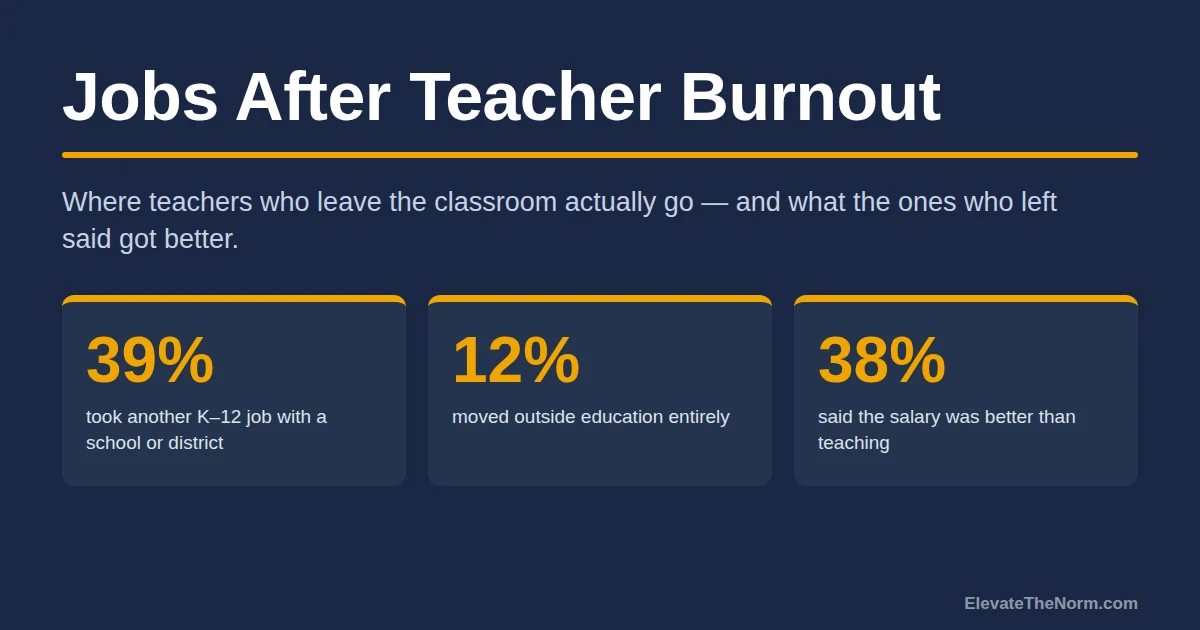
    Most teachers who leave the classroom do not leave education. In the federal follow-up survey, 39 percent of former public school teachers were working for a school or district in K–12 in a job that was not regular classroom teaching, while about 12 percent had moved outside education entirely. What most of them said got better was time and control. What usually did not was pay or job security.

    This page is about a decision adults make with real consequences, so it does not push. It will not tell you to quit and it will not tell you to stick it out. Both of those are cheap advice from someone who does not have to live in your house. What it will do is put the actual numbers in front of you — where teachers go, what improves, what gets worse, and how many people who say they are leaving are still there a year later — and give you a way to test a job before you take it. If you are earlier in this than that, start with what the word means and who holds the levers, or with the recovery side of this, written for people who are staying.

    Key Takeaways

    • The most common destination is another job in K–12. Among former public school teachers, 39 percent were working for a school or district in a K–12 role that was not classroom teaching. Only about 12 percent were working outside education.
    • Time and control improve. Money and security usually do not. Of former teachers who were working, 65 percent said work–life balance was better than in teaching and 60 percent said autonomy was better — but only 38 percent said salary was better, and only 21 percent said job security was.
    • Nobody can promise you that leaving fixes burnout. The research overwhelmingly measures plans to leave, not what happens afterward. That gap is real and this article does not paper over it.
    • Burnout is a property of working conditions. A review of the measurement literature puts it flatly: it is “not a personal problem, but a consequence of certain characteristics of the work activity.” A new job with the same conditions is a new job with the same conditions.
    • Planning to leave is not leaving. In a study of 7,714 teachers, nearly three-fourths of those who said they planned to leave or retire were still in the same school the next year. Thinking hard about it is normal. It is not a commitment you have already made.
    • Do not research your exit on a school device or account. Those belong to your employer. Use your own phone and your own email.

    Free Download · 2-page PDF

    The Leaving Decision Worksheet

    Page one: the six conditions that produce burnout, side by side — the job you have against the job you are considering, with the blanks marking the questions to ask in the interview. Page two: which condition is actually broken, what would have to change for staying to win, the four boring things to do before you resign, and who to talk to first. It returns no score and it is not a screening instrument.

    Download the free PDF

    Free. No email address required. Designed for grades 6–12 educators.

    Where do teachers actually go after burnout?

    Mostly into other jobs in K–12 education. The National Center for Education Statistics runs a Teacher Follow-up Survey that tracks a national sample of teachers into the next school year. The 2021–22 round covered roughly 10,300 current and former teachers, including about 4,100 who had left, with data collected from January to July 2022. Eight percent of public school teachers had left the profession — a rate unchanged since it was last measured a decade earlier.
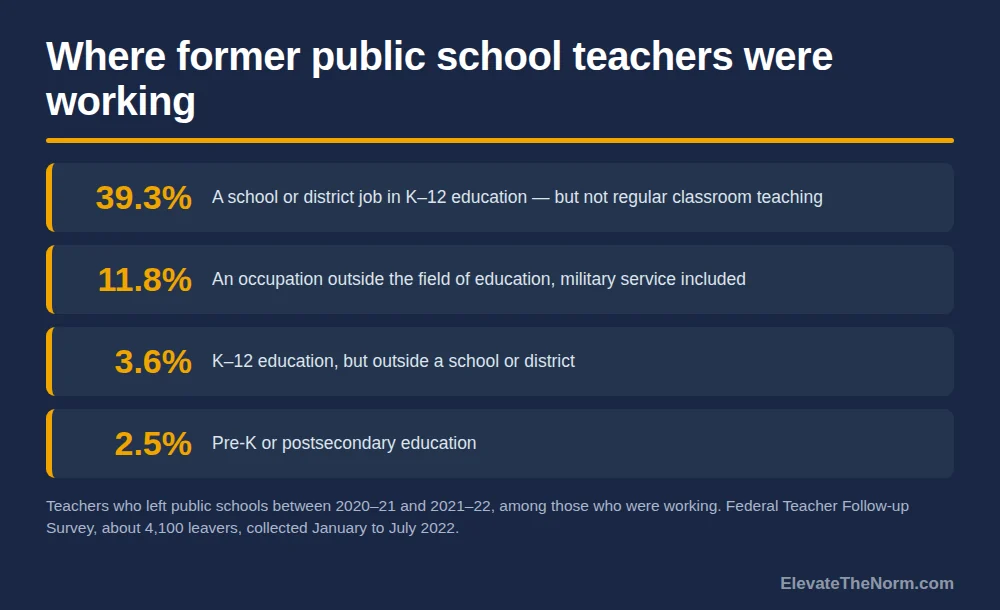
    Chart of where former public school teachers were working: 39.3 percent in a school or district K-12 job that is not regular classroom teaching, 11.8 percent outside education, 3.6 percent in K-12 outside a school or district, and 2.5 percent in pre-K or postsecondary education.
    Three in ten stay inside K–12 for every one who leaves education altogether.

    Of the former public school teachers who were working, 39.3 percent held a job with a school or district in K–12 education that was not regular classroom teaching. Another 3.6 percent were in K–12 education outside a school or district, and 2.5 percent had moved into pre-K or postsecondary education. Just 11.8 percent were working outside education, military service included.

    That single comparison — roughly three in ten staying inside K–12 for every one who leaves education — is the thing most articles on this keyword get backwards. The standard piece is a list of ten careers for former teachers, heavy on instructional design and corporate training. Those jobs exist and people take them. They are not where most people go.

    The survey does not publish job titles inside that 39 percent, so treat the following as examples rather than as data: instructional coaching, curriculum and assessment work, interventionist and MTSS roles, media and library positions, counseling if you hold or can add the certification, and district-office work in professional learning or scheduling. The honest summary is that the exit most teachers take is lateral, not away — the same building or the same district, a different set of demands.

    Do teachers who leave say the new job is better?

    On most measures yes, but not on the two people worry about most. The same survey asked former teachers who were working to compare their current position with teaching, one aspect at a time. The pattern in the answers is consistent enough to plan around.

    Ranked bar chart of what former teachers said was better in their current position than in teaching: balance of personal life and work 65 percent, autonomy 60, professional prestige 59, manageability of workload 58, advancement 54, general work conditions 50, intellectual challenge 45, salary 38, job security 21.
    The two shortest bars are the price. Salary and job security are where leaving usually costs you.

    Better in the current position: balance of personal life and work, 65 percent. Autonomy or control over their own work, 60 percent. Professional prestige, 59 percent. Manageability of workload, 58 percent. Opportunities for advancement, 54 percent. General work conditions, 50 percent.

    And then the other end. Intellectual challenge, 45 percent. Salary, 38 percent. Job security, 21 percent.

    Read those two low numbers carefully, because they are the price. Roughly three in five former teachers did not say they were making more money. Roughly four in five did not say their new job was more secure. Teaching, for all of it, is a job with tenure structures, a salary schedule you can read years in advance, and a public pension. Very little outside it works that way, and the people who left are telling you so.

    What they are also telling you is that the thing burnout takes from you — hours, control over your own day — is the thing that most reliably comes back. If your honest answer to “what do I want” is my evenings rather than more money, the data is on your side. If it is more money, the data is thinner than the career-change articles suggest.

    Does leaving actually fix burnout?

    Nobody can honestly tell you that it does. This is the most important sentence on this page and it is the one you will not find in a listicle. The burnout literature is enormous, and it is almost entirely about what predicts intending to leave. A 2025 National Academies paper reviewing burnout’s consequences says the research “has most commonly documented a relationship between burnout and… plans to leave their job,” and adds that because most of the underlying studies are neither longitudinal nor randomized, the results are “limited to describing associations.”

    So the field can tell you that burned-out people want out. It is much quieter on whether the ones who got out felt better afterward. Anyone who tells you a career change cures burnout is telling you something the evidence does not currently support.

    What the evidence does support is a reason to be careful about which job you take next. A 2022 review of burnout theory and measurement states the core finding of fifty years of work in one line: burnout is “not a personal problem, but a consequence of certain characteristics of the work activity.” Individual factors moderate it. Organizational factors generate it.

    Follow that through and the implication is uncomfortable. If burnout is produced by unmanageable workload, no control, no recognition, a bad community, unfairness and a values mismatch, then walking those six conditions into a new building does not leave them behind. It relocates them. A district office job with a worse workload than your classroom is not an escape. Neither is a startup that expects sixty hours.

    That is why the framework further down this page is about conditions rather than job titles. A job title tells you almost nothing about whether you will be well in it.

    How many teachers who plan to leave actually leave?

    Far fewer than say they will. Researchers at CALDER followed 7,714 teachers across 35 low-performing Michigan districts from 2018–19 through 2021–22, matching what teachers said on a survey against what they actually did the next year. Of the teachers who reported plans to leave the profession or retire, nearly three-fourths were still in the same school the following year. Of those planning to transfer, about two-thirds stayed put. That is a specific sample — districts already flagged as low-performing, where turnover pressure runs high — so the exact fractions should not be read as a national rate. The direction is the durable part: stated intentions badly overstate actual exits.

    The intention is not meaningless — teachers who said they planned to leave were about three times more likely to do so than teachers who said they planned to stay, 30 percent against 10 percent. But it is a weak predictor in the other direction too: only 46 percent of the teachers who actually left Michigan public education had said beforehand that they planned to.

    Two things follow, and they point in opposite directions on purpose.

    First, if you have been thinking about leaving, you are in enormous and entirely ordinary company, and you have not committed to anything. Most people who sit where you are sitting in March are back in the same room in August. That is not weakness and it is not a failure of nerve. It is what a hard decision looks like while it is being made.

    There is also a third group the numbers do not describe. Plenty of teachers would leave and cannot — a spouse tied to the area, insurance that covers somebody else, a mortgage, a pension eight years out, one district within driving distance. If that is you, an article about jobs after teaching is not much use to you, and the honest thing is to say so rather than pretend the door is open. What is still available is the audit below, run against the job you already have, and the case for holding the line where you are — and asking for one specific condition to change instead of asking for everything to be different.

    Second, and it is worth saying plainly to anyone who manages teachers: a survey that says a third of your staff is leaving is not a prediction that a third of your staff is leaving. It is a measurement of how bad the conditions feel right now. Those are different problems with different answers — and the second one is not the easier problem. A third of a staff reporting that they want out is a serious reading on working conditions whether or not those people go, and it stays serious after they stay.

    How do you test a job before you take it?

    Interview the conditions, not the title. The six features of a job that produce burnout — workload, control, reward, community, fairness and values — are the areas of worklife that Christina Maslach’s research identified, and they are the spine of every page in this series. Because they are features of a job, you can ask about all six directly in an interview, and the answers will tell you more than any description of the role. Here is the audit, in the order it is worth running.
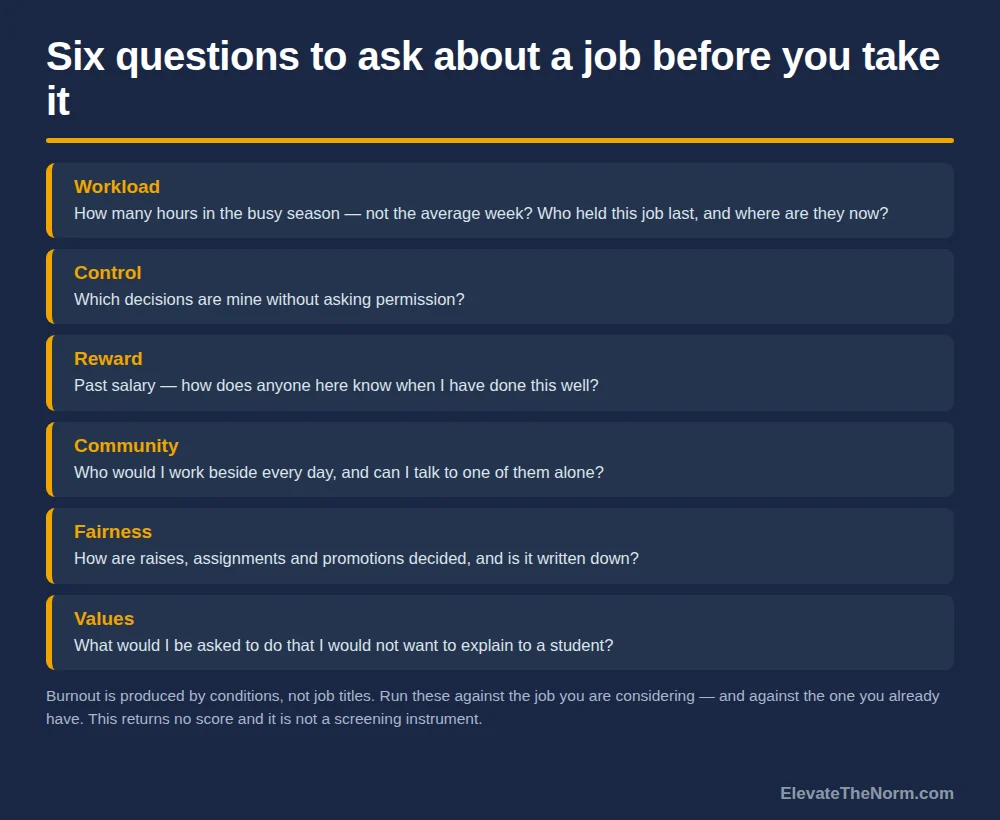
    Six-row checklist of questions to ask about a job before taking it, one for each area of worklife: workload, control, reward, community, fairness and values.
    A job title tells you almost nothing about whether you will be well in it. These six do.
    1. Workload. How many hours does this actually take in the busy season, not the average week? Who did this job last and where are they now? A role nobody has held for more than eighteen months is telling you something.
    2. Control. What decisions are mine without asking? Teaching gives you more autonomy inside four walls than most people realize. Plenty of jobs give you less.
    3. Reward. Past salary — how does anyone here know when I have done well? If the answer is vague, the recognition will be too.
    4. Community. Who would I work with day to day, and do they like each other? Ask whether you can talk to one of them without the hiring manager in the room. If the answer is no, that is data.
    5. Fairness. How are raises, assignments and promotions decided, and is that written down anywhere? “We handle it case by case” is an answer.
    6. Values. What would I be asked to do here that I would be uncomfortable explaining to a student? If nothing comes to mind, good. If something does, believe it.

    You will not get honest answers to all six. You will get honest answers to some, and the pattern of what people dodge is information in itself. Run the same six questions against your current job while you are at it. Sometimes the audit says the problem is one condition, not six, and that one is fixable where you are — which is the case an administrator can be asked to answer before you go anywhere.

    What do the adjacent jobs actually pay?

    About the same as teaching, with the growth and the pay pulling in opposite directions. The Bureau of Labor Statistics puts the median annual wage for high school teachers at $72,040 as of May 2025, with employment projected to show little or no change from 2025 to 2035.

    Instructional coordinators — the curriculum, assessment and professional-learning roles that sit closest to the 39 percent above — had a median of $77,440 in May 2025. That is real money over a career. But the same source projects 2 percent growth over the decade, slower than average, and notes that public school instructional coordinators are required to hold a master’s degree in education or curriculum and instruction and typically need several years of experience as a teacher or instructional leader. It is a promotion-shaped job with few openings.

    Training and development specialists, the most common corporate landing spot, had a median of $69,280 and are projected to grow 11 percent, much faster than average, with a bachelor’s degree typically sufficient to enter.

    Put those together honestly. The adjacent job that pays more than teaching is barely growing and wants credentials you may need to go get. The one that is growing quickly pays less than the classroom median. That is the shape of the trade, and it matches what leavers reported: only 38 percent said the money was better.

    Two practical notes that cost nothing. Keep your certificate current even if you are leaving — renewal is cheap and rebuilding a lapsed license is not. And check what your state retirement system does with a partial year of service before you set a resignation date, because the arithmetic sometimes favors a specific month.

    What should you do next?

    Do the boring, private, reversible things first, in this order.

    Move the search off your employer’s property. Your school email, your district laptop and your school Google account belong to the district, not to you. Applications, resignation drafts and searches for “jobs after teaching” do not belong on any of them. Use your own phone, your own email address, your own machine. This is not paranoia; it is the same advice anyone would give about any employer.

    Write down which of the six conditions is actually broken. Not “I am done.” Which one. A blank reflection page is as much structure as this needs. People who can name it sometimes discover the problem is a schedule or a duty rather than a profession, and that is a much smaller thing to fix. People who name all six have learned something too.

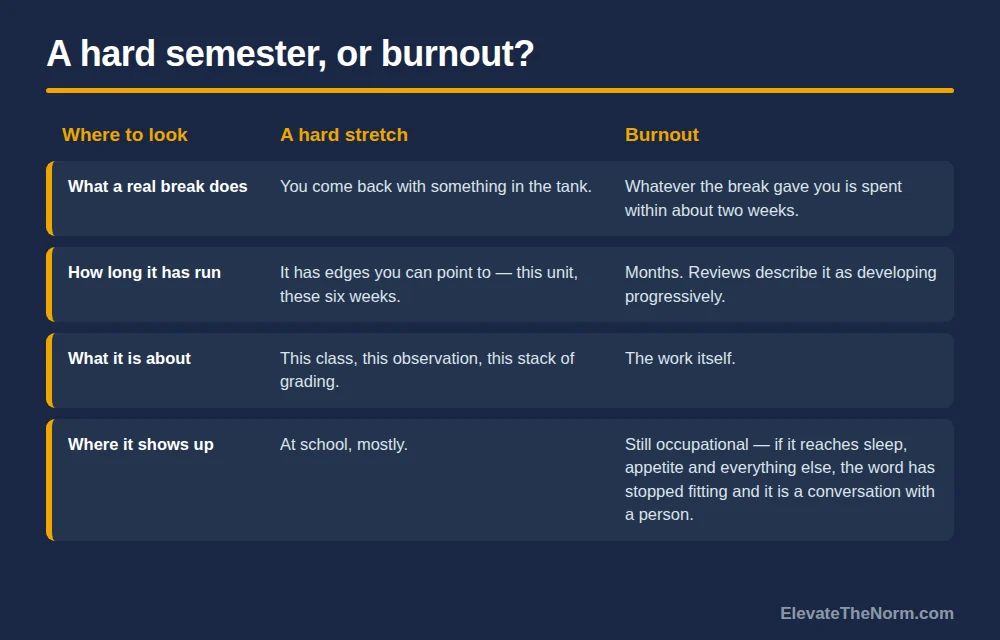
    Talk to an actual person. Someone who left, someone who stayed, and — if what you are carrying is heavier than a job problem — a doctor or a counselor. This page cannot tell you whether you are burned out, and neither can any checklist, quiz or article, including the worksheet below; if you have not yet worked out whether what you are carrying is burnout or an ordinary hard stretch, that is a different question with a different answer. Burnout is an occupational condition described by researchers, not a diagnosis you can give yourself from a web page, and the measurement instruments used to study it do not have clinically validated cutoff scores. If you are wondering whether what you are feeling is something more than exhaustion, that question belongs to a person who can ask you follow-up questions.

    Then decide on your own clock. The people who leave well tend to leave with a destination, a date and their certificate intact. Some people do not get that choice — health, a family emergency, or a situation that has stopped being safe can end a year in March, and none of that is bad planning or a character problem. But when the timing is genuinely yours, the calendar is one of the few parts of this you control. You are allowed to take a year to decide, and the evidence says most teachers in your position do exactly that. You are also allowed to go. Neither one of those is the brave choice and neither one is quitting. Nobody in your building gets a medal for outlasting the job, and nobody should have to.

    One last thing, and it is the part students actually see. Leaving well means leaving the person who follows you something to work with: notice where you can give it, plans and passwords handed over, grades current, a word to the kids who will wonder where you went. Teenagers read how adults exit a room, and they read it accurately. Going is allowed. Disappearing is a different thing, and it is the only version of this that costs somebody else.

    Before you go: grab the free Leaving Decision Worksheet (PDF) — ElevateTheNorm.com branded, printable, no email required, and not a screener.

    Frequently Asked Questions

    Is it normal to think about leaving teaching?

    Yes, and thinking about it is not the same as doing it. Researchers who followed 7,714 teachers across 35 Michigan districts found that nearly three-fourths of those who reported plans to leave the profession or retire were still in the same school the next year. Nationally, 8 percent of public school teachers actually left between 2020-21 and 2021-22, a rate unchanged from a decade earlier. Far more people consider it than go. You have not committed to anything by wondering.

    What jobs do most former teachers actually take?

    Most stay in K-12. Among former public school teachers who were working, 39.3 percent held a job with a school or district in K-12 education that was not regular classroom teaching, while only 11.8 percent had moved outside education entirely. The federal survey does not publish titles inside that 39 percent, but the roles that sit there are things like instructional coaching, curriculum and assessment, intervention and MTSS work, media and library positions, and district-office professional learning. The typical exit is lateral, not away.

    Will I make more money if I leave the classroom?

    Probably not, and the data on this is clearer than most career-change advice admits. Only 38 percent of former teachers said salary was better in their current position than in teaching. For reference, the Bureau of Labor Statistics put the May 2025 median at $72,040 for high school teachers, $77,440 for instructional coordinators, and $69,280 for training and development specialists. The adjacent job that pays more is projected to grow 2 percent over the decade and usually requires a master’s degree plus teaching experience. The one growing quickly pays less than the classroom median.

    Does leaving teaching cure burnout?

    Nobody can honestly promise that. The burnout literature overwhelmingly measures intentions to leave rather than what happens afterward, and a 2025 National Academies review says the underlying studies are mostly neither longitudinal nor randomized, so results are limited to describing associations. What is well established is that burnout comes from conditions of the work rather than from the person, which means a new job carrying the same workload, the same lack of control and the same values mismatch is likely to reproduce it. That is the argument for auditing the conditions of the next job rather than its title.

    Is student behavior the reason teachers burn out and leave?

    No. This one matters, and the answer is not a soft one. Burnout is an occupational condition produced by how a job is structured — workload, control, recognition, community, fairness and values. Those are set by schedules, staffing, policy and budgets, which are adult decisions made by adults. Students are not the cause, and a student who is worried that a favorite teacher is exhausted because of their class is worrying about something that is not theirs to carry.

    Is it bad for students when a teacher leaves?

    Turnover is genuinely disruptive, and it is fair for a family to care about it. But the cause of turnover is working conditions, not articles about working conditions, and a teacher grinding through exhaustion for another two years is not a good outcome for students either. The thing that protects students is a teacher who either gets the conditions fixed or leaves well — with notice, with plans and grades handed over, and with a word to the kids about where they went. The version that costs students is the one where an adult disappears without any of that.

    How do I know if I am burned out or just tired?

    You cannot settle that from a web page, and this one will not pretend otherwise. The instruments researchers use to study burnout do not have clinically validated cutoff scores, so no checklist, quiz or article — including the worksheet on this page — can return a verdict. What a page can do is describe what the three symptoms look like in a classroom so you have better words for it. If what you are carrying feels heavier than a job problem, or has lasted past the breaks that usually help, that question belongs to a doctor or a counselor who can ask you follow-up questions.

    Can I use my school computer to apply for other jobs?

    Don’t. Your school email address, your district laptop and your school-issued accounts belong to your employer, and in most districts the acceptable-use policy says so explicitly. Job applications, resignation drafts, and searches about leaving should live on your own phone, your own machine and a personal email address. This is not about hiding wrongdoing — there isn’t any — it is the same basic advice anyone would give about any employer.

    Sources

    Every link above was opened and read on September 24, 2026. Where a figure could not be confirmed in the source document itself, it is not quoted here. This article describes burnout as an occupational condition. It is not medical advice, it is not a diagnosis, and neither this page nor the linked worksheet is a screening instrument. Nothing here is financial, legal or career advice about your particular situation — retirement and certification rules vary by state, and those questions belong to your own retirement system and certification office.

    About Clay Shumate

    By Clay Shumate — Clay Shumate is a certified secondary Social Studies teacher in the public schools of West Alabama, with seven years of classroom experience, a B.A. in History, and an M.Ed. in Secondary Education. He writes about project-based learning, student responsibility, respect, and practical ways to hold young people to a higher standard while giving them room to learn from mistakes. He is a member of the Society of Professional Journalists and writes to its Code of Ethics; this site’s editorial standards and corrections policy are published in full.

  • How to Help Teacher Burnout: What Administrators Can Actually Change

    How to Help Teacher Burnout: What Administrators Can Actually Change

    To help teacher burnout, change the working conditions that produce it — workload, control, recognition, community, fairness and values — rather than the coping skills of the people inside them. Burnout is an occupational condition. The research points at the job, and the measured cost to students lands on the classroom experience before it lands on any test score. Most of the levers that matter are held by an administrator, not a teacher.

    This page is for the person holding those levers: a principal, an assistant principal, a department chair with a schedule to build, a central-office administrator with a budget. Everything else in this series is written for the teacher — the definition the rest of this series is built on, how the three symptoms present in a 6–12 classroom, and what recovery asks of someone already past prevention. This one is about what you can do from your chair, and the honest size of the effect to expect. Some of that evidence is less flattering to the standard advice than you would guess, and it is here too.

    Key Takeaways

    • Burnout is a condition of the job, not a defect in the person. Christina Maslach, whose framework the WHO definition is built on, puts it plainly: “Organizational intervention can be more productive than individual intervention.”
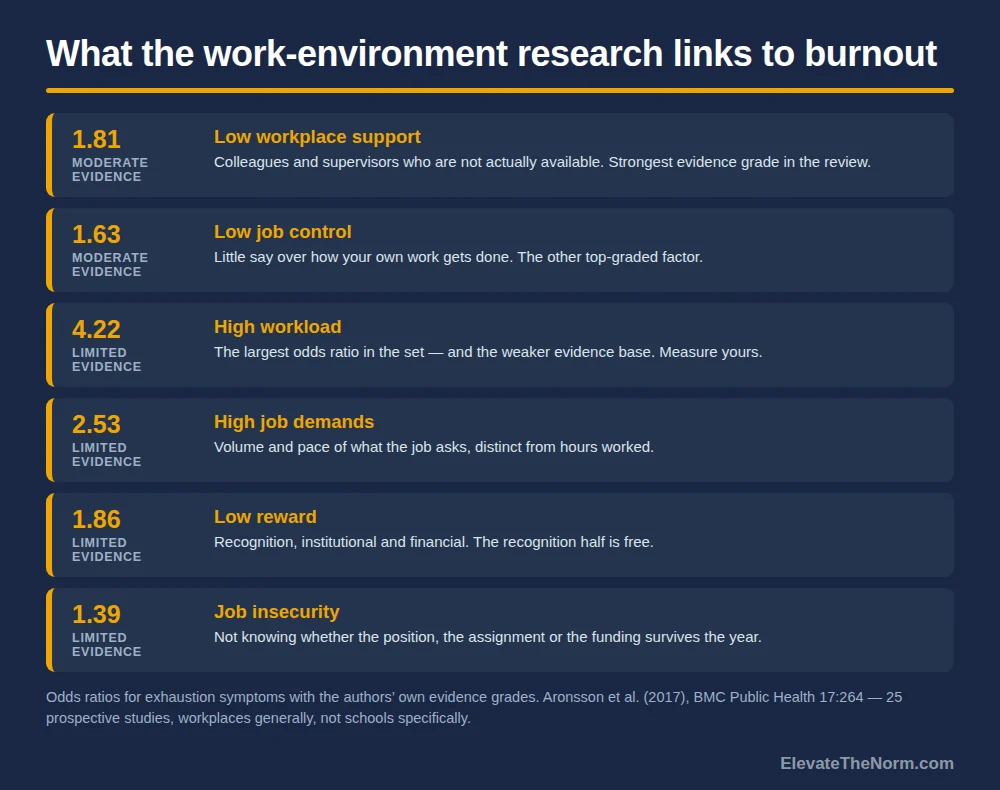
    • Job control and workplace support have the best evidence behind them. A systematic review of 25 prospective studies graded both as moderate — low job control at an odds ratio of 1.63 for exhaustion symptoms, low workplace support at 1.81. High workload carries the biggest number, 4.22, on the weaker limited grade: the loudest signal, and the one most worth measuring locally rather than assuming.
    • Expect a small effect, honestly reported. Across 23 controlled teacher-burnout trials the overall effect was d = 0.18, and almost nothing on cynicism (0.03). Organizational interventions move exhaustion about −0.30, on evidence the authors call very low quality. Real workload reductions ran −0.44; schedule tweaks showed no significant effect at all.
    • There is real contrary evidence. A 35-year meta-analysis in a related helping profession found person-directed interventions beat organization-directed ones on exhaustion (g = .38 vs .13). “Fix the job, not the person” is better supported by the cause research than by the intervention research.
    • Fewer than half of teachers think you are trying. In RAND’s 2025 national survey, fewer than one-half said their school or district was making efforts to help them balance work and life. Forty-six percent said the job left them too tired for their own lives.
    • None of this makes you a clinician. Conditions are your job. A particular person’s health is not, and a wellness newsletter is not a substitute for either.

    Free Download · 2-page PDF

    The Administrator’s Six Conditions Walkthrough

    Page one: the six areas of worklife, the question to ask in each, the levers that answer it, and space to write the lever you hold, who owns it and by when. Page two: the three-question count, the scheduling-problem versus staffing-finding test, what to say when a teacher tells you, and what not to do. It returns no score and it is not a screening instrument.

    Download the free PDF

    Free. No email address required. Designed for grades 6–12.

    What actually helps teacher burnout?

    Changing the conditions that caused it. Specifically: cutting real workload rather than redistributing it, giving teachers genuine decision-making authority over their own work, making recognition and fairness visible, and protecting the time that makes the rest of a life possible. Everything else is downstream of whether those four are true.

    That ordering comes out of the definition. The World Health Organization classifies burn-out as an occupational phenomenon resulting from chronic workplace stress “that has not been successfully managed.” The stress is the input. If the input does not change, an intervention can only help someone tolerate it longer — worth doing, and not the same as helping.

    Six-row chart of odds ratios for exhaustion symptoms: low workplace support 1.81 and low job control 1.63 at moderate evidence; high workload 4.22, job demands 2.53, low reward 1.86 and job insecurity 1.39 at limited evidence.
    The largest number in the set sits on the weaker evidence. The grades matter as much as the ratios.

    Maslach’s 2017 paper in Consulting Psychology Journal makes the administrative case in one sentence: “If improvements can be made in job conditions that affect a lot of employees, then those interventions can have a much larger impact.” That is a scale argument, and it is aimed squarely at your job. A counselor helps one teacher at a time. A schedule helps everybody on it, every day, whether or not they opted in.

    Which working conditions actually predict burnout?

    Low job control and low workplace support have the strongest evidence. A systematic review including meta-analysis of the work environment and burnout symptoms — 25 studies that survived quality screening, drawn from prospective research across Europe, North America and Australasia — graded both at the highest level of confidence the review awarded anything.

    The odds ratios for exhaustion symptoms, with the authors’ own evidence grades attached, are in the chart. The short version: low workplace support 1.81 and low job control 1.63, both graded moderate; high workload 4.22, job demands 2.53, low reward 1.86 and job insecurity 1.39, all graded limited.

    Read honestly, that is slightly awkward. The condition with the largest apparent effect — workload — sits on the weaker evidence base, while the two firmest findings are the quieter ones about autonomy and support, both of which the review found actively protective rather than merely neutral. So do not skip control and support because workload is what everybody is shouting about. And because this evidence covers workplaces generally rather than schools specifically, treat the workload number as a reason to measure yours rather than a finding to quote at a board meeting.

    How big an effect should an administrator expect?

    Small. Real, repeatedly measured, and small. Anyone promising you a transformation is selling something. The honest range is a modest shift in exhaustion, very little movement on cynicism, and nothing at all if the change is cosmetic.

    Six-row chart of burnout intervention effect sizes: combined job-and-person changes minus 0.54, workload-focused minus 0.44, participatory minus 0.34, organizational overall minus 0.30, all teacher trials 0.18, and work-schedule interventions with no significant effect.
    Small, real, and repeatedly measured. Combined approaches produced the largest figure in the set.

    A meta-analysis of 23 controlled trials aimed specifically at reducing teacher burnout found an overall effect of d = 0.18 — statistically significant, practically small — and an effect on depersonalization of 0.03, which is nothing. Interventions lasting under a month had the smallest effects of all, so a one-day training in August is close to a rounding error.

    A separate 2023 meta-analysis looked only at organizational interventions and exhaustion, across 13 studies with a median of 119 workers each. Pooled effect: −0.30, which the authors themselves call a small reduction on very low quality evidence. The pattern inside it is the useful part. Workload reductions ran −0.44. Participatory changes — where staff had a hand in designing them — ran −0.34. Work-schedule interventions produced no significant effect at all. And combined interventions, which change the job and support the person, ran −0.54, the largest figure in the set. That last one is what I would build a plan around: not because it is large, but because it is the only one that beats doing a single thing well.

    Does fixing the teacher instead of the job ever work?

    Sometimes better than fixing the job, and the research saying so is good research. Leaving this out is how you end up with a plan that cannot survive a skeptical question.

    A meta-analysis of 35 years of burnout-intervention research in a closely related helping profession — mental health providers, 27 samples, 1,894 workers — compared the two approaches directly. Person-directed interventions outperformed organization-directed ones on emotional exhaustion, Hedges’ g of .38 against .13, and the gap was statistically significant. On overall burnout the two were indistinguishable.

    Two caveats, neither of which erases it. The organizational studies were a relatively small subset, which limits what the comparison carries. And those workers are not teachers. But the honest summary stands: “change the job, not the person” is much better supported by research on what causes burnout than by research on what fixes it.

    Which is an argument for doing both, and for being suspicious of any plan — including yours — that only does the cheap half. A resilience workshop with no workload change is the cheap half. So is a structural announcement with nothing for the people already depleted while it takes effect.

    What is a practical framework for a principal to use?

    Walk the six areas of worklife and, for each one, name a lever you personally control and a date. Maslach’s model describes six places where a person and a job can mismatch. It was not written for schools, but it maps onto a building without much translation, and it has the advantage of being the framework the definition itself rests on.

    Six-row framework listing workload, control, reward, community, fairness and values, each with the question an administrator should ask and the concrete levers that answer it.
    One afternoon, teachers in the room, written down. Every row needs a thing, a person and a date.

    Here is the walkthrough. The test for every row is the same: can you name a specific thing, a specific person, and a specific date? If not, you have written a value, not a change.

    • Workload. What is the heaviest recurring demand here that is not instruction? Duty rotations, meeting count and length, separate preps assigned to one person, data entry done three times instead of once, grading systems that take longer than the feedback is worth, coverage absorbed by whoever is nearest. If the answer is “we need more staff,” that may be true and it is still not this week’s lever.
    • Control. What decisions about their own work do teachers not get to make? Pacing, assessment format, room arrangement, how a department spends its own PD time, who is consulted before a schedule publishes rather than after. A 2020 systematic review of 31 studies on administrator support found an outright gap here: no study it located had tested a principal intervention that increased teachers’ decision-making. A gap in the literature, not permission to skip it.
    • Reward. Is good work noticed specifically, or generically? Named recognition in front of peers; protected time rather than pizza; pay, where you have any say. Recognition is the half you can act on today.
    • Community. Do teachers here have colleagues, or just neighbors? Common planning that is actually common, deliberate veteran and early-career mixing, and dealing with the one adult everybody works around — a documented personnel process with its own timeline, and starting it in September is the only version that finishes.
    • Fairness. Can a teacher predict how a decision will be made before it is made? Written criteria for coverage, duties, rooms and course assignments; consistent follow-through on referrals; explaining the reasoning when a decision goes against someone. Nearly free. And note the direction: when behavior shows up as a burnout driver it is almost always the process that failed, not the students.
    • Values. Does what we say we care about survive contact with the calendar? Stop asking for a thing you have decided not to fund. Stop running an initiative you will abandon in March. When a mandate arrives that you think is wrong, say so rather than selling it.

    Run it as a walkthrough, not a survey — one afternoon, with three or four teachers in the room rather than alone, because participatory changes were the second-best performing category in the meta-analysis and because you will get the workload answer wrong by yourself. Pick the room deliberately: at least one person who will disagree with you out loud, at least one early-career teacher, not only department chairs.

    How do you tell a scheduling problem from a staffing problem?

    Count how many people describe the same condition. One teacher describing one duty is a scheduling problem. Nine teachers describing the same three conditions is a staffing finding, and it belongs in a budget conversation rather than a coaching conversation. Special education is where this distinction bites hardest, because the vacancy rate does the redistributing for you — what the same question looks like for special education staffing.

    The two failures are opposite. Treating a building-wide condition as an individual problem produces a teacher coached on time management while carrying an impossible load, which reads — correctly — as blame. Treating one person’s situation as a crisis produces an initiative that annoys forty people to help one. Neither is an argument against coaching a skill someone wants; what reads as blame is coaching offered as the answer to a structural load.

    The count is easy to get and most administrators do not have it. Ask the same three questions in every exit interview, every post-observation conference and every department meeting for a semester, write the answers down, and read them together in May. Look for repetition, not intensity — the loudest complaint in a building is frequently not the most common one. Then disaggregate: RAND’s national data has repeatedly found stress and burnout reported at different rates across groups of teachers, and a building average can look tolerable while a subset of your staff carries most of it.

    What do administrators try that does not work?

    Anything that adds an obligation in the name of relief. That is the clean test, and it catches most of the failures on its own.

    • An after-school wellness session, or appreciation week. Not harmful; not interventions. The session costs an hour of the exact resource that is missing — run it inside contract time and cancel something to make room, or do not run it. And recognition is about whether good work is noticed specifically and routinely, not whether there were donuts in April.
    • A survey with no published response. Asking teachers to describe conditions you then neither act on nor explain is a fairness problem you created on purpose.
    • Schedule tinkering presented as the fix. Work-schedule interventions were the one category showing no significant effect on exhaustion. Moving the same load around the same week is not a reduction, and teachers do that arithmetic faster than you can present it.
    • A one-off August training. Interventions shorter than a month had the smallest effects measured. Whatever you do has to outlive the first grading period.

    One more, and it is the one I would most want an administrator to hear. Do not frame endurance as a virtue. Praising the teacher who never takes a day, telling a depleted staff that this is what the work asks, treating a request for help as a character question — that is not motivation. It is an instruction to hide the problem until it is much more expensive, and it works. You will stop hearing about burnout in your building long before it stops happening.

    What can a district change that a principal cannot?

    Time, coverage, and the number of separate things a teacher is accountable for. Those are budget and policy decisions; a building leader can only ration them. RAND’s 2025 national survey put numbers on the gap: three times as many teachers as similar working adults said it was hard to change their work schedule, 46% said the job made them too tired for their private life, and fewer than one-half said their school or district was making efforts to help them balance the two. That last one is a perception measure, so it moves on two things — what you do, and whether anyone knows you did it.

    The report’s own recommendations are concrete and unglamorous: make paid leave genuinely usable by guaranteeing coverage, offer flexible arrangements such as team teaching or job-sharing, provide benefits that address household responsibilities, and change the messaging so taking time is not treated as a lapse. Coverage is the hinge. A leave policy that produces a scramble every time it is used is not a leave policy — so coverage that does not create a second problem is worth sorting out before you tell anybody to take a day.

    Two more levers that quietly add hours. The number of distinct initiatives a teacher is accountable for in a year — each with its own training, data entry and fidelity check — is a workload decision even when every piece is defensible. And family contact is real work that mostly happens after hours; a contact routine that does not eat every evening gives back several hours a month.

    A teacher just told you they are burned out. What do you actually say?

    Treat it as information about conditions, ask which demand is heaviest, and do not diagnose anybody. The shortest useful version: thank you for telling me — which part of the load is heaviest right now, and what would it take to move it? Three things to get right after that.

    • It is not a performance conversation and should not feel like one. Someone describing burnout is describing the fit between a person and a set of working conditions. If they leave your office having been evaluated, nobody else will tell you anything this year. It is also not a favour you are doing them: mental distance is one of the three defining symptoms, and it reaches students as less patience long before it reaches a resignation letter.
    • Do not decide what is wrong with them. Burnout is occupational and it overlaps with things that are not. You cannot tell the difference and neither can a checklist — the instruments researchers use lack a clinically validated cutoff. Name what you can act on, make sure they know how to reach a counselor, the employee assistance program or their own doctor, and let them decide. Do not ask for a diagnosis, do not record a guess about one, and keep health conjecture out of email and out of an evaluation file.
    • Come back with something specific — and say how it was decided. One removed duty, one deadline moved, one meeting cancelled, with a date. But an unexplained exception is a fairness problem for everybody else. Either the criterion is public and anybody who meets it gets the same relief, or you have traded one teacher’s load for the building’s trust.

    Keep that record off the school network, and encourage them to do the same with anything they write for themselves. A district device is not a private place to write “I am not coping.”

    And know the limits of the role. If what you are hearing sounds like more than the job — and sometimes it will — the honest answer is not a framework. It is a person: a counselor, a doctor, the employee assistance line. Conditions are your department. Health is theirs to take to someone qualified.

    Where to start this month

    Pick one row of the walkthrough and finish it. Not six. The evidence supports small, real, durable changes over large announcements, and the one category that produced nothing measurable was the kind that moved work around without reducing it.

    A defensible first month: run the walkthrough with three or four teachers in the room, written down. End one recurring non-instructional demand outright, with a date. Publish what you decided and what you could not do. Then start the count. And pair it with the teacher-facing half, because combined approaches were the only ones that beat doing a single thing well — the prevention side, written for the teacher is what people can use while a structural change works through a budget cycle.

    None of this is dramatic and the effect sizes are small. They are also the largest ones anybody has measured, they compound across everyone on the schedule, and a teacher can tell within a month whether a building is actually trying. Fewer than half of them currently think so. That number is yours to move. And if what you want is what a facilitated hour actually has to include to be the thing that was tested, that is a separate page.

    Before you go: grab the free Administrator’s Six Conditions Walkthrough (PDF) — ElevateTheNorm.com branded, printable, no email required, and not a screener.

    Frequently Asked Questions

    What can a principal do about teacher burnout with no budget?

    Three of the six areas of worklife cost nothing. Fairness: publish written criteria for how coverage, duties, room assignments and course assignments get decided, and explain the reasoning when a decision goes against someone. Control: consult teachers before a schedule is published rather than after, and hand back a decision they currently do not get to make — pacing, assessment format, how a department spends its own PD time. Reward: notice good work specifically and by name, in front of peers, routinely rather than annually. In the systematic review of work environment and burnout symptoms, low job control and low workplace support carried the strongest evidence grade of any factor examined — stronger than workload, which is the one that costs money. Start there while the budget conversation takes its year.

    Does reducing a teacher’s workload mean students get less?

    Not if you cut the right thing. The workload levers that matter most in a 6–12 building are duty rotations, meeting count, redundant data entry, the number of separate preps assigned to one person, and feedback systems that make grading take three times longer than the feedback is worth — none of which is instruction. Cutting a third data-entry pass does not cost a student anything. It is also worth saying the reverse plainly: a depleted teacher is already giving students less. Mental distance from the work is one of the three defining symptoms of burnout, and it shows up as less patience, less individual attention, and a room that is a worse place to be. Protecting a teacher’s capacity is a student-facing decision, not a perk.

    Is student behavior the cause of teacher burnout?

    It is one demand among several, and the research does not single it out. The work-environment evidence points at job control, workplace support, workload, reward and fairness — conditions set by adults, not by teenagers. Behavior becomes a burnout driver mainly through a fairness failure: when a teacher follows the process, sends the referral, and nothing predictable happens. That is an administrative problem wearing a student’s face. Treating students as the cause leads to policy that punishes kids for a scheduling decision, and it is both unfair and ineffective. Students are the people who lose most when a building runs its teachers down; they are not the reason it happens.

    How do I tell burnout from a teacher having one hard semester?

    You largely cannot, from the outside, and it is not your call to make. The useful version of the question for an administrator is different: what is the pattern, and what is the load? A hard semester has a cause with an end date — a new prep, a difficult section, something happening at home. Burnout is the condition that does not lift when the immediate pressure does. The three symptoms and where the word stops fitting are set out in detail for teachers elsewhere on this site. What you can act on is the same in both cases: find out which demand is heaviest and whether any part of it can be moved, reassigned or ended with a date attached.

    Should we run a wellness program, or is that a waste of money?

    Run one, but never instead of a conditions change. The evidence here is genuinely mixed and worth knowing: a 35-year meta-analysis of burnout interventions in mental health providers found person-directed approaches outperformed organization-directed ones on emotional exhaustion (g = .38 versus .13), while the causal research consistently points at the job. The strongest single number in the organizational meta-analysis was for combined interventions — changing the job and supporting the person — at −0.54, larger than either alone. What fails is the wellness session that adds an obligation in the name of relief. If you run one, run it inside contract time and cancel something to make room for it.

    How long before a change shows up in how teachers feel?

    Longer than a month, and you should plan for a semester before you read anything into the result. The teacher-burnout meta-analysis found that interventions lasting under one month had the smallest effects of any duration category — a one-day August training is close to a rounding error. Expect the effect itself to be small when it arrives: the overall figure across 23 controlled trials was d = 0.18, and the effect on cynicism was essentially zero. The thing that changes faster than the burnout measure is the credibility measure. Teachers can tell within a few weeks whether a stated change actually happened, and that judgment determines whether anyone tells you anything next time.

    What if a teacher seems to be dealing with more than the job?

    Then the honest answer is a person, not a framework. Burnout is an occupational condition and it overlaps with things that are not occupational; the instruments researchers use to measure it lack a clinically validated cutoff, which is exactly why no checklist and no administrator can sort one from the other. Do not attempt a diagnosis, do not ask for one, and do not put a health conjecture in writing. Make sure the person knows how to reach a counselor, the employee assistance program, or their own doctor, say clearly that using any of those is not a mark against them, and then act on the part you actually control — the load. Conditions are your department. Health is theirs to take to someone qualified.

    How do we measure this without another survey nobody answers?

    Count instead of survey. Ask the same three questions in every exit interview, every post-observation conference and every department meeting for a semester, write the answers down, and read them together at the end. You are looking for repetition, not intensity — the loudest complaint in a building is frequently not the most common one. One teacher describing one duty is a scheduling problem; nine teachers describing the same three conditions is a staffing finding that belongs in a budget conversation. Disaggregate before you conclude: RAND’s national data has consistently found stress and burnout reported at different rates across groups of teachers, so a building average can look acceptable while a subset of your staff is carrying most of it. And if you do run a survey, publish what you decided and what you could not do. An unanswered survey is a fairness problem you created on purpose.

    One more reason to move on the conditions rather than the newsletter: the teachers who do leave are not mostly leaving education. In the federal follow-up survey, about three in ten former teachers took another K–12 job with a school or district for every one who left the field. They are not disappearing. They are moving to a job with a better workload, often in somebody else’s district.

    Sources

    Every link above was opened and checked on September 24, 2026. Where a figure could not be read verbatim in the source document, it is not quoted here. This article describes burnout as an occupational condition. It is not medical advice, it is not a diagnosis, and neither this page nor the linked walkthrough is a screening instrument.

    For the same ground from the other side of the desk, see the demand side at classroom resolution, written for the teacher carrying it — including the four-column log a teacher can bring you, which is a far more workable agenda than a general complaint.


    About Clay Shumate

    By Clay Shumate — Clay Shumate is a certified secondary Social Studies teacher in the public schools of West Alabama, with seven years of classroom experience, a B.A. in History, and an M.Ed. in Secondary Education. He writes about project-based learning, student responsibility, respect, and practical ways to hold young people to a higher standard while giving them room to learn from mistakes. He is a member of the Society of Professional Journalists and writes to its Code of Ethics; this site’s editorial standards and corrections policy are published in full.

  • Standards Based Grading Gradebook: How to Build One That Survives a Semester

    Standards Based Grading Gradebook: How to Build One That Survives a Semester

    A standards based grading gradebook stores evidence by learning target instead of by assignment. Each row is a standard. Each entry is a piece of evidence a student produced for that standard. That one structural change is what makes a gradebook readable to a student, a parent, and the teacher who inherits the class next year. It is also what creates every hard decision you will spend the semester making.

    Most of what gets written about standards-based grading is about philosophy. This is not that. This page is about the file — what goes in the columns, what happens when a kid takes a quiz three times, what you do when the office needs a letter grade by Friday, and what the research says happens when you get those choices wrong.

    I will say up front that the evidence here is thinner and more mixed than the professional development usually admits. That is covered honestly below, because a teacher about to rebuild a semester of records deserves to know what they are buying.

    Key Takeaways

    • The structure is the whole idea. Rows are standards, not assignments. If your gradebook still reads as a chronological list of tasks with points attached, you have changed the labels and not the system.
    • One randomized trial found a real gain. A cluster RCT across 29 schools of a proficiency-plus-reassessment program in ninth-grade algebra and geometry reported a 0.33 standard deviation improvement on end-of-course mathematics tests — roughly the 50th to the 63rd percentile.
    • But no grading system improves learning by itself. Guskey and Link put it plainly: grading does not change curriculum or instruction, and there is no evidence that standards-based grading on its own raises achievement. What it reliably does is make the grade mean something specific.
    • Taking practice work out of the grade has a measurable cost. A two-year study of a policy change in secondary mathematics found that when practice stopped counting, completion of practice fell and achievement declined on several standards.
    • Students object on fairness grounds, and their objections are specific. In a survey of 478 high school students, the complaints were not about rigor. They were about inconsistent reassessment rules between teachers and about losing credit for work they had done.
    • The five decisions below are where implementations live or die: how many standards, what scale, how repeated attempts combine, what counts as evidence, and where behavior goes.

    What is a standards based grading gradebook?

    It is a gradebook whose primary axis is the standard rather than the assignment. A traditional gradebook answers “what did this student turn in and what was it worth?” A standards-based gradebook answers “what can this student do, and how do we know?”

    In practice that means a column per learning target instead of a column per task. A single test might feed six different columns, because a single test usually assesses six different things. Three separate assignments over a month might all feed one column, because they were all evidence for the same skill. The assignment does not disappear — it becomes the container for the evidence rather than the thing being measured.

    If you want the underlying rationale and the arguments for and against the approach as a whole, that is covered in the main standards-based grading guide. This page assumes you have already decided, or been told, and now have to build the thing.

    Does a standards based grading gradebook actually improve learning?

    The honest answer: one good randomized trial says a specific version of it helped, a large review says grading systems do not improve learning on their own, and at least one comparison found worse outcomes. Anyone who tells you the evidence is settled has not read it.

    The positive result

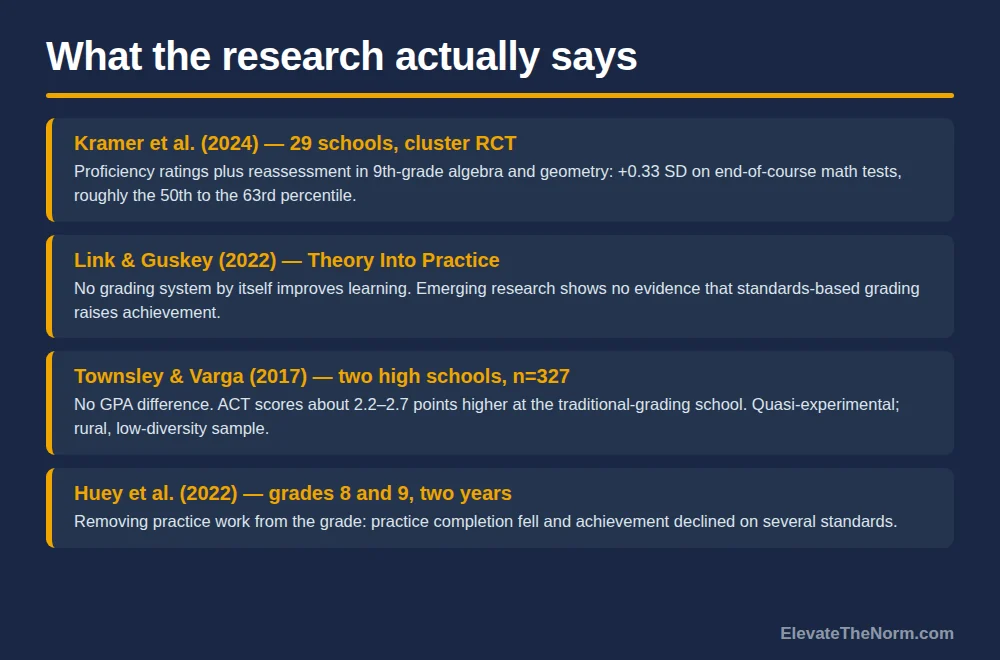
    The strongest evidence for this approach comes from a cluster randomized controlled trial of the PARLO program run by Kramer and colleagues and published in the Journal of Research on Educational Effectiveness. Twenty-nine schools were randomized — 14 treatment, 15 control — with the intervention in ninth-grade algebra and geometry classrooms. Students were rated not-yet-proficient, proficient, or high-performance on each learning outcome, and could reassess any outcome for full credit after further study. The program produced a 0.33 standard deviation improvement on end-of-course mathematics tests, moving the average student from roughly the 50th to the 63rd percentile. The effect was strongest among students who were already more motivated.

    Two caveats on that one. First, PARLO is a defined program with mastery definitions and reassessment built in, not a gradebook layout — the trial tested the whole package. Second, the full published article was not accessible to me, so the figures above come from the study summary published by the Society for Research on Educational Effectiveness rather than from the paper itself. I am citing what I actually read.

    The sobering results

    Laura Link and Thomas Guskey, writing in Theory Into Practice, argue that standards-based grading is best understood as a communication tool and not as an achievement intervention. Their sentence is the one worth keeping: no grading system by itself improves student learning, because grading does not alter curriculum or instruction. They note that the practice remains largely unstudied, that emerging research shows it produces a stronger relationship between grades and external measures, and that no evidence indicates it improves achievement.

    Four research summaries on standards-based grading: Kramer 2024 cluster randomized trial, Link and Guskey 2022, Townsley and Varga 2017, and Huey 2022
    Five peer-reviewed sources, and they do not agree with each other.

    Matt Townsley and Matt Varga compared two demographically similar Midwestern high schools of about 450 students each, one using standards-based grading and one traditional, across the graduating classes of 2015 and 2016. They found no significant difference in math, English, or cumulative GPA — and ACT scores roughly 2.2 to 2.7 points higher at the traditional school. That is a quasi-experimental comparison of two schools with all the confounding that implies, and the authors flag the rural, low-diversity sample themselves. It is not proof that the gradebook caused it. It is also not a result anyone should skip past.

    The broadest context comes from A Century of Grading Research in the Review of Educational Research, an eight-author review of the whole field. Two findings from it matter for anyone building a gradebook. Teachers mix achievement with work habits whether or not their system says they should — even teachers who report supporting standards-based reform report using practices that blend effort and improvement into academic marks. And grades, messy as they are, consistently predict educational persistence and completion better than standardized tests do. The multidimensionality that standards-based grading tries to strip out may be part of what makes a grade useful.

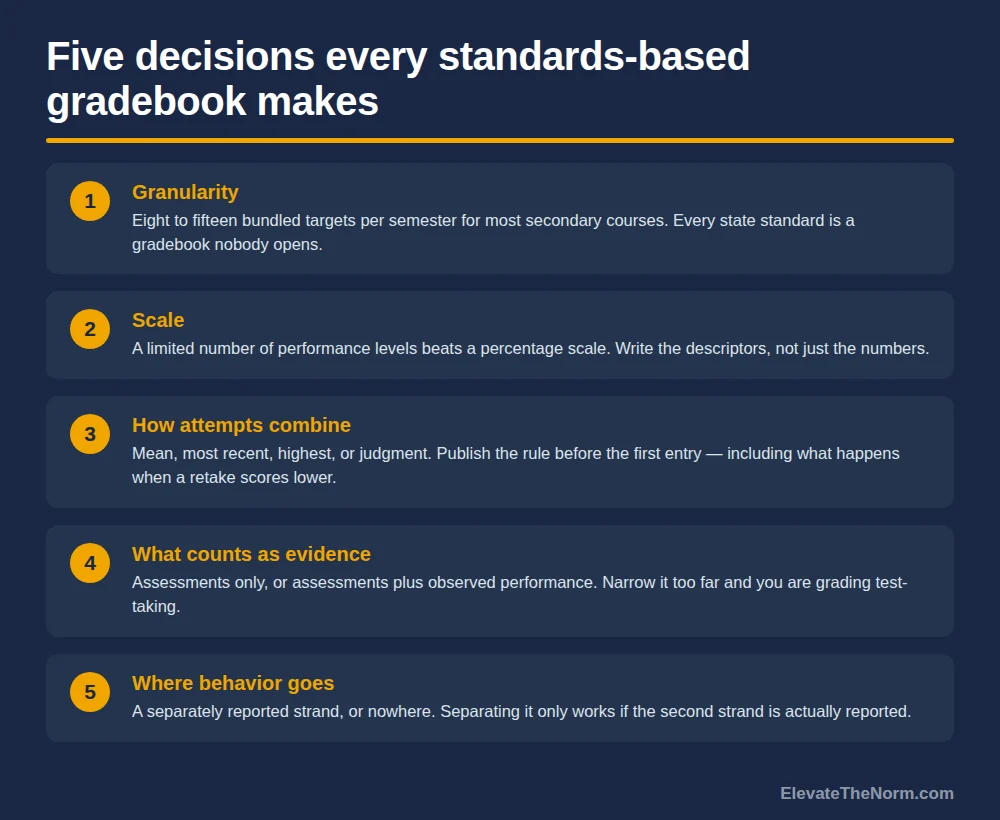
    The five decisions every standards-based gradebook has to make

    Make these five on purpose, write them down, and do not change them midyear. Every failed implementation I have read about failed at one of these, usually by leaving it to be decided case by case.

    DecisionThe optionsWhat to weigh
    1. GranularityEvery state standard, or 8–15 bundled targets per courseToo many rows and nobody reads the gradebook. Too few and the grade stops being diagnostic. Most workable secondary courses land between eight and fifteen per semester.
    2. Scale4-point, 3-level proficiency, or letter equivalentsGuskey argues for a limited number of performance categories rather than percentage scales, to cut down on false precision. The 1–4 scale and its conversion problems are worth reading before you commit.
    3. How attempts combineMean, most recent, highest, or professional judgmentThis is the one students notice. Averaging punishes early struggle. “Most recent” can drop a student for one bad day. Write the rule down and publish it.
    4. What counts as evidenceAssessments only, or assessments plus observed performanceNarrow it too far and you are grading test-taking. Widen it without criteria and you are back to impressions.
    5. Where behavior goesA separate reported strand, or nowhereSeparating academic marks from work habits is one of the three criteria Guskey names. It only works if the second strand is actually reported, not deleted.

    On decision three specifically: students in one large survey complained that a reassessment score replaced a higher earlier score even when it was worse. That is a defensible rule and an indefensible surprise. The rule is not the problem; discovering it after the fact is.

    Five numbered gradebook design decisions: granularity, scale, how attempts combine, what counts as evidence, and where behavior is reported
    Decide these on purpose, write them down, and hold them all year.

    Should practice work count in the grade?

    The evidence says be careful, and it points the opposite direction from the standard advice.

    The usual argument is that practice is formative, so it should not be graded — students will do it because it helps them. A two-year study by Huey and colleagues in Studies in Educational Evaluation tested exactly that policy change with 122 eighth graders and 123 ninth graders in year-long geometry courses. When practice work was removed from grade computations, completion of practice work decreased overall, and student achievement declined on several of the standards being assessed. The authors concluded that process grades are likely essential to maintaining achievement in that population, and noted their result contradicts reform advocates who claim engagement holds regardless.

    That is one study of high-achieving students in one subject, and it should not be read as a verdict on the whole question. But it is a direct test of a specific gradebook decision, and it came out against the conventional answer. If you take practice out of the grade, put something else in its place that makes the practice visibly matter, and watch your completion rates rather than assuming.

    Students see the same thing from the other side. In a study of 478 students at one high school, the most common complaint about standards-based grading was that homework should count — not because they wanted easy points, though some did, but because with few graded items the whole grade rested on two or three assessments. “There are so few points available on quizzes and tests” is a fairness objection, and it is a reasonable one.

    How do you convert to a letter grade when the office needs one?

    Publish the conversion rule before the first grade goes in, and use the same one every time.

    Most secondary teachers running this system do not control the report card, so the standards-based gradebook feeds a traditional one. That translation is where trust gets lost, because a student who sees a row of 3s and receives a B wants to know how. Three workable approaches:

    1. A published crosswalk. A fixed table — all 4s and 3s with no 2s is an A, and so on. Simple, transparent, and slightly blunt at the boundaries.
    2. A proficiency threshold. The grade is determined by the proportion of standards at proficient or above, with a stated floor of standards that must be met regardless.
    3. A weighted composite with named priority standards. More precise, harder to explain, and worth it only if you will actually explain it.

    Whichever you choose, the parent-facing version has to be one paragraph long. Brookhart and colleagues found that many parents attempt to interpret standards-based labels by translating them back into letter grades regardless of what the school intends. Give them the translation rather than letting them invent one.

    What breaks, and when

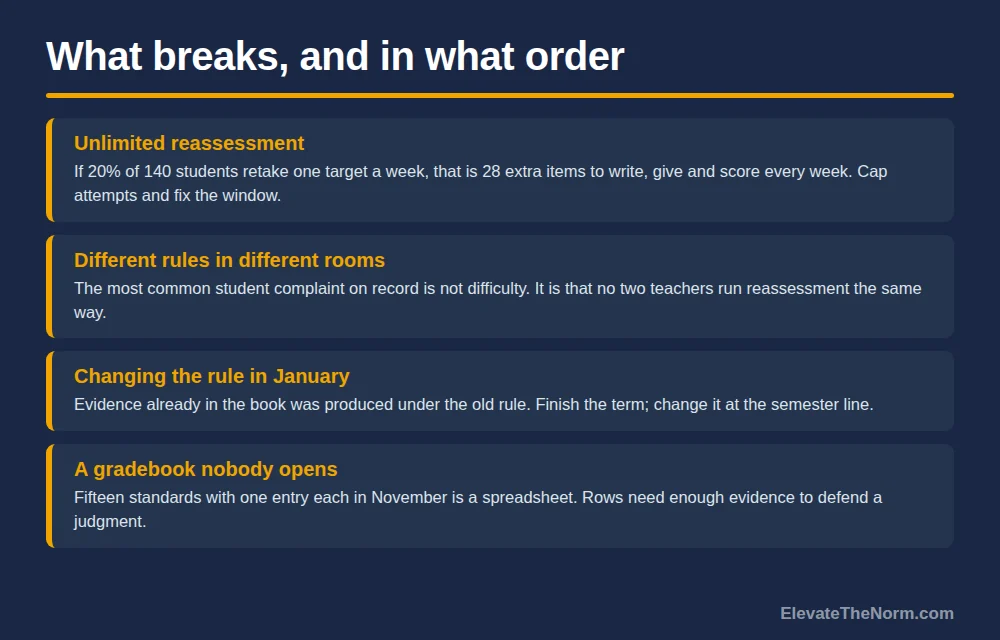
    Reassessment load, teacher-to-teacher inconsistency, and midyear rule changes — in that order.

    • Unlimited reassessment. Guskey and Link warn directly that unlimited retakes create burdensome workloads, and that retaking a poorly aligned assessment does not produce learning regardless of how many attempts you allow. Cap attempts, require evidence of new study before a retake, and put reassessment in a fixed window rather than on demand.
    • Different rules in different rooms. Students in the 478-student survey said it repeatedly: nobody communicates the same, there is no standardization, some teachers appear to make reassessment deliberately difficult. Within a department, the five decisions above should have one answer, not six.
    • Changing the rule in January. A grading rule changed midyear is functionally retroactive, because the evidence already in the book was produced under the old one. If a decision is wrong, finish the term and change it at the semester line.
    • A gradebook nobody opens. Fifteen standards with one entry each in November is not a standards-based gradebook, it is a spreadsheet. The system only pays off if there is enough evidence per row to make the row mean something.

    Before you do this alone: what it costs beyond your own room

    A standards-based gradebook inside one classroom in a traditional building is a bigger undertaking than it looks, and four things will bite you.

    • The transcript is not yours. Whatever you do internally, a letter grade and a GPA leave your room and go on a document that affects class rank, scholarship eligibility, and athletic eligibility. Confirm with your counseling office how your marks will be recorded before you change how you produce them, not in May.
    • Your software may not support it. Most district gradebooks are built around assignments with point values. Some can be bent into standards; some can only fake it with categories. Find out which you have before you design a system it cannot hold, because a parallel spreadsheet you maintain by hand is a system that dies in November.
    • Students transfer. A student who arrives in week twelve arrives with points, and a student who leaves takes your proficiency levels into a building that will not know what they mean. Have a stated rule for both directions.
    • Reassessment is the real labor cost. Be concrete about it before you promise anything. If 20% of 140 students reassess one target a week, that is 28 additional items to write, administer, and score every week, on top of everything else. That number is why reassessment windows and attempt caps exist, and it is why Guskey and Link warn that unlimited retakes become burdensome.

    There is an instructional point buried in that last one that a coach would raise immediately. Reassessment only works if you have more than one assessment item per target that genuinely measures the same thing. If the retake is the same quiz, you are measuring memory of a quiz. If the retake is harder, you are punishing the student for needing it. Building a second and third form for each priority standard is the unglamorous prerequisite, and it is most of the actual work of this system.

    Four failure points for a standards-based gradebook: unlimited reassessment workload, inconsistent rules between teachers, midyear rule changes, and too little evidence per standard
    In roughly this order, and usually by midyear.

    None of this is an argument against doing it. It is an argument for doing it with the department and the counseling office rather than in private, and for starting with one course rather than a schedule.

    A setup checklist you can work through in an afternoon

    1. List the course’s learning targets and bundle them down to 8–15 per semester. Write each one in student-facing language. If you cannot say it in a sentence a fifteen-year-old understands, it is still a standards document and not yet a target.
    2. Pick the scale and write the descriptors. Not just the numbers — what a 3 actually looks like in this course. Rubric templates are the fastest way in.
    3. Write the five decisions on one page. Granularity, scale, how attempts combine, what counts as evidence, where behavior goes. Date it.
    4. Build the columns before the semester, not during it. Retrofitting a gradebook in week six means hand-remapping every entry already in it.
    5. Decide the reassessment window and the entry requirement now. Which days, how many attempts, what a student must show to earn one.
    6. Write the one-paragraph explanation for families. What the numbers mean, how they become a letter, and when. Send it in the first two weeks rather than after the first complaint — the same front-loaded contact that works for everything else works here.
    7. Pick your check date. A day in week eight when you open the gradebook and ask whether any row has too little evidence to defend, and whether your conversion rule still produces grades you believe.

    What to tell students, and what to tell families

    Tell students the rules before the first entry, and show them the gradebook. Most of the recorded student resistance to this system is not resistance to rigor. It is the experience of being graded by a machine whose rules nobody explained.

    Grades 6–12 students can handle the actual explanation, and they deserve it. Say what the scale means. Say how repeated attempts combine, including the case where a retake scores lower. Say which standards carry the most weight. Say what happens to homework. Then hold to it, because the fastest way to lose a room under this system is to make an exception for one student and get caught.

    For families, lead with the translation and the one thing that changed. If your building is also making the shift, the arguments against are worth knowing as well as the arguments for — the case that standards-based grading does not work is an honest summary of the objections, and a teacher who can state the objection fairly is more persuasive than one who cannot.

    What to do next

    Before you rebuild anything, write the five decisions on one page and show it to one colleague who teaches the same course. Most of the damage in a standards based grading gradebook happens because a decision was never made explicitly — it just emerged from whatever the software defaulted to and whatever felt fair in the moment.

    Then build one unit, not one semester. Run it, look at how many entries each row actually accumulated, and see whether your conversion rule produced a grade you would defend to a parent. Adjust once, at the unit boundary. That is a slower start than a summer rebuild and it is the version that is still running in April. When the unit is done, a short structured reflection on what the rows told you is worth more than another round of reorganizing the columns.

    Frequently Asked Questions

    What is a standards based grading gradebook?

    A gradebook organized by learning target rather than by assignment. Each row is a standard and each entry is evidence a student produced for that standard, so a single test can feed six different rows and three assignments over a month can feed one. The practical test is whether the gradebook answers “what can this student do” rather than “what did this student turn in.” If the rows are still tasks with point values, the labels have changed and the system has not.

    How many standards should be in the gradebook?

    For most secondary courses, eight to fifteen bundled targets per semester. Listing every state standard produces a gradebook nobody opens, including you. Bundling too aggressively produces a grade that is no more diagnostic than a single letter. The working check is whether each row will accumulate enough evidence by the end of the term to defend a judgment — a row with one entry in November is not measuring anything.

    Should homework and practice work count toward the grade?

    The evidence is more cautious than the usual advice. A two-year study of a policy change in secondary mathematics found that when practice work was removed from grade computations, practice completion fell and achievement declined on several standards. Students in a separate survey said the same thing from their side: with few graded items, removing practice makes the entire grade rest on two or three assessments. If you take practice out, replace it with something that makes practice visibly matter and watch your completion rates.

    How should multiple attempts at the same standard be combined?

    Pick one rule, publish it before the first entry, and do not change it midyear. Averaging punishes early struggle, which is the thing the system is supposed to fix. “Most recent” can drop a student for one bad day. Highest score removes the incentive to prepare. Many teachers use most-recent with professional judgment for outliers. Whichever you choose, students need to know in advance what happens when a retake scores lower than the original — that specific surprise is one of the most common student complaints on record.

    Does standards-based grading raise test scores?

    The evidence is mixed and should be described that way. A cluster randomized trial across 29 schools of a proficiency-plus-reassessment program in ninth-grade math reported a 0.33 standard deviation gain on end-of-course tests. A comparison of two Midwestern high schools found no GPA difference and ACT scores roughly 2.2 to 2.7 points higher at the traditional school. Guskey and Link argue no grading system improves learning on its own, because grading changes neither curriculum nor instruction. What it reliably changes is what the grade means.

    How do you turn standards-based marks into a letter grade?

    With a published conversion rule applied identically every time. The three workable approaches are a fixed crosswalk table, a proficiency threshold based on the proportion of standards met, and a weighted composite with named priority standards. Write the parent-facing version in one paragraph and send it in the first two weeks. Research on grading found that many parents translate standards-based labels back into letter grades regardless of what the school intends, so it is better to hand them the translation than to let them invent one.

    What is the biggest implementation mistake?

    Leaving the rules implicit and letting them emerge from whatever the software defaults to. The five decisions — granularity, scale, how attempts combine, what counts as evidence, and where behavior goes — need explicit written answers that are the same across a department. Students surveyed about standards-based grading complained most about inconsistency between teachers, not about difficulty. Unlimited reassessment is a close second; it produces a workload that collapses by midyear.

    Can one teacher run this if the rest of the school does not?

    Yes, with three conversations first. Confirm with the counseling office how your marks will be recorded on the transcript, since class rank, scholarships, and athletic eligibility depend on a document you do not control. Confirm that your district gradebook can actually hold standards rather than categories pretending to be standards. And agree on a rule for students who transfer in or out mid-term. Start with one course rather than a full schedule.

    Sources

    • Link, Laura J., and Thomas R. Guskey. “Is Standards-Based Grading Effective?” Theory Into Practice, 2022. Full text (PDF).
    • Brookhart, Susan M., Thomas R. Guskey, Alex J. Bowers, James H. McMillan, Jeffrey K. Smith, Lisa F. Smith, Michael T. Stevens, and Megan E. Welsh. “A Century of Grading Research: Meaning and Value in the Most Common Educational Measure.” Review of Educational Research, vol. 86, no. 4, 2016, pp. 803–848. Full text (PDF).
    • Townsley, Matt, and Matthew Varga. “Getting High School Students Ready for College: A Quantitative Study of Standards-Based Grading Practices.” Journal of Research in Education, vol. 28, no. 1, 2017, pp. 93–112. Full text (PDF).
    • Huey, Maryann E., Peter R. Silvey, Amanda G. Vaughan, and Anne L. Fisher. “Assessing the Impact of Standards-Based Grading Policy Changes on Student Performance and Practice Work Completion in Secondary Mathematics.” Studies in Educational Evaluation, vol. 75, 2022, article 101211. Journal listing.
    • Peters, Randal, Jerrid Kruse, Tom Buckmiller, and Matt Townsley. “‘It’s Just Not Fair!’ Making Sense of Secondary Students’ Resistance to a Standards-Based Grading.” American Secondary Education, vol. 45, no. 3, 2017, pp. 9–28. Full text (PDF).
    • Kramer, Karen, Jill Posner, Alexander Browman, Rebecca Lawrence, Jennifer Roem, and Kathryn Krier. “The Impact of a Standards-Based Grading Intervention on Ninth Graders’ Mathematics Learning.” Journal of Research on Educational Effectiveness, 2024. Figures cited here come from the Society for Research on Educational Effectiveness study summary, which is what was read; the full article was not accessible.

    A note on the evidence. Five of the six sources above are peer-reviewed, and they do not agree with each other. That is the accurate state of this field, and a gradebook decision made on the assumption that the research is settled is a decision made on something that is not true.


    About Clay Shumate

    By Clay Shumate — Clay Shumate is a certified secondary Social Studies teacher in the public schools of West Alabama, with seven years of classroom experience, a B.A. in History, and an M.Ed. in Secondary Education. He writes about project-based learning, student responsibility, respect, and practical ways to hold young people to a higher standard while giving them room to learn from mistakes. He is a member of the Society of Professional Journalists and writes to its Code of Ethics; this site’s editorial standards and corrections policy are published in full.

  • Teacher Burnout Symptoms: Telling the Real Thing From a Hard Semester

    Teacher Burnout Symptoms: Telling the Real Thing From a Hard Semester

    Teacher burnout has three symptoms, not a long list: exhaustion that sleep doesn’t fix, a growing distance from the students and the work, and a creeping sense that nothing you do matters. The World Health Organization defines it that way, and the definition is occupational. Ordinary tiredness lifts on a break. Burnout is still there Monday.

    Most articles about this hand you twenty bullet points and a score at the bottom. That is the wrong shape for the problem. The research behind the word is narrow, the boundary between burnout and ordinary exhaustion is genuinely blurry, and the boundary between burnout and something that needs a doctor is not a thing a web page gets to rule on. So this page does the narrow thing: what the three symptoms are, what they look like in a middle or high school classroom, where the honest limits of the word sit, and what to do with whatever you just recognized.

    Key Takeaways

    • Three symptoms, not twenty. Exhaustion, mental distance or cynicism, and reduced professional efficacy. Everything else on the usual lists is downstream of those three.
    • The tell is what a break does. Tiredness responds to a weekend. WHO defines burn-out as chronic workplace stress “that has not been successfully managed” — the stress is ongoing, so the symptoms come back with the job.
    • It is an occupational condition, and WHO says so explicitly. Burn-out “is not classified as a medical condition” and “should not be applied to describe experiences in other areas of life.” If it followed you home into everything, the word has stopped fitting.
    • You can have one symptom without the others. Maslach and Leiter describe in-between profiles — exhausted but not cynical, cynical but not exhausted. Exhaustion alone is not the whole thing.
    • The overlap with depression is real and unresolved. A review of 92 studies found exhaustion correlating with depressive symptoms about as strongly as with the other burnout dimensions.
    • There is no validated cutoff. Burnout inventories “lack a clinically validated threshold or cutoff values” — which is why no quiz can tell you what you have.
    • Common, and not fixed. In RAND’s nationally representative 2025 survey, 53% of teachers reported burnout — down from 60% the year before.

    Free Download · 2-page PDF

    The Teacher Burnout Noticing Sheet

    Page one: the three symptoms, and a four-row table for telling a hard semester from something that is not lifting. Page two: the three-column noticing sheet with room to write, and the one-sentence ask. It returns no score, it is not a screening instrument, and nothing on it can tell you what you have.

    Download the free PDF

    Free. No email address required. Designed for grades 6–12. Browse every printable in Your Free Library.

    What Are the Symptoms of Teacher Burnout?

    Three: energy depletion or exhaustion, increased mental distance from the job along with cynicism or negativism about it, and reduced professional efficacy. That is the entire official list, and it is worth knowing that it is that short.

    Numbered three-card chart listing energy depletion or exhaustion, mental distance and cynicism, and reduced professional efficacy, each with concrete examples of what the symptom looks like in a middle or high school classroom.
    The whole official list is three items long. Everything else is downstream of these.

    The wording comes straight out of the ICD-11, where the World Health Organization added burn-out in 2019 as an occupational phenomenon. Christina Maslach, whose research framework the WHO definition is built on, has described the same three as “an overwhelming exhaustion, feelings of cynicism and detachment from the job, and a sense of ineffectiveness and lack of accomplishment.” Same three things, different words. The full definitional picture — the three dimensions and who actually holds the levers on each of them — sits on the pillar page for this series.

    Notice what is not on the list. Not headaches. Not Sunday night dread. Not snapping at your own kids. Those things are real and they travel with burnout constantly, but they are correlates and consequences, not the definition. Keeping that straight matters, because a list of thirty symptoms will always describe you on a bad week in February, and the three-item list will not.

    Is This Teacher Burnout, or Is It Just a Hard Semester?

    If you are in your first year, read this section with the year-one caveat in mind: a first year is genuinely harder than the same job later, for reasons that have nothing to do with you. The clearest practical test is what a genuine break does to it. Regular exhaustion is a debt. You pay it down over a long weekend, a Thanksgiving break, ten days in July, and you come back with something in the tank. Burnout does not behave like a debt, because the thing generating it is still running.

    That is written into the definition rather than being an add-on to it. The WHO calls burn-out a syndrome “resulting from chronic workplace stress that has not been successfully managed.” Chronic and unmanaged. If your hundred-and-fifty-student load, your three preps, your duty schedule and your fourth-period class are identical on August 15 and identical again on January 5, then whatever a break gave you gets spent in about nine days and you are back where you started. Teachers notice this and misread it as a personal failure — everyone else came back rested, what is wrong with me — when it is arithmetic.

    Two rough markers, offered as rough markers and not as criteria. Duration: a hard stretch has edges you can point to, while reviews describe burnout as something that “develops progressively and can eventually become chronic.” And scope: a hard stretch is about this unit, this class, this observation. Burnout is about the work.

    What Do the Three Symptoms Look Like in a 6–12 Classroom?

    Mostly they look like competence. That is the part nobody warns you about. A burned-out secondary teacher is very often still on time, still covering the standards, still getting decent evaluation scores. The symptoms are interior before they are visible, which is why colleagues miss them and why you can miss them in yourself.

    Four-row comparison table contrasting a hard stretch with burnout across what a real break does, how long it has run, what it is about, and where it shows up.
    Four places to look when you are trying to tell one from the other.

    Exhaustion in a secondary building is rarely dramatic. It is sitting in your car in the lot for six minutes before you can make yourself walk in. It is the plan for fifth period being “whatever I did fourth period.” It is grading with the television on because the silence makes it worse, and it is a bone-level reluctance to open your email after 4:00. Physically, the research associates burnout with insomnia, chronic fatigue, headaches, gastric trouble and more frequent infections — so the endless February cold is not nothing.

    Mental distance and cynicism is the symptom that costs students the most, and it is the one that feels most like a personality change. It sounds like these kids instead of my kids. It is finding a student’s excuse annoying before you have finished hearing it. It is writing the referral instead of asking the question, because the question takes eleven minutes you do not have — and to be clear, plenty of referrals are exactly the right call; the symptom is the shift in your own pattern, not the paperwork. The way teachers most often describe this stage is the same each time: becoming a person they do not like, at work, on purpose, because it is the only way they can see to get through the day.

    Reduced professional efficacy is the quietest and the meanest. It is the thought that the unit you spent a weekend building landed nowhere, that the kid you kept after class is going to fail regardless, that your good years were earlier. Those are the symptom talking, and it is worth naming loudly that it lies. Reduced efficacy is a feature of the condition, not an assessment of your teaching, and burned-out teachers routinely rate their own work far below what anyone observing it would say.

    That cuts one way only, and the distinction matters if you work with a coach. “The symptom is lying” is not a reason to wave off real feedback about your instruction. Sometimes a unit did land nowhere and there is something to fix. The difference is specificity: an accurate judgment is about one lesson and comes with a next move, while the symptom is global, permanent and has nothing attached to it.

    One practical note on the exhaustion piece. A large share of a secondary teacher’s daily fatigue is decision fatigue rather than effort — a hundred small rulings about bathroom passes, late work, seating, phones and volume, made fresh every period. Routines that make most of those decisions in advance do not cure burnout, but they take a real load off the part of you that is most depleted.

    Can You Have One Symptom and Not the Others?

    Yes, and this is one of the more useful things the research has to say. Burnout is not a switch. Maslach and Leiter describe a set of profiles between full engagement and full burnout: people who score high on exhaustion alone are overextended; people high on cynicism alone are disengaged. Only the profile that is high on all three is burnout as the framework defines it.

    That distinction has teeth on a Tuesday. If you are wiped out but you still light up when third period walks in, you are in a different situation from the colleague who has plenty of energy and no patience left. Both need something. They do not need the same thing, and advice written for one tends to insult the other.

    The mixed picture shows up in teacher samples too. In a Finnish study of 149 subject teachers, about 70% landed in a profile the authors called engaged-burnout — moderate engagement sitting right alongside elevated exhaustion, cynicism and inadequacy, with the remaining 30% highly engaged and low on all three. Caveats belong with that number: 149 teachers in one metropolitan area, mostly high school, cross-sectional, self-reported, and Finland is not the United States. It is not a prevalence estimate. What it shows is that caring about the work and being depleted by it coexist routinely — worth knowing if you have been treating your own enthusiasm as proof you must be fine.

    Are Teacher Burnout Symptoms the Same Thing as Depression?

    No — but the honest answer is that the line is contested, and anyone who tells you it is clean is overselling. This is the single most important thing on this page and the part most articles skip.

    The standard distinction is the one Maslach and Leiter give: burnout is “job-related and situation-specific, as opposed to depression, which is more general and context-free.” Burnout is about the work. Depression is about everything. That is a real difference and it is usually the right frame.

    Now the contrary evidence, which Rule 4 of this site says gets reported rather than buried. Bianchi, Schonfeld and Laurent reviewed 92 studies — 67 cross-sectional with 58,785 participants and 25 longitudinal with 36,334 — and found the exhaustion dimension correlating with depressive symptoms about as strongly as it correlates with the other burnout dimensions. In several of the studies they cite, exhaustion tracked depression more closely than it tracked reduced personal accomplishment, which is not what you would expect if burnout were one tidy construct. In one of their own samples, up to 90% of people identified as burned out also met criteria for a provisional depression diagnosis. Their conclusion is that evidence for burnout being clearly distinct from depression is inconsistent, and that the absence of agreed diagnostic criteria for burnout is a large part of why.

    Other researchers push back and argue burnout holds up as its own construct. That argument is live and it is not settled. What it means for you is simple and it is not a hedge: the question “is this burnout or is it depression?” cannot be answered by reading a web page, including this one. It is answered by a person with training, in a room, who can ask follow-up questions. If what you are feeling shows up in your sleep, your appetite, your relationships, or in things you used to enjoy that have nothing to do with school, that is not a signal to read more articles. Talk to your doctor or a counselor.

    How Common Are These Symptoms Among Teachers?

    Common enough that feeling this way says very little about you personally. In RAND’s State of the American Teacher survey, fielded to the American Teacher Panel between late January and early March 2025 with 1,419 nationally representative K–12 public school teachers, 53% reported feelings of burnout — down from 60% in 2024. Frequent job-related stress ran higher still, at 68% of female teachers and 46% of male teachers. That 53% is not the same number as the ones in the headlines, and it is worth seeing exactly how the four best-known figures differ before you repeat any of them.

    Read that number with its measurement attached, because this is where burnout statistics go wrong. RAND did not administer a clinical instrument. Teachers were counted as reporting burnout if they agreed with at least two of four statements about enthusiasm and satisfaction at work — a reasonable survey approach, and not the same as a score on the Maslach Burnout Inventory, which is not a diagnosis either. Any “half of teachers are burned out” headline carries an invisible asterisk about what got measured, and the drop from 60% to 53% in one year is a reminder that these figures move.

    Why You Cannot Diagnose Yourself From a Symptom List

    Because the instruments the field actually uses do not have a validated line to cross. A 2022 review of burnout theory and measurement puts it plainly: most instruments “lack a clinically validated threshold or cutoff values for burnout diagnosis.” There is no blood test. There is no number that flips you from not-burned-out to burned-out.

    Three-column worksheet graphic headed Exhaustion, Distance and Efficacy with a prompt under each, and a footer strip listing the next steps.
    A noticing sheet returns no score. That is the point of it, not a limitation.

    This is why there is no burnout quiz on this site and will not be one. A ten-question widget that returns “You are moderately burned out” is inventing a threshold the research has not established, attaching it to your name, and sending you off with a label instead of a next step. Christina Maslach has said for years that burn-out “has become a popular term rather than a theoretical or clinical term” and that it is “most properly applied to the workplace.” Her read on what helps is blunt: situational solutions generally work better than individual ones — it is usually more productive to change the conditions than to counsel the person inside them.

    So what is a symptom list for? Noticing. It is a vocabulary for something you have been carrying without a name, and a starting point for a specific conversation — with a doctor, a counselor, a spouse, a department head who can move one thing on your plate. That is useful. It is just not a diagnosis, and it should not pretend to be one.

    What Should You Do With What You Just Recognized?

    Write it down in three columns, then take one column to one person. Not a score. A description specific enough that somebody can act on it.

    Here is the whole framework. It takes about fifteen minutes and it is deliberately boring.

    1. Three columns on one page: Exhaustion, Distance, Efficacy. One per symptom. Nothing else on the page — no scale, no total. Keep it on paper and off the school network; this is yours, and a district device is not a private place to write it.
    2. Under each, write what you have actually noticed in the last month, in concrete terms. Not “I’m tired.” “I have not planned anything new since September.” Concrete is what makes the next steps possible.
    3. Put a rough start date on each column. Three weeks and eight months are different problems with different answers.
    4. Ask which column is heaviest. If it is Distance, the load is relational and the fix usually involves people. If it is Exhaustion, it is demands and time. If it is Efficacy, some of it is the symptom lying, and some of it is a real feedback problem worth fixing.
    5. Name the one condition sitting behind the heaviest column — the duty, the caseload, the prep, the committee, the one class with no support in it.
    6. Take that one thing to one person who can move it, in one sentence, with an end date. “Can someone else take morning duty through the end of the semester?” is a request. “I’m drowning” is not, and it puts the burden of inventing a solution on whoever hears it.
    7. Set a check-back six weeks out. One line: did it change, and what moved into the gap?

    Two honest limits on that framework. It is a noticing tool, not an instrument, and it does not return a result. And it assumes there is somebody who can actually grant the ask — which is often not true. The assistant principal you hand it to may have no more control over your caseload than you do — though the levers a school leader actually holds are more numerous than most teachers assume, and if the person above you is itself the condition, the one-sentence ask has nowhere to land. That is a real dead end and it deserves saying rather than glossing. What is left when it happens is still not nothing: your association or union representative, a colleague outside your building, your district’s employee assistance program if it has one, and a doctor. Those are all people, and people are the point.

    It is also worth knowing what those individual asks look like from the other end. One teacher describing one duty is a scheduling problem. Nine teachers in the same building describing the same three conditions is a staffing and workload finding, and it is the only version of this that a principal or a central office can actually act on at scale. Writing yours down specifically is what turns a mood into data somebody can use.

    Where you go from here depends on where you are. If most of what you recognized is still mild and intermittent, you are on the prevention side of this, and the things that keep the tank from emptying in the first place are the right reading. If you are past that — if a summer already failed to fix it — then the honest answer is months of structural change rather than a better morning routine, and the sooner you start the shorter it runs. And whichever it is, keeping a short written record of your own weeks is how most teachers notice any of this before it gets loud, because the drift from my kids to these kids is nearly impossible to see from inside it and obvious on a page from six months ago.

    Last thing, and it is the point of the page. Recognizing yourself in a symptom list is not a verdict on whether you are good at this. It is information about the fit between a person and a set of working conditions. That fit changes when somebody describes the problem precisely enough that it can be worked on. You are allowed to be the person who does that.

    Before you go: grab the free Teacher Burnout Noticing Sheet (PDF) — ElevateTheNorm.com branded, printable, no email required, and not a screener.

    Frequently Asked Questions

    What are the first signs of teacher burnout?

    Usually exhaustion, and usually the kind that a weekend no longer clears. It tends to show up before the other two symptoms and it is the one people notice first in themselves. What follows, often by months, is mental distance — finding that you have less patience than you used to, that students have quietly become “these kids” rather than “my kids.” Reduced professional efficacy, the sense that none of it is working, usually arrives last. There is no fixed order and plenty of teachers never develop all three. Maslach and Leiter describe in-between patterns specifically: high exhaustion on its own is what they call the overextended profile, and high cynicism on its own is the disengaged profile. Neither is the full thing, and both are worth taking seriously.

    How do I know if it is burnout or just a hard semester?

    Ask what a real break does to it. Ordinary exhaustion is a debt you can pay down over a long weekend or a summer; you come back with something in the tank. Burnout does not behave that way, because the WHO defines it as chronic workplace stress that has not been successfully managed — the source is still running, so whatever the break gave you is gone within a couple of weeks. Two softer markers: a hard stretch has edges you can point to, while burnout has usually been building for months; and a hard stretch is about this unit or this class, while burnout is about the work itself. These are rough guides for noticing, not criteria for deciding.

    Is there a reliable teacher burnout test or quiz?

    No, and that is a statement about the science rather than about the quizzes. A 2022 review of burnout measurement found that most instruments “lack a clinically validated threshold or cutoff values for burnout diagnosis.” There is no agreed number that separates burned out from not burned out. Even the Maslach Burnout Inventory, the most widely used research instrument, is a research measure and not a diagnosis. A web quiz that returns “you are moderately burned out” has invented a threshold that the field has not established. That is why this site publishes no burnout quiz. The free worksheet linked on this page is a noticing sheet — it returns no score and it is not a screening instrument.

    When are these symptoms a reason to see a doctor or a counselor?

    When they stop being about work. The WHO is explicit that burn-out “refers specifically to phenomena in the occupational context and should not be applied to describe experiences in other areas of life.” So if what you are feeling shows up in your sleep, your appetite, your relationships, or in things you used to enjoy that have nothing to do with school, the word has stopped fitting and the next step is a person rather than an article. The research supports taking that seriously: a review of 92 studies found the burnout–depression boundary to be genuinely blurry, with one sample finding that up to 90% of people identified as burned out also met criteria for a provisional depression diagnosis. No page can tell you which you have. A clinician can ask follow-up questions, and that is the whole difference.

    Can a teacher be burned out and still be good at the job?

    Routinely, and this is why burnout goes unnoticed in buildings for years. A burned-out secondary teacher is very often still on time, still covering the standards, and still getting solid evaluation scores. Reduced professional efficacy is a symptom — a feeling about your work — and it is frequently far harsher than anything an observer would say. In one Finnish study of 149 subject teachers, around 70% fell into a profile the authors named engaged-burnout: genuine engagement sitting right next to elevated exhaustion and cynicism. That was a small cross-sectional sample from one country and not a prevalence figure, but it makes the point that caring about the work and being depleted by it are not opposites.

    How does teacher burnout affect students in the classroom?

    The dimension that reaches students most directly is mental distance, because it changes how many follow-up questions get asked. A depleted teacher is likelier to process the behavior than the reason behind it — the eleven-minute conversation is the first thing to go when there is nothing left. Students often read that shift as being disliked, which is rarely what is happening. Parents who notice it are not imagining things, and it is a workload and staffing problem rather than a character problem. The clearest thing a family can do is raise the specific change they have noticed with the school rather than with the teacher alone, because the conditions behind it are usually set above the classroom.

    If my teacher seems burned out, is that my fault as a student?

    No. Burnout is defined as a mismatch between what a job demands and the resources available to meet it — class sizes, preps, duties, support, time — and none of those are set by students. A teacher who is short with the room is almost never short with you specifically. You are also not responsible for managing an adult’s workload, and you should not take that on. What is fair to expect is that you still get taught well and treated decently, and if that is genuinely not happening, telling a counselor or another trusted adult in the building is the right move. That is not tattling. It is information the school needs and cannot get any other way.

    What should an administrator do with a teacher describing these symptoms?

    Treat the description as information about working conditions, not as a performance conversation. The research consistently points at the job rather than the person: Christina Maslach’s own conclusion after decades of this work is that situational solutions generally work better than individual ones, and that it is more productive to change conditions than to counsel the person inside them. Practically, that means asking which specific demand is heaviest and whether any part of it can be moved, reassigned or ended with a date attached. It also means noticing patterns: one teacher describing one duty is a scheduling problem, while nine teachers describing the same three conditions is a staffing finding. A wellness newsletter does not change the equation. A removed duty does.

    Naming it is the first question. What to do about it is the second, and for some people that question ends with leaving. If you are there, the federal data on where teachers go next is a better starting point than a list of career ideas — not least because most of them do not leave K–12 at all. If you came looking for a number rather than a description, the instruments themselves are worth a look first.

    Sources

    Every link above was opened and checked on September 23, 2026. Where a figure could not be read verbatim in the source document, it is not quoted here. This article describes burnout as an occupational condition. It is not medical advice, it is not a diagnosis, and neither this page nor the linked worksheet is a screening instrument.

    Recognising the symptoms is one question; where the load is coming from in the first place is a different one, with different evidence behind it — including what the national surveys establish and what they quietly do not.


    About Clay Shumate

    By Clay Shumate — Clay Shumate is a certified secondary Social Studies teacher in the public schools of West Alabama, with seven years of classroom experience, a B.A. in History, and an M.Ed. in Secondary Education. He writes about project-based learning, student responsibility, respect, and practical ways to hold young people to a higher standard while giving them room to learn from mistakes. He is a member of the Society of Professional Journalists and writes to its Code of Ethics; this site’s editorial standards and corrections policy are published in full.

  • How to Recover From Teacher Burnout (When the Summer Didn’t Fix It)

    How to Recover From Teacher Burnout (When the Summer Didn’t Fix It)

    You recover from teacher burnout by changing the job, not by toughening up. Subtract a recurring demand, get real mental distance from work on ordinary weeknights, make one specific ask of the person who can grant it, and give it months rather than a long weekend. Recovery is slow, uneven, and mostly structural.

    That is not the answer most of us want. The one we want is a habit — a morning routine, a hard stop at 4:00 — because a habit is something you can start on Monday without asking anybody for permission. The research is not especially kind to that hope, and it is not useless either. This page is about the difference, and about what moves once you are past the point where prevention advice helps.

    Key Takeaways

    • Recovery is a different problem from prevention. Prevention keeps the tank from emptying. Recovery starts after it is empty, and advice for one is often useless for the other.
    • Summer does not do the work. In a Dutch study tracking employees ten times around a long vacation, well-being peaked on the eighth day away and had entirely faded by the first day back.
    • Detachment is the best-supported off-job lever. A meta-analysis of 91 samples and 38,124 employees found mentally switching off from work tracked lower exhaustion, less fatigue and better sleep — though the data are correlational.
    • Subtract before you add. Burnout is a mismatch between demands and resources. Ending one recurring demand moves that equation further, and costs less, than adding one more practice to an already full life.
    • Give it months, and expect an uneven line. In a Swedish follow-up of people treated for clinical exhaustion, recovery was long and fluctuating, and about a third still met the criteria six to ten years later.
    • Programs aimed at the individual teacher help a little. Across 23 controlled trials the overall effect was d = 0.18 — small, real, and close to zero on the cynicism dimension.
    • No web page can tell you what you have. If it follows you home into sleep, appetite, and things that have nothing to do with school, that is a conversation with a person.

    Free Download · 2-page PDF

    The Teacher Burnout Recovery Plan

    A demand audit on page one, the four recovery experiences and a check-back log on page two, and a place to write the one specific ask. A planning worksheet — not a screening tool, not a score, and nothing on it can tell you what you have.

    Download the free PDF

    Free. No email address required. Designed for grades 6–12. Browse every printable in Your Free Library.

    How Do You Actually Recover From Teacher Burnout?

    You change the demands, the resources, or both — and then you wait longer than you think you should have to. There is no version of this where the job stays identical and you come back different.

    The reason is in the definition. The World Health Organization calls burn-out “a syndrome conceptualized as resulting from chronic workplace stress that has not been successfully managed,” and says plainly that it is not classified as a medical condition and refers specifically to the occupational context. It is a work problem. Christina Maslach, whose framework has organized this field for forty years, puts the mismatch in six places a job and a person come apart: workload, control, reward, community, fairness and values. Her conclusion after decades of it is blunt: organizational intervention can be more productive than individual intervention.

    Which puts a teacher in an awkward spot. The biggest levers belong to the building, and you still have to do something on Monday. So the honest framing is not “seven habits that will fix you.” It is: here is the part of the equation you can reach, roughly what it is worth, and what to ask someone else for.

    Why Didn’t the Summer Fix It?

    Because time off restores you and then hands you straight back to the thing that emptied you. Vacation works while you are on it. It is not a treatment for the conditions you return to.

    One study makes this uncomfortably concrete. De Bloom, Geurts and Kompier tracked 54 Dutch employees at ten points around a long vacation — before, during, the first day back, and weekly for a month after. Health and well-being climbed during the break and peaked on the eighth day. Then, in the authors’ own words, “on the first day of work resumption, positive vacation effects on H&W have already entirely faded out.”

    Two caveats, because this gets repeated badly. That was 54 people in mixed occupations, not teachers, and a study that small should move your expectations rather than settle anything. And “faded out” does not mean the break was pointless — it means the gain was a state, not a cure. So if you rested all summer and walked back into October feeling exactly the same, nothing is wrong with you. You rested. You did not change anything that was doing the draining.

    How Long Does Recovery From Teacher Burnout Take?

    Nobody can give you a number, and anybody who does is guessing. What the research supports is a direction: months rather than weeks, uneven rather than steady, with setbacks that are part of the shape instead of evidence you failed.

    The closest thing to a long view comes from Sweden, where severe stress-related exhaustion is a clinical diagnosis in its own right. Aronsson and colleagues interviewed 38 people six to ten years after they were treated at a stress rehabilitation clinic. They described what the paper calls a long and ongoing process where recovery activities are needed every step of the way — a fluctuating path, not a ramp. And approximately one third of the participants still fulfilled the criteria for exhaustion disorder at that follow-up.

    Read that carefully, because it is easy to misread toward despair. Those 38 people had a clinical diagnosis severe enough to land them in a rehabilitation program — not the same condition as the occupational burnout the WHO describes, and not a forecast for a teacher who is exhausted in April. It is a small, self-selected Swedish sample and the authors call their own figure tentative. What it is good for is this: if even the severe end takes years and wobbles, a six-week timeline from a blog post is a made-up number.

    The practical version: judge the change by whether the demand actually went away, not by how you feel on any given Thursday. Feelings lag structure by a long way.

    Which Recovery Steps Actually Have Research Behind Them?

    Four off-job experiences come up again and again: detachment, relaxation, control and mastery. Detachment — mentally switching off from work, not merely being off the clock — has the strongest track record of the four.

    Numbered chart listing four recovery experiences with research behind them: detachment, relaxation, control, and mastery, each with a short definition.
    Detachment, relaxation, control and mastery are the four off-job experiences with the most evidence behind them.

    Wendsche and Lohmann-Haislah pooled 91 independent samples covering 38,124 employees and found detachment from work correlated at r = −0.36 with burnout-related exhaustion, −0.42 with fatigue, and 0.30 with sleep. Those are not small numbers for this literature.

    They are also not proof, and the authors say so. The evidence is mostly self-reported and individual-level, longitudinal data remain rare, and there is a reverse reading nobody has ruled out: exhausted people may simply find it harder to stop thinking about work. Detaching may be partly a symptom of being okay rather than the cause of it. Treat it as a strong lead, not a prescription.

    The teacher-specific data is thinner but it exists. Virtanen, De Bloom and Kinnunen surveyed 909 Finnish teachers and principals on six off-job experiences. Detachment, relaxation, control and mastery all tracked higher vitality; younger teachers got more out of relaxation, older teachers more out of control and mastery. One caveat that matters: that study measured vitality, life satisfaction and work ability, not burnout. It tells you what feeds teachers, not what cures exhaustion.

    What this looks like in an actual week, for a secondary teacher:

    • Detachment. The school email app is the whole ballgame here. Not a policy, not a boundary speech — the notification badge. If there is one change on this page with evidence behind it that costs nothing and requires nobody’s permission, it is taking work email off the device you look at in bed. If you are worried about being unreachable, check how your building actually contacts staff in an emergency — it is a phone call or an alert system, not your inbox.
    • Relaxation. Low effort, nothing to produce, nobody to manage. Grading in front of the TV is not this. Neither is scrolling the teacher side of the internet, which is mostly work with a different font.
    • Control. One block of time per week that you decide the use of, in advance, and that does not get donated to grading when Thursday arrives.
    • Mastery. Getting better at something that is not teaching. A demand you chose is a completely different animal from a demand you were handed, even when it is harder.

    What Should You Subtract First?

    The one recurring demand that costs you the most hours and that you have some standing to end, shrink, or hand back. One. Not five.

    Numbered five-step graphic: start with the demand side, name the five things that cost the most time, circle one you can end or hand back, make the ask specific and time-bounded, and protect the gap you made.
    The demand side of the equation is usually the cheaper side to move.

    The logic: if burnout is a mismatch between demands and resources, there are two sides to push on. Everybody pushes the resource side, because that is where self-care advice lives. But adding a practice to a life that is already overfull is itself a demand, and the demand side is usually cheaper to move.

    Start with an honest list of the five things that cost you the most hours this month. Not the five that annoy you — different list, and only one of them matters here. The duty you volunteered for in August. The grading practice you invented three years ago that no policy requires. The committee. The thing you do every Sunday because you always have.

    Two guardrails on that list, because the wrong subtraction costs more than it saves. Some duties are contractual or assigned, and a teacher cannot simply end one — those belong in the ask, not on the chopping block. And the thing you cut should not be the thing students depend on most. If feedback is what is eating your weekends, the move is a lighter version of feedback, not less of it: shorter comments, more of it in class, fewer things graded to the same depth. Cutting the practice is fine. Cutting what the practice was for is how a recovery plan turns into a year your students pay for.

    Then circle exactly one and write the ask so it can be answered. “I need help” is unanswerable, so it does not get answered. “I’m stepping back from the data committee for this semester” names the thing, the scope and the end date, and an administrator can say yes or no to it in ten seconds. Ask early in a semester rather than in week fifteen; a principal can usually re-cover a role in August or January and usually cannot in April. A specific ask also survives the meeting it was made in, which a vague one never does.

    Some of what drains a teacher is not a committee at all — it is friction built into the ordinary day. A classroom that runs on established routines costs less to operate than one re-decided every hour, and family contact hurts less on a rotation you set rather than a queue that sets you. Those are demands you can quietly lower without asking anyone.

    And then protect the gap. An hour you free up gets refilled inside two weeks unless something is already sitting in it when it opens. That is where the four recovery experiences go. Subtraction without a plan for the space is just a shorter path back to the same place.

    What If Nothing About the Job Can Change?

    Then you work the small levers honestly, and you stop grading yourself on an outcome you do not control. Some buildings will not move. Pretending otherwise is its own kind of exhaustion.

    It is also worth saying that this advice is not equally available. Detachment, control and mastery all assume some discretionary hours, and a teacher carrying a second job or caring for a parent has fewer of them than the person writing the advice usually imagines. If that is you, the subtraction step is not one option among several — it is the only lever on the page that does not cost you time you do not have.

    The individually-aimed programs do help, a little. Iancu and colleagues pooled 23 controlled trials of interventions built to reduce teacher burnout and found an overall effect of d = 0.18 — statistically significant and genuinely small. On the cynicism dimension it was d = 0.03, which is nothing. Programs running under a month were the least effective of all. So: mindfulness training, coaching, peer groups are real, modest and slow — worth doing if a longer program is on offer, not worth believing in as a substitute for a workload change.

    Two things that are free and are not nothing. The first is community, one of Maslach’s six areas and the one teachers lose first — the planning period you used to spend with a colleague becomes one you spend catching up, and the isolation arrives on schedule. Eating lunch with one adult, on purpose, twice a week is smaller than any intervention a study measures and it is the one I would put money on. Twenty-two minutes and a duty schedule is not much to work with, I know. Do it on the two days you have and let it be unimpressive.

    The second is refusing to read the meaning of the work off how you currently feel. Reduced efficacy is a dimension of burnout, which makes the sense that nothing you do lands a symptom rather than an assessment. Keep some record of the work that is not your own memory of it, because your memory is currently a hostile witness. Written reflection is one way to do that — not as a wellness ritual, but as evidence.

    How Do You Keep It From Coming Back by October?

    You make the change structural rather than motivational. Anything that depends on you continuing to feel like doing it will not survive the first bad week.

    The vacation research is the warning here. A state fades. A structure does not. “I will stop checking email at night” is a state. Deleting the mail app is a structure. “I’ll try to get out by 4:30” is a state; having somewhere you have to be at 5:00 twice a week is a structure — and it need not cost anything. Picking somebody up, a standing walk, a shift at something you already do. What makes it work is that another person notices when you are not there. The question to ask of any recovery plan is simple: what happens to this in week six, when I feel exactly the way I feel right now?

    Then put one date on the calendar, six weeks out, to check whether the demand you removed actually stayed removed. It very often has not — things you hand back have a way of walking home with you, and the check-back is the only reliable way to notice.

    Once you are through it, the work turns into the ordinary, unglamorous business of not getting back here — measuring workload before it becomes a crisis, contacting families before the conference, and taking the day when you need the day rather than after you needed it.

    When Recovery Is the Wrong Word

    When it has stopped being about work. Burn-out, in the WHO’s definition, refers specifically to phenomena in the occupational context and should not be applied to describe experiences in other areas of life. That sentence is doing real work.

    Two-column comparison graphic listing five things that do not work on their own against five recovery steps that have evidence behind them.
    Five things that do not work on their own, and five that have something behind them.

    If the flatness follows you home — into sleep, into appetite, into things you used to enjoy that have nothing to do with a classroom — that is outside what the word covers, and outside what any article can sort out. That is a doctor or a counselor. Not because something is wrong with you in a way that needs whispering about, but because the two things need different help and only a person can tell them apart.

    I want to be direct about the limits of this page and every page like it. There is no checklist here you can score, and there should not be. A list of symptoms on a website is not a screening instrument and it is not the Maslach Burnout Inventory. The worksheet linked above is a planning tool; it returns no number.

    One more thing that belongs on a page like this. Nothing here treats students as the problem. The research puts burnout in job conditions — workload, control, reward, community, fairness, values — and a class of teenagers is not a condition, it is the reason the job exists. A group that can tell their teacher is running on empty is reading the room accurately, not doing something wrong, and what they are owed does not change while an adult is recovering. The whole point of getting the demand off your plate is being able to give them the thing you came here to give them.

    And one thing this page will not say: that pushing through it is admirable. It is not. Exhaustion is not a credential and enduring more of it does not make anybody a better teacher.

    What to Do This Week

    Four things, in order, none of which require becoming a different person.

    1. Take the school email app off your phone — or at minimum off the phone you look at after nine. This is the cheapest evidence-backed change on the page.
    2. Write the five things that cost you the most hours. Honest hours, not annoyance. Twenty minutes with a pen.
    3. Circle one and write the ask in one sentence — the thing, the person who can grant it, the end date. Send it this week, while you can still see the list.
    4. Put a check-back on the calendar six weeks out. One line: did the demand stay gone, and what moved into the gap?

    And one more thing worth saying plainly. Burnout is a persuasive liar about the value of your work — and if you are still working out whether that is what this is, the three symptoms and what separates them from a hard stretch are laid out separately — reduced efficacy is a symptom of the condition, not a verdict on your teaching. Your students are still getting something from you that will never show up on a test. You are just not currently in a position to see it. And if what you want is a checked list of where you can actually go, and what each one costs, that is a separate page.

    Before you go: grab the free Teacher Burnout Recovery Plan (PDF) — ElevateTheNorm.com branded, printable, no email required.

    Frequently Asked Questions

    How long does it take to recover from teacher burnout?

    There is no established timeline, and any specific number you are given is a guess. What the research supports is a direction rather than a date: months rather than weeks, and an uneven line rather than a steady climb. The longest view available comes from Sweden, where Aronsson and colleagues interviewed 38 people six to ten years after treatment for clinical exhaustion disorder and described a long, fluctuating process in which recovery activities were needed at every stage — with about a third still meeting the diagnostic criteria at follow-up. That was a small, self-selected clinical sample and not a forecast for a teacher who is exhausted in April, but it is the reason nobody honest will promise you a six-week turnaround.

    Can you recover from teacher burnout without leaving teaching?

    Yes, but not by leaving everything exactly as it is. Burnout is defined as a mismatch between what a job demands and the resources available to meet it, so something has to move on one side or the other. Ending or shrinking one recurring demand, buying back one block of time you control, or getting one specific request granted all change the equation. Deciding to try harder does not change it, and neither does a summer. Most teachers who recover do it inside the profession, and they do it by changing the shape of the job rather than by changing themselves.

    Will a summer off cure teacher burnout?

    No — it restores you and then hands you back to the conditions that emptied you. In a Dutch study that measured 54 employees at ten separate points around a long vacation, health and well-being peaked on the eighth day away and, in the authors’ words, had entirely faded out by the first day back at work. That was a small study in mixed occupations rather than teaching, so treat it as a strong hint rather than a law. But it matches what most teachers already notice: you come back in August genuinely better, and by late September you cannot find the difference. Rest is necessary. It is not the change.

    What is the single most effective thing a teacher can do on their own?

    Get real mental distance from work on ordinary weeknights — what the research calls psychological detachment. A meta-analysis of 91 samples covering 38,124 employees found detachment correlated at r = −0.36 with burnout-related exhaustion, −0.42 with fatigue, and 0.30 with sleep. The practical version is unglamorous: take the school email app off the phone you look at in bed. Two honest caveats. The evidence is largely self-reported and cross-sectional, so it shows association rather than cause, and exhausted people plausibly find detaching harder in the first place. It is the best-supported lever a teacher owns alone, which is not the same as a cure.

    What should I do if my principal says no to the ask?

    Ask what would make it a yes, and ask when. A no with a reason and a date is workable; an unanswered request is the thing that actually corrodes trust. If the answer is a flat no with nothing behind it, you are back to the levers you control alone — detachment, one protected block of time, one colleague you eat lunch with — and to being honest with yourself that the building is not going to move this year. That is worth knowing clearly rather than discovering slowly. Ask early in a semester, too: a role can usually be re-covered in August or January and usually cannot be in April.

    Does recovering from burnout mean cutting back on what students get?

    It should not, and a plan that does is the wrong plan. The distinction worth holding is between a practice and what the practice was for. If feedback is eating your weekends, the move is a lighter version of feedback — shorter comments, more of it delivered in class, fewer assignments graded to the same depth — not less feedback. Students are not the demand to subtract. The reason to get a committee or a duty off your plate is to be able to do the actual teaching well, and a class can tell the difference between a teacher who has less to give and a teacher who has decided to give less.

    My child’s teacher seems burned out. What actually helps?

    Send the message when something goes right, not only when something goes wrong — recognition and collegial support are two of the six areas where a job and a person come apart, and families are one of the few outside parties who can move them. Raise workload, staffing or coverage concerns with the principal rather than with the teacher, because that is where those decisions live. What does not help is asking a teacher directly whether they are burned out; it puts a professional in the position of discussing their own well-being with a family, which is not a fair thing to ask of them.

    Is burnout the same as being tired, or the same as depression?

    Neither, and a web page cannot sort out which one you are dealing with. The World Health Organization defines burn-out as an occupational phenomenon resulting from chronic workplace stress that has not been successfully managed, states that it is not classified as a medical condition, and says it refers specifically to the work context and should not be applied to other areas of life. Ordinary tiredness lifts with rest. If the flatness follows you home into sleep, appetite, or things you used to enjoy that have nothing to do with school, that is outside what the word covers and it is a conversation with a doctor or a counselor. No article, checklist or online quiz is a screening instrument, and none of them can give you an answer.

    And if the honest answer after all of this is that you are not staying, that is a real option and it deserves real information rather than a slogan. Here is what the federal follow-up data says about where teachers who leave actually go — including the two things that usually get worse, not better.

    Sources

    Every link above was opened and checked on September 23, 2026. Where a figure could not be read verbatim in the source document, it is not quoted here. This article describes burnout as an occupational condition; it is not medical advice, it is not a diagnosis, and nothing on this page or in the linked worksheet is a screening instrument.


    About Clay Shumate

    By Clay Shumate — Clay Shumate is a certified secondary Social Studies teacher in the public schools of West Alabama, with seven years of classroom experience, a B.A. in History, and an M.Ed. in Secondary Education. He writes about project-based learning, student responsibility, respect, and practical ways to hold young people to a higher standard while giving them room to learn from mistakes. He is a member of the Society of Professional Journalists and writes to its Code of Ethics; this site’s editorial standards and corrections policy are published in full.

Teacher Emergency Toolkit — practical resources, real classroom support. Shop on TPT.Teacher Emergency Toolkit — practical resources, real classroom support. Shop on TPT.