Category: Assessment & Feedback

Checking for understanding, feedback, and assessment that changes what happens next.

  • Student Self Assessment for Group Work: What to Ask and What to Skip

    Student Self Assessment for Group Work: What to Ask and What to Skip

    By Clay Shumate

    Student self assessment in group work is a short structured rating in which each student judges their own contribution against criteria everyone saw before the project started. It is not a popularity form and it is not a way to catch a freeloader. Its job is to make individual effort visible inside a shared product, which is the one thing a group grade cannot do.

    That is a narrower purpose than most group-work reflection sheets claim, and the narrowness is what makes it work. What follows is what the research supports, the one design decision that determines whether the ratings mean anything, and a form that takes a student four minutes.

    Key Takeaways

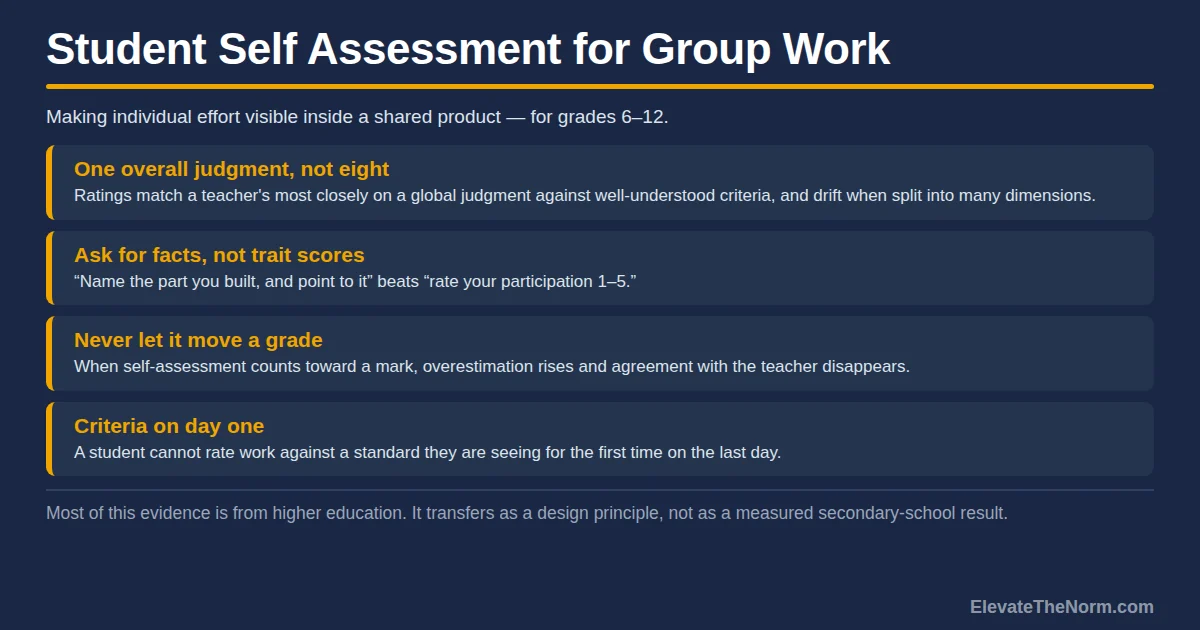
    • Ask for one overall judgment, not eight. The clearest finding in the peer-assessment literature is that ratings line up with a teacher’s when students make a global judgment against criteria they understand — and drift when they are asked to score many separate dimensions.
    • Self-assessment is the individual-accountability half of group work. Cooperative learning research names individual accountability as one of five elements that have to be present. A self-rating with evidence is the cheapest way to supply it.
    • Never let it change anybody’s grade. When self-assessment counts toward a mark, overestimation rises and agreement with the teacher disappears.
    • Criteria before the project, not after. A student cannot rate a contribution against a standard they are seeing for the first time on the last day.
    • Most of this evidence is from higher education. It transfers as a design principle. It is not a measured secondary-school result, and you should not be told otherwise.

    Free Download · PDF

    Student Self-Assessment Forms for Grades 6–12

    A general self-assessment form, a project reflection, a group-work accountability form, and a conference preparation sheet — reflection that asks for evidence instead of a confidence rating.

    Download the free PDF

    Free. No email address required. Designed for grades 6–12. Browse every printable in Your Free Library.

    What Is Student Self Assessment for Group Work?

    It is each student, separately and in writing, answering three questions about a shared project: what did I actually do, how well does it meet the criteria we agreed on, and what would I do differently next time. Three parts. Take away the criteria and it is a feelings check. Take away the evidence and it is a claim. The same evidence rule governs checking a draft while it is still a draft.

    It is worth distinguishing from the thing it gets confused with. Self-assessment is not peer assessment. Peer assessment asks students to rate each other, which raises questions about friendship, retaliation and social cost that a self-rating does not. The two can coexist, and plenty of published teamwork instruments combine them, but they are different instruments doing different jobs, and mixing them without saying so is how a reflection sheet turns into a blame form.

    The wider practice is covered in the guide to student self assessment. Group work only changes what sits in the criteria column — and it adds a problem that individual work does not have, which is that the product no longer tells you who did what.

    Why Bother, When the Project Already Has a Grade?

    Because a group grade is a measurement of the artifact, and you are also trying to teach something about contribution. One number on one poster cannot carry both jobs.

    Cooperative learning is one of the better-evidenced practices in education, and the research is specific about what has to be in place. Robyn Gillies’s 2016 review in the Australian Journal of Teacher Education names five elements: positive interdependence, promotive interaction, individual accountability, explicitly taught social skills, and group processing. The effect sizes she reports from Johnson and Johnson’s syntheses run in the 0.58 to 0.70 range across 117 studies, and the underlying work spans preschool to tertiary and most subject areas.

    The sentence in that review that matters most for a secondary teacher is the plainest one: simply placing students in groups does not guarantee cooperation. Gillies notes that discord shows up when students struggle with the task and with managing each other, and that without teacher mediation high-level talk appears with low frequency. Group work is not self-executing. Individual accountability and group processing are the two elements a self-assessment directly supplies, and they are the two most often left out.

    She also reports two structural findings worth acting on for free: optimal group size is three or four, and lower-attaining students benefit most from mixed-attainment grouping while middle-attaining students tend to do better in more homogeneous groups. Neither costs anything to apply.

    What Should Students Rate — and How Many Things?

    One overall judgment against two or three criteria they already know. Not a scorecard. This is the single most actionable finding in this whole literature and almost every classroom teamwork form gets it backwards.

    Falchikov and Goldfinch’s 2000 meta-analysis in the Review of Educational Research pooled 48 studies comparing peer marks with teacher marks. Their central result: agreement was closest when students made global judgments based on well-understood criteria, and worse when they were asked to break a judgment into many separate components and score each one.

    That is the opposite of how most group-work forms are built. The typical sheet asks a student to rate themselves on participation, preparation, communication, reliability, respect, leadership and time management, on a five-point scale, seven times. The literature predicts exactly what you see when you collect them: rows of fours, no discrimination between the dimensions, and no usable information.

    The honest caveat: those 48 studies were higher education, and they were peer marks rather than self-marks. The mechanism — that people judge a whole thing against a standard better than they decompose it — is a reasonable thing to carry into a secondary classroom. It is not a measured result about fifteen-year-olds, and nobody should sell it to you as one.
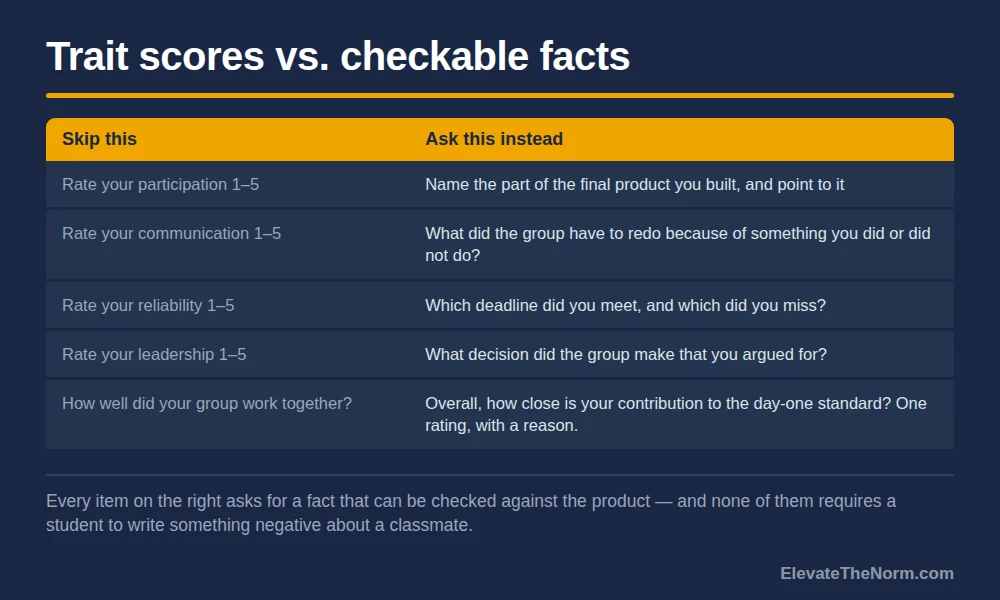
    Two-column table contrasting trait rating scales such as rate your participation one to five with fact-based questions such as name the part of the final product you built and which deadline did you miss
    Every item on the right asks for a fact that can be checked against the product.

    So what goes on the form:

    Skip thisAsk this instead
    Rate your participation 1–5Name the part of the final product you built, and point to it
    Rate your communication 1–5What did the group have to redo because of something you did or did not do?
    Rate your reliability 1–5Which deadline did you meet, and which did you miss?
    Rate your leadership 1–5What decision did the group make that you argued for?
    How well did your group work together?Overall, how close is your own contribution to the standard we set on day one? One rating, with a reason.

    Every item on the right asks for a fact rather than a number about a personality trait. Facts are checkable against the product, and a student who claims to have built the timeline can be asked to show it. That is also what makes the sheet safe: it never requires a teenager to say something negative about a classmate in writing.

    Does a Rubric Make the Self-Rating Better?

    For the work, clearly. For the teamwork part, less clearly, and the evidence is thinner than the enthusiasm.

    Heidi Andrade’s 2019 critical review in Frontiers in Education reports that criterion-referenced self-assessment — using a rubric or checklist — showed main effects on every criterion assessed, and that concrete, task-specific criteria outperform vague competence-based criteria. If the rubric says “the claim is supported by at least two sources,” a student can check. If it says “demonstrates strong collaboration,” they cannot.

    On the teamwork side specifically, one study is worth reporting honestly because it cuts both ways. Pang, Kootsookos, Fox and Pirogova compared two cohorts of 186 first-year engineering undergraduates on a team design project: one got a marking scheme, the next got a detailed rubric. The rubric cohort reported more helpful feedback, higher satisfaction and achieved higher grades, and 96 percent said the rubric helped them reach the learning goals. But only 52 percent found it useful for constructive feedback on teamwork specifically. The authors list the limits themselves: one course, one institution, one grading instructor.

    Read that as the useful signal it is. A rubric is very good at telling a student whether the work meets a standard. It is much weaker at telling them whether they were a good group member, because that is a harder thing to write criteria for. So write the rubric for the product, and handle contribution with the evidence questions above rather than by inventing a collaboration scale. The project rubric guide covers the product side.

    A Four-Minute Group Work Self-Assessment

    Five prompts, filled in individually, before anyone talks about it. Individually and before matters: a student who has already heard the group’s version writes the group’s version.

    1. Name your piece. Which part of the finished product did you make? Point at it. If you cannot point at anything, say that — it is real information and it is not a punishment.
    2. Give one piece of evidence. A file, a draft, a section, a specific decision. This is the step that does the work; a contribution claim with no evidence is an opinion.
    3. One overall rating against the day-one standard. 0–3, with the anchors written out, and a one-sentence reason. One rating, not seven.
    4. What did the group have to redo because of you? The most useful question on the sheet, and the one students answer more honestly than you expect, because it is about a task rather than a character.
    5. One thing you would do differently on the next project. Specific and small. “Start the research before the night before” is a plan.
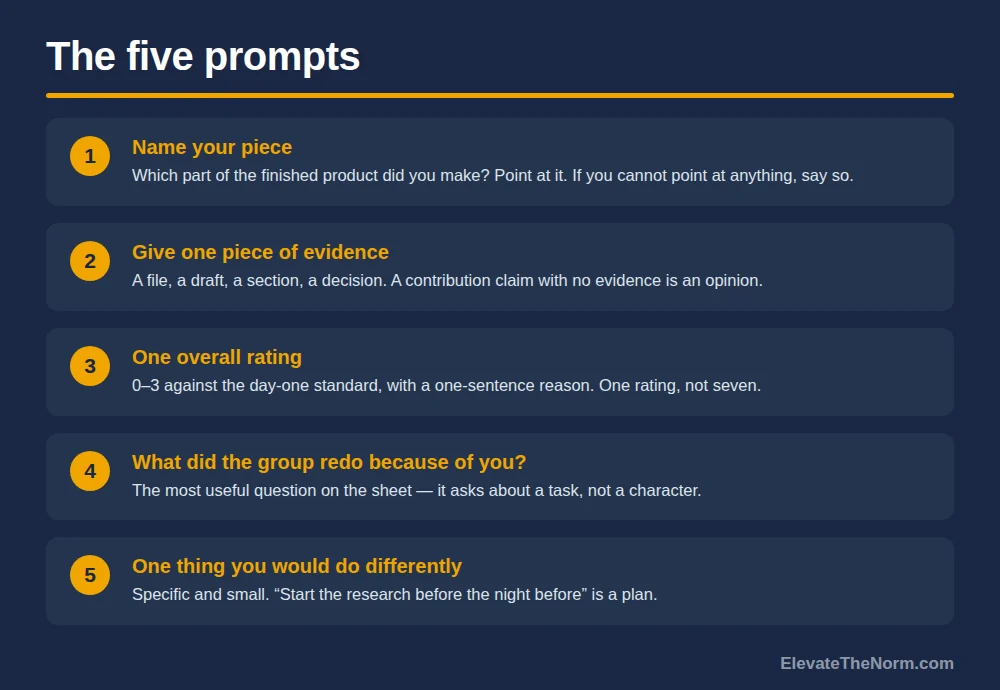
    Numbered graphic of five group work self assessment prompts: name your piece, give one piece of evidence, give one overall rating, say what the group had to redo because of you, and name one thing you would do differently
    Filled in individually, before the group talks about it. Prompt four is the most useful one on the sheet.

    The first time you run it, teach it. Students have almost never been asked to describe their own contribution in specific terms, and left alone most will write “I helped with the slides.” Show a worked example on the board — a vague answer next to a specific one — and say plainly that naming a real limit is not going to be held against them. Ten minutes once. Every version of this that gets abandoned was abandoned because the first round produced nothing and the teacher concluded students could not do it.

    Then hold the group conversation. Gillies’s fifth element is group processing — students reflecting together on how the work went and what to do next. The sheet is the private half; five minutes of the group comparing what each person wrote is the public half, and the sequence only works in that order. If you want a ready-made form to adapt, the free self-assessment pack has one you can retype the criteria into.

    Be realistic about what reading twenty-eight of these costs you. It is not a stack to mark. Read them once, fast, looking only for the two things that matter: who could not point at a piece of the product, and what any group says it had to redo. That is a scan, not a grading session, and it should take about fifteen minutes for a full class. If you find yourself writing responses on them, you have turned a diagnostic into an assignment and you will stop doing it by November.

    One accessibility note. The written form is one container, not the only one. A student who cannot produce five written answers quickly — a writing disability, a newcomer building English — can answer the same five prompts out loud in ninety seconds while you note it down. The judgment against criteria is the part that has to survive, not the paragraph.

    Should Any of This Touch the Grade?

    No. Not the student’s own, and not anybody else’s. This is the one place where the research gives a clean answer and the answer is unambiguous.

    Andrade’s review reports the Tejeiro finding directly: when self-assessment counted toward a final grade, student overestimation increased dramatically and no correlation emerged between the instructor’s assessment and the student’s. Run formatively, agreement with external evaluators improved substantially, and every study in the review that used self-assessment formatively showed a positive association with learning.

    There is a second reason specific to group work, and it is about fairness rather than accuracy. A self-rating that moves a grade creates an incentive to inflate, which rewards confidence rather than contribution — and confidence is not evenly distributed across a class. The students most likely to under-claim are often the ones who did the quiet, unglamorous work. Attaching marks to self-report turns that into a penalty.

    This is also the answer to the most common complaint families raise about group work, which is that a child did most of the work and shared the grade with people who did not. That complaint is often correct, and the fix families usually ask for — let my child report who slacked, and grade accordingly — is the one the evidence says not to build. The better answer, and the one worth putting in an email before the project starts rather than after it: the group grade covers the product, every student also produces something individual, the groups are small enough that contribution is visible, and the self-assessment exists so a student’s own account of their work is on the record. That is a real answer rather than a deflection, and it holds up at a conference.

    If you have a genuine contribution problem, solve it with the design instead. Assign distinct, visible roles so the product itself shows who did what. Keep the groups at three or four, where hiding is harder. Collect an individual artifact from every student alongside the group one. All three make effort visible without asking a sixteen-year-old to adjudicate it in writing.

    Four Ways This Goes Wrong

    All four are design errors, and all four are cheaper to prevent than to repair.

    The criteria arrive at the end. A student handed a rating scale on the last day is being asked to judge work against a standard they did not have while doing it. The criteria go up on day one, in the same words you will use on the form.
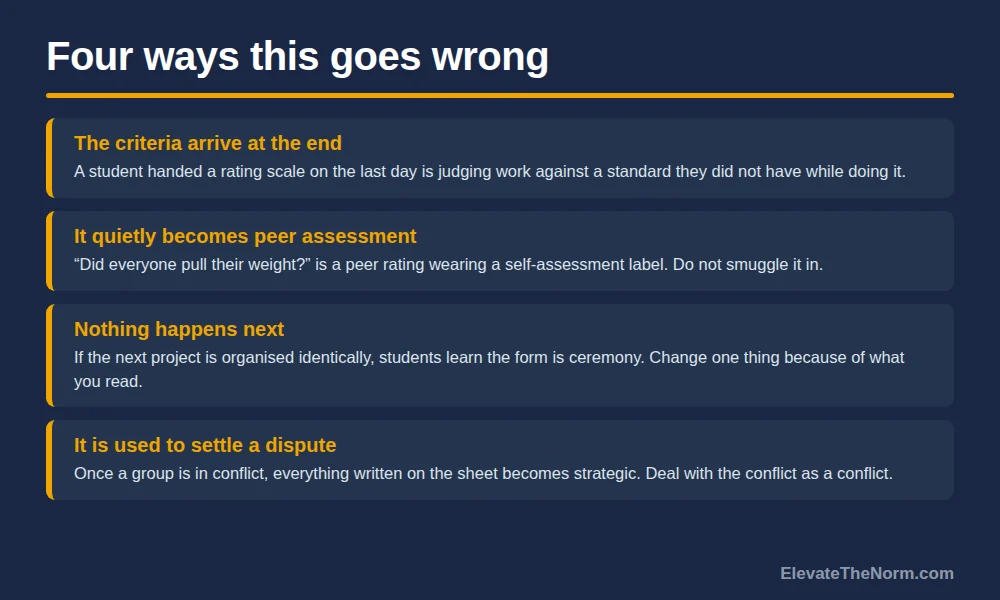
    Graphic listing four failure modes for group work self assessment: the criteria arrive at the end, it quietly becomes peer assessment, nothing happens next, and it is used to settle a dispute
    All four are design errors, and all four are cheaper to prevent than to repair.

    It quietly becomes peer assessment. A question like “did everyone pull their weight?” is a peer rating wearing a self-assessment label. If you want peer input, say so openly, design it properly, and be clear about who reads it. Do not smuggle it in.

    Nothing happens next. If the sheets go in a folder and the next project is organized the same way, students learn the form is ceremony. The minimum honest follow-through is one change to the next project that came from reading them — a different group size, a required interim deadline, distinct roles.

    It is used to settle a dispute. When a group is already in conflict, a self-assessment form becomes evidence in a case, and everything anyone writes becomes strategic. Deal with the conflict as a conflict. The sheet is a routine instrument for ordinary projects; it is not an investigation tool and it will not survive being used as one.

    Where to Start on the Next Project

    Pick the next group project you already have planned. On day one, put two criteria for the product on the board in the words you will use again at the end. Keep the groups at three or four. On the last day, before any group talks, give every student the five prompts and four minutes.

    Then read them for one thing only: which groups had someone who could not point at a piece of the product. That is the design question, not a discipline question, and the answer usually turns out to be that the task had fewer real jobs in it than it had people.

    Keep it out of the gradebook, keep it to one overall rating, and change one thing about the next project because of what you read. The point is not to catch anybody. It is that a student who has had to name their own contribution in writing, against a standard, has done something a group grade will never make them do — which is the same argument as handing a teenager the job of naming their own conduct against a standard they were taught rather than waiting to be told how they did.

    Before you go: grab the free Student Self-Assessment Forms for Grades 6–12 (PDF) — ElevateTheNorm.com branded, printable, no email required.

    Frequently Asked Questions

    Should a group work self-assessment ever change a student’s grade?

    No. Andrade’s review reports that when self-assessment counted toward a final grade, overestimation rose sharply and the correlation with the instructor’s own assessment disappeared; run formatively, agreement improved substantially. There is a fairness reason on top of the accuracy one: attaching marks to self-report rewards confidence rather than contribution, and the students most likely to under-claim are often the ones who did the quiet work. If you have a contribution problem, fix it with distinct roles, smaller groups and an individual artifact — not with a self-rating that moves numbers.

    How do I stop one student doing all the work without making others rate each other?

    Change the task before you change the paperwork. Three or four to a group rather than five or six, so there is less room to disappear. Distinct visible roles, so the product itself shows who did what. An individual artifact from every student alongside the group one. Those three do more about free-riding than any rating form, and none of them asks a teenager to write something negative about a classmate.

    Why one overall rating instead of scoring several categories?

    Because the evidence points that way. Falchikov and Goldfinch’s meta-analysis of 48 studies found that student ratings matched teacher marks most closely when students made a global judgement against well-understood criteria, and less closely when asked to break the judgement into many separate dimensions. The seven-category teamwork form produces rows of fours and no usable information. Be aware that those studies were higher education and were peer rather than self ratings — the mechanism travels, the measurement has not been repeated with secondary students.

    What do I do with a student who writes that they did nothing?

    Take it as information and not as a confession. A student who says honestly that they cannot point at a piece of the product has told you something valuable and has told you the truth, which is exactly the behaviour the form is supposed to make safe. Ask what the group’s tasks were and how they got divided. About half the time the answer is that the project had three real jobs and four people in the group, which is a design problem you own.

    Is peer assessment ever worth adding?

    Sometimes, but never by stealth. Peer rating carries social costs that self-rating does not — friendship, retaliation, and the position you put a student in by asking them to write something about a classmate that a teacher will read. If you use it, say plainly that you are using it, be specific about who sees the responses, keep it to observable contributions rather than judgements about people, and never let it move a grade. A question like “did everyone pull their weight?” buried in a self-assessment is peer assessment without the safeguards.

    When should students fill this in — during the project or at the end?

    Both is better than either, and the end alone is the common mistake. A short version at the halfway point can still change something while the project is running, which is the whole difference between formative and post-mortem. The end-of-project version is where the overall rating and the “what would you do differently” question belong. What matters more than timing is that students write individually before the group discusses anything.

    Does this work for a long project or only a short one?

    It scales better to longer projects, because a longer project has more distinguishable pieces for a student to point at. On a two-day task, the honest answer to “name your piece” is often that everyone did a bit of everything, and the form has little to work with. If your groups are doing short tasks, run the group processing conversation and skip the written self-assessment until there is a project big enough to have parts.

    Sources

    1. Gillies, Robyn M. “Cooperative Learning: Review of Research and Practice.” Australian Journal of Teacher Education, vol. 41, no. 3, 2016. https://files.eric.ed.gov/fulltext/EJ1096789.pdf (The Johnson & Johnson and Slavin effect sizes quoted above are reported in this review; the primary syntheses were not read directly.)
    2. Falchikov, Nancy, and Judy Goldfinch. “Student Peer Assessment in Higher Education: A Meta-Analysis Comparing Peer and Teacher Marks.” Review of Educational Research, vol. 70, no. 3, 2000, pp. 287–322. https://eric.ed.gov/?id=EJ630369
    3. Andrade, Heidi L. “A Critical Review of Research on Student Self-Assessment.” Frontiers in Education, vol. 4, art. 87, 2019. https://www.frontiersin.org/journals/education/articles/10.3389/feduc.2019.00087/full (The Tejeiro et al. 2012 and Fastré et al. 2010 findings are reported in this review; the primary papers were not read directly.)
    4. Pang, Vinh, Alex Kootsookos, Rebecca Fox, and Elena Pirogova. “Does an assessment rubric provide a better learning experience for undergraduates in developing transferable skills?” Journal of University Teaching & Learning Practice, vol. 19, no. 3, 2022. https://files.eric.ed.gov/fulltext/EJ1361716.pdf
    5. Avina, A., Boyle, S., Duble Moore, T., Hicks, T., and Wiggins, A. “Intensive Intervention Practice Guide: Self-Monitoring Systems to Support Students’ Behavioral Needs.” U.S. Department of Education, Office of Special Education Programs / National Center on Intensive Intervention, Fall 2022. https://files.eric.ed.gov/fulltext/ED628226.pdf
    About Clay Shumate

    Clay Shumate is a certified secondary Social Studies teacher in the public schools of West Alabama, with seven years of classroom experience, a B.A. in History, and an M.Ed. in Secondary Education. He writes about project-based learning, student responsibility, respect, and practical ways to hold young people to a higher standard while giving them room to learn from mistakes. He is a member of the Society of Professional Journalists and writes to its Code of Ethics; this site’s editorial standards and corrections policy are published in full. More about Clay.

  • Student Self Assessment of Behavior: What It Fixes, What It Doesn’t

    Student Self Assessment of Behavior: What It Fixes, What It Doesn’t

    By Clay Shumate

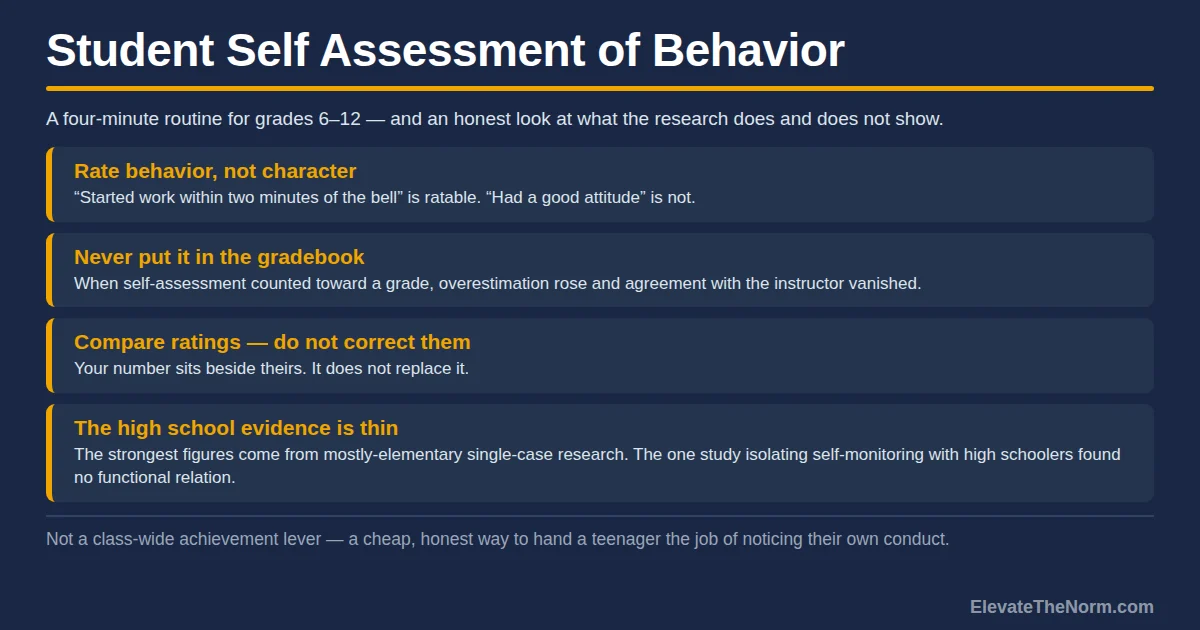
    Student self assessment of behavior is a short routine in which a student rates their own conduct against visible criteria, gives evidence for the rating, and names one thing to do differently. Not an apology form, not a mood check. Done right it takes four minutes and moves the work of noticing from you to them.

    Narrow is the point. The research here is better than what sits behind most in-service handouts, and more limited than the workshop slides admit. What follows is what the evidence supports for grades 6–12, what it does not, and a routine that survives a real Tuesday.

    Key Takeaways

    • Rate behavior you can point at, not character. “Started work within two minutes of the bell” is ratable. “Had a good attitude” is not — and a student who disagrees has nowhere to go.
    • The moment you grade it, it stops working. In one study of self-assessment counted toward a final mark, overestimation rose sharply and the correlation with the instructor’s rating vanished.
    • The evidence is real, and the high school evidence is thin. A federal practice guide reports large average improvements. The one study found here that isolated self-monitoring with high schoolers found no functional relation.
    • Two behaviors. Not eight. Every version that survives past October tracks a small number of specific, positively stated behaviors on a form the student can fill out in under two minutes.
    • Compare ratings, do not correct them. Rating the same period yourself is the accuracy check. Overwriting the student’s number turns the whole thing back into your paperwork.

    Free Download · PDF

    Student Self-Assessment Forms for Grades 6–12

    A printable self-assessment form with space to write your own behavior criteria, a 0–3 rating scale, and a next-step line. No email required.

    Download the free PDF

    Free. No email address required. Designed for grades 6–12. Browse every printable in Your Free Library.

    What Is Student Self Assessment of Behavior?

    It is a student judging their own conduct against stated criteria and recording it. Three parts, all required: an observable behavior, a rating, a next step. Drop the observable behavior and you have a feelings survey. Drop the next step and you have a confession.

    The U.S. Department of Education’s Office of Special Education Programs describes two forms in its 2022 practice guide on self-monitoring systems: students record whether a behavior happened, or they rate it against criteria set in advance. The second is what most secondary teachers want. A checkbox says a thing occurred. A rating asks a student to hold their own conduct against a standard and say how close they came — a different and more useful act with a fifteen-year-old.

    Two neighbors to separate from. Not a restorative conversation — that happens after harm and involves the people affected. Nor is it academic self-assessment, though it borrows the machinery; the guide to judging your own work against criteria covers that version. Behavior just changes what sits in the criteria column. A third variant narrows it to a single project: what one student contributed inside a group that shares a grade.

    Does Student Self Assessment of Behavior Actually Work?

    Yes, with caveats big enough that you should read them. The headline numbers are good. The ones that apply specifically to teenagers are much thinner, and one is a null result.

    Start with the strongest claim. The OSEP guide cites a 2015 systematic review by Bruhn and colleagues covering 41 studies and reports that every one showed improvement: problem behavior falling from an average of 22% to 4%, academic engagement rising from 37% to 86%. Those are the figures that get onto the slide.

    Forty-one out of forty-one should make you suspicious rather than confident. A literature in which nothing ever fails usually has a publication problem, and nearly all of this work uses single-case designs — a handful of students, observed intensively, with effects judged by eye or by a non-standard metric. Single-case research is useful for showing something can work for a particular student. It is weak evidence for how far it moves a class of twenty-eight.

    The better evidence is the randomized trial. Bruhn, Wehby, Hoffman and colleagues ran a multisite RCT of a self-monitoring app across 25 schools and 57 student–teacher pairs (Behavioral Disorders, 2022). Students using it improved academic engagement more than controls (d = 0.44) and cut disruptive behavior more (d = −0.35) — and the behavior reduction largely held two weeks after the intervention stopped, while the engagement gain faded (d = −0.30). Note the grade band: 3rd through 8th. That is mostly elementary. It is not a high school result.

    Which brings us to the honest part. The one study located here that isolated self-monitoring with high schoolers is Estrapala, Bruhn and Rila (2022), comparing goal reminders against interval self-monitoring with three students with emotional or behavioral disorders. Visual analysis found no functional relation for either condition. Tau-U effect sizes ran 0.44 to 0.64, moderate to large, with self-monitoring slightly ahead — but the authors report classroom management as a substantial confound. Three students is three students; it does not overturn the wider literature. It does mean nobody should tell you this is proven for eleventh graders.

    The general picture for this age group is modest too. Murray, Kurian, Soliday Hong and Andrade (2022, Journal of Adolescence) pooled 33 randomized trials of self-regulation interventions with 7,269 young people aged 10–15 and found Hedges g = 0.12. Small. Emotion-regulation approaches reached g = 0.20; cognitive regulation, parent training, physical activity and working-memory approaches showed no significant effects at all.

    The defensible claim is this: behavior self-assessment reliably helps individual students who are struggling, is cheap, and has no plausible downside when it is not graded. It is not a class-wide achievement lever and nobody has shown that it is.

    Two things follow from that at building scale. First, this is about as cheap as an intervention gets — a half sheet of paper, no license, no platform, no staffing line, and so no procurement decision needed to try it in three classrooms. Second, and harder: who ends up holding a behavior sheet is an equity question, not a neutral one. Discipline data in most systems is not evenly distributed, and a practice assigned one student at a time inherits whatever pattern already exists in who gets noticed. Anyone running this as a tier-two intervention should read the roster of assigned students the way they read a referral report. Skipping that five-minute check is how a well-meant practice ends up pointed at the same kids as everything else.

    Will a Teenager Rate Themselves Honestly?

    More honestly than you expect, right up until the rating counts for something. That single design decision explains most of the variance between a routine that works and one that becomes theater.

    Heidi Andrade’s 2019 critical review in Frontiers in Education lays the accuracy picture out plainly. Correlations between student self-ratings and external measures run from about 0.20 to 0.80, few above 0.60. Males tend to overrate, females to underrate, and older and more academically competent students are more consistent — mildly good news for secondary teachers.

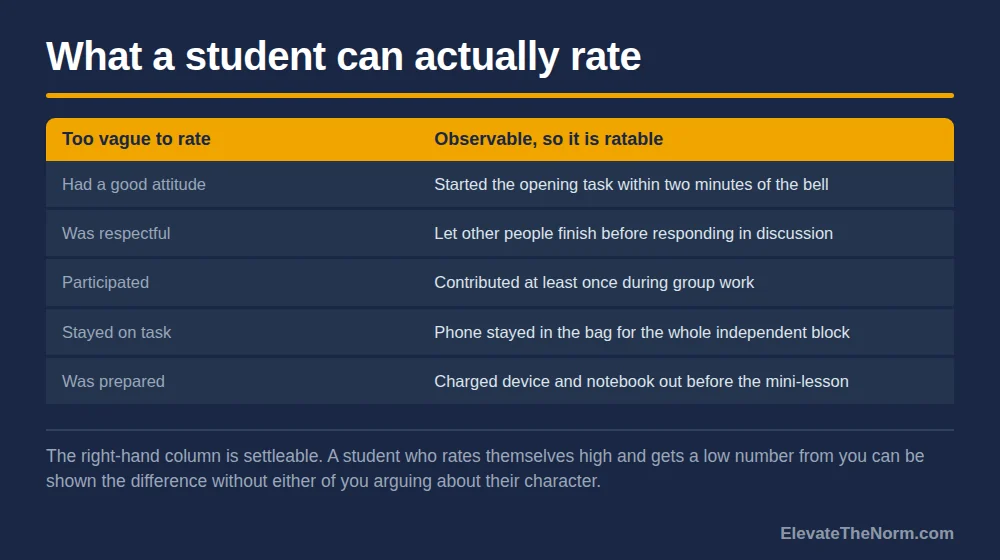
    Two-column table contrasting vague behavior descriptions such as had a good attitude and was respectful with observable versions such as started the opening task within two minutes of the bell and contributed at least once during group work
    The right-hand column is settleable. The left-hand column is an argument about a person.

    The decisive finding is about grading. Andrade cites Tejeiro and colleagues (2012), where self-assessment counted toward the final grade: overestimation increased dramatically and no correlation emerged between the professor’s rating and the student’s. Run formatively, agreement with external evaluators improved substantially. All twenty studies in Andrade’s review that used self-assessment formatively showed a positive association with learning.

    A second finding is worth stealing. Andrade reports that concrete, task-specific criteria outperform vague competence-based ones — a result from Fastré and colleagues. In behavior terms: “I was ready when the bell rang” beats “I was responsible today,” and it is far harder to argue about.

    Andrade also makes a point most summaries skip: the obsession with accuracy may be misplaced. Her review notes little evidence that inaccurate self-assessment produces worse learning, and that students act on their predictions regardless of accuracy. The purpose is not a number that matches yours. It is to get a student to look.

    What Should Students Actually Rate?

    Two or three behaviors, each stated as something a stranger could watch and score. The OSEP guide is specific: targets should be stated positively, defined in observable and measurable terms, and taught with examples and non-examples before anyone rates anything.

    Stated positively matters more than it sounds. “Did not disrupt” gives a student nothing to aim at. “Asked for help by raising a hand or coming to the desk” names the thing you want more of. Here is the difference in practice:

    Not ratableRatable
    Had a good attitudeStarted the opening task within two minutes of the bell
    Was respectfulLet other people finish before responding in discussion
    ParticipatedContributed at least once in the group work segment
    Stayed on taskPhone stayed in the bag for the whole independent work block
    Was preparedHad the charged device and the notebook out before the mini-lesson

    The right-hand column has a property the left lacks: a student who rates themselves high and gets a low number from you can be shown the difference without either of you arguing about their character. It moves a disagreement about a person into a disagreement about a fact, and facts are settleable.

    Pick two. A student tracking six behaviors is doing clerical work, and clerical work gets abandoned. Few, specific and observable beats many and inspirational — the same discipline that makes a short list of classroom expectations work at all.

    Let the student pick the second one. You choose the first target — you can see the pattern from the front of the room. Hand them the second. Ask what they would fix about their own class period if they could fix one thing, and write down their words. This costs nothing and it changes what the sheet is: a form you assigned becomes a form with something of theirs on it. It also produces better targets than you would guess, because a fifteen-year-old knows things about their own period that are invisible from six feet away — the argument for taking student voice seriously in the first place.

    A Four-Minute Behavior Self-Assessment Routine

    Four steps, once a period or once a day, on one sheet. The design constraint is that it has to be cheap enough that you still run it in week nine.

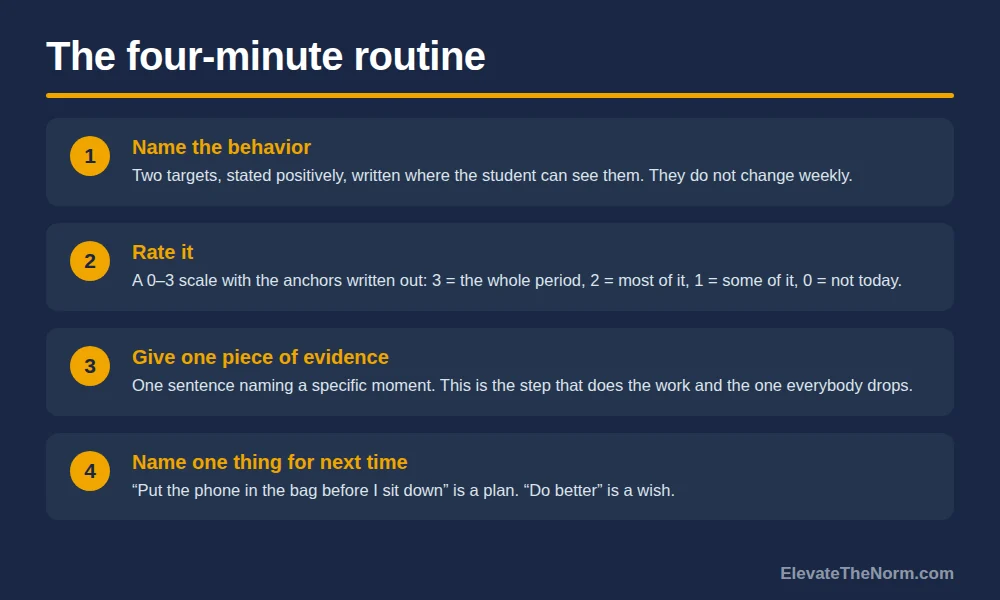
    1. Name the behavior. Two targets, stated positively, written where the student can see them. They do not change weekly; a target that moves every few days never gets a baseline.
    2. Rate it. A 0–3 scale beats 1–5. Fewer points means less hedging toward the middle, and the anchors fit on the page: 3 = the whole period, 2 = most of it, 1 = some of it, 0 = not today.
    3. Give one piece of evidence. One sentence naming a specific moment. This is the step that does the work and the one everybody drops. A rating with no evidence is a guess; with evidence it is an observation — and a student who has to produce evidence starts watching for it during the period instead of reconstructing it afterward.
    4. Name one thing for next time. Specific and small. “Put the phone in the bag before I sit down” is a plan. “Do better” is a wish.
    Numbered graphic of a four-step behavior self-assessment routine: name the behavior, rate it on a 0 to 3 scale, give one piece of evidence, and name one thing for next time
    Four minutes. Step three is the one that does the work and the one everybody drops.

    Two easy-to-skip things make it stick. First, teach it before you run it. The OSEP guide recommends explaining the definition in student-friendly language, modeling the steps, guided practice, and telling students why the behavior matters — that last one builds buy-in rather than compliance. Fifteen minutes once beats re-explaining it daily for a month.

    Second, let them see their own trend. The guide recommends self-graphing, the cheapest motivational feature available: a strip of boxes down the side of the sheet the student shades in. Ten shaded days is the first time most students have seen their own conduct as a line rather than a series of unrelated bad days — which is what makes learning from a mistake possible at all. My Behavior Reflection Sheets on TPT ask students for reasons, not apologies, and come in two reading levels.

    One adjustment before you print anything: the written version is not the only version. Step three assumes a student who can produce a sentence quickly in writing, and plenty cannot — a student with a writing disability, a newcomer still building English, a student whose handwriting speed turns four minutes into twelve. None of them needs less self-assessment; they need a different container. Saying the evidence out loud in the last minute of class does the same cognitive work, and so does an evidence line offering three pre-written options plus a blank. What has to survive is the judgment against criteria, not the paragraph.

    If you want a form rather than building one, the free student self-assessment pack has a general version you can retype the criteria into. No email required.

    How Do You Check Accuracy Without Turning It Into a Trap?

    Rate the same period yourself, compare the two numbers, and talk about the gap — do not replace their number with yours. The OSEP guide describes exactly this: the teacher takes data at the same time the student self-records, and the comparison establishes accuracy. It calls this verification that supports rather than replaces student self-assessment, and that distinction is doing real work.

    Be realistic about frequency. Rating two behaviors for one student while teaching twenty-seven others is not a daily act, and a version that demands it quits on you in week three. Three days out of ten is enough to tell whether a student’s ratings track reality. Mark your numbers on a sticky note rather than building a second tracking sheet.

    The failure mode is obvious once you name it. If your rating overwrites theirs, the student learns that the sheet is a quiz with one right answer, which is you. They will start guessing what you wrote instead of watching what they did, and you have rebuilt teacher-managed behavior tracking with an extra step and the student’s handwriting on it.

    What to do with a gap depends on its direction, and this is where the practice earns its keep:

    • Higher than you. Ask what they were looking at. Usually the criteria are fuzzier than you thought, or they counted a different part of the period. That is information about your criteria, not evidence of dishonesty.
    • Lower than you. Say so. A student who gives themselves a 1 on a day you saw a 3 is telling you something, and it is rarely about the behavior.
    • A match. Say that once, then fade the checking. Matching is the exit condition, not a reason to keep checking forever.

    On fading, the guide is clear: the goal is a student who monitors their own behavior without the system, faded individually through longer intervals, higher goals or less frequent recording, while you keep watching the behavior itself. A behavior self-assessment with no exit plan is a permanent accommodation you did not mean to create. Decide at the start what “done” looks like, and tell the student.

    Four Ways This Goes Wrong

    All four are design errors, and all four are fixable before you start.

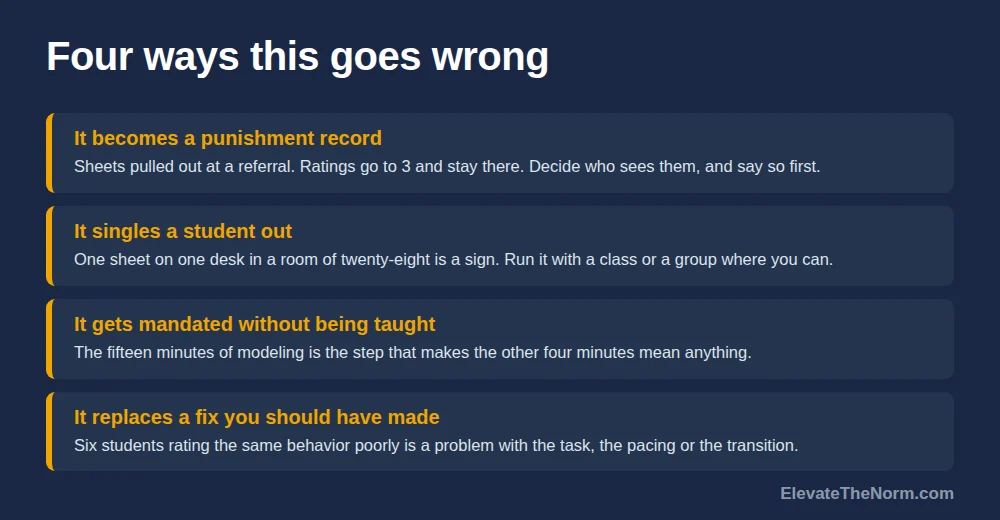
    It becomes a punishment record. The fastest way to kill it: a stack of sheets pulled out at a parent meeting or a referral. Once a student suspects the form is evidence against them, the ratings go to 3 and stay there, and you have taught them that honest self-report is a liability. Decide up front who sees the sheets and say so. If a sheet genuinely has to go into a behavior plan, tell them before the first one is filled out, not after.

    Graphic listing four failure modes for behavior self-assessment: it becomes a punishment record, it singles a student out, it gets mandated without being taught, and it replaces a fix to the lesson
    All four are design errors. All four are fixable before the first sheet is printed.

    It singles a student out. A behavior sheet on one desk in a room of twenty-eight is a sign, and teenagers read signs. That is a real cost, and it is why the practice is often worth running with a whole class or group even when one or two students need it. If it has to be individual, make the form unremarkable and handle the handoff privately — not at the front of the room on the way out.

    It gets mandated without being taught. When this arrives as a tier-two box to check, the teaching step is the first thing cut — it is the only step that costs a block of class time. A student handed a sheet with no instruction rates it the way they rate everything handed over with no instruction: fast, high, without looking. The fifteen minutes of modeling is what makes the other four mean anything, and a school adopting this should build that time into the rollout.

    It replaces a fix you should have made. If six students rate themselves poorly on the same behavior, the problem is not six students. It is the task, the seating, the pacing, or the transition around it. Self-assessment data is a diagnostic you collect for free, and reading it only as a statement about individual kids wastes it. Sometimes the right response to the sheets is to change the lesson. That is not a failure of the practice; it is the practice working.

    Where to Start This Week

    Pick one class. Write two behaviors on the board, stated positively, in language a student would use. Put a 0–3 scale under each with the anchors written out. Spend fifteen minutes teaching what a 3 looks like and what it does not, using examples from the actual room. Then run it ten days without changing anything, rating the same two behaviors yourself on three of those days. On day ten, hand students their own ten days and ask one question: what does this show you that you did not know on day one? That question is the entire product. Everything before it is setup.

    Keep it out of the gradebook. Keep it to two behaviors. Plan the exit before you plan the start. Behavior self-assessment will not turn a hard section into an easy one, and anything promising that is selling something. What it does is hand a teenager the job of noticing their own conduct — a job they are old enough to have and one almost nobody has ever formally given them. The natural next step, once they can rate themselves against criteria, is doing it out loud to someone other than you, which is what building student responsibility looks like as a sequence rather than a slogan.

    Before you go: grab the free Student Self-Assessment Forms (PDF) — ElevateTheNorm.com branded, printable, no email required.

    Frequently Asked Questions

    Should a behavior self-assessment ever count toward a grade?

    No. This is the single clearest finding in the research. When self-assessment counted toward a final grade in Tejeiro and colleagues’ study, student overestimation increased dramatically and the correlation with the instructor’s own assessment disappeared entirely. Run formatively, the same practice produced substantially better agreement with external evaluators. A grade converts an honest instrument into a negotiation. If your school requires a conduct grade, keep it in a separate column and say out loud that the self-assessment sheet does not feed it.

    Is this just a behavior chart for teenagers?

    It looks similar and it works differently. On a behavior chart, an adult records what a student did. On a self-assessment, the student records it, produces evidence for the rating, and names the next step. The recording is the intervention — the point is the act of judging your own conduct against a standard, not the data. If you fill in the sheet for the student, you have a chart, and you should not expect the self-assessment findings to apply to it.

    How do I do this without embarrassing the one student who needs it?

    Run it with the whole class or a whole group where you can. A single sheet on a single desk is visible and teenagers read it correctly as a label. If it has to be individual, make the form look ordinary, hand it over and collect it privately rather than at the door, and tell the student at the start exactly who will see it. Then hold to that. A promise about who sees the sheet is the whole basis of honest ratings.

    Can parents or an administrator ask to see the sheets?

    Possibly — records policies vary by district and this is not legal advice. The practical move is to decide before the first sheet is filled out and tell the student. If the sheets will feed a behavior plan or a meeting, say so up front; students can handle a known rule and cannot handle a surprise one. If the sheets are for the two of you, write nothing on them you would not want read aloud, and keep other students’ names off them entirely.

    Does the research support this for high school students?

    Less than you would gather from a workshop. The strongest average figures come from a federal practice guide citing a 41-study review that is overwhelmingly single-case research, and the best randomized trial covers grades 3 through 8. The one study located here that isolated self-monitoring with high schoolers — Estrapala, Bruhn and Rila (2022), three students with emotional or behavioral disorders — found no functional relation, though effect sizes were moderate to large and the authors flag classroom management as a confound. The honest summary: it plainly helps individual struggling students, it costs almost nothing, and it is not proven as a class-wide lever for teenagers.

    How long before I should expect to see anything?

    Give it ten school days before you judge it, and expect the first week to look like nothing. Students need several cycles before the ratings stabilize enough to be worth reading, and the useful moment is usually the first time a student sees ten days of their own data at once rather than any single entry. If nothing has moved after three or four weeks of consistent use, the target behavior is probably too vague or the real problem is somewhere in the lesson rather than in the student.

    Should I tell families their child is doing this?

    Yes, and it takes one sentence. A short note home saying what the two behaviors are, that the student rates themselves, that it is not graded, and who sees the sheet prevents the version of this conversation where a parent finds a behavior form in a backpack and reasonably assumes their child is in trouble. It also tends to produce useful information back — families often know which part of the day is hard and why. Send it before the first sheet, not after the first question.

    What if a student refuses to fill it out?

    Ask what they think it is for. A refusal is usually a reasonable read of the situation — they have decided it is surveillance, or paperwork, or a trap that ends in a referral. All three are things the design can fix. If the answer is that they do not see the point, that is fair, and the counter is to show them what ten days of their own data looks like rather than to argue. Do not make compliance with the sheet itself a disciplinary issue; you will win that fight and lose the practice.

    Sources

    1. Avina, A., Boyle, S., Duble Moore, T., Hicks, T., and Wiggins, A. “Intensive Intervention Practice Guide: Self-Monitoring Systems to Support Students’ Behavioral Needs.” U.S. Department of Education, Office of Special Education Programs / National Center on Intensive Intervention, Fall 2022. https://files.eric.ed.gov/fulltext/ED628226.pdf
    2. Andrade, Heidi L. “A Critical Review of Research on Student Self-Assessment.” Frontiers in Education, vol. 4, art. 87, 2019. https://www.frontiersin.org/journals/education/articles/10.3389/feduc.2019.00087/full (The Tejeiro et al. 2012 and Fastré et al. 2010 findings cited above are reported in this review; the primary papers were not read directly.)
    3. Bruhn, Allison, Joseph Wehby, Lesa Hoffman, Sara Estrapala, Ashley Rila, Eleanor Hancock, Alyssa Van Camp, Amanda Sheaffer, and Bailey Copeland. “A Randomized Control Trial on the Effects of MoBeGo, a Self-Monitoring App for Challenging Behavior.” Behavioral Disorders, vol. 48, no. 1, 2022, pp. 29–43. https://files.eric.ed.gov/fulltext/EJ1351615.pdf
    4. Estrapala, Sara, Allison Leigh Bruhn, and Ashley Rila. “Behavioral Self-Regulation: A Comparison of Goals and Self-Monitoring for High School Students With Disabilities.” Journal of Emotional and Behavioral Disorders, 2022. https://files.eric.ed.gov/fulltext/EJ1349728.pdf
    5. Murray, Desiree W., Jennifer Kurian, Sandra L. Soliday Hong, and Fernanda C. Andrade. “Meta-Analysis of Early Adolescent Self-Regulation Interventions: Moderation by Intervention and Outcome Type.” Journal of Adolescence, vol. 94, no. 2, 2022, pp. 101–117. https://files.eric.ed.gov/fulltext/ED622592.pdf

    About Clay Shumate

    Clay Shumate is a certified secondary Social Studies teacher in the public schools of West Alabama, with seven years of classroom experience, a B.A. in History, and an M.Ed. in Secondary Education. He writes about project-based learning, student responsibility, respect, and practical ways to hold young people to a higher standard while giving them room to learn from mistakes. He is a member of the Society of Professional Journalists and writes to its Code of Ethics; this site’s editorial standards and corrections policy are published in full. More about Clay.

  • Ideas for Student Led Conferences: 16 Formats That Fit Grades 6–12

    Ideas for Student Led Conferences: 16 Formats That Fit Grades 6–12

    By Clay Shumate

    The best ideas for student led conferences in grades 6–12 are formats, not decorations. Pick one thing the student has to defend — a single piece of work, a growth pair, a data pattern, a goal that failed — and build the conference around it. Sixteen formats are below, sorted by what the student defends, how long each takes, and when to use it.

    Key Takeaways

    • A format is a decision about evidence. Every idea on this page answers one question: what does the student have to put on the table and explain?
    • Ten minutes is not enough when the student is talking. Budget twenty. A student who has never defended their own work needs room to be slow.
    • Pick the format that survives your calendar, not the one that looks best in a staff meeting. Stations, advisory slots, recordings, and rolling conferences all work; a ninety-minute evening event for 140 students does not.
    • The research supports the parts, not the package. Self-assessment has a small, real effect on self-regulated learning and a larger but probably inflated effect on self-efficacy. Nobody has run a large randomized trial of the conference itself.
    • Half of high school families will not come. Federal survey data puts high school conference attendance at 54%. A format that only works in person is a format that reaches half your roster.

    Free Download · Student-Led Conference Toolkit

    The readiness checklist, portfolio planner, student script and follow-up agreement

    Four printable parts that work with any format on this page. Use the checklist and planner for prep, then let the student choose which format they are ready to run.

    Download the free PDF

    Free. No email address required. Designed for grades 6–12. Browse every printable in Your Free Library.

    What are some good ideas for student led conferences?

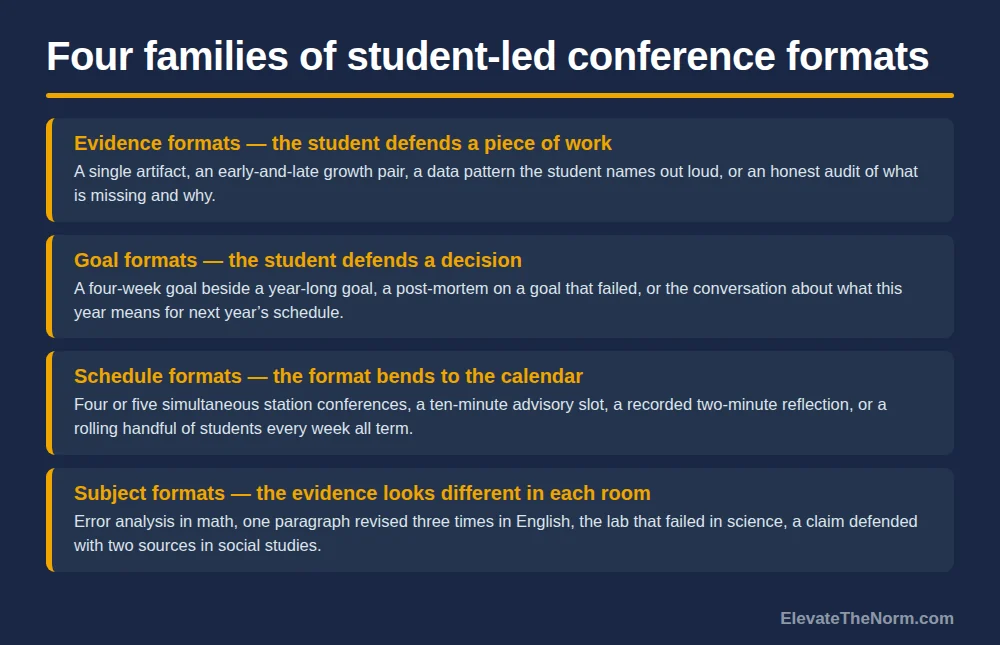
    Good ideas for student led conferences fall into four families: evidence formats, where the student defends a piece of work; goal formats, where the student defends a decision; schedule formats, which bend the event to fit a real calendar; and subject formats, which change what counts as evidence depending on the room. Almost every conference idea you will find online is a variation inside one of those four.

    That framing matters because it stops you from shopping for activities. The question is not “what cute thing can students do at the conference.” The question is what the student has to be able to explain out loud to an adult who is not their teacher. Everything else — the binder, the slides, the sign-in sheet — is packaging around that one moment. If you want the full case for why the event works and where it comes from, that is covered in the main guide to student-led conferences. This page is the catalogue of formats.

    Four labeled rows describing evidence formats, goal formats, schedule formats, and subject formats for student-led conferences.
    The four families every student-led conference format falls into.

    Sixteen ideas for student led conferences, by what the student defends

    Each format below lists what the student brings, roughly how long it runs, and the situation it is built for. None of them require a schoolwide program. Most can be run by one teacher in one course.

    Evidence formats: the student defends a piece of work

    1. The single-artifact defense. One assignment. Three questions: what is this, what does it show about what you can do, and what would you change. Ten to fifteen minutes. This is the format to start with if you have never done this before, because it fails gracefully — a student who freezes still has the paper in front of them.
    2. The growth pair. The earliest and latest version of the same skill, side by side. The student names the specific difference, not “it got better.” Fifteen minutes. Works best in a course with recurring tasks — writing, problem sets, lab reports, studio work.
    3. The data walk. The student reads their own assessment data out loud and names the pattern in it before any adult does. Fifteen to twenty minutes. This is the most uncomfortable format and the most honest one. It also requires that your gradebook actually shows patterns rather than a single running average, which is its own argument for grading by standard. Do not run this one in a station setup — a student reading their own failing scores aloud within earshot of three other families is not a format, it is an exposure.
    4. The missing-work audit. The student accounts for what is not there. Peter Neeves, a middle school principal writing in Edutopia in December 2025, describes exactly this: for incomplete assignments, students write a reflection and build an “assistance plan” for finishing. Fifteen minutes. Use it when the gap between a student’s ability and their grade is mostly a gap in turned-in work.

    Goal formats: the student defends a decision

    1. The four-week goal beside the year goal. The Missouri State Teachers Association’s practical guide recommends a four-week goal, a year-long goal, and one “whole-self” goal. The four-week goal is the useful one, because it is close enough to check. Fifteen minutes.
    2. The goal autopsy. The student revisits a goal they set and did not hit, and says why — not as an apology, as a diagnosis. Twenty minutes, because this one takes real talking. Use it at the second conference of the year, never the first.
    3. The next-course conversation. An eleventh or twelfth grader explains what this year’s evidence means for next year’s schedule, and what they would need to be true to take the harder course. Twenty minutes, and worth pulling a counselor in if you can.

    Schedule formats: the format bends to the calendar

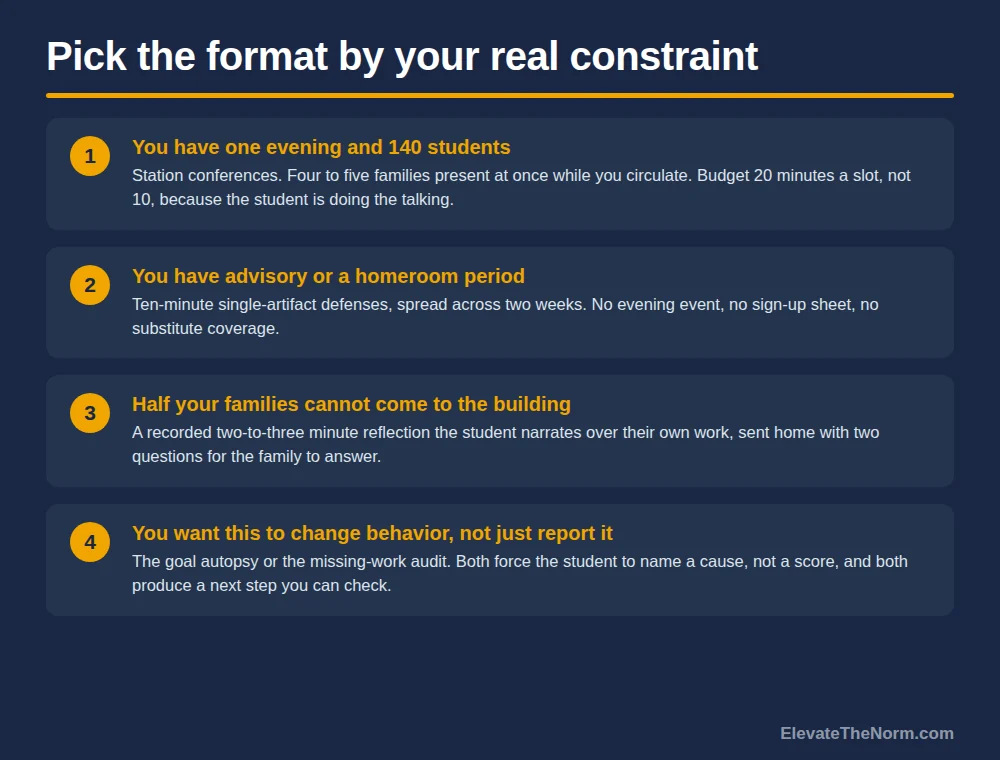
    Four numbered cards matching a teaching constraint to a student-led conference format: one evening with 140 students, an advisory period, families who cannot attend, and wanting behavior change.
    Match the student-led conference format to the constraint you actually have.
    1. Station conferences. Four or five families present simultaneously in one room while you circulate. This is the standard secondary workaround and the MSTA guide describes it directly. Twenty-minute slots. The trade-off is privacy: anything a family might not want overheard has to happen somewhere else.
    2. The advisory conference. Ten-minute single-artifact defenses run during advisory or homeroom across two weeks. No evening event, no coverage, no sign-up system. The weakest format on the list and the one most likely to actually happen.
    3. The recorded conference. A two-to-three minute screen recording in which the student narrates their own work, sent home with two questions for the family to answer and return. The MSTA guide lists this as an option; it is also the only format on this page that reaches a family working a second shift. Three practical guardrails: use whatever recording tool your district has already approved, make sure no other student appears or is named in the recording, and give a student with no reliable device at home a written narration or a phone-audio version instead. The format is the point, not the video.
    4. The rolling conference. Four or five students a week, every week, all term. Nobody schedules an event. By May every student has defended their work twice. This is the format that changes a course culture rather than adding a night to the calendar.

    Subject formats: the evidence looks different in each room

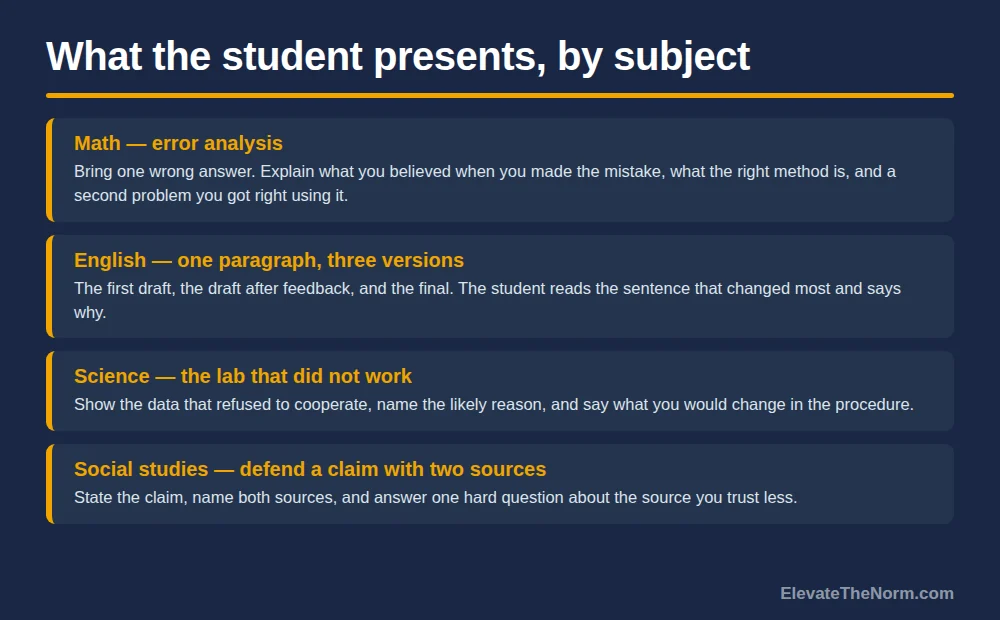
    1. Math — error analysis. The student brings one wrong answer, explains what they believed when they made the mistake, states the correct method, and shows a second problem they got right using it. Fifteen minutes. This format does more for a math student than any portfolio of correct work.
    2. English — one paragraph, three versions. First draft, post-feedback draft, final. The student reads the sentence that changed the most and explains the change. Fifteen minutes.
    3. Science — the lab that did not work. Data that refused to cooperate, the likely reason, and what the student would change in the procedure. Fifteen minutes, and it teaches more about science than a poster of a successful experiment.
    4. Social studies — defend a claim with two sources. The student states a claim, names both sources, and answers one hard question about the source they trust less. Twenty minutes.

    One more, for the hardest case

    1. The repair conference. After an integrity incident or a serious behavior problem, the student explains to their family what happened, who it affected, and what they are doing about it — with you in the room and the school’s formal process already finished, not instead of it. Twenty to thirty minutes. This one is not for everybody and it is not a substitute for required procedure. It is voluntary for the student and the family, it never replaces a mandated report or a discipline process, and your administrator should know it is happening before it happens. It works when a student has already accepted responsibility and needs a way to come back from the mistake rather than carry it. If any of those conditions are missing, skip it.
    Four rows describing what a student presents in math, English, science, and social studies at a student-led conference.
    What the student brings to the table in each subject.

    Do student-led conferences actually do anything?

    The short answer: the parts have evidence behind them and the package does not. Self-assessment and goal-setting — the two things a student-led conference forces — have been studied. The conference as an event has not been tested at scale, and anyone telling you otherwise is stretching. The goal-setting half is worth reading on its own terms too: what the evidence does and does not support about student goal setting is more mixed than most professional development admits.

    The best available evidence on the underlying mechanism is Panadero, Jonsson and Botella’s 2017 set of four meta-analyses in Educational Research Review. Across 2,305 students with a mean age of 17.5, self-assessment interventions produced a small effect on self-regulated learning (d = 0.23) and a large effect on self-efficacy (d = 0.73). Ten of the studies were in secondary schools, so this is not elementary research being stretched upward. But read the authors’ own caution: they state plainly that for self-efficacy “there might exist some over-estimation of the magnitude of the effect” because of publication bias, and that the studies do not clarify the mechanism. A d of 0.73 that the authors themselves flag as probably inflated is not a number to build a school improvement plan on.

    On the conference itself, the most-cited piece of research is Sherri Nauss’s 2010 study in the ERIC database, covering 90 students in grades 6–8, 90 parents and six teachers. It reports that 59 of 90 students said the conferences “consistently” or “usually” made them take responsibility for their learning, and 64 of 90 said the conferences helped them focus on grades. Those are real numbers, and they are also self-reported survey responses from a single school, from students in a narrow 2.5–3.5 GPA band, with no achievement data and no data from families who did not participate. Nauss says all of that herself in the limitations section. It is a useful signal. It is not proof.

    So the honest version is this: if you run one of these formats, you are on solid ground saying that it makes students assess their own work, and reasonable ground expecting that to help a little with how they manage their learning. You are not on solid ground promising a grade bump. Say the first thing to your administrator and skip the second.

    Which format should you pick?

    Pick by constraint, not by preference. The format that fits your worst scheduling problem is the one that will still be running in March.

    If this is your situationUseTime per student
    One evening, 140 studentsStation conferences (#8)20 min
    You have advisory or homeroomAdvisory conference (#9)10 min
    Families work shifts or lack transportRecorded conference (#10)2–3 min of video
    You want a culture change, not an eventRolling conference (#11)15 min, 4–5 a week
    First time ever doing thisSingle-artifact defense (#1)10–15 min
    The problem is missing work, not abilityMissing-work audit (#4)15 min
    Second conference of the yearGoal autopsy (#6)20 min
    Juniors and seniors picking coursesNext-course conversation (#7)20 min

    Whatever you choose, the preparation is the same shape: the student selects evidence, annotates it, and rehearses. The free conference template pack has the readiness checklist and portfolio planner that do that work, and the self-assessment guide explains why the annotation step is the part you cannot skip.

    What do you do about the families who do not come?

    Plan for roughly half of them, and build a format that does not require a body in a chair. This is not pessimism. It is the federal data.

    The National Center for Education Statistics tracks this in the National Household Education Surveys Program. In the 2018–19 survey, the share of parents who attended a regularly scheduled parent-teacher conference was 90% in kindergarten through second grade, 88% in grades 3–5, 72% in grades 6–8, and 54% in grades 9–12. The drop is not a failure of any one school. It is what happens when a child goes from one teacher to seven and the conference stops feeling like the only channel. The 2023 survey puts overall conference attendance across all grades at 72%. If you want a simple record of who you called and why, my free Parent Contact Log on TPT has a page ready to print.

    Three things follow from that. First, a recorded conference is not the consolation prize; for half a high school roster it is the primary format. Second, the family who does not come is often the family you most need to hear from, which is an argument for the short, regular, individual contact that actually has trial evidence behind it. Third, do not grade the student on whether an adult showed up. That is the one design mistake that turns a good idea into a punishment for being poor.

    What about students and families who need accommodations?

    Every format on this page assumes a student can talk about their work for fifteen minutes, and that assumption is wrong for some of your students. Fix it before the conference, not during it.

    For a student with a communication-related disability, the defense is a mode, not a speech. A written narration read by the student, a slide deck the student points to, a recorded version, or a peer-supported walkthrough all satisfy the same purpose. Check the IEP or 504 plan first and follow it — this is an instructional activity, and accommodations apply to it the same way they apply to a presentation in any other class. For an emergent bilingual student, let the conference happen in the language the family speaks, and request the interpreter through whatever process your school already has for conferences. If your school does not have one, that is worth raising before you pick a format, because a conference the family cannot follow is worse than the form letter it replaced.

    Five ways these ideas go wrong

    • The student reads a script and nobody learns anything. A script is scaffolding for a nervous kid, not the product. If a student can deliver the whole thing without looking up, you have built a performance.
    • Only the successful work goes in the folder. A portfolio of A’s is a brag book. The growth pair, the missing-work audit and the error analysis all exist to prevent this.
    • The time slot assumes an adult is talking. Ten minutes is a teacher-led conference. A fifteen-year-old explaining their own reasoning to their mother takes longer, and the silences are part of it.
    • It becomes an eighth grading event. Grade the preparation if you must grade something. Do not put a number on how convincingly a teenager talked about themselves in front of their parent.
    • Nobody follows up. A goal named in October that nobody mentions again in November teaches students that the conference was theater. Put the four-week check on your own calendar before the conference happens.

    What to do next

    Pick one format and one class period. Not the department, not the grade level — one section. The single-artifact defense (#1) run during advisory (#9) is the lowest-risk combination on this page, and it takes one week of prep: students choose the artifact on Monday, annotate it Tuesday, rehearse with a partner Wednesday, and defend it Thursday and Friday.

    Then write down what actually happened — who could explain their own work and who could only describe it. That distinction is the whole point of the exercise, and it is the thing you will want in front of you the next time someone asks whether this is worth the class time. It is. But argue it with what your students did, not with a number from a study that was run somewhere else.

    Before you go: grab the free Student-Led Conference Toolkit (PDF) — ElevateTheNorm.com branded, printable, no email required.

    Frequently Asked Questions

    What are some good ideas for student led conferences in middle and high school?

    Start with a format rather than an activity. The four that work best in grades 6-12 are the single-artifact defense (one assignment, three questions), the growth pair (earliest and latest version of the same skill side by side), the missing-work audit (the student accounts for what is not there and writes an assistance plan), and the goal autopsy (the student explains why a goal they set did not happen). Each runs in ten to twenty minutes and none of them require a schoolwide program.

    How long should a student-led conference be?

    Budget twenty minutes, not ten. Ten minutes is the length of a teacher-led conference, where an adult who has said the same thing six times that night is doing the talking. A fifteen-year-old explaining their own reasoning to their parent is slower, and the pauses are part of the work. If your schedule only allows ten, use the single-artifact defense, which is built to fit.

    Do student-led conferences improve grades?

    There is no good evidence that they do, and you should not promise it. What has been studied is self-assessment, the mechanism underneath the conference. Panadero, Jonsson and Botella’s 2017 meta-analyses found a small effect on self-regulated learning (d = 0.23) and a larger effect on self-efficacy (d = 0.73) across 2,305 students with a mean age of 17.5 – but the authors themselves warn that the self-efficacy figure is probably inflated by publication bias. The most-cited study of the conference itself, Nauss (2010), is 90 students in one middle school reporting on themselves, with no achievement data at all.

    What if the parent disagrees with how the student assessed their own work?

    That disagreement is useful, and it is one of the few things a student-led conference produces that a traditional conference does not. Let it happen, then anchor it to the evidence on the table: the paper, the data, the two drafts. Your job is not to referee who is right about the student’s character. It is to point at the artifact and ask what it shows. If the conversation is heading somewhere a student should not have to sit through, end the conference and schedule a separate one with the adults.

    How do you handle families who do not come to conferences?

    Assume about half of them will not, and build a format that does not require attendance. Federal survey data from 2018-19 puts parent attendance at regularly scheduled conferences at 54% in grades 9-12 and 72% in grades 6-8, down from 90% in the earliest elementary grades. The recorded conference – a two- to three-minute narration the student makes over their own work, sent home with two questions for the family to answer – is the format built for this, and for half a high school roster it is the primary format, not a backup. Never grade a student on whether an adult showed up.

    Should student-led conferences be graded?

    Grade the preparation if you need a grade: the artifact selection, the annotation, the written reflection. Do not put a number on how convincingly a teenager talked about themselves in front of their parent. That turns a format built on honesty into a performance, and the students who most need to say something uncomfortable are exactly the ones a grade will silence.

    Do these formats work for students with IEPs or students learning English?

    Yes, with the accommodations those students already have. The defense is a purpose, not a speech: a written narration the student reads, a slide deck the student points to, a recorded version, or a peer-supported walkthrough all satisfy it. Check the IEP or 504 plan and follow it, the same as you would for any presentation. For a family that speaks another language, request an interpreter through the process your school already uses for conferences, and hold the conference in the language the family actually speaks.

    How is this different from a regular parent-teacher conference?

    In a traditional conference the teacher reports and the family listens. In a student-led conference the student presents evidence of their own learning and the adults ask questions about it. The teacher is still in the room and still responsible for accuracy – this is not the teacher stepping out. What changes is who has to be able to explain the work, which is the entire point.

    Sources

    • McQuiggan, Meghan, and Mahi Megra. Parent and Family Involvement in Education: Results from the National Household Education Surveys Program of 2019 (NCES 2020-076). National Center for Education Statistics, U.S. Department of Education, 2019. Conference attendance by grade band appears in Table 2. Full report (PDF).
    • Parent and Family Involvement in Education: 2023 (NCES 2024-113). National Center for Education Statistics, U.S. Department of Education, 2024. Sample of 19,562 students; overall conference attendance 72%. Summary (PDF). This edition does not disaggregate by grade band, which is why the 2019 report is cited for that figure.
    • Panadero, Ernesto, Anders Jonsson, and Juan Botella. “Effects of self-assessment on self-regulated learning and self-efficacy: Four meta-analyses.” Educational Research Review, vol. 22, 2017, pp. 74–98. Journal listing; open-access author copy at the Universidad Autónoma de Madrid repository (PDF), which is the version read for this article.
    • Nauss, Sherri A. Student Led Conferences: Students Taking Responsibility. 2010. ERIC document ED516784. Full text (PDF). 90 students in grades 6–8 with GPAs between 2.5 and 3.5, self-reported survey data, no achievement measures — limitations stated by the author.
    • Neeves, Peter. “How to Successfully Institute Student-Led Conferences at Your School.” Edutopia, George Lucas Educational Foundation, 3 December 2025. Article.
    • “A Practical Guide to Student-Led Conferences.” Missouri State Teachers Association. Guide.

    A note on the evidence. Two of the six sources are federal survey reports, one is a peer-reviewed set of meta-analyses, and one is a small single-school study whose limitations are stated in the text above rather than buried. The two practitioner sources are cited for format details, not for outcomes. Nobody has run a large randomized trial of student-led conferences at the secondary level, and this article does not pretend otherwise.


    About Clay Shumate

    By Clay Shumate — Clay Shumate is a certified secondary Social Studies teacher in the public schools of West Alabama, with seven years of classroom experience, a B.A. in History, and an M.Ed. in Secondary Education. He writes about project-based learning, student responsibility, respect, and practical ways to hold young people to a higher standard while giving them room to learn from mistakes. He is a member of the Society of Professional Journalists and writes to its Code of Ethics; this site’s editorial standards and corrections policy are published in full.

  • Student Self Assessment for Parent Teacher Conferences: A Grades 6–12 Guide

    Student Self Assessment for Parent Teacher Conferences: A Grades 6–12 Guide

    By Clay Shumate

    Student self assessment for parent teacher conferences is a short written judgment a student makes about their own work — against stated criteria, with evidence attached — that goes into the conference and gets talked about there. It is one page. Its job is to stop the meeting being a conversation about a teenager conducted without the teenager.

    That is the entire idea, and it works in a traditional conference where the parent and the teacher are the ones talking. The student does not have to run the meeting for their own assessment to change what happens in it.

    Key Takeaways

    • The sheet is not a feelings inventory. Every rating on it points at a specific piece of work. “I try hard in this class” is not evidence. “My last two lab write-ups had no analysis section” is.
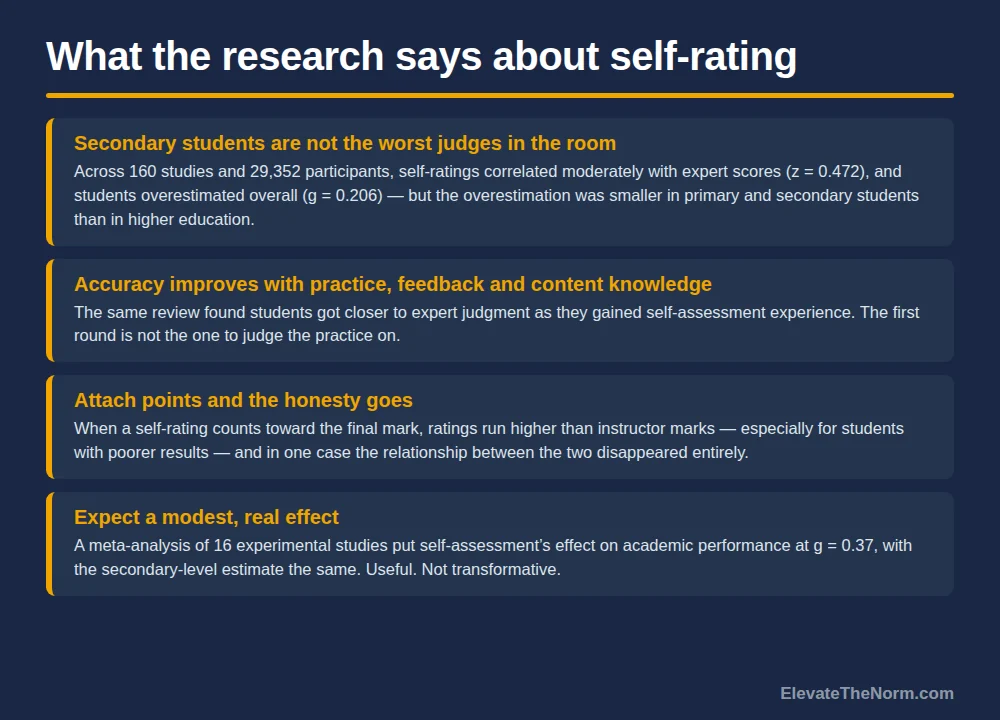
    • Secondary students are better at this than people assume. A 2023 meta-analysis of 160 studies found students overestimate their own work on average — but that the overestimation is smaller in primary and secondary students than in university students.
    • Never let the rating count for points. The moment a self-rating carries a grade, it inflates, and the research on that is consistent enough to treat as settled.
    • What families do with the information matters more than the meeting. Across 50 studies of middle-school parental involvement, the form most strongly tied to achievement was academic socialization — talking about expectations, plans and strategies. Helping with homework was the one form that was not.
    • Expect a modest, real effect. A meta-analysis of self-assessment interventions puts the secondary-level effect at about g = 0.37. Useful. Not transformative.

    What Is Student Self Assessment for Parent Teacher Conferences?

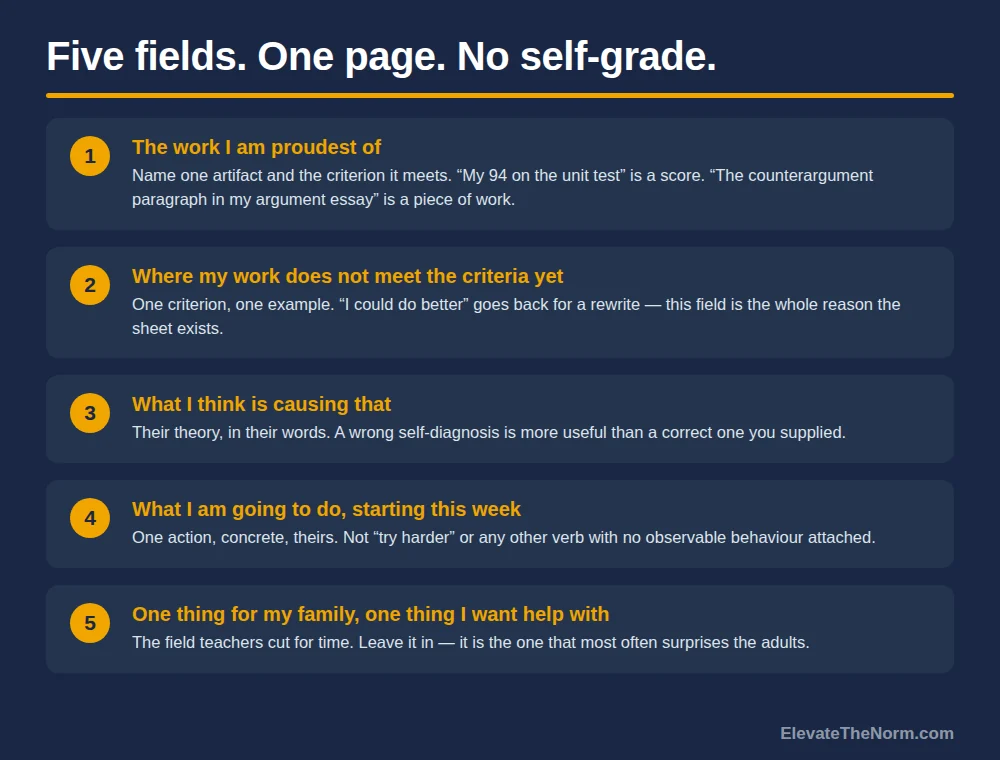
    It is a one-page document a student completes in class, in the week before conferences, in which they rate their own work against criteria you have taught, name the evidence for each rating, and write one thing they intend to do about it. The student keeps a copy. A copy goes to the conference. The adults read it before anyone starts talking.

    Three things it is not, because each of them is a version teachers accidentally build.

    It is not a progress report in the student’s handwriting. If the sheet just restates grades the parent can already see in the portal, it has added nothing and cost a class period. The value is in the judgment, not the numbers.

    It is not a behavior confession. A sheet whose questions are all about effort, attitude and talking in class turns the conference into a disciplinary meeting with extra steps. Some of that may belong in the conversation. It does not belong on this document.

    It is not a student-led conference. A student-led conference is a format in which the student runs the meeting. This is an artifact, and it works inside either format. If your school runs ten-minute traditional conferences down a cafeteria table, this still works. It might work better there, because it is the only thing in the room written by the person everyone is discussing. If you are weighing which conference format to run in the first place, the sixteen formats sorted by time and constraint lay out which ones survive a single evening and which need a full class period. My Parent-Teacher Conference Forms on TPT give you a script for the opening, the hard part, and the next steps, so nobody leaves confused.

    If you want the broader practice this sits inside — what self-assessment is, and the evidence behind it generally — that is in the guide to the general grades 6–12 guide to the practice. This page is about the conference version specifically. If conduct is what the meeting is really about, the behavior version of the same four-step routine is the better sheet to start from. If you do run the student-led format, pair this sheet with a free student-led conference template so the student has a structure for the meeting itself.

    Why Bring a Student Self Assessment to a Conference at All?

    Because the research on what families actually do with school information points away from monitoring and toward conversation — and a self-assessment gives them something to have a conversation about.

    Nancy Hill and Diana Tyson’s meta-analysis of 50 studies of parental involvement in middle school found that involvement was positively associated with achievement across almost every form they measured, with one exception: parental help with homework. The form with the strongest positive association was what they call academic socialization — communicating expectations, discussing strategies, connecting schoolwork to a future the student can picture.1 That is a correlational finding across a mixed body of studies, and it should not be read as proof that a particular conversation causes a grade to move. But it tells you what to aim a conference at. Not “here is the number.” Closer to “here is what your kid thinks is hard, and here is what they plan to do.”

    The federal family-engagement framework used by many districts lands in the same place from a policy direction. The Dual Capacity-Building Framework for Family-School Partnerships lists the essential conditions for engagement that works, and the first two are that it is “relational: built on mutual trust” and “linked to learning and development.”2 A conference built around a student’s own account of their work is both of those by construction. A conference built around a gradebook printout is neither.

    There is a plainer reason too. A conference is a meeting about a fifteen-year-old’s work, held between two adults, often while the fifteen-year-old sits in the hallway or at home. If you believe teenagers are developing young adults, that arrangement is hard to defend. The self-assessment is the cheapest available fix — it puts their judgment in the room even when they are not.

    Will a Teenager Rate Themselves Honestly?

    More honestly than most adults expect, and less honestly the moment you attach points to it. Those two findings are the whole design brief for the sheet.

    Four-row evidence graphic on student self-assessment accuracy, covering the moderate correlation with expert scores, improvement with practice and feedback, inflation when ratings are graded, and a modest overall effect size
    Secondary students self-rate better than the staffroom assumes — until you attach points to it.

    Start with accuracy. Sam P. León, Ernesto Panadero and Inmaculada García-Martínez pooled 160 articles covering 29,352 participants to ask how close student self-ratings come to expert scores. The average correlation was moderate — z = 0.472 — and students did overestimate on the whole, with a small overall effect of g = 0.206. The part worth knowing, because it runs against the staffroom assumption, is that the overestimation was smaller in primary and secondary students than in higher education.3 Your ninth graders are not the worst judges in the building.

    The same review found that accuracy improves with feedback, with content knowledge, and with experience of self-assessing. That is not a reason to skip it in October because they are bad at it. It is a reason to do it more than once.

    Now the part that is closer to settled. Heidi Andrade’s critical review of the field is direct about what happens when self-assessment becomes summative: in one study she cites, students’ self-assessments ran higher than the marks given by their instructors, “especially for students with poorer results,” and when the self-grade counted toward the final mark, “no relationship was found” between the two sets of judgments at all.4 Her own position is stated flatly: “My commitment to keeping self-assessment formative is firm,” and “if there is no opportunity for adjustment and correction, self-assessment is almost pointless.”

    Read together, those give you three non-negotiables for a conference sheet:

    • No points. Not for accuracy, not for completion, not extra credit. The instant it is worth something, it stops being information.
    • Criteria the student has actually been taught. A rating against a rubric nobody explained is a guess with a number on it.
    • Somewhere to go afterwards. If the conference ends and nothing the student wrote can be acted on, you have run a ceremony.

    And keep the expected size of the effect honest. Pinar Karaman’s meta-analysis of 16 experimental and quasi-experimental studies — 46 effect sizes, 7,654 participants — found an overall effect of self-assessment interventions on academic performance of g = 0.37, with the secondary-level estimate also at 0.37.5 That is a real, small-to-moderate effect from a small body of studies. It is not a reason to promise a parent anything.

    What Actually Goes On the Sheet?

    Five fields, one page, no more. Anything longer gets filled in during homeroom on the morning of, which is the failure mode this format exists to prevent.

    Numbered graphic listing the five fields of a student self assessment sheet for parent teacher conferences, from the work the student is proudest of through to what they want their family to know
    Five fields, one page. No numeric self-grade, no effort rating, no behavior self-report.

    Here is what each field is asking for, and the common way each one gets ruined.

    1. The work I am proudest of, and why it meets the criteria. The student names one artifact — an essay, a lab, a project, a problem set — and points at the specific criterion it satisfies. Ruined by: letting them name a grade instead of a piece of work. “My 94 on the unit test” is a score. “The counterargument paragraph in my argument essay” is a piece of work.

    2. Where my work does not meet the criteria yet. One criterion, one example. Ruined by: accepting “I could do better.” Send it back. This field is the entire reason the sheet exists, and vagueness here is almost always a sign the criteria were never concrete enough to apply.

    3. What I think is causing that. Their theory, in their words. Time, confusion about the task, not knowing where to start, a skill gap, not asking. Ruined by: leading them to the answer you want. A wrong self-diagnosis is more useful than a correct one you supplied — it is the thing the conference can actually correct.

    4. What I am going to do about it, starting this week. One action, concrete, theirs. Ruined by: “try harder,” “focus more,” and every other verb with no observable behavior attached.

    5. One thing I want my family to know, and one thing I want help with. This is the field that changes the temperature of the meeting, and it is the one teachers cut for time. Leave it in. It is also the field that most often surprises the adults in the room.

    Notice what is not on the list: a numeric self-grade, an effort rating, and a behavior self-report. The first two inflate, and the third turns the page into something a student would be foolish to answer honestly.

    If you want a ready-made version rather than building your own, the free student self-assessment forms on this site cover the same structure and print on one page — no email address required.

    How Do You Prepare Students Without Losing a Week?

    Three class periods, spread across the week before conferences, totalling about forty-five minutes. Less than that and the sheets come back empty. More than that and it will not survive contact with a pacing guide.

    Three-step graphic showing a forty-five minute preparation sequence before conference week: reading the criteria, completing fields one to four with the work in hand, and writing the family field with a read-back
    About forty-five minutes total, spread across the week before conferences.

    Day one, fifteen minutes — read the criteria. Put the rubric or standards list in front of them and read it aloud while they follow. Then take one piece of anonymous work — last year’s, or one you wrote badly on purpose — and have the class rate it together against one criterion. Judging someone else’s work first is substantially easier than judging your own, and it is how students learn what the criterion actually means.

    Day two, twenty minutes — fill in fields one to four with the work in front of them. Not from memory. Folders open, portal open, papers on the desk. A self-assessment written from memory is a self-assessment about how the semester felt. Circulate and ask one question of anyone who has written a vague line in field two: which assignment, and which sentence in it?

    Day three, ten minutes — field five and a read-back. They write what they want their family to know and what they want help with, then reread the whole sheet once and change anything they would not want said out loud. That last instruction matters. A student who knows they can edit before it leaves the room writes more honestly in the first place, not less.

    Two practical notes. Do this on paper even if your school is one-to-one — a sheet you can hand across a table is doing a different job than a document you have to open. And make a copy before the conference, because a meaningful number of them will not come back.

    On the obvious objection: if you teach 140 students, you are not reading 140 sheets closely. You do not have to. Read field two and field five on all of them — that is genuinely about fifteen seconds each, call it thirty-five minutes — and read the full page only for the students whose conference is actually scheduled. The rest of the sheets did their work in the writing, which is where most of the value sits anyway.

    What Do You Do With the Sheet Once Everyone Is in the Room?

    Read it first, out loud or silently, before anyone gives an opinion. The sequence is the whole technique. If the teacher speaks first, the sheet becomes a document that gets evaluated. If the sheet goes first, it becomes the agenda.

    A workable ten-minute shape, whether or not the student is present:

    1. Minute 1 — everyone reads the sheet. Hand the parent a copy. Say nothing while they read it. This is more uncomfortable than it sounds and it is worth sitting through.
    2. Minutes 2–4 — confirm or complicate field two. Your job here is to say whether you see the same gap the student named. Agreeing is useful. So is “I actually see something different, and here it is.” What it is not is a correction. When your read and the student’s read disagree, both stay on the table and you say why you see it differently. A student whose judgment gets overruled the first time they offer it has learned exactly what the sheet is worth.
    3. Minutes 5–7 — talk about field three, the cause. This is where a parent usually knows something you do not. It is the most valuable three minutes in the meeting and the ones most often spent on grade arithmetic instead.
    4. Minutes 8–9 — make field four specific enough to check. Turn the student’s intention into something with a day attached. “Come to tutoring Tuesday” beats “get more help.”
    5. Minute 10 — name the follow-up. Who checks, when, and how the family will hear. Then actually do it, because a conference with no follow-up teaches everyone that the meeting was the point.

    If the student is in the room, they read field one aloud and you stay quiet. If they are not, read their words rather than paraphrasing them — “here is what she wrote” carries a weight that “she feels like” does not. The broader ground rules for these conversations are set out in the guide to talking with families all year, not just at the meeting.

    How Do You Make This Work for Every Student and Every Family?

    Fix the criteria first. Almost every access problem with self-assessment turns out to be a reading problem in the rubric.

    Rubric language is some of the densest prose in a school building — multi-clause, comparative, written for teachers marking rather than students applying. Before you reach for accommodations, rewrite each criterion as one short present-tense sentence naming something you could point at in the work. Cut the list to three. That single move does more for students with IEPs, 504 plans and English learners than any scaffold you add on top of a bad rubric.

    Beyond that:

    • Sentence stems, printed on the sheet. My evidence for this is on page ___. I still need to ___. The part I get stuck on is ___.
    • Translation of the sheet itself, not just the conference. If your district provides interpretation for conferences, the one-page document is a far easier translation job than a live conversation, and a family that reads it beforehand arrives ready.
    • Say up front who will see it. Students calibrate their honesty to the audience. Tell them the audience before they write, not after — and tell them plainly that it is going home, because field five occasionally surfaces something a student would not have chosen to send to a parent. If something a student writes triggers your mandatory-reporting duty or your counseling referral process, that duty runs first and the conference sheet is not the venue. Know what your school’s process is before you hand the pages out, not while you are holding one.
    • For families who do not attend — and there will be some — the sheet still has a job. Send it home with a two-sentence note naming field four and one way to reply. That is not a substitute for a conference. It is the version that costs you four minutes and reaches people a scheduled evening meeting never will.

    Three Ways This Goes Wrong

    It becomes a grade recap. The sheet fills with scores and percentages, the conference becomes a reading of the portal, and everybody leaves having learned nothing. The fix is field two: if the student cannot name a specific criterion their work does not meet, the sheet is not finished.

    Somebody attaches points to it. Usually with good intentions — a completion grade, to get them turned in. The result is predictable and documented: ratings go up, and the relationship between self-assessment and teacher judgment weakens, most for the students who are struggling most.4 If you need them submitted, use a deadline, not a grade.

    Nothing happens afterwards. The sheets go in a folder, the follow-up never runs, and next year the students fill them in exactly as carefully as the process deserves. Teenagers are good at working out which school rituals are real. If you can only protect one part of this, protect the follow-up.

    What to Do Before the Next Conference Window

    Pick one class. Take the rubric you already use and rewrite three criteria in plain sentences. Build the five-field page — or print the existing form — and give it the three short periods above in the week before conferences. Do not grade it. Read it first in the room.

    Then, at the next conference cycle, do it again with the same students. The accuracy research is clear that this gets better with repetition and feedback, and almost nothing in the first round will be as good as the third.3 The honest promise is a modest one: a meeting that is about the student’s actual work rather than their average, and a teenager who was treated as a participant in a conversation about their own life. That is worth forty-five minutes of class time on its own. And when the meeting itself arrives, families who walk in with a short list of questions worth the fifteen minutes get more out of it than the ones who open with “how is she doing?”

    Frequently Asked Questions

    What is student self assessment for parent teacher conferences?

    It is a one-page document the student completes in class before conferences, rating their own work against criteria the teacher has taught, naming the evidence for each rating, and writing one thing they intend to do about it. A copy goes into the conference and the adults read it before anyone gives an opinion. It works in a traditional conference as well as a student-led one — the student does not have to run the meeting for their own assessment to change what happens in it.

    Should the self-assessment count toward the student’s grade?

    No. This is the closest thing to a settled finding in the area. When a self-rating carries points, ratings inflate, most sharply among the students who are struggling most, and in at least one study the relationship between student and instructor judgments disappeared entirely. If you need the sheets submitted, use a deadline rather than a grade.

    Won’t students just say what they think the adults want to hear?

    Some will, at first. Three things reduce it: tell them plainly who will read the sheet before they write it, give them a read-back step where they can edit anything they would not want said aloud, and never attach points. The accuracy research also suggests this improves with repetition — students get closer to expert judgment as they gain experience self-assessing, so the first round is not the one to judge the practice on.

    What if the student’s self-assessment disagrees with my assessment?

    Say so, and say why, and leave both on the table. That disagreement is usually the most useful thing in the meeting — it tells you the criteria were not concrete enough, or that the student cannot yet see the gap, and either of those is worth more than agreement. What it is not is an occasion to correct them. A student whose judgment is overruled the first time they offer it has learned exactly what the sheet is worth.

    I teach 140 students. How am I supposed to read all of these?

    You are not. Read field two and field five on every sheet — about fifteen seconds each, call it thirty-five minutes — and read the full page only for students whose conference is actually scheduled. The rest of the sheets did most of their work in the writing.

    What if a student writes something concerning on the sheet?

    Know your school’s counseling referral and mandatory reporting process before you hand the pages out, not while you are holding one. If something a student writes triggers that duty, the duty runs first and the conference is not the venue. Tell students up front that the sheet is going home, so nobody is surprised by where their words end up.

    Should a district require every teacher to use the same form?

    Be careful. The value of this comes from criteria students have actually been taught in a specific course, and a district-wide form tends to drift toward generic effort-and-attitude questions that produce nothing usable. Requiring that students bring a self-assessment is reasonable. Dictating its contents usually is not.

    Does this actually improve achievement?

    Modestly, on current evidence, and you should not promise a family more than that. A meta-analysis of 16 experimental and quasi-experimental studies put the effect of self-assessment interventions on academic performance at about g = 0.37, with the same figure at secondary level, drawn from a small body of studies. The stronger argument for doing it is not the effect size. It is that a meeting about a teenager’s work should include the teenager’s account of it.

    Sources

    1. Hill, Nancy E., and Diana F. Tyson. “Parental Involvement in Middle School: A Meta-Analytic Assessment of the Strategies That Promote Achievement.” Developmental Psychology, vol. 45, no. 3, 2009, pp. 740–763. https://pubmed.ncbi.nlm.nih.gov/19413429/
    2. Mapp, Karen L., and Eyal Bergman. Dual Capacity-Building Framework for Family-School Partnerships (Version 2), 2019. Retrieved from www.dualcapacity.org
    3. León, Samuel P., Ernesto Panadero, and Inmaculada García-Martínez. “How Accurate Are Our Students? A Meta-analytic Systematic Review on Self-assessment Scoring Accuracy.” Educational Psychology Review, vol. 35, no. 4, art. 106, 2023. https://link.springer.com/article/10.1007/s10648-023-09819-0
    4. Andrade, Heidi L. “A Critical Review of Research on Student Self-Assessment.” Frontiers in Education, vol. 4, art. 87, 2019. https://www.frontiersin.org/journals/education/articles/10.3389/feduc.2019.00087/full
    5. Karaman, Pinar. “The Impact of Self-assessment on Academic Performance: A Meta-analysis Study.” International Journal of Research in Education and Science, vol. 7, no. 4, 2021, pp. 1151–1166. https://files.eric.ed.gov/fulltext/EJ1319061.pdf

    Every source above was opened and read on September 22, 2026. One figure was deliberately left out: the NCES Parent and Family Involvement in Education: 2023 tables on conference attendance by grade level could not be transcribed reliably from the published PDF in this session, so no attendance percentage is quoted here rather than quoting one that could not be checked.

    About Clay Shumate

    Clay Shumate is a certified secondary Social Studies teacher in the public schools of West Alabama, with seven years of classroom experience, a B.A. in History, and an M.Ed. in Secondary Education. He writes about project-based learning, student responsibility, respect, and practical ways to hold young people to a higher standard while giving them room to learn from mistakes. He is a member of the Society of Professional Journalists and writes to its Code of Ethics; this site’s editorial standards and corrections policy are published in full. More about Clay.

  • Standards Based Grading Gradebook: How to Build One That Survives a Semester

    Standards Based Grading Gradebook: How to Build One That Survives a Semester

    A standards based grading gradebook stores evidence by learning target instead of by assignment. Each row is a standard. Each entry is a piece of evidence a student produced for that standard. That one structural change is what makes a gradebook readable to a student, a parent, and the teacher who inherits the class next year. It is also what creates every hard decision you will spend the semester making.

    Most of what gets written about standards-based grading is about philosophy. This is not that. This page is about the file — what goes in the columns, what happens when a kid takes a quiz three times, what you do when the office needs a letter grade by Friday, and what the research says happens when you get those choices wrong.

    I will say up front that the evidence here is thinner and more mixed than the professional development usually admits. That is covered honestly below, because a teacher about to rebuild a semester of records deserves to know what they are buying.

    Key Takeaways

    • The structure is the whole idea. Rows are standards, not assignments. If your gradebook still reads as a chronological list of tasks with points attached, you have changed the labels and not the system.
    • One randomized trial found a real gain. A cluster RCT across 29 schools of a proficiency-plus-reassessment program in ninth-grade algebra and geometry reported a 0.33 standard deviation improvement on end-of-course mathematics tests — roughly the 50th to the 63rd percentile.
    • But no grading system improves learning by itself. Guskey and Link put it plainly: grading does not change curriculum or instruction, and there is no evidence that standards-based grading on its own raises achievement. What it reliably does is make the grade mean something specific.
    • Taking practice work out of the grade has a measurable cost. A two-year study of a policy change in secondary mathematics found that when practice stopped counting, completion of practice fell and achievement declined on several standards.
    • Students object on fairness grounds, and their objections are specific. In a survey of 478 high school students, the complaints were not about rigor. They were about inconsistent reassessment rules between teachers and about losing credit for work they had done.
    • The five decisions below are where implementations live or die: how many standards, what scale, how repeated attempts combine, what counts as evidence, and where behavior goes.

    What is a standards based grading gradebook?

    It is a gradebook whose primary axis is the standard rather than the assignment. A traditional gradebook answers “what did this student turn in and what was it worth?” A standards-based gradebook answers “what can this student do, and how do we know?”

    In practice that means a column per learning target instead of a column per task. A single test might feed six different columns, because a single test usually assesses six different things. Three separate assignments over a month might all feed one column, because they were all evidence for the same skill. The assignment does not disappear — it becomes the container for the evidence rather than the thing being measured.

    If you want the underlying rationale and the arguments for and against the approach as a whole, that is covered in the main standards-based grading guide. This page assumes you have already decided, or been told, and now have to build the thing.

    Does a standards based grading gradebook actually improve learning?

    The honest answer: one good randomized trial says a specific version of it helped, a large review says grading systems do not improve learning on their own, and at least one comparison found worse outcomes. Anyone who tells you the evidence is settled has not read it.

    The positive result

    The strongest evidence for this approach comes from a cluster randomized controlled trial of the PARLO program run by Kramer and colleagues and published in the Journal of Research on Educational Effectiveness. Twenty-nine schools were randomized — 14 treatment, 15 control — with the intervention in ninth-grade algebra and geometry classrooms. Students were rated not-yet-proficient, proficient, or high-performance on each learning outcome, and could reassess any outcome for full credit after further study. The program produced a 0.33 standard deviation improvement on end-of-course mathematics tests, moving the average student from roughly the 50th to the 63rd percentile. The effect was strongest among students who were already more motivated.

    Two caveats on that one. First, PARLO is a defined program with mastery definitions and reassessment built in, not a gradebook layout — the trial tested the whole package. Second, the full published article was not accessible to me, so the figures above come from the study summary published by the Society for Research on Educational Effectiveness rather than from the paper itself. I am citing what I actually read.

    The sobering results

    Laura Link and Thomas Guskey, writing in Theory Into Practice, argue that standards-based grading is best understood as a communication tool and not as an achievement intervention. Their sentence is the one worth keeping: no grading system by itself improves student learning, because grading does not alter curriculum or instruction. They note that the practice remains largely unstudied, that emerging research shows it produces a stronger relationship between grades and external measures, and that no evidence indicates it improves achievement.

    Four research summaries on standards-based grading: Kramer 2024 cluster randomized trial, Link and Guskey 2022, Townsley and Varga 2017, and Huey 2022
    Five peer-reviewed sources, and they do not agree with each other.

    Matt Townsley and Matt Varga compared two demographically similar Midwestern high schools of about 450 students each, one using standards-based grading and one traditional, across the graduating classes of 2015 and 2016. They found no significant difference in math, English, or cumulative GPA — and ACT scores roughly 2.2 to 2.7 points higher at the traditional school. That is a quasi-experimental comparison of two schools with all the confounding that implies, and the authors flag the rural, low-diversity sample themselves. It is not proof that the gradebook caused it. It is also not a result anyone should skip past.

    The broadest context comes from A Century of Grading Research in the Review of Educational Research, an eight-author review of the whole field. Two findings from it matter for anyone building a gradebook. Teachers mix achievement with work habits whether or not their system says they should — even teachers who report supporting standards-based reform report using practices that blend effort and improvement into academic marks. And grades, messy as they are, consistently predict educational persistence and completion better than standardized tests do. The multidimensionality that standards-based grading tries to strip out may be part of what makes a grade useful.

    The five decisions every standards-based gradebook has to make

    Make these five on purpose, write them down, and do not change them midyear. Every failed implementation I have read about failed at one of these, usually by leaving it to be decided case by case.

    DecisionThe optionsWhat to weigh
    1. GranularityEvery state standard, or 8–15 bundled targets per courseToo many rows and nobody reads the gradebook. Too few and the grade stops being diagnostic. Most workable secondary courses land between eight and fifteen per semester.
    2. Scale4-point, 3-level proficiency, or letter equivalentsGuskey argues for a limited number of performance categories rather than percentage scales, to cut down on false precision. The 1–4 scale and its conversion problems are worth reading before you commit.
    3. How attempts combineMean, most recent, highest, or professional judgmentThis is the one students notice. Averaging punishes early struggle. “Most recent” can drop a student for one bad day. Write the rule down and publish it.
    4. What counts as evidenceAssessments only, or assessments plus observed performanceNarrow it too far and you are grading test-taking. Widen it without criteria and you are back to impressions.
    5. Where behavior goesA separate reported strand, or nowhereSeparating academic marks from work habits is one of the three criteria Guskey names. It only works if the second strand is actually reported, not deleted.

    On decision three specifically: students in one large survey complained that a reassessment score replaced a higher earlier score even when it was worse. That is a defensible rule and an indefensible surprise. The rule is not the problem; discovering it after the fact is.

    Five numbered gradebook design decisions: granularity, scale, how attempts combine, what counts as evidence, and where behavior is reported
    Decide these on purpose, write them down, and hold them all year.

    Should practice work count in the grade?

    The evidence says be careful, and it points the opposite direction from the standard advice.

    The usual argument is that practice is formative, so it should not be graded — students will do it because it helps them. A two-year study by Huey and colleagues in Studies in Educational Evaluation tested exactly that policy change with 122 eighth graders and 123 ninth graders in year-long geometry courses. When practice work was removed from grade computations, completion of practice work decreased overall, and student achievement declined on several of the standards being assessed. The authors concluded that process grades are likely essential to maintaining achievement in that population, and noted their result contradicts reform advocates who claim engagement holds regardless.

    That is one study of high-achieving students in one subject, and it should not be read as a verdict on the whole question. But it is a direct test of a specific gradebook decision, and it came out against the conventional answer. If you take practice out of the grade, put something else in its place that makes the practice visibly matter, and watch your completion rates rather than assuming.

    Students see the same thing from the other side. In a study of 478 students at one high school, the most common complaint about standards-based grading was that homework should count — not because they wanted easy points, though some did, but because with few graded items the whole grade rested on two or three assessments. “There are so few points available on quizzes and tests” is a fairness objection, and it is a reasonable one.

    How do you convert to a letter grade when the office needs one?

    Publish the conversion rule before the first grade goes in, and use the same one every time.

    Most secondary teachers running this system do not control the report card, so the standards-based gradebook feeds a traditional one. That translation is where trust gets lost, because a student who sees a row of 3s and receives a B wants to know how. Three workable approaches:

    1. A published crosswalk. A fixed table — all 4s and 3s with no 2s is an A, and so on. Simple, transparent, and slightly blunt at the boundaries.
    2. A proficiency threshold. The grade is determined by the proportion of standards at proficient or above, with a stated floor of standards that must be met regardless.
    3. A weighted composite with named priority standards. More precise, harder to explain, and worth it only if you will actually explain it.

    Whichever you choose, the parent-facing version has to be one paragraph long. Brookhart and colleagues found that many parents attempt to interpret standards-based labels by translating them back into letter grades regardless of what the school intends. Give them the translation rather than letting them invent one.

    What breaks, and when

    Reassessment load, teacher-to-teacher inconsistency, and midyear rule changes — in that order.

    • Unlimited reassessment. Guskey and Link warn directly that unlimited retakes create burdensome workloads, and that retaking a poorly aligned assessment does not produce learning regardless of how many attempts you allow. Cap attempts, require evidence of new study before a retake, and put reassessment in a fixed window rather than on demand.
    • Different rules in different rooms. Students in the 478-student survey said it repeatedly: nobody communicates the same, there is no standardization, some teachers appear to make reassessment deliberately difficult. Within a department, the five decisions above should have one answer, not six.
    • Changing the rule in January. A grading rule changed midyear is functionally retroactive, because the evidence already in the book was produced under the old one. If a decision is wrong, finish the term and change it at the semester line.
    • A gradebook nobody opens. Fifteen standards with one entry each in November is not a standards-based gradebook, it is a spreadsheet. The system only pays off if there is enough evidence per row to make the row mean something.

    Before you do this alone: what it costs beyond your own room

    A standards-based gradebook inside one classroom in a traditional building is a bigger undertaking than it looks, and four things will bite you.

    • The transcript is not yours. Whatever you do internally, a letter grade and a GPA leave your room and go on a document that affects class rank, scholarship eligibility, and athletic eligibility. Confirm with your counseling office how your marks will be recorded before you change how you produce them, not in May.
    • Your software may not support it. Most district gradebooks are built around assignments with point values. Some can be bent into standards; some can only fake it with categories. Find out which you have before you design a system it cannot hold, because a parallel spreadsheet you maintain by hand is a system that dies in November.
    • Students transfer. A student who arrives in week twelve arrives with points, and a student who leaves takes your proficiency levels into a building that will not know what they mean. Have a stated rule for both directions.
    • Reassessment is the real labor cost. Be concrete about it before you promise anything. If 20% of 140 students reassess one target a week, that is 28 additional items to write, administer, and score every week, on top of everything else. That number is why reassessment windows and attempt caps exist, and it is why Guskey and Link warn that unlimited retakes become burdensome.

    There is an instructional point buried in that last one that a coach would raise immediately. Reassessment only works if you have more than one assessment item per target that genuinely measures the same thing. If the retake is the same quiz, you are measuring memory of a quiz. If the retake is harder, you are punishing the student for needing it. Building a second and third form for each priority standard is the unglamorous prerequisite, and it is most of the actual work of this system.

    Four failure points for a standards-based gradebook: unlimited reassessment workload, inconsistent rules between teachers, midyear rule changes, and too little evidence per standard
    In roughly this order, and usually by midyear.

    None of this is an argument against doing it. It is an argument for doing it with the department and the counseling office rather than in private, and for starting with one course rather than a schedule.

    A setup checklist you can work through in an afternoon

    1. List the course’s learning targets and bundle them down to 8–15 per semester. Write each one in student-facing language. If you cannot say it in a sentence a fifteen-year-old understands, it is still a standards document and not yet a target.
    2. Pick the scale and write the descriptors. Not just the numbers — what a 3 actually looks like in this course. Rubric templates are the fastest way in.
    3. Write the five decisions on one page. Granularity, scale, how attempts combine, what counts as evidence, where behavior goes. Date it.
    4. Build the columns before the semester, not during it. Retrofitting a gradebook in week six means hand-remapping every entry already in it.
    5. Decide the reassessment window and the entry requirement now. Which days, how many attempts, what a student must show to earn one.
    6. Write the one-paragraph explanation for families. What the numbers mean, how they become a letter, and when. Send it in the first two weeks rather than after the first complaint — the same front-loaded contact that works for everything else works here.
    7. Pick your check date. A day in week eight when you open the gradebook and ask whether any row has too little evidence to defend, and whether your conversion rule still produces grades you believe.

    What to tell students, and what to tell families

    Tell students the rules before the first entry, and show them the gradebook. Most of the recorded student resistance to this system is not resistance to rigor. It is the experience of being graded by a machine whose rules nobody explained.

    Grades 6–12 students can handle the actual explanation, and they deserve it. Say what the scale means. Say how repeated attempts combine, including the case where a retake scores lower. Say which standards carry the most weight. Say what happens to homework. Then hold to it, because the fastest way to lose a room under this system is to make an exception for one student and get caught.

    For families, lead with the translation and the one thing that changed. If your building is also making the shift, the arguments against are worth knowing as well as the arguments for — the case that standards-based grading does not work is an honest summary of the objections, and a teacher who can state the objection fairly is more persuasive than one who cannot.

    What to do next

    Before you rebuild anything, write the five decisions on one page and show it to one colleague who teaches the same course. Most of the damage in a standards based grading gradebook happens because a decision was never made explicitly — it just emerged from whatever the software defaulted to and whatever felt fair in the moment.

    Then build one unit, not one semester. Run it, look at how many entries each row actually accumulated, and see whether your conversion rule produced a grade you would defend to a parent. Adjust once, at the unit boundary. That is a slower start than a summer rebuild and it is the version that is still running in April. When the unit is done, a short structured reflection on what the rows told you is worth more than another round of reorganizing the columns.

    Frequently Asked Questions

    What is a standards based grading gradebook?

    A gradebook organized by learning target rather than by assignment. Each row is a standard and each entry is evidence a student produced for that standard, so a single test can feed six different rows and three assignments over a month can feed one. The practical test is whether the gradebook answers “what can this student do” rather than “what did this student turn in.” If the rows are still tasks with point values, the labels have changed and the system has not.

    How many standards should be in the gradebook?

    For most secondary courses, eight to fifteen bundled targets per semester. Listing every state standard produces a gradebook nobody opens, including you. Bundling too aggressively produces a grade that is no more diagnostic than a single letter. The working check is whether each row will accumulate enough evidence by the end of the term to defend a judgment — a row with one entry in November is not measuring anything.

    Should homework and practice work count toward the grade?

    The evidence is more cautious than the usual advice. A two-year study of a policy change in secondary mathematics found that when practice work was removed from grade computations, practice completion fell and achievement declined on several standards. Students in a separate survey said the same thing from their side: with few graded items, removing practice makes the entire grade rest on two or three assessments. If you take practice out, replace it with something that makes practice visibly matter and watch your completion rates.

    How should multiple attempts at the same standard be combined?

    Pick one rule, publish it before the first entry, and do not change it midyear. Averaging punishes early struggle, which is the thing the system is supposed to fix. “Most recent” can drop a student for one bad day. Highest score removes the incentive to prepare. Many teachers use most-recent with professional judgment for outliers. Whichever you choose, students need to know in advance what happens when a retake scores lower than the original — that specific surprise is one of the most common student complaints on record.

    Does standards-based grading raise test scores?

    The evidence is mixed and should be described that way. A cluster randomized trial across 29 schools of a proficiency-plus-reassessment program in ninth-grade math reported a 0.33 standard deviation gain on end-of-course tests. A comparison of two Midwestern high schools found no GPA difference and ACT scores roughly 2.2 to 2.7 points higher at the traditional school. Guskey and Link argue no grading system improves learning on its own, because grading changes neither curriculum nor instruction. What it reliably changes is what the grade means.

    How do you turn standards-based marks into a letter grade?

    With a published conversion rule applied identically every time. The three workable approaches are a fixed crosswalk table, a proficiency threshold based on the proportion of standards met, and a weighted composite with named priority standards. Write the parent-facing version in one paragraph and send it in the first two weeks. Research on grading found that many parents translate standards-based labels back into letter grades regardless of what the school intends, so it is better to hand them the translation than to let them invent one.

    What is the biggest implementation mistake?

    Leaving the rules implicit and letting them emerge from whatever the software defaults to. The five decisions — granularity, scale, how attempts combine, what counts as evidence, and where behavior goes — need explicit written answers that are the same across a department. Students surveyed about standards-based grading complained most about inconsistency between teachers, not about difficulty. Unlimited reassessment is a close second; it produces a workload that collapses by midyear.

    Can one teacher run this if the rest of the school does not?

    Yes, with three conversations first. Confirm with the counseling office how your marks will be recorded on the transcript, since class rank, scholarships, and athletic eligibility depend on a document you do not control. Confirm that your district gradebook can actually hold standards rather than categories pretending to be standards. And agree on a rule for students who transfer in or out mid-term. Start with one course rather than a full schedule.

    Sources

    • Link, Laura J., and Thomas R. Guskey. “Is Standards-Based Grading Effective?” Theory Into Practice, 2022. Full text (PDF).
    • Brookhart, Susan M., Thomas R. Guskey, Alex J. Bowers, James H. McMillan, Jeffrey K. Smith, Lisa F. Smith, Michael T. Stevens, and Megan E. Welsh. “A Century of Grading Research: Meaning and Value in the Most Common Educational Measure.” Review of Educational Research, vol. 86, no. 4, 2016, pp. 803–848. Full text (PDF).
    • Townsley, Matt, and Matthew Varga. “Getting High School Students Ready for College: A Quantitative Study of Standards-Based Grading Practices.” Journal of Research in Education, vol. 28, no. 1, 2017, pp. 93–112. Full text (PDF).
    • Huey, Maryann E., Peter R. Silvey, Amanda G. Vaughan, and Anne L. Fisher. “Assessing the Impact of Standards-Based Grading Policy Changes on Student Performance and Practice Work Completion in Secondary Mathematics.” Studies in Educational Evaluation, vol. 75, 2022, article 101211. Journal listing.
    • Peters, Randal, Jerrid Kruse, Tom Buckmiller, and Matt Townsley. “‘It’s Just Not Fair!’ Making Sense of Secondary Students’ Resistance to a Standards-Based Grading.” American Secondary Education, vol. 45, no. 3, 2017, pp. 9–28. Full text (PDF).
    • Kramer, Karen, Jill Posner, Alexander Browman, Rebecca Lawrence, Jennifer Roem, and Kathryn Krier. “The Impact of a Standards-Based Grading Intervention on Ninth Graders’ Mathematics Learning.” Journal of Research on Educational Effectiveness, 2024. Figures cited here come from the Society for Research on Educational Effectiveness study summary, which is what was read; the full article was not accessible.

    A note on the evidence. Five of the six sources above are peer-reviewed, and they do not agree with each other. That is the accurate state of this field, and a gradebook decision made on the assumption that the research is settled is a decision made on something that is not true.


    About Clay Shumate

    By Clay Shumate — Clay Shumate is a certified secondary Social Studies teacher in the public schools of West Alabama, with seven years of classroom experience, a B.A. in History, and an M.Ed. in Secondary Education. He writes about project-based learning, student responsibility, respect, and practical ways to hold young people to a higher standard while giving them room to learn from mistakes. He is a member of the Society of Professional Journalists and writes to its Code of Ethics; this site’s editorial standards and corrections policy are published in full.

Teacher Emergency Toolkit — practical resources, real classroom support. Shop on TPT.Teacher Emergency Toolkit — practical resources, real classroom support. Shop on TPT.