The Elevate Blog banner: Real Classrooms. Practical Ideas. Higher Expectations. Three students climb a rocky ridge at sunrise, each pulling the next one up, toward a teacher reaching down to help.

Category: Assessment & Feedback

Checking for understanding, feedback, and assessment that changes what happens next.

  • Media Literacy Activities for Grades 6–12: 12 Ideas, and Which Ones Are Actually Tested

    Media Literacy Activities for Grades 6–12: 12 Ideas, and Which Ones Are Actually Tested

    By Clay Shumate

    Media literacy activities teach students to check who made a claim and what the evidence behind it is, using real online content rather than made-up examples. In grades 6–12, lateral reading has the strongest evidence: students leave the page and look up the source in a new tab. Most published activities have never been tested at all.

    Key Takeaways

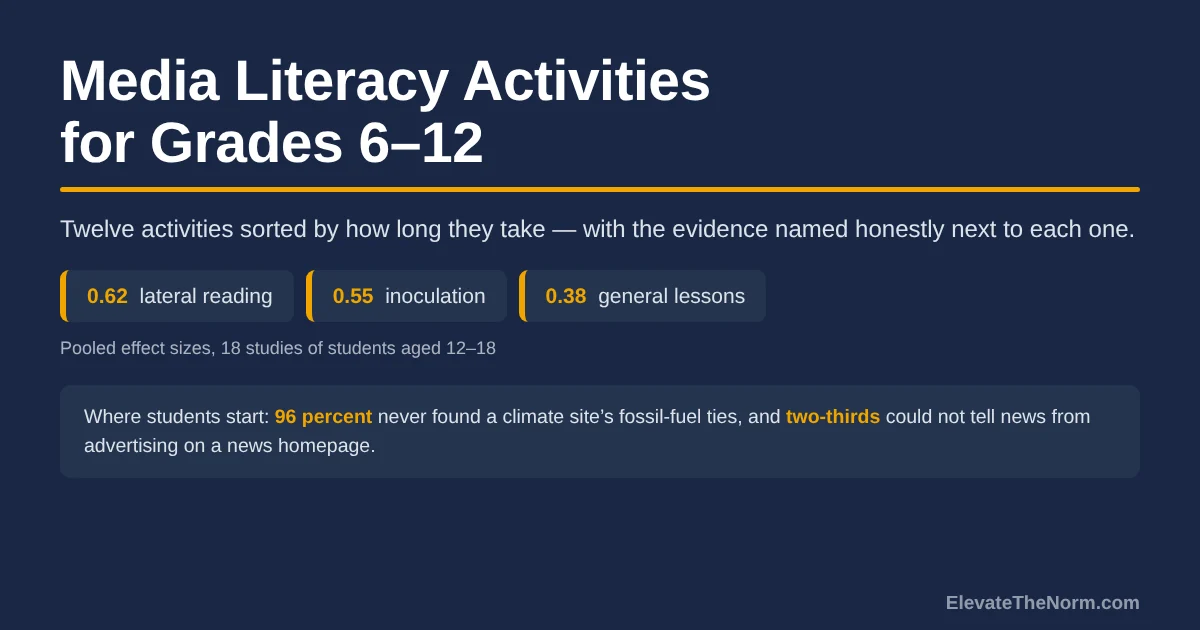
    • Across 18 studies of adolescents aged 12–18, media literacy instruction moved misinformation outcomes by a standardised mean difference of 0.48 (95% CI 0.31–0.65). Lateral-reading activities were the strongest category at 0.62; general media literacy lessons were the weakest at 0.38.
    • The cheapest activity with a real randomised test is a printed list of tips. Reading ten tips for spotting false news improved discernment by 26.5 percent in a nationally representative U.S. sample. Weeks later the effect on false-headline ratings had attenuated by more than half, though discernment was still measurably above zero.
    • Gamified "spot the fake" activities may not do what they appear to do. A reanalysis of five studies of two popular misinformation games found no improvement in students’ ability to tell true from fake — only a general willingness to call everything fake.
    • Students start lower than most teachers expect. Of 3,446 U.S. high school students, two-thirds could not tell news stories from advertisements on a news homepage, and 96 percent never discovered that a climate website was tied to the fossil fuel industry.
    • Repetition is the moderator that keeps showing up: in a meta-analysis of 49 experiments and 81,155 participants, multi-session interventions outperformed single-session ones. One activity in October does not survive to April.

    Most media literacy activity lists have the same problem. They hand you twenty ideas with no indication of which ones have ever been tested on teenagers, how long each takes, or what goes wrong when you run it on a Tuesday in a room of ninth graders who have already decided the whole internet is lying to them.

    So this article does it the other way round. Twelve activities, sorted by how long they take, with the evidence named honestly next to each one — including the three categories that have been measured on students this age, and the nine that are reasonable and untested. Everything here is written for grades 6–12. If you teach elementary, the activities below will not transfer cleanly and I would rather say so than pretend.

    What are media literacy activities?

    Media literacy activities are classroom tasks in which students evaluate real media — a website, a post, an ad, a video, a news story — by asking who made it, what evidence supports it, and what other sources say. The defining feature: students judge live content they did not write.

    That last part matters more than it sounds. The curriculum that produced measurable gains in the one classroom study of ninth graders was built on four design principles, and one of them was evaluating real online content rather than sanitised samples. A worksheet about a fictional website teaches students to complete worksheets.

    Media literacy overlaps with two things this site covers separately. It is not the same as teaching document analysis with primary sources, which asks students to read a historical source for what it reveals about its maker — same three habits, different material and a different framework. It is also not the same as reading comprehension on screens. Media literacy is the credibility question specifically: should I believe this, and how would I find out?

    Do media literacy activities actually work?

    Yes, modestly, and it depends heavily on which activity you run. A 2026 meta-analysis of adolescents aged 12 to 18 pooled 18 studies and found a moderate overall effect of SMD 0.48 (95% CI 0.31–0.65). That is real movement, not a transformation.

    What makes that review worth more than its headline number is the breakdown by type. Rodríguez Castillo and colleagues report three categories separately:

    Activity categoryEffect (SMD)95% CIStudies
    Lateral reading ("side reading")0.620.45–0.796
    Cognitive inoculation (prebunking, games)0.550.37–0.735
    General media literacy instruction0.380.21–0.557
    Rodríguez Castillo et al. (2026), Journalism and Media 7(2):71. Random-effects model, adolescents 12–18, I² = 56 percent for the overall estimate. The authors searched three databases, English and Spanish only, and note that several included studies used self-reported measures.

    A broader meta-analysis that was not limited to teenagers reached a larger figure — d = 0.60 overall across 49 experiments and 81,155 participants, with discernment moving 0.76 and sharing behaviour 1.04. Two cautions on that one. Its samples were mostly college students and online panels rather than secondary students, and the effects were stronger with multiple sessions than with one. I read it at abstract level; the full text sits behind a paywall, so nothing beyond those figures is claimed here.

    The honest summary: a single activity produces a small, decaying effect. A sequence of them, run across a year in a subject that already asks students to evaluate claims, produces something closer to a skill.
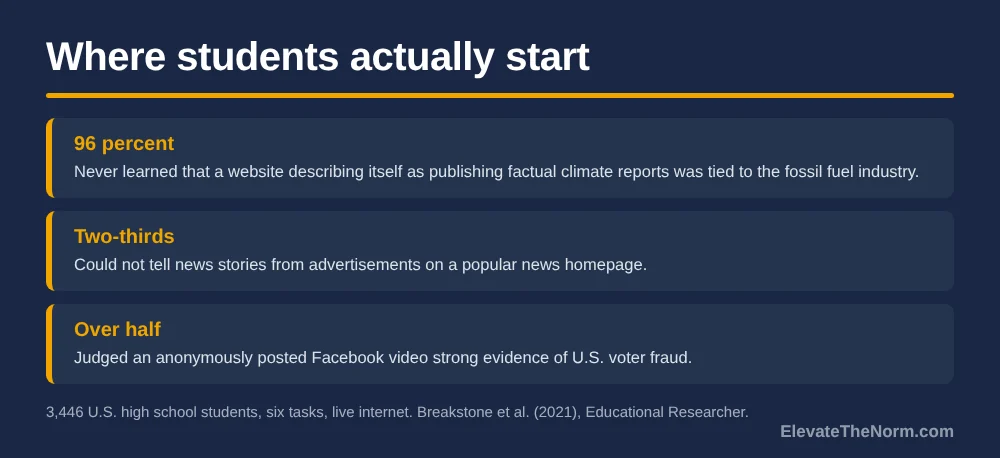
    Three-row graphic on a national study of 3,446 U.S. high school students: 96 percent never learned a climate website was tied to the fossil fuel industry; two-thirds could not tell news stories from advertisements on a news homepage; over half judged an anonymously posted Facebook video strong evidence of voter fraud.

    Which media literacy activity has the strongest evidence?

    Lateral reading, at SMD 0.62 in the adolescent meta-analysis. Lateral reading means leaving the page you are judging and opening new tabs to find out what other sources say about it — instead of staying on the page and judging it by how professional it looks.

    The reason it is the headline activity is that it came out of watching people who are good at this. Wineburg and McGrew compared 10 professional fact checkers, 10 PhD historians and 25 university undergraduates as they evaluated websites and tracked down who funded a lawsuit. The fact checkers were faster and more accurate than both other groups. The historians — subject-matter experts with doctorates — largely judged an advocacy group’s website reliable, and the students overwhelmingly rated it more reliable than the mainstream pediatric association’s.

    That finding is the one I would put in front of a sceptical department. The problem is not that students lack subject knowledge. A PhD in history did not protect against this. The thing the fact checkers had was a procedure, and a procedure can be taught in a class period.

    The second move those fact checkers used has a name too: click restraint — reading the whole search results page before clicking anything, rather than taking the top result because it is the top result. The students and several historians clicked high-ranking links without asking why they ranked high.

    What are 12 media literacy activities for grades 6–12?

    Twelve activities, grouped by the time they take. The evidence column in the table above applies to categories, not to each specific task — so each activity below is labelled tested, category-tested or untested, and I have not blurred the three.

    Five-minute activities for the start of class

    These fit the first five minutes of class and are the only version of this work that survives a full year, because they cost almost nothing to run.

    1. The tips card. Tested. Put ten short tips for spotting false news on the board or on a half-sheet, have students read them, then apply them to one headline. This is almost exactly the intervention Guess and colleagues randomised, and it produced a 26.5 percent improvement in discernment in the U.S. sample. It is the lowest-effort activity on this list with a randomised trial behind it — and most of the effect was gone within weeks, which is the argument for running it more than once rather than once well.
    2. New tab, thirty seconds. Category-tested. Project an unfamiliar site’s homepage. Students get thirty seconds and one instruction: do not read this page, find out who runs it. Then compare what they found. This is lateral reading stripped to its smallest unit.
    3. News or ad? Untested as a task, grounded in a documented failure. Screenshot a news homepage, number six items, and ask students to sort them into news, opinion and advertising. Two-thirds of 3,446 high school students could not do this, so expect it to be harder than it looks and do not treat a bad first result as a behaviour problem.
    4. Headline versus body. Untested. Give the headline and the third paragraph of the same real article and ask whether the headline is supported. Good for teaching that an inaccurate framing does not require anyone to have lied.

    One-period activities

    1. Who paid for this? Category-tested. Give students a real website making a claim in your subject area and one question: who funds it, and how do you know? In the national study, 96 percent of students never found the fossil-fuel ties of a site that described itself as disseminating factual climate reports. The funding question is almost always answerable and almost never answered on the page itself.
    2. Trace the video. Category-tested. Take a circulating video or image and have students work backwards to its first appearance using reverse image search and date-filtered results. Over half of the 3,446 students accepted an anonymously posted video as strong evidence of voter fraud; the fix is procedural, not attitudinal.
    3. Click restraint drill. Category-tested. Project a search results page with the links disabled or covered. Students must rank which three results they would open and justify the order before anyone clicks. This isolates the single habit that separated fact checkers from historians.
    4. What’s the evidence? Category-tested. Students take one specific claim from a post or article and locate the evidence actually offered for it — a study, a named source, a number, or nothing. Stanford’s Civic Online Reasoning curriculum publishes this as a free introductory lesson under that name.
    5. Two sources that disagree. Category-tested. Put two credible outlets’ accounts of the same event side by side and ask what each includes, omits and asserts. This is corroboration, and it is the activity that overlaps most with document work in a history class — if you already run that, you are already running this.

    Multi-day activities and projects

    1. Algorithm audit. Untested. Students record what their feed showed them over two days in one category — sport, politics, clothes — and write up what the pattern suggests the platform believes about them. Keep it voluntary and keep the data private; see the privacy note below, because this one has a real consent problem.
    2. Local story, traced. Untested. Take one local story and have groups identify every source in it, who is missing, and what a reader would need to verify it. Pairs well with project work in social studies, and local stories are short enough to finish.
    3. Students build the explainer. Untested. Groups produce the one-page credibility guide they would hand a younger student, and the class critiques each against a shared standard. If you want a ready structure for the critique round, the free source evaluation checklist and peer critique protocol on this site both fit without modification.

    What are the best media literacy activities for middle school versus high school?

    For middle school, use short visual content and one question at a time. For high school, use text and funding trails and let students run the full procedure themselves. The activities are the same; what changes is how much of the thinking the student carries alone.

    No study I could find compares the grade bands directly, so this split is editorial judgment rather than a finding. It is based on what the research says goes wrong. The national assessment found students were misled by weak signals — how a site looked, its domain ending, the content of its About page, how much information it offered. Those are the cues a twelve-year-old reaches for first, and they are also the cues a seventeen-year-old reaches for when the reading is hard. So the design principle is the same at both ends: make the page itself unavailable as evidence.

    In grades 6–8, that means images and videos before articles. A tracing task on a photo asks nothing of reading stamina and still teaches the procedure, which is why "trace the video" and "news or ad?" belong early. Give one question per activity rather than three, and script the search — tell students exactly what to type the first several times. Middle schoolers do not fail these activities because the thinking is beyond them; they fail because searching well is a separate skill nobody taught them.

    In grades 9–12, hand over the whole sequence and make the targets harder. "Who paid for this?" is the best high school activity on the list because the answer is genuinely buried, finding it takes four or five moves, and the result is often surprising enough to be remembered. This is also the band where the two-sources-disagree activity pays off, because older students can hold two accounts in mind and argue about omission rather than accuracy. And it is where you can say out loud what the historian study found — juniors and seniors are old enough to be interested in the fact that expertise did not protect the experts.

    One thing that does not change: do not switch frameworks between grades. If a student gets a three-question version in eighth grade and a different acronym in tenth, the procedure never becomes automatic, which is the entire point of having one.

    How do you teach lateral reading, step by step?

    Teach it as a fixed sequence students run without you, on real content, in under ten minutes. The six steps below operationalise the habits described in the research above; they are a recommendation for sequencing it, not a finding from any study.

    1. Name the claim. Students write the single sentence they are deciding whether to believe. Vague targets produce vague verdicts.
    2. Leave the page. Explicitly instruct students to stop reading the source. This is the step they resist, because judging the page in front of you feels like doing the work.
    3. Search the source, not the claim. Type the organisation’s or author’s name, not the claim itself. Searching the claim returns the claim.
    4. Read the results page first. Click restraint. Students rank three results and say why before opening one.
    5. Answer two questions out loud. Who is behind this, and what do other sources say about them? Stanford’s curriculum uses a three-question version adding "what is the evidence?"
    6. Commit to a verdict with a reason. Credible, not credible, or cannot tell yet — and the reason must reference something found off the page. "It looked professional" is the failure mode the research documents, so rule it out by name.

    Keep "cannot tell yet" as a legitimate answer. Forcing a verdict on thin evidence trains the exact habit the next section warns about.
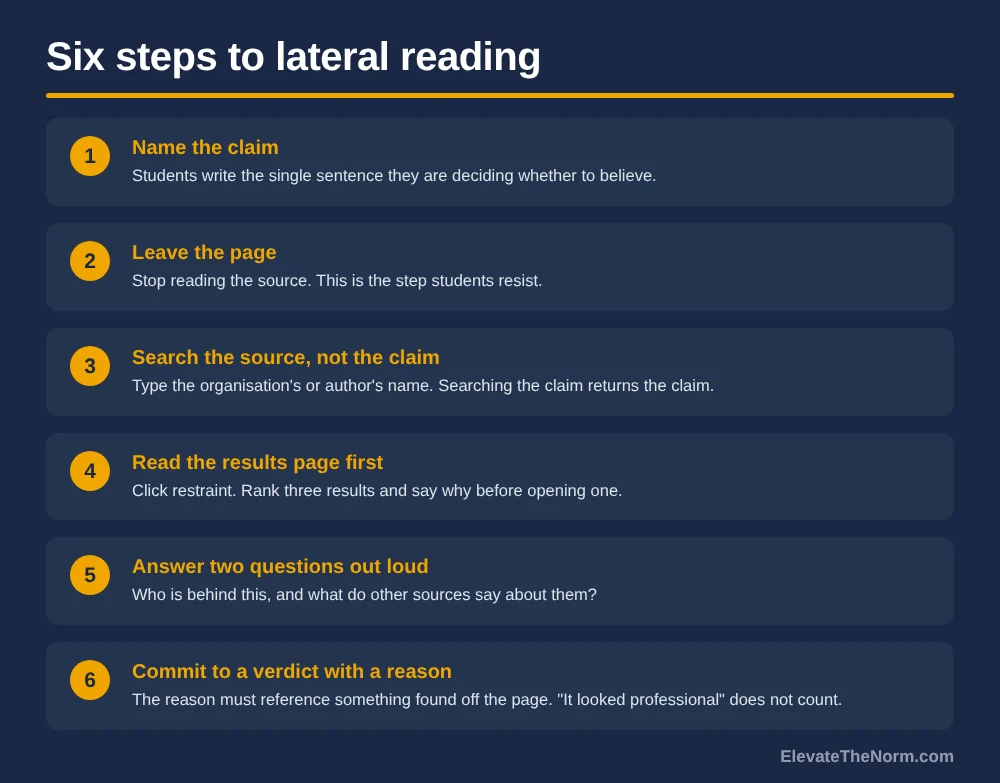
    Numbered six-step graphic for teaching lateral reading: name the claim; leave the page; search the source, not the claim; read the results page first; answer two questions out loud about who is behind the information and what other sources say; and commit to a verdict with a reason found off the page.

    Can media literacy activities make students too cynical?

    Yes, and some popular activities do mainly that. A 2023 reanalysis of five studies of two widely used misinformation games found that after playing, participants did not get better at telling true news from fake — they simply called more things false, including the true items.

    The methodological point is worth understanding, because it recurs. Earlier studies compared average ratings of true and fake headlines before and after play, a measure that cannot separate discrimination (telling them apart) from response bias (a general shift toward saying "false"). Modirrousta-Galian and Higham reran the data using ROC analysis from signal detection theory, which separates the two, and concluded the games "are not as effective as previously believed and may even be counterproductive."

    Note the tension with the meta-analysis above, because this site is not going to hide it: the adolescent review scores cognitive inoculation at 0.55, a solid second place. Both can be true. The review pools outcomes including belief and sharing, where a general increase in scepticism counts as success; the ROC reanalysis asks the narrower question of whether students can tell the difference, and answers no for those two games. If your goal is students who are harder to fool, the distinction matters. If your goal is students who distrust everything, you do not need an activity for that.

    The practical consequence is small and specific: every activity above should include at least one credible item that students are expected to accept. An activity made entirely of fakes teaches that everything is fake.

    Where can you get free media literacy lesson materials?

    Two sources cover most of what a grades 6–12 teacher needs, and both are free. The notes below reflect what each site states about itself as of this writing, and nothing beyond that is claimed.

    SourceCostAccount neededWhat you getWorth knowing
    Civic Online Reasoning (Stanford / Digital Inquiry Group)FreeSign-in offered; single lessons downloadableLessons and assessments, plus a video library of skill explainers. Named lessons include "What’s the Evidence?", lateral reading and click restraintBuilt by the research team behind the lateral-reading findings. The site does not publish a total lesson count or grade bands per lesson
    Checkology (News Literacy Project)"100% free for educators," no paid tierYes — register with email, or Google / Microsoft / Clever sign-onAdvertised as 250+ lessons, activities and teaching tools for grades 5–12, including Intro to Algorithms, InfoZones, Misinformation and Evaluating Science-based ClaimsThe 250+ figure covers resources of all kinds combined, not lessons alone
    Compiled for this article from each provider’s own pages. Neither has been tested against the other, and no ranking between them is implied.

    If you want one starting point rather than two: the Civic Online Reasoning lessons are closer to the evidence base, since the group that publishes them ran the studies that produced the lateral-reading result.

    What do you need to run these activities, and who gets left out?

    A projector is enough for seven of the twelve media literacy activities. Student devices are genuinely required only for the three multi-day projects and for "trace the video," which needs reverse image search in a student’s own hands. Every five-minute activity runs off one screen at the front.
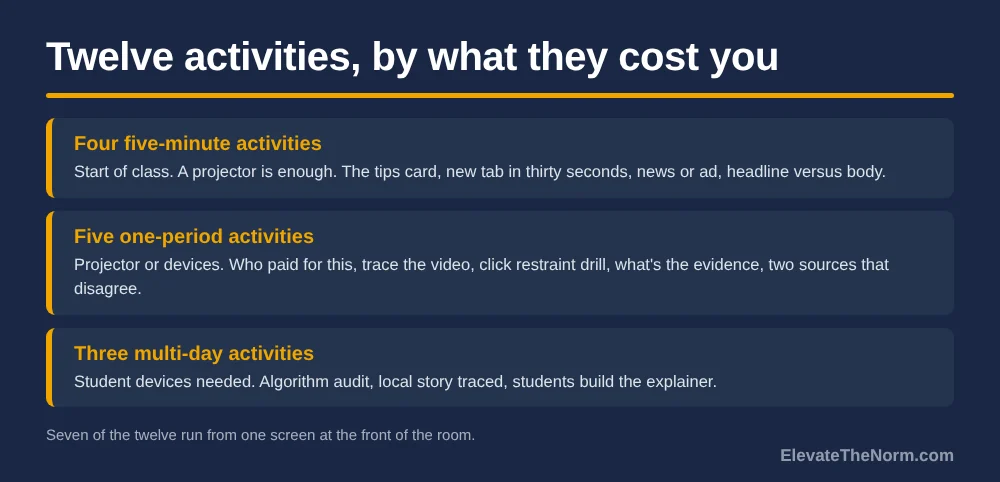
    Graphic sorting twelve media literacy activities into three groups: four five-minute activities needing only a projector, five one-period activities needing a projector or devices, and three multi-day activities needing student devices.

    For grades 6–8, I would keep it that way on purpose. Use pages you chose and loaded in advance rather than sending twelve-year-olds into open search on a live claim. You get the same procedure, you keep the lesson on the rails, and you avoid the filter-block detour that eats ten minutes of a fifty-minute period.

    The harder question is who these activities serve less well, and the national data answers it uncomfortably. In that study of 3,446 students, scores varied by grade level, self-reported grades, locality, socioeconomic status, race, maternal education, and free or reduced-price lunch eligibility — and the assessment was administered in English. So the gap it measured is partly a gap in who has been taught this and partly a gap in who could read the task quickly. Both matter to how you run it.

    Two adjustments follow directly. Read the claim aloud and keep it on the board, so the activity tests source evaluation rather than reading speed. And for multilingual learners, let the written verdict be one short sentence or a sentence frame — the thinking you are assessing happens before the writing, and a procedure is easier to demonstrate than to narrate.

    Worth knowing at the district level: this does not have to live in English or social studies. In that study of 574 students, the lessons were taught by biology and world geography teachers, embedded in their existing curriculum. Evaluating a claim about a vaccine and evaluating a claim about a border are the same procedure.

    Is media literacy required in your state?

    Possibly. Media Literacy Now reports that 25 states have media literacy laws on their books, drawing on legislative activity through 30 October 2025 with its map last updated in January 2026.

    Read that number carefully, because the organisation itself does. Its count tracks states that have moved something through the legislative process, and it says plainly that it has not evaluated how state education departments actually integrated media literacy into standards. A law on the books is not a standard in your pacing guide and not a required course. Before telling an administrator that your state mandates this, check your own state’s standards document — the law and the standard are frequently different things.

    How do you grade media literacy activities without drowning in marking?

    Grade the reasoning, not the verdict, and grade one sentence. The scorable product of every activity above is a verdict plus a reason that cites something found off the page. That is one sentence per student, and it can be read at a glance.

    Three things make this sustainable rather than another stack to carry home:

    • A fixed three-point scale. No reason, a reason from the page itself, or a reason from outside the page. The middle category is the one that shows you the instruction is landing.
    • Most of these are formative and should stay that way. The five-minute versions are checks on where the class is, not assessments of a student. Scoring a bell-ringer on credibility punishes students for not yet having a skill you are in the middle of teaching.
    • Score a sample, not a set. Eight responses tell you what the class can do. Read eight, adjust tomorrow, and move on.

    Expect low scores for a long time. In the one classroom study of ninth graders, curriculum-embedded lessons produced "statistically significant growth in students’ ability to evaluate the credibility of online content" across 574 students — and the repository record for that study does not report how large the improvement was, so no size is claimed here. The design was single-group, pretest and posttest, with no control group and no randomisation, in one suburban high school, which makes it movement rather than proof of a cause. Plan for years, not a unit.

    What about privacy and politically contested content?

    Two rules keep media literacy activities defensible. First, no activity requires a student to show anyone their own accounts, feeds or data. Second, pick claims whose verification question has a checkable answer.

    The algorithm audit is the one activity above with a genuine consent problem: a student’s feed is personal information, and the teacher does not need to see it. Keep participation voluntary, let students describe a pattern rather than submit screenshots, and offer an alternative using a public account for anyone who would rather not.

    On the second rule: "Who funds this organisation" and "when did this video first appear" are checkable. "Which side is right about immigration" is not a media literacy activity, it is a debate, and running it as one puts you in a conversation with a parent you cannot win. If you do want students arguing two sides, set it up as a structured debate with a resolution chosen for that purpose. The national study used a climate-funding task and a voter-fraud video precisely because both have verifiable answers independent of anyone’s politics — the ties existed, the video’s origin was traceable.

    Tell families what you are doing before you need to. A one-line note that students are learning to check sources, with the two or three sites you will use, converts almost every version of this complaint before it starts. Say the other half of it too, because it is the part parents actually worry about: no activity here asks a student to evaluate, rate or report on the news their family watches. The targets are chosen by the teacher and they are public organisations, not anybody’s household. The same framing covers a weekly routine built around the news, where those parent questions tend to arrive sooner.

    Clay’s take: the procedure is the whole lesson

    The finding I keep coming back to is the one about the historians. Ten people with doctorates, trained for years in evaluating sources, looked at an advocacy website and mostly called it reliable. What the fact checkers had was not knowledge. It was a habit of leaving the page.

    That reframes what these activities are for. We tend to teach media literacy as a disposition — be sceptical, think critically, consider the source — and dispositions are exactly what the games produced: students who say "fake" more often and cannot tell any better. A procedure is different. It is six steps, it takes nine minutes, a fourteen-year-old can run it without me in the room, and it works whether or not they feel sceptical that morning.

    Which is also why I would rather run the thirty-second version twenty times than the two-week unit once. The decay in the tips-card study is the clearest number in this whole literature: measurable improvement, more than half of it gone within weeks. Nothing about teenagers makes that surprising. It is the same reason we spiral everything else.

    And treat the low starting scores as information rather than as a verdict on the kids. Two-thirds of a nationally representative sample could not separate advertising from news on a homepage built to blur exactly that line. That is a design problem they were handed, not a character flaw. Our job is to give them the procedure nobody has given them yet.

    What to do next

    Pick one activity, not twelve. For the strongest evidence at the least preparation, run "new tab, thirty seconds" on Monday with a site from your own unit, then again on Thursday with a different site. That is lateral reading, the 0.62 category, at two minutes of planning.

    Then do three things across the term. Teach the six-step procedure once properly so students have a sequence to run. Put one credible item in every activity so you are building discernment rather than suspicion. And repeat it monthly, because every study here says one session does not hold.

    If you already teach document work, you are closer than you think — sourcing and corroboration are the same two habits, pointed at a website instead of a letter. The primary source analysis frameworks transfer, and the annotation routines you already use will carry the written half of the work.

    These activities sit inside a wider job. Evaluating a source is one of several things a school is expected to teach about life online, alongside digital identity, privacy and conduct — and it is the one with the strongest classroom evidence behind it. What digital citizenship covers, and what schools are already required to teach maps the whole requirement, including the federal rule that arrives attached to E-rate funding.

    Frequently Asked Questions

    What are media literacy activities?

    Media literacy activities are classroom tasks in which students evaluate real media – a website, a post, an advertisement, a video or a news story – by asking who made it, what evidence supports it, and what other sources say about it. The defining feature is that students judge live content they did not write, rather than a sanitised textbook example.

    What is the best media literacy activity for middle school?

    Tracing an image or short video back to its first appearance. It teaches the whole procedure without asking anything of reading stamina, which is the usual obstacle in grades 6-8. Use a page you selected and loaded in advance rather than open search, give students one question instead of three, and script exactly what to type the first several times you run it.

    Do media literacy activities actually work?

    Modestly, and it depends on which one. A 2026 meta-analysis of 18 studies of adolescents aged 12 to 18 found an overall effect of SMD 0.48, with lateral-reading activities strongest at 0.62 and general media literacy lessons weakest at 0.38. Effects from a single session are small and decay within weeks, so repetition across a year matters more than any individual lesson.

    How long should a media literacy activity take?

    Five to ten minutes for most of them, and that is the version worth repeating. Four of the twelve activities on this list fit the start of a class period, five fill one period, and three run across several days. Because the measured effects decay within weeks, a short activity run monthly beats a two-week unit run once a year.

    Where can I get free media literacy lessons for high school?

    Two providers cover most of it. Stanford’s Civic Online Reasoning curriculum, now published by the Digital Inquiry Group, offers free lessons and assessments including lateral reading and click restraint. Checkology from the News Literacy Project states it is 100 percent free for educators with no paid tier, covering grades 5 to 12, and requires registration with an email or a Google, Microsoft or Clever sign-on.

    Can media literacy activities make students too cynical?

    Some can. A 2023 reanalysis of five studies of two popular misinformation games found players did not get better at telling true news from fake – they simply called more things false, including the true items. The fix is cheap: put at least one genuinely credible item in every activity, and accept “cannot tell yet” as a legitimate verdict rather than forcing a call.

    Do students need devices for media literacy activities?

    Not for most of them. A projector is enough for seven of the twelve activities on this list, including every five-minute version, where the class argues over one screen at the front of the room. Student devices are genuinely needed only for the three multi-day projects and for tracing an image, which requires reverse image search in a student’s own hands.

    Is media literacy instruction required by law?

    In some states. Media Literacy Now reports that 25 states have media literacy laws on their books, based on legislative activity through October 2025. Read that carefully: the organisation counts states that moved something through the legislative process and says it has not evaluated how education departments integrated media literacy into standards. Check your own state’s standards document before telling an administrator it is mandated.

    Sources

    • Rodríguez Castillo, N. E., Mendoza Carrera, J. E., Andrade-Vásquez, M. M., & Acosta-Barreno, K. (2026). Media literacy education and misinformation in social media among adolescents: A systematic review and meta-analysis. Journalism and Media, 7(2), 71. 46 studies in the qualitative synthesis, 18 in the meta-analysis, adolescents aged 12–18 primarily from secondary schools. Overall SMD 0.48 (95% CI 0.31–0.65), I² = 56 percent, random effects. By type: side (lateral) reading 0.62 (6 studies), cognitive inoculation 0.55 (5 studies), general literacy 0.38 (7 studies). Limitations the authors state: only three databases searched, English and Spanish only, 2019–2025, varied designs, and some included studies relied on self-reported measures. One inconsistency noted on reading it: its own Table 1 lists studies from 2016 and 2018, outside the stated window.
    • Huang, G., Jia, W., & Yu, W. (2024). Media literacy interventions improve resilience to misinformation: A meta-analytic investigation of overall effect and moderating factors. Communication Research, 53(7), 899–926. 49 experimental studies, 81,155 participants, overall d = 0.60; belief in misinformation 0.27, discernment 0.76, sharing 1.04. Multi-session interventions outperformed single-session ones; effects were stronger among college students than among crowdsourced adults. Read at abstract level only — the full text is behind a restricted landing page, so no confidence intervals, limitations or intervention-type moderators are quoted here. Its samples are not secondary students.
    • Guess, A. M., Lerner, M., Lyons, B., Montgomery, J. M., Nyhan, B., Reifler, J., & Sircar, N. (2020). A digital media literacy intervention increases discernment between mainstream and false news in the United States and India. PNAS, 117(27). Preregistered survey experiments; respondents randomly assigned to read tips adapted from Facebook’s "Tips to Spot False News" — 10 tips verbatim in the U.S., 6 adapted in India. U.S. wave 1 N = 4,907, wave 2 N = 4,283; India online 3,273 and 1,369; India face-to-face (Uttar Pradesh) 3,744 and 2,695. U.S. ITT β = 0.146 (SE 0.024), a 26.5 percent improvement in discernment; d = 0.20 on false headlines. In wave 2 the effect on false-headline ratings attenuated by more than half while discernment remained above zero (β = 0.050, SE 0.020, p < .05). Honest caveats: the paper reports 17.3 percent for the India online sample in its body text and 17.5 percent in its abstract; the India online effect did not hold in wave 2; and there was no effect at all in the rural face-to-face sample, where 11 percent used WhatsApp (versus 90 percent online), 24 percent passed comprehension checks, and 6 percent were college graduates. A correction to this paper exists (PNAS, doi 10.1073/pnas.2221752120); it could not be opened from this session, so what it changes is not described here and the figures above are the originally published ones. Read via an openly licensed full-text reproduction (CC BY-NC-ND 4.0).
    • Modirrousta-Galian, A., & Higham, P. A. (2023). Gamified inoculation interventions do not improve discrimination between true and fake news: Reanalyzing existing research with receiver operating characteristic analysis. Journal of Experimental Psychology: General, 152(9), 2411–2437. Reanalysis of five prior studies of the Bad News and Go Viral! games using ROC analysis from signal detection theory. Where comparable true and fake items were used, neither game improved discrimination; participants instead gave more "false" responses to all items. Authors conclude the interventions "are not as effective as previously believed and may even be counterproductive." Read at repository-record level; the sample sizes of the five reanalysed studies are not reported there and none is quoted here.
    • McGrew, S., & Breakstone, J. Civic online reasoning across the curriculum: Developing and testing the efficacy of digital literacy lessons. Stanford Digital Repository, doi 10.25740/dd707pp9195; published in AERA Open, 9 (2023). 574 ninth graders, pretest/posttest; lessons taught by biology and world geography teachers and built on four design principles including evaluating real online content and support for teacher learning. Reports "statistically significant growth in students’ ability to evaluate the credibility of online content." Caveats: single-group pretest/posttest, no control group, no randomisation, one suburban high school. The repository record does not state the number of lessons, their duration, or the size of the improvement, and none of those is claimed here. It dates the work 2022 while the journal version is 2023; both are given above.
    • Breakstone, J., Smith, M., Wineburg, S., Rapaport, A., Carle, J., Garland, M., & Saavedra, A. (2021). Students’ civic online reasoning: A national portrait. Educational Researcher, 50(8). 3,446 U.S. high school students, six constructed-response tasks completed with a live internet connection, sample reflecting the national high school demographic profile. 96 percent never learned of a climate website’s fossil-fuel industry ties; two-thirds could not distinguish news stories from advertisements on a popular homepage; over half judged an anonymously posted Facebook video strong evidence of U.S. voter fraud. Students were misled by weak cues — a site’s appearance, its top-level domain, its About page and the sheer volume of information. Scores varied by grade level, self-reported grades, locality, socioeconomic status, race, maternal education and free or reduced-price lunch status, on an assessment administered in English. Read via the Stanford Digital Repository record, which does not list the six tasks individually. This site’s companion article on primary source analysis quotes more precise per-task percentages from the published journal version; the rounded figures above are what the record read this time states.
    • Wineburg, S., & McGrew, S. Lateral reading and the nature of expertise: Reading less and learning more when evaluating digital information. Stanford History Education Group. 10 professional fact checkers, 10 PhD historians holding full-time faculty positions, and 25 Stanford undergraduates evaluated two websites on bullying and traced who financed the legal team in Vergara v. California. Fact checkers were fastest and most accurate; historians largely judged both pediatric sites reliable and students overwhelmingly rated the advocacy site more reliable. Fact checkers also showed "click restraint," reviewing results before clicking, while some historians and students opened top-ranked links without asking why they ranked. Cited from Stanford Graduate School of Education’s own summary of the study, not from the paper — the repository record for the paper reports no findings. Exact per-group correct counts are not published in that summary and none is claimed here.
    • Current Policy, Media Literacy Now. States that "to date, 25 states have media literacy laws on their books." Page dated 28 April 2026; its map was last updated January 2026 and the underlying report covers legislative activity as of 30 October 2025. The page does not name the 25 states, and the organisation states that it has not evaluated how state education departments integrated media literacy into standards. Its map tracks states that have moved something through the legislative process only.
    • Civic Online Reasoning, Digital Inquiry Group (the former cor.stanford.edu now redirects here). Describes its lessons and assessments as free, downloadable individually or as a full curriculum, with a video library of skill explainers and classroom examples. Named lessons include "What’s the Evidence?", lateral reading and click restraint, and a three-question frame: who is behind the information, what the evidence is, and what other sources say. The page does not publish a total lesson count or grade bands per lesson, and neither is claimed here.
    • Checkology, News Literacy Project. States it is "100% free for educators" with "no paid tier," requires registration by email or Google, Microsoft or Clever single sign-on, and advertises "250+" resources for grades 5–12. Named items include Intro to Algorithms, What is News?, Practicing Quality Journalism, Misinformation, InfoZones, Evaluating Science-based Claims and Democracy’s Watchdog. The 250+ figure is described on the page as lessons, activities and teaching tools combined, so it is not a lesson count.
    • Editorial notes. The twelve activities, the six-step lateral reading sequence, the three-point marking scale and the middle-school-versus-high-school split are compiled and written for this article to operationalise the habits described in the sources above. They are recommendations, not a report of any teacher’s classroom, and no study above tests these twelve activities as a set or in this sequence. The tested, category-tested and untested labels are this article’s own mapping of each activity onto the meta-analysis categories: tested means a randomised trial of substantially that task exists, category-tested means the activity belongs to a category measured in the adolescent meta-analysis, and untested means no study above measures it. The two free-resource providers have not been compared with each other and no ranking between them is implied.
    About Clay Shumate

    Clay Shumate is a certified secondary Social Studies teacher in the public schools of West Alabama, with seven years of classroom experience, a B.A. in History, and an M.Ed. in Secondary Education. He writes about project-based learning, student responsibility, respect, and practical ways to hold young people to a higher standard while giving them room to learn from mistakes. He is a member of the Society of Professional Journalists and writes to its Code of Ethics; this site’s editorial standards and corrections policy are published in full. More about Clay.

  • Vocabulary Instruction in Grades 6–12: What Actually Moves Comprehension

    Vocabulary Instruction in Grades 6–12: What Actually Moves Comprehension

    By Clay Shumate

    Vocabulary instruction is the explicit teaching of word meanings and of strategies for figuring out unfamiliar words. In grades 6–12 it reliably improves comprehension of the text that carries the taught words, and barely moves standardized reading scores. The version that works is one or two essential words per text, taught through use, not a weekly list of ten.

    Key Takeaways

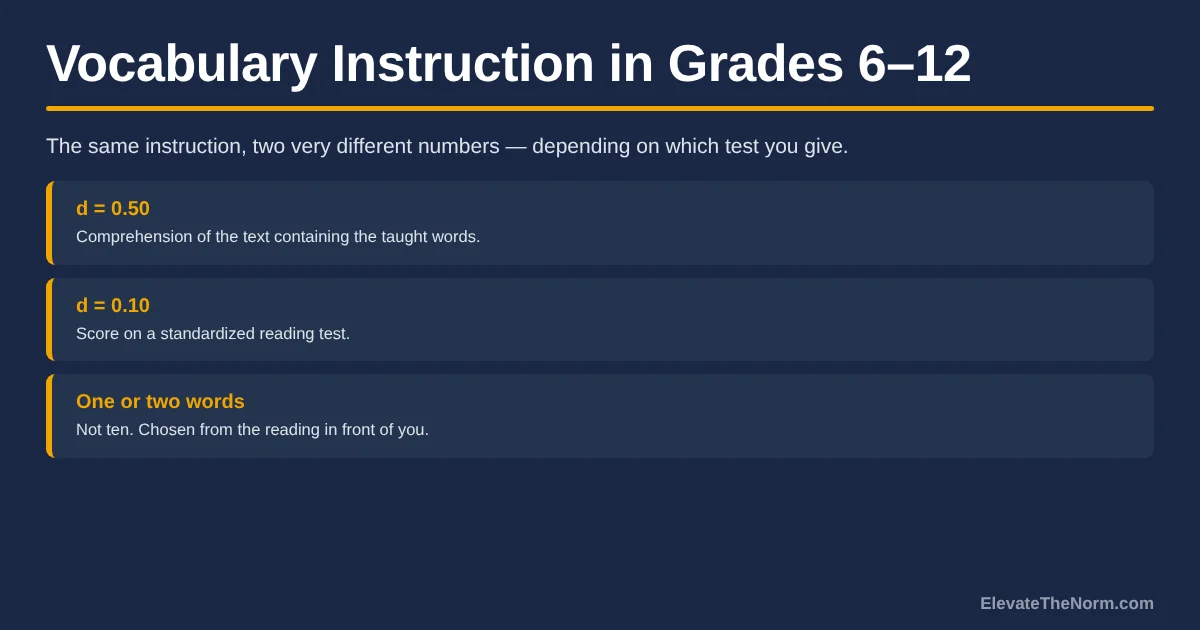
    • The same vocabulary instruction produces two very different numbers depending on which test you give. Across 37 studies, Elleman and colleagues found an effect of d = 0.50 on comprehension measures built for the study and d = 0.10 on standardized reading tests.
    • Students who struggle with reading gain the most. On those study-built measures, controlling for method variables, students with reading difficulties gained d = 1.23 against d = 0.39 for students without — more than three times as much — while gains on the vocabulary tests themselves were similar for both groups.
    • The federal practice guide for grades 4–9 tells you to teach one or two essential words before a text, not a list. Its comprehension recommendation carries a strong evidence rating on 34 studies.
    • A school-randomized trial of academic vocabulary across 28 schools and 1,554 students in grades 6–8 moved the taught words (g = 0.25) and did nothing measurable to general vocabulary. What it moved most was the quality of classroom discussion (d = 0.62).
    • Teaching one or two word-attack strategies is the part with the least support. A review of 36 studies found no empirical evidence that it improves general comprehension. Context clues as a standalone unit is the weakest thing on most vocabulary plans.

    Walk into most secondary classrooms the week before a unit test and you will find a vocabulary list. Ten words, definitions copied, sentences written, quiz Friday. It is the most common literacy practice in grades 6–12 and it is mostly a waste of a class period.

    That is not an argument against teaching words. The research on vocabulary is better than the research behind most things teachers are told to do. It is an argument against the format and the promise attached to it.

    What is vocabulary instruction?

    Vocabulary instruction is the deliberate teaching of word meanings and of strategies for working out unfamiliar words, as opposed to leaving students to pick up words from reading and talk alone. It splits into two things researchers treat separately: direct teaching of specific word meanings, and teaching generalizable word-learning strategies like using context or breaking a word into parts.

    That distinction matters more than any brand-name routine, because the two halves have very different track records. Direct teaching of specific words has a good one; strategy teaching on its own does not. Most programs sell both in the same box.

    You will also hear words sorted into tiers — Tier 1 everyday, Tier 2 high-utility academic words that cross subjects, Tier 3 technical words belonging to one discipline. That comes from Isabel Beck and Margaret McKeown’s work and it is a useful way to triage a reading. It is a sorting scheme, not a finding: no effect size attaches to it.

    Does vocabulary instruction actually improve reading comprehension?

    It improves comprehension of the passage containing the taught words, consistently and by a lot. It barely improves performance on a standardized reading test. Elleman and colleagues meta-analyzed 37 vocabulary intervention studies from pre-K through grade 12 and found d = 0.50 on comprehension measures designed for the study and d = 0.10 on standardized measures.

    Read those two numbers together and the field makes sense. Teaching a student mercantilism helps that student read a passage about mercantilism. It does not make them a better reader of a passage about tide pools.

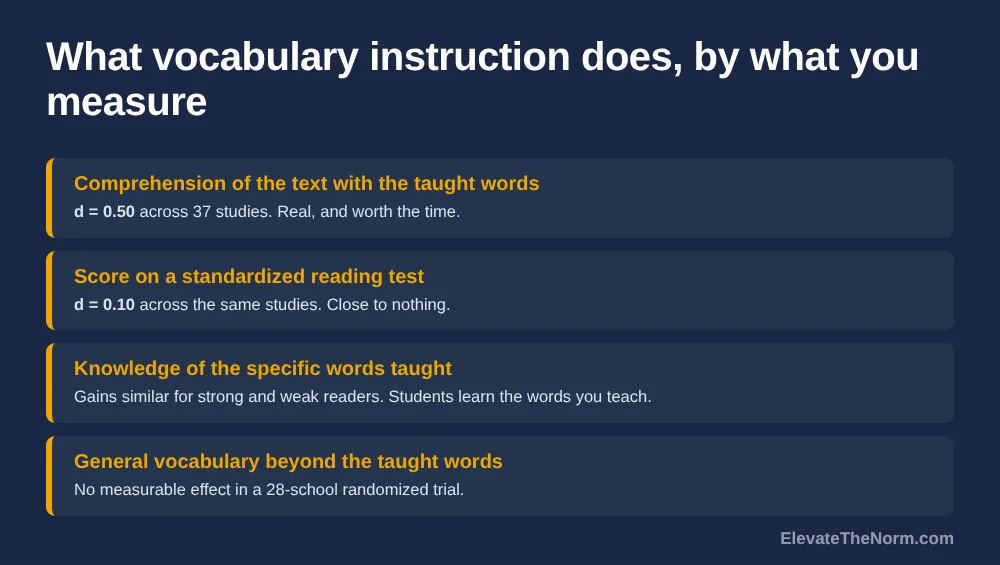
    What you measureEffect of vocabulary instructionWhat that means for your Monday
    Comprehension of the text containing the taught wordsd = 0.50 across 37 studiesReal and worth the time. This is the claim to make.
    Score on a standardized reading testd = 0.10 across the same studiesClose to nothing. Do not promise this to an administrator.
    Knowledge of the specific words taughtGains similar for strong and weak readersReliable. Students learn the words you teach.
    General vocabulary beyond the taught wordsNo measurable effect in a 28-school randomized trialWord lists do not grow a student’s overall word stock.
    Effect sizes from Elleman et al. (2009); the general-vocabulary row is the null result from Lawrence et al. (2015).

    Wright and Cervetti’s 36-study review lands in the same place from a different direction: teaching word meanings supported comprehension of the texts containing those words in almost every study, while evidence for generalized comprehension was — in their words — very limited, even in long interventions covering many words. They also could not determine how much instruction per word is enough, which is worth noticing in a field full of six-step routines.

    So the defensible claim is narrow and still useful: vocabulary instruction is how you make a hard text readable, not a lever on reading ability. Which leaves a procurement question worth asking out loud. If a program’s own evidence rests on measures it built, the claim you can hold it to is students understand assigned texts better, measured on your own unit assessments. That is a real, checkable commitment. A state-test target written into a vocabulary plan is a commitment the published evidence says will not be met, and writing it down anyway sets up the teachers delivering it to take the blame.

    How many vocabulary words should you teach per week?

    Far fewer than most schedules assume. The federal practice guide for grades 4–9 recommends selecting one or two essential words to teach before a reading — words that are critical to the passage and likely to be hard — then giving quick meanings for other important words as they come up, so reading is not interrupted.

    One or two. Not ten. And run the arithmetic from the student’s side before defending the list: a seventh grader with six teachers who each assign ten words is handling sixty words a week, none of which were chosen with the others in mind. No adult in the building carries that load. The reasoning is not that students cannot learn ten words; it is that deep instruction on two words costs about as much class time as shallow instruction on ten and produces something students can actually use. Wright and Cervetti found that instruction involving active processing generally beat definitions and dictionary work for understanding the text, which is precisely what a ten-word list has no room for.

    You will see other credible guidance say three or four, and the difference is worth naming rather than hiding. Elsewhere on this site, the digital reading routine budgets two minutes for three or four pre-taught words, because a screen reading loses the edges a printed page gives for free and the words are part of what a Lexile measure is detecting. The practice guide is stricter because it is describing deep instruction on an essential word, not a quick gloss. Both can hold at once: one or two words get the full treatment, and another two or three get five seconds each. What nobody’s evidence supports is fifteen.

    That guide’s broader comprehension recommendation is rated strong on 34 studies, 23 of which met What Works Clearinghouse standards without reservations. One caveat worth stating: the guide covers grades 4–9, so the top half of a secondary teacher’s roster sits outside its range. Nothing in it is implausible for grades 10–12, but it has not been tested there.

    There is also a reason not to despair about the arithmetic. Hiebert, Goodwin and Cervetti mapped a core vocabulary of 2,451 morphological families containing 11,298 words, and found those families account for about 89 percent of the words in texts pitched at grade 11 and college readiness. By middle school roughly 20 percent of the distinct words in a text sit outside that core; in high school it is about 25 percent. That is the real size of the problem. It is not an infinite list, and it is not two words either.

    Those two numbers are in open tension and the honest thing is to say so. If a quarter of the distinct words in a high school text sit outside the core vocabulary, teaching one or two words per reading cannot possibly close that gap. Both claims are still true, because they answer different questions. The one-or-two rule is about the words that block comprehension of this passage, which is a problem instruction can solve this week. The long-run size of a student’s word stock is a different problem, and the evidence above does not show that any amount of word-list instruction solves it — the 28-school trial found exactly nothing on general vocabulary after a full year. Anyone who tells you a vocabulary curriculum closes the word-gap is going beyond what has been measured.

    Which words should you choose for instruction?

    Choose the words that carry the meaning of this text and that students will meet again. A word qualifies if removing it would break a student’s understanding of the passage. That test does more work than any tier chart, because it is answered by the reading in front of you rather than by a list someone else made.

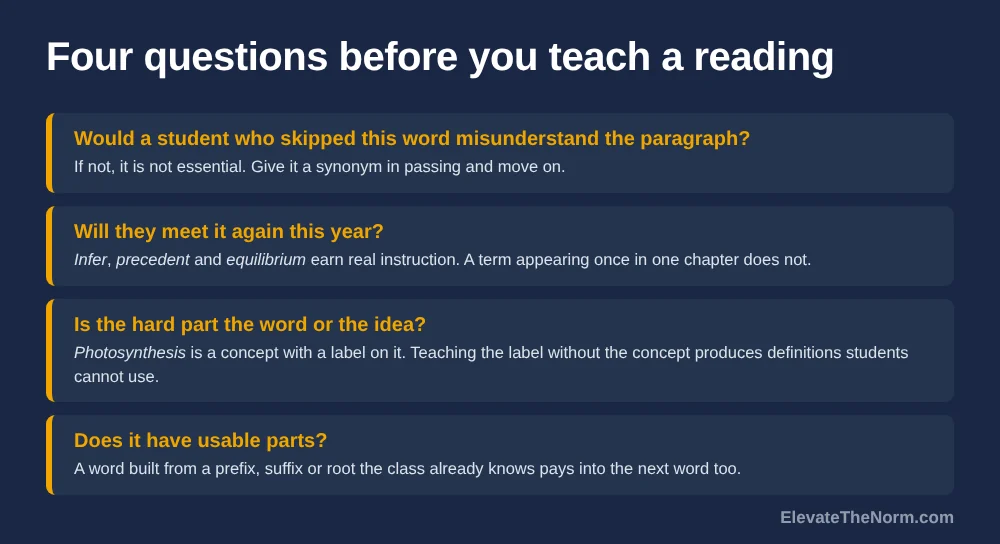
    Four questions to run over a reading before you teach it:

    • Would a student who skipped this word misunderstand the paragraph? If not, it is not essential. Give it a synonym in passing and move on.
    • Will they meet it again this year? Infer, precedent and equilibrium earn real instruction. A term appearing once in one chapter does not.
    • Is the hard part the word or the idea? Photosynthesis is a concept with a label on it. Teaching the label without the concept is how students write definitions they cannot use.
    • Does it have usable parts? A word built from a prefix, suffix or root the class already knows is worth teaching twice over, because it pays into the next word too.
    Four questions to run over a reading before teaching it: would a student who skipped this word misunderstand the paragraph; will they meet it again this year; is the hard part the word or the idea; does it have usable parts.
    Four questions that decide which words earn real instruction.

    The guide’s sequence on word parts is worth keeping: common prefixes and suffixes first, then Latin and Greek roots, using word maps. Prefixes and suffixes are regular and few. Roots are neither.

    What does vocabulary instruction look like in a grades 6–12 content classroom?

    It looks like about four minutes before the reading, a few seconds during it, and one short task a week after it. Here is the routine the practice guide describes, written as steps you can run tomorrow in history, biology, algebra or English.

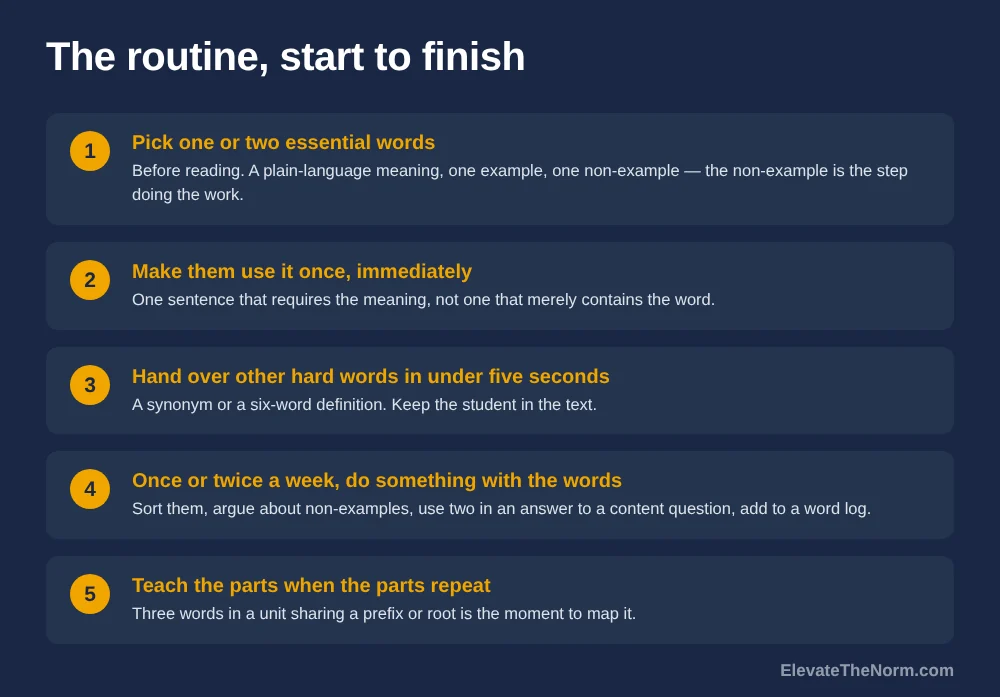
    • Before reading, pick one or two essential words. Give a student-friendly meaning in plain language — not the dictionary entry. Then give one example and one non-example, because the boundary is where the meaning lives. A precedent is an earlier decision that sets a pattern for later ones. The first state to lower a voting age sets a precedent. A state that lowers it afterward is following one. The non-example is the step teachers skip and it is the one doing the work — a student who can tell you what does not count has the boundary, and a student with only the definition usually does not.
    • Make students use it once, immediately, out loud or in writing. One sentence that requires the meaning, not one that merely contains the word. “Name something in this chapter that set a precedent and say what followed it” works. “Use precedent in a sentence” produces “The precedent was very important.”
    • During reading, hand over other hard words in under five seconds. A synonym or a six-word definition. The point is to keep the student in the text, not to teach a second word.
    • Once or twice a week, make them do something with the words. Sort them, argue about non-examples, use two in an answer to a content question, add them to a running word log. This is the active processing that the reviews found outperforms definitions.
    • Teach the parts when the parts repeat. When three words in a unit share a prefix or a root, stop and map it. That is the only point at which strategy instruction has an argument behind it.
    Numbered five-step routine: pick one or two essential words before reading with a plain-language meaning, an example and a non-example; make students use the word once immediately; hand over other hard words in under five seconds; once or twice a week do something with the words; teach word parts when the parts repeat.
    The whole routine, which fits in the margins of a lesson you were already teaching.

    On prep cost: the only real labor here is reading the text as a student would and marking the words that would stop one. That takes about ten minutes the first time you teach a reading and nothing at all afterwards, provided you keep the marked copy. If you teach six sections of two courses, you are marking two readings, not twelve.

    Notice what is missing: the quiz. Keep one if your gradebook needs it, but do not confuse it with the instruction — matching ten words to ten definitions on Friday demonstrates the one thing the research says transfers least. So collect different evidence. The question worth answering is whether a student can answer a content question that cannot be answered without the word. “Which of these decisions set a precedent, and what followed from it?” tells you something a matching quiz cannot. That is also the easiest thing for a coach or an administrator to look for in a ten-minute walkthrough: not whether words are posted, but whether a student had to use one on the content inside the first fifteen minutes.

    If you already run regular checks on understanding, this folds into them rather than adding a system. The same logic drives formative assessment strategies for reading: find out what the text actually cost students before you move past it. And when a class spans a wide range of reading levels, the word-choice question above is one of the cleanest places to differentiate instruction without writing two lesson plans.

    Do word-learning strategies like context clues and roots actually work?

    Teaching one or two word-attack strategies has the weakest evidence in the whole field. Wright and Cervetti’s review of 36 studies found no empirical evidence that teaching one or two strategies for working out word meanings improves generalized comprehension. That is a null result on the practice most schools spend the most instructional time on.

    This deserves care, not a victory lap: null evidence for a narrow version of a practice is not proof the practice is useless. What the reviewers found promising was the fuller version — teaching students to monitor whether they understand a word and move flexibly among several strategies rather than drilling one. They call that a promising direction for future research, which means nobody has shown it works yet either.

    The practical read: a September context-clues unit that never comes back is the unsupported version. Prefixes and roots taught at the moment three words in a unit share them, repeatedly across a year, is the version with an argument. One is a week of lessons. The other is thirty seconds, forty times.

    Why doesn’t vocabulary instruction raise standardized reading scores?

    Because a standardized reading test samples the whole language while your instruction samples your unit. Teach forty words well in a semester and a student knows forty more words, against a test drawing from tens of thousands. The signal is real and it is swamped.

    Four-row comparison graphic: comprehension of the text with the taught words d = 0.50 across 37 studies; score on a standardized reading test d = 0.10 across the same studies; knowledge of the specific words taught shows gains similar for strong and weak readers; general vocabulary beyond the taught words shows no measurable effect in a 28-school randomized trial.
    Same instruction, four different outcomes, depending on what you measure.

    The Word Generation trial shows this cleanly. Lawrence, Crosson, Paré-Blagoev and Snow randomly assigned schools within matched pairs across two districts — 28 schools, 1,554 students in grades 6–8 with pre- and posttest, one full school year, delivered by whole grade-level teams. A significant effect on the taught academic words (Hedges’ g = 0.25), and no significant effect on general vocabulary on the Gates–MacGinitie, estimated at roughly −0.01.

    The most interesting finding there was not about words. Discussion quality improved substantially in treatment schools — d = 0.62 overall and d = 1.13 in math — and mediated about 14 percent of the effect on word learning. A vocabulary program’s most visible consequence was that students argued about ideas more often.

    The authors are candid about the study’s weaknesses, and they matter: posttest completion was 49 percent in treatment schools and 35 percent in control schools, treatment schools started with higher vocabulary scores, observers could not be blinded, and the word test covered only 36 of the 120 words taught. Attrition at that level can bend a result in either direction. Read g = 0.25 as a reasonable estimate rather than a settled number.

    Which students gain the most from vocabulary instruction?

    Students who struggle with reading, by a wide margin. In Elleman’s meta-analysis, looking only at the study-built comprehension measures and controlling for method variables, students with reading difficulties gained d = 1.23 against d = 0.39 for students without reading problems. More than three times the benefit from the same instruction.

    Two qualifications. That contrast comes from the custom measures, the generous end of the evidence. And gains on the vocabulary tests were similar regardless of reading ability — both groups learned the words. The difference was in what the words did for comprehension, which points at word knowledge being the binding constraint for the weaker readers and not the stronger ones. Across studies reporting both outcomes the correlation between vocabulary effects and comprehension effects was r = 0.43 — modest. Learning the words helps; it is not the only thing in the way.

    What about English learners, and classes where reading levels vary widely?

    The honest answer on English learners is that this article cannot give you one. It is one of the most common things teachers ask about vocabulary. Neither review above reports results for English learners as a subgroup, and no English-learner-specific source was read for this article, so nothing here is an evidence claim about them. If somebody hands you a vocabulary program marketed on its results for English learners, ask which studies and which measures — and expect the custom-versus-standardized gap to show up there too.

    For a class with a wide spread of reading levels, word selection is the cheapest lever you have: the same two words serve everybody while the amount of support varies. That is the logic behind differentiated instruction strategies generally: change the scaffold, not the destination.

    And there is a real risk attached to the finding that weaker readers gain most, worth naming before a district acts on it. “Front-load vocabulary where reading is hardest” is a sound instructional read. “Those classes do words while the honors classes do ideas” is how that read turns into a lower-rigor track, and nothing in this evidence supports it. Elleman’s finding is that word knowledge was the binding constraint for those readers on the taught text — remove it and they are reading the same text about the same ideas. The whole point of clearing the word is to get to the argument.

    If a parent asks why the weekly list went away, the one-sentence version is: the list taught words for a Friday quiz, and we would rather spend that time making sure the reading itself is understandable. For what a parent can do at home, the truthful answer is that no source in this article tests home vocabulary work, so treat any specific routine as a guess. Talking about what a kid read, in ordinary language, is a reasonable thing to do and is not a studied intervention.

    Clay’s take: the list is a ritual, and rituals are hard to kill

    The ten-word Friday list survives for reasons that have nothing to do with learning: easy to assign, easy to grade, easy to show a parent, and it produces a number in the gradebook every week. Those are real problems. None of them is comprehension. The honest version is smaller and harder to show off. Two words taught properly before a hard reading. A few seconds of definition handed over during it so nobody stalls. One short task a week using the words on content. That is the whole thing, and it fits in the margins of a lesson you were already teaching.

    Where I would push back: the standardized-test number gets used to argue vocabulary work does not matter, and that is a misreading. A d of 0.10 on a test of everything is perfectly compatible with a d of 0.50 on the text in front of the student — and the text in front of the student is the job. A student who can read today’s document can participate in today’s class, and participation is not a consolation prize. It is the condition for everything else.

    And the thing I would not do is use a vocabulary gap as an explanation for a student’s behavior or ceiling. The evidence says word knowledge was the binding constraint for weaker readers on the taught text. It says nothing about what those students can do. Treat the gap as a thing you remove from in front of them, not as a description of them. Students hear the difference immediately. A room where hard words get handed over without comment is a room where asking is normal; a room where not knowing a word is treated as a finding about you is a room where students stop asking and start guessing.

    What to do next

    Pick the hardest reading on next week’s plan. Read it as a student would and mark every word that would stop one. Cut the list to the one or two that carry the paragraph, write a plain-language meaning plus one non-example for each, and plan the thirty seconds where students have to use them. Keep a word log for the unit and spend five minutes on Friday making students do something with it other than recite.

    If you want the rest of the system this sits inside, the list of formative assessment strategies covers how to find out what a text cost before you move on, digital reading strategies for students deals with the screen-reading problem that makes hard words easier to skip, and formative assessment strategies for listening covers the half of comprehension that never gets checked. And if the hardest readings in your course are documents rather than textbook pages, primary source analysis covers how to excerpt and frame them so the words are not the obstacle. Everything on this site is free and nothing asks for your email address.

    Where a single concept carries a whole unit, a dedicated organizer earns its minutes in a way a routine cannot — when four boxes beat a definition list covers that case, how to score it, and what the evidence will and will not carry.

    Pre-teaching vocabulary and building topic footing are two halves of the same federal recommendation, and the practice guide pairs them deliberately. For the second half there is a before-reading tool that surfaces what students already believe — along with a blunt account of how little controlled evidence the format itself has at this grade band.

    Frequently Asked Questions

    What is vocabulary instruction?

    Vocabulary instruction is the deliberate teaching of word meanings and of strategies for working out unfamiliar words, rather than leaving students to absorb words from reading alone. Researchers split it into direct teaching of specific word meanings and teaching generalizable word-learning strategies. The two halves have very different evidence behind them, with direct teaching of specific words faring much better than strategy instruction.

    How many vocabulary words should I teach per week?

    The federal practice guide for grades 4-9 recommends selecting one or two essential words to teach before a reading, then giving quick meanings for other important words as they appear so reading is not interrupted. One or two taught deeply costs about the same class time as ten taught shallowly and leaves students with something they can use. Add one short word task once or twice a week.

    Does vocabulary instruction improve reading comprehension?

    It improves comprehension of the text containing the taught words. Across 37 studies, Elleman and colleagues found d = 0.50 on comprehension measures built for the study and only d = 0.10 on standardized reading tests. So vocabulary instruction is a reliable way to make a specific hard text readable, and a weak lever on general reading ability.

    Which words should I choose for vocabulary instruction?

    Choose words that carry the meaning of the passage and that students will meet again. The working test is whether a student who skipped the word would misunderstand the paragraph. High-utility academic words that cross subjects, such as infer, precedent or equilibrium, earn real instruction. A technical term that appears once in one chapter usually does not.

    Do context clues and root words actually work?

    A review of 36 studies found no empirical evidence that teaching one or two strategies for working out word meanings improves generalized comprehension. The version with more promise, which the reviewers call a direction for future research rather than a finding, teaches students to monitor their own understanding and move flexibly among several strategies. A one-off context-clues unit is the weakest part of most vocabulary plans.

    Which students benefit most from vocabulary instruction?

    Students who struggle with reading. On study-built comprehension measures, controlling for method variables, students with reading difficulties gained d = 1.23 against d = 0.39 for students without reading problems. Both groups learned the taught words at similar rates, so the difference was in what knowing the words did for their comprehension of the passage.

    Is Marzano’s six-step vocabulary process evidence-based?

    Treat named routines carefully. The reviews find that instruction involving active processing beats definitions and dictionary work for understanding the text, which supports the general shape of multi-step routines. What the research does not establish is how much instruction per word is enough, or that any specific branded sequence outperforms another. Wright and Cervetti say so directly.

    Will a vocabulary program raise our state reading scores?

    Probably not measurably. A school-randomized trial across 28 schools and 1,554 students in grades 6-8 found a significant effect on the academic words taught and no significant effect on general vocabulary. A standardized test samples the whole language while your instruction samples your unit. Promise better comprehension of assigned texts instead.

    Sources

    • Elleman, A. M., Lindo, E. J., Morphy, P., & Compton, D. L. (2009). The impact of vocabulary instruction on passage-level comprehension of school-age children: A meta-analysis. Journal of Research on Educational Effectiveness, 2(1), 1–44. 37 studies, pre-K through grade 12. d = 0.50 custom comprehension measures, d = 0.10 standardized; reading difficulties d = 1.23 vs. d = 0.39 on custom measures controlling for method variables; r = 0.43 between vocabulary and comprehension effects. Read at ERIC abstract level — the full article is paywalled, so no figure beyond those reported in the abstract is quoted here, and the grade distribution across the 37 studies is not reported.
    • Wright, T. S., & Cervetti, G. N. (2017). A systematic review of the research on vocabulary instruction that impacts text comprehension. Reading Research Quarterly, 52(2), 203–226. 36 studies. Teaching word meanings supported comprehension of texts containing the taught words in almost all cases; active processing beat definitions and dictionary use; evidence for generalized comprehension very limited; no evidence that teaching one or two word-solving strategies improves generalized comprehension; amount of instruction needed indeterminate. Read via the ERIC record and the University of Michigan Deep Blue repository record; the Wiley full text is paywalled.
    • Institute of Education Sciences / What Works Clearinghouse (2022). Providing Reading Interventions for Students in Grades 4–9 (WWC 2022007). Recommendation 3 (“Routinely use a set of comprehension-building practices”) rated strong on 34 studies, 23 meeting WWC standards without reservations and 11 with reservations. Part A specifies selecting one or two essential words before reading, brief meanings during reading, word work once or twice a week with a word log, and prefixes and suffixes before Latin and Greek roots. Covers grades 4–9; grades 10–12 are outside its tested range. Full guide read.
    • Lawrence, J. F., Crosson, A. C., Paré-Blagoev, E. J., & Snow, C. E. (2015). Word Generation randomized trial: Discussion mediates the impact of program treatment on academic word learning. American Educational Research Journal, 52(4), 750–786. Schools randomized within matched pairs in two districts; 28 schools, 1,554 students grades 6–8 with pre- and posttest, one school year. Taught academic vocabulary g = 0.25 (p < .01); general vocabulary (Gates–MacGinitie) not significant; discussion quality d = 0.62 overall and 1.13 in math; discussion mediated about 14 percent of the effect. Authors’ stated limitations include posttest completion of 49 percent (treatment) and 35 percent (control), higher treatment-school pretest scores, unblinded observers, and a word test covering 36 of 120 taught words. Full text read.
    • Hiebert, E. H., Goodwin, A. P., & Cervetti, G. N. (2018). Core vocabulary: Its morphological content and presence in exemplar texts. Reading Research Quarterly, 53(1). 2,451 morphological families containing 11,298 words; coverage of 97.1 percent of tokens in grades K–1 exemplar texts falling to 89.1 percent at grade 11/college-and-career-ready, and 95.6 percent to 74.9 percent for unique words; roughly 20 percent of unique words outside the core by middle school and 25 percent in high school. Read as the authors’ pre-copyedit manuscript posted by TextProject.
    • Tier 1/2/3 word classification is attributed to Beck and McKeown’s work on robust vocabulary instruction and is described above as a sorting framework rather than an evidenced intervention. No effect size is claimed for it here, and no source above tests it against an alternative.
    • The four word-selection questions and the example wording for precedent are written for this article to illustrate the practice guide’s criteria. They are worked examples, not findings, and not a report of any teacher’s classroom.

    About Clay Shumate

    Clay Shumate is a certified secondary Social Studies teacher in the public schools of West Alabama, with seven years of classroom experience, a B.A. in History, and an M.Ed. in Secondary Education. He writes about project-based learning, student responsibility, respect, and practical ways to hold young people to a higher standard while giving them room to learn from mistakes. He is a member of the Society of Professional Journalists and writes to its Code of Ethics; this site’s editorial standards and corrections policy are published in full. More about Clay.

  • No Zero Grading Policy: The Math, the Evidence, and the Part Schools Get Wrong

    No Zero Grading Policy: The Math, the Evidence, and the Part Schools Get Wrong

    By Clay Shumate

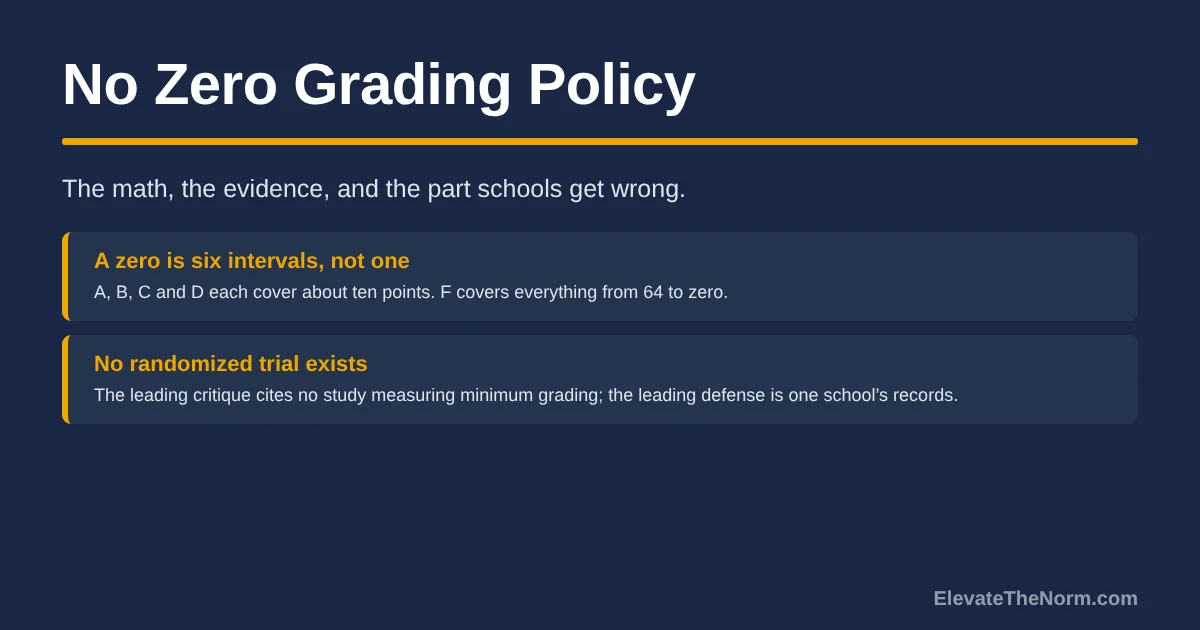
    A no zero grading policy replaces a score of zero for missing or failed work with a floor, usually 50 on a 100-point scale. It exists because a zero costs a student roughly six letter-grade intervals while every passing grade costs one. The floor fixes that arithmetic. It does not, on its own, get the work done.

    Key Takeaways

    • The argument for a grading floor is arithmetic, not sympathy. On a 100-point scale where 65 passes, the failing band is about two-thirds of the scale while each passing letter grade gets roughly ten points, so a single zero carries a penalty no passing grade can match.
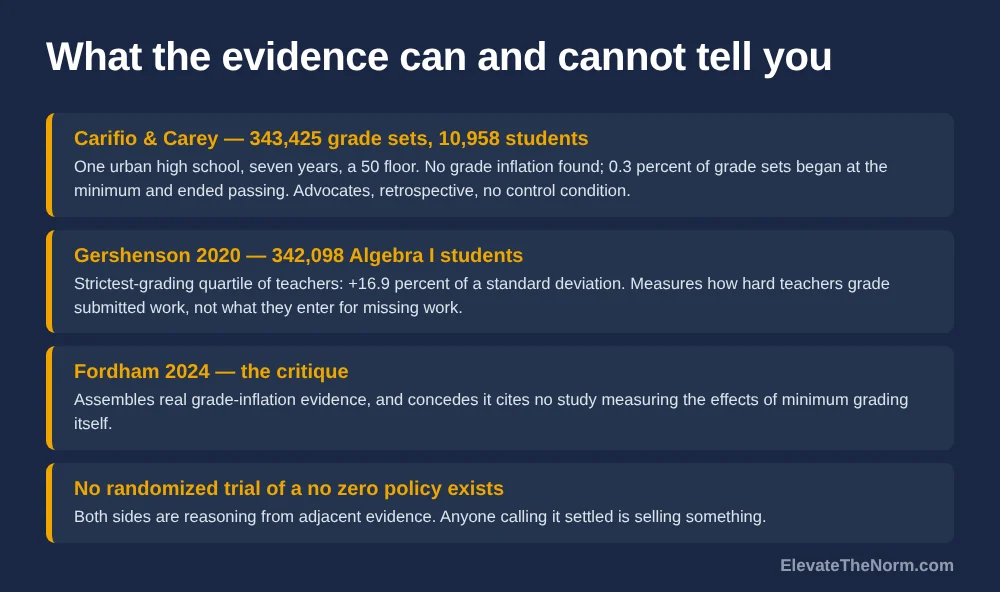
    • The largest study of minimum grading in practice looked at 343,425 sets of grades given to 10,958 students over seven years in one urban high school with a 50 floor, and found no grade inflation. Only 0.3 percent of grade sets started with a minimum grade and ended in a pass.
    • The strongest evidence on the other side is about grading standards, not grading floors. Across 342,098 North Carolina Algebra I students, the strictest-grading quarter of teachers raised same-year test scores by 16.9 percent of a standard deviation over the most lenient quarter.
    • Nobody has run a controlled trial of a no zero grading policy. The leading critique of equitable grading concedes it cites no study measuring the effects of minimum grading itself, and the leading defense comes from one school’s retrospective records. Anyone who tells you the question is settled is selling something.
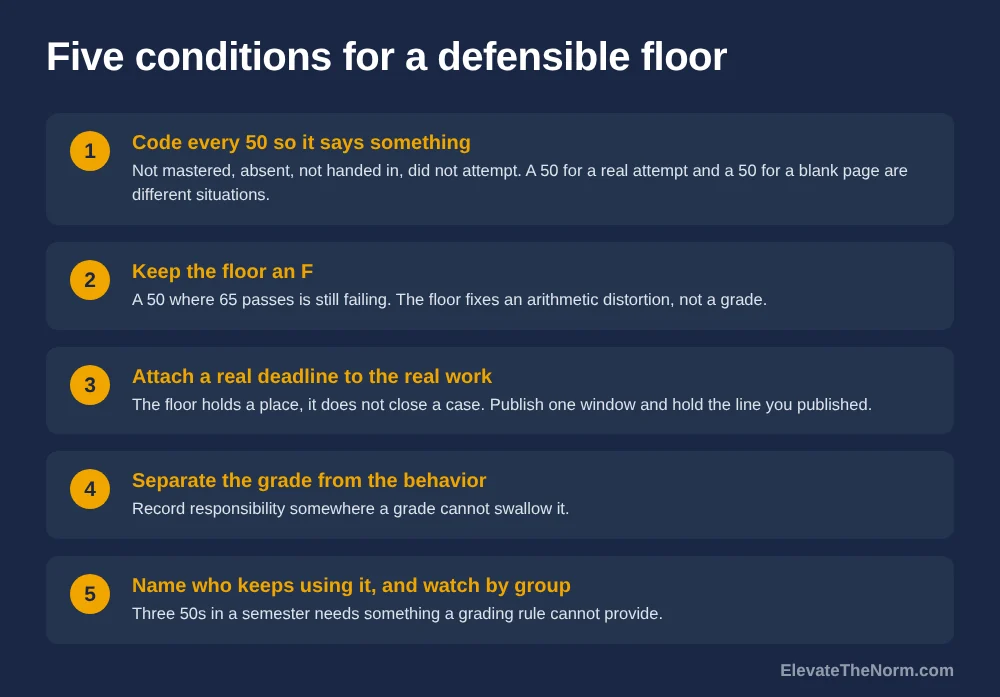
    • A floor without a required redo is the version that earns the criticism. The policy that holds up pairs the 50 with a recorded reason, a deadline for the real work, and a grade that still says the student has not shown the learning yet.

    Every school argument about zeros collapses into the same two sentences. One side says a zero is the only honest score for work that does not exist. The other says a zero is a punishment dressed up as a measurement. Both sides are partly right, and both sides usually skip the part that decides it, which is what the number does to the average afterward.

    So, in order: what the policy is, the arithmetic that started the fight, what the research on both sides actually found, and the five conditions that separate a defensible floor from a free pass.

    What is a no zero grading policy?

    A no zero grading policy is a grading rule that sets a minimum score for any assignment, so that missing or failed work is entered as that minimum rather than as a zero. On a 100-point scale the floor is almost always 50. The work is still unfinished and the grade is still an F. Only the size of the hole changes.

    Three versions get called by the same name, and they are not the same policy. The first is a bare floor: nothing is entered below 50, and that is the end of it. The second is a floor plus a required redo, where the 50 is a placeholder until the student submits the work. The third replaces the number entirely with an incomplete or a not-yet code until the assignment arrives.

    When a teacher tells you a no zero policy ruined their class, they almost always mean the first version. When an administrator tells you it transformed their school, they almost always mean the second. The two groups are arguing about different rules.

    Why does one zero do so much damage on a 100-point scale?

    A zero is the only score on a 100-point scale that can outweigh a semester of work, because the scale is not evenly divided. A, B, C and D each occupy about ten points. F occupies everything from 64 down to nothing. A zero is not one grade worse than a D; it is about six intervals worse.

    Carifio and Carey put the point plainly in the Mid-Western Educational Researcher: a disproportionate two-thirds of the 100-point scale represents a failing grade, which concentrates every bit of teacher-to-teacher variation at the bottom end of the scale, where it does the most damage. Their summary of the underlying problem is the best sentence written on the subject: “The core and unavoidable problem is the effects of intermittent catastrophic failures.”

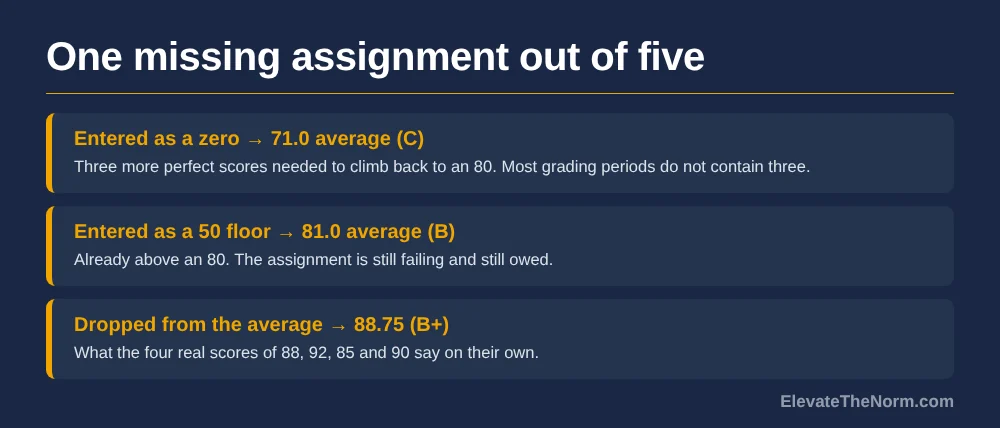
    Run the arithmetic on an ordinary grades 6–12 student. Four assignments at 88, 92, 85 and 90 is an average of 88.75, a solid B+. Add one missing fifth assignment and watch what the two choices do.

    Entry for the missing workNew averageLetterPerfect scores needed to climb back to an 80
    Zero71.0C3
    50 floor81.0B0 — already there
    Dropped from the average88.75B+0
    Four scores of 88, 92, 85 and 90, plus one missing assignment. Plain arithmetic, not a finding.

    One missing assignment out of five takes a B+ student to a C, and climbing back to a B takes three more perfect scores that most grading periods do not contain. That is the whole case for the floor, and it is a case about mathematics rather than effort or character. It is also why a four-level scale changes the shape of the problem — though Carifio and Carey note a 0.0–4.0 scale only solves the asymmetry if its minimum is 1.0 rather than zero. The spacing is what matters, not the scale.

    That arithmetic holds whatever letter bands your district uses. A 10 point grading scale moves the failing line to 60, but the 0-to-59 stretch underneath it is still where a single zero does its damage.

    Comparison graphic showing four assignment scores of 88, 92, 85 and 90 and what happens when a fifth is missing: a zero produces a 71 average requiring three perfect scores to recover, a 50 floor produces an 81, and dropping the score leaves an 88.75.
    Same student, same missing assignment, three different entries.

    What does the research on minimum grading actually show?

    The only large-scale study of a school-wide minimum grade found no grade inflation and almost no social promotion. Carifio and Carey analyzed seven years of grading records from one large urban high school with a 50 floor: 343,425 sets of grades across 10,958 students. They report finding no evidence of grade inflation or social promotion.

    The specific numbers matter more than the headline. Only 1,159 grade sets, about 0.3 percent, began with a minimum grade and ended with a passing grade, which is the exact outcome critics predict and it barely happened. 925 students, 8.4 percent of the school, passed at least one course after receiving a minimum grade somewhere along the way, roughly 142 students a year. The authors also report that after adjusting for GPA, students who received minimum grades outperformed peers who never received one on Massachusetts state exams.

    Now the honest caveats, because this is the study everybody quotes and nobody qualifies. Carifio and Carey are advocates for minimum grading, and the article I read is their own point-counterpoint defense of it. It is one school, retrospective records, and no control condition. The design can tell you what happened in a building that adopted the floor. It cannot tell you that the floor caused it.

    What does the evidence against lenient grading show?

    The strongest evidence against lenient grading is about how hard teachers grade, not about whether zeros are allowed. Seth Gershenson tracked 342,098 eighth and ninth grade Algebra I students across about 8,000 North Carolina teachers over ten years and found that students of the strictest-grading quarter of teachers scored 16.9 percent of a standard deviation higher on the end-of-course exam than students of the most lenient quarter.

    The effect carried forward. Those students scored 7.3 percent of a standard deviation higher in Geometry a year later and 8.6 percent higher in Algebra II two years later. It held across subgroups at roughly the same size: 8.2 percent for Black students, 10.3 percent for white students, 10.4 percent for Hispanic students, with the subgroup differences not statistically significant. The effect was slightly larger in less-affluent schools than in more-affluent ones.

    That is a serious result and I am not going to soften it. But read what the study says about its own reach. Gershenson states that “the mechanism that leads from higher standards to higher performance is not clear,” and the report does not study no-zero or grade-floor policies at all. Its only mention of them sits in the implications section as a policy argument, not a tested finding. Grading harder on the work students do hand in is a different variable from what you enter when they hand in nothing.

    The fullest critique of the wider equitable-grading movement comes from Meredith Coffey and Adam Tyner at the Thomas B. Fordham Institute, and it is worth reading because it is specific. They assemble real evidence that grades have drifted from achievement: an average ACT-tested GPA of 3.4 in 2021, the highest on record, against composite scores at their lowest since 2010, and TNTP’s finding that students earned the same grade or better in 2022 as in 2019 despite losing about five months of learning. They also cite Figlio and Lucas on stricter-grading teachers producing greater test-score growth, and Babcock’s finding that college students expecting a C studied about 50 percent more than those expecting an A.

    And then they concede the thing the headlines left out. The brief cites no study measuring the effects of minimum grading itself, acknowledges that “it is difficult to quantify the impact of these specific grading reforms on national grading standards,” and allows that “some grading reforms may benefit students.” Its strongest line against the reforms, that there is “not an iota of hard evidence” they help long term, is a claim about missing evidence rather than a finding of harm.

    So the state of the field is this. Nobody has randomized a no zero grading policy. One side has a large retrospective study from an advocate. The other side has strong evidence about a related but different variable and an openly stated absence of evidence about this one. That is not a tie, and it is not a victory. It means the decision has to be made on design and on values, with the evidence informing it rather than deciding it.

    Four rows summarising the no zero grading evidence and naming each sample: Carifio and Carey's 343,425 grade sets in one urban high school, Gershenson's 342,098 North Carolina Algebra I students at 16.9 percent of a standard deviation, the Fordham brief's concession that no study measures minimum grading, and the absence of any randomized trial of the policy.
    Every sample named, including what each one cannot tell you.

    Does a no zero grading policy mean students stop being accountable?

    A floor removes one consequence, and if nothing replaces it, accountability does drop. That is the legitimate complaint and it should not be waved away. Teachers at Leominster Public Schools in Massachusetts concluded that “kids just weren’t learning to be responsible” and the district rescinded its policy, and one teacher in the same reporting described students who could “take half of a year off and still pass.”

    Notice what those complaints are about. Not the number 50 — the missing second half of the policy. A 50 that requires nothing is a gift; a 50 that holds a slot open until the work arrives is a deadline with a different shape. There is also a real argument that a zero was never much of a consequence to begin with. Sarah Duncan of the University of Chicago’s Network for College Success noted in the same reporting that students who get an F tend to withdraw, because “they interpret an F as ‘You do not belong in this environment.’” A consequence that makes a student quit is working as an exit, not a consequence.

    What should a no zero grading policy actually require?

    Five conditions separate a defensible floor from a free pass, and all five are about what happens after the 50 goes in the book. A policy with the floor and none of the rest is the version that gets rescinded two years later. The same test decides whether bonus work belongs in a grade at all: points that measure something other than the standard move the number without moving the learning it reports.

    1. Code every 50 so it says something. A 50 with no explanation tells a student and a parent nothing. Gradebook codes do the work: not mastered, absent, not handed in, did not attempt. One teacher in the Edutopia reporting uses exactly those four so families can see which problem they are looking at. A 50 for a genuine attempt and a 50 for a blank page are different situations wearing the same number.
    2. Keep the floor an F. A 50 on a scale where 65 passes is still failing. If the policy is being sold as protecting students from failure, it is being sold wrong. It protects them from a specific arithmetic distortion, which is a smaller and more defensible claim.
    3. Attach a real deadline to the real work. The floor should hold a place, not close a case. Publish one window, say what happens at the end of it, and hold the line you published. The deadline question deserves its own policy, and the two rules have to agree with each other or students will find the gap in about a week.
    4. Separate the grade from the behavior. If the concern is responsibility, record responsibility somewhere a grade cannot swallow it. Mixing a measure of learning with a measure of compliance produces a number that answers neither question, which is the same problem standards-based grading is built to solve.
    5. Name who keeps using it, and watch the pattern by group. Track which students take the floor repeatedly. Three 50s in a semester is a student who needs something other than a grading rule, and the floor is doing its job only if it buys time for somebody to notice. Run the same count by student group, because a floor applied far more often to one group is either catching a real inequity or hiding one, and you cannot tell which without looking.

    One thing a grading floor genuinely costs you, and the reason the reason codes in condition one are not optional: a 50 is not a measurement. It is a placeholder entered where no evidence exists. A gradebook with nine real scores and one 50 still tells you what the student can do. A gradebook with four real scores and six 50s has stopped being a record of learning, and no amount of averaging will tell you which standard the student missed. That is the strongest objection to the policy and it has nothing to do with accountability. It is why the incomplete or not-yet version is cleaner on the measurement question, and why a floor without reason codes destroys information a teacher needs.

    And one logistical fact that decides whether any of this survives contact with a building: most gradebooks cannot enforce a floor automatically. If the rule depends on every teacher remembering to type 50 instead of 0, the policy will be applied unevenly within the same hallway by November. Check what the software can actually do before the policy is announced, not after.

    Numbered graphic of five conditions for a defensible no zero grading policy: code every 50, keep the floor an F, attach a real deadline to the real work, separate the grade from the behavior, and name who keeps using it.
    Five conditions. The floor on its own is none of them.

    How do you explain a no zero grading policy to a parent who thinks it is soft?

    Lead with the arithmetic and never with the compassion. A parent who hears “we did not want him to feel bad” has every reason to object. A parent who hears “one missing assignment was costing him three perfect scores to recover from, and he is still failing that assignment” is being told something checkable.

    Then say the part most schools skip. The 50 is not the grade for the work; it is the grade for the absence of the work, and it is still an F. The assignment is still due. If the policy does not include that second sentence, the parent is right to push, and the way the message is written decides how the conversation goes more than the policy does.

    The harder parent to answer is the one whose child does every assignment on time. That parent is not asking about arithmetic; they are asking why the gap between their child and a classmate who turned in nothing just got smaller. The honest answer is that it did, by ten points on one assignment, and that their child’s grade is unchanged while the classmate is still failing that assignment and still owes the work. If the policy has no redo requirement, there is no good answer to give that parent, which is another reason the second half of the rule is not optional.

    What does this look like from the student’s side?

    Students read a grading floor as information about whether recovery is possible. That is the honest reason it changes behavior when it changes behavior at all. A student at 71 with three assignments left can do the math and see a path; a student who did the same math and found no path has already decided what the rest of the semester is worth. They also read it as information about whether the adults are consistent, and a floor announced in August and quietly ignored in October is worse than no floor at all.

    And the students who do all the work have a fairness complaint of their own, which deserves a straight answer rather than a lecture about empathy. They notice when a classmate gets fifty points for a blank page. The answer is that the classmate is still failing that assignment, still owes it, and gets no credit until it arrives — and that the student asking is owed the same consistency everyone else is getting. A policy you cannot defend to a sixteen-year-old who did the work is not ready.

    What should a school decide before mandating this?

    A district adopting a floor is making three decisions at once, and most adopt the first and skip the other two. The number, what it obligates the student to do next, and what it obligates the school to do next — which is where the staffing and the money live.

    Carifio and Carey estimate the school they studied saved roughly $1 million over seven years in avoided course repeats, summer school and credit recovery. Treat that figure carefully: it is one school, it is the authors’ own estimate, and savings assume the students who passed had actually learned enough to move on. But it does mean the cost conversation runs in both directions, which is not how the policy usually gets presented to a board.

    Two decisions usually get made by default instead of on purpose. The first is whether teachers keep any discretion. A mandate that strips judgment from every teacher in the building will be worked around, and a rule everyone quietly works around is worse than either option honestly chosen. The second is who chases the redo. The required-work half of the policy is real labor — tracking, reminding, re-collecting, re-grading — and if the answer is “the classroom teacher, on top of everything else,” say so out loud when the policy is announced rather than letting people discover it in week three.

    One compliance item to check before adopting, not after: how the floor interacts with transcripts, GPA calculation and anything your state reports. A grading rule that changes course averages changes the number colleges see, and a district that cannot explain the relationship between its floor and its transcripts has created a problem for its own counselors.

    Clay’s take

    My position starts somewhere slightly different than the research. If a student can fail that badly in my room, the first question is what the planning looked like, and the second is what I was doing for the three weeks it took to get there. A zero that accumulated quietly over a grading period is usually a record of adult inattention as much as student choice.

    So the floor is not the interesting part of this policy. The redo requirement is, and a school that adopts the 50 without it has bought the criticism and none of the benefit. Give a teenager a path back and most of them take it; give them arithmetic saying the semester is already over and some of them believe you. And the honest answer to “what does the research say” is that the research has not been done — which teachers deserve to hear instead of a confident number from whichever side asked first.

    The redo requirement is easier to honor when a second version of the assessment already exists. For the big one at the end of the semester, Mid-Terms.org publishes 200 free printable midterms with answer keys for grades 6–12, and every course comes as a Form A and a Form B, so the student who takes the floor in December has a different paper waiting when the work comes due.

    What to do next

    Pull your own gradebook and find one student whose average is held down by a single zero. Run the arithmetic above on that student and see how many perfect scores recovery would take. If the answer is more assignments than the grading period contains, you have found the problem the floor is built for.

    Then decide the second half before you decide the number. What does the student owe, by when, and what happens when the work arrives? If you cannot answer those three questions, the floor is not ready to adopt. Next, read the late work policy that has to agree with it and the objections to standards-based grading taken seriously, because every real version of this fight ends up in one of those two places. Everything on this site is free and nothing asks for your email address.

    Frequently Asked Questions

    What is a no zero grading policy?

    A no zero grading policy sets a minimum score for any assignment, usually 50 on a 100-point scale, so missing or failed work is entered as that minimum instead of a zero. The grade is still an F and the assignment is still owed. The rule changes only how far a single missing assignment can drag an average down.

    Does a no zero grading policy cause grade inflation?

    The largest study available says no. Carifio and Carey examined 343,425 sets of grades for 10,958 students across seven years in one urban high school with a 50 floor and reported no evidence of grade inflation or social promotion, with only 0.3 percent of grade sets starting at the minimum and ending in a pass. It is one school, retrospective, and written by advocates.

    Why is a zero considered mathematically unfair?

    Because the 100-point scale is not evenly spaced. A, B, C and D each cover about ten points while F covers everything from 64 to zero. That makes a zero roughly six letter-grade intervals below a D rather than one, so a single zero can outweigh several strong scores in a way no passing grade ever can.

    Is there research proving no zero policies help students?

    No. There is no randomized trial of a no zero grading policy. The Fordham Institute’s critique of equitable grading concedes it cites no study measuring the effects of minimum grading itself, and the main study in favor is retrospective records from a single school. Both sides are reasoning from adjacent evidence.

    Does strict grading produce better results than a grading floor?

    Strict grading standards do have strong evidence behind them, but on a different question. Gershenson found that across 342,098 North Carolina Algebra I students, the strictest-grading quarter of teachers raised end-of-course scores by 16.9 percent of a standard deviation. That study measures how hard teachers grade submitted work, not what they enter for missing work.

    What should replace a zero if you do not use a 50?

    An incomplete or not-yet code with a required submission date is the cleanest alternative, because it withholds a number rather than inventing one. Some teachers record the true score on the paper and a 50 in the gradebook with a reason code attached. The common requirement in every workable version is that the real work is still owed.

    How many 50s should one student be allowed?

    Set a count and watch it rather than leaving it open. A student taking the floor three times in a semester needs something a grading rule cannot provide, and the point of the floor is to buy time for an adult to notice. A policy with no counting mechanism cannot tell the difference between a bad week and a pattern.

    Sources

    • Carifio, J., & Carey, T. (2013). The arguments and data in favor of minimum grading. Mid-Western Educational Researcher, 25(4), 19–30. Seven years of grading data from one large urban high school with a 50 minimum: 343,425 sets of grades, 10,958 students; 0.3 percent of grade sets began at the minimum and ended passing; 925 students (8.4 percent) passed at least one course after a minimum grade; estimated savings of roughly $1 million over seven years. The authors advocate for minimum grading, the design is retrospective with no control condition, and it is a single school. Reports the figures of their own 2012 Educational Researcher study, 41(6), 201–208.
    • Gershenson, S. (2020). Great Expectations: The Impact of Rigorous Grading Practices on Student Achievement. Thomas B. Fordham Institute. 342,098 eighth and ninth grade Algebra I students, about 8,000 teachers, North Carolina, 2006–2016. Top grading-standards quartile versus the lowest: +16.9 percent of a standard deviation same-year, +7.3 percent in Geometry, +8.6 percent in Algebra II. Subgroup effects 8.2–10.4 percent, differences not significant. No effect on graduation. The study does not examine no-zero or grade-floor policies; its mention of them is a policy argument in the implications section. Author states the mechanism is unclear.
    • Coffey, M., & Tyner, A. (2024). Think Again: Does “equitable” grading benefit students? Thomas B. Fordham Institute. Assembles the grade-inflation evidence (ACT 2023: average GPA 3.4 against composite scores at a post-2010 low; TNTP False Signals; CALDER and Brookings grade-versus-test gaps) and cites Figlio and Lucas (2004), Gershenson (2020) and Babcock (2010) for stricter standards. Concedes it cites no study measuring the effects of minimum grading itself, that quantifying the reforms’ impact is difficult, and that “some grading reforms may benefit students.”
    • Minero, E. (2018). Do no-zero policies help or hurt students? Edutopia. Cited as practitioner reporting, not a study. Source of the Leominster Public Schools rescission, the gradebook reason-code practice, and Sarah Duncan’s observation that students read an F as not belonging. Describes the 50-percent floor as implemented in districts including Fairfax County and Philadelphia.
    • Minimum grade / grading scale (book excerpt, “Equitable Grading Practices,” p. 84). Corwin. Read as an excerpt; the excerpt does not name its author and ends mid-argument. Sets out the two alternatives — raise the minimum or change the scale — and carries Guskey’s (2004) explanation that secondary teachers keep the zero partly so students feel a consequence. Also cites Reeves (2004).
    • Arithmetic in the table and the recovery counts is my own calculation from the four stated scores, not a finding from any source above.

    About Clay Shumate

    Clay Shumate is a certified secondary Social Studies teacher in the public schools of West Alabama, with seven years of classroom experience, a B.A. in History, and an M.Ed. in Secondary Education. He writes about project-based learning, student responsibility, respect, and practical ways to hold young people to a higher standard while giving them room to learn from mistakes. He is a member of the Society of Professional Journalists and writes to its Code of Ethics; this site’s editorial standards and corrections policy are published in full. More about Clay.

  • Annotation Strategies for Grades 6–12: What the Evidence Supports

    Annotation Strategies for Grades 6–12: What the Evidence Supports

    By Clay Shumate

    Annotation strategies work when the mark forces a student to think — write a question, restate a chunk in their own words, flag a contradiction. They stop working when students only highlight. A randomized eighth-grade study found structured annotation beat normal instruction by d = 0.46; highlighting alone is rated low utility, alongside rereading.

    Key Takeaways

    • Annotation has one real randomized result in a secondary classroom. In 256 eighth-grade social studies students across five teachers, a structured annotating condition gained an average of 44.19 points pre-to-post against 40.95 for the control, d = 0.458 — a medium effect.
    • Highlighting is not the same thing as annotating, and the distinction decides whether this works. Dunlosky and colleagues rated highlighting and underlining low utility in their review of ten learning techniques, alongside summarization and rereading.
    • When annotation is the untrained control condition, it loses. In 149 fifth and sixth graders reading textbook chapters on ancient Greece and Rome, a trained relational-reasoning group outscored the annotation group (β = 0.25) and the other trained group (β = 0.41).
    • The mechanism that carries the weight is self-explanation. A meta-analysis of 69 effect sizes and 5,917 participants found g = 0.552 for prompting learners to explain material to themselves, with a detectable effect at every level of schooling (high school k = 13, g = 0.426).
    • The federal practice guide for grades 4–9 puts strong evidence behind a bundle, not a marking system: build word and world knowledge, ask and answer questions about the text, determine the gist of short sections, and monitor your own comprehension. Annotation is a vehicle for those four, nothing more.

    Most annotation advice is a list of symbols. Circle unfamiliar words, star the main idea, underline evidence, question mark where you are lost. Students learn the symbols in four minutes and then produce pages that look annotated and prove nothing. I have graded stacks of those pages.

    The research is not about symbols. It is about whether the student had to generate a thought to make the mark. That distinction separates the one condition that produced a medium effect in a real middle school from the condition that lost to a trained comparison group in a journal article the same year. Below: what the evidence shows, the five marks worth teaching, the one most classrooms default to that does nothing, how often to run it, and where the research stops.

    What are annotation strategies?

    Annotation strategies are the specific marks and notes a reader makes directly on a text while reading it — questions, restatements, connections, objections, and symbols — in order to make their own thinking visible. The marks are not the point. The thought required to produce the mark is the point.

    That definition matters because it cuts the category in two. Marking that requires a decision about importance, meaning or disagreement is generative. Marking that requires only a hand movement — a highlighter dragged across a line that felt important — is not. Both get called annotation. Only one has evidence behind it.

    It also separates annotation from note-taking, which it is often confused with. Notes live somewhere else: a page, a document, a two-column template. Annotation lives on the text, which is its one structural advantage — the thought stays attached to the sentence that caused it. If you want the other half of this, the evidence on what belongs on a separate page is a different literature with different numbers.

    Do annotation strategies actually improve comprehension?

    Yes, when it is explicitly taught and structured. The best secondary evidence is one study: 256 eighth graders, randomized by class section, d = 0.458 on unit tests. One school, never replicated — and still more than most classroom reading strategies can show at this grade level.

    The study is worth the detail because the detail is where the usefulness lives. Lloyd, Kim, Cox, Doepker and Downey (2022) ran it in a middle school in the southern United States where over 90 percent of students were economically disadvantaged. Each of five teachers taught two sections; one section per teacher was randomly assigned to annotate. Both groups read the same texts — ReadWorks, Newsela and the standard textbook — and answered the same 20-question pre- and post-tests across a six-week unit.

    The intervention was not a handout. Teachers got two hours of training. Students annotated at least twice a week, a minimum of ten sessions, at least ten minutes each. Series one came out at d = 0.320, series two at d = 0.353, and the averaged comparison at d = 0.458, p < .001. Gender showed no significant main effect.

    Two things in that design are easy to skim past and both matter. First, the dose: twenty-plus sessions over six weeks. Nobody tested whether one lesson on annotation symbols does anything, and there is no reason to assume it does. Second, the population: a high-poverty eighth-grade cohort, which is the population most annotation advice is written for and almost never tested on.

    What annotation strategies don’t work well?

    Highlighting alone is the one to stop teaching as a strategy. Dunlosky and colleagues rated highlighting and underlining low utility across learners, materials and outcome measures, and placed it with summarization and rereading rather than with practice testing.

    Their 2013 review in Psychological Science in the Public Interest graded ten techniques students actually use. Practice testing and distributed practice earned high utility. Elaborative interrogation, self-explanation and interleaved practice earned moderate. Highlighting or underlining, summarization, the keyword mnemonic, imagery for text, and rereading all earned low. The review’s own framing is blunt: the techniques students lean on hardest do not consistently boost performance.

    Why highlighting fails is not mysterious. Deciding what matters in a passage requires already knowing what matters in the passage. A student who can reliably pick the important sentence has largely already comprehended the text, and a student who cannot will highlight the sentence that sounded impressive. Timothy Shanahan made this point in a trade report on the question, arguing that annotation can hinder comprehension specifically when readers lack the knowledge to separate important from unimportant information. That is commentary rather than a trial, and it is worth reading as such.

    The other honest problem is that annotation can lose to something better. Hattan and Alexander (2021), in the Journal of Educational Psychology, randomly assigned 149 rural students to one of three conditions reading textbook chapters on ancient Greece and Rome: a traditional knowledge-mobilization technique, a relational-reasoning technique, or text annotation as the control. Relational reasoning — comparing what the text says against what you already know — scored significantly higher than annotation (β = 0.25) and than mobilization (β = 0.41).

    Read that result precisely. Annotation was the business-as-usual condition and received no training, while the comparison groups did. It does not show annotation is harmful. It shows that untrained annotation is a low bar, and that a trained thinking routine clears it. Note also the grade band: fifth and sixth graders, which sits at the bottom edge of a grades 6–12 audience and below it for half the sample.

    Which annotation strategies work best?

    The five that survive the evidence all require the student to generate language rather than mark a location: ask a question, restate a chunk, name the connection, flag the disagreement, and predict what comes next. Each one is a self-explanation prompt wearing a reading-strategy costume.

    That is not a rhetorical flourish. Self-explanation is the single best-evidenced mechanism available here. Bisra, Liu, Nesbit, Salimi and Winne (2018) pooled 69 effect sizes from 64 reports covering 5,917 participants and found g = 0.552 (95% CI 0.454 to 0.650) for prompting learners to explain material to themselves. Grade level did not moderate it significantly (QB = 3.051, p = .384): elementary g = 0.483, high school g = 0.426, undergraduate g = 0.611. Social sciences specifically came in at g = 0.555 across six effect sizes.

    Numbered graphic of five annotation marks worth teaching: the question, the restatement, the connection, the objection and the prediction, each with the thinking it requires from the student.
    Five marks. Each one is a self-explanation prompt.
    The markWhat the student writesWhat it forcesWhere it fails
    The questionA real question in the margin, ending in a question markNaming what you do not understand, which requires monitoring comprehensionStudents write “what?” Require the question to be answerable by the next page
    The restatementOne sentence per section, in their own words, no copied phrasesDetermining the gist — the practice named in the federal guideCopying. Ban any clause that appears in the text
    The connection“This is like … because …”Relational reasoning against prior knowledgeVague connections to personal life. Require the because
    The objection“I don’t buy this because …”Evaluating a claim against evidence rather than absorbing itStudents think disagreeing with a textbook is not allowed. Say out loud that it is
    The predictionOne line before a section break: what happens or follows nextBuilding a model of the text rather than decoding sentence by sentenceFiction-style guessing on expository text. Ask what the author will argue next
    Highlighting onlyNothingNothing it can be held toRated low utility. Keep it as a locator, not a strategy

    Highlighting still earns a small place. As a locator — mark the three lines you will come back to, then write beside them — it saves time and the writing does the work. The failure mode is highlighting as the finished product.

    What does the strongest evidence actually recommend?

    The federal practice guide for grades 4–9 puts strong evidence behind a bundle of four comprehension practices, and annotation is not one of them. It is a delivery method for three of them.

    The What Works Clearinghouse guide Providing Reading Interventions for Students in Grades 4–9 makes four recommendations. Three carry a strong evidence rating: build decoding of multisyllabic words, provide purposeful fluency-building, and “routinely use a set of comprehension-building practices to help students make sense of the text.” The fourth — practice with stretch text — carries moderate evidence. The comprehension recommendation rests on 34 studies, 23 meeting WWC standards without reservations and 11 with reservations.

    Its four parts are worth naming because they map almost exactly onto the marks in the table above: build world and word knowledge relevant to the passage; give students repeated chances to ask and answer questions about the text; teach a routine for determining the gist of a short section; and teach students to monitor their comprehension as they read. The question mark, the restatement and the comprehension check are items two, three and four.

    A caution for anyone reading this at district level, because it is the predictable way this gets ruined. Annotation is free, which makes it attractive to mandate, and it is visible on a page, which makes it attractive to put on a walkthrough form. Both of those are mistakes. The only result here came from a six-week routine with teacher training behind it, and an annotation box on an observation rubric reliably produces annotated-looking pages rather than thinking — the same substitution of the visible for the real that makes highlighting feel productive. Fund the training and the short texts; do not count the marks.

    This is the most useful reframe in the whole topic. You are not teaching annotation. You are teaching four comprehension practices, and annotation is the cheapest way to make them visible and gradeable on a page you can collect. The same logic applies to what you can actually see a student understanding in any format.

    How often should students annotate?

    The only dose with a result attached is twice a week for at least ten minutes, across at least ten sessions in a six-week unit. That is the schedule the eighth-grade study ran, and the effect belongs to that schedule, not to annotation in general.

    Which means the honest answer to “should I do an annotation day?” is no. One lesson on symbols has no evidence behind it and considerable evidence against the general class of one-off strategy lessons. Annotation that works is a recurring routine on short texts, not an event on a long one.

    It also means short texts. Ten minutes of real annotation covers one or two pages at this grade level, not a chapter. A teacher assigning fifteen pages of annotated reading is assigning highlighting, whatever the directions say.

    And it means solving the problem nobody writing about annotation seems to have: most students in grades 6–12 cannot write in the book. School textbooks are inventoried and reissued, which makes the core instruction physically impossible on the main text in most buildings. The workarounds are all fine and worth choosing deliberately rather than improvising on the day. Print the one page. Use sticky notes, which is what the eighth-grade study did. Put a two-inch margin column on a half-sheet that sits beside the book. Or move the text to a device. What does not work is assigning annotation on a consumable students do not have, which produces nothing and teaches them the assignment was not serious.

    One accessibility note that belongs here rather than in a footnote. The requirement is that the student generate the thought, not that they write it by hand. A restatement spoken to a partner who writes it down, dictated to a phone, or typed is the same cognitive act. Students with writing disabilities, slow handwriting or a hand injury should not be locked out of the one practice here with evidence behind it because the delivery got confused with the strategy.

    Here is the sequence I would run, built from the two studies and the practice guide rather than from the symbol charts:

    1. Pick a text you could read aloud in four minutes. One page. Expository. Something they need for the unit anyway, not a strategy exercise.
    2. Teach one mark. One. Start with the restatement, because determining the gist is the practice with the clearest instructions in the federal guide and the easiest to check.
    3. Model it badly on purpose, then well. Write a restatement that copies three words from the text and ask the room why it does not count. The rule becomes theirs instead of yours.
    4. Annotate the first chunk together, then release one chunk at a time. This is the gradual release the practice guide’s comprehension studies almost all use.
    5. Collect and read for one thing only. Did the sentence require thought? That is a thirty-second judgment per page and you can do a class set in a planning period.
    6. Add the second mark after two weeks, not two days. The question mark next, then the objection. Five marks across a semester is a realistic ceiling.
    7. Keep doing it after it stops feeling new. The result came from twenty sessions. Session four is where most classrooms quit.
    Numbered graphic of a seven-step sequence for teaching one annotation mark: choose one page, teach one mark, model it badly first, release one chunk at a time, read for one thing, add the second mark after two weeks, and keep going past session four.
    Seven steps, one mark at a time.

    How do you stop students from faking it?

    Make the mark impossible to produce without thinking, then grade the thinking rather than the quantity. Every faked annotation page shares one feature: the marks could have been made without reading. Remove that possibility and the problem mostly disappears.

    Three requirements do most of the work. Ban copied clauses in a restatement — any phrase lifted from the text makes the line void. Require the word because in a connection or an objection, which is the self-explanation prompt in its smallest possible form. And cap the number of marks per page, which kills the volume strategy outright; six good marks beats forty.

    The grading question is where teachers rightly get nervous, because an annotation assignment sounds like a stack of unquantifiable pages. It is not. One mark, read for whether it required thought, scored out of two. Collect six pages a semester rather than sixty, and spot-check the rest during the lesson while students are still writing — which is also when the information is useful to you rather than historical.

    Does annotation work on a screen?

    Probably, but nobody has demonstrated it for grades 6–12 with the clarity of the paper study, so treat digital annotation as a reasonable extension rather than an evidenced equivalent.

    The honest state of play: the secondary result above was produced with symbols, highlighters and sticky notes on paper. The sizeable research literature on social annotation tools — shared margins where students see and reply to each other’s notes — sits overwhelmingly in higher education, and transferring an undergraduate result to a ninth-grade room is exactly the move this site tries not to make.

    What does carry over is the mechanism, since self-explanation showed a detectable effect at every level of schooling and did not vary significantly by subject. A comment box that demands a because is doing the same cognitive work as a margin that demands one. The practical differences are mundane: a shared margin changes who the annotation is performed for, and you can see every student’s thinking at once, which beats carrying a paper set around. If devices are the constraint you are working around, reading on screens has its own set of problems worth sorting out first.

    Where does the evidence run out?

    It runs out early, and the gaps are large enough to name plainly: one secondary randomized study, no comparison between marking systems, no high school sample at all, and no test of whether annotation skill lasts past the unit.

    Five rows summarising the annotation evidence and naming each sample: Lloyd and colleagues 2022 with 256 eighth graders at d = 0.458, Hattan and Alexander 2021 with 149 fifth and sixth graders where annotation was the untrained control, the Bisra self-explanation meta-analysis at g = 0.552, the Dunlosky low-utility rating for highlighting, and the federal practice guide's strong rating for comprehension-building practices.
    Every sample named, including the two that cut against annotation.
    • One study carries the grade band. Lloyd and colleagues is a single eighth-grade cohort in one school. It was randomized by section rather than by student, five teachers delivered it, and it has not been replicated. A medium effect from one site is a reason to try something, not a reason to mandate it.
    • No high school evidence. The two classroom studies here are grades 5–6 and grade 8. For grades 9–12 the argument is entirely mechanistic: self-explanation works at high school level (g = 0.426, k = 13), and these marks are self-explanation prompts. That is a reasonable inference and it is not a result.
    • Nobody has compared marking systems. There is no trial showing a five-symbol code beats a three-symbol code, or that AVID-style marking beats a plain question margin. Anyone selling you a specific system is selling a preference.
    • Durability is untested. Both studies measured outcomes inside or just after the intervention. Whether a student who annotated for six weeks in eighth grade still does it in tenth is unknown.
    • The one measured comparison went against annotation. Hattan and Alexander found a trained alternative beat it. If you have time to teach one thinking routine properly, the evidence does not clearly say annotation should be that routine.

    Clay’s take: the margin is the only place I can see them think

    I teach history, so most of what I assign was written by somebody who wanted students to believe it. A question mark in the margin is worth more to me than any comprehension question I could write. The margin tells me where the student stopped following; my question only tells me whether they can answer my question.

    The place this pays off is the whiteboard table. I built that table and it sits in the corner under a lower lamp with a rug and the better chairs, and students ask to go there. When a kid comes over with a page they have marked up, I am not diagnosing them from scratch. The page already tells me where it went wrong, and we start from that sentence. Without the margin I would be asking questions until I found the gap, which costs the whole conference.

    What I will not claim is that I taught annotation well my first few years. I taught the symbols. Students learned the symbols, handed in colorful pages, and understood the reading no better than before. The change was dropping four symbols and keeping one requirement: write a sentence that proves you thought about this, and do not use the author’s words to do it. The pages got uglier and the conferences got shorter.

    And the thing the research says that I would say anyway: a highlighter is a confidence machine. It makes a student feel like they studied. Ask them to write one sentence instead and the feeling goes away, which is the first honest signal either of you has had.

    What to do next week

    Pick one page, not a chapter. Teach the restatement only, ban copied phrases, and require one sentence per section. Collect it on Friday and read for a single question: did this require thought? Then do it again the following week, because the only result anyone has was produced by doing it twenty times.

    If you want the companion pieces: what the evidence says about the separate page covers guided notes and the laptop-versus-longhand fight, five checks that fit a real week is where annotation becomes information you can act on, and the engagement guide has the version of this that sits inside a wider set of routines. Document-based projects are where the objection mark starts earning its keep, and checking who made a source before you read it is the same habit pointed at the open web. Everything on this site is free and nothing asks for your email address.

    Annotation is a reading method, not a revision method. If a text is too hard for students to start alone, an interactive read aloud can carry the class through the first pages before the marking begins. When students move from reading the text to preparing for an assessment on it, the study techniques with the strongest evidence are practice testing and spacing — and highlighting rates near the bottom of the same list.

    The payoff shows up fastest on a timed task. Margin notes that record a document’s position rather than its content are what make the grouping step possible when students have to build one argument from several sources.

    Annotation is a during-reading move; it assumes students are already in the text. The before-reading counterpart asks them to take a position first and then go hunting for whatever supports or demolishes it — how to build an anticipation guide covers the three-phase version, including why the column students fill in after reading is the one that does the work. The more open version of the same before-reading move is the KWL chart, which asks what students already know instead of asking them to take a position.

    Marking a text up is one pass, not the whole job. The protocol that surrounds it gives each reading its own question — what the text says, how it is built, what it means — and confines the marking to the middle one. How close reading works in grades 6–12 sets out that sequence, along with an honest account of why the comparison studies behind it do not exist.

    Marking the page and talking about the page are different acts, and only one of them is audible. Reciprocal teaching puts four comprehension jobs into a student-led conversation, which is the part its originator says is load-bearing. The four roles, and why the dialogue is the piece that works covers what each role asks for, what the roles look like when students are performing them rather than doing them, and how to pick a text that gives the clarifier something to do.

    Before a student can annotate usefully, somebody has to show them what the marks are for. A margin note is the visible residue of a decision, and most students have never watched an adult make one out loud. How to narrate your own reading so the decision is audible sets out the difference between a think aloud and reading a passage aloud, what the federal guides actually rate as strong, and the one head-to-head test in which narration beat nothing at all.

    Annotation gets students to the evidence. It does not get them to the point. Pulling the theme out of a marked-up text is a separate move with its own failure mode: students name a topic in one word and stop. Teaching theme in grades 6–12 gives a definition students can use, a sentence frame that forces a claim rather than a label, and the two questions — what changed, and why did the author let it — that do most of the work.

    Frequently Asked Questions

    What are the best annotation strategies for students?

    The five with the best support all require the student to generate language: write a real question, restate a section in their own words with no copied phrases, name a connection using the word because, record a disagreement, and predict what the author argues next. Each is a self-explanation prompt, and self-explanation is the mechanism with the strongest evidence behind it.

    Does annotating actually improve reading comprehension?

    In the one randomized secondary study available, yes. Lloyd and colleagues (2022) assigned 256 eighth graders by class section to structured annotation or normal instruction across a six-week unit and found an average effect of d = 0.458 on unit tests. It is a single school and has not been replicated, so treat it as promising rather than settled.

    What annotation strategies don’t work well?

    Highlighting on its own. Dunlosky and colleagues rated highlighting and underlining low utility in their review of ten learning techniques, grouping them with rereading and summarization rather than with practice testing. The problem is that choosing what to highlight requires already knowing what matters, so it rewards students who have comprehended and gives the others nothing.

    How often should students annotate?

    The only schedule with a result attached is at least twice a week, ten minutes or more per session, for at least ten sessions. A single lesson on annotation symbols has no evidence behind it. Short texts matter too: ten minutes of genuine annotation covers one or two pages in grades 6 through 12, not a full chapter.

    Is annotation the same as taking notes?

    No. Annotation lives on the text, so the thought stays attached to the sentence that caused it. Notes live on a separate page or document. They draw on different research literatures with different numbers, and a student can be good at one and poor at the other. Both are worth teaching, but not in the same week.

    How do you grade annotation without drowning in paper?

    Grade one thing: did the mark require thought? That is a judgment of a few seconds per page, scored out of two. Cap the number of marks per page so volume cannot substitute for quality, collect six pages a semester rather than sixty, and spot-check the rest while students are still writing, when the information is useful to you.

    Does annotation work for struggling readers?

    The eighth-grade study was run in a school where over 90 percent of students were economically disadvantaged, which is more relevant than most reading research. But one literacy researcher has argued annotation can hinder comprehension when readers cannot separate important from unimportant information, which is a real caution. Teaching the restatement first rather than importance-marking addresses it directly.

    What if students cannot write in the textbook?

    That is the normal case in grades 6 through 12, and it has four workable answers: print the single page, use sticky notes as the eighth-grade study did, add a wide margin column to a half-sheet that sits beside the book, or move the text to a device. Choose one deliberately. Assigning annotation on a consumable students do not have produces nothing.

    Sources

    • Lloyd, Z. T., Kim, D., Cox, J., Doepker, G. M., & Downey, S. E. (2022). Using the annotating strategy to improve students’ academic achievement in social studies. Journal of Research in Innovative Teaching & Learning, 15(2), 218–231. 256 eighth graders, five teachers, sections randomly assigned; over 90% economically disadvantaged. Series 1 d = 0.320; series 2 d = 0.353; averaged d = 0.458, p < .001. No significant gender effect.
    • Hattan, C., & Alexander, P. A. (2021). The effects of knowledge activation training on rural middle-school students’ expository text comprehension: A mixed-methods study. Journal of Educational Psychology, 113(5), 879–897. 149 rural fifth and sixth graders randomly assigned to knowledge mobilization, relational reasoning, or text annotation as the control. Relational reasoning scored higher than mobilization (β = 0.41) and than the annotation control (β = 0.25). Note the grade band and that annotation received no training.
    • Bisra, K., Liu, Q., Nesbit, J. C., Salimi, F., & Winne, P. H. (2018). Inducing self-explanation: A meta-analysis. Educational Psychology Review. 69 effect sizes from 64 reports, 5,917 participants. Random-effects g = 0.552 (SE = .050, 95% CI 0.454–0.650). No significant moderation by grade level (QB = 3.051, p = .384): elementary g = 0.483, high school g = 0.426 (k = 13), undergraduate g = 0.611. Social sciences g = 0.555.
    • Dunlosky, J., Rawson, K. A., Marsh, E. J., Nathan, M. J., & Willingham, D. T. (2013). Improving students’ learning with effective learning techniques. Psychological Science in the Public Interest, 14(1), 4–58. Practice testing and distributed practice rated high utility; elaborative interrogation, self-explanation and interleaved practice moderate; highlighting/underlining, summarization, keyword mnemonic, imagery for text and rereading all rated low. Read via the journal’s abstract and summary page; the full text sits behind a login.
    • Institute of Education Sciences, What Works Clearinghouse. Providing Reading Interventions for Students in Grades 4–9 (Educator’s Practice Guide). Recommendation 3, “routinely use a set of comprehension-building practices,” carries a strong evidence rating based on 34 studies (23 meeting WWC standards without reservations, 11 with reservations). Its parts: build world and word knowledge; ask and answer questions about the text; determine the gist of short sections; monitor comprehension while reading.
    • Barnum, M. (2023). Annotation can hinder reading comprehension compared to other literacy strategies. K-12 Dive. Cited as a trade report, not a study. Carries Timothy Shanahan’s argument that annotation can hinder comprehension when readers lack the knowledge to distinguish important from unimportant information, and points to the two studies above.

    About Clay Shumate

    Clay Shumate is a certified secondary Social Studies teacher in the public schools of West Alabama, with seven years of classroom experience, a B.A. in History, and an M.Ed. in Secondary Education. He writes about project-based learning, student responsibility, respect, and practical ways to hold young people to a higher standard while giving them room to learn from mistakes. He is a member of the Society of Professional Journalists and writes to its Code of Ethics; this site’s editorial standards and corrections policy are published in full. More about Clay.

  • How to Talk to a Student Who Is Failing: What to Say, and When

    How to Talk to a Student Who Is Failing: What to Say, and When

    By Clay Shumate

    Talk to a student who is failing privately, early, and about one specific thing rather than the whole grade. Name what is missing, ask what is getting in the way, say plainly that you expect them to reach the standard, and leave with one task and one date. Then check back when you said you would.

    Key Takeaways

    • A failing grade is usually the last signal, not the first. In Chicago Public Schools, freshman absences alone explained 63 percent of the variation in course failures, against 8 percent for eighth-grade test scores.
    • Private, specific and early beats comprehensive. One behaviour, one question, one task, one date. A conversation that covers nine problems gives the student nothing to do tonight.
    • In a randomized study of 44 seventh graders, attaching one sentence to critical feedback — high expectations, and I know you can reach them — raised essay revision among African American students from 17 to 71 percent. A 44-student study is promising, not settled.
    • Ask what is getting in the way, not what is wrong at home. The American School Counselor Association states that even school counselors do not diagnose; a teacher notices and routes.
    • Structured follow-up has the clearest evidence and the clearest limit: in the two randomized trials the What Works Clearinghouse accepted on Check & Connect, the programme had positive effects on staying in school and no discernible effects on completing school.

    Most of these conversations go wrong in the first thirty seconds, and almost never because the teacher was unkind. It is because the teacher opened with the grade. A 41 on a progress report is an aggregate of a dozen decisions a student has already made and mostly cannot undo, so leading with it hands a teenager a number they cannot act on and a feeling they will act on instead.

    What follows is the structure that holds up: when to have the conversation, the six things it needs, the four very different situations a failing grade can mean, the sentences to leave out, and the honest research on all of it — including the part that found no effect on graduation.

    What should you say to a student who is failing?

    Say one specific thing that is missing, ask one open question about what is getting in the way, state that you expect them to reach the standard, and agree one task with a date on it. Six moves, in order, and the whole thing fits in four minutes.

    1. Pick the moment, not the lesson. After class, at your table, during independent work — anywhere the rest of the room is not an audience. A conversation about a failing grade held within earshot of twenty-eight people is a performance, and the student will play their part in it.
    2. Open with the specific, not the total. “You have three missing assignments and two of them are the ones the unit test is built on.” Not “you are failing my class.” The first sentence is a problem with an edge on it. The second is a verdict.
    3. Ask what is getting in the way, then stop talking. This is the question most teachers skip because they already have a theory. Ask it anyway. The answer is frequently logistical — a shared laptop, a shift that ends at eleven, a folder lost in a locker change — and logistical problems have fixes.
    4. Say the expectation out loud. Not a pep talk. One sentence: this standard is the standard, and you can reach it. The research below suggests that sentence does real work, particularly with students who have reason to wonder whether the adult in front of them has already written them off.
    5. Agree one task and one date — and let the student pick them. Ask which one they want to start with and when it will be done. A teenager who names the date is holding their own deadline; one who is handed it is complying with yours. The student who owes eleven assignments needs the first one back, not a recovery plan.
    6. Say when you will check, and then check. A follow-up that does not happen teaches the student that the conversation was for your records. That is the part teachers drop, and it is the part that carries the evidence.
    Numbered graphic of six moves in a conversation with a failing student: pick the moment, open with the specific, ask what is getting in the way, say the expectation out loud, agree one task and one date, and say when you will check.
    Six moves, in order. The whole thing fits in four minutes.

    When is the right time to have this conversation?

    Before the grade is failing. The warning signs that predict a failed course are attendance and missing work, and both are visible weeks earlier than the average on a progress report.

    The clearest evidence on this is still Elaine Allensworth and John Easton’s on-track study of Chicago Public Schools freshmen, and the numbers are blunt. Fifty-three percent of CPS freshmen failed at least one semester course. Students who ended ninth grade on-track graduated in four years at about 82 percent; students who were off-track graduated at about 22 percent. And freshman absences alone explained 63 percent of the variation in course failures, against 8 percent for eighth-grade test scores.

    Their sentence on absence is the one worth pinning above a gradebook: “Just one week of absence per semester indicates problems with students’ grades.” Not two weeks. One. Students with the lowest eighth-grade test scores who missed one week averaged fewer Fs (1.3) than top-scoring students who missed two (2.1).

    That is one large urban district and a cohort that entered high school in 2000–01, so the percentages are not national facts. The ordering has held up well enough that most early-warning systems use the same signals, and the lesson for a teacher is simple: check the attendance column before building a theory about motivation. The reasons behind a pattern of absence are mostly outside your room, which is a separate problem with its own evidence base.

    Does telling a student you believe in them actually help?

    One sentence of it, attached to critical feedback, has measurable support. Open-ended encouragement that is not attached to anything does not. The distinction matters more than the sentiment.

    David Yeager and colleagues ran a set of field experiments on what they called wise feedback. Seventh graders handed back a marked-up essay received one of two notes. The control note read: “I’m giving you these comments so that you’ll have feedback on your paper.” The other read: “I’m giving you these comments because I have very high expectations and I know that you can reach them.”

    Seventy-one percent of African American students who got the second note revised their essay, against 17 percent who got the first. For White students the difference — 87 against 62 percent — was not statistically significant. Among African American students who had reported low trust in the school, none of the control group revised and 82 percent of the treated group did. A second study the following year found treated students incorporated 5.54 of the teacher’s edits against 2.19.

    The caveats are large. Each study had 44 students, and only students carrying B or C averages were eligible — which the authors say limits how far this travels to the students a teacher would call failing. The race-by-condition interaction was not significant, and the authors call the trust findings tentative. It is a reason to say the sentence, not proof that saying it fixes a grade.

    What it does explain is why the sentence is not flattery. The mechanism is attribution: a student handed hard criticism has to decide whether it means the teacher thinks they can do better or thinks they cannot. Most teachers mean the first and say neither.

    Four rows naming each study behind the article and who it was run on: the Chicago on-track indicator, a 44-student wise-feedback experiment, a 99-study relationships meta-analysis, and two Check and Connect trials.
    Every finding, with the population it came from.

    It is also worth knowing that the relationship itself matters more in high school than most people assume, not less. Debora Roorda and colleagues’ meta-analysis of 99 studies and 129,423 students found positive teacher–student relationships associated with engagement at r = .39 overall, and the secondary-school estimates were larger than the primary ones — r = .30 to .40 for engagement across 23 studies. The authors flag that as unexpected, and they state plainly that the design “does not permit conclusions about causality,” since most of the underlying studies are cross-sectional. The modest, useful read: a student rarely takes hard feedback from an adult they have decided is not on their side. That does not mean being liked. It means being predictable.

    Which conversation does this student actually need?

    Four different problems produce the same failing grade, and each needs a different opening line. Working out which one you have in front of you takes about ninety seconds in the gradebook and saves the entire conversation.

    The categories are for your diagnosis, not for the student’s ears — say the question out loud, never the label, and be ready to be wrong when they answer. One caution on the third row: “I’ve missed you” only works if it is true, and a teenager can tell.

    What the grade actually isHow you can tellHow to openWhat success looks like in two weeks
    Missing work, not failed workScores are mostly zeros; the attempts that exist are passing“You can do this — three of these were never turned in. Let’s pick one.”One assignment in, and the student knows the window for the rest
    Attempted and not learnedWork is submitted and scoring low; quiz and test scores agree“You’re doing the work. Something in the middle isn’t landing. Show me where it stops making sense.”Reteaching or a reassessment scheduled, not more of the same practice
    Not in the roomAbsences or tardies cluster; grade drop tracks them“I’ve missed you. What’s making it hard to get here?”An attendance plan with someone other than you in it
    Something outside the classA sudden change in a student who was fine; across several subjects“Something’s changed. I’m not going to pry. Who in the building do you trust?”The student has talked to a counsellor; you have adjusted one deadline

    Most teachers’ default script is written for the second row while most failing grades belong to the first. Missing work is a logistics problem in a motivation costume, and it responds to a clear window and a short list better than to a conversation about caring — which is the same argument behind a late work policy with a floor instead of a zero.

    For the second row, “show me where it stops making sense” is not a figure of speech. Have the student work one problem out loud, or read you their notes from the lesson in question. The breakdown is usually three steps earlier than either of you assumed, and you cannot scaffold a gap you have not located. Check the student’s accommodations or IEP before you design any of it — the case manager may already know the answer, and an agreement that cuts across a plan on file is worse than no agreement.

    What should you never say to a student who is failing?

    Anything that asks the student to account for their character rather than their work. The four sentences below are all well-intentioned and all of them end the useful part of the conversation.

    • “You’re so much smarter than this.” It sounds like a compliment and lands as a charge: the student now has to explain why they are a disappointment. Replace it with the expectation sentence, which does the same job without the accusation.
    • “Do you even care about this class?” A teenager asked this in front of a grade they are ashamed of will say no, because no is the only answer that protects them. Then both of you are stuck with it. What not caring usually turns out to mean is a different problem entirely.
    • “At this rate you’re not going to pass.” Probably true and entirely useless. A student who already knows the number needs the next step, not the forecast. If the mathematics genuinely no longer works, say what is still available — credit recovery, a summer option, a reassessment window — in the same breath.
    • “Is everything okay at home?” Well meant, and not yours to ask cold. It invites a disclosure you are not trained or authorised to handle and it can read as an assumption about the student’s family. “What’s getting in the way?” gets you the same information and leaves the student in charge of how much they say.

    One more guardrail, and it is an administrator’s point: only offer what your school actually permits. A reassessment window, a late-work floor or a credit-recovery route is school policy before it is your policy, and a promise you cannot keep does more damage than the original grade. If you are not certain what is allowed, ask before the conversation rather than walking it back afterward.

    And one structural rule: do not make this conversation the consequence. A failing grade is already a consequence. Layering a lecture on top of it teaches the student that coming to you with a problem costs them something, which is the opposite of what the next six weeks require. The distinction between a consequence and a punishment is worth being precise about.

    What if the problem is clearly bigger than your class?

    Route it, immediately, and do not try to handle it yourself. Notice, name that you have noticed, hand the student to someone whose job this is, and follow the referral path your school already has.

    The boundary here is not a matter of taste. The American School Counselor Association’s position statement on student mental health states that “school counselors do not diagnose” and that providing long-term therapeutic counselling in school is inappropriate even for a counsellor who holds a therapy licence; their role is brief counselling, crisis intervention, and referral to school and community providers. If that is the limit on a licensed counsellor, a social studies teacher’s limit is considerably tighter.

    What ASCA does list as warning signs is squarely in a teacher’s field of view: changes in grades or attendance, shifts in mood, school avoidance. You are well placed to see those and badly placed to interpret them. So the move is three sentences long — something has changed, I am not going to pry, here is who I think you should talk to — followed by a walk to the counsellor’s office or an email to them the same day.

    That assumes a counsellor who is reachable, and in a lot of schools the counselling caseload makes that optimistic. If yours is carrying hundreds of students, find out now — not in the moment — who the route actually is: a school social worker, a nurse, an administrator, a named point of contact for a district programme. The referral path existing on paper is not the same as you knowing it.

    If a student says something that makes you worry about their immediate safety, that is not a conversation to finish alone or to leave until tomorrow. Follow your school’s reporting procedure that day and tell your administrator.

    Four rows pairing a sentence to avoid with a replacement, covering you are smarter than this, do you even care, at this rate you will not pass, and is everything okay at home.
    Four well-meant sentences, and what to say in their place.

    What happens after the conversation?

    The follow-up is the intervention. Structured, repeated contact with one named adult has the strongest evidence in this area — and a clear ceiling.

    Check & Connect is the tested version: a named monitor who tracks attendance, behaviour and grades, intervenes when a signal trips, and coordinates with the family. The What Works Clearinghouse intervention report accepted two randomized trials without reservations and rated it positive effects on staying in school (improvement index +25), potentially positive effects on progressing in school (+30), and no discernible effects on completing school (+1).

    That last row is the honest headline: the programme kept students enrolled and did not demonstrably get them to a diploma. Both trials ran in Minneapolis with fewer than 350 students in total, all ninth graders receiving special education services for learning, emotional or behavioural disabilities, and the WWC rates the extent of evidence small in every domain.

    The scaled-down version a teacher can actually run is one adult, one signal, and a check-in that happens on the day it was promised. Not a case plan — a thirty-second question on Thursday because Thursday is when you said. It is the same reason test corrections only work when the student has to produce thinking rather than the right answer: the structure does the work, not the sentiment.

    Contacting home belongs in this stage rather than the first one, and it belongs after you have told the student. To be clear about what that means for a family: telling the student first is a matter of hours, not weeks, and it is not a reason to delay contact. It is so the student hears it from you rather than at the dinner table. Send it in a language the family reads, say how they can reach you, and keep every other student out of it — including the one whose grade the parent asks to compare. If the next step is a conference instead of a message, these are the questions actually worth the fifteen minutes.

    Where does the evidence run out?

    Sooner than any of the above implies. There is no randomized trial of the teacher–student conversation itself, and every study cited here was run on a population that is not quite yours.

    • Nobody has tested the conversation. What has been tested is a written note on feedback, a monitoring programme, and a correlation. The four-minute talk is assembled from those, not validated as a unit.
    • The wise-feedback studies had 44 participants each, were limited to students with B and C averages, and the authors call the trust moderation tentative. Treat the sentence as low-cost and promising, not as an established lever.
    • The on-track figures are one district, one era — Chicago Public Schools in the early 2000s. The ordering of the signals has replicated widely; the numbers are not national facts.
    • Check & Connect’s trials were ninth graders with disabilities in one city, and the completing-school result was no discernible effect. Anyone selling monitoring as a graduation strategy is quoting the first row and skipping the third.

    Clay’s take: the grade is information about the plan too

    My position here is unfashionable and I will defend it: if a student in my room could fail badly enough for it to matter, that is mostly a planning problem.

    If a kid can screw up that badly in a classroom, what was the teacher doing the entire time? I am moving between tables most of the period. A grade that collapses without my noticing is a grade I stopped looking at.

    So I read a failing grade as two pieces of information. One is about the student, and it is usually attendance or a stack of untouched work rather than anything about character. The other is about me — where the scaffolding was thin, which day the class lost the thread, what I posted and then quietly let slide. The second half is what I can fix this week.

    Where I will not go is “let them fail so they learn.” Manufactured stakes are not a teaching method. Students can struggle, do a thing badly, need help and still be held to the standard afterward; what they should not be able to do is walk off a cliff an adult built and then watched them approach. The article on when to let students wrestle and when to step in walks through where that line sits.

    So I keep the conversation small and keep my word about it. A teenager who has been failing for a month has usually had plenty of adults be disappointed at them and very few be specific with them. Specific, and then back on Thursday like you said, is most of the job.

    What to do tomorrow

    1. Sort your gradebook by missing assignments rather than by average. The list you get is the list of conversations worth having, in order.
    2. Pick the top three students. With 120 or 150 on a roster you are not having thirty of these this week, and three conversations you finish beat ten you start. Sorting by missing work rather than by who worries you keeps the choice honest.
    3. For each one, work out which of the four rows above you are looking at before you say a word.
    4. Hold it somewhere private, in four minutes, with one task and one date out of it. Private rarely means an empty room — the doorway as the bell goes, your table during independent work, and the two minutes while everyone else packs up all count.
    5. Write the check-in date where you will see it, and set the due dates on a schedule you can actually mark — twelve recovery assignments landing the same Friday helps nobody. Then check in on the day, even if nothing has changed, because that is the part the student is actually measuring.

    If the student’s problem turns out to be refusal in the moment rather than a quiet backlog, that is a different ninety seconds and it comes first. Everything on this site is free and nothing asks for your email address.

    Frequently Asked Questions

    How do you start a conversation with a student who is failing?

    Start with one specific missing piece of work rather than the grade, and start somewhere private. “You have three missing assignments and two of them are what the test is built on” gives a student something to do. “You are failing my class” gives them a verdict to react to. Then ask what is getting in the way and let them answer.

    Should you tell a student they are failing?

    Yes, and earlier than most teachers do. A student who learns it from a report card has lost the weeks when it was fixable. Say it plainly, say it in private, and pair it with the one task that starts the recovery. Attendance and missing work show the problem coming long before the average does.

    Does telling a student you have high expectations actually work?

    There is real but small-scale evidence for it. In a randomized study of 44 seventh graders, a note saying the teacher had high expectations and believed the student could reach them raised essay revision among African American students from 17 to 71 percent. The sample was tiny and limited to B and C students, so treat the sentence as low-cost and promising rather than proven.

    What should you not say to a failing student?

    Avoid “you’re smarter than this,” “do you even care,” and “at this rate you won’t pass.” All three ask the student to defend their character instead of fixing their work. Also avoid opening with “is everything okay at home?” — “what’s getting in the way?” gets the same information and leaves the student deciding how much to share.

    Should I contact the parents before or after talking to the student?

    After. A student who finds out at dinner that you emailed home has learned that you go around them. Telling them first, at the end of class, costs twenty seconds and keeps them a party to their own situation. The exception is anything involving immediate safety, which goes to your administrator the same day.

    What if a failing grade seems to be about something outside school?

    Notice it, say you have noticed, and route it. Do not probe and do not offer a theory about what is happening. The American School Counselor Association states that school counselors do not diagnose, which puts a teacher’s limit well short of that. Three sentences and a walk to the counselor’s office is the whole move.

    How often should I follow up after the conversation?

    On the day you said, and briefly. Thirty seconds on the agreed date does more than a long meeting a fortnight later, because the student is measuring whether you meant it. Structured follow-up with one named adult has the best evidence in this area, though the strongest trials showed it kept students enrolled without demonstrably improving graduation.

    Sources

    • Allensworth, E. M., & Easton, J. Q. (2007). What Matters for Staying On-Track and Graduating in Chicago Public High Schools. Consortium on Chicago School Research, University of Chicago. Chicago Public Schools freshmen, 2000–01 entering cohort and surrounding years; a single large urban district. The 63 percent / 8 percent variance comparison, the 82 / 22 percent graduation figures and the one-week-of-absence sentence all come from this report.
    • Yeager, D. S., Purdie-Vaughns, V., Garcia, J., Apfel, N., Brzustoski, P., Master, A., Hessert, W. T., Williams, M. E., & Cohen, G. L. Breaking the cycle of mistrust: Wise interventions to provide critical feedback across the racial divide. Journal of Experimental Psychology: General. Studies 1 and 2 each used 44 seventh graders at one suburban northeastern middle school, restricted to students with B or C averages; Study 3 used about 76 mostly tenth graders at an urban New York City high school. The authors describe the trust moderation findings as tentative.
    • Roorda, D. L., Koomen, H. M. Y., Spilt, J. L., & Oort, F. J. (2011). The influence of affective teacher–student relationships on students’ school engagement and achievement: A meta-analytic approach. Review of Educational Research, 81(4), 493–529. 99 studies, 129,423 students, preschool to high school. The secondary estimates quoted here rest on 23 studies for engagement and 17 for achievement. The authors state the design does not permit causal conclusions.
    • What Works Clearinghouse (2015). Check & Connect intervention report. Institute of Education Sciences, U.S. Department of Education. Two randomized trials in Minneapolis high schools, fewer than 350 students in total, all ninth graders receiving special education services for learning, emotional or behavioural disabilities. Positive effects on staying in school; no discernible effects on completing school.
    • American School Counselor Association. The School Counselor and Student Mental Health (position statement; adopted 2009, revised 2015, 2020 and 2025). Source of the “school counselors do not diagnose” language and of the warning-sign list. This article is not legal, medical or clinical advice, and district policy sits on top of all of it.

    About Clay Shumate

    Clay Shumate is a certified secondary Social Studies teacher in the public schools of West Alabama, with seven years of classroom experience, a B.A. in History, and an M.Ed. in Secondary Education. He writes about project-based learning, student responsibility, respect, and practical ways to hold young people to a higher standard while giving them room to learn from mistakes. He is a member of the Society of Professional Journalists and writes to its Code of Ethics; this site’s editorial standards and corrections policy are published in full. More about Clay.

Teacher Emergency Toolkit — practical resources, real classroom support. Shop on TPT.Teacher Emergency Toolkit — practical resources, real classroom support. Shop on TPT.