Three-day weekends are awesome. Nobody argues that part. The argument I want to have is about the two days that sit on either side of one — the Friday before and the Tuesday after — because those are the two days most of us quietly write off every single year.
I don’t write them off. I use them to introduce new material. Here’s how.
The Friday tension nobody names
As soon as that final bell hits on Friday — and really the day or two before it — these kids are going to be all riled up. They are going to be ready to go as much as you are. And that creates a tension whether you believe it or not.
They’re happy. And you’re probably, let’s just be honest, a little unhappy at how happy they are. Because you’re standing there running the checklist in your head: are they actually paying attention? Are they getting their information? Are you meeting your standards for those two days that you don’t already have enough time to do?
Probably not. So what do you do?
Don’t review. Not yet.
Review is the reflex. It’s the move that feels responsible, because it looks like content and it fills a block. But a review on Friday afternoon, aimed at a room that mentally left the building on Thursday, is not going to repair anything. If they didn’t have it Wednesday, one more pass at 2:15 on Friday isn’t the fix.
Save review for a day they can actually spend it. You don’t need it yet.
Play a game — a real one, that you built
So go back to what I did on the Thursday or Friday before: play games.
And I need to be specific about that word, because it gets used badly. These games aren’t Candy Land and dice and pick-it-up-off-the-shelf. It’s a true game that you have taken the time to build, one that creates curiosity, interest, and fun. The build is the whole thing. A game you didn’t design is a babysitter. A game you designed is a lesson wearing better clothes. If you want the design rules rather than the argument, they are set out in how to build a review game that actually teaches something.
The engine underneath it is curiosity. You ask them questions they more than likely don’t know the answer to — not questions that check whether they were listening Tuesday. Not knowing is the point. Not knowing is what makes a fourteen-year-old pick up a laptop on a Friday.
Make it a webquest, not a worksheet
Here’s the turn that makes it a lesson instead of a time-filler. Instead of this webquest being on a piece of paper that they turn in at the end of the day, you create a webquest for them to do. Then you ask them the questions and you tell them: you are free to use your computer. You must cite the source. And you must say in the source where you found the info.
That’s it. That’s the whole rule set. Everything they turn in has a trail attached to it.
Yes, they can use AI. Make them show the receipts.
Including if they choose to use AI. Especially then.
Please remember, everyone’s using AI. Instead of being afraid of it or trying to fight it, start teaching them how to successfully use it on a daily basis.
I don’t think that’s a controversial position anymore, but plenty of buildings are still acting like it is. The kids are using it whether it’s on your syllabus or not. The only variable you control is whether they learn to use it well — naming the tool, checking what it told them against a real source, and being able to say out loud where a fact came from.
A webquest on a Friday before a long weekend is about the lowest-stakes place in the calendar to teach that skill. Nobody’s grade is riding on it. The topic is brand new. And you get to watch, in real time, which students can tell a source from a sentence that just sounds confident.
Now it’s Tuesday. Everybody’s energized, right?
No.
Most of the time the teachers are energized and the students are tired, peeved, wondering why they didn’t do this or that this weekend, and catching up with their friends. That’s the room you’re walking into. Planning a Tuesday like it’s a Wednesday is how good lessons get burned.
So what do you do on that day? It’s a rinse and repeat, folks. Find a new game. Same structure, new topic, new questions they don’t know the answer to yet.
Notes get taken Wednesday
Then, as we settle back down on Wednesday and they wake up a little bit more, we begin maybe fifteen minutes of direct instruction.
Their notes are not taken on a Tuesday after a long weekend. And if we’ve got a more in-depth activity on deck, that activity is going to be given a lot more attention and love by those students when they’re not exhausted and unable to wake up no matter what time of day it is.
Same content. Same standards. Different order. That’s the entire trick.
Thursday/Friday before: built game plus webquest on the next unit. Sources cited, AI disclosed. No review, no notes.
Tuesday back: new game, same rules, next slice of the same topic. Low floor, high curiosity, zero note-taking.
Wednesday: about fifteen minutes of direct instruction into a room that already has the vocabulary in its hands — plus the in-depth activity, now that they can actually give it something.
If you’re a new teacher, classroom management on those two bookend days is most of the battle, and this is a management plan as much as it’s a lesson plan. A room chasing an answer is not a room you have to manage. That’s not a trick — it’s just where their attention already wanted to go.
This is not anti-direct-instruction
I talk about project based learning constantly, and I live and die by it, so it seems like this is that. It’s not, or at least not only that.
I am somebody who believes in direct instruction. I just believe in less direct instruction. I don’t believe in wasting days.
That’s the honest version of my position, and it’s the same one I’d give you about PBL versus traditional instruction. Direct instruction works. Fifteen focused minutes into a prepared room beats fifty minutes into a room that’s still asleep, every time. This is my way of not wasting days, introducing new topics, and buying myself a Wednesday where the notes actually stick.
Fun and learning are not opposites
So embrace the fun. Embrace the fact that fun can be learning. Embrace the fact that you can have an entire class walk out thinking they hadn’t learned anything — and then come back the next day and not have to take half their notes, because they already know it.
That gap between what they think happened and what happened is the best feedback you’ll get all year. When a kid tells you Friday was a blow-off day and then answers your Wednesday question before you finish asking it, you built the right game. And if you want more ideas to build from, that’s the standard I’d hold them to.
Kids figure things out. That’s what people do.
Kids learn in a myriad of ways. Remember that we are a people who have evolved over millions of years, and through that time you see evolution create people who know how to get out of problems. Those become us. We were the first to figure out small problems, and instead of ignoring them or working around them, we figured out a solution.
It’s the same thing now. Just because we have evolved does not mean we don’t have basic instincts. Hand a teenager a question they can’t answer and a way to go find it, and something old kicks in. They will figure that stuff out.
Which leaves the part that’s on us. It comes down to two questions, and neither one is about the kids:
Are you giving them enough time?
Are you presenting the opportunity on the correct day for them to have the information they need in order to execute?
Get those two right and a three-day weekend stops costing you two days. It starts buying you one.
Frequently asked questions
Why introduce new material before a long weekend instead of reviewing?
Review on a Friday afternoon into a room that has mentally left the building rarely sticks. New material paired with a curiosity-driven game works because it meets students where their energy already is — not bored by something they’ve heard twice, but genuinely stumped by something they haven’t seen yet. The review gets its proper day later, when they can actually spend the attention.
What makes a teacher-built game different from a commercial classroom game?
A commercial game is built for generic engagement. A teacher-built game is built around the specific vocabulary and questions of the next unit. The questions students can’t answer are the point — that gap is what generates real curiosity instead of hollow competition. The build takes time upfront, but it doubles as next-unit pre-exposure, not filler.
How should students properly cite an AI tool in a webquest?
Students should name the specific tool (e.g., “ChatGPT, September 2026”), record the question or prompt they used, and then cite a primary or secondary source they consulted to verify the AI’s answer. Both the AI disclosure and the verification citation are required. The goal isn’t just transparency — it’s teaching students that AI output is a starting place, not a source.
Does this approach work across different subjects and grade levels?
Yes, with adaptation. The structure — curiosity-first game, webquest with sourcing requirements, notes deferred to Wednesday — applies from middle through high school across most content areas. A science teacher builds a game around phenomena students haven’t studied yet; an English teacher builds one around an author or text coming up next. The rules are the same. The content is yours.
How long does it take to build one of these games?
Forty-five minutes to a couple of hours, depending on how elaborate the question set needs to be and how well you already know the content. The webquest sourcing rules add a few minutes of setup once you have a bank of reliable sites. The investment is front-loaded: once you’ve built the game for a unit, the next year you refine it rather than starting from scratch.
What if district pacing guides expect direct instruction on those days?
The approach doesn’t drop content — it reorders it. Students meet the same standards on the same week; they just encounter the vocabulary through a game on Friday and Tuesday and take formal notes on Wednesday. If a pacing guide is day-specific, document Friday and Tuesday as “unit introduction and pre-exposure” and Wednesday as “note-taking and structured input.” Most pacing guides care about when students have the content, not which day the notes were written.
What if students don’t take the Friday game seriously?
That’s a management signal, not a content problem. A room that won’t engage with a curiosity-driven question on a Friday afternoon is telling you something about established expectations, not about the game design. The fix is building throughout the year — starting in September — that every class has a task with a standard attached. Students who believe you mean it in the fall behave differently by spring.
About Clay Shumate
Clay Shumate is a certified secondary Social Studies teacher in the public schools of West Alabama, with seven years of classroom experience, a B.A. in History, and an M.Ed. in Secondary Education. He writes about project-based learning, student responsibility, respect, and practical ways to hold young people to a higher standard while giving them room to learn from mistakes. He is a member of the Society of Professional Journalists and writes to its Code of Ethics; this site’s editorial standards and corrections policy are published in full. More about Clay.
Project-based learning in high schools does not require restructuring the bell schedule, eliminating teacher autonomy, or rebuilding your curriculum from scratch. It requires redesigning one unit well enough that the schedule you already have holds it. Most of the barriers teachers cite — the pacing guide, the forty-five-minute period, the standardized assessment calendar — are real constraints. None of them prevent strong PBL.
What actually blocks PBL in high schools is usually design. A project with a vague driving question, no real audience, and no individual accountability component will fail whether the period is forty-five minutes or ninety. A project with a specific question, a genuine audience, a clear rubric, and individual checkpoints throughout will work in almost any schedule. The implementation models below are sized to what actually exists in most high schools: single teachers with no extra planning time, limited administrative support, and students who have not been asked to produce public work before.
What the Schedule Obstacle Actually Is
Teachers who say “PBL won’t work in my schedule” are describing something real. Exhibition days, extended hands-on builds, and complex multi-week projects are genuinely harder to run in fifty-minute periods than in ninety-minute blocks. The concern is legitimate.
The concern is also overstated. The core operations of strong PBL — questioning, researching, drafting, conferencing, revising, presenting — happen inside conventional periods when you plan the sequence carefully. You assign each phase a number of days. A four-week project in a fifty-minute class gives you roughly twenty class periods, which is enough to run a genuine inquiry cycle if you use each day with the same specificity you would use a lesson plan.
Condliffe et al.’s 2017 MDRC literature review found that PBL improved student outcomes when it was well-implemented across a range of school structures and schedules. The schedule matters less than the implementation. A well-designed project in a conventional period outperforms a poorly designed project in a block every time.
The Single-Teacher Model
This is where most high school PBL starts, and where most of it should start. Pick one unit. Redesign it as a project. Keep everything else the same.
A single-teacher PBL unit has a driving question, a real audience, and a public product. The driving question is not a discussion prompt — it is a question worth investigating, specific enough to constrain the inquiry and open enough to produce disagreement. “Was Reconstruction a success or failure?” is a discussion prompt. “What would a just settlement for the formerly enslaved have required in 1865, and why didn’t the country build it?” is a driving question. Students produce something that answers the question for people who are not their teacher. For subject-by-subject models, see these project based learning driving question examples.
The project runs inside your existing pacing guide. You are not abandoning standards — you are choosing how one unit demonstrates them. For more on what this structure looks like from the beginning, see the seven-step PBL framework, which walks through each phase from driving question to public product.
Han, Capraro, and Capraro (2015) found in their meta-analysis of STEM PBL that the approach benefited high achievers, middle achievers, and low achievers — though the effect sizes differed. Low achievers benefited most from structured scaffolding built into the project design. That finding has a practical implication: a well-scaffolded project is more equitable than the alternative, not less.
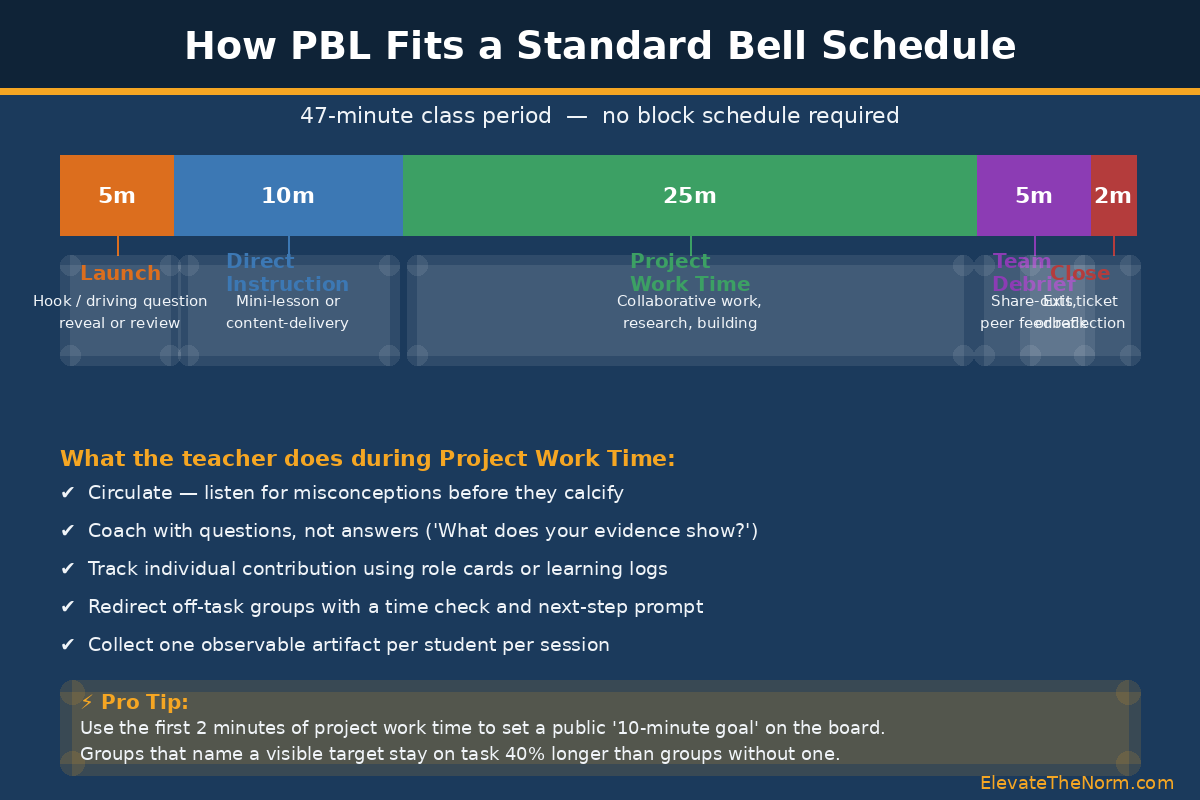
A 47-minute period provides enough structure for PBL — launch, instruction, work time, debrief, and close.
The Coordinated Model
Two or three teachers align one project across their subjects. A junior researching water quality in a chemistry unit is also analyzing the data in statistics and writing a persuasive proposal in English. Each teacher contributes one piece; the student produces one coherent product.
This requires planning time, which most high schools do not generously provide. It does not require schedule restructuring. It requires two planning conversations — one to agree on the project and one to divide the work — and then enough coordination that you are not both assigning major due dates on the same day.
The coordinated model produces stronger student work than the single-teacher model because it shows students that the connections between subjects they already suspect are real. It also distributes the grading burden: each teacher grades only their component, rather than one teacher grading everything.
The most common coordination failure is drift — teachers agree on the project in September and diverge by October because their pacing guides pull them in different directions. The fix is a shared timeline with checkpoints that all three teachers can see. A shared document, a standing check-in once every two weeks, and an explicit agreement about which teacher owns the driving question are usually enough.
The Schoolwide Model
A schoolwide PBL commitment means dedicated exhibition days, structural schedule flexibility, and sustained administrative support. It is the model most commonly described in PBL literature because it is the most documented. It is also the model that requires the most buy-in and is the wrong place to start.
Start with one unit in one class. Document the student work. A principal who sees the evidence — real student products, real depth of engagement, real outcomes — is more persuadable than one being asked to commit time and resources to a theory. The single-teacher model is the proof of concept that earns the schoolwide model later. Do not ask for institutional support before you have something to show.
Kokotsaki, Menzies, and Wiggins (2016), reviewing the PBL implementation literature, found that teacher comfort and competence with PBL were the strongest predictors of successful outcomes — more than school structure, administrative support, or technology access. A confident teacher running a single unit in an ordinary classroom produces better outcomes than an uncertain teacher running a schoolwide model with all the resources. Build the confidence first.
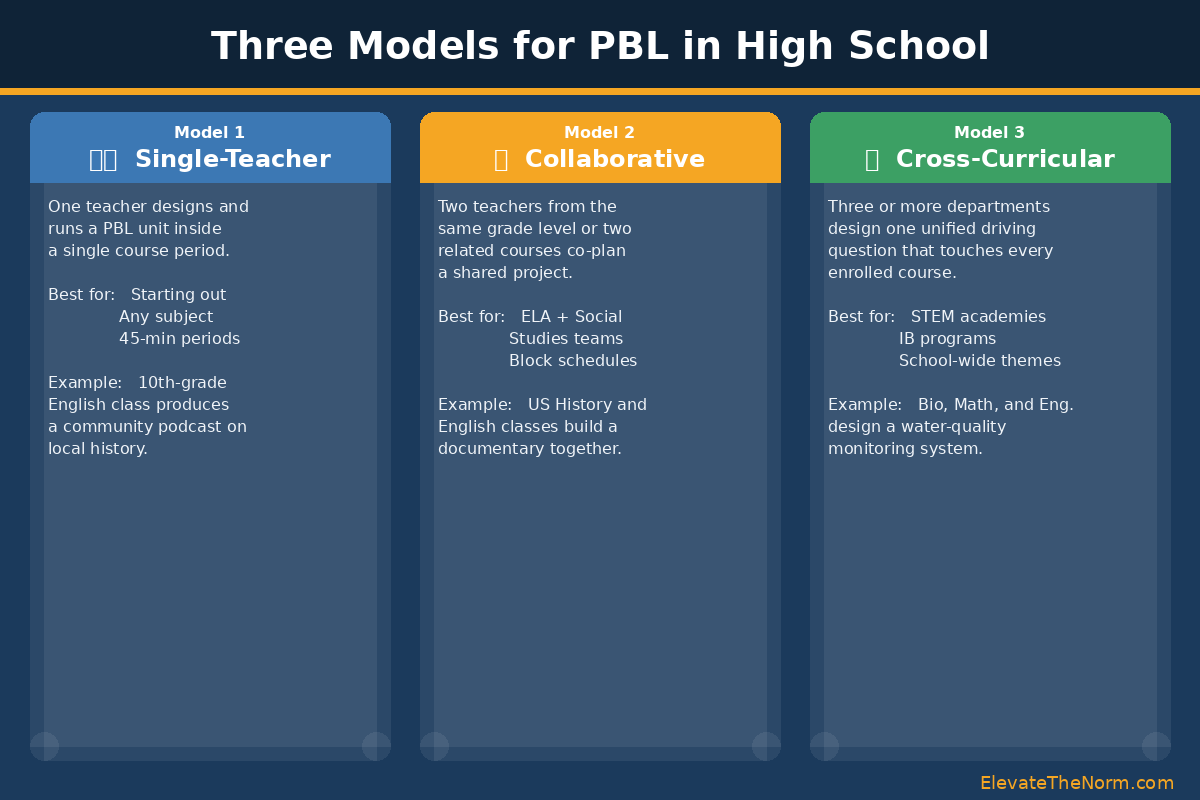
Three ways to structure PBL in high school, from a single-classroom unit to a schoolwide commitment.
What Has to Stay in Place
Standards are not optional. A PBL unit that covers interesting work without hitting the required standards is a liability for students who need those standards taught. Every project needs a clear answer to three questions: what standard does this project demonstrate, how will student work show mastery, and how does the grade reflect it? If you cannot answer all three, the unit is not ready to run.
Individual accountability is not optional. Group projects in which one student does most of the work while others contribute minimally are not PBL — they are badly supervised group projects. PBL requires a component of the final grade that reflects individual student work: individual research logs, individual reflection journals, or a presentation component in which each student defends their own contribution. A project based learning rubric that separates individual contribution from group product solves the most common grading problem in PBL before it becomes a problem.
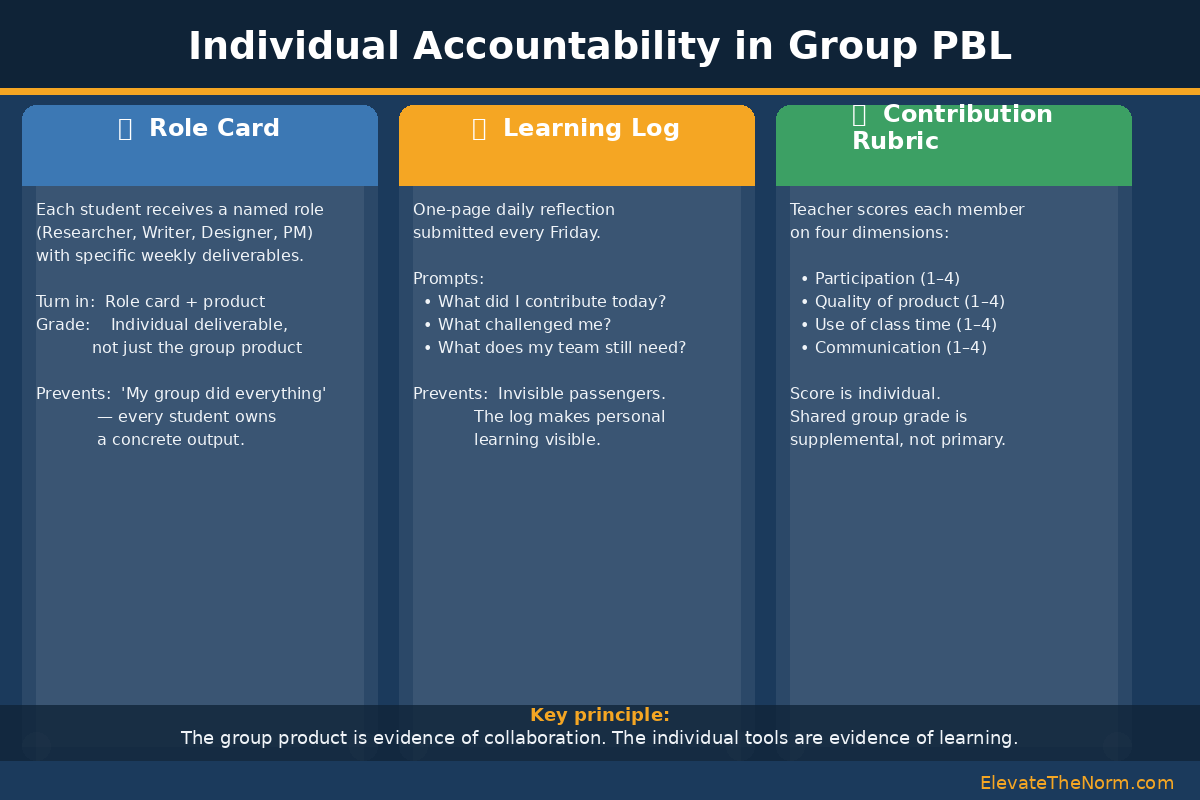
Role cards, learning logs, and contribution rubrics keep every student individually accountable inside a group project.
Grading standards are not optional. Students who are used to being graded on compliance — following directions, completing steps, meeting deadlines — need to be explicitly taught what quality looks like before they can produce it. Criterion-referenced rubrics with clear, student-readable descriptors do this. A rubric that says “Research is thorough and relevant” teaches nothing. A rubric that says “Research includes at least four credible sources that are directly cited in the product” teaches what thorough looks like.
Special Populations and PBL
A real high school classroom has students with IEPs, students with 504 plans, English language learners, students who are two or three grade levels behind in reading, and students who have learned that staying invisible is the safest strategy. PBL is not inherently more or less accessible than a unit test. It is differently accessible — which means you have to plan for it differently.
Every accommodation that applies to a test applies to a project. Extended time on the research and drafting phases. Alternative presentation formats when the standard permits it. Scaffolded notes and graphic organizers during the inquiry phase. A student who struggles with written expression but reasons clearly can produce a strong verbal or visual component. A student who has never raised their hand in a lecture has a better chance of contributing in a structured conference on a question they actually worked to answer.
The key is building the scaffolding before the project starts, not after the first group falls apart. Explicit instruction in the process skills the project assumes — how to evaluate a source, how to structure an argument, how to give useful feedback to a peer — must happen before students are expected to use those skills. If you have not taught these as discrete, assessable skills, you cannot grade them as discrete, assessable skills, and the students who most need the instruction will be the least prepared to produce without it.
Ertmer and Simons (2006), in their research on PBL implementation barriers for K–12 teachers, found that scaffolding decisions — specifically, how much structure to provide and when to reduce it — were the most frequently cited challenge for new PBL teachers. The answer is to start with more structure than you think you need and reduce it as students demonstrate readiness. PBL is not a launch-and-step-back model. It is a sustained presence model. The teacher is circulating, conferencing, redirecting, and adjusting throughout the project’s duration.
What Administrators Must Protect
The most common way PBL fails in high schools is not in the classroom. It is when a principal or curriculum coordinator, under pressure from test scores, eliminates the conditions that let project work develop.
Projects take longer to show results than unit tests. A class spending three weeks on one question while the pacing guide suggests five days looks inefficient from the outside. An administrator who understands what is being built — and what the research comparing project based learning vs traditional learning actually shows about depth of engagement producing stronger retention and transfer than coverage speed — can defend that choice. An administrator who does not understand it cannot, and will not.
Administrators researching this before a department meeting usually start with a search box or an AI assistant, and what comes back is shaped by whoever is selling a platform. It is worth reading what AI is telling people about project-based learning before that conversation, because the funding, staffing and curriculum answers a chatbot gives are the ones your teachers will have already seen.
What administrators must protect: the presentation or exhibition component. A project with no real audience beyond the teacher is not a public product — it is a long homework assignment. The audience changes the stakes, and the stakes change the quality of the work. Mergendoller, Maxwell, and Bellisimo (2006) found that problem-based learning produced stronger content mastery than direct instruction in their economics study, but the effect was largest when students were required to explain and defend their work — not just produce it.
What administrators must provide: protected planning time, even in small amounts. A single-teacher PBL unit can happen without any new time. A coordinated project needs one shared planning session. A schoolwide model needs a sustained structure. The level of institutional support you provide determines the level of implementation you can reasonably expect. Teachers who are asked to run PBL without any planning time will default to the version of PBL that requires the least coordination, which is rarely the version that produces the best outcomes.
The Room That Makes This Easier
In my room, partner work is the default condition, not a special activity. Tables are pushed together into groups from the moment class starts. Students sit alongside somebody as a structural fact of the room, not as a reward or a project-day configuration. The collaboration that happens inside a PBL unit builds on top of a habit students have been practicing all year.
It also raises the question every project eventually raises, which is how you see what any individual student actually contributed — a job for a short group-work self assessment rather than for the group grade. That distinction matters for high school implementation. The failure mode in project work is isolation — students who have no one to think alongside drift toward the minimum. When a class has been working in partners and small groups since September, the project’s collaborative components are not a new mode they have to learn. They are the usual mode applied to a more complex question.
You do not need my specific room setup to run effective PBL. But the arrangement of a classroom is a decision, and the default arrangement in most high school rooms — desks facing forward, students working alone — is a decision that makes project-based work harder. If you are planning to introduce PBL, consider whether your physical setup supports it. Desks can be moved. Tables can be pushed together. The collaborative condition does not require a renovation — it requires a decision. For ideas on what strong examples of project-based learning look like in practice, the examples linked there show what finished student work can look like at different grade levels.
PBL in high schools is not a school reform project unless you want it to be. It is a unit design decision you can make in any classroom, on any schedule, with any level of administrative enthusiasm, as long as you design it carefully enough that the structure of the school holds it. The schedule is not the problem. The design is the work. For a deeper look at how to structure individual student accountability within group projects, see the high expectations framework that this site returns to across multiple articles — the expectations you set for PBL are the same expectations you set for every other part of the year.
Han, S. Y., Capraro, R., & Capraro, M. M. (2015). How science, technology, engineering, and mathematics (STEM) project-based learning (PBL) affects high, middle, and low achievers differently. International Journal of Science and Mathematics Education, 13(5), 1089–1113. https://doi.org/10.1007/s10763-014-9526-0
Kokotsaki, D., Menzies, V., & Wiggins, A. (2016). Project-based learning: A review of the literature. Improving Schools, 19(3), 267–277. https://doi.org/10.1177/1365480216659494
Ertmer, P. A., & Simons, K. D. (2006). Jumping the PBL implementation hurdle: Supporting the efforts of K–12 teachers. Interdisciplinary Journal of Problem-Based Learning, 1(1), 40–54. https://doi.org/10.7771/1541-5015.1005
Mergendoller, J. R., Maxwell, N. L., & Bellisimo, Y. (2006). The effectiveness of problem-based instruction: A comparative study of instructional methods and student characteristics. Interdisciplinary Journal of Problem-Based Learning, 1(2), 49–69. https://doi.org/10.7771/1541-5015.1026
Krajcik, J., & Shin, N. (2014). Project-based learning. In R. K. Sawyer (Ed.), The Cambridge handbook of the learning sciences (2nd ed., pp. 275–297). Cambridge University Press.
Frequently Asked Questions
Can I do project-based learning in a forty-five-minute period?
Yes. The period length constrains certain activities — a complex hands-on build or a formal public exhibition takes more than forty-five minutes — but the core operations of PBL happen inside conventional periods when you phase the project carefully. Assign each phase a set number of days: questioning on day one, initial research on days two and three, drafting on days four through six. The period is a budget, not a prohibition. A well-phased project in a fifty-minute class produces the same learning as one in a ninety-minute block.
Does project-based learning work with state standards?
Standards are the frame, not the obstacle. Every PBL unit should answer three questions before it starts: what standard does this project demonstrate, how will student work show mastery, and how does the grade reflect it? A project that does not target a standard is an enrichment activity, not a PBL unit. Select one or two standards and build the driving question around what demonstrating those standards would look like applied to a real problem. The standards do not change; the form in which students demonstrate them does.
How do I grade a group project fairly?
Separate what you assess from who produces it. An eight-category rubric that covers process, product, research quality, collaboration, revision, presentation, individual contribution, and reflection lets you grade the final product on quality criteria while tracking each student’s individual role. The individual contribution and research-log components prevent the one-student-does-everything problem. A shared rubric introduced at the start of the project — not at the end — also teaches students what quality looks like before they are graded on it.
What about students with IEPs or 504 plans?
Every accommodation that applies to a test applies to a project. Extended time applies to the research and drafting phases, not just the final product. Alternative presentation formats apply when the standard permits them. Graphic organizers and scaffolded note-taking structures apply during the inquiry phase. The critical difference between PBL and direct instruction for students with learning differences is that PBL offers more legitimate pathways to demonstrate the standard — a student who struggles with written expression can contribute a strong verbal or visual component. Plan the accommodations before the project starts, not after the first group session falls apart.
How do I get my principal to support PBL?
Run one unit and document the student work. An administrator who sees a class’s worth of evidence-based arguments — specific, researched, revised — is more persuadable than one being asked to commit resources to a theory. The case for administrative support is a portfolio of student products, not a research summary. Start small, save the work, show what depth of engagement looks like when it works. Schoolwide support is earned through demonstrated outcomes in individual classrooms, not by leading with the institutional vision.
What is the most common reason PBL fails in high schools?
Design, not scheduling. A project with a vague driving question, no real audience, and no individual accountability component fails regardless of the period length or the level of administrative support. The driving question has to be specific enough to constrain the inquiry and open enough to produce genuine disagreement. The audience has to exist outside the classroom. Individual students have to have something at stake that cannot be carried by a partner. When those three conditions are met, most scheduling and staffing obstacles become manageable. When they are missing, no amount of institutional support compensates.
About Clay Shumate
Clay Shumate is a certified secondary Social Studies teacher in the public schools of West Alabama, with seven years of classroom experience, a B.A. in History, and an M.Ed. in Secondary Education. He writes about project-based learning, student responsibility, respect, and practical ways to hold young people to a higher standard while giving them room to learn from mistakes. He is a member of the Society of Professional Journalists and writes to its Code of Ethics; this site’s editorial standards and corrections policy are published in full. More about Clay.
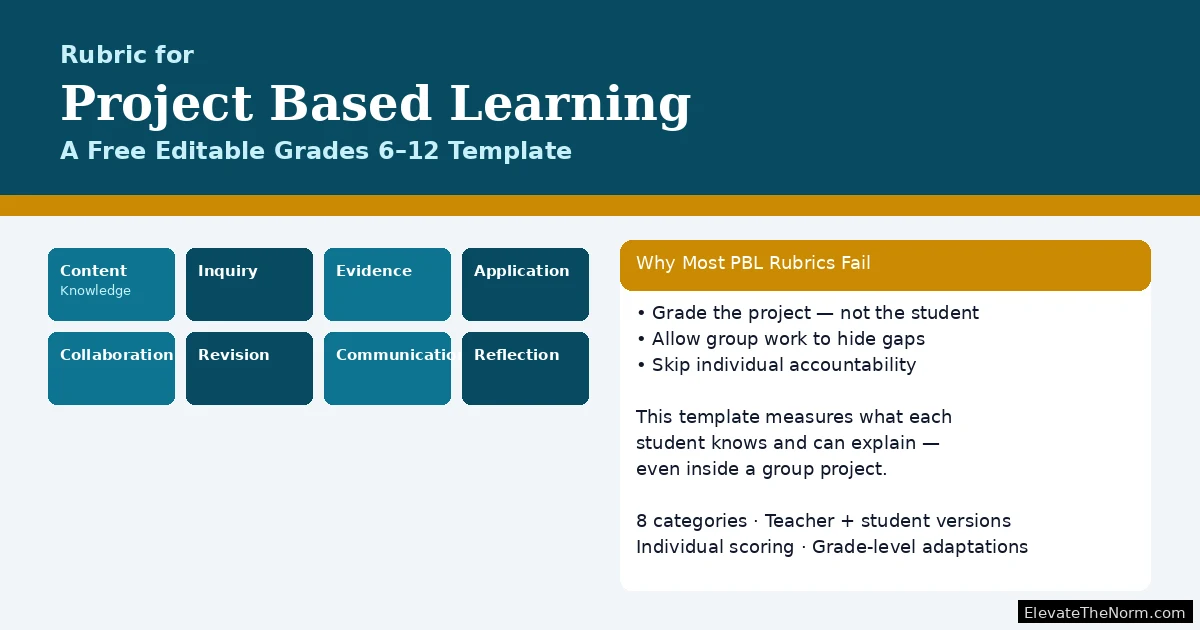
A rubric for project based learning is a scoring guide that separates what a student personally understood and produced from what the group turned in. A good one measures content knowledge, inquiry, evidence, application, collaboration, revision, communication, and reflection — and never lets teamwork points cover for weak academic understanding.
A seventh-grader stood across my trapezoid table three days before her team’s final presentation. I asked her one question: “Tell me why you chose this solution instead of the other one your group was considering.”
She paused. Then she started talking about the other group members—who did what, who didn’t do what. She never answered the question.
That’s the moment I knew my rubric was broken. Not hers. Mine. I had built a rubric that let a student disappear into a group product and earn a grade based on what her teammates produced. The rubric was measuring the project, not the learning.
This is the problem most PBL rubrics share: they grade the thing, not the student who made it. This free editable template fixes that. It measures what each student knows and can do—even inside a group project—and it includes a student-facing version your class can use for self-assessment and peer feedback before the final day.
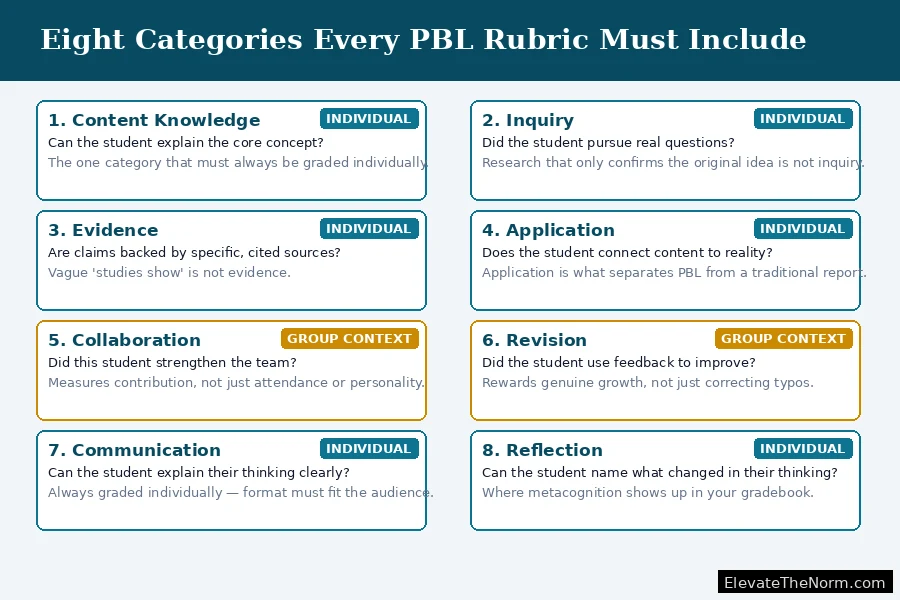
A PBL rubric that only grades the final product is an audience-review form dressed up as assessment. The eight categories below are what actually tell you whether a student learned something—and they map directly onto the seven steps of a complete PBL unit, particularly the critique, revision, and public product phases.
Five categories are always graded individually; two use group context while still reflecting individual contribution.
Content knowledge. Can the student explain the core concept or answer the driving question accurately? This is the one category that must always be graded individually. A group can produce a beautifully designed poster for the wrong answer.
Inquiry. Did the student identify meaningful questions, pursue credible sources, and change their thinking based on what they found? Research that only confirms the original idea is not inquiry.
Evidence. Does the student support claims with specific, accurate, properly cited evidence? Vague gestures toward “studies show” are not evidence.
Application. Does the student connect the content to a real situation, a genuine problem, or something outside the classroom? Application is what separates PBL from a traditional research report, and it is the category where the evidence on traditional instruction versus project based learning shows the clearest difference.
Collaboration. Did the student contribute to the group in ways that made the team stronger? This category can be informed by group dynamics, but it should measure individual contribution—not just “got along” or “showed up every day.” The same trap shows up in discussion scoring, where “participated” usually means “spoke often” — a seminar rubric that scores preparation and reflection instead of talking turns is the version that survives a parent asking how it was graded.
Revision. Did the student use critique and feedback to make substantive improvements? A student who adds one sentence after three rounds of feedback did not revise. This category rewards genuine growth, not just correcting typos.
Communication. Can the student explain their thinking clearly—in writing, verbally, or visually—in a format appropriate for the actual audience? Communication is always graded individually.
Reflection. Can the student honestly name what they learned, what they would do differently, and what they still don’t understand? Reflection is where metacognition shows up in your gradebook.
The Problem Most PBL Rubrics Create
When teamwork is scored as one unified category—“worked well with others, 25 points”—students learn that group membership earns a grade. A student who contributes nothing to the actual thinking gets protected by the students who did. A student who carried the group gets penalized by the teammates who didn’t.
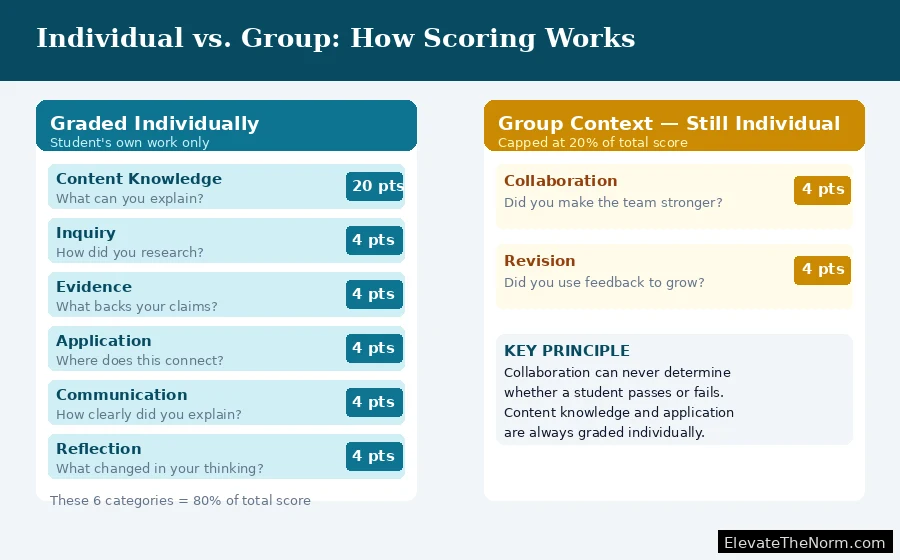
There is a straightforward fix: cap the collaboration and revision categories together at no more than 20% of the total score, keep content knowledge and application as individual-only categories, and require each student to complete the reflection independently. That structure makes it impossible for teamwork—positive or negative—to determine whether a student earned a passing grade on their own understanding. If your school is also moving toward reporting proficiency on named standards instead of accumulated points, it is worth understanding what a standards-based grading system actually is and what the evidence supports before you rebuild the rubric around it.
This connects directly to holding high expectations for students—the rubric is the vehicle for those expectations. When the rubric doesn’t distinguish individual understanding from group output, the expectation becomes meaningless.
The Complete Teacher Version
Use this version for formal grading. Each category has four performance levels: Exceeds (4 pts), Meets (3 pts), Approaching (2 pts), and Beginning (1 pt). Total possible: 32 points.
Individual categories account for 80 percent of the total score. Group context cannot determine whether a student passes.
Grade individually using group work as context: Collaboration, Revision — 2 categories × 4 pts = 8 pts (25% of total, capped)
Category
Exceeds (4)
Meets (3)
Approaching (2)
Beginning (1)
Content Knowledge (Individual)
Accurate, detailed, nuanced explanation; anticipates misconceptions or hard questions
Accurate, complete explanation of the core concept
Partially accurate; some gaps or misunderstandings
Inaccurate or missing; student cannot explain the core concept
Inquiry (Individual)
Self-directed questions; adjusts approach based on findings; uses multiple source types; shows changed thinking
Purposeful questions; uses credible sources; shows some revision of initial thinking
Questions are vague or teacher-prompted; sources are limited or uncritical
No meaningful questions; relies on first source found or prior knowledge only
Evidence (Individual)
Specific, accurate, properly cited evidence for every claim; evaluates source quality
Most claims supported with accurate evidence; citations present
Some claims unsupported; evidence vague or unverified
Claims not supported by evidence; no citations or inaccurate citations
Application (Individual)
Makes insightful, specific connection to a real context; anticipates real-world implications
Makes a clear connection to a real problem or situation
Connection is vague or generic (“this relates to real life”)
No meaningful connection to context outside the classroom
Collaboration (Group context)
Consistent, substantive contribution throughout; visibly strengthened others’ work
Contributed regularly; met responsibilities; helped the group succeed
Inconsistent contribution; needed reminders; didn’t hurt but didn’t strengthen the group
Did not contribute meaningfully; group worked around this student
Revision (Group context)
Made substantive, documented changes based on specific feedback; can explain why each change was made
Made meaningful improvements after receiving feedback
Made surface-level changes; did not address the core feedback received
Did not revise, or changes made no meaningful difference to the work
Communication (Individual)
Clear, precise, audience-appropriate; engages the real audience with confidence and purpose
Clear, organized; audience can follow; format is appropriate
Partial clarity; audience needs to ask for clarification to follow the work
Hard to follow; format doesn’t fit the audience; major content gaps
Reflection (Individual)
Honest, specific, forward-looking; identifies what changed in thinking and what remains open
Identifies what was learned and names at least one specific thing to do differently
Surface-level (“I learned teamwork”); vague or formulaic response
Reflection absent, off-topic, or entirely positive without any specificity
Weighting for different courses: For content-heavy courses (history, science, ELA), double the Content Knowledge category to 8 pts and reduce Collaboration to 2 pts. For interdisciplinary or design-challenge projects, double the Application category to 8 pts while keeping all individual columns at full weight. Make the weights explicit to students before the project launches—never change them mid-project.
How to Use Individual Grades in Group Projects
The most common pushback: “It’s a group project—how do I give individual grades?”
The answer is already built into the template. Six of eight categories are graded individually using evidence the student produces—their written section, their explanation during a check-in conversation, their cited sources, their reflection. The grade reflects what that student can show and explain, not what the group turned in. You can see more of this in action in our examples of project-based learning, where individual and group contributions are visible throughout.
For presentations, have each student speak to their own section rather than dividing presentation duties randomly or letting the most confident student present everything. That isn’t more work—it’s more fair. A student who can’t explain their own part during the presentation has revealed something the rubric needs to capture.
Rubric-based scoring sits close to standards-based grading, and it inherits some of the same arguments. Before you move a whole gradebook that direction, it is worth reading the objections teachers and students actually raise — the retake and no-zero complaints, the fairness problem secondary students name most often, and the conditions under which waiting is the better call.
Contribution logs can supplement the rubric for Collaboration: a one-page document each student submits independently (who did what, by which date) creates a paper trail for conversations that the rubric score alone won’t support. Find templates and other assessment tools on the project-based learning resources page.
The Student-Friendly Version
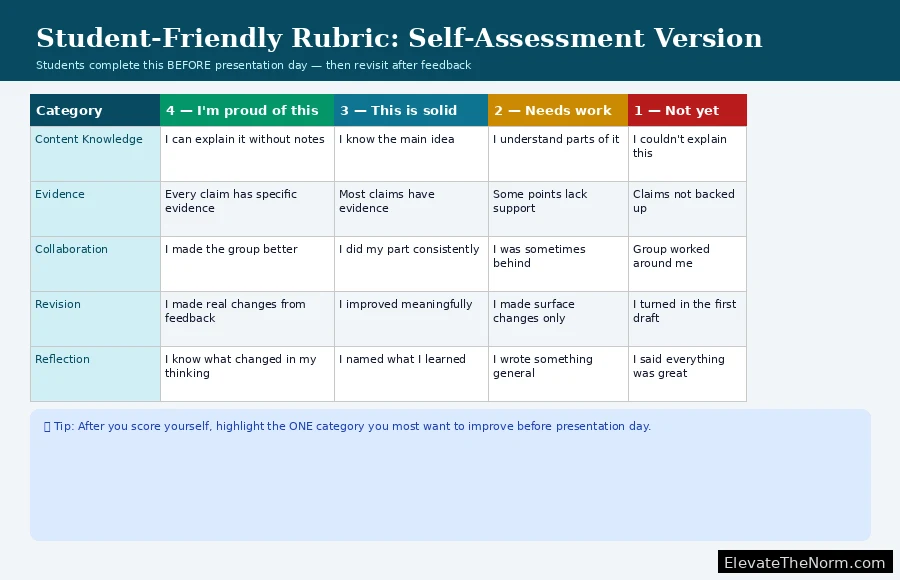
This version uses the same eight categories in plain language. Students complete it before their presentation day, then revisit it after receiving peer and teacher feedback. The goal is to build the habit of honest self-assessment—not to generate a second grade.
Students complete the self-assessment version before presentation day, then revisit after receiving feedback.
Category
4 — I’m proud of this
3 — This is solid
2 — This needs work
1 — I haven’t done this yet
I know the content
I can explain it clearly and answer hard questions without looking at notes
I can explain the main idea
I understand parts of it but have gaps
I’m not sure I could explain this to someone who wasn’t in the class
I asked real questions
I changed my mind based on what I found; I used more than one type of source
I had a real question and found credible answers
My question was kind of vague, or I didn’t look hard enough
I mostly used what I already knew going in
I used evidence
Every claim I made has specific, cited evidence behind it
Most of my claims have evidence; I cited my sources
Some of my points don’t have evidence behind them
I made claims without backing them up
I applied it
I made a real, specific connection—not just “this relates to real life”
I connected the content to a real problem or situation
The connection feels kind of general
I stayed inside the classroom on this one
I contributed
I made the group’s work better than it would have been without me
I did my part and showed up consistently
I got distracted or fell behind sometimes
The group worked around me more than with me
I revised
I made real, substantive changes based on the feedback I received—and I can explain why
I made meaningful improvements after getting feedback
I made some small changes; I didn’t really address the core feedback
I turned in the first version
I communicated clearly
The audience understood it and I made it worth their time
It was clear and organized; the audience could follow
Some parts were hard to follow
It wasn’t clear or didn’t match the audience
I reflected honestly
I know exactly what changed in my thinking and what I’d do differently next time
I identified what I learned and named one thing to change
I wrote something general—mostly summary, not reflection
I said everything was great, or I didn’t write anything real
After students complete the self-assessment, have them highlight the one category they most want to improve before presentation day. That single action turns the rubric from a grading form into a revision prompt.
Adapting the Rubric by Grade Level
Grades 6–7
Add a fifth option to the student-facing version: “I’m not sure what this means yet—I need to ask.” Middle schoolers need a landing spot that isn’t a failing score. Remove it once they’ve used the rubric two or three times and the language is familiar.
For the teacher version, weight Inquiry more heavily early in the year when you’re still building research habits. Lower-stakes projects can use five categories: Content Knowledge, Evidence, Application, Communication, and Reflection. Add Collaboration and Revision once students have completed at least one group cycle.
Grades 8–10
Use the template as written. This range benefits most from the clear structure—the table is the scaffold. Introduce the student version first, have students score a sample project with it, then reveal the teacher version. The gap between self-assessed and teacher-assigned scores is where the learning begins. When that gap stays wide, the problem is usually the habit rather than the rubric — teaching students to judge their own work against criteria they understand is the part that has to come first.
Grades 11–12
Reduce the rubric to five categories (Content Knowledge, Application, Evidence, Communication, Reflection) and remove the point totals from the student version. Have students co-develop the performance descriptors at the start of the project—the rubric becomes part of the learning. Upper-secondary students who helped write the “Exceeds” descriptor almost always aim for it.
How to Introduce the Rubric to Students
Give students the rubric on the first day of the project, not the last. A rubric revealed at the end is a grading sheet. A rubric revealed at the beginning is a roadmap.
Walk through each category out loud and ask students to find the difference between a 2 and a 3 in one category—then justify their reasoning. That conversation is usually more useful than any lecture about expectations. Follow it with a brief look at a past project (real or hypothetical) and have students practice applying the rubric before their own work begins.
On a group project the rubric covers the product, and contribution needs its own short instrument — the guide to self assessment in group work covers what to ask and what to leave off the form. For the self-assessment version, model honest scoring first. Show students a sample of work you’d give yourself a 2 on and explain why. Students who have only seen rubrics used to assign grades are reluctant to score themselves honestly. The goal is accurate self-assessment, not strategic underscoring to avoid accountability.
This is also where student voice matters: invite students to identify any category they think is unclear or unfair before the project launches. That conversation catches rubric design flaws early and builds buy-in. The full bank of PBL project ideas shows how this rubric scales across different content areas and formats.
Frequently Asked Questions
Can I use this rubric for a major grade?
Yes, but check it against your district’s grading policy first. If your school requires a specific point scale, convert the 32-point total to a percentage (for example, 24/32 = 75%). The eight categories and the individual-versus-group structure survive the conversion. What you want to preserve is the weighting: individual understanding must account for most of the grade.
What do I do when one student carries the whole group?
The individual columns already protect that student—their content knowledge, evidence, communication, and reflection scores reflect their own work regardless of what the group produced. For documentation, add a one-page contribution log each student submits independently (who did what, by which date). That log also gives you something concrete to use in a conversation with the group about what happened.
Is it fair to grade collaboration when some students have IEPs or 504 plans that affect communication?
Collaboration in this rubric measures contribution, not communication style or personality. A quiet student who prepared consistently, shared ideas in small-group settings, and met every deadline would score a 3 or 4—not a 1 for being quiet. If a student has an IEP or 504 that limits communication in specific ways, modify the collaboration descriptor to match what the accommodation allows. Document the modification before the project launches.
How many points should content knowledge be worth?
That depends on your course’s core purpose. For a course built around disciplinary content (history, biology, literature), weight Content Knowledge at 8 to 10 points and reduce Collaboration to 2. For a project-based capstone or interdisciplinary course where application is the primary competency, weight Application more heavily instead. Make the weights explicit to students at the start of the project and do not change them midway through.
Can students improve their scores after the initial grade?
If your school’s grading policy allows revision for credit, attach a condition: the student must submit the self-assessment version with specific evidence of what changed and why the change addresses the feedback they received. That prevents a resubmission that is cosmetically different from the original. The Revision category already captures this habit—a student who revises well should already be earning a 3 or 4.
What is the difference between this and a traditional rubric?
A traditional rubric grades the product. This rubric grades what the student knows and can do. That distinction matters most in group projects, where a polished product can hide a student who contributed nothing to the thinking. The eight categories here require each student to demonstrate understanding individually, even when the final work was produced with a team.
Ravitz, J. (2010). Beyond changing culture in small high schools: Reform models and changing instruction with project-based learning. Peabody Journal of Education, 85(3), 290–312.
About Clay Shumate
Clay Shumate is a certified secondary Social Studies teacher in the public schools of West Alabama, with seven years of classroom experience, a B.A. in History, and an M.Ed. in Secondary Education. He writes about project-based learning, student responsibility, respect, and practical ways to hold young people to a higher standard while giving them room to learn from mistakes. He is a member of the Society of Professional Journalists and writes to its Code of Ethics; this site’s editorial standards and corrections policy are published in full. More about Clay.
Most students will tell you, if you ask them directly, that they don’t always understand why they’re doing what they’re doing in school. Not because they’re disengaged, but because no one has made the connection between the task and anything that matters outside the classroom. Authentic learning is the attempt to close that gap — and the evidence behind it is more specific, and more compelling, than the phrase usually suggests.
What Authentic Learning Actually Means
The phrase gets used loosely. Teachers call hands-on projects authentic. Administrators call anything real-world authentic. Some people use it to mean simply “not worksheets.”
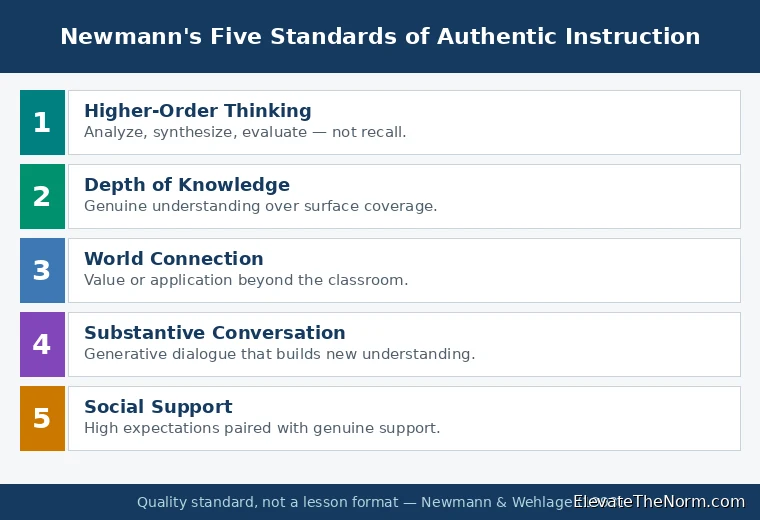
Fred Newmann, a University of Wisconsin researcher who spent decades studying what makes student work worth doing, defined it more precisely. In a 1993 paper with Gary Wehlage, Newmann proposed five standards of authentic instruction — not as a lesson format, but as a quality standard for asking whether the intellectual work students do in school resembles the intellectual work that matters outside of it.
Those five standards are:
Higher-order thinking. Students analyze, synthesize, and evaluate rather than recall and reproduce. They construct interpretations rather than retrieve stored answers.
Depth of knowledge. Students develop genuine understanding of a topic rather than covering as much material as possible as quickly as possible. Breadth is sacrificed for meaning.
Connectedness to the world beyond the classroom. The work has value or application outside school. Students produce something, solve something, or engage with something that exists beyond the classroom walls — not just as a simulation, but as a real contribution or genuine inquiry.
Substantive conversation. Students and teachers engage in real dialogue about ideas, not just question-and-answer recitation. Talk is generative — it produces new understanding rather than merely correcting mistakes.
Social support for student achievement. The environment communicates that every student is capable of high-quality intellectual work. High expectations are paired with genuine support — not as a slogan, but as a visible daily practice.
These five standards are not a lesson format or a curriculum design. They are a quality standard. You can teach a lecture that hits all five. You can run a week-long project that hits none. The question is whether the work asks students to think in ways that are worth thinking.
Newmann’s five standards frame authentic learning as a quality judgment, not a lesson format.
What the Research Actually Shows
The phrase “research-based” appears on so many practices and products that it has largely lost meaning. So let me be specific about what the research on authentic learning actually demonstrates.
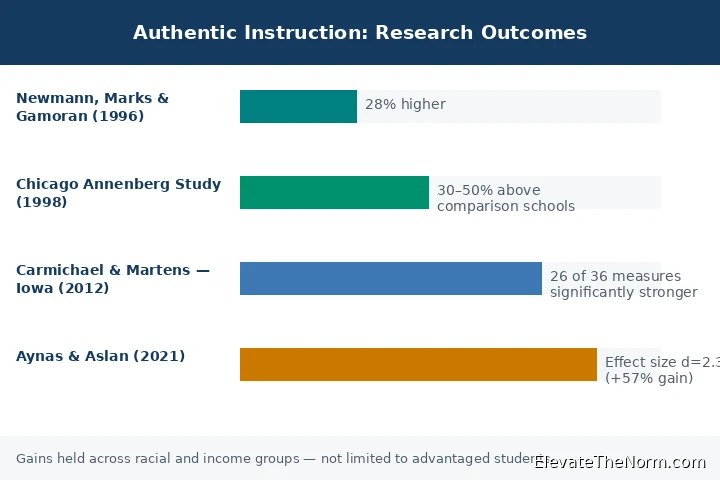
In 1996, Newmann, Marks, and Gamoran studied 2,128 students in grades 3, 6, and 8 across 24 restructured schools — schools given autonomy to try new instructional approaches. Students in classrooms that scored high on the authentic instruction standards outperformed students in low-scoring classrooms by roughly 28 percent on assessments measuring genuine understanding. That gap held across racial and income groups, which matters: the gain was not confined to already-advantaged students.
A separate Chicago Annenberg Challenge study by Newmann, Lopez, and Bryk (1998) found that schools implementing authentic intellectual work produced student achievement margins of 30 to 50 percent above comparison schools across reading and mathematics.
A 2012 study by Carmichael and Martens followed students in 27 Iowa schools implementing Authentic Intellectual Work frameworks. In 26 of 36 measured comparisons, students showed significantly stronger performance on state assessments than matched comparison groups.
More recently, a 2021 study by Aynas and Aslan worked with 92 sixth-grade students comparing authentic problem-based tasks against traditional instruction. Students in the authentic learning group improved problem-solving scores from 30.06 to 47.41 — a 57 percent gain — with an effect size of Cohen’s d = 2.37. That effect size is extraordinarily large by social science standards.
These are not studies of elite schools or specially selected students. They are studies of ordinary classrooms where teachers changed the quality of the intellectual work expected, not the subject, not the schedule, and not the student population.
Research across multiple large-scale studies shows authentic instruction produces meaningful achievement gains regardless of student background.
The Gap Between Authentic and Traditional
Here is the practical difference in concrete terms.
In a traditional classroom, a student studying a local water-quality issue might read an article about pollution, answer comprehension questions, and write a paragraph summarizing the article’s main points. In an authentic classroom, that same student might analyze actual water-quality data from a local river, identify a trend, and present findings — with recommendations — to someone who could act on them: a city council member, a county health board, a local environmental organization.
The content knowledge is identical in both cases. The intellectual demand is not. The authentic version requires the student to ask what the data means, not just what the article says. It requires judgment about the strength of evidence, not just recall of facts. And it produces something that exists in the world — a report, a presentation, a recommendation — rather than a paper graded and returned.
This distinction matters because students are not fooled. They understand when work is made up. They understand when nobody outside the classroom will ever read it, use it, or care about it. And they calibrate their effort accordingly — not because they are lazy, but because they are rational. They are treating manufactured tasks with the seriousness manufactured tasks deserve.
What connects all of this to real-world learning at its best is the shift from performing school to producing understanding. The goal is not an assignment. It is thinking that goes somewhere.
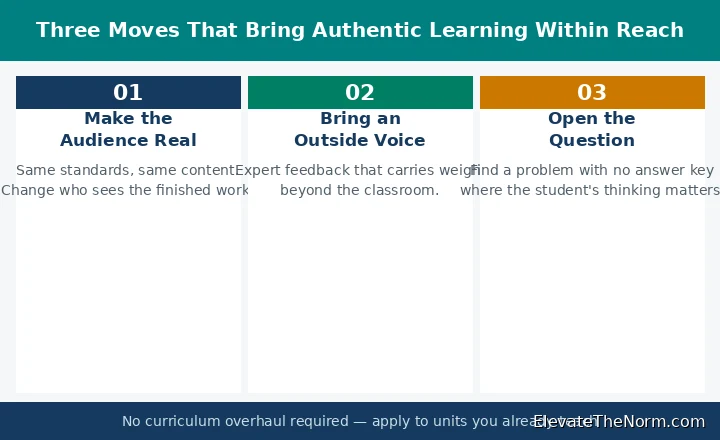
Three Moves That Bring Authentic Learning Within Reach
None of these require a complete curriculum overhaul. Each can be applied to a unit you already teach.
Make the audience real. The simplest shift is changing who sees the work. A persuasive essay written for the teacher is different from a persuasive essay written for the school board, the principal, or the local newspaper. Same standards, same skills. The audience changes the stakes, and the stakes change the thinking. Students who know their work will be read by someone other than their teacher tend to revise it more carefully and argue more precisely.
Bring in an outside voice.Experiential learning research consistently finds that outside expert feedback is one of the most powerful levers available to classroom teachers. The expert does not need to be famous or formally credentialed — they need to be someone whose opinion carries weight beyond the classroom. A local engineer reviewing a student’s bridge design. A small-business owner reading a marketing proposal. A retired teacher critiquing an educational policy argument. The outside voice introduces a standard that is not just the teacher’s standard, and that shift changes what students produce.
Connect to a question that does not have an answer yet. This works in every subject. History teachers can ask what a historical decision should have been, given the evidence available at the time. Science teachers can ask what a data set actually suggests, before revealing what researchers concluded. English teachers can ask what a character’s choice means for how we should read the rest of the novel. The key is finding a question where the student’s thinking actually matters — where there is no answer key and where the argument has to hold up under scrutiny.
Three practical moves that introduce authentic learning without redesigning an entire course.
A Project Check-In
Midway through most projects, I run a check-in where I ask each group — or each student individually — to defend their decisions to me.
Not present their work. Not summarize what they have done. Defend their specific choices: why did they organize the information this way, why did they select this source over another one, what does their argument actually claim, and what would someone with the opposing view say in response?
The conversation takes three to five minutes. It sounds like this: “Walk me through why you went in this direction.” Then silence. Then: “What is the strongest argument against that position?” Then silence again.
Students who are doing genuine intellectual work — who have actually wrestled with the material — can answer those questions. Students who have been arranging surface information rather than thinking with it usually cannot, not because they are unwilling, but because the work they have been doing has not required that kind of thinking. The check-in reveals which kind of work the project is producing, and it reveals it early enough to do something about it.
This kind of mid-process accountability is one of the most direct expressions of student autonomy in its genuine form — students who are making decisions they can account for, not students who are completing tasks according to directions. The check-in is how I know whether those two things are happening at the same time.
It is also how I find out whether the project structure itself is supporting the right kind of thinking. When multiple students cannot defend their choices in the same way, the problem is usually with the task design, not with the students. That feedback is worth more than any rubric.
What Authentic Learning Is Not
Three distinctions worth making explicit, because the term is misused often enough that they are not obvious:
Authentic learning is not permissiveness or reduced rigor. High-quality intellectual work is more demanding than recall, not less. Students who engage with ambiguous real-world questions must manage genuine uncertainty, revise their thinking when evidence cuts against them, and produce something that can withstand scrutiny from a real audience. That is harder than filling in a blank or summarizing a chapter. Teachers who worry that authentic learning “lowers the bar” have it backward.
Authentic learning is not project-based learning by another name.Project-based learning is a specific instructional approach with its own design elements — a sustained inquiry, a driving question, a public product, and formal critique and revision cycles. Authentic learning is a quality standard that can apply to many different instructional formats, including short lessons, discussions, and even well-designed lectures. A lecture can satisfy all five of Newmann’s standards. A poorly designed three-week project may satisfy none of them. The format is not the point.
Authentic learning is not simply making class engaging or enjoyable. Engagement without intellectual demand is not authentic instruction. A fun simulation that produces only surface-level recall has failed the depth-of-knowledge standard and the higher-order-thinking standard simultaneously. The goal is not enthusiasm — it is thinking that holds up under scrutiny and produces understanding that transfers beyond the classroom.
Starting Without Overhauling Everything
A student-centered classroom does not require redesigning every unit at once, and neither does authentic learning. The research Newmann and his colleagues conducted was not research on schools that had replaced their entire curriculum. It was research on classrooms where individual teachers made a persistent, specific effort to raise the intellectual quality of the work they assigned.
One starting point: take one unit you already teach and add a real audience to the final product. Keep the standards you are covering. Keep the content. Change only who sees the finished work and why. That single shift — from “turn it in to the teacher” to “present it to people who might actually respond to it” — tends to change the quality of the thinking that leads up to it.
Another starting point: find one question in your current curriculum that genuinely has not been settled. Not a trick question. A real question where reasonable people who have examined the evidence still disagree. Give students the evidence, the frameworks, and the time to form a defensible position. Require them to engage with the counterargument. That is authentic intellectual work by Newmann’s standard, and it costs no additional planning time beyond what you are already doing. If you want activities that work with any article, my Current Events and Media Literacy Bundle on TPT has 21 of them for grades 6–12.
The experiential learning activities that stay with students years after the course are almost always the ones that produced something real — a genuine discovery, a real audience, a question that did not have an answer in the back of the book. The difference is not the format. It is whether the work produced understanding that goes somewhere.
Sources
Newmann, F. M., & Wehlage, G. G. (1993). Five standards of authentic instruction. Educational Leadership, 50(7), 8–12. Available at the ASCD archive.
Newmann, F. M., Marks, H. M., & Gamoran, A. (1996). Authentic pedagogy and student performance. American Journal of Education, 104(4), 280–312. https://doi.org/10.1086/444136
Newmann, F. M., Lopez, G., & Bryk, A. S. (1998). The quality of intellectual work in Chicago schools: A baseline report. Consortium on Chicago School Research. Consortium on Chicago School Research
Carmichael, D. L., & Martens, K. (2012). Authentic intellectual work: Improving teaching for rigorous learning. Corwin Press.
Aynas, N., & Aslan, S. (2021). The effect of authentic learning on problem-solving skills of secondary school students. Malaysian Online Journal of Educational Sciences, 9(4), 1–16.
Newmann, F. M. (Ed.). (1996). Authentic achievement: Restructuring schools for intellectual quality. Jossey-Bass.
Frequently Asked Questions
What is authentic learning in simple terms?
Authentic learning means schoolwork that asks students to think in ways that matter outside the classroom — work that connects to real questions, real audiences, or real problems rather than to manufactured tasks designed only to be graded. The term comes from Fred Newmann’s research framework, which defines authentic instruction by five standards: higher-order thinking, depth of knowledge, connectedness to the world beyond the classroom, substantive conversation, and social support for student achievement.
What does authentic learning look like in a 50-minute class period?
It does not have to span multiple class periods or require a full project. A single class period can include authentic elements: a discussion that generates new thinking rather than reciting correct answers, a short writing task with a real audience (even if that audience is only a schoolmate or a department head), or an analysis of real data rather than textbook examples. The format matters less than whether the intellectual demand is genuine.
Does authentic learning prepare students for standardized tests and college?
The research suggests it does. Newmann, Marks, and Gamoran (1996) found that students in classrooms with high authentic instruction scores outperformed comparison students not just on open-ended assessments but also on standardized measures. This is consistent with what cognitive science suggests: students who develop deep understanding of material — rather than surface familiarity — tend to perform better on varied assessment formats, including multiple-choice and short-answer tests.
How do I grade authentic learning fairly?
Grading authentic work requires making the criteria explicit before students begin — what makes an argument defensible, what distinguishes strong evidence from weak evidence, what a well-reasoned recommendation includes. Rubrics that describe quality thinking (rather than just format compliance) work better for authentic tasks than rubrics that reward procedure. It also helps to involve students in understanding the criteria before the work begins, which is itself an authentic intellectual task.
Can I use authentic learning when I have a prescribed textbook curriculum?
Yes. Authentic learning is a quality standard applied to the intellectual work students do — it is not a curriculum. You can add a real audience to a textbook writing assignment, find a genuine open question within a textbook chapter, or bring in outside expert feedback on work students produce from textbook content. None of that requires replacing the curriculum. It requires adjusting the intellectual demand placed on students while using the same material.
Does authentic learning work for all students, including those who struggle academically?
The research by Newmann and colleagues found that the achievement gains from authentic instruction held across racial and income groups — not just for already-advantaged students. Carmichael and Martens’ Iowa study showed consistent results across diverse student populations. This matters: one concern about raising intellectual demand is that it benefits strong students while leaving struggling students further behind. The available evidence does not support that concern. Genuine intellectual demand, paired with genuine support, appears to improve outcomes across the range.
What is the difference between authentic learning and just making class more fun or engaging?
Engagement without intellectual demand is not authentic learning. A fun simulation that produces only surface recall has failed Newmann’s higher-order-thinking and depth-of-knowledge standards, regardless of how much students enjoyed it. The goal of authentic learning is not enthusiasm — it is understanding that transfers. Students should leave a well-designed authentic task able to think with what they learned, not just remember that they had a good time. Both things can happen at once, but enjoyment is not the measure.
About Clay Shumate Clay Shumate is a certified secondary Social Studies teacher in the public schools of West Alabama, with seven years of classroom experience, a B.A. in History, and an M.Ed. in Secondary Education. He writes about project-based learning, student responsibility, respect, and practical ways to hold young people to a higher standard while giving them room to learn from mistakes. He is a member of the Society of Professional Journalists and writes to its Code of Ethics; this site’s editorial standards and corrections policy are published in full. More about Clay.
Experiential learning activities put students inside the subject instead of in front of it. The 30 ideas below follow Kolb’s experiential learning cycle — act, observe, reflect, conceptualize, apply — and are built for grades 6–12 classrooms with limited budgets, real schedules, and students who will check out the moment an activity feels pointless. Every one of them can run in a public school without special funding, a field trip bus, or a rewritten master schedule. If you teach the older end of that range, the high-school version of this deals with scheduling and credit directly.
Key Takeaways
An experience is not the same thing as experiential learning. The difference is the reflection and conceptualization that follow.
Kolb’s cycle has four stages: concrete experience, reflective observation, abstract conceptualization, and active experimentation. Activities that skip stages produce fun, not learning.
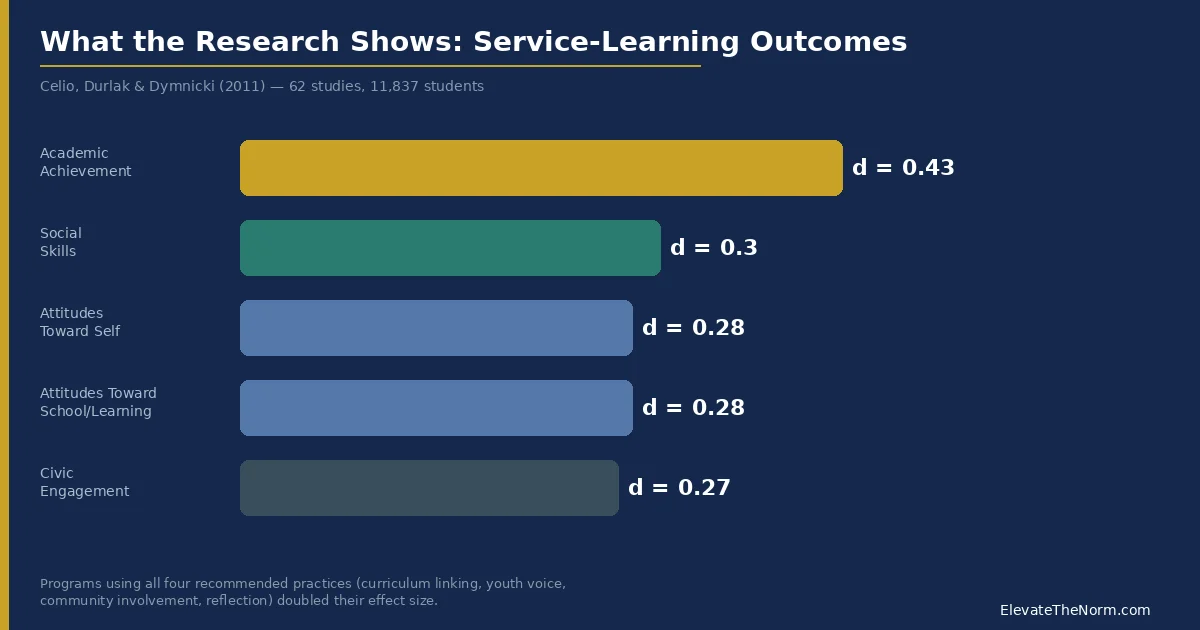
A meta-analysis of 62 studies found that service-learning — one category of experiential activity — improved academic achievement by an effect size of 0.43, the strongest of any outcome measured.
Most activities below require no budget, no technology, and no administrative approval beyond what a classroom teacher already has.
Partner and group work is the default format for experiential learning — not an add-on. Students learn from each other during the experience, not just during the debrief.
The Difference Between an Experience and Experiential Learning
A student who watches a documentary has had an experience. A student who watches a documentary, writes down what surprised them, connects those surprises to a concept from class, and then uses that concept to analyze a second documentary has done experiential learning. The difference is not the activity — it is what happens after the activity.
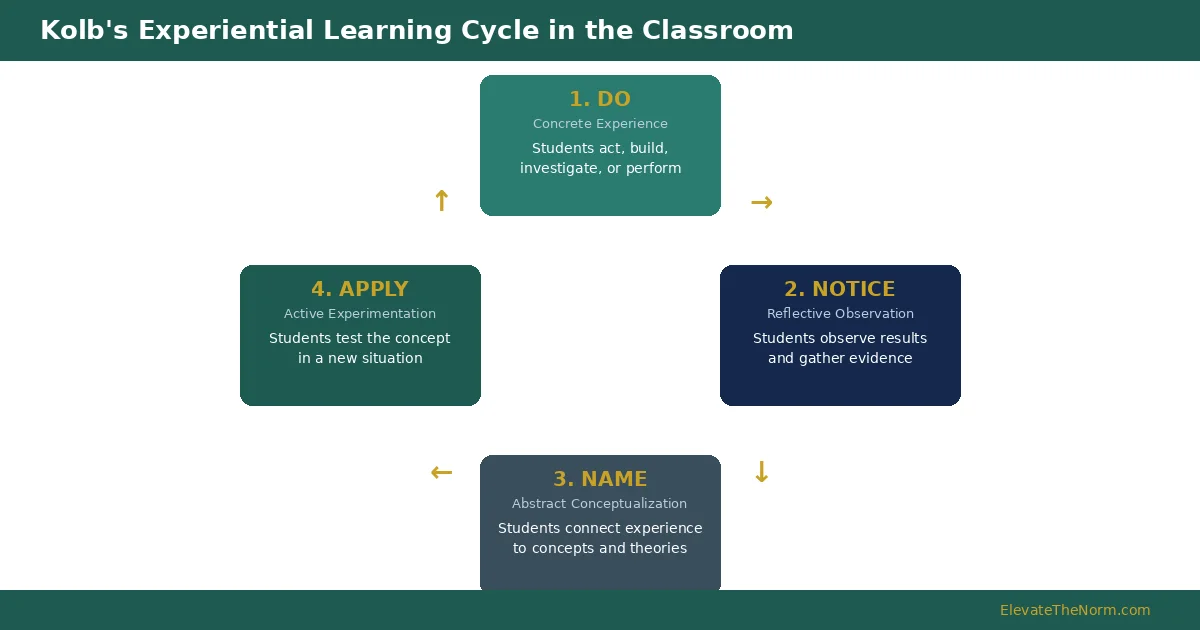
David Kolb formalized this in 1984 with a four-stage cycle that still holds up: concrete experience (do something), reflective observation (think about what happened), abstract conceptualization (connect the experience to a principle or theory), and active experimentation (apply the principle to a new situation). John Dewey made the same point forty-six years earlier in Experience and Education (1938): “The belief that all genuine education comes about through experience does not mean that all experiences are genuinely or equally educative.” Dewey called experiences that do not lead to learning “miseducative” — and he was talking about exactly the kind of activity that keeps students busy without making them think.
Every activity in this article is designed to complete the full cycle. If you strip out the reflection or the conceptualization step to save time, you have a field trip, not a lesson.
Here is the cycle in plain terms, because the academic language makes it sound more complicated than it is:
Do. Students participate in an activity, investigation, simulation, or task. They are inside the experience, not watching it.
Notice. Students observe what happened — what worked, what surprised them, what went wrong. This is not a grade. It is data collection about their own experience.
Name. Students connect their observations to a concept, theory, or principle. This is the bridge between “that was interesting” and “here is what it means.”
Try again. Students apply what they named to a new situation. This is the test of whether they actually learned something transferable or just had a one-time experience.
In my room, the tables are pushed together in groups, and students are almost always working alongside somebody. That is not a choice I made to be trendy — it is the structure experiential learning requires. When students do something and then need to reflect on what happened, the reflection is richer when they can talk through it with a partner who was in the same experience and noticed different things. Partner work is the default condition of the room, not a reward for finishing early, and that matters for every activity below. The experience happens collaboratively; the reflection deepens because of it.
30 Experiential Learning Activities for Grades 6–12
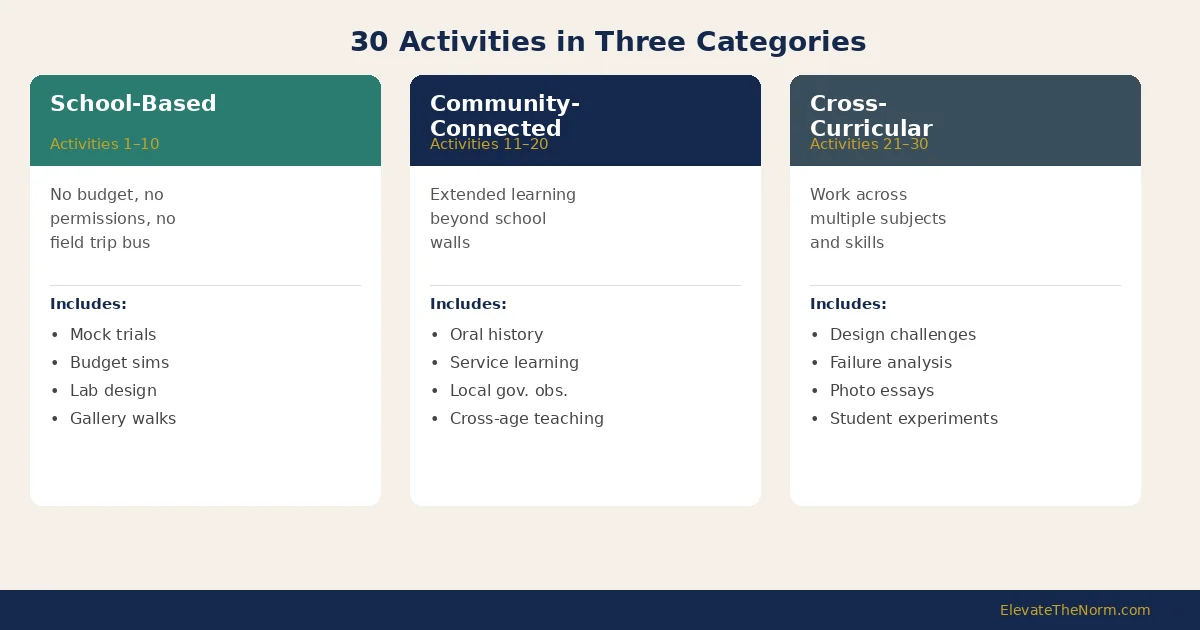
30 activities organized in three categories from classroom-only to community-connected.
These are organized by type: school-based activities that need nothing beyond your classroom, community-connected activities that extend learning outside the building, and cross-curricular activities that work in multiple subjects. Budget notes are included where relevant.
School-Based Activities (No Special Permissions Needed)
1. Mini Mock Trial. Students take roles — prosecution, defense, witnesses, judge, jury — in a simplified trial based on a historical event, a literary conflict, or a current ethical question. The experience is arguing a position under rules. The reflection is: “What evidence was most persuasive, and why did the jury weigh it that way?” Runs in one to two class periods.
2. Budget Simulation. Give each group a fixed income and a list of expenses for a household — rent, food, transportation, insurance, taxes. They allocate, make trade-offs, encounter unexpected expenses (car repair, medical bill), and rebuild their plan. The conceptualization: what does this reveal about economic decision-making, poverty, or policy? Cost: zero. A printed handout is all you need.
3. Primary Source Investigation. Place three to five primary sources on a table — documents, photographs, maps, or objects. Students examine them physically (or high-quality printouts), generate questions, and build a hypothesis about what they reveal. The reflection compares their hypothesis to the textbook account. A history teacher’s bread and butter, and it works in science (lab observation logs) and English (author manuscripts, historical editions) just as well.
4. Peer Teaching Rounds. Each student or pair prepares a five-minute lesson on one section of a unit. They teach it to a rotating group of classmates, receive written feedback, revise, and teach it again. The experience is teaching — which forces deeper understanding than listening ever does. The reflection: “What question from your students made you realize you did not understand this as well as you thought?”
5. Data Collection and Analysis. Students collect real data — classroom survey results, school lunch waste measured by weight, hallway traffic patterns, library usage statistics — then analyze it using methods from the curriculum. The experience is measurement. The conceptualization is: “What does this data actually tell us, and what does it not tell us?” This is project based learning in miniature.
6. Fishbowl Debate. A small group discusses a debatable question in the center of the room while the rest of the class observes, takes notes, and tags in to replace a speaker. The experience is both performing and observing. Reflection prompt: “What did you notice about how the conversation changed when a new voice entered?”
7. Lab Design Challenge. Instead of following a pre-written lab procedure, students receive a question and design their own procedure, predict outcomes, run the experiment, and compare results to predictions. The teacher provides safety parameters and materials — students provide the method. Works in any science class and teaches the difference between following instructions and doing science.
8. Role-Play Negotiation. Assign students roles in a historical or contemporary negotiation — treaty talks, labor disputes, environmental policy. They research their position, negotiate with opposing parties, and attempt to reach an agreement. Reflection: “What did you have to give up, and why? What would have changed if you had different information?” One class period, no budget.
9. Gallery Walk With Feedback. Students display their work — drafts, diagrams, solutions, prototypes — and classmates circulate, leaving specific written feedback using structured prompts. The experience is both creating and evaluating. The reflection: “What feedback surprised you? What will you change, and what will you keep?” Gallery walks teach respect in the classroom through practice, not a poster. What makes the written feedback specific enough to act on is the part worth deciding before students reach the first station.
10. Simulation of Scarcity. Give groups limited resources (paper, tape, time) to complete a task that requires more than they have. Watch how they allocate, trade, cooperate, or compete. Debrief with the question: “What does this show about how people behave when resources are scarce?” This is economics, psychology, and history in one forty-minute block.
Community-Connected Activities
11. Community Problem Investigation. Students identify a real problem in their school or neighborhood — a safety concern, an access issue, an environmental hazard — research it, interview stakeholders, and propose a solution they present to an actual decision-maker (principal, city council member, local business owner). The service-learning research is strong here: Celio, Durlak, and Dymnicki (2011) reviewed 62 studies involving 11,837 students and found an effect size of 0.43 for academic achievement — the largest of any outcome category they measured. Programs that incorporated structured reflection doubled their effect.
12. Oral History Project. Students interview a community member — a grandparent, a veteran, a local business owner, a longtime resident — about a topic connected to the curriculum. They record, transcribe, and analyze the interview against historical or sociological sources. The experience is the conversation. The conceptualization: “How does one person’s story confirm or complicate what the textbook says?”
13. Environmental Audit. Students measure something real — water quality in a nearby stream, energy usage in the school building, waste generated by the cafeteria over a week — and compare their findings to published standards or benchmarks. The product is a written report with recommendations presented to administration or a community group. Works in science, math, and social studies.
14. Job Shadow Reflection. If your school allows it, students spend a half-day observing a professional in a field connected to the curriculum. The activity is not the shadow itself — that is just the experience. The learning happens in the structured reflection afterward: “What skills did you see this person use? Which ones are you already building in this class? Which ones surprised you?” Not every school can do this, but the schools that can should.
15. Community Mapping. Students map resources, hazards, demographics, or services in their neighborhood using walking surveys, public data, or online tools. The product is a visual map with analysis. The conceptualization: “What patterns do you see, and what might cause them?” This teaches geography, data literacy, and civic awareness simultaneously.
16. Public Service Announcement Production. Students research a public health or safety issue, create a thirty-to-sixty-second video or audio PSA, and share it with a real audience (school announcements, a local nonprofit, social media with school approval). The experience is production. The reflection: “What choices did you make about what to include and what to leave out? How did your audience change your message?”
17. Small Business Plan. Students develop a simple business plan for a product or service that addresses a real need in their community. They research costs, identify customers, create a marketing pitch, and present to a panel that includes at least one real business owner or community member. No actual money changes hands — the value is in the planning and the presentation to a real audience.
18. Local Government Observation. Students attend (in person or via livestream) a city council meeting, school board meeting, or county commission session. They take notes on how decisions are made, who speaks, what evidence is presented, and how the process compares to what they learned in class. Reflection: “What surprised you about how this process actually works?” This is civics as experience, not vocabulary.
19. Service-Learning Project. Students identify a community need, plan a service response, carry it out, and reflect on what they learned about the issue and about themselves. This is different from community service because the learning is explicit — tied to curriculum standards, assessed, and reflected on. Celio et al. found that programs using four recommended practices (curriculum linking, youth voice, community involvement, reflection) yielded effect sizes of 0.35, compared to 0.17 for programs using none.
20. Cross-Age Teaching. High school students design and deliver a lesson to elementary or middle school students on a topic from the curriculum. The experience forces them to simplify, explain, and anticipate misconceptions — skills that require deep understanding. The reflection: “What question from a younger student exposed a gap in your own understanding?”
Cross-Curricular Activities
21. Design Challenge. Give groups a problem (build a bridge from paper that holds a textbook, design a water filtration system from household items, create a container that keeps an egg intact from a second-floor drop) and limited materials. The experience is building and testing. The reflection: “What did your first failure teach you that led to your second design?” Engineering, physics, and teaching responsibility through consequential tasks.
22. Socratic Seminar on a Controversial Question. Students prepare evidence on a debatable topic — historical, scientific, ethical, or literary — and discuss it in a structured circle. The experience is sustained, evidence-based conversation. The conceptualization: “Where did you change your mind, and what evidence made you do it?” Works in every subject that asks debatable questions, which is all of them.
23. Process Journal. Students keep a running journal during a multi-day activity or project, documenting decisions, setbacks, changes in thinking, and reflections. The journal itself becomes the conceptualization artifact — a record of learning over time, not just the final product. Pair with project based learning ideas to give students ownership of the process, not just the outcome.
24. Simulation of a Historical Event. Assign students roles within a historical event — the Constitutional Convention, a UN Security Council debate, the Montgomery Bus Boycott planning meetings — and run a compressed simulation. Students must research their historical figure’s actual positions and argue from evidence. The reflection connects the simulation to the outcomes: “What decisions could have gone differently, and how would history have changed?”
25. Measurement Lab. Students measure something real using disciplinary tools — pH, temperature, distance, weight, density, sound levels, population counts — and use the data to answer a question. The experience is measurement and observation. The conceptualization: “What did the data show that you did not expect? What would you measure next?” This is how science and math become tangible.
26. Ethical Dilemma Discussion. Present students with a genuine ethical dilemma — medical triage, resource allocation during a disaster, whistleblowing, journalistic responsibility — and have them work through it in small groups using a structured framework (stakeholder analysis, consequence mapping, principled reasoning). The experience is the moral reasoning. The reflection: “Where did your group disagree, and what value was each person prioritizing?”
27. Recipe Scaling and Cooking. Students scale a recipe up or down for a different number of servings, calculate costs per serving, and (if facilities allow) prepare the food. Math, nutrition, chemistry, and real world learning in one activity. The reflection: “What math did you actually use, and how was it different from doing a worksheet problem?” Even without a kitchen, the scaling and cost analysis are worthwhile on their own.
28. Photo Essay. Students use phone cameras to document a theme — “systems in our school,” “geometry in our neighborhood,” “evidence of change over time” — and curate their photos into a narrative with captions that connect observations to course concepts. The experience is seeing. The conceptualization is framing what they see in disciplinary language.
29. Failure Analysis. Give students a case study of a real engineering failure, a business collapse, a policy disaster, or a historical miscalculation. They analyze what went wrong, identify the decision points where a different choice could have changed the outcome, and present their findings. The experience is forensic thinking. The reflection: “What is the difference between a mistake and a systemic failure?” This pairs directly with the site’s core belief that learning from mistakes is how people grow — but only if they understand what actually went wrong.
30. Student-Designed Experiment. Students choose a question, design an experiment or investigation, carry it out, analyze results, and present findings to the class. The teacher provides the framework (hypothesis, method, data collection, analysis, conclusion) and the safety boundaries. Students provide everything else. This is the capstone version of experiential learning — students own every stage of the cycle, and the teacher’s job is to keep the guardrails in place while the students do the driving.
What the Research Says About Experiential Learning Outcomes
Service-learning effect sizes from Celio et al. (2011): academic achievement led all outcomes.
The evidence base for experiential learning is substantial, but it is important to be honest about what it shows and what it does not.
Morris (2020) conducted a systematic review of Kolb’s model and found that while the four-stage cycle remains the most widely used framework for experiential learning, its effectiveness depends entirely on implementation — particularly the reflection and conceptualization stages. Activities that skip those stages consistently produce weaker outcomes. The cycle is not optional, and Kolb himself argued this: “Learning is the process whereby knowledge is created through the transformation of experience.”
The Celio, Durlak, and Dymnicki (2011) meta-analysis remains the strongest quantitative evidence for service-learning specifically. Across 62 studies and 11,837 students, service-learning produced significant gains in academic achievement (d = 0.43), social skills (d = 0.30), attitudes toward self (d = 0.28), attitudes toward school (d = 0.28), and civic engagement (d = 0.27). The academic achievement effect was notably the largest — a finding the authors called “probably the most important for educators.” This is not a soft skill gain masquerading as rigor. Students who did service-learning learned more content, measured by the same assessments their peers took.
Research on simulation-based learning in secondary education, reviewed across 145 studies, found that simulations produce strong overall effects on achievement across disciplines. Students who learned through simulations showed better problem-solving abilities compared to traditional methods, improved collaboration skills, and rated simulations as the most effective learning method compared to lectures and case studies. However, the research is clear that effectiveness depends on instructional design, not just the tool — a poorly designed simulation is no better than a poorly designed lecture.
The honest summary: experiential learning works when it includes all four stages of the cycle, when reflection is structured rather than optional, and when the teacher stays involved throughout. It does not work when “experiential” is used as a synonym for “fun” or when the reflection step is cut because the bell is about to ring.
Making It Work: Practical Considerations
Most of these activities require no budget. A few need minimal supplies (printed handouts, poster paper, tape). The community-connected activities may require coordination with administrators, parents, or community partners, but none of them require spending money the school does not have.
Time is the real constraint. A full experiential learning cycle — do, reflect, conceptualize, apply — takes longer than a lecture-and-worksheet class. That is a fact, not an objection. The research consistently shows that the time invested produces stronger learning outcomes, which means the apparent time cost is actually a time savings: students who understand a concept through experience need less reteaching than students who memorized it from a slide.
For teachers working within tight pacing guides, start with activities that fit inside a single period (1–10 on the list above) and expand as you learn what your students can handle. The community-connected activities (11–20) require more planning but produce deeper engagement. The cross-curricular activities (21–30) are where experiential learning becomes genuinely student centered — students are not just experiencing content, they are experiencing the process of learning itself.
One final note: student responsibility in the classroom is not something you can lecture into existence. It is built through activities where students have real decisions to make and real consequences to learn from — consequences bounded by planning and presence, not by manufactured stakes designed to punish mistakes. These thirty activities are how that happens.
Frequently Asked Questions
What is the difference between experiential learning and hands-on learning?
Hands-on learning means students are physically doing something — building, measuring, manipulating materials. Experiential learning includes hands-on work but adds structured reflection, conceptualization, and application. A student who builds a bridge out of paper has done hands-on learning. A student who builds it, analyzes why it failed, connects that analysis to engineering principles, and redesigns it has done experiential learning. The reflection and conceptualization stages are what separate the two.
How do I fit experiential activities into a packed curriculum?
Start with single-period activities from the school-based list. Many of them replace a lecture and worksheet with a more effective learning experience that covers the same content. The time investment pays off in reduced reteaching — students who learn through experience retain more than students who memorize from slides. If your pacing guide is truly immovable, use experiential activities for the concepts students struggle with most. That is where the return on time is highest.
Do experiential learning activities work for students who struggle academically?
The research says yes. The Celio et al. meta-analysis found that service-learning programs using structured reflection and curriculum linking — two features that directly support struggling learners — produced the strongest results. Experiential activities provide multiple entry points (visual, kinesthetic, verbal, social) that traditional instruction often does not. That said, struggling students need more scaffolding, not less — provide clearer task cards, shorter rotations, and more frequent check-ins during the experience phase.
What if my school does not allow field trips or community partnerships?
Activities 1 through 10 require nothing beyond your classroom. Simulations, mock trials, data collection, design challenges, and gallery walks all create experiential learning inside the building. Community connections enrich the work but are not required for it. Many of the community-connected activities (oral history, local government observation via livestream, community mapping using public data) can be adapted to work within school walls if your district restricts off-campus activities.
How do I grade experiential learning activities?
Grade the products the cycle produces, not the experience itself. Reflection journals, analysis papers, design reports, presentation rubrics, and peer feedback forms all generate gradeable artifacts. Do not grade participation in the experience — that turns a learning activity into a compliance check. Grade what students demonstrate they learned from the experience, which is visible in the reflection and application stages.
Are experiential learning activities appropriate for every subject?
Yes, though the format varies. Science uses labs and investigations. History uses primary sources and simulations. Math uses data collection and measurement. English uses discussion protocols and creative production. The common thread is the cycle: do something, reflect on it, connect it to a concept, and apply it to a new situation. Any subject that asks students to think — which is all of them — can use experiential learning.
How do I manage behavior during experiential activities?
Structure prevents most behavior problems. When students know what they are doing, how long they have, and what they will produce, off-task behavior drops. Circulate constantly — your physical presence in the room is your primary management tool. Set expectations before the activity starts, not during it. Use a two-minute check at the beginning to catch confusion early. If a specific group is off task, redirect quietly and individually rather than stopping the whole class. The teacher’s job during experiential learning is to move, listen, and intervene surgically.
Sources
Kolb, D. A. (1984). Experiential Learning: Experience as the Source of Learning and Development. Prentice-Hall.
Dewey, J. (1938). Experience and Education. Kappa Delta Pi/Macmillan.
Celio, C. I., Durlak, J., & Dymnicki, A. (2011). “A Meta-Analysis of the Impact of Service-Learning on Students.” Journal of Experiential Education, 34(2), 164–181. https://doi.org/10.1177/105382591103400205
Morris, T. H. (2020). “Experiential Learning — A Systematic Review and Revision of Kolb’s Model.” Interactive Learning Environments, 28(8), 1064–1077. https://doi.org/10.1080/10494820.2019.1570279
Baeten, M., Dochy, F., Struyven, K., Parmentier, E., & Vanderbruggen, A. (2023). “Student-Centered Education: A Meta-Analysis of Its Effects on Non-Academic Achievements.” SAGE Open, 13(2). https://doi.org/10.1177/21582440231168792
About Clay Shumate
Clay Shumate is a certified secondary Social Studies teacher in the public schools of West Alabama, with seven years of classroom experience, a B.A. in History, and an M.Ed. in Secondary Education. He writes about project-based learning, student responsibility, respect, and practical ways to hold young people to a higher standard while giving them room to learn from mistakes. He is a member of the Society of Professional Journalists and writes to its Code of Ethics; this site’s editorial standards and corrections policy are published in full. More about Clay.
More free classroom ideas for grades 6–12, saved to boards you can browse.