Category: Project Based Learning

Project based learning in real classrooms: what it is, how to plan it, and what to look for when you walk into the room.

  • Project Based Learning vs Traditional Learning: What the Evidence Actually Says

    Project Based Learning vs Traditional Learning: What the Evidence Actually Says

    By Clay Shumate

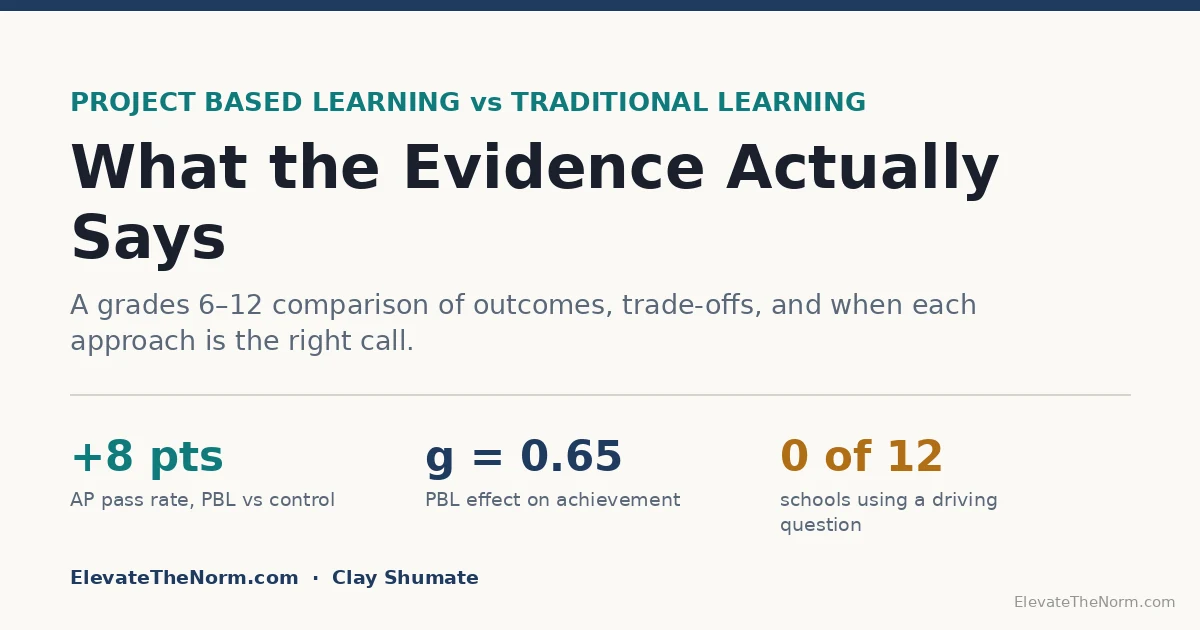
    Project based learning and traditional learning differ in where the content lives. Traditional instruction delivers knowledge first and asks students to apply it afterward. Project based learning has students build that knowledge while solving a real problem for a real audience. The research favors projects for transfer and retention, and favors direct instruction for teaching brand-new material to beginners.

    Key Takeaways

    • The comparison is not projects versus lectures. It is when content gets delivered and who does the thinking while it happens.
    • Meta-analytic evidence gives project based learning a moderate advantage on academic achievement, with the strongest effects at the high school level.
    • Explicit, guided instruction still beats minimally guided approaches for novices meeting new content. That finding is not a rebuttal of PBL — it is a scheduling instruction.
    • Most classrooms that say they run project based learning are running the visible half of it. Products and presentations are common; driving questions and revision cycles are not.
    • You do not have to pick a side for the whole year. You pick one for each unit, and you should be able to say why.

    What “Project Based Learning vs Traditional Learning” Actually Compares

    Most of the arguments about project based learning vs traditional learning are arguments about caricatures. One side pictures a teacher droning through slides while thirty kids copy notes. The other pictures a room full of poster board and glue sticks where nobody learns anything. Neither is a real classroom, and comparing them settles nothing.
    The real difference is sequence and ownership. In a traditional unit, the teacher delivers the content, students practice it, and then — if there is time — a project shows that the learning happened. The project is the dessert. In project based learning, the project is the main course. Students are handed a question worth answering, and they build the content knowledge on the way to answering it, with the teacher pulling groups aside, correcting misconceptions, and teaching directly at the moments it is needed. If you teach history or civics, my Social Studies Teacher Toolkit Bundle on TPT has ready-made pieces you can build a project around.

    That distinction matters because it is the one that gets lost. If you want the precise version, the definition of project based learning comes down to sustained inquiry, authenticity, student voice, critique and revision, and a public product. Strip any one of those out and you have a graded assignment with better packaging.

    What the Research Says About Project Based Learning vs Traditional Learning

    The evidence is stronger than skeptics assume and softer than advocates claim. Both of those things can be true, and if you read only one camp’s summary you will get a distorted picture.
    The strongest single study is a randomized trial in AP courses

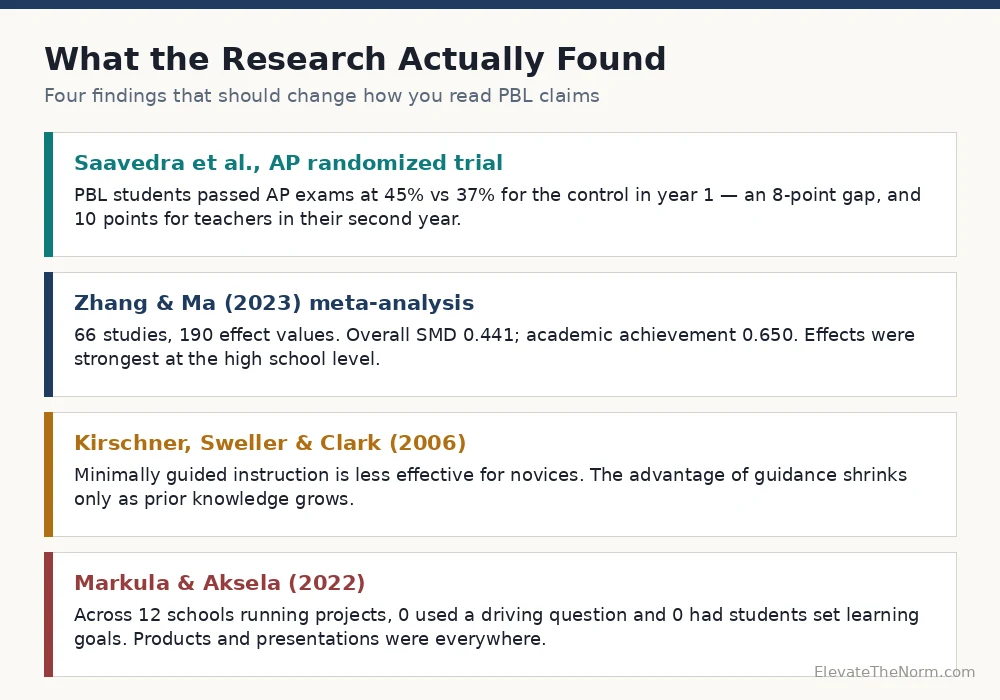
    Saavedra and colleagues ran a randomized controlled trial of the Knowledge in Action project based curriculum in AP U.S. Government and Politics and AP Environmental Science across five predominantly urban districts. In year one, 3,645 students and 74 teachers in 68 schools participated. Students in the project based classrooms passed their AP exams at 45 percent, against 37 percent for the control group — an eight percentage-point gap. For teachers in their second year of implementation, the gap widened to ten points.

    Two details are worth holding onto. First, this was a randomized trial with a real external outcome measure — the College Board’s own exam, not a test the researchers wrote. Second, the effect held for lower-income students, in a sample where 38 to 46 percent qualified for free or reduced-price lunch. The common objection that projects only work in well-resourced schools does not survive contact with this study.

    It is one study of one curriculum in two courses. It is not proof that any project beats any lecture. It is good evidence that a carefully built project based course can outperform a conventional one on a test neither side designed.

    The meta-analyses point the same direction, with caveats

    Zhang and Ma (2023) pooled 66 experimental and quasi-experimental studies into 190 effect values in Frontiers in Psychology. The overall standardized mean difference for project based learning was 0.441, and for academic achievement specifically it was 0.650 — a moderate effect, and the strongest of the three outcome categories they examined. Effects were most pronounced at the high school level, which is the band this site writes for.

    The authors are candid about the limitations, and so should we be. Heterogeneity was high (I² = 87.4 percent), meaning the studies disagreed with each other a great deal. Results from Asian school systems substantially outperformed those from North America and Western Europe. Engineering and technology subjects outperformed others. An average across that much variation tells you the direction of the effect, not the size you should expect in your own room.

    Balemen and Keskin (2018) found an even larger effect — 1.063 across 48 science-education studies — but a number that large in a body of small quasi-experimental studies should make you more careful, not more excited. The direction is consistent. The magnitude is not settled.

    Where Traditional Instruction Still Wins

    Here is the part that PBL advocates skip, and it is the part that makes the rest of the argument credible.

    Kirschner, Sweller, and Clark argued in Educational Psychologist (2006) that minimally guided instruction is less effective and less efficient than guided instruction, and that the disadvantage shrinks only as learners accumulate prior knowledge. Their case is built on human cognitive architecture: a novice working memory does not have the spare capacity to search for a solution and learn the underlying content at the same time. Handing a beginner an open problem does not build expertise. It builds frustration and a lot of confidently wrong conclusions.

    Rosenshine’s Principles of Instruction (2012) is the practical version of the same evidence. Review prior learning. Present new material in small steps with practice after each step. Ask a lot of questions and check everyone’s response. Model. Guide practice. Aim for a high success rate. Scaffold hard tasks and withdraw the scaffolds gradually. None of that is out of fashion because it works, and none of it is incompatible with running projects.

    So the finding is not “projects are bad.” The finding is that a project is a terrible place to meet a concept for the first time and an excellent place to use one. That is a sequencing rule, and it is the most useful thing in this entire literature. For practical implementation strategies inside a standard high-school schedule, see project based learning high schools can use without rebuilding the schedule.

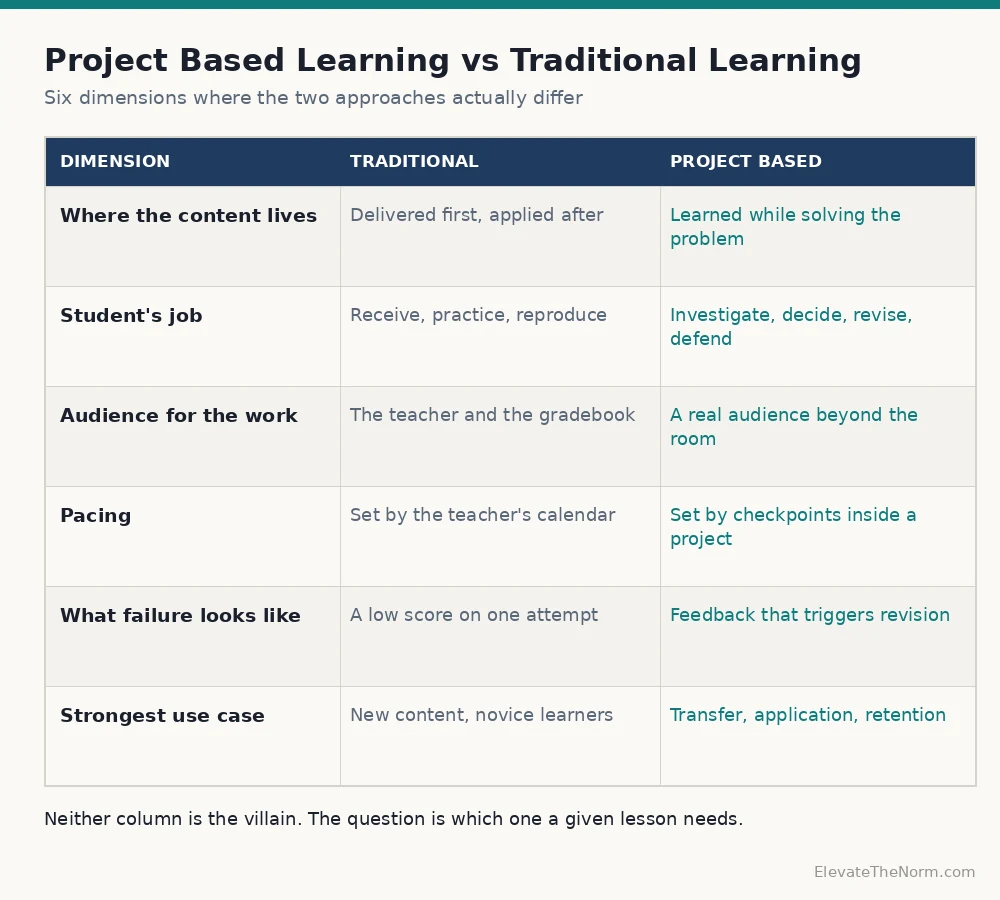
    Project Based Learning vs Traditional Learning: A Side-by-Side

    DimensionTraditional learningProject based learning
    Where content livesDelivered first, applied afterwardBuilt while solving the problem
    Student’s jobReceive, practice, reproduceInvestigate, decide, revise, defend
    AudienceThe teacher and the gradebookSomeone outside the room
    PacingSet by the teacher’s calendarSet by checkpoints inside the project
    What failure looks likeA low score on one attemptFeedback that triggers a revision
    Teacher’s positionFront of the room, deliveringCirculating, conferencing, teaching on demand
    Strongest use caseNew content, novice learners, tight pacingTransfer, application, retention, motivation
    Most common failureStudents comply without thinkingStudents produce without learning
    Neither column is the villain. The question is which one a given lesson needs.

    The Implementation Problem Nobody Puts on the Brochure

    Markula and Aksela (2022) studied 17 student projects at 12 schools across seven countries — schools that had volunteered for an international science programme and considered themselves to be doing project based learning. Collaboration showed up in 11 of the 12. All 12 produced artifacts. All 12 presented results.

    And none of the 12 showed evidence of a driving question. None had students setting their own learning goals. Hypothesis testing appeared in none of the projects. Student-generated questions shaped the work in only four.

    That is a portrait of committed teachers running the visible half of PBL — groups, products, presentations — while the parts that actually generate the learning were missing. It also explains a lot of the disagreement between studies. When a research team compares “PBL” against traditional instruction, what they are actually comparing depends entirely on which half the treatment classrooms implemented.

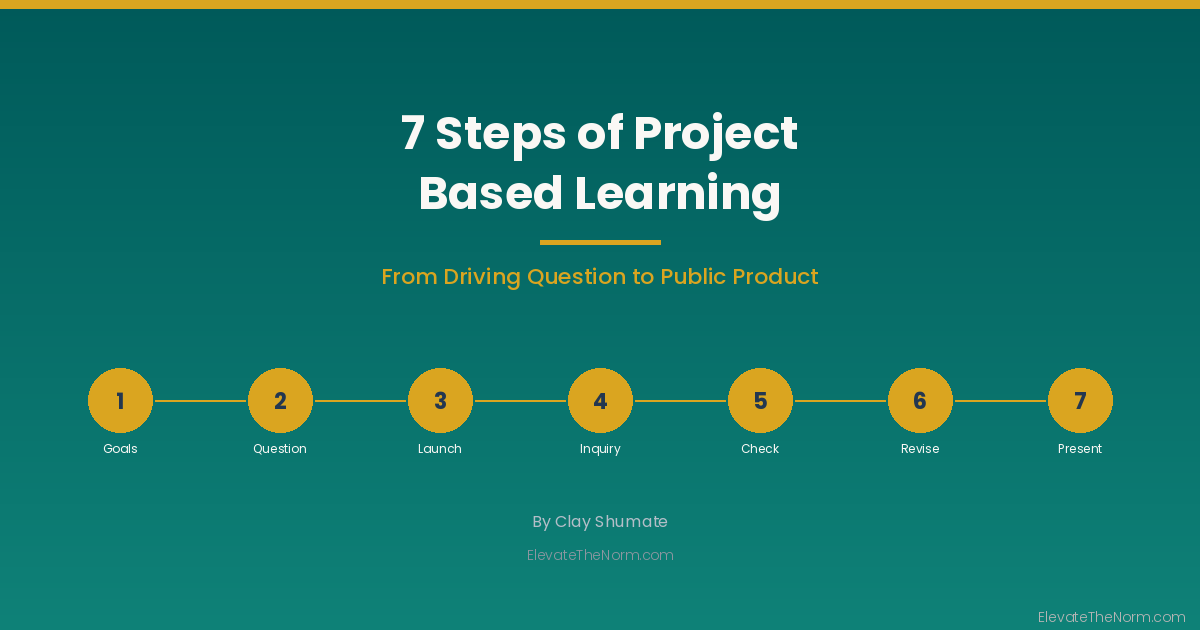
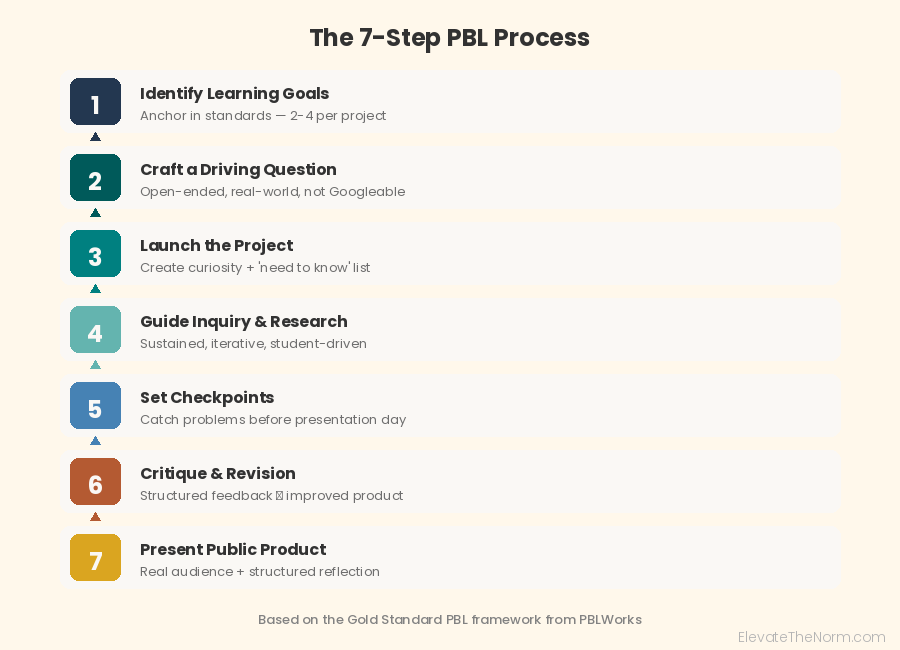
    If you are deciding whether to move a unit to project based learning, the honest comparison is not PBL against your current teaching. It is well-implemented PBL against your current teaching, and the difference between well-implemented and decorative is a driving question, a real audience, and a revision cycle. The seven steps of project based learning exist mostly to keep those three from getting dropped when the calendar gets tight.

    What This Looks Like on an Ordinary Tuesday

    My room is not a lecture hall and it is not a free-for-all. There are no rows. Tables are pushed together in pairs and groups of four, and that is the resting state of the furniture — not a configuration students move into on project days. Working alongside somebody is the default condition, not a reward for finishing early.

    That setup does not mean I disappear. I am on a wheeled stool, moving between groups, and I pull students to a whiteboard table when something needs to be taught directly. Some days that whiteboard table is where I deliver five minutes of straight instruction to four kids who need it, and the rest of the room keeps working. That is direct instruction and project work happening in the same forty minutes, which is what the research actually supports and what the “versus” framing hides.

    The mistake I see teachers make — and made myself — is treating the choice as an identity. You are not a PBL teacher or a traditional teacher. You are a teacher deciding, unit by unit, what a particular group of students needs in order to learn a particular thing. A student-centered classroom is not one where the teacher stopped teaching. It is one where the teaching happens closer to the student and later in the process.

    How to Decide Which One a Lesson Needs

    Five questions, asked before you plan the unit rather than after.
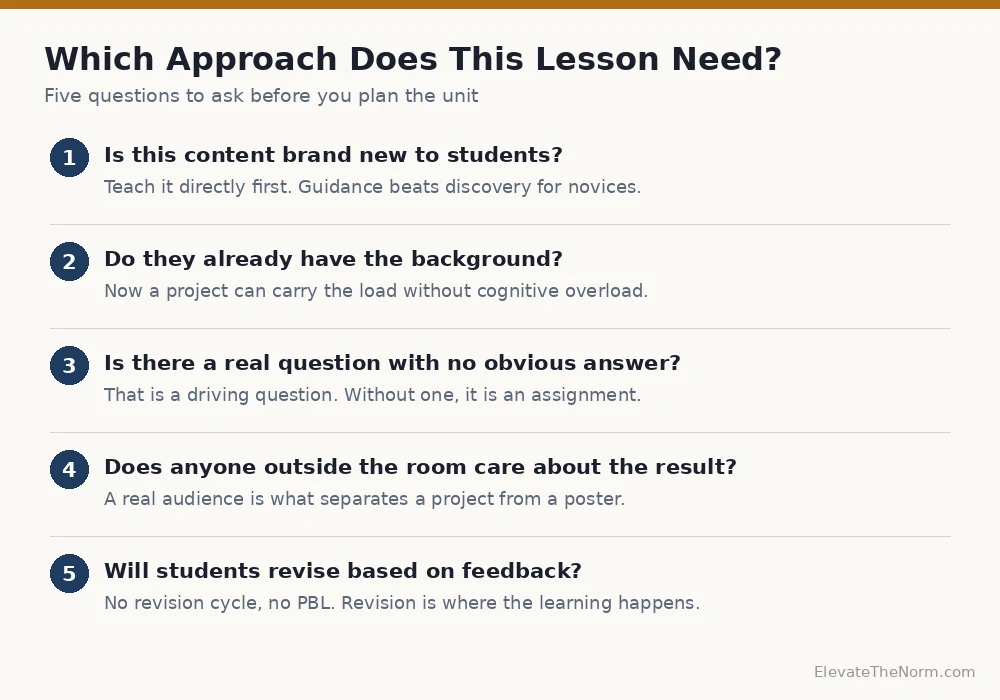
    1. Is this content brand new to students? If yes, teach it directly first. Guidance beats discovery for novices, and pretending otherwise costs you a week.
    2. Do students already have the background? If yes, a project can carry the load without overloading working memory. This is the condition that makes PBL work.
    3. Is there a real question here that I cannot answer in one sentence? That is a driving question. If you can Google the answer, it is a research assignment, not a project.
    4. Does anybody outside this room care about the result? A real audience is the difference between a project and a poster. It does not have to be the city council. The class next door counts. Anything that involves outside adults, off-campus work, or publishing student names should clear your administration and your district’s policies first, before you promise students an audience you cannot deliver.
    5. Will students revise based on feedback before it is graded? No revision cycle, no PBL. Revision is where most of the learning lives, and it is the first thing cut when the calendar gets tight.

    If you answer no to questions three, four, or five, do not call it project based learning. Call it a good assignment, grade it fairly, and move on. There is nothing wrong with a good assignment. There is something wrong with claiming research support that only applies to a structure you did not build. A set of worked project examples is a faster way to see the difference than any definition.

    What to Do Next

    Pick one unit. Not a semester, not a course — one unit, in one section, on content your students already have some footing in. Write a driving question you genuinely cannot answer in a sentence. Find an audience, even a small one. Build two checkpoints and one revision cycle into the calendar before you launch, because you will not add them once you are inside the unit.

    Be honest with yourself about the cost. The first time you build a project it will take more planning hours than the unit it replaces, and most of those hours go into the checkpoints and the rubric rather than the launch. The second time you run it, it takes less time than the traditional unit did. That front-loaded cost is the real reason projects get abandoned, and knowing it in advance is most of the fix.

    Teach everything else the way you already teach it. Then compare — your own students, your own assessment, two versions of the same content. That comparison will tell you more about project based learning vs traditional learning in your building than any meta-analysis can, and you will have run it at a cost of one unit. If you want a wider version of the same idea, experiential learning approaches high schools can actually use covers the models that fit inside an ordinary schedule.

    The teachers who get this right are not the ones who picked a side. They are the ones who can tell you, for any given day, why they are teaching the way they are teaching.

    Frequently Asked Questions

    Is project based learning better than traditional learning?

    It depends on what you are asking students to do. Meta-analytic evidence, including Zhang and Ma’s 2023 synthesis of 66 studies, shows a moderate positive effect for project based learning on academic achievement compared with conventional instruction, and the effect was strongest at the high school level. But Kirschner, Sweller, and Clark (2006) make the opposite case just as clearly for novices encountering brand-new content, where guided, explicit instruction outperforms minimally guided approaches. The honest answer is that PBL is better for transfer, application, and retention once students have something to work with, and direct instruction is better for building that something in the first place.

    What is the main difference between project based learning and traditional learning?

    Where the content lives. In traditional learning, the teacher delivers the content first and students apply it afterward in a quiz, an essay, or an end-of-unit project. In project based learning, the project is the instruction — students build the knowledge while investigating a real question for a real audience, with checkpoints, critique, and revision along the way. A project assigned after the unit is a demonstration. A project that carries the unit is PBL.

    Does project based learning cover fewer standards?

    It covers fewer standards per week and more standards per project, and that trade is the real planning decision. A well-built project can carry several standards at once because students are using them together instead of one at a time. What it cannot do is race. If your pacing guide gives you three days on a topic, that topic is not a project. Pick the two or three units a year where the depth is worth the calendar and teach the rest directly.

    Is project based learning harder to grade fairly?

    It is harder if you grade the product and nothing else. It gets fair when you grade the individual thinking inside the group — checkpoint work, a research log, a short defense of the student’s own decisions — separately from the shared final product. Group grades that average everyone together are the single most common reason students and families lose faith in projects, and they are avoidable.

    What does the research say about project based learning and lower-income students?

    The randomized trial of the Knowledge in Action project based AP curriculum, run across five largely urban districts, found that students in project based classrooms passed their AP exams at 45 percent versus 37 percent for the control group in year one, and reported comparable gains for lower-income students and their higher-income peers. That is one strong study in one setting, not a universal finding, but it directly contradicts the assumption that projects are a luxury for well-resourced schools.

    Do students need technology for project based learning?

    No. The requirements for PBL are a genuine question, a real audience, time for revision, and a teacher who is circulating. None of that is a device. Interviews, archival work, community problems, physical builds, and public presentations all run on paper. Technology can widen the audience and speed the revision cycle, but a project that only works with one-to-one devices was designed around the tool rather than the learning.

    How do I start if my school teaches traditionally?

    Start with one unit in one course, not a program. Pick content your students already have some background in, write a driving question that you personally cannot answer in one sentence, find an audience outside your classroom even if it is only the class next door, and build two checkpoints and one revision cycle into the calendar before you launch. Teach the rest of your year the way you already do. Nobody has to rebuild a schedule to run a project.

    Sources

    1. Saavedra, A. R., Rapaport, A., Morgan, K. L., Garland, M., Liu, Y., Hu, A., Hoepfner, D., & Korn, S. “Project-Based Learning Boosts Student Achievement in AP Courses.” College Board / Lucas Education Research.
    2. Zhang, L., & Ma, Y. (2023). “A study of the impact of project-based learning on student learning effects: a meta-analysis study.” Frontiers in Psychology, 14, 1202728.
    3. Kirschner, P. A., Sweller, J., & Clark, R. E. (2006). “Why Minimal Guidance During Instruction Does Not Work: An Analysis of the Failure of Constructivist, Discovery, Problem-Based, Experiential, and Inquiry-Based Teaching.” Educational Psychologist, 41(2), 75–86.
    4. Rosenshine, B. (2012). “Principles of Instruction: Research-Based Strategies That All Teachers Should Know.” American Educator, 36(1), 12–19, 39.
    5. Markula, A., & Aksela, M. (2022). “The key characteristics of project-based learning: how teachers implement projects in K-12 science education.” Disciplinary and Interdisciplinary Science Education Research, 4, 2.
    6. Balemen, N., & Keskin, M. Ö. (2018). “The Effectiveness of Project-Based Learning on Science Education: A Meta-Analysis Search.” International Online Journal of Education and Teaching, 5(4), 849–865.

    About Clay Shumate

    Clay Shumate is a certified secondary Social Studies teacher in the public schools of West Alabama, with seven years of classroom experience, a B.A. in History, and an M.Ed. in Secondary Education. He writes about project-based learning, student responsibility, respect, and practical ways to hold young people to a higher standard while giving them room to learn from mistakes. He is a member of the Society of Professional Journalists and writes to its Code of Ethics; this site’s editorial standards and corrections policy are published in full. More about Clay.
  • Activities for Student Centered Learning That Give Students Real Ownership

    Activities for Student Centered Learning That Give Students Real Ownership

    By Clay Shumate

    Activities for student centered learning only work when students are doing the thinking — not just following instructions that feel participatory. The activities below transfer real decision-making to students while keeping the teacher present, circulating, and holding the standard. Each one works in grades 6–12 without requiring a technology budget, a flexible schedule, or permission from anyone outside your room.

    Key Takeaways

    • Student-centered activities shift the cognitive load to students — they think, decide, and defend rather than listen and record.
    • The teacher does not disappear. The teacher circulates, intervenes at the right moment, and holds the standard.
    • Structure prevents confusion. Every activity below includes a clear task, a time frame, and an accountability check.
    • A 2023 meta-analysis of 31 studies found that student-centered approaches produced the largest effect sizes at the secondary level — stronger than primary or higher education.
    • Start with one activity. Trying to overhaul everything at once is how student-centered learning gets abandoned by October.

    What Makes an Activity Student Centered — and What Just Looks Like It

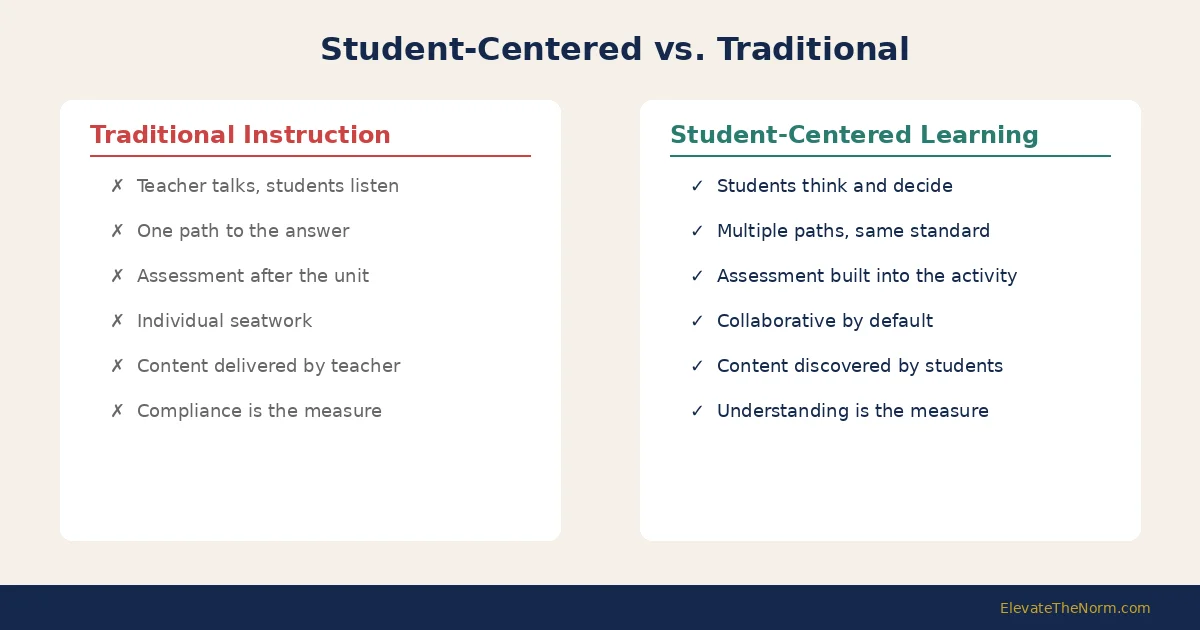
    Side-by-side comparison of student centered learning versus traditional instruction showing who does the thinking in each model
    In student-centered activities, students do the thinking — not just the moving.

    A lot of activities get called student centered because students are moving, talking, or using colored markers. That is not the test. The test is: who is doing the thinking?

    If students are following a step-by-step handout, filling in blanks, or rotating through stations that ask nothing beyond recall, the teacher is still doing the cognitive work — just delivering it through a different medium. Student-centered means students are making decisions about what to investigate, how to approach a problem, or how to present evidence. It means they encounter genuine uncertainty — not a question where the answer is already written on the back of the card.

    A meta-analysis by Baeten, Dochy, Struyven, Parmentier, and Vanderbruggen (2023), published in SAGE Open, reviewed 31 studies and found a large overall effect of student-centered education on learning outcomes (SMD = 0.72, p < .001). The finding that matters most for middle and high school teachers: secondary education showed the strongest effect of any level, with an SMD of 0.98 — meaning student-centered approaches produced nearly a full standard deviation of improvement at the grades where many teachers still default to lecture. Programs that ran longer than six months showed the largest gains (SMD = 1.08), which means this is not a novelty effect. It is a sustained instructional advantage.

    That said, the study’s heterogeneity was very high (I² = 99.7%), which means the quality of implementation matters enormously. Poorly structured student-centered activities will not produce these results. The activities below are designed with that constraint built in: every one of them includes the structure that makes the approach work, not just the freedom that makes it sound good.

    Activities That Transfer Real Thinking to Students

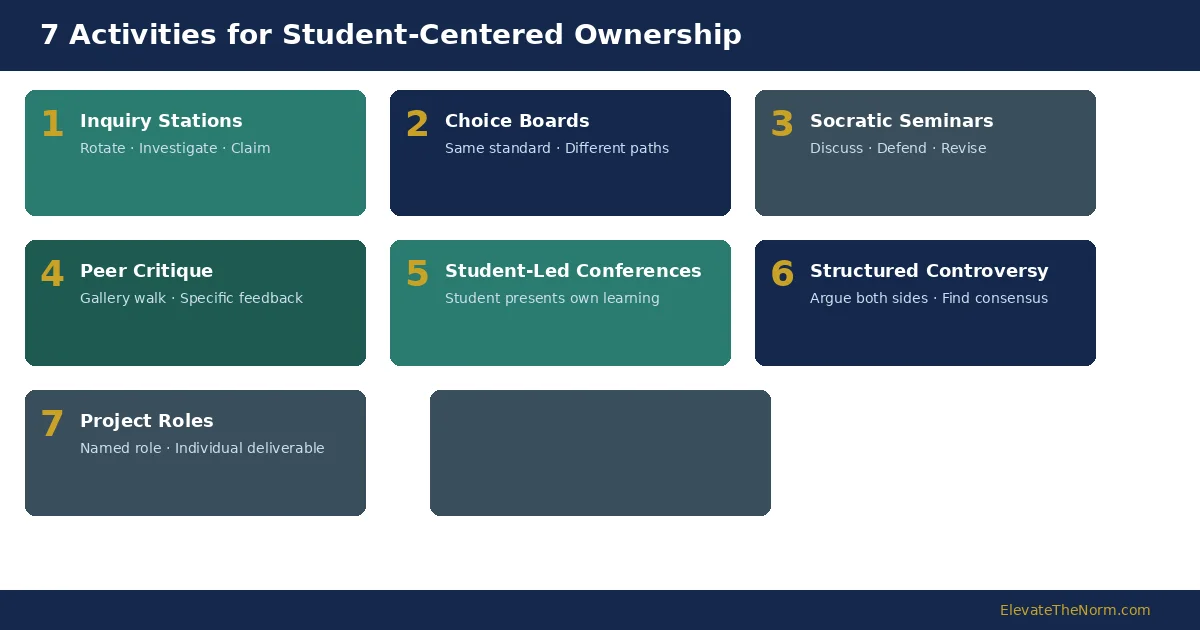
    Overview of seven student centered learning activities including inquiry stations, choice boards, Socratic seminars, peer critique, student-led conferences, structured controversy, and project roles
    Seven activities that transfer real decision-making to students.

    Inquiry Stations

    What it is: Students rotate through three to five stations, each presenting a different primary source, data set, image, or short text related to the same question. At each station, they record observations, generate questions, and build toward a claim they will defend at the end of the rotation.

    Why it works: Students encounter evidence before they encounter the teacher’s interpretation. They have to look at something, decide what it means, and compare it against what they found at the previous station. The thinking is theirs.

    The structure that prevents confusion: Post the driving question where everyone can see it. Give each station a task card with one or two specific prompts — not open-ended “discuss what you see” instructions that lead to three minutes of silence followed by off-task conversation. Set a timer for each rotation. Have students record individually, even if they talk in groups, so there is an accountability artifact.

    In my room, I set up inquiry stations on trapezoid tables pushed together, which means groups of three or four are already facing each other when they sit down. I circulate during rotations. More than once, I have caught a group building a misconception from one station’s source — they misread a chart or drew a conclusion the data did not support — and the only reason I caught it was because I was standing close enough to hear them reason through it before they wrote it down. That is the teacher’s job in a student centered learning classroom: not to deliver the content from the front, but to be close enough to redirect the thinking before it hardens into a wrong answer. The same demand on your attention runs through the longer bank of experiential activities for grades 6–12.

    Choice Boards Within Standards

    What it is: A grid of options — typically three-by-three or four-by-four — where each cell is a different way to demonstrate understanding of the same learning target. Students choose which cells to complete. Every option meets the same standard; only the mode of expression changes.

    Why it works: A meta-analysis by Patall, Cooper, and Robinson (2008) reviewed 41 studies on the effects of choice on intrinsic motivation and found a moderate positive effect (d = 0.30–0.36). More importantly for teachers, choice also improved perceived competence (d = 0.59) and task performance (d = 0.32). The authors found that younger learners benefited more than older ones, and that a moderate number of options — two to four — worked better than an overwhelming menu.

    The structure that prevents confusion: The board is not a buffet of busywork. Every cell must require the same depth of thinking — do not put “draw a poster” next to “write an analytical paragraph” and pretend those are equivalent. Build the board so a student who picks any combination of cells has demonstrated the target. Include a rubric that applies across all cells. Require students to commit to their choices before starting, not to switch mid-task when the first one gets hard.

    Choice boards are one of the clearest ways to give students real student responsibility without lowering the bar. The standard does not move. The path to it does.

    Socratic Seminars

    What it is: A structured discussion in which students — not the teacher — drive the conversation about a text, question, or problem. Participants sit in a circle (or an inner-outer circle variation), reference evidence, build on each other’s ideas, and disagree respectfully. The teacher observes, tracks participation, and intervenes only to redirect or probe.

    Why it works: Students practice every skill that matters and cannot be tested on a multiple-choice exam: listening, articulating a position, responding to disagreement, revising their thinking in real time. Research from the Association for Supervision and Curriculum Development describes Socratic seminars as developing “listening, speaking, and critical-thinking abilities” through peer dialogue rather than teacher-directed Q&A (ASCD, 2023). In one documented middle school implementation, students who participated in regular seminars began using structured discussion moves spontaneously during regular class activities — evidence of transfer, not performance.

    The structure that prevents confusion: Assign the text in advance. Require students to come with at least two prepared questions. Use a fishbowl format (inner circle discusses, outer circle evaluates and rotates in) if your class is larger than fifteen. Set a participation tracker — a simple grid where the teacher tallies contributions — so quiet students are noticed and dominant talkers learn to make space. Follow every seminar with a written reflection: “What changed in your thinking today, and why?”

    Socratic seminars work in every subject. A history class argues over primary sources. A science class debates competing hypotheses. An English class examines authorial intent. The format is the same; the content changes. It is one of the most powerful activities for student centered learning because the students genuinely cannot predict where the conversation will go — and neither can the teacher. The long version — six moves, six norms, and an honest read of what the discussion research does and does not support — is in the full walkthrough of running a seminar in a secondary classroom.

    Peer Critique Protocols

    What it is: A structured process in which students review each other’s work using specific criteria. The most effective version is the gallery walk, where student work is posted around the room and classmates circulate, leaving written feedback on sticky notes or feedback forms. Ron Berger’s framework from EL Education requires that feedback be “kind, specific, and helpful” — three words that do more than any rubric to prevent critique from becoming cruelty or flattery.

    Why it works: Students learn to evaluate quality by evaluating someone else’s work against a standard. That is harder than evaluating their own, and it builds the judgment they need to self-assess later. PBLWorks, which runs this protocol constantly, reports from its own practice that giving participants a specific focus — such as content accuracy, argument structure, or evidence quality — helps generate higher-quality feedback, where open-ended instructions produced superficial comments like “good DQ!”. That is practice knowledge rather than a study; the article cites no research. What is well evidenced is the peer assessment underneath the protocol — a meta-analysis of 54 control-group studies put it at g = 0.31 on achievement, and higher at secondary level.

    The structure that prevents confusion: Give students the rubric or success criteria before the gallery walk, not after. Require written feedback — verbal feedback disappears the moment the bell rings. Use structured stems: “I notice…,” “I wonder…,” “One thing that would strengthen this is….” Set a time limit per station. Debrief as a class afterward, pulling patterns from the feedback rather than singling out individual work. The six-step version of this protocol, and the four ways it most often collapses, are in the full walkthrough of running one so the feedback is worth reading.

    Peer critique teaches respect in the classroom through practice, not through a poster. When students learn to disagree with someone’s work without attacking the person who made it, they are learning a skill most adults have not mastered.

    Student-Led Conferences

    What it is: Instead of the teacher reporting to the parent about the student, the student leads the conversation. They present their work, explain their progress, identify their strengths and weaknesses, and set goals — with the teacher and parent as listeners and questioners, not narrators.

    Why it works: The student has to articulate what they know, what they do not know, and what they plan to do about it. That requires self-assessment, organization, and the ability to speak about learning — not just perform it. It also shifts the parent-teacher conference from a conversation about the student to a conversation with the student, which is what project based learning looks like when it extends beyond the classroom walls.

    The structure that prevents confusion: Give students a preparation template at least a week in advance. Include sections for: “one piece of work I am proud of and why,” “one area where I need to improve,” “my plan for improvement,” and “questions I have for my teacher or parent.” Rehearse the conference format in class. Set a time limit — ten to fifteen minutes is enough. Have the teacher take brief notes during the conference and follow up privately if anything the student said needs correction or support.

    Structured Academic Controversy

    What it is: Pairs of students are assigned a position on a debatable question. They research and present their side, then switch sides and argue the opposite. Finally, the group drops the assigned positions and reaches a consensus based on the evidence from both sides.

    Why it works: Students cannot settle for their first opinion. They have to argue a position they may disagree with, which forces them to engage with evidence rather than preference. The consensus requirement at the end prevents the activity from becoming a performance — it requires synthesis, not just persuasion.

    The structure that prevents confusion: Choose a question where both sides have legitimate evidence — not a question with a clear factual answer. Provide curated sources so the research phase is productive, not a twenty-minute Google detour. Set time limits for each phase: five minutes to prepare, three minutes to present each side, five minutes for consensus. Require each group to write a one-paragraph consensus statement citing evidence from both sides.

    Project Roles With Built-In Accountability

    What it is: Within a group project, each student holds a named role with a specific deliverable that the group depends on. Roles might include project manager (owns the timeline and check-ins), lead researcher (synthesizes sources), quality controller (evaluates drafts against the rubric), or presentation coordinator (designs the final product). The key: each role has a visible individual deliverable, not just a title.

    Why it works: The most common complaint about group projects — “one person does all the work” — is a design problem, not a student problem. When the role includes a deliverable that the group cannot complete without, freeloading becomes structurally difficult. Students learn to manage real project work rather than divide a poster into four corners.

    The structure that prevents confusion: Define each role on a printed card with the title, the deliverable, the deadline, and how the role connects to the final product. Rotate roles across projects so students build multiple skills. Include a brief individual reflection at the end: “What did your role require? What did you do well? What would you do differently?” This makes individual accountability visible without turning group work into individual work in disguise.

    Reflection Protocols

    What it is: A structured end-of-task or end-of-week routine in which students write about what they learned, how their thinking changed, what confused them, and what they would do differently. This is not a journal entry. It is a directed reflection with specific prompts and a purpose.

    Why it works: Learning that is not reflected on tends to stay shallow. A student who completes an inquiry station, participates in a seminar, or finishes a project but never pauses to consolidate what happened will forget most of it by the following week. Reflection is where experience becomes understanding — which is exactly why experiential learning frameworks like Kolb’s cycle put reflection at the center of the process, not the end.

    The structure that prevents confusion: Use three to four specific prompts, not “reflect on your learning.” Try: “What did you think before this activity? What do you think now? What evidence changed your mind?” or “Name one thing that confused you today. Write down what you tried before asking for help.” Keep it to five minutes. Read the reflections — they are your best formative data, and students write more honestly when they know the teacher actually reads them.

    The Teacher’s Role: Present, Not Passive

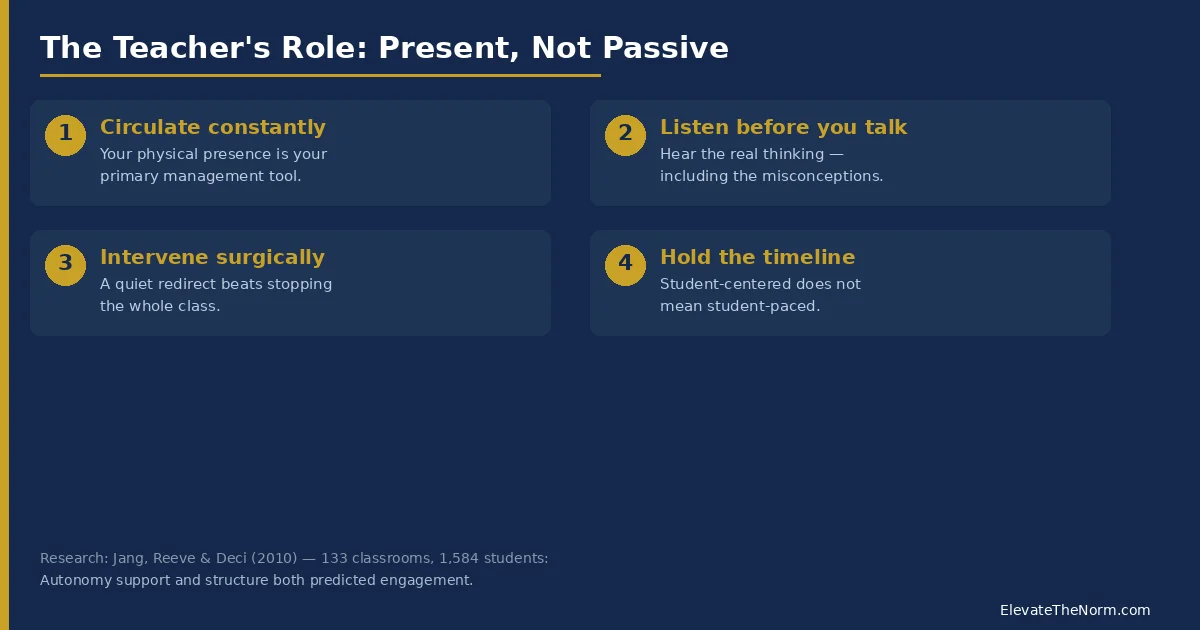
    Four teacher roles in student centered learning: circulate constantly, listen before talking, intervene surgically, hold the timeline — based on Jang, Reeve, and Deci research
    The teacher’s role in student-centered learning: present, active, and strategic.

    Every activity above requires a teacher who is actively working the room — not sitting at a desk, not grading papers, and certainly not treating “student centered” as a synonym for “teacher absent.” The research is clear on this. Jang, Reeve, and Deci (2010) studied 133 high school classrooms with 1,584 students and found that autonomy support and structure were positively correlated — teachers who gave students meaningful choices also provided clear expectations and active guidance. Both predicted behavioral engagement, and autonomy support uniquely predicted students’ self-reported engagement.

    That finding should end the false dichotomy between “teacher-directed” and “student-centered.” The best version of student-centered instruction is teacher-led in terms of structure and student-led in terms of thinking. The teacher builds the frame. The students fill it.

    In practical terms, this means:

    • Circulate constantly. Every activity in this article assumes the teacher is moving. If you are standing in one spot, you are missing what is happening across the room.
    • Listen before you talk. When you approach a group, listen for thirty seconds before saying anything. You will hear the real thinking — including the misconceptions you need to address.
    • Intervene surgically. A quiet redirect to one group is more effective than stopping the whole class. Save the full-class interruption for patterns, not individual mistakes.
    • Hold the timeline. Student-centered does not mean student-paced. Post the schedule. Keep it visible. Name the time remaining. Students work better inside a boundary they can see.

    How to Prevent Freedom From Becoming Confusion

    The number one reason teachers abandon student-centered activities is not that the activities failed — it is that the room fell apart during the transition. Students did not know what to do, took too long to start, or interpreted “work with your group” as “talk to your friends about the weekend.”

    Here is the fix, and it is not complicated:

    1. Explain the activity in under two minutes. If your instructions take longer than that, the activity is too complicated or your explanation is too detailed. Students learn the activity by doing it, not by listening to you describe every contingency.
    2. Post the task, the time, and the product. Every student should be able to look at the board and answer three questions without asking you: What am I doing? How long do I have? What do I turn in?
    3. Start with a model. The first time you run a Socratic seminar, model it with a small group while the rest of the class watches. The first time you use peer critique, walk through one example piece of feedback as a class. This takes ten minutes and saves you from answering the same question thirty times.
    4. Build in a two-minute check. Two minutes after students begin, stop and ask: “Raise your hand if you are not sure what you should be doing right now.” Fix the confusion immediately. Do not wait until the end of the period to discover that half the room was lost from the start.
    5. Debrief every time. Spend the last three minutes of the activity debriefing what worked and what did not. This is where student motivation builds — when they see that the activity had a point, that their effort produced something, and that the teacher noticed.

    Starting Small: A Realistic Entry Point

    Do not try to run all of these activities next Monday. Pick one. Run it once. See what happens. Adjust. Run it again.

    If you have never done anything student-centered beyond group work, start with a choice board. It requires the least classroom management adjustment, gives you a visible product to assess, and lets students practice making decisions within a structure you control. Once that feels routine — two or three times, usually — add a Socratic seminar or a gallery walk. Build the repertoire over weeks, not days.

    The Baeten et al. (2023) meta-analysis found that student-centered interventions lasting longer than six months produced effect sizes nearly double those of shorter interventions (SMD = 1.08 vs. 0.63–0.72). Translation: this is a long game. The activities get more effective the more students experience them, which means the worst thing you can do is try everything once, decide it did not work, and go back to lecture. It did not fail. It had not started yet.

    Teach the way you want students to learn: start with what is manageable, build from experience, and treat the mistakes as data, not as evidence that you should quit. For a ready-to-use tool on this, see a printable student-led conference toolkit.

    Student-centered activities work best when students also have a real say in how the work is structured. For a framework on how much say students can hold at each level — and where teacher authority must stay — see student voice and choice.


    Frequently Asked Questions

    Do student-centered activities work in large classes?

    Yes, but the structure matters more. Inquiry stations, choice boards, and peer critique protocols all scale to thirty-plus students because they operate in small groups. Socratic seminars work best with fifteen or fewer in the inner circle — use the fishbowl format for larger classes. The key is that every student has a specific task, not that every student is doing the same thing at the same time.

    How do I assess student-centered activities?

    Use the products the activities produce. Inquiry stations generate claim statements. Choice boards produce varied demonstrations of the same standard. Peer critique generates written feedback. Socratic seminars pair with participation trackers and written reflections. Every activity in this article includes a built-in artifact you can grade, which means assessment does not require a separate test.

    What if students are not used to this kind of work?

    Expect the first attempt to be messy. Students who have spent years in teacher-directed classrooms need time to adjust to making decisions, and that adjustment sometimes looks like confusion or off-task behavior. The fix is not to abandon the approach — it is to start with the most structured option (choice boards), build routines over several weeks, and explicitly teach the behaviors each activity requires before running it.

    Can student-centered activities cover required standards?

    They must. Student-centered is not a license to skip the curriculum. Every activity in this article is designed around a learning target tied to standards. Choice boards offer multiple paths to the same standard. Inquiry stations present evidence aligned to specific content. Socratic seminars and structured academic controversies require engagement with course material. If the activity does not serve the standard, redesign the activity — do not lower the standard.

    Is student-centered learning the same as project based learning?

    No, but they overlap. Project based learning is one type of student-centered instruction — one that is sustained, inquiry-driven, and produces a public product. The activities in this article are shorter, can fit inside a single class period, and do not require a multi-week project structure. A teacher running PBL will use many of these activities within a project. A teacher who does not run PBL can still use all of them.

    How do I handle students who refuse to participate in group activities?

    First, find out why. A student who refuses to participate is telling you something — about the group, the task, the social dynamics, or their own confidence. Offer a structured alternative that meets the same objective individually, and check in privately. Do not force public participation as a compliance test. That said, opting out of collaboration entirely is not a long-term option in a classroom that values it, so build toward participation gradually with low-risk entry points like written peer feedback before verbal discussion.

    Do these activities work for students with IEPs or 504 plans?

    Student-centered activities are often more accessible than traditional instruction, not less. Choice boards allow students to demonstrate learning through their strongest mode. Inquiry stations can include differentiated source materials at different reading levels. Socratic seminars can be supported with sentence stems and pre-discussion preparation time. The built-in flexibility of student-centered work makes accommodation a design feature, not an add-on — but you still need to review each activity against the specific accommodations in each student’s plan.


    Sources

    1. Baeten, M., Dochy, F., Struyven, K., Parmentier, E., & Vanderbruggen, A. (2023). “Student-Centered Education: A Meta-Analysis of Its Effects on Non-Academic Achievements.” SAGE Open, 13(2). https://doi.org/10.1177/21582440231168792
    2. Patall, E. A., Cooper, H., & Robinson, J. C. (2008). “The Effects of Choice on Intrinsic Motivation and Related Outcomes: A Meta-Analysis of Research Findings.” Psychological Bulletin, 134(2), 270–300. https://doi.org/10.1037/0033-2909.134.2.270
    3. Jang, H., Reeve, J., & Deci, E. L. (2010). “Engaging Students in Learning Activities: It Is Not Autonomy Support or Structure but Autonomy Support and Structure.” Journal of Educational Psychology, 102(3), 588–600. https://doi.org/10.1037/a0019682
    4. Association for Supervision and Curriculum Development (ASCD). (2023). “Socratic Seminars: Engaging Students in Intellectual Discourse.” Educational Leadership. https://www.ascd.org/el/articles/socratic-seminars-engaging-students-in-intellectual-discourse
    5. PBLWorks. (2024). “Using Gallery Walks for Critique & Revision in PBL.” Buck Institute for Education. https://www.pblworks.org/blog/using-gallery-walks-critique-revision-pbl
    6. Berger, R., Rugen, L., & Woodfin, L. (2014). Leaders of Their Own Learning: Transforming Schools Through Student-Engaged Assessment. Jossey-Bass/EL Education.

    About Clay Shumate

    Clay Shumate is a certified secondary Social Studies teacher in the public schools of West Alabama, with seven years of classroom experience, a B.A. in History, and an M.Ed. in Secondary Education. He writes about project-based learning, student responsibility, respect, and practical ways to hold young people to a higher standard while giving them room to learn from mistakes. He is a member of the Society of Professional Journalists and writes to its Code of Ethics; this site’s editorial standards and corrections policy are published in full. More about Clay.
  • Experiential Learning High Schools Can Actually Use

    Experiential Learning High Schools Can Actually Use

    Experiential Learning High Schools Can Actually Use

    By Clay Shumate

    Experiential learning in high schools is learning that comes from doing something real, reflecting on what happened, and applying what you figured out to the next challenge. It is not a field trip. It is not a hands-on activity tacked onto the end of a lecture unit. It is a structured cycle of experience, reflection, and transfer — and high schools can use it inside ordinary schedules and budgets without rebuilding anything.

    Key Takeaways

    • Experiential learning is a structured cycle — experience, reflection, conceptualization, application — not just any activity where students use their hands.
    • High schools can implement experiential learning within existing courses, bell schedules, and budgets. The barrier is design, not money.
    • Reflection and transfer are what separate experiential learning from mere activity. Without them, students have an experience but do not learn from it.
    • Types range from simulations and case studies that never leave the classroom to internships, service learning, and community partnerships that extend beyond it.
    • The teacher’s role shifts from delivering information to designing experiences, supporting learners through difficulty, and facilitating reflection — not disappearing.

    What Experiential Learning Actually Is

    The term goes back to John Dewey, who argued in the 1930s that education must be grounded in real experience — not experience for its own sake, but experience organized to produce growth. David Kolb formalized the idea into a four-stage cycle in 1984: concrete experience, reflective observation, abstract conceptualization, and active experimentation. That cycle remains the dominant framework (Morris, 2020).

    The Association for Experiential Education defines it as “a teaching philosophy that informs many methodologies in which educators purposefully engage with learners in direct experience and focused reflection in order to increase knowledge, develop skills, clarify values, and develop people’s capacity to contribute to their communities” (AEE).

    The key word in that definition is purposefully. A student who dissects a frog has had an experience. A student who dissects a frog, records what they observe, connects it to the circulatory system they studied, and applies that understanding to a comparative anatomy problem has had experiential learning. The difference is not the activity. The difference is the reflection and the transfer.

    The Kolb Cycle in a High School Classroom

    Kolb’s four stages look abstract on paper. In a classroom, they look like this:

    Kolb's four-stage experiential learning cycle showing concrete experience, reflective observation, abstract conceptualization, and active experimentation
    Based on Kolb 1984, reviewed by Morris 2020

    Stage 1 — Concrete Experience. The student does something. They run a simulation of a historical negotiation. They conduct an interview with a local business owner. They attempt to solve a problem with incomplete data. The experience is real enough that it produces genuine confusion, interest, or difficulty — not a rehearsal of something the teacher already explained.

    Stage 2 — Reflective Observation. The student steps back and thinks about what happened. What worked? What did not? What surprised them? This stage is where most high school implementations fail — the activity ends, the bell rings, and nobody processes anything. Without reflection, the experience is a memory, not learning.

    Stage 3 — Abstract Conceptualization. The student connects the experience to bigger ideas, theories, or principles. This is where content instruction lives. The difference is that the student encounters the concept after the experience, not before — so the concept explains something they have already encountered rather than something they have only been told about.

    Stage 4 — Active Experimentation. The student applies what they have learned to a new situation. This is the transfer. A student who ran a Treaty of Versailles simulation, reflected on why negotiations collapsed, and connected it to concepts of national self-interest now applies that understanding to analyzing a current diplomatic dispute. The cycle starts again.

    I have a whiteboard table in my classroom — a table I built, surrounded by better chairs and a low lamp, in the corner of the room where students actually ask to sit. That table is where the reflection stage happens for most of my small-group work. When I pull a group there after a simulation or a document analysis, the shift in setting signals that we are moving from doing to thinking. The conversation changes. Students are not performing for the room anymore. They are processing what just happened, and the physical space — quieter, closer, more intentional — makes that processing better.

    Types of Experiential Learning That Work in High Schools

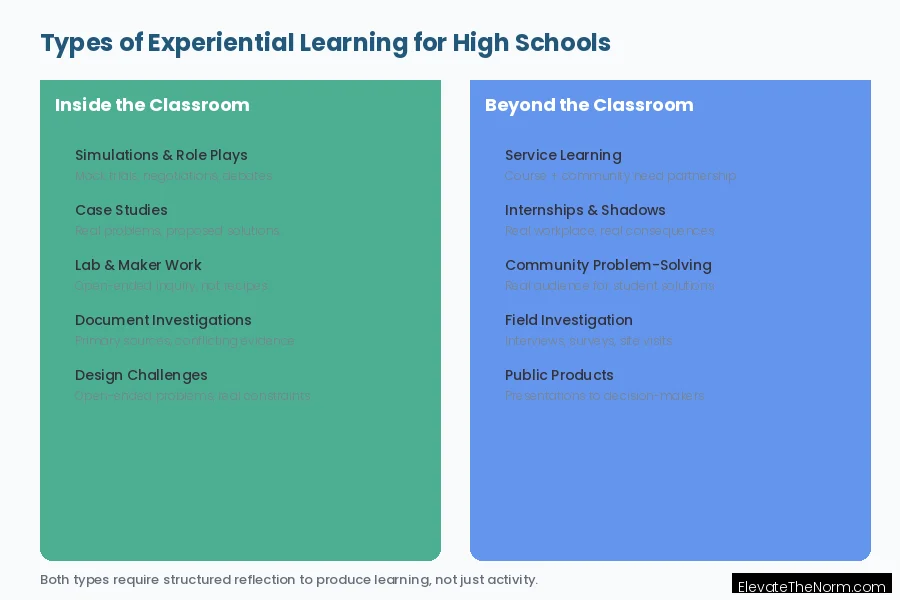
    Not every form of experiential learning requires a bus, a budget, or a community partner. Many of the most effective types happen inside the building, during regular class periods, with materials already available. A set of worked project examples across subjects shows what this looks like in school-based, community-connected, and cross-curricular formats. My Social Studies Teacher Toolkit Bundle on TPT covers world history and civics if you want finished materials for the content side.

    Two-column comparison of experiential learning types: inside the classroom including simulations, case studies, and labs, and beyond the classroom including service learning and internships
    Both types require structured reflection to produce learning, not just activity

    Inside the Classroom

    Simulations and role plays. A mock trial. A constitutional convention with competing delegates. A town-hall debate on a local zoning decision. Simulations compress real-world complexity into a classroom-sized experience and force students to make decisions under constraints. The learning lives in the debrief — the conversation afterward about why they made the choices they made and what those choices reveal about the subject.

    Case studies. Give students a real problem — a business decision, a public health crisis, an engineering failure, a historical dilemma — and ask them to analyze it, propose a solution, and defend their reasoning. Case-based learning is experiential because the student is doing the intellectual work of a practitioner, not memorizing someone else’s conclusions.

    Laboratory and maker work. Science labs are the oldest form of experiential learning in secondary schools. The challenge is ensuring that labs are genuine inquiry — where the student does not know the answer before they start — rather than confirmation exercises where they follow a recipe to arrive at a predetermined result. The same principle applies to maker spaces, fabrication labs, and design challenges: the value is in the open-ended problem, not the equipment.

    Document-based investigations. In a social studies class, this means handing students primary sources, conflicting accounts, or incomplete evidence and asking them to construct an interpretation. The experience is the intellectual struggle of the discipline itself — weighing evidence, identifying bias, tolerating ambiguity, building an argument.

    Beyond the Classroom

    Service learning. Service learning is not community service with a reflection worksheet. It is a structured partnership between a course and a community need, where the service advances the academic learning and the academic learning improves the service. A biology class monitoring water quality for a local watershed organization is service learning. A class picking up trash for a day is community service — valuable, but not the same thing.

    Internships and job shadows. Extended placements in professional settings give students access to the real pace, decisions, and consequences of adult work. Several states have begun requiring or incentivizing these: Mississippi now provides career coaches in every public high school, Indiana requires all graduates to complete a work-based learning experience, and Delaware has built a statewide career pathway system that connects classroom learning to industry credentials.

    Community problem-solving and public products. Students identify a real problem in their community, research it, propose a solution, and present that solution to a genuine audience — a city council, a school board, a local business, a nonprofit. The audience is what makes it experiential rather than hypothetical. A student who presents to someone who might actually implement their idea is having a fundamentally different experience from a student who presents to their teacher for a grade. This is also the heart of strong project-based learning.

    Field investigation. Site visits, interviews, environmental surveys, oral history projects, archaeological-style artifact analysis. The fieldwork does not need to be exotic. Interviewing a grandparent about their experience during a historical period is field investigation. Photographing and documenting the architectural history of a single block downtown is field investigation. What matters is that the student encounters primary evidence in its natural context rather than in a textbook.

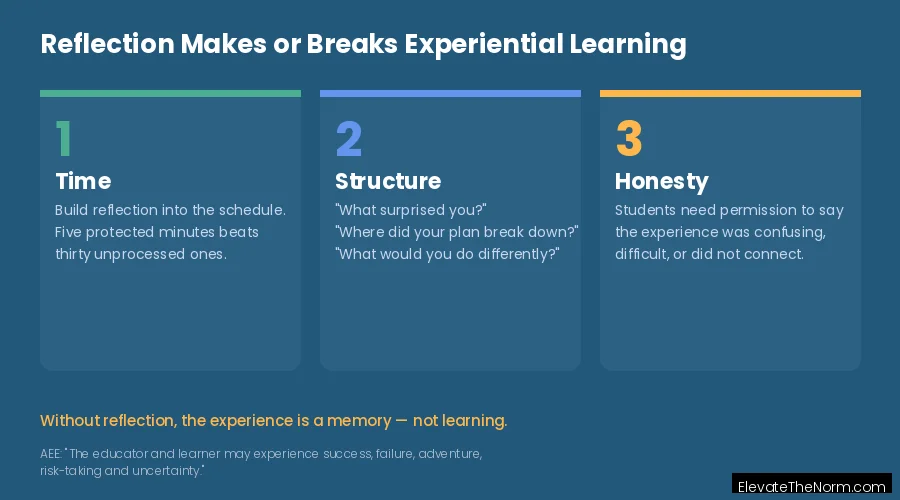
    Why Reflection Makes or Breaks the Whole Thing

    An experience without reflection is just something that happened. Reflection is the mechanism that converts an event into understanding. Kolb’s model, Dewey’s philosophy, and the AEE’s principles all agree on this point: the learning does not live in the experience. It lives in what the learner makes of the experience afterward.

    Three requirements for effective reflection in experiential learning: time, structure, and honesty
    Without reflection, the experience is a memory — not learning

    In practice, reflection requires three things from the teacher:

    Time. This is the hardest resource to protect. When the simulation runs long or the lab takes the full period, reflection gets cut. Plan for it. Build it into the schedule, not the leftover minutes. Even five protected minutes of structured reflection are worth more than thirty minutes of unprocessed activity.

    Structure. “What did you think?” is not reflection. It is an invitation to say “It was cool” and move on. Effective reflection questions are specific: What surprised you? Where did your plan break down? What would you do differently if you ran the simulation again? What does this experience suggest about how [concept] works in practice?

    Honesty. Students need permission to say the experience did not work, was confusing, or did not connect. The AEE’s principles explicitly state that “the educator and learner may experience success, failure, adventure, risk-taking and uncertainty.” If every reflection ends with a tidy success narrative, the reflection is performative, and students will learn to produce the expected answer rather than the honest one.

    Making It Work Inside an Ordinary Schedule

    The most common objection to experiential learning in high schools is time. Block schedules help, but plenty of schools run 45-minute periods. Experiential learning is still possible. It just requires different design.

    Break the cycle across days. Kolb’s cycle does not need to happen in one period. Run the experience on Monday, the reflection on Tuesday, connect to the content on Wednesday, and apply to a new situation on Thursday. This is no different from what good teachers already do — it just makes the structure explicit.

    Use the classroom for what the classroom can do. Simulations, case studies, document analyses, design challenges, and problem-solving protocols are all experiential and all fit inside a regular class period. A bank of ready-to-run activities across those categories shows how each one fits a single period. Not every experiential activity requires leaving the building. Some of the strongest experiences are intellectual, not physical — the struggle of interpreting conflicting evidence, the difficulty of building a persuasive argument, the challenge of solving a problem with incomplete information.

    Start with one unit. You do not need to redesign an entire course. Take one unit you already teach, identify where students currently receive information passively, and replace that section with an experience that forces them to encounter the concept before you explain it. Then add structured reflection. That is the whole conversion. You can scale from there.

    Budget is not the barrier — design is. A simulation costs nothing. A case study costs nothing. A structured interview protocol costs nothing. An oral history project costs nothing. The expensive forms of experiential learning — internship programs, community partnerships, off-campus placements — are valuable, but they are not the only forms, and waiting for the budget to build them should not prevent you from using the forms you can start tomorrow.

    What the Research Says

    Ranken’s 2025 rapid evidence assessment, published in The Curriculum Journal, examined studies on the effect of experiential learning on academic achievement for students aged 4–14. The assessment found positive effects overall but noted wide variation by implementation quality, with the strongest outcomes in programs that included structured reflection and explicit connection to curriculum content (Ranken, 2025).

    Morris (2020), in a systematic review and revision of Kolb’s model published in Interactive Learning Environments, confirmed the experiential learning cycle’s continued relevance while noting that Kolb’s original four-stage model benefits from greater emphasis on the social context of learning — the idea that experiences are more powerful when learners process them with others, not just internally (Morris, 2020).

    Data from CapSource and other employer surveys consistently find a gap between what high school and college graduates can do and what employers need them to do. CapSource reported that 72 percent of graduates felt unprepared for workplace challenges and 84 percent of hiring managers identified readiness gaps. Experiential learning directly addresses this by giving students practice with the skills — problem-solving, communication, adaptation, professional judgment — that traditional instruction often describes but rarely lets students perform.

    The evidence does not suggest that experiential learning is a universal replacement for direct instruction. Some content is efficiently taught through explanation, practice, and feedback. The evidence suggests that experiential learning fills a gap that direct instruction cannot: the gap between knowing about something and knowing how to do it, between receiving information and constructing understanding. Strong project-based learning uses the same principle at a larger scale.

    Common Mistakes to Avoid

    Activity without purpose. An experience that is fun but unconnected to learning goals is not experiential learning. It is a field trip. Every activity needs to produce a struggle, a question, or a problem that the curriculum can then help resolve.

    Skipping the reflection. This is the most common failure, and it reduces experiential learning to busy hands. If the bell rings before students process what happened, the learning did not happen. Protect the reflection time the way you protect the test — it is not optional.

    Assuming experiences must leave the building. Internships and community partnerships are excellent, but they are not the definition. Simulations, case analyses, structured debates, and design challenges are experiential, and they work inside a regular classroom during a regular period.

    Removing the teacher. Experiential learning shifts the teacher’s role — it does not eliminate it. The AEE’s principles describe the educator’s role as setting suitable experiences, posing problems, supporting learners, ensuring physical and emotional safety, and facilitating the learning process. A teacher who launches an activity and then retreats to a desk has not implemented experiential learning. They have implemented unsupervised activity.

    Confusing experiential learning with entertainment. Difficulty is not a design flaw. It is the point. An experience that challenges, confuses, or frustrates the student is exactly where learning happens — provided the teacher supports the student through it and the reflection helps them make sense of it. Ease and fun are not the goal. Growth is.

    Conclusion

    Experiential learning in high schools does not require a new building, a grant, or a revolution. It requires a teacher who is willing to let students encounter a problem before the answer, sit with difficulty long enough to learn from it, and reflect honestly on what happened. That cycle — experience, reflection, understanding, application — is how people actually learn outside of school. There is no reason school should be different.

    Start with one simulation, one case study, one structured interview, one investigation. Build in the reflection. Connect it to the content. Let the student apply what they figured out to something new. That is experiential learning. It works in a 45-minute period, in a regular classroom, on a regular budget. And it produces students who can actually use what they learned the moment they walk out the door.

    Frequently Asked Questions

    What is the difference between experiential learning and hands-on learning?

    Hands-on learning means the student physically manipulates materials or does an activity. Experiential learning adds three critical layers: the experience must produce a genuine question or challenge, the student must reflect on what happened, and the student must apply the insight to a new situation. A student building a volcano model is doing hands-on learning. A student designing a structure to withstand a simulated earthquake, reflecting on why it failed, and revising the design based on engineering principles is doing experiential learning. The difference is the reflection and the transfer, not the materials.

    Can experiential learning work in a 45-minute class period?

    Yes. Kolb’s learning cycle does not need to happen in a single period. Run the experience on one day and the reflection on the next. Alternatively, use shorter experiential activities that fit inside a standard period: a 15-minute simulation followed by 10 minutes of structured reflection and 15 minutes of content connection. Many classroom-based forms — case studies, document analyses, structured debates, design challenges — are designed for exactly these time constraints.

    What is the teacher’s role in experiential learning?

    The teacher designs the experience, sets up the problem, supports students through difficulty, ensures physical and emotional safety, and facilitates reflection. The teacher does not disappear. The Association for Experiential Education explicitly names educator presence and intentional facilitation as foundational principles. The role shifts from delivering information to creating the conditions for students to encounter, struggle with, and make sense of that information through experience.

    What are examples of experiential learning that stay inside the classroom?

    Simulations and role plays, such as a mock trial or a historical negotiation. Case studies where students analyze a real problem and propose solutions. Document-based investigations using primary sources, conflicting accounts, or incomplete evidence. Design challenges and maker projects with open-ended problems. Laboratory investigations structured as genuine inquiry rather than recipe-following. Structured debates where students must argue positions they did not choose. All of these produce authentic intellectual struggle, which is what makes them experiential.

    How is experiential learning different from project-based learning?

    Experiential learning is the broader philosophy — learning through direct experience, reflection, and application. Project-based learning is one methodology that uses experiential principles at an extended scale, typically involving a driving question, sustained inquiry, and a public product. All strong PBL is experiential, but not all experiential learning is PBL. A 20-minute simulation is experiential but is not a project. A two-week investigation culminating in a community presentation is both.

    Does experiential learning work for all subjects?

    Yes, though it looks different across disciplines. In science, it may involve laboratory inquiry or field investigation. In social studies, it may involve simulations, primary-source analysis, or oral history. In English, it may involve real-world writing for an actual audience. In math, it may involve data collection and analysis on a genuine question. In career and technical education, it may involve internships, job shadows, or client projects. The principle is universal: students learn more deeply when they encounter problems before solutions and reflect on what they discover.

    How do I assess experiential learning?

    Assess both the process and the product. Reflection journals, debriefing discussions, self-evaluations, and peer feedback capture what the student learned from the experience. Rubrics, portfolios, and final products measure the quality of work produced. The key is aligning assessment with the learning goals, not the activity itself. A student who had a strong experience but a weak reflection has not completed the cycle. A student who produced a polished product without engaging genuinely in the experience has performed, not learned.

    Sources


    About Clay Shumate

    Clay Shumate is a certified secondary Social Studies teacher in the public schools of West Alabama, with seven years of classroom experience, a B.A. in History, and an M.Ed. in Secondary Education. He writes about project-based learning, student responsibility, respect, and practical ways to hold young people to a higher standard while giving them room to learn from mistakes. He is a member of the Society of Professional Journalists and writes to its Code of Ethics; this site’s editorial standards and corrections policy are published in full. More about Clay.
  • Project Based Learning Resources: Free Tools for Middle and High School Teachers

    Project Based Learning Resources: Free Tools for Middle and High School Teachers

    By Clay Shumate

    Project based learning resources worth using are the ones that solve a specific problem in your planning, not the ones that look impressive in a Pinterest folder. This article evaluates free planning templates, rubrics, critique protocols, driving-question tools, reflection forms, and project calendars for grades 6–12 teachers—and tells you what each one actually does well and where it falls short. A companion piece answers the questions teachers are actually asking AI about PBL.


    Key Takeaways

    • The best PBL resources solve one clear problem—planning, assessment, critique, or reflection—rather than trying to do everything.
    • Free does not mean ready to use. Most templates need adaptation for your students, your standards, and your schedule.
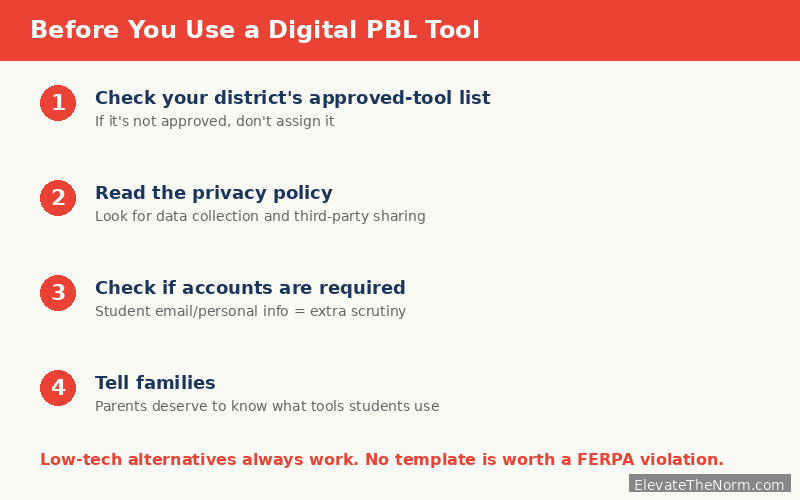
    • Evaluate every digital tool for student data privacy before putting it in front of a class. Free platforms often collect data that schools have a legal obligation to protect.
    • A driving-question tool and a critique protocol will improve your projects faster than any other single resource.
    • ElevateTheNorm.com will be building original, downloadable PBL planning templates designed specifically for grades 6–12. Those are coming.

    The Problem with Most PBL Resource Lists

    Search for project based learning resources and you will find dozens of lists. Most of them share the same problem: they dump thirty links on you with no evaluation, no context, and no explanation of what each resource actually does when you sit down to use it.

    That is not a resource hub. That is a reading assignment.

    Teachers do not need more links. They need someone to say: here is what this tool does, here is what it does not do, here is where it breaks down, and here is whether it is worth your limited planning time. That is what this article does.

    A 2023 meta-analysis published in Frontiers in Psychology examined 106 studies on PBL’s impact on student learning and found a significant positive effect across subjects and grade levels (Zhang & Ma, 2023). The evidence for PBL is strong, and it holds up when you look at how PBL compares with traditional instruction on content knowledge and skill transfer. The barrier is not whether it works—it is whether teachers can plan and manage it without burning out. Good resources lower that barrier. Bad ones raise it by adding confusion.


    Planning Templates

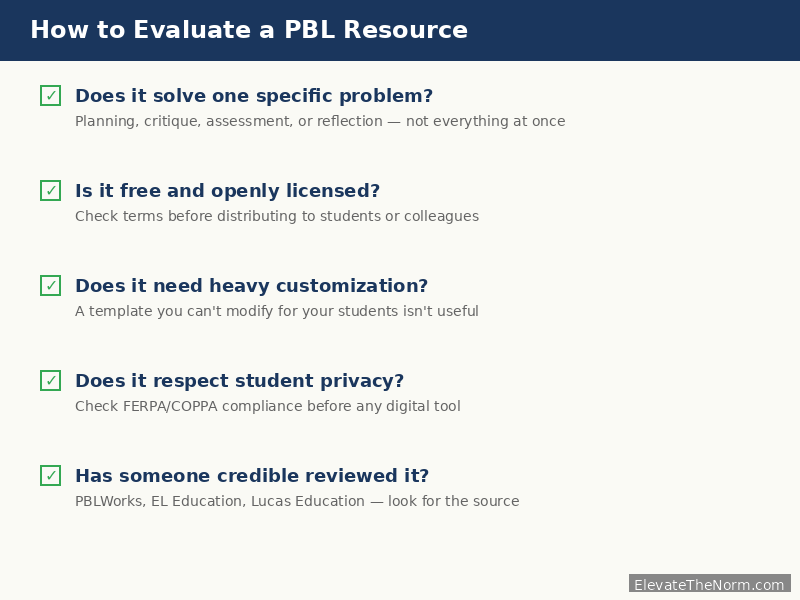
    Five-item checklist for evaluating project based learning resources: standards alignment, student ownership, assessment integration, accessibility, and teacher support
    Five criteria for evaluating whether a project based learning resource is worth your time

    PBLWorks Project Design Overview

    What it is: A one-page planning template from PBLWorks (formerly the Buck Institute for Education) that walks you through the Gold Standard PBL design elements—driving question, sustained inquiry, authenticity, student voice and choice, reflection, critique and revision, and a public product.

    What it does well: Forces you to think about every essential element before you start building lessons. The format is tight enough to fit on a single page, which means you cannot hide vague thinking behind long paragraphs. If you leave a box blank, you know something is missing.

    Where it falls short: The template assumes you already understand the Gold Standard framework. If you are new to PBL, the boxes will not teach you what belongs in them. Pair it with the PBLWorks “Getting Started” guide or with the definition of project based learning article on this site.

    Verdict: Use it. This is the most widely used PBL planning template for a reason. It is free, it is well-structured, and it keeps you honest about whether your project is actually PBL or just a long assignment.

    Project Calendar Template

    What it is: A week-by-week or day-by-day calendar that maps your project phases onto actual class periods.

    What it does well: Solves the most common PBL planning failure—not knowing how long things take. When you map inquiry, research, drafting, critique, revision, and presentation onto real days, you find out immediately whether your timeline is realistic. It also gives students a visible schedule so they can pace themselves.

    Where it falls short: No single calendar template fits every project, schedule, or block length. You will need to build your own or heavily modify whatever you find. The PBLWorks template above does not include one.

    Verdict: Build your own from a simple spreadsheet. Map the Gold Standard phases onto your actual bell schedule. Share it with students on day one. Adjust publicly when reality changes the plan—that is modeling real project management, not admitting failure.


    Driving-Question Tools

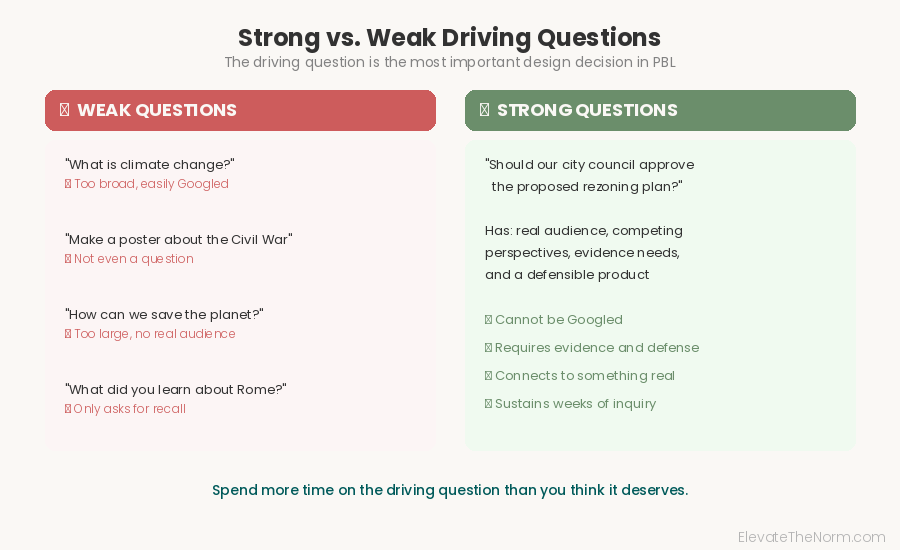
    A strong driving question is the difference between a project that sustains genuine inquiry and a project that collapses into a Google search on day two. If you are going to invest time in one PBL resource, invest it here.

    PBLWorks Driving Question Tubric

    What it is: A “tubric”—a combination of a rubric and a tutorial—that helps you evaluate whether your driving question is open-ended, engaging, aligned to standards, and complex enough to sustain weeks of investigation.

    What it does well: Gives you specific criteria for testing a question before you commit to it. “Can students answer this in one class period?” is the single most useful diagnostic. If the answer is yes, the question is not a driving question.

    Where it falls short: The language is written for teachers, not students. If you want students to help develop or evaluate driving questions—and you should—you will need to simplify the criteria for them.

    Verdict: Essential. Weak driving questions are the number-one reason PBL projects fail. This tool will not write the question for you, but it will tell you whether the one you wrote is strong enough to carry a project.

    For more on writing effective driving questions, see project based learning driving question examples on this site.


    Critique Protocols

    Critique is where student work gets better. Not praise, not grades—structured critique that tells a student specifically what is working, what is not, and what to do next. These protocols make that process fair and productive instead of awkward and personal.

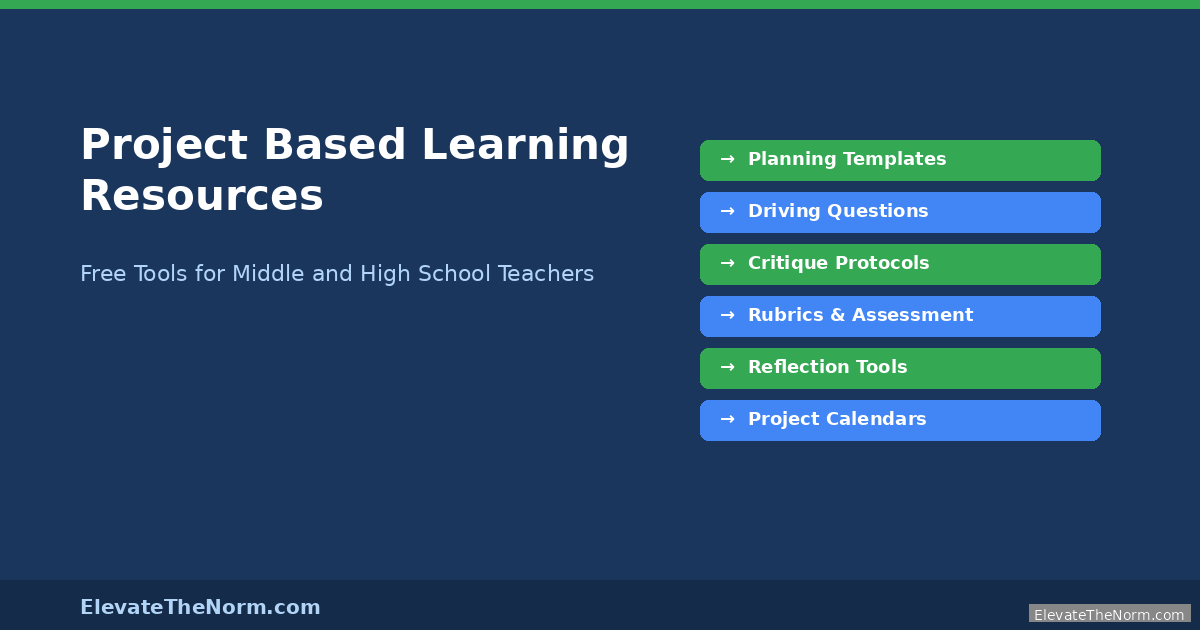
    Project based learning resource categories organized by purpose: planning templates, driving-question tools, critique protocols, rubrics and assessment, and reflection tools with recommended free sources
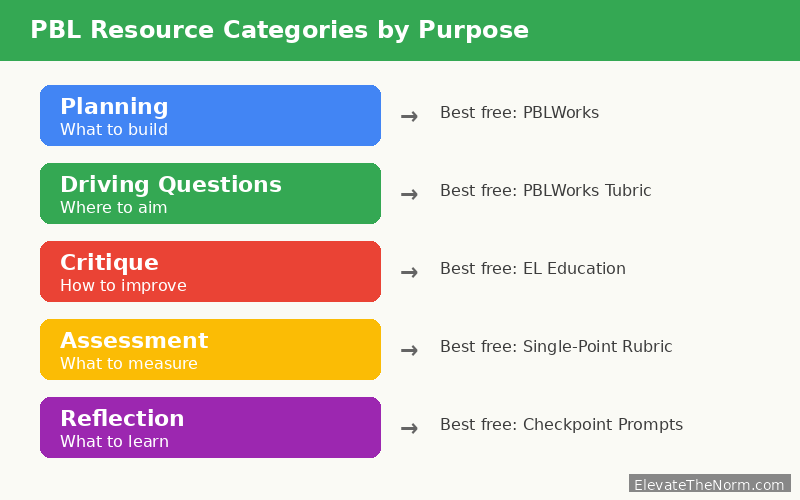
    Project based learning resources organized by category with the best free source for each

    EL Education Classroom Protocols

    What it is: A collection of structured discussion and critique protocols from EL Education (formerly Expeditionary Learning), including gallery walks, tuning protocols, peer critique checklists, and Socratic seminars.

    What it does well: These are some of the most carefully designed classroom protocols available anywhere, and they are free. The critique protocols in particular—especially the “kind, specific, helpful” framework—give students language for feedback that is honest without being destructive. That matters enormously in grades 6–12, where peer feedback can go sideways fast.

    Where it falls short: The protocols were designed for EL Education’s own curriculum, so some require adaptation for standalone PBL use. The formatting is dense. You may need to extract the protocol you need and reformat it as a student-facing handout. If you are an instructional coach supporting a teacher’s first project, model the critique protocol in the teacher’s room before asking them to run it independently—cold handoffs of complex protocols do not work.

    Verdict: The single best free critique resource for secondary PBL. Download the protocols PDF, learn the “kind, specific, helpful” framework, and use it every time students give feedback on each other’s work. It will change the quality of your projects.

    I use partner work as the default condition in my room—students are almost always working alongside somebody, not sitting in rows facing the front. That means critique is not a special event I schedule once before the final product. It is woven into every work session. A student finishes a draft, turns to their partner, and gets immediate feedback using the protocol we practiced together. The whiteboard table groups make this natural—when your tables are already pushed together, you do not have to rearrange the room to make peer critique happen. You just have to teach students how to do it well, which is exactly what the EL Education protocols are for.

    Austin’s Butterfly (Video Protocol)

    What it is: A short video by Ron Berger showing first graders giving specific, actionable feedback on a student’s scientific illustration of a butterfly—and watching the drawing improve dramatically through multiple drafts.

    What it does well: Shows students what critique looks like in practice. Even high school students respond to this video because the principle is the same regardless of age: specific feedback plus revision equals better work. It is the fastest way to teach your class that critique is not criticism.

    Where it falls short: It is an elementary example. Some secondary students will need you to connect it explicitly to their own work level. Use it as a launch, not as the only model.

    Verdict: Show it on the first day you introduce peer critique. Then move to structured protocols for ongoing use.


    Rubrics and Assessment Tools

    PBLWorks Rubrics

    What it is: Free rubrics from PBLWorks covering collaboration, presentation, critical thinking, and creativity—aligned to the Gold Standard PBL framework.

    What it does well: Separates content knowledge from PBL skills, which solves the grading problem that makes many teachers hesitate: how do I give an individual grade for a group project? The rubrics allow you to assess academic understanding independently of collaboration quality.

    Where it falls short: The rubrics are generic by design. You will need to add your content-specific criteria. A PBL rubric that does not include your actual standards is a process rubric, not an assessment rubric.

    Verdict: Use the framework, but customize. Add a row for the specific content standards your project addresses. Make sure the content row carries the majority of the grade weight. See this editable eight-category PBL rubric for a deeper breakdown.

    Single-Point Rubrics

    What it is: A rubric format with one column of criteria in the center, blank space on the left for “not yet meeting,” and blank space on the right for “exceeding.” Teachers write specific feedback in the blank spaces instead of circling a pre-written performance level.

    What it does well: Forces you to give personalized feedback rather than checking a box. Students read the feedback because it is written specifically about their work. Research from Lucas Education Research confirms that PBL students perform as well or better on standardized assessments when projects are well-designed (Saavedra & Rapaport, 2021)—and strong assessment tools are part of that design.

    Where it falls short: Takes more time to complete than a traditional rubric. If you have 150 students, the time investment is real. Consider using it for the final product and a simpler checklist for interim checkpoints.

    Verdict: Worth the time for major products. Use checklists for checkpoints.


    Reflection Tools

    Reflection is the step most teachers cut when time runs short. That is a mistake. Without structured reflection, students finish a project and move on without understanding what they learned, how they learned it, or what they would do differently.

    Structured Reflection Prompts

    What it is: A set of questions students answer at defined points during and after the project—not just at the end.

    What it does well: When reflection happens at checkpoints throughout the project, it becomes a self-regulation tool, not just a postmortem. Students who reflect mid-project catch their own problems earlier. For structured reflection activities across all four stages of the learning cycle, see these experiential learning activities.

    What to include: At minimum, ask students to answer three questions at each checkpoint: What did I learn since the last checkpoint? What is not working? What will I do differently before the next checkpoint?

    Where it falls short: Reflection prompts only work if students believe their answers matter. If you collect reflection forms and never reference them, students will write the minimum. Read the reflections. Respond to them. Use them in conferences.

    Verdict: Build your own using the three questions above. Add project-specific questions as needed. Schedule reflection into your project calendar—if it is not on the calendar, it will not happen.


    Digital Tools: A Privacy Warning

    Four-step privacy check process for digital project based learning tools: FERPA compliance, data storage, parent notification, and student consent
    Four privacy checks to complete before using any digital project based learning tool with students

    Free digital tools for PBL collaboration—shared documents, project management boards, discussion platforms—can be genuinely useful. They can also collect student data in ways that violate FERPA and COPPA if your district has not reviewed them.

    Before you put any digital tool in front of students, check four things:

    1. Does your district have a signed data privacy agreement with this platform? Many districts maintain approved-tool lists. Check yours before adopting a new platform, no matter how popular it is with other teachers.
    2. What data does the platform collect, and who can access it? Read the privacy policy. If you cannot find a clear answer, that is your answer.
    3. Can students use the tool without creating personal accounts? Platforms that require student email addresses or personal information deserve extra scrutiny.
    4. Have you told families what tools students will use? Parents have a reasonable expectation of knowing what platforms their children are accessing at school. A brief note home listing the tools and their purpose prevents problems later—and builds the trust that makes PBL possible across the school year.

    A multi-complementary study published in 2026 found that PBL’s positive effects on academic achievement and motivation held across diverse school contexts (Batdı et al., 2026). The method works. The technology is optional. Do not let a tool’s convenience override your students’ privacy rights.

    Low-tech alternatives work. Shared physical whiteboards, paper critique forms, printed calendars posted on the wall, and in-person presentations to real audiences are PBL resources too—and they do not collect data on anyone.

    The same evaluation applies to the reading platforms projects tend to lean on. Several of the best-known ones have moved features behind a school licence since teachers first started recommending them, so it is worth checking which classroom reading tools are actually still free before you build a project around one.


    What This Site Is Building

    ElevateTheNorm.com is developing original, downloadable PBL resources specifically designed for grades 6–12 teachers. These are not reformatted versions of existing tools. They are built from the ground up for secondary classrooms where you have 50-minute periods, 27 students, and no extra planning time. I keep the forms I use most in my Teacher Emergency Kit ULTIMATE Bundle on TPT, so the planning time goes to students instead of formatting.

    Planned resources include:

    • A one-page PBL project planner that includes a built-in calendar and standards-alignment section
    • A student-facing critique protocol adapted from the “kind, specific, helpful” framework for secondary use
    • A single-point rubric template with content and process rows pre-built
    • A mid-project reflection form designed for 10-minute checkpoint conversations
    • A driving-question development worksheet students can use to strengthen their own questions

    These will be free, downloadable, and designed to be used without training. Watch the resources page for availability.

    The driving-question worksheet is the one most teachers reach for first, and it is also the hardest to fill in cold. If you want models before you write your own, these driving question examples for grades 6–12 walk through strong and weak versions in science, social studies, math, and ELA, along with a five-step formula for revising a question that is not working yet.


    Three Things to Do Before You Use Any of These Resources

    Before you download a single template, do three things that will determine whether the resources actually improve your projects:

    1. Pick one resource and learn it well. Do not download everything on this list at once. Choose the tool that addresses your biggest current weakness—planning, critique, or assessment—and use it for one full project before adding another.

    2. Adapt it for your students. Every template on this list was designed for a general audience. Your students are not a general audience. Simplify the language for sixth graders. Add content-specific criteria for your subject. Adjust timelines for your block length. A resource you have customized will outperform a polished one you use as-is.

    3. Teach the tool before you use it. A critique protocol that students encounter for the first time during a high-stakes project review will not produce useful feedback. Practice the protocol on low-stakes work first. Let students get comfortable with the structure before the quality of their feedback matters.

    4. Let students help choose. When you are deciding between two reflection formats or two critique structures, let your class weigh in. Students who helped select the tool will use it more seriously than students who had it handed to them. This is not about making every decision a vote—it is about giving students real voice where their input genuinely improves the outcome.


    Sources

    1. Zhang, L. & Ma, Y. (2023). “A study of the impact of project-based learning on student learning effects: a meta-analysis study.” Frontiers in Psychology, 14, Article 1202728. https://pubmed.ncbi.nlm.nih.gov/37564309/
    2. Saavedra, A. & Rapaport, A. (2021). “Key lessons from research about project-based teaching and learning.” Phi Delta Kappan / Lucas Education Research. https://kappanonline.org/research-project-based-teaching-and-learning-saavedra-rapaport/
    3. Batdı, V., Elaldı, Ş., & Sönmez, A. (2026). “Project-based learning in schools: a multi-complementary study of its effectiveness.” Humanities and Social Sciences Communications, Nature. https://www.nature.com/articles/s41599-026-06684-4
    4. PBLWorks. “Project Design Overview and Resources.” Buck Institute for Education. https://www.pblworks.org/resources-overview
    5. EL Education. “Classroom Protocols.” https://curriculum.eleducation.org/sites/default/files/curriculumtools_classroomprotocols_053017.pdf
    6. U.S. Department of Education. “Family Educational Rights and Privacy Act (FERPA).” https://www2.ed.gov/policy/gen/guid/fpco/ferpa/index.html

    Frequently Asked Questions

    Do I need special training to use project based learning resources effectively?

    No, but you do need to understand the resource before putting it in front of students. A planning template assumes you know what belongs in each section. A critique protocol assumes you have practiced the process yourself. Spend 30 minutes with any new resource before your first use. Modify it for your students. Most PBL resources are designed to be self-explanatory, but “self-explanatory” and “ready to use cold” are not the same thing.

    Are these resources appropriate for both middle school and high school?

    Yes, but with adaptation. A driving-question rubric designed for general use will work for both, but the language may need simplifying for sixth graders and the complexity expectations may need raising for eleventh graders. The resource categories—planning, critique, rubrics, reflection—apply across grades 6–12. The specific templates within each category need adjustment for your students.

    How do I know if a PBL resource is actually backed by research?

    Look for the source. A resource from PBLWorks is built on the Gold Standard PBL framework, which is grounded in decades of research. A resource from a random education blog may or may not be. Check whether the organization behind the resource cites peer-reviewed studies, has been evaluated by independent researchers, or is affiliated with a university or established research organization. If a resource makes bold claims about student outcomes and cites nothing, treat it with skepticism.

    What if my school does not allow certain digital tools?

    Use the paper versions. Every digital PBL tool has a low-tech equivalent: printed calendars, paper critique forms, physical whiteboards, and face-to-face presentations. PBL existed before project management software. The method does not depend on the technology—it depends on a strong driving question, sustained inquiry, and a real audience for student work.

    How do I protect student privacy when using free online PBL tools?

    Check your district’s approved-tool list first. If the tool is not on it, ask your technology coordinator to review it before assigning it to students. Look for platforms that do not require student accounts or personal information. Read the privacy policy—specifically the sections on data collection, third-party sharing, and data retention. When in doubt, use the paper version. No planning template is worth a FERPA violation.

    Can I use these resources if I have never done PBL before?

    Yes, and you should start small. Pick one project for one unit. Use the PBLWorks Project Design Overview to plan it. Use the EL Education critique protocol to structure peer feedback. Use a simple reflection prompt at two checkpoints and at the end. Do not try to use every resource on this list for your first project. Build your capacity one tool at a time.

    What is the most important PBL resource for a teacher just getting started?

    A driving-question tool. Everything in a PBL project flows from the driving question. If the question is weak—too narrow, too Googleable, too disconnected from standards—no amount of beautiful templates will save the project. Start by learning how to write and test a strong driving question, then add planning, critique, and assessment tools as you gain experience.


    About Clay Shumate

    Clay Shumate is a certified secondary Social Studies teacher in the public schools of West Alabama, with seven years of classroom experience, a B.A. in History, and an M.Ed. in Secondary Education. He writes about project-based learning, student responsibility, respect, and practical ways to hold young people to a higher standard while giving them room to learn from mistakes. He is a member of the Society of Professional Journalists and writes to its Code of Ethics; this site’s editorial standards and corrections policy are published in full. More about Clay.
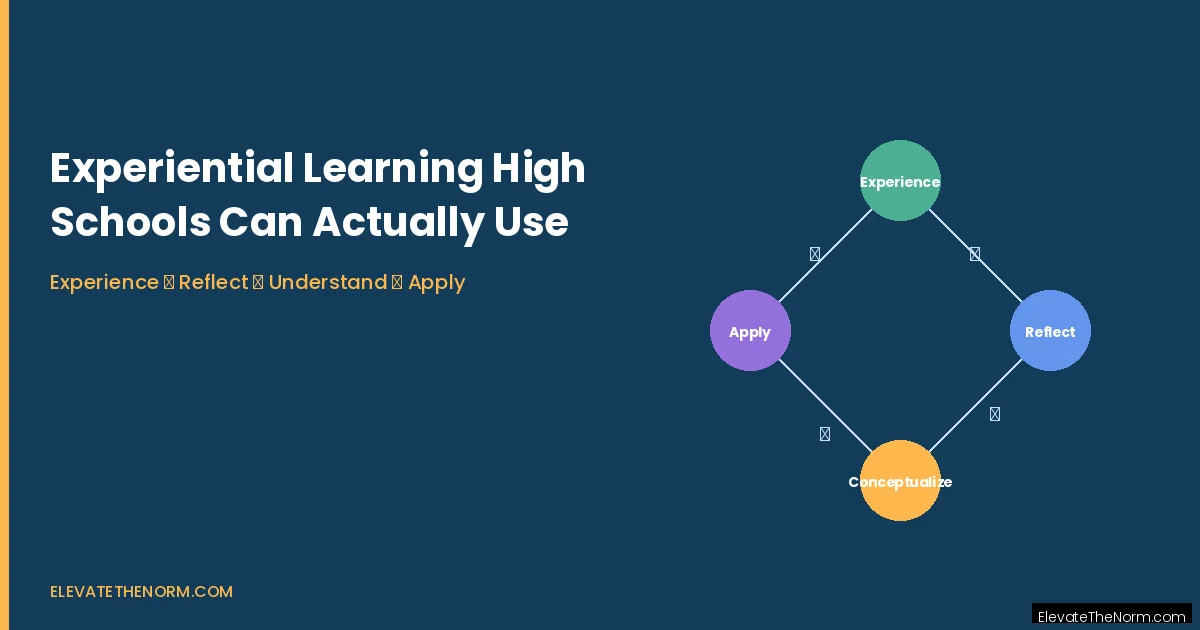
  • 7 Steps of Project Based Learning: From Driving Question to Public Product

    7 Steps of Project Based Learning: From Driving Question to Public Product

    By Clay Shumate

    The 7 steps of project based learning move a class from a question worth answering to a product worth defending. They are: identify learning goals, craft a driving question, launch the project, guide inquiry and research, set checkpoints and manage the work, facilitate critique and revision, and present the public product with reflection. Each step has a teacher role and a student role, and skipping any of them is how PBL collapses into a decorated group assignment. Each step works better when teachers and students have reliable project based learning tools—the planning templates, role cards, and critique protocols that keep the process on track. There is also a reviewed list of outside PBL resources worth the download, with the weak ones named.

    Why Steps Matter: PBL Without Structure Falls Apart

    Project based learning has a reputation problem. Teachers who have tried it and watched it fail usually did not fail at the project — they failed at the process. A class that jumps from “here is your project” to “present on Friday” without the steps in between produces exactly the kind of shallow, off-task, unequal group work that gives PBL a bad name.

    The Gold Standard PBL framework from PBLWorks, developed by John Larmer, John Mergendoller, and the Buck Institute for Education, identifies seven essential project design elements: a challenging problem or question, sustained inquiry, authenticity, student voice and choice, reflection, critique and revision, and a public product. Those elements are not decorations. They are structural requirements. Remove any one of them and the project loses what makes it PBL.

    The seven steps below translate those design elements into a sequence a teacher can actually follow. They are grounded in PBLWorks’ framework, supported by the research comparing PBL vs traditional teaching, and tested in real classrooms — including mine, where the tables are pushed together, students are always working with somebody, and the projects run while I circulate between groups.

    Step 1: Identify Learning Goals and Standards

    The teacher’s job: Decide what students must know and be able to do by the end of the project. Anchor these goals in your actual standards — state standards, Common Core, NGSS, C3, whatever your district uses. This is not optional. A project without clear learning goals is an activity, not instruction. If you need a refresher on the definition of project based learning and what separates it from traditional group work, start there.

    The common mistake: Designing the fun part first and then trying to reverse-engineer the standards into it. That produces projects where the academic content is an afterthought — the poster looks great but the student cannot explain what they learned.

    What to do instead: Start with the standards. Identify two to four that the project will assess directly. Then ask: what kind of work would require students to use these standards to answer a real question or solve a real problem? The project grows from the learning, not the other way around.

    A practical tip: write the standards on one side of a sheet of paper and the project idea on the other. If you cannot draw clear lines connecting them, the project needs to change or the standards need to change. One or the other.

    Step 2: Craft a Driving Question

    The teacher’s job: Write a question that is open-ended, challenging, anchored in real concerns, and aligned to the learning goals from Step 1. This question drives the entire project. If the question is weak, everything after it will be shallow.

    Comparison of strong and weak driving questions for project based learning showing what makes an effective PBL question
    Strong versus weak driving questions — the most important design decision in PBL

    What makes a strong driving question:

    • It cannot be answered with a Google search.
    • It requires students to gather evidence, weigh competing claims, and defend a position.
    • It connects to something real — a community issue, a professional challenge, a decision someone actually has to make.
    • It is specific enough to be answerable and broad enough to sustain weeks of inquiry.

    What makes a weak driving question:

    • “What is climate change?” — Too broad, easily Googled.
    • “Make a poster about the Civil War.” — Not a question at all.
    • “How can we save the planet?” — Too large, no real audience, no defensible product.
    • “What did you learn about ancient Rome?” — Only asks for recall, not application.

    A strong example: “Should our city council approve the proposed rezoning plan for the neighborhood south of Main Street?” This question has a real audience (the council), competing perspectives (residents, developers, environmental groups), evidence requirements (zoning data, traffic studies, community input), and a defensible product (a recommendation with data).

    Spend more time on this step than you think it deserves. A mediocre driving question produces mediocre projects no matter how well you execute the other six steps. If you want side-by-side models to work from, these driving question examples across four subject areas show what the revision from weak to strong actually looks like.

    Step 3: Launch the Project

    The teacher’s job: Introduce the driving question in a way that creates genuine curiosity, not just compliance. The launch is the moment students go from “we have a project” to “I actually want to know the answer to this.”

    Effective launches include:

    • A real-world entry event: a guest speaker, a site visit, a video of the actual problem, a letter from someone who needs the answer.
    • A “need to know” list: after the launch, students generate questions about what they need to learn to answer the driving question. This list becomes their research agenda.
    • Clear project parameters: timeline, deliverables, team structures, and how the work will be assessed.

    The trap: Over-explaining everything on day one. If students walk away from the launch knowing exactly what the final product should look like, you have removed the inquiry. Give them the question and the constraints. Let them figure out the path.

    Step 4: Guide Inquiry and Research

    The teacher’s job: This is the sustained inquiry step — the one that separates PBL from a group assignment with a poster. Students are not following a worksheet. They are identifying what they need to know, finding sources, evaluating evidence, and building understanding over days or weeks.

    Seven step project based learning process from identifying learning goals to presenting the public product
    The seven-step PBL process based on PBLWorks’ Gold Standard framework

    What this looks like in practice:

    • Students work from their “need to know” list and add to it as new questions emerge.
    • The teacher provides direct instruction when the whole class needs it — a lesson on evaluating sources, a skill workshop on data analysis, a mini-lecture on background content — but these lessons serve the project, not the other way around.
    • Research is iterative. Students may find that their initial approach does not work and need to change direction. That is not a failure. That is inquiry.

    I spend most of this step circulating. The tables in my room are already grouped, so students are working in pairs or small teams by default. Most of what I do is listen. I stop at a group, hear what they are discussing, and decide whether to step in or move on. If I overhear a group building on a premise that is factually wrong — and it happens more often than you would think — I do not announce it to the room. I sit down with that group and ask them to show me where they found it. Usually, the source is a single website or a misread paragraph. We look at it together, and they see the problem themselves. That is more valuable than a correction from the front of the room.

    A note on diverse learners: Students with IEPs, 504 plans, or English language needs may require adjusted entry points for inquiry — a modified source list, a graphic organizer, a shorter initial reading, or a paired research partner. The inquiry itself does not change. The scaffolding that gets a student into the inquiry does. Work with your special education and ELL colleagues to design those entry points before the project launches, not after a student stalls.

    The common failure point: Letting inquiry drift. Without regular check-ins, some groups will spend two weeks on research and produce nothing usable. Step 5 prevents that.

    Step 5: Set Checkpoints and Manage the Work

    The teacher’s job: Build structured checkpoints into the project timeline where you review student progress, provide feedback, and catch problems before they compound. This is the project management step, and skipping it is the single most common reason PBL fails.

    What checkpoints look like:

    • End of week one: Groups submit a research plan — what they are investigating, where they are looking, what they have found so far, and what is still missing.
    • Midpoint: Groups present a rough draft, preliminary findings, or a prototype. This is not graded. It is feedback.
    • Before the final product: Groups present a near-final version for critique (Step 6).

    The teacher’s role during checkpoints:

    At my whiteboard table, I pull groups one at a time. They show me what they have. I ask questions: What is your claim? Where is your evidence? What would someone who disagrees say? If the answers are thin, we talk about what needs to happen before the next check-in. If the answers are solid, I push harder: What have you left out? What are you unsure about?

    These conversations are not optional. They are the mechanism that prevents the end-of-project crash where one group has done everything and another has done nothing.

    A practical tool: A project calendar posted where students can see it, with checkpoint dates circled. Students should know exactly when they will be expected to show progress and in what form.

    Step 6: Facilitate Critique and Revision

    The teacher’s job: Teach students to give and receive specific, constructive feedback — and then give them structured time to use it. This step is what turns a first draft into a defensible product.

    Why critique and revision matter:

    PBLWorks identifies critique and revision as one of the seven essential design elements for a reason. A project that is never revised is not PBL. It is an assignment that took longer. Real-world work — journalism, engineering, policy, research, design — goes through multiple drafts. Students need to practice that process, not skip it.

    How to structure critique:

    • Use a protocol. Unstructured “peer review” devolves into “looks good” within minutes. A simple protocol works: the presenting group shares their work, the audience asks clarifying questions, the audience offers specific feedback (what is strong, what is unclear, what is missing), and the presenting group records the feedback without defending their work.
    • Model it first. Show students what specific, useful feedback sounds like versus vague or personal feedback. “Your graph does not label the axes” is useful. “I do not like it” is not.
    • Schedule revision time. Feedback without time to use it is performative. Build revision days into the calendar.

    The teacher’s additional role: Give your own feedback alongside the peer critique. Students respect peer feedback more when the teacher is also participating in the same process rather than standing outside it. Critique works best when everyone is scoring against the same published criteria, which is what a shared project scoring guide is for.

    Step 7: Present the Public Product with Reflection

    The teacher’s job: Create an authentic presentation opportunity where students share their work with an audience beyond the classroom — and then lead a structured reflection on what they learned.

    What “public” means:

    The audience does not need to be the United Nations. It needs to be someone other than you. Options that work in an ordinary school:

    • Another class.
    • Parents and families at an evening showcase.
    • A community panel invited for the occasion — a local business owner, a council member, a professional in the field.
    • A recorded presentation shared with a real organization.
    • A published piece — a blog, a letter to the editor, a recommendation submitted to the actual audience named in the driving question. For a concrete example of project based learning in action, see how one classroom handled the full cycle.

    Why the public audience matters:

    When the only audience is the teacher, students calibrate their effort to “good enough to pass.” When someone else will see it — someone they want to impress, someone who might ask hard questions — the standard shifts. The work gets better not because you demanded it, but because the audience did.

    Reflection is the step most teachers skip:

    After the presentation, students need structured time to think about what they learned — not just the content, but the process. What worked? What did they struggle with? What would they do differently? What did the critique feedback change?

    This is not a journal entry for a grade. It is the metacognitive step that turns experience into learning. Without it, students finish the project knowing what they made, but not necessarily what they learned.

    A useful reflection prompt: If you had to do this project again with a new group and a different driving question, what is the one thing you would do differently and why?

    Common Failure Points Across All Seven Steps

    Skipping Step 2 (the driving question): Teachers who start with the product — “we are making a documentary” — instead of the question produce projects where students focus on production quality rather than learning. The documentary looks polished but says nothing original.

    Rushing Step 4 (inquiry): In a tight schedule, it is tempting to hand students the information and skip the research. But if students do not find the information themselves, they do not own it. PBL without inquiry is craft time.

    Ignoring Step 5 (checkpoints): Every PBL horror story — the group that did nothing, the student who carried the team, the project that went completely off track — is a checkpoint failure. You had weeks to catch it. You did not check.

    Treating Step 6 (critique) as optional: Students who present their first draft as their final product have not experienced PBL. They have experienced a long assignment with a due date.

    A Practical Planning Checklist

    Project based learning planning checklist with ten items to confirm before launching any student project
    Confirm every item before launching a project

    Before you launch a project, confirm:

    • Two to four standards are clearly identified and assessable through the project.
    • The driving question is open-ended, challenging, authentic, and connected to standards.
    • The launch creates curiosity and generates a student “need to know” list.
    • Inquiry time is built into the calendar — not just one day, but sustained over weeks.
    • At least three checkpoints are scheduled with specific deliverables for each.
    • A critique protocol is selected and taught before the critique session.
    • The audience for the public product is identified and confirmed.
    • Reflection is scheduled and structured.
    • Individual accountability is built into the group assessment so one student cannot carry or hide.
    • The project calendar is visible to students from day one.

    Conclusion

    The 7 steps of project based learning are not a formula. They are a sequence of decisions — learning goals, driving question, launch, inquiry, checkpoints, critique and revision, and public product — that keep a project from becoming busywork with a poster board. Skip any step and you will feel it. Rush the driving question and the research is shallow. Skip checkpoints and you find out too late. Skip critique and the product never improves. Skip the public audience and students treat it like homework.

    Get the sequence right — and if you need ideas for project based learning to get started — PBL produces something most classroom assignments cannot: students who know what they learned, why it matters, and how to defend it to someone who was not in the room.

    For strategies on implementing this sequence inside a standard high-school bell schedule, see project based learning high schools can use without rebuilding the schedule.


    How long should a PBL project take?

    Most projects that follow all seven steps need at least two to three weeks of class time, though some run a full semester. Shorter projects — one to two days — can incorporate PBL elements, but they rarely sustain the inquiry and revision cycle that makes PBL distinct. The driving question should determine the timeline, not the other way around.

    Can I use PBL in a class with a tight pacing guide?

    Yes, but it requires planning. Identify two to four standards the project will cover and use the project as the vehicle for teaching those standards, not an addition to your existing lessons. Replace instruction on those standards with the project, do not stack them. PBL is the main course, not the dessert.

    What if some groups finish early and others are behind?

    This is a checkpoint problem. If you are checking progress at regular intervals, you will catch the groups that are behind before the final deadline. For groups that finish early, add an extension question or have them prepare to serve as peer critics for other groups — a role that deepens their own understanding.

    How do I grade individual students in a group project?

    Build individual accountability into the assessment. Require each student to submit their own written reflection, defend a specific part of the project during the presentation, or complete an individual component alongside the group work. The group product shows collaboration. The individual assessment shows learning.

    What if I have never done PBL before? Should I start with all seven steps?

    Start with a smaller project — two to three weeks, one driving question, one product — and include all seven steps even if you simplify them. Skipping steps is what causes PBL to fail, so it is better to do all seven simply than to do three of them elaborately. Your first project will be imperfect. That is normal. Reflect on what worked and adjust the next one.

    Do I need special materials or technology for PBL?

    No. Some of the strongest projects use nothing but paper, community access, and the students themselves. Technology can enhance research and production, but the seven steps work with or without it. A driving question, a library, and a real audience are more important than a 1:1 device ratio.

    How do I handle a student who does not contribute to the group?

    Address it at checkpoints, not at the end. When you pull a group to the whiteboard table and one member has done nothing, that is a conversation — not a grade penalty. Ask what the barrier is. Sometimes it is confusion, sometimes it is a group dynamic problem, sometimes it is disengagement that needs a different intervention. The answer changes the response.


    Sources

    1. Larmer, J., Mergendoller, J. R., & Boss, S. (2015). Setting the Standard for Project Based Learning. ASCD/Buck Institute for Education.
    2. PBLWorks. “Gold Standard PBL: Essential Project Design Elements.” Buck Institute for Education.
    3. PBLWorks. “Gold Standard PBL: Project Based Teaching Practices.” Buck Institute for Education.
    4. Condliffe, B. (2017). “Project-Based Learning: A Literature Review.” MDRC Working Paper.
    5. Larmer, J., & Mergendoller, J. R. (2010). “Seven Essentials for Project-Based Learning.” Educational Leadership, 68(1), 34–37.
    6. Hattie, J. (2023). Visible Learning: The Sequel. Routledge.

    About Clay Shumate

    Clay Shumate is a certified secondary Social Studies teacher in the public schools of West Alabama, with seven years of classroom experience, a B.A. in History, and an M.Ed. in Secondary Education. He writes about project-based learning, student responsibility, respect, and practical ways to hold young people to a higher standard while giving them room to learn from mistakes. He is a member of the Society of Professional Journalists and writes to its Code of Ethics; this site’s editorial standards and corrections policy are published in full. More about Clay.
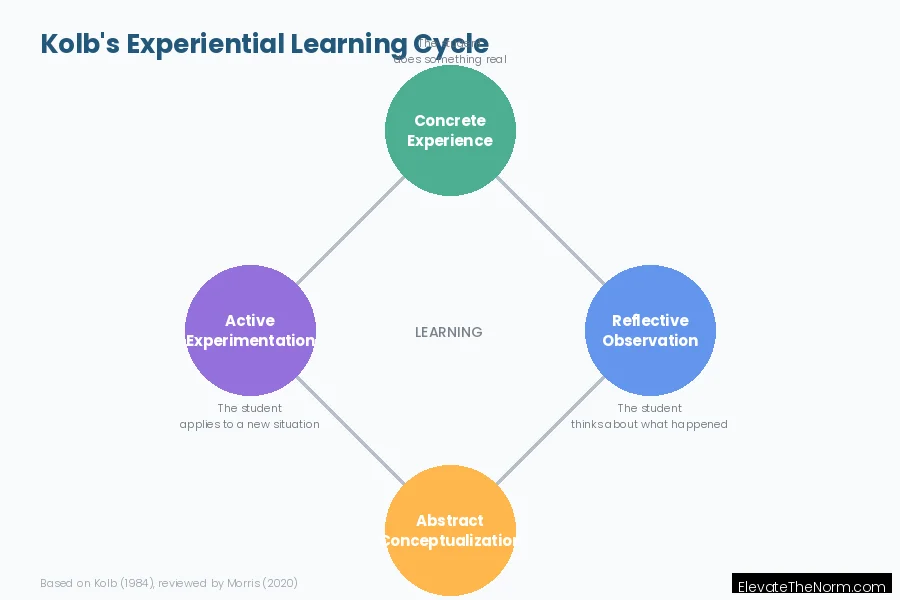
Teacher Emergency Toolkit — practical resources, real classroom support. Shop on TPT.Teacher Emergency Toolkit — practical resources, real classroom support. Shop on TPT.