The Elevate Blog banner: Real Classrooms. Practical Ideas. Higher Expectations. Three students climb a rocky ridge at sunrise, each pulling the next one up, toward a teacher reaching down to help.

Tag: education research

  • Close Reading in Grades 6–12: The Three Passes, and the Research Nobody Ran

    Close Reading in Grades 6–12: The Three Passes, and the Research Nobody Ran

    By Clay Shumate

    Close reading means reading a short, difficult text more than once, with a different job each time: what it says, how it is built, what it means. That is the whole protocol. What it lacks is controlled evidence that it beats ordinary good teaching in grades 6–12, and the researcher most associated with it says so himself.

    Key Takeaways

    • It is several passes over one short, hard text, not one slow read with a highlighter. The questions are the method, not the count.
    • The researcher whose three-pass version everyone was trained on says the comparison studies do not exist. Timothy Shanahan calls close reading “more of a desired outcome, a curricular goal” than a method.
    • The mechanism has federal backing; the brand name does not. The What Works Clearinghouse guide for grades 4–9 recommends practice with “stretch text” and a routine set of comprehension-building practices, listed with 15 and 34 supporting studies. None of its four recommendations is called close reading.
    • The only published head-to-head comparison lost. Boudreaux-Johnson, Mooney and Lastrapes found a validated alternative ahead for all six students — six fourth graders, six weeks, no statistics. It settles nothing, but it is what exists.
    • Whether to front-load background knowledge is genuinely unsettled. Shanahan says leave it out; a UCLA guide quotes Catherine Snow warning that a cold read of too-hard text produces “destructive frustration”; a Berkeley study in high school classrooms found pre-reading helped.

    What is close reading?

    Close reading is the intensive analysis of a short, challenging text across repeated readings, each set to a different purpose. Shanahan’s formal definition is “an intensive analysis of a text with the purpose of determining what it says, how it says it, and what it means.” His shorter one is better: “to make sense of a text – to figure it out, to solve it like a problem.”

    Two facts about the term explain most of the confusion around it. It came out of literary criticism, not reading research — in her Berkeley dissertation on close reading in secondary classrooms, Amy Koehler Catterson writes that “the phrase close reading originated with the New Criticism, a literary school most active from the 1930s through the 1970s.” And it is in your building because of standards policy: Shanahan says the Common Core State Standards “introduced the idea of ‘close reading,’ in elementary reading instruction.” A practice that arrives through a standards document rather than a trial never had to prove anything.

    What do the three passes actually ask students to do?

    Three readings, three different questions: what the text says, how it worked, and what it means. A practitioner guide from UCLA’s CRESST describes Shanahan as recommending “at least three readings of a text,” each aligned to one of the three main categories of the reading anchor standards.

    Here is what most training leaves out: he does not mean three literal trips every time. “The idea of multiple readings is metaphorical,” he writes, then gives the exemption outright — “One may read a text only once – and in some cases that would be sufficient.” If your department has turned close reading into a required three-read worksheet, it has standardized the one part of this its own author calls a metaphor.

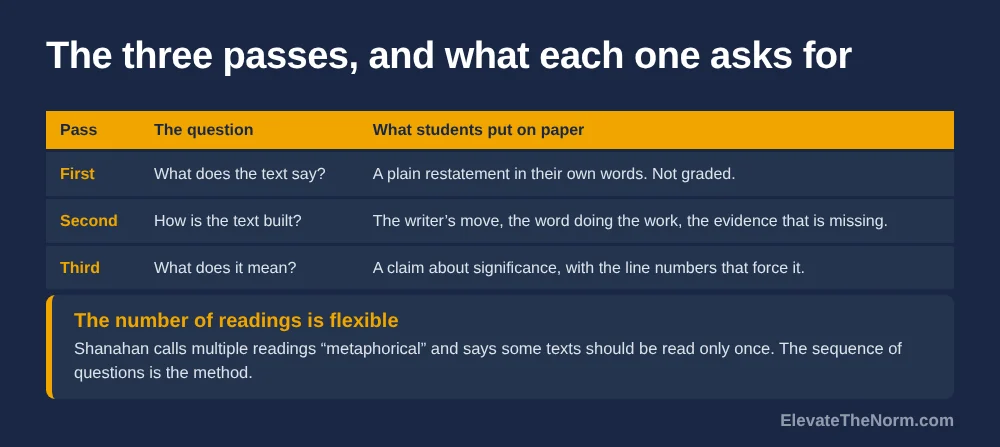
    PassThe question it answersWhat students put on paperWhat it is not
    FirstWhat does the text say?A plain restatement — the claim, the sequence, who is speaking. Ungraded.Not a summary written from the headline or from what they already assumed.
    SecondHow is the text built?Marked structure: the move the writer makes, the word doing the work, the evidence that is missing.Not colouring in every line that looks important.
    ThirdWhat does the text mean?A claim about significance, with the line numbers that force it.Not an opinion about the topic that the text never touched.
    The three purposes Shanahan assigns to repeated readings. The count is flexible; the sequence of questions is not.
    Chart of the three close reading passes: the first read asks what the text says and produces an ungraded restatement, the second asks how the text is built, the third asks what it means and requires line numbers.

    Does close reading improve reading comprehension?

    There is no controlled secondary-classroom evidence that it does. Shanahan, who wrote the three-pass version most teachers were trained on, puts it in his own words: “there are not studies comparing close reading with traditional ways of guiding students’ reading comprehension.”

    He still thinks it belongs in a curriculum. He just will not promise it does anything measurable — “I don’t know whether practicing these activities will have a sufficient impact to guarantee those outcomes.” A researcher saying that about his own recommendation is the most useful sentence here. Catterson reached the same place from the other side, finding “very few empirical tests of particular approaches to adolescent close reading instruction.”

    The one head-to-head test went against it. Boudreaux-Johnson, Mooney and Lastrapes ran close reading against Collaborative Strategic Reading, which already had an evidence base, in The Journal of At-Risk Issues: “in all six cases … the Daze score for CSR was higher than that for close reading by intervention’s end.” Close reading ran at 95 percent fidelity and the comparison at 75.6, so the worse-implemented condition still came out ahead. Their verdict is that “the present body of evidence supporting implementation of close reading practices is lacking.”

    The caveats are big enough that nobody should use that study to kill close reading in a department meeting. The participants were six fourth graders in a Tier 2 programme at a rural public school, over six weeks, in a single-subject design read by eye with no statistical testing and no effect sizes. Six nine-year-olds in an intervention group are not a secondary classroom, and this site will not pretend otherwise.

    Those authors do name one experiment in our grade band, calling it “the lone experimental study” of its kind: by their description, 438 students in grades 7 and 8 in an afterschool programme, 100 randomly assigned across five intervention classrooms, with gains in attendance, reader self-perception and state reading scores. I could not open that paper, so that is another team’s account, cited that way below — and by that account the treatment bundled close reading with independent reading and small-group instruction, so even if every number holds it cannot say which of the three did the work.

    What does the federal evidence actually support?

    The machinery underneath close reading, not the label on it. The What Works Clearinghouse guide Providing Reading Interventions for Students in Grades 4–9, chaired by Sharon Vaughn, makes four recommendations. Two are the engine of any close reading lesson, and neither is called close reading.

    Recommendation 3 is to “routinely use a set of comprehension-building practices to help students make sense of the text,” listed with 34 supporting studies. Recommendation 4 is to “provide students with opportunities to practice making sense of stretch text (i.e., challenging text) that will expose them to complex ideas and information,” listed with 15. For scale, the guide gives its decoding recommendation “a strong level of evidence … based on 32 studies” — a tier it defines as “consistent evidence that meets WWC standards.”

    Limits, stated rather than buried: the guide covers grades 4 through 9, so a high school junior sits outside its scope, and I read roughly its first third in full, so you are getting study counts and exact wording rather than a tier for Recommendations 3 and 4 that I did not see.

    One passage deserves reading aloud in every secondary building. Writing about older students who need decoding help, the panel tells teachers to use real linguistic terms rather than the cute elementary ones “to ensure that the students do not feel like they are being treated like early-elementary students,” because “the goal is only for students to feel self-assured and respected as more mature learners.” Teenagers notice being talked down to, and they stop working when it happens.
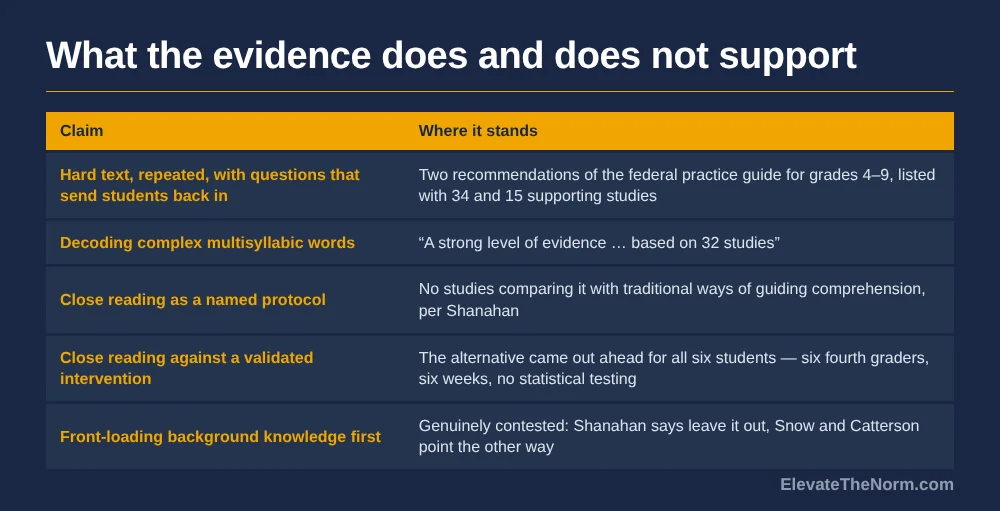
    Table comparing close reading claims against the evidence, separating the practices with federal research support from the named protocol, which has no comparison studies.

    Should I build background knowledge before a close reading?

    This is the one piece where the evidence disagrees with itself, so decide on purpose rather than by whichever training you happened to get. Shanahan says leave prior-knowledge activation out. A UCLA guide quotes Catherine Snow warning that a cold read of a too-hard text produces frustration rather than struggle. A Berkeley study in high school classrooms found pre-reading helped.

    Shanahan’s position is narrower than the slogan version. On previews: “No, you probably should not provide much of a preview.” On prior knowledge: “it would be better for a close reading lesson for the teacher to leave that out” — and, in the same breath, “it is reasonable to provide prior knowledge preparation often.” He is saying that on the day you teach students to wring meaning out of the page itself, handing them the meaning first defeats the lesson. The CRESST guide describes that same minimal-preview practice and prints the objection beside it, recording that Snow “cautions against what she calls cold close reading”: reading a text too hard “often results, not in productive struggle, but in destructive frustration.” That quotation reached me through the UCLA guide rather than Snow’s own article, and is credited that way below.

    Catterson ran the question instead of arguing it, in a high school chemistry classroom: 28 students aged 14 to 17, one teacher, one semester, with randomized comparisons inside a mixed-methods design. She found that “students who had their background knowledge activated with pre-reading activities prior to closely reading an article wrote more argument-generating questions than students who did not.” Weigh it at its real strength: an unpublished dissertation whose author says her design is “less concerned about establishing specific causal relations.”

    In a real room the cold read is defensible when the text is inside reach and the lesson is about reading strategy. It is indefensible when students have never met the topic, because then you are not watching them solve a problem, you are watching them drown politely. If the topic is new, spend two minutes on the words that actually unlock the passage, or get their position on the table with a short set of arguable statements they commit to before reading. Neither tells them what the text says.

    If the barrier is the words themselves, more passes will not fix it — which is why the federal guide treats decoding as its own recommendation. Pre-teach the words, pair students for the first pass, or give the same three questions against a shorter excerpt of the same source; not a different, easier topic, which quietly tells a student they are in the group that does not get the real thing. And when a child comes home saying they did not understand the reading at all, that is information about the text, not a verdict on the reader.

    Which texts are worth reading closely?

    Short ones that resist you. Shanahan is blunt about the filter — “not all texts are worth the trouble of close reading” — and what he asks for is “high-quality texts, texts with a lot of depth,” because “challenging texts do not give up their meanings easily.”
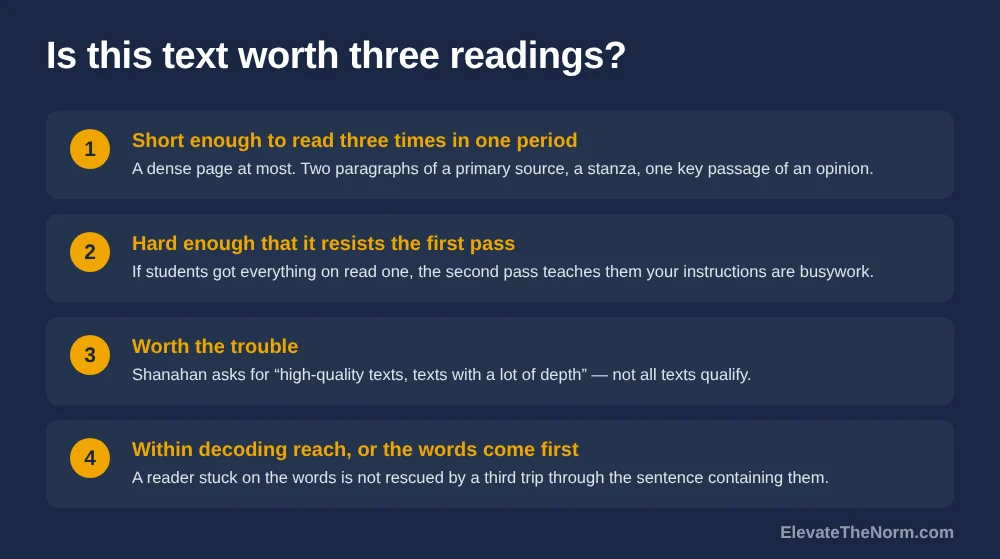
    Four-point checklist for choosing a close reading text: short enough for three readings, hard enough to resist the first pass, worth the trouble, and within decoding reach.

    The practical filter is arithmetic: if students read a text three times and discuss it inside one period, each reading has to cost a few minutes. A dense page is plenty — two paragraphs of a primary source, a stanza, one court opinion’s key passage, a methods section. A chapter is a reading assignment, and treating it as a close reading is how this becomes a week nobody enjoyed. The other half of the filter is whether the text rewards the second trip. If students get everything on the first pass, the second teaches them your instructions are busywork, and they are right.

    Subject matters too, and Shanahan warns the single-protocol version is too narrow: historians read “author centered” while scientists read across texts to compare them, so “there are other kinds of reading that students should also be exposed to.” In history the second pass is usually about the author rather than the structure, which is its own sequence — working a single historical document for what it is and who made it. Once the task becomes comparing several documents under time pressure, you have arrived at the document-based question as an assessment task, with its own rubric and failure modes.

    How do I run a close reading in one fifty-minute period?

    Pick a text short enough to read three times, give each read a different question, and spend the back half of the period arguing about the third. The sequence below assembles what the sources above describe into one period — the protocol as the research and the practitioner guides lay it out, not a recipe anybody has tested end to end in this form.

    1. Decide the pre-reading question before the bell. New topic or a text at the top of their range: two minutes on context and the words that gate the passage. Familiar topic, text inside reach: go in cold, and say out loud that you are doing it on purpose.
    2. Give the general purpose and nothing else. “Find out what this says” is a purpose. “Find the three ways the author builds sympathy” is the answer, handed over before they read a word.
    3. First read for what it says, and do not grade it. Score the first attempt and the unsure student writes nothing or copies a neighbour, and you have lost the one honest reading of the three.
    4. Second read for how it is built. This is where marking the page earns its keep, and the only pass where it should happen. One question, not nine.
    5. Walk the room, and do not correct what you overhear. Fix a misreading with a question — “read me the sentence that makes you think that” — not with a correction. A student told they are wrong in front of the two people they were talking to learns to say nothing during the second pass, which destroys the only reason you were listening.
    6. Third read for meaning, in the open. Ask questions that cannot be answered without going back into the text, and require line numbers in every answer. That requirement is the mechanism: it makes the conversation about the page rather than about opinions.
    7. End with something written and short. One claim, two pieces of text evidence, one sentence on what the author did to make it work. If you cannot read the class set in twenty minutes, you assigned too much.

    Two omissions are deliberate: no reading it aloud first, because that replaces their first read with yours, and no vocabulary quiz at the end, because the close reading is the lesson. Finding the text is the prep; the three questions take about a quarter of an hour, and there is nothing to buy. If the room dies halfway through the second pass, that usually means the text was too long for three trips, or gave everything up on the first.

    Is annotation the point of close reading?

    No, and the person most associated with the protocol thinks schools have this backwards. Shanahan says annotation’s “use has been overblown in lots of classrooms”: “too often the notetaking seemed to be the point of the reading, rather than accomplishing those goals.”

    Students agree, for what it is worth: in the Boudreaux-Johnson comparison the lowest-rated element of the close reading condition was “the annotating/note taking component,” at 5.5 on a nine-point scale. Neither that study nor Shanahan measured what annotation does to comprehension, so this is not evidence that marking a text is useless — it is evidence that students can tell when the marking has become the assignment. Marking well is its own skill, and there is a whole separate discipline to marking up a text while you read. Inside a close reading, confine it to the second pass and give it one job.

    This matters most to whoever is doing walkthroughs, because a marked-up page is easy to count and so it is what gets looked for — precisely the failure Shanahan names. Listen instead for whether students’ answers point back at specific lines. A silent room full of highlighted paper is the version that does nothing.

    Doesn’t this site say rereading is a weak strategy?

    It does, and both are true, because they are different acts. Rereading your own notes alone at a kitchen table the night before a test is one of the weakest ways to study. Reading a hard source a second time with a specific question attached, in a room with a teacher in it, is an instructional move.

    I flag it because someone will eventually quote this site against itself. Our page on which study strategies actually survive scrutiny rates passive rereading poorly, and it is right to. The difference is the question and the audience: solo rereading has no purpose attached and nobody to catch the misreading, which is exactly what the second and third passes supply. If a student asks why the teacher who said rereading does not work just asked them to read it three times, that is the answer — and it is a good question.

    Clay’s take: use it, but stop selling it

    Close reading is a good thing to do two or three times a unit with a text that deserves it, and a bad thing to make into a weekly ritual. That is my read of the evidence above, not a finding from it.

    What keeps me doing it is the second pass. I run a workshop room — tables in groups, no rows, me on a stool moving between them rather than talking at the front — and the most useful thirty seconds of any reading lesson is overhearing a group confidently build on a sentence they have misread. On a one-pass assignment I never hear it; it turns up a week later in an essay, by which point it is theirs and load-bearing. What you do with those thirty seconds decides whether you keep getting them. Correct the table and you have taught them that thinking out loud is how you get caught being wrong. Ask which sentence gave them that, and they fix it themselves while you walk away.

    What I would refuse: adopting close reading as a department-wide intervention for struggling readers, because the evidence for that use does not exist and the one published head-to-head went the other way; and putting it in an improvement plan as a way to raise reading scores, because anybody claiming that is extrapolating from studies that did not measure it. As a shared habit in content classrooms it is a different proposition — no purchase, no licence, no platform, just a passage, three questions and a teacher. If your school already paid for the training, Shanahan’s own advice is to retain it and “expand the focus to some other approaches to text.”

    And teenagers can be told the truth about this. “We are reading this three times because it is hard and I think it is worth it” is a sentence a fifteen-year-old can respect. “Because this is how we do close reading” is not.

    What to do next

    Pick one text in your next unit that you have always wished students understood better and that fits on a single page. Write three questions for it — what it says, how it is built, what it means — and run one close reading lesson, deciding in advance whether you are front-loading the context or going in cold. Then judge it on what you learned about your readers, not on whether it felt like a strategy. That is a fair test, and the only one available until somebody runs the study nobody has run.

    A second pass through a passage is one way to slow students down; handing them four jobs and letting them run the discussion is another. What the reciprocal teaching evidence shows once you separate the tests reports the finding that has held for thirty years: about .87 on comprehension tests the researchers wrote themselves, and about .32 on standardized reading tests, from the same pool of studies.

    By the third pass, the question students are usually reaching for is what the whole thing is about — and that is the one they have the least language for. Theme is not a topic word; it is a full sentence that says something about people or life, which the story earns through its characters, conflict and outcome. What theme is, in a definition students can actually use covers the topic-versus-theme distinction, the two questions that get students there, and how to stop “greed” being handed in as an answer.

    The second pass asks what the text says. Naming it in one sentence is harder than it sounds. The central idea is the claim every section of the text supports — not the topic, and not a theme, which is a different thing that belongs to fiction. How students find the central idea, and how it differs from main idea and theme covers the distinction, the test for a good central-idea sentence, and where the classroom vocabulary gets muddled.

    Frequently Asked Questions

    What is close reading?

    Close reading is the intensive analysis of a short, challenging text across repeated readings, with each reading set to a different purpose: what the text says, how it is built, and what it means. The term comes from literary criticism rather than reading research, and it reached most American classrooms through the Common Core standards rather than through a trial.

    What are the three reads in close reading?

    The first read establishes what the text says, as a plain restatement. The second looks at how the text is built: the writer’s moves, the words doing the work, the evidence offered or missing. The third asks what the text means, answered with specific lines. Timothy Shanahan, who set out this sequence, stresses that the three readings are metaphorical and that some texts need only one.

    Does close reading improve reading comprehension?

    There is no controlled secondary-classroom evidence that it does. Shanahan states that no studies compare close reading with traditional ways of guiding comprehension. The only published head-to-head comparison, involving six at-risk fourth graders, favoured a validated alternative intervention. The underlying practices of working with challenging text do have federal evidence behind them; the named protocol does not.

    How long should a close reading text be?

    Short enough to read three times and discuss inside one class period, which in practice means a dense page at most. Two paragraphs of a primary source, a single stanza, or one key passage of a court opinion all work. A full chapter is a reading assignment, not a close reading, and treating it as one is how the lesson collapses on the second pass.

    Should students be given background knowledge before a close reading?

    This is genuinely contested, so decide deliberately. Shanahan advises leaving prior-knowledge activation out of a close reading lesson, while agreeing it is reasonable to build knowledge often. A UCLA guide records Catherine Snow warning that a cold read of too-hard text produces destructive frustration rather than productive struggle, and a Berkeley study in high school classrooms found pre-reading helped.

    Is close reading the same as annotating a text?

    No. Annotation is one tool inside the second pass, and Shanahan argues its use "has been overblown in lots of classrooms," with notetaking becoming the point of the reading instead of a means to it. In the one comparison study available, students rated the annotation component the lowest-scoring part of the whole close reading condition.

    Does close reading work for struggling readers?

    Not if the barrier is decoding. A student who cannot read the words on the page will not get there through additional passes, and the federal practice guide for grades 4 to 9 treats decoding complex multisyllabic words as a separate recommendation carrying a strong evidence rating from 32 studies. Pre-teach the words, pair the first read, or shorten the excerpt rather than reassigning an easier topic.

    Is close reading only for English class?

    No, but it looks different by subject and should not be the only approach. Shanahan notes that historians read in an author-centred way and scientists read across texts to compare them, concluding that students need exposure to other kinds of reading too. In history the second pass is usually about who wrote the document and why, rather than about its structure.

    Sources

    • Shanahan, T. Should We Still Teach Close Reading? Shanahan on Literacy. Post. Source of the three purposes, the “metaphorical” status of multiple readings, the statements that no comparison studies exist, the position that close reading is a curricular goal rather than a method, the judgment that annotation has been overblown, the advice to schools to retain and expand, and the text-selection filter. An opinion essay by a reading researcher, not a study; it reports no data of its own.
    • Boudreaux-Johnson, M., Mooney, P., & Lastrapes, R. E. An Evaluation of Close Reading With At-Risk Fourth-Grade Students in Science Content. The Journal of At-Risk Issues, 20(1). Full text via ERIC. Source of the head-to-head comparison against Collaborative Strategic Reading, the fidelity figures, the 5.5 annotation rating, and the authors’ conclusion that the evidence base is lacking. Six fourth-grade students in a Tier 2 programme at a rural public school, six weeks, single-subject alternating treatments design read by visual inspection, with no statistical testing and no effect sizes. It is also the source for this article’s description of Fisher and Frey’s grades 7–8 study, which is reported here as their account of it because the original could not be opened.
    • Vaughn, S., Gersten, R., Dimino, J., Taylor, M. J., Newman-Gonchar, R., Krowka, S., Kieffer, M. J., McKeown, M., Reed, D., Sanchez, M., St. Martin, K., Wexler, J., Morgan, S., Yañez, A., & Jayanthi, M. (2022). Providing Reading Interventions for Students in Grades 4–9. WWC 2022007. National Center for Education Evaluation and Regional Assistance, Institute of Education Sciences, U.S. Department of Education. Full guide. Source of the four recommendations and their wording, the 32/34/15 study counts, the strong-evidence tier definition and its assignment to the decoding recommendation, the multisyllabic-word passage, the instruction to use formal linguistic terms so older students feel respected, and the “not a cookbook” caveat. Roughly the first third of the guide was readable in full for this article, which is why the evidence tiers for Recommendations 3 and 4 are not quoted here.
    • Jones, B., Chang, S., Heritage, M., Tobiason, G., & Herman, J. Supporting Students in Close Reading. National Center for Research on Evaluation, Standards, and Student Testing (CRESST), UCLA. Full text via ERIC. Source of the alignment between the three readings and the reading anchor standards, the description of minimal pre-reading, and the Catherine Snow caution against “cold close reading,” including the “destructive frustration” quotation. A practitioner guide with no study population, design or results, and the Snow quotation is cited here as this guide reproduces it, because Snow’s own article could not be opened.
    • Catterson, A. K. (2017). Close Reading in Secondary Classrooms: A 21st-Century Update for a 20th-Century Practice. Doctoral dissertation, University of California, Berkeley. Full text via eScholarship. Source of the New Criticism origin, the assessment that there is very little research on close reading instruction, and the finding that activating background knowledge before a close read produced more argument-generating questions. A doctoral dissertation rather than a peer-reviewed trial; the empirical chapter covers 28 students aged 14 to 17 with one teacher in four non-AP chemistry sections, and the author states her design is less concerned with establishing causal relations. Her question counts are not quoted here because they could not be verified against the document.
    • Named but not cited as evidence, because they could not be opened for this article: Bogaerds-Hazenberg, Droop and van Steensel’s literature review of close reading interventions in grades 3–9, Still too close to call, published in Reading Psychology and referenced above only as Shanahan cites it; and Fisher and Frey’s grades 7–8 study, described above through Boudreaux-Johnson and colleagues. Neither is quoted here beyond those attributions.
    About Clay Shumate

    Clay Shumate is a certified secondary Social Studies teacher in the public schools of West Alabama, with seven years of classroom experience, a B.A. in History, and an M.Ed. in Secondary Education. He writes about project-based learning, student responsibility, respect, and practical ways to hold young people to a higher standard while giving them room to learn from mistakes. He is a member of the Society of Professional Journalists and writes to its Code of Ethics; this site’s editorial standards and corrections policy are published in full. More about Clay.

  • Anticipation Guide: How to Build One and What the Evidence Shows

    Anticipation Guide: How to Build One and What the Evidence Shows

    By Clay Shumate

    An anticipation guide is a short list of statements students agree or disagree with before they read, then revisit afterward with evidence from the text. It sets a purpose for reading and surfaces what students already believe. Three to five opinion statements work better than true-or-false facts.

    Key Takeaways

    • The statements have to be arguable, not factual. The IRIS Center at Vanderbilt is explicit that statements should be phrased “as opinions rather than true-false facts,” because opinions give students somewhere to stand.
    • The after column is the whole point. A guide that never gets revisited is a warm-up. The learning sits in making students face what the text did to their first answer.
    • The mechanism has strong evidence; the worksheet does not. the federal What Works Clearinghouse practice guide for grades 4–9 gives strong evidence, from 34 studies, to building topic knowledge and word meanings before reading — the thing an anticipation guide is a container for. The container itself has almost no controlled evidence at this grade band.
    • The one experiment that measured learning found none. Valle, Antonenko, Wang and Luo (2020) randomly assigned 17 adults and found no significant difference in learning (p = 0.1), with the control group scoring numerically higher on the transfer test.
    • Do not grade the before column. Score the first guess and students write what they think you want, which destroys the only data the instrument produces.

    What is an anticipation guide?

    An anticipation guide is a pre-reading tool: three to five statements about a text’s big ideas, which students agree or disagree with before reading and then return to after. It gives students a position to defend and a reason to look for evidence.

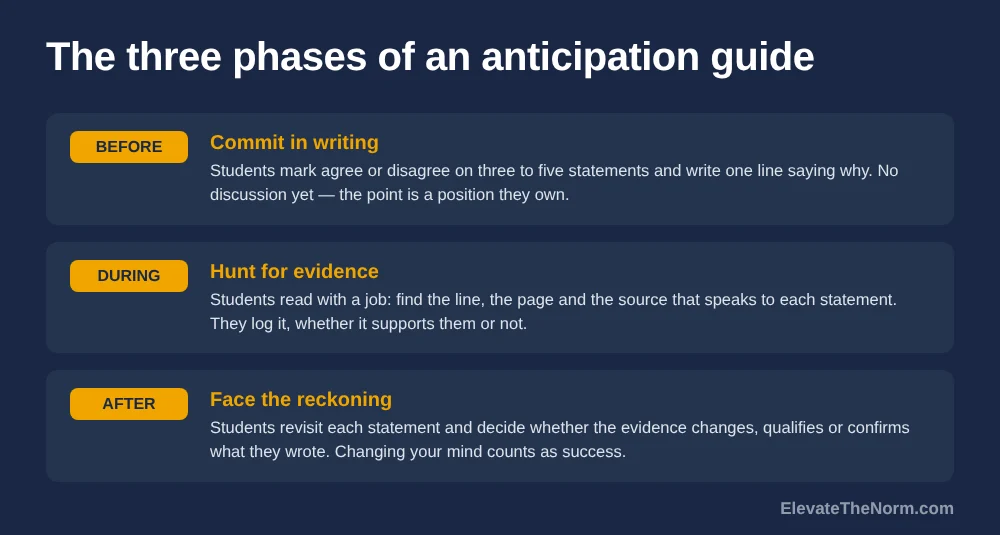
    Chart of the three phases of an anticipation guide: before reading students commit in writing to agree or disagree on three to five statements, during reading they log textual evidence for each statement, and after reading they revisit each one and decide whether the evidence changes their position.

    It is sometimes called an anticipation-reaction guide or an opinionnaire, and the second word in that first name matters. The IRIS Center at Vanderbilt builds the template around six columns: the statement, agree, disagree, the reader’s perspective before reading, textual evidence with a source and page number, and the reader’s perspective after reading. The evidence column is what separates this from a show of hands.

    The practitioner trail for the modern version runs back to a 1994 article by Frederick Duffelmeyer in the Journal of Reading, which is the citation AdLit, the adolescent literacy service of public broadcaster WETA, gives for its own steps. Who invented the format originally is not something the major teaching references agree on, and this article is not going to pretend otherwise.

    How do I make an anticipation guide?

    Pick the three to five ideas the text actually argues, turn each into a sentence a reasonable person could disagree with, and build a place for students to record evidence. The whole job is about twenty minutes the first time and under ten after that.

    1. Read the text and find what it argues, not what it covers. The IRIS Center at Vanderbilt calls this identifying key concepts or themes. A chapter on industrialization covers dates; it argues that the trade-offs were uneven. Write toward the argument.
    2. Write three to five statements. Not ten. Students have to produce a before answer, an evidence line and an after answer for each one, so every statement you add costs three pieces of work.
    3. Phrase each one as an opinion. The IRIS Center at Vanderbilt warns against true-false facts and recommends statements that allow for competing perspectives, specifically so more than one reading becomes defensible.
    4. Say no to the topics that will not survive the room. The IRIS guidance is to consider somewhat controversial statements but avoid politically or emotionally charged ones the class has already handled badly. That is a judgment about your room, and you are the one qualified to make it.
    5. Add the evidence column and require a source. Page number, paragraph, speaker. Without it students will report a vibe and call it textual support.
    6. Decide now when the after column happens. Put it on the lesson plan with a time. The single most common failure of this strategy is that the class runs out of period before the reckoning and the guide quietly becomes a worksheet.
    7. Print one line at the top saying what the sheet is for. Something like: there are no wrong answers in the first column; changing your mind after reading is the point. It costs nothing, it settles the question for the student who is anxious about guessing, and it means the sheet explains itself if it ends up on a kitchen table.

    One differentiation move is worth building in from the start, because retrofitting it mid-lesson never works: for students who need it, write the page or paragraph range next to each statement. They still have to find the evidence and decide what it means, which is the thinking the guide is for. What you have removed is the search, which is not.

    What makes a good anticipation guide statement?

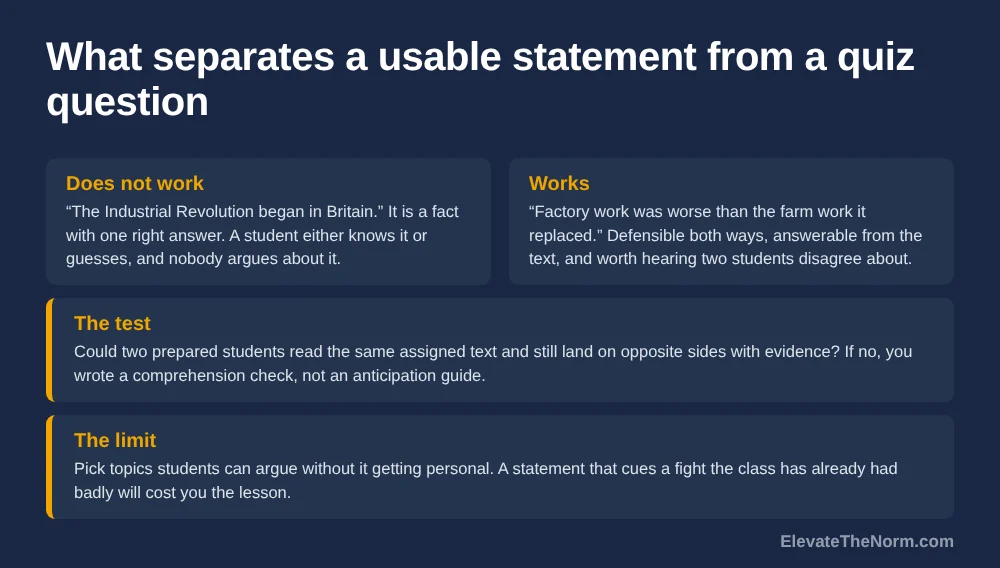
    A good statement is one two prepared students could read the same text about and still land on opposite sides, with evidence. If the text settles it in one line, you have written a comprehension check.

    Comparison graphic contrasting a factual statement that does not work in an anticipation guide with an opinion statement that does, plus a test for whether two prepared students could disagree with evidence and a caution about emotionally charged topics.

    Compare two statements for the same chapter. “The Industrial Revolution began in Britain” is a fact. There is one right answer, a student either knows it or guesses, and after reading there is nothing to revisit. “Factory work was worse than the farm work it replaced” is arguable, answerable from the same chapter, and will split a class — which is exactly the condition that makes the after column worth doing.

    There is a second test worth applying, and it catches the statements that look arguable and are not. Ask yourself what evidence in this text would move a student from one side to the other. If you cannot name it, students cannot find it, and the evidence column will come back empty with the opinions unchanged. That is also where this differs from reading a single source closely: there you interrogate one document; here you test a claim against whatever the reading offers.

    What does a finished anticipation guide look like?

    Four columns and four rows fits on half a page. Below is the shape, using example statements for a unit on industrialization — these are illustrations of the format, not a recommended reading list.

    StatementBefore readingEvidence from the textAfter reading
    Factory work was worse than the farm work it replaced.Agree / Disagree, plus one line saying why.Page and quote. Wage data, hours, accounts from workers.Changed, qualified or confirmed — and what did it.
    New technology mostly helps the people who already have money.Agree / Disagree, one line.Who owned the machinery; who was paid what.Same three options, in a sentence.
    A country is better off when it industrializes quickly.Agree / Disagree, one line.Comparison of two countries or two decades in the chapter.Same.
    Child labor ended because people decided it was wrong.Agree / Disagree, one line.What the text says actually changed the law.Same.

    The after column should take a sentence, not a paragraph. “I still agree, but only for the first twenty years” is a better outcome than a tidy reversal, and it is the kind of answer worth reading aloud.

    Does the research say anticipation guides work?

    Honestly: the evidence for the underlying move is strong, and the evidence for this specific worksheet is thin. No controlled trial in a secondary classroom shows that anticipation guides raise comprehension. That is worth knowing before a department adopts one.

    Start with what is solid. the federal What Works Clearinghouse practice guide for grades 4–9, published in 2022 as WWC 2022007, assigns a strong level of evidence — its highest — to routinely using a set of comprehension-building practices, based on 34 studies, 23 of which met the Clearinghouse’s standards without reservations. The first part of that recommendation is building topic knowledge and word meanings before reading, roughly three to five minutes on each. An anticipation guide is one way to spend those minutes. The practice is evidenced; the format is a choice.

    Now the specific studies, which are small and mostly not about teenagers. Valle, Antonenko, Wang and Luo (2020) ran the only randomized comparison we could find that measured learning: 17 adults aged 18 to 61, 8 with a guide and 9 without, watching a professional development video. Eye tracking showed the guide group made significantly more transitions between the text and the images — about 18 more in each direction, p = 0.002. Learning showed no significant difference (p = 0.1), and the control group scored numerically higher on the knowledge transfer test, 4.11 against 3.37. The authors are careful about it, writing that in the absence of a learning difference “it would be irresponsible to claim” the extra eye movement was integration rather than split attention.

    Modjanggo (2019) is the study usually cited as the win: 25 university students in a Reading 1 course went from a 55.6 pretest mean to an 89 posttest mean after three sessions. But it is a single-group pre-post design with no control group, the participants are university students learning English rather than secondary readers, and the write-up reports two different degrees of freedom for the same test. A 33-point gain with nothing to compare it against cannot separate the strategy from three more weeks of practice.

    Evans, Kodela and Khan (2022) is the most interesting of the three and the least like a classroom: 47 internal medicine residents used guides before and after five teaching conferences, and 35 of them — about 74 percent — showed a change in knowledge or thinking. It is a qualitative case study with no statistical test, and the authors say plainly that studies of guides in their field are scarce. What it does show is the mechanism working: the instructors used what residents got wrong to change what they taught next.

    So the fair summary is this. Anticipation guides are a reasonable container for a practice with strong federal evidence behind it. They are not themselves a proven intervention, and anyone telling you they raise reading scores is extrapolating from studies that did not measure that.

    There is one limit worth naming before you build the first one. The guide assumes students have enough footing on the topic to hold an opinion. A student who has never encountered the subject is not activating prior knowledge; they are flipping a coin in public, and if the class then discusses the split, they are flipping it in front of everyone. The federal guide pairs before-reading work on topic knowledge with word meanings for exactly this reason. If a class is coming in cold, spend two minutes establishing the ground first, then hand out the guide. If you are not sure which it is, a KWL chart used as a diagnostic will show you what the room actually brings to the topic before you commit a lesson to it.

    Should I grade an anticipation guide?

    Grade completion, never correctness, and never the before column. The instrument runs on an honest first guess. The moment a wrong guess costs points, students stop guessing and start predicting what the teacher wants.

    If you need it in the gradebook, score the evidence column — did the student find a real line with a real page number — and the after column, where the question is whether they engaged with what they found. Both are things a student controls through effort. The before column is not.

    This is also the place to say something to students out loud, because they will not assume it: changing your mind on this sheet is the success condition, not an admission you were dumb. Teenagers read a graded before-and-after as a trap unless you tell them it is not one. Say that the only wrong answer in the after column is the one that ignores the evidence.

    One adjustment on that, and it is the kind of thing that only shows up from a desk. Reading a good reversal aloud is worth doing, and it should be read without the name unless the student has said yes first. Praised or not, being held up as the person who was wrong at the start of the period is still being held up as the person who was wrong, and the quiet lesson a fifteen-year-old takes from it is to write the safe answer in the before column next time. Read the reasoning, keep the author out of it, and the honest first guesses keep coming.

    How does this fit in a fifty-minute period?

    Five minutes to commit, the bulk of the period to read and log evidence, and eight to ten minutes at the end for the reckoning. If the reading will not fit, split the guide across two days rather than cutting the after column.

    The front end works well as the opening routine it has to fit inside: students are writing within ninety seconds of the bell and they have a reason to care about the reading before you have said anything. The residents in the medical study completed theirs in about five minutes and revisited them in about five, which is the right order of magnitude.

    One structural pairing is worth knowing. If you want discussion in the middle, a structure that makes everyone commit before anyone talks is the natural partner, because the guide has already done the committing step for you. And if vocabulary is what will stop students from reading the evidence at all, handle that first — pre-teaching the words that would otherwise stop them is the other half of the practice the federal guide describes.

    What goes wrong with anticipation guides?

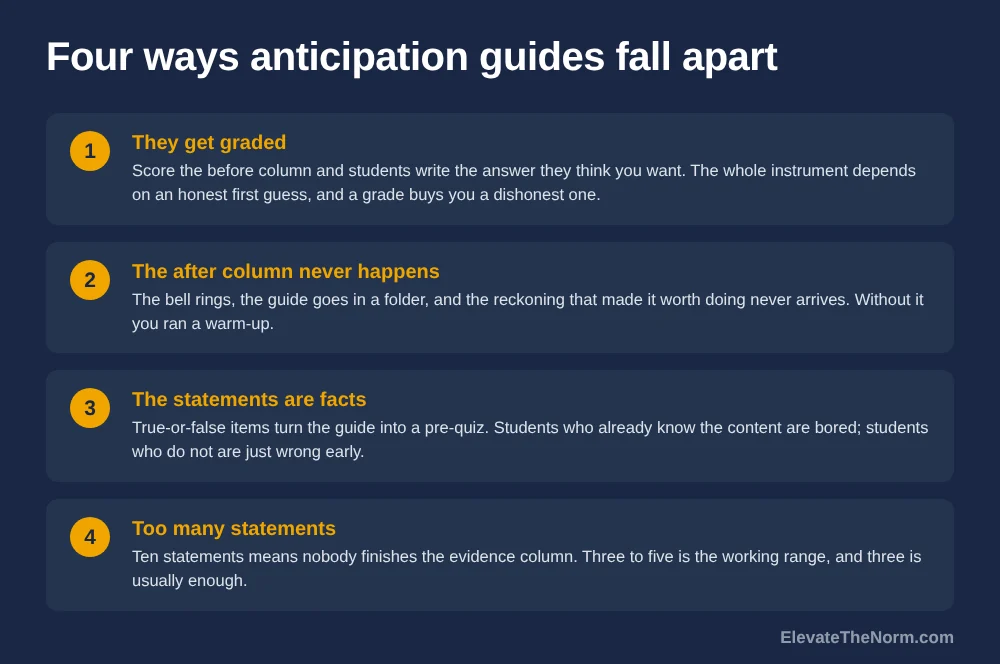
    Four failures account for most of it: grading the first guess, never running the after column, writing facts instead of arguable claims, and using too many statements. All four are avoidable in the planning, not in the moment.

    Numbered graphic listing four common failures of anticipation guides: grading the before column, never completing the after column, writing factual statements instead of arguable ones, and using too many statements.

    The missing after column is the one that happens to good teachers on busy days, and it is the one that costs the most. Without it students have made a prediction and never found out what happened, which is not a learning experience in any form. If the period is going badly, cut the number of statements you discuss rather than skipping the discussion.

    The fourth failure — too many statements — is usually enthusiasm. Ten statements looks thorough on paper and produces thirty pieces of student work, none of them finished. Three good statements beat eight mediocre ones, and the IRIS guidance of three to five is a ceiling worth respecting.

    There is a quieter failure too, which is the guide that duplicates work students are already doing. If your class already does marking up a text while they read, the evidence column may just be annotation with extra steps. Use the guide when you want students to arrive at the text with a position; use annotation when you want them to track one as it develops.

    What to do next

    Take the next reading you already planned to assign and write three statements about what it argues. Put ten minutes at the end of that lesson on the plan, in writing, for the after column. Then run it once before you decide anything about whether it belongs in your rotation.

    And hold it at the right strength. Clay’s read, as a grades 6–12 teacher: this is a cheap, sensible way to do a thing the federal evidence says is worth doing, and it is not a reading intervention. If a department adopts it as one, the research will not back the claim, and the first year of flat scores will get blamed on the teachers rather than on the promise.

    Frequently Asked Questions

    What is an anticipation guide used for?

    An anticipation guide is used before reading to activate what students already believe about a topic and give them a purpose for reading. Students mark agree or disagree on three to five statements, read while collecting textual evidence about each one, then revisit their positions. It is also called an anticipation-reaction guide or an opinionnaire, and the reaction half is where the learning sits.

    How many statements should an anticipation guide have?

    Three to five. The IRIS Center at Vanderbilt recommends that range, and the arithmetic supports it: each statement requires a before answer, an evidence line with a source, and an after answer, so ten statements produce thirty pieces of work that no class period can finish. Three strong arguable statements are more useful than eight weak ones.

    Should anticipation guide statements be true or false?

    Neither. They should be opinions a reasonable person could argue either way using the assigned text. The IRIS Center specifically advises phrasing statements as opinions rather than true-false facts, because factual items turn the guide into a pre-quiz with one right answer and leave nothing to revisit afterward.

    Do anticipation guides improve reading comprehension?

    There is no controlled secondary-classroom evidence that they do. The strongest related finding is from the federal What Works Clearinghouse guide for grades 4 to 9, which gives strong evidence to building topic knowledge before reading in general. The one randomized study measuring learning, by Valle and colleagues, found no significant difference between guide and no-guide groups.

    Should I grade an anticipation guide?

    Grade completion of the evidence and after columns if you need a grade, but never grade the before column for correctness. The instrument depends on students recording what they honestly think before reading. Once a wrong first guess costs points, students write what they expect the teacher wants and the guide stops producing useful information for anyone.

    What is the difference between an anticipation guide and a KWL chart?

    An anticipation guide asks students to take a position on specific claims the text addresses, which they then test against evidence. A KWL chart asks what students know and want to know about a topic in open form. The guide is narrower and more argumentative by design, which is what makes the after-reading comparison concrete rather than general.

    How long does an anticipation guide take in class?

    About five minutes at the start and eight to ten at the end, with the reading in between. The residents in the PRiMER study completed theirs roughly five minutes before instruction and revisited them about five minutes after, which is a realistic benchmark. If the reading will not fit in one period, split the guide across two days rather than cutting the after column.

    Can anticipation guides be used outside English class?

    Yes, and the published examples skew that way. The IRIS Center’s worked example is a middle school science lesson on rainforests and natural resources, and the PRiMER study used guides in medical education. Any subject with assigned reading that makes a claim will work, including science, history, health and career and technical courses.

    Sources

    • The IRIS Center, Peabody College, Vanderbilt University. Introduction to Anticipation-Reaction Guide, from the Secondary Reading Instruction module. Page. Source of the six-column template, the instruction to phrase statements as opinions rather than true-false facts, the three-to-five range, and the caution about emotionally charged topics. Note that this page cites no studies; it is authoritative guidance, not evidence.
    • Vaughn, S., Gersten, R., Dimino, J., and colleagues (2022). Providing Reading Interventions for Students in Grades 4–9. WWC 2022007. Institute of Education Sciences, What Works Clearinghouse. Full text. Source of the strong evidence rating for Recommendation 3, the 34 supporting studies with 23 meeting standards without reservations, and the three-to-five minutes each on topic knowledge and word meanings before reading. This guide evaluates the practice, not the anticipation guide format.
    • Valle, N., Antonenko, P., Wang, J., & Luo, W. (2020). Effects of Anticipation Guide Use on Visual Attention Distribution in a Multimedia Environment: An Eye Tracking Study. The Excellence in Education Journal, 9(3). Full text. Source of the null learning result (p = 0.1), the transition findings (p = 0.002), and the 4.11 against 3.37 transfer scores. The sample is 17 adults aged 18 to 61 — childcare providers and early childhood education majors — not secondary students, and the authors describe the work as exploratory. No effect sizes are reported.
    • Modjanggo, V. K. (2019). The Effect of Anticipation Guide Strategy in Teaching Reading. sintuwumarosoJET, 5(1), 24–29. Full text. Source of the 55.6 to 89 pre-post gain. Single-group pre-post design with no control group, 25 university students in an English education program, selected purposively. The paper reports conflicting degrees of freedom and no effect sizes, and its causal framing goes beyond what the design supports.
    • Evans, D. R., Kodela, J., & Khan, A. (2022). Anticipation Guides: A Tool to Highlight Knowledge and Promote Reflection on Learning. PRiMER, 6:20. Full text. Source of the 35-of-47 figure and the five-minutes-before, five-minutes-after timing. A qualitative case study of internal medicine residents at a single program, with no statistical tests and no effect sizes; the authors note that studies of guides in medical education are scarce.
    • AdLit, an education service of WETA, Washington, D.C. Anticipation Guides. Page. Source of the Duffelmeyer (1994) attribution for the strategy’s steps and of the middle-and-high-school framing. AdLit cites no reference list beyond that single in-text citation.

    About Clay Shumate

    Clay Shumate is a certified secondary Social Studies teacher in the public schools of West Alabama, with seven years of classroom experience, a B.A. in History, and an M.Ed. in Secondary Education. He writes about project-based learning, student responsibility, respect, and practical ways to hold young people to a higher standard while giving them room to learn from mistakes. He is a member of the Society of Professional Journalists and writes to its Code of Ethics; this site’s editorial standards and corrections policy are published in full. More about Clay.

  • Depth of Knowledge: What Webb’s Four Levels Actually Measure

    Depth of Knowledge: What Webb’s Four Levels Actually Measure

    By Clay Shumate

    Depth of knowledge is a four-level scale, built by Norman Webb in 1997, that classifies how complex the thinking a task demands is — not how hard the task is. Level 1 is recall. Level 2 is applying a skill. Level 3 is reasoning you have to justify. Level 4 is extended investigation across time and sources.

    Key Takeaways

    • Depth of knowledge describes the task, not the student and not the difficulty. Webb’s own 2009 guide says plainly that DOK “describes the kind of thinking required by a task.” A punishing recall question is still level 1.
    • It was built to audit tests, not to plan Tuesday. Webb (1997) created it to check whether a state assessment was as cognitively demanding as the standards it claimed to measure. Everything teachers do with it now is a borrowed use — which is why no district should fund a DOK initiative expecting test scores to move. There are no controlled trials behind that promise.
    • A verb is not a level. Webb’s guide states that the central verb alone “is/are not sufficient information to assign a DOK level.” Verb wheels are a shortcut around the judgment the framework actually requires.
    • The levels are hard to agree on, and the people who built the method said so. Webb’s 2002 alignment study of three states found reviewer agreement on DOK was weaker between groups than within them, with most of the disagreement sitting on the line between level 1 and level 2.
    • Most tasks land low, and that is the finding worth acting on. Hess, Carlock, Jones and Walkup analyzed more than 200,000 samples of student work from about 200 schools in Nevada and Oklahoma. English assignments clustered in one low-to-middle cell; math sampled the lowest level even more heavily.

    What is depth of knowledge?

    Depth of knowledge is a four-level classification of how deep into the content a task forces a student to go. It was developed by Norman Webb, a researcher at the University of Wisconsin, and it answers one question about an assignment: how much thinking does this actually require?

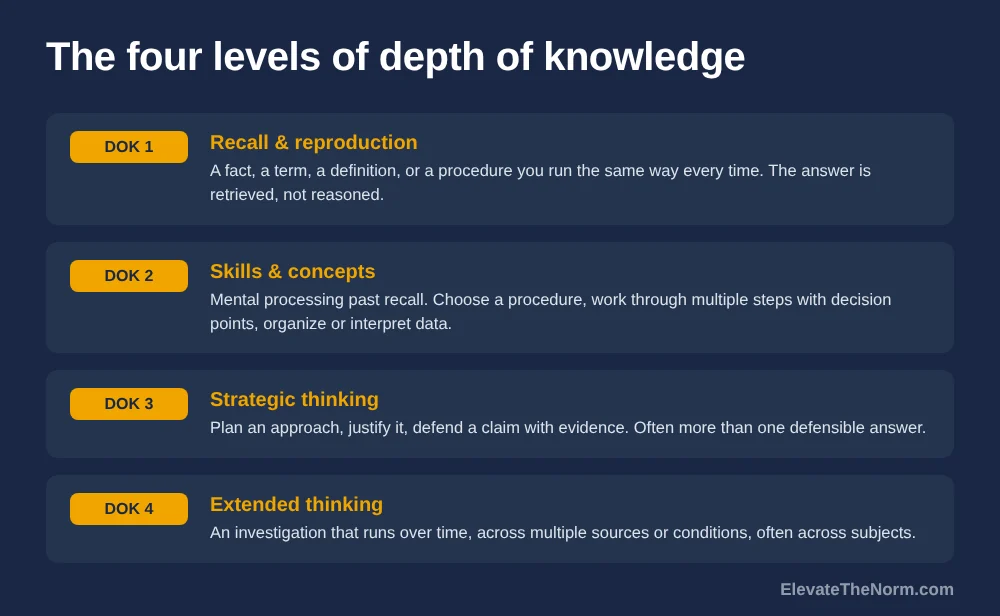
    Chart of the four levels of depth of knowledge: DOK 1 recall and reproduction, DOK 2 skills and concepts, DOK 3 strategic thinking, and DOK 4 extended thinking, each with a one-sentence description of the thinking the level demands.

    That is the whole idea, and it is worth saying what it is not. DOK is not a measure of how hard a question is. It is not a ranking of students. It is not a lesson-planning template, and it was never designed as one. Webb (1997) built it as a criterion for alignment — a way of asking whether the test a state gave was as demanding as the standards the state had written. The original phrase is “depth-of-knowledge consistency,” and consistency is between two documents, not between a teacher and a class.

    Webb defined depth of knowledge as something “related to the number and strength of the connections within and between mental networks.” In plain terms: a task is deeper when more ideas have to be held together at once, and when the path from the question to the answer is not already laid down.

    What are Webb’s four DOK levels?

    The four levels run from recall to extended investigation. Level 1 is retrieving a fact or running a known procedure. Level 2 is processing past recall — choosing a method, taking multiple steps, interpreting data. Level 3 is reasoning you have to defend. Level 4 is an investigation that takes time and multiple sources.

    LevelWhat the student doesExample taskHow long it takes
    DOK 1
    Recall & reproduction
    Retrieves a fact, term or definition, or runs a routine procedure the same way every time.Name the three branches of government. Identify the independent variable in a given setup.Seconds to a minute.
    DOK 2
    Skills & concepts
    Chooses a procedure, works through steps with decision points, organizes or interprets data.Summarize an argument in your own words. Build a graph from a data table and describe the trend.Minutes.
    DOK 3
    Strategic thinking
    Plans an approach, justifies it, defends a claim with evidence. Usually more than one defensible answer.Argue which of two causes mattered more, and say what evidence would change your mind.A class period or a short assignment.
    DOK 4
    Extended thinking
    Investigates over time, across multiple sources or conditions, often across subjects.Design and run an inquiry, gather your own evidence, and publish a conclusion to a real audience.Days or weeks.

    One line from Webb’s guide is worth copying onto a sticky note, because it settles most arguments in a department meeting: a level should reflect “the level of work students are most commonly required to perform” to produce an acceptable answer. Not the best answer. Not what a strong student might do unprompted. What the task requires to be counted correct.

    How is depth of knowledge different from Bloom’s taxonomy?

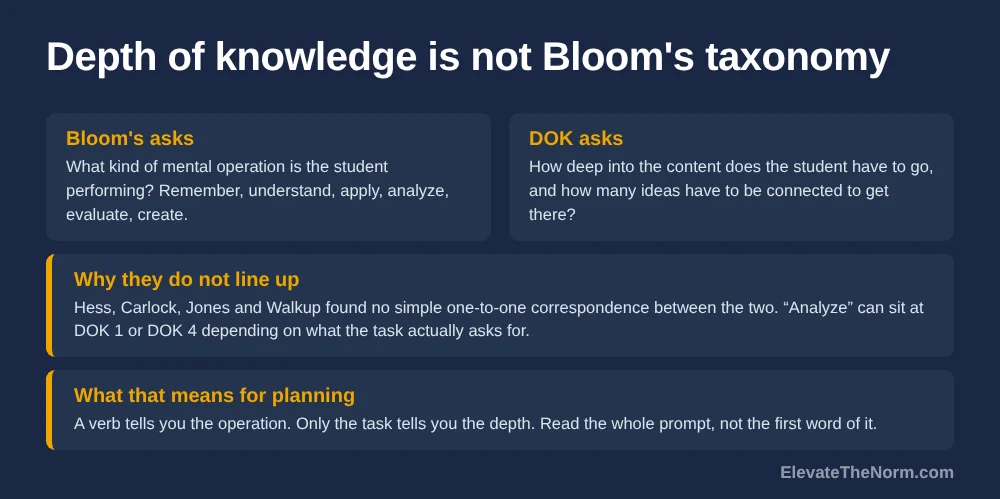
    Bloom’s taxonomy classifies the mental operation — remember, understand, apply, analyze, evaluate, create. Depth of knowledge classifies how far into the content the student has to travel. They are not two names for the same ladder, and they do not line up.

    Comparison graphic showing that Bloom's taxonomy asks what mental operation a student performs while depth of knowledge asks how deep into the content a student must go, with a note that Hess and colleagues found no simple one-to-one correspondence between the two.

    Hess, Carlock, Jones and Walkup built a Cognitive Rigor Matrix precisely because of this. They crossed Bloom’s levels against Webb’s and reported that there is “no simple one-to-one correspondence” between the two. Their complaint about Bloom’s is the one every teacher has had at some point: many verbs “appear at multiple levels and do not clearly articulate the intended complexity.”

    Here is the practical version. “Analyze this chart” is a Bloom’s analyze-level verb either way. If the chart is labeled, the trend is obvious and the answer is one sentence, you have written a level 2 task. If the student has to decide which of three charts is even relevant to the question and say why the other two mislead, you have written a level 3 task. Same verb. Different depth. The verb told you nothing.

    Which is also why this matters for writing a target you can actually check. A target and a task at different depths make the target decoration.

    Why isn’t depth of knowledge the same as difficulty?

    Because difficulty is about how many students get it right, and depth is about what kind of thinking the question asks for. Those move independently. A level 1 question can have a 20 percent success rate and a level 3 question can have an 85 percent one.

    Ask students to name the Secretary of State in 1952. That is pure recall — level 1 — and almost nobody will get it. Now ask a class that has spent two weeks on an argument to pick a side and defend it with two pieces of evidence from the documents in front of them. Level 3, and most of the room will manage it, because they have been taught to.

    This is the most useful thing DOK gives a teacher and the first thing lost when a school adopts it. “Raise the rigor” usually becomes harder recall: more terms, more obscure terms, a longer list. That raises difficulty and leaves depth where it was. The Cognitive Rigor paper records a teacher saying DOK levels “do not correlate to her notion of ‘difficulty,’” which is the realization the whole framework is trying to produce.

    It is also the honest answer to a question families ask at curriculum night. When a school says it is increasing rigor, the fair follow-up is whether the work asks students to think about more at once, or just to memorize more. Those are different promises, and only one of them is what depth of knowledge describes.

    How do I assign a DOK level to a question I already wrote?

    Read the task, not the verb, and ask what a student must do to earn credit. Five steps get you to a defensible level in under a minute, and the last one is Webb’s own tiebreaker.

    1. Cover the verb. Read the rest of the prompt and ask what the student has to produce. If the verb is doing all the work in your judgment, you are classifying the wording rather than the task.
    2. Ask whether the answer is already known to the student. If it is retrieval from memory or a procedure practiced to automaticity, you are at level 1 and no amount of wording changes that.
    3. Ask whether there is a decision point. If the student has to choose a method, select which information matters, or take steps in an order they determine, you are at level 2 or higher.
    4. Ask whether the student has to justify. If an acceptable answer requires reasoning that could be challenged — and if a different defensible answer exists — you are at level 3.
    5. Ask how long it runs. Level 4 needs time, multiple sources or conditions, and usually work the student plans themselves. If it fits in a period, it is not level 4, whatever the project is called.
    6. When you are stuck between two levels, take the higher one. That is Webb’s instruction, not a convenience: his guide says when unsure, “it is appropriate to select the higher of the two levels.”

    At under a minute an item, a twenty-item quiz is about a fifteen-minute job — that is arithmetic from the step above, not a research finding, but it is the right order of magnitude to plan around. And if a department is going to use DOK at all, calibrate before you argue: have two people level the same five items independently, then compare. Webb’s own reviewers disagreed most on the line between level 1 and level 2, so expect that to be where your department lands too, and settle it with examples rather than with the wheel.

    What does the research actually say about depth of knowledge?

    Less than the training slides suggest. DOK has a strong record as an audit tool for alignment and almost no record as a classroom intervention. There is no body of controlled trials showing that teaching teachers DOK raises student achievement.

    What the evidence does show is worth having anyway. Webb’s 2002 alignment study of three states applied the framework to state math standards and tests and set the bar at 50 percent — an objective passed if at least half the matching items sat at or above its DOK level. Most standards failed. In the one grade where item-level numbers are reported in full, 46 percent of items were at or above the objective’s level, 39 percent at it, 7 percent above it, and 54 percent below. Webb’s conclusion was that “more than half of the objectives under the standards required a more complex depth-of-knowledge than the corresponding items.”

    Translated: the standards asked for more thinking than the test measured — the same gap that opens between a unit plan and the quiz at the end of it.

    The honest caveats belong here too. Webb’s 2002 alignment study of three states reported that agreement between reviewer groups on DOK was weaker than agreement within them, and that most of the trouble was coding level 1 against level 2 — the two levels teachers also argue about most. Webb’s recommendation was more reviewer training, which is a polite way of saying the scale is not self-evident. None of that makes DOK useless. It makes a single teacher’s rating an opinion with reasons behind it, which is the right way to hold it.

    Where does depth of knowledge go wrong in schools?

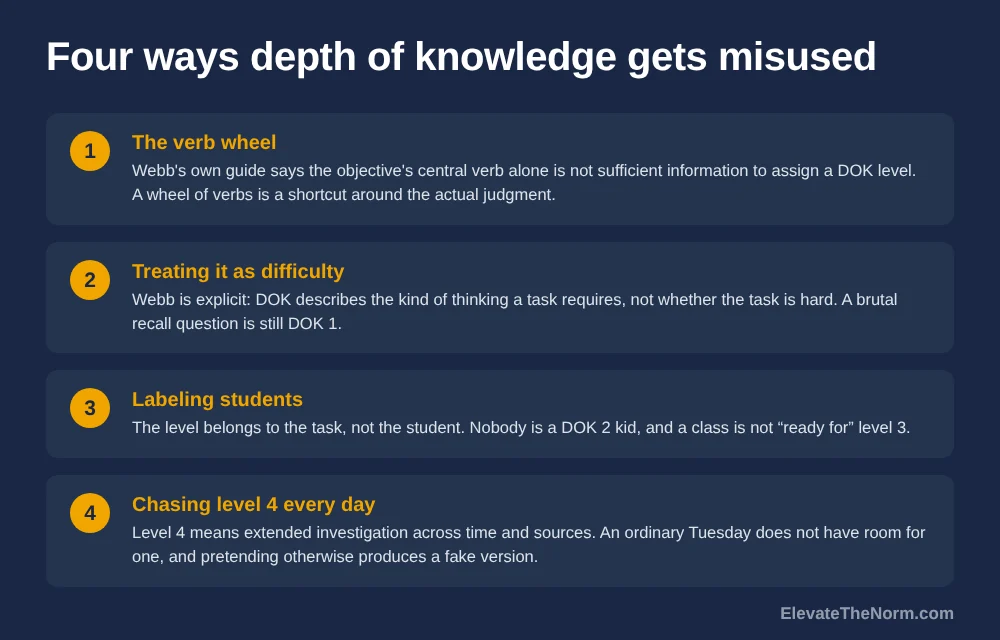
    Four ways, all of them from treating a classification scale as a quality scale: the verb wheel, the difficulty mix-up, labeling students instead of tasks, and chasing level 4 on an ordinary school day.

    Numbered graphic listing four common misuses of depth of knowledge: relying on a verb wheel, treating DOK as difficulty, labeling students with a level instead of tasks, and trying to reach level 4 every day.

    The verb wheel is the most common and the most explicitly ruled out: Webb’s guide says the central verb alone is not sufficient to assign a level. A wheel hands you a level without reading the task, which is the error the framework exists to prevent.

    Labeling students is the one that does real damage. The level belongs to the task. There is no such thing as a DOK 2 kid, and once a department talks that way, a scale built to audit a test has become a way to describe children. If a class is not managing level 3 work, the answer is supports you plan to remove on a schedule, not a lower ceiling.

    The one an administrator should watch hardest is DOK showing up in walkthroughs. A level is a property of the task, and a five-minute visit catches whatever the task happened to be at that moment — which on any honest Tuesday is often level 1, because students cannot reason about content they have not learned yet. Writing up a teacher for a level 1 observation punishes the part of the lesson that was supposed to be there. If a building wants to use DOK, use it on assessments and unit plans, where the sample is the whole thing rather than a slice of it.

    And the daily level 4 chase produces a fake. Level 4 means extended investigation across time and multiple sources. If it happened between the bell and the exit ticket, it was not level 4. The Cognitive Rigor teachers landed somewhere sensible on this: their working plan blended levels 1, 2 and 3 on assessments and reserved level 4 for in-class projects. That is the right shape. Most of the week is 1 through 3, and level 4 shows up a handful of times a year with the calendar cleared for it.

    What this is actually good for

    Here is where Clay comes down on it, as a grades 6–12 teacher rather than a researcher. DOK is a diagnostic, not a goal, and it is at its best pointed backward at work you already assigned: over the last two weeks, what did my students mostly do?

    Pull your last five assignments and the last quiz and put a level on each item. Not to feel bad about the level 1s — recall is load-bearing, and nobody reasons about content they do not know — but to see the shape of the week. If every item is a 1 or a 2, the rigor problem is in the task design, not in the kids. If the unit plan promised level 3 reasoning and the test is all recall, you have reproduced Webb’s three-state misalignment inside one classroom.

    That is also a cheaper fix than it sounds. Raising the depth of a question usually means removing something — the labeled chart, the pre-sorted evidence, the step list — rather than adding. Some of that is simply leaving students in the difficulty on purpose, for a stretch that has a floor under it.

    One warning on that, and it is the thing students notice first. If you raise the depth of a task by taking away the labeled chart or the step list, say so out loud. A teenager who gets last week’s assignment back with the supports quietly stripped out does not read that as rigor; they read it as the teacher making it harder and not saying why, and the reasonable response to that is to stop trying. Name the removal, name what you are now asking them to do without, and tell them the difficulty is the point. Students will take a harder task on those terms. They will not take it on terms nobody explained.

    What to do next

    Take one upcoming assessment and level every item before you give it. If more than three-quarters of the points sit at levels 1 and 2, rewrite two items to level 3 by removing scaffolding rather than adding words — then check the result still matches what you told students the unit was about.

    After that it is a habit, not an initiative. The next step is making sure the thing you are leveling is the thing you meant to measure, which is the difference between a check and a grade. And if you want the day-to-day version, the quick in-lesson reads are covered in checking for understanding.

    Cutting cognitive load is a presentation decision, not a permission slip to lower the level of thinking. That conflation is how a theory about where to put the labels on a diagram turns into an argument for easier questions. What cognitive load theory does and does not license covers the three types of load, the two the field now treats as contested, and the five presentation changes that cost nothing.

    Frequently Asked Questions

    What does DOK stand for?

    DOK stands for Depth of Knowledge. It is a four-level scale developed by researcher Norman Webb in 1997 to classify how cognitively complex a task is. Level 1 is recall and reproduction, level 2 is skills and concepts, level 3 is strategic thinking, and level 4 is extended thinking. The levels describe tasks and test items, not students and not difficulty.

    Is DOK the same as Bloom’s taxonomy?

    No. Bloom’s taxonomy classifies the mental operation a student performs, such as remember, analyze or create. Depth of knowledge classifies how deep into the content the task requires the student to go. Hess, Carlock, Jones and Walkup built a Cognitive Rigor Matrix crossing the two and reported there is no simple one-to-one correspondence between them. The same Bloom’s verb can sit at several DOK levels.

    Can I assign a DOK level just from the verb in the question?

    No, and Webb’s own guide rules it out: the objective’s central verb alone is not sufficient information to assign a DOK level. The same verb lands at different levels depending on what the task supplies and what it withholds. Read the whole prompt and ask what a student must do to earn credit, then assign the level from that.

    Does a higher DOK level mean a harder question?

    No. Depth and difficulty are separate. A level 1 recall question about an obscure date can be very hard, and a level 3 argument task can be answered well by most of a class that has been taught to make arguments. Webb’s guide says DOK describes the kind of thinking a task requires, not whether the task is hard. Confusing the two turns rigor into longer vocabulary lists.

    How many DOK 4 tasks should I plan in a semester?

    A handful, not a weekly one. Level 4 is defined by extended investigation over time, across multiple sources or conditions, so anything that finishes inside one class period is not level 4 no matter what it is called. The teachers described in the Cognitive Rigor paper blended levels 1, 2 and 3 on assessments and reserved level 4 for in-class projects, which is a realistic shape.

    Is there research showing DOK improves student achievement?

    Not directly. DOK has a solid record as an alignment audit tool and almost no record as a classroom intervention, and there is no body of controlled trials showing that training teachers in DOK raises test scores. Its demonstrated value is diagnostic: Webb’s 2002 analysis used it to show that state test items were frequently less demanding than the standards they were meant to measure.

    How reliable are DOK ratings between different teachers?

    Less reliable than the framework’s confident presentation suggests. Webb’s 2002 study found agreement between reviewer groups was weaker than agreement within a group, and most disagreement came from coding level 1 against level 2. His recommendation was more reviewer training. Treat a single DOK rating as a reasoned judgment to be discussed, not a measurement.

    Should students see the DOK level of their work?

    Usually not as a label. The level belongs to the task, so telling a student their assignment is level 2 says nothing about them and risks turning a task scale into a description of the student. What does help is naming what the task asks for in plain words, such as whether they need to recall something, choose a method, or defend a claim with evidence.

    Sources

    • Webb, N. L. (1997). Criteria for Alignment of Expectations and Assessments in Mathematics and Science Education. Research Monograph No. 6. National Institute for Science Education, University of Wisconsin–Madison, and the Council of Chief State School Officers. Full text (ERIC ED414305). Source of the origin of depth-of-knowledge consistency as an alignment criterion, the “number and strength of the connections within and between mental networks” definition, and the “full” and “acceptable” qualitative thresholds. Note that this monograph is about mathematics and science standards and assessments, not about classroom instruction.
    • Webb, N. L. (2009). Webb’s Depth of Knowledge Guide. Full text. Source of the four level descriptors quoted here, the statement that DOK “describes the kind of thinking required by a task,” the warning that the central verb alone is not sufficient to assign a level, the “most commonly required to perform” standard, and the instruction to select the higher of two levels when unsure.
    • Webb, N. L. (2002). An Analysis of the Alignment Between Mathematics Standards and Assessments for Three States. Paper presented at the American Educational Research Association Annual Meeting, New Orleans. Full text. Source of the 50 percent criterion, the 46 percent at-or-above item figure and its 39/7/54 breakdown, the “more than half of the objectives” conclusion, and the finding that between-group reliability on DOK was weaker than within-group reliability, concentrated on level 1 versus level 2. The item-level percentages come from one grade in one of the three states; the rest of the paper reports the share of standards meeting the criterion rather than item counts.
    • Hess, K. K., Carlock, D., Jones, B. S., & Walkup, J. R. Cognitive Rigor: Blending the Strengths of Bloom’s Taxonomy and Webb’s Depth of Knowledge. Full text (ERIC ED517804). Source of the Cognitive Rigor Matrix, the “no simple one-to-one correspondence” finding, the criticism that Bloom’s verbs appear at multiple levels, the teacher quotations about difficulty, and the work-sample analysis. The paper carries no publication date and its sample size is reported inconsistently — 200 schools in the text, 205 in a figure caption — which is noted in the article rather than smoothed over.

    About Clay Shumate

    Clay Shumate is a certified secondary Social Studies teacher in the public schools of West Alabama, with seven years of classroom experience, a B.A. in History, and an M.Ed. in Secondary Education. He writes about project-based learning, student responsibility, respect, and practical ways to hold young people to a higher standard while giving them room to learn from mistakes. He is a member of the Society of Professional Journalists and writes to its Code of Ethics; this site’s editorial standards and corrections policy are published in full. More about Clay.

  • Classroom Escape Room: How to Build One for Grades 6–12 Without Losing a Week

    Classroom Escape Room: How to Build One for Grades 6–12 Without Losing a Week

    By Clay Shumate

    A classroom escape room is a timed activity where student teams solve content problems to open a sequence of locks, physical or digital. Students reliably enjoy one. The measured learning evidence is thin and wildly inconsistent, and the real cost is teacher prep time. Build one well, debrief it hard, and do not run it every week.

    Key Takeaways

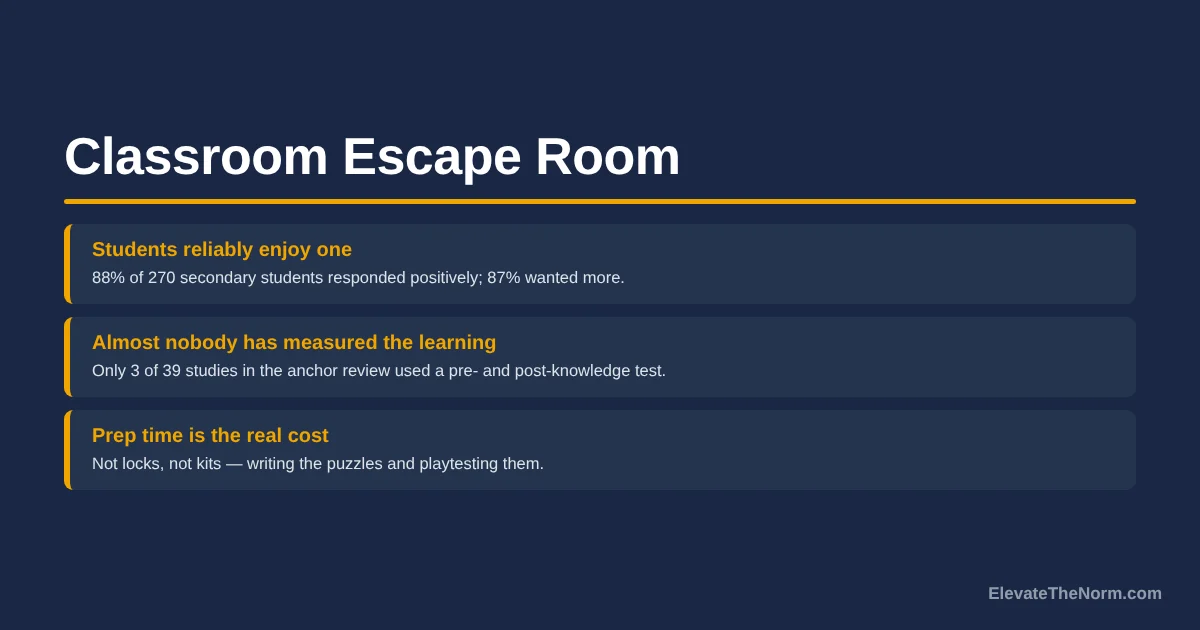
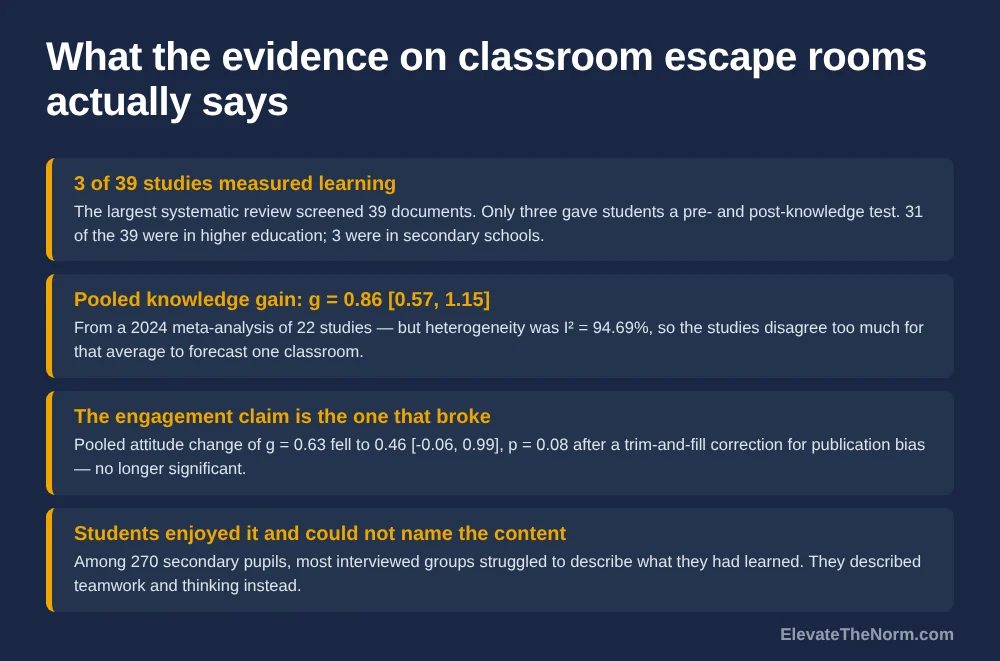
    • Almost nobody has measured whether a classroom escape room teaches anything. The largest systematic review screened 39 studies and found only three that gave students a pre- and post-knowledge test. Thirty-one of the 39 were in higher education; three were in secondary schools.
    • The pooled effect looks big and means less than it looks. A 2024 meta-analysis of 22 studies put knowledge gains at g = 0.86 with heterogeneity of I² = 94.69 percent. That much inconsistency means the average does not predict your room.
    • Students enjoy it and often cannot tell you what they learned. Among 270 secondary students, 88 percent were positive about the experience, and most interviewed groups could not describe the content they had covered.
    • Prep time is the binding constraint, not money. A full escape room runs with no locks and no kit. What you cannot avoid is writing the puzzles and playtesting them — the barrier teachers name most often — and the debrief, which is the first thing cut when the bell is close.

    What Is a Classroom Escape Room?

    A classroom escape room is a timed activity in which small teams solve a sequence of content-based puzzles, each yielding a code that opens the next lock, until the final lock opens. Nobody is locked in anything. The locks are the scoring mechanism.

    They are also what makes the format honest: a team either has the right answer or the box stays shut. No partial credit, no bluffing.

    Three things separate it from the rest of the activity drawer. It is a designed one-off rather than a routine, built once for a specific unit. The sequence is locked, so teams cannot skip a puzzle they cannot solve — a strength for rigour and a serious problem for pacing. And every student should be working the whole time, or the design has failed.

    If what you want is something repeatable for the Friday before a test, you want a different tool: the two review formats broken down here are built for that job and run on a fraction of the prep. This article is about the event version.

    One note first, because it is the first question an administrator asks: the name is misleading and worth correcting out loud. Nothing here confines a student. Doors stay unobstructed, nothing locks with a person inside it, and the only things that lock are boxes and envelopes. Say so before you run it, because “we did an escape room in class” sounds like something it is not.

    Do Classroom Escape Rooms Actually Improve Learning?

    Almost nobody has checked properly, and the studies that did check mostly found nothing. Escape rooms are one of the most enthusiastically adopted classroom formats of the past decade and one of the least rigorously evaluated.

    Graphic listing four findings on classroom escape room evidence: only 3 of 39 studies in the largest systematic review measured learning with a pre- and post-knowledge test, and 31 of 39 were in higher education; a 2024 meta-analysis of 22 studies found pooled knowledge gains of g equals 0.86 with a confidence interval of 0.57 to 1.15 but heterogeneity of I squared equals 94.69 percent; pooled attitude change of g equals 0.63 fell to 0.46 and became non-significant after a trim-and-fill correction; and among 270 secondary pupils most interviewed groups could not describe the content they had learned.

    The anchor study is a systematic review by Veldkamp and colleagues in Educational Research Review, which screened 39 documents on escape rooms in education. Only three of the 39 measured achievement against the learning goals with a pre- and post-knowledge test. One compared an escape room with a regular case activity in 19 students: 18 of 19 preferred the escape room, only 11 thought they learned better from it, and it produced no measurable gain or drop. One found no significant pre/post result while 96 percent of its 51 students said the debrief improved their learning. One found scores rising from 56 to 81 percent — but a week passed between the test and the game, and those authors concluded that “the knowledge increase cannot be solely attributed to the game.”

    None used a randomised design. The review’s verdict was that one study showed a disputable improvement in content knowledge while most students experienced learning. Those are different claims about different things.

    A 2024 meta-analysis takes a more favourable view and is worth reading alongside it. Kim, Na, Zhang and Bai pooled 22 studies and reported knowledge gains of g = 0.86, 95% CI [0.57, 1.15]. Two numbers in the same paper complicate that:

    • Heterogeneity was I² = 94.69 percent. Nearly all the variation between studies is real difference, not sampling noise. An average drawn from results that disagree that violently does not forecast your classroom.
    • The attitude effect did not survive a correction for publication bias. Pooled attitude change was g = 0.63, but the funnel plot was asymmetric and a trim-and-fill correction dropped it to 0.46, 95% CI [-0.06, 0.99], p = 0.08 — no longer statistically significant.

    That second point is the opposite of what most people assume: the claim everybody is confident about — students love it — is the one that weakened once the analysis corrected for missing studies. The same paper found no significant differences by escape room type, subject or educational level, but its level categories were K–12, college and adults, so secondary students sit pooled with elementary ones. That is not evidence the format works equally well with a middle school class.

    Clay’s read, as a grades 6–12 teacher: enough evidence to justify building one, nowhere near enough to justify building a unit around one. Treat it as an expensive consolidation activity whose job is making students retrieve content under pressure, and judge it by what they can do the next day.

    Why Do Students Love a Classroom Escape Room and Still Not Remember the Content?

    Because the puzzle is memorable and the content is the thing students pass through to reach the puzzle. Students remember what they spent attention on, and in a badly structured escape room that is the padlock, not the causes of the war.

    The clearest evidence comes from the one large study run with secondary students rather than undergraduates. Veldkamp and colleagues studied a national escape room challenge with 50 teachers and 270 seventh-grade biology pupils, average age 12. Eighty-eight percent responded positively and 87 percent wanted more escape rooms. And:

    • Sixteen interviewed groups reported learning or strengthening knowledge, but most struggled to describe the biology content they had actually learned. Their descriptions focused on teamwork and thinking skills.
    • Observers recorded frustration in 9 percent of groups when students got stuck.
    • Only 3 of 14 observed teachers discussed teamwork in the debrief at all.

    That is the whole problem in one study. The experience lands. The content does not attach to it by itself.

    The fix is the debrief. In the systematic review, 25 of the 39 studies included one, ranging from five minutes to two hours, and the reviewers concluded that implementing a debrief “seems crucial.” A debrief is not “good job everyone, pack up” — it is a structured return to the content: which puzzle mapped to which concept, which answer your team got wrong first, what the correct reasoning was. One published workshop structure ran 20 minutes of introduction, 60 minutes of play and 40 minutes of debrief, which is more debrief than most teachers would ever plan.

    Do not grade it for accuracy. The locks already give students immediate feedback, which is the useful part, and attaching a grade turns a consolidation activity into a timed high-stakes test — exactly the combination that penalises the slowest reader in the room for something other than knowing the content. Grade participation if your gradebook demands an entry. Keep the diagnostic information for yourself.

    How Long Does It Take to Build a Classroom Escape Room?

    Longer than you expect, and the cost sits almost entirely in writing and testing puzzles rather than in buying anything. Teacher time is the barrier teachers themselves name most often, and it is why most classroom escape rooms get built once and never again.

    In the study of 270 secondary students, time was the dominant constraint teachers reported. They described development as time-consuming relative to the effective time it bought with students, and every time-related condition teachers raised beforehand reappeared afterwards as a real barrier, in 71 percent of cases. Finances, materials and finding a suitable room were named too, but well behind time.

    The expensive, unavoidable step is playtesting. The systematic review called defining a realistic playtime through playtests crucial, and it is the step everybody skips. In one project where senior high school students aged 17 to 18 designed eight escape rooms themselves, teams were expected to test each room at least ten times. You are not going to playtest ten times before second period. Playtest once, on somebody who is not you, because the first run always reveals that one puzzle is impossible and another takes eleven seconds.

    Two honest ways to cut the cost: build four puzzles, not eight — four well-written ones with a clean lock sequence beat eight thin ones and halve the testing load — and reuse the shell, change the content. The structure is reusable across units; the puzzles are what you rewrite, so the second escape room costs a fraction of the first.

    And one thing worth saying plainly: if your real reason for building one is to check what students know before a test, there are far cheaper instruments. A page of formative checks that fit a real week will tell you more about the class for a twentieth of the preparation. Build the escape room because the event is worth something on its own, not as an expensive exit ticket.

    Do You Need to Buy Locks for a Classroom Escape Room?

    No. A classroom escape room needs a way to verify an answer and refuse a wrong one, and that can be a padlock, a digital form that rejects an incorrect code, or an envelope a student cannot open without saying the code to you. Physical locks buy atmosphere, not learning.

    The commercial route is priced per classroom. Breakout EDU, the best-known vendor, lists its Single Classroom plan at a starting price of $99 per year for up to one educator with access starting at 60 students, and its School or District plan at a starting price of $1,499 per year. That mainly buys a library of ready-made games, which is a genuine saving on the expensive part — writing puzzles. It is not a requirement.

    Lock typeCostBuild timeGrade fitBest forMain drawback
    Physical locks and a boxOne-off purchase of padlocks and a hasp, or from $99/year per classroom for a commercial kit and game libraryHighest — build, test, and reset between every classWorks across 6–12; novelty lands hardest in middle schoolA showpiece event you repeat yearlyResetting between periods, and one broken lock stops a team dead
    Digital locks (a form that rejects wrong codes)Free with tools your school already hasMedium — no reset at all between classesStrongest fit for high schoolRunning the same room across five periodsEverything happens on a screen, which removes most of the physical energy
    Paper-only, no locksFreeLowestAny, including classes where devices are unreliableA first attempt, or a 50-minute periodYou are the lock, so you verify every code and cannot watch the room

    A paper-only build is the right first attempt for most teachers. Teams bring you a code, you check it and hand over the next envelope. It costs nothing, it cannot break, and it tells you whether your puzzles work before you spend money on hardware.

    How Do You Build a Classroom Escape Room, Step by Step?

    Start from the content you want retrieved and work outwards to the puzzles, never the reverse. The common failure is designing a clever puzzle first and bolting curriculum onto it, which produces an activity students enjoy and learn nothing from.

    Numbered graphic showing eight steps for building a classroom escape room: pick four to six retrievable items; tell students why you are running it; turn each item into a code derived from the content; choose a linear or branching structure; write the hint economy before writing hints; build in a floor and a ceiling for fast and stuck teams; playtest once on somebody else and write the debrief questions down; and plan the reset between class periods.
    1. Pick four to six things students must be able to retrieve. Not topics — specific retrievable items: a sequence, a definition, a map location, a calculation, a document’s author. These become your puzzles, one each.
    2. Tell students what the activity is and why you are running it. Thirty seconds at the start: this is a retrieval exercise built as a game, the puzzles are the content, and pulling an answer out of your head is what makes it stick. Students in grades 6–12 are old enough to be told the method being used on them, and a class that knows the content is the point attends to the content instead of the padlock.
    3. Turn each item into a code. A date becomes a four-digit combination, three events in order become a three-letter sequence, a map location becomes a direction lock. The code must be derived from the content, not attached to it arbitrarily.
    4. Choose your structure. A linear chain is easier to follow and needs less guidance from you. A branching structure, where several puzzles must all be solved before a final lock opens, forces real interdependence because no single student can run the whole chain. Linear is the safer first build; branching is the better activity.
    5. Write a hint economy before you write the hints. Decide how many hints each team gets, what they cost and how a team asks. Three cards per team, spendable any time, is a workable default. Without the rule you spend the period rescuing whoever shouts loudest.
    6. Build in a floor and a ceiling. Decide what a team that finishes in fifteen minutes does next, and what happens to a team stuck on puzzle two at twenty minutes. Both will happen in the same period.
    7. Playtest once, on somebody who is not you, then write the debrief questions down before the day. If the debrief is improvised at the bell, it will not happen.
    8. Plan the reset. With physical locks across multiple periods, reset is a real task on a real clock. Count it in your prep time, or go digital.

    Teams of four to six is what the national challenge used and it is about right. Below four, a weak link stalls the team; above six, students disappear. If you want the groups to function rather than simply exist, the five conditions that separate cooperative learning from furniture arrangement apply here exactly as anywhere else.

    How Do You Stop One Team Finishing in Four Minutes and Another Never Getting Out?

    Design for the spread before the day, because it is guaranteed. Give fast teams a second-layer task that is genuinely harder rather than a reward, and give stuck teams a priced hint they can choose to spend rather than waiting to be rescued.

    The failure to avoid is ending the activity when the first team wins. In the national challenge studied with 270 students, the game ended when the first team opened the vault — so every other team’s experience was terminated mid-thought, and the slowest team’s last memory of the content is failing at it in public. Let every team finish, or set a hard stop that applies to everyone equally and announce it at the start.

    • A second-layer task for finishers. Have them write next year’s fifth puzzle, with the answer key. That is harder than solving one and it is not busywork.
    • Priced hints, not pity hints. Three cards per team. Spending one is a legitimate strategic choice rather than an admission of failure, which is what makes a stuck team willing to use it.
    • An escalating ladder. First hint narrows the content, second names the concept, third gives the mechanism. Never give the code.
    • A floor, delivered quietly. At twenty minutes, any team still on puzzle one gets the first code outright — handed over at the table, not announced from the front, because a rescue announced to everybody is just a slower way of telling a team they lost.

    One caution from the research: the systematic review found that sequential puzzle structures do not align well with genuinely collaborative goals, because a chain can be solved by one capable student while the rest watch. If you want all hands working, parallel puzzles converging on a final lock do that work — the structure carries the interdependence, not your instructions.

    Graphic showing a 50-minute classroom escape room schedule: five minutes to brief with rules on one slide and teams of four to six; twenty-five minutes of play with four puzzles and priced hints; five minutes for the reveal, with the floor code handed to a stuck team at the table; and fifteen minutes to debrief. A closing note says to cut the puzzle count, never the debrief.

    In a 50-minute period, cut the puzzle count and never the debrief. A workable split is five minutes to brief, twenty-five to play, five for the reveal and fifteen to debrief, which makes four puzzles the honest maximum. The national challenge ran six connected puzzles in 40 minutes, but that was a ready-made, heavily tested game. Two things go wrong in a short period, always the same two: the brief overruns because the rules were not written down, and the debrief gets eaten because play overran. Put the rules on one slide and hold a visible hard stop. If you want the energy without the build, a recurring format beats an event — the 25 short management games catalogued here are aimed at routines rather than content and cost almost no prep.

    What About Students Who Freeze Under a Countdown?

    A visible timer and a competitive puzzle in front of peers is a genuinely different activity for a student who reads slowly, processes carefully, or experiences test anxiety. Plan for that student at design time, because this format concentrates exactly the pressures that disadvantage them.

    The direct evidence on time pressure is suggestive rather than settled, and it is not drawn from teenagers. A 2023 experiment with 211 adults aged 18 to 40 learning unfamiliar times tables found that participants in the timed condition reported higher state anxiety after every session and were less accurate on the immediate test than the untimed group. Those were adults doing arithmetic online, so a secondary teacher reading across to a classroom escape room is extrapolating and should say so. The directional point still holds: time pressure is not a free source of energy.

    • Reduce the reading load. Long puzzle text turns a content assessment into a reading-speed assessment. Keep prompts short and put the difficulty in the thinking.
    • Give the timer a floor, not a cliff. “Twenty-five minutes, and every team finishes” is a different instruction from “first team out wins.”
    • Make hints visibly normal. If the strongest team spends a card early, nobody else has to be embarrassed about it.
    • Give every student a job. One reader, one recorder, one code-tester, one checker. A student who cannot push to the front still has a defined contribution, and a genuine quiet role — running the hint desk, keeping time, verifying codes — is real work inside the activity for a student for whom the scrum is intolerable.

    None of that lowers the standard. It removes a barrier that has nothing to do with whether the student knows the content, which is the logic behind every other differentiation move that does not require five lesson plans.

    Is a Classroom Escape Room Worth It, and What Should You Do Next?

    Once or twice a year, for a unit that genuinely rewards retrieval under pressure, yes. As a regular instructional strategy, no — the build cost is too high and the measured learning evidence too weak to justify the hours.

    The honest case for building one anyway: students in the one substantial secondary study reported needing to think harder and reported feeling autonomy and mastery, which is worth something even with content gains unproven. A well-designed escape room also produces assessment data that is hard to get any other way — you watch which concept each team stalls on, live, which is more diagnostic than a quiz score. Against that sits the evidence base already described, and the fact that teachers consistently report the build takes more time than it returns.

    For anyone deciding this at building or district level: the evidence does not support a district-wide purchase or a mandate. Fund a licence where teachers are already asking, and leave it optional. There is also a quiet equity problem in a format whose main input is unpaid prep time — it will always be easier for the teacher with one planning period than for the teacher with four sections and a duty.

    So pick one unit. Write down four things students must be able to retrieve from it, turn each into a four-digit or four-letter code, and build the paper-only version with envelopes instead of locks. Write your three debrief questions before the day and playtest it once on somebody who is not you.

    Then make the check specific rather than a feeling: a five-item retrieval quiz the next day, on the four things the puzzles were built from, scored against what the same class usually does on a comparable unit. That is a low bar and a real one, and it is the only way to find out whether the period bought learning or bought enthusiasm. If it worked, buy the locks for version two. If it did not, you spent a weekend and no money, and the review formats that run on five minutes of prep are still there.

    Sources

    • Veldkamp, A., van de Grint, L., Knippels, M.-C. P. J., & van Joolingen, W. R. (2020). “Escape education: A systematic review on escape rooms in education.” Educational Research Review, 31, 100364. Veldkamp and colleagues (2020). Source of the 39 included documents; the three studies measuring achievement by pre- and post-test and their individual results; the 31-of-39 higher-education and 3-of-39 secondary split; the debrief count of 25 of 39 and the “seems crucial” conclusion; the playtest recommendation; and the finding on sequential structures and collaborative goals. Read in full.
    • Veldkamp, A., Knippels, M.-C. P. J., & van Joolingen, W. R. (2021). “Beyond the Early Adopters: Escape Rooms in Science Education.” Frontiers in Education, 6, 622860. Veldkamp, Knippels and van Joolingen (2021). Source of the 50 teachers and 270 pupils; the 88 percent positive and 87 percent wanting more figures; the finding that most interviewed groups could not describe the content learned; frustration observed in 9 percent of groups; teams of four to six with six puzzles in 40 minutes; the game ending when the first team opened the vault; 3 of 14 teachers debriefing teamwork; and time as the dominant barrier at 71 percent. Population is Dutch seventh-grade biology pupils, average age 12. Read in full.
    • Kim, C., Na, H., Zhang, N., & Bai, C. (2024). “Escape rooms for education: A meta-analysis.” International Journal of Instruction, 17(4), 219–234. Kim, Na, Zhang and Bai (2024). Source of the 22 included studies; knowledge gains of g = 0.86 [0.57, 1.15] with I² = 94.69 percent; attitude change of g = 0.63 reduced to 0.46 [-0.06, 0.99] at p = 0.08 after trim-and-fill; and the non-significant moderation by escape room type, subject and educational level. Read in full.
    • Jazbutis, O. R., Wiseheart, M., Radvansky, G. A., & McNeil, N. M. (2023). “Distributed practice and time pressure interact to affect learning and retention of arithmetic facts.” Journal of Numerical Cognition, 9(2), 302–326. Jazbutis and colleagues (2023). Source of the finding that timed participants reported higher state anxiety after every session and were less accurate on the immediate test. Participants were 211 adults aged 18 to 40 learning arithmetic online, not secondary students; cited as directional evidence and labelled as such in the body. Read in full.
    • Rawlinson, R. E., & Whitton, N. (2024). “Escape Rooms as Tools for Learning Through Failure.” The Electronic Journal of e-Learning, 22(4), 19–29. Rawlinson and Whitton (2024). Source of the 40 senior high school students aged 17 to 18 who designed eight escape rooms, the expectation that teams test each room at least ten times, and the 20/60/40-minute workshop structure. A qualitative case study with no control group and self-reported outcomes; used for design guidance only. Read in full.
    • Breakout EDU. “Pricing.” breakoutedu.com/pricing. The seller’s own pricing page and the source of the Single Classroom plan starting at $99 per year for up to one educator with access starting at 60 students, and the School or District plan starting at $1,499 per year. Prices change; check the page.

    What is a classroom escape room?

    A classroom escape room is a timed activity in which student teams solve content-based puzzles to open a sequence of locks, physical or digital, until a final box opens. Nothing confines a student and no door is blocked. The locks simply verify answers: a team either has the right code or the box stays shut, which removes partial credit and guessing.

    Do classroom escape rooms actually improve learning?

    The evidence is thin. The largest systematic review screened 39 studies and found only three that measured achievement with a pre- and post-test, and those three produced no gain, no significant result, and one gain the authors themselves discounted. A 2024 meta-analysis of 22 studies reported knowledge gains of g = 0.86, but with 94.69 percent heterogeneity, so that average cannot predict your classroom.

    How long does it take to build a classroom escape room?

    Longer than teachers expect, and the cost is in writing and testing puzzles rather than buying materials. Time is the barrier teachers name most often, and in one study of 270 secondary students every time-related concern teachers raised beforehand reappeared afterwards as a real obstacle in 71 percent of cases. Build four puzzles rather than eight and reuse the shell for the next unit.

    Do I need to buy locks or a kit?

    No. A paper-only build works: teams bring you a code, you verify it and hand over the next envelope. Digital locks using a form that rejects wrong codes are free and need no reset between class periods. Breakout EDU lists a Single Classroom plan starting at $99 per year, which mainly buys ready-made games and saves you the expensive part, writing the puzzles.

    Should a classroom escape room be graded?

    No, not for accuracy. The locks already give students immediate feedback, which is the useful part. Attaching a grade turns a consolidation activity into a timed high-stakes test, which penalises the slowest reader in the room for something other than knowing the content. Grade participation if your gradebook requires an entry, and keep the information about which concepts stalled teams for yourself.

    How do I handle a team that gets completely stuck?

    Price the hints in advance instead of rescuing teams in the moment. Three hint cards per team, spendable whenever they choose, makes asking a strategy rather than an admission of failure. Escalate the ladder: the first hint narrows the content, the second names the concept, the third gives the mechanism, and none gives the code. Set a floor too, and hand it over at the table rather than announcing it.

    What about a student who panics under a timer?

    Design for that student rather than managing them on the day. Keep puzzle text short so the activity measures thinking instead of reading speed, say at the start that every team finishes rather than that the first team wins, make spending a hint visibly normal, give every student a defined job in the team, and offer a genuine quiet role such as running the hint desk or verifying codes.

    Can I run a classroom escape room in a 50-minute period?

    Yes, with four puzzles rather than six or eight. A workable split is five minutes to brief, twenty-five to play, five for the reveal and fifteen for the debrief. Cut the puzzle count, never the debrief, because the debrief is the part that attaches the content to the experience. Write the rules on one slide so the briefing does not overrun.

    About Clay Shumate

    Clay Shumate is a certified secondary Social Studies teacher in the public schools of West Alabama, with seven years of classroom experience, a B.A. in History, and an M.Ed. in Secondary Education. He writes about project-based learning, student responsibility, respect, and practical ways to hold young people to a higher standard while giving them room to learn from mistakes. He is a member of the Society of Professional Journalists and writes to its Code of Ethics; this site’s editorial standards and corrections policy are published in full. More about Clay.

  • Productive Struggle in Grades 6–12: When to Let Students Wrestle and When to Step In

    Productive Struggle in Grades 6–12: When to Let Students Wrestle and When to Step In

    By Clay Shumate

    Productive struggle is the effort a student spends on a task they don’t yet know how to do but can get started on. The research most consistently shows gains in conceptual understanding and transfer, not procedural fluency. It depends on enough prior knowledge to begin, and it stops being productive the moment a student quits.

    Key Takeaways

    • Productive struggle buys conceptual understanding, not speed. In two randomized trials with ninth graders, Kapur (2014) found students who wrestled with a problem before any instruction scored far higher on conceptual understanding and transfer and no better at all on procedural questions. If you want faster, cleaner computation, this is not the tool.
    • It needs prior knowledge to work, and that is the single most common reason it fails. The IES practice guide on algebra reports that studies using students with no prior algebra knowledge produced mixed or negative results. A student with nothing to reason from is not struggling productively. They are just stuck.
    • There is real disagreement here, not a settled consensus. Cognitive load researchers argue that making a hard task harder for a novice is an undesirable difficulty, and they have replication problems of their own to point at. Anybody selling you productive struggle as established science is overselling it.
    • Most of the evidence is mathematics, and some of it is not even students. The big meta-analysis excluded reading, writing, humanities and social studies outright. A lot of the classroom-observation work was done on pre-service teachers doing math tasks. Teachers outside math are extrapolating, and should say so.
    • The teacher move that matters is the one you make while a student is stuck. Asking a question that helps a student find their own sticking point keeps the difficulty. Answering the question removes it. Both feel like helping.

    What Is Productive Struggle?

    Productive struggle is the intellectual effort a student spends trying to make sense of something they do not yet understand, on a task that is hard but reachable.

    The phrase traces back to Hiebert and Grouws, who described struggle as the effort students expend to make sense of concepts — a definition quoted in most of the literature that followed, including Zeybek (2016).

    It is not the same thing as frustration, and it is not the same thing as a task being too hard. A recent content analysis of twenty-eight studies on the term (Young, Sanders, Bevan & Amin, 2025) found that all twenty-eight offered a conceptual definition and only nine — thirty-two percent — offered an operational one. That is worth sitting with. The most common features across the studies were cognitive demand, deeper understanding, and effortful engagement. The authors are blunt that struggle is not needless frustration or an overly difficult problem, and that the task has to be within reach.

    So the term is widely used and loosely defined. That is not a reason to ignore it. It is a reason to be specific about what you are actually doing in your room.

    Graphic listing four kinds of struggle: getting started, which is often a task-clarity problem where telling is usually fine; carrying out a process, described as the sweet spot to leave alone longer than feels comfortable; uncertainty in explaining, which is easily resolved by accident when a teacher explains it for the student; and misconceptions and errors, which need to surface publicly rather than be corrected quietly.

    Productive struggle, productive failure, and plain old being stuck

    Three things get mixed together, and separating them is most of the work.

    • Productive struggle is the general idea: students working hard at something they cannot yet do, with the teacher present and the task within reach.
    • Productive failure is a specific designed sequence from the research literature: students attempt a problem before being taught the method, generate their own partial approaches, fail to reach the standard solution, and then get the instruction. The failure is planned and it has no consequences attached.
    • Being stuck is what happens when a student has no entry point, no prior knowledge to reason from, and no idea what to try next. It produces nothing except a bad afternoon.

    Does Productive Struggle Actually Work?

    For conceptual understanding and transfer in grades 6–12 mathematics, yes, with large effects in controlled studies. For procedural fluency, no measurable benefit. For subjects outside math and science, the evidence base does not really exist yet.

    The cleanest evidence comes from Kapur (2014), two randomized controlled trials with ninth graders aged fourteen and fifteen at a private school in India, teaching standard deviation. Study 1 had seventy-five students; Study 2 had a hundred and eleven. In the productive failure condition students worked on an unfamiliar problem first and generated as many approaches as they could. In the direct instruction condition they were taught the method first and then practised it.

    What happened is specific enough to be useful:

    • Nobody in the struggle condition found the formula. Zero percent reached the canonical solution. Every student in the direct instruction condition had it. The struggling students generated about six different approaches each; the taught students produced fewer than three.
    • Procedural knowledge came out identical. In Study 1, 9.24 out of 10 for the struggle group against 9.47 for the taught group — no significant difference. Kapur’s own footnote says procedural performance was at ceiling, so the test may simply not have been able to detect a gap. Either way, struggling first bought nothing here.
    • Conceptual understanding and transfer came out far apart. Conceptual understanding was 6.33 against 3.84 in Study 1 (d = 2.00) and 6.57 against 3.57 in Study 2 (d = 2.25). Transfer was 5.37 against 3.11 (d = 1.52) and 5.36 against 3.06 (d = 1.29). Those are very large effects by the standards of education research.
    • It cost the students something. Self-reported mental effort was much higher in the struggle condition in both the problem-solving phase and the instruction phase that followed (d values from 0.84 to 1.70). Reported engagement did not differ. Harder, not more fun.
    • The number of approaches a student generated predicted their scores. Within the struggle condition, solutions generated correlated with transfer at r = .81 in Study 1 and r = .88 in Study 2, and with conceptual understanding at r = .65 and r = .82. It did not correlate with procedural scores. In the taught condition nothing correlated with anything.

    That last finding is the practical one. The payoff tracked how much the student actually produced during the struggle, not how long they sat there. A student generating five wrong approaches is doing the thing. A student staring at the page for the same eleven minutes is not.

    Graphic of five findings on productive struggle. Conceptual understanding: 6.33 versus 3.84 out of 10 in Kapur's Study 1 with d equals 2.00, and 6.57 versus 3.57 in Study 2 with d equals 2.25. Transfer: 5.37 versus 3.11 with d equals 1.52, and 5.36 versus 3.06 with d equals 1.29, among ninth graders aged 14 to 15. Procedural knowledge: 9.24 versus 9.47, not significant, with scores at ceiling. The number of approaches a student generated correlated with transfer at r equals .81 and .88. The IES algebra guide reports mixed or negative results for students with no prior algebra knowledge.

    What the larger review adds, and what it does not

    Sinha and Kapur published a meta-analysis in Review of Educational Research covering fifty-three studies and a hundred and sixty-six comparative analyses. I could not get into the paper itself. What follows comes from ETH Zurich’s own write-up of it, and I am naming it as a summary rather than pretending otherwise.

    Two things in that summary matter for a secondary classroom. First, the benefit was reported as larger for secondary students and undergraduates than for primary students, with the authors attributing the weaker primary result to students having too little domain knowledge to reason from. That is the right direction for this site’s audience. Second, the studies covered mathematics, physics, chemistry, biology and medicine, and explicitly excluded reading and writing proficiency and problems from the humanities and social sciences.

    The release also claims the approach was “nearly twice as efficient as receiving a year of instruction from an outstanding teacher” and in places up to three times better. I am not repeating those as findings. No standardized effect size is attached to either comparison in the release, and I did not read the paper, so I have no way to check what is being compared to what. Treat the study count and the secondary-versus-primary moderation as the usable parts.

    What Is the Evidence Against Productive Struggle?

    The strongest objection is cognitive load theory: for a novice working on material with many interacting parts, adding difficulty does not produce learning, it produces overload. On that view a struggling beginner needs explicit instruction and worked examples, not a harder problem.

    Paul Kirschner’s summary of Sweller’s account of cognitive load theory makes the case directly. What counts as one thing to hold in mind depends on what the learner already knows — an equation is a dozen moving parts to a beginner and a single chunk to an expert. That produces the expertise reversal effect, where worked examples help novices and start to get in the way of experts. The claim about difficulty is narrow and specific: desirable difficulties help with low-interactivity material and are harmful with high-interactivity material, where making a struggling learner’s problem harder simply does not work. He calls that an undesirable difficulty, which is a better phrase than most of what gets written on this topic. I am citing his summary rather than Sweller’s paper, which I did not read.

    The honest thing to say is that this is a live argument between research camps and not a case of one side having the evidence. Bill McCallum, who worked on the IES algebra guide, accepts that working memory is limited and that worked examples help novices, and then argues that the direct-instruction case overreaches — that it moves its definition of “minimal guidance” around and that the national reports it cites actually support a mix of approaches. His own summary is that a well-designed pair of worked examples is itself a form of productive struggle. He also names the real classroom failure mode: taking something that works sometimes and turning it into “never tell, always ask,” which stops teachers giving students information they need.

    And the single most concrete warning comes from the government’s own review. The IES and What Works Clearinghouse practice guide on algebra for middle and high school has three recommendations. Two carry a minimal evidence rating and one carries moderate. On the moderate one — teaching students to choose intentionally among alternative strategies — the guide says the benefits appeared mainly for procedural flexibility and only after students already had some procedural algebra knowledge, and that studies using students with no prior algebra knowledge showed mixed or negative results.

    Read that next to the meta-analysis summary blaming the weak primary-school result on thin domain knowledge and you get the same finding twice from opposite directions. Prior knowledge is the switch. Below some threshold, struggle is not productive at any duration.

    That finding has an edge to it that rarely gets said out loud in a staff meeting. If the method works above a prior-knowledge threshold and does nothing or worse below it, then mandating it across a department or a district will help the students who arrived with the background and spend the time of the students who did not. The same lesson would widen the gap between two classes in the same building. That is not an argument against using it. It is an argument against rolling it out as a blanket expectation without checking, class by class, whether the entry knowledge is actually there.

    How Do You Tell Productive Struggle From a Student Who Is Just Stuck?

    Watch what the student is producing, not how uncomfortable they look. A student writing down wrong approaches, arguing with a partner, or crossing things out is struggling productively. A student who has stopped writing, gone quiet, or started talking about how much they hate the subject has crossed over.

    Young and colleagues summarize the unproductive markers from the literature as students becoming overwhelmed, expressing negativity toward the subject, or stopping work altogether. That third one is the clearest signal in a real room and the easiest to see from a stool.

    The most useful framework for what the struggle actually looks like comes from Warshauer, applied in a classroom study by Zeybek (2016). It names four kinds, and they call for different responses:

    1. Getting started. The student is confused about the task itself, uncertain, or unwilling to write anything down. This is often a task-clarity problem rather than a thinking problem, and it is the one kind where telling is usually fine.
    2. Carrying out a process. The student knows roughly what to try and hits an impasse, or cannot get a familiar procedure to work on an unfamiliar problem. This is the sweet spot. Leave it alone longer than feels comfortable.
    3. Uncertainty in explaining and sense-making. The student has an answer and cannot justify it, or cannot say why their strategy works. Also productive, and the easiest to accidentally resolve by explaining it for them.
    4. Expressing misconceptions and errors. The student is working confidently from something false. In Zeybek’s study the misconception that blocked progress was refusing to accept a square as a rectangle. This one needs to surface publicly rather than be corrected quietly, because the rest of the room probably holds it too.

    A caveat on that study, because it matters: the participants were forty-eight third-year pre-service middle-grades teachers in Turkey working on a geometry task, not grades 6–12 students. The framework is the useful part. The findings are about adults learning math.

    Two-column graphic. Still productive: marks are appearing on the page, partners are arguing about the task, and the student can name their own sticking point. Stopped being productive: the writing stopped, the student is negative about the whole subject rather than the problem, and the student is overwhelmed with no prior knowledge to reason from and nothing left to try.

    How Long Should You Wait Before Stepping In?

    Long enough for the student to produce something, which is a judgment rather than a number. The research gives no duration. The question is not how many seconds have passed but whether anything is appearing on the page.

    I hold a deliberate pause before I respond to most things in my room — roughly a count of fifteen, on average. It is not a rule and I do not run a stopwatch. It moves with the room, the day, and the student. The point of it is not the number. It is that my first instinct is almost always to step in too early, and a pause I have decided on in advance beats an instinct I have not. The same logic applies to a question asked out loud, which is why waiting before you call on anybody changes who answers.

    The professional organizations are clear about which direction the error runs. NCTM lists “support productive struggle in learning mathematics” as one of eight effective teaching practices, and its own warning is about teachers rescuing students — which, it says, undermines students’ efforts and lowers the cognitive demand of the task. Worth knowing that the definition most people attribute to NCTM actually comes from Warshauer, and that NCTM’s passage on struggle cites Reinhart and Stein and colleagues rather than reporting new evidence.

    In practice I use three questions instead of a timer, and I can answer all three while walking:

    • Is anything appearing on the page? Marks, crossings-out, a wrong equation, a sentence they will delete. Production means keep walking.
    • Are they talking to each other about the problem? Partner work is the default in my room, so an argument about the task is usually the most productive sound in it.
    • Have they named their own sticking point? “I don’t know what to do” is not a sticking point. “I don’t know whether this number goes on top” is, and a student who can say it is close to solving it.

    If the answer to all three is no for more than a minute or two, the struggle has stopped being productive and waiting longer is not loyalty to a method. It is just watching a kid sink. That is usually the moment for a scaffold rather than an answer, and which scaffold is its own question — I have written separately about which scaffolds actually hold weight and how to take them away again.

    Which Teacher Responses Keep the Struggle Going?

    Probing guidance and giving students more time maintain productive struggle. Telling and directed guidance resolve it — sometimes appropriately, often too early. Warshauer’s four-response framework, as applied in Zeybek’s classroom analysis, is the most practical thing in this whole literature.

    ResponseWhat you actually doEffect on the difficultyWhen it is the right call
    TellingAnswer the question. “You need six pieces.”Removes it. Cognitive demand drops to zero on that step.Task-clarity confusion, a stuck student about to quit, or information they could not have derived.
    Directed guidanceSteer toward a specific next step. “Draw the shape first.” “Check that value.”Lowers it. Useful, but Zeybek notes it can reduce the task’s cognitive level if overused.Getting-started struggle, and students who need a route back in after a long stall.
    Probing guidanceAsk a question that makes the student locate their own problem. “Is a square a rectangle?”Maintains it. Keeps demand high while giving the student something to work with.Almost always the first move, and the only one that works on misconceptions.
    AffordanceGive more time and leave it alone. Say you will come back.Maintains it — while anything is still being produced.Carrying-out-a-process struggle, where the student has traction and just needs room.

    Zeybek’s honest footnote on affordance is the one teachers need: it sometimes lost momentum when students could not get past the struggle without more support. Leaving a group alone is a real instructional decision with a real failure mode, not a safe default.

    How Do You Design a Task Worth Struggling With?

    Pick something students can start without the method you are about to teach, make the method the thing they cannot reach, and plan the instruction that follows the struggle. The struggle is not the lesson. It is the first half of one.

    1. Check that the prior knowledge is actually there. This is the step people skip and it is the step the evidence keeps pointing at. For the standard deviation task in Kapur’s studies, students already understood the mean. Pick your task so the entry ticket is something you have already taught and can verify — which is a job for a quick formative check before the lesson, not a hunch.
    2. Make the problem intuitively graspable but not solvable with what they have. Students should be able to say what the question is asking and have several plausible-looking approaches. If they cannot describe the problem, you have a reading task, not a thinking one.
    3. Build in more than one entry point. A class is not uniform in prior knowledge. McCallum’s recommendation is to design problems with multiple ways in so students with different starting points can all engage — which is the same logic as differentiating without writing five separate lesson plans.
    4. Ask for multiple approaches, not the answer. “Find as many ways as you can” is the instruction that produced six approaches per student in the research, and the number of approaches was what correlated with learning. Asking for the answer produces one attempt and a stall.
    5. Tell students what you are doing and why. This matters more than any other step on this list. A teacher who quietly withholds help is, from a student’s seat, a teacher playing a game with them. Say it plainly: this is hard on purpose, you are not expected to finish it, I am going to make you work before I explain it, and here is why that helps. Teenagers will go along with almost anything if you tell them the reason. They will resist almost anything if you do not.
    6. Do not grade it. Zero percent of students in the struggle condition reached the formula, and the design assumed that. The struggle phase is not an assessment and should not be in the gradebook in any form, including completion points. If students think they are being assessed, you have manufactured stakes instead of a learning sequence.
    7. Teach the method afterward, properly. In the research the instruction phase is not optional and not a debrief — it is where the knowledge gets assembled. Students in the struggle condition reported working harder during the instruction than the taught students did, which is the whole point. Skip this and you have run a frustrating activity.
    8. Surface the wrong approaches by name. Put two or three student attempts up and compare them. This is where a misconception the whole room holds gets dealt with, and it is also what the IES guide recommends independently — analysing solved problems, including incorrect ones.

    What Does Productive Struggle Cost a Teacher to Run?

    More planning time than a normal lesson and about the same amount of class time. The expensive part is writing a task students can genuinely start and genuinely not finish.

    That is an hour of real work the first time you do it for a topic, and close to free every year after, because the task does not expire.

    The cost nobody mentions is behavioral. Ten or twelve minutes of a room full of teenagers not knowing what they are doing is not a neutral event. In a class that already drifts, it is an invitation. Three things make that manageable, and none of them is a trick:

    • Students work with somebody. Partner work is the default condition in my room rather than a special arrangement, and a pair that is arguing about a problem is not a pair looking for something else to do.
    • You are moving the entire time. This sequence does not work from a desk. The whole reason to run it is that you get to see what thirty students actually think before you teach them, and you only get that by walking.
    • The time is budgeted out loud. I post the plan to the minute and I say what the block is for. “Twelve minutes, as many approaches as you can find, nobody is expected to finish” is a different instruction from “work on this.”

    If your room is not there yet, run the sequence for five minutes instead of twelve and build up. A short struggle that holds is worth more than a long one that falls apart, and a class that has never been asked to sit in not-knowing will need practice at it before the method can do anything.

    Does Productive Struggle Work Outside of Math?

    Nobody has shown that it does, and the main review deliberately did not look. The meta-analysis summary says it covered mathematics, physics, chemistry, biology and medicine and excluded reading, writing, humanities and social science problems.

    I teach social studies. That means I am extrapolating, and I am going to say so rather than pretend the research covers me.

    What the content analysis adds is that the literature is almost entirely mathematics education, twenty-six of twenty-eight studies were based in the United States, and only six of the twenty-eight involved K–12 students on their own — the rest were pre-service teachers, in-service teachers, or mixed groups. So the base is narrower than the confidence with which the term gets used in staff meetings.

    My read, as a teacher and not as a researcher: the mechanism the research describes — activating what you already know, finding out where the gap is, then getting the explanation — is not obviously math-specific. Handing students three conflicting primary accounts before teaching them how historians weigh evidence has the same shape as handing them a spread of numbers before teaching standard deviation. But shape is not evidence. If somebody tells you productive struggle is proven in English or history, ask them for the study.

    Is Productive Struggle Worth It? My Take

    Yes, for conceptual work, if you are in the room while it happens and you have planned the instruction that comes after. No, as a philosophy of letting kids fail.

    I want to be plain about where I split from a lot of writing on this. There is a version of this idea that romanticizes failure — give them real stakes, let them fall, that is how they learn. I do not buy it. If a student in my room can mess up badly enough for it to really matter, that is a planning problem and it is mine. It means the task was badly scoped, the entry knowledge was not there, or the adult was not paying attention.

    That is not an argument against difficulty. It is an argument about what kind of difficulty. Kapur’s students failed completely — not one of them found the formula — and nothing bad happened to any of them, because the failure was designed, ungraded, and followed by teaching. That is the distinction worth holding onto: not knowing yet is not the same as being allowed to fail. The first is a lesson structure. The second is usually an excuse for a task nobody checked.

    The other thing I would say to anybody being handed this in a professional development session: the burden of proof sits with the person making the claim. Two of the three recommendations in the federal algebra guide carry a minimal evidence rating. A third of the studies using the term bother to define it operationally. The strongest single result in the field comes from two classes of ninth graders in one school in one country learning one topic. That is genuinely promising and it is not a mandate. Treat it the way you would treat any claim about raising expectations — useful when it comes with support, harmful when it is just pressure with a research citation attached.

    And the part that gets left out: struggle only pays if the student is allowed to be wrong out loud. That is a culture question before it is an instructional one, and it is the same work as making a mistake survivable in your room. A class that has learned wrong answers get you corrected in front of everybody will not generate six approaches. They will wait for you to say it.

    Which brings me to the thing I would want said if I were sitting in the desk. Deliberately not helping a student who has asked for help is a strange thing to do to somebody, and if you never explain it, it reads as the teacher being difficult on purpose. Tell them. “I am going to make you work on this before I explain it, you are not expected to finish, and here is why I think that helps you” costs twenty seconds and changes the whole meaning of the next twelve minutes. Students in grades 6–12 are old enough to be let in on the method being used on them. Running it on them without saying so is the version of this I would object to as a parent.

    What to Do Next

    Pick one lesson where students currently get the method first, and flip it. Choose a topic where the entry knowledge is something you have already taught and can check in two minutes.

    Write the task so students can start it and cannot finish it. Ask for as many approaches as they can find, tell them plainly that nobody is expected to get the answer and that none of it is graded, and give it ten or twelve minutes while you walk and watch what is appearing on paper.

    Then teach the method properly, using two or three of their wrong approaches as the way in. That is the whole sequence. Run it once, on one topic, and judge it on whether students could explain the idea a week later — not on whether the room looked comfortable while it happened.

    Sources

    Mixed practice is the same bargain as productive struggle, in worksheet form. Accuracy falls while students are working and rises weeks later, which means the signals available on the day all point the wrong way. What interleaving costs in the first fortnight covers how to read a dip that is supposed to happen, and how to tell students why it is happening to them.

    The argument for moving the explanation out of the room is that it buys back the minutes where students struggle in front of you. That is only an argument if the freed period is spent on the struggling rather than on a second lecture. The flipped classroom, read honestly reports what happens when the class period is left unchanged, and the finding that flipped classes which cut face-to-face time performed worse than the ones that did not.

    There is a difference between difficulty that sits in the thinking and difficulty that sits in the layout. One is the lesson. The other is a handout problem wearing the lesson’s clothes. Which kind of load to cut, and which to leave alone sets out the distinction cognitive load theory draws, along with the honest state of the evidence behind it: worked examples pool at g = 0.43, and most of the research was run on adults rather than teenagers.

    Deciding how long to let a student stay stuck is one question; deciding what to say when you finally step in is another. The answer is usually not the solution, it is the move you would have made silently. Modeling the thinking students cannot see explains why experienced teachers find this hardest, what the expert blind spot research shows about high school teachers specifically, and how to keep a demonstration to three minutes so it does not become a lecture about thinking.

    Letting students wrestle with something is a decision about timing, and there is a whole model built on getting that timing right. Release too early and struggle becomes floundering; release too late and you have done the thinking for them all year. How the gradual release of responsibility handles that handover covers the four phases, the honest state of the evidence behind them, and why the model is better used as a planning check than a lesson template.

    What is productive struggle in simple terms?

    Students working hard at something they do not yet know how to do, on a task that is difficult but within reach. The teacher stays present and resists answering. It is different from a task being too hard: if a student has no prior knowledge to reason from and nothing to try, that is not productive struggle, it is just being stuck.

    How long should I let a student struggle before helping?

    There is no research-backed number, so watch production instead of the clock. If marks are appearing on the page, partners are arguing about the problem, or the student can name their own sticking point, keep walking. If none of those is true for a minute or two, step in with a scaffold rather than an answer.

    Does productive struggle improve test scores?

    It depends which test. In Kapur’s two randomized trials with ninth graders, students who struggled first scored no better on procedural questions and far higher on conceptual understanding and transfer, with effect sizes above d = 1.2. If your assessment is mostly computation, expect no gain from this.

    What is the difference between productive struggle and productive failure?

    Productive struggle is the broad idea of students working at the edge of what they can do. Productive failure is a specific designed sequence: students attempt a problem before being taught the method, generate partial approaches, fail to reach the standard solution, and then receive the instruction. The failure is planned, ungraded, and followed by teaching.

    Does productive struggle work for students who are behind?

    Not reliably, and prior knowledge is the reason. The IES algebra practice guide reports that studies using students with no prior algebra knowledge showed mixed or negative results, and the meta-analysis summary blames the weaker primary-school effect on thin domain knowledge. Check the entry knowledge first, or the struggle produces nothing.

    Is there research on productive struggle outside mathematics?

    Very little. The large meta-analysis covered mathematics, physics, chemistry, biology and medicine and explicitly excluded reading, writing, humanities and social science problems. A content analysis of twenty-eight studies on the term found them almost entirely in mathematics education. Teachers in other subjects are extrapolating.

    What should I say to a student who is stuck without giving away the answer?

    Ask a question that makes them locate their own problem rather than one that steps them through it. In the research framework this is called probing guidance, and it was the only response that maintained cognitive demand while still helping. Directing a student to a specific next step helps too, but it lowers the difficulty of the task.

    Do parents and administrators object to productive struggle?

    Sometimes, and usually for a fair reason: from outside the room, a class that looks confused looks like a class that is not being taught. The answer is to be explicit that the struggle is a planned first half, that it is not graded, and that direct instruction on the method follows in the same lesson.

    About Clay Shumate

    Clay Shumate is a certified secondary Social Studies teacher in the public schools of West Alabama, with seven years of classroom experience, a B.A. in History, and an M.Ed. in Secondary Education. He writes about project-based learning, student responsibility, respect, and practical ways to hold young people to a higher standard while giving them room to learn from mistakes. He is a member of the Society of Professional Journalists and writes to its Code of Ethics; this site’s editorial standards and corrections policy are published in full. More about Clay.

Teacher Emergency Toolkit — practical resources, real classroom support. Shop on TPT.Teacher Emergency Toolkit — practical resources, real classroom support. Shop on TPT.