The Elevate Blog banner: Real Classrooms. Practical Ideas. Higher Expectations. Three students climb a rocky ridge at sunrise, each pulling the next one up, toward a teacher reaching down to help.

Tag: education research

  • Scaffolding Strategies for Grades 6–12: Eight That Work, and When to Take Them Away

    Scaffolding Strategies for Grades 6–12: Eight That Work, and When to Take Them Away

    By Clay Shumate

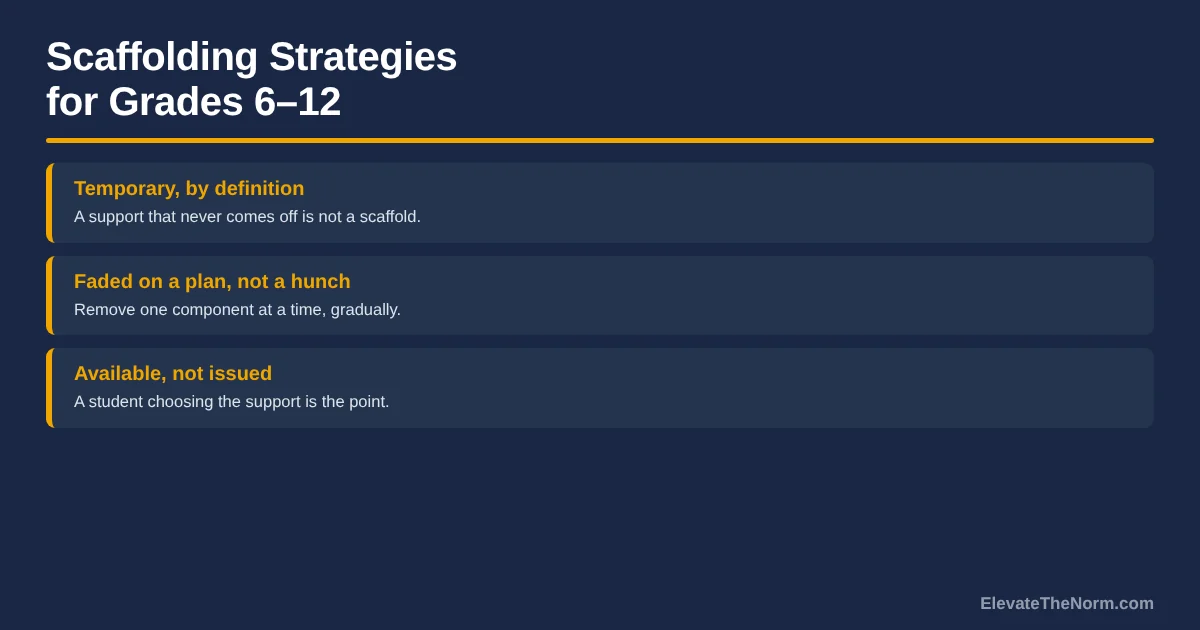
    Scaffolding is temporary support that lets a student do a task they could not yet do alone, and that is removed as they get better at it. Fading is part of the definition, not an optional extra. The scaffolding strategies that work in grades 6–12 are cheap: modeling, cue cards, checklists, worked models, and warning students about likely errors.

    Key Takeaways

    • A support that never comes off is not a scaffold. Reviewers of the research name three characteristics: contingency, fading, and transfer of responsibility. A sentence starter handed out every Monday for a year meets the first and fails the other two.
    • Scaffolding and differentiation are not the same thing. A scaffold is temporary and aimed at a task. Differentiation adjusts for a difference that is still going to be there next month. Mixing them up is how a scaffold quietly becomes a lower standard.
    • Rosenshine names eight concrete scaffolds, and none of them costs money. Modeling, thinking aloud, cue cards, checklists, a completed model to compare against, reading prompts, an organising prompt, and anticipating likely errors.
    • Helping too fast can make high-quality support worse than low-quality support. In a study of 768 students aged 12 to 15, when teachers intervened frequently, less contingent support produced higher achievement and task effort than highly contingent support.
    • A scaffold that helped in September can hurt in November. The expertise reversal effect is the finding that guidance which helps novices becomes redundant load for learners who already have the schema, and gradual fading beats an abrupt switch.

    Walk into most secondary classrooms and you will find scaffolds. Sentence starters taped inside a folder, a graphic organiser for every essay, a word bank on the board since August. What you will rarely find is a plan for taking any of it away. That is the part of scaffolding that almost nobody runs, and it is in the definition.

    This guide covers what scaffolding actually means in the research, how it differs from differentiation, eight specific strategies for grades 6–12, what the evidence does and does not show, and the harder question of when to remove a support. The strategies and sequences are compiled from the sources at the end and from the structures those sources describe. Read them as recommendations, not as a record of any one classroom.

    What Is Scaffolding in Education?

    Scaffolding is a temporary support a teacher provides so a learner can complete a task that is currently beyond them, withdrawn gradually as the learner becomes competent. Barak Rosenshine defines a scaffold plainly as “a temporary support that is used to assist a learner,” and says scaffolds are “gradually withdrawn as learners become more competent.”

    The word comes from a 1976 tutoring study by David Wood, Jerome Bruner and Gail Ross. It is worth knowing what that study actually was, because it gets cited as though it were a classroom trial. According to a research briefing summarising the paper, it involved 30 children aged three, four and five, ten per age band, each working one-to-one with a single tutor to build a wooden block pyramid. Direct hands-on help dropped from a median of 12 instances per child at age three to 3 at age five, and constructions completed with no help rose from 64.5 percent to 87.5 percent.

    That is a descriptive study of preschoolers with no comparison group. It named something real and it cannot tell you anything about a ninth grader writing a thesis statement. The briefing says so itself. The origin story is not the evidence base.

    The three characteristics that define a scaffold

    Janneke van de Pol, Monique Volman and Jos Beishuizen reviewed 66 articles published between 1998 and 2009 in primary and secondary education, and pulled out three characteristics that recur across the definitions.
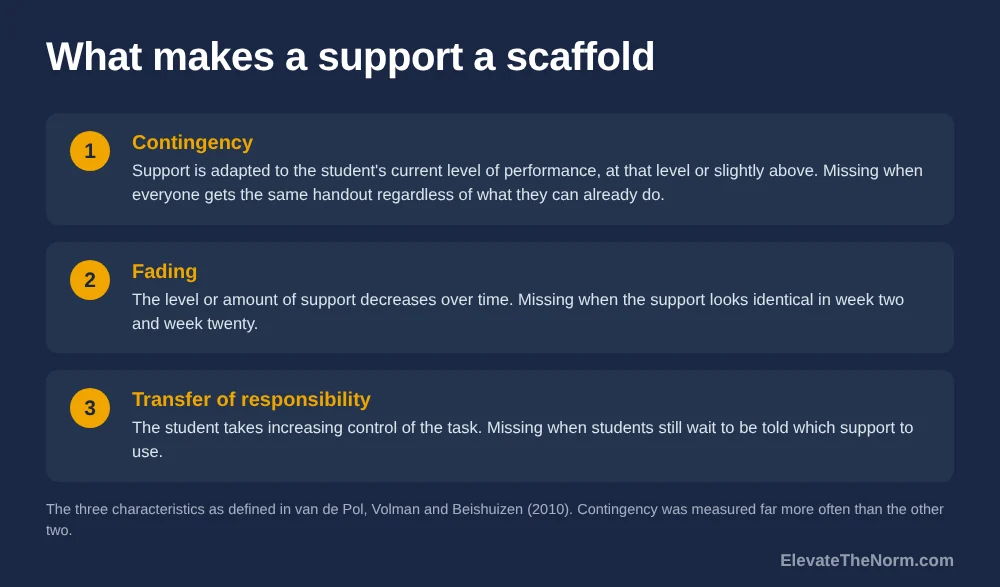
    Graphic defining the three characteristics that make a support a scaffold - contingency, fading and transfer of responsibility - each with a sign that it is missing.
    CharacteristicWhat it meansHow you can tell it is missing
    ContingencySupport is adapted to the student’s current level of performance — at that level or slightly aboveEveryone gets the same handout regardless of what they can already do
    FadingThe level or amount of support decreases over timeThe support looks identical in week two and week twenty
    Transfer of responsibilityThe student takes increasing control of the task, cognitively and metacognitivelyStudents still wait to be told which support to use
    The three characteristics as defined in van de Pol, Volman and Beishuizen (2010). The right-hand column is this guide’s practical restatement, not part of their framework.

    Contingency is worth one extra note, because it has a prerequisite nobody mentions. Support can only be adapted to a student’s current level if you know what that level is this period, which makes checking for understanding the thing that makes scaffolding possible at all. A scaffold chosen from last month’s data is not contingent on anything.

    The reviewers’ own finding about these three is the uncomfortable one. Contingency was operationalised far more often than fading or transfer of responsibility. Many studies named all three in their definition and then measured only the first. Establishing that fading happened, they note, requires several observations over time and ideally across different tasks. So the research literature has the same blind spot the average classroom does: everybody agrees support should come off, and almost nobody checks whether it did.

    What Is the Difference Between Scaffolding and Differentiation?

    A scaffold is temporary and attached to a task; differentiation is an ongoing adjustment for a difference between students. Scaffolding assumes the support comes off. Differentiation does not. Treating a permanent accommodation as a scaffold is how the support stops being support and becomes a different, lower standard.

    ScaffoldingDifferentiation
    What it responds toA task the student cannot yet do aloneA difference in readiness, interest or profile
    Time horizonTemporary, by definitionOngoing for as long as the difference persists
    Success looks likeThe student no longer needs itThe student can access the same standard
    The standard itselfUnchangedUnchanged
    Main failure modeIt never gets removedIt becomes a permanent lower track
    A definitional comparison drawn from the scaffolding characteristics in van de Pol and colleagues’ review. The distinction is conceptual, not a research finding.

    Both are legitimate and they overlap in practice. An accommodation written into an IEP or a 504 plan is not a scaffold and is not a teacher’s to fade. It is a documented entitlement, changed through the team that wrote it, and “they seem to be doing better” is not the process. The problem this article is about is the reverse case: a temporary support that was never meant to be permanent, quietly becoming permanent because removing it would be awkward. If what you need is the full picture of adjusting instruction for a mixed class — including the honest question of how you do any of this with 150 students — differentiated instruction strategies is the page for that. This one is about the supports that are supposed to disappear.

    Eight Scaffolding Strategies That Work in Grades 6–12

    Rosenshine’s “provide scaffolds for difficult tasks” principle names eight specific supports. All eight are things a teacher can build in a planning period, and all eight are designed to be removed.
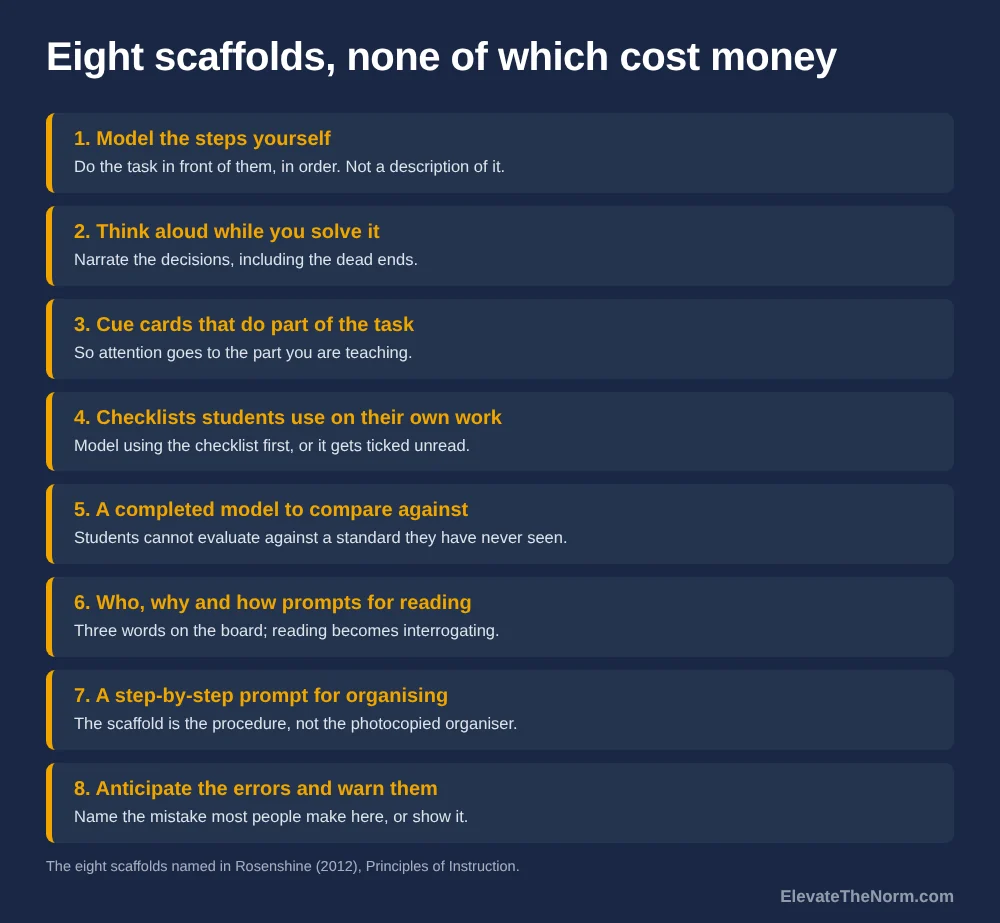
    Graphic listing eight scaffolding strategies named by Rosenshine: modeling the steps, thinking aloud, cue cards, checklists, a completed model to compare against, who-why-how reading prompts, a step-by-step organising prompt, and anticipating likely errors.
    1. Model the steps yourself. Do the task in front of them, in the order you want it done. Not a description of the task — the task. This is the cheapest scaffold there is and the one most often replaced by instructions.
    2. Think aloud while you solve it. Narrate the decisions, including the dead ends. Students who have only ever seen finished work assume competent people do it right first time, which is the single most discouraging belief in a classroom.
    3. Cue cards that complete part of the task. Rosenshine’s framing is important: a cue card does some of the work, so the student can spend their attention on the part you are teaching. A card listing transition words while you teach argument structure is doing its job.
    4. Checklists students use to judge their own work. Rosenshine’s version has the teacher model using the checklist first. An unmodelled checklist gets ticked without being read.
    5. A model of the completed task to compare against. Not an exemplar to copy — a finished piece students hold their own work next to. This is the scaffold that makes self-assessment possible at all, because a student cannot evaluate against a standard they have never seen.
    6. Prompts for generating questions while reading. Rosenshine names “who,” “why” and “how” as the prompts. Three words on the board, and the comprehension task changes from reading to interrogating.
    7. A step-by-step prompt for organising material. His example is drawing a central box and skimming for main ideas. The scaffold is the procedure, not the graphic organiser you photocopied.
    8. Anticipate the errors and warn them first. Tell students the mistake most people make here, or show it. This is the one teachers skip because it feels like putting the idea in their heads, and it is the one that saves the most re-teaching.

    Rosenshine groups all of this under cognitive apprenticeship, where a master models, coaches and supports until the learner can work alone, and he is explicit that providing scaffolds is a form of guided practice rather than a substitute for it. He also notes something honest: students may still reach for a scaffold on an especially hard problem even after they have outgrown it on ordinary ones. That is not regression. It is what a scaffold is for.

    Two adjacent problems have their own pages. If the students you are scaffolding cannot start a task because they cannot plan one, that is a different lever — executive functioning strategies for students covers it. If they do not know what success looks like in the first place, start with learning targets, because a scaffold toward an unclear goal is just extra paper.

    Does Scaffolding Actually Improve Achievement?

    The evidence is positive for thinking and learning activities and genuinely mixed for achievement. Reviewers found only eight effectiveness studies in a decade of research, most of them one-to-one tutoring with simple tasks. The one large secondary-classroom experiment found scaffolding is “not unequivocally effective.”

    Van de Pol and colleagues’ review of a decade of scaffolding research concluded that results on students’ cognitive and metacognitive activities indicate scaffolding is effective, while results on affect were less consistent. Their 66 articles break down into 27 theoretical, 26 descriptive and only eight effectiveness studies, some with very small samples — nine students in one case. Their own recommendation was for more research in naturalistic classrooms with a wider range of tasks.

    Five years later the same lead author ran something much closer to a real classroom, and the result is the most useful finding in this article. In a study published in Instructional Science, 30 social studies teachers and 768 students aged 12 to 15 worked through a five-lesson project on the European Union. The researchers measured how contingent each teacher’s support was and how long students worked independently before the teacher intervened.
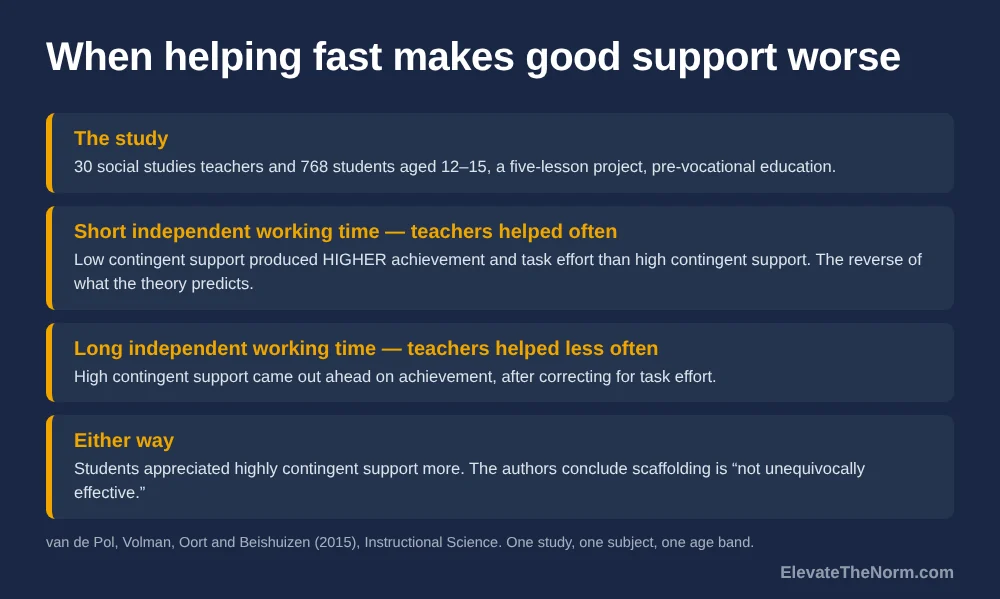
    Graphic summarising a study of 768 students aged 12 to 15, showing that when teachers helped often, low contingent support produced higher achievement than high contingent support, and the reverse when students worked independently for longer.

    What they found runs against the theory. When independent working time was short — that is, when teachers helped frequently — low contingent support produced higher achievement and task effort than high contingent support. Only when students worked independently for longer did high contingent support come out ahead on achievement, after correcting for task effort. Students appreciated highly contingent support more either way. The authors’ conclusion is that scaffolding is not unequivocally effective and that its value depends on independent working time and student effort.

    Read carefully, that is not an argument against scaffolding. It is an argument that when you intervene matters at least as much as how well. Carefully tuned help delivered constantly appears to do less good than blunter help delivered after students have struggled for a while. One study in one subject with one age band cannot settle that, and this is pre-vocational social studies in a five-lesson project, not your course. But it is the closest thing in this literature to a secondary classroom, and it points the same way as the fading research below. The piece on productive struggle in grades 6–12 walks through that timing question on its own terms.

    When Should You Take a Scaffold Away?

    As soon as the student can do the part the scaffold was doing, and gradually rather than all at once. The expertise reversal effect is the finding that instructional support which helps a novice can stop helping, or start hurting, once the learner has built the relevant knowledge.

    Slava Kalyuga, Paul Ayres, Paul Chandler and John Sweller set this out in “The expertise reversal effect” in Educational Psychologist. The mechanism is working memory. A novice has no schema, so explicit guidance helps them build one. A learner who already has the schema has to spend working memory cross-referencing your support against what they already know — load with no return.

    The studies they summarise are mostly adult and vocational: electrical trainees, mechanical trade apprentices, industrial machinery operators, plus one high school biology study where added text coherence helped low-knowledge readers and the original, less coherent text served high-knowledge readers better. The paper reports no effect sizes and most of its samples are not secondary students. The pattern is consistent across eight separate reversals, which is what makes it worth taking seriously, but nobody should present it as a finding about teenagers.

    Their practical recommendations are three, and they are the whole fading argument in a paragraph. Match the support to the learner’s experience, because a design that ignores experience produces inconsistent results and can backfire. Reduce guidance as knowledge grows, since experienced learners generally do better with minimal guidance. And fade gradually rather than switching abruptly — they cite Renkl and colleagues finding that a gradual move from worked examples to independent problems outperformed an abrupt one.

    How Do You Fade a Scaffold Without Losing Half the Class?

    Fade one component at a time, on a schedule you set in advance, and keep the scaffold available for the hardest version of the task. Deciding in advance is the part that matters, because a scaffold with no removal date is a scaffold that stays.

    1. Write down what the scaffold is doing for the student. One sentence. “This organiser is holding the structure so they can concentrate on evidence.” If you cannot write it, you cannot tell when it is no longer needed.
    2. Name the evidence that it has done its job. Not a feeling. A specific thing a student produces — a paragraph with the structure in it and no organiser on the desk.
    3. Remove one component, not the whole support. Drop the sentence starters and keep the headings. Keep the checklist and stop modelling it. Abrupt removal is the version the research says works least well.
    4. Lengthen independent working time before you lengthen the task. This is the lever the 768-student study points at. Let students work longer before you intervene, and intervene well when you do.
    5. Make the scaffold available rather than issued. On a shelf, in a folder, on request. A student choosing to pick up a cue card is transfer of responsibility; the same card on every desk is not. This also solves the fairness problem that contingency creates: if support is available to everyone and chosen by each student, nobody has been publicly handed the easier version.
    6. Keep it for the hard version. Rosenshine’s point stands: reaching for a scaffold on an unusually difficult problem is appropriate use, not relapse. Fade it for the routine task and leave it in reach for the stretch one.

    The step students notice most is the fifth. Moving a support from issued to available changes who is deciding, and that decision is the thing you were trying to teach the whole time.

    Where Does Scaffolding Go Wrong?

    Three failure modes cover nearly all of it: the support never comes off, the support quietly replaces the standard, and the teacher intervenes before the student has done any thinking worth supporting.

    • The permanent scaffold. Nobody decided to keep it forever; no date was ever set. Fix: set the removal condition at the same time you build the scaffold, in writing.
    • Scaffolding the standard instead of the task. The organiser gets so complete that filling it in is the assignment. Fix: check whether a student could score well on your rubric without doing the thinking the standard names. If they could, the scaffold has eaten the task.
    • Helping too fast. The teacher circulates, sees a stalled student, and solves it. Fix: the fourth step above. The secondary-classroom study found frequent intervention undercut even well-tuned support.
    • The same scaffold for everyone. Which fails the contingency characteristic outright. Fix: two versions, or one version offered rather than issued.
    • No way to tell whether fading happened. The review’s own blind spot. Fix: one dated note per unit on what came off. Establishing fading takes observations over time, and a memory is not an observation.

    What to Do Next Week

    Pick one scaffold already in use, write down what it is doing and what evidence would show it is no longer needed, then remove one component of it. That is the whole intervention, and it costs about ten minutes.

    Clay’s take, as a grades 6–12 teacher: the honest reading of this research is that scaffolding is not the high-leverage move it gets sold as. Eight effectiveness studies in a decade, mostly one-to-one tutoring, and the one large secondary experiment finding that helping frequently made good support worse — that is not a reason to stop scaffolding. It is a reason to stop treating a stack of graphic organisers as evidence of good teaching.

    The part that matters for how students are treated is the fading. A support you never remove tells a sixteen-year-old you do not expect them to get past needing it. Taking it away on a plan, telling them that is the plan, and leaving it in reach for the hard version tells them the opposite. Holding a high standard and handing over the support are the same act, done in the right order. That is the argument for high expectations, applied to paper.

    And if a student is far enough behind that no scaffold is reaching them, the conversation is a different one. How to talk to a student who is failing covers that, and it is a better use of a planning period than a sixth organiser.

    Sources

    • Van de Pol, J., Volman, M., & Beishuizen, J. (2010). Scaffolding in teacher–student interaction: A decade of research. Educational Psychology Review, 22, 271–296. Review of 66 articles from 1998 to 2009 in primary and secondary education; only 8 were effectiveness studies, most one-to-one tutoring with simple tasks, one with 9 students. The authors state there is no agreed definition of scaffolding and no instrument covering all three characteristics. Read in full, via the author’s thesis chapter.
    • Van de Pol, J., Volman, M., Oort, F., & Beishuizen, J. (2015). The effects of scaffolding in the classroom: Support contingency and student independent working time in relation to student achievement, task effort and appreciation of support. Instructional Science, 43(5), 615–641. 30 social studies teachers, 768 students aged 12–15, pre-vocational education, a five-lesson project. The authors state scaffolding is “not unequivocally effective.” Abstract and findings read; the full paper is paywalled and was not read.
    • Kalyuga, S., Ayres, P., Chandler, P., & Sweller, J. (2003). The expertise reversal effect. Educational Psychologist, 38(1), 23–31. A review article summarising eight reversals across other researchers’ studies. It reports no effect sizes, and most samples are adult trainees and apprentices rather than school students; one high school biology study is named. Read in full.
    • Rosenshine, B. (2012). Principles of instruction: Research-based strategies that all teachers should know. American Educator, 36(1), 12–19, 39. Source of the scaffold definition and all eight named scaffolds. A practitioner synthesis of three research areas, not a study; adapted from the author’s 2010 report for the International Academy of Education. Read in full.
    • Wood, D., Bruner, J. S., & Ross, G. (1976). The role of tutoring in problem solving. Journal of Child Psychology and Psychiatry, 17(2), 89–100. I read a summary, not the paper: Support that fades, Structural Learning research briefing. The study involved 30 children aged three to five, one-to-one, with no comparison group; the briefing states it describes a pattern rather than showing that fading caused the gains. The journal article itself was not reachable.

    A scaffold is a support you intend to remove. A design choice is one you never needed to add. The distinction matters because the frameworks sit next to each other in most professional development and get treated as the same thing. Where universal design, differentiation and accommodations actually divide sets out the timing and the legal line, including why good design never retires a requirement written into a student plan.

    Withdrawing support is the half of scaffolding nobody schedules, and classroom charts are where it fails most visibly. The practice’s own definition calls a chart “a temporary and visible scaffold or cue until a majority of the class reaches independence” — and a decade-long review of scaffolding found only eight effectiveness studies, with few of them operationalising fading at all. When an anchor chart stops being a scaffold and becomes furniture turns that into four questions you can answer in ten seconds.

    Scaffolding is the support; the gradual release is the schedule for taking it away. The two are constantly treated as one idea, and the model has a more awkward history than its four-box diagram suggests — it came out of 1983 reading-comprehension research, its own authors say it is not a linear lesson format, and nobody has tested it as a whole model. What the gradual release of responsibility actually says covers where the four phases came from, why three-phase and four-phase versions both circulate, and the part teachers most often get wrong.

    What is scaffolding in simple terms?

    Temporary help that lets a student do something they cannot yet do alone, which you then take away as they improve. Rosenshine’s definition is a temporary support used to assist a learner, gradually withdrawn as learners become more competent. If the help is never withdrawn, it stopped being a scaffold and became a permanent feature of the task.

    What is the difference between scaffolding and differentiation?

    Scaffolding is temporary and aimed at a specific task the student cannot do yet. Differentiation is an ongoing adjustment for a difference in readiness, interest or profile that is likely to still be there next month. Both keep the standard the same. The difference is whether the support is supposed to disappear.

    What are some examples of scaffolding strategies for secondary students?

    Rosenshine names eight: modeling the steps, thinking aloud while solving, cue cards that do part of the task, checklists students use on their own work, a completed model to compare against, who-why-how prompts for reading, a step-by-step prompt for organising material, and warning students about likely errors in advance.

    Does scaffolding actually improve student achievement?

    The evidence is mixed. A review of a decade of research found only eight effectiveness studies, mostly one-to-one tutoring, and concluded scaffolding helps cognitive and metacognitive activities. A study of 768 students aged 12 to 15 found it is not unequivocally effective, because its value depends on how long students work independently first.

    When should you remove a scaffold?

    When the student can do the part the scaffold was doing, and in stages rather than all at once. The expertise reversal effect shows that guidance helping a novice can become redundant working-memory load for a learner who already has the knowledge. Research cited in that paper found gradual fading outperformed an abrupt switch.

    Can you scaffold too much?

    Yes, in two ways. A scaffold can get so complete that filling it in becomes the assignment, which replaces the standard rather than supporting it. And intervening too often appears to undercut even well-tuned support: when teachers helped frequently, less contingent support produced higher achievement than highly contingent support in one secondary study.

    Won’t students feel singled out if some of them get extra support?

    They will if you hand it to them. Offering the scaffold to the whole class and letting each student decide whether to pick it up removes the public sorting while keeping the support available, and choosing it is itself the transfer of responsibility the research describes. Accommodations written into an IEP or 504 plan are a separate matter and are not a teacher’s to withdraw.

    Is it a problem if students keep using a scaffold after you fade it?

    Not necessarily. Rosenshine notes students may still lean on a scaffold for especially hard problems after outgrowing it on routine ones, and that is appropriate use rather than regression. The useful move is to fade it for the ordinary version of the task and leave it available on request for the harder version.
    About Clay Shumate

    Clay Shumate is a certified secondary Social Studies teacher in the public schools of West Alabama, with seven years of classroom experience, a B.A. in History, and an M.Ed. in Secondary Education. He writes about project-based learning, student responsibility, respect, and practical ways to hold young people to a higher standard while giving them room to learn from mistakes. He is a member of the Society of Professional Journalists and writes to its Code of Ethics; this site’s editorial standards and corrections policy are published in full. More about Clay.

  • Service Learning Projects in Grades 6–12: The Eight Quality Standards and How to Plan One

    Service Learning Projects in Grades 6–12: The Eight Quality Standards and How to Plan One

    By Clay Shumate

    A service learning project links classroom curriculum to a community need students help meet, with structured reflection built in. That reflection is what separates it from volunteering. The National Youth Leadership Council publishes eight quality standards for K–12 practice, and a meta-analysis of 62 controlled studies found a small average benefit across five outcome areas.

    Key Takeaways

    • Reflection is the dividing line. A food drive is community service. A food drive that students plan against a standard, carry out, and then analyse in writing is a service learning project. Remove the reflection and you have removed the learning half of the name.
    • There are eight published quality standards, and most projects meet three or four. The National Youth Leadership Council names meaningful service, link to curriculum, reflection, diversity, youth voice, partnerships, progress monitoring, and duration and intensity.
    • The average effect is real but small. Celio, Durlak and Dymnicki pooled 62 controlled studies and found a mean effect size of 0.28 overall, with academic achievement at 0.43 from only 17 studies. Two-thirds of the students in that pool were college undergraduates.
    • The evidence specific to middle and high school is thin. A systematic review of adolescents found only ten studies that met its criteria, two of them randomised, and most relied on student self-report.
    • Service does not have to mean a field trip. Four recognised types — direct, indirect, advocacy, and research — mean a project can run entirely from your room if transport and permission slips are the obstacle.

    Most of what gets called service learning in a middle or high school is a canned food drive with a sign-up sheet. Students collect, somebody counts, a photo goes in the newsletter, and nobody can say which standard it met. That is community service, and there is nothing wrong with it. It is just not the thing the research is about.

    This guide covers what separates a service learning project from a service activity, the eight published standards that define quality practice, what the evidence does and does not support for students aged 11 to 18, the four types of service a project can take, and a planning sequence that fits one semester. The steps and timings are compiled from the sources at the end and from the structures those sources describe. Read them as recommendations, not as a record of any one classroom.

    What Is a Service Learning Project?

    A service learning project is an instructional strategy in which students meet a real community need and are deliberately taught through doing it. Barbara Jacoby defines service-learning as experiential education in which students engage in activities that address human and community needs, with structured reflection built in.

    Writing in Faculty Focus, Jacoby names reflection and reciprocity as the two elements that distinguish the method, and calls reflection “the bridge, like a hyphen, that connects the two.” Her definition is written for higher education, so treat it as a definition rather than as evidence about teenagers. The point it makes still travels: learning comes from reflecting on an experience, not from having had one.

    Reciprocity matters just as much and gets skipped more often. A project is reciprocal when the community partner gets something they actually asked for. A project where a class decides what a shelter needs, delivers it, and leaves is a project with a service shape and a one-way relationship.

    How service learning differs from the things it gets confused with

    ApproachWho sets the goalTied to a standard?Reflection required?Who it is meant to benefit
    Service learning projectStudents and the community partner togetherYes, by definitionYes, ongoingBoth the student and the community
    Community serviceThe school or an outside organiserNoNoThe community
    VolunteeringThe student, on their own timeNoNoThe community
    Internship or work placementThe host organisationSometimesSometimesMainly the student
    Experiential learning taskThe teacherUsuallyYes, in most modelsMainly the student
    Compiled for this guide from the definitions in the sources listed at the end. The distinctions are definitional, not findings.

    If what you want is the wider question of how to make school work feel like it matters outside the building, that is a different page: real world learning covers it. If you want a bank of shorter hands-on tasks that do not need a community partner at all, experiential learning activities is the list. Service learning is the narrower thing with a partner, a need, and a reflection requirement.

    What Are the Eight K–12 Service-Learning Standards?

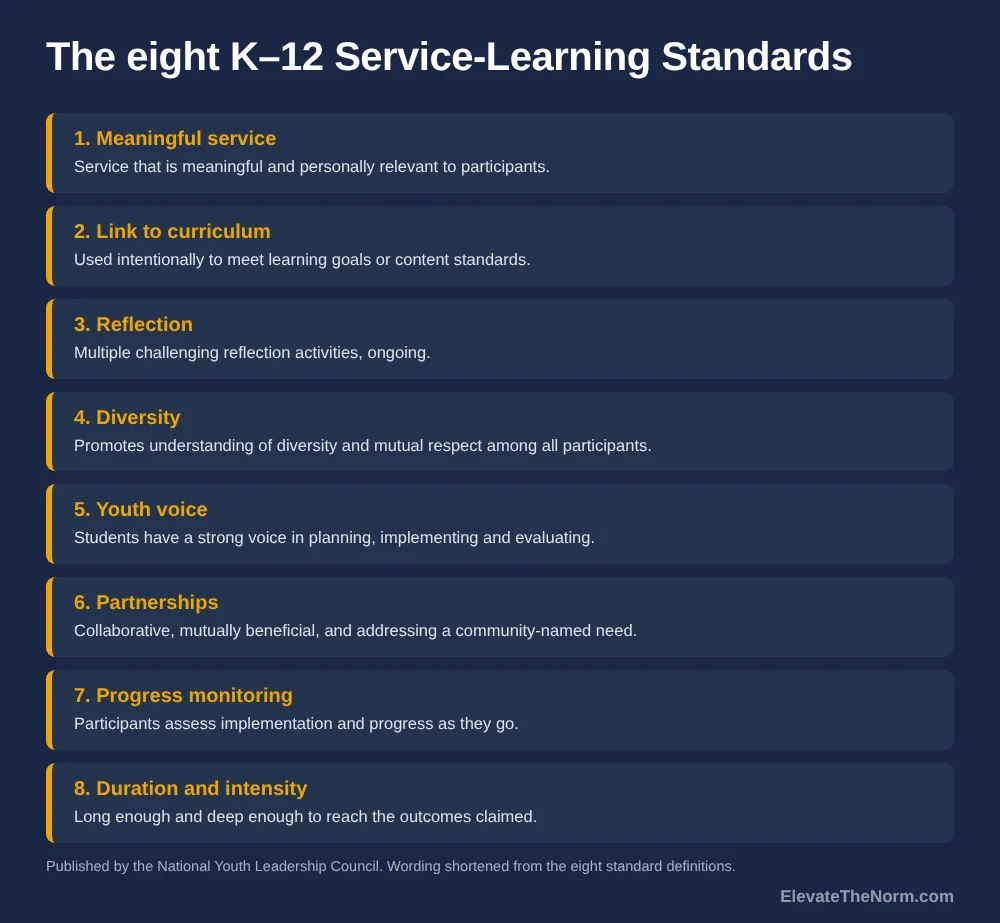
    The National Youth Leadership Council publishes eight K–12 Service-Learning Standards for Quality Practice: meaningful service, link to curriculum, reflection, diversity, youth voice, partnerships, progress monitoring, and duration and intensity. They were published in 2008 and are the closest thing the field has to a shared definition of quality.

    Graphic listing the eight K-12 Service-Learning Standards for Quality Practice - meaningful service, link to curriculum, reflection, diversity, youth voice, partnerships, progress monitoring, and duration and intensity - each with a one-line definition.

    The council’s own page describes them as representing best practices for high-quality experiences, and the Wisconsin Department of Public Instruction reproduces each standard with its one-sentence definition. The wording below is theirs, shortened only where a standard runs to two clauses.

    1. Meaningful service. The work actively engages participants in service that is meaningful and personally relevant. A task students find pointless fails this standard even if the community benefits.
    2. Link to curriculum. The project is used intentionally as an instructional strategy to meet learning goals or content standards. This is the standard that turns a drive into a unit.
    3. Reflection. Multiple challenging reflection activities, ongoing, prompting deep thinking about oneself and one’s relationship to society. Note the plural and the word ongoing.
    4. Diversity. The project promotes understanding of diversity and mutual respect among all participants, which includes the people being served.
    5. Youth voice. Students have a strong voice in planning, implementing and evaluating the project, with guidance from adults.
    6. Partnerships. The partnership is collaborative, mutually beneficial, and addresses a need the community itself names.
    7. Progress monitoring. Participants assess the quality of implementation and progress toward goals as they go, and use the results to improve.
    8. Duration and intensity. The project lasts long enough and goes deep enough to address the need and reach the outcomes claimed for it.

    One honest caveat. Celio and colleagues wanted to test whether following these standards predicts better outcomes and could only analyse four of the eight, because the studies did not report enough detail to code the other four. They also note the standards are not clearly operationalised. So the eight are a credible professional consensus about quality, not eight separately validated levers.

    Does Service Learning Actually Improve Academic Results?

    Modestly, and the strongest number comes from the smallest set of studies. In a meta-analysis of 62 controlled studies, academic achievement showed a mean effect size of 0.43, but only 17 of the 62 studies measured achievement at all. The overall average across five outcome areas was 0.28.

    Those figures come from Celio, Durlak and Dymnicki (2011) in the Journal of Experiential Education, pooling 62 studies and 11,837 students. Every included study had a control group, which is better than this literature’s reputation suggests. The five domains came out as follows.

    Outcome domainStudiesMean effect size95% confidence interval
    Academic achievement170.430.29 to 0.58
    Social skills280.300.18 to 0.38
    Attitudes toward self360.280.18 to 0.38
    Attitudes toward school and learning120.280.12 to 0.43
    Civic engagement280.270.16 to 0.38
    Overall620.280.21 to 0.34
    Figures from Celio, Durlak and Dymnicki (2011). All five domains differed significantly from zero; academic achievement was significantly higher than the other four.

    Now the caveats, because they change how you should read the table. Sixty-eight percent of the students were college undergraduates. Sixteen percent were high school and six percent were middle school. This is not a secondary-school result; it is a mostly-college result with a secondary minority inside it. Only 19 of the 62 studies randomised. And 87 percent of the outcomes were student self-report, which the authors flag themselves as vulnerable to social desirability.

    One finding does cut cleanly in favour of doing the work properly. Studies whose programmes used all four of the codeable recommended practices — linking to curriculum, youth voice, community involvement and reflection — averaged 0.35. Studies using none of them averaged 0.17. The effect did not climb steadily with each practice added, so this is not a dose-response curve. But the gap between all four and none is roughly double.

    For evidence on students in the actual age band this site writes for, the picture is thinner. Fernández-Martín and Ayllón-Salas screened 4,342 records for their systematic review of service-learning among adolescents and found ten studies that qualified, covering roughly grades 7 to 10, with samples from 28 to 359 students. Two were randomised controlled trials, four were quasi-experimental with a control group, and four had no control group at all. Only three of the ten had at least 30 participants per group, and only four reported an effect size.

    What they found: all four studies measuring academic outcomes reported significant improvement, eight of nine measuring socioemotional outcomes found gains on at least one indicator, and all five measuring civic outcomes found positive change on at least some indicators. The one study measuring community-level outcomes found nothing significant. The authors describe the cognitive effects as small and the academic effects as inconsistent, and they did not run a risk-of-bias assessment. Ten studies, mostly small, mostly self-report, is a reason for cautious optimism and not for a staff meeting slide.

    What Kinds of Service Learning Projects Are There?

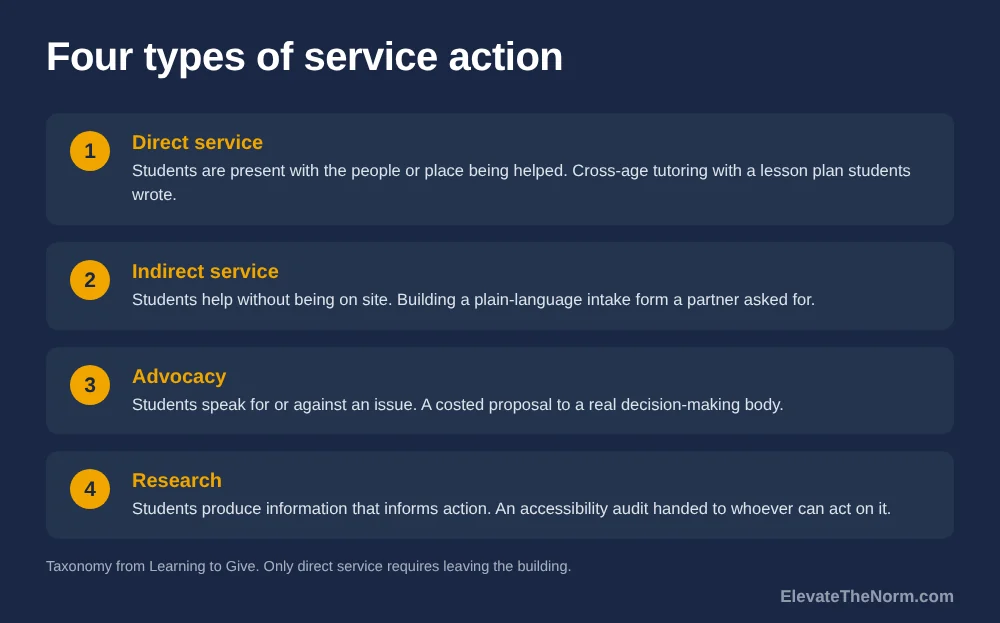
    Four: direct service done in the presence of the people or place being helped, indirect service done away from them, advocacy that speaks for or against an issue, and research that produces information to inform action. Three of the four need no bus and no field-trip form.

    Graphic showing the four types of service action for service learning projects - direct, indirect, advocacy and research - each with a grades 6-12 example.

    The four-type taxonomy comes from Learning to Give. It is the most useful planning tool in this whole article, because the reason most secondary service learning dies is transport, liability and the master schedule — and only one of the four types requires leaving the building. The project ideas below are grouped by type and written for grades 6–12.

    Direct service — students are present with the people or place

    • Cross-age tutoring with a planned curriculum. Older students teach a specific skill to younger ones, with a lesson plan they wrote and a pre- and post-check they designed.
    • Restoring a neglected space on the grounds. A courtyard, a pollinator strip, a weather station plot. Measured before, planted, maintained on a schedule students keep.
    • Running a community information night. Students plan, staff and present the whole event, from the agenda to the room setup to the follow-up.

    Indirect service — students help without being on site

    • Building something a partner organisation asked for. A plain-language intake form, a translated flyer, a reading-level-appropriate guide. The partner names the gap; students build to spec and revise after feedback.
    • A supply drive with a brief students wrote. Students survey the partner, decide what is actually needed, set a target, and report variance against it. The analysis is the assignment.
    • A how-to archive for a specific local audience. Short written or recorded guides for a need a partner identifies, kept somewhere the partner can actually reach.

    Advocacy — students speak for or against something

    • A proposal to a real decision-making body. Student council, a school board, a city committee. Researched, costed, delivered in the format that body actually accepts.
    • An awareness campaign on a named local issue. Not a poster about kindness. A specific issue, a specific audience, and a way to tell whether the audience heard it.
    • A written public comment on a live policy question. Students read the actual document, find the clause, and write a submission in the register the process expects.

    Research — students produce information that informs action

    • Collecting environmental data and reporting it back. The Learning to Give example is water sampling shared with the community to prompt action; air quality, noise and tree canopy work the same way.
    • An accessibility or safety audit of a public space. Students build the instrument, walk the route, record findings, and hand the report to whoever can act on it.
    • An oral history or local records project. Students gather and organise material a local institution says it is missing, and deposit it there in a usable form.

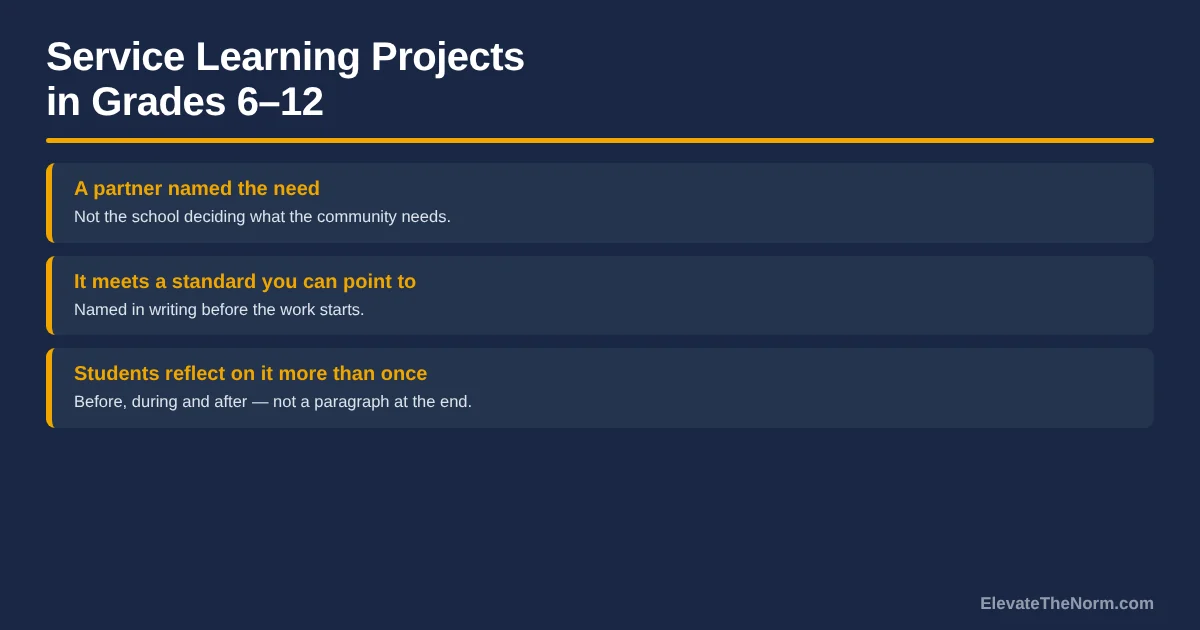
    Two of those overlap with ordinary project-based work, which is fine. The test is not novelty. It is whether a partner named the need, whether the work meets a standard you can point to, and whether students reflect on it more than once. For the assessment half, building a rubric for project-based learning covers the mechanics, and student voice and choice covers how much of the planning to actually hand over.

    How Do You Plan a Service Learning Project in One Semester?

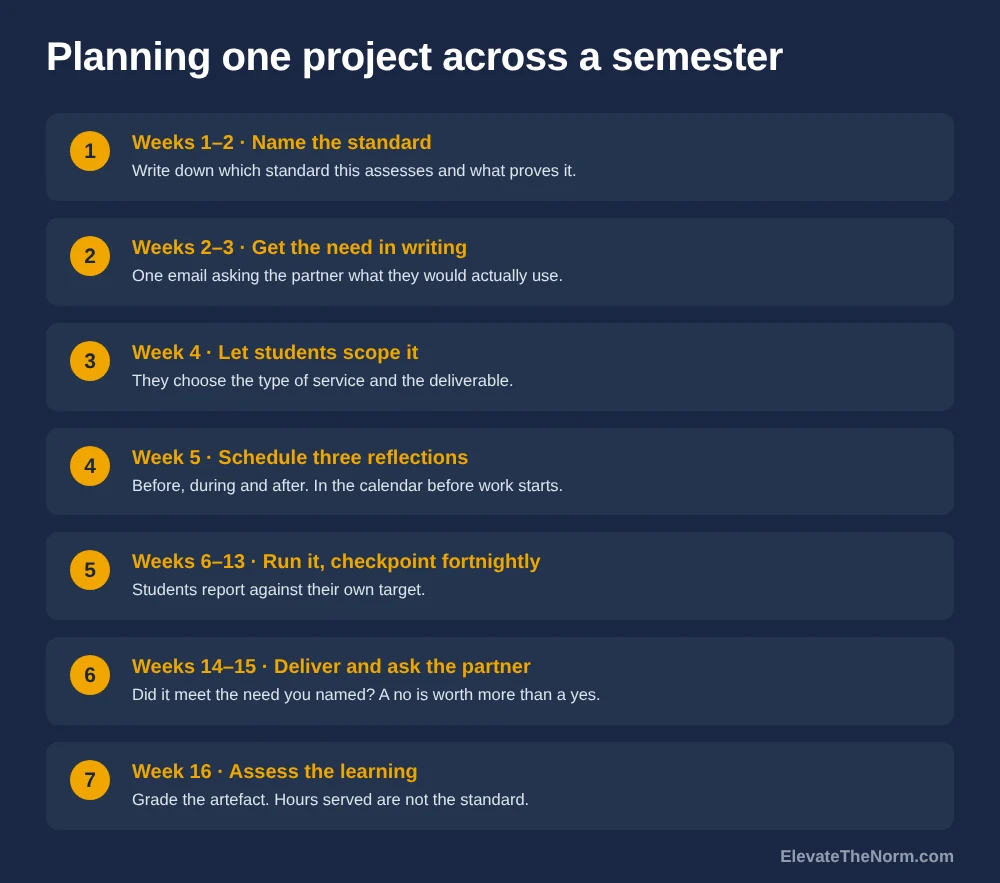
    Start from the standard, not the service. Pick the content standard first, find a need a partner will confirm in writing, let students scope the work, build reflection into three fixed points, then run it. The sequence below spreads over about sixteen weeks without taking over the course.

    Graphic showing a seven-step sequence for planning a service learning project across a sixteen-week semester, from naming the standard in weeks one and two to assessing the learning in week sixteen.
    1. Weeks 1–2: name the standard and the evidence. Write down which content standard this project assesses and what a student will produce that proves it. If you cannot write that sentence, you have a service activity. Standard two of the eight is the one most projects fail.
    2. Weeks 2–3: get the need from the partner, in their words. One email or one call asking what they would actually use. Keep the reply. This is the partnerships standard and it takes about twenty minutes.
    3. Week 4: let students scope it, inside your constraints. Give them the standard, the partner’s stated need, the calendar and the budget, and let them choose the type of service and the deliverable. That is the youth voice standard, and it is the cheapest of the eight to meet.
    4. Week 5: set the three reflection points now. Before, during and after — the pattern Jacoby’s 4 C’s calls continuous. Put them in the calendar before the work starts, because a reflection you schedule later is a reflection that gets cut.
    5. Weeks 6–13: run it, with a visible checkpoint every two weeks. Students report progress against their own target, not against your impression of how it is going. This is progress monitoring, and it is also how you find out in week eight rather than week thirteen.
    6. Weeks 14–15: deliver, and close the loop with the partner. Hand over the work and ask the partner whether it met the need they named. A no here is worth more than a yes, and it is the only honest test of reciprocity.
    7. Week 16: assess the learning, separately from the service. Grade the evidence you named in week one. Hours served, bags collected and photos taken are not the standard and should not be in the grade. And this assessment replaces a unit’s assessment rather than sitting on top of it — if the project is extra work bolted onto a full course, students are right to resent it.

    Sixteen weeks sounds enormous until you notice how little of it is class time. Steps one, two, four, five and seven are planning and assessment you would do for any unit. The duration and intensity standard is about the project having enough runway to matter, not about surrendering a semester of instruction to it.

    How Do You Build the Reflection That Makes It Learning?

    Use Eyler, Giles and Schmiede’s 4 C’s: reflection should be continuous, connected, challenging and contextualised. In practice that means reflection before, during and after the work, tied to course content, with questions hard enough that a student cannot answer them from goodwill alone.

    Jacoby’s account of the 4 C’s is the clearest short version. Continuous means before, during and after, not a paragraph at the end. Connected means the reflection links course content, the student’s own thinking and what they saw firsthand. Challenging means the questions balance challenge with support rather than inviting a feel-good summary. Contextualised means the format suits the setting and what is actually going on in students’ lives.

    The failure mode is predictable. “How did this project make you feel?” produces a page of sentiment that no rubric can grade and no standard can claim. The questions that work name the content: what did the partner’s constraint teach you about the problem, which of your assumptions turned out wrong and what evidence changed it, what would you do differently with the same budget.

    Reflection was also the most commonly used of the four recommended practices in the Celio pool, present in 74 percent of programmes, while community involvement appeared in only 26 percent. Read that as a warning rather than reassurance: the easiest standard to claim is the one almost everybody claims, and it is the partnership half that most projects are quietly missing.

    Where Do Service Learning Projects Go Wrong?

    Four failure modes account for most of it: no curriculum link, a need nobody outside the building named, reflection bolted on at the end, and a grade built on hours instead of learning. Each has a fix that costs under an hour.

    • The project is not linked to anything you teach. It runs in advisory, or on a Friday, or as an extracurricular with a teacher sponsor. Fix: name the standard in writing before week two, or run it as community service and call it that honestly.
    • The school decided what the community needs. This is the most common and the least discussed. Fix: one email to the partner asking what they would use, and keep the answer. If the partner’s answer is boring, build the boring thing.
    • Reflection happens once, at the end. Which makes it a report, not reflection. Fix: three scheduled points, written into the calendar in week five.
    • The grade measures compliance. Hours logged, items collected, attendance at the event. Fix: grade the artefact you named in week one and let the service be ungraded. Students notice very quickly which one you actually count.
    • Participation depends on a family’s resources. Transport, weekend availability, a parent who can drive. Fix: choose indirect, advocacy or research service, which run inside the school day, and never make the out-of-school version the only route to the grade. The same check applies to students with an IEP or 504 and to English learners: if the only full-credit route requires a skill the plan says to accommodate, the project is grading the accommodation.
    • The partner goes quiet in week nine. Staff turnover, a funding change, a missed email. It happens often enough to plan for. Fix: get the need in writing at the start, keep a second partner on the list, and build the deliverable so a redirected version still meets the standard you named.
    • Nobody cleared the permissions. Direct service is the only one of the four types that routinely needs supervision ratios, transport approval, and sometimes a check on the adults students will be working alongside. Fix: ask an administrator before students start scoping, not after they have chosen. A project a principal has to stop in week six costs more than the one you did not run.

    Two of those deserve more than a bullet. A project that quietly requires a car is a project that grades family circumstance; the four-type taxonomy exists partly to solve exactly this, and student leadership activities covers the related problem of who ends up with the visible roles when adults pick.

    The other is the dignity of the people being served, which almost no planning template asks about. Photographs are where this goes wrong fastest. A picture of students handing something to an identifiable person who is having a hard week is a picture taken for the school, not for them, and the person in it rarely got a real choice about it. The diversity standard is partly about this: mutual respect among all participants includes the people on the receiving end. Ask the partner what they are comfortable with, default to photographing the work rather than the recipients, and tell families plainly at the start what the project is, what will be published, and what is actually being graded.

    Is a Service Learning Project Worth the Trouble?

    Worth it for one unit a year, run properly, rather than as a schoolwide initiative. The effect sizes are small and the secondary-specific evidence is thin, so the honest case for service learning is not that it raises test scores. It is that it makes one unit’s work real and gives students something to be accountable to besides a grade.

    Clay’s take, as a grades 6–12 teacher: the number worth paying attention to in all of this is not 0.43. It is the 0.35 against 0.17 gap between programmes that used all four recommended practices and programmes that used none. That gap is about whether the adult running the project did the unglamorous parts — naming the standard, asking the partner, scheduling the reflection — and those parts are free. A school that announces service learning and skips them has bought the 0.17.

    And the thing teenagers detect fastest is a project that exists for the photo. If the partner did not ask for it, they know. If the reflection questions are about feelings, they know. Treating students as people capable of hearing “the organisation said they do not need what we planned, so we are starting over” is most of what separates a project that teaches something from a drive with a banner.

    If you want the structural version of this — how to run the planning cycle for any project, not just a service one — the seven steps of project-based learning is the sequence.

    Sources

    • Celio, C. I., Durlak, J., & Dymnicki, A. (2011). A meta-analysis of the impact of service-learning on students. Journal of Experiential Education, 34(2), 164–181. 62 studies, 11,837 students, all with control groups; 68% college undergraduates, 16% high school, 6% middle school; 19 of 62 randomised; 87% of outcomes were student self-report. Read in full.
    • Fernández-Martín, F. D., & Ayllón-Salas, P. (2026). Impact of service-learning among adolescents: A systematic review. Adolescents, 6(1), 10. Ten studies, roughly grades 7–10, samples of 28 to 359; only 2 randomised controlled trials and 4 with no control group; a narrative review, not a meta-analysis, with no risk-of-bias assessment. Read in full.
    • National Youth Leadership Council. K–12 Service-Learning Standards for Quality Practice. The publisher’s own page; it names the eight standards but does not list the indicators or a year. Read in full.
    • Wisconsin Department of Public Instruction. K–12 Service-Learning Standards for Quality Practice. A state education agency’s reproduction of the eight standards with each one-sentence definition, attributed to the National Youth Leadership Council and dated 2008. Used here for the wording. Read in full.
    • Jacoby, B. What makes service-learning unique: Reflection and reciprocity. Faculty Focus. Source of the working definition and of Eyler, Giles and Schmiede’s 4 C’s of critical reflection. Written for higher education, not K–12, and it is a practitioner article rather than a study. Read in full.
    • Learning to Give. The four types of service action. Source of the direct, indirect, advocacy and research taxonomy and its examples. A curriculum organisation’s framework, not a research finding. Read in full.

    What is a service learning project in simple terms?

    Classwork where students help meet a real community need and are taught through doing it. Three things have to be true: it is tied to something you teach, a community partner named the need, and students reflect on it more than once. Take away the reflection and the curriculum link and you have community service instead.

    What is the difference between service learning and community service?

    Community service meets a need. Service learning meets a need and teaches a standard, with structured reflection connecting the two. A food drive is community service. A food drive students scope against a standard, run, and then analyse in writing is a service learning project. The reflection is the dividing line, not the amount of work.

    Does service learning raise test scores?

    Not dramatically. The largest meta-analysis found a mean effect size of 0.43 for academic achievement, but only 17 of its 62 studies measured achievement, and about two-thirds of the students were college undergraduates. A review focused on adolescents found only ten qualifying studies and described the academic effects as inconsistent.

    Can you run a service learning project without leaving the school?

    Yes. Of the four recognised types of service action, only direct service requires being present with the people or place being helped. Indirect service, advocacy and research can all run from a classroom, which also removes the transport and permission barriers that make projects depend on a family’s resources.

    How do you grade a service learning project?

    Grade the learning, not the service. Name in advance what a student will produce that proves the standard, and grade that artefact. Hours served, items collected and event attendance are compliance measures, not evidence of learning, and students work out very quickly which one actually counts toward their grade.

    What if no community partner will work with my class?

    Start with an organisation already connected to the school and ask one question: what would you actually use. Research and advocacy projects also need a far lighter partnership than direct service, because the deliverable is information or a submission rather than labour. A partner who only confirms the need is still a partner.

    What permissions do you need, and what about student and community privacy?

    Direct service is the type that triggers supervision ratios and transport approval, so clear it with an administrator before students scope the project rather than after. On images, default to photographing the work instead of the people receiving help, ask the partner what they are comfortable with, and tell families at the start what will be published.

    What if a student does not want to be visible, or objects to the cause?

    Give them a route that earns full credit without a public role. Research, writing and planning work are all genuine contributions, and the graded artefact should be the learning rather than the appearance. A student who disagrees with the cause can often do the strongest work on it, because disagreement forces them to engage with the evidence.

    About Clay Shumate

    Clay Shumate is a certified secondary Social Studies teacher in the public schools of West Alabama, with seven years of classroom experience, a B.A. in History, and an M.Ed. in Secondary Education. He writes about project-based learning, student responsibility, respect, and practical ways to hold young people to a higher standard while giving them room to learn from mistakes. He is a member of the Society of Professional Journalists and writes to its Code of Ethics; this site’s editorial standards and corrections policy are published in full. More about Clay.

  • Capstone Project Ideas for Grades 8–12: How to Scope One and 15 Ideas That Hold Up

    Capstone Project Ideas for Grades 8–12: How to Scope One and 15 Ideas That Hold Up

    By Clay Shumate

    A capstone project is a long, student-chosen project that ends in a finished product and a defense in front of people who can ask hard questions. The capstone project ideas that hold up start with a question one search cannot answer, name an adult who agreed to meet the student on a schedule, and end in something real. Scope it smaller for eighth graders and larger for seniors, and the same structure works for both.

    Key Takeaways

    • A capstone is a structure, not a topic. Ohio’s senior capstone toolkit requires four parts: a proposal, an anchor experience, a culminating portfolio and a presentation to a panel. A list of topics with none of those parts is just a research assignment with a bigger deadline.
    • The evidence is promising, not proven. MDRC’s review of project-based learning research describes the evidence as “promising but not proven,” and Education Week’s report on Oakland’s capstone offers qualitative support rather than controlled outcome data. Adopt capstones for the ownership and the defense, not for a promised test-score gain.
    • Scope by grade, or the project eats the student. Poly Prep ends its middle school capstone with a Capstone Night for eighth graders; Oceana High School asks seniors for a 15- to 30-page paper and a 20- to 30-minute presentation. Those are not the same job and should not be handed out as one.
    • Mentors and checkpoints are what keep a long project alive. Ohio’s toolkit asks students to meet an advisor and a mentor at least twice per semester. Without scheduled check-ins, a capstone is a long assignment with a due date at the end.

    Most lists of capstone project ideas are lists of topics. “Do a project on climate.” “Research a career.” A topic is not a capstone, and a student handed a topic and a six-month calendar will spend five of those months deciding what to do and the sixth panicking. The ideas below are written as questions and deliverables instead, because that is what a student can actually start on Monday.

    This guide covers what a capstone project is, what makes an idea hold up, how to scope the same project for an eighth grader and a twelfth grader, fifteen ideas in three groups, and how mentors, checkpoints and grading work. The scope and timings are recommendations compiled from the programs and sources listed at the end. Read them as recommendations, not as a record of any one classroom.

    What Is a Capstone Project, and How Is It Different From a Regular Project?

    A capstone project is a culminating, student-designed project that pulls learning together over a long stretch, anywhere from a semester to a full year, and ends with a product and a presentation to an audience that can question it. It differs from a regular project in three ways: it runs much longer, the student owns the question, and there is a defense at the end.

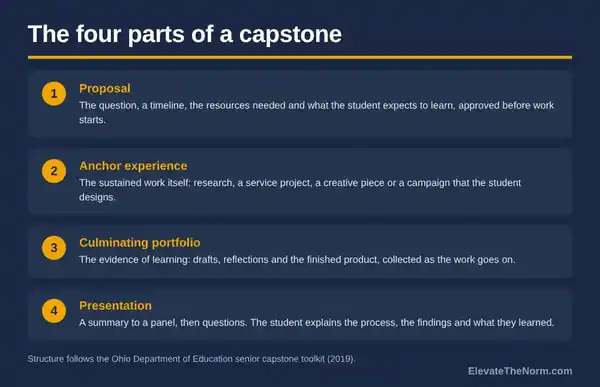
    The clearest written structure comes from Ohio’s Senior Capstone Toolkit (May 2019), issued under the state’s EachChildOurFuture plan. It names four required parts. The proposal states the objective, the timeline, the resources needed and what the student expects to learn. The anchor experience is a student-designed learning experience such as an internship, a research project, a public service project or a creative work. The culminating portfolio collects the documents, deliverables and reflections that show what was learned. The presentation is a summary delivered to a panel, followed by questions. The toolkit does not set a required number of hours, which tells you something: the state cares that the four parts exist, and leaves the size to the school.

    Graphic titled The four parts of a capstone, showing four numbered cards: proposal, anchor experience, culminating portfolio and presentation.

    Three real programs, three very different sizes

    Oakland, California’s Graduate Capstone Project, reported by Education Week in 2019, is a yearlong assessment built around a student-developed research question on a social issue. Students draft essays, do field research through focus groups, expert interviews or surveys, and present to their school, then answer questions from a panel of teachers. The district has required a serious research project or exhibition to graduate since 2005, and for the class of 2018 two-thirds of graduating seniors completed the full project. The article is candid that most of its support is qualitative, and it says plainly that the individual pieces are not unusual. What stands out is how they are knit together.

    Oceana High School’s senior exhibition, described in a Learning Policy Institute profile, is a graduation requirement with a 15- to 30-page research paper on a student-chosen essential question, followed by a 20- to 30-minute presentation and a question period. The research runs a year, and students spend about six weeks preparing the presentation. Smaller exhibition-style projects happen in tenth and eleventh grades, which matters later in this guide.

    At the other end, Poly Prep’s middle school capstone is the culminating project of a history course for eighth graders. Students write research questions, research with primary and secondary sources, and build a final product, which can be a paper, a website, a game or a short documentary, that teaches peers and parents about the topic. Panels at an annual Capstone Night in May show the work. The page does not say how long the project takes or who mentors it, so I am not going to guess at either.

    What Makes a Capstone Project Idea Hold Up?

    A capstone project idea holds up when it passes four tests: the question cannot be answered with one search, a real audience can disagree with the result, there is a finished product a stranger could use, and one adult has agreed in writing to meet the student on a schedule. An idea that fails any of the four tends to stall long before the defense.

    1. The question resists a single search. “Sharks” is a topic. “What would it take for our town to cut its stormwater runoff?” needs sources, interviews and a judgment call. The same test applies to driving questions for project-based learning, and the examples there transfer.
    2. A real audience can disagree. A teacher grading a paper is not an audience. A panel that includes a person from outside the school, or a decision-maker who could act on a recommendation, is.
    3. There is a finished product. Something a stranger could read, watch, play, use or visit. The product is what turns research into work with consequences.
    4. One adult agreed to meet. Ohio’s toolkit has the mentor sign a pledge after reading the proposal, and the timeline must list check-ins with the advisor and the mentor. That signature is the cheapest piece of structure in the whole design.

    None of this is proven to raise achievement. The MDRC literature review of project-based learning, by Condliffe and colleagues (2017), rates the evidence as promising rather than proven, notes that evaluation designs often leave open the possibility that something other than the project caused the result, and says the wide variation in how project-based learning is done makes general conclusions hard. The Oakland coverage is honest in the same way: no controlled outcome data, plenty of teacher and student testimony. So the case for a capstone is not a research finding. It is that the parts are sensible, each one is cheap to check, and a student who defends a year of work to adults who can question it has done something a worksheet cannot ask of them.

    How Should You Scope a Capstone Project for Eighth Grade Versus Twelfth Grade?

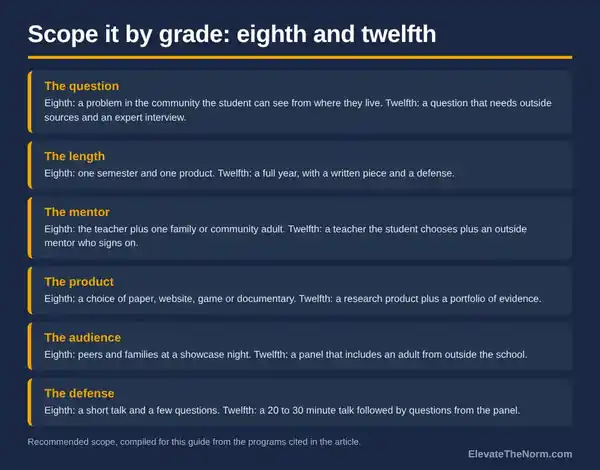
    Keep the same four parts but change the size of every one. An eighth-grade capstone is one semester, one product and a short talk to peers and families; a twelfth-grade capstone is a full year with an outside mentor, a research product plus a portfolio, and a longer defense in front of a panel that includes someone from outside the school.

    ElementEighth gradeTwelfth grade
    The questionA problem in the community the student can see from where they liveA question that needs outside sources and an expert interview
    The lengthOne semester and one productA full year, with a written piece and a defense
    The mentorThe teacher plus one family or community adultA teacher the student chooses plus an outside mentor who signs on
    The productA choice of paper, website, game or documentaryA research product plus a portfolio of evidence
    The audiencePeers and families at a showcase nightA panel that includes an adult from outside the school
    The defenseA short talk and a few questionsA 20 to 30 minute talk followed by questions from the panel
    Recommended scope, compiled for this guide from the programs cited. These are suggestions, not findings.

    The right-hand column borrows from two programs: the length of the talk and the outside evaluator come from Oceana’s senior exhibition, and the portfolio comes from Ohio’s toolkit. The left-hand column borrows from Poly Prep’s structure of research questions, a choice of product that teaches an audience, and a public night. What I added is the scaffolding between them.

    Comparison graphic titled Scope it by grade: eighth and twelfth, with six rows (question, length, mentor, product, audience, defense) showing a smaller eighth-grade version and a larger twelfth-grade version of each.

    The scaffolding matters because of what the Oakland reporting found. Students there initially found it too much to master research, writing and presenting in senior year, and one teacher argued that students need to practice those skills every year. That is the argument for the middle of the sequence. An eighth-grade capstone is the first repetition. A ninth-through-eleventh-grade version, a one-semester project with an outside audience, is where the interview, the survey and the revision get practiced before a student carries them alone. Oceana does something similar with its smaller exhibitions in tenth and eleventh grades. A first-ever capstone in the spring of senior year is the version most likely to feel like an ambush.

    Grade level is also a judgment about respect. A fourteen-year-old can run a real project with a real audience, and the best thing a teacher can do is expect it and then build the supports. A school that treats older students as capable but gives them no practice is asking for performance without preparation. The guide to student voice and choice covers how much of the decision to hand over at each stage.

    What Are 15 Capstone Project Ideas That Hold Up?

    Here are fifteen ideas in three groups: research and argument, build and make, and serve and advocate. Each is written as a deliverable rather than a topic, and each can be scaled down for eighth grade by trimming the sources and the audience, or up for twelfth grade by adding an outside mentor and a harder evidence requirement.

    If you need smaller, unit-sized ideas rather than semester-long ones, the guide to ideas for project-based learning and the list of history project ideas fit that size better. These fifteen are built for the long haul.

    Research and argument

    • Local history with a living source. Interview people in the community about a change in the town, then write the history that only those interviews can support. Eighth grade: one interview and a short documentary. Twelfth grade: three interviews checked against archival records.
    • A policy brief for a real decision. Pick a decision someone actually faces, such as a bell schedule, a phone policy or a crosswalk, and write a recommendation that weighs the evidence on both sides. A decision-maker reads it and responds.
    • Does the claim hold? Take a popular claim about study habits, sleep or nutrition, and test it against primary research. Report what the evidence supports, what it does not, and which populations the studies actually covered.
    • Two interpretations, one verdict. Collect two sources that disagree about the same event, explain why they disagree, and defend which reading the evidence favors. The defense is the whole point.
    • A data investigation from the school or town. Gather public data a student can actually get, such as monthly attendance or local weather readings, show a trend, and state the limits of what the numbers can say.

    Build and make

    • Design, prototype and test a fix. Pick a real problem in the building, a hallway bottleneck or a long lunch line, prototype a change, test it with the people affected, and report what happened.
    • A teaching resource for younger students. Build a lesson, game or tutorial on a subject the student knows deeply, try it with real learners, and revise from what they got wrong.
    • A documentary or podcast series. Several short episodes on one question, with sources named on air. The finished series has to hold up for a listener who knows nothing about the topic.
    • A working tool for a real client. A website, app or spreadsheet system for a club, a team or a local organization that will actually use it. A named client who can say what is wrong with it is the entire test.
    • A creative work with a written defense. A short story collection, a composition, a mural or a one-act play, paired with a defense that explains the choices and the influences.

    Serve and advocate

    • A service project with a measurable result. Plan, run and measure a drive, clean-up or repair against a stated goal, and write up what the plan got wrong.
    • A needs assessment and a pilot. Survey and interview a defined group, identify a need, and pilot a response on a small scale. Spend real time on the survey wording. Oakland’s account notes that survey data are limited by how the questions are framed.
    • A career shadow with analysis. Shadow a professional for a set number of hours, then analyze the path to that career: training, cost, alternatives and what the person wishes they had known. Ohio lists an internship as one acceptable anchor experience.
    • An awareness campaign with a before-and-after measure. Run a campaign on a topic that matters locally, measure the change with a short pre- and post-survey, and report honestly if nothing moved.
    • A peer tutoring or mentoring program. Design a small program, run a pilot with a handful of students, track what happened, and recommend whether to keep, change or end it.

    Notice what the strongest ideas share. Each has a person outside the student’s head who can say whether the work is any good: an interviewee, a decision-maker, a client, a younger learner. That person is the real rubric, and the rubric on paper is only a record of what that person would say.

    8th Grade Capstone Project Ideas for Middle School

    A middle school capstone project should fit one semester, produce one finished product, and end with a short talk to classmates and families. These six 8th grade capstone project ideas are sized for that, and each still passes the four tests above.

    1. One fix for the school. Survey classmates about one daily problem, such as the lunch line or locker time, and pitch one tested change to the principal.
    2. A single oral history. Interview one older neighbor or relative about how the town has changed, and turn it into a three-minute recorded story with a written source note.
    3. Teach it to a younger class. Build a short lesson or game on something learned this year, teach it to younger students, and revise it from what they got wrong.
    4. Four weeks of local data. Track one thing, such as bus arrival times or cafeteria food waste, then present a chart and one recommendation.
    5. Build, test, revise once. Design a fix for a small classroom problem, test it with the people who use the room, and show the second version.
    6. One letter that could change something. Research a local issue with at least two sources and present a recommendation to someone who could act on it.

    The scope table above has the eighth-grade column for timing, product size and audience. An eighth grader who finishes one of these has done a real capstone, just a smaller one, and will be ready for the full version in high school.

    How Do Mentors, Checkpoints and the Defense Work?

    A mentor is an adult outside the grading relationship who agrees to meet the student on a schedule and react to real drafts. Checkpoints are dated moments when the student shows evidence, not intentions. The defense is a public presentation followed by questions from adults who did not write the assignment.

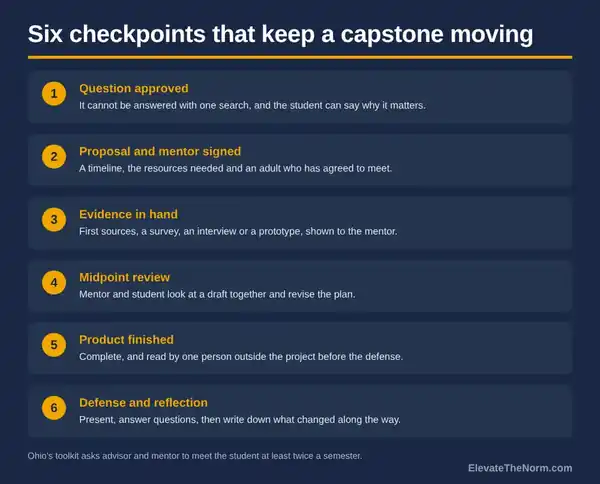
    Checklist graphic titled Six checkpoints that keep a capstone moving, showing six numbered cards from question approved to defense and reflection.

    Ohio’s toolkit sets the floor: the student meets with an advisor and a mentor a minimum of twice per semester to review drafts and get guidance, and the timeline must list those check-ins. Six checkpoints is a reasonable shape for a year-long version, and a semester version can compress them:

    1. Question approved. It cannot be answered with one search, and the student can say why it matters.
    2. Proposal and mentor signed. A timeline, the resources needed and an adult who has agreed to meet.
    3. Evidence in hand. First sources, a survey, an interview or a prototype, shown to the mentor.
    4. Midpoint review. Mentor and student look at a draft together and revise the plan.
    5. Product finished. Complete, and read by one person outside the project before the defense.
    6. Defense and reflection. Present, answer questions, then write down what changed along the way.

    Oceana shows what the defense looks like when a school takes it seriously. A mentor teacher and a community evaluator, who may be a former student, a parent, a teacher or a local volunteer, each score every presentation. Community evaluators complete a 2.5-hour training and may score up to six presentations in one day. Each session runs about an hour, covering the talk, the question period, the evaluators’ private discussion and the time spent sharing results with the student.

    You do not need Oceana’s infrastructure to borrow the principle. One outside adult in the room changes how a student prepares, because the audience is no longer someone who already knows how the semester went.

    Two practical limits belong on the proposal form before any student contacts anyone. Outside mentors and any work off campus need approval under your school’s own policies, so route the first contact through the teacher and follow your district’s rules on volunteer screening and student safety. And send families the one-page proposal, the checkpoint dates and the defense date at the start, so nobody learns the schedule from a surprise email in April. Parents then know what the student committed to, and the student can point to it.

    How Do You Grade a Capstone Fairly?

    Score the paper or product and the presentation on separate rubrics, put at least two adults on the scoring, and build in a revision level so a weak first attempt becomes a second draft rather than a failure. Grade what every student can control, and never charge a student for materials.

    Oceana scores its paper on nine areas, such as introduction, context, claims, interview research and library and internet research, and scores the presentation on a shared eight-area rubric used by the mentor and the community evaluator. Both rubrics use four levels: revisit, approaching, proficient and advanced. A “revisit” on the paper sends the student back to revise; a “revisit” on the presentation means presenting again, usually in a smaller, private setting. The profile reports that in 2015–16 fewer than five students failed either project.

    Oakland takes a different but compatible approach. Drafts are shared among faculty, and final versions are blind-scored by at least two educators, with three sets of scoring guidelines (paper, field research, presentation) and teacher training on them. If you are building from scratch, start with the rubric for project-based learning and the presentation rubric, then add one row for the thing unique to your capstone, such as the quality of the interview or the evidence from the prototype test.

    Two guardrails matter more than any rubric language. First, grade the process alongside the product. A student whose prototype fails but whose testing was honest and whose reflection is specific has done the work. Second, remember that a polished product is partly a measure of resources at home. Supply the materials, offer a second route to an audience for students whose families cannot attend a showcase night, and score the evidence, not the budget.

    What Goes Wrong With Capstone Projects?

    The common failures are predictable: the first capstone arrives in senior year, field research stalls on logistics, access to mentors is uneven, and the teacher keeps directing instead of coaching. All four can be designed around if you name them before the project starts.

    • It is the first time. The Oakland reporting says students found it too much to learn research, writing and presenting all in senior year. Fix it by building smaller versions in earlier grades.
    • Field research stalls. The same article notes that focus groups are hard to schedule and that many students were nervous about interviews because few had ever done one. Teach the interview request and the survey draft as skills, with a practice run, before students need them.
    • Mentor access is uneven. A student whose family knows a professional may land a better mentor than a student whose family does not. Build a pool of volunteer mentors at the school level, so access does not depend on who the student already knows. Oakland’s district reported uneven access to in-depth research before the requirement was refined, sometimes within one school.
    • Group conflict. If students work in teams, plan for it. The MDRC review reports that in one set of project classes it describes, 37 of 53 surveyed groups reported conflict, and it identifies classroom norms for group work as a promising strategy. Individual capstones avoid this; team capstones need norms written down first.
    • The teacher keeps directing. The MDRC review says teachers must shift from director to facilitator, tolerate more noise and ambiguity, and that adaptations can undermine the model. In one study it describes, teacher-led demonstrations replaced student investigations, and students who did the investigations themselves learned more. Coach the question; do not hand over the answer.

    Capstone Project Ideas: Where to Start This Month

    Start small and dated. Pick one grade, write the four parts on a single page, and fix the defense date on the calendar before anything else. Then work backward to the checkpoints.

    1. Choose the size. Use the table above: a semester and a showcase night for the first run, a full year for seniors.
    2. Recruit two or three outside adults to serve as mentors or panel members.
    3. Hand students the fifteen ideas as questions, not topics, and require a one-page proposal that names the audience and the mentor.
    4. Schedule the six checkpoints before the project begins, and run the first one in week two.
    5. Send families the proposal and the dates at the start, along with who to contact if the student gets stuck.
    6. Run the defense, then debrief, and change one thing before the next cohort starts.

    The best capstone project ideas are the ones a student will still be arguing about six months later. If a student can defend the work to a stranger, the project did its job, whatever the rubric says.

    Sources

    • EachChildOurFuture, Ohio’s strategic plan for education. (2019, May). Senior Capstone Toolkit. Read in full via a school district’s hosted copy. Source of the four required parts and the twice-per-semester advisor and mentor meeting minimum. The toolkit specifies no required number of hours.
    • Education Week. (2019, February). Can ‘capstone projects’ deepen learning for high school seniors? Read in full. A news report on Oakland’s program; it offers qualitative support and no controlled outcome data.
    • Learning Policy Institute, California Performance Assessment Collaborative. Performance assessment profile: Oceana High School. Read in full. A program profile, not an evaluation; the figure on students who did not pass (fewer than five in 2015–16) is the profile’s own report.
    • Poly Prep. Middle School Capstone. Read in full. A school’s own description; it states no duration and names no mentor, and this guide does not supply either for Poly Prep.
    • Condliffe, B., et al. (2017). Project-based learning: A literature review. MDRC. The copy I could read was cut off partway through the section on teacher practice, so the sections on student outcomes and recommendations were not read. Claims here rest on the abstract and the earlier sections only.

    What is a capstone project in high school?

    A capstone project is a long, student-designed project that ends with a finished product and a presentation to an audience that can ask questions. Ohio’s senior capstone toolkit names four required parts: a proposal, an anchor experience, a culminating portfolio and a presentation.

    How long should a capstone project take?

    Programs vary. Oceana High School’s senior exhibition runs a year, with about six weeks spent preparing the presentation. Ohio’s toolkit sets no required hours. A reasonable recommendation is one semester for an eighth-grade version and a full year for seniors.

    Can eighth graders do a capstone project?

    Yes. Poly Prep runs a middle school capstone as the culminating project of a history course for eighth graders, ending in an annual Capstone Night. Keep it smaller than the senior version: one semester, one product and a short talk.

    Does a capstone project improve student outcomes?

    Nobody has shown that it does. Education Week’s report on Oakland’s program offers qualitative support and no controlled outcome data, and MDRC’s literature review calls project-based learning evidence promising but not proven. The case for a capstone rests on student ownership and the defense, not on a measured test-score gain.

    Do students need an outside mentor?

    It helps, and Ohio’s toolkit requires one, with the mentor signing a pledge after reading the proposal. If outside mentors are hard to find, a teacher advisor plus one family or community adult is a workable eighth-grade version. A school-level pool of volunteer mentors keeps access from depending on a student’s family connections.

    How do you grade a capstone project fairly?

    Use separate rubrics for the product and the presentation, put at least two adults on the scoring, and include a revision level. Oceana scores on four levels including a revisit that sends the student back to revise or present again. Never charge students for materials, and score the evidence rather than the polish.

    What if a student’s capstone question is too big or too small?

    Reject the question, not the subject. If it can be answered with one search, ask for a harder version by a set date. If it needs a year of fieldwork, narrow it to one population, one place or one decision. Treat it as a revision note, the same move you would make on a weak thesis.

    About Clay Shumate

    Clay Shumate is a certified secondary Social Studies teacher in the public schools of West Alabama, with seven years of classroom experience, a B.A. in History, and an M.Ed. in Secondary Education. He writes about project-based learning, student responsibility, respect, and practical ways to hold young people to a higher standard while giving them room to learn from mistakes. He is a member of the Society of Professional Journalists and writes to its Code of Ethics; this site’s editorial standards and corrections policy are published in full. More about Clay.

  • Think Pair Share in Grades 6–12: The 90-Second Routine and What the Research Shows

    Think Pair Share in Grades 6–12: The 90-Second Routine and What the Research Shows

    By Clay Shumate

    Think pair share is a three-step discussion routine: students think alone about a question, talk it over with a partner, then share with the class. In grades 6–12 a full cycle fits in about 90 seconds. The evidence is stronger for participation and thinking time than for test scores, and the learning results are mixed.

    Key Takeaways

    • Think pair share is a 90-second routine, not a lesson. Students think alone, compare answers with one partner, then report to the class. It works as a check on one question, not as a way to teach a unit.
    • The think step does the real work. Teachers typically wait about one second after asking a question; the IRIS Center recommends three to five. A silent, written think step builds that pause into the routine.
    • The learning evidence is thin and mixed. A college nursing study found larger critical-thinking gains with the routine. A high school chemistry comparison found no significant difference in learning gain.
    • The participation evidence is more encouraging. In a study of ninth graders, adding a pair step produced more hand-raising than asking for volunteers cold, and it helped shyer students most.
    • Most failures are design failures. One partner dominates, nobody thinks first, or the share hides what the pairs said. Each has a specific fix, and none of the fixes costs more than a minute of preparation.

    Think pair share is one of the first routines most teachers learn and one of the easiest to run badly. The usual version is a question, a vague instruction to “turn to your partner,” and three volunteers who would have answered anyway. That version takes two minutes and tells you nothing you did not already know.

    This guide covers what the routine is, a version tight enough to run in about 90 seconds, what the research does and does not support, and where it breaks. The timings and steps are compiled from the sources at the end and from the structures those sources describe. Read them as recommendations, not as a record of any one classroom.

    What Is Think Pair Share?

    Think pair share is a cooperative discussion strategy in which a teacher poses a question, students think about it individually, discuss it with a partner, and then share their thinking with the whole class. It is usually credited to Frank Lyman and colleagues at the University of Maryland in 1981.

    Kaddoura’s 2013 study in Educational Research Quarterly describes the three phases this way: think, where students spend a few minutes alone with the prompt; pair, where they compare notes and identify the strongest answers; and share, where pairs report to the class. The structure is the point. A routine that skips the first step is a partner chat. A routine that skips the last is a private conversation the teacher never hears.

    It also sits in a family of structures that are easy to confuse. The table below separates the ones teachers most often swap for each other.

    How think pair share differs from the formats near it

    FormatTypical lengthGroupIndividual thinking first?Best when you want
    Think pair shareAbout 90 secondsPairs, then whole classYes, by designA quick check of one idea, with every student answering
    Cold callUnder a minuteOne studentNoAccountability for one answer
    Small-group discussionFive to fifteen minutesThree to five studentsSometimesA task with several parts that students split
    Socratic seminarA full period or a large part of oneWhole classPrepared in advanceSustained discussion of a text or question
    Compiled for this guide from the formats as commonly practiced. Lengths are conventional practice, not findings.

    If you want the long version of whole-class talk, that is a different page: the guide to Socratic seminar covers it, and student discourse covers the broader question of how to get students talking to each other in the first place. If what you need is accountability for a single answer, cold calling is the tool. Think pair share is the 90-second structure in between.

    How Do You Run Think Pair Share in 90 Seconds?

    Ask one question, give about 30 seconds of silent, written thinking, give partners about 45 seconds to compare, then spend about 15 seconds calling on pairs. Name the partner, the question, and the clock before you start, and keep the timer visible.

    Graphic of the 90-second think pair share routine: think for about 30 seconds in silence, pair for about 45 seconds, share for about 15 seconds by calling on pairs and having each speaker report their partner's answer.
    1. Choose a question worth ninety seconds. A question with one correct answer is a quiz, and a pair has nothing to settle. Ask something with more than one defensible answer, or with a reason that has to be stated.
    2. Fix the partners before the question. Assign pairs in advance, even if it is only the person next to them. Looking for a partner is where the first 20 seconds go.
    3. Start the clock and make the think step silent and written. Thirty seconds, a sentence on paper. Silence is what separates this from a conversation, and writing is how you can later see who thought.
    4. Tell students what the routine is for. One sentence is enough: you want everyone to have a chance to think before the loudest answer lands. Students who understand the purpose are less likely to treat it as busywork.
    5. Tell partners who speaks first. “The person closer to the window starts.” Without it, the more confident student starts every time, and the other student agrees.
    6. Pair for about 45 seconds. The job is to compare answers, say why, and settle on the best one or agree on the difference. Walk the room while they do it and listen to a few pairs, not all of them.
    7. Call on pairs, not volunteers. Ask a speaker to report what their partner said. That one move gives every student a reason to listen to the person beside them.
    8. Close the loop on the same question. Say what the best answers had in common, fix a misconception if you heard one, and move on. If you ask a question and then do nothing with the answers, students correctly conclude it did not matter.

    Those timings are a starting point. A question that asks students to compare two documents will need longer than one that asks them to pick a side. The point of a number is that the routine ends; a think pair share with no clock grows into five minutes of unstructured talk.

    Does Think Pair Share Actually Work?

    The honest answer is partly. Studies show it can increase participation and, in one college trial, critical-thinking gains. A comparison in a high school chemistry class found no significant difference in learning gain. Almost none of the evidence is from a randomized trial in grades 6–12.

    Graphic of four findings: college nursing students gained 42.9 critical-thinking points with think pair share against 12.4 without; high school chemistry learning gain was 38.8 percent versus 38.5 percent with no significant difference; ninth graders in Germany raised their hands more; a 3 to 5 second wait time is recommended.

    Here is what each study measured, and on whom:

    • College nursing students. Kaddoura compared two sections of one Health Assessment course over 17 weeks, with the routine added to one. Critical-thinking scores gained 42.9 points in the think pair share section and 12.4 in the other, a significant difference. The sample is about ninety sophomore nursing students at one college; the paper gives 91 in the abstract but 86 in its method section, and which section got the routine was decided by a coin flip rather than by randomizing students. The author notes the single-program limit himself. This is not a secondary-school result.
    • High school chemistry. In a master’s thesis at Louisiana State University (Trent, 2013), a class using the routine was compared with a comparison class of chemistry students in grades 10 to 12; the thesis describes which material each group used inconsistently. Both groups improved. Learning gain was 38.8 percent with the routine and 38.5 percent without, and the difference was not significant. The sample was small, 14 students analyzed in the comparison class and 32 in the other, the groups were not randomized, and the comparison students were also talking with partners informally.
    • Ninth graders. Mundelsee and Jurkowski compared share-only, think-then-share and full think pair share in German schools. The full routine produced more hand-raising than share-only, and the benefit was larger for students who reported being shyer. I read a summary of this study, not the paper. It measured voluntary participation, not learning.

    Read together, the pattern is consistent and modest. Adding a pair step makes it easier for students to speak. It has not been shown to make every group learn more than they would have with another well-run discussion routine. That is a reasonable thing to adopt a routine for, as long as you say so out loud and do not borrow a claim about test scores.

    Why Does the Think Step Matter?

    Because it forces a pause that most classrooms skip. The IRIS Center recommends waiting three to five seconds after a question and notes that teachers typically wait about one second. Longer waits are linked in that literature to longer answers and more participation from lower-performing students.

    The IRIS Center fundamental skill sheet on wait time traces the idea to Rowe’s research from the early 1970s and says later work has confirmed it. It also reports that the highest-performing students tend to get about two seconds and the lowest-performing less than one. That is the reason the think step is silent and written. A teacher who asks a question and takes the first hand is, without meaning to, picking the students who already think fastest.

    One caution from the same sheet: the pause feels like dead time at first, and teachers drift back to fast pacing within a few weeks. Putting a timer on the board is a cheap defence against that. It also removes the temptation to rescue students from the silence by answering your own question.

    Where Does Think Pair Share Break?

    It breaks at four predictable points: one partner dominates, students do not actually think before talking, the share stage shows only what volunteers want to say, and the teacher cannot hear every pair. Each is fixable with structure rather than with more enthusiasm.

    Ben Crockett, writing for the Durrington Research School, lists most of these and is careful about what he does not know: he says the evidence base is limited and that many of his concerns come from reflection rather than data. He points to research suggesting the rich conversation that happens in pairs often does not make it into the whole-class share. His proposed fix is to make pair thinking visible, for example with mini whiteboards, so the teacher can see it and use it.

    Graphic of four failure points in think pair share and a fix for each: one partner dominating, nobody thinking first, the share hiding what pairs said, and being unable to hear every pair.
    • One partner does the talking. Name who speaks first and give each partner a turn. Ask each speaker to report their partner’s idea so listening counts.
    • Nobody thinks first. The think step has to be written and silent. A mental think step is the first thing students skip.
    • The share hides the pairs. Use a mini whiteboard or one written line per pair so you see all of them, not only the volunteers. Then pick two pairs whose answers differ and have them respond to each other.
    • You cannot hear every pair. Circulate to three named pairs each round and rotate across the week, so every pair is heard on a schedule rather than by luck.
    • The question is too easy. If every pair says the same thing in ten seconds, the question was a recall check. Use a one-sentence quick write or a hand-raise instead, and save the routine for a question with real disagreement in it.

    A related warning appears in Watson’s summary of the German study at Learning & the Brain. Without any accountability, a student with a partner can simply reuse the partner’s idea instead of thinking. That is why the written think step and the “report your partner’s answer” move matter: they are the accountability. The same move scaled to a table of four is numbered heads together, where a random number decides who reports. For the broader picture of structured pair and group work, see what cooperative learning is, and the catch.

    Who the routine can leave out

    Two groups need a plan before you start. Students who find speaking to a peer hard, whether from anxiety, a language barrier or a speech difference, should have a way to take part that does not depend on talking: they can read what they wrote, or hand it to their partner. The German study suggests the pair step helps shyer students, but it measured hand-raising, so do not assume it helps every student who struggles to speak. And pairs need to be fair. Rotate partners so no student is stuck beside the same person all semester, and do not pair students who are in an active conflict.

    What Makes a Good Think Pair Share Question?

    A good question has more than one defensible answer, can be answered in a sentence or two, and gives pairs something to settle. Questions that ask students to choose, rank, predict, or justify work better than questions that ask them to recall.

    • Choose and defend. “Which of these two sources would you trust more, and what would change your mind?”
    • Rank. “Put these three causes in order of importance and be ready to say why the first one is first.”
    • Predict. “Before we run this, what do you think will happen, and what would surprise you?”
    • Find the error. “This worked solution has one mistake. Where is it?”
    • Apply. “Where would this rule break?”

    These are compiled from common practice, not from a study of question types. They share one property: a pair can disagree with itself usefully. If you are using the routine mainly to find out what students already know, checking for understanding has more options, and the guide to a talkative class covers what to do when the pair step gets away from you.

    Is Think Pair Share Worth It? My Take

    Worth it as a participation and thinking-time routine, not worth selling as an achievement booster. It is cheap, it can be dropped into almost any lesson, and the evidence that it helps students speak is better than the evidence that it raises scores.

    The thing I would hold to is the structure, because the structure is the teacher’s job. If a student has nothing to say in the pair step, I treat that as a planning problem before I treat it as a character problem: the question was too hard to start, the partner was a bad match, or the think step was too short. A routine that depends on the best students carrying the rest is not a routine, it is a rescue.

    At the school level it costs nothing but a timer and a shared expectation, which is also its risk: a mandated routine with no attention to question quality produces compliance, not thinking. Do not grade the think step. Collect it occasionally as evidence of what students were thinking, and ask a colleague or instructional coach to time one round and count how many pairs actually spoke.

    The other part is respect for the timer. If you tell a class they have 30 seconds to think, take 30 seconds and not ten, and if you say pairs will be called on, call on pairs. Students notice quickly whether the clock and the promise are real. A think pair share that works the first week and gets abandoned in the third has taught them that the routine is optional.

    What to Do Next

    Pick one question in tomorrow’s lesson that has two defensible answers. Pair students in advance, put 30, 45 and 15 seconds on the board, and call on pairs, not volunteers. Run it three times in a week before deciding whether think pair share is working, because the first run mostly teaches students the routine.

    If you want to go deeper on student talk, start with student discourse, then the Socratic seminar guide for the long-form version.

    Sources

    Think pair share and the jigsaw sit at opposite ends of the same spectrum. Think pair share takes ninety seconds and every student works on the same question; the jigsaw method takes a full period and deliberately gives every student different information. Reach for the first to check thinking, the second when the content genuinely divides.

    Ninety seconds of paired thinking and a four-week tutoring block are the same idea at two very different scales. Both depend on structure rather than goodwill: every version of peer tutoring that produced a result had a script, a role and a short, fixed block. What the peer tutoring evidence supports at grades 6–12 reports the trials that found nothing alongside the averages that look strong, and what separated them.

    Ninety seconds of structured pair talk solves the participation problem. It does not solve the quality problem. Once every student is talking, the next question is whether any of it is reasoning, and the answer tends to track what the teacher asked for: in one study, teacher asking for reasoning correlated with students providing reasoning at r = .88. The talk moves that press for reasoning, and what the trials really found covers the twelve published moves, the wait-time figures, and where this approach fails.

    What is think pair share in simple terms?

    A three-step discussion routine. The teacher asks a question, students think about it alone, they compare answers with a partner, and then pairs share with the class. A full cycle can run in about 90 seconds, which makes it one of the cheapest ways to get every student answering the same question.

    How long should think pair share take?

    About 90 seconds for a single question: roughly 30 seconds of silent thinking, 45 seconds with a partner, and 15 seconds of sharing. Those timings are a starting point rather than a research finding. Harder questions need longer, and a routine with no clock tends to grow into unstructured talk.

    Does think pair share improve test scores?

    Not reliably. A college nursing study found larger critical-thinking gains, but a comparison in high school chemistry found no significant difference in learning gain. The better-supported benefit is participation: a study of ninth graders found more hand-raising when students paired before sharing, especially shyer students.

    How do you stop one student from doing all the talking?

    Name who speaks first, give each partner a turn, and ask speakers to report what their partner said. That last step gives both students a reason to listen. Pairing students in advance also helps, because the more confident student otherwise starts every time and the other tends to agree.

    What if students just talk about something else in the pair step?

    Shorten the pair step, use a written think step so each student has something to compare, and walk the room. If it keeps happening, the question is probably too easy or too vague. A question with real disagreement in it keeps pairs on task better than a longer timer does.

    Is think pair share different from turn and talk?

    The names overlap, and teachers use them loosely. The distinguishing feature of think pair share is the individual thinking step before anyone speaks, followed by a share. A quick turn and talk with no think step and no share is a lighter routine and does not give the same pause.

    Does think pair share work in high school, or only in lower grades?

    The evidence is not specific to a grade band. The studies here cover ninth graders, high school chemistry students in grades 10 to 12, and college students. The routine is short and scales with question difficulty, so it fits secondary classes, but none of this evidence settles how large the effect is in your room.

    What about students who are anxious or find speaking to a partner hard?

    Give them a route that does not depend on speaking: reading what they wrote, handing it to their partner, or writing a reply. Rotate partners so nobody is stuck with a bad match, and avoid pairing students in conflict. The ninth-grade study found the pair step helped shyer students, but it measured hand-raising only.

    About Clay Shumate

    Clay Shumate is a certified secondary Social Studies teacher in the public schools of West Alabama, with seven years of classroom experience, a B.A. in History, and an M.Ed. in Secondary Education. He writes about project-based learning, student responsibility, respect, and practical ways to hold young people to a higher standard while giving them room to learn from mistakes. He is a member of the Society of Professional Journalists and writes to its Code of Ethics; this site’s editorial standards and corrections policy are published in full. More about Clay.

  • Genius Hour: How to Run It in Grades 6–12 Without Losing the Semester

    Genius Hour: How to Run It in Grades 6–12 Without Losing the Semester

    By Clay Shumate

    Genius Hour is a recurring block of class time, usually one period a week, in which students pursue a self-chosen inquiry and finish with a product they share publicly. It takes its name from Google’s 20 percent time. The evidence on student choice supports the motivation claim behind it. It does not support a learning claim.

    Key Takeaways

    • Genius Hour is a time structure, not a lesson. Students choose the question, plan the work, pick the product format and share it with an audience. The teacher coaches rather than instructs.
    • Choice reliably raises motivation and does not reliably raise learning. Across 41 studies, choice produced an effect of about 0.30 standard deviations on intrinsic motivation — roughly 0.21 to 0.24 once publication bias was corrected for — but only 0.10 on subsequent learning, which was not statistically significant.
    • The moderators are awkward for anyone selling this. In that same meta-analysis the effect was stronger for instructionally irrelevant choices than for instructionally relevant ones, stronger with two to four choices than with many, and stronger when no reward followed.
    • Research on Genius Hour itself is close to nonexistent. The most-cited study is a four-year qualitative case study of one school’s teachers. It reports teacher perceptions, not student outcomes — and those teachers largely did not adopt the practice in their own classrooms afterwards.
    • Unstructured discovery fails students who lack the background knowledge for it. The cognitive-load literature is clear that minimal guidance works mainly for learners who already have prerequisite knowledge and prior structured experience. That is an argument for scaffolding Genius Hour, not for skipping it.

    Genius Hour is one of the easiest ideas in teaching to fall in love with and one of the easiest to run badly. Hand thirty teenagers an hour and the instruction “work on something you care about” and you will get three students who do something remarkable, a dozen who research a hobby for six weeks and produce a slideshow, and a handful who spend the semester deciding. That spread is not a discipline problem. It is what the research would predict.

    This guide covers what Genius Hour is, what the evidence does and does not support, and how to structure it for grades 6–12 so the hour produces something. The timings and steps below are compiled from the sources at the end and from the structures those sources describe; read them as recommendations rather than as a record of any one classroom.

    What Is Genius Hour?

    Genius Hour is a protected, recurring block of class time in which students pursue a question or project they chose themselves, set their own goals, decide the format of the final product, and present it to an audience. The teacher’s role shifts from delivering content to coaching the work.

    The Association for Middle Level Education’s research-to-practice summary describes the common features as student-chosen topics, student-set goals and plans, student-selected product formats, student self-evaluation, and a teacher acting as facilitator. It also ties the practice to authentic achievement: students construct original knowledge, apply disciplined inquiry, and share a public product. The last of those three is what separates Genius Hour from independent reading time.

    Graphic listing the common features of Genius Hour: the student chooses the topic, sets goals and plans the work, picks the product format and evaluates their own performance; the product is shared publicly; and the teacher coaches rather than instructs.

    Where the name comes from, and why that matters

    Genius Hour borrows its logic from Google’s 20 percent time, the policy that let engineers spend a day a week on their own projects. Quartz reported in 2013 that the policy had become “as good as dead” in practice: engineers now needed management approval, managers were reportedly discouraged from granting it, and productivity targets assumed full-time work on primary responsibilities. Google never formally ended it; it was curtailed. The same report credits 20 percent time with incubating Gmail, AdSense, Google News, Google Talk and Google Transit.

    That history is worth knowing before you pitch this at a department meeting, because both halves of it are true. The structure produced genuinely valuable things, and the organization that invented it let it die under production pressure. A school year has the same pressure, and it arrives in February.

    How Genius Hour differs from the other choice structures

    “Give students choice” covers at least four different structures that cost different amounts and do different jobs. They are not interchangeable, and picking the wrong one for what you actually want is the most common mistake here.

    StructureWho picks the topicTypical lengthPublic audience?Best when you want
    Genius HourThe student, with few limitsOne period a week, ongoingYes, it is the pointSelf-direction and a reason to come to school
    Choice boardThe teacher writes the options; the student picksOne unit or one weekUsually noDifferentiated practice on content you must cover
    Project-based learning unitThe teacher sets the driving question; students choose approach and productTwo to six weeksYesStandards covered through the project itself
    Independent study or capstoneThe student, inside a negotiated contractA term or a yearUsually yesA single sustained piece of work from an older student
    Compiled for this guide from the structures described in the sources below. Lengths are conventional practice, not findings.

    If what you need is coverage of required content, you want a choice board or a project-based learning unit, not Genius Hour. Genius Hour deliberately does not promise standards coverage, and pretending it does is how it gets cancelled.

    Does the Research Support Genius Hour?

    Not directly. There is almost no research on Genius Hour specifically, and the single most-cited study examines teachers’ perceptions at one school rather than student outcomes. The supporting evidence is indirect: it comes from the literature on choice and autonomy, which is strong on motivation and weak on learning.

    The study everyone cites is LeGeros, Bishop, Netcoh and Downes, published in RMLE Online in 2022. I was able to read the abstract and the citation record but not the full text, which sits behind a paywall this site cannot reach. The AMLE summary of it, which I did read in full, describes it as a qualitative case study drawing on interviews with 17 teachers and one administrator over four years at a school running a school-wide Genius Hour.

    What the abstract itself says is specific and should temper anyone’s enthusiasm. Teachers saw Genius Hour as building student self-direction and as engaging students through relationships and choice. They valued watching personalized learning work. And then logistical, personal and curricular concerns kept them from using the practice widely in their own classrooms. Teachers in that study also questioned whether Genius Hour should be the norm for all instruction, and said students need exposure beyond their own interests.

    That is the most useful finding in the Genius Hour literature, and it is not a finding about students. A school ran this well enough that its teachers admired it, and most of them still did not take it into their own rooms. Any plan that does not account for why should expect the same result. The AMLE summary names the constraints the teachers raised: mandated curricula, and the question of breadth.

    The honest summary of the evidence base, then: few studies exist, the best one measures teacher perception, and nobody has shown that Genius Hour raises achievement. That does not make it a bad idea. It makes it a practice you adopt for reasons other than test scores, and you should say so out loud rather than borrow a research claim it has not earned.

    What Does the Evidence on Student Choice Actually Say?

    Choice produces a reliable, modest gain in intrinsic motivation and no reliable gain in learning. In a meta-analysis of 41 studies, choice moved intrinsic motivation by about 0.30 standard deviations but moved subsequent learning by only 0.10, which was not statistically significant.

    Patall, Cooper and Robinson’s meta-analysis in Psychological Bulletin pulled 290 effect sizes from 41 studies across kindergarten through twelfth grade, college and general adult samples. Their results, as weighted mean effect sizes:

    • Intrinsic motivation: 0.30 (fixed effects), 0.36 (random effects). After a trim-and-fill correction for publication bias it shrank to roughly 0.21 to 0.24.
    • Perceived competence: 0.59. Task performance: 0.32. Effort: 0.22.
    • Subsequent learning: 0.10, confidence interval −0.02 to 0.21. Not significant.
    • Pressure or tension, creativity and satisfaction: no significant effect. Of the 91 overall intrinsic-motivation effects, 13 were negative.

    Four of their moderators matter for how you build Genius Hour, and three of them cut against the obvious design:

    Graphic of effect sizes for student choice: perceived competence 0.59, task performance 0.32, intrinsic motivation 0.30, effort 0.22, and subsequent learning 0.10 which was not statistically significant.
    • The effect was stronger for instructionally irrelevant choices — things like the fantasy setting of a task — than for instructionally relevant ones. The motivational payoff of choice is not mainly coming from the academic weight of the decision.
    • Two to four successive choices beat more. More options is not more motivation.
    • No reward afterwards beat a reward. Attaching a prize to self-chosen work reduced the effect.
    • The effect was stronger for children than for adults, which is in Genius Hour’s favour for grades 6–12 — though the samples here were North American and excluded students identified with learning disabilities or behavioural disorders, so the finding does not automatically travel to every student in your room.

    Read together with the null result on learning, this is a specific brief rather than a blank cheque. Choice buys engagement, the engagement is real, and it does not convert into measured learning on its own. The choice continuum is the piece worth reading next, because the question is not whether to give students choice but how much and over what.

    Why Does “Just Let Them Explore” Fail?

    Because searching for information consumes working memory without necessarily building long-term knowledge, and students who lack background knowledge in a field have nothing to search with. Minimally guided instruction works best for learners who already have prerequisite knowledge and prior structured experience.

    Kirschner, Sweller and Clark’s 1 2006 analysis in Educational Psychologist is the standard statement of this and it is worth reading even if you disagree with it. Their argument rests on cognitive architecture: working memory holds only a handful of novel items and loses unrehearsed information within about 30 seconds, so a learner hunting for a solution can spend an hour of effort and store almost nothing. They cite the worked-example effect — novices who study worked examples outperform those who solve the equivalent problems — replicated many times since the mid-1980s.

    Two of their concessions are the design brief for Genius Hour, and they get quoted far less often than the title:

    • The expertise reversal effect. The advantage of heavy guidance fades, and eventually reverses, as a learner gains knowledge in the area. Guidance becomes redundant for someone who knows the terrain.
    • Discovery works under conditions. They cite work finding discovery learning succeeds when students have the prerequisite knowledge and prior structured experience, and note that the most effective teachers observed in discovery classrooms provided considerable scaffolding.

    So the question is not whether a student should be allowed to direct their own inquiry. It is whether they have enough knowledge of the thing to direct it yet, and what you put in place while they build that. One finding in their review is worth sitting with: in a review of roughly 70 studies on how learner aptitude interacts with instruction, lower-aptitude learners in unguided conditions sometimes scored lower on the posttest than on the pretest. An unscaffolded hour is not neutral for the students who need the most help.

    That is also the practical answer to the colleague who says Genius Hour is a free period. They are right about the version with no scaffolding. The fix is the scaffolding, and it is specific.

    How Do You Run Genius Hour in Grades 6–12?

    Protect one period a week, cap the first cycle at six weeks, require a proposal before any work starts, and build in checkpoints and a public share. The scaffolding goes in the first two weeks and at every checkpoint — not into the student’s topic, which stays theirs.

    1. Pick the slot and defend it. One period a week, same day, on the calendar for the whole cycle. This is the step that fails. Google’s version died because the time became negotiable, and February will make yours negotiable too unless it is already scheduled.
    2. Run a short cycle first, not an open-ended one. Six weeks with a fixed share date beats “all year.” A deadline is the only thing that converts an interest into a product, and a short first cycle lets you run a second one having learned something.
    3. Teach the question before the project. Spend the first session on what separates a question you can work on from a topic you can only read about. The guide to writing driving questions is the tool for this; the same test applies. “Sharks” is a topic. “Why do shark attack numbers keep rising when shark populations are falling?” is something a student can actually do.
    4. Require a one-page proposal and approve it. The question, what they will make, who will see it, what they need, and what they already know about it. That last line is the one that catches the student with no background knowledge in the area, which is exactly the student the cognitive-load research says will struggle most. Approving proposals is also how you keep two to four real options in play rather than infinite ones.
    5. Put checkpoints at weeks two and four. A checkpoint is a five-minute conference with one question: show me what you have. Checkpoint evidence is what tells you a project has stalled while there is still time to move it.
    6. Scaffold the method, never the topic. Teach how to find a source, how to draft a request for an interview, how to build a simple plan with dates. These are transferable and they are what the students who struggle are actually missing. Their subject stays theirs.
    7. Write the limits into the proposal form. Nothing that happens off campus, nothing that requires money, nothing involving tools or chemicals outside a supervised lab, and no outside contact that does not go through you — if a student wants an interview, you send the first email and you are copied on the rest. These are not obstacles to student ownership; they are the conditions under which a school can let a fourteen-year-old do real work at all, and stating them up front is faster than refusing projects one at a time.
    8. Fix the audience in advance. A product with no audience quietly becomes a slideshow for the teacher. Another class, a parent evening, a display, a short talk to a club — name it in the proposal. What makes work feel real is mostly who sees it.
    9. End with a debrief, then run it again. What would you do differently; what did you learn about working on your own. Self-evaluation is part of the practice as AMLE describes it, and the second cycle is always better than the first.

    How Do You Grade Genius Hour?

    Grade the process, not the topic or the polish. Score the proposal, the checkpoints, the evidence of work and the share — things every student can meet regardless of what they chose. Attaching a competitive prize to self-chosen work is the one thing the research specifically warns against.

    Grading the product is tempting and it is unfair in a predictable direction. A student who builds a working circuit, a student who writes a 2,000-word history of a local building and a student who makes a short documentary have not produced comparable artefacts, and a single quality scale between them is really a scale of who had resources at home. Grading the process keeps the bar identical.

    Four things are fair to score: a proposal that meets its requirements, checkpoints met with evidence, a reflection that names a specific change in approach, and a share delivered to the stated audience. Notice that a student whose project fails can score full marks on all four, which is the point. The failure is information if the process was real.

    Who gets Genius Hour, and what it must not require

    Two access questions decide whether this is a good practice or a nice thing some students get. The first is which classes it runs in. If self-directed inquiry time exists in the honors sections and the on-level sections get worksheets, the school has not adopted Genius Hour — it has made self-direction a reward for students who already had it. The students most likely to benefit from practice at directing their own work are the ones least likely to be handed the chance.

    The second is money. No project may require a student to spend anything. If a proposal needs materials, the school supplies them or the project changes, and the student is never the one who has to say which situation they are in. The same applies to the share: if the audience is a parent evening, the students whose families cannot attend need a second route to an audience, not an exemption. Real-world work cannot depend on a ZIP code and neither can this.

    How to say no to a proposal without killing it

    You will reject proposals, and how you do it is the whole thing. A rejection that lands as “your interest is not serious” costs you that student for the rest of the cycle. The version that works is to reject the question and keep the subject: the topic is fine, the question as written can be answered in one search, bring me a harder one by Thursday. That is a revision note, not a verdict, and it is the same move you would make on a weak thesis statement.

    It also gives you something concrete to look for when you ask whether this is working. Self-direction is visible in small, checkable things: a student who revises a question without being told to, who shows up at a checkpoint with a plan that has changed since the last one, who asks for a specific resource rather than for help in general. Those are the indicators worth recording, because they are what you will be asked to show at the end of a pilot.

    On the reward finding: Patall and colleagues found choice’s motivational effect was stronger when no reward followed. That is a direct argument against a Genius Hour competition with a winner. If you want extrinsic stakes, the grade for completing the process is enough. A trophy for best project converts a self-chosen inquiry into someone else’s contest.

    What Does Genius Hour Actually Cost?

    About 18 periods a year for one period a week, plus the planning and conference time that makes it work. In the one multi-year study available, logistical, personal and curricular concerns were enough to stop most of the teachers who admired it from adopting it themselves.

    Graphic of a six-week Genius Hour cycle: week one teach the question and collect proposals, week two first checkpoint, week four second checkpoint, week six share to the named audience and debrief.

    One period a week across a semester is roughly 18 class periods. That is a real number and it comes out of something. Before starting, it is worth being able to say which unit gets compressed and whether you are willing to defend that choice in March, because the request to suspend Genius Hour for test review is coming and it will be reasonable.

    The hidden cost is conference time. Six checkpoint conversations across thirty students twice a cycle is 60 short conferences, and the model does not work without them. The AMLE summary of the research recommends a school-wide rather than single-classroom approach and a multi-year commitment, partly for this reason: the load is more survivable when it is shared and the structure is not one teacher’s experiment.

    There is one cost worth naming that nobody advertises. If you run Genius Hour and your colleagues do not, students will compare the two and you will be asked why other classes are not like yours. That is a good problem and it is still a problem, and it is part of why the research points at doing this as a school rather than alone.

    Is Genius Hour Worth It? My Take

    Worth running, not worth overselling. The honest case for Genius Hour is that it gives students practice at directing their own work, which is a thing schools claim to value and rarely assess. The dishonest case is that it raises achievement, and the evidence does not support that.

    I want to be careful here, because the easiest thing to do in an article like this is to claim a practice as my own. I have not run a Genius Hour. The closest thing I have built is a mock election project, and it is worth saying what the difference is: that was my structure with real roles inside it for students. It started with one class and grew to the whole school, and I built it with my instructional coach rather than on my own — I did not know of anybody near me doing it at the time. Genius Hour hands over the structure too, which is a bigger step than handing over the roles inside one.

    What makes me take it seriously anyway is a position I have argued on this site for a long time: if a student can fail badly enough in my room for it to matter, that is usually my planning, not their character. Applied here, that rules out the version of Genius Hour where you hand over an hour and find out in week six that eleven students have nothing. The proposal, the checkpoints and the fixed share date are not bureaucracy. They are the planning that makes the freedom survivable, and they are the difference between treating students as capable and treating them as a test.

    The other thing I would hold to is the part about keeping your word. If you tell a class Thursday is theirs, Thursday has to be theirs, including the Thursday you are behind. Students track that with great precision. A Genius Hour that gets cancelled twice has taught them something more durable than anything in their projects.

    Where Genius Hour Goes Wrong

    • The time becomes negotiable. This is how Google’s version ended and it is the most common failure in classrooms. Two cancellations and it is over.
    • No proposal gate. Without one, the students who most need direction get the least, and you find out in week five.
    • No audience. A public product with no public is a slideshow, and students know the difference immediately.
    • It is sold on achievement. Promise test gains and the first round of data will end the programme. Promise self-direction and name how you will see it.
    • Research becomes reading about a hobby. The fix is the question, not the topic — a question that cannot be answered by a single search. The driving question test applies.
    • It is graded on polish. Which grades resources at home. Grade the process.

    What to Do Next

    If you want to try this, do not start with an hour. Start with a six-week cycle, one period a week, a required proposal and a fixed date when students present to somebody who is not you. Put the share date on the calendar first and work backwards. Then run it a second time, because the first cycle teaches you where your students need scaffolding and the second is where they get it. If a student’s cycle turns into something a six-week window cannot hold, that is the point where it becomes a capstone, and scoping a long independent project is a different job with its own checkpoints.

    If what you actually need is required content taught through student work, that is a different structure and it is better documented: start with the seven steps of project-based learning or with a choice board for a single unit.

    Sources

    What is Genius Hour in simple terms?

    A protected block of class time, usually one period a week, in which students work on a question or project they chose themselves and finish by sharing it with an audience. The teacher coaches instead of teaching content. It takes its name and its logic from Google’s 20 percent time policy for engineers.

    Does Genius Hour improve student achievement?

    There is no evidence that it does. Research on Genius Hour specifically is very limited, and the most-cited study reports teacher perceptions at a single school rather than student outcomes. The broader meta-analysis on student choice found a significant effect on motivation but no significant effect on subsequent learning.

    How long should Genius Hour be?

    One class period a week is the common pattern, and a first cycle of about six weeks with a fixed share date works better than an open-ended commitment. One period a week runs to roughly 18 periods a semester, so decide in advance which content gets compressed.

    How do you grade Genius Hour?

    Grade the process: a proposal that meets its requirements, checkpoints met with evidence, a reflection naming a specific change in approach, and a share delivered to the stated audience. Grading the finished product penalises students with fewer resources at home, and a competitive prize works against the motivation the structure relies on.

    What do you do about students who never pick a topic?

    Treat it as a scaffolding problem rather than a motivation one. A required one-page proposal with a line for what the student already knows about the subject surfaces them in week one. Offering two to four concrete starting options is also supported by the research, which found choice worked better with a few options than with many.

    Is Genius Hour the same as project-based learning?

    No. In project-based learning the teacher sets the driving question and the project covers required standards. In Genius Hour the student sets the question and the structure makes no promise about standards coverage. Use project-based learning when content must be covered and Genius Hour when self-direction is the goal.

    Does Genius Hour work for students who struggle academically?

    Only with scaffolding. The cognitive-load research finds that minimally guided instruction works mainly for learners who already have prerequisite knowledge, and that lower-aptitude learners in unguided conditions sometimes performed worse afterwards than before. Scaffold the method, the proposal and the checkpoints rather than the student’s topic.

    How do I convince an administrator to allow Genius Hour?

    Do not sell it on test scores, because the evidence will not support that and the first data review will end it. Ask for a short pilot cycle with a fixed share date, name what you will show them at the end, and state which content is being compressed. Research recommends a school-wide approach over a single classroom.

    About Clay Shumate

    Clay Shumate is a certified secondary Social Studies teacher in the public schools of West Alabama, with seven years of classroom experience, a B.A. in History, and an M.Ed. in Secondary Education. He writes about project-based learning, student responsibility, respect, and practical ways to hold young people to a higher standard while giving them room to learn from mistakes. He is a member of the Society of Professional Journalists and writes to its Code of Ethics; this site’s editorial standards and corrections policy are published in full. More about Clay.

Teacher Emergency Toolkit — practical resources, real classroom support. Shop on TPT.Teacher Emergency Toolkit — practical resources, real classroom support. Shop on TPT.