The Elevate Blog banner: Real Classrooms. Practical Ideas. Higher Expectations. Three students climb a rocky ridge at sunrise, each pulling the next one up, toward a teacher reaching down to help.

Tag: teaching strategies

  • Early Finisher Activities for Grades 6–12 That Students Won’t Read as a Punishment

    Early Finisher Activities for Grades 6–12 That Students Won’t Read as a Punishment

    By Clay Shumate

    Early finisher activities are what a student does with the minutes between finishing the assigned work and the end of the period. In grades 6–12 the question is not which activity is fun enough. It is what the activity teaches the room about finishing early. Hand out more work and students learn to work slower; hand out nothing and you lose the minutes. Everything below is built on that one trade.

    Search for this and you get kindergarten centers, art-room doodle bins and first-grade challenge cards. Very little of it survives contact with a fifteen-year-old who has worked out that being done means being handed another worksheet.

    Key Takeaways

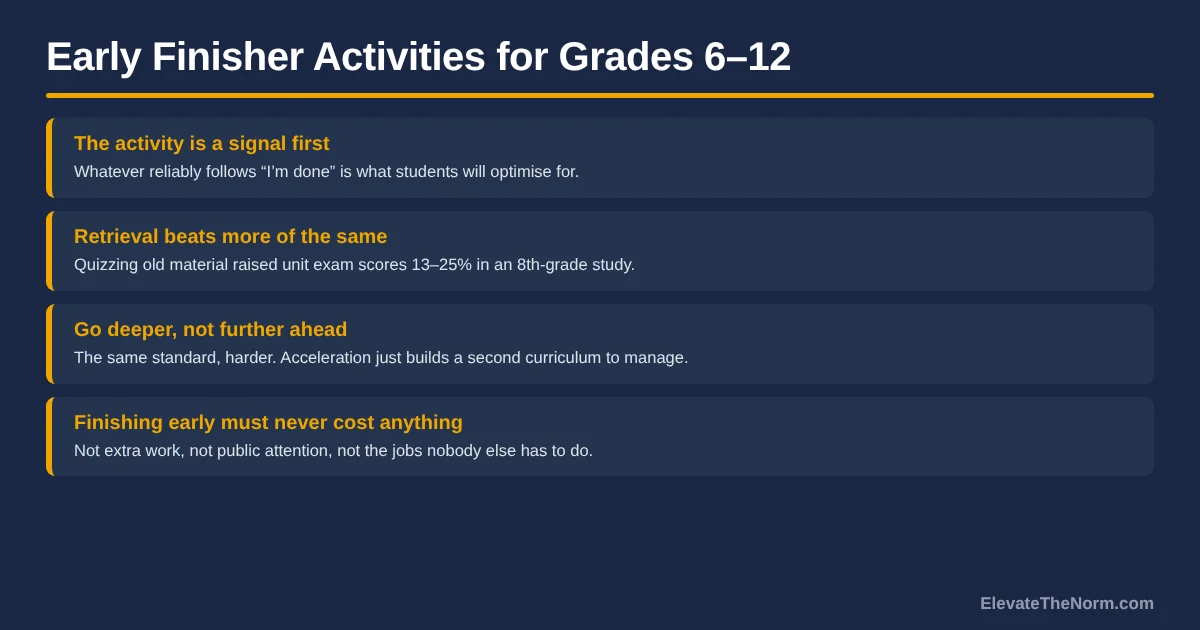
    • The activity is a signal before it is a task. Whatever reliably follows “I’m done” is what students will optimise for. Design the signal first and the activity second.
    • Use the minutes for retrieval, not new content. Quizzing on material already taught produced 13–25% gains on unit exams in an eighth-grade science classroom, and practice testing is one of only two techniques a major review rated high utility.
    • Going deeper beats going further. Pushing an early finisher into next week’s content creates a second, invisible curriculum you then have to manage.
    • A standing menu beats daily invention. Choice reliably lifts motivation — but the same meta-analysis found no significant effect on learning, so build the menu for willingness, not for test scores.
    • Never make finishing early cost anything. Not more work, not public attention, not a job nobody else has to do.

    What Are Early Finisher Activities?

    Early finisher activities are planned, low-supervision tasks a student moves to independently after completing the assigned work, before the class has moved on together. In a secondary classroom they usually need to work in gaps of three to twelve minutes, require no new instruction, make no noise that disrupts students still working, and need no grading from you.

    This is the operational end of differentiation rather than differentiation itself. Deciding how to vary a task by readiness is a planning question; deciding what a student does in the nine minutes after they finish it is a routine question. They are related and they are not the same job, and conflating them is why early finisher advice so often arrives as a lesson-planning project nobody has time for.

    That list of constraints is the whole design problem. Most published ideas fail at least two of them. Anything that needs you to explain it, mark it, or supervise it is not an early finisher activity — it is a second lesson you are now teaching to one student while twenty-nine others work.

    Why This Changes After Elementary School

    An elementary teacher with one class of twenty-four can keep a physical bin of activities, knows every child’s reading level, and has the same students all day. None of that is true in a middle or high school room. You may see 150 students across five or six sections, in periods short enough that ten minutes is a fifth of the class, and you will never have the same ten minutes free twice.

    The second difference matters more, and almost nothing written about early finishers acknowledges it. Teenagers read incentives accurately and act on them. A nine-year-old handed a bonus puzzle is usually pleased. A sixteen-year-old handed a bonus puzzle does the arithmetic: working efficiently produced more work, so next time, work slower. You are not managing boredom. You are setting the price of finishing.

    This is the same reason the usual advice about keeping students busy stops working somewhere around sixth grade, and it is why a routine that students can see the logic of does more for you than any individual activity. The ones that hold up are the ones a student would still choose if nobody were watching.

    How Much Time Is Actually in Play?

    Less than the productivity advice implies, and more than you would guess from any single lesson.

    Matthew Kraft and Sarah Novicoff’s 2024 analysis of Providence Public Schools estimated that students lose 16 to 25 percent of the school day, rising by grade band: 16 percent for the average elementary student, 21 percent in middle school and 25 percent — a full quarter — in high school. Two honest caveats belong with those numbers. The largest single contributor is unexcused student absence, not anything happening inside your lesson. And the authors call their own figure a lower-bound estimate from one district with, in their words, “limited generalizability.”
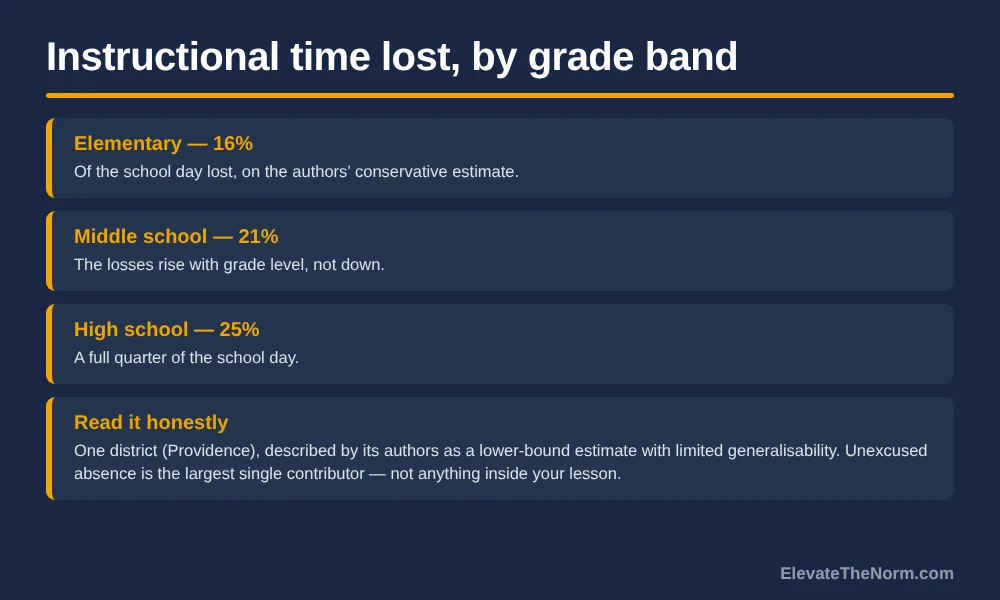
    Chart listing instructional time lost by grade band: 16 percent elementary, 21 percent middle school, 25 percent high school, with a note that the figures come from one district, are a lower-bound estimate, and that unexcused absence is the largest contributor.
    Time lost rises with grade level – and the headline figure is mostly not about your lesson.

    Their paper also cites other researchers’ estimates that off-task behaviour, transitions and wait time together occupy 17 to 29 percent of instructional time. That is the range closest to the early finisher problem — but it is a figure Kraft and Novicoff are reporting from other studies rather than measuring themselves, it bundles three different things together, and no part of it is specifically “students who finished early.” Anyone quoting you a clean number for that is estimating.

    What you can say defensibly: the dead minutes are a real and measurable share of the week, they are worse in secondary than in elementary, and the portion you personally control is smaller than the headline. That is still worth planning for. It is not worth a system so elaborate it costs more time than it recovers — and the same arithmetic applies to the minutes lost moving a class from one task to the next.

    The One Rule: Finishing Early Can Never Cost a Student

    If you take one thing from this, take this. Every early finisher system succeeds or fails on whether students believe that working well is safe.

    Three things make finishing early expensive, and all three are common:

    • More of the same. Another page of the problems they just demonstrated they can do. This is the most common response and the most costly one, because it is transparently a penalty for competence.
    • Public attention. “Marcus is finished — everyone else needs to hurry up.” You have just made finishing early a social liability and told the rest of the room they are behind.
    • Unpaid labour. Handing out papers, tidying, tutoring a classmate who has not asked for help. Occasionally fine and genuinely useful; as a default it means the fastest workers do the chores.

    The alternative is not a reward system. It is predictability. Students should be able to state, without asking, what happens when they finish — and it should be the same thing on Monday as on Thursday. Respecting students mostly comes down to doing exactly what you said you would do, every time, and an early finisher routine is an unusually visible test of it. If you promise that finishing early buys you a free read and then fill the time with a worksheet twice, the routine is finished.

    The useful question is not “what do I give them?” but “what do I want students to conclude about finishing early?” Answer that and the activity list mostly writes itself. This is the same logic that makes a written plan for how the room runs more useful than a list of rules.

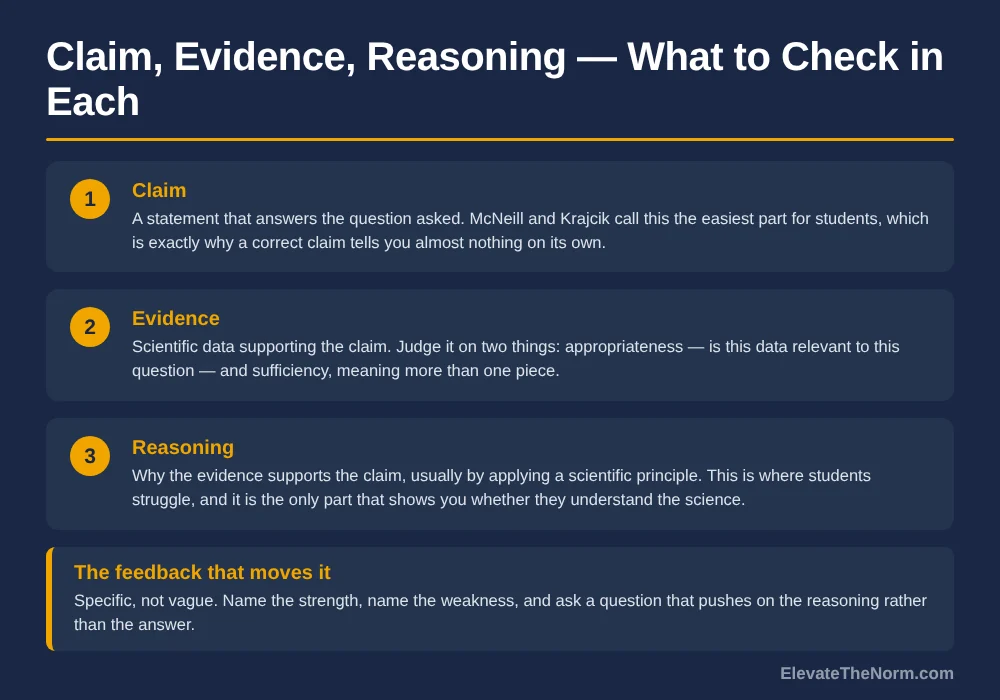
    Early Finisher Activities That Hold Up in Grades 6–12

    Ordered by what they cost you, cheapest first. The first three cost nothing once set up, which is the only reason they survive a real February.
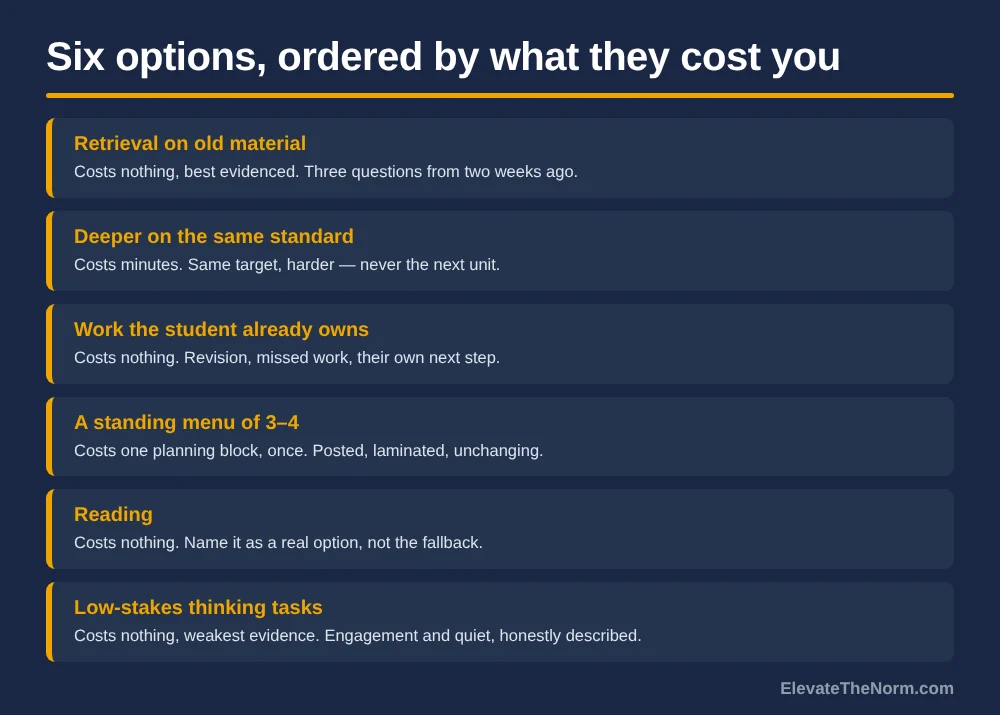
    List of six early finisher options ordered by what they cost the teacher: retrieval on old material, going deeper on the same standard, work the student already owns, a standing menu of three or four, reading, and low-stakes thinking tasks.
    Six options, cheapest first. The first three cost nothing once set up.

    1. Retrieval on old material — costs nothing, pays the most

    Have the student answer three or four questions about material from two or three weeks ago, not from today. This is the single best-evidenced use of the time, and the evidence is from the right age group. In an eighth-grade science classroom, McDaniel and colleagues found that quizzing on previously taught content produced 13 to 25 percent gains on summative unit exams compared with content that was not quizzed, and the advantage persisted on cumulative semester and end-of-year exams. Review quizzing — close to the exam rather than immediately after the lecture — produced the largest gains.

    A broader review by Dunlosky and colleagues rated only two of ten study techniques as high utility: practice testing and distributed practice. Both are exactly what a three-minute retrieval card is. Summarising, highlighting and rereading were rated low utility, which rules out most of what students do voluntarily with spare minutes. The same authors are careful to say these techniques “will not be a panacea” and will benefit only students motivated and able to use them — so this is a strong default, not a guarantee.

    The practical objection is where the questions come from, and the answer has to be “not from you, daily.” Build one stack per unit as you teach it — four index cards, three questions each, written once while the material is fresh — and then reuse the stack for the rest of the term. A system that needs you to generate questions in the moment is a system you will stop using in week three.

    Keep it ungraded and keep it short. The point is the act of retrieving, and the moment it carries a grade it becomes an assessment you have to mark. If you already run a recall task at the start of the period, the early finisher version is the same instrument pointed at a different gap in the lesson. If you want a stack you did not have to write, I give away a free five-day warm-up sampler for grades 6–12 that works the same way in the spare minutes.

    2. Going deeper on the same standard — costs minutes

    Not the next unit. The same target, harder. If the task was identifying a claim, the extension is to find the weakest evidence supporting it and say why. If the task was solving for x, the extension is to write a problem whose answer is seven and explain how they built it.

    Depth keeps everyone on the same destination, which is the thing that makes it manageable. Acceleration creates a second curriculum: a student three sections ahead is now a planning problem for the rest of the term, and you will be the one reconciling it.

    3. Work the student already owns — costs nothing

    Revising a graded piece against the rubric. Finishing something missed during an absence. Writing the next step on a goal they set earlier. None of this requires you to invent anything, and all of it is work the student has a reason to care about because it is already theirs.

    This is the most under-used option in secondary classrooms and the easiest to defend to anybody who asks what a student was doing. It also pairs naturally with pulling a few students for a short booked session, because it gives the rest of the room something legitimate to be getting on with.

    4. A standing menu of three or four options — costs one planning block, once

    A posted, laminated, unchanging list. Three or four choices, not twelve. Students pick without asking. The menu is the system; the items on it matter less than the fact that it never changes and never has to be re-explained.

    Four is roughly the right number for a reason covered in the next section, and the list should include at least one option that is clearly not more work.

    Worth letting the class fill one of the slots. Not all four — you need the retrieval option on there and students will not choose it — but handing over one line costs you nothing, tells you what they actually consider worth doing with eight minutes, and makes the menu something they had a hand in rather than another posted rule.

    5. Reading — costs nothing, and say it plainly

    A book, an article, anything of their choosing. This is a legitimate use of eight minutes and it is worth announcing as such rather than treating it as what happens when you have run out of ideas. The honest framing is that nothing on this list is better for a student who has already demonstrated the standard.

    Two practical notes. Keep a shelf of anything readable in the room, because the student who has nothing to read is the student who has no option three. And whatever students bring is subject to the same materials expectations as anything else in your building — worth knowing your school’s position before you make reading a standing option rather than after.

    Where it goes wrong is leaving it unnamed. If reading is the fallback nobody mentions, students read it as the teacher giving up. If it is option three on a posted menu, it is a choice.

    6. Low-stakes thinking tasks — costs nothing, weakest evidence

    Puzzles, logic problems, a discussion prompt to write on, a challenge card. Genuinely useful for the student who is done, restless and not going to read. Put them last because the evidence that they produce learning is thin — their case is engagement and quiet, which is a real benefit honestly described rather than dressed up as rigour. I sell a print-and-go set of early finisher and brain break cards in my No-Prep Sub Plans, Early Finishers & Brain Breaks bundle for teachers who would rather not build the stack themselves.

    What Not to Hand Them

    More of the work they just finished. It is the default, it is understandable on a Tuesday, and it is the one thing on this page that actively trains students to slow down.

    There is relevant evidence, with a population caveat that matters on a secondary site. In a study reported by Reis and Renzulli, teachers across 27 districts eliminated 40 to 50 percent of the standard curriculum for students who had already mastered it. Post-test scores in science, maths, social studies and spelling were no different from the control group, and in language arts the compacted students scored significantly higher. Removing work from students who already knew the material cost them nothing.

    The caveat: that sample was 465 teachers in grades 2 through 6. Only the top of that band overlaps with this site’s readers, and the study was about formally compacting a curriculum, not about what to do with a spare eight minutes. It does not transfer directly. What it does establish is that the instinct behind “more practice can’t hurt” is wrong often enough to stop treating it as obviously safe. The same researchers also noted that many replacement activities their teachers used were not advanced enough to be worth the swap — which is the risk on this page too.

    Two more to avoid. Anything that needs new instruction, because you will be teaching it one-to-one while the class works. And anything you have to grade, because a system that generates marking will be abandoned by October.

    Does Giving Them a Choice Actually Help?

    Yes for motivation, and — stated plainly, because most articles on this topic imply otherwise — no for learning.

    Patall, Cooper and Robinson’s meta-analysis of 41 studies found choice had a positive effect on intrinsic motivation, with a weighted average of d = 0.30 (0.36 under a random-effects model). The effect was stronger when two to four successive choices were offered, stronger when no reward followed, and stronger for children than for adults — which means the benefit is probably smaller for your seniors than the headline figure suggests.

    The finding worth knowing: the effect of choice on subsequent learning was not significant (d = 0.10, with a confidence interval crossing zero). Thirteen of the ninety-one motivation effect sizes were negative. So build the menu because it makes students more willing to use the time and less likely to read the time as a penalty. Do not claim it raises test scores, because the best available synthesis does not support that.

    Practically: three or four options, no points attached, and do not keep adding to the list.

    Setting It Up So It Runs Without You

    The system is four sentences, posted where students can see it.

    1. Name the standard for “done.” Done means it meets the criteria on the board, not that the last box has writing in it.
    2. State what happens next, permanently. The three or four options, in the same place, all year.
    3. Say what it is never going to be. Telling a class outright that finishing early will never earn them extra work is worth more than any activity on the menu, and you then have to keep it.
    4. Make it silent and self-serve. If a student has to ask you, it will not survive a week when you are busy.
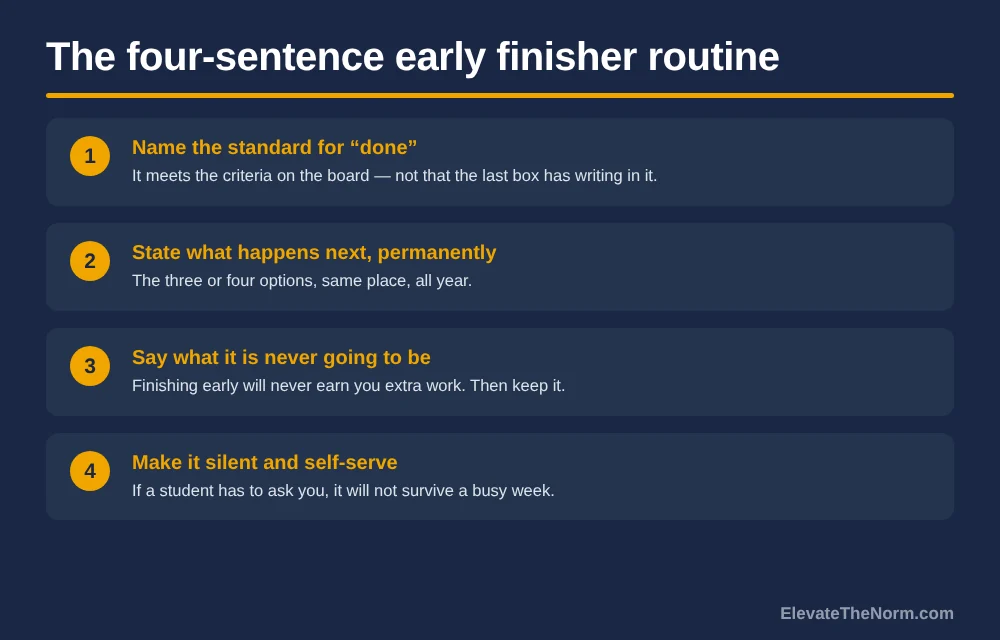
    Numbered list of the four-sentence early finisher routine: name the standard for done, state what happens next permanently, say what it is never going to be, and make it silent and self-serve.
    The whole system is four sentences, posted where students can see them.

    Two things that decide whether it holds. Phones. In a secondary room, “finished early” means phone unless you have said otherwise, and a menu that ignores that is a menu competing with a device and losing. Whatever your school’s policy is, the early finisher routine has to state its own position explicitly, because silence reads as permission. And the posted menu is your answer to a walkthrough. A room where six students are doing six different quiet things looks like drift to anyone standing in the doorway for ninety seconds; a laminated list on the wall is what makes it legible as a routine rather than a loss of control.

    What If They Finished Early Because They Rushed?

    Then the problem is the definition of “done,” not the activity, and no menu fixes it.

    The gate goes before the menu. If “done” means meets the posted criteria, a rushed paper is not done, and the student’s early finisher activity is the work itself. That conversation is short and it is not a reprimand: this does not meet the third criterion yet, have another look. Rushing is usually a rational response to a system in which finishing fast is rewarded and quality is not checked — which is the same mechanism as before, pointed the other way.

    The case that matters more, and the one most advice misses entirely: a student can arrive at “done” because they got stuck and quietly gave up. That looks identical to finishing early from across the room. It is the reason the gate is worth checking rather than assuming, and the response is not the menu — it is the two minutes of help the student did not ask for. A routine that cannot tell mastery from surrender will reliably reward the wrong one.

    If a student genuinely finishes good work early and often, that is information. It may mean the task is too easy for them, and the answer is a conversation about the course, not a sixth item on the menu.

    Where the Evidence Runs Out

    Honestly: there is no body of research on early finisher activities as such. Nobody has run a controlled trial on what secondary students should do with nine spare minutes.

    What exists is evidence about the components — retrieval practice, distributed practice, choice, curriculum compacting — mostly gathered in other settings and for other purposes, and in two of the four cases in samples younger than this site’s readers. The recommendations above are those findings applied by reasoning, and the reasoning is visible so you can disagree with it. The claim that the signal matters more than the activity is an argument from how incentives work, not a measured result.

    Treat the retrieval recommendation as well supported, the menu as reasonable and low-risk, and the rest as practice worth trying rather than settled.

    What to Do Next Week

    Write three options on a piece of paper and post it. Make one of them retrieval questions from two weeks ago, one of them work the student already owns, and one of them reading. Tell the class, once, that finishing early will never produce extra work.

    Then keep that promise for a month and watch two things. Whether the pace of the room changes — students stop stalling when stalling stops paying. And who is using the menu, because that is the equity question in this whole topic. Early finishers are disproportionately students who arrived already knowing more, so a routine that quietly hands the best minutes of the week to the students with the most prior knowledge widens a gap rather than closing one. If the same six names are always on option one, the honest read is that the task is too easy for them and too hard for everyone else, and that is a problem with the lesson rather than the menu.

    Different problem, same two minutes. When the whole class needs the reset rather than the fast finishers, see what a brain break looks like with 14- to 18-year-olds — and why the dance video is the fastest way to lose them. Retrieval needs something to retrieve from, which is an argument for a page students can actually quiz themselves on.

    Frequently Asked Questions

    What are early finisher activities?

    Early finisher activities are planned, low-supervision tasks a student moves to independently after completing the assigned work, before the class moves on together. In grades 6 through 12 they need to work in gaps of roughly three to twelve minutes, require no new instruction from the teacher, stay quiet enough not to disturb students still working, and generate nothing the teacher has to grade. Most published ideas fail at least two of those four constraints.

    What should early finishers do in middle school and high school?

    The best-evidenced option is retrieval practice on material taught two or three weeks earlier, because quizzing previously taught content raised unit exam scores by 13 to 25 percent in an eighth-grade science study. After that: going deeper on the same standard rather than moving ahead to new content, finishing or revising work the student already owns, and reading. Keep the whole list to three or four standing options rather than inventing something each day.

    Should early finisher work be graded?

    No. A grade turns the task into an assessment the teacher has to mark, and any early finisher system that generates marking gets abandoned within a few weeks. It also changes what the activity signals: work that counts is work, and students who notice that finishing early produces more graded work will simply finish later. Keep it ungraded and keep it short.

    How many options should an early finisher menu have?

    Three or four. The meta-analysis on choice found the motivational benefit was strongest when two to four successive choices were offered, and a longer list costs more to maintain without adding anything. One of the options should be clearly not more work. Letting the class choose what goes in one of the slots is worth doing, though the retrieval option should not be the one put to a vote.

    What do I tell a parent who asks why their child spent ten minutes reading?

    The honest answer is usually the best one: their child met the standard for the assignment before the period ended, and rather than being given repetitive extra practice they already demonstrated they do not need, they read. If a parent pushes further, the useful information is whether this happens often. A student who regularly finishes good work early is telling you the task is not demanding enough for them, and that is a conversation about the course rather than about the ten minutes.

    What if a student finishes early because they gave up rather than because they understood?

    This is the case most advice misses, and from across the room it looks identical to genuine early finishing. It is the reason done should mean meets the posted criteria rather than has writing in every box. When a student has stopped because they are stuck, the response is not the activity menu, it is two minutes of help they did not ask for. A routine that cannot tell mastery from surrender will reliably reward the wrong one.

    Do early finisher activities widen the gap between students?

    They can, and it is worth watching for. Students who finish early are disproportionately students who arrived already knowing more, so a routine that gives the best spare minutes of the week to that group can widen a gap rather than close it. The practical check is who is actually using the menu. If it is the same few names every time, the likeliest explanation is that the task is too easy for them and too hard for the rest, which is a problem with the lesson rather than with the menu.

    Can students use their phones when they finish early?

    That depends on your school policy, but the routine has to state its own position out loud either way. In a secondary classroom, finished early means phone unless something else has been established, so silence on the question reads as permission. A menu that does not address phones is competing with a device and losing.

    Sources

    1. Kraft, M. A., & Novicoff, S. (2024). Time in School: A Conceptual Framework, Synthesis of the Causal Research, and Empirical Exploration. EdWorkingPaper No. 22-653, Annenberg Institute, Brown University. Estimated that students in the Providence Public School District lose 16–25% of the school day — 16% in elementary, 21% in middle and 25% in high school — with unexcused student absence the largest single contributor. The authors describe this as a lower-bound estimate from a single district and state that their case-study results likely have “limited generalizability.” The separate 17–29% figure for off-task behaviour, transitions and wait time combined is their summary of other researchers’ estimates, not their own measurement, and is not specific to students who finish early. https://www.edworkingpapers.com/ai22-653
    2. McDaniel, M. A., Agarwal, P. K., Huelser, B. J., McDermott, K. B., & Roediger, H. L. (2011). Test-Enhanced Learning in a Middle School Science Classroom: The Effects of Quiz Frequency and Placement. Journal of Educational Psychology, 103(2), 399–414. Eighth-grade science classes; multiple-choice quizzes with feedback on some unit content and not others, allowing a within-class comparison. Quizzing produced 13–25% gains on summative unit examinations, review quizzing close to the exam produced the largest gains, and the advantage persisted on cumulative semester and end-of-year exams. https://doi.org/10.1037/a0021782
    3. Dunlosky, J., Rawson, K. A., Marsh, E. J., Nathan, M. J., & Willingham, D. T. (2013). Improving Students’ Learning With Effective Learning Techniques: Promising Directions From Cognitive and Educational Psychology. Psychological Science in the Public Interest, 14(1). Of ten study techniques reviewed, only practice testing and distributed practice received a high utility rating; summarisation, highlighting and underlining, and rereading were rated low utility. The authors caution that the techniques “will not be a panacea” and will benefit only students who are motivated and capable of using them. Cited here from the Association for Psychological Science’s published summary of the report, which was the version read; the full monograph was not accessed. https://www.psychologicalscience.org/news/releases/which-study-strategies-make-the-grade.html
    4. Patall, E. A., Cooper, H., & Robinson, J. C. (2008). The Effects of Choice on Intrinsic Motivation and Related Outcomes: A Meta-Analysis of Research Findings. Psychological Bulletin, 134(2), 270–300. 41 studies, 290 effect sizes from 46 samples. Choice had a positive effect on intrinsic motivation (weighted average d = 0.30, 95% CI 0.25–0.35 fixed-error; d = 0.36 random-error), strongest when two to four successive choices were offered, when no reward followed, and for children rather than adults. The effect on subsequent learning was not significant (d = 0.10, 95% CI −0.02 to 0.21), and 13 of the 91 intrinsic-motivation effect sizes were negative. https://pubmed.ncbi.nlm.nih.gov/18298272/
    5. Reis, S. M., & Renzulli, J. S. (2005). Curriculum Compacting: An Easy Start to Differentiating for High-Potential Students, reporting the technical results of Reis et al. (1992). 27 school districts and 465 teachers, randomly assigned to treatment or control. Where 40–50% of the standard curriculum was eliminated for students who had already mastered it, post-test scores did not differ from controls in science, mathematics concepts, mathematics computation, social studies or spelling, and were significantly higher in language arts. The sample was grades 2 through 6, so only the top of that band overlaps with secondary classrooms, and the study concerned formal curriculum compacting rather than short in-period extension tasks. The authors also noted that many replacement activities their teachers used were not advanced enough to suit high-ability students. https://gifted.uconn.edu/schoolwide-enrichment-model/curriculum_compacting
    About Clay Shumate

    Clay Shumate is a certified secondary Social Studies teacher in the public schools of West Alabama, with seven years of classroom experience, a B.A. in History, and an M.Ed. in Secondary Education. He writes about project-based learning, student responsibility, respect, and practical ways to hold young people to a higher standard while giving them room to learn from mistakes. He is a member of the Society of Professional Journalists and writes to its Code of Ethics; this site’s editorial standards and corrections policy are published in full. More about Clay.

  • Differentiated Instruction Strategies for Grades 6–12 That Don’t Need Five Lesson Plans

    Differentiated Instruction Strategies for Grades 6–12 That Don’t Need Five Lesson Plans

    By Clay Shumate

    Differentiated instruction strategies are the moves a teacher makes so that students who arrive at a lesson with different knowledge, skills and language can all reach the same standard. The standard does not move. The route to it does. Everything useful in differentiation lives in that one sentence, and most of what goes wrong is a violation of it.

    The version sold in professional development usually looks like three lesson plans for one period. Nobody does that for five preps in February, and the people who tell you to do it are not currently teaching five preps in February.

    Key Takeaways

    • Change the route, not the destination. The learning target, the standard and the final criteria stay the same for everyone. If those move, you are running two courses in one room.
    • The evidence is encouraging and genuinely thin. A systematic review of secondary differentiation found only 12 usable studies out of 1,029 screened, and its authors named “severe knowledge gaps” in the same abstract that reported a positive effect.
    • Ability grouping is not differentiation. In primary education, homogeneous grouping showed a small negative effect on low-ability students and no effect on anyone else.
    • Do not differentiate by learning style. There is no adequate evidence base for matching instruction to a preferred modality, and the studies designed properly to test it mostly contradict it.
    • Five strategies carry most of the load: tiered questioning, scaffolds that come back, choice of product, grouping that actually changes, and pre-assessment that changes the plan. Four of the five are nearly free.

    What Is Differentiated Instruction?

    It is adjusting content, process, product or environment in response to what students actually need, while holding the learning goal constant. The adjustment has to be driven by evidence about this group of students, in this unit, right now — not by a label attached to a child in sixth grade.

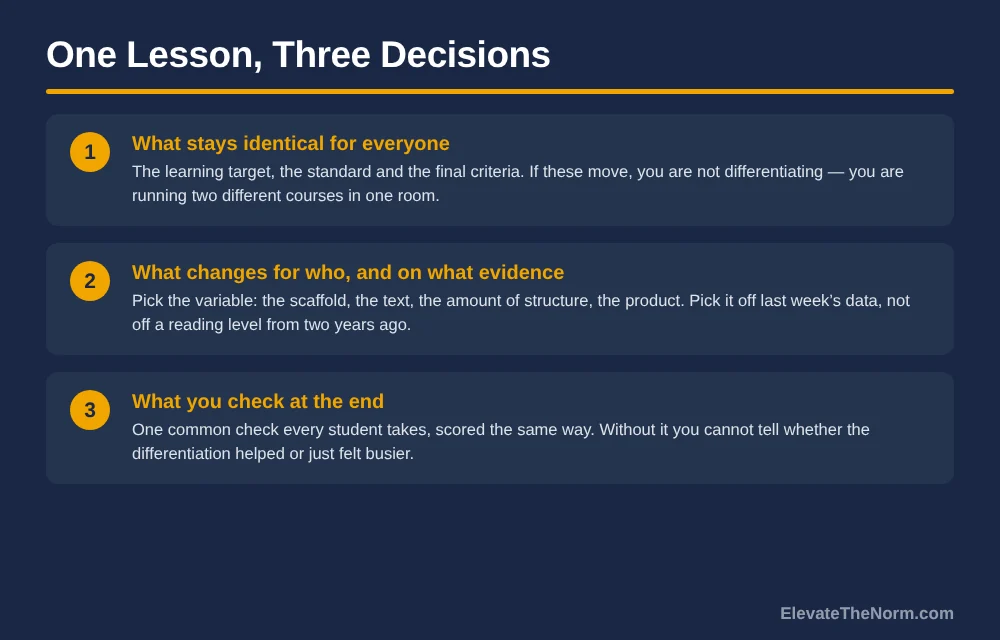
    Numbered three-card framework graphic for differentiating one lesson: what stays identical for everyone, what changes for which students and on what evidence, and what common check happens at the end
    Three decisions per lesson. That is the whole planning load.

    In practice, one lesson is three decisions.

    One: what stays identical for everybody. The target, the standard, the criteria for good work. Nail these down first, because everything after is a variation on them.

    Two: what changes, for whom, on what evidence. Pick one variable — the scaffold, the text, the amount of structure, the product. One. Then name why those students and not others, and point at the data that says so. If the only answer is “they’re my low group,” you have a track, not a differentiation plan.

    Three: what you check at the end. One common check every student takes, scored the same way. Without it, you cannot distinguish a lesson that helped from a lesson that was busier.

    Does Differentiated Instruction Actually Work?

    Probably, somewhat, and we know less than the training implies. The best secondary-specific review found a positive average effect across a small number of mostly quasi-experimental studies, and said so alongside a warning about how thin the base is.

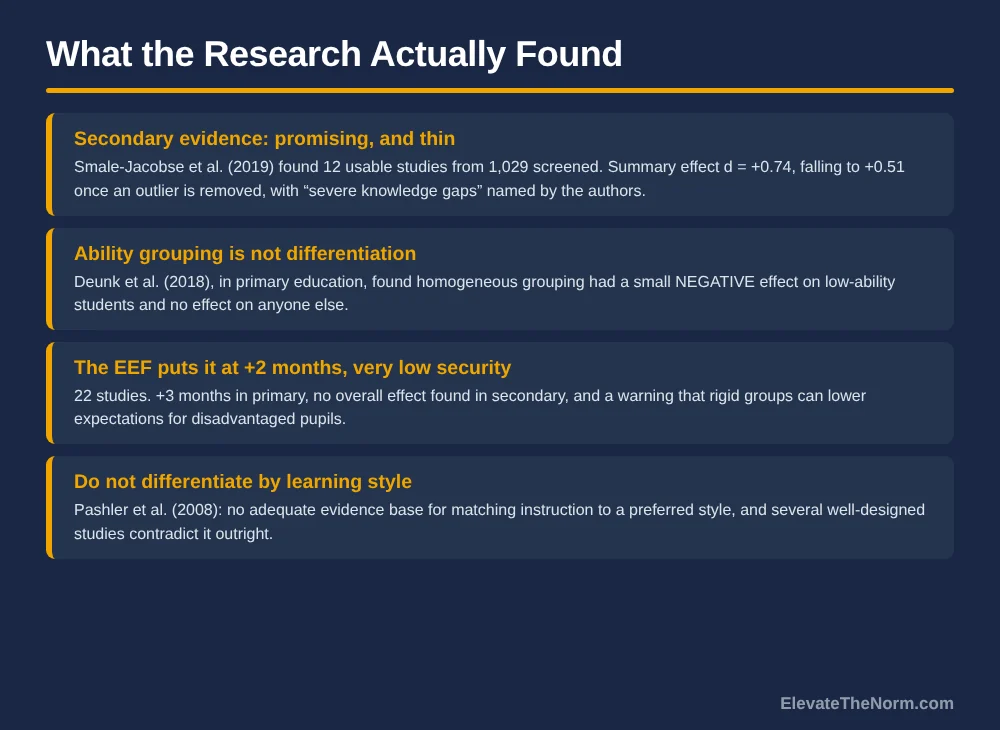
    Four-row research graphic on differentiated instruction: Smale-Jacobse and colleagues 2019 finding 12 usable secondary studies with an effect of 0.74 falling to 0.51 without an outlier, Deunk and colleagues 2018 finding homogeneous grouping slightly negative for low-ability students, the Education Endowment Foundation rating within-class attainment grouping at plus two months with very low security, and Pashler and colleagues 2008 on the absence of evidence for learning styles
    Four findings worth knowing before anyone sells you a differentiation initiative.

    Smale-Jacobse, Meijer, Helms-Lorenz and Maulana screened 1,029 papers and ended up with 12 unique studies of differentiated instruction in secondary education, mostly in maths and science, with students roughly 11 to 17. The summary effect was d = +0.741. Remove one extreme outlier and it drops to d = +0.509. Heterogeneity was enormous (Q = 507.7), the larger studies produced the smaller effects, only two studies had at least 15 cases per condition at the randomization level, and many of the outcome tests were researcher-made. The authors’ own summary is that the findings “give some indication of the possible benefits” but “point out that there are still severe knowledge gaps.”

    That is an honest finding and it is worth something. It is not a mandate.

    The Education Endowment Foundation puts within-class attainment grouping at +2 months of additional progress, at very low cost, with the security of the evidence rated very low — 22 studies, few of them recent. Their breakdown matters more than the headline: about +3 months in primary, +4 in maths, no difference on average in literacy, and no overall impact found at secondary, where there are few studies to begin with.

    And in primary education, Deunk, Jacobse, de Boer, Doolaard and Bosker reviewed 21 studies and 78 effect sizes. Computerized differentiation tools and differentiation embedded in a broader program produced small to moderate positive effects. Homogeneous ability grouping on its own produced a small negative effect on low-ability students and no effect on anyone else. Their conclusion is the one to carry into a department meeting: grouping by itself does not constitute differentiated instruction.

    Worth saying plainly: Deunk and the EEF’s strongest results are primary findings. They do not transfer to a ninth-grade classroom automatically, and I am not going to pretend they do. What transfers is the warning.

    What Differentiation Is Not

    It is not teaching to learning styles

    Pashler, McDaniel, Rohrer and Bjork tested what they called the meshing hypothesis — the idea that a “visual learner” learns more from visual material. Credible evidence would require grouping students by style, randomly assigning instruction methods, testing everyone the same way, and finding a crossover interaction. They found “virtually no evidence” of that pattern, and noted that several studies using an adequate method flatly contradict it. Their conclusion: there is no adequate evidence base for building learning-styles assessment into general educational practice.

    If a differentiation plan starts with a learning-styles inventory, it is starting from a dead end. Vary the representation because the content calls for it — a map, a graph, a demonstration — not because a survey labelled a student kinesthetic in seventh grade.

    It is not lowering the bar for some students

    A shorter task with the same standard is differentiation. A simpler standard quietly substituted for one group is not, and it is the single most common failure mode. Students work out within a week whose work is being graded against what. Holding the same expectations for every student in the room is not in tension with support; support is how you make the expectation reachable.

    It is not permanent groups with friendly names

    The Eagles, the Falcons and the Hawks, unchanged since September, are a tracking system with a bird theme. The students know. Rigid grouping carries a documented equity risk — the EEF names lower teacher expectations for disadvantaged pupils and damage to low attainers’ belief that effort changes anything.

    Differentiated Instruction Strategies, Ranked by What They Cost

    Start with the ones that cost nothing. Most teachers who “cannot differentiate” have simply been handed the most expensive version first.

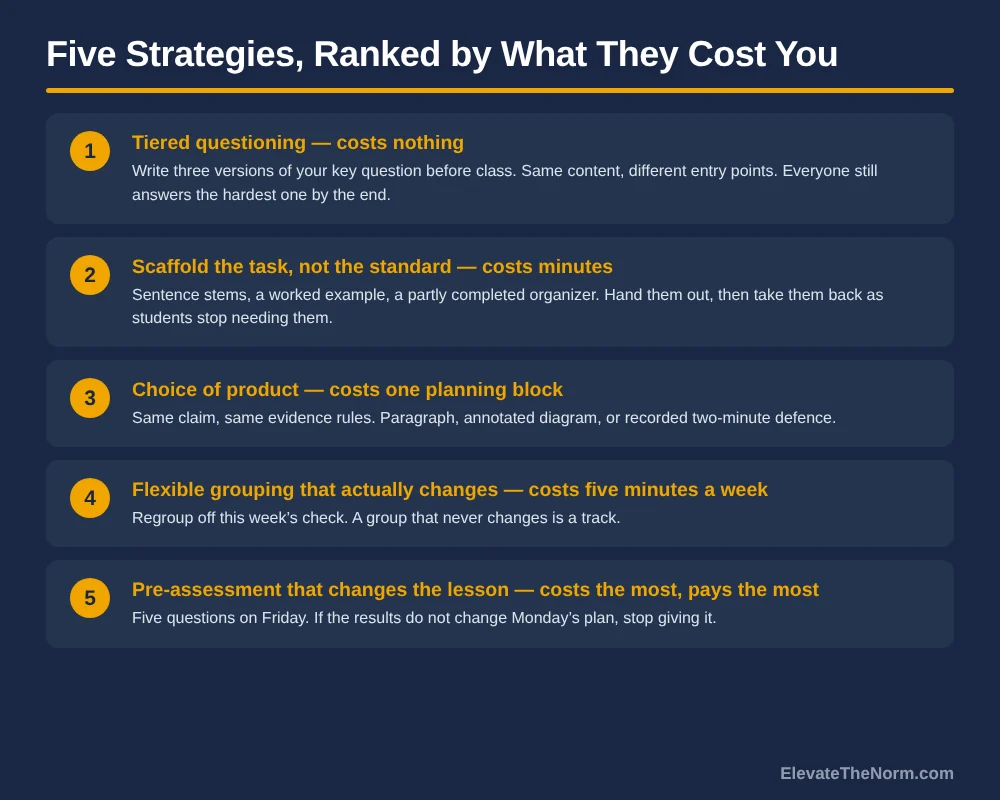
    Numbered five-card graphic ranking differentiated instruction strategies by preparation cost: tiered questioning, scaffolding the task rather than the standard, choice of product, flexible grouping that actually changes, and pre-assessment that changes the lesson
    Ranked by what they cost you, cheapest first.

    1. Tiered questioning — costs nothing

    Before class, write your key question three ways: one that gets anyone in, one at grade level, one that pushes. Same content, different entry points. You are not assigning questions to students; you are making sure the discussion has a door at every height. Every student should still meet the hardest version before the period ends — that is the difference between tiering and sorting.

    2. Scaffold the task, not the standard — costs minutes

    Sentence stems, a worked example at the top of the page, a graphic organizer with two boxes already filled in, a word bank for the four terms that will otherwise stop a student cold. The rule that keeps this honest: scaffolds are temporary and you must plan their removal. If a student has had the same organizer since September, the organizer is now the skill.

    3. Choice of product — costs one planning block

    Same claim, same evidence rules, same criteria — written paragraph, annotated diagram, or a recorded two-minute defense. This is where a choice board earns its keep, as long as the options differ in form and not in difficulty. Three options is plenty. Nine is a craft fair.

    4. Flexible grouping that actually changes — costs five minutes a week

    Group off this week’s evidence, not last year’s. Sometimes by readiness, sometimes by interest, sometimes at random, often mixed on purpose. If your groups have not changed in a month, they are not flexible. Small-group instruction in a secondary classroom works best when the rest of the room has something genuinely worth doing, which is a planning problem before it is a grouping problem.

    5. Pre-assessment that changes the lesson — costs the most, pays the most

    Five questions on Friday about Monday’s content. Not graded. The point is to find out who already has it and what the two common misconceptions are. Here is the test of whether it was worth doing: if the results do not change Monday’s plan, stop giving it. A pre-assessment you collect and file is paperwork.

    Any of the quick formative checks works for this. What matters is the twenty minutes afterward where you actually look.

    Differentiated Instruction Examples for Grades 6–12

    Each of these is one lesson, one variable changed, same standard for everybody.

    • Grade 9 history, document analysis. Everyone analyzes the same three documents against the same criteria. Two students get a version with the archaic vocabulary glossed in the margin. One group that finished the skill last unit gets a fourth document that contradicts the other three.
    • Grade 7 science, data claims. Same data set for the room. Some students get a claim-evidence-reasoning frame with the first sentence started; some get a blank page; the ones who have the structure cold get asked to write the strongest objection to their own claim.
    • Grade 8 algebra, error analysis. Everyone finds the mistake in a solved equation. One table gets problems with the error in the first two lines; another gets it buried in line five; a third gets two errors, one of which is not actually an error.
    • Grade 11 English, revision. Same paragraph, same revision criteria. Some students revise on paper with a checklist; some revise aloud to a partner first; some revise a second paragraph after the first one is done.
    • Any subject, same day. The whole class gets the same exit check: one question, four minutes, scored the same way. That single common measure is what makes the rest of it defensible.

    How Do You Differentiate When You Teach 150 Students?

    You differentiate the lesson, not the student. Build one lesson with planned variation inside it, and let students move through the variation, rather than writing a plan per child.

    Three things make this survivable.

    Sample instead of reading everything. You do not need to read 150 exit tickets. Read fifteen — five you expect to be strong, five middling, five you are worried about — and sort the rest into three piles by a single criterion. That takes ten minutes and tells you nearly as much as an hour would.

    Reuse the structures. The same tiered-question frame and the same CER scaffold work across a whole unit. You build them once, in August or over a weekend, and spend the rest of the semester choosing which to deploy. The planning cost is front-loaded, which is the only way it ever gets paid.

    Pick one class to start. Not all five. One section, one unit, one variable. If it works there, it transfers; if it does not, you have lost a week instead of a semester.

    What About the Students Who Already Got It?

    They are the group most often skipped, and the evidence says so directly.

    Ziernwald, Hillmayr and Holzberger reviewed 49 studies published 2000–2019 on differentiated instruction for high-achieving students in mixed-ability classrooms, spanning primary and secondary. Effects on achievement and on motivational outcomes were mostly positive but varied a great deal. The finding that should sting: teachers typically did not use differentiation for high achievers proactively or regularly, and both students and school staff reported it was rarely used. The barriers were time, resources, training, misconceptions about high-achieving students, and a focus on struggling students.

    Their caution is important too. Only six studies had a pretest-posttest control group design, so they did not run a meta-analysis at all. No study met every quality criterion. Treat this as a well-documented description of practice, not a proven intervention effect.

    The practical move is cheap: for the students who already have it, extend sideways rather than forward. One more document, a counter-argument, a constraint added to the problem, a request to teach the step to someone else. Sideways keeps them in the same conversation. Forward just sends them into next week alone.

    Sideways is also the whole argument for what you hand a student who simply finishes first. Our guide to what to do with the minutes after a student says “I’m done” orders six options by what each one costs you to run, and starts from the rule that finishing early can never cost the student anything.

    Why Does Differentiation Fail in Real Schools?

    Mostly for reasons that are not about teacher willingness.

    Gibbs interviewed seven teachers and two school leaders at an Australian secondary school of roughly 1,250 students. Every one of the seven teachers named limited resources as a barrier. Three named student behaviour, and three named limited planning and instruction time. Leaders named their own time and administrative load, including inconsistent records arriving from feeder primary schools. Four of the seven reported no pre-service training in differentiation at all, and the training the other three described focused on inclusion and disability — which suggests differentiation is widely confused with special education provision.

    It is a small, single-site qualitative study and the author says so. But the pattern is recognizable in any building.

    Two of those barriers are leadership decisions rather than teacher decisions. Planning time and class size are set in a master schedule. A district that mandates differentiation without changing either has bought a slogan. If you lead a building and want to know whether this is happening, do not add a differentiation box to a walkthrough form — that produces visible differentiation and nothing else. Look at whether groups changed between September and November, and whether anyone can show you a pre-assessment that altered a plan.

    It is also worth being honest that behaviour showed up in that list. Differentiation assumes a room where several things can happen at once, and that is downstream of the management work that makes multiple simultaneous activities possible. Trying to run four stations in a room that cannot hold one task is not a differentiation problem.

    A Planning Checklist

    • Can every student in the room name the same learning goal for today?
    • Did I change exactly one variable, and can I say what evidence picked it?
    • Is the final criterion identical for everyone?
    • Is there one common check at the end, scored the same way?
    • Do the scaffolds I handed out have a removal date?
    • Have the groups changed in the last three weeks?
    • If a student asked “why do I have this version?” could I answer honestly in one sentence?

    That last question is the one that keeps this ethical. If the honest answer is one you would not say out loud to the student, the plan needs changing, not the phrasing.

    What to Say to Students and Parents

    Students know when the work is different. Pretending otherwise costs you more credibility than telling the truth does: “Everyone is being graded against the same four criteria. You’ve got the version with the vocabulary glossed because that was slowing you down last week, not because I expect less from you. It comes off the next one.” That is a sentence a fifteen-year-old can respect, and it has the advantage of being true. Giving students some say in which version they take — real student voice and choice — removes most of the sting on its own.

    Parents ask a sharper version: is my kid getting the easy work? Answer it directly. Name the standard, show the common criteria, show the common end-of-unit check, and explain which support is in place and when it comes off. A parent who hears “same standard, different scaffolding, here is the removal plan” is usually satisfied. A parent who hears “we differentiate” is not, and should not be.

    Differentiated Instruction Strategies: What to Do Next Week

    Pick one section and one unit. Write your key question three ways. Build one scaffold and decide now which lesson it comes off at. Give one five-question pre-assessment and change something in the plan because of it. Give the same exit check to everybody and score it the same way.

    That is five moves, four of them nearly free, and it is more differentiation than most buildings are actually running. If it works, add the sixth thing in November. If it does not, you will know exactly which move failed, because you only changed one.

    And whatever else you cut, keep the common check at the end. Without it you are differentiating on faith, and the research base is nowhere near strong enough to carry that.

    Frequently Asked Questions

    What are differentiated instruction strategies?

    They are the adjustments a teacher makes to content, process, product or learning environment so that students with different prior knowledge, skills and language can all reach the same standard. The standard and the criteria for good work stay constant; the route changes. The five that carry most of the load in a secondary classroom are tiered questioning, temporary scaffolds, choice of product, flexible grouping that actually changes, and pre-assessment that alters the plan.

    Does differentiated instruction improve achievement?

    The secondary-specific evidence is positive but thin. Smale-Jacobse, Meijer, Helms-Lorenz and Maulana (2019) screened 1,029 papers and found 12 usable studies, reporting a summary effect of d = +0.741 that falls to +0.509 once an outlier is removed. Heterogeneity was very large, most designs were quasi-experimental, and the authors named “severe knowledge gaps.” The Education Endowment Foundation rates within-class attainment grouping at +2 months with very low evidence security and found no overall impact at secondary level.

    Is ability grouping the same as differentiated instruction?

    No, and treating it that way can do harm. Deunk and colleagues (2018), reviewing 21 studies in primary education, found homogeneous ability grouping produced a small negative effect on low-ability students and no effect on other students. Their conclusion is that grouping by itself does not constitute differentiation and must be embedded in a broader instructional approach. Permanent groups that never change are a tracking system, whatever they are called.

    Should I differentiate by learning style?

    No. Pashler, McDaniel, Rohrer and Bjork (2008) concluded there is no adequate evidence base for incorporating learning-styles assessment into general educational practice. They found virtually no evidence for the crossover interaction the theory predicts, and noted that several studies using an adequate experimental method flatly contradict it. Vary how content is represented because the content calls for it, not because a survey labelled a student visual or kinesthetic.

    How do you differentiate with 150 students and five preps?

    Differentiate the lesson rather than the student. Build one lesson with planned variation inside it; sample student work instead of reading all of it, by marking fifteen carefully and sorting the rest into three piles on one criterion; build reusable structures like a tiered-question frame or a CER scaffold once and deploy them across the unit; and start with one section and one unit rather than all five preps at once.

    What about students who already understand the material?

    They are the group most often skipped. Ziernwald, Hillmayr and Holzberger (2022) reviewed 49 studies and found that teachers typically did not use differentiation for high-achieving students proactively or regularly, with students and staff both reporting it was rare. Their evidence base was weak enough that no meta-analysis was possible, so read it as a description of practice. Practically, extend sideways rather than forward: an extra contradictory source, an added constraint, the strongest objection to their own answer.

    How do I explain differentiated work to a student without embarrassing them?

    Say it plainly and tie it to the standard. Something like: everyone is graded against the same four criteria, you have the version with the vocabulary glossed because that slowed you down last week, and it comes off the next assignment. Students work out within a week whose work is being graded against what, so concealment costs more credibility than honesty does. Letting students choose which version to take removes most of the sting on its own.

    Why does differentiated instruction fail in practice?

    Usually for reasons outside a teacher’s control. In Gibbs’s (2023) interview study at an Australian secondary school, all seven teachers named limited resources as a barrier, and three each named student behaviour and limited planning time. Four reported no pre-service training in differentiation at all, and the training the others described focused on inclusion and disability. Planning time and class size are set in the master schedule, so a mandate that changes neither is a slogan.

    Sources

    1. Smale-Jacobse, A. E., Meijer, A., Helms-Lorenz, M., & Maulana, R. (2019). Differentiated Instruction in Secondary Education: A Systematic Review of Research Evidence. Frontiers in Psychology, 10, Article 2366. 1,029 papers screened; 14 papers reporting 12 unique studies and 15 effect sizes; summary effect d = +0.741 (95% CI 0.397–1.085), falling to d = +0.509 (95% CI 0.215–0.803) with one outlier removed; Q = 507.701. Mostly quasi-experimental, only two studies with 15+ cases per condition at randomization level, many researcher-made tests; the authors name “severe knowledge gaps.” https://doi.org/10.3389/fpsyg.2019.02366
    2. Deunk, M. I., Smale-Jacobse, A. E., de Boer, H., Doolaard, S., & Bosker, R. J. (2018). Effective Differentiation Practices: A Systematic Review and Meta-Analysis of Studies on the Cognitive Effects of Differentiation Practices in Primary Education. Educational Research Review, 24, 31–54. 21 studies, 78 effect sizes; computerized differentiation and differentiation embedded in broader programs showed small to moderate positive effects; homogeneous ability grouping showed a small negative effect on low-ability students and no effect on others. Primary education only — these findings do not transfer automatically to grades 6–12. https://doi.org/10.1016/j.edurev.2018.02.002
    3. Education Endowment Foundation. Within-Class Attainment Grouping. Teaching and Learning Toolkit, last updated August 2021. Impact +2 months; cost very low; security of the evidence rated very low; 22 studies; +3 months in primary and +4 in mathematics, no average difference in literacy, and no overall impact found at secondary level, where studies are few; warns that rigid grouping may lower teacher expectations for disadvantaged pupils. https://educationendowmentfoundation.org.uk/education-evidence/teaching-learning-toolkit/within-class-attainment-grouping
    4. Ziernwald, L., Hillmayr, D., & Holzberger, D. (2022). Promoting High-Achieving Students Through Differentiated Instruction in Mixed-Ability Classrooms: A Systematic Review. Journal of Advanced Academics, 33(4), 540–573. 49 studies published 2000–2019, primary and secondary, mostly US and Canada; effects mostly positive but highly variable; teachers rarely used differentiation for high achievers proactively. Only six pretest-posttest control-group studies were analyzable, so no meta-analysis was conducted and no study met all quality criteria. https://doi.org/10.1177/1932202X221112931
    5. Pashler, H., McDaniel, M., Rohrer, D., & Bjork, R. (2008). Learning Styles: Concepts and Evidence. Psychological Science in the Public Interest, 9(3), 105–119. Found “virtually no evidence” for the crossover interaction the meshing hypothesis requires, noted that several adequately designed studies contradict it, and concluded there is no adequate evidence base for incorporating learning-styles assessment into general educational practice. https://digitalcommons.usf.edu/psy_facpub/1765/
    6. Gibbs, K. (2023). Voices in Practice: Challenges to Implementing Differentiated Instruction by Teachers and School Leaders in an Australian Mainstream Secondary School. The Australian Educational Researcher, 50(4), 1217–1232. Semi-structured interviews with seven teachers and two leaders at one Queensland secondary school of about 1,250 students; limited resources named by all seven teachers, behaviour and planning time by three each; four teachers reported no pre-service differentiation training. Small, single-site, convenience sample; the author notes limited generalisability. https://doi.org/10.1007/s13384-022-00551-2

    About Clay Shumate

    Clay Shumate is a certified secondary Social Studies teacher in the public schools of West Alabama, with seven years of classroom experience, a B.A. in History, and an M.Ed. in Secondary Education. He writes about project-based learning, student responsibility, respect, and practical ways to hold young people to a higher standard while giving them room to learn from mistakes. He is a member of the Society of Professional Journalists and writes to its Code of Ethics; this site’s editorial standards and corrections policy are published in full. More about Clay.

  • Learning Targets: How to Write One a Student Can Actually Use

    Learning Targets: How to Write One a Student Can Actually Use

    By Clay Shumate

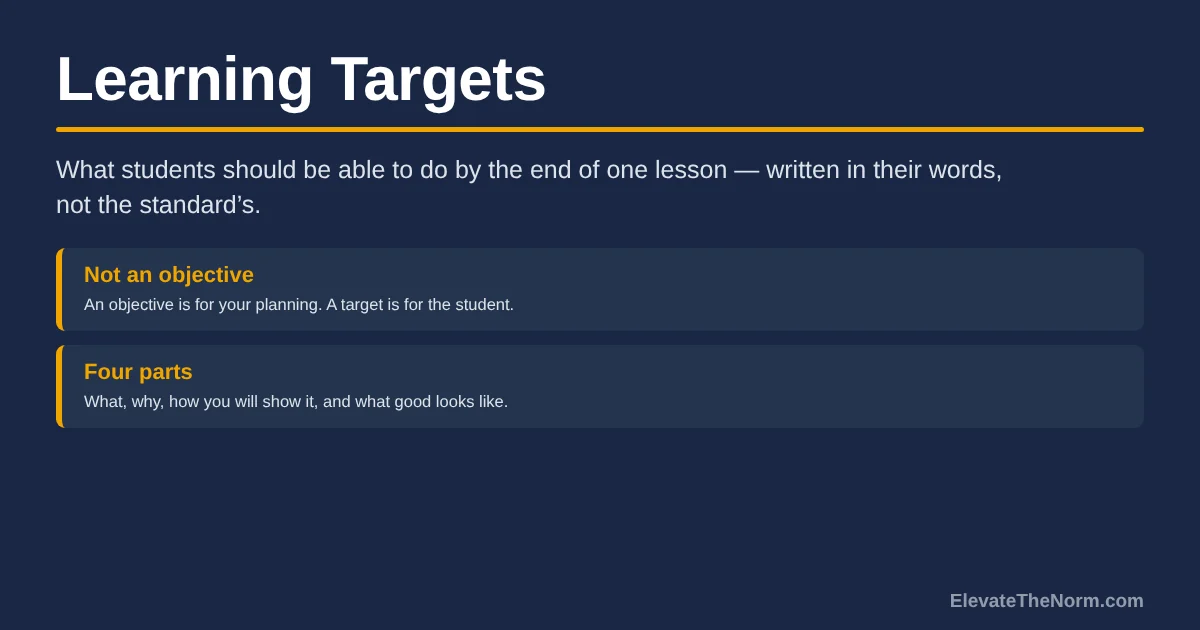
    A learning target is a short statement of what a student should be able to do by the end of one lesson, written in the student’s own language and paired with a description of what good work looks like. It is not the standard. It is not the objective in your plan book. Those are written for you. The target is written for them.

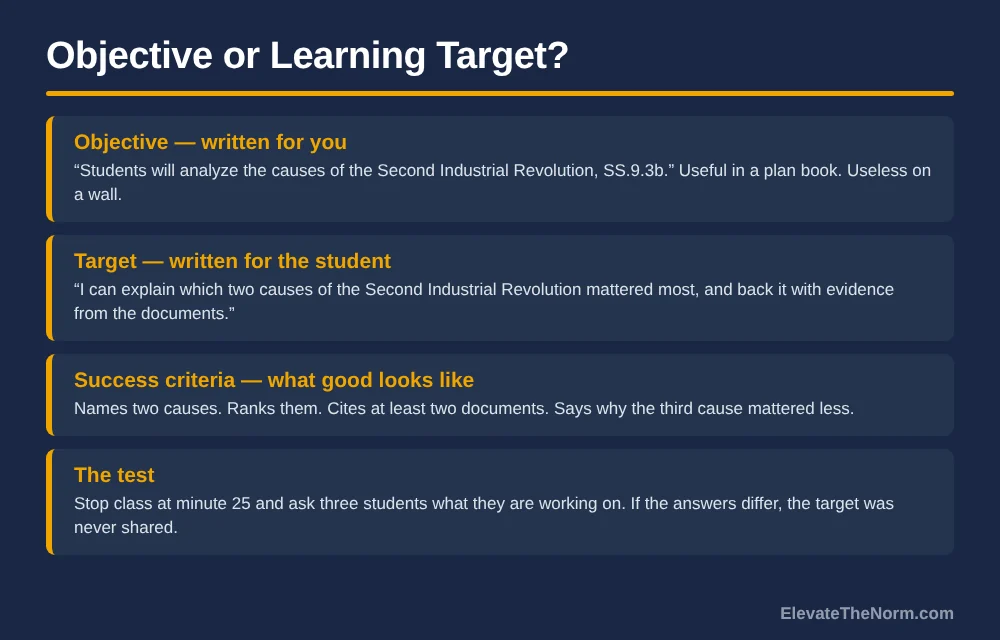
    That distinction sounds like semantics until you walk into a room at minute twenty-five and ask three students what they are working on. If you get three different answers, there was no target. There was a sentence on a whiteboard.

    Key Takeaways

    • A target answers three student questions: what am I learning, why does it matter, and how will I know when I have it. Drop the third and you have a topic, not a target.
    • Objectives and learning targets are not the same document. An objective is a planning tool written in standards language. A target is a communication tool written in student language.
    • The evidence is thinner than the training says. One video study of 13 physics classes found real benefits from goal clarity. A broad review by the same lead author put “goal setting and orientation” near the bottom of the list at .03.
    • In real classrooms, goals are usually implicit. Across 146 videotaped lower-secondary maths lessons in five Nordic systems, only about 19 percent of segments had an explicit goal. Most had to be inferred by the researchers.
    • Do not quote the famous effect sizes. The 0.5 and 0.88 numbers that circulate for learning intentions come out of a synthesis whose method has been published as statistically unsound. Argue for targets on what they do for students, not on a number.

    What Is a Learning Target?

    It is a lesson-sized piece of learning, stated from the student’s point of view, that a student could repeat back in their own words and use to judge their own work before you grade it.

    Four-row comparison graphic showing an instructional objective written in standards language, the same content rewritten as a student-facing learning target, the matching success criteria, and a test for whether the target was actually shared
    The same lesson, written three ways. Only one of them is for the student.

    Connie Moss, Susan Brookhart and Beverly Long put it plainly in Educational Leadership: a shared learning target “unpacks a ‘lesson-sized’ amount of learning” and frames the lesson from where the student is sitting. They argue instructional objectives “are not designed for students but for the teacher,” and that targets have to be translated into language that is developmentally appropriate and culturally respectful before they are worth anything.

    They also name the part most people skip. The single best way to share a target, they argue, is a learning experience that embodies it — a task where finishing the task is the evidence. Not a sentence read aloud at the bell and never mentioned again.

    How Is a Learning Target Different From an Objective?

    An objective tells you what you are teaching. A target tells a student what they are learning and how they will know they got there. You need both, and they are written at different times, for different readers, in different words.

    Here is the same lesson three ways.

    • The standard: “Analyze the causes and effects of industrialization in the late nineteenth century.”
    • The objective, in your plan book: “Students will analyze primary and secondary sources to evaluate the relative significance of three causes of the Second Industrial Revolution.”
    • The target, on the board and in their mouths: “I can explain which two causes of the Second Industrial Revolution mattered most, and back it up with evidence from the documents.”

    The third one is the only version a fifteen-year-old can act on. It also tells them what you will not be asking for, which matters more than teachers usually admit. Students spend a lot of class time guessing at the real assignment.

    Do Learning Targets Actually Improve Learning?

    The honest answer is that goal clarity shows up as a real effect in a small number of careful classroom studies, and close to nothing in broad averages across the field. That is a reason to write good targets, not a reason to build a school initiative on them.

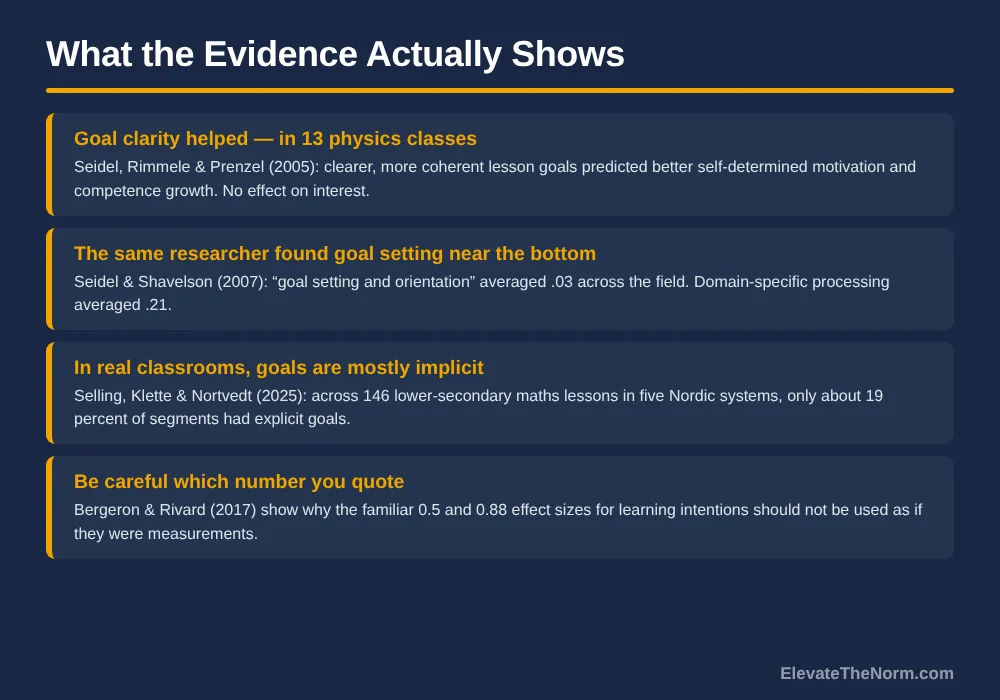
    Four-row research graphic summarizing evidence on learning targets: Seidel Rimmele and Prenzel 2005 on goal clarity in 13 physics classes, Seidel and Shavelson 2007 placing goal setting near the bottom at .03, Selling Klette and Nortvedt 2025 finding only about 19 percent of lesson segments had explicit goals, and Bergeron and Rivard 2017 on why familiar effect sizes should not be quoted
    Four findings that should change how confidently anyone sells you learning targets.

    Start with the study that supports the practice. Tina Seidel, Rolf Rimmele and Manfred Prenzel video-recorded introductory lessons for two topics across 13 physics classes and rated how clear and coherent the lesson goals were. Classes with high goal clarity and coherence reported more supportive learning conditions, more self-determined motivation, and better organization of their own learning. Over a school year, high clarity was also linked to positive competence development. It had no effect on individual interest.

    Thirteen classes, one subject. That is a careful study, not a large one, and the abstract does not report the grade level or an effect size. Treat it as suggestive.

    Now the part the professional development rarely includes. Two years later Seidel co-authored a review of a decade of teaching-effectiveness research with Richard Shavelson in the Review of Educational Research. Across the field, “goal setting and orientation” averaged .03. Domain-specific processing — the actual thinking students do inside your subject — averaged .21, by far the largest component. The same researcher who found goal clarity mattered in physics classrooms also found that, averaged across everything, goal setting is one of the smallest levers in teaching.

    Both of those can be true. Clarity probably matters most when it is the thing that is missing, and almost not at all once it is adequate. That is how most classroom variables behave.

    There is also a related body of work on teacher clarity, which is broader than learning targets. Titsworth, Mazer, Goodboy, Bolkan and Myers ran two meta-analyses, one covering 144 reported effects across more than 73,000 participants. They found a moderate overall relationship, with clarity accounting for roughly 13 percent of the variance in student learning, and a larger effect on affective learning than on cognitive learning. Worth knowing — but the ERIC record does not state what education levels those studies drew on, so I am not going to hand it to you as a secondary-school finding.

    Why Shouldn’t I Quote the Effect Size I Was Shown in Training?

    Because the most-quoted numbers for learning intentions and success criteria come from a synthesis whose statistical method has been formally challenged in print, and the challenge has not been answered to the satisfaction of people who do statistics for a living.

    Pierre-Jérôme Bergeron’s critique, translated by Lysanne Rivard in the McGill Journal of Education, lays out the specifics: common language effect values that come out negative or above 100 percent, averaging incompatible effects together, converting correlations into Cohen’s d in ways that make weak relationships look strong, and a 0.4 “desired effect” threshold with no stated basis. He notes that a correlation of .196 lands in the desired zone while explaining under four percent of the variance. His conclusion is blunt: the method should be qualified as pseudoscience.

    You will still see 0.88 quoted for success criteria. It turns up, for example, in a 2023 practitioner article in the NECTFL Review, attributed onward to another source. That article collects no original data and reports no sample. The number has a long life because it is convenient, not because it was measured in rooms like yours.

    None of this means targets are useless. It means you should defend them the way you would defend any other practice that asks students to be treated as capable adults — on the grounds that a student who knows what they are doing and why can do something about it.

    Why Don’t Students Know the Target Even When It’s on the Board?

    Because in most lessons the goal is never actually said out loud. Researchers watching real classrooms find they have to infer the goal themselves most of the time.

    Selling, Klette and Nortvedt analyzed 146 videotaped lessons from 48 lower-secondary mathematics classrooms across Norway, Sweden, Finland, Denmark and Iceland. Using the PLATO observation protocol, they found most lesson segments scored a 2 on Purpose — meaning the goal existed but had to be inferred. Only about 19.4 percent of segments scored a 3 or 4 for explicit goals, and just 3.7 percent scored at the top. In Sweden, roughly 94 percent of segments sat at the inferred level.

    They also found that in Iceland, Norway and Sweden, more than 40 percent of segments made no reference at all to what students already knew. A goal with no bridge from prior knowledge is a destination with no road to it.

    Two honest caveats. This study measured instruction, not outcomes — it did not test whether clearer goals produced more learning. And the only relationship it reports is a weak correlation (r = 0.265) between the Purpose score and references to prior knowledge. What it shows is simply that the practice everyone says they do is rare when someone puts a camera in the room.

    How Do You Write a Learning Target?

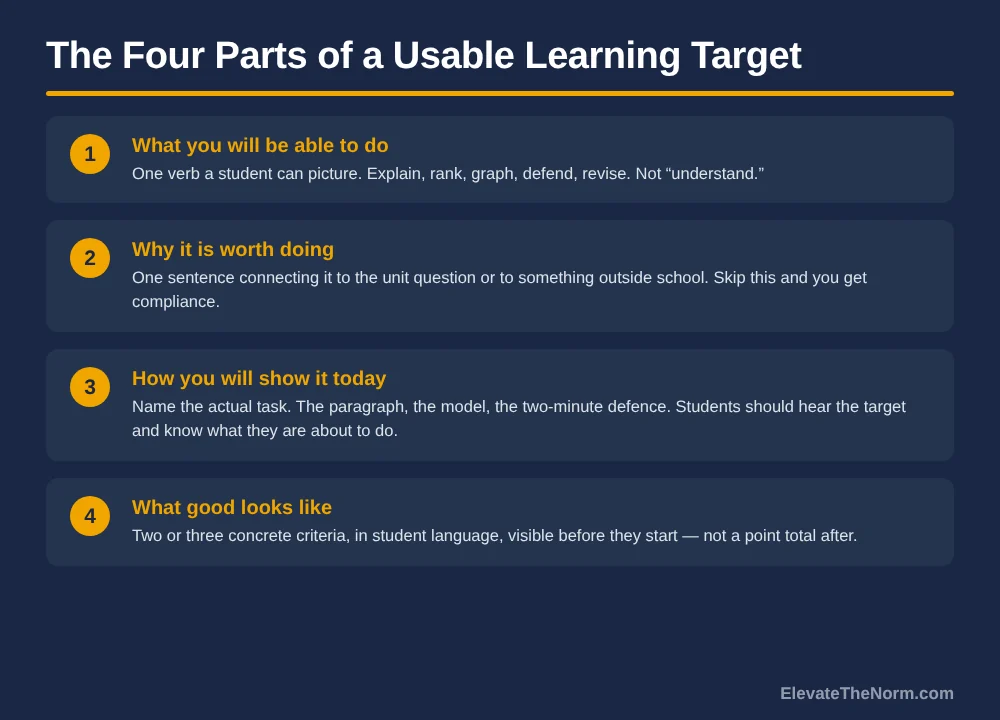
    Four parts: what the student will be able to do, why it is worth doing, how they will show it today, and what good looks like. If you cannot write all four in under two minutes, the target is too big for one lesson.

    Numbered four-card graphic listing the parts of a usable learning target: what you will be able to do, why it is worth doing, how you will show it today, and what good looks like
    Four parts. Drop any one of them and the target stops working.

    1. What you will be able to do. One verb a student can picture. Explain, rank, graph, defend, revise, predict, trace. Not “understand,” not “be exposed to,” not “explore.” If a student cannot tell from the verb whether they are writing, talking, building or calculating, pick a different verb.

    2. Why it is worth doing. One sentence tying it to the unit question or to something outside the building. Skip this and the best you get is compliance. Teenagers give you compliance cheaply and it is worth exactly what you paid.

    3. How you will show it today. Name the actual task. The paragraph, the labeled model, the two-minute defense, the corrected problem set. Students should hear the target and already know what they are about to be doing.

    4. What good looks like. Two or three concrete criteria, in student language, visible before they start. Not a point total handed back afterward.

    Learning Target Examples for Grades 6–12

    Each of these is one lesson, with criteria attached. Steal the shape, not the content.

    Social studies, grade 9

    Target: “I can rank three causes of an event by importance and defend my ranking with evidence.”
    Criteria: Names all three causes accurately. Puts them in an order and says why. Uses at least two documents. Names the strongest objection to my ranking.

    Science, grade 7

    Target: “I can tell the difference between a result my data supports and one it doesn’t.”
    Criteria: Points to the specific numbers behind each claim. Says what the data cannot tell us. Does not use the word “prove.”

    Algebra, grade 8

    Target: “I can find my own mistake in a solved equation and explain what rule I broke.”
    Criteria: Circles the exact line. Names the property or step. Rewrites from that line forward instead of starting over.

    English, grade 11

    Target: “I can rewrite a paragraph so the evidence comes before the opinion, and say why that order is stronger.”
    Criteria: Quote appears before the claim is restated. Explains the quote in my own words. Cuts at least one sentence that was doing no work.

    Notice what is missing from all four: a standard code. Put the code in your plan book and your standards-based gradebook where it belongs. A student does not need to read “SS.9.3b” to learn anything.

    What Are Success Criteria, and How Are They Different?

    The target says what you are learning. The success criteria say what it will look like when you have learned it. The criteria are the half that gets dropped, and they are the half students actually use.

    Moss, Brookhart and Long describe success criteria as “developmentally appropriate descriptions and concrete examples” of quality — not grades and not item counts. Three to five points. Rubrics and real work samples help, because most students cannot picture “well organized” until they have seen two versions side by side.

    The strongest version of this is letting students help build the criteria from exemplars. Hand two anonymous pieces of past work to a table group, ask them what the better one does that the other does not, and write their answers on the board. You will get most of your rubric back in their words, which makes it far more likely to be used. It also pairs naturally with student self-assessment, which is close to pointless when students are guessing at the standard.

    A Two-Minute Check Before You Post It

    • Can a student read it and say what they will be doing in the next ten minutes?
    • Is there exactly one lesson in it? Two verbs usually means two days.
    • Does it survive the “so what” question without a speech?
    • Are the criteria specific enough that two students would grade the same paper the same way?
    • Is there any jargon in it you would not use at a dinner table?
    • Can you check it at the end of class in under four minutes? Pick one of the quick formative checks and name it before the lesson starts. If you cannot, you have no way of knowing whether the target landed.

    That last one matters more than the wording. A target with no check at the end of the period is a prediction nobody ever scores.

    Where Learning Targets Go Wrong

    They become a compliance item

    The fastest way to kill the practice is to audit it. When a walkthrough form has a box for “objective posted,” every board in the building gets a sentence on it by 8:05 and nothing else changes. If you lead a building and you want to know whether targets are working, do not look at the wall. Ask three students in the hallway what they were working on and why. That takes ninety seconds and it is the only version of this audit that measures anything.

    They get written for five preps every night

    Nobody is writing twenty-five fresh targets a week in December. The realistic move is to write targets at the unit level once, during planning, and break them into lesson-sized pieces as you go. Most units have four to six real targets in them, not twenty. Reusing a target across two days is fine and honest — it tells students the thing is hard enough to take two days.

    They are read aloud and then abandoned

    A target mentioned at the bell and never again is theater, and students know it faster than adults do. Come back to it twice: once in the middle, when you stop and ask what part of it they have so far, and once at the end, when the exit check is visibly the same thing the target promised.

    They get confused with a schedule

    “Today we will finish the packet and start the lab” is an agenda. Agendas are useful. They are not targets, and posting one in the target’s slot is how most classrooms end up believing they do this already.

    What About Targets for a Multi-Day Project?

    Keep one project-length target for the whole arc, and write a smaller daily target underneath it that names today’s piece.

    On a three-week project, “I can design and defend a solution to a real problem” is the arc. Today’s is “I can write two interview questions that will get me something I cannot find online.” Students need both: the arc so the work has a point, the daily piece so they know what finished looks like by 2:15. This is also where students setting their own goals stops being an add-on — once the criteria are public, a student can name their own next step without you assigning it.

    What to Say to a Parent

    You will get the question eventually, usually phrased as “what are they actually supposed to be learning?” A posted target makes that a short conversation. “Here is the target for this week, here is what good work looks like on it, and here is where your son is against those three criteria” is a different conference than reading a column of percentages aloud. It also makes a low grade explicable instead of mysterious, which is most of what parents want from a conference.

    Learning Targets: What to Do in Your Next Lesson

    Pick one lesson you are teaching this week. Write the target in a student’s voice, add three criteria, and name the four-minute check that will tell you whether it landed. That is the entire practice.

    Then do the thing that actually tests it: stop the class halfway through and ask three students what they are working on and how they will know they did it well. If you get the same answer three times, the target is doing its job. If you get three different answers, the problem is not that your students were not listening. The sentence was never written for them in the first place.

    And if you only change one thing, add the criteria. The target without them is a topic.

    Check the target at the bell. The fastest way to find out whether students hit today’s learning target is a one-question exit ticket. Our sister site has free exit tickets and exit slips for grades 6–12, plus daily bell ringers to open the period.

    Frequently Asked Questions

    What is a learning target?

    A learning target is a short statement of what a student should be able to do by the end of one lesson, written in the student’s own language and paired with a description of what good work looks like. It is distinct from an instructional objective, which is written in standards language for the teacher’s planning. Moss, Brookhart and Long describe a shared learning target as unpacking a “lesson-sized” amount of learning from the student’s point of view.

    What is the difference between a learning target and an objective?

    The reader. An objective is a planning document written in standards language for the teacher — “students will analyze primary sources to evaluate the relative significance of three causes.” A learning target is a communication document written for the student — “I can explain which two causes mattered most, and back it up with evidence from the documents.” You need both, and they are written at different times in different words.

    Do learning targets improve student achievement?

    The evidence is mixed and thinner than most training implies. Seidel, Rimmele and Prenzel (2005) found that clearer, more coherent lesson goals across 13 physics classes predicted more self-determined motivation and positive competence development over a year, though no effect on interest. But Seidel and Shavelson’s (2007) review of a decade of teaching-effectiveness research placed “goal setting and orientation” near the bottom at .03, well below domain-specific processing at .21. Clarity most likely matters when it is missing and much less once it is adequate.

    Why shouldn’t I quote the 0.88 effect size for success criteria?

    Because it traces back to a synthesis whose statistical method has been formally challenged in print. Bergeron and Rivard (2017), in the McGill Journal of Education, document miscalculated common language effects, averaging of incompatible effects, unreliable conversion of correlations into Cohen’s d, and an unexplained 0.4 threshold, and conclude the methodology should be qualified as pseudoscience. Argue for learning targets on what they do for students, not on a number.

    How many learning targets should one lesson have?

    One. If your target contains two verbs, you most likely have two lessons. A realistic planning approach is to write four to six real targets at the unit level during planning and break them into lesson-sized pieces as you go, rather than drafting a fresh target every night for every prep. Reusing a target across two days is honest — it tells students the content is hard enough to need two days.

    What are success criteria?

    Success criteria describe what it will look like when a student has met the target. Moss, Brookhart and Long call them developmentally appropriate descriptions and concrete examples of quality — not grades and not item counts. Three to five specific points works. The strongest version is building them with students from two anonymous work samples, because most students cannot picture “well organized” until they have seen a better and a worse version side by side.

    Do students actually hear the learning target?

    Usually not. Selling, Klette and Nortvedt (2025) analyzed 146 videotaped lessons from 48 lower-secondary mathematics classrooms in five Nordic systems and found that only about 19.4 percent of lesson segments contained an explicit goal; in most, researchers had to infer the goal themselves. More than 40 percent of segments in three of the countries made no reference to students’ prior knowledge. The test in your own room is to stop at minute 25 and ask three students what they are working on.

    Should administrators check whether learning targets are posted?

    Checking the wall measures the wall. If a walkthrough form has a box for “objective posted,” every board in the building will have a sentence on it and nothing else will change. The useful version takes ninety seconds: ask three students in a hallway what they were working on and how they would know they did it well. That measures whether the target was shared, which is the only thing that matters.

    Sources

    1. Seidel, T., Rimmele, R., & Prenzel, M. (2005). Clarity and Coherence of Lesson Goals as a Scaffold for Student Learning. Learning and Instruction, 15(6), 539–556. Video ratings of introductory lessons in 13 physics classes; high goal clarity and coherence predicted supportive learning conditions, self-determined motivation, better organization of learning, and positive competence development over a year, with no effect on individual interest. Thirteen classes, one subject; the ERIC abstract does not state grade level, country, or effect sizes, and the full text is paywalled. https://eric.ed.gov/?id=EJ724179
    2. Seidel, T., & Shavelson, R. J. (2007). Teaching Effectiveness Research in the Past Decade: The Role of Theory and Research Design in Disentangling Meta-Analysis Results. Review of Educational Research, 77(4), 454–499. Weighted Fisher’s Z-based effects across all outcomes: domain-specific processing .21; goal setting and orientation .03; organization of learning .01. These are not Cohen’s d and should not be read as such; cited from the abstract and published tables, as the full article is paywalled. https://journals.sagepub.com/doi/10.3102/0034654307310317
    3. Selling, A. J. V., Klette, K., & Nortvedt, G. A. (2025). Teachers’ Goal Communication in Nordic Mathematics Classrooms. Mathematics Education Research Journal, 37(3), 483–506. 146 videotaped lessons from 48 lower-secondary mathematics classrooms in Norway, Sweden, Finland, Denmark and Iceland; about 19.4 percent of segments scored 3 or 4 for explicit goals and 3.7 percent scored 4. The study measured instruction, not student outcomes. https://link.springer.com/article/10.1007/s13394-024-00498-w
    4. Titsworth, S., Mazer, J. P., Goodboy, A. K., Bolkan, S., & Myers, S. A. (2015). Two Meta-analyses Exploring the Relationship Between Teacher Clarity and Student Learning. Communication Education, 64(4), 385–418. 144 reported effects (N = 73,281) and a second random-effects analysis of 46 studies (N = 13,501); clarity accounted for roughly 13 percent of the variance in student learning, with a larger effect on affective than cognitive learning and significant unexplained heterogeneity. The ERIC record does not state the education levels sampled, so this is not presented here as a secondary-school finding. https://eric.ed.gov/?id=EJ1082982
    5. Bergeron, P.-J., & Rivard, L. (trans.) (2017). How to Engage in Pseudoscience With Real Data: A Criticism of John Hattie’s Arguments in Visible Learning From the Perspective of a Statistician. McGill Journal of Education, 52(1), 237–246. Documents miscalculated common language effects, averaging of incompatible effects, unreliable correlation-to-d conversion, and an unexplained 0.4 threshold. https://mje.mcgill.ca/article/view/9475
    6. Moss, C. M., Brookhart, S. M., & Long, B. A. (2011). Knowing Your Learning Target. Educational Leadership, 68(6), 66–69. Defines a shared learning target, distinguishes it from an instructional objective, and describes success criteria as developmentally appropriate descriptions and concrete examples rather than grades. A practitioner article, cited for its definitions rather than as empirical evidence. https://www.montanalanguageteachers.org/uploads/6/6/4/8/66489615/3_excerpts_brookhart_knowing_your_learning_target_march_2011.pdf
    7. Eagan, T. (2023). Unlocking Student Success: The Power of Success Criteria, Relationships, and Clarity. NECTFL Review, Number 90, 95–102. Cited as an example of the .88 success-criteria figure circulating in practitioner literature; the article reports no original data and no sample. https://files.eric.ed.gov/fulltext/EJ1382629.pdf

    About Clay Shumate

    Clay Shumate is a certified secondary Social Studies teacher in the public schools of West Alabama, with seven years of classroom experience, a B.A. in History, and an M.Ed. in Secondary Education. He writes about project-based learning, student responsibility, respect, and practical ways to hold young people to a higher standard while giving them room to learn from mistakes. He is a member of the Society of Professional Journalists and writes to its Code of Ethics; this site’s editorial standards and corrections policy are published in full. More about Clay.

  • Formative Assessment Strategies in Science That Catch a Misconception Before the Unit Test

    Formative Assessment Strategies in Science That Catch a Misconception Before the Unit Test

    By Clay Shumate

    Formative assessment strategies in science are the short, ungraded checks you run mid-lesson to find out what model a student is actually using — not just whether the answer is right. In science that distinction matters more than in most subjects, because a student can reach the correct result from a wrong theory and nobody finds out until a transfer question in March.

    That is the case for doing this. The case against overselling it comes next, and it is stronger than most articles on this topic will tell you.

    Key Takeaways

    • The famous effect size is not real. The often-quoted 0.40–0.70 for formative assessment was not supported when somebody went and checked. The best meta-analysis found a weighted mean of 0.20 — and 0.09 in science, the lowest of the three subjects.
    • That 0.09 is contested too. A published commentary by five assessment researchers challenged the study selection and the effect-size calculations. Do not use the small number as a reason to skip formative assessment any more than you should have used the big one as proof.
    • Chase the model, not the answer. The checks that pay in science are the ones that make a student’s underlying theory visible — a written prediction, a forced choice plus an explanation, a piece of reasoning.
    • Reasoning is the part they cannot do. In the claim-evidence-reasoning framework, the claim is the easiest piece for students. A correct claim is close to no information on its own.
    • If it takes an evening to read, it will not survive October. Every strategy below is designed to be readable in the time between classes.

    What Are Formative Assessment Strategies in Science?

    They are checks run during instruction, for the purpose of changing instruction, and they are not graded. That last clause is the one people drop. A quiz you record is a small summative assessment, and the moment students know it counts they start writing what they think you want instead of what they believe — which destroys the only thing you were collecting it for.

    The Developing Assessments for the Next Generation Science Standards report from the National Research Council puts classroom assessment at the centre of instruction and separates its two jobs cleanly: formative assessment guides instructional decisions and lesson planning, summative assessment assigns grades. The same report sets the bar that makes science assessment hard. Three-dimensional science learning asks students to use science practices and crosscutting concepts in the context of disciplinary core ideas, and assessment tasks therefore need multiple components reflecting that connected use. The committee is blunt that tasks like these are challenging to design, implement and interpret, and that teachers will need real professional development to do it.

    This is the general version of the argument we make in the main list of formative assessment strategies. What follows is the part that is specific to a science room.

    Does Formative Assessment Actually Work Better in Science?

    On the measured evidence, science is the weakest of the three subjects studied — and the measurement itself is disputed. Anyone who tells you formative assessment is a 0.7-effect intervention in your biology class is quoting a number that was checked and did not hold up.

    Four-row graphic on formative assessment evidence: the 0.40 to 0.70 claim is unsupported, Kingston and Nash found a weighted mean of 0.20 from 13 usable studies, subject effect sizes of 0.32 for English language arts, 0.17 for mathematics and 0.09 for science, and a published critique of that estimate
    Science scores lowest of the three subjects, on a very thin evidence base.

    Here is what happened. Neal Kingston and Brooke Nash reviewed more than 300 studies that appeared to address formative assessment in grades K–12. Their abstract states plainly that the commonly claimed effect of about 0.70, or 0.40 to 0.70, “is not supported by the existing research base.” Many studies had severely flawed designs yielding uninterpretable results. Only 13 provided enough information to calculate an effect size at all, producing 42 independent estimates. The median observed effect was 0.25; the weighted mean under a random-effects model was 0.20. Their moderator analysis estimated 0.32 for English language arts, 0.17 for mathematics and 0.09 for science.

    Then the argument got better rather than worse. Derek Briggs, Maria Araceli Ruiz-Primo, Erin Furtak, Lorrie Shepard and Yue Yin published a commentary in the same journal challenging the analysis on four grounds: that the keyword search was not validated and could not be fully replicated, that the inclusion criteria were applied inconsistently — they name two studies that met the criteria and were excluded and one that was wrongly included — that effect sizes computed without pretest data diverge substantially from adjusted ones, and that the analysis never examined whether outcome measures close to the taught curriculum inflated results differently across subjects.

    So the responsible reading is not “formative assessment barely works in science.” It is that 13 usable studies out of 300 is not an evidence base, and the subject-level split sits on a fraction of those 13. We treat contested evidence as contested on this site, and this is as contested as school research gets.

    Which leaves you with a practical standard instead of a statistical one: use a check because it makes student thinking visible to you in time to act on it. That is a claim you can verify in your own room by Friday, and it does not depend on anyone’s meta-analysis.

    Why Science Is Different From Reading and Writing

    Because the wrong ideas students bring in are coherent, useful to them, and survive being taught the right answer. A student who thinks heavier objects fall faster is not missing information; they have a working theory built from a decade of watching things fall, and it predicts most of what they have seen. Telling them the correct rule does not remove the theory. It adds a second one they use on tests.

    This is why the science version of “check for understanding” has to go after the model. A thumbs-up, a right answer on a plug-in-the-formula problem, or a confident nod all leave the old theory completely intact. Our broader piece on checking for understanding makes the case against compliance signals generally; in science the gap between the signal and the understanding is just wider.

    The second difference is the three-dimensional structure described above. A check that only asks students to recall a core idea is assessing one third of what the standards ask for and none of the practice. The strategies below are chosen because most of them put a practice — arguing from evidence, analysing data, constructing an explanation — into a five-minute container.

    Nine Formative Assessment Strategies That Fit Inside One Science Period

    Every one of these is readable in a planning period and none of them needs to be graded. Pick two and run them until they are automatic rather than trying all nine in a week.

    Numbered graphic listing nine formative assessment strategies for science: misconception probe, prediction before data, claim evidence reasoning exit slip, card sort, graph read, one-criterion notebook check, confidence rating, error analysis, and student-written question
    Nine checks, each short enough to run inside one period.

    1. The misconception probe. A short forced choice among several plausible student ideas, followed by “explain your thinking.” NSTA has published these for years as the Uncovering Student Ideas series by Page Keeley, and the teacher notes that come with them summarise the research behind each misconception. You can write your own in ten minutes once you know the common wrong answers in your unit. The choices are the hook; the explanations are the data.

    2. Prediction before data. Before the lab or the demo runs, every student writes down what will happen and why. Thirty seconds. The “why” is the whole point — a wrong prediction with sound reasoning is a different student than a right prediction with no reasoning, and only one of them needs reteaching. It also stops the quiet rewrite where students adjust their memory of what they expected once they see the result.

    3. The claim-evidence-reasoning exit slip. One claim, one piece of evidence from today’s data, one sentence of reasoning. Ten minutes at the end of class gives you a whole-class picture of who can connect data to a conclusion. More on what to look for below.

    4. Card sort. Twelve items to sort into examples and non-examples of a concept — physical and chemical change, or inherited and acquired traits. Sorting takes four minutes. The assessment is the argument over the three hard cards, and you should be circulating with a notebook while it happens.

    5. The graph read. Hand them an unfamiliar graph from the same system and ask one question: what does the slope mean here? Students who have learned a procedure answer the shape; students who understand the science answer the quantity. This is the fastest way to separate the two.

    6. One-criterion notebook check. Walk the room and check every notebook against exactly one thing — units, or the controlled variable, or whether the axis is labelled. A full notebook review does not scale and so it does not happen. A single-criterion pass takes six minutes and actually happens.

    7. Confidence rating. Answer the question, then rate how sure you are. The quadrant that matters is confident-and-wrong, because those students will not ask for help and will not revise. Unsure-and-right is a different problem and needs reassurance rather than reteaching.

    8. Error analysis. Give them a flawed explanation and ask them to find the fault. Catching a bad inference is cognitively harder than producing a tidy one, and it tells you whether a student can evaluate reasoning or only generate it. Write the flawed version yourself from the errors you saw last year.

    9. The student-written question. Ask each student to write a test question on today’s objective. What they think is worth testing tells you exactly what they think the lesson was about, which is frequently not what you thought it was about.

    What If You Teach 150 Students?

    Then you read a sample, not a set. Nobody reads 150 exit slips in a planning period, and pretending otherwise is how a good strategy dies in week three.

    Take one class’s worth — thirty slips — and sort them into three piles as you go: has it, partly has it, does not have it. Do not write on them. Count the piles, read four or five from the middle pile properly, and that is your instructional decision made in eight minutes. If the sampled class is wildly different from what you saw while circulating in the others, sample a second class before you change anything.

    The sample is for the decision. The individual feedback is a separate job and does not have to happen on every check — which is the trade most teachers get backwards, giving thin comments to everyone instead of a real decision to themselves.

    How Do You Check Reasoning and Not Just the Answer?

    Use claim, evidence and reasoning as three separate things to look at, and spend your attention on the third one. Katherine McNeill and Joseph Krajcik, writing for NSTA Press on assessing middle school students’ written scientific explanations, are direct about the asymmetry: the claim is the easiest component for students to construct.

    Three-card graphic breaking down the claim, evidence and reasoning framework and what a teacher should check in each part, with a fourth row on giving specific feedback
    Reasoning is the part that tells you whether they understand the science.

    Their framework splits the work. The claim is a statement that answers the question. The evidence is scientific data supporting it, and they give you two criteria for judging it: appropriateness, meaning the data is actually relevant to the problem, and sufficiency, meaning students use more than one piece rather than resting on a single data point. The reasoning is the justification for why that evidence supports that claim, and it usually requires applying a scientific principle — which is also what tells students what counts as evidence in the first place.

    They report that students often struggle to justify their claims appropriately, which is the finding with the most practical consequence here. If you mark a CER response by checking whether the claim is right, you will grade a lot of students as proficient who cannot explain why anything follows from anything.

    One caution the framework does not raise and a science teacher has to. A written explanation is a literacy task sitting inside a science check, and a student who understands the chemistry but cannot yet produce a paragraph in English will score as not understanding the chemistry. That is a measurement error, not a finding. Sentence stems fix most of it — “My claim is… The evidence that supports this is… This matters because…” — and for students on language or writing accommodations, take the reasoning verbally or as a labelled diagram. You are assessing whether they can justify a claim, not whether they can type it.

    On feedback, their guidance is specific rather than encouraging: identify the particular strength, identify the particular weakness, suggest an improvement, and ask a question that pushes on the thinking. “Good evidence — explain more” is not feedback. “Your evidence is relevant but it is one trial; what would a second trial have to show for your claim to hold?” is.

    Where Science Formative Assessment Goes Wrong

    Four failure modes, and three of them are about what happens after the data arrives.

    You collect and do not act. This is the big one. A probe you read on Saturday and never mention again is a worksheet. If you are not willing to change Monday, do not run it on Friday.

    You reteach by repeating. If a dozen explanations contain the same wrong idea, you have found a shared model, and volume does not displace a model. Find the case their theory cannot explain and build ten minutes around that instead.

    You grade it. Covered above and worth repeating, because it is the most common way a good probe gets ruined. Record completion if you must record something.

    Say that part out loud to the room, and be ready to say it to a parent. Teenagers are not stupid about ungraded work; left unexplained, “this does not count” reads as “this does not matter,” and the effort drops accordingly. The version that works is the honest one: this is not graded because I need to know what you actually think, and if it counted you would write what you think I want. A parent asking why work in the gradebook is marked complete rather than scored gets the same sentence. It is a better answer than most grading policies can give.

    The other half of the dignity question is what you do with a wrong answer once you have it. Patterns go on the board; names do not. The whole arrangement depends on students believing that telling you what they really think is safe, and one wrong explanation read aloud with an author attached ends that for the year.

    You run too many. Nine strategies in one article is a menu, not a schedule. Two strategies you run every week beat nine you run once, both for your sanity and because students get fluent in a format and stop spending their effort decoding the task. That is the same argument as the one for stable classroom routines, applied to assessment.

    What to Do Next

    Pick two. One that runs before instruction — the misconception probe or the written prediction — and one that runs after, which for most science rooms should be the CER exit slip. Run them for three weeks before you judge them, because the first week measures how well students understand the format rather than the content.

    Then write down what you changed. If after three weeks you cannot name a lesson you taught differently because of what a check told you, the problem is not the strategy. It is that the data is arriving somewhere that does not feed a decision, and that is fixable in a way a 0.09 effect size is not.

    One note for anyone reading this with a department rather than a classroom in mind. Eight of these nine checks run on paper and none of them needs a device, a subscription or a consumable, which matters in a building where the lab budget and the technology cart are not evenly distributed. What they do need is the thing the National Research Council flagged: the skill to design and interpret them. That is a department-level job. A shared bank of probes for the three units everyone teaches, built once and reused, is worth considerably more than nine teachers each inventing their own in September.

    The sibling guides for other subjects are built the same way: formative assessment in reading and in writing, and the printable strategy guide collects the cross-subject versions in one free download.

    Ready to build the whole unit? Our guide to project based learning science for grades 6–12 has 25 projects, the randomized evidence with its caveats, and the safety and standards questions that shut science projects down.

    Need tomorrow’s check already written? Our sister site has free science bell ringers for the start of class and science exit tickets for the last five minutes, both built for grades 6–12.

    Frequently Asked Questions

    What are formative assessment strategies in science?

    They are the short, low-stakes checks a science teacher runs during a lesson or unit to find out what students actually think before the summative assessment does it for them. In science specifically they have to surface the student’s model of how something works — not just whether they got the answer — because a student can produce a correct result from a wrong mental model and nobody notices until the transfer question.

    Is formative assessment proven to work in science?

    Less than you have been told. Kingston and Nash’s meta-analysis found a weighted mean effect size of 0.20 across subjects and an estimated 0.09 in science — the lowest of the three subject areas they examined — from only 13 studies that were methodologically usable out of more than 300 reviewed. A published commentary then challenged that estimate on several grounds. The honest summary is that the research base is too thin to give you a number in either direction.

    How is science formative assessment different from reading or writing?

    Two things. First, science misconceptions are durable — students arrive with working theories about force, heat, inheritance and seasons that instruction often fails to displace, so a check has to go after the model and not the vocabulary. Second, the Next Generation Science Standards ask for three dimensions at once: a disciplinary core idea, a science practice and a crosscutting concept. A check that only tests recall is not assessing what you are teaching.

    How long should a formative check take?

    Five to ten minutes, and the reading of it should take less than that. If a strategy costs you twenty minutes of class and an evening of marking, it will not survive October, which means it is not a strategy — it is a one-off. The one-criterion notebook check exists precisely because a full notebook review does not scale and a single-criterion pass does.

    Do I have to grade formative assessments?

    No, and grading them usually ruins them. The moment a probe counts, students answer what they think you want rather than what they believe, and the data you wanted disappears. Record completion if your gradebook needs something. Keep the content ungraded.

    What is a misconception probe?

    A short question — often a forced choice between several plausible student ideas — followed by “explain your thinking.” NSTA publishes a long-running series of them under the title Uncovering Student Ideas, written by Page Keeley, with teacher notes that summarise the research on each misconception. The choice is only the hook. The explanation is the assessment.

    What do I do when half the class gets it wrong?

    Reteach, but not by repeating. If the same wrong idea shows up in a dozen explanations you have found a shared model, and saying the correct version louder does not displace a model — confronting it with a case it cannot explain does. Pick the piece of evidence their idea gets wrong and build the next ten minutes around that.

    Can I use these strategies without lab equipment?

    Most of them, yes. The misconception probe, card sort, graph read, error analysis and student-written question all run on paper. Prediction before data needs a demonstration rather than a full lab, and a single front-of-room demo works. The claim-evidence-reasoning exit slip needs data, which can be a data set you hand out rather than one the class collected.

    Sources

    1. Kingston, Neal, and Brooke Nash. “Formative Assessment: A Meta-Analysis and a Call for Research.” Educational Measurement: Issues and Practice, vol. 30, no. 4, 2011, pp. 28–37. More than 300 K–12 studies reviewed; only 13 allowed effect-size calculation, yielding 42 independent effect sizes. Median 0.25; random-effects weighted mean 0.20. Moderator estimates: ELA 0.32, mathematics 0.17, science 0.09. Cited from the published abstract via the ERIC record; the full article sits behind a publisher paywall and was not read in full. https://eric.ed.gov/?id=EJ951173
    2. Briggs, Derek C., Maria Araceli Ruiz-Primo, Erin Furtak, Lorrie Shepard, and Yue Yin. “Meta-Analytic Methodology and Inferences About the Efficacy of Formative Assessment.” Educational Measurement: Issues and Practice, 2012. Commentary challenging Kingston and Nash on four grounds: unvalidated and non-replicable keyword search; inconsistently applied inclusion criteria, naming Andrade et al. (2008) and Bonner (2009) as wrongly excluded and one study as wrongly included; divergence between effect sizes computed with and without pretest data; and unexamined effects of curriculum-proximal outcome measures. A commentary, not an independent meta-analysis — it argues the estimate is unreliable, not that a different number is correct. https://www.colorado.edu/education/sites/default/files/attached-files/EMIP_Commentary_FINAL_082012.pdf
    3. National Research Council. Developing Assessments for the Next Generation Science Standards. National Academies Press, 2014. Places classroom assessment at the centre of instruction; distinguishes formative assessment (guiding instructional decisions) from summative (assigning grades); states that three-dimensional assessment tasks require multiple components reflecting the connected use of science practices, crosscutting concepts and disciplinary core ideas, and that such tasks are challenging to design, implement and interpret. https://nap.nationalacademies.org/read/18409/chapter/2
    4. McNeill, Katherine L., and Joseph S. Krajcik. “Assessing middle school students’ content knowledge and reasoning through written scientific explanations.” National Science Teachers Association Press. Defines the claim-evidence-reasoning framework; identifies the claim as the easiest component for students to construct, sets appropriateness and sufficiency as the two criteria for evidence, and describes reasoning as the justification that applies a scientific principle. Reports that students often have difficulty appropriately justifying their claims, and recommends explicit, specific feedback over general comments. A book chapter written for practitioners, not a peer-reviewed empirical report; the version read is the authors’ accepted manuscript and carries no publication year on its face. https://websites.umich.edu/~krajcik/McNeill&Krajcik_NSTA.pdf
    5. “Uncovering Student Ideas Probes.” National Science Teaching Association. Describes the probe series by Page Keeley as questions designed to reveal what all students are thinking and to uncover initial ideas and misconceptions about core concepts, with teacher notes containing research summaries and instructional suggestions. A publisher’s description of a commercial series, cited for what a probe is rather than as evidence of effect. https://www.nsta.org/uncovering-student-ideas-probes

    About Clay Shumate

    Clay Shumate is a certified secondary Social Studies teacher in the public schools of West Alabama, with seven years of classroom experience, a B.A. in History, and an M.Ed. in Secondary Education. He writes about project-based learning, student responsibility, respect, and practical ways to hold young people to a higher standard while giving them room to learn from mistakes. He is a member of the Society of Professional Journalists and writes to its Code of Ethics; this site’s editorial standards and corrections policy are published in full. More about Clay.

  • Presentation Rubric: How to Grade a Student Presentation Without Grading Confidence

    Presentation Rubric: How to Grade a Student Presentation Without Grading Confidence

    By Clay Shumate

    A presentation rubric is a scoring guide that splits a student presentation into separate criteria and describes what each level of performance looks like on each one. A good one scores the claim, the evidence, the organization, the audience work and the answers to questions. A bad one scores how comfortable the student looked. That difference is the entire article.

    Most presentation rubrics you can download in thirty seconds have a row called “poise” or “confidence” or “enthusiasm.” I understand why — those are what you notice from the back of the room. They are also what you did not teach, cannot coach in a week, and should not be putting in a gradebook.

    Key Takeaways

    • Score five things: the claim, the evidence, the organization, the adaptation to the audience, and the answers to unscripted questions. Weight the claim heaviest.
    • Confidence is not a criterion. Neither is eye contact on its own. Both measure temperament and cultural habit more than anything you taught. Delivery still matters — it belongs inside audience adaptation, where it describes a choice the student made rather than a personality they have.
    • Rubrics improve scoring reliability, but only under conditions. A review of 75 studies found the gains come from rubrics that are analytic and topic-specific and paired with exemplars or rater training — not from having a rubric at all.
    • Visual aids are the least reliable row on any presentation form. In an ETS study, trained raters agreed exactly on visual aids only 40 percent of the time. Score whether the visual carries information, and nothing else.
    • Your own severity drifts across a week of presentations. That has been measured on seventh graders, and it drifted at the individual level, not the group level. Which means it is your problem to control, not the rubric’s.

    What Should a Presentation Rubric Measure?

    It should measure the five things a student can actually get better at: the accuracy of what they claimed, the quality of what they used to support it, whether a listener could follow the order, whether the talk was built for the people in the room, and whether the student could answer a question they did not write.

    Everything else on a typical form is either a proxy for one of those five or it is personality.

    Those five also map onto what most state speaking-and-listening standards ask for at the secondary level: present findings and supporting evidence clearly and logically, organize the information so a listener can follow the line of reasoning, make strategic use of a visual, and adapt speech to the task and audience. Check your own state’s wording before you borrow mine — but if your rubric has a row that matches no standard in your course of study, that row is worth questioning.

    The rubric is only as good as whether you can explain a row to a fifteen-year-old who disagrees with their score, so here is the one-line version of each. Claim: does the presentation say something, and is it right? A tour of a topic is not a claim. Evidence: is each point supported by a source named specifically enough to check? “A study said” is not sourcing. Organization: could a listener follow the sequence with the slides turned off? Audience adaptation: did the student define unfamiliar terms, pace it for listening, and answer the question this room would actually have? Response to questions: the one row that cannot be faked the night before, and the one most rubrics leave off entirely.

    Five-row graphic listing what a presentation rubric should measure: claim and content accuracy, evidence and sourcing, organization, audience adaptation, and response to questions
    Five criteria. The claim carries the most weight.

    On whether rubrics help at all: Anders Jonsson and Gunilla Svingby reviewed 75 studies of scoring rubrics for Educational Research Review and concluded that reliable scoring of performance assessments can be improved by rubrics — especially if those rubrics are analytic, topic-specific, and supported by exemplars or rater training. That qualifier is the useful part. They also found that a rubric does not by itself make the judgement valid. Handing out a form is not the intervention; the design and the training are.

    If you want a professionally built reference point, the National Communication Association’s Competent Speaker Speech Evaluation Form breaks public speaking into eight competencies — among them narrowing the topic for the audience and occasion, providing supporting material, using an organizational pattern, and using physical behaviors that support the verbal message — each scored unsatisfactory, satisfactory or excellent. Notice that even the delivery competencies are written as things the speaker does, not states they are in. One honest caveat: the 1990 development report states plainly that reliability and validity testing was still planned rather than completed, so treat the form as a well-reasoned professional instrument rather than a validated one.

    I am not going to re-argue analytic versus holistic scoring here, because that question already has a home on this site. The Socratic seminar rubric article works through that choice and the mechanics of scoring a room full of students at once, and the answer there applies to presentations too. A third option skips the filled-in levels entirely and describes only the proficient target, leaving the rest of each row blank for feedback — what that format buys and what it does not is worth reading before rebuilding a form around it.

    Why Most Presentation Rubrics Grade the Wrong Thing

    Because the categories that are easiest to see from the back of the room — confidence, enthusiasm, eye contact, polish — are the categories least connected to anything you taught.

    Take the oral presentation rubric published by the National Council of Teachers of English through ReadWriteThink — probably the most-printed presentation rubric in American schools. It is a reasonable, free form covering grades 3 through 12 on a 1–4 scale across three categories: Delivery, Content/Organization, and Enthusiasm/Audience Awareness. I am naming it as the common case, not to dunk on it. But Delivery is defined there as eye contact and voice inflection, and Enthusiasm is scored as something a student either has or does not.

    For a third grader learning to speak above a whisper, those categories do real work. For a sixteen-year-old, scoring enthusiasm means putting a number on whether a teenager performed excitement about a topic you assigned. I have never heard anyone defend that score to a parent well.

    Four-row graphic listing what to keep off a presentation rubric: confidence, eye contact as its own line item, slide design polish, and group participation points
    Four categories that look fair on a rubric and are not.

    There is a fairness problem underneath this, and it is not a small one. This next part is my own judgement as a classroom teacher rather than a research finding, and I want it labeled that way. A rubric row for confidence transfers points from students with anxiety to students without it. A row for eye contact scores a cultural norm about looking adults in the face. A row for slide polish scores whose family owns a laptop and which students have had reason to learn design software. None of those rows are measuring the standard. All of them are measuring something a student brought in the door.

    The right move is not to stop caring about delivery. It is to put delivery inside audience adaptation, defined as choices the student made for the listener, which is coachable. “You spoke to the slides for two minutes without looking up, so the room stopped following” is feedback. “You seemed nervous” is an observation about a person.

    The Presentation Rubric

    Here is the full form. Five criteria, four levels, and the claim row weighted double. Copy it, cut a row if you must, and change the point values to fit your gradebook. It is free and there is no form to fill out.

    Criterion4 — Exceeds3 — Meets2 — Approaching1 — Not yet
    Claim and accuracy
    (×2)
    States a clear, specific, defensible claim and sustains it. No factual errors.States a clear claim and mostly sustains it. Minor errors that do not undercut the point.Topic is clear but the claim is vague, or an error undercuts part of the argument.No identifiable claim, or central content is inaccurate.
    Evidence and sourcingEvery significant point is supported. Sources named specifically enough to check. Weighs a counterpoint.Main points supported. Sources named.Some points supported; sourcing vague (“a study,” “online”).Assertions without support, or sources that do not exist as described.
    OrganizationA listener could follow the sequence with the visuals off. Opening frames it; close lands it.Clear beginning, middle and end. Order makes sense.Follows the slide order rather than an argument. Close trails off.No discernible structure.
    Audience adaptationUnfamiliar terms defined, pace set for listening, addresses the question this audience would have. Visual carries information the talk does not.Mostly built for the listener. Visual supports the talk.Delivered at the slides or the notes. Visual duplicates what is being said.Read verbatim; audience not accounted for.
    Response to questionsAnswers directly, distinguishes what they know from what they are inferring, says “I don’t know” where true.Answers the question asked, with reasonable accuracy.Answers adjacent to the question, or repeats a line from the talk.Cannot engage a question about their own material.
    A presentation rubric for grades 6–12. Claim is weighted double; delivery lives inside audience adaptation.

    One more thing worth doing, and it costs a class period’s first ten minutes: hand students the draft and let them argue one row’s descriptors. Not the criteria — those come from the standard and they are not up for a vote — but the wording of what a 3 looks like. Students who have argued over a descriptor stop treating the number as something that happened to them.

    Three notes on using it. Give it out before students plan, not before they present — a rubric handed out the morning of is a grading instrument, not a teaching one. Show them a 4 and a 2; Jonsson and Svingby’s review is explicit that exemplars are part of what makes rubric scoring reliable, and students calibrate off one example faster than off four paragraphs of descriptors. And say out loud that confidence is not on the rubric. The kids who most need to hear it are the ones who would otherwise spend their prep week worrying about the wrong thing.

    What If Your School Already Adopted a Rubric?

    Then use it, and use the rows above as your feedback rather than your grade.

    Plenty of schools have a common presentation rubric attached to a capstone, a portfolio or a graduate profile, and a teacher quietly swapping in their own form breaks the one thing that instrument is for — comparability across classrooms. Score the adopted rubric as written. Then give the student the five rows above in the comment, because that is where the coachable information is. If the adopted form scores confidence, that is a department or district conversation and it is worth having with the evidence in this article in hand. It is not worth having by going rogue on your own section.

    Visual Aids Are the Least Reliable Row You Will Score

    If you and another teacher score the same presentation, the row you are most likely to disagree about is the visual aid.

    An Educational Testing Service study had trained raters score video of oral presentations and reported intraclass correlations for each dimension. Most held up well — word choice at .93, vocal expression at .91, nonverbal behavior at .89, organization at .73. Visual aids came in at an ICC of .78 but only 40 percent exact agreement, the weakest exact-agreement figure on the form. The same study found that when raters worked from transcripts alone, scoring word choice collapsed to an ICC of .27 and persuasion to .39.

    Two caveats before anyone quotes that at a department meeting. The participants were college students and the raters were trained, not a teacher scoring period four. And trained raters disagreeing sets a ceiling, not a floor — your agreement with a colleague is unlikely to be better.

    Three-card research graphic: rubrics improve reliable scoring when analytic and paired with exemplars or rater training, visual aids reached only 40 percent exact agreement in an ETS study, and individual raters drifted more severe or lenient while scoring seventh-grade presentations over four days
    Three findings that change how you write and use a presentation rubric.

    The practical conclusion is to stop asking the visual-aid row to do too much. Do not score design. Ask one question: does the visual carry information the talk does not? A chart the student made from their own data is a 4. A slide of the paragraph they are reading aloud is a 1, no matter how clean the template. That question is answerable and it is the same question whether the student had Canva or a sheet of poster board.

    Your Scoring Drifts, and Somebody Measured It

    Over four days of presentations, individual raters got measurably more severe or more lenient — and the drift was personal, not shared.

    Aslıhan Erman Aslanoğlu and Mehmet Şata looked at exactly this in a secondary setting, which is rare and worth knowing about. Twenty-eight raters scored eight oral presentations by seventh graders across four days, two per day. Using many-facet Rasch measurement, they found that some raters tended toward more severity or more leniency over time, but found no significant rater drift at the group level. The shifts had no common pattern.

    That is a small study and it is one grade level. But the finding matches what every teacher who has graded thirty presentations in two days already suspects, and the group-level result is the interesting half: you cannot correct for drift by assuming everyone drifts the same way. Four things help, and none of them cost money.

    1. Score during the presentation, not after the period. Scores written from memory are scores written against whoever presented most recently.
    2. Keep two anchor examples in front of you — a known 4 and a known 2, from last year or from the exemplars you showed the class.
    3. Randomize the order, and tell students it is random. Volunteers-first means your strongest students set your scale on day one.
    4. Re-score the first two presentations at the end — before you enter anything. If those scores move, your scale moved, and the fix is to re-score the set rather than to split the difference. Do this while the grades are still in your notes; changing a posted grade is a conversation with a family that you do not need to have.

    How to Get Thirty Presentations Through in One Period

    Cap the talk at four minutes, take one question, and finish the rubric in the sixty seconds while the next student sets up.

    Thirty four-minute presentations will not fit in one period, so make the call deliberately: run them across two days, run them in parallel small groups with you rotating, or shorten the format. A four-minute talk with a required claim and two pieces of evidence tests more than a twelve-minute one, because the student has to decide what matters.

    The question row only works if a question gets asked, and in a real room it will not happen on its own. Assign it. Two students per presenter, named in advance, each owing one question that is not “how long did this take you.” If nobody bites, you ask — but then you are the only questioner for thirty presentations, and by the twentieth your questions get thin.

    Do not write comments live. Score the five rows, write one sentence, and move. The sentence should name the single highest-value change: “Your evidence was strong but the claim never got stated as a sentence — write it on a card next time and open with it.” If you try to write paragraphs you will either stop watching or stop scoring, and both are worse than a short comment.

    If the goal is to get more students talking more often rather than to grade a formal performance, a presentation is a heavy tool for the job. A gallery walk puts every student’s work in front of an audience in one period, and most of the quicker moves on the list of formative assessment strategies get you the same information about who understands the material without anyone standing up, and a Socratic seminar gets them accountable for speaking without the stage. Use the rubric above when the presentation itself is the standard being assessed — not as the default whenever you want students to speak.

    Grading Group Presentations Without Hiding the Silent Student

    Score each speaker on their own segment against the same five criteria, then score one shared row for whether the parts added up to a single argument.

    A single group score is how a student who said eleven words gets the same grade as the student who built the thing, and it makes the grade indefensible the moment a parent asks what their kid specifically did. The fix is not peer-rated effort percentages, which mostly measure social standing. It is to require that every member owns a segment, and to score the segment.

    The individual-versus-group grading problem is worked through in more depth in the project based learning rubric, including how to keep collaboration points from covering for weak content. The principle is the same here: teamwork can be a criterion, but it cannot be a criterion that rescues a grade.

    What About the Student Who Cannot Stand Up There?

    Change the size of the audience, not the criteria.

    Some students genuinely cannot present to thirty peers, and a few have a documented plan that says so. Those plans are not optional — follow them and talk to the case manager rather than improvising.

    And do not build an informal workaround for a student you merely suspect is struggling. If a student seems unable to do this, the route is the counselor or the case manager, not a side deal at your desk — a private arrangement that changes how a student is assessed is a modification nobody has reviewed, and it can quietly cost that student the evaluation that would have gotten them real support.

    For everyone else, notice what the five criteria actually require. A claim, evidence, structure, adaptation to an audience, and answering a question. None of that requires a stage. A student can present to you and two classmates at a back table, or record it, or present to a group of four, and still be scored on the identical form. If you take the recording route, check your district’s policy first and keep the file out of shared drives — a video of a minor is not a normal piece of student work, and a parent is entitled to ask where it went. What you must not do is quietly drop the claim row or the questions row because the setting got smaller. That is lowering the standard and calling it an accommodation, and students can tell.

    And the fixed version of the rubric helps here more than any kindness would. When confidence is not scored, the student who shakes through four minutes and nails the claim, the evidence and the questions gets the grade they earned.

    What to Do Next

    Tell families what the rubric does and does not score before the first grade is entered. A one-line note that reads “this presentation is graded on the claim, the evidence, the structure, how it was built for the audience, and the answers to questions — not on confidence or slide design” prevents most of the emails you would otherwise get, and it reaches the parent of the anxious kid before that kid spends a week dreading the wrong thing.

    Take the table above, cut it to the rows you can defend, and hand it out with the assignment rather than the week of. Pull a 4 and a 2 to show the class. Then, the first time you use it, re-score your first two presentations at the end of the set and see whether your scale moved. That one check will tell you more about your grading than the rubric will.

    If you only change one thing today, delete the confidence row.

    Frequently Asked Questions

    What should a presentation rubric include?

    Five criteria, each scored separately: the accuracy and clarity of the student’s claim, the quality and sourcing of their evidence, the organization of the talk, how well it was adapted to the audience in the room, and how the student handled a question they did not script. Weight the claim heaviest, because it is the only row that measures the subject you teach. Everything else on a typical form is either a proxy for one of those five or it is personality.

    Should a presentation rubric grade confidence or eye contact?

    No. Confidence is a trait rather than a skill you taught, and scoring it moves points from students with anxiety to students without it. Eye contact as its own line scores a cultural habit about looking adults in the face. Delivery still matters — put it inside an audience-adaptation row, where it describes a choice the student made for the listener and can therefore be coached. “You spoke to the slides, so the room stopped following” is feedback. “You seemed nervous” is not.

    How do you grade a group presentation fairly?

    Require that every member owns a segment, then score each student on their own segment against the same five criteria, and add one shared row for whether the parts added up to a single argument. A single group score lets the student who said eleven words earn the same grade as the student who built the project, and it is indefensible the first time a parent asks what their child specifically did. Avoid peer-rated effort percentages — they mostly measure social standing.

    How do you score thirty presentations in one class period?

    You do not. Thirty four-minute talks is two hours of speaking before a single question. Make the call deliberately: run presentations across two days, run parallel small groups with you rotating, or shorten the format. Score the rows during the presentation rather than from memory afterwards, write one sentence naming the single highest-value change, and move. Scores written at the end of the period are scores written against whoever presented most recently.

    Do rubrics actually make grading more consistent?

    They help, but not automatically. Jonsson and Svingby’s review of 75 studies found that reliable scoring of performance assessments is improved by rubrics — especially rubrics that are analytic, topic-specific, and paired with exemplars or rater training. They also found that having a rubric does not by itself make the judgement valid. The design and the training are the intervention, not the handout.

    Does my scoring really change over several days of presentations?

    There is evidence that it does. Aslanoğlu and Şata had 28 raters score eight oral presentations by seventh graders across four days and found that individual raters tended to get more severe or more lenient over time — with no significant drift at the group level, meaning the shifts had no shared pattern. Practical defences: keep a known 4 and a known 2 in front of you, randomize the presentation order, and re-score your first two before you enter any grades.

    What if a student has severe anxiety about presenting?

    Change the size of the audience, not the criteria. A claim, evidence, structure, audience adaptation and answering a question do not require a stage — a student can present to you and two classmates, to a group of four, or on video and be scored on the identical form. What you must not do is quietly drop the claim row or the questions row because the setting got smaller; students can tell. If a student has a documented plan, follow it and talk to the case manager rather than improvising a private arrangement nobody has reviewed.

    Is this presentation rubric free to use?

    Yes. Copy it, cut rows, change the point values, put your school’s name on it. There is no email form, no download gate and nothing to buy. Everything on ElevateTheNorm.com is free.

    Sources

    1. Jonsson, A., & Svingby, G. (2007). The Use of Scoring Rubrics: Reliability, Validity and Educational Consequences. Educational Research Review, 2(2), 130–144. A review of 75 studies; reliable scoring is improved by rubrics that are analytic, topic-specific, and complemented with exemplars and/or rater training, and a rubric alone does not ensure a valid judgement. https://eric.ed.gov/?id=EJ796733
    2. Erman Aslanoğlu, A., & Şata, M. (2023). Examining the Rater Drift in the Assessment of Presentation Skills in Secondary School Context. Journal of Measurement and Evaluation in Education and Psychology. 28 raters scored 8 oral presentations by 7th-grade students across four days; individual-level drift toward severity or leniency was found, with no significant drift at the group level. Small sample, one grade level. https://dergipark.org.tr/en/pub/epod/issue/76343/1213969
    3. A Proof-of-Concept Study on Scoring Oral Presentation Videos in Higher Education. (2019). ETS Research Report Series. Trained raters scoring full videos reached ICCs of .73–1.00 across dimensions; visual aids had the weakest exact agreement at 40 percent, and transcript-only scoring dropped word choice to ICC .27. Participants were college students and raters were trained — not a secondary-classroom sample. https://files.eric.ed.gov/fulltext/EJ1238389.pdf
    4. Morreale, S. P., et al. (1990). “The Competent Speaker”: Development of a Communication-Competency Based Speech Evaluation Form and Manual. National Communication Association / ERIC ED325901. Eight competencies, each scored unsatisfactory, satisfactory or excellent. The report states that reliability and validity testing was planned rather than completed at publication, so it is cited here as a professionally developed instrument, not a validated one. https://files.eric.ed.gov/fulltext/ED325901.pdf
    5. National Council of Teachers of English. Oral Presentation Rubric. ReadWriteThink. A free grades 3–12 form scoring Delivery, Content/Organization and Enthusiasm/Audience Awareness on a 1–4 scale. Cited as the widely used common case this article argues with, not as supporting evidence. https://www.readwritethink.org/classroom-resources/printouts/oral-presentation-rubric

    About Clay Shumate

    Clay Shumate is a certified secondary Social Studies teacher in the public schools of West Alabama, with seven years of classroom experience, a B.A. in History, and an M.Ed. in Secondary Education. He writes about project-based learning, student responsibility, respect, and practical ways to hold young people to a higher standard while giving them room to learn from mistakes. He is a member of the Society of Professional Journalists and writes to its Code of Ethics; this site’s editorial standards and corrections policy are published in full. More about Clay.

Teacher Emergency Toolkit — practical resources, real classroom support. Shop on TPT.Teacher Emergency Toolkit — practical resources, real classroom support. Shop on TPT.