The Elevate Blog banner: Real Classrooms. Practical Ideas. Higher Expectations. Three students climb a rocky ridge at sunrise, each pulling the next one up, toward a teacher reaching down to help.

Category: Assessment & Feedback

Checking for understanding, feedback, and assessment that changes what happens next.

  • Formative Assessment Strategies for Reading: Five Checks That Fit a Real Week

    Formative Assessment Strategies for Reading: Five Checks That Fit a Real Week

    By Clay Shumate

    Formative assessment strategies for reading are short, ungraded checks that show you what students understood from a text while the lesson is still running. A two-sentence gist, a flagged confusion, a prediction. They take two minutes, they are not graded, and they are only worth doing if the answer changes what you teach next.

    What follows is the honest version: five checks that survive a real secondary schedule, a routine that does not require reading 120 responses, and the numbers — including the ones that are smaller than your last in-service claimed.

    Key Takeaways

    • The check is not the intervention. What you do with the answer is. Studies where reading checks fed differentiated instruction showed nearly five times the effect of studies where they did not.
    • The honest effect is modest. Around +0.19 to +0.20, not the 0.40 to 0.70 that gets quoted. English language arts does better than math or science at 0.32.
    • Sort, do not mark. Twenty-eight gist statements is a five-minute sort into three piles. Marking them is what kills the practice by week three.
    • Nothing here requires reading aloud in front of the class. That is a design decision, not an oversight.
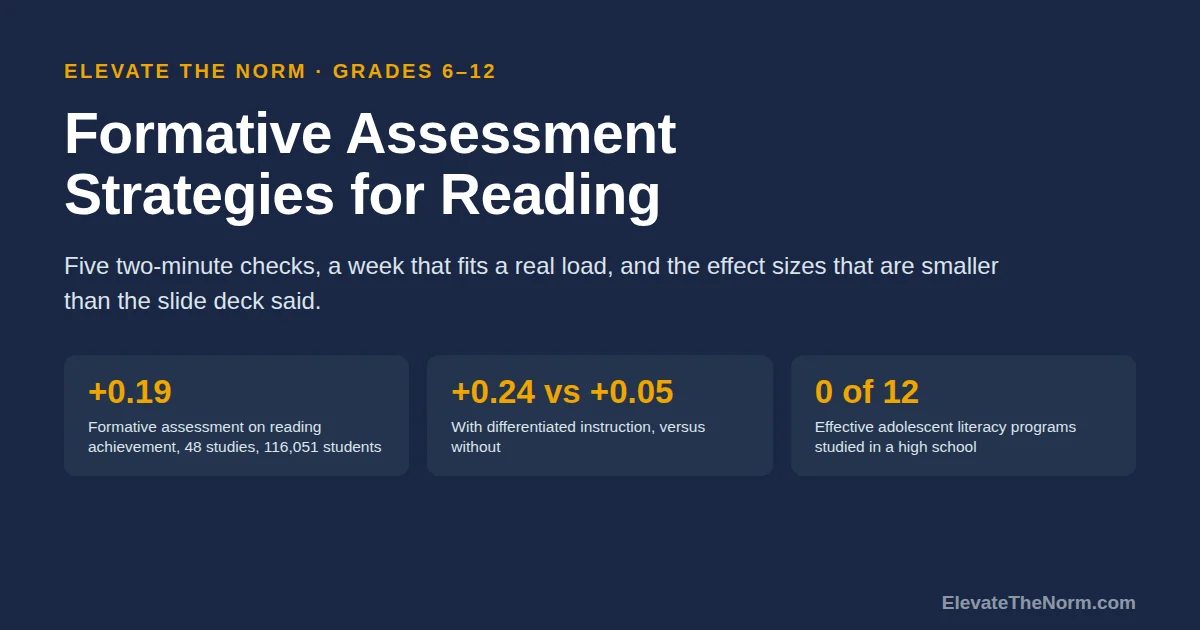
    • The high school evidence gap is real. An IES review found twelve adolescent literacy programs with positive effects and not one of them studied in a high school.

    Free Download · PDF

    Formative Assessment Quick-Use Pack

    A strategy decision matrix, an evidence tracker, four exit-ticket formats, and a next-day response planner — four pages built around changing the next instructional move.

    Download the free PDF

    Free. No email address required. Designed for grades 6–12. Browse every printable in Your Free Library.
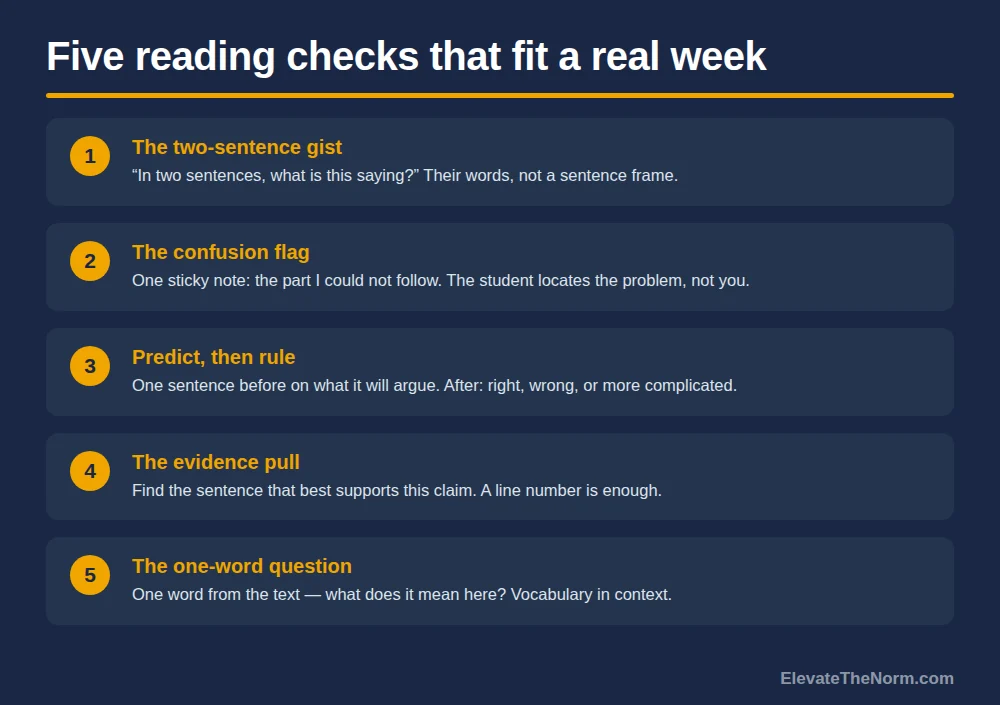
    Numbered list of five formative reading checks: the two-sentence gist, the confusion flag, predict then rule, the evidence pull, and the one-word question, each with a one-line description
    Five checks. None takes more than three minutes and none requires reading aloud.

    What Counts as a Formative Assessment Strategy for Reading?

    Any short check that tells you what a student took from a text in time for you to act on it. The format is negotiable. The timing is not.

    That definition rules more out than it rules in. A comprehension worksheet collected at the bell and returned Thursday is not formative — not because worksheets are bad, but because the information arrived after the decision it was supposed to inform. A five-question quiz you grade and record is summative wearing different clothes. The line is whether the answer reaches you while you can still change the next ten minutes.

    It also rules out the thing most reading checks actually measure, which is whether a student did the reading. That is a useful fact and it is not comprehension. “Did you read it” and “what did you understand” require different questions, and a margin that demands a restatement is one of the cheaper ways to make the second one visible, and conflating them is how a teacher ends up with a stack of evidence that everyone read a chapter nobody understood. The broader version of this distinction is covered in the cross-subject guide to choosing a check and acting on it; this page is the reading-specific case.

    What Does the Research Actually Show?

    A modest, consistent benefit — smaller than the number most professional development quotes.

    The most direct evidence is a 2022 meta-analysis by Xuan, Cheung and Sun covering 48 qualifying studies and 116,051 K–12 students. The pooled effect of formative assessment on reading achievement was +0.19 (95% CI 0.15–0.23). By grade band: kindergarten +0.28, elementary +0.16, and middle and high school +0.27 — though the meta-regression found grade-level differences were not significant once other variables were controlled. Secondary students are not the weak case here.

    The older and more quoted number is worse than people think. Kingston and Nash reviewed more than 300 studies, found only 13 with enough data to analyze, and reported a weighted mean effect of 0.20. Their conclusion is unusually blunt for a meta-analysis: the 0.40 to 0.70 figure “often claimed for the efficacy of formative assessment… is not supported by the existing research base.” The one genuinely encouraging row for a reading teacher is the subject breakdown — English language arts came in at 0.32, against 0.17 for mathematics and 0.09 for science.

    So: real, replicated, worth two minutes a day. Not transformational, and anyone selling it as transformational is selling something.
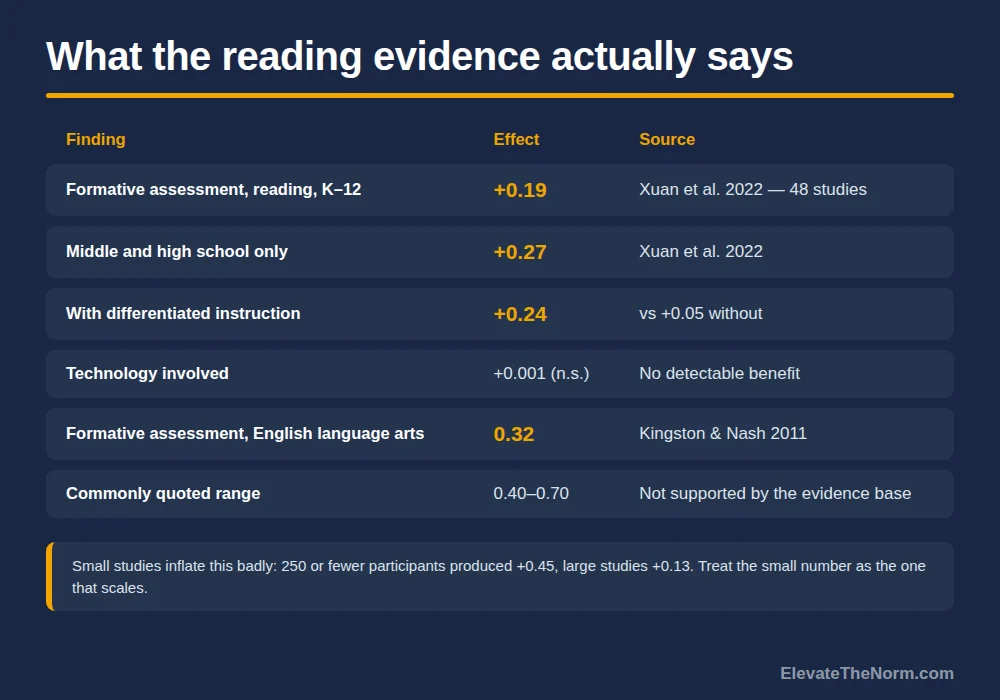
    Table of effect sizes for formative assessment on reading: plus 0.19 across K-12, plus 0.27 for middle and high school, plus 0.24 with differentiated instruction versus plus 0.05 without, plus 0.001 for technology involvement, and 0.32 for English language arts
    The numbers, including the one that contradicts the slide deck.

    What Makes the Difference Between a Check That Works and One That Does Not?

    Two moderators did most of the work, and neither is the check itself.

    First, who uses the information. In the Xuan meta-analysis, teacher-directed approaches alone produced significantly smaller effects than approaches that integrated teacher and student use of the results (coefficient −0.12, p < 0.001). Purely student-directed assessment showed no significant advantage either. The winning configuration is both: you see the pattern, and the student sees their own answer against what the text actually said.

    Second, whether anything got differentiated. Studies in which the information fed differentiated instruction showed an effect of +0.24. Studies where it did not: +0.05. That is close to the whole finding. A reading check that produces a number you record and nothing you change is worth almost nothing, and the meta-analysis says so with a p-value. If the next question is what the changing actually looks like on a Tuesday, we walk through five ways to teach a mixed-readiness room without writing five lesson plans.

    And one thing that made no difference at all: technology. The moderator coefficient for technology involvement was +0.001 (p = 0.978). A Google Form and a sticky note perform identically. Pick the one your students will finish in ninety seconds.

    Which Five Reading Checks Fit a Real Secondary Schedule?

    These five take two to three minutes, need no materials beyond paper, and none requires a student to read aloud in front of peers.

    • The two-sentence gist. After a passage: “In two sentences, what is this saying?” Not a summary, not a main idea in a sentence frame. Two sentences in their own words. The students who can’t do it in their own words are the ones you need to find.
    • The confusion flag. One sticky note, one sentence: the part of this text I could not follow. Nothing else on it. Collected at the door. This is the highest-yield check on the list because it is the only one where the student, not you, locates the problem.
    • Pre-reading prediction, post-reading verdict. Before: one sentence on what you expect this will argue. After: right, wrong, or more complicated, and why. The post-reading half is the assessment; the pre-reading half is what makes them read looking for something.
    • The evidence pull. “Find the sentence in the text that best supports this claim.” Line number is enough. It is fast to scan and it catches the student who agrees with an argument without being able to find it on the page.
    • The one-word question. Give a single word from the text and ask what it means here. Vocabulary in context is the check with the strongest evidence behind it — explicit vocabulary instruction is one of the two practices the What Works Clearinghouse panel rates strong for adolescent literacy. What that rating covers is worth being precise about: the measured effect is far larger on the taught text than on a standardized reading score.

    The WWC practice guide is worth reading alongside these. Its five recommendations carry explicit evidence ratings: explicit vocabulary instruction (strong), direct and explicit comprehension strategy instruction (strong, based on five randomized experiments), extended discussion of text meaning (moderate), increasing motivation and engagement (moderate), and intensive individualized intervention for struggling readers (strong). The panel is honest about its own limits: most of the discussion studies used narrative texts, which is a meaningful caveat if you teach history or science. When I need a quick way to analyze a source with students, I use my Current Events and Media Literacy Bundle on TPT.

    How Do You Run This Without Reading 120 Responses?

    You sort them. You do not mark them.

    This is the single practical thing that decides whether a teacher is still doing reading checks in November. Twenty-eight two-sentence gist statements is not a marking job. It is a five-minute sort into three piles — got it, partial, missed the point — and the only thing you write down is how many are in each pile. Three numbers. That is your instructional decision. If you would rather not design the recording sheet yourself, the free quick-use pack includes a class evidence tracker built for exactly that three-pile sort.

    Here is a week that fits a normal load:

    • Monday. Confusion flags on the week’s first text. Sort into piles. Whatever the biggest pile names becomes Tuesday’s opening five minutes.
    • Tuesday. Nothing collected. Teach into Monday’s biggest pile. This is the differentiation the research is actually measuring.
    • Wednesday. Two-sentence gist. Sort. Read four aloud — anonymized, and only with the writer’s permission, because every student recognizes their own sentences.
    • Thursday. Evidence pull on the same text. Ninety seconds. Scan for line numbers that are obviously wrong.
    • Friday. Nothing collected. Whatever Thursday showed, fix it in the room.

    Two collection days, two teaching-into days, one flexible. That is the whole system, and it is deliberately smaller than what a district rollout would design, because a smaller system that runs every week beats a comprehensive one that runs until October.
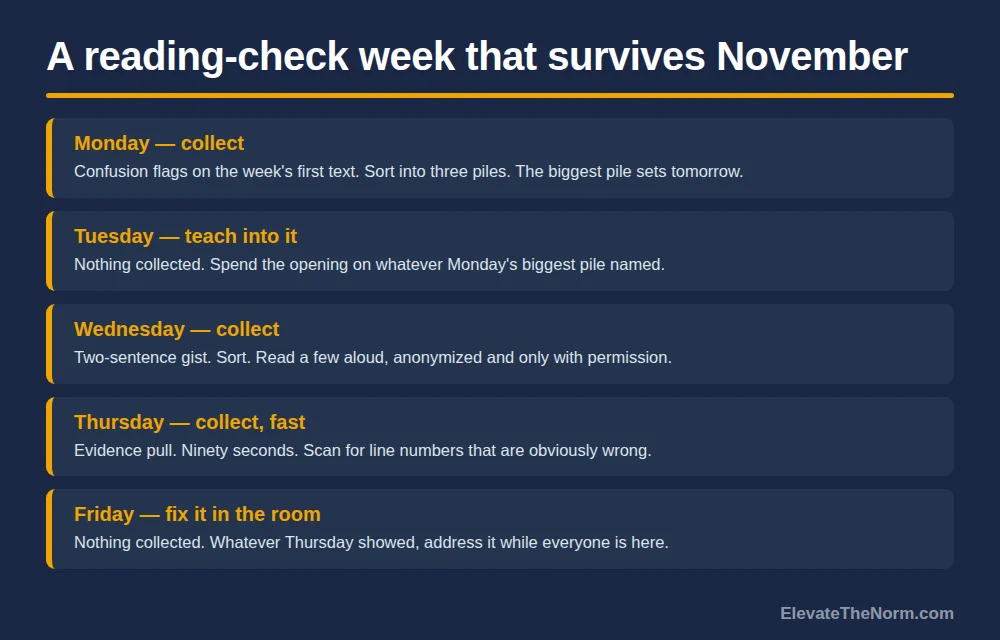
    Five-day routine showing Monday collect confusion flags, Tuesday teach into the biggest pile, Wednesday collect two-sentence gists, Thursday collect a fast evidence pull, and Friday fix what Thursday showed
    Two collection days. Two days spent on what they showed. That is the ratio that matters.

    What Does This Look Like in a Room?

    My room runs as a workshop, and the piece of furniture that does the most work is a whiteboard table I built, set in a corner under a lower lamp, with a rug and better chairs than the rest of the room has. Students ask to go there. That matters more than it sounds like it should.

    When a confusion flag says something I cannot fix from the front of the room, that table is where the conversation happens — not as a remediation station, because it is the seat everyone wants. A student reading a paragraph out loud at that table, with one other person, is doing the same thing that would humiliate them standing at their desk. The check tells you who needs the conversation. The room decides whether the conversation costs them anything.

    That is the part no meta-analysis measures and the part a teacher controls completely.

    Two ready-to-run versions of that table, one for grades 6–8 and one for grades 9–12, are laid out in the site’s guide to small group instruction in middle and high school.

    Where Does the Evidence Run Out?

    At high school, more precisely than most people admit.

    An IES review summarizing twenty years of adolescent literacy research screened 111 studies, found 33 meeting What Works Clearinghouse evidence standards, and identified 12 programs and practices with positive or potentially positive effects on reading comprehension, vocabulary or general literacy across grades 6–12. And then the line that belongs in every conversation about this: none of the 12 was conducted in a high school setting. The evidence base for adolescent literacy is, in practice, a middle school evidence base.

    Three more honest limits from the meta-analytic work. Small studies inflate the result badly — studies with 250 or fewer participants produced an effect of +0.45 against +0.13 for large ones, which is the usual sign that tightly-supervised implementations outperform real ones. The Xuan authors found no significant difference between published and unpublished studies, so publication bias is not the explanation, but the sample-size gap is a warning about what happens when a practice scales. And only 8 of the 48 studies came from Confucian-heritage contexts against 40 Anglophone, so the authors caution against moving interventions across cultures unadapted.

    None of that is a reason not to run a two-minute gist check. It is a reason not to build a district initiative on a number somebody rounded up.

    What Should You Do Next?

    Pick one check — the confusion flag if you want the highest yield for the least work — and run it twice a week for three weeks on a text you were teaching anyway. Sort, do not mark. Spend one whole class period in those three weeks teaching into whatever the biggest pile said, and notice whether the next set of flags moves.

    If it does, add a second check. If it does not, the problem is probably that the flags are not changing your lesson yet, which is the failure mode the research is loudest about. Two related pages are worth having open: the site’s guide to what counts as evidence that a class understood something for the general-purpose version of these moves, and the version that runs while a draft is still being written for the same problem on the production side. Listening is that problem again with nothing on the page to re-read — seven checks for what students heard covers it, standards and honest effect sizes included. If your reading happens on screens, the medium changes some of this — digital reading has its own comprehension research and its own accessibility upside. And if you want students doing more of the judging themselves, which is what the strongest moderator in the meta-analysis points at, start with student self-assessment.

    Before you go: grab the free Formative Assessment Quick-Use Pack (PDF) — ElevateTheNorm.com branded, printable, no email required.

    Same idea, different subject: see how these checks work in a science classroom, where the goal is catching a misconception while there is still time to teach into it. For the category question underneath all of these — planned written check or live questioning — see formal vs informal formative assessment.

    Frequently Asked Questions

    What is a formative assessment strategy for reading, exactly?

    It is any short, ungraded check that shows you what a student understood from a text while you can still do something about it. A two-sentence gist statement, a confusion flag, a one-question prediction, a retell in the student’s own words. The test is not the format. The test is whether the information changes what you do in the next ten minutes. If you collect it and file it, you ran a quiz.

    Should reading checks be graded?

    No, and the reason is practical rather than philosophical. The moment a gist statement counts for points, students write what they think you want instead of what they actually understood, and the check stops telling you anything. Keep them in a separate column or in no column at all. If your school requires a reading grade, take it from something summative and say out loud that the daily checks do not feed it.

    How do I do this without reading 120 responses every night?

    Sort, do not mark. A stack of 28 two-sentence gist statements is a five-minute sort into three piles — got it, partial, missed the point — and the only thing you write is the number in each pile. That number is the instructional decision. Reading every response carefully is what makes teachers abandon this in week three, and it is not what produces the benefit.

    Does the research actually support this for high school students?

    Partly, and the gap is worth knowing before anyone quotes a number at you. The meta-analysis evidence for formative assessment and reading achievement includes middle and high school studies and finds them performing at least as well as elementary. But an IES review of twenty years of adolescent literacy research found that of twelve programs with positive or potentially positive effects on reading outcomes, none was conducted in a high school setting. The practices are defensible. The claim that they are proven in a high school is not.

    Is the effect size big enough to be worth the class time?

    It is modest and it is real. The most recent meta-analysis puts formative assessment’s effect on reading achievement at +0.19 across 48 studies and 116,051 students. An earlier meta-analysis found a weighted mean of 0.20 overall and 0.32 for English language arts specifically — and explicitly rejected the 0.40 to 0.70 range that gets quoted in professional development. Two or three minutes a day for a modest, reliable gain is a good trade. A forty-minute assessment system for the same gain is not.

    What about the student who cannot read the text at all?

    A comprehension check tells you that, which is most of its value. What it must not do is tell the whole room. None of the checks here require reading aloud in front of peers, and that is deliberate. A written gist, a confusion flag on a sticky note, or a quiet conversation at a side table all give you the same information without making a struggling reader perform. The WWC panel rates intensive individualized support for struggling adolescent readers as a strong recommendation, and a daily check is how you find out who needs it — not a substitute for it.

    Does technology make these checks better?

    The evidence says not much. The same meta-analysis that found a +0.19 effect for formative assessment in reading tested whether technology involvement moderated it and found essentially nothing — a coefficient of +0.001. A form on a laptop and a sticky note produce the same result. Use whichever one your students will actually complete in ninety seconds.

    What actually predicted bigger effects, if not technology?

    Two things, and both are about what happens after the check. Approaches that integrated teacher and student use of the information beat teacher-directed approaches alone by a significant margin. And studies where the information fed differentiated instruction showed an effect of +0.24 against +0.05 for those where it did not. Collecting the data is not the intervention. Changing the next lesson is.

    Sources

    1. Xuan, Qingzhi, Alan C. K. Cheung, and Danping Sun. “The Effectiveness of Formative Assessment for Enhancing Reading Achievement in K-12 Classrooms: A Meta-Analysis.” Frontiers in Psychology, vol. 13, 2022. 48 studies, 116,051 students; pooled ES +0.19; middle/high school +0.27; differentiated instruction +0.24 vs +0.05; technology coefficient +0.001 (n.s.); small-sample studies +0.45 vs +0.13 for large. https://www.frontiersin.org/journals/psychology/articles/10.3389/fpsyg.2022.990196/full
    2. Kingston, Neal, and Brooke Nash. “Formative Assessment: A Meta-Analysis and a Call for Research.” Educational Measurement: Issues and Practice, vol. 30, no. 4, 2011, pp. 28–37. 13 studies, 42 effect sizes; weighted mean 0.20, median 0.25; English language arts 0.32, mathematics 0.17, science 0.09. https://eric.ed.gov/?id=EJ951173
    3. Kamil, Michael L., et al. Improving Adolescent Literacy: Effective Classroom and Intervention Practices. IES Practice Guide, NCEE 2008-4027, What Works Clearinghouse, 2008. Five recommendations with evidence levels; explicit vocabulary instruction and explicit comprehension strategy instruction both rated strong. https://ies.ed.gov/ncee/wwc/docs/practiceguide/adlit_pg_082608.pdf
    4. Institute of Education Sciences, Regional Educational Laboratory Southeast. Summary of 20 Years of Research on the Effectiveness of Adolescent Literacy Programs and Practices. 111 studies screened, 33 met WWC evidence standards, 12 programs with positive or potentially positive effects — none conducted in a high school setting. https://ies.ed.gov/use-work/resource-library/report/systematic-literature-review/summary-20-years-research-effectiveness-adolescent-literacy-programs-and-practices
    5. Agarwal, Pooja K., Ludmila D. Nunes, and Janell R. Blunt. “Retrieval Practice Consistently Benefits Student Learning: A Systematic Review of Applied Research in Schools and Classrooms.” Educational Psychology Review, vol. 33, no. 4, 2021, pp. 1409–1453. 50 experiments, 5,374 participants; 57% of effect sizes medium or large. https://link.springer.com/article/10.1007/s10648-021-09595-9
    About Clay Shumate

    Clay Shumate is a certified secondary Social Studies teacher in the public schools of West Alabama, with seven years of classroom experience, a B.A. in History, and an M.Ed. in Secondary Education. He writes about project-based learning, student responsibility, respect, and practical ways to hold young people to a higher standard while giving them room to learn from mistakes. He is a member of the Society of Professional Journalists and writes to its Code of Ethics; this site’s editorial standards and corrections policy are published in full. More about Clay.

  • Formative Assessment Strategies for Writing: Checks That Fit a Real Week

    Formative Assessment Strategies for Writing: Checks That Fit a Real Week

    By Clay Shumate

    Formative assessment strategies for writing are the checks a teacher runs while a piece is still being written, so the information can still change the draft. Exit tickets and comprehension checks do not transfer here. Writing has its own set, because the thing being assessed takes days, gets revised, and is too long to read thirty times a week. The equivalents for reading work on a different clock and are collected separately.

    That last constraint is the real problem. Almost every writing-feedback system that gets abandoned was abandoned because it required reading every draft. What follows is what the research supports, the number that should worry you, and a set of checks that fit an ordinary secondary schedule.

    Key Takeaways

    • Feedback works, and the size depends on who gives it. A meta-analysis found adult feedback at an effect size of 0.87, self-evaluation at 0.62 and peer feedback at 0.58 — but that study covered grades 1–8.
    • Two popular practices showed no meaningful effect in the same analysis. Teacher progress monitoring and the 6+1 Trait Writing model did not improve writing quality.
    • The federal practice guide rates the assessment recommendation as its weakest. Of three recommendations for teaching secondary writing, “use assessments to inform instruction and feedback” carries minimal evidence. That is worth knowing before anyone sells you a system.
    • Assess one thing at a time. A draft marked for everything gets revised for nothing. Pick the criterion the lesson taught and check only that.
    • Never put a grade on a draft you want revised. Self-assessment that counts toward a mark stops being honest, and the same logic applies to a draft.

    Free Download · PDF

    Formative Assessment Quick-Use Pack

    A strategy decision matrix, an evidence tracker, four exit-ticket formats, and a next-day response planner — four pages built around changing the next instructional move.

    Download the free PDF

    Free. No email address required. Designed for grades 6–12. Browse every printable in Your Free Library.

    What Makes a Writing Check Formative?

    Timing and use. A check is formative if it happens while the piece can still change and if somebody acts on it. Both conditions. A rubric applied to a final draft, however detailed, is a grade with extra steps.

    That rules out more of the standard toolkit than teachers expect. Marking a finished essay is summative no matter how much you write in the margin. A reading quiz is not a writing check. A participation grade for peer editing measures compliance with a procedure, not the quality of anything. The general versions of these checks are covered in the general version, twenty techniques sorted by lesson phase; this page is about the ones built for a text that takes a week.

    What is distinctive about writing is that the product has stages. A thesis exists before the paragraph does, an outline before the draft, a draft before the revision. Each stage is a place to check something cheaply, while it is still cheap to fix. The whole art is checking the earliest stage at which the problem is visible — because a thesis fixed on Monday saves five paragraphs that never had to be written.

    What Does the Research Actually Show?

    That feedback on writing works, that two popular practices do not, and that the evidence for the whole assessment-driven approach is weaker than its popularity suggests. All three are worth having straight.

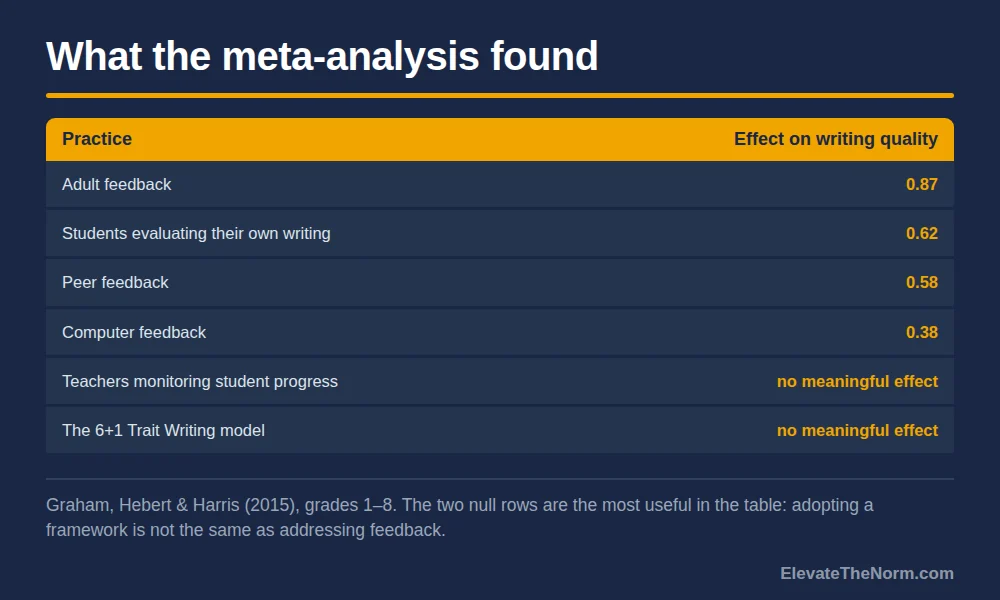
    The central study is Graham, Hebert and Harris’s 2015 meta-analysis in the Elementary School Journal, which pooled experimental studies of formative writing assessment and reported effect sizes by who does the assessing:

    PracticeEffect on writing quality
    Adult feedback0.87
    Students evaluating their own writing0.62
    Peer feedback0.58
    Computer feedback0.38
    Teachers monitoring student progressno meaningful improvement
    The 6+1 Trait Writing modelno meaningful improvement

    Three things to notice. First, the grade band is 1 through 8. Only the top three grades of that range are secondary, and none of it is high school. The practices are reasonable to carry upward; the numbers do not travel with them.

    Second, the two null results are the most useful rows in the table. Progress monitoring — tracking writing scores over time to inform instruction — showed no meaningful improvement, and neither did 6+1 Trait, which is a widely adopted framework. That does not make either worthless, but it does mean a department should not treat adopting them as having addressed writing feedback.

    Third, student self-evaluation at 0.62 nearly matched adult feedback and beat peer feedback. For a teacher with 120 students, that is the most consequential number in the table, because it is the only one that does not scale with your reading time.

    Now the part most articles omit. The What Works Clearinghouse practice guide on teaching secondary students to write effectively, written by a panel including Steve Graham, Jill Fitzgerald, Linda Friedrich, Katie Greene, James Kim and Carol Booth Olson, makes three recommendations and rates the evidence behind each. Explicitly teaching writing strategies through a model–practice–reflect cycle is rated strong. Integrating writing and reading using exemplar texts is rated moderate. Using assessments to inform instruction and feedback is rated minimal.

    Minimal is the lowest rating in that system, and it is attached to the recommendation this article is about. Read it as a statement about proportion rather than a reason to stop. If you have a fixed amount of energy for improving writing in your classroom, the guide says to spend it first on explicitly teaching strategies and modeling them — and the assessment practices below are what you run inside that, not instead of it.

    Table of effect sizes on writing quality from a formative assessment meta-analysis: adult feedback 0.87, student self-evaluation 0.62, peer feedback 0.58, computer feedback 0.38, and no meaningful effect for teacher progress monitoring or the 6+1 Trait Writing model
    Graham, Hebert and Harris (2015), grades 1-8. The two null rows are the most useful in the table.

    Which Checks Fit a Secondary Schedule?

    The ones that read a sentence rather than a draft. Every strategy below is designed around the fact that you cannot read 120 full drafts and still have a weekend.

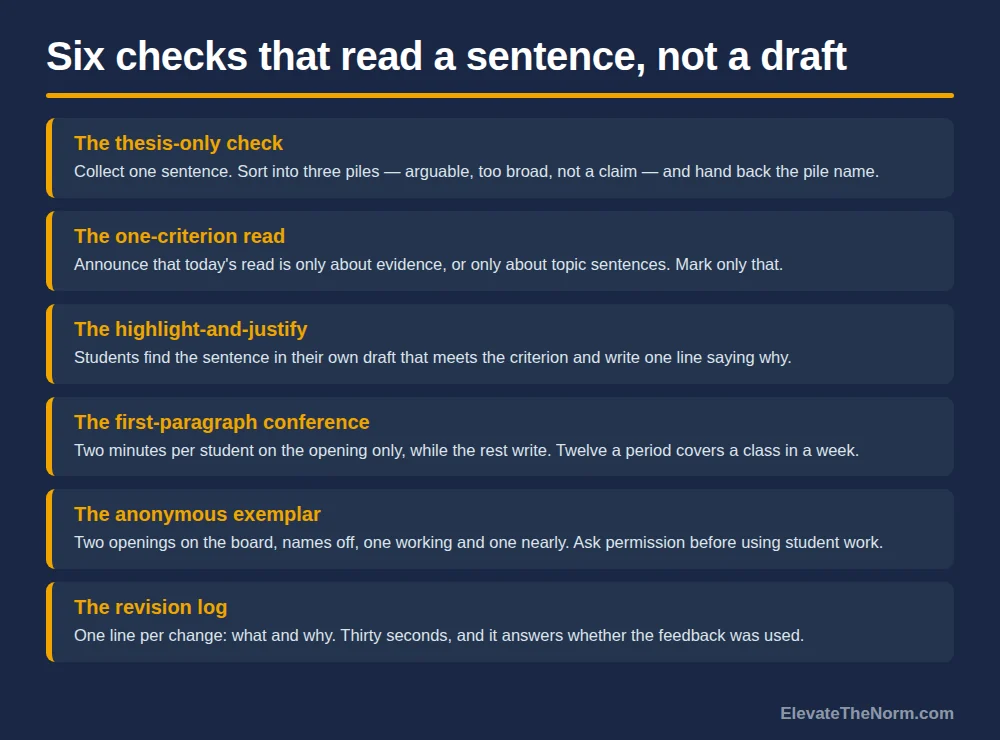
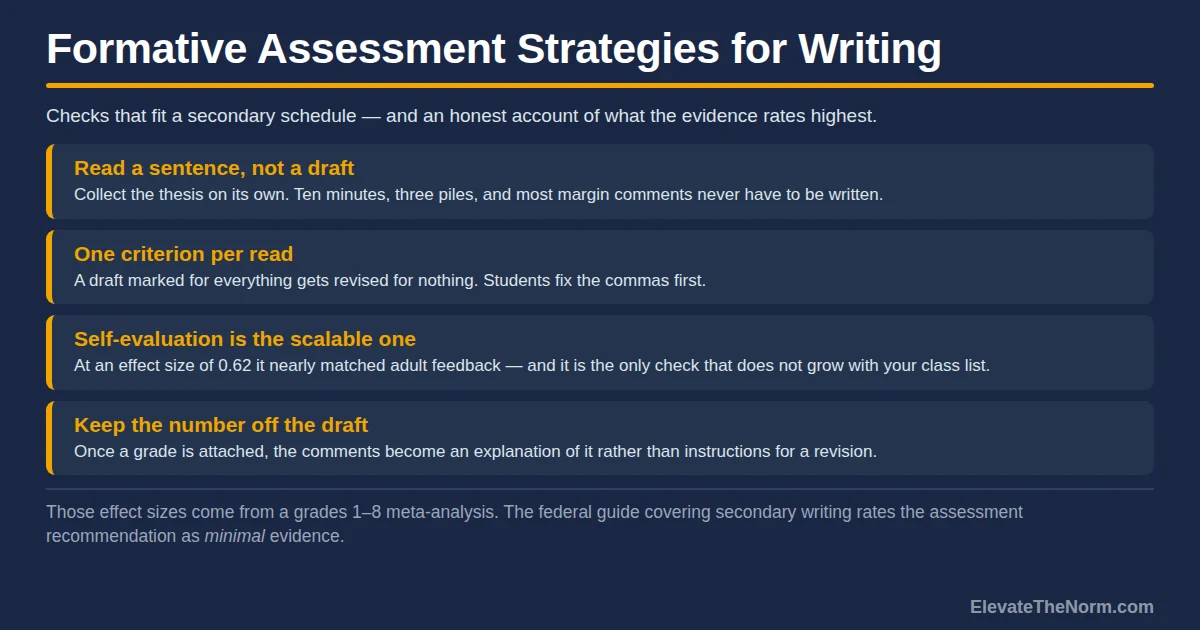
    • The thesis-only check. Collect one sentence. Read all of them in ten minutes, sort into three piles — arguable, too broad, not a claim — and hand them back with the pile name. Fixing this on day one prevents most of what you would otherwise write in margins on day six.
    • The one-criterion read. Announce that today’s read is only about evidence, or only about topic sentences. Mark only that. A draft marked for everything gets revised for nothing, because a student facing thirty marks does not know where to start and usually starts with the commas.
    • The highlight-and-justify. Students highlight the sentence in their own draft that meets a specific criterion, and write one line explaining why. If they cannot find it, that is the check — and they have found it themselves, which is the part that matters.
    • The first-paragraph conference. Two minutes per student, on the opening paragraph only, while the rest write. Twelve students a period, everybody covered across a week.
    • The anonymous exemplar. Put two short pieces of writing on the board with names removed — one that does the thing, one that nearly does it — and have the class say which and why. This is the model–practice–reflect cycle the WWC rates as strong evidence, run as a five-minute check. Ask before you use a student’s work, even anonymized, because the writer always recognizes their own sentences and so do the people sitting next to them. Asking takes ten seconds, almost nobody says no, and the ones who do have a reason. Writing your own two versions, or using last year’s with permission, works just as well.
    • The revision log. One line per revision: what changed, and why. It takes a student thirty seconds and tells you whether feedback was used, which is the only question a progress tracker was ever trying to answer.

    Notice what is missing: reading every draft, writing extended comments, and any system requiring a spreadsheet. Those are the things that get abandoned in October, and abandonment is the real failure mode — not choosing the second-best check. If you would rather start from something printed, the free formative assessment quick-use pack has a general version to adapt.

    Graphic listing six formative writing checks: the thesis-only check, the one-criterion read, the highlight-and-justify, the first-paragraph conference, the anonymous exemplar, and the revision log
    Every one of these reads a sentence rather than a draft. That is what makes them survive past October.

    How Do You Make Self-Evaluation Work?

    Give the criteria first, keep it out of the gradebook, and ask for evidence rather than a rating. At 0.62 this is the best return per minute of teacher time in the whole table, and all three conditions matter.

    Heidi Andrade’s 2019 critical review in Frontiers in Education supplies the design rules. Criterion-referenced self-assessment showed main effects on every criterion assessed, and concrete task-specific criteria outperformed vague competence-based ones — a result she attributes to Fastré and colleagues. In writing terms, “every claim is followed by a quotation and an explanation of it” is checkable. “Uses evidence effectively” is not.

    The decisive rule is about grading. Andrade cites Tejeiro and colleagues, where self-assessment counted toward the final grade: overestimation rose dramatically and no correlation remained between the instructor’s assessment and the student’s. Run formatively, agreement improved substantially, and all twenty studies in her review that used self-assessment formatively showed a positive association with learning.

    Andrade makes one more point worth carrying. There is little evidence that inaccurate self-assessment produces worse learning, and students act on their predictions regardless of accuracy. You are not trying to make a student’s judgment match yours. You are trying to make them read their own draft as a reader. The broader version of the practice is in the student self assessment guide; writing only changes what sits in the criteria.

    Is Peer Feedback Worth the Class Time?

    Yes at 0.58, and only if you narrow what you ask for. Unstructured peer review produces “I liked it, maybe add more detail,” which is the outcome most teachers have seen and correctly concluded is a waste of twenty minutes.

    There is a useful finding from an adjacent literature. Falchikov and Goldfinch’s meta-analysis of 48 higher-education studies comparing peer marks with teacher marks found that agreement was closest when students made a global judgment against well-understood criteria, and worse when asked to break the judgment into many separate dimensions and score each. Those were undergraduates marking work, not teenagers giving revision advice, so treat it as a design hint rather than a transferred result — but the hint points somewhere useful: the twelve-box peer editing checklist is probably the worst available format.

    What works better is narrower and more concrete:

    • Ask for a location, not a judgment. “Underline the sentence where the argument actually starts.” A reader can do that honestly; “rate the organization” they cannot.
    • Ask what the reader could not follow. This is the one thing a peer knows that you do not, because they read it without already knowing what the writer meant.
    • Ask for one question, not one suggestion. Suggestions are advice from a novice. A genuine question — “is this the same person as in paragraph two?” — is information the writer can act on without deferring to anyone.

    Two cautions. Peer feedback has a social cost that teacher feedback does not. A fifteen-year-old asked to critique a classmate’s writing is managing a relationship as well as a text, and most will resolve that tension by being vague. Asking for locations and questions rather than evaluations removes the tension rather than asking students to override it. And decide who reads what before you start. Writing is personal in a way a math worksheet is not; a student writing about something that matters to them should know in advance whether a classmate will see it, and should have a way out.

    A One-Week Routine That Does Not Require Reading Every Draft

    Four checks across a week, none of which takes you more than fifteen minutes.

    1. Day one — collect the thesis only. One sentence per student. Sort into three piles, hand back with the pile name, and give the “not a claim” pile five minutes to try again.
    2. Day two — the anonymous exemplar. Two openings on the board, names off, one working and one nearly working. The class names the difference. This is the modeling step, and it is the one with the strongest evidence behind it.
    3. Day three — highlight and justify. Students find the sentence in their own draft that meets today’s single criterion and write one line saying why. Walk the room and read over shoulders; collect nothing.
    4. Day four — peer question round. Swap drafts. Each reader underlines where the argument starts and writes one genuine question. Ten minutes, no checklist.

    Then the revision log on day five: one line per change, what and why. That log is the whole assessment record, and unlike a score tracker it answers the question that actually matters, which is whether any of this changed the draft.

    Two adjustments. First, differentiate the container rather than the criterion — a student who cannot produce the written justification quickly can say it to you in the last minute of class, and a student working in a second language can highlight and point. The judgment against criteria is what has to survive. Second, if a student’s draft has a problem that is not today’s criterion, note it for yourself and leave it. You will get to organization on the week you are checking organization, and a student who receives one correctable thing at a time actually corrects it. For the general version of this discipline, see what actually counts as evidence that a class understood something.

    Four Ways Writing Feedback Fails

    All four are common, and all four are about the system rather than the student.

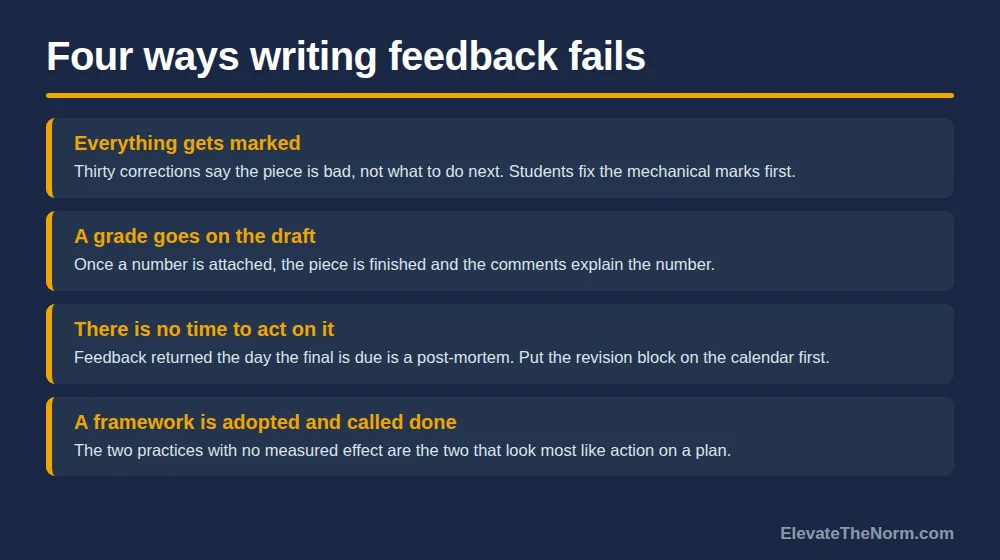
    Everything gets marked. A draft returned with thirty corrections communicates that the piece is bad, not what to do next. Students respond by fixing the easiest marks, which are almost always the mechanical ones. One criterion per read is not a compromise — it is what makes revision possible.

    A grade goes on the draft. Once a number is attached, the piece is finished in the student’s mind, and the comments underneath it become an explanation of the number rather than instructions for a revision. If you need the draft in the gradebook, grade completion rather than quality, and say which you are doing.

    The one-criterion rule is also the thing families most often ask about, usually in the form of why the teacher did not correct all the errors. It deserves a straight answer rather than a defensive one: every error was noticed, and marking all of them is what produces a draft a student fixes the commas in and hands back otherwise unchanged. The errors get their turn, one at a time, on the assignment where that is the thing being taught. Said in advance, in a sentence on the assignment sheet, that lands as a deliberate method. Said after a parent email, it sounds like an excuse.

    There is no time to act on it. Feedback returned the day the final is due is a post-mortem. If the schedule does not contain a revision block after the feedback, the feedback is decorative, and it is more honest to admit that than to keep writing comments into a void.

    Graphic listing four ways writing feedback fails: everything gets marked, a grade goes on the draft, there is no time to act on it, and a framework is adopted and called done
    All four are about the system rather than the student.

    The department adopts a framework and calls it done. This is where the two null results earn their keep. Adopting 6+1 Trait or installing a progress-monitoring spreadsheet is a visible action that showed no meaningful effect on writing quality in the meta-analysis. The things that did work — someone reads a piece of writing and responds to it, or a student reads their own against criteria — are less visible on a plan, and are the ones worth protecting time for.

    What to Try on the Next Assignment

    Take the next piece of writing you have already assigned. Collect the thesis on its own, before anything else exists, and sort the sentences into three piles. That single move costs you ten minutes and changes more drafts than any set of margin comments you will write later.

    Then pick one criterion for the whole assignment and check only that — in the exemplar, in the self-evaluation, in the peer round, in your own read. Put a revision block on the calendar before you give any feedback, and keep a number off the draft.

    None of this is a system, and that is deliberate. The evidence for assessment-driven writing instruction is rated minimal by the people best placed to judge it, while explicit strategy instruction and modeling are rated strong. The checks here are worth running because they are cheap and they surface problems early. They are not a substitute for teaching students how to write, and any resource presenting them as one has the proportions backwards.

    Before you go: grab the free Formative Assessment Quick-Use Pack (PDF) — ElevateTheNorm.com branded, printable, no email required.

    A writing check you run in one period and a writing measure you can plot across ten weeks are not the same instrument. State guidance for high-school monitoring suggests five-minute writing samples scored by correct minus incorrect word sequences, which is a deliberately narrow number that can sit next to twelve other numbers. How that kind of repeated measure works, and where it runs out at secondary level covers the frequency standards, the reliability problem with the measures that fit a full class, and why the graph tells you when to change something without telling you what.

    Frequently Asked Questions

    Do these effect sizes apply to high school students?

    Not directly, and it matters. The meta-analysis behind the headline numbers — adult feedback 0.87, self-evaluation 0.62, peer feedback 0.58 — covered grades 1 through 8, so only its top three grades are secondary at all and none is high school. The practices are reasonable to carry upward because the mechanisms are not age-specific, but the numbers should not be quoted as a high school result. The federal practice guide that does cover secondary writing rates the assessment recommendation as having minimal evidence.

    Should I put a grade on a draft?

    Not if you want it revised. Once a number is attached, most students treat the piece as finished and read the comments as justification for the mark rather than instructions for a revision. The self-assessment research points the same way: when self-evaluation counted toward a grade, overestimation rose sharply and agreement with the instructor disappeared. If a draft has to appear in the gradebook, grade completion rather than quality and tell students that is what you are doing.

    Is 6+1 Trait Writing a waste of time?

    That is stronger than the evidence supports. What the meta-analysis found is that 6+1 Trait showed no meaningful improvement in writing quality, and the same was true of teachers monitoring student progress over time. That is a real finding and a department should not treat adopting the framework as having addressed writing feedback. It is not a finding that a shared vocabulary for talking about writing is harmful — it is a finding that the vocabulary alone does not move the writing.

    How do I give feedback to 120 students without losing every weekend?

    Stop reading whole drafts. Collect one sentence rather than one essay; mark one criterion rather than everything; run two-minute conferences on opening paragraphs while the rest write; and lean on self-evaluation, which came in at 0.62 and is the only practice in the table that does not scale with your reading time. A teacher who reads every draft thoroughly in September and nothing at all by November has given less useful feedback than one who reads one paragraph from everybody every week.

    Does peer feedback actually help, or is it busywork?

    It helped at an effect size of 0.58, which is real — but what most classrooms run is not what was studied. Unstructured peer review produces “I liked it, add more detail.” Narrow the ask instead: have readers underline where the argument starts, say what they could not follow, and write one genuine question rather than one suggestion. Those ask for information a peer actually has. Also settle who reads what before you begin, because writing is more personal than a worksheet and a student should know in advance.

    What if a student’s draft has problems that are not this week’s criterion?

    Note them for yourself and leave them alone. A student who receives one correctable thing at a time usually corrects it; a student who receives thirty fixes the commas. Keep your own running list and let it decide what the criterion is for the next assignment — that list is more useful as a planning document than as margin notes, and it means the pattern across the class shapes what you teach next rather than disappearing into thirty separate drafts.

    How is this different from just marking essays carefully?

    Timing and use. Marking a finished essay is summative however detailed it is, because nothing about that piece can change afterwards. A formative check happens while the writing is still in progress and is followed by time to act on it. The practical test is simple: if there is no revision block on the calendar after the feedback goes back, what you did was grading, and calling it formative assessment does not make it function like one.

    Where should I spend my energy if I can only change one thing?

    Not here, according to the people who reviewed the evidence. The What Works Clearinghouse panel rates explicitly teaching writing strategies through a model–practice–reflect cycle as strong evidence, integrating reading and writing with exemplar texts as moderate, and using assessments to inform instruction and feedback as minimal. If you have one change in you this year, make it the modeling. The checks on this page are cheap enough to run inside that work, and they are not a replacement for it.

    Sources

    1. Graham, Steve, Michael Hebert, and Karen R. Harris. “Formative Assessment and Writing: A Meta-Analysis.” Elementary School Journal, vol. 115, no. 4, 2015, pp. 523–547. https://eric.ed.gov/?id=EJ1068976
    2. Graham, Steve, Jill Fitzgerald, Linda D. Friedrich, Katie Greene, James S. Kim, and Carol Booth Olson. “Teaching Secondary Students to Write Effectively” (practice guide summary). What Works Clearinghouse, Institute of Education Sciences, U.S. Department of Education. https://ies.ed.gov/ncee/wwc/Docs/PracticeGuide/wwc_secwrit_summary_053117.pdf
    3. Andrade, Heidi L. “A Critical Review of Research on Student Self-Assessment.” Frontiers in Education, vol. 4, art. 87, 2019. https://www.frontiersin.org/journals/education/articles/10.3389/feduc.2019.00087/full (The Tejeiro et al. 2012 and Fastré et al. 2010 findings are reported in this review; the primary papers were not read directly.)
    4. Falchikov, Nancy, and Judy Goldfinch. “Student Peer Assessment in Higher Education: A Meta-Analysis Comparing Peer and Teacher Marks.” Review of Educational Research, vol. 70, no. 3, 2000, pp. 287–322. https://eric.ed.gov/?id=EJ630369

    About Clay Shumate

    Clay Shumate is a certified secondary Social Studies teacher in the public schools of West Alabama, with seven years of classroom experience, a B.A. in History, and an M.Ed. in Secondary Education. He writes about project-based learning, student responsibility, respect, and practical ways to hold young people to a higher standard while giving them room to learn from mistakes. He is a member of the Society of Professional Journalists and writes to its Code of Ethics; this site’s editorial standards and corrections policy are published in full. More about Clay.

  • Student Self Assessment for Group Work: What to Ask and What to Skip

    Student Self Assessment for Group Work: What to Ask and What to Skip

    By Clay Shumate

    Student self assessment in group work is a short structured rating in which each student judges their own contribution against criteria everyone saw before the project started. It is not a popularity form and it is not a way to catch a freeloader. Its job is to make individual effort visible inside a shared product, which is the one thing a group grade cannot do.

    That is a narrower purpose than most group-work reflection sheets claim, and the narrowness is what makes it work. What follows is what the research supports, the one design decision that determines whether the ratings mean anything, and a form that takes a student four minutes.

    Key Takeaways

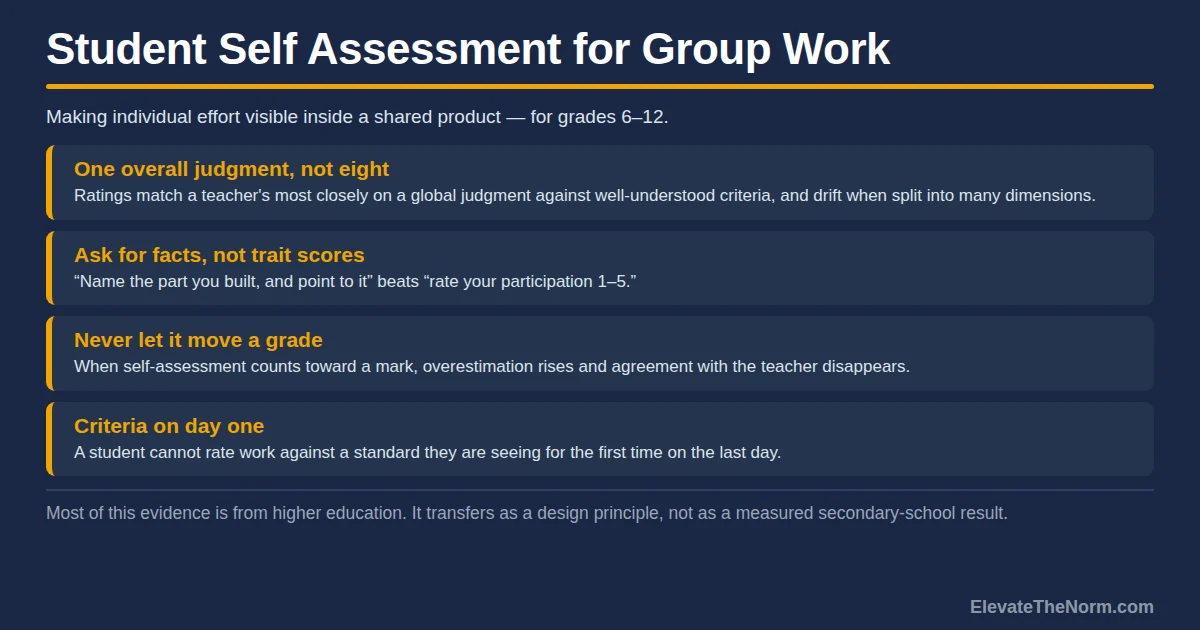
    • Ask for one overall judgment, not eight. The clearest finding in the peer-assessment literature is that ratings line up with a teacher’s when students make a global judgment against criteria they understand — and drift when they are asked to score many separate dimensions.
    • Self-assessment is the individual-accountability half of group work. Cooperative learning research names individual accountability as one of five elements that have to be present. A self-rating with evidence is the cheapest way to supply it.
    • Never let it change anybody’s grade. When self-assessment counts toward a mark, overestimation rises and agreement with the teacher disappears.
    • Criteria before the project, not after. A student cannot rate a contribution against a standard they are seeing for the first time on the last day.
    • Most of this evidence is from higher education. It transfers as a design principle. It is not a measured secondary-school result, and you should not be told otherwise.

    Free Download · PDF

    Student Self-Assessment Forms for Grades 6–12

    A general self-assessment form, a project reflection, a group-work accountability form, and a conference preparation sheet — reflection that asks for evidence instead of a confidence rating.

    Download the free PDF

    Free. No email address required. Designed for grades 6–12. Browse every printable in Your Free Library.

    What Is Student Self Assessment for Group Work?

    It is each student, separately and in writing, answering three questions about a shared project: what did I actually do, how well does it meet the criteria we agreed on, and what would I do differently next time. Three parts. Take away the criteria and it is a feelings check. Take away the evidence and it is a claim. The same evidence rule governs checking a draft while it is still a draft.

    It is worth distinguishing from the thing it gets confused with. Self-assessment is not peer assessment. Peer assessment asks students to rate each other, which raises questions about friendship, retaliation and social cost that a self-rating does not. The two can coexist, and plenty of published teamwork instruments combine them, but they are different instruments doing different jobs, and mixing them without saying so is how a reflection sheet turns into a blame form.

    The wider practice is covered in the guide to student self assessment. Group work only changes what sits in the criteria column — and it adds a problem that individual work does not have, which is that the product no longer tells you who did what.

    Why Bother, When the Project Already Has a Grade?

    Because a group grade is a measurement of the artifact, and you are also trying to teach something about contribution. One number on one poster cannot carry both jobs.

    Cooperative learning is one of the better-evidenced practices in education, and the research is specific about what has to be in place. Robyn Gillies’s 2016 review in the Australian Journal of Teacher Education names five elements: positive interdependence, promotive interaction, individual accountability, explicitly taught social skills, and group processing. The effect sizes she reports from Johnson and Johnson’s syntheses run in the 0.58 to 0.70 range across 117 studies, and the underlying work spans preschool to tertiary and most subject areas.

    The sentence in that review that matters most for a secondary teacher is the plainest one: simply placing students in groups does not guarantee cooperation. Gillies notes that discord shows up when students struggle with the task and with managing each other, and that without teacher mediation high-level talk appears with low frequency. Group work is not self-executing. Individual accountability and group processing are the two elements a self-assessment directly supplies, and they are the two most often left out.

    She also reports two structural findings worth acting on for free: optimal group size is three or four, and lower-attaining students benefit most from mixed-attainment grouping while middle-attaining students tend to do better in more homogeneous groups. Neither costs anything to apply.

    What Should Students Rate — and How Many Things?

    One overall judgment against two or three criteria they already know. Not a scorecard. This is the single most actionable finding in this whole literature and almost every classroom teamwork form gets it backwards.

    Falchikov and Goldfinch’s 2000 meta-analysis in the Review of Educational Research pooled 48 studies comparing peer marks with teacher marks. Their central result: agreement was closest when students made global judgments based on well-understood criteria, and worse when they were asked to break a judgment into many separate components and score each one.

    That is the opposite of how most group-work forms are built. The typical sheet asks a student to rate themselves on participation, preparation, communication, reliability, respect, leadership and time management, on a five-point scale, seven times. The literature predicts exactly what you see when you collect them: rows of fours, no discrimination between the dimensions, and no usable information.

    The honest caveat: those 48 studies were higher education, and they were peer marks rather than self-marks. The mechanism — that people judge a whole thing against a standard better than they decompose it — is a reasonable thing to carry into a secondary classroom. It is not a measured result about fifteen-year-olds, and nobody should sell it to you as one.

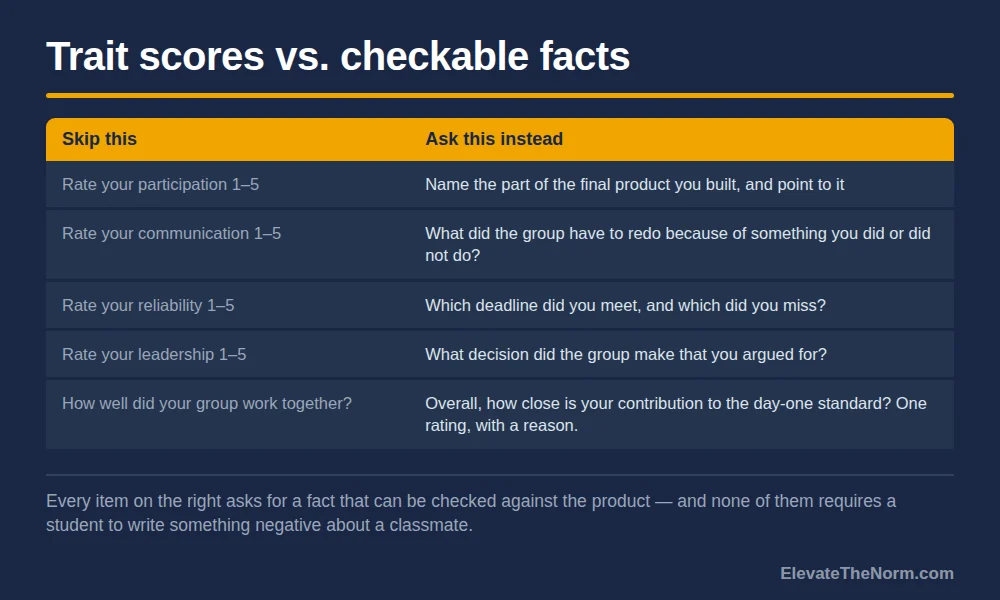
    Two-column table contrasting trait rating scales such as rate your participation one to five with fact-based questions such as name the part of the final product you built and which deadline did you miss
    Every item on the right asks for a fact that can be checked against the product.

    So what goes on the form:

    Skip thisAsk this instead
    Rate your participation 1–5Name the part of the final product you built, and point to it
    Rate your communication 1–5What did the group have to redo because of something you did or did not do?
    Rate your reliability 1–5Which deadline did you meet, and which did you miss?
    Rate your leadership 1–5What decision did the group make that you argued for?
    How well did your group work together?Overall, how close is your own contribution to the standard we set on day one? One rating, with a reason.

    Every item on the right asks for a fact rather than a number about a personality trait. Facts are checkable against the product, and a student who claims to have built the timeline can be asked to show it. That is also what makes the sheet safe: it never requires a teenager to say something negative about a classmate in writing.

    Does a Rubric Make the Self-Rating Better?

    For the work, clearly. For the teamwork part, less clearly, and the evidence is thinner than the enthusiasm.

    Heidi Andrade’s 2019 critical review in Frontiers in Education reports that criterion-referenced self-assessment — using a rubric or checklist — showed main effects on every criterion assessed, and that concrete, task-specific criteria outperform vague competence-based criteria. If the rubric says “the claim is supported by at least two sources,” a student can check. If it says “demonstrates strong collaboration,” they cannot.

    On the teamwork side specifically, one study is worth reporting honestly because it cuts both ways. Pang, Kootsookos, Fox and Pirogova compared two cohorts of 186 first-year engineering undergraduates on a team design project: one got a marking scheme, the next got a detailed rubric. The rubric cohort reported more helpful feedback, higher satisfaction and achieved higher grades, and 96 percent said the rubric helped them reach the learning goals. But only 52 percent found it useful for constructive feedback on teamwork specifically. The authors list the limits themselves: one course, one institution, one grading instructor.

    Read that as the useful signal it is. A rubric is very good at telling a student whether the work meets a standard. It is much weaker at telling them whether they were a good group member, because that is a harder thing to write criteria for. So write the rubric for the product, and handle contribution with the evidence questions above rather than by inventing a collaboration scale. The project rubric guide covers the product side.

    A Four-Minute Group Work Self-Assessment

    Five prompts, filled in individually, before anyone talks about it. Individually and before matters: a student who has already heard the group’s version writes the group’s version.

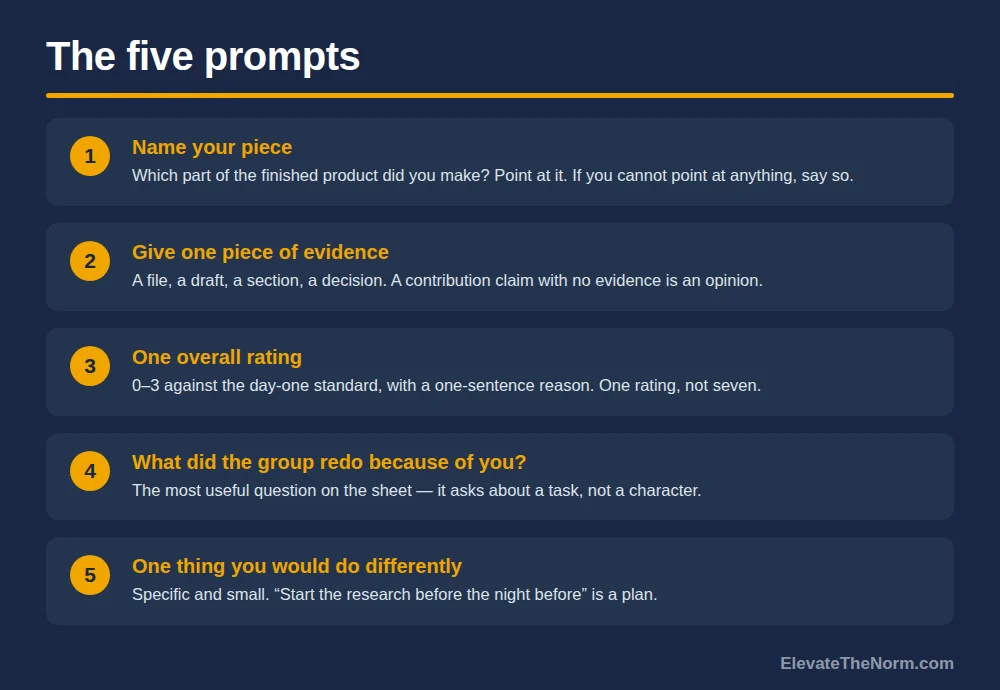
    1. Name your piece. Which part of the finished product did you make? Point at it. If you cannot point at anything, say that — it is real information and it is not a punishment.
    2. Give one piece of evidence. A file, a draft, a section, a specific decision. This is the step that does the work; a contribution claim with no evidence is an opinion.
    3. One overall rating against the day-one standard. 0–3, with the anchors written out, and a one-sentence reason. One rating, not seven.
    4. What did the group have to redo because of you? The most useful question on the sheet, and the one students answer more honestly than you expect, because it is about a task rather than a character.
    5. One thing you would do differently on the next project. Specific and small. “Start the research before the night before” is a plan.
    Numbered graphic of five group work self assessment prompts: name your piece, give one piece of evidence, give one overall rating, say what the group had to redo because of you, and name one thing you would do differently
    Filled in individually, before the group talks about it. Prompt four is the most useful one on the sheet.

    The first time you run it, teach it. Students have almost never been asked to describe their own contribution in specific terms, and left alone most will write “I helped with the slides.” Show a worked example on the board — a vague answer next to a specific one — and say plainly that naming a real limit is not going to be held against them. Ten minutes once. Every version of this that gets abandoned was abandoned because the first round produced nothing and the teacher concluded students could not do it.

    Then hold the group conversation. Gillies’s fifth element is group processing — students reflecting together on how the work went and what to do next. The sheet is the private half; five minutes of the group comparing what each person wrote is the public half, and the sequence only works in that order. If you want a ready-made form to adapt, the free self-assessment pack has one you can retype the criteria into. The same reflection can feed a student-led conference template at report time.

    Be realistic about what reading twenty-eight of these costs you. It is not a stack to mark. Read them once, fast, looking only for the two things that matter: who could not point at a piece of the product, and what any group says it had to redo. That is a scan, not a grading session, and it should take about fifteen minutes for a full class. If you find yourself writing responses on them, you have turned a diagnostic into an assignment and you will stop doing it by November.

    One accessibility note. The written form is one container, not the only one. A student who cannot produce five written answers quickly — a writing disability, a newcomer building English — can answer the same five prompts out loud in ninety seconds while you note it down. The judgment against criteria is the part that has to survive, not the paragraph.

    Should Any of This Touch the Grade?

    No. Not the student’s own, and not anybody else’s. This is the one place where the research gives a clean answer and the answer is unambiguous.

    Andrade’s review reports the Tejeiro finding directly: when self-assessment counted toward a final grade, student overestimation increased dramatically and no correlation emerged between the instructor’s assessment and the student’s. Run formatively, agreement with external evaluators improved substantially, and every study in the review that used self-assessment formatively showed a positive association with learning.

    There is a second reason specific to group work, and it is about fairness rather than accuracy. A self-rating that moves a grade creates an incentive to inflate, which rewards confidence rather than contribution — and confidence is not evenly distributed across a class. The students most likely to under-claim are often the ones who did the quiet, unglamorous work. Attaching marks to self-report turns that into a penalty. The grade itself has to carry the fairness instead, which is the argument for building an individual grade that survives a parent email.

    This is also the answer to the most common complaint families raise about group work, which is that a child did most of the work and shared the grade with people who did not. That complaint is often correct, and the fix families usually ask for — let my child report who slacked, and grade accordingly — is the one the evidence says not to build. The better answer, and the one worth putting in an email before the project starts rather than after it: the group grade covers the product, every student also produces something individual, the groups are small enough that contribution is visible, and the self-assessment exists so a student’s own account of their work is on the record. That is a real answer rather than a deflection, and it holds up at a conference.

    If you have a genuine contribution problem, solve it with the design instead. Assign distinct, visible roles so the product itself shows who did what. Keep the groups at three or four, where hiding is harder. Collect an individual artifact from every student alongside the group one. All three make effort visible without asking a sixteen-year-old to adjudicate it in writing.

    Four Ways This Goes Wrong

    All four are design errors, and all four are cheaper to prevent than to repair.

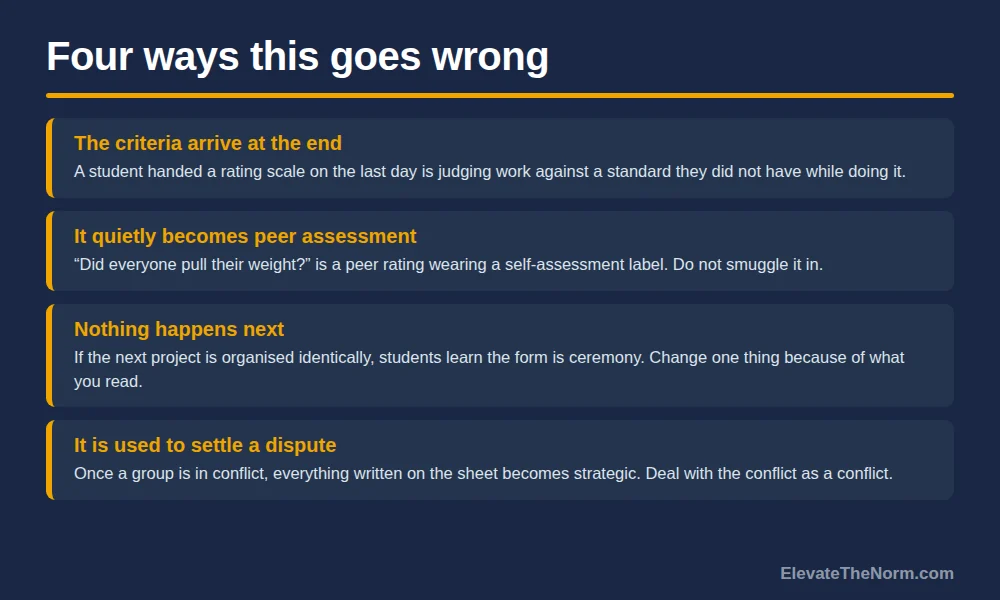
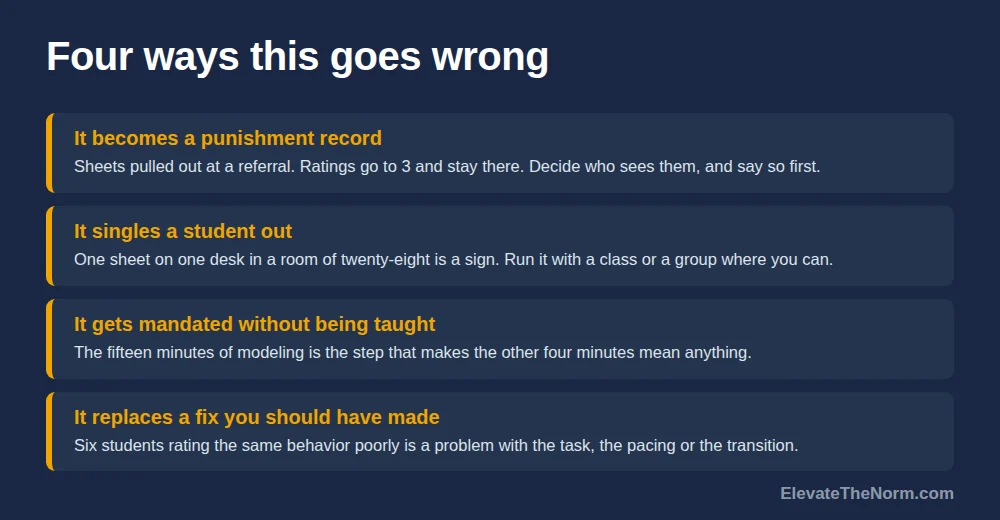
    The criteria arrive at the end. A student handed a rating scale on the last day is being asked to judge work against a standard they did not have while doing it. The criteria go up on day one, in the same words you will use on the form.

    Graphic listing four failure modes for group work self assessment: the criteria arrive at the end, it quietly becomes peer assessment, nothing happens next, and it is used to settle a dispute
    All four are design errors, and all four are cheaper to prevent than to repair.

    It quietly becomes peer assessment. A question like “did everyone pull their weight?” is a peer rating wearing a self-assessment label. If you want peer input, say so openly, design it properly, and be clear about who reads it. Do not smuggle it in.

    Nothing happens next. If the sheets go in a folder and the next project is organized the same way, students learn the form is ceremony. The minimum honest follow-through is one change to the next project that came from reading them — a different group size, a required interim deadline, distinct roles.

    It is used to settle a dispute. When a group is already in conflict, a self-assessment form becomes evidence in a case, and everything anyone writes becomes strategic. Deal with the conflict as a conflict. The sheet is a routine instrument for ordinary projects; it is not an investigation tool and it will not survive being used as one.

    Where to Start on the Next Project

    Pick the next group project you already have planned. On day one, put two criteria for the product on the board in the words you will use again at the end. Keep the groups at three or four. On the last day, before any group talks, give every student the five prompts and four minutes.

    Then read them for one thing only: which groups had someone who could not point at a piece of the product. That is the design question, not a discipline question, and the answer usually turns out to be that the task had fewer real jobs in it than it had people.

    Keep it out of the gradebook, keep it to one overall rating, and change one thing about the next project because of what you read. The point is not to catch anybody. It is that a student who has had to name their own contribution in writing, against a standard, has done something a group grade will never make them do — which is the same argument as handing a teenager the job of naming their own conduct against a standard they were taught rather than waiting to be told how they did.

    Before you go: grab the free Student Self-Assessment Forms for Grades 6–12 (PDF) — ElevateTheNorm.com branded, printable, no email required.

    Frequently Asked Questions

    Should a group work self-assessment ever change a student’s grade?

    No. Andrade’s review reports that when self-assessment counted toward a final grade, overestimation rose sharply and the correlation with the instructor’s own assessment disappeared; run formatively, agreement improved substantially. There is a fairness reason on top of the accuracy one: attaching marks to self-report rewards confidence rather than contribution, and the students most likely to under-claim are often the ones who did the quiet work. If you have a contribution problem, fix it with distinct roles, smaller groups and an individual artifact — not with a self-rating that moves numbers.

    How do I stop one student doing all the work without making others rate each other?

    Change the task before you change the paperwork. Three or four to a group rather than five or six, so there is less room to disappear. Distinct visible roles, so the product itself shows who did what. An individual artifact from every student alongside the group one. Those three do more about free-riding than any rating form, and none of them asks a teenager to write something negative about a classmate.

    Why one overall rating instead of scoring several categories?

    Because the evidence points that way. Falchikov and Goldfinch’s meta-analysis of 48 studies found that student ratings matched teacher marks most closely when students made a global judgement against well-understood criteria, and less closely when asked to break the judgement into many separate dimensions. The seven-category teamwork form produces rows of fours and no usable information. Be aware that those studies were higher education and were peer rather than self ratings — the mechanism travels, the measurement has not been repeated with secondary students.

    What do I do with a student who writes that they did nothing?

    Take it as information and not as a confession. A student who says honestly that they cannot point at a piece of the product has told you something valuable and has told you the truth, which is exactly the behaviour the form is supposed to make safe. Ask what the group’s tasks were and how they got divided. About half the time the answer is that the project had three real jobs and four people in the group, which is a design problem you own.

    Is peer assessment ever worth adding?

    Sometimes, but never by stealth. Peer rating carries social costs that self-rating does not — friendship, retaliation, and the position you put a student in by asking them to write something about a classmate that a teacher will read. If you use it, say plainly that you are using it, be specific about who sees the responses, keep it to observable contributions rather than judgements about people, and never let it move a grade. A question like “did everyone pull their weight?” buried in a self-assessment is peer assessment without the safeguards.

    When should students fill this in — during the project or at the end?

    Both is better than either, and the end alone is the common mistake. A short version at the halfway point can still change something while the project is running, which is the whole difference between formative and post-mortem. The end-of-project version is where the overall rating and the “what would you do differently” question belong. What matters more than timing is that students write individually before the group discusses anything.

    Does this work for a long project or only a short one?

    It scales better to longer projects, because a longer project has more distinguishable pieces for a student to point at. On a two-day task, the honest answer to “name your piece” is often that everyone did a bit of everything, and the form has little to work with. If your groups are doing short tasks, run the group processing conversation and skip the written self-assessment until there is a project big enough to have parts.

    Sources

    1. Gillies, Robyn M. “Cooperative Learning: Review of Research and Practice.” Australian Journal of Teacher Education, vol. 41, no. 3, 2016. https://files.eric.ed.gov/fulltext/EJ1096789.pdf (The Johnson & Johnson and Slavin effect sizes quoted above are reported in this review; the primary syntheses were not read directly.)
    2. Falchikov, Nancy, and Judy Goldfinch. “Student Peer Assessment in Higher Education: A Meta-Analysis Comparing Peer and Teacher Marks.” Review of Educational Research, vol. 70, no. 3, 2000, pp. 287–322. https://eric.ed.gov/?id=EJ630369
    3. Andrade, Heidi L. “A Critical Review of Research on Student Self-Assessment.” Frontiers in Education, vol. 4, art. 87, 2019. https://www.frontiersin.org/journals/education/articles/10.3389/feduc.2019.00087/full (The Tejeiro et al. 2012 and Fastré et al. 2010 findings are reported in this review; the primary papers were not read directly.)
    4. Pang, Vinh, Alex Kootsookos, Rebecca Fox, and Elena Pirogova. “Does an assessment rubric provide a better learning experience for undergraduates in developing transferable skills?” Journal of University Teaching & Learning Practice, vol. 19, no. 3, 2022. https://files.eric.ed.gov/fulltext/EJ1361716.pdf
    5. Avina, A., Boyle, S., Duble Moore, T., Hicks, T., and Wiggins, A. “Intensive Intervention Practice Guide: Self-Monitoring Systems to Support Students’ Behavioral Needs.” U.S. Department of Education, Office of Special Education Programs / National Center on Intensive Intervention, Fall 2022. https://files.eric.ed.gov/fulltext/ED628226.pdf

    About Clay Shumate

    Clay Shumate is a certified secondary Social Studies teacher in the public schools of West Alabama, with seven years of classroom experience, a B.A. in History, and an M.Ed. in Secondary Education. He writes about project-based learning, student responsibility, respect, and practical ways to hold young people to a higher standard while giving them room to learn from mistakes. He is a member of the Society of Professional Journalists and writes to its Code of Ethics; this site’s editorial standards and corrections policy are published in full. More about Clay.

  • Student Self Assessment of Behavior: What It Fixes, What It Doesn’t

    Student Self Assessment of Behavior: What It Fixes, What It Doesn’t

    By Clay Shumate

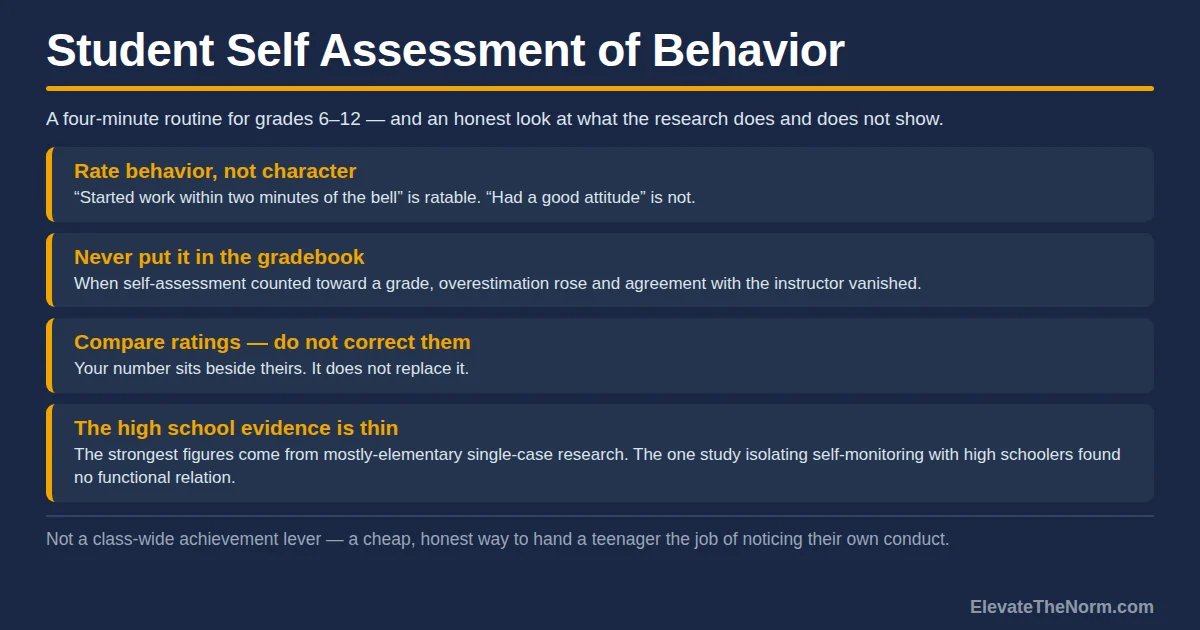
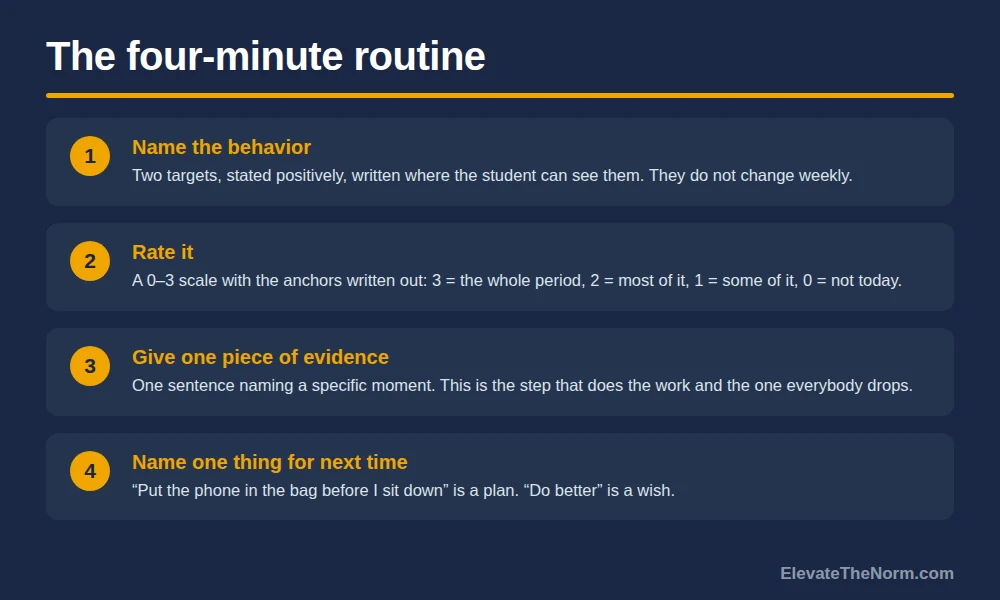
    Student self assessment of behavior is a short routine in which a student rates their own conduct against visible criteria, gives evidence for the rating, and names one thing to do differently. Not an apology form, not a mood check. Done right it takes four minutes and moves the work of noticing from you to them.

    Narrow is the point. The research here is better than what sits behind most in-service handouts, and more limited than the workshop slides admit. What follows is what the evidence supports for grades 6–12, what it does not, and a routine that survives a real Tuesday.

    Key Takeaways

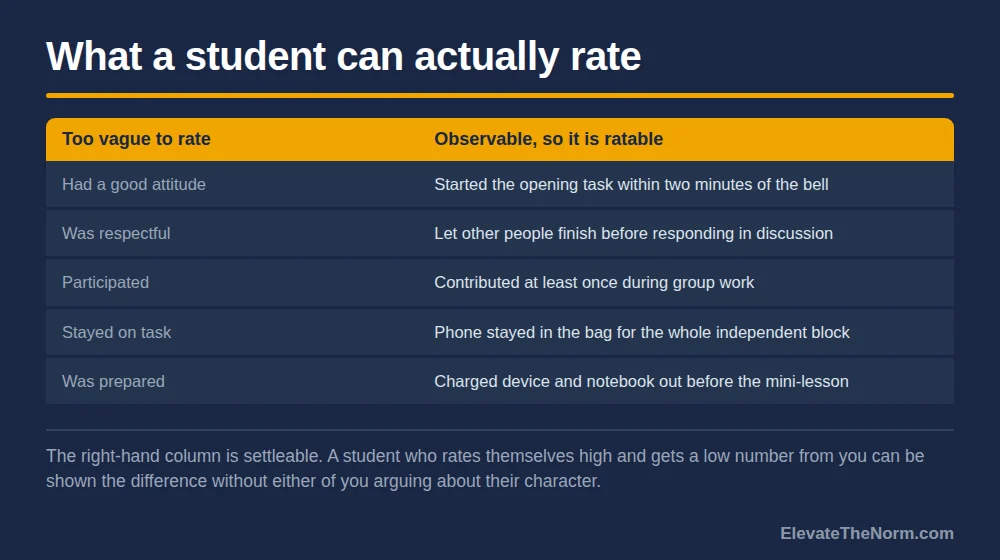
    • Rate behavior you can point at, not character. “Started work within two minutes of the bell” is ratable. “Had a good attitude” is not — and a student who disagrees has nowhere to go.
    • The moment you grade it, it stops working. In one study of self-assessment counted toward a final mark, overestimation rose sharply and the correlation with the instructor’s rating vanished.
    • The evidence is real, and the high school evidence is thin. A federal practice guide reports large average improvements. The one study found here that isolated self-monitoring with high schoolers found no functional relation.
    • Two behaviors. Not eight. Every version that survives past October tracks a small number of specific, positively stated behaviors on a form the student can fill out in under two minutes.
    • Compare ratings, do not correct them. Rating the same period yourself is the accuracy check. Overwriting the student’s number turns the whole thing back into your paperwork.

    Free Download · PDF

    Student Self-Assessment Forms for Grades 6–12

    A printable self-assessment form with space to write your own behavior criteria, a 0–3 rating scale, and a next-step line. No email required.

    Download the free PDF

    Free. No email address required. Designed for grades 6–12. Browse every printable in Your Free Library.

    What Is Student Self Assessment of Behavior?

    It is a student judging their own conduct against stated criteria and recording it. Three parts, all required: an observable behavior, a rating, a next step. Drop the observable behavior and you have a feelings survey. Drop the next step and you have a confession.

    The U.S. Department of Education’s Office of Special Education Programs describes two forms in its 2022 practice guide on self-monitoring systems: students record whether a behavior happened, or they rate it against criteria set in advance. The second is what most secondary teachers want. A checkbox says a thing occurred. A rating asks a student to hold their own conduct against a standard and say how close they came — a different and more useful act with a fifteen-year-old.

    Two neighbors to separate from. Not a restorative conversation — that happens after harm and involves the people affected. Nor is it academic self-assessment, though it borrows the machinery; the guide to judging your own work against criteria covers that version. Behavior just changes what sits in the criteria column. A third variant narrows it to a single project: what one student contributed inside a group that shares a grade.

    Does Student Self Assessment of Behavior Actually Work?

    Yes, with caveats big enough that you should read them. The headline numbers are good. The ones that apply specifically to teenagers are much thinner, and one is a null result.

    Start with the strongest claim. The OSEP guide cites a 2015 systematic review by Bruhn and colleagues covering 41 studies and reports that every one showed improvement: problem behavior falling from an average of 22% to 4%, academic engagement rising from 37% to 86%. Those are the figures that get onto the slide.

    Forty-one out of forty-one should make you suspicious rather than confident. A literature in which nothing ever fails usually has a publication problem, and nearly all of this work uses single-case designs — a handful of students, observed intensively, with effects judged by eye or by a non-standard metric. Single-case research is useful for showing something can work for a particular student. It is weak evidence for how far it moves a class of twenty-eight.

    The better evidence is the randomized trial. Bruhn, Wehby, Hoffman and colleagues ran a multisite RCT of a self-monitoring app across 25 schools and 57 student–teacher pairs (Behavioral Disorders, 2022). Students using it improved academic engagement more than controls (d = 0.44) and cut disruptive behavior more (d = −0.35) — and the behavior reduction largely held two weeks after the intervention stopped, while the engagement gain faded (d = −0.30). Note the grade band: 3rd through 8th. That is mostly elementary. It is not a high school result.

    Which brings us to the honest part. The one study located here that isolated self-monitoring with high schoolers is Estrapala, Bruhn and Rila (2022), comparing goal reminders against interval self-monitoring with three students with emotional or behavioral disorders. Visual analysis found no functional relation for either condition. Tau-U effect sizes ran 0.44 to 0.64, moderate to large, with self-monitoring slightly ahead — but the authors report classroom management as a substantial confound. Three students is three students; it does not overturn the wider literature. It does mean nobody should tell you this is proven for eleventh graders.

    The general picture for this age group is modest too. Murray, Kurian, Soliday Hong and Andrade (2022, Journal of Adolescence) pooled 33 randomized trials of self-regulation interventions with 7,269 young people aged 10–15 and found Hedges g = 0.12. Small. Emotion-regulation approaches reached g = 0.20; cognitive regulation, parent training, physical activity and working-memory approaches showed no significant effects at all.

    The defensible claim is this: behavior self-assessment reliably helps individual students who are struggling, is cheap, and has no plausible downside when it is not graded. It is not a class-wide achievement lever and nobody has shown that it is.

    Two things follow from that at building scale. First, this is about as cheap as an intervention gets — a half sheet of paper, no license, no platform, no staffing line, and so no procurement decision needed to try it in three classrooms. Second, and harder: who ends up holding a behavior sheet is an equity question, not a neutral one. Discipline data in most systems is not evenly distributed, and a practice assigned one student at a time inherits whatever pattern already exists in who gets noticed. Anyone running this as a tier-two intervention should read the roster of assigned students the way they read a referral report. Skipping that five-minute check is how a well-meant practice ends up pointed at the same kids as everything else.

    Will a Teenager Rate Themselves Honestly?

    More honestly than you expect, right up until the rating counts for something. That single design decision explains most of the variance between a routine that works and one that becomes theater.

    Heidi Andrade’s 2019 critical review in Frontiers in Education lays the accuracy picture out plainly. Correlations between student self-ratings and external measures run from about 0.20 to 0.80, few above 0.60. Males tend to overrate, females to underrate, and older and more academically competent students are more consistent — mildly good news for secondary teachers.

    Two-column table contrasting vague behavior descriptions such as had a good attitude and was respectful with observable versions such as started the opening task within two minutes of the bell and contributed at least once during group work
    The right-hand column is settleable. The left-hand column is an argument about a person.

    The decisive finding is about grading. Andrade cites Tejeiro and colleagues (2012), where self-assessment counted toward the final grade: overestimation increased dramatically and no correlation emerged between the professor’s rating and the student’s. Run formatively, agreement with external evaluators improved substantially. All twenty studies in Andrade’s review that used self-assessment formatively showed a positive association with learning.

    A second finding is worth stealing. Andrade reports that concrete, task-specific criteria outperform vague competence-based ones — a result from Fastré and colleagues. In behavior terms: “I was ready when the bell rang” beats “I was responsible today,” and it is far harder to argue about.

    Andrade also makes a point most summaries skip: the obsession with accuracy may be misplaced. Her review notes little evidence that inaccurate self-assessment produces worse learning, and that students act on their predictions regardless of accuracy. The purpose is not a number that matches yours. It is to get a student to look.

    What Should Students Actually Rate?

    Two or three behaviors, each stated as something a stranger could watch and score. The OSEP guide is specific: targets should be stated positively, defined in observable and measurable terms, and taught with examples and non-examples before anyone rates anything.

    Stated positively matters more than it sounds. “Did not disrupt” gives a student nothing to aim at. “Asked for help by raising a hand or coming to the desk” names the thing you want more of. Here is the difference in practice:

    Not ratableRatable
    Had a good attitudeStarted the opening task within two minutes of the bell
    Was respectfulLet other people finish before responding in discussion
    ParticipatedContributed at least once in the group work segment
    Stayed on taskPhone stayed in the bag for the whole independent work block
    Was preparedHad the charged device and the notebook out before the mini-lesson

    The right-hand column has a property the left lacks: a student who rates themselves high and gets a low number from you can be shown the difference without either of you arguing about their character. It moves a disagreement about a person into a disagreement about a fact, and facts are settleable.

    Pick two. A student tracking six behaviors is doing clerical work, and clerical work gets abandoned. Few, specific and observable beats many and inspirational — the same discipline that makes a short list of classroom expectations work at all.

    Let the student pick the second one. You choose the first target — you can see the pattern from the front of the room. Hand them the second. Ask what they would fix about their own class period if they could fix one thing, and write down their words. This costs nothing and it changes what the sheet is: a form you assigned becomes a form with something of theirs on it. It also produces better targets than you would guess, because a fifteen-year-old knows things about their own period that are invisible from six feet away — the argument for taking student voice seriously in the first place.

    A Four-Minute Behavior Self-Assessment Routine

    Four steps, once a period or once a day, on one sheet. The design constraint is that it has to be cheap enough that you still run it in week nine.

    1. Name the behavior. Two targets, stated positively, written where the student can see them. They do not change weekly; a target that moves every few days never gets a baseline.
    2. Rate it. A 0–3 scale beats 1–5. Fewer points means less hedging toward the middle, and the anchors fit on the page: 3 = the whole period, 2 = most of it, 1 = some of it, 0 = not today.
    3. Give one piece of evidence. One sentence naming a specific moment. This is the step that does the work and the one everybody drops. A rating with no evidence is a guess; with evidence it is an observation — and a student who has to produce evidence starts watching for it during the period instead of reconstructing it afterward.
    4. Name one thing for next time. Specific and small. “Put the phone in the bag before I sit down” is a plan. “Do better” is a wish.
    Numbered graphic of a four-step behavior self-assessment routine: name the behavior, rate it on a 0 to 3 scale, give one piece of evidence, and name one thing for next time
    Four minutes. Step three is the one that does the work and the one everybody drops.

    Two easy-to-skip things make it stick. First, teach it before you run it. The OSEP guide recommends explaining the definition in student-friendly language, modeling the steps, guided practice, and telling students why the behavior matters — that last one builds buy-in rather than compliance. Fifteen minutes once beats re-explaining it daily for a month.

    Second, let them see their own trend. The guide recommends self-graphing, the cheapest motivational feature available: a strip of boxes down the side of the sheet the student shades in. Ten shaded days is the first time most students have seen their own conduct as a line rather than a series of unrelated bad days — which is what makes learning from a mistake possible at all. My Behavior Reflection Sheets on TPT ask students for reasons, not apologies, and come in two reading levels. For a family meeting the student leads, there is a free student led conference template for middle school and high school.

    One adjustment before you print anything: the written version is not the only version. Step three assumes a student who can produce a sentence quickly in writing, and plenty cannot — a student with a writing disability, a newcomer still building English, a student whose handwriting speed turns four minutes into twelve. None of them needs less self-assessment; they need a different container. Saying the evidence out loud in the last minute of class does the same cognitive work, and so does an evidence line offering three pre-written options plus a blank. What has to survive is the judgment against criteria, not the paragraph.

    If you want a form rather than building one, the free student self-assessment pack has a general version you can retype the criteria into. No email required.

    How Do You Check Accuracy Without Turning It Into a Trap?

    Rate the same period yourself, compare the two numbers, and talk about the gap — do not replace their number with yours. The OSEP guide describes exactly this: the teacher takes data at the same time the student self-records, and the comparison establishes accuracy. It calls this verification that supports rather than replaces student self-assessment, and that distinction is doing real work.

    Be realistic about frequency. Rating two behaviors for one student while teaching twenty-seven others is not a daily act, and a version that demands it quits on you in week three. Three days out of ten is enough to tell whether a student’s ratings track reality. Mark your numbers on a sticky note rather than building a second tracking sheet.

    The failure mode is obvious once you name it. If your rating overwrites theirs, the student learns that the sheet is a quiz with one right answer, which is you. They will start guessing what you wrote instead of watching what they did, and you have rebuilt teacher-managed behavior tracking with an extra step and the student’s handwriting on it.

    What to do with a gap depends on its direction, and this is where the practice earns its keep:

    • Higher than you. Ask what they were looking at. Usually the criteria are fuzzier than you thought, or they counted a different part of the period. That is information about your criteria, not evidence of dishonesty.
    • Lower than you. Say so. A student who gives themselves a 1 on a day you saw a 3 is telling you something, and it is rarely about the behavior.
    • A match. Say that once, then fade the checking. Matching is the exit condition, not a reason to keep checking forever.

    On fading, the guide is clear: the goal is a student who monitors their own behavior without the system, faded individually through longer intervals, higher goals or less frequent recording, while you keep watching the behavior itself. A behavior self-assessment with no exit plan is a permanent accommodation you did not mean to create. Decide at the start what “done” looks like, and tell the student.

    Four Ways This Goes Wrong

    All four are design errors, and all four are fixable before you start.

    It becomes a punishment record. The fastest way to kill it: a stack of sheets pulled out at a parent meeting or a referral. Once a student suspects the form is evidence against them, the ratings go to 3 and stay there, and you have taught them that honest self-report is a liability. Decide up front who sees the sheets and say so. If a sheet genuinely has to go into a behavior plan, tell them before the first one is filled out, not after.

    Graphic listing four failure modes for behavior self-assessment: it becomes a punishment record, it singles a student out, it gets mandated without being taught, and it replaces a fix to the lesson
    All four are design errors. All four are fixable before the first sheet is printed.

    It singles a student out. A behavior sheet on one desk in a room of twenty-eight is a sign, and teenagers read signs. That is a real cost, and it is why the practice is often worth running with a whole class or group even when one or two students need it. If it has to be individual, make the form unremarkable and handle the handoff privately — not at the front of the room on the way out.

    It gets mandated without being taught. When this arrives as a tier-two box to check, the teaching step is the first thing cut — it is the only step that costs a block of class time. A student handed a sheet with no instruction rates it the way they rate everything handed over with no instruction: fast, high, without looking. The fifteen minutes of modeling is what makes the other four mean anything, and a school adopting this should build that time into the rollout.

    It replaces a fix you should have made. If six students rate themselves poorly on the same behavior, the problem is not six students. It is the task, the seating, the pacing, or the transition around it. Self-assessment data is a diagnostic you collect for free, and reading it only as a statement about individual kids wastes it. Sometimes the right response to the sheets is to change the lesson. That is not a failure of the practice; it is the practice working.

    Where to Start This Week

    Pick one class. Write two behaviors on the board, stated positively, in language a student would use. Put a 0–3 scale under each with the anchors written out. Spend fifteen minutes teaching what a 3 looks like and what it does not, using examples from the actual room. Then run it ten days without changing anything, rating the same two behaviors yourself on three of those days. On day ten, hand students their own ten days and ask one question: what does this show you that you did not know on day one? That question is the entire product. Everything before it is setup.

    Keep it out of the gradebook. Keep it to two behaviors. Plan the exit before you plan the start. Behavior self-assessment will not turn a hard section into an easy one, and anything promising that is selling something. What it does is hand a teenager the job of noticing their own conduct — a job they are old enough to have and one almost nobody has ever formally given them. The natural next step, once they can rate themselves against criteria, is doing it out loud to someone other than you, which is what building student responsibility looks like as a sequence rather than a slogan.

    Before you go: grab the free Student Self-Assessment Forms (PDF) — ElevateTheNorm.com branded, printable, no email required.

    Frequently Asked Questions

    Should a behavior self-assessment ever count toward a grade?

    No. This is the single clearest finding in the research. When self-assessment counted toward a final grade in Tejeiro and colleagues’ study, student overestimation increased dramatically and the correlation with the instructor’s own assessment disappeared entirely. Run formatively, the same practice produced substantially better agreement with external evaluators. A grade converts an honest instrument into a negotiation. If your school requires a conduct grade, keep it in a separate column and say out loud that the self-assessment sheet does not feed it.

    Is this just a behavior chart for teenagers?

    It looks similar and it works differently. On a behavior chart, an adult records what a student did. On a self-assessment, the student records it, produces evidence for the rating, and names the next step. The recording is the intervention — the point is the act of judging your own conduct against a standard, not the data. If you fill in the sheet for the student, you have a chart, and you should not expect the self-assessment findings to apply to it.

    How do I do this without embarrassing the one student who needs it?

    Run it with the whole class or a whole group where you can. A single sheet on a single desk is visible and teenagers read it correctly as a label. If it has to be individual, make the form look ordinary, hand it over and collect it privately rather than at the door, and tell the student at the start exactly who will see it. Then hold to that. A promise about who sees the sheet is the whole basis of honest ratings.

    Can parents or an administrator ask to see the sheets?

    Possibly — records policies vary by district and this is not legal advice. The practical move is to decide before the first sheet is filled out and tell the student. If the sheets will feed a behavior plan or a meeting, say so up front; students can handle a known rule and cannot handle a surprise one. If the sheets are for the two of you, write nothing on them you would not want read aloud, and keep other students’ names off them entirely.

    Does the research support this for high school students?

    Less than you would gather from a workshop. The strongest average figures come from a federal practice guide citing a 41-study review that is overwhelmingly single-case research, and the best randomized trial covers grades 3 through 8. The one study located here that isolated self-monitoring with high schoolers — Estrapala, Bruhn and Rila (2022), three students with emotional or behavioral disorders — found no functional relation, though effect sizes were moderate to large and the authors flag classroom management as a confound. The honest summary: it plainly helps individual struggling students, it costs almost nothing, and it is not proven as a class-wide lever for teenagers.

    How long before I should expect to see anything?

    Give it ten school days before you judge it, and expect the first week to look like nothing. Students need several cycles before the ratings stabilize enough to be worth reading, and the useful moment is usually the first time a student sees ten days of their own data at once rather than any single entry. If nothing has moved after three or four weeks of consistent use, the target behavior is probably too vague or the real problem is somewhere in the lesson rather than in the student.

    Should I tell families their child is doing this?

    Yes, and it takes one sentence. A short note home saying what the two behaviors are, that the student rates themselves, that it is not graded, and who sees the sheet prevents the version of this conversation where a parent finds a behavior form in a backpack and reasonably assumes their child is in trouble. It also tends to produce useful information back — families often know which part of the day is hard and why. Send it before the first sheet, not after the first question.

    What if a student refuses to fill it out?

    Ask what they think it is for. A refusal is usually a reasonable read of the situation — they have decided it is surveillance, or paperwork, or a trap that ends in a referral. All three are things the design can fix. If the answer is that they do not see the point, that is fair, and the counter is to show them what ten days of their own data looks like rather than to argue. Do not make compliance with the sheet itself a disciplinary issue; you will win that fight and lose the practice.

    Sources

    1. Avina, A., Boyle, S., Duble Moore, T., Hicks, T., and Wiggins, A. “Intensive Intervention Practice Guide: Self-Monitoring Systems to Support Students’ Behavioral Needs.” U.S. Department of Education, Office of Special Education Programs / National Center on Intensive Intervention, Fall 2022. https://files.eric.ed.gov/fulltext/ED628226.pdf
    2. Andrade, Heidi L. “A Critical Review of Research on Student Self-Assessment.” Frontiers in Education, vol. 4, art. 87, 2019. https://www.frontiersin.org/journals/education/articles/10.3389/feduc.2019.00087/full (The Tejeiro et al. 2012 and Fastré et al. 2010 findings cited above are reported in this review; the primary papers were not read directly.)
    3. Bruhn, Allison, Joseph Wehby, Lesa Hoffman, Sara Estrapala, Ashley Rila, Eleanor Hancock, Alyssa Van Camp, Amanda Sheaffer, and Bailey Copeland. “A Randomized Control Trial on the Effects of MoBeGo, a Self-Monitoring App for Challenging Behavior.” Behavioral Disorders, vol. 48, no. 1, 2022, pp. 29–43. https://files.eric.ed.gov/fulltext/EJ1351615.pdf
    4. Estrapala, Sara, Allison Leigh Bruhn, and Ashley Rila. “Behavioral Self-Regulation: A Comparison of Goals and Self-Monitoring for High School Students With Disabilities.” Journal of Emotional and Behavioral Disorders, 2022. https://files.eric.ed.gov/fulltext/EJ1349728.pdf
    5. Murray, Desiree W., Jennifer Kurian, Sandra L. Soliday Hong, and Fernanda C. Andrade. “Meta-Analysis of Early Adolescent Self-Regulation Interventions: Moderation by Intervention and Outcome Type.” Journal of Adolescence, vol. 94, no. 2, 2022, pp. 101–117. https://files.eric.ed.gov/fulltext/ED622592.pdf

    About Clay Shumate

    Clay Shumate is a certified secondary Social Studies teacher in the public schools of West Alabama, with seven years of classroom experience, a B.A. in History, and an M.Ed. in Secondary Education. He writes about project-based learning, student responsibility, respect, and practical ways to hold young people to a higher standard while giving them room to learn from mistakes. He is a member of the Society of Professional Journalists and writes to its Code of Ethics; this site’s editorial standards and corrections policy are published in full. More about Clay.

  • Ideas for Student Led Conferences: 16 Formats That Fit Grades 6–12

    Ideas for Student Led Conferences: 16 Formats That Fit Grades 6–12

    By Clay Shumate

    The best ideas for student led conferences in grades 6–12 are formats, not decorations. Pick one thing the student has to defend — a single piece of work, a growth pair, a data pattern, a goal that failed — and build the conference around it. Sixteen formats are below, sorted by what the student defends, how long each takes, and when to use it.

    Key Takeaways

    • A format is a decision about evidence. Every idea on this page answers one question: what does the student have to put on the table and explain?
    • Ten minutes is not enough when the student is talking. Budget twenty. A student who has never defended their own work needs room to be slow.
    • Pick the format that survives your calendar, not the one that looks best in a staff meeting. Stations, advisory slots, recordings, and rolling conferences all work; a ninety-minute evening event for 140 students does not.
    • The research supports the parts, not the package. Self-assessment has a small, real effect on self-regulated learning and a larger but probably inflated effect on self-efficacy. Nobody has run a large randomized trial of the conference itself.
    • Half of high school families will not come. Federal survey data puts high school conference attendance at 54%. A format that only works in person is a format that reaches half your roster.

    Free Download · Student-Led Conference Toolkit

    The readiness checklist, portfolio planner, student script and follow-up agreement

    Four printable parts that work with any format on this page. Use the checklist and planner for prep, then let the student choose which format they are ready to run.

    Download the free PDF

    Free. No email address required. Designed for grades 6–12. Browse every printable in Your Free Library.

    What are some good ideas for student led conferences?

    Good ideas for student led conferences fall into four families: evidence formats, where the student defends a piece of work; goal formats, where the student defends a decision; schedule formats, which bend the event to fit a real calendar; and subject formats, which change what counts as evidence depending on the room. Almost every conference idea you will find online is a variation inside one of those four.

    That framing matters because it stops you from shopping for activities. The question is not “what cute thing can students do at the conference.” The question is what the student has to be able to explain out loud to an adult who is not their teacher. Everything else — the binder, the slides, the sign-in sheet — is packaging around that one moment. If you want the full case for why the event works and where it comes from, that is covered in the main guide to student-led conferences. This page is the catalogue of formats.

    Four labeled rows describing evidence formats, goal formats, schedule formats, and subject formats for student-led conferences.
    The four families every student-led conference format falls into.

    Sixteen ideas for student led conferences, by what the student defends

    Each format below lists what the student brings, roughly how long it runs, and the situation it is built for. None of them require a schoolwide program. Most can be run by one teacher in one course.

    Evidence formats: the student defends a piece of work

    1. The single-artifact defense. One assignment. Three questions: what is this, what does it show about what you can do, and what would you change. Ten to fifteen minutes. This is the format to start with if you have never done this before, because it fails gracefully — a student who freezes still has the paper in front of them.
    2. The growth pair. The earliest and latest version of the same skill, side by side. The student names the specific difference, not “it got better.” Fifteen minutes. Works best in a course with recurring tasks — writing, problem sets, lab reports, studio work.
    3. The data walk. The student reads their own assessment data out loud and names the pattern in it before any adult does. Fifteen to twenty minutes. This is the most uncomfortable format and the most honest one. It also requires that your gradebook actually shows patterns rather than a single running average, which is its own argument for grading by standard. Do not run this one in a station setup — a student reading their own failing scores aloud within earshot of three other families is not a format, it is an exposure.
    4. The missing-work audit. The student accounts for what is not there. Peter Neeves, a middle school principal writing in Edutopia in December 2025, describes exactly this: for incomplete assignments, students write a reflection and build an “assistance plan” for finishing. Fifteen minutes. Use it when the gap between a student’s ability and their grade is mostly a gap in turned-in work.

    Goal formats: the student defends a decision

    1. The four-week goal beside the year goal. The Missouri State Teachers Association’s practical guide recommends a four-week goal, a year-long goal, and one “whole-self” goal. The four-week goal is the useful one, because it is close enough to check. Fifteen minutes.
    2. The goal autopsy. The student revisits a goal they set and did not hit, and says why — not as an apology, as a diagnosis. Twenty minutes, because this one takes real talking. Use it at the second conference of the year, never the first.
    3. The next-course conversation. An eleventh or twelfth grader explains what this year’s evidence means for next year’s schedule, and what they would need to be true to take the harder course. Twenty minutes, and worth pulling a counselor in if you can.

    Schedule formats: the format bends to the calendar

    Four numbered cards matching a teaching constraint to a student-led conference format: one evening with 140 students, an advisory period, families who cannot attend, and wanting behavior change.
    Match the student-led conference format to the constraint you actually have.
    1. Station conferences. Four or five families present simultaneously in one room while you circulate. This is the standard secondary workaround and the MSTA guide describes it directly. Twenty-minute slots. The trade-off is privacy: anything a family might not want overheard has to happen somewhere else.
    2. The advisory conference. Ten-minute single-artifact defenses run during advisory or homeroom across two weeks. No evening event, no coverage, no sign-up system. The weakest format on the list and the one most likely to actually happen.
    3. The recorded conference. A two-to-three minute screen recording in which the student narrates their own work, sent home with two questions for the family to answer and return. The MSTA guide lists this as an option; it is also the only format on this page that reaches a family working a second shift. Three practical guardrails: use whatever recording tool your district has already approved, make sure no other student appears or is named in the recording, and give a student with no reliable device at home a written narration or a phone-audio version instead. The format is the point, not the video.
    4. The rolling conference. Four or five students a week, every week, all term. Nobody schedules an event. By May every student has defended their work twice. This is the format that changes a course culture rather than adding a night to the calendar.

    Subject formats: the evidence looks different in each room

    1. Math — error analysis. The student brings one wrong answer, explains what they believed when they made the mistake, states the correct method, and shows a second problem they got right using it. Fifteen minutes. This format does more for a math student than any portfolio of correct work.
    2. English — one paragraph, three versions. First draft, post-feedback draft, final. The student reads the sentence that changed the most and explains the change. Fifteen minutes.
    3. Science — the lab that did not work. Data that refused to cooperate, the likely reason, and what the student would change in the procedure. Fifteen minutes, and it teaches more about science than a poster of a successful experiment.
    4. Social studies — defend a claim with two sources. The student states a claim, names both sources, and answers one hard question about the source they trust less. Twenty minutes.

    One more, for the hardest case

    1. The repair conference. After an integrity incident or a serious behavior problem, the student explains to their family what happened, who it affected, and what they are doing about it — with you in the room and the school’s formal process already finished, not instead of it. Twenty to thirty minutes. This one is not for everybody and it is not a substitute for required procedure. It is voluntary for the student and the family, it never replaces a mandated report or a discipline process, and your administrator should know it is happening before it happens. It works when a student has already accepted responsibility and needs a way to come back from the mistake rather than carry it. If any of those conditions are missing, skip it.
    Four rows describing what a student presents in math, English, science, and social studies at a student-led conference.
    What the student brings to the table in each subject.

    Do student-led conferences actually do anything?

    The short answer: the parts have evidence behind them and the package does not. Self-assessment and goal-setting — the two things a student-led conference forces — have been studied. The conference as an event has not been tested at scale, and anyone telling you otherwise is stretching. The goal-setting half is worth reading on its own terms too: what the evidence does and does not support about student goal setting is more mixed than most professional development admits.

    The best available evidence on the underlying mechanism is Panadero, Jonsson and Botella’s 2017 set of four meta-analyses in Educational Research Review. Across 2,305 students with a mean age of 17.5, self-assessment interventions produced a small effect on self-regulated learning (d = 0.23) and a large effect on self-efficacy (d = 0.73). Ten of the studies were in secondary schools, so this is not elementary research being stretched upward. But read the authors’ own caution: they state plainly that for self-efficacy “there might exist some over-estimation of the magnitude of the effect” because of publication bias, and that the studies do not clarify the mechanism. A d of 0.73 that the authors themselves flag as probably inflated is not a number to build a school improvement plan on.

    On the conference itself, the most-cited piece of research is Sherri Nauss’s 2010 study in the ERIC database, covering 90 students in grades 6–8, 90 parents and six teachers. It reports that 59 of 90 students said the conferences “consistently” or “usually” made them take responsibility for their learning, and 64 of 90 said the conferences helped them focus on grades. Those are real numbers, and they are also self-reported survey responses from a single school, from students in a narrow 2.5–3.5 GPA band, with no achievement data and no data from families who did not participate. Nauss says all of that herself in the limitations section. It is a useful signal. It is not proof.

    So the honest version is this: if you run one of these formats, you are on solid ground saying that it makes students assess their own work, and reasonable ground expecting that to help a little with how they manage their learning. You are not on solid ground promising a grade bump. Say the first thing to your administrator and skip the second.

    Which format should you pick?

    Pick by constraint, not by preference. The format that fits your worst scheduling problem is the one that will still be running in March.

    If this is your situationUseTime per student
    One evening, 140 studentsStation conferences (#8)20 min
    You have advisory or homeroomAdvisory conference (#9)10 min
    Families work shifts or lack transportRecorded conference (#10)2–3 min of video
    You want a culture change, not an eventRolling conference (#11)15 min, 4–5 a week
    First time ever doing thisSingle-artifact defense (#1)10–15 min
    The problem is missing work, not abilityMissing-work audit (#4)15 min
    Second conference of the yearGoal autopsy (#6)20 min
    Juniors and seniors picking coursesNext-course conversation (#7)20 min

    Whatever you choose, the preparation is the same shape: the student selects evidence, annotates it, and rehearses. The free conference template pack has the readiness checklist and portfolio planner that do that work, and the self-assessment guide explains why the annotation step is the part you cannot skip.

    What do you do about the families who do not come?

    Plan for roughly half of them, and build a format that does not require a body in a chair. This is not pessimism. It is the federal data.

    The National Center for Education Statistics tracks this in the National Household Education Surveys Program. In the 2018–19 survey, the share of parents who attended a regularly scheduled parent-teacher conference was 90% in kindergarten through second grade, 88% in grades 3–5, 72% in grades 6–8, and 54% in grades 9–12. The drop is not a failure of any one school. It is what happens when a child goes from one teacher to seven and the conference stops feeling like the only channel. The 2023 survey puts overall conference attendance across all grades at 72%. If you want a simple record of who you called and why, my free Parent Contact Log on TPT has a page ready to print.

    Three things follow from that. First, a recorded conference is not the consolation prize; for half a high school roster it is the primary format. Second, the family who does not come is often the family you most need to hear from, which is an argument for the short, regular, individual contact that actually has trial evidence behind it. Third, do not grade the student on whether an adult showed up. That is the one design mistake that turns a good idea into a punishment for being poor.

    What about students and families who need accommodations?

    Every format on this page assumes a student can talk about their work for fifteen minutes, and that assumption is wrong for some of your students. Fix it before the conference, not during it.

    For a student with a communication-related disability, the defense is a mode, not a speech. A written narration read by the student, a slide deck the student points to, a recorded version, or a peer-supported walkthrough all satisfy the same purpose. Check the IEP or 504 plan first and follow it — this is an instructional activity, and accommodations apply to it the same way they apply to a presentation in any other class. For an emergent bilingual student, let the conference happen in the language the family speaks, and request the interpreter through whatever process your school already has for conferences. If your school does not have one, that is worth raising before you pick a format, because a conference the family cannot follow is worse than the form letter it replaced.

    Five ways these ideas go wrong

    • The student reads a script and nobody learns anything. A script is scaffolding for a nervous kid, not the product. If a student can deliver the whole thing without looking up, you have built a performance.
    • Only the successful work goes in the folder. A portfolio of A’s is a brag book. The growth pair, the missing-work audit and the error analysis all exist to prevent this.
    • The time slot assumes an adult is talking. Ten minutes is a teacher-led conference. A fifteen-year-old explaining their own reasoning to their mother takes longer, and the silences are part of it.
    • It becomes an eighth grading event. Grade the preparation if you must grade something. Do not put a number on how convincingly a teenager talked about themselves in front of their parent.
    • Nobody follows up. A goal named in October that nobody mentions again in November teaches students that the conference was theater. Put the four-week check on your own calendar before the conference happens.

    What to do next

    Pick one format and one class period. Not the department, not the grade level — one section. The single-artifact defense (#1) run during advisory (#9) is the lowest-risk combination on this page, and it takes one week of prep: students choose the artifact on Monday, annotate it Tuesday, rehearse with a partner Wednesday, and defend it Thursday and Friday.

    Then write down what actually happened — who could explain their own work and who could only describe it. That distinction is the whole point of the exercise, and it is the thing you will want in front of you the next time someone asks whether this is worth the class time. It is. But argue it with what your students did, not with a number from a study that was run somewhere else.

    Before you go: grab the free Student-Led Conference Toolkit (PDF) — ElevateTheNorm.com branded, printable, no email required.

    Frequently Asked Questions

    What are some good ideas for student led conferences in middle and high school?

    Start with a format rather than an activity. The four that work best in grades 6-12 are the single-artifact defense (one assignment, three questions), the growth pair (earliest and latest version of the same skill side by side), the missing-work audit (the student accounts for what is not there and writes an assistance plan), and the goal autopsy (the student explains why a goal they set did not happen). Each runs in ten to twenty minutes and none of them require a schoolwide program.

    How long should a student-led conference be?

    Budget twenty minutes, not ten. Ten minutes is the length of a teacher-led conference, where an adult who has said the same thing six times that night is doing the talking. A fifteen-year-old explaining their own reasoning to their parent is slower, and the pauses are part of the work. If your schedule only allows ten, use the single-artifact defense, which is built to fit.

    Do student-led conferences improve grades?

    There is no good evidence that they do, and you should not promise it. What has been studied is self-assessment, the mechanism underneath the conference. Panadero, Jonsson and Botella’s 2017 meta-analyses found a small effect on self-regulated learning (d = 0.23) and a larger effect on self-efficacy (d = 0.73) across 2,305 students with a mean age of 17.5 – but the authors themselves warn that the self-efficacy figure is probably inflated by publication bias. The most-cited study of the conference itself, Nauss (2010), is 90 students in one middle school reporting on themselves, with no achievement data at all.

    What if the parent disagrees with how the student assessed their own work?

    That disagreement is useful, and it is one of the few things a student-led conference produces that a traditional conference does not. Let it happen, then anchor it to the evidence on the table: the paper, the data, the two drafts. Your job is not to referee who is right about the student’s character. It is to point at the artifact and ask what it shows. If the conversation is heading somewhere a student should not have to sit through, end the conference and schedule a separate one with the adults.

    How do you handle families who do not come to conferences?

    Assume about half of them will not, and build a format that does not require attendance. Federal survey data from 2018-19 puts parent attendance at regularly scheduled conferences at 54% in grades 9-12 and 72% in grades 6-8, down from 90% in the earliest elementary grades. The recorded conference – a two- to three-minute narration the student makes over their own work, sent home with two questions for the family to answer – is the format built for this, and for half a high school roster it is the primary format, not a backup. Never grade a student on whether an adult showed up.

    Should student-led conferences be graded?

    Grade the preparation if you need a grade: the artifact selection, the annotation, the written reflection. Do not put a number on how convincingly a teenager talked about themselves in front of their parent. That turns a format built on honesty into a performance, and the students who most need to say something uncomfortable are exactly the ones a grade will silence.

    Do these formats work for students with IEPs or students learning English?

    Yes, with the accommodations those students already have. The defense is a purpose, not a speech: a written narration the student reads, a slide deck the student points to, a recorded version, or a peer-supported walkthrough all satisfy it. Check the IEP or 504 plan and follow it, the same as you would for any presentation. For a family that speaks another language, request an interpreter through the process your school already uses for conferences, and hold the conference in the language the family actually speaks.

    How is this different from a regular parent-teacher conference?

    In a traditional conference the teacher reports and the family listens. In a student-led conference the student presents evidence of their own learning and the adults ask questions about it. The teacher is still in the room and still responsible for accuracy – this is not the teacher stepping out. What changes is who has to be able to explain the work, which is the entire point.

    Sources

    • McQuiggan, Meghan, and Mahi Megra. Parent and Family Involvement in Education: Results from the National Household Education Surveys Program of 2019 (NCES 2020-076). National Center for Education Statistics, U.S. Department of Education, 2019. Conference attendance by grade band appears in Table 2. Full report (PDF).
    • Parent and Family Involvement in Education: 2023 (NCES 2024-113). National Center for Education Statistics, U.S. Department of Education, 2024. Sample of 19,562 students; overall conference attendance 72%. Summary (PDF). This edition does not disaggregate by grade band, which is why the 2019 report is cited for that figure.
    • Panadero, Ernesto, Anders Jonsson, and Juan Botella. “Effects of self-assessment on self-regulated learning and self-efficacy: Four meta-analyses.” Educational Research Review, vol. 22, 2017, pp. 74–98. Journal listing; open-access author copy at the Universidad Autónoma de Madrid repository (PDF), which is the version read for this article.
    • Nauss, Sherri A. Student Led Conferences: Students Taking Responsibility. 2010. ERIC document ED516784. Full text (PDF). 90 students in grades 6–8 with GPAs between 2.5 and 3.5, self-reported survey data, no achievement measures — limitations stated by the author.
    • Neeves, Peter. “How to Successfully Institute Student-Led Conferences at Your School.” Edutopia, George Lucas Educational Foundation, 3 December 2025. Article.
    • “A Practical Guide to Student-Led Conferences.” Missouri State Teachers Association. Guide.

    A note on the evidence. Two of the six sources are federal survey reports, one is a peer-reviewed set of meta-analyses, and one is a small single-school study whose limitations are stated in the text above rather than buried. The two practitioner sources are cited for format details, not for outcomes. Nobody has run a large randomized trial of student-led conferences at the secondary level, and this article does not pretend otherwise.


    About Clay Shumate

    By Clay Shumate — Clay Shumate is a certified secondary Social Studies teacher in the public schools of West Alabama, with seven years of classroom experience, a B.A. in History, and an M.Ed. in Secondary Education. He writes about project-based learning, student responsibility, respect, and practical ways to hold young people to a higher standard while giving them room to learn from mistakes. He is a member of the Society of Professional Journalists and writes to its Code of Ethics; this site’s editorial standards and corrections policy are published in full.

Teacher Emergency Toolkit — practical resources, real classroom support. Shop on TPT.Teacher Emergency Toolkit — practical resources, real classroom support. Shop on TPT.