By Clay Shumate
Test corrections work when every student has to explain why each wrong answer was wrong, not just copy the right one. Research on learning from errors supports correcting mistakes with feedback, but optional reflection gets skipped by the students who need it most. Require corrections from everyone, grade the reasoning pass/fail, and cap the points back.
Done well, a test correction is the most efficient reteaching you’ll ever get: the student already knows what they missed. Done badly, it’s twenty minutes of copying answers off a neighbor’s paper for half the points back.
Key Takeaways
- Making errors and then correcting them with feedback helps learning. A review in the Annual Review of Psychology found that error avoidance “appears to be the rule in American classrooms” and that errorful learning followed by corrective feedback “is beneficial to learning.”
- Feedback is what makes a test correction work. In one lab study, errors were corrected on a later test about 70% of the time with feedback and roughly 4% of the time without it.
- A student’s most confident wrong answers are the ones most likely to get fixed. That’s the hypercorrection effect, so the student who argues about question 14 is the one most likely to remember the right answer later.
- When test corrections are optional, most students skip them. Across 20,058 assessments from 2,826 students in grades 5–11, students opened detailed error feedback in only 44% of cases, and students with low scores were the least likely to look.
- A reflection form on its own doesn’t raise scores. A study of “exam wrappers” with 86 students found no effect on exam scores, final grades, or measured metacognition, so the correction has to force thinking about each specific error.
Free Download · PDF
The Test Correction Sheet and Policy Card (2 pages)
Page 1 is the student sheet — three blocks of the four-box correction, with the reasoning box that makes copying an answer useless. Page 2 is a policy card to fill in and staple to the first test of the term, plus a sorting sheet for reading a class set in five minutes.
Free. No email address required. Designed for grades 6–12. Browse every printable in Your Free Library.
What Are Test Corrections?
A test correction is a required second pass over a returned assessment in which the student states the right answer and explains why their first answer was wrong. That second part is the whole practice. Without it, a test correction is a transcription exercise.
Two versions run in American schools under the same name, and they produce opposite results.
Version one: hand back the test, let students fix wrong answers, give half credit back. Most look at the answer key, write the right letter, hand it in. Nobody learns anything, the grade goes up, and the next test looks exactly like the last one.
Version two: the student has to name the error — not the answer, the error. What did I think was true that wasn’t? That version is slower, harder to grade, and is the one with research behind it.
Clay’s take: if you only take one thing from this article, take this: the credit is not the intervention. The credit is the thing that gets students to do the intervention. Confusing the two is how a good practice turns into grade inflation with extra steps.
Does Research Support Test Corrections and Learning From Mistakes?
Research on learning from errors supports test corrections, as long as the correction comes with feedback. Laboratory studies find that making an error and then getting corrective feedback helps students learn, and that steering students around every mistake may work against them.
Janet Metcalfe’s review “Learning from Errors,” published in the Annual Review of Psychology in 2017, surveys that evidence and reaches a blunt conclusion: error avoidance “appears to be the rule in American classrooms,” while errorful learning followed by corrective feedback “is beneficial to learning.” Avoiding errors, she writes, “may be a counterproductive strategy.”
She suggests it may be worthwhile to “allow and even encourage students to commit and correct errors while they are in low-stakes learning situations,” precisely because the goal is performance later, when the stakes are high.
The crucial qualifier is the phrase followed by corrective feedback. Metcalfe is explicit: “Corrective feedback, including analysis of the reasoning leading up to the mistake, is crucial.” A wrong answer left wrong is just a wrong answer. Same logic that makes formative assessment worth the class time: information is only worth collecting if something happens next.
Why Do Confident Students Gain the Most From Test Corrections?
Students correct the errors they were most sure about more reliably than the ones they guessed at. That’s the hypercorrection effect, and it’s counterintuitive enough that it’s worth stating twice.
Janet Metcalfe and Bridgid Finn tested it directly in a 2011 paper in the Journal of Experimental Psychology: Learning, Memory, and Cognition. Participants answered general-knowledge questions, rated their confidence, received corrective feedback on their errors, and were tested again later. Errors held with high confidence were corrected on the final test around 82% of the time. Overall recall after feedback was about 70%. Without feedback, correction rates fell to roughly 4%.
Two things follow. First, the gap between 70% and 4% is the clearest number in this entire literature, and it says the thing teachers most need to hear: returning a graded test without a correction process is close to doing nothing. Second, the student who comes up after class and argues that question 14 was unfair isn’t being difficult. High confidence plus a wrong answer is the configuration most likely to produce durable learning. Argue back, with evidence.
Stated honestly: these were college undergraduates, in a lab, answering trivia. Samples ran from 25 to 45 people per experiment. The mechanism is about confidence and attention rather than age, so it’s reasonable to expect it to transfer to a fifteen-year-old and a unit test. The exact percentages aren’t yours to quote as classroom results.
Why Don’t Test Corrections Always Work?
Test corrections often fail because students skip feedback when looking at it is optional, and the students who need it most are the least likely to look. That finding should change what you build, and it comes from the largest secondary-school sample in this article.
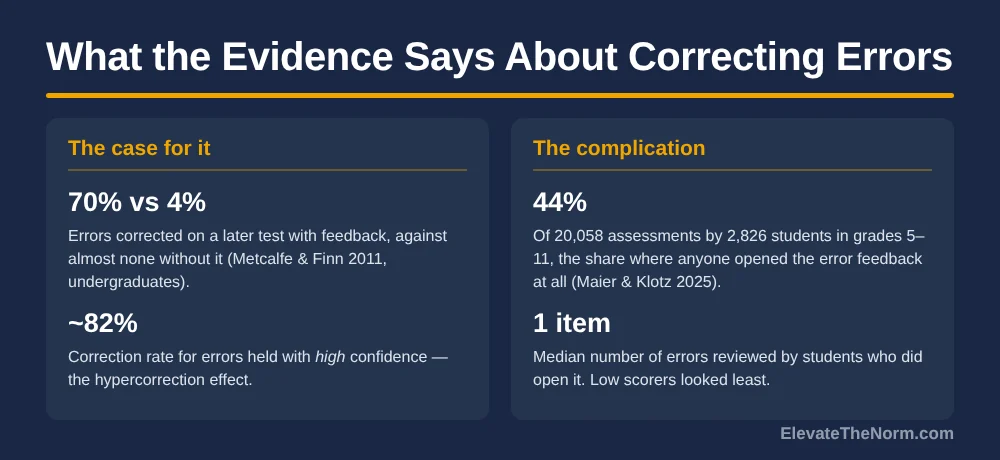
Uwe Maier and Christian Klotz analyzed log data from an adaptive grammar app used in German secondary schools, in a paper titled “Students Ignore Their Mistakes” in Contemporary Educational Psychology in 2025. The scale is unusual: 20,058 formative assessment cases from 2,826 students in 182 secondary classrooms, grades 5 through 11. After each assessment the app offered a detailed error feedback page explaining what went wrong.
What students did with it:
- They opened the error feedback page in only 44% of cases. In the majority of assessments, nobody looked at the explanation at all.
- Among those who opened it, the median number of error items reviewed was one. The average was 1.74.
- Low scores went with less looking. The authors found low formative assessment scores, which they read as low prior knowledge, “strongly associated with reduced error feedback seeking.” Earlier research the paper reviews found the same pattern: low-achieving students tend to ignore elaborated feedback, despite being the group most likely to benefit from it.
- Students who were sure of their answers were more likely to open the feedback, especially on assessments they had failed.
That’s a digital grammar app rather than a paper test, and German secondary schools rather than American ones, so the exact rates won’t be yours. But the shape of it will be. Optional reflection is self-selecting, and it selects for the students who already understand the material. Any correction process you design has to assume the student who most needs it will skip it unless the structure doesn’t permit skipping.
Does an Exam Wrapper or Reflection Sheet Improve Test Scores?
A reflection sheet on its own doesn’t reliably improve test scores. A study of exam wrappers, the short reflection forms students fill out after a returned exam, found no gains in exam scores, final grades, or measured metacognition.
Raechel Soicher and Regan Gurung studied exam wrappers in a single course, reflection sheets about how students studied and what they’ll change. Published in Psychology Learning & Teaching in 2017, the study put 86 students in three conditions: real exam wrappers with metacognitive instruction, sham wrappers with no instruction, or a control group. There were no improvements in exam performance, final grades, or measured metacognitive ability. Scores on the Metacognitive Awareness Inventory rose over the semester in every condition, including the control, which is a reminder of what happens to an uncontrolled before-and-after comparison.
Earlier research the authors cite found benefits when students used wrappers in more than one course, so a single course may be too small a dose. Fair. But the practical lesson for a secondary teacher is immediate: if your test correction process is a sheet of reflection prompts stapled to the front, you’ve bought the packaging and not the thing. The questions that produce learning are about the specific item — this question, this error, this misconception — not about study habits in general.
What Should a Test Correction Form Include?
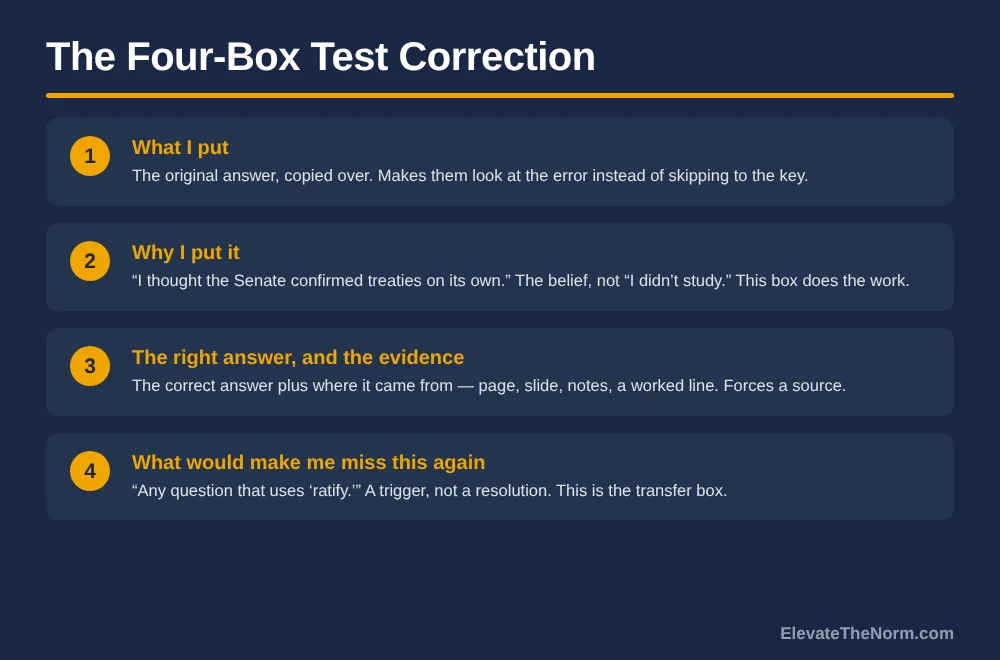
A test correction form should give each wrong answer four boxes: what I put, why I put it, the right answer with its evidence, and what would make me miss it again. Four boxes is the smallest structure that makes copying an answer useless.
| Box | What the student writes | Why it is there |
|---|---|---|
| 1. What I put | The original answer, copied over. | Makes them look at the error rather than skipping straight to the key. Takes five seconds. |
| 2. Why I put it | “I thought the Senate confirmed treaties on its own.” A sentence naming the belief, not “I didn’t study.” | This is the box that does the work. It is also the one students resist, because it requires admitting what they believed. |
| 3. The right answer, and the evidence | The correct answer plus where it came from — page, slide, notes, a worked line. | Forces a source. A student who cannot find it does not understand it yet, and now you both know. |
| 4. What would make me miss this again | “Any question that uses ‘ratify.’” A trigger, not a resolution. | Transfer. The point is the next question of this type, not this question. |
Box 2 is the one people cut when they’re short on time, and it’s the only one that distinguishes this from an answer key. “Careless mistake” isn’t an acceptable entry in box 2 more than once per test; if a student writes it three times, the pattern is the finding and it’s worth a two-minute conversation.
For a free-response or math item, box 3 becomes “the first line where it went wrong,” which is more useful than reworking the whole problem and usually faster.
How Much Credit Should Test Corrections Be Worth?
Test corrections should be worth enough that students do them and little enough that the grade still means something. Half the missed points back is a common, defensible answer. So is a flat cap: corrections can move a score up to a 79 and no further.
Credit for corrections holds up for the same reason most extra credit arrangements don’t — the points still measure the learning the grade claims to report. The inflation risk is real, though. In one college engineering technology course, class test averages rose 5% in 2018 and 3% in 2019 once corrections were offered, and 80% of the 61 students took part. That report had no control group, and its author says plainly that the changes “did however cause grade inflation.”
Three things to settle before you announce it:
- Check your district’s grading policy first. Many boards have adopted language about reassessment, grade replacement, and minimum scores. A teacher-invented points-back scheme that conflicts with board policy is a problem that has nothing to do with pedagogy, and you’ll lose that argument in March rather than in September.
- Write it down and hand it out. Parents are reasonable about a policy that exists and furious about one that appears to change by student. “Up to half the missed points, corrections due within one week, box 2 must be completed” fits on an index card.
- Decide whether a correction can raise an A. The honest answer is yes. A student who got a 97 has three errors worth understanding, and excluding the strongest students from the only reteaching structure in the class is backwards. If credit is the only incentive you have, offer the strongest students the thing they actually want: the correction counts, and it gets read.
A note on what this does to your gradebook. If corrections replace scores rather than adding points, you’re most of the way to standards-based grading already, and you should read the honest case against it before you commit, because the implementation problems there are real.
Should I Use Test Corrections or a Retake?
A test correction analyzes the test the student already took, and a retake is a new assessment of the same material. They answer different questions, so neither one substitutes for the other.
If the retake half is the part you’re still arguing about, the evidence on whether students should be allowed to retake tests — including where it cuts against the practice — is worked through separately, with a policy you can hand to an administrator.
- Use corrections when the errors are scattered. A 71 made of eleven different small mistakes is a diagnosis problem. Corrections surface the pattern.
- Use a retake when the student didn’t know the material. A 44 doesn’t have a pattern to find. It has a hole, and corrections on a test you didn’t understand is just copying.
- Use both, in order, when the stakes are real. Corrections first, as the price of admission to the retake. It’s a reasonable gate and it stops the retake from being a free second roll of the dice.
Sequencing them that way also solves a fairness problem administrators raise: if a retake is available to anyone who asks, the students who ask are the students whose families know to ask. Requiring the correction makes the path the same for everybody. One high school math teacher writing in Edutopia skips partial credit entirely: she goes over corrections with a small group, then retests a day or two later for full credit.
What About the Student Who Just Copies the Right Answer?
A student can’t copy their way through a test correction that requires a “why I put it” box, because nobody can copy someone else’s misconception. Assume copying will happen and build the correction so it doesn’t pay.
Beyond that the answers are ordinary. Do corrections in class, not as homework, at least the first few times — so you see the thinking happen and so students without a quiet place to work aren’t disadvantaged. Spend two of those minutes circulating and asking one student per row to explain box 2 out loud.
How Do I Grade Test Corrections Without Drowning in Paper?
Grading test corrections stays manageable when students correct only their five worst items and the teacher scores only the reasoning box, pass/fail. A teacher with 150 students who reads four boxes on every missed item will usually stop doing corrections within a few weeks.
Three ways to make it survivable:
- Cap it. Students correct their five worst items, not all of them. Five is plenty for a pattern and it bounds your reading.
- Score box 2 only, and score it pass/fail. A complete, specific sentence gets the credit. A blank or “I didn’t study” doesn’t. You can do that at a glance.
- Read them as a class set, not as individual papers. Sort the box-2 responses into piles by misconception. Five minutes of sorting tells you what to reteach tomorrow, which is the only reason to collect them at all.
That last one is also the answer to a coach’s question: the evidence of learning isn’t the corrected test. It’s what you teach differently on the next item of that type, and whether the same misconception shows up again on the unit after this one. If it does, the corrections were decoration. The habit of asking that question after an assessment is the same one behind any serious approach to checking for understanding.
What Do Test Corrections Look Like From a Student’s Seat?
For a student, a test correction means writing down, in their own words, the thing they were wrong about. That’s harder than it sounds at fifteen, and it’s worth naming out loud the first time you assign it.
Say the thing directly: this isn’t a punishment, everyone does it including the people who scored highest, and nobody is reading box 2 to laugh at you. Then make that true. A correction process where the teacher reads a student’s misconception back to them in front of the class is a process that will be filled in with nothing real by Thanksgiving.
Students should also be able to argue. If a student’s box 2 says “I put B because the question says ‘primarily,’ and both A and B are true,” they may be right and the item may be bad. Give points back when they are. A correction process in which the teacher is never wrong is one the students will correctly read as theater.
And handle accommodations through the plan, not through the policy. A student with extended time or a scribe on the test has the same entitlement on the correction. A student with a processing or writing accommodation can answer box 2 out loud to you in ninety seconds; the requirement is the thinking, not the handwriting. The plan governs, and designing the correction so that honoring it looks ordinary is easier than making an exception every time.
What Mistakes Make Test Corrections Fail?
Test corrections fail when they turn into a points economy, when only failing students do them, or when nobody reads the reasoning. Each of the five mistakes below turns a correction back into paperwork.
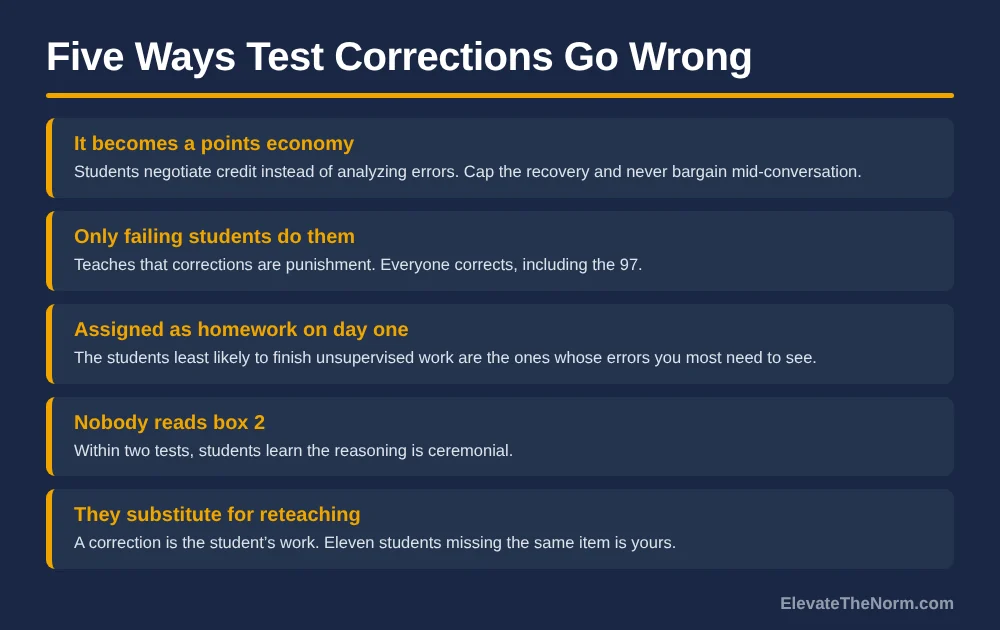
- They become a points economy. Students negotiate credit instead of analyzing errors. Fix: cap the recovery and never bargain over it mid-conversation.
- Only failing students do them. Which teaches that corrections are what happens when you mess up, rather than what everyone does with a returned test. Fix: everyone corrects, including the 97.
- They’re assigned as homework on day one. The students least likely to complete unsupervised work are the students whose errors you most need to see — the same self-selection Maier and Klotz measured.
- Nobody reads box 2. If the teacher never responds to the reasoning, students learn within two tests that the reasoning is ceremonial.
- They substitute for reteaching. A correction is the student’s work. If eleven students missed the same item, that’s your work.
How Do I Start Using Test Corrections on the Next Test?
Start test corrections on the next test you hand back by requiring them from every student, making the “why I put it” box mandatory for credit, and sorting those boxes before you plan the next lesson.
- Require corrections from every student, not just the ones who failed.
- Make box 2 — why I put it — mandatory for credit, and refuse “careless mistake” as a repeat answer.
- Do the first round in class, so you can see the thinking happen.
- Sort the box-2 responses into piles before you plan tomorrow, because that pile is the most honest data you’ll get all unit.
The deeper argument here isn’t about points. It’s that a test handed back and filed away teaches a teenager that a wrong answer is a verdict, and a test corrected teaches them it’s information. That’s the same case the site makes about learning from mistakes everywhere else, and it’s the reason a correction belongs in the student’s hands rather than the gradebook — which is also the argument for student self-assessment as a routine rather than an event.
Corrections only work if the student can check an answer against something, which is why I would not run them on a test without a key. The midterm library at Mid-Terms.org has 200 free printable exams for grades 6–12, every one with an answer key, across Social Studies, ELA, Math and Science.
Test corrections are retrieval practice after the fact. Running the same mechanism before the test is cheaper, and the study skills research explains why a few minutes of closed-notes recall beats an hour of rereading.
Before you go: grab the free The Test Correction Sheet and Policy Card (2 pages) (PDF) — ElevateTheNorm.com branded, printable, no email required.
A surprising share of wrong answers on a reading assessment are not comprehension failures at all; they are students answering a different question from the one asked. “Central idea,” “main idea” and “theme” appear on the same test and are routinely treated as synonyms. What each of those three terms actually means is worth going through before the next corrections round, with the three-step method students use to find the central idea.
Frequently Asked Questions
Do test corrections actually work?
Test corrections work when students get feedback and have to explain their errors. Janet Metcalfe’s 2017 review in the Annual Review of Psychology found that errorful learning followed by corrective feedback is beneficial to learning, and in one lab study errors were corrected about 70 percent of the time with feedback against roughly 4 percent without it. Optional corrections mostly don’t work, because the students who need them skip them.
Should test corrections be optional?
Test corrections shouldn’t be optional. In a study of 20,058 assessments from 2,826 students in grades 5 to 11, students opened detailed error feedback in only 44 percent of cases, and students with low scores were the least likely to look. A correction process has to be built so the students who most need it can’t quietly opt out, which means requiring it from everyone.
How much credit should test corrections be worth?
Test corrections should be worth enough that students do them and little enough that the grade still means something. Half the missed points back is a common, defensible rule, and so is a cap that lets corrections raise a score to a 79 and no further. Check the district’s grading and reassessment policy first, write the rule down, and apply it the same way to every student.
What is the difference between test corrections and a retake?
A test correction analyzes the test a student already took, while a retake is a new assessment of the same material. Corrections fit scattered errors, like a 71 built from eleven small mistakes. A retake fits a student who didn’t know the material, like a 44. When the stakes are real, use both in order and make the completed correction the price of admission to the retake.
How do I stop students from just copying the right answer on test corrections?
Students can’t copy their way through a test correction that requires a “why I put it” box naming the belief behind the wrong answer, because nobody can copy someone else’s misconception. Do the first few rounds in class rather than as homework, so the thinking happens where the teacher can see it, and ask one student per row to explain that box out loud.
Should students who got an A do test corrections?
Students who score an A should do test corrections too. A 97 still has three errors worth understanding, and leaving the strongest students out of the only reteaching structure in the class is backwards. Requiring corrections from everyone also protects dignity: if only failing students correct, corrections start to look like a punishment instead of what everyone does with a returned test.
How do I grade test corrections for 150 students?
Grading test corrections for 150 students is manageable with three limits: students correct only their five worst items, the teacher scores only the reasoning box, and that box is scored pass/fail at a glance. Then sort the reasoning boxes into piles by misconception. A few minutes of sorting shows what to reteach tomorrow, which is the main reason to collect corrections.
Do test corrections work for students with IEPs or 504 plans?
Test corrections work for students with IEPs or 504 plans when the plan governs the correction the same way it governs the test. A student with extended time or a scribe on the test gets the same support on the correction. A student with a writing accommodation can explain the “why I put it” box out loud, because the requirement is the thinking, not the handwriting.
Sources
- Metcalfe, Janet. “Learning from Errors.” Annual Review of Psychology, vol. 68, 2017, pp. 465–489. Review concluding that error avoidance “appears to be the rule in American classrooms” and that errorful learning followed by corrective feedback is “beneficial to learning”; that corrective feedback “including analysis of the reasoning leading up to the mistake” is crucial; and suggesting it may be worthwhile to allow students to commit and correct errors in low-stakes situations. A review of laboratory evidence, not a classroom trial. https://www.annualreviews.org/content/journals/10.1146/annurev-psych-010416-044022
- Metcalfe, Janet, and Bridgid Finn. “People’s Hypercorrection of High-Confidence Errors: Did They Know It All Along?” Journal of Experimental Psychology: Learning, Memory, and Cognition, vol. 37, no. 2, 2011, pp. 437–448. Three experiments, 25–45 participants each. High-confidence errors corrected at roughly 82% on the final test; overall recall with feedback about 70%; correction without feedback roughly 4%. College undergraduates answering general-knowledge questions in a laboratory, not secondary students on a unit test. https://pmc.ncbi.nlm.nih.gov/articles/PMC3079415
- Maier, Uwe, and Christian Klotz. “Students Ignore Their Mistakes: Elaborated Error Feedback Processing in a Digital Learning System.” Contemporary Educational Psychology, vol. 82, 2025, article 102395. Observational log analysis of 20,058 formative assessment cases from 2,826 students across 182 secondary classrooms, grades 5–11. Error feedback opened in 44% of cases; median one error item reviewed, mean 1.74; low formative assessment scores “strongly associated with reduced error feedback seeking.” Observational, German secondary schools, a digital grammar application rather than a paper test. https://www.sciencedirect.com/science/article/pii/S0361476X25000608
- Soicher, Raechel N., and Regan A. R. Gurung. “Do Exam Wrappers Increase Metacognition and Performance? A Single Course Intervention.” Psychology Learning & Teaching, 2017, pp. 64–73. 86 students in three conditions: exam wrappers, sham wrappers, or control. No improvement in exam performance, final grades, or Metacognitive Awareness Inventory scores; MAI rose in all conditions including control. A single-course study; the abstract cites earlier research finding benefits when wrappers were used in more than one course. https://liberalarts.oregonstate.edu/biblio/do-exam-wrappers-increase-metacognition-and-performance-single-course-intervention
- Rice, Bethany S. “How Extra Credit Quizzes and Test Corrections Improve Student Learning While Reducing Stress.” ASEE 127th Annual Conference & Exposition, 2020. Average exam scores rose 5% (2018) and 3% (2019) when corrections were offered; 80% of students participated; survey responses strongly favorable (4.8 of 5); the author notes the changes “did however cause grade inflation.” Cited as a descriptive classroom report, not a controlled study: no comparison group, 31 survey respondents, university engineering technology students. https://peer.asee.org/how-extra-credit-quizzes-and-test-corrections-improve-student-learning-while-reducing-stress.pdf
- McDade, Margaret. “Using Test Corrections as a Learning Tool.” Edutopia, George Lucas Educational Foundation. A high school math teacher’s small-group correction routine, with retesting for full credit rather than partial credit on corrections. Cited as practice knowledge: the article reports a teacher’s own method and cites no studies. https://www.edutopia.org/article/test-corrections-high-school-math/