The Elevate Blog banner: Real Classrooms. Practical Ideas. Higher Expectations. Three students climb a rocky ridge at sunrise, each pulling the next one up, toward a teacher reaching down to help.

Category: Classroom Management

Behavior, routines, and what actually holds a room together without raising your voice.

  • Activities for Teaching Responsibility to Middle and High School Students

    Activities for Teaching Responsibility to Middle and High School Students

    By Clay Shumate · Updated October 24, 2026

    The best activities for teaching responsibility to middle and high school students give students something to actually own, not a lecture about character. Below are ten activities built around real ownership, structured reflection, and clear repair after mistakes, sequenced from ones you can add to a class you already run to ones that take more trust to pull off. Before selecting activities, it helps to clarify what you are building—the article on what is student responsibility offers a definition that distinguishes genuine ownership from simple compliance.

    Key Takeaways

    • Responsibility is a practiced behavior, not a character trait you either have or lack. Adolescents develop it through repeated opportunities to own tasks, meet deadlines, and deal honestly with what happens when they fall short.
    • The best responsibility activities for secondary students involve real stakes within safe boundaries — meaning the work matters, but a failure does not destroy a student’s standing or grade.
    • Self-regulation research confirms that adolescents benefit most from structured responsibility practice paired with warm, responsive adult relationships (Murray & Rosanbalm, 2017).
    • Reflection is where responsibility actually grows. An activity without a reflection step is just compliance — the student did the thing but never examined why it mattered.
    • Repair after mistakes is the hardest part to teach and the most important. It requires activities that go beyond “say sorry” and into “what do you owe, to whom, and by when?”

    Why Do Activities Teach Responsibility Better Than Lectures?

    Most educators agree that responsibility matters. The disagreement is about how it develops. One approach treats responsibility as a character trait: talk about it, model it, hope students absorb it. The other approach treats responsibility as a skill: design situations where students practice it, receive feedback, and try again.
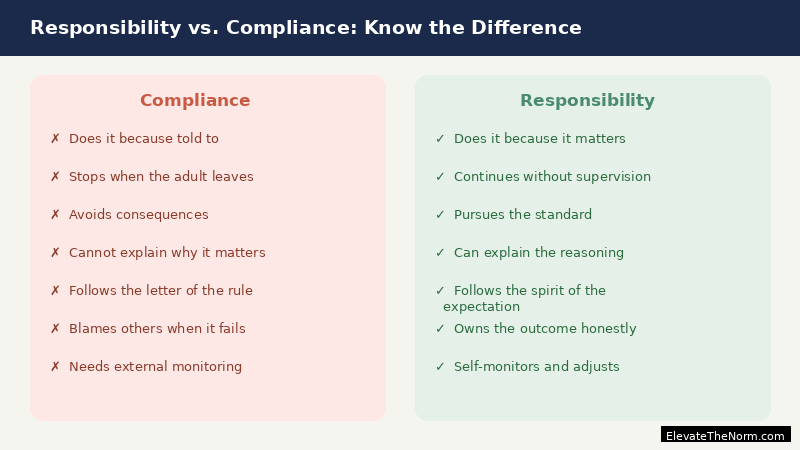
    Comparison showing the difference between teaching responsibility and teaching compliance, with responsibility involving genuine choice and self-assessment while compliance involves following rules without reflection
    Responsibility internalizes through genuine choice and honest reflection — not through compliance alone.

    The research supports the second approach. Self-determination theory, developed by Deci and Ryan and applied extensively in educational settings, identifies autonomy, competence, and relatedness as the three psychological needs that drive internalized motivation (Ryan & Deci, 2020). Responsibility does not internalize through compliance — it internalizes when students experience genuine choice, see evidence of their own competence, and feel connected to the people holding them accountable. Understanding what actually motivates students is the foundation for designing responsibility activities that work.

    That is what the activities below are designed to create. Each one gives students something real to own, a clear standard to meet, a structure for reflection when they fall short, and a path back after a mistake.

    What Are the Best Activities for Teaching Responsibility?

    1. The Deadline Choice Contract

    Instead of assigning a single due date, give students a planning window. They choose when to submit — within a defined range — and commit to that date in writing. If they meet their chosen deadline, the work is graded normally. If they miss it, they complete a brief reflection: what happened, what they would change, and what their revised deadline is.

    Why it works: It shifts the locus of control. The teacher is no longer the person imposing the deadline — the student chose it. Missing it becomes a broken commitment to themselves, not just a rule violation.

    What to watch: Some students will choose the latest possible date every time. That is fine. The skill is making a plan and keeping it, not choosing the earliest date to impress the teacher.

    2. The Group Role Rotation

    Assign clear, named roles within group work — timekeeper, recorder, quality checker, presenter — and rotate them across projects. Each role comes with specific deliverables. After each project, every student writes a one-paragraph self-assessment of how they handled their role, and the group writes a brief evaluation of how the rotation worked.

    Why it works: Named roles with deliverables make responsibility visible. A student who was the quality checker either caught errors or did not — there is evidence. The rotation prevents students from hiding in the same comfortable role every time. The same logic scales past group work: a role is only worth assigning when the student controls something real.

    What to watch: Do not let the “quality checker” role become a way for strong students to redo weak students’ work. The role checks quality and identifies problems — it does not fix them for the other person.

    Naming what the role is meant to develop keeps that line clear. Our breakdown of what a leadership skill is, as opposed to a personality trait gives you the observable behaviour for each one, which is also the fairest way to grade a role.

    3. The Missing-Work Conversation

    When a student misses an assignment, replace the zero-and-move-on approach with a structured conversation. The student answers three questions in writing before the conversation: What was the assignment? What got in the way? What is your plan to complete it?

    This is not optional and it is not a punishment. It is the practice of taking responsibility for an incomplete obligation.

    Why it works: It requires the student to acknowledge the gap honestly and propose a solution — two components of genuine responsibility that a zero on a gradebook never teaches.

    What to watch: Keep it brief and private. This is a five-minute conversation at the whiteboard table, not a public interrogation. The goal is a plan, not a confession. And account for circumstances beyond the student’s control — transportation problems, family obligations, lack of internet access at home, or a job that keeps them up late. The conversation should distinguish between a student who chose not to do the work and a student who could not. Both need a plan. Only the first needs a conversation about choices.
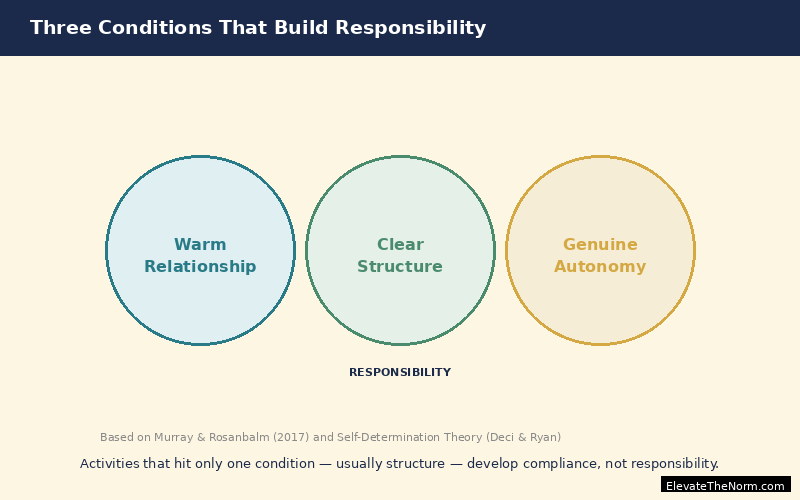
    Diagram showing the three conditions research identifies for building adolescent responsibility: warm adult relationships, structured environment with clear expectations, and genuine autonomy within structures
    Self-regulation research identifies three conditions that help adolescents build genuine responsibility.

    4. The Repair Letter

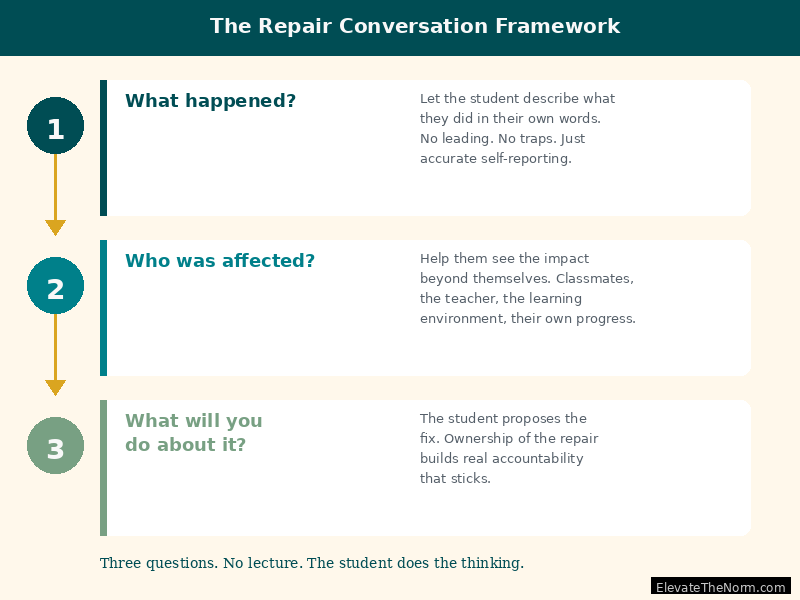
    After a significant behavioral incident — not every small disruption, but the ones that damage trust or affect other students — ask the student to write a letter addressing three things: what happened (facts, not excuses), who was affected and how, and what they will do differently. The letter is not graded. It is reviewed by the teacher, discussed, and then the incident is considered addressed.

    I use this after repair conversations in my room. When something goes wrong — when a student lets a group down, or says something they should not have — we sit down and talk about what is owed, to whom, and by when. The letter is the student’s record of that conversation. It matters because writing it requires them to articulate what they are taking responsibility for, not just nod and leave. The repair process connects directly to the broader idea of helping students learn from their mistakes rather than simply penalizing them.

    Why it works: It connects behavior to impact. Most adolescents are not trying to cause harm — they are impulsive, reactive, or unaware. The letter forces awareness without humiliation.

    What to watch: Never require a forced apology. The letter should be honest. If a student genuinely believes they were not wrong, the conversation that follows the letter is more useful than the letter itself. And be clear: a repair letter does not replace required school discipline documentation. If your school policy requires an incident report, a referral, or a parent contact for the behavior in question, complete those first. The repair letter is an addition to the process, not a substitute for it.

    5. The Project Check-In Protocol

    For any multi-day assignment or project, build in structured check-ins where the student — not the teacher — reports on progress. The format is simple: What have I done? What is next? What am I stuck on?

    During check-ins, the student explains their choices and defends their decisions. “I chose to focus on the primary source analysis first because…” is more useful than a teacher looking over a shoulder and saying “You’re behind.”

    Why it works: It practices the professional skill of giving a progress report — something adults do constantly and students almost never practice. It also creates a record: if a student says “I’m on track” at the check-in and then is not on track at the deadline, the gap between their self-assessment and their output becomes the teaching moment.

    What to watch: Do not turn check-ins into micromanagement. The point is for the student to report and reflect, not for the teacher to direct every decision.

    6. The Self-Assessment Before the Grade

    Before returning a graded assignment, have students assess their own work against the rubric. They predict their score, identify their strongest section, and name one area where they fell short. Then they receive the actual grade and compare.

    Why it works: Self-assessment accuracy is a metacognitive skill directly tied to responsibility. Students who consistently overestimate their work are not being arrogant — they are not seeing their own gaps. Students who consistently underestimate may not be recognizing their own competence. Either pattern is worth a conversation.

    What to watch: This works best with a clear, student-friendly rubric distributed before the assignment. If students do not know what “proficient” looks like in advance, the self-assessment is just guessing.
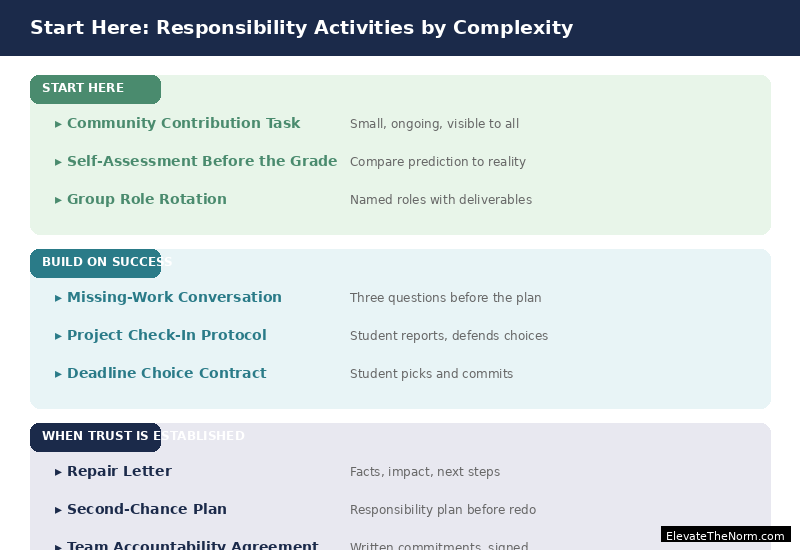
    Chart organizing ten responsibility activities by complexity level from simple to advanced, showing which work best for middle school versus high school students
    Start with two or three activities and add more as you and your students get comfortable.

    7. The Responsibility Debrief

    At the end of a unit, project, or quarter, students write a responsibility reflection: What commitment did I keep this unit? What commitment did I break? What did I learn about how I work? What will I do differently next time?

    Why it works: It normalizes honest self-evaluation. Most schools give students grades but never ask them to reflect on the habits that produced those grades. The debrief is where students connect effort to outcome — or more importantly, connect avoidance to outcome.

    What to watch: Students will write what they think you want to hear unless you make it clear that honesty is valued more than optimism. Share your own example if you can: a time this semester when you planned poorly, fell behind, and had to adjust.

    8. The Team Accountability Agreement

    Before any group project, each team writes a brief agreement: what each person is responsible for, when each piece is due, what happens if someone does not deliver, and how the group will handle conflict. The agreement is signed and kept by the teacher.

    Why it works: It front-loads responsibility instead of back-loading blame. When a group falls apart — and some will — the agreement provides a reference point for a conversation that is about commitments, not feelings.

    What to watch: Do not let the “what happens if someone does not deliver” section become punitive. The healthiest answer is usually “We have a conversation and make a plan” — not “They get a zero.” Effective classroom consequences are always about what comes next, not just what went wrong.

    9. The Community Contribution Task

    Assign each student a real, ongoing responsibility that serves the class: maintaining the supply station, updating the assignment board, organizing returned work, or keeping the shared digital folder clean. The task is small, consistent, and visible.

    Why it works: It gives students a piece of the room to own. Not a pretend ownership — an actual, ongoing responsibility where others notice if it does not get done. The student is not doing it for a grade. They are doing it because the room needs it done.

    What to watch: Rotate tasks quarterly so the same students do not get stuck with the least appealing jobs. And acknowledge it when it is done well — not with a reward, but with a thank-you that names what they contributed.

    10. The Second-Chance Plan

    When a student bombs an assignment or test, offer a structured second attempt. The catch: before they can redo the work, they must complete a responsibility plan. What happened the first time? What will they do differently? What specific support do they need? They submit the plan, the teacher approves it, and then they redo the work.

    Why it works: It separates the failure from the identity. “You failed this assignment” is a fact. “You are a failure” is a conclusion students draw when there is no path forward. The second-chance plan keeps the standard high — you still have to meet it — while making the path back visible.

    What to watch: Set a clear window for the redo. “Whenever you get around to it” is not a plan — it is an invitation to never complete it. A deadline on the redo teaches the same skill as the original deadline.

    ActivityWhat the student ownsGood first pick?
    1. Deadline Choice ContractA due date they chose within a windowYes
    2. Group Role RotationA named role with specific deliverables
    3. Missing-Work ConversationA written plan for an incomplete assignment
    4. Repair LetterThe impact of a significant incident on others
    5. Project Check-In ProtocolReporting their own progress on multi-day workYes
    6. Self-Assessment Before the GradeA predicted score checked against the rubricYes
    7. Responsibility DebriefCommitments kept and broken over a unit
    8. Team Accountability AgreementTheir piece of a group plan, agreed up front
    9. Community Contribution TaskAn ongoing class job, rotated quarterly
    10. Second-Chance PlanA plan for the redo before the redo
    The ten responsibility activities at a glance. Start with two or three.

    Why Do Responsibility Activities Fail?

    The most common failure is not the activities themselves — it is the gap between the activity and the follow-through.

    Responsibility activities fail when teachers assign them but do not follow up on the reflections. They fail when the consequences for not completing a responsibility task are identical to the consequences for not completing any other assignment — a zero in the gradebook. And they fail when the activities are age-inappropriate, making teenagers feel like they are being managed rather than developed.

    Research on adolescent self-regulation confirms that young people build responsibility most effectively when three conditions are present: a warm relationship with the adult holding them accountable, a structured environment where classroom expectations are clear, and genuine autonomy within those structures (Murray & Rosanbalm, 2017). Activities that check all three boxes develop responsibility. Activities that hit only one — usually structure — develop compliance.

    Before You Start: Tell Families What You Are Doing

    Responsibility activities work best when families understand the framework. Early in the year — ideally before the first missed assignment or behavioral conversation — communicate to parents and guardians what your classroom responsibility process looks like: that students will be asked to reflect on missed work rather than simply receive zeros, that repair conversations focus on what is owed rather than punishment, and that second chances come with plans attached. A family that understands the system can reinforce it. A family that encounters it only when their child is in trouble will question it. A student led conference template lets students explain their own progress to families.

    What Does Teaching Responsibility Look Like Day to Day?

    It looks like follow-through. It looks like a teacher who says “I will check your progress on Thursday” and then checks on Thursday. It looks like a room where a student who missed a deadline has a conversation — not a lecture, not a zero entered silently — about what happened and what comes next.

    It also looks like grace. Not the kind of grace that eliminates standards, but the kind that maintains them while holding the door open. A student who writes an honest responsibility reflection about why they did not finish a project — and then finishes it — has learned more about responsibility than a student who met every deadline without ever having to recover from a miss.

    The goal is not to produce students who never fail. It is to produce students who know what they owe when they do. For a deeper look at how teaching responsibility connects to broader classroom culture, and the research behind why student responsibility is a skill rather than a trait, those articles explore the framework in more detail.

    If you want more classroom-tested ideas like these on a regular schedule, I send a short issue of Bell to Bell every Wednesday for grades 6–12 teachers. It is free, and every other issue includes a printable classroom resource.


    What are good responsibility activities for high school students?

    High school students can handle the full range: the deadline choice contract, the project check-in protocol, self-assessment before the grade, the team accountability agreement, the repair letter, and the second-chance plan. Each gives students something real to own, a clear standard, a structure for reflection when they fall short, and a path back after a mistake.

    How do you teach responsibility to middle school students?

    Use simpler versions with concrete ownership: the community contribution task and the group role rotation work well in grades 6–8. Keep reflection short, follow up on every commitment, and add planning-heavy activities such as the deadline choice contract as students build the capacity for abstract thinking and self-reflection.

    At what age should responsibility activities start in school?

    Responsibility activities should be developmentally appropriate at every grade, but the version described here — involving self-assessment, planning, written reflection, and repair — is designed for grades 6–12. Middle schoolers can handle simpler versions (the community contribution task, the group role rotation). High schoolers can handle the full range, including the deadline choice contract and the second-chance plan. The key is matching the complexity of the activity to the student’s capacity for abstract thinking and self-reflection.

    How do you teach responsibility without making it feel like a punishment?

    By separating the activity from consequences. A repair letter is not a punishment — it is a process for honest self-examination. A second-chance plan is not a penalty — it is a structured path to improvement. The tone of the teacher matters more than the structure of the activity. If you approach a responsibility conversation with curiosity (“What happened?”) rather than judgment (“Why didn’t you…?”), students are more likely to engage honestly.

    What if a student refuses to participate in a responsibility activity?

    Start with a private conversation. Ask what is getting in the way. Sometimes refusal is about the activity; sometimes it is about something else entirely. If the student still refuses after the conversation, document the refusal and follow your classroom or school procedure — but do not abandon the expectation. The activity stands. The student may need more time, a different format, or a different adult to have the conversation with.

    Do responsibility activities work for students with IEPs or behavioral plans?

    Yes, with modifications. Consult the IEP or 504 plan first — some students have specific accommodations around deadlines, reflection activities, or self-assessment that must be followed. The principles of responsibility still apply: students with behavioral plans deserve the same expectation of honest self-assessment, repair, and follow-through. The accommodations adjust the how, not the whether.

    How do you grade responsibility?

    Most of these activities should not carry a traditional grade. Grading a reflection on what went wrong creates an incentive to lie. The activities that are graded — the project, the assignment, the group work — carry grades based on the quality of the academic work. The responsibility activities support the academic work but are evaluated through conversation, not points.

    Can these activities backfire?

    Yes, if they are applied inconsistently. If one student writes a repair letter and another student who did the same thing does not, the first student learns that the system is arbitrary. Consistency across students is non-negotiable. The activities also backfire if the teacher does not follow through — assigning a responsibility reflection and then never reading it teaches students that the activity is busywork.

    How many of these activities should a teacher use at once?

    Start with two or three. The deadline choice contract, the self-assessment before the grade, and the project check-in protocol are a strong starting combination because they integrate into work you are already assigning. Add the repair letter and the responsibility debrief as you get comfortable. Trying all ten at once will overwhelm you and your students.


    Sources


    About Clay Shumate

    Clay Shumate is a certified secondary Social Studies teacher in the public schools of West Alabama, with seven years of classroom experience, a B.A. in History, and an M.Ed. in Secondary Education. He writes about project-based learning, student responsibility, respect, and practical ways to hold young people to a higher standard while giving them room to learn from mistakes. He is a member of the Society of Professional Journalists and writes to its Code of Ethics; this site’s editorial standards and corrections policy are published in full. More about Clay.
  • Chronic Absenteeism: What Actually Brings Students Back to Class

    Chronic Absenteeism: What Actually Brings Students Back to Class

    By Clay Shumate

    Chronic absenteeism means missing 10 percent or more of the school year — about eighteen days, excused and unexcused combined — and it’s sitting near a quarter of all U.S. students. Most of that isn’t about your lesson plans: illness and lost sleep outrank boredom by a wide margin. But re-entry, what happens the day a student walks back in, is squarely a teacher’s job, and most classrooms have no plan for it at all.

    Key Takeaways

    • Chronic absenteeism counts a student missing 10 percent or more of enrolled school days, excused and unexcused together — it is not the same thing as truancy, which is specifically about unexcused absences and can trigger legal consequences for a family.
    • The national rate peaked near 28.5 percent in 2022, fell to roughly 23.5–25 percent by 2024, and has stalled — the decline slowed enough in 2024 that a full return to the 15 percent pre-pandemic baseline is no longer guaranteed.
    • When students are asked directly why they missed school, illness and lack of sleep dominate the answers. Boredom and disengagement are real but smaller, and high schoolers actually report fewer disengagement reasons after the pandemic than before.
    • Attendance Works sorts causes into four categories — barriers, aversion, disengagement, and misconceptions — and a classroom teacher has real leverage over only two of them.
    • The best-evidenced classroom-adjacent lever isn’t a lesson plan; it’s what happens on re-entry day, and separately, honest and consistent family communication is one of the few things correlated with meaningfully lower rates.

    What Chronic Absenteeism Actually Means

    Chronic absenteeism is a student missing 10 percent or more of enrolled school days in a year — roughly eighteen days in a standard 180-day calendar, or about two days a month. Every state and most districts now track it because it correlates with weaker outcomes at every level, from third-grade reading to ninth-grade credit accumulation to graduation. The count includes excused and unexcused absences together. A student out with the flu for two weeks, a student with a broken attendance streak from oversleeping, and a student who simply stopped coming all land in the same statistic, and the number alone tells you nothing about which one you’re looking at.

    That combined counting is also what separates chronic absenteeism from truancy, and the two get confused constantly in casual conversation. Truancy is specifically about unexcused absences, and in most states it is a legal category with a defined escalation path — a set number of unexcused absences triggers truant status, repeated truancy can trigger a referral, and in the most severe cases a district attorney can pursue charges against a parent or guardian. Chronic absenteeism carries no such court process on its own. A student who is chronically absent because of documented illness has never been truant a single day. Confusing the two terms is how a school ends up applying a punitive, legal-track response to a problem that is, for most students, not a compliance problem at all.

    How Bad Is It, and Is It Getting Better?

    Nationally, chronic absenteeism held steady around 15 percent through the 2018 and 2019 school years. It jumped to roughly 28.5 percent at its 2022 peak, then eased to about 25.4 percent in 2023 and 23.5 percent in 2024. RAND’s 2024–25 district survey put the most recent figure at approximately 22 percent — nearly 11 million students. The trend line is real improvement, and it is also slowing down. Nat Malkus, who tracks the numbers for the American Enterprise Institute, has written plainly that the deceleration raises “the very real possibility that absenteeism rates might never return to pre-pandemic levels.”

    The average also hides where the actual crisis sits. Low-achieving districts went from about 19 percent chronically absent in 2018 to 35 percent in 2022; high-achieving districts moved from 10 percent to 19 percent over the same stretch — both got worse, but the gap between them widened. RAND found urban districts were five to six times more likely than rural or suburban ones to report extreme chronic absence, meaning 30 percent of students or more. If your school sits in that first group, the national “one in four” statistic is understating your actual room by a wide margin.

    The Four Root Causes — and Which Ones Are Actually Yours

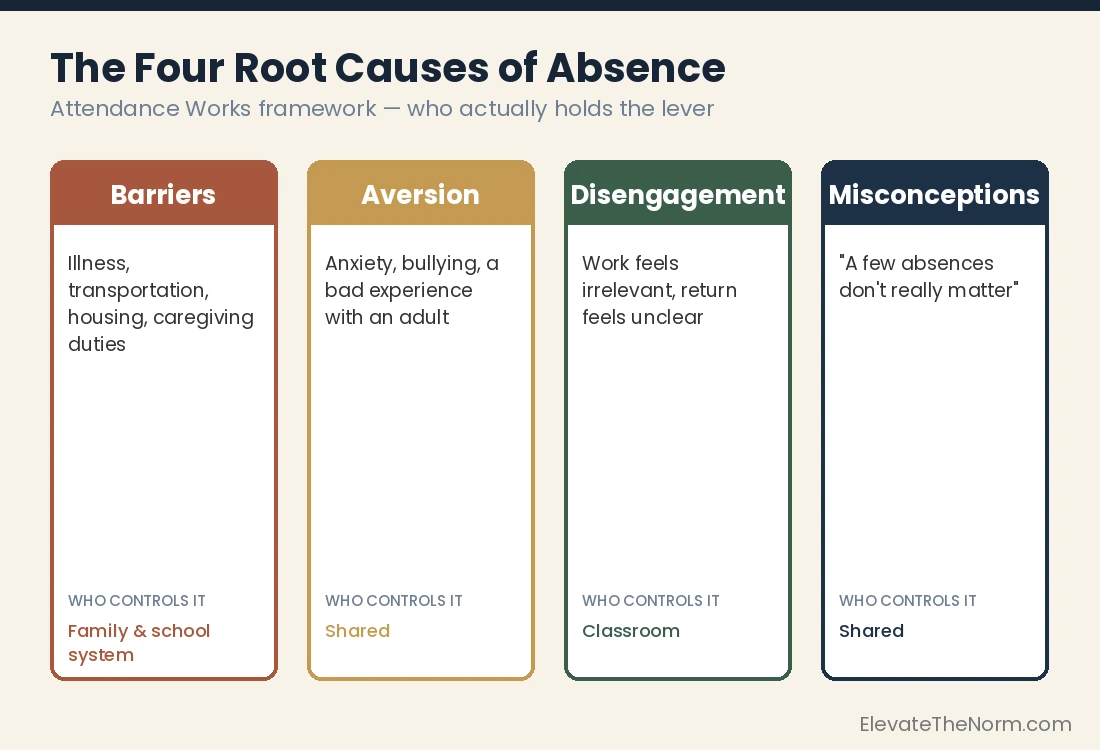
    Attendance Works, the research and policy organization most state departments of education cite on this topic, sorts every reason a student misses school into four categories: barriers, aversion, disengagement, and misconceptions about how much a few absences really matter. It’s a useful framework precisely because it forces an honest answer to the question every overwhelmed teacher eventually asks: which part of this is mine to fix?

    CategoryWhat it looks likeWho actually controls it
    BarriersIllness, unreliable transportation, unstable housing, caregiving duties for a sibling or family memberFamily, school system, community resources — not the classroom teacher
    AversionAnxiety about a specific class or hallway, bullying, a bad experience with a particular adultShared — a teacher can remove one specific aversion, but not the underlying anxiety
    DisengagementThe student sees no point in showing up because the work feels irrelevant or the return is unclearLargely the classroom — relevance, relationship, and clarity are teacher-level moves
    MisconceptionsBelief that a handful of absences “doesn’t really matter” as long as grades hold upShared — a teacher’s re-entry practice and a family’s messaging both shape this
    Four-category chart showing the root causes of chronic absenteeism: barriers, aversion, disengagement, and misconceptions, with who controls each one
    The Attendance Works framework for chronic absenteeism, showing which causes a classroom teacher can actually influence.

    Look at that middle column honestly and the division of labor gets clear fast. Barriers are not solvable from a classroom. No lesson plan fixes a broken car, an undiagnosed illness, or a kid watching a younger sibling because there’s nobody else. Pretending otherwise is how teachers end up carrying blame for outcomes they were never equipped to move, and it’s a big part of why attendance initiatives that live entirely inside individual classrooms tend to disappoint — they’re aimed at maybe half the problem.

    Why Most of It Isn’t About Your Classroom

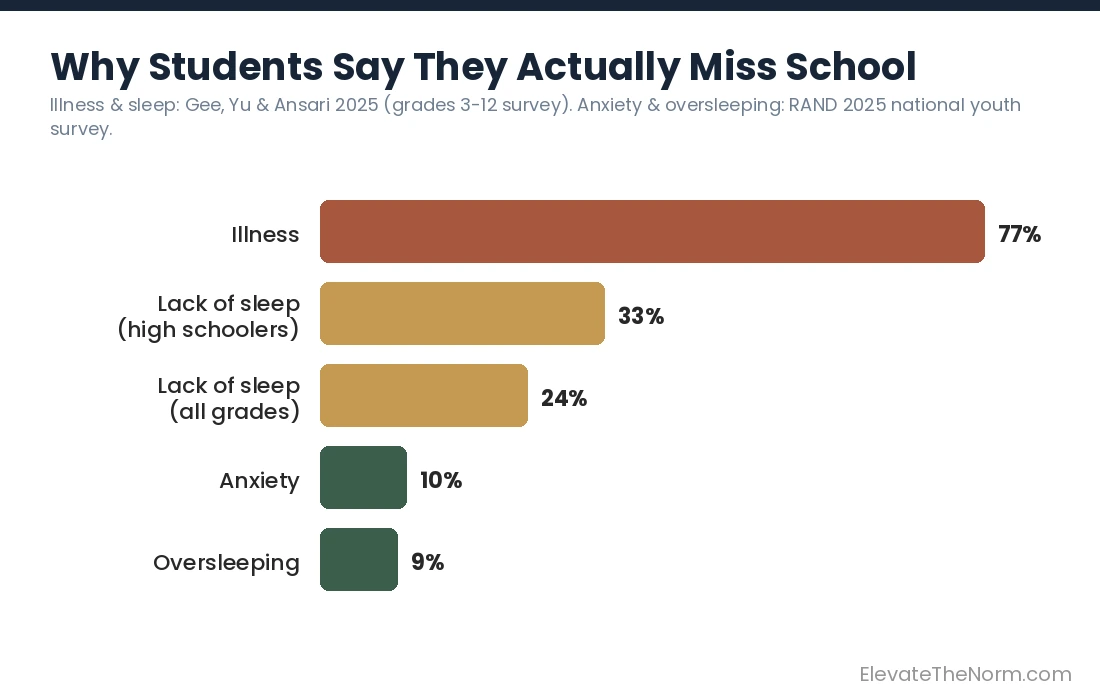
    When you ask students directly why they missed school, the answer that comes back most is not the one teacher-facing advice usually assumes. A 2025 analysis of Rhode Island survey data covering grades 3–12 found illness reported by roughly three-quarters of students both before and after the pandemic — 77 percent post-pandemic specifically. Lack of sleep came in second at 24 percent overall and a striking 33 percent among high schoolers. Boredom and safety concerns did rise after the pandemic, but from a much smaller base, and — this is the finding that should reshape how engagement gets talked about — high school students actually reported fewer disengagement reasons after the pandemic than before it. RAND’s national youth survey landed in the same place: 67 percent sickness, 10 percent anxiety, 9 percent oversleeping.

    Bar chart showing self-reported reasons students miss school: illness 77 percent, lack of sleep 33 percent among high schoolers and 24 percent overall, anxiety 10 percent, oversleeping 9 percent
    Illness and lost sleep outrank boredom by a wide margin in student-reported reasons for absence.

    That doesn’t mean engagement is irrelevant. It means engagement is not the lever most teacher-facing advice on this topic claims it is. If a school’s entire absenteeism strategy is “make class more interesting,” it is aimed at a real but minority slice of the problem, and it will underdeliver — not because the advice is wrong, but because it was never sized to the actual distribution of causes. For the students where disengagement genuinely is the driver, the deeper diagnosis and fix belong in a companion piece on what actually motivates students once rewards and speeches stop working — this page is about the much larger group whose absence has nothing to do with motivation at all.

    What’s Actually Yours: The Four Minutes That Change the Semester

    Here’s the honest, narrower claim. A classroom teacher cannot fix a transportation gap or an untreated illness. What a classroom teacher controls almost completely is what an absence costs a student once they’re back — and that cost is what determines whether eighteen missed days becomes thirty.

    I check the roster before the bell, not after. When I see a student has been out, I already know before they walk through the door — deciding what they need in the doorway, with the rest of the class watching, guarantees a bad decision made badly. If it’s a longer absence, that student gets pulled to the whiteboard table early — the same table I use for regular small-group work, not a separate “catch-up corner.” Low lamp, rug, better chairs. Students already know that table is where you go to be worked with, not managed. That matters more than it sounds like it should: a student coming back from eighteen missed days is highly sensitive to whether re-entry feels like punishment or like being picked back up.

    Reserve the full version of this for absences that actually need it — three or more days, or a pattern, not a single day for a dentist appointment. And none of what follows replaces your school’s required attendance reporting or truancy referral process. If a student’s pattern of absence raises a safety concern — signs of neglect, abuse, homelessness, or anything that meets your district’s mandated-reporting threshold — that goes to your counselor or administrator through the normal protocol immediately, separate from and before any classroom routine. Re-entry is about what a teacher does with the students in front of them; it is not a substitute for the systems built to catch the more serious cases.

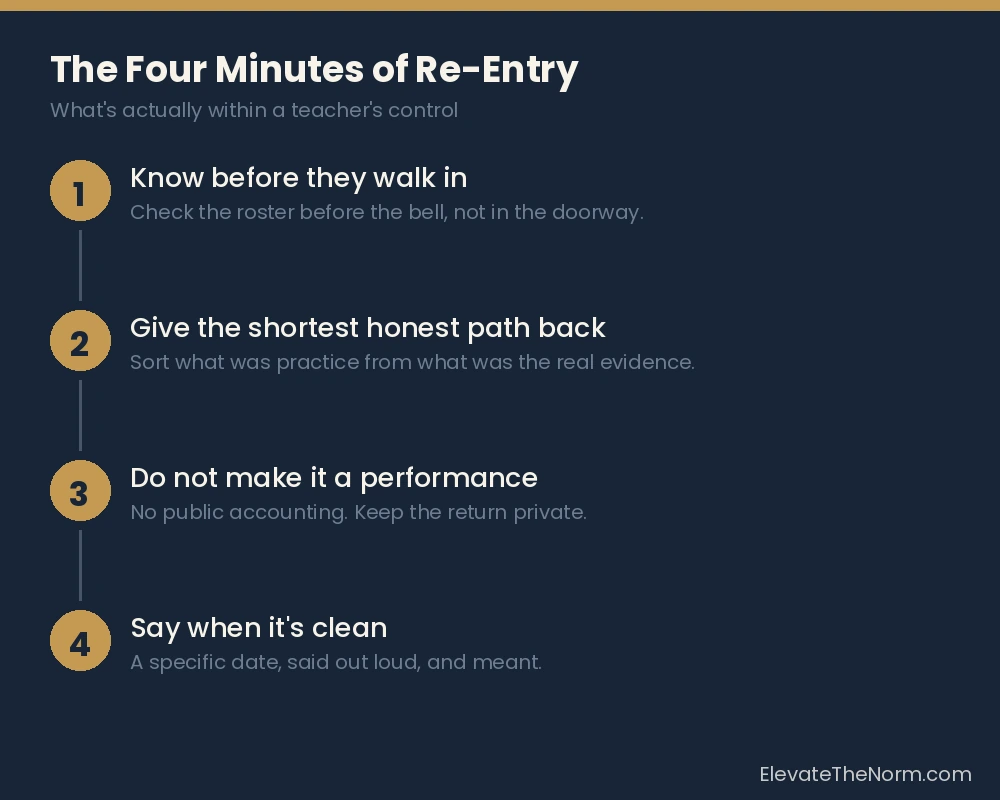
    Four things make re-entry actually work.

    Know before they walk in. Check attendance history before class starts, not during it. A decision made in the doorway, in front of an audience, by a teacher who is also trying to start the lesson, is reliably the worst version of that decision.

    Give the shortest honest path back. Not every missed assignment carries the same weight. Ask yourself which pieces were practice and which ones were the actual evidence that the student learned the standard — the practice can often be waived or condensed; the evidence usually can’t. Sorting the pile down to what genuinely matters is a judgment call only the teacher can make, and it’s the difference between a student who can start today and a student who takes one look at forty backlogged items and shuts down. Better still, ask the student what they think is realistic before you hand them the final list — a plan a student helped build survives contact with a hard week better than one that was simply issued to them. This is student responsibility in its most practical form — the student still owns finishing the list, but the list has to be one a person could actually finish, and building it together is what makes it theirs. For an absence stretching past a week or two, or anything with a doctor’s note attached, loop in a counselor or your 504/IEP team before you finalize the plan alone — some of that catch-up may need to be a formal accommodation, not an informal favor.

    Do not make the return a performance. No public accounting of the absence, no comment in front of the class, no sarcasm at the door, and no requirement that the student explain themselves out loud. Some reasons are private — a medical diagnosis, a family situation, a mental health day — and a teacher doesn’t need the full story to run a fair re-entry process. A teenager who’s been gone is already running the social math on what walking back in will cost. Raise that cost and the cheapest option left is to stay gone. This is the same standard covered in respect in the classroom applied to a specific moment: a student’s absence is not public material, and treating it that way trades a little teacher satisfaction for a much worse attendance problem next month. Apply it the same way to every student, every time — the fastest way to make a re-entry routine feel arbitrary is to run it warmly for some students and coldly for others.

    Say when it’s clean. Give a specific date and a specific list, and when the list is finished, say so out loud and mean it. Open-ended debt is what convinces a student the hole is unclimbable. A defined end is what makes climbing rational.

    In practice this is a thirty-second exchange, not a meeting: “Good to see you back. Here’s what actually matters from the last few days — these three things. Everything else, let it go. Can you have these done by Friday?” That’s the whole script. It names what matters, drops what doesn’t, and ends with a date the student agreed to rather than one you handed down.

    Four-step checklist for helping a student return after an absence: know before they walk in, give the shortest honest path back, do not make it a performance, and say when it is clean
    The four re-entry moves that are genuinely within a classroom teacher’s control after chronic absenteeism.

    None of this is softness. The standard doesn’t move — the work still has to be real and the deadline still has to be a deadline. What moves is how much guesswork a student has to do to find their way back to it, and guesswork is where students who are already behind quietly give up. This is the same logic behind natural consequences instead of punishment: the goal is a consequence that teaches something, not one that simply makes the return more painful.

    Expect it to look worse before it looks better, especially with a student who’s been checked out for a while. A kid who suddenly gets real attention after being invisible will often test whether that attention is real — that’s a normal, predictable phase, not proof the approach isn’t working, and it connects directly to what happens the first few weeks after building a relationship with a student who’s been guarded. Most adults quit right at the point where the testing is actually a good sign.

    What the Research Says Works Beyond Your Classroom

    Honesty about the ceiling matters here too. The best-evidenced attendance interventions in the research aren’t classroom practices — they’re family communication, and the effect sizes are real but modest. Which tool carries that communication matters less than whether families can actually receive it — the questions to ask before adopting a communication app start with reach, not features.

    Rogers and Feller, publishing in Nature Human Behaviour in 2018, tested personalized mailings sent to the parents of 28,080 high-risk K–12 students. The most effective versions reduced chronic absenteeism by 10 percent or more, largely by correcting parents’ underestimates of how many days their child had actually missed — many parents simply didn’t know the number was as high as it was. A smaller trial run by the Regional Educational Laboratory Mid-Atlantic in the School District of Philadelphia found a single October postcard cut absences by a more modest 2.4 percent, with no measurable difference between message variations.

    A 2023 analysis by Harvard researchers Karen Mapp and Todd Rogers, working with Learning Heroes and TNTP across more than 3,000 Illinois schools, found something adjacent and worth taking seriously: schools with strong pre-pandemic family engagement — measured through trust, involvement, and parent influence on school decisions — had chronic absenteeism rates roughly six percentage points lower than similar schools with weak engagement, even after controlling for poverty. Between 2019 and 2022, the strong-engagement schools saw a 39 percent smaller increase in chronic absenteeism than everyone else. This is a correlational finding from one state, not a randomized trial, and the researchers themselves describe it as the first phase of a larger project — it should be read as suggestive, not proof that family engagement alone moves the number. But it lines up with the honest re-entry advice above: families who already trust the school and understand what the classroom is doing are the same families likely to reinforce a re-entry plan rather than fight it. In practice that trust gets built with plain, non-alarmist language rather than a form letter — something closer to “I noticed six absences this month, is there anything the school can help with?” than an automated warning that reads like a legal notice. The first invites a conversation. The second reads like the truancy-court track discussed above, even for a family whose child has never come close to it.

    None of this reaches a transportation gap, an untreated health condition, or a family in crisis, and no classroom teacher should feel responsible for the part of the number that genuinely isn’t theirs. What is genuinely theirs — re-entry, and a habit of honest, non-alarmist communication home — is smaller than the whole problem and still worth doing well, because it’s the piece within reach on a Tuesday afternoon, not a district initiative that takes a year to fund.

    What to Do With This on Monday

    Start with one thing: check the roster before the bell and know, before a returning student walks in, what the shortest honest path back looks like for them. Add the no-performance rule next — it costs nothing and it’s the fastest way to stop making re-entry harder than it needs to be. Everything else on this page — the barriers your school actually controls, the family-communication research, the honest accounting of what disengagement is and isn’t driving — belongs to a bigger conversation about chronic absenteeism than one classroom can solve alone. Your four minutes with a returning student is the part that starts today. For a ready-to-use tool on this, see a printable parent-teacher communication log pack. Absence is also the clearest single thing that got worse since 2019, which is why it sits near the top of our review of whether student behavior is actually getting worse.


    Is chronic absenteeism the same thing as truancy?

    No. Chronic absenteeism counts a student missing 10 percent or more of enrolled school days, whether the absences are excused or unexcused. Truancy is a narrower legal category built specifically from unexcused absences, and in most states it comes with a defined escalation process that can eventually involve a district attorney and consequences for a parent or guardian. A student who is chronically absent because of documented illness has never been truant. Treating the two as interchangeable is how schools end up applying a legal, punitive response to a problem that, for most students, was never about defiance.

    Whose fault is chronic absenteeism — the school, the family, or the student?

    Usually none of the above, at least not in the way the question assumes. National survey data shows the leading reasons students miss school are illness and lost sleep, not defiance or indifference. Framing absence as a fault to assign tends to produce blame instead of a fix. The more useful question is which piece of the problem a given adult actually has leverage over — a classroom teacher, a family, and a school system each control a different slice.

    What can one classroom teacher realistically do about chronic absenteeism?

    Less than district-level interventions, and that’s fine — a teacher’s real leverage is re-entry, not prevention. Checking the roster before class, sorting missed work down to what actually matters, keeping a returning student’s absence private, and giving a clear date when the catch-up is finished are all inside a single teacher’s control and take a few minutes per student. Preventing the absence in the first place usually depends on factors — transportation, health, housing — that sit outside any one classroom.

    Does missing school always mean a student doesn’t care about class?

    No, and the data says the opposite more often than not. When students are asked directly why they were out, illness and lack of sleep dominate the answers, and one national analysis found high schoolers reporting fewer disengagement-related reasons for absence after the pandemic than before it. Assuming apathy is usually wrong, and assuming it out loud to a student who was actually sick or exhausted damages the relationship for no reason.

    How should a teacher handle makeup work without overwhelming a student who’s behind?

    Sort before you hand anything over. Separate what was practice from what was the actual evidence that a student learned the standard, and let most of the practice go. Ask the student what they think is realistic before finalizing the list — a plan they helped build holds up better than one that was simply issued. For anything longer than a week or two, or work tied to a documented medical absence, loop in a counselor or the student’s 504/IEP team rather than solving it alone.

    What if a student’s pattern of absences seems like a sign of something more serious?

    That goes to your school’s counselor or administrator through your normal mandated-reporting and attendance-review process immediately — before, and separate from, any classroom re-entry routine. Signs like a sudden pattern change, indications of neglect or abuse, or signs of homelessness are outside what a classroom-level practice is built to address, and they need the systems your school already has for exactly that purpose.

    Do attendance letters or family outreach actually reduce absences?

    Some forms do, modestly. A large study of personalized parent mailings correcting misperceptions about how many days a child had actually missed reduced chronic absenteeism by roughly 10 percent in its most effective version; a simpler single postcard trial produced a smaller 2.4 percent reduction. The tone matters — plain, non-alarmist language that reads like a conversation (‘is there anything the school can help with?’) is associated with better outcomes than a form letter that reads like a legal warning, even though neither approach comes close to solving the problem on its own.

    What’s a realistic first step for a teacher who wants to get better at this?

    Start with one habit: check attendance before the bell so you already know, before a student walks in, what their shortest honest path back looks like. Add the no-performance rule next — keeping the return private costs nothing and prevents the single most common way teachers accidentally make attendance worse. Everything else on this page is worth knowing, but those two moves are where an ordinary Tuesday actually changes.


    Sources


    About Clay Shumate

    Clay Shumate is a certified secondary Social Studies teacher in the public schools of West Alabama, with seven years of classroom experience, a B.A. in History, and an M.Ed. in Secondary Education. He writes about project-based learning, student responsibility, respect, and practical ways to hold young people to a higher standard while giving them room to learn from mistakes. He is a member of the Society of Professional Journalists and writes to its Code of Ethics; this site’s editorial standards and corrections policy are published in full. More about Clay.
  • Why Are Classroom Expectations Important? Because Students Deserve Clarity

    Why Are Classroom Expectations Important? Because Students Deserve Clarity

    By Clay Shumate · Updated October 24, 2026

    Why are classroom expectations important? Because a room without them runs on guesswork, and guesswork is unfair to the student who can’t read your mood on a given day. Clear, taught expectations tell a class exactly what the room requires and what it promises back — protected instructional time, predictable fairness, and a real path toward independence.

    Key Takeaways

    • Clear expectations reduce discipline problems and protect instructional time — Marzano’s research found teachers with strong management practices and high-quality relationships had 31 percent fewer discipline issues over a full year.
    • Expectations are not rules posted on a wall. They are behaviors you teach, model, practice, and revisit — the same way you teach content.
    • Adolescents respond better to expectations they understand the reasoning behind. Stating a standard without explaining why it exists invites testing.
    • Consistency matters more than severity. A predictable room where small things are addressed early is calmer than a room where nothing happens until someone explodes.
    • Expectations must go both ways. If students are expected to be prepared, on time, and respectful, the adult in the room owes them the same.

    What Are Classroom Expectations?

    Classroom expectations are the specific, observable behaviors that define how a learning environment operates. They cover how students enter the room, how they participate, how they treat each other, how they handle materials, what happens when they finish early, and what happens when they need help.

    That is different from rules. Rules tell students what not to do. Expectations tell them what to do instead — and the research consistently favors the second approach. Positively stated expectations (“Be prepared with your materials before the bell”) give students a target to hit rather than a minefield to avoid. If you are building a complete set of classroom expectations for the first time, starting with positively stated behaviors is the most important decision you will make.

    Side-by-side comparison showing the difference between classroom rules and classroom expectations, with rules focused on what not to do and expectations focused on what to do
    Rules tell students what not to do. Expectations tell them what to do instead.

    The distinction matters more than it sounds. “No talking” is a rule. “Use a voice level appropriate to the activity” is an expectation. The first one creates a room where students are trying not to get caught. The second creates a room where students are making judgments about what the moment requires — and that judgment is a skill worth developing.

    Classroom rulesClassroom expectations
    What they stateWhat not to doWhat to do instead
    Example“No talking”“Use a voice level appropriate to the activity”
    Who they apply toStudentsEveryone in the room, teacher included
    How they are learnedPosted and announcedTaught, modeled, practiced, and revisited
    What they buildAvoiding getting caughtJudgment about what the moment requires
    Classroom rules vs. classroom expectations at a glance.

    Why Are Classroom Expectations Important in Middle and High School?

    They Protect Instructional Time

    Research from the IRIS Center at Vanderbilt University is direct about this: teachers who establish and maintain clear norms for behavior spend more time teaching because less time goes to discipline (Brophy, 2000). Every minute spent restating a procedure that was never taught properly is a minute taken from the content students came to learn.

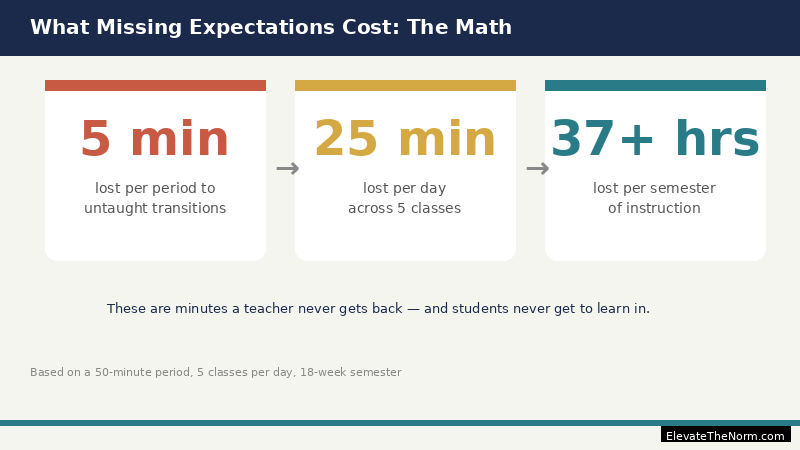
    In a secondary classroom with 50-minute periods — or in some cases, 90-minute blocks — lost minutes compound fast. If a teacher loses five minutes every period to transitions that were never practiced, that is 25 minutes a day across five classes. Over a semester, that is roughly 2,250 minutes — more than 37 hours of instruction gone.

    They Reduce Anxiety and Guesswork

    This is the part most teachers underestimate. Adolescents are performing a complicated identity negotiation every period of every day. They are testing who they are, what their peers think of them, how much authority to accept, and how much risk to take. A room with clear expectations removes one variable from that equation: they do not have to guess what the teacher wants.

    The Australian Education Research Organisation reviewed the evidence and found that when behavioral standards are transparent, “students feel more secure because they know where they stand” (DeNobile, 2021). Security does not mean softness. It means the room is predictable — and predictable rooms are calmer rooms.

    They Make Fairness Visible

    One of the fastest ways to lose a teenager’s trust is to enforce something they did not know existed. When expectations are public, taught, and consistent, a correction becomes a reference to a shared agreement rather than a personal attack. “We said prepared means materials out before the bell — grab your notebook” is a different conversation than “Why aren’t you ready?”

    The first version holds the standard. The second version questions the student. Adolescents can feel the difference, and they respond accordingly. This same principle applies to how teachers handle respect in the classroom — fairness is not about treating every moment identically, but about making every standard visible and every correction consistent.

    They Build Independence Over Time

    Here is what gets overlooked: clear expectations are not about control. They are a scaffold. When students know the procedures, they stop relying on the teacher to direct every transition, every material distribution, and every shift between activities. They run the routines themselves — and that frees the teacher to do the work that actually requires a human being: circulating, checking understanding, pulling small groups, and responding to what students need in real time.

    I spend most of my class period moving between groups, sitting down with students at the whiteboard table I built in the corner of my room. That table is the best seat in the house — low lamp, a rug, better chairs. Students ask to come there. But the only reason I can spend my time that way is because the rest of the room is running on expectations we practiced until they became automatic. If I had to stand at the front managing every transition, that table would just be furniture.

    How Do You Teach Classroom Expectations?

    Posting expectations on a wall is step one of a five-step process. Stopping there is the most common mistake secondary teachers make — and it is the reason so many give up on expectations by October. If you have already created a classroom expectations poster, that visual is useful — but it is the beginning of the work, not the end of it. A free Classroom Norms Poster Set on TPT gives you something to point to once the class agrees on what the standard is.

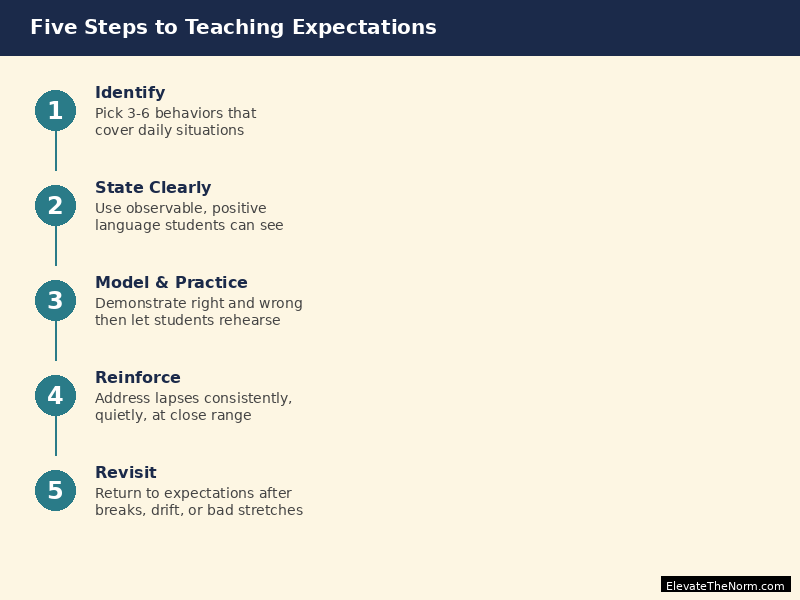
    Infographic showing the five steps to teaching classroom expectations: identify key behaviors, state them in observable language, model and practice, reinforce consistently, and revisit and adjust
    Teaching expectations requires five deliberate steps — not just posting them on a wall.

    Step 1: Identify the Behaviors That Matter Most

    You cannot have 30 expectations. You can have five or six — the ones that cover the situations your students encounter every day. Start with the moments that consistently cause problems: entering the room, transitions between activities, asking for help, working with a partner, and what to do when you finish early.

    Step 2: State Them in Observable Language

    An expectation is only useful if you can see whether someone is meeting it. “Be respectful” is not observable. “Listen without interrupting when someone is speaking to the class” is. “Be responsible” is not observable. “Turn in your work by the deadline or communicate with me before it passes” is.

    The IRIS Center recommends keeping rules few, universal, and positively stated — then linking specific procedures to each one (IRIS Center, 2003). A general expectation like “Be prepared” needs concrete procedures attached: what “prepared” looks like in this room, by this bell, for this type of activity.

    Step 3: Model and Practice

    This is where secondary teachers get uncomfortable. Modeling expectations feels elementary — and most of us skipped it. But the research is clear: students perform better when expectations are explicitly taught through demonstration, not merely announced (Archer & Hughes, 2011).

    Model what a good transition looks like. Model what asking for help looks like. Model the wrong way, too, if you can do it with humor and not sarcasm — so students see the contrast. Then let them practice. The first three days of the year are not lost instruction. They are the most important instruction you will give all year. This is especially critical if you are in your first years and still working out classroom management as a new teacher.

    Step 4: Reinforce Consistently, Not Loudly

    Marzano’s meta-analysis found that the quality of teacher-student relationships was the most important variable in effective classroom management — teachers with strong relationships and clear expectations had 31 percent fewer discipline problems across the year (Marzano et al., 2003). That finding matters because it means enforcement does not require volume. It requires consistency and connection.

    When a student does not meet an expectation, address it immediately, briefly, and at close range. A quiet redirect while you are already circulating — “Materials out, please” — costs less social capital than a public correction from across the room. And it preserves the relationship that makes the expectation stick. Strong relationships with students are not a separate initiative from classroom management — they are the mechanism that makes management work.

    Step 5: Revisit and Adjust

    Expectations are not a September activity. They need to be revisited after breaks, after schedule changes, after a stretch of bad days, and after you realize one of your expectations was unreasonable in the first place. Acknowledging that an expectation needs adjusting is not weakness. It is modeling exactly the kind of honest self-assessment you want from students.

    What Happens When Classroom Expectations Are Missing?

    The consequences of vague or absent expectations are not dramatic. They are gradual — and that is what makes them dangerous.

    Visual showing the costs of missing classroom expectations: lost instructional time, reactive discipline cycles, eroded trust, and disproportionate impact on marginalized students
    Without clear expectations, teachers spend more time managing confusion than teaching content.

    Without clear expectations, teachers tend to rely on reactive discipline: waiting for something to go wrong and then responding. That pattern creates an exhausting cycle. The teacher feels like they are constantly putting out fires. The students feel like the rules change depending on the teacher’s mood. Both sides get frustrated, and the relationship erodes. That fire-fighting cycle is one of the most reliable routes into exhaustion, and most of what prevents it is structural rather than a matter of willpower.

    Research on teacher expectations confirms this pattern. A 2024 narrative review published in the Journal of the Royal Society of New Zealand found that teachers’ expectations significantly influence student outcomes, and that inconsistent or unclear expectations disproportionately affect students from marginalized backgrounds (Rubie-Davies et al., 2024). Students who already face barriers outside of school should not have to decode a second set of hidden expectations inside it.

    For a practical look at what those belief-driven expectations actually require—the specific moves, language, and mindset that separate genuine high expectations from surface-level optimism—see holding students to high expectations in secondary classrooms.

    Expectations Go Both Ways

    This is the part that separates a set of classroom expectations from a set of classroom rules. Rules flow in one direction — from the teacher to the student. Expectations, done well, apply to everyone in the room.

    If students are expected to arrive on time, the teacher starts on time. If students are expected to be prepared, the teacher has the plan posted and the materials ready. If students are expected to listen without interrupting, the teacher does the same when a student is speaking.

    That does not mean teachers and students hold identical authority. They do not. But mutual respect for each other’s time, effort, and presence is what turns expectations from a behavior-management tool into a culture.

    Three Things Your Expectations Cannot Decide for You

    No classroom expectations list exists in isolation. Before you finalize yours, account for these:

    Your school’s behavior framework comes first. If your building uses PBIS, a schoolwide behavior matrix, or a restorative practices model, your classroom expectations must align with it — not contradict it. A classroom expectation that conflicts with the schoolwide framework confuses students who are trying to follow both, and it puts you in an awkward position with administrators when a situation escalates beyond your room.

    IEPs and 504 plans take legal precedence. A student’s documented behavior intervention plan overrides your classroom expectations for that student. This is not optional, and it is not a weakening of your standards. It is the law. Consult with the special education team before the year starts and whenever a new student with a plan enters your class.

    Families should know what you expect in week one. Send your expectations home — in writing, not just verbally through students. A parent who understands what the room requires can support it. A parent who discovers your expectations only when their child gets a consequence feels blindsided, and that damages a relationship you may need later.

    A Practical Starting Point

    If you are starting from scratch — or starting over — here is what works:

    Pick three to five expectations that cover the broadest range of daily situations. State each one in observable, positive language. On the first day, explain each one, model it, let students practice it, and explain why it exists. Then hold it — every day, every period, for every student — without exceptions that are not also explained publicly.

    It is not complicated. But it is relentless, and the relentlessness is the point. Students do not learn expectations from a poster. They learn them from a teacher who means what they say and says it every single day until the room runs on its own. The same principle applies to teaching student responsibility — it is a daily practice, not a one-time conversation.


    What are the benefits of classroom expectations?

    Clear, taught expectations protect instructional time, reduce student anxiety and guesswork, make fairness visible because corrections refer to a shared agreement, and build independence as students learn to run routines on their own. Marzano’s research links strong management and relationships to 31 percent fewer discipline problems over a school year.

    What are examples of good classroom expectations?

    Good expectations are positive and observable. Examples: “Be prepared with your materials before the bell,” “Use a voice level appropriate to the activity,” and “Listen without interrupting when someone is speaking to the class.” Most secondary classrooms need three to six that cover entering the room, transitions, asking for help, partner work, and finishing early.

    How many expectations should a secondary classroom have?

    Three to six. More than that and students cannot remember them, teachers cannot enforce them consistently, and the list starts contradicting itself. Each expectation should be broad enough to cover multiple situations but specific enough to be observable. If you need more than six, you probably need better procedures underneath fewer expectations.

    Are classroom expectations the same as classroom rules?

    Not exactly. Rules typically tell students what they cannot do and carry stated consequences. Expectations tell students what the room requires and are stated positively — what to do, not what to avoid. In practice, many teachers use a small set of expectations supported by procedures, with consequences understood but not the headline. The research favors positively stated expectations because they give students a behavior to perform, not just a behavior to suppress.

    When should expectations be introduced — the first day or after content starts?

    The first day. Marzano’s research and the IRIS Center’s synthesis both agree: explicitly teaching expectations during the first days of school produces better outcomes than announcing rules and moving to content. Time spent modeling, practicing, and discussing expectations in week one saves far more time than it costs over the remaining weeks of the semester.

    Do expectations work with students who have behavioral challenges?

    Clear expectations help every student, but they are especially important for students with behavioral challenges, including those with IEPs or 504 plans. Predictability reduces anxiety, and publicly stated expectations prevent the perception that consequences are personal or arbitrary. That said, individual behavior plans required by an IEP or 504 take legal precedence over classroom expectations — always follow the documented plan and consult with the special education team.

    How do you handle a student who refuses to follow expectations?

    Start with a private, calm conversation — not a public confrontation. Ask what happened. Restate the expectation. Give the student a clear path to meet it. If the behavior continues, follow your escalation process and document. Never abandon the expectation itself because one student resists it. The other 25 students are watching to see whether the standard is real.

    Should students help create classroom expectations?

    Research supports involving students in the process when it is genuine — not performative. A class discussion about why an expectation exists and what it should look like increases buy-in, especially with adolescents who need to understand the reasoning behind a standard. What does not work is asking students to create the expectations entirely and then overriding them when you do not like the result. If you ask for input, use it.

    Do expectations need to be revisited after the first week?

    Yes — after every long break, after a schedule change, after a substitute teacher, and after any stretch where the room has drifted. Expectations are not a contract signed and filed. They are a practice maintained through repetition and honest conversation about what is working and what is not.


    Sources


    About Clay Shumate

    Clay Shumate is a certified secondary Social Studies teacher in the public schools of West Alabama, with seven years of classroom experience, a B.A. in History, and an M.Ed. in Secondary Education. He writes about project-based learning, student responsibility, respect, and practical ways to hold young people to a higher standard while giving them room to learn from mistakes. He is a member of the Society of Professional Journalists and writes to its Code of Ethics; this site’s editorial standards and corrections policy are published in full. More about Clay.
  • Example of Classroom Expectations for Middle and High School Students

    Example of Classroom Expectations for Middle and High School Students

    By Clay Shumate

    A good example of classroom expectations for middle and high school says exactly what a student is supposed to do, not how they are supposed to be. “Be in your seat and working when the bell rings” is an expectation. “Be respectful” is a mood. This page gives you observable examples for several different kinds of secondary classrooms, the reasoning behind each one, and the words to teach them with.

    I am going to skip the part where I tell you expectations matter. You know that. What most teachers actually need is not the argument, it is the wording—a set of examples specific enough to steal from, and honest about the edge case each one is designed to survive.

    Key Takeaways

    • An expectation is only usable if two people watching the same student would agree on whether it happened. If they would not, you have written a judgment call, not an expectation.
    • Five is the ceiling. The IRIS Center’s guidance for secondary classrooms is no more than five, stated positively, in observable terms.
    • Vague expectations are not just ineffective—they are where discipline disparities concentrate. Subjectively defined infractions like “willful defiance” show the largest racial gaps in referral research.
    • The examples below are written for different rooms: a middle school classroom, a high school seminar, a lab or shop, a performance class, and a one-to-one device room. Take the wording, not the whole list.
    • An expectation you will not enforce on your worst day is not an expectation. It is a wish, and students identify it within two weeks.

    Two notes before the examples. If you want the underlying framework—why expectations work, how they differ from rules, how to build a set from scratch—that lives in classroom expectations: a practical framework for grades 6–12. If you want print-ready wall copy, that is the classroom expectations poster. This page is the examples themselves, sorted by the kind of room you actually teach in.

    What Separates a Good Example of Classroom Expectations From a Bad One

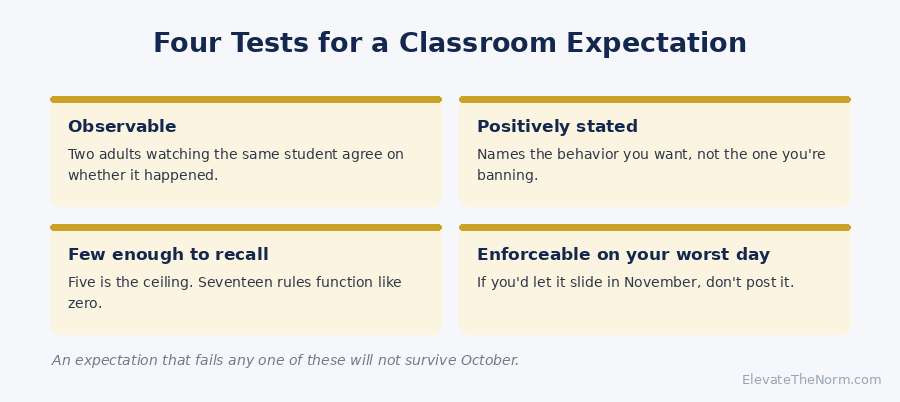
    Four tests. An expectation has to pass all four to be worth posting.

    Four tests for a classroom expectation: observable, positively stated, few enough to recall, and enforceable on your worst day
    Four tests. An expectation that fails any one of them will not survive October.
    1. Observable. Two adults watching the same student agree on whether it happened. The IRIS Center puts it as “observable and measurable,” and offers the useful contrast: “Follow directions” beats “Be respectful,” because one of those can be seen (IRIS Center, Vanderbilt University).
    2. Positively stated. Name the behavior you want, not the one you are banning. “Phones stay in the caddy until the work needs one” tells a student what to do. “No phones” only tells them what you will be annoyed about.
    3. Few enough to recall. No more than five. Seventeen rules function like zero, because nobody—including you—is holding seventeen standards consistently.
    4. Enforceable on your worst day. This is the test nobody writes down and everybody fails. If you would let it slide on a Friday in November when you are tired and behind, do not post it. Students learn which expectations are real by watching what you do when you are worn out.

    Rewriting Vague Expectations Into Usable Examples

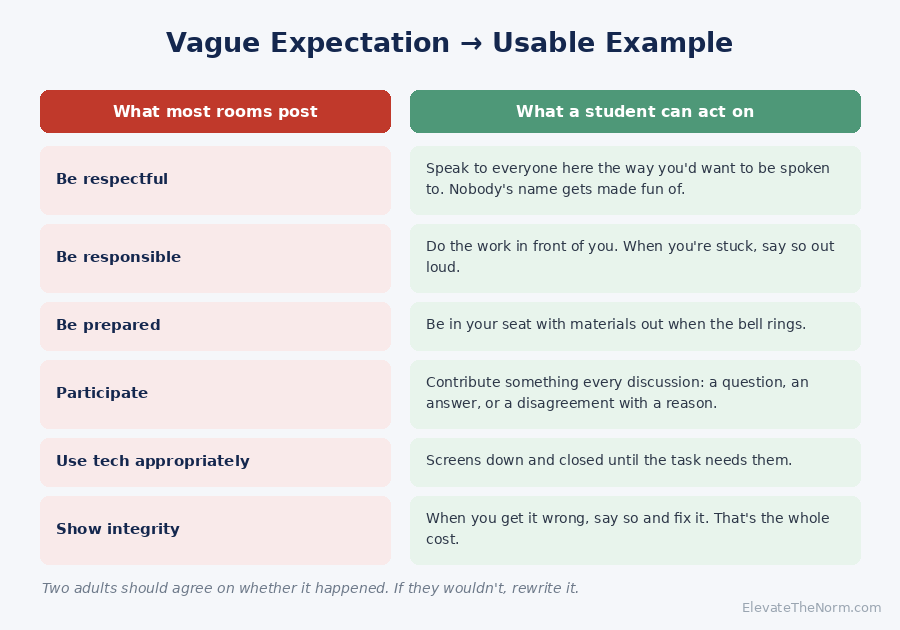
    Most expectation sets are not wrong, they are just unfinished. The words on the wall are the category; the usable version is the behavior underneath it. Here is the same standard written both ways.

    The category most rooms postThe observable example a student can act on
    Be respectfulSpeak to everyone in this room the way you would want to be spoken to. Nobody’s name gets made fun of.
    Be responsibleDo the work in front of you. When you are stuck, say so out loud—to me or to your table.
    Be preparedBe in your seat with your materials out when the bell rings.
    ParticipateContribute something to every discussion: a question, an answer, or a disagreement with a reason attached.
    Use technology appropriatelyScreens are down and closed until the task needs them. When it does, I will say so.
    Show integrityWhen you get something wrong, say so and fix it. That is the whole cost.
    Be on taskBetween the bell and the last five minutes, you are working on this class’s work.
    CooperateYour group can name what you contributed by the end of the period.
    Chart converting vague classroom expectations such as be respectful and be responsible into specific observable behaviors students can act on
    The wall version is the category. The usable version is the behavior underneath it.

    This is not only a clarity problem. It is a fairness problem with data behind it. Research summarized by Brookings found that Black students in North Carolina were less likely to face exclusionary discipline when taught by Black teachers than by white teachers within the same school, and that the gap was strongest for office referrals categorized as “willful defiance”—the most subjectively defined infraction available (Brookings, summarizing Lindsay & Hart, 2017).

    Read that as a design instruction. Every vague expectation you post is a place where a judgment call gets made, and judgment calls are where the disparities live. Writing “be in your seat when the bell rings” instead of “be respectful of class time” is not pedantry. It shrinks the space where bias operates.

    Examples of Classroom Expectations by Type of Room

    A set that works in a discussion-heavy history room will not work in a shop with power tools. Below are five worked examples, each capped at five expectations, each with the specific problem it is built to survive. Take the wording. Do not take the whole list—an expectation set only works if the person enforcing it believes it.

    Middle school, grades 6–8

    Sixth graders are still learning what school even is at this level. The wording has to be concrete without sounding like elementary school, because nothing loses a twelve-year-old faster than being talked to like a child.

    ExpectationWhat it is built to survive
    Be in your seat with materials out when the bell rings.The four-minute settling period that eats a week of instruction per semester.
    One person talks at a time, and it is whoever has the floor.Enthusiastic interrupting, which at this age is usually not defiance.
    Nobody’s name gets made fun of. Ever.The specific cruelty that middle schoolers are best at and adults most often miss.
    When you are stuck, say so out loud before the period ends.Students who have learned that silence hides not knowing.
    When you get it wrong, say so and fix it.The instinct to lie about small things because the cost feels enormous.

    High school, grades 9–12, discussion-heavy course

    Older students will meet a higher bar if the bar is explained. This set assumes disagreement is the point of the class, not a disruption of it.

    ExpectationWhat it is built to survive
    Be working within a minute of the bell.The senior-year drift where arrival becomes negotiable.
    Disagree with the idea, by name, with a reason. Never with the person.Debate collapsing into personal shots—or into nobody saying anything.
    Contribute something every discussion: a question, an answer, or a disagreement.Four students carrying every conversation while twenty coast.
    Screens down and closed until the task needs them.The device that is technically for notes.
    Meet the deadline, or renegotiate it before it passes.The after-the-fact excuse, replaced with a before-the-fact conversation.

    Lab, shop, or any room with equipment

    Safety expectations are the one category where “positively stated” bends. A hard prohibition tied to a real hazard should be stated as a prohibition, and it should be the shortest sentence on the wall.

    ExpectationWhat it is built to survive
    Eye protection on before you touch anything, off when you leave the bench.The five-second task nobody thought needed goggles.
    Hands stay off equipment until you have been checked out on it.Confidence outrunning training.
    Report every spill, break, or injury immediately. Nothing bad happens to you for reporting.The student who hides a small problem until it becomes a large one.
    Clean and return everything before the last five minutes.The bell as an exit from responsibility.
    If you are unsure, stop and ask. Stopping is never the wrong call.Guessing under time pressure.

    Performance class: PE, band, theater, athletics

    These rooms run on effort in front of an audience, which makes them the easiest place for a student to protect themselves by not trying. The expectations have to make trying safe.

    ExpectationWhat it is built to survive
    Dressed, present, and in your spot on time.The slow leak of five minutes per class.
    Attempt everything. You are graded on the attempt, not the outcome.Opting out to avoid being seen failing.
    Nobody laughs at somebody else’s attempt. That is the one that ends a class.The single behavior that makes a performance room unsafe.
    Take the correction, run it again.Feedback treated as an insult.
    If something hurts, say so immediately.Playing through an injury to look tough.

    One-to-one device classroom

    I have taught with no devices, with one cart shared between two classrooms, and with one-to-one. The one-to-one year needed the most explicit expectations, not the fewest, because the distraction is inside the tool students are required to use.

    ExpectationWhat it is built to survive
    Lids at forty-five degrees when I am talking, open when you are working.The ambiguity of “pay attention” in a room full of screens.
    One tab for the task. If a second one is open, be able to say why.Tab-switching as a reflex rather than a decision.
    Charged and ready is part of being prepared.The dead battery as a daily out.
    If you use an AI tool, say where and what you changed. (Check your district’s policy first—yours may already answer this.)Pretending the question does not exist.
    Nothing about a person in this room gets typed, shared, or posted.The fight that starts in a document and finishes in the hallway.

    Notice what is missing from all five sets: threats. Students deserve to know what happens after a miss, and that conversation is real—but it happens calmly, separately, and it always includes the way back. That is covered in classroom consequences that teach instead of humiliate. A list of expectations that reads like a list of warnings tells students you are expecting the worst from them, and teenagers are accommodating people.

    How to Teach an Expectation Instead of Announcing It

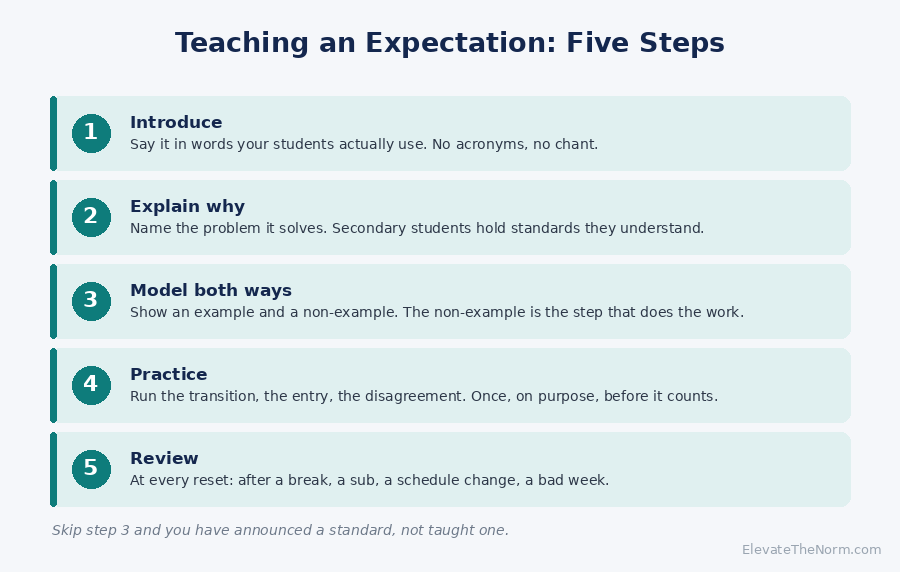
    A posted expectation is a claim. A taught expectation is a skill. The IRIS Center’s sequence for secondary classrooms has five steps: introduce it in student-friendly language, discuss why it exists, model it with examples and non-examples, practice it, and review it—especially at transitions and whenever it starts slipping (IRIS Center, Vanderbilt University).

    Five-step sequence for teaching a classroom expectation: introduce, explain why, model with examples and non-examples, practice, and review
    A posted expectation is a claim. A taught one is a skill.

    The step teachers skip is the non-example, and it is the one that does the work. Secondary students do not need “what respect looks like.” They need the eight-inch difference between a joke that lands and a joke that costs somebody something. Show both. Let them argue about where the line is. They will hold a line they helped draw.

    The Australian Education Research Organisation makes the companion point: high expectations only function when the belief comes packaged with instruction. “I believe you can do it” has to be followed by “here is how” (AERO). An expectation announced without a method is a standard you have set and then declined to teach toward.

    The Launch-Day Script

    Here is roughly what I say on day one. It takes about six minutes and I do not read it off a slide.

    “When you walk through that doorframe, you have 100% of my respect. You don’t earn it in here. You already have it. What you do with it is up to you, and it’s yours to lose—but it starts full.”

    “Here’s what I need from you. Five things. That’s the whole list, and I’m not adding to it in October.”

    [Read the five. One sentence each on why it exists.]

    “Two of these I will hold on my worst day, and you should know which. You will not make fun of anybody’s name in here—not how it’s spelled, not how it sounds, not where it came from. And when you get something wrong, you’ll say so and fix it, and that’s the end of it. No speech from me, no bringing it back up in April.”

    “Everything else on that list, I’ll remind you about. Those two I’ll hold.”

    Then I stop talking. That pause is doing more than the speech was. The room decides in that silence whether I meant it, and filling the gap is how you tell them you did not.

    Two things about that script are worth stealing regardless of your wording. First, respect starts at full rather than being earned—which changes what a correction means later, because you are restoring something rather than withholding it. More on that in respect in the classroom. Second, name which expectations are absolute and which are coachable. Pretending all five carry equal weight is a lie students catch by week three, and once one expectation turns out to be soft, they will test all of them. If you want posters written for teenagers instead of little kids, my free Classroom Norms Poster Set on TPT is ready to print.

    What Follow-Through Actually Looks Like

    The expectations are the easy part. Three practices decide whether they survive past September.

    • Precorrect before the moment, not after it. Prompt the expectation right before the transition where it usually breaks—”Materials out, we’re moving to the lab in ninety seconds”—rather than correcting the eleven students who got it wrong. The OSEP classroom PBIS guide lists prompts before difficult routines as a core practice (Simonsen et al., 2015).
    • Acknowledge the expectation being met, roughly five times for every correction. That same guide puts the target at about five praise statements per corrective one. In a secondary room this is not gold stars—it is naming the behavior quietly and moving on. “Whole table was working before the bell finished. Thanks.”
    • Correct at close range, at conversation volume. A redirect delivered across the room is a performance, and the audience changes what the student has to do to save face. Walking over costs you four seconds and removes the audience entirely.

    Consistency here is not a management preference. It is fairness. The expectation that flexes with your energy teaches students to read your mood instead of the standard, and the students who already trust school least pay the highest price for that unpredictability.

    Three Things These Examples Cannot Decide for You

    Any set you borrow has to survive contact with three things that are specific to your building.

    • The schoolwide behavior matrix. If your building runs a schoolwide system with its own three or four expectations, yours have to sit underneath those, not compete with them. A student who hears one standard in the hallway and a different one in your room learns that standards are a matter of whose room they are in. Map each of your five to the schoolwide expectation it makes concrete—that alignment is the point, and it is usually a ten-minute exercise.
    • Students with an IEP, a 504, or an individual behavior plan. A written plan takes precedence over a classroom list, and it is not an exception you are granting—it is a legal document you are following. Read the plans before you finalize the wording, because sometimes a small rewrite makes an expectation workable for a student instead of setting up a conflict every day. “Be in your seat when the bell rings” and “be in the room and settled within two minutes” hold the same standard; only one of them is reachable for some students.
    • How families find out. Send the five home in the first week, in plain language, without a signature line. Families who know the standard can back it; families who first hear about it when something has gone wrong will reasonably assume it was invented on the spot. It costs one email and it removes most of the arguments you would otherwise have in October.

    Where These Examples Go Wrong

    • Copied wholesale. An expectation set in someone else’s words is one you will not enforce, because you do not believe it in your body. Rewrite every line until it sounds like you saying it out loud.
    • Posted and never revisited. Laminated is not learned. Reteach at every natural reset: after a long break, after a bad week, after a schedule change.
    • Written for the student you dread. A set designed around your hardest class reads as suspicion to the other four sections. Write for the room you want and handle the outlier individually.
    • No route back. If missing an expectation only costs and never leads anywhere, students stop trying to recover once they have missed one. The way back has to be built in, not improvised. See learning from mistakes.
    • Enforced for compliance instead of for the room. If a student cannot tell you who the expectation protects, it is a rule about your convenience. Some of those are legitimate. Just be honest about which ones they are.

    Take the Wording, Not the List

    Pick the set closest to your room. Cut it to five. Rewrite every line in your own words until you could say it to a class without looking at the page, and cross out anything you would let slide in November. What is left is your actual expectations set, and it will be shorter and more honest than what you started with.

    Then teach it—introduce, explain, model both ways, practice, review—and hold it at close range and low volume for the first three weeks. That is the entire job. The example of classroom expectations you land on matters far less than whether the students watching you decide the standard is real. For what happens after a student misses one, keep reading in student responsibility.

    How many classroom expectations should I have?

    No more than five. The IRIS Center’s guidance for secondary classrooms is to limit the list to five or fewer, stated positively and in observable terms, so students can actually recall them. Seventeen rules function like zero, because neither you nor your students are holding seventeen standards consistently. If your list is longer, most of the items are procedures rather than expectations and belong in a routine you teach, not on the wall.

    What is the difference between classroom rules and classroom expectations?

    Expectations are broad goals for behavior; rules are explicit statements defining what those goals look like in a specific context. “Take care of this room and the people in it” is an expectation. “Return tools to the board before the last five minutes” is a rule that shows what it means in a shop. Most secondary classrooms need a small number of expectations and a slightly larger number of taught procedures.

    Should students help write the classroom expectations?

    Student input works best on wording and on the non-examples, not on whether a standard exists. Bring the five you need, then let the class argue about where each line actually falls and rewrite the phrasing together. Students hold a line they helped draw. What does not work is a blank-slate vote, which either produces the list you were going to write anyway or produces one you cannot enforce.

    Why is “be respectful” considered a weak classroom expectation?

    Because two adults watching the same student will not agree on whether it happened. That ambiguity is not only a clarity problem: research summarized by Brookings found racial disparities in office referrals were strongest for subjectively defined infractions like willful defiance. Every vague expectation is a place where a judgment call gets made, and judgment calls are where disparities concentrate. Replacing it with an observable behavior shrinks that space.

    How do I teach expectations without sounding like an elementary teacher?

    Explain the reasoning and use real non-examples. Secondary students do not need a chant or an acronym; they need to know what problem the expectation solves and where exactly the line falls. Show a case that clearly crosses it, a case that clearly does not, and one genuinely ambiguous case, then let them argue. Treating the line as debatable is what makes it land with teenagers.

    When should I reteach classroom expectations during the year?

    At every natural reset: after a long break, after a schedule change, after a substitute, after a bad week, and any time a specific expectation starts slipping. Reteaching is not punishment and should not be delivered as a lecture about disappointment. Two minutes naming the expectation, why it exists, and what it looks like today is enough.

    What if a student refuses to follow an expectation?

    Handle it at close range and at conversation volume rather than across the room, which removes the audience the student would otherwise have to perform for. Address the behavior, name the expectation, and give a path back in the same breath. Follow your school’s policy for anything involving safety or repeated refusal, and keep the what-happens-next conversation separate, calm, and always inclusive of the route to repair.

    Sources


    About Clay Shumate
    Clay Shumate is a certified secondary Social Studies teacher in the public schools of West Alabama, with seven years of classroom experience, a B.A. in History, and an M.Ed. in Secondary Education. He writes about project-based learning, student responsibility, respect, and practical ways to hold young people to a higher standard while giving them room to learn from mistakes. He is a member of the Society of Professional Journalists and writes to its Code of Ethics; this site’s editorial standards and corrections policy are published in full. More about Clay.
  • Classroom Consequences That Teach Instead of Humiliate

    Classroom Consequences That Teach Instead of Humiliate

    Classroom Consequences That Teach Instead of Humiliate

    By Clay Shumate

    Classroom consequences are the responses a teacher uses when a student’s behavior falls below the standard. Consequences that teach are related to the behavior, respectful of the student and realistic to enforce, and they end with a short repair conversation. Public shaming, busywork and removal as a first step punish the student without teaching anything.

    Classroom consequences are the responses a teacher uses when a student’s behavior or choices fall below the standard. Good consequences are predictable, proportionate, connected to the behavior, and respectful enough that the student can still learn from the experience. Bad consequences punish the person instead of addressing the problem. Here’s how to design consequences that teach, and how to avoid the ones that just make teenagers resentful.

    Key Takeaways

    • Classroom consequences and punishment aren’t the same thing: a consequence aims to teach, and a punishment aims to hurt enough to stop the behavior.
    • Effective classroom consequences are related to the behavior, respectful of the student and realistic to carry out, a test often called the three R’s.
    • Natural consequences happen without teacher intervention, while logical consequences are designed by the teacher to connect to the behavior.
    • Humiliation, public call-outs and disproportionate responses damage the teacher-student relationship and don’t teach the behavior you want.
    • A short repair conversation after a classroom consequence, asking what happened, who was affected and what the student will do, is where most of the learning happens.

    Free Printable: Classroom Consequence Planning Sheet

    A one-page teacher reference with the 3 R’s checklist, a behavior-response planner you fill in for your own class, and the three-question repair conversation framework. Print it and keep it at your desk.

    Download Free Planning Sheet (PDF)

    What Is the Difference Between Consequences and Punishment?

    A classroom consequence helps a student understand and repair the impact of a behavior; a punishment tries to make the student uncomfortable enough to stop. Many teachers say “consequences” and deliver punishment, and the difference changes what the student learns.

    Side-by-side comparison showing how classroom consequences differ from punishment in focus, tone, message, goal, and result
    One builds walls. The other builds understanding.

    Punishment is designed to cause enough discomfort that the student stops the behavior. It focuses on the adult’s power and the student’s suffering. A student who talks during instruction gets assigned a 500-word essay on respect. A student who is late gets locked out of the classroom. A student who forgets materials sits with nothing to do for the entire period. The message is: you made a mistake, and now you pay. A consequence that teaches needs something written down and owed back, which is what a repair-and-return sheet is for.

    Consequences are designed to help the student understand the impact of their behavior and take responsibility for repairing it. A student who talks during instruction has a brief private conversation about what they missed and what the expectation is. A student who is late makes up the missed work on their own time. A student who forgets materials uses a loaner set and brings their own the next day. The message is: you made a mistake, and here is what you do about it. If you want the exact words for that follow-up talk, my Restorative Conversation Scripts on TPT give you a script for each step.

    The Responsive Classroom framework separates the two by purpose. Punishment aims “to enforce compliance with the rules by using external controls,” while logical consequences aim to help students develop “internal understanding, self-control, and a desire to follow the rules,” the foundation of real student responsibility (Responsive Classroom, 2024).

    The research on punishment points the same way. A 2026 meta-analysis in Frontiers in Psychology pooled 18 effect sizes covering more than six million participants, all from middle school, high school or mixed secondary samples, and found a weak but statistically significant negative association between teacher punishment, mostly suspension and other exclusionary discipline, and academic achievement (r = −0.183, p < 0.001). The authors say to read it as correlational evidence, so it doesn’t prove punishment causes lower grades. It does mean punishment shows no sign of helping them (Li et al., 2026).

    What Are the Types of Classroom Consequences?

    Classroom consequences come in three types: natural consequences, which follow from a behavior without the teacher doing anything; logical consequences, which the teacher designs to connect to the behavior; and restorative consequences, which add repair of the relationship.

    Knowing the types helps a teacher choose a response instead of defaulting to the most convenient one.

    Natural consequences

    These happen without any teacher intervention. A student who does not study performs poorly on the assessment. A student who does not participate in the group project has nothing to present. A student who does not bring supplies to class falls behind on the day’s work.

    Natural consequences are powerful because they come from reality, not from an adult’s decision. The student cannot argue with them, resent the teacher for imposing them, or claim the system is unfair. The work simply did not get done, and the result is what the result is.

    For a deeper look at how natural consequences work—and when they do not—see natural consequences in the classroom.

    But natural consequences have limits. They only work when the natural outcome is safe, timely, and genuinely experienced by the student. A student who runs in the hallway might fall—but you do not wait for that to happen. A student who cheats might not get caught until the consequences are permanent. And some natural consequences fall hardest on students who already have the fewest resources, which is not teaching—it is neglect.

    Logical consequences

    These are teacher-designed responses that connect directly to the behavior. They are the backbone of effective classroom discipline in grades 6–12.

    Responsive Classroom names three logical consequences for teachers to choose from (Responsive Classroom, 2024):

    1. Loss of privilege. The student temporarily loses access to something related to the misuse. A student who misuses a laptop loses laptop access for the rest of the period. A student who abuses the freedom to choose a seat returns to an assigned seat.
    2. Break it, fix it. The student repairs the damage they caused. A student who makes a mess cleans it up. A student who damages a relationship makes a direct apology. A student who disrupts a lesson contributes positively to the next one.
    3. Space and time. The student takes a brief break from the activity to reset. This isn’t punishment. It’s a cooling-off period, and the student returns to the group when they are ready to re-engage.

    The test for whether a logical consequence is actually logical: can you explain the connection between the behavior and the response in one sentence? If the student talked during instruction and the consequence is copying dictionary definitions, you cannot explain that connection—because there is none.

    Restorative consequences

    These go beyond fixing the immediate problem to repairing the relationship. They ask the student to consider who was affected, what the impact was, and what they owe.

    A University of Chicago Crime Lab and Education Lab analysis of restorative practices training in 73 Chicago Public Schools high schools found an 18% decline in suspension days in the four years after rollout and a 19% decrease in student arrests. Reductions in suspension days for Black students were more than double the average. The researchers found no evidence that test scores fell, though they say they can’t tell whether the drop in suspensions came from teachers simply suspending less (Adukia et al., 2025).

    The randomized trials are more mixed. A research summary from the Critical Social Epidemiology Research Collaborative reports promising findings in high schools, but notes that the Pittsburgh trial didn’t significantly improve academic outcomes and a Maine trial found no significant school-level changes (CSERC).

    Restorative consequences are not a replacement for accountability. They add a step: after the consequence, you have a conversation. What happened? Who was affected? What can you do about it? When will you do it? Schools that formalize this into a program are practicing something with a real research base and real limits; the guide to accountability without empty punishment lays out what the randomized evidence does and does not support.

    What Are the Three R’s of Classroom Consequences?

    The three R’s say a classroom consequence should be related to the behavior, respectful of the student’s dignity and realistic for the teacher to enforce and the student to complete. Responsive Classroom lists the same three tests for logical consequences: “respectful, related, and realistic.”

    Three cards showing the three Rs of effective consequences: Related connects to behavior, Reasonable fits severity, Respectful preserves dignity
    When all three Rs are present, consequences become teaching tools.

    The three R’s give teachers a quick test for any consequence they’re considering, and they show up across Responsive Classroom and similar frameworks.

    Related. The consequence connects logically to the behavior. A student who wastes class time makes up the time. A student who is disrespectful to a peer makes a direct apology. A student who turns in poor work revises the work.

    Respectful. The consequence addresses the behavior without attacking the student’s character. (For a deeper look at why this matters, see Respect in the Classroom.) “You need to redo this section because it doesn’t meet the standard” is respectful. “I guess you didn’t think this was worth your time” is not.

    Realistic. The consequence is something the teacher can actually enforce and the student can actually complete. Assigning a lunch detention every day for a week sounds firm. It also means the teacher has to show up every day for a week, and the student misses the only unstructured time they have. If a consequence is unsustainable, it will collapse—and when it does, the student learns that the teacher’s word does not hold.

    If a consequence fails any one of the three R’s, it is probably punishment dressed up as a consequence.

    What Consequence Fits Common Classroom Behavior Problems?

    A proportionate classroom consequence starts with the smallest response that could work, such as proximity or a private word, and moves up only when the behavior continues or escalates. The response ladder below covers seven common problems, from off-task talk to safety threats.

    It isn’t a rigid escalation chart. Skip steps when the situation requires it, and start lower than you think you need to.

    Before you reach for any of it, check whether the behavior is a broken rule or an untaught procedure. A class that packs up early or crowds the door is usually failing a routine that was announced but never actually taught, and a consequence will not fix that. Most of this work sits upstream of the ladder entirely, which is why prevention comes first on any honest list of what works.

    BehaviorFirst ResponseIf It ContinuesIf It Escalates
    Off-task (phone, talking, zoning out)Proximity + quiet redirectBrief private conversation; remove the distractionLoss of privilege for the period; contact home if pattern develops
    Disrespect toward a peerImmediate, private correctionRestorative conversation between the students with teacher presentSeparate the students; parent contact; administrative referral if repeated
    Refusal to workCheck in privately: “What do you need to get started?”Offer modified entry point; document the patternParent contact; team conference; check for underlying issues
    Late to classNote it; do not interrupt instruction to address itBrief private conversation about the patternMake up missed time; parent contact if chronic
    Incomplete or missing workState the deadline and ask for a planRequire revision or completion before new privilegesParent contact; academic intervention plan
    Cheating or plagiarismPrivate conversation; require honest resubmissionParent contact; academic consequence per school policyAdministrative referral per school policy
    Physical aggression or safety threatImmediate administrative referralFollow school safety protocolFollow school safety protocol

    Notice what is not on this list: writing lines, public humiliation, removing the student’s chair, making students stand in the hallway, or assigning unrelated busywork. Those are punishments. They do not teach anything except that the teacher has more power than the student, which the student already knew.

    What Is a Repair Conversation After a Classroom Consequence?

    A repair conversation is a short, private talk after a classroom consequence in which the student answers three questions: what happened, who was affected and how, and what they’ll do about it and by when. The student does the thinking, and the teacher doesn’t lecture.

    Three-step repair conversation framework: What happened, Who was affected, What will you do about it - showing the process for accountability after classroom consequences
    Three questions. No lecture. The student does the thinking.

    The consequence isn’t the end. It’s the setup. Once the disruption, the missed deadline or the moment that went sideways is over, pull the student aside somewhere private and comfortable, not at the front of the room with the class watching, and talk through three questions:

    1. What happened? Not “what did you do wrong.” What happened. Let them describe it. Often their version is different from yours, and the difference is where the real issue lives.
    2. Who was affected, and how? This is the question that turns a behavior correction into a moral education moment. When a student can name who was affected—their group partner lost ten minutes of work time, the class lost focus, the teacher had to stop instruction—they are learning something consequences alone cannot teach.
    3. What are you going to do about it, and by when? This is where accountability lives. Not “what will you never do again,” which is a promise teenagers cannot keep. What will you do about this specific situation? Apologize to the partner. Turn in the revised work by Thursday. Show up on time for the next three days. Something concrete, something measurable, something the student commits to with a date attached.

    Clay’s take: a few minutes of that conversation is worth more than a detention, because a detention only asks a student to sit, and the three questions ask the student to think about the people affected and commit to something specific.

    Which Classroom Consequences Should Teachers Stop Using?

    Teachers should stop using public call-outs, writing lines, group punishment, removal as a first resort, delayed or disproportionate consequences, and questions meant to shame. These consequences survive in secondary classrooms because they’re easy, familiar or satisfying in the moment, not because they change behavior.

    Public call-outs

    Naming a student’s misbehavior in front of the class. (This is a close cousin of yelling at students—both use volume and audience as weapons.) This forces the student to choose between backing down (humiliating) and pushing back (escalating). There is no good outcome for either party.

    Writing lines or copying text

    Writing “I will not talk in class” fifty times teaches the student exactly one thing: that their time means nothing to the teacher. It has no connection to the behavior and no instructional value.

    Group punishment

    Punishing the entire class because one or two students misbehaved. This destroys trust, breeds resentment among the students who did nothing wrong, and teaches the class that individual accountability does not exist in this room.

    The one genuine edge case is an environmental change that takes nothing away from anybody and reverses within a day or two — turning the overhead lights back on in a lamp-lit room is the version I use. It still affects students who did nothing, so it still has to be rare, never aimed at one student, and named out loud rather than left to be guessed at.

    Removal as a first resort

    Sending a student out of the room should be a last step, not a first one. A meta-analysis of 274 effect sizes from 40 studies identified exclusionary discipline, meaning suspensions and expulsions, as “an important and meaningful predictor of increased delinquency” (Gerlinger et al., 2021). A school discipline literature review prepared under a U.S. Department of Education grant is blunter: “Excluding students from the classroom is an ineffective and harmful intervention,” with exceptions for real safety emergencies (IDRA, 2022). Understanding what actually motivates students makes it clear why removal does the opposite.

    Delayed or disproportionate consequences

    A consequence that arrives days after the behavior loses its connection to the event. A consequence that is wildly out of proportion to the offense—three weeks of detention for one late assignment—teaches the student that the system is arbitrary, not fair.

    Consequences disguised as questions

    “Do you think that was a good choice?” is not a real question. It is a humiliation ritual. The student knows the answer. The teacher knows the answer. The only purpose is to make the student say it out loud for the teacher’s satisfaction.

    What Should Teachers Do When School Policy Dictates the Consequence?

    When school policy, a district code or state law dictates the response to a behavior, the teacher follows the policy and doesn’t substitute a classroom consequence. The teacher can still hold a repair conversation and welcome the student back once the formal process ends.

    School policies, district codes and state laws dictate certain responses for certain behaviors. Fights may require an automatic suspension. Drugs or weapons may require an automatic referral. Bullying may trigger a mandated investigation.

    In those situations, the teacher’s role is clear: follow the policy. Do not try to handle a legally mandated situation with a classroom consequence. The liability is too high, the situation is too serious, and the student may need supports the teacher cannot provide.

    But following the policy does not mean abandoning the student. After the formal process runs its course, the teacher can still have a repair conversation. The teacher can still welcome the student back without a grudge. Building relationships with students means staying in their corner even after the hard moments. The teacher can still be the adult who says: “We need to talk about what happened, and I still expect good things from you.”

    The American Psychological Association’s Zero Tolerance Task Force review is still relevant here. It found “surprisingly few data that could directly test the assumptions of a zero tolerance approach to school discipline, and the data that are available tend to contradict those assumptions.” Its report adds that schools with higher suspension and expulsion rates appear to have less satisfactory school climate ratings, while noting that the finding doesn’t show causality (APA, 2008). Mandatory does not mean effective. And a teacher who adds humanity to a rigid process is not undermining the policy—they are making the policy survivable for the student on the other end of it.

    How Do You Make Consequences Consistent Without Being Rigid?

    Consistent classroom consequences are predictable, not identical: certain behaviors always get a response, but the response accounts for context such as a first offense, a hard week or an IEP or 504 plan. The standard stays the same for every student.

    A student who is late for the first time gets a different response than a student who is late every day. A student who snaps at a classmate during a terrible week gets a different response than a student who routinely bullies peers. A student with an IEP or a 504 plan may have specific behavioral supports that modify the standard consequence.

    None of this is favoritism. It is professional judgment. Doctors do not give every patient the same prescription. Teachers should not give every student the same consequence. What stays consistent is the standard—not the response.

    Document when you flex. If a parent or administrator asks why Student A received a different consequence than Student B, you need to be able to explain the reasoning. Flexibility without documentation becomes inconsistency, and inconsistency erodes trust.

    How Do You Build a Classroom Consequence System That Lasts?

    A classroom consequence system lasts when it’s simple, taught explicitly, used early, followed through every time and paired with repair. A system that collapses by October was never a system. It was a list of threats.

    Here’s what each of those five habits looks like:

    1. Keep it simple. Three to five clear expectations with predictable responses. Consequences only read as fair when students already know the standard, which is why naming expectations out loud does so much of the work. If you need a flowchart to explain your consequence system, it is too complicated for you to enforce and too complicated for students to follow.
    2. Teach it explicitly. Do not assume students know what will happen when they miss a deadline or disrupt a class. Tell them on day one. Revisit it in week three. Refer to it every time you use it.
    3. Use it early. A teacher who lets small violations slide for two weeks and then suddenly cracks down is not being patient—they are building a credibility problem. Address small things early, calmly, and consistently. This is one of the most important habits for new teachers building classroom management skills.
    4. Follow through. If you say the consequence is losing laptop access for the period, take the laptop. If you say you will call home, call home — which is easier when you have already decided in advance who you contact, through which channel, and at what point. Every time you do not follow through, you teach students that your words are suggestions.
    5. Pair consequences with repair. The consequence addresses the immediate behavior. The repair conversation addresses the relationship and the learning. You need both.

    What’s the Bottom Line on Classroom Consequences?

    Classroom consequences aren’t about making students suffer for their mistakes. They are about helping students understand what went wrong, take responsibility for the impact, and do something concrete to make it right. When consequences are related, respectful, and realistic—and when they are followed by a genuine conversation—they teach more than any lecture on behavior ever could. I hand students a page from my Behavior Reflection Sheets on TPT so the reflection is written down before we talk.

    The alternative is punishment: public, disproportionate, disconnected from the behavior, and designed to make the student feel bad enough to stop. The research cited above points the same way: punishment and removal are linked to worse outcomes, not better ones, and they cost the relationship you need to fix the behavior.

    Hold the standard. Address the behavior. Have the conversation. That is how consequences teach.

    Free Printable: Classroom Consequence Planning Sheet

    A one-page teacher reference with the 3 R’s checklist, a behavior-response planner you fill in for your own class, and the three-question repair conversation framework. Print it and keep it at your desk.

    Download Free Planning Sheet (PDF)

    When one student needs something more specific than a class-wide system: our guide to writing a student behavior contract covers what belongs in it, how to write it with the student rather than at them, and how to end it on purpose.

    Consequences are one piece of classroom management, and the rest of it tends to need small adjustments week to week. That is what Bell to Bell is for — a free Wednesday newsletter for grades 6–12 teachers with classroom-tested ideas, from the first bell ringer to the last exit ticket.

    Repair and consequence are not alternatives, whatever a staff meeting may imply. A student can owe an apology and still owe the work. If your school is moving toward circles, it is worth reading what a restorative circle can and cannot carry first — the guidance is detailed on how to run one and conspicuously silent on when not to.

    Frequently Asked Questions

    When consequences are connected to the behavior and followed by a genuine second chance, students can learn from mistakes rather than just survive the punishment. A complementary framework is positive discipline for teens, which builds on the same idea that consequences should teach rather than humiliate.

    What are examples of classroom consequences?

    Common classroom consequences include loss of a related privilege, such as losing laptop access for the rest of the period or returning to an assigned seat; break it, fix it, such as cleaning up a mess or making a direct apology; and space and time, a brief reset before rejoining the group. A short repair conversation afterward is where most of the learning happens.

    What are the three R’s of classroom consequences?

    The three R’s say a classroom consequence should be related, respectful and realistic. Related means the response connects directly to the behavior. Respectful means no humiliation or public shaming. Realistic means the teacher can enforce it and the student can complete it. If you can’t explain the link between the behavior and the consequence in one sentence, it isn’t a logical consequence.

    What is the difference between natural and logical consequences?

    Natural consequences happen without any teacher action: a student who doesn’t study does poorly on the test. Logical consequences are designed by the teacher to connect to the behavior: a student who misuses a laptop loses it for the period. Both can teach, but logical consequences let the teacher control timing, safety and proportion, which matters when the natural result would be harmful.

    How do I keep classroom consequences from feeling like punishment to students?

    Three things keep classroom consequences from feeling like punishment. Explain the connection between the behavior and the consequence so the student understands why this response. Deliver it calmly and privately, not in anger or in front of the class. Then follow it with a brief repair conversation about what happened and what comes next. When students see the reasoning, consequences read as structure, not retribution.

    What should a teacher do when a student refuses to accept a consequence?

    When a student refuses a consequence, the teacher shouldn’t escalate in the moment. State the consequence once, calmly, and move on: “The laptop is done for today. We can talk about it after class.” If the refusal continues, bring in an administrator, which is part of their job. A power struggle in front of the class has no winner, and it hands the student an audience.

    Should classroom consequences be the same for every student?

    The standard should be the same for every student, but the response can account for context. A student having a crisis week may need a different consequence than one repeating a pattern. A student with an IEP or 504 plan may have behavior supports written into the plan, and those are legal requirements to follow. Document your reasoning so you can explain any difference.

    When should a teacher call home about classroom consequences?

    A teacher should call home when a pattern develops, when the behavior is serious, or when the student needs support the teacher can’t give alone. Calling home after a single minor incident tends to erode trust with both the student and the family. Parents should already know the classroom expectations and system, and the call should be framed as a partnership, not a complaint.

    Do restorative consequences reduce suspensions?

    Restorative consequences have reduced suspensions in some large studies. An analysis of 73 Chicago high schools found suspension days fell 18% in the four years after restorative practices training, with no evidence test scores dropped. Randomized trials are more mixed: a Pittsburgh trial didn’t significantly improve academic outcomes. Restorative work adds repair to accountability; it doesn’t replace the consequence itself.

    Sources


    About Clay Shumate
    Clay Shumate is a certified secondary Social Studies teacher in the public schools of West Alabama, with seven years of classroom experience, a B.A. in History, and an M.Ed. in Secondary Education. He writes about project-based learning, student responsibility, respect, and practical ways to hold young people to a higher standard while giving them room to learn from mistakes. He is a member of the Society of Professional Journalists and writes to its Code of Ethics; this site’s editorial standards and corrections policy are published in full. More about Clay.
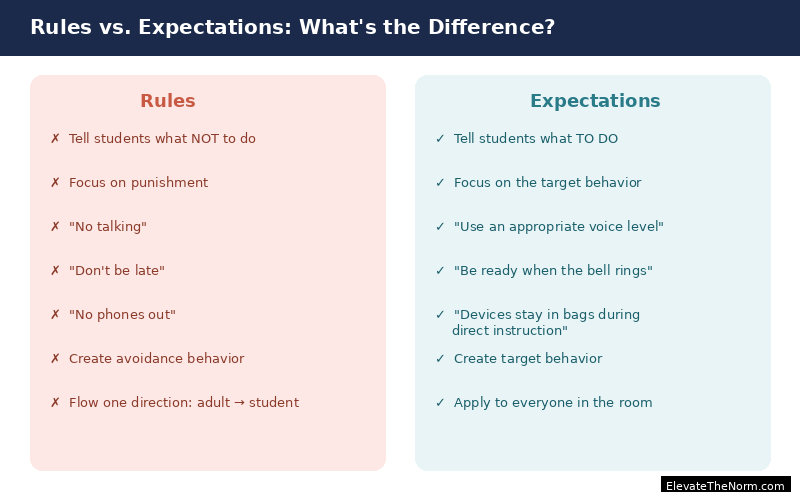
    Consequences work best as one section of something larger. Setting the whole thing down in writing is what keeps the response consistent on the days you are least inclined to be.

Teacher Emergency Toolkit — practical resources, real classroom support. Shop on TPT.Teacher Emergency Toolkit — practical resources, real classroom support. Shop on TPT.