The Elevate Blog banner: Real Classrooms. Practical Ideas. Higher Expectations. Three students climb a rocky ridge at sunrise, each pulling the next one up, toward a teacher reaching down to help.

Category: Classroom Management

Behavior, routines, and what actually holds a room together without raising your voice.

  • Classroom Expectations Poster for Middle and High School Students

    Classroom Expectations Poster for Middle and High School Students

    By Clay Shumate · Updated October 24, 2026

    The short answer: a classroom expectations poster for middle and high school should list five to eight specific, observable behaviors that every seat can read and you can point to in the moment. The free 11×17 poster below has eight: come in ready, bring your actual effort, listen, disagree respectfully, own your work, stay in the work, respect what isn’t yours, and follow through.

    Every classroom has rules posted somewhere. Most of them say things like “Be Respectful,” “Be Responsible,” and “Be Ready” — alliterative, inoffensive, and almost entirely meaningless to a teenager who doesn’t know what those words look like in practice.

    In my seventh year in the classroom, I’ve stopped treating a posted list of slogans as a finished job. Three phrases in block letters, laminated and mounted near the door, give the impression that expectations have been communicated. They haven’t. Teenagers need specifics. They need to know what “respect” looks like at 8:15 on a Monday when they’re exhausted and the assignment makes no sense. They need to know what “ready” looks like when they forgot a pencil and the lesson starts in thirty seconds.

    A classroom expectations poster, done right, is more than decoration. It’s a reference tool — a shared agreement students can point to and that you can point to when a situation arises. It’s the honest answer to “I didn’t know that was a rule,” because it was, and it was visible the whole time.

    This article gives you the full poster text I use, the thinking behind each line, and how to introduce it so students actually read it instead of walking past it for nine months.

    Why Don’t Most Classroom Expectations Posters Work?

    The three-slogan poster fails for a predictable reason: vague language does not change vague behavior. When a student acts dismissively toward a classmate and you point to “Be Respectful” on the wall, they will look at it and genuinely not see the connection. That’s not defiance — it’s the natural result of abstract words without concrete definition.
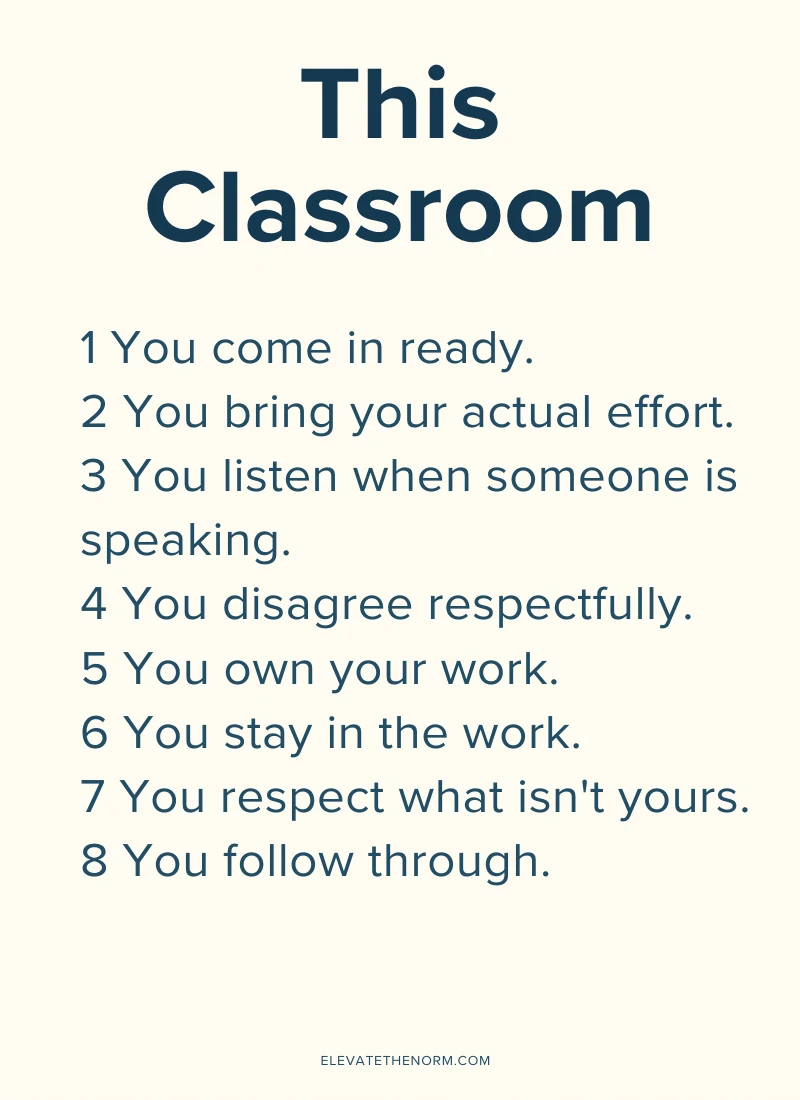
    Example classroom expectations poster showing specific observable behaviors for middle and high school students
    Specificity is what separates a useful expectations poster from a decorative wall hanging.

    The IRIS Center at Vanderbilt University makes a useful distinction in their classroom management research: classroom norms are familiar ways of interacting, while expectations are desired behaviors and outcomes. The difference matters because norms require explicit teaching, not just posting. “Be Respectful” is a norm. “When someone is speaking, you are looking at them and waiting your turn” is an expectation — observable, specific, and something a teacher can actually reference in the moment. My free Classroom Norms Poster Set on TPT uses plain, respectful language students in grades 6–12 will not roll their eyes at.

    Research from Education Northwest found that five to ten percent of the variance in student performance is attributable to teacher expectations — not the poster on the wall, but the behavioral expectations teachers communicate, model, and consistently reinforce. That number might sound small, but compounded across a school year for thirty kids, it adds up. The poster is only valuable if it represents what you actually teach and hold students to.

    The secondary-level mistake is slightly different than elementary. High school teachers often skip the poster entirely — “they’re old enough to know how to behave” — or go the opposite direction with a legalistic list of prohibited behaviors. Neither approach works. Students at this age respond to expectations framed as the standards of a serious environment that takes them seriously. They want to know that the rules make sense, not that they’re being controlled.

    Vague poster sloganSpecific expectation students can act on
    “Be Prepared”You come in ready: materials in hand, in your seat, working when the bell rings
    “Be Respectful”You listen when someone is speaking: eyes up, phone down, waiting your turn
    “Give 110%”You bring your actual effort: your today effort, whatever that is
    “Be Responsible”You follow through: if something comes up, talk to me before the due date, not after
    Slogans vs. specific, observable expectations.

    What Should a Classroom Expectations Poster Include?

    Before writing a single word for your poster, decide what job it’s going to do. A classroom expectations poster for middle and high school students should serve three purposes:

    First, it should define what success looks like in your room. Not what’s prohibited — what’s expected. There’s a meaningful difference. A list of don’ts puts students in a defensive posture. A list of expectations frames the room as a place with standards worth meeting.

    Second, it should be specific enough to reference in real situations. If you cannot point to a line on your poster during a conversation with a student and have them immediately understand why that line applies, the language isn’t specific enough.

    Third, it should treat students as capable of meeting the standards listed. Research consistently shows that students perform closer to the level their teachers genuinely believe they can reach. A poster that assumes low capability — or that feels like it was written for elementary students — communicates something you probably don’t intend.

    The research of Rosenthal and Jacobson, which famously showed that teacher expectations influence student performance even when the expectations are communicated unconsciously through treatment and attention, underlines why the framing of a poster matters. A poster that communicates “here’s what I believe students like you actually need reminding about” sets a different tone than one that says “here are the standards of a serious classroom.”

    The Poster Text: Full Copy for Middle and High School

    Here is the full text I use in my room. This version was written with the specific goal of being direct, respectful, and specific enough to be useful. Copy it, adapt it, and make it yours.

    In This Classroom

    You come in ready.
    Materials in hand, in your seat, working on what’s up when the bell rings. Not almost ready — ready.

    You bring your actual effort.
    Not your best-day effort. Your today effort, whatever that is. Show up and do the work. That’s the standard.

    You listen when someone is speaking.
    Eyes up, phone down, waiting your turn. This applies to me and to your classmates.

    You disagree respectfully.
    If you think something is wrong, you say so — directly, with reasoning. You do not dismiss, ridicule, or roll your eyes.

    You own your work.
    Yours means yours. Mistakes are expected. Excuses are not. If something goes wrong, we figure out what happened and fix it.

    You stay in the work.
    When a task is hard, you stay with it before you ask for help. When you’re lost, you say so. “I don’t get it” is the beginning of learning, not a reason to stop.

    You respect what isn’t yours.
    Desks, supplies, and other people’s belongings are treated accordingly.

    You follow through.
    Deadlines exist. Commitments matter. If something comes up, you talk to me before the due date, not after.

    Download the Classroom Expectations Poster

    The poster is free and right here, with no email or signup of any kind. Blanks are built in for your room number, your name, and your course. Print the 11×17 for wall mounting where the back row can read it, or the letter size for a desk-level copy. The PNG is there if you would rather drop it into your own layout first.
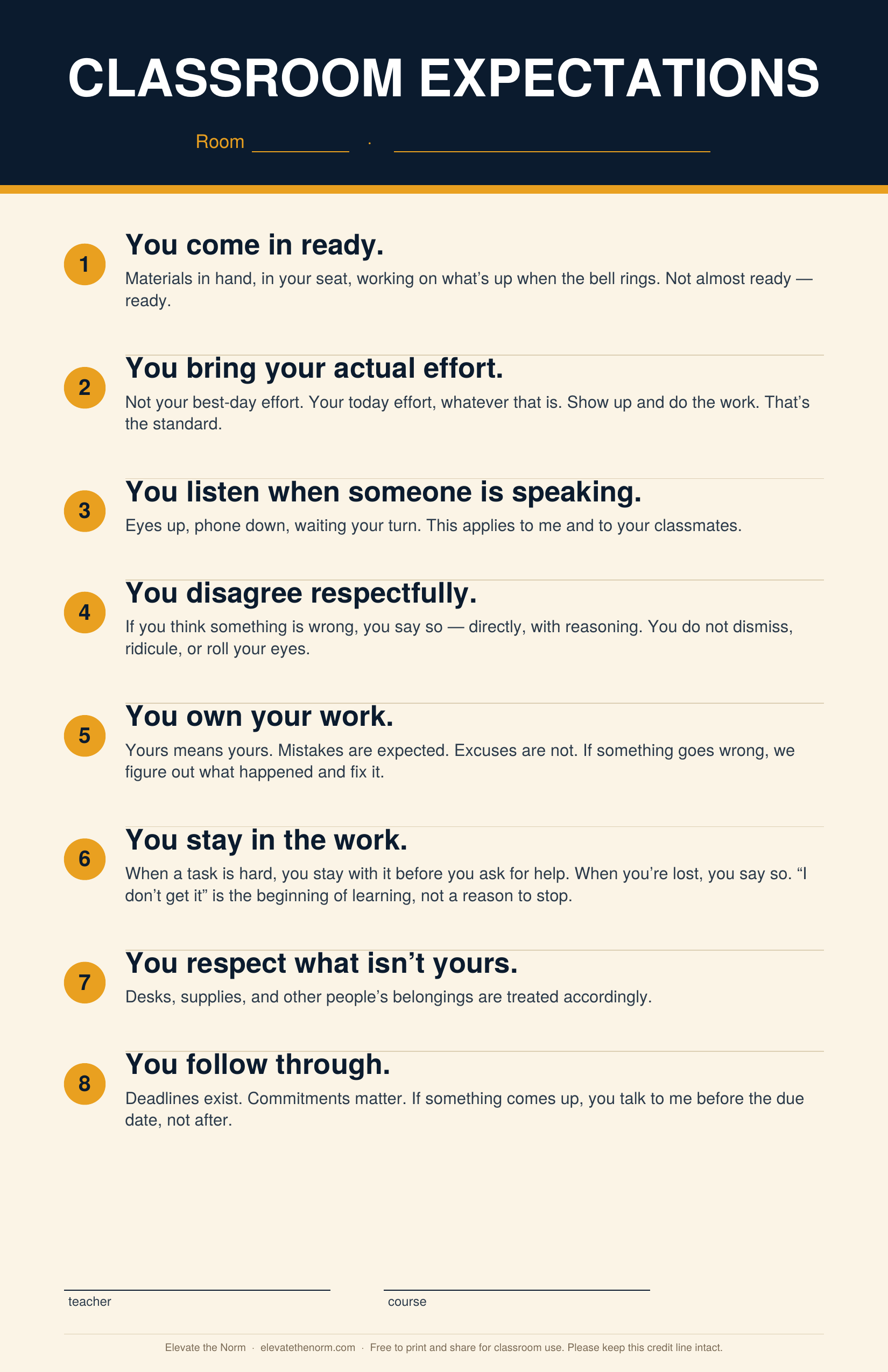
    Printable classroom expectations poster for grades 6-12 listing eight numbered expectations: you come in ready, you bring your actual effort, you listen when someone is speaking, you disagree respectfully, you own your work, you stay in the work, you respect what isn't yours, and you follow through, with blank lines for room number, teacher, and course
    The full poster, sized for 11×17. Blanks at the top and bottom are for your room number, name, and course.

    Free. No email address required. Free to print and share for classroom use — please keep the credit line intact. More free classroom packs are on the teacher resources page.

    Why These Lines Are Written This Way

    Each line was written to be as direct and specific as possible while treating students as people who can meet the standard.

    “You come in ready” is more specific than “Be Prepared.” It names the three things ready actually means: materials, seat, and working. First-week students who struggle with this aren’t defying you — they don’t know what ready looks like yet. This line tells them.

    “You bring your actual effort” is specifically not a “give 110%” type of statement, which sounds like a motivational poster and lands about as well. Instead, it acknowledges that effort looks different on different days and asks for whatever today’s version is. This matters for students who check out because they think they’re already behind.

    “You listen when someone is speaking” is specific. Eyes up, phone down, waiting your turn. Those are observable behaviors. If a student has eyes on their phone while a classmate presents, that line directly applies. “Be Respectful” does not.

    “You disagree respectfully” is one of the most important lines on the poster — and the one most teachers skip. When students know that disagreement is not only tolerated but expected to happen in a particular way, they’re more likely to engage substantively rather than disengage silently. Related to the principle of student voice and choice, this expectation tells students that their perspective has a place in the room, with conditions.

    “You own your work” addresses academic integrity and personal responsibility without using either phrase. Teenagers understand “mistakes are expected, excuses are not” faster than they understand a policy statement about academic dishonesty. See also: student responsibility in the classroom.

    “You stay in the work” targets the most common avoidance pattern in secondary school: the student who gives up after thirty seconds and announces they’re done. It gives them a two-step response — stay with it first, ask for help second — and frames “I don’t get it” as a learning step rather than a stopping point. This connects directly to developing student autonomy, where students learn to work through challenges before seeking support.

    “You respect what isn’t yours” is brief on purpose. Students this age know what it means. A long explanation implies you don’t trust them to understand basic respect for property.

    “You follow through” names the expectation most teachers dance around with a long late-work policy. Commitments matter. Deadlines exist. Talk to me before, not after. That’s a relationship-based expectation, not a punitive one, and it sets the stage for a student accountability culture rather than one built on consequences alone.

    How Do You Introduce a Classroom Expectations Poster on Day One?

    Posting the expectations is step one. Teaching them is the actual job. The IRIS Center research makes this explicit: simply displaying rules is insufficient. Students need direct instruction, modeling, opportunity for practice, and feedback throughout the year.
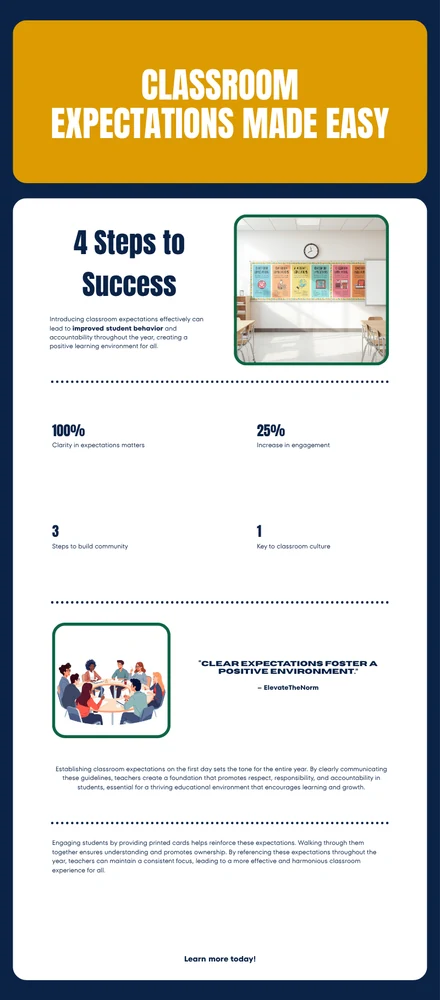
    Teacher introducing the classroom expectations poster on the first day of school to middle school students
    The first day introduction of classroom expectations sets the tone for the entire year.

    In my room, on day one, every student gets a printed card — half-sheet size — with the poster text on it. They keep it in their folder or notebook for the first few weeks. Then I walk through each line, one by one, and do two things: explain what it means in practice in our room specifically, and ask students what they think it means.

    This is not a lecture about rules. It’s a conversation about how this room is going to work. I ask: “What would ‘you come in ready’ look like in practice? What might make it harder? What should you do if you need a minute?” The goal is for students to own the expectations, not just receive them.

    The research on high expectations for students consistently shows that the quality of how expectations are communicated matters as much as the expectations themselves. Expectations delivered as a list to be memorized have less impact than expectations discussed, practiced, and genuinely held.

    After the first-day conversation, I reference the poster regularly — not as a threat, but as a natural part of class language. “We’re going to stay in the work here.” “If you disagree, say so with reasoning.” The poster becomes shorthand for a full expectation that students already understand.

    Where Should You Hang a Classroom Expectations Poster?

    Placement matters more than most teachers realize. If the poster is tucked in a corner next to three other posters, it is not functioning as a reference tool — it’s decoration. Put your expectations poster in a location that is:

    • Visible from every seat in the room
    • Large enough to read from the back of the room
    • Not competing with surrounding content for visual attention

    A single-page format works best for a secondary classroom. Font should be readable at a distance — no smaller than 24pt for body text, larger for the title. Design it in a way that fits the aesthetic of your room without making it look childish. A clean, simple design with clear typography communicates professionalism; clip-art borders do not.

    If you use Canva or a similar tool, create the poster in the dimensions for your printer (typically 11×17 for a poster-size sheet) or design it as a digital display if you have a dedicated screen. Watermark it as yours if you’re sharing it externally.

    Consider a smaller companion card — quarter-sheet or half-sheet — that students keep in their folders or journals. The poster is a reference for the room. The card is a personal reference they can access during independent work.

    After Day One: Keeping Expectations Alive

    The most important part of a classroom expectations poster is what happens after you put it up. If you never reference it again, it becomes wallpaper within two weeks. Students are paying attention to what you actually prioritize, not what you display.
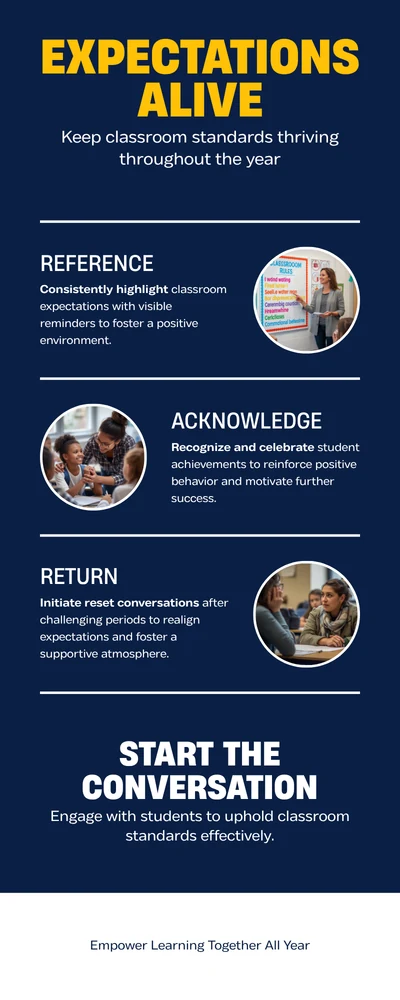
    Year-long classroom expectations poster displayed prominently in a secondary classroom for daily student reference
    A year-long classroom expectations reference keeps standards visible and consistent all semester.

    Three practices that keep expectations functional all year:

    Reference by name. When you redirect a student, name the expectation you’re referencing. “Hey — we’re listening when someone’s speaking.” Not “you’re being disrespectful.” The specific language connects the moment to the poster.

    Acknowledge when expectations are met. This is particularly important with secondary students, who often expect correction but not affirmation. When a student owns a mistake without excuses, name it. “That’s exactly what ‘you own your work’ looks like. I appreciate that.” It reinforces the expectation without being saccharine.

    Return to the poster after a rough stretch. Every classroom hits a rough patch — after a long break, during testing, late spring. When behavior patterns shift, a brief return to the poster is more useful than a lecture. “Let’s check in on where we are as a class. Which of these are we doing well? Which are we slipping on?” That conversation treats students as capable of self-assessing, which supports the student voice and choice culture you’re building.

    The research from TNTP’s 2024 literature review on teacher expectations notes that proactive, consistent, and equitable enforcement of expectations is what produces outcomes — not the initial posting or the first-day conversation. The poster is a starting point. How you use it the rest of the year is the actual work.

    Additionally, consider how positive discipline for teens connects here — expectations, when held consistently without shame or power struggles, build the foundation for students to make better choices because they understand the standard, not because they fear the consequence.

    Frequently Asked Questions

    Is this classroom expectations poster free?

    Yes. The poster is free to download with no email or signup. It comes as an 11×17 PDF for wall mounting, a letter-size PDF for a desk-level copy, and a PNG if you want to drop it into your own layout. Blanks are built in for your room number, your name, and your course.

    What size should a classroom expectations poster be for high school?

    Big enough to read from the back row. An 11×17 single-page poster works well in a secondary room, with body text no smaller than 24pt and a larger title. Hang it where it is visible from every seat and not competing with other posters, and give students a half-sheet or quarter-sheet card version to keep in their folders.

    Should students help create the classroom expectations?

    Student-generated expectations have merit, especially for building buy-in. The practical tradeoff: students will often generate vaguer language than you need (‘be nice’), and you may spend the first class period negotiating rather than establishing a clear standard. A middle path that works well is to give students the poster framework and ask them to discuss and refine what each line means in practice — they help define the specifics without starting from a blank slate. If your classroom culture already supports significant student voice and choice, full co-creation is worth the time.

    What’s the difference between classroom rules and classroom expectations?

    Rules prohibit specific behaviors (‘no phones’). Expectations define what success looks like (‘when someone is speaking, you’re looking at them’). For secondary students, expectations framed in terms of what they should do tend to get better results than a list of don’ts, which puts students in a defensive mental posture from the first day.

    How many expectations should be on the poster?

    Research on classroom norms suggests five to eight is a useful range — enough to cover the major categories of behavior in a learning environment without becoming a list students can’t remember. The poster text above has eight lines. If your context requires different emphasis, cut or adapt rather than pile on.

    Should middle school and high school expectations look different?

    The core expectations are similar, but the delivery and design should shift. Middle school students often benefit from more concrete specifics and visual cues alongside the text. High school students respond better to fewer words and more direct language. The poster text above was written to work across grades 6–12 with minor adjustments in tone depending on how you introduce it.

    What do I do when a student violates an expectation repeatedly?

    The poster is a reference tool, not a consequence system. If a student is repeatedly not meeting an expectation, that’s a conversation — not a pointing-at-the-poster moment. The poster helps you name the expectation clearly; the actual work of changing behavior usually requires a private conversation, some investigation of what’s causing the pattern, and sometimes a connection to the school’s support systems. A student accountability sheet can structure those conversations and help students track their own patterns.

    Is it worth posting expectations in a room where students rotate (secondary, multiple classes)?

    Absolutely — arguably more so than in an elementary setting. When students move from class to class, each teacher’s expectations may be different, and ambiguity around those differences is where a lot of secondary classroom behavior issues actually live. Posting clear expectations makes your room legible to students and reduces the mental load of figuring out how this room is different from last period.

    What’s the right response when a student says the expectations are unfair?

    Take it seriously. Ask them to be specific: which expectation do they think is unfair, and why? You may learn something useful. Sometimes students are naming a real inconsistency in how an expectation is enforced (equity concerns are worth listening to). Sometimes they’re testing to see if you mean it. Either way, a direct, calm conversation — ‘Tell me more about what you’re seeing’ — respects their perspective while making clear the expectations themselves aren’t up for negotiation in the moment.

    Sources

    Brophy, J. (1983). Research on the self-fulfilling prophecy and teacher expectations. Journal of Educational Psychology, 75(5), 631–661.

    Education Northwest. (n.d.). Expectations and student outcomes. https://educationnorthwest.org/sites/default/files/expectations-and-student-outcomes.pdf

    IRIS Center, Peabody College, Vanderbilt University. (n.d.). Establishing classroom norms and expectations. https://iris.peabody.vanderbilt.edu/case-study/establishing-classroom-norms-and-expectations/

    Rosenthal, R., & Jacobson, L. (1968). Pygmalion in the classroom: Teacher expectation and pupils’ intellectual development. Holt, Rinehart and Winston.

    TNTP. (2024). The impacts of teacher expectations on student outcomes: A literature review. https://tntp.org/wp-content/uploads/2024/09/The-Impacts-of-Teacher-Expectations-on-Student-Outcomes-Literature-Review-2024.pdf
    About Clay Shumate

    By Clay Shumate — Clay Shumate is a certified secondary Social Studies teacher in the public schools of West Alabama, with seven years of classroom experience, a B.A. in History, and an M.Ed. in Secondary Education. He writes about project-based learning, student responsibility, respect, and practical ways to hold young people to a higher standard while giving them room to learn from mistakes. He is a member of the Society of Professional Journalists and writes to its Code of Ethics; this site’s editorial standards and corrections policy are published in full.

  • Student Accountability Sheet: A Free, Non-Childish Classroom Template

    Student Accountability Sheet: A Free, Non-Childish Classroom Template

    By Clay Shumate · Updated October 24, 2026

    A student accountability sheet is a short, structured form a student completes after something went wrong — a missed deadline, a group conflict, a behavior that affected the room. Done right, it takes about five minutes and produces a useful conversation. Done wrong, it is busywork that teaches students nothing except how to fill out busywork. This guide explains the difference, offers a free template in four versions, and shows exactly how to use it in a secondary classroom without humiliating anyone or generating a paper trail for things that do not belong on one.

    Key Takeaways

    • An accountability sheet supports a conversation — it is not a punishment, a replacement for a school referral, or a way to document a student for later.
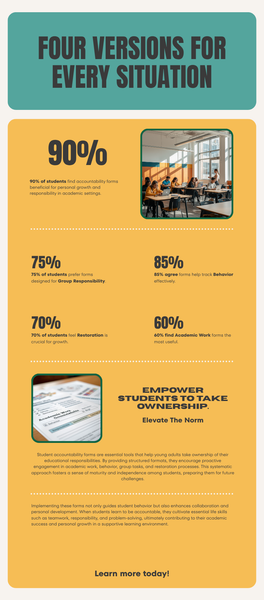
    • Four versions cover the situations teachers actually face: academic work, group responsibility, behavior, and restoration after a conflict.
    • Students complete the sheet themselves. That is the point. If the teacher is doing the writing, the tool is being used incorrectly.
    • The sheet is not a file. Unless a required school procedure calls for documentation, it lives with the student or gets recycled after the conversation.
    • Any teacher can use this the first week of school. No program, no training, and no administrator approval required.

    What Most Accountability Sheets Get Wrong

    Most accountability sheets found in schools — and most of the printables circulating on teacher resource sites — were designed for elementary students and scaled up by changing the font. They ask students to write “what I did wrong” in a box, then “how I will do better next time” in another box, and they expect that sequence to produce insight. It rarely does, because the sequence assumes the student already has a clear picture of what happened and why. They often do not.

    The other common design flaw is that the sheet exists only as a record. A teacher hands it to a student, the student fills it out, the teacher collects it and puts it in a folder. Nothing happens as a result. The student learns that accountability means paperwork, not change — which is exactly the wrong lesson.

    A well-designed student accountability sheet for grades 6–12 does three things that most forms skip. It separates facts from interpretations, so students can describe what actually happened without being led toward a particular framing. It identifies who, specifically, was affected — not just “the class” in the abstract. And it generates a next step the student can actually take, not a vague commitment to “try harder.”

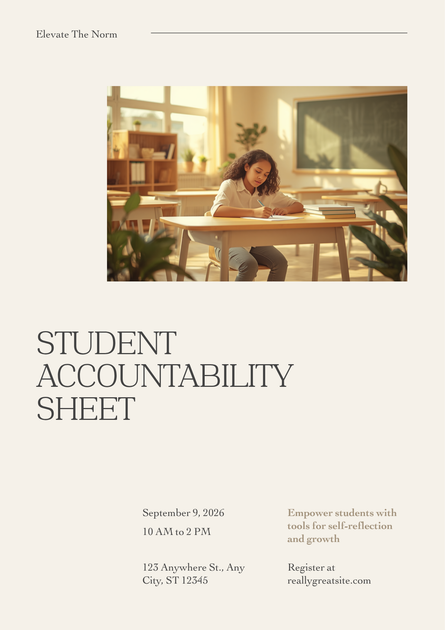
    Classroom accountability sheet template on a student desk in a secondary classroom with warm lamp lighting
    An accountability sheet is a tool for a five-minute conversation, not a substitute for one.

    When Should You Use a Student Accountability Sheet?

    There are four situations where a short accountability sheet is useful in a secondary classroom. Understanding the difference between them matters, because each version of the sheet asks slightly different questions.

    Academic Work

    A student missed a deadline, submitted incomplete work, or disengaged from a task. The goal of the sheet in this case is not to assign blame but to figure out what actually got in the way. Sometimes the answer is workload. Sometimes it is confusion about the assignment. Sometimes it is something happening at home. The sheet creates space to say so without the conversation becoming a confrontation.

    Group Responsibility

    A student did not hold up their part of a group project. Or a group is in conflict about who did what. The group version of the sheet is filled out individually by each member before the group meets together — which means every voice is already on paper before anyone starts defending themselves out loud. This simple sequencing change reduces the volume of these conversations significantly.

    Behavior

    Something happened in the room — a comment that landed wrong, a refusal, an outburst — that the teacher needs to address before moving on. This version is short by design, because a behavior conversation does not benefit from extended written reflection in the moment. The sheet gives the student a minute to collect their thoughts before speaking, which is often all that is needed to de-escalate the temperature.

    One important note: if the behavior requires a school referral, disciplinary report, or any documentation under your district’s required procedures — do that. The accountability sheet is a classroom tool, not a substitute for mandated process. If you are unsure whether a situation requires official documentation, assume it does and act accordingly. The sheet goes with the student afterward, not instead of the referral.

    Restoration

    Something happened between students — a conflict, an unkind comment, a damaged trust — and the class needs to move forward. The restoration version is the most conversational of the four. It is the one most closely aligned with restorative approaches, and it works best when both students complete their own version before sitting down together. For more on restorative approaches in a school context, see restorative practices in schools.

    VersionUse it whenKey question
    Academic workA missed deadline, incomplete work, or disengagement from a task“What got in the way?”
    Group responsibilityA student did not hold up their part, or a group disputes who did what“What do you owe the group at this point?”
    BehaviorA comment, refusal, or outburst the teacher must address before moving on“Who was affected by it?”
    RestorationA conflict or broken trust between students that the class needs to move past“What did the other person lose or experience?”
    The four accountability sheet versions at a glance.

    What Goes on a Student Accountability Sheet? (4 Free Templates)

    Each template below is designed to be reprinted, typed into a shared document, or read aloud and answered verbally depending on the student and the situation. The fields are short. The language is direct. None of it is condescending.

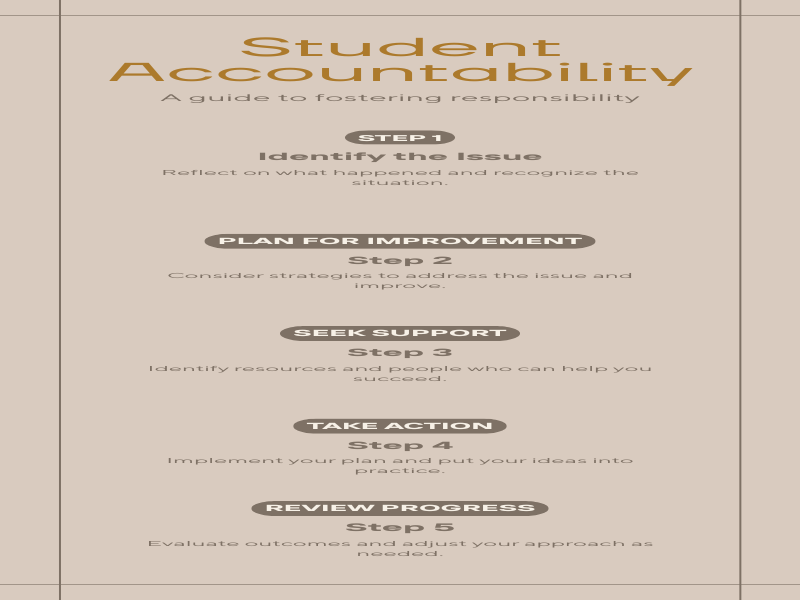
    Four versions of student accountability sheet side by side showing academic work group responsibility behavior and restoration fields
    Four distinct versions of the sheet cover the situations teachers actually face in grades 6–12.

    Version 1 — Academic Work

    Student name: _______________ Date: _______________

    The assignment or task: _______________

    What was supposed to happen? (Describe the expectation — due date, format, what “complete” looked like.)

    What actually happened? (Facts only. Not reasons yet.)

    What got in the way? (This is where reasons belong. Be honest — including “I didn’t prioritize it” is a valid answer.)

    What is one thing you can do in the next 48 hours to move this forward?

    What support, if any, do you need from me?

    Version 2 — Group Responsibility

    Student name: _______________ Project or task: _______________ Date: _______________

    What was your agreed-upon role or task in this group?

    What did you actually complete?

    What did your group expect from you that you did not deliver?

    What happened from your perspective? (State facts and reasons separately.)

    What do you owe the group at this point?

    What is your next step, and when will it be done?

    Version 3 — Behavior

    Student name: _______________ Date: _______________ Period/class: _______________

    Describe what happened. (What you said or did — not what someone else did first.)

    Who was affected by it? (Name the people, not just “everyone.”)

    What do you want those people to know?

    What is one thing you will do differently?

    Note to the teacher: this version is designed for classroom-level situations. If the incident requires a disciplinary referral, complete your school’s required documentation first. This sheet is a follow-up conversation tool, not a replacement for required procedures.

    Version 4 — Restoration

    Student name: _______________ Date: _______________

    What happened between you and the other person? (Your account of it — not what they did, what happened between you.)

    What did the other person lose or experience because of the situation? (This is a perspective-taking question. Answer it honestly even if it is uncomfortable.)

    What do you want to be different going forward?

    Is there something specific you are willing to do or say to move toward that?

    What do you need from me or from the other person to make this work?

    Teacher and student sitting together at a whiteboard table reviewing an accountability sheet in a secondary classroom
    The sheet starts the conversation — it does not replace it. Five minutes at the whiteboard table is worth more than a folder full of completed forms.

    How Do You Use a Student Accountability Sheet?

    The sheet is not the conversation. It is the preparation for one. A student who fills it out in silence and hands it in has not been held accountable — they have completed a writing assignment. The point of the form is that it gives the teacher and the student a shared document to look at together, which is significantly less confrontational than looking at each other across a desk.

    The sequence that works: hand the student the sheet and give them three to five minutes to complete it, without hovering. Sit down together to review it — ideally somewhere that is not the center of the room. Read it together, ask one or two follow-up questions, and agree on the next step before the student returns to work. That is the whole procedure. If it is taking longer than ten minutes, either the situation is more serious than this tool was designed for, or the conversation has turned into a lecture. Stop the lecture.

    The anchor question in every version is some variation of “what is your next step?” That is the question that determines whether the sheet produced anything useful. A vague next step (“I’ll try harder,” “I’ll be better”) is not a next step. Push for something specific and time-bound: “I’ll finish the introduction section by Thursday,” or “I’ll ask Morgan what I can do to address what happened.” Specificity is what makes accountability concrete rather than performative.

    A Classroom Anchor: Authority Handed and Held

    The accountability sheet works best when students already understand that authority in the room is real and is held to. A clearly visible classroom expectations poster does much of this work passively — it gives students a reference point before anything goes wrong, so the accountability sheet’s first question (“what was supposed to happen?”) lands with specificity rather than guesswork. In my workshop room — where students are almost always working alongside somebody, and I move between groups rather than lecture from the front — the sheet tends to come up most often around group work, and specifically around moments where a student was trusted with a role and did not follow through on it.

    When that happens, I do not announce it to the room. I slide the Version 2 sheet to the student at their table and give them four or five minutes while I circulate. Then I pull them to the whiteboard table — my small-group conferencing area with a rug, better chairs, and a lower lamp, where students know they are being seen carefully and not put on display — and we work through their answers together.

    The conversation is not about catching them in something. It is about naming what happened clearly enough that we can figure out what comes next. Students who have been given real authority over something — their section of a project, their role in a group, a decision that affects others — understand why the accounting matters. It matches the weight of the responsibility they were given. What does not match it is a form that feels like it was designed for a third-grader. The template above is written at the level the student is actually operating at. That is the difference between accountability and humiliation, and it matters.

    This approach connects directly to what student responsibility looks like in the classroom — real responsibility includes real accounting when things go wrong, not manufactured consequences or empty apologies. For the broader case for high expectations paired with the room to learn from mistakes, see high expectations for students.

    What If a Student Doesn’t Follow Through?

    A student completes the sheet, agrees to a next step, and then does not take it. This happens. Here is the important thing: that outcome does not mean the sheet failed. It means you now have a second conversation with more information than you had before. You know what the student said they would do. You know they did not do it. The conversation gets more specific, not more punitive.

    The escalation path in this case depends on what the situation actually requires. Some students need more support than a single conversation provides — academic, social, or something else entirely. The sheet is not a substitute for identifying that need and addressing it. If a pattern emerges across multiple sheets and conversations, that is information that may need to go to a counselor, an interventionist, or a parent. At that point the sheet is one piece of a larger picture, not the whole solution.

    For students whose accountability issues involve ongoing behavior challenges, the positive discipline framework for teenagers provides a more structured approach that pairs well with the sheet. For situations involving harm between students, the natural consequences framework and the restoration version of the sheet work together. And for the broader question of how to build a classroom where students actually want to hold themselves accountable, see the site’s overview of student responsibility as a developmental skill, not a character judgment.

    The Research Behind It

    Self-regulated learning research has consistently found that students who can reflect on their own performance — identify what went wrong, name contributing factors, and plan a corrective action — outperform students who receive only external evaluation (Zimmerman, 2002). The accountability sheet is applied self-regulated learning: it scaffolds a reflective process that students build over time.

    Self-determination theory (Deci & Ryan, 2000) adds an important dimension: students are far more likely to take a next step they chose than a consequence that was imposed on them. Every version of the sheet ends with the student naming a next step. That ownership matters for what actually happens afterward. Hattie’s (2009) meta-analysis of over 800 studies identified student self-assessment — including structured reflection on what went wrong — as one of the highest-leverage interventions available to teachers. The accountability sheet is a low-cost, no-training version of exactly that.

    Research on restorative approaches in schools (Morrison & Vaandering, 2012; Skiba & Peterson, 2000) supports the same conclusion from the discipline side: punitive responses to student misbehavior consistently underperform restorative ones on measures of recurrence, school climate, and relationship repair. A sheet that asks students to identify who was affected and what they are willing to do to repair it is grounded in that same framework, without requiring a school-wide program or a trained facilitator.

    If you want the same plain, non-childish approach for the days you are not in the room, the free Sub Survival Kit at SubstitutePlans.com has a daily report form a substitute fills out, plus attendance sheets, seating charts and backup activities. It covers the record-keeping so the accountability conversation can still happen when you get back.

    Printables for this

    Two of mine on TPT, both built for this. Behavior Documentation Forms are the other half of the picture — the ABC data and MTSS logs you keep when a pattern does need a record, which the sheet above deliberately is not. The Makeup Work System handles the follow-through on the academic version, so “what is your next step” has a process behind it.

    If a tracking sheet is not enough on its own: see how to build a behavior contract a student will actually respect, including a sample and an honest read on whether contracts work.

    Frequently Asked Questions

    What is a student accountability sheet?

    A student accountability sheet is a short, structured form a student completes after something went wrong, such as a missed deadline, a group conflict, or a behavior that affected the room. It separates facts from reasons, names who was affected, and ends with a specific next step. It supports a private conversation; it is not a punishment or a disciplinary record.

    How long should an accountability sheet conversation take?

    About five minutes. Give the student three to five minutes to complete the sheet without hovering, then sit down together away from the center of the room, ask one or two follow-up questions, and agree on a specific, time-bound next step. If it runs past ten minutes, the situation needs more than this tool or the talk has turned into a lecture.

    Is a student accountability sheet the same as a disciplinary referral?

    No. A disciplinary referral is a formal school document that enters a student’s record, triggers review by an administrator, and may carry consequences under district policy. An accountability sheet is a classroom tool — a short form that supports a private conversation and a next step. It is not filed, not sent to the office, and not part of the student’s disciplinary record unless you deliberately attach it to a referral as supporting documentation. If a situation requires a referral, complete the referral. The accountability sheet is for situations that do not — which is the majority of what happens in a classroom on any given day.

    What if the student doesn’t fill it out honestly?

    Some students will write what they think you want to hear. That is useful information, too. If the sheet reads like a performance rather than a reflection, say so directly and ask one specific follow-up question: “When you wrote you would try harder — what does that look like for you on Monday?” Most students will either give a more honest answer or reveal that they actually do not know. Both are starting points for a real conversation. The sheet is not a truth test. It is a structure for a conversation, and the conversation is where the real work happens.

    Does this go in the student’s permanent file or record?

    No — not unless your school’s procedures specifically require it for a given type of incident. For most classroom-level situations, the sheet lives with the student or gets recycled after the conversation. If you are using it as part of a required disciplinary process, follow your school’s documentation requirements for that process. Do not create an informal file of completed accountability sheets. That is not what this tool is for, and it can create problems if the file is ever requested.

    Can parents request to see these sheets?

    Parents can request records their child’s school maintains about them under FERPA. If you are collecting and storing completed accountability sheets in any systematic way, you should treat them as education records and handle them accordingly. The simplest way to avoid this issue is to not store them: use the sheet, have the conversation, and let the student keep it or discard it. A brief note in your own records of the conversation and the agreed-upon next step is sufficient documentation for your own use.

    What should I do if the student refuses to fill it out?

    A student who refuses to engage with the sheet is telling you something about their state in that moment. Do not escalate over the sheet itself. Give them a minute, check in quietly, and decide whether this is a moment of genuine distress, a test of your authority, or something else. If it is a test, name what you see calmly: “I’m going to give you two more minutes. I’ll come back.” If it is distress, the sheet can wait. If refusal becomes a pattern, that is a separate conversation — about engagement and trust, not about a form.

    At what grade level does this work best?

    The templates above are designed for grades 6–12. The language is appropriate for middle school and can be used as-is with most high school students. Students in grades 6–8 may need more scaffolding during the conversation — they often have the self-awareness but not yet the vocabulary to name what happened clearly. The teacher’s role in those grades is slightly more coaching than questioning. High school students can generally complete the sheet more independently, though the conversation afterward is equally important at both levels.

    How do I use the group responsibility version fairly when students blame each other?

    Have each student complete their own version of the sheet before anyone talks. This is non-negotiable: if students start talking first, they immediately start building a shared story that may not reflect what each person actually experienced. Once each student has answered the questions in writing, bring them together. Start with what each person wrote about their own contribution — not the other person’s failures. The sheet’s structure forces that sequence because the questions are framed around the student’s own actions. It does not eliminate conflict, but it changes the opening move from accusation to accounting.

    Sources

    • Zimmerman, B. J. (2002). Becoming a self-regulated learner: An overview. Theory Into Practice, 41(2), 64–70. https://doi.org/10.1207/s15430421tip4102_2
    • Deci, E. L., & Ryan, R. M. (2000). The “what” and “why” of goal pursuits: Human needs and the self-determination of behavior. Psychological Inquiry, 11(4), 227–268. https://doi.org/10.1207/S15327965PLI1104_01
    • Hattie, J. (2009). Visible Learning: A Synthesis of Over 800 Meta-Analyses Relating to Achievement. Routledge.
    • Morrison, B. E., & Vaandering, D. (2012). Restorative justice: Pedagogy, praxis, and discipline. Journal of School Violence, 11(2), 138–155. https://doi.org/10.1080/15388220.2011.653322
    • Skiba, R. J., & Peterson, R. L. (2000). School discipline at a crossroads: From zero tolerance to early response. Exceptional Children, 66(3), 335–346. https://doi.org/10.1177/001440290006600303

    About Clay Shumate

    By Clay Shumate — Clay Shumate is a certified secondary Social Studies teacher in the public schools of West Alabama, with seven years of classroom experience, a B.A. in History, and an M.Ed. in Secondary Education. He writes about project-based learning, student responsibility, respect, and practical ways to hold young people to a higher standard while giving them room to learn from mistakes. He is a member of the Society of Professional Journalists and writes to its Code of Ethics; this site’s editorial standards and corrections policy are published in full. More about Clay.

  • High Expectations for Students: The Difference Between Belief and Pressure

    High Expectations for Students: The Difference Between Belief and Pressure

    By Clay Shumate

    High expectations for students means holding a standard you genuinely believe a teenager can reach, and then building the path that lets them reach it. Belief without a path is not a high expectation. It is pressure. The research is clear that expectations move outcomes — and just as clear that they move them only when support moves with them.

    Key Takeaways

    • Teacher expectations really do change outcomes. A national study of 10th graders found that a teacher expecting a student to finish college, rather than not, was associated with roughly a 15-percentage-point increase in the odds that the student actually did.
    • But the effect is smaller than the Pygmalion legend. The most careful review of the field concluded that self-fulfilling prophecies in classrooms are real, typically small, and more likely to fade than to compound.
    • Expectations are mostly accurate, which is its own problem. When a teacher’s read on a student is wrong, it is usually wrong in a patterned way — and the pattern tracks race, income, and prior grades.
    • Press without support does almost nothing. Chicago middle-grades students with high academic press and low support gained about half as much math as students who had both.
    • One sentence changes how criticism lands. Seventh graders who were told the comments came from high expectations and a belief they could meet them revised at more than twice the rate of students who got the same comments without the sentence.
    • The bar stays. The runway changes. Every honest version of high expectations keeps the task and adds the scaffolding, the conference, and the second attempt.

    What high expectations for students actually means

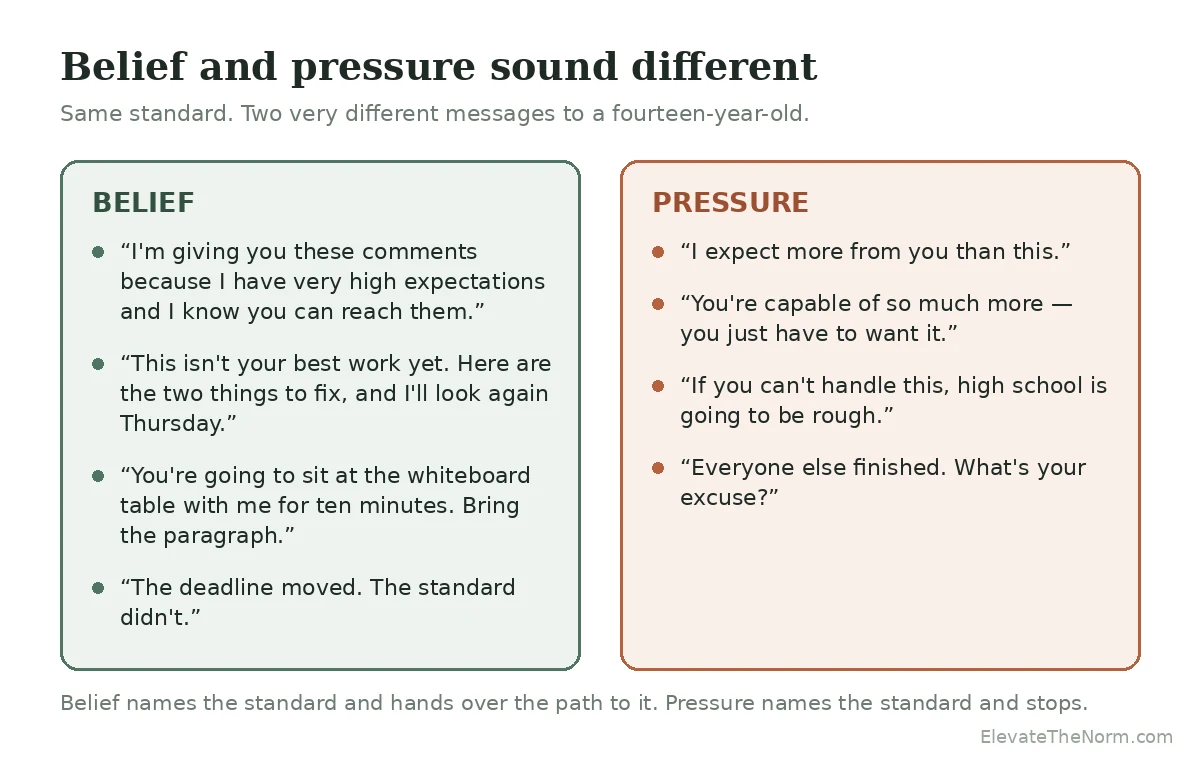
    Two-column comparison of teacher phrasing. The belief column names a standard and a next step; the pressure column names a standard and stops.
    The same standard can be delivered as belief or as pressure. The difference is whether a path comes with it.

    Most schools say they have high expectations. Very few can tell you what that sentence commits them to on a Tuesday.

    Here is a working definition. A high expectation has three parts: a standard the student can actually see, a stated belief that this particular student can reach it, and a route from where they are now to there. Drop the third part and you have a slogan. Drop the second and you have a syllabus.

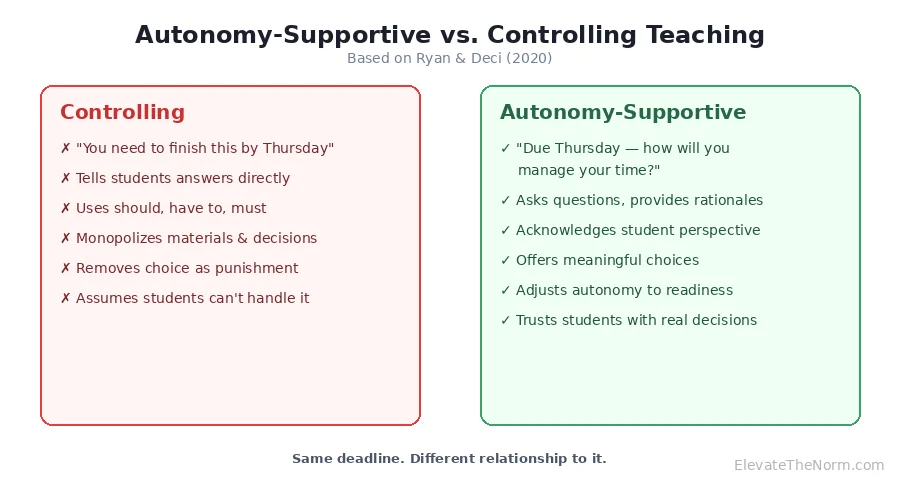
    This is different from classroom expectations in the behavior sense — how we treat each other, how we start class, what happens when work is late. Those matter, and teaching them explicitly — including with a well-designed classroom expectations poster that students can reference all year — is most of the job in September. This article is about the other kind: what you believe a student is academically capable of, and what that belief does to them.

    The two get confused constantly. A teacher can run a tightly managed room with airtight procedures and still quietly expect very little of half the students in it.

    The evidence: real, causal, and smaller than the legend

    Short answer: expectations move outcomes, but not by magic, and not by much on their own.

    Everyone in education has heard some version of the 1968 Pygmalion study — tell teachers a random group of kids are late bloomers, and the kids bloom. It is one of the most repeated findings in the field and one of the least accurately repeated.

    The most thorough review of what came after it is blunt. Lee Jussim and Kent Harber concluded that self-fulfilling prophecies in classrooms do occur, but that the effects are “typically small,” do not accumulate much across teachers or years, and “may be more likely to dissipate than accumulate” (Jussim & Harber, 2005). They also found something more uncomfortable: teacher expectations predict student outcomes largely because those expectations are accurate, not because they are self-fulfilling. Teachers are generally reading students correctly.

    That is worth sitting with before you assume belief alone will carry a kid. It usually will not.

    What Jussim and Harber also found is where this gets useful: the powerful self-fulfilling effects show up selectively, among students from stigmatized groups. The students most affected by what a teacher believes are the students the system already treats worst.

    The strongest causal estimate available comes from Nicholas Papageorge, Seth Gershenson, and Kyung Min Kang, who used a national sample of 10th graders in which two different teachers each predicted the same student’s educational future. Comparing the two predictions strips out the student’s own characteristics and isolates the teacher. When a teacher expected a student to complete a four-year degree rather than not, that student’s likelihood of actually earning one rose by about 15 percentage points (Papageorge, Gershenson & Kang, 2018/2020).

    Read that carefully. It is a large effect attached to a large swing — from a teacher writing a student off to a teacher expecting a degree. It is not a promise that raising your general enthusiasm raises test scores.

    Where the expectation goes wrong before the student ever sees it

    If expectations are mostly accurate, the interesting question is what happens when they are not.

    Using the same national data, Gershenson and colleagues compared the two teachers each student had. Non-Black teachers of Black students were about 9 percentage points less likely than Black teachers to expect that student to finish a four-year degree — about 11 points for Black boys. That single mismatch accounted for more than half of the overall Black–white gap in teacher expectations, and it was larger among math teachers than reading teachers (Gershenson, Holt & Papageorge, 2016).

    Two teachers. Same student. Same transcript in front of both of them. Different forecast.

    The related finding in the Papageorge paper is stranger and worth naming honestly: white teachers were more optimistic overall, and their optimism about white students was the least accurate of the lot. The problem is not simply that some teachers are pessimistic. It is that optimism gets handed out unevenly, and the students who receive less of it are the ones for whom it matters most.

    You are not going to fix this by deciding you are unbiased. Nobody has ever found their own expectation gap by introspection. You find it by looking at what you handed back.

    Why expectations without support turn into pressure

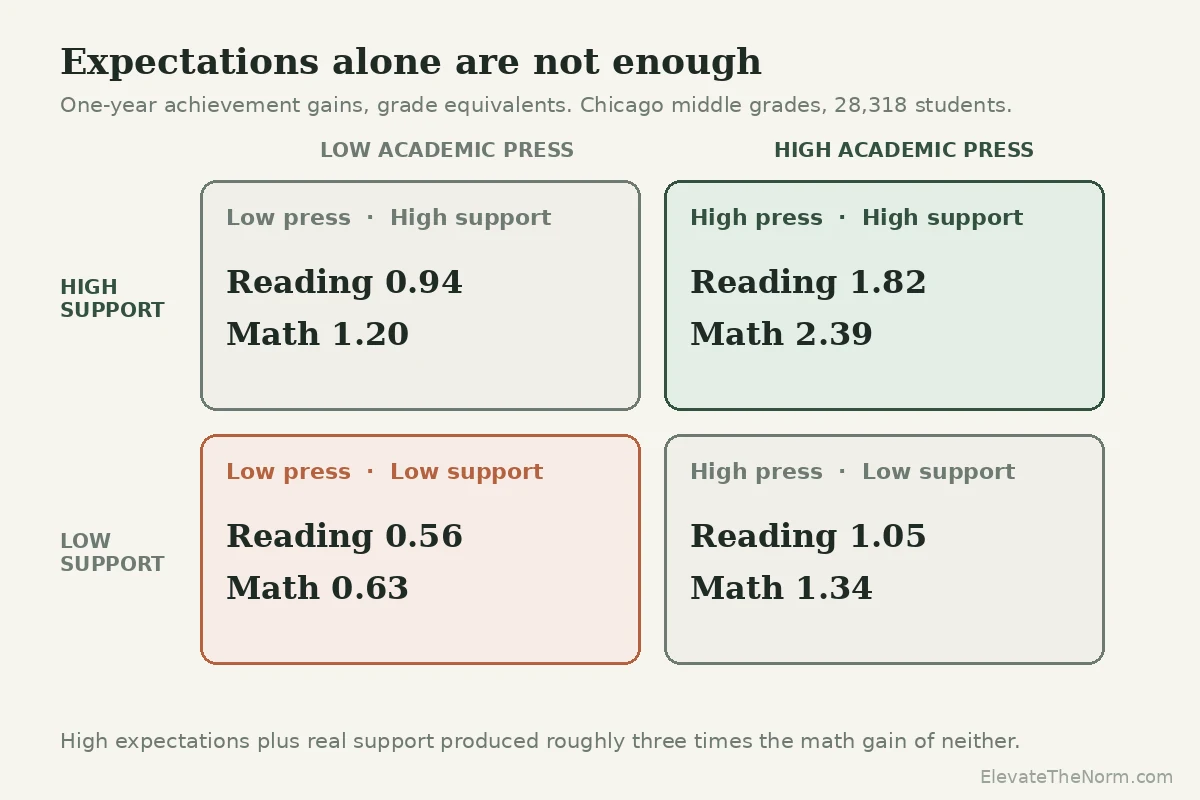
    Two-by-two grid of one-year achievement gains in grade equivalents by level of academic press and social support, from the Chicago middle-grades study.
    High press with high support produced 2.39 grade equivalents of math growth in a year; low press with low support produced 0.63.

    Researchers have a term for the demand side of this: academic press. It just means how strongly a school signals that academic achievement is expected and non-negotiable. The other side is social support — the adults and peers a student can actually go to for help.

    Valerie Lee, Julia Smith, Tamara Perry, and Mark Smylie put 28,318 sixth and eighth graders across 304 Chicago schools into that two-by-two and measured a year of achievement growth in grade equivalents (Lee, Smith, Perry & Smylie, 1999).

    ConditionReading gainMath gain
    High press + high support1.822.39
    High press + low support1.051.34
    Low press + high support0.941.20
    Low press + low support0.560.63
    One-year achievement gains in grade equivalents. Lee, Smith, Perry & Smylie (1999), Chicago middle grades.

    Look at the middle two rows. High expectations without support and warm support without expectations land in almost the same place. Neither one is worth much alone. Together they roughly triple the math growth of a school that has neither.

    One honest caveat: this is sixth and eighth grade in one large urban district in the 1990s, and it is correlational. It does not prove that adding support to a demanding classroom causes the jump. It does show that the two travel together in the data, at scale, and that the version of “high expectations” that arrives as pressure alone is the version with the weakest results attached to it.

    That is the whole argument of this article in one table. If you take nothing else, take the fact that the demand and the help are not in tension. They are the same intervention.

    What high-expectation teachers do differently

    Christine Rubie-Davies and colleagues ran something rare in this field: an actual randomized intervention that trained teachers in the practices of high-expectation teachers rather than just measuring their beliefs. Eighty-four teachers across twelve schools; students in the intervention classrooms gained roughly 28% more in mathematics over the year than the control group, an effect size of about 0.24 (Rubie-Davies, Peterson, Sibley & Rosenthal, 2014).

    The caveat that matters for this site: that study was run in New Zealand with students aged roughly 6 to 13. It is not a secondary-school result and I am not going to pretend it is. What transfers is the list of practices, which are recognizably about older students too. The number does not automatically transfer with them.

    The practices the intervention taught, summarized by the Society for Personality and Social Psychology:

    • Flexible grouping instead of fixed ability grouping. High-expectation teachers move students between groups based on the task in front of them, not on a permanent read of who is smart.
    • Goal setting with the student, not for them. Which is also how student autonomy gets built without losing the room.
    • A warm class climate. Not soft. Warm. Those are different words.
    • Different feedback. More specific, more forward-looking, and delivered to everyone rather than saved for the students most likely to use it.
    • Attention to non-verbal signals. Who you stand near, who you wait longer for, whose answer you finish for them.

    Notice that none of these are about announcing higher standards. They are about the ordinary mechanics of a class period.

    The one sentence that makes criticism land

    If you only change one thing this week, change this.

    In a study of seventh graders earning Bs and Cs, researchers had teachers return marked-up essays with one of two notes attached. The control note read: “I’m giving you these comments so that you’ll have feedback on your paper.” The other read: “I’m giving you these comments because I have very high expectations and I know that you can reach them.”

    The comments themselves were identical. Among African-American students, 64% of those who got the second note revised their essay, against 27% of those who got the first. When revision was required, 88% of students who had received the high-expectations note improved from first draft to second, compared with 34% in the control condition (Stanford SPARQ summary of Yeager et al., 2014).

    The mechanism is not flattery. Critical feedback across a trust gap is ambiguous — a student who has good reason to wonder whether an adult has written them off cannot tell from the red pen alone whether the comments mean I think you can do better or I already knew you couldn’t. The sentence removes the ambiguity. That is all it does, and it is enough to more than double a revision rate.

    Write it on the paper. Say it out loud when you hand the work back. Do not save it for the students you think need encouragement, because deciding who needs it is exactly the judgment the research says you should not trust.

    What this looks like at the whiteboard table

    I built a whiteboard table for small-group work. It sits in a corner under a lower lamp, on a rug, with the better chairs. Students ask to go there.

    That was deliberate, and it is the most useful thing I have done about expectations. The standard pull-aside table has a problem everyone in a school can name: it becomes the table where the kids who are behind get sent. Students read that instantly. Being called over becomes a public statement about what the adult thinks of you, which means the support itself starts carrying a message that undercuts the expectation.

    I did not solve that with a policy about not calling it the remediation table. I solved it by making that corner the best seat in the room. When it is the place people want to be, sitting down there stops being a verdict and starts being a normal thing that happens to everybody — the student who is lost, the student who is three steps ahead and bored, the group that needs a decision made.

    The general version: if your support is visibly reserved for the students you have low expectations of, the support and the expectation cancel each other out. Whatever your version of the table is, everybody has to end up there.

    What high expectations cannot fix

    This is the part that usually gets left out of the assembly speech.

    • They cannot substitute for course access. If a student is not enrolled in the class that leads to the next class, no amount of belief in that student’s potential changes the transcript. Master-schedule decisions outrank classroom optimism.
    • They cannot replace an IEP or 504 team. Goals for a student with a disability are set by a team through a legal process. “I have high expectations” is not a reason to disregard an accommodation, and a teacher does not get to raise a documented goal unilaterally. Bring the observation to the team.
    • They cannot compensate for missing instruction. A student who never learned to cite evidence needs to be taught to cite evidence. Believing harder is not a curriculum.
    • They cannot fix a schedule with no time for revision in it. If the pacing guide leaves no room for a second attempt, the school has decided the standard is a filter. That is an administrative choice, not a teacher’s failure of will.
    • They are not a district initiative. A campaign that tells staff to expect more, with no change to grouping, feedback, planning time, or course access, costs nothing and does about as much. The Rubie-Davies work changed practices, not slogans.

    Being honest about the limits is what keeps the rest credible. A teacher who claims expectations can overcome anything will be disbelieved on the parts that are true.

    A four-week way to check yourself

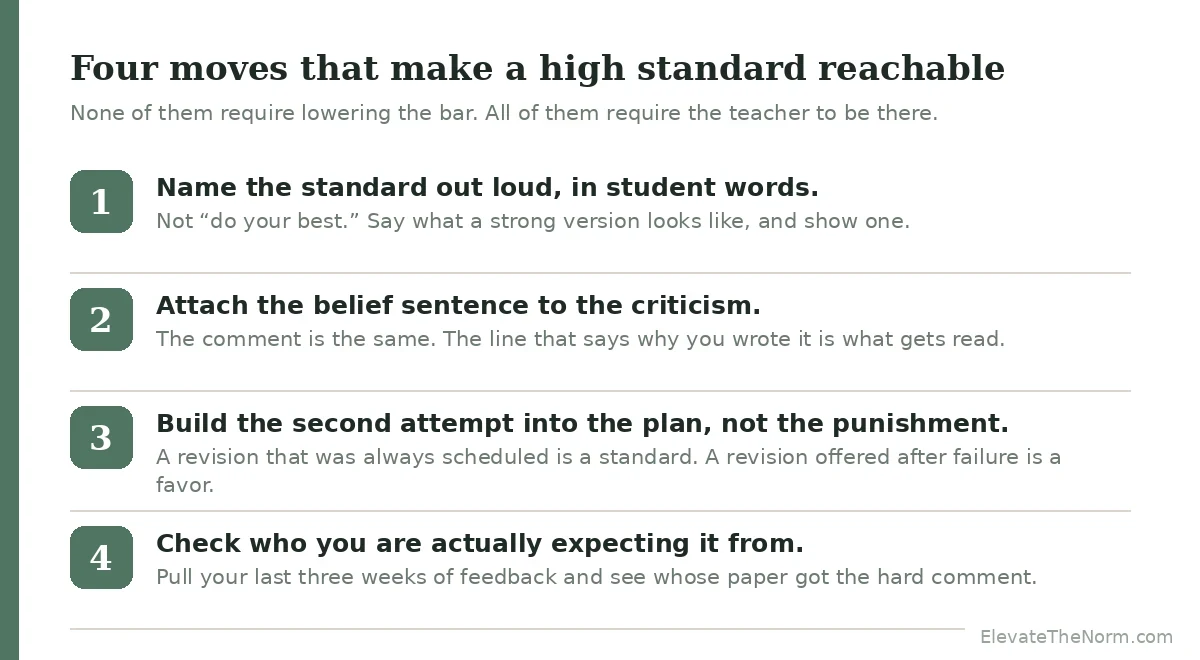
    Numbered list of four classroom moves: name the standard in student words, attach the belief sentence to criticism, schedule the second attempt, and audit who receives the hard feedback.
    Four moves that keep the standard high and make it reachable.

    None of this requires a program. It requires four weeks and a willingness to look at your own paperwork.

    1. Week one — the feedback audit. Pull every piece of work you handed back in the last three weeks. Sort it into “got a demanding comment” and “got a pleasant one.” Then look at the names. You are not looking for villainy. You are looking for a pattern you did not choose.
    2. Week two — the sentence. Attach the high-expectations line to every marked-up paper. Every student, no exceptions, no editing the list.
    3. Week three — the call list. Track who you call on for the question that requires reasoning rather than recall. Most teachers find they have a small rotation of four or five students they trust with the hard question, and that the rotation formed itself.
    4. Week four — the second attempt. Put one revision cycle into the calendar in advance, before anyone has failed anything. Announce it when you assign the work, not after the grades come back.

    Four weeks of this will tell you more about your expectations than any survey will. It also pairs naturally with what already works for students who look like they have stopped caring — disengagement is frequently a reasonable response to being quietly written off.

    Holding the standard when a student misses it

    The test of a high expectation is not what happens when a student meets it. It is what happens the first time they do not.

    Two failure modes, and both are common. The first is quietly dropping the bar for that student from then on — usually dressed up as being realistic. The second is holding the bar and treating the miss as a character finding, which teaches the student that the standard was really a test of who they are.

    The honest third option is that the standard holds, the miss gets named plainly, and the student does the work of getting there. That is the same logic behind accountability paired with another chance, and, when the miss involved harming somebody else, behind structured repair rather than empty punishment. In every case the standard is the constant. What flexes is the route back to it.

    Students can tell the difference between a teacher who lowered the bar for them and a teacher who kept it and stayed. They tend to remember the second one.

    Conclusion: what to do Monday

    High expectations for students are not a posture. They are a set of decisions about who gets the hard question, whose paper gets the demanding comment, who gets pulled to the table, and whether anybody gets a second attempt.

    The evidence says expectations matter, that they are unevenly distributed along lines nobody would defend out loud, and that they do very little on their own. It also says the fix is not more enthusiasm. It is attaching one sentence to your feedback, scheduling the revision before the failure, making your support desirable rather than remedial, and auditing what you actually handed back.

    Start with the feedback audit. It costs an hour and it is the only one of these that will tell you something you do not already believe about yourself.

    Frequently Asked Questions

    What does “high expectations for students” actually mean in a classroom?

    It means naming a standard you believe a specific student can reach, saying out loud what reaching it looks like, and then building the instruction, feedback, and second attempts that make it reachable. Belief is half of it. The path is the other half. An expectation with no path attached is not a high expectation — it is a demand.

    Can high expectations be harmful?

    Yes, when they arrive without support. In the Chicago middle-grades data, students in schools with high academic press but low social support gained about 1.34 grade equivalents in math in a year, compared with 2.39 for students who had both. The standard was the same in both groups. What differed was whether anyone helped. Pressure by itself mostly teaches students that the adult’s opinion of them is already fixed.

    How do I hold a high standard for a student who is several grade levels behind?

    Keep the standard and change the runway. The grade-level task stays; you add the vocabulary front-loading, the worked example, the sentence frames, the extra conference, and the built-in revision. What you do not do is hand that student an easier assignment and call it differentiation. Scaffolding is temporary and comes off. A lowered task is permanent and the student knows it.

    Isn’t this just growth mindset again?

    No, and the distinction matters. Growth mindset research is about what students believe about their own ability, and the intervention literature there is contested. This is about what teachers believe about students and what they do as a result — a different body of evidence with different findings. You can hold accurate, high expectations for a student without ever saying the word “mindset.”

    How would I know if I have lower expectations for some students without realizing it?

    Audit the artifacts instead of your intentions. Pull three weeks of graded work and look at whose paper got a demanding comment and whose got “nice job.” Look at who you called on for the hard question, who you pulled for a conference, and who you told about the honors option. Bias in expectations rarely shows up as a thought you would recognize. It shows up as a pattern in what you actually handed back.

    What should I tell a parent who says my class is too demanding?

    Show them the standard and the support in the same conversation. Say what the assignment asks, what a strong version looks like, what help is available and when, and how many attempts their child gets. Most families are not objecting to rigor. They are objecting to rigor that arrived without a plan, which is a fair objection.

    Do high expectations mean no second chances?

    The opposite. A standard you only get one shot at is a sorting device, not a standard. Building the revision into the calendar from the start — rather than offering it as mercy after a failure — is what makes the bar credible. The student who has to redo the work has been held to more, not less.


    Sources


    About Clay Shumate

    Clay Shumate is a certified secondary Social Studies teacher in the public schools of West Alabama, with seven years of classroom experience, a B.A. in History, and an M.Ed. in Secondary Education. He writes about project-based learning, student responsibility, respect, and practical ways to hold young people to a higher standard while giving them room to learn from mistakes. He is a member of the Society of Professional Journalists and writes to its Code of Ethics; this site’s editorial standards and corrections policy are published in full. More about Clay.

  • Restorative Practices in Schools: Accountability Without Empty Punishment

    Restorative Practices in Schools: Accountability Without Empty Punishment

    By Clay Shumate

    Restorative practices in schools are structured ways of responding to harm that require a student to face what happened, hear who it affected, and do something about it. They are not the opposite of accountability. Done well they are harder on a student than a suspension, because a suspension asks nothing of anyone. Done badly they ask nothing either.

    Key Takeaways

    • Restorative practices are a response system, not a mood. They run on a continuum from a two-sentence affective statement to a formal conference, and most of the work is the informal end.
    • The suspension evidence is genuinely strong. Almost every study finds exclusionary discipline goes down, and the one large randomized trial found the racial discipline gap narrowed too.
    • The academic evidence is not. That same trial found achievement did not improve, and got worse in grades 6–8 — the exact band most of this site’s readers teach.
    • Partial implementation is close to useless. Researchers reviewing failed rollouts concluded that doing some of it looked about the same as doing none of it.
    • Restoration does not replace safety procedures. Weapons, assault, threats, abuse disclosures, and anything your code of conduct defines as mandatory still go through the office, every time.
    • A single teacher can still use most of this. The repair conversation works in one classroom without a district initiative, a consultant, or a budget line.

    What restorative practices in schools actually are

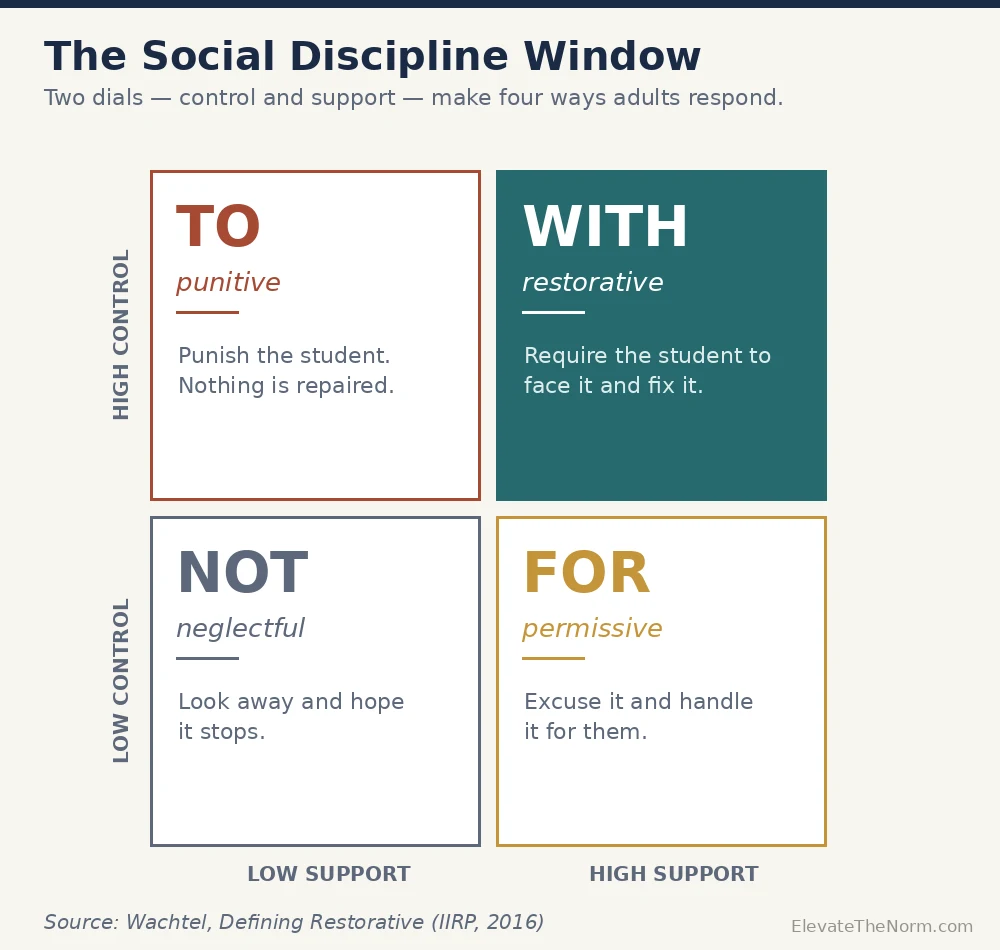
    The International Institute for Restorative Practices defines restorative practices as “a social science that studies how to build social capital and achieve social discipline through participatory learning and decision-making” (Wachtel, 2016). Strip the academic phrasing and it means this: you deal with problems with students rather than to them or for them.

    Four-quadrant social discipline window showing the TO, FOR, NOT and WITH approaches to student discipline
    The social discipline window: restorative practice is the high-support, high-control quadrant, not the permissive one.

    Wachtel’s “social discipline window” is the clearest picture of that idea. Cross high and low control with high and low support and you get four quadrants. TO is high control and low support — punitive. FOR is low control and high support — permissive, doing everything for the student. NOT is low control and low support, which is neglect. WITH is high control and high support, and that is the restorative quadrant.

    That last point is where most staff-room arguments about restorative practice go wrong. People hear “restorative” and picture the FOR box: a teacher who lets things slide, a school where nothing happens after a fight. The framework says the opposite. High control stays. What changes is that the student is required to participate in fixing it instead of just absorbing a penalty.

    The continuum, from two sentences to a formal conference

    Restorative practice is not one event. Wachtel describes a continuum that runs from informal to formal: affective statements, affective questions, small impromptu conferences, groups and circles, and formal conferences. The formal end — the circle with a facilitator and a signed agreement — is the part that gets photographed for district newsletters. It is also the rarest and the most expensive.

    The informal end is where a classroom teacher lives. An affective statement is one sentence naming the effect of a behavior: “When you talk over her, she stops offering answers, and I lose the best thinker in the room.” An affective question asks the student to do that work instead: “Who else is affected when this table doesn’t finish?” Neither takes more than fifteen seconds, and neither requires anyone’s permission. For the two-part shape, the worked rewrites and an honest account of how thin the evidence for them actually is, see a closer look at the smallest restorative move.

    What the research on restorative practices actually shows

    Short version: strong and consistent evidence that suspensions fall, promising evidence on racial discipline gaps, weak evidence on climate, and one real warning sign on middle-school achievement. Anyone who tells you the research is settled in either direction has not read it.

    Suspensions go down, and the discipline gap narrows

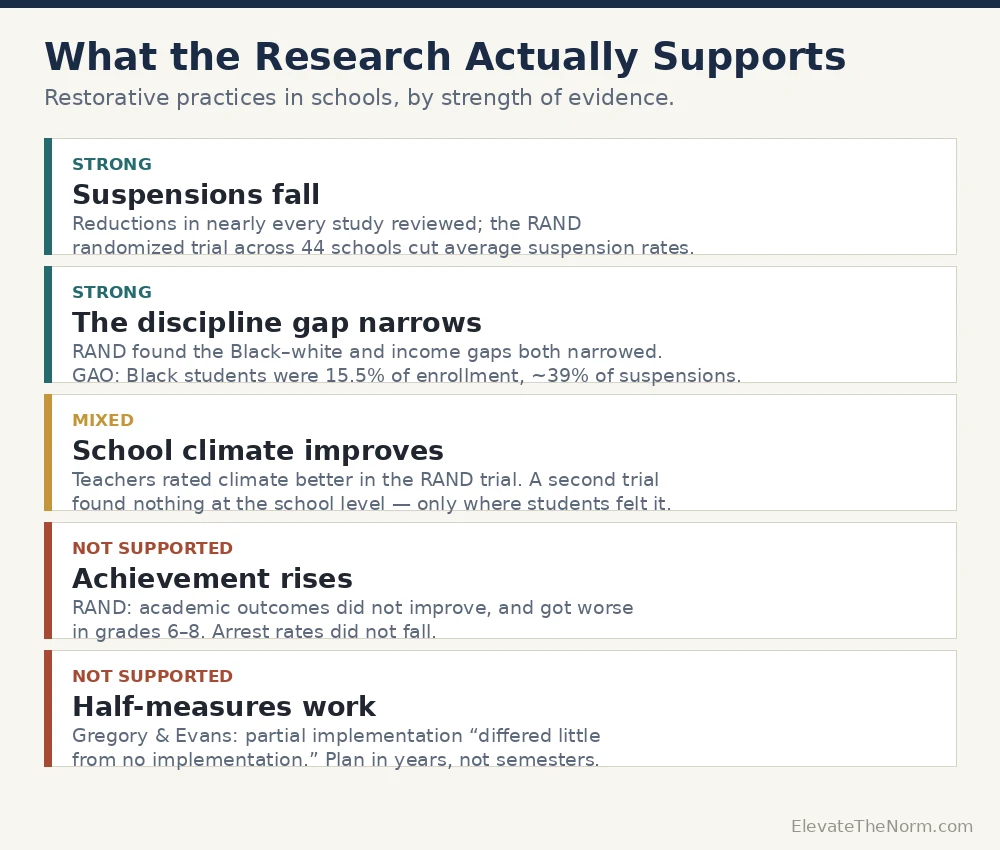
    WestEd’s research review found reductions in exclusionary discipline in nearly every study it examined (Fronius, Darling-Hammond, Persson, Guckenburg, Hurley & Petrosino, 2019). The strongest single piece of evidence is a randomized controlled trial that RAND ran across 44 Pittsburgh schools over the 2015–16 and 2016–17 school years (Augustine et al., 2018). Average suspension rates dropped. The gap between Black and white students narrowed, and so did the gap between lower- and higher-income students. Teachers rated school climate better.

    Chart comparing what restorative practices research supports strongly, partially, and not at all
    What the evidence supports, what it does not, and where the honest gaps are.

    That matters because the disparities are real and documented. The Government Accountability Office found that Black students made up 15.5 percent of public school enrollment but about 39 percent of students suspended from school in 2013–14 (GAO-18-258, 2018). Boys and students with disabilities were also disciplined out of proportion to their share of enrollment. Any approach that shrinks that gap without lowering the standard deserves a serious look.

    The grades 6–8 result nobody quotes

    The same RAND trial found that academic outcomes did not improve — and that they got worse in grades 6–8. Arrest rates did not fall either. RAND did not explain the middle-grades result, and neither will I; a single trial in one district is not a verdict. But if you teach middle school, that is the finding most directly about your students, and you will not usually hear it from a vendor.

    A second randomized trial, run across 13 middle schools with about 2,771 students over two years, found no significant effects at the school level at all (Acosta, Chinman, Ebener, Malone, Phillips & Wilks, 2019). What it did find is more interesting: students who reported actually experiencing restorative practices showed better school connectedness, peer attachment, and social skills, and less cyberbullying victimization. Assignment to the program did nothing. Exposure to the practice did something. That is a fidelity finding wearing a null result’s clothes.

    Half-implemented is barely different from not implemented

    Reviewing what goes wrong in restorative rollouts, Anne Gregory and Katherine Evans concluded that partial implementation “differed little from no implementation” (Gregory & Evans, 2020). They name the common failure patterns: top-down mandates that contradict restorative values, a narrow focus on student behavior while adult behavior stays the same, inadequate training — the “train and hope” approach — and short, under-resourced initiatives. They argue meaningful change should be measured over three to five years, not one.

    Read that next to the two trials and a pattern shows up. The program that was implemented deeply moved suspensions. The program that was assigned but not really lived produced nothing. This is not a practice that rewards a one-day August in-service.

    What restorative practices cannot replace

    A repair conversation is not a substitute for a mandatory procedure, and treating it as one puts students at risk and puts you in real trouble. Your school’s code of conduct and your state’s law decide these, not you and not a circle.

    • Weapons, credible threats, and anything your district defines as a mandatory referral or reportable offense.
    • Assault, sexual harassment, and hazing — these have investigation and notification requirements attached to them.
    • Any disclosure of abuse or neglect. You are a mandated reporter and that obligation does not pause for a restorative process.
    • Situations where a student who was harmed does not want to sit down with the student who harmed them. Requiring that is not restoration; it is a second harm.
    • Documentation. If the incident requires a written referral, write it. A repair conversation can happen alongside the paperwork, not instead of it.

    This is also where restorative practice and ordinary classroom consequences that teach rather than humiliate meet. Restoration answers “what do we do about the harm.” It does not answer “what does the handbook require.” Both questions have to get answered.

    What one teacher can do without a schoolwide program

    Most of the informal continuum needs nothing but your own consistency. You cannot run a whole-school initiative from one room, but you can run the conversation, and the conversation is the part the research suggests students actually have to experience for anything to change.

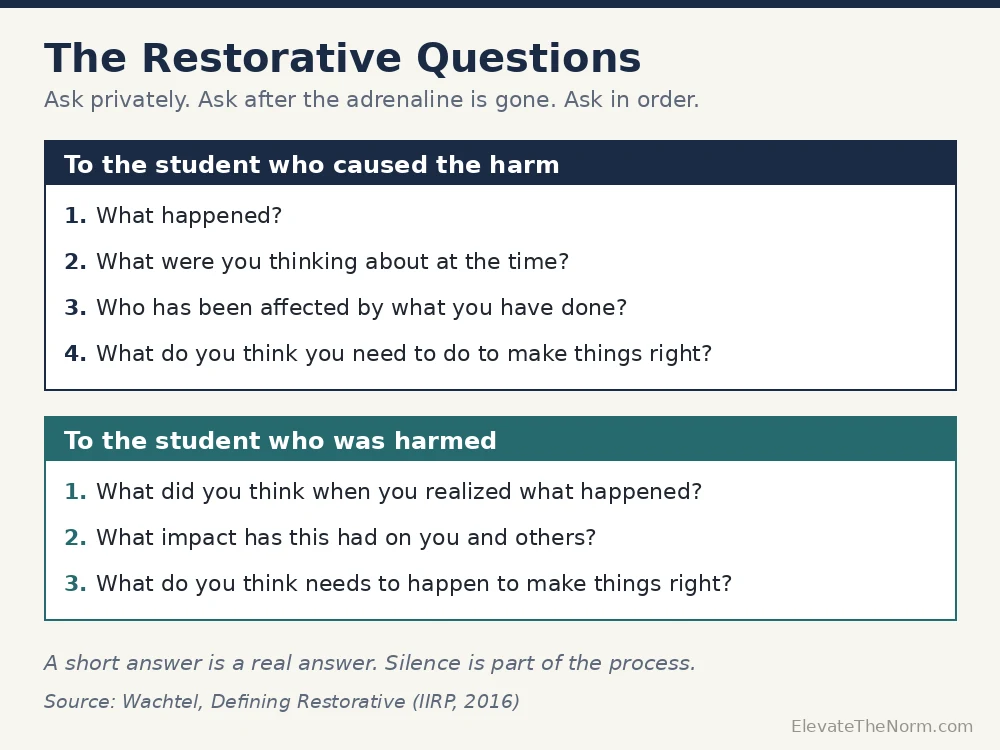
    The five restorative questions used in a repair conversation with a secondary student
    The restorative questions, in the order that keeps the conversation from turning into an interrogation.

    Wachtel’s restorative questions are the script, and they are short enough to memorize. For the student who caused harm: What happened? What were you thinking about at the time? Who has been affected by what you have done? What do you think you need to do to make things right? For the student who was harmed: What did you think when you realized what happened? What impact has this had on you and others? What do you think needs to happen to make things right?

    Four things make that script work with teenagers rather than sound like a booklet. Ask it privately, not in front of the room. Ask it after the adrenaline is gone, usually the next period or the next day. Ask the questions in order and let the silence sit. And accept a short answer — a fourteen-year-old saying “I wasn’t thinking, I was just mad” is a real answer, not a dodge. This is the same principle behind holding students accountable while still giving them another chance: the goal is a student who can name the harm, not a student who performs remorse well.

    A response ladder that keeps restoration in proportion

    The most common mistake is using a heavy tool on a light problem. A circle for a missed deadline wastes a period and teaches students that the process is theater. Match the response to the size of the harm.

    SituationRestorative responseTime cost
    Side conversation, phone out, off taskAffective statement — name the effect, move on15 seconds
    Group member coasting on a projectAffective question to the group, not the individual1 minute
    Rudeness to you or to another studentSmall impromptu conference, privately, next day4–5 minutes
    Conflict between two students that is still liveSeparate conversations first; joint only if both agree10–15 minutes
    Harm affecting the whole classCircle, with a plan and a follow-up dateHalf a period
    Anything in the mandatory-referral list aboveOffice referral first; repair later, if at allFollow policy

    Notice that the top three rows cover most of a school year. That is deliberate. Restorative practice at the classroom level is mostly small, fast, and unremarkable, which is exactly why it is sustainable — the same reason consequences that connect naturally to the behavior outlast elaborate point systems. When a repair conversation ends with a concrete student commitment, a student accountability sheet gives that agreement a trackable written form for the follow-up conversation.

    How to tell whether it is actually working

    Suspension counts are the easiest number to move and the easiest to fake. A school can cut suspensions by simply declining to write referrals, which improves the spreadsheet and makes teachers feel abandoned. Watch these instead:

    1. Repeat incidents involving the same student. If repair is working, the second conversation should be about something different than the first.
    2. Whether the harmed student came back. Restoration that only serves the student who caused the harm is not restoration.
    3. Teacher referral rates. If referrals collapse while classroom complaints rise, staff have stopped reporting, not stopped having problems.
    4. Who is still being removed. Run the disparity numbers by race, disability status, and grade level. That is the whole point of the intervention.
    5. Whether adults changed anything. Gregory and Evans are blunt that initiatives focused only on student behavior fail. If nothing about adult practice looks different, nothing has been implemented.

    None of that requires a data dashboard. A page in a notebook and a willingness to look honestly will do, which is the same standard I would apply to any discipline approach that promises firm standards without shame.

    Where this leaves you

    Restorative practices in schools are worth using, and they are worth using honestly. The evidence that they reduce suspensions and narrow discipline gaps is about as good as school-level evidence gets. The evidence that they raise achievement is not there, and in the one rigorous trial that looked, middle-grades achievement went the wrong way. Both of those sentences are true at once, and a teacher can hold both.

    So start where the evidence is strongest and the cost is lowest. Learn the seven restorative questions. Use affective statements this week instead of the sigh and the raised eyebrow. Keep writing the referrals your handbook requires. If your school is considering a formal rollout, ask the two questions Gregory and Evans would ask: how many years is the plan, and what is changing about adult practice? If the answers are “one” and “nothing,” the money is better spent elsewhere. And whatever the program, the floor stays the same — respect in the classroom has to run both directions before any of this works.

    Printables for this

    The repair conversation is the hard part to hold onto in the moment, so I wrote mine down. Restorative Conversation Scripts is the follow-up conversation, laid out line by line, and Behavior Reflection Sheets is the written half at two levels. Both are written for teenagers rather than third graders.

    Of all the practices on the restorative continuum, the circle is the one schools picture first and prepare for least. It has a fixed sequence, a talking piece and a target split of roughly four proactive circles for every responsive one. How a restorative circle actually runs walks through the rounds — and reports the randomized trial finding that the suspension gains sat in elementary schools while middle-grade academic outcomes worsened.

    Frequently Asked Questions

    Are restorative practices just a way to avoid disciplining students?

    No. In the framework restorative practice comes from, the restorative response is the high-control, high-support quadrant — the same firmness as a punitive response, with the addition of support and a requirement that the student help repair the harm. A student who has to face the person affected and agree to a fix is doing more work than a student sent home for a day, not less.

    Do restorative practices actually reduce suspensions?

    Yes, and this is the best-supported claim in the whole field. A WestEd review found reductions in exclusionary discipline in nearly every study examined, and a randomized controlled trial across 44 Pittsburgh schools found average suspension rates fell while the gaps between Black and white students and between lower- and higher-income students both narrowed.

    Do restorative practices improve grades or test scores?

    The evidence says no. The Pittsburgh randomized trial found academic outcomes did not improve, and that they got worse in grades 6–8. Arrest rates did not fall either. Restorative practice should be adopted for the discipline and climate outcomes it can support, not sold as an achievement strategy.

    When should a teacher not use a restorative approach?

    Whenever school policy or state law requires something else. Weapons, credible threats, assault, sexual harassment, hazing and any disclosure of abuse go to the office and follow mandated procedures. Also skip it when the student who was harmed does not want to sit down with the student who harmed them — requiring that meeting is a second harm, not a repair.

    How long does a repair conversation take?

    Usually four or five minutes, held privately and after the adrenaline has worn off — typically the next period or the next day. Most classroom-level restorative work is much shorter than that: a one-sentence affective statement naming the effect of a behavior takes about fifteen seconds and covers the majority of daily incidents.

    Can one teacher use restorative practices if the school has no program?

    Yes, for the informal end of the continuum. Affective statements, affective questions and small impromptu conferences need nothing but your own consistency. Schoolwide circles, formal conferences and any change to the discipline code are administrative decisions. Notably, a second randomized trial found that program assignment predicted nothing while students’ actual experience of restorative practice predicted better connectedness and social skills — which suggests one teacher’s practice is not wasted.

    What is the difference between restorative practices and restorative justice?

    Restorative justice is the older criminal-justice concept: responding to an offense by addressing harm and involving those affected. Restorative practices is the broader school-and-community application, and it includes the everyday preventive side — circles, affective language, relationship-building — not just what happens after something goes wrong. In schools the two terms are often used interchangeably.

    Sources


    About Clay Shumate

    Clay Shumate is a certified secondary Social Studies teacher in the public schools of West Alabama, with seven years of classroom experience, a B.A. in History, and an M.Ed. in Secondary Education. He writes about project-based learning, student responsibility, respect, and practical ways to hold young people to a higher standard while giving them room to learn from mistakes. He is a member of the Society of Professional Journalists and writes to its Code of Ethics; this site’s editorial standards and corrections policy are published in full. More about Clay.

  • Student Autonomy: How to Give Students Freedom Without Losing the Room

    Student Autonomy: How to Give Students Freedom Without Losing the Room

    By Clay Shumate

    Student autonomy is a student’s genuine ability to make meaningful decisions about their own learning — what to study, how to demonstrate understanding, when to ask for help, and how to manage their own time — within boundaries an adult has thoughtfully set. It is not freedom without structure. It is freedom because of structure. This guide explains how teachers in grades 6–12 can offer autonomy that increases engagement and responsibility without creating chaos.

    Key Takeaways

    • Autonomy does not mean students do whatever they want. It means they make real decisions within boundaries the teacher has planned.
    • Self-determination theory identifies autonomy, competence, and relatedness as three basic needs that drive genuine motivation in classrooms.
    • Structure and autonomy are not opposites. The research shows they work best together.
    • Autonomy should increase gradually as students demonstrate they can handle it. Start tight, expand deliberately.
    • The biggest risk of student autonomy is not chaos — it is giving choices students are not prepared to make.

    What Student Autonomy Actually Means

    Student autonomy sounds like a simple concept until you try to implement it in a room of twenty-eight teenagers. The word “autonomy” gets used to mean everything from letting students pick their own seats to running an entirely student-directed classroom, and the gap between those two things is enormous. Practical activities that hand students real decisions bridge that gap with structure.

    In research, student autonomy has a specific meaning. Deci and Ryan’s self-determination theory (1985, updated by Ryan & Deci, 2020) defines autonomy as the experience of volition and willingness — acting from one’s own values and interests rather than from external pressure. In a classroom, this means a student who writes an essay because they find the question genuinely interesting is acting autonomously. A student who writes the same essay only because it is graded is not.

    That definition matters because it separates autonomy from permissiveness. A student can experience autonomy within a highly structured environment — as long as the structure makes sense to them, they understand why the expectations exist, and they have some genuine say in how they operate within it.

    Why Student Autonomy Matters for Grades 6–12

    Adolescents are developmentally primed for autonomy. Their brains are building the capacity for independent decision-making, abstract reasoning, and identity formation. When schools respond to this developmental reality by tightening control — more rules, fewer choices, stricter consequences — they create a mismatch between what students need and what the environment provides.

    The research on this point is consistent. A meta-analysis by Vasconcellos et al. (2020) across 144 studies found that autonomy-supportive teaching was associated with higher autonomous motivation, greater engagement, and better academic outcomes across age groups, with effects that held across cultures and subject areas. Jang, Reeve, and Deci (2010) studied 133 high-school classrooms and found that autonomy support and structure were positively correlated — teachers who offered more autonomy also tended to provide more structure — and both predicted students’ observed behavioral engagement. That finding is the usable part of the answer to the student who appears not to care.

    The point is worth emphasizing because it contradicts the most common objection to student autonomy: the fear that giving students choices means giving up control. The evidence suggests the opposite. Autonomy and structure rise and fall together, not inversely.

    The Difference Between Autonomy and Chaos

    This is the section most autonomy guides skip, and it is the section teachers most need.

    Autonomy without preparation is not autonomy. It is abandonment. Handing a student a choice they are not equipped to make — pick any topic, design any project, manage your own time with no checkpoints — does not develop independence. It develops anxiety in the students who care and apathy in the students who have learned that unstructured time means nothing matters.

    Here is what that looks like in practice. A teacher announces that students can research any topic related to the unit. No constraints on scope, no required sources, no checkpoint before the final product. Some students thrive. Most flounder. Several pick topics that cannot be meaningfully researched at a secondary level. A few do nothing at all. The teacher then blames the students for “not being ready for autonomy,” when the truth is the task was not ready for the students.

    The fix is not less autonomy. It is better structure around the autonomy. Define the boundaries. Provide the scaffolding. Check in at defined points. And then let the student make real decisions within that frame.

    Seven Domains of Student Autonomy

    Student autonomy is not a single switch you flip. It is a set of decisions across different parts of the learning experience, and the teacher can offer autonomy in one domain while maintaining control in another. Here are seven domains where autonomy is practical in a secondary classroom.

    Seven numbered domains of student autonomy including pacing topic selection product choice methods help-seeking self-assessment and reflection
    Autonomy is not a single switch. It is a set of decisions across seven domains.

    Pacing

    Let students manage their own time within a defined window. Instead of “everyone moves to step two at 10:15,” try “you have until 10:40 to complete steps one through three — manage your time across those three steps however you need to.” Some students will spend more time on step one. Others will move quickly and spend more time on step three. Both are fine as long as the deadline holds.

    The structure is the deadline. The autonomy is the path to it.

    Topic Selection

    Within a unit, let students choose which specific question they want to investigate. In a unit on the causes of the Civil War, a student might choose to focus on the economics of slavery, the political compromises that failed, or the role of abolitionist media. The unit stays the same. The angle is the student’s.

    The structure is the unit scope and the required evidence. The autonomy is the angle.

    Product Choice

    Students demonstrate understanding through a written argument, a presentation, a recorded analysis, a visual timeline with annotations, or a structured debate. The learning target is fixed. The product is negotiable.

    This domain has a common trap: offering product choices that are not equivalent in rigor. A poster board is not equivalent to a written analysis. If you offer it as an option, the expectation for depth, evidence, and clarity must be just as high.

    Methods and Resources

    Let students decide how they gather information. Some students prefer reading a primary source. Others learn better from a documentary or an interview. The content standards do not require a specific resource type — they require understanding. Let students find the path that gets them there.

    Help-Seeking

    Autonomy in help-seeking means students decide when they need help, what kind of help they need, and who to ask. This sounds minor, but it is one of the most important autonomy skills a student can develop. A student who can accurately assess their own confusion and seek targeted help is a student who will succeed beyond your classroom.

    Build this by making help available without making it mandatory or punitive. In my room, students can come to the whiteboard table for focused small-group instruction whenever they need it. It is not assigned. It is not remediation. It is the best seat in the room — a corner with a lamp, a rug, better chairs, and a surface where we can draw out ideas together. Students ask to work there, which is exactly the point. When the help feels like an opportunity rather than a correction, students seek it out on their own.

    Self-Assessment

    Before turning in work, students evaluate their own product against the rubric and identify one area of strength and one area that could improve. This is not a substitute for teacher assessment — it is preparation for it. A student who can assess their own work accurately is a student who does not need the teacher to be the only source of quality information.

    Reflection

    Let students choose what they reflect on. Not “answer these three reflection questions” but “write about one thing from today’s work that changed how you think about the topic, and explain what changed.” The reflection is required. The content of the reflection is the student’s.

    How to Build Student Autonomy Gradually

    The most effective approach to student autonomy is progressive. You do not open the semester with full choice in every domain. You start tight and expand deliberately as students demonstrate they can handle it.

    Three-phase framework for building student autonomy from structured choice to expanded choice to managed independence
    Start tight. Expand deliberately. Match autonomy to demonstrated readiness.

    Phase 1: Structured Choice (First Three Weeks)

    Offer two or three options in one domain — typically product or pacing. Keep everything else structured. This teaches students how choice works in your room and establishes that autonomy comes with accountability.

    Phase 2: Expanded Choice (Weeks Four Through Eight)

    Add a second domain. Let students choose both their topic angle and their product. Introduce self-assessment alongside teacher assessment — how students learn to judge their own work is the skill you are actually building here. The check-in structure stays tight — you are circulating, conferencing, and holding students to the timeline.

    Phase 3: Managed Independence (Second Quarter and Beyond)

    Students who have demonstrated responsibility in Phases 1 and 2 can manage multiple domains simultaneously. They propose a topic, choose a method, manage their pacing, and assess their own work before conferencing with you. Students who have not demonstrated that readiness stay in Phase 2 — not as punishment, but because they need more practice with fewer decisions at once.

    This progression is the critical piece most autonomy guides miss. A room where every student has the same level of autonomy regardless of demonstrated readiness is a room that has confused equality with equity. Meeting students where they are means some students have more freedom because they have earned it through consistent, responsible work.

    What Autonomy Support Looks Like in the Classroom

    Ryan and Deci (2020) describe autonomy-supportive teaching through specific, observable behaviors. Autonomy-supportive teachers listen to students, make time for independent work, give students opportunities to speak, acknowledge improvement and mastery, and provide rationales when requiring specific tasks.

    Controlling teachers, by contrast, monopolize learning materials, tell students answers directly, issue directives, and rely on controlling language like “should” and “have to.”

    Comparison of controlling teaching behaviors and autonomy-supportive teaching behaviors based on Ryan and Deci 2020
    Same deadline. Different relationship to it. Based on Ryan and Deci (2020).

    The practical difference is often in language. “You need to finish this by Thursday” is controlling. “This is due Thursday — how are you planning to manage your time?” is autonomy-supportive. The deadline is identical. The relationship to the deadline is different.

    Bloem et al. (2024) found that teachers reported giving students from lower socioeconomic backgrounds less autonomy support and more controlling instruction — and teachers with more biased attitudes toward low-SES students differentiated the most. That finding matters for every school in which I have worked. The students who most need the experience of genuine decision-making are often the students least likely to get it, not because they cannot handle it, but because adults assume they cannot.

    When Student Autonomy Does Not Work

    Autonomy does not work when it is a substitute for planning. A teacher who hands students unstructured time and calls it “student-directed learning” has not given students autonomy. They have given themselves a break.

    Autonomy does not work when the choices are not meaningful. Letting students pick between blue paper and green paper is not autonomy. Letting students choose which essay prompt to respond to when both prompts require the same depth of thinking — that is autonomy.

    Autonomy does not work without a relationship. A student will not take intellectual risks for a teacher they do not trust. Autonomy support and relatedness — the third pillar of self-determination theory — work together. Building the relationship comes first.

    And autonomy does not work when consequences are absent. A student who chooses poorly and faces no consequence has not experienced autonomy. They have experienced permissiveness. Real autonomy includes real accountability — not manufactured stakes, but honest follow-through. If a student chose not to manage their time well, the conversation is not punitive. It is honest: this is what happened, this is what you chose, and this is what you owe now.

    The Repair Conversation — Student Autonomy After a Mistake

    One of the most important moments in building student autonomy is what happens after a student makes a poor choice. The standard school response is a consequence — a zero, a detention, a phone call home. Those responses are sometimes necessary, but they do not teach autonomy. They teach compliance under threat.

    A repair conversation teaches autonomy because it puts the student in the position of identifying what went wrong, who was affected, and what they owe. It is not a lecture. It is a set of questions: What happened? Who was affected by that? What do you think you owe them? When will you do it?

    The student does the thinking. The teacher holds the boundary. That is student autonomy at its most practical — a student making real decisions about how to respond to their own mistake, within a structure where the adult is present and the expectation is clear.

    This is also where the line between autonomy and permissiveness becomes sharpest. Permissiveness lets the mistake pass. Control punishes it without discussion. Autonomy support says: you made a choice, you are capable of evaluating that choice, and here is what accountability looks like. For a ready-to-use tool on this, see a printable seating chart planning pack.

    That same question — how much control students should hold — extends beyond the repair conversation into everyday classroom decisions. For a close look at how that line is drawn across five levels of agency, see student voice and choice in practice.

    Frequently Asked Questions

    What is the difference between student autonomy and letting students do whatever they want?

    Student autonomy means students make genuine decisions within boundaries a teacher has thoughtfully planned. Letting students do whatever they want is not autonomy — it is the absence of teaching. The boundary is what makes the choice meaningful. Without it, students are not exercising autonomy. They are just unsupervised.

    How do I give autonomy to students who are not ready for it?

    Start with structured choice in one domain — two or three options rather than open-ended freedom. Students who are not yet ready for full autonomy are not incapable of making decisions. They need smaller decisions with more support. Expand the choices as they demonstrate readiness. This is a graduated process, not a binary switch.

    Does student autonomy work in tested subjects?

    Yes. The learning targets in a tested subject are fixed. Autonomy applies to how students reach those targets — which resources they use, how they pace their work, what product they create to demonstrate understanding, and how they assess their own readiness. Standards constrain the destination. Autonomy applies to the journey.

    What about students who choose not to work when given freedom?

    A student who stops working when given choice is telling you something about their relationship to the work, the environment, or both. The answer is not to remove the choice for everyone. It is to have a private conversation with that student about what happened, then adjust the level of autonomy for that individual while maintaining it for students who are using it well.

    How does student autonomy affect classroom management?

    Research consistently shows that autonomy support improves classroom behavior, not the reverse. Jang, Reeve, and Deci (2010) found that autonomy support and structure both predicted observed behavioral engagement in 133 high-school classrooms. When students feel their choices matter and the environment is predictable, disruptive behavior decreases — not because it is punished more effectively, but because the underlying need driving it is addressed.

    Can I offer student autonomy in a highly structured school environment?

    Yes. Student autonomy lives inside your classroom, within your lesson plans. Even in schools with rigid bell schedules, required curricula, and standardized assessments, you can offer meaningful choice in how students engage with content, how they demonstrate understanding, and how they manage their time within your class period. Autonomy does not require administrative permission. It requires teacher planning.

    Sources

    1. Ryan, R. M., & Deci, E. L. (2020). “Intrinsic and Extrinsic Motivation from a Self-Determination Theory Perspective.” Contemporary Educational Psychology, 61, 101860.
    2. Jang, H., Reeve, J., & Deci, E. L. (2010). “Engaging Students in Learning Activities: It Is Not Autonomy Support or Structure but Autonomy Support and Structure.” Journal of Educational Psychology, 102(3), 588–600.
    3. Vasconcellos, D., et al. (2020). “Self-Determination Theory Applied to Physical Education: A Systematic Review and Meta-Analysis.” Journal of Educational Psychology, 112(7), 1444–1469.
    4. Niemiec, C. P., & Ryan, R. M. (2009). “Autonomy, Competence, and Relatedness in the Classroom.” Theory and Research in Education, 7(2), 133–144.
    5. Bloem, N., et al. (2024). “Teachers’ Autonomy Support and Control Towards Students from Different Socioeconomic Backgrounds.” Social Psychology of Education, 27, 1247–1270.
    6. Reeve, J. (2012). “A Self-Determination Theory Perspective on Student Engagement.” In S. L. Christenson, A. L. Reschly, & C. Wylie (Eds.), Handbook of Research on Student Engagement (pp. 149–172). Springer.

    About Clay Shumate

    Clay Shumate is a certified secondary Social Studies teacher in the public schools of West Alabama, with seven years of classroom experience, a B.A. in History, and an M.Ed. in Secondary Education. He writes about project-based learning, student responsibility, respect, and practical ways to hold young people to a higher standard while giving them room to learn from mistakes. He is a member of the Society of Professional Journalists and writes to its Code of Ethics; this site’s editorial standards and corrections policy are published in full. More about Clay.

Teacher Emergency Toolkit — practical resources, real classroom support. Shop on TPT.Teacher Emergency Toolkit — practical resources, real classroom support. Shop on TPT.