Category: Classroom Management

Behavior, routines, and what actually holds a room together without raising your voice.

  • High Expectations for Students: The Difference Between Belief and Pressure

    High Expectations for Students: The Difference Between Belief and Pressure

    By Clay Shumate

    High expectations for students means holding a standard you genuinely believe a teenager can reach, and then building the path that lets them reach it. Belief without a path is not a high expectation. It is pressure. The research is clear that expectations move outcomes — and just as clear that they move them only when support moves with them.

    Key Takeaways

    • Teacher expectations really do change outcomes. A national study of 10th graders found that a teacher expecting a student to finish college, rather than not, was associated with roughly a 15-percentage-point increase in the odds that the student actually did.
    • But the effect is smaller than the Pygmalion legend. The most careful review of the field concluded that self-fulfilling prophecies in classrooms are real, typically small, and more likely to fade than to compound.
    • Expectations are mostly accurate, which is its own problem. When a teacher’s read on a student is wrong, it is usually wrong in a patterned way — and the pattern tracks race, income, and prior grades.
    • Press without support does almost nothing. Chicago middle-grades students with high academic press and low support gained about half as much math as students who had both.
    • One sentence changes how criticism lands. Seventh graders who were told the comments came from high expectations and a belief they could meet them revised at more than twice the rate of students who got the same comments without the sentence.
    • The bar stays. The runway changes. Every honest version of high expectations keeps the task and adds the scaffolding, the conference, and the second attempt.

    What high expectations for students actually means
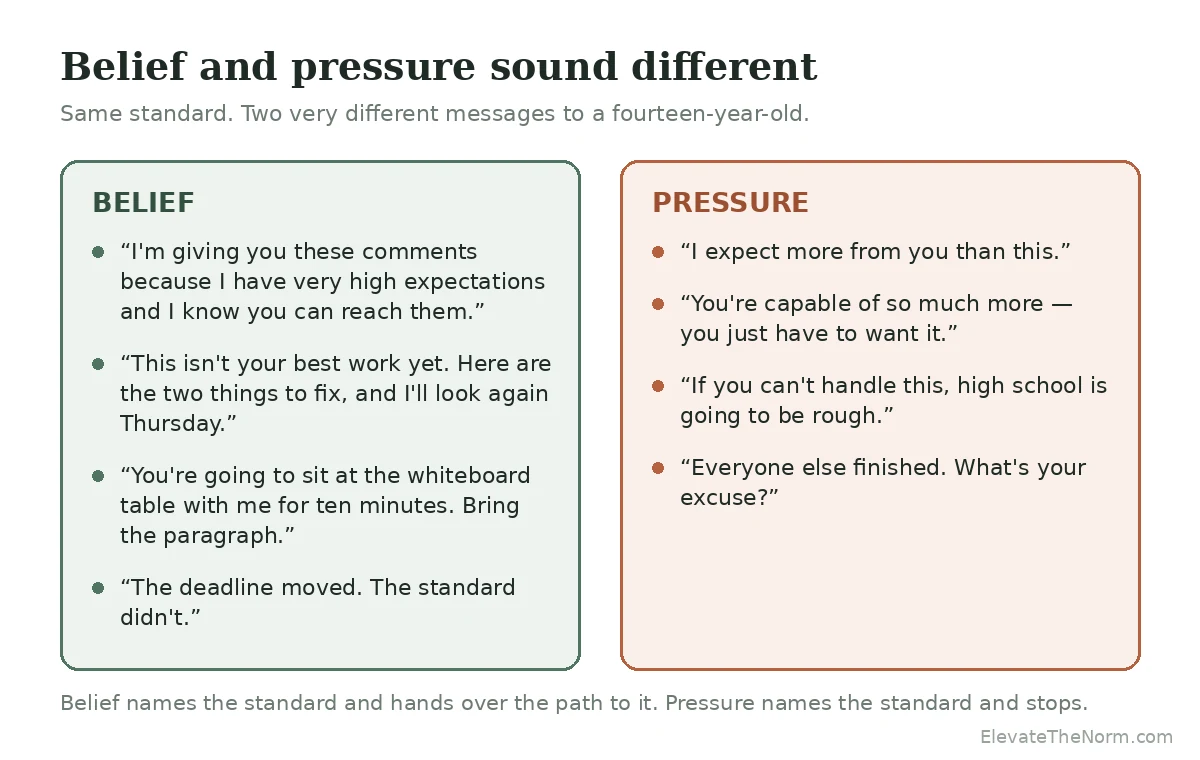
    Two-column comparison of teacher phrasing. The belief column names a standard and a next step; the pressure column names a standard and stops.
    The same standard can be delivered as belief or as pressure. The difference is whether a path comes with it.

    Most schools say they have high expectations. Very few can tell you what that sentence commits them to on a Tuesday.

    Here is a working definition. A high expectation has three parts: a standard the student can actually see, a stated belief that this particular student can reach it, and a route from where they are now to there. Drop the third part and you have a slogan. Drop the second and you have a syllabus.

    This is different from classroom expectations in the behavior sense — how we treat each other, how we start class, what happens when work is late. Those matter, and teaching them explicitly — including with a well-designed classroom expectations poster that students can reference all year — is most of the job in September. This article is about the other kind: what you believe a student is academically capable of, and what that belief does to them.

    The two get confused constantly. A teacher can run a tightly managed room with airtight procedures and still quietly expect very little of half the students in it.

    The evidence: real, causal, and smaller than the legend

    Short answer: expectations move outcomes, but not by magic, and not by much on their own.

    Everyone in education has heard some version of the 1968 Pygmalion study — tell teachers a random group of kids are late bloomers, and the kids bloom. It is one of the most repeated findings in the field and one of the least accurately repeated.

    The most thorough review of what came after it is blunt. Lee Jussim and Kent Harber concluded that self-fulfilling prophecies in classrooms do occur, but that the effects are “typically small,” do not accumulate much across teachers or years, and “may be more likely to dissipate than accumulate” (Jussim & Harber, 2005). They also found something more uncomfortable: teacher expectations predict student outcomes largely because those expectations are accurate, not because they are self-fulfilling. Teachers are generally reading students correctly.

    That is worth sitting with before you assume belief alone will carry a kid. It usually will not.

    What Jussim and Harber also found is where this gets useful: the powerful self-fulfilling effects show up selectively, among students from stigmatized groups. The students most affected by what a teacher believes are the students the system already treats worst.

    The strongest causal estimate available comes from Nicholas Papageorge, Seth Gershenson, and Kyung Min Kang, who used a national sample of 10th graders in which two different teachers each predicted the same student’s educational future. Comparing the two predictions strips out the student’s own characteristics and isolates the teacher. When a teacher expected a student to complete a four-year degree rather than not, that student’s likelihood of actually earning one rose by about 15 percentage points (Papageorge, Gershenson & Kang, 2018/2020).

    Read that carefully. It is a large effect attached to a large swing — from a teacher writing a student off to a teacher expecting a degree. It is not a promise that raising your general enthusiasm raises test scores.

    Where the expectation goes wrong before the student ever sees it

    If expectations are mostly accurate, the interesting question is what happens when they are not.

    Using the same national data, Gershenson and colleagues compared the two teachers each student had. Non-Black teachers of Black students were about 9 percentage points less likely than Black teachers to expect that student to finish a four-year degree — about 11 points for Black boys. That single mismatch accounted for more than half of the overall Black–white gap in teacher expectations, and it was larger among math teachers than reading teachers (Gershenson, Holt & Papageorge, 2016).

    Two teachers. Same student. Same transcript in front of both of them. Different forecast.

    The related finding in the Papageorge paper is stranger and worth naming honestly: white teachers were more optimistic overall, and their optimism about white students was the least accurate of the lot. The problem is not simply that some teachers are pessimistic. It is that optimism gets handed out unevenly, and the students who receive less of it are the ones for whom it matters most.

    You are not going to fix this by deciding you are unbiased. Nobody has ever found their own expectation gap by introspection. You find it by looking at what you handed back.

    Why expectations without support turn into pressure
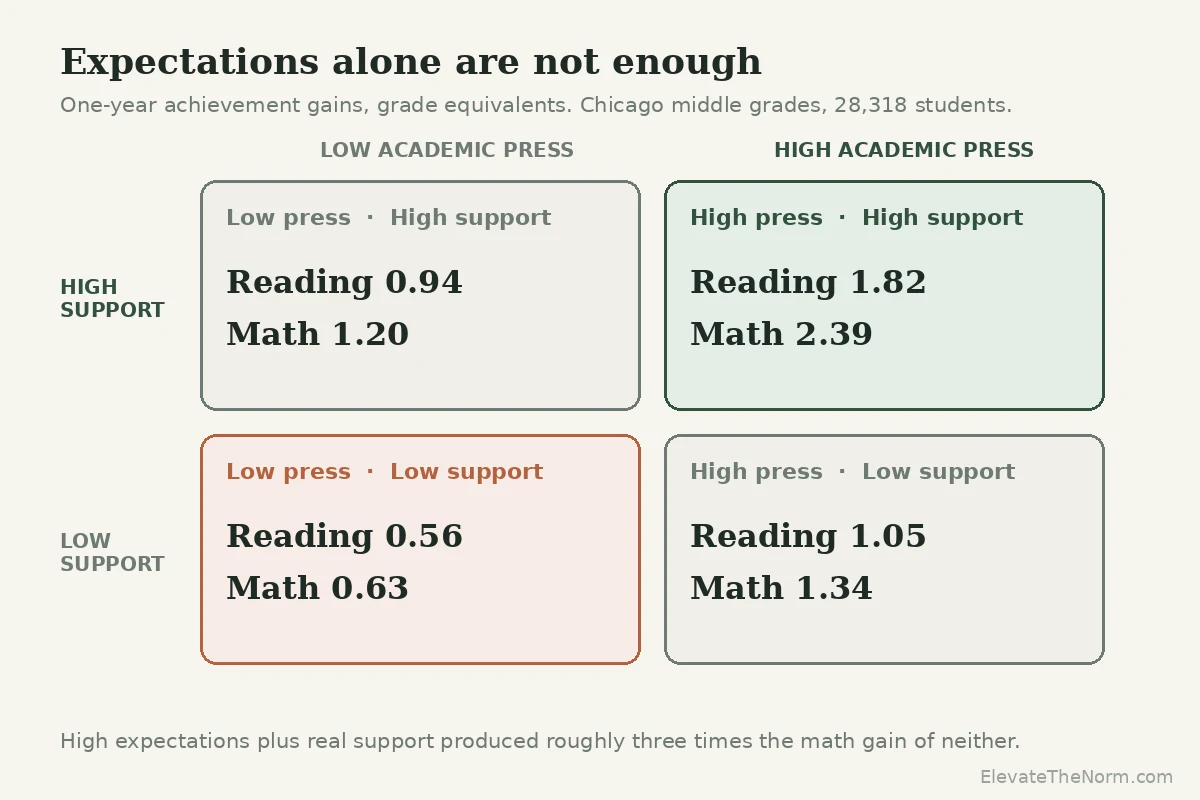
    Two-by-two grid of one-year achievement gains in grade equivalents by level of academic press and social support, from the Chicago middle-grades study.
    High press with high support produced 2.39 grade equivalents of math growth in a year; low press with low support produced 0.63.

    Researchers have a term for the demand side of this: academic press. It just means how strongly a school signals that academic achievement is expected and non-negotiable. The other side is social support — the adults and peers a student can actually go to for help.

    Valerie Lee, Julia Smith, Tamara Perry, and Mark Smylie put 28,318 sixth and eighth graders across 304 Chicago schools into that two-by-two and measured a year of achievement growth in grade equivalents (Lee, Smith, Perry & Smylie, 1999).

    ConditionReading gainMath gain
    High press + high support1.822.39
    High press + low support1.051.34
    Low press + high support0.941.20
    Low press + low support0.560.63
    One-year achievement gains in grade equivalents. Lee, Smith, Perry & Smylie (1999), Chicago middle grades.

    Look at the middle two rows. High expectations without support and warm support without expectations land in almost the same place. Neither one is worth much alone. Together they roughly triple the math growth of a school that has neither.

    One honest caveat: this is sixth and eighth grade in one large urban district in the 1990s, and it is correlational. It does not prove that adding support to a demanding classroom causes the jump. It does show that the two travel together in the data, at scale, and that the version of “high expectations” that arrives as pressure alone is the version with the weakest results attached to it.

    That is the whole argument of this article in one table. If you take nothing else, take the fact that the demand and the help are not in tension. They are the same intervention.

    What high-expectation teachers do differently

    Christine Rubie-Davies and colleagues ran something rare in this field: an actual randomized intervention that trained teachers in the practices of high-expectation teachers rather than just measuring their beliefs. Eighty-four teachers across twelve schools; students in the intervention classrooms gained roughly 28% more in mathematics over the year than the control group, an effect size of about 0.24 (Rubie-Davies, Peterson, Sibley & Rosenthal, 2014).

    The caveat that matters for this site: that study was run in New Zealand with students aged roughly 6 to 13. It is not a secondary-school result and I am not going to pretend it is. What transfers is the list of practices, which are recognizably about older students too. The number does not automatically transfer with them.

    The practices the intervention taught, summarized by the Society for Personality and Social Psychology:

    • Flexible grouping instead of fixed ability grouping. High-expectation teachers move students between groups based on the task in front of them, not on a permanent read of who is smart.
    • Goal setting with the student, not for them. Which is also how student autonomy gets built without losing the room.
    • A warm class climate. Not soft. Warm. Those are different words.
    • Different feedback. More specific, more forward-looking, and delivered to everyone rather than saved for the students most likely to use it.
    • Attention to non-verbal signals. Who you stand near, who you wait longer for, whose answer you finish for them.

    Notice that none of these are about announcing higher standards. They are about the ordinary mechanics of a class period.

    The one sentence that makes criticism land

    If you only change one thing this week, change this.

    In a study of seventh graders earning Bs and Cs, researchers had teachers return marked-up essays with one of two notes attached. The control note read: “I’m giving you these comments so that you’ll have feedback on your paper.” The other read: “I’m giving you these comments because I have very high expectations and I know that you can reach them.”

    The comments themselves were identical. Among African-American students, 64% of those who got the second note revised their essay, against 27% of those who got the first. When revision was required, 88% of students who had received the high-expectations note improved from first draft to second, compared with 34% in the control condition (Stanford SPARQ summary of Yeager et al., 2014).

    The mechanism is not flattery. Critical feedback across a trust gap is ambiguous — a student who has good reason to wonder whether an adult has written them off cannot tell from the red pen alone whether the comments mean I think you can do better or I already knew you couldn’t. The sentence removes the ambiguity. That is all it does, and it is enough to more than double a revision rate.

    Write it on the paper. Say it out loud when you hand the work back. Do not save it for the students you think need encouragement, because deciding who needs it is exactly the judgment the research says you should not trust.

    What this looks like at the whiteboard table

    I built a whiteboard table for small-group work. It sits in a corner under a lower lamp, on a rug, with the better chairs. Students ask to go there.

    That was deliberate, and it is the most useful thing I have done about expectations. The standard pull-aside table has a problem everyone in a school can name: it becomes the table where the kids who are behind get sent. Students read that instantly. Being called over becomes a public statement about what the adult thinks of you, which means the support itself starts carrying a message that undercuts the expectation.

    I did not solve that with a policy about not calling it the remediation table. I solved it by making that corner the best seat in the room. When it is the place people want to be, sitting down there stops being a verdict and starts being a normal thing that happens to everybody — the student who is lost, the student who is three steps ahead and bored, the group that needs a decision made.

    The general version: if your support is visibly reserved for the students you have low expectations of, the support and the expectation cancel each other out. Whatever your version of the table is, everybody has to end up there.

    What high expectations cannot fix

    This is the part that usually gets left out of the assembly speech.

    • They cannot substitute for course access. If a student is not enrolled in the class that leads to the next class, no amount of belief in that student’s potential changes the transcript. Master-schedule decisions outrank classroom optimism.
    • They cannot replace an IEP or 504 team. Goals for a student with a disability are set by a team through a legal process. “I have high expectations” is not a reason to disregard an accommodation, and a teacher does not get to raise a documented goal unilaterally. Bring the observation to the team.
    • They cannot compensate for missing instruction. A student who never learned to cite evidence needs to be taught to cite evidence. Believing harder is not a curriculum.
    • They cannot fix a schedule with no time for revision in it. If the pacing guide leaves no room for a second attempt, the school has decided the standard is a filter. That is an administrative choice, not a teacher’s failure of will.
    • They are not a district initiative. A campaign that tells staff to expect more, with no change to grouping, feedback, planning time, or course access, costs nothing and does about as much. The Rubie-Davies work changed practices, not slogans.

    Being honest about the limits is what keeps the rest credible. A teacher who claims expectations can overcome anything will be disbelieved on the parts that are true.

    A four-week way to check yourself
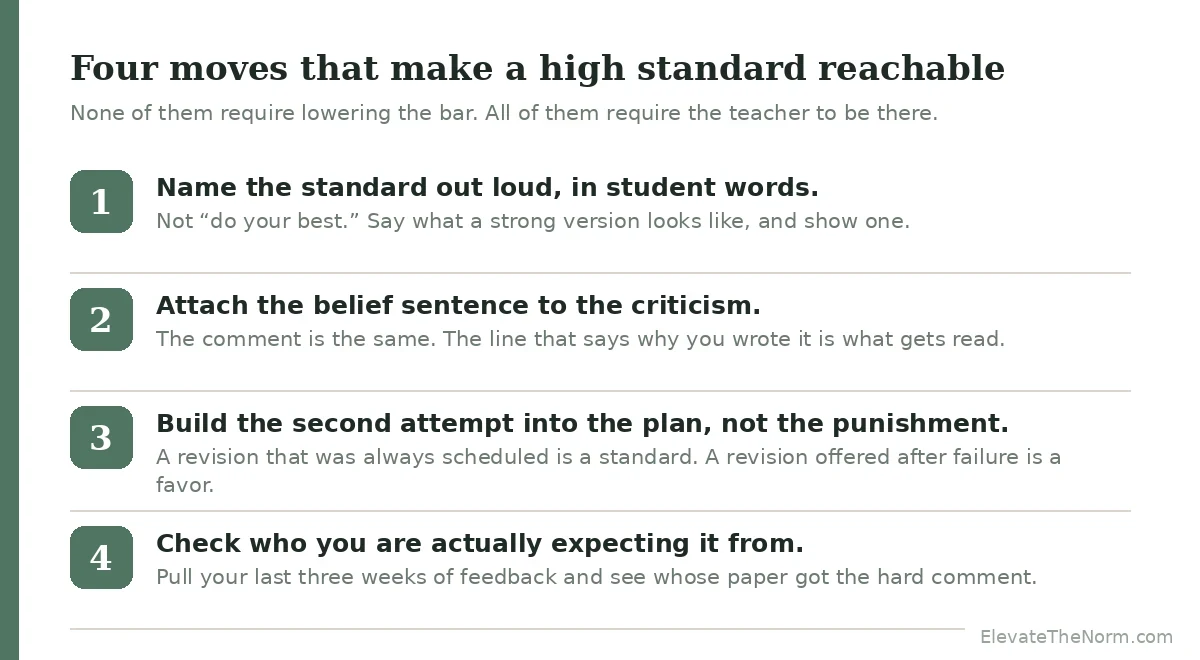
    Numbered list of four classroom moves: name the standard in student words, attach the belief sentence to criticism, schedule the second attempt, and audit who receives the hard feedback.
    Four moves that keep the standard high and make it reachable.

    None of this requires a program. It requires four weeks and a willingness to look at your own paperwork.

    1. Week one — the feedback audit. Pull every piece of work you handed back in the last three weeks. Sort it into “got a demanding comment” and “got a pleasant one.” Then look at the names. You are not looking for villainy. You are looking for a pattern you did not choose.
    2. Week two — the sentence. Attach the high-expectations line to every marked-up paper. Every student, no exceptions, no editing the list.
    3. Week three — the call list. Track who you call on for the question that requires reasoning rather than recall. Most teachers find they have a small rotation of four or five students they trust with the hard question, and that the rotation formed itself.
    4. Week four — the second attempt. Put one revision cycle into the calendar in advance, before anyone has failed anything. Announce it when you assign the work, not after the grades come back.

    Four weeks of this will tell you more about your expectations than any survey will. It also pairs naturally with what already works for students who look like they have stopped caring — disengagement is frequently a reasonable response to being quietly written off.

    Holding the standard when a student misses it

    The test of a high expectation is not what happens when a student meets it. It is what happens the first time they do not.

    Two failure modes, and both are common. The first is quietly dropping the bar for that student from then on — usually dressed up as being realistic. The second is holding the bar and treating the miss as a character finding, which teaches the student that the standard was really a test of who they are.

    The honest third option is that the standard holds, the miss gets named plainly, and the student does the work of getting there. That is the same logic behind accountability paired with another chance, and, when the miss involved harming somebody else, behind structured repair rather than empty punishment. In every case the standard is the constant. What flexes is the route back to it.

    Students can tell the difference between a teacher who lowered the bar for them and a teacher who kept it and stayed. They tend to remember the second one.

    Conclusion: what to do Monday

    High expectations for students are not a posture. They are a set of decisions about who gets the hard question, whose paper gets the demanding comment, who gets pulled to the table, and whether anybody gets a second attempt.

    The evidence says expectations matter, that they are unevenly distributed along lines nobody would defend out loud, and that they do very little on their own. It also says the fix is not more enthusiasm. It is attaching one sentence to your feedback, scheduling the revision before the failure, making your support desirable rather than remedial, and auditing what you actually handed back.

    Start with the feedback audit. It costs an hour and it is the only one of these that will tell you something you do not already believe about yourself.

    Frequently Asked Questions

    What does “high expectations for students” actually mean in a classroom?

    It means naming a standard you believe a specific student can reach, saying out loud what reaching it looks like, and then building the instruction, feedback, and second attempts that make it reachable. Belief is half of it. The path is the other half. An expectation with no path attached is not a high expectation — it is a demand.

    Can high expectations be harmful?

    Yes, when they arrive without support. In the Chicago middle-grades data, students in schools with high academic press but low social support gained about 1.34 grade equivalents in math in a year, compared with 2.39 for students who had both. The standard was the same in both groups. What differed was whether anyone helped. Pressure by itself mostly teaches students that the adult’s opinion of them is already fixed.

    How do I hold a high standard for a student who is several grade levels behind?

    Keep the standard and change the runway. The grade-level task stays; you add the vocabulary front-loading, the worked example, the sentence frames, the extra conference, and the built-in revision. What you do not do is hand that student an easier assignment and call it differentiation. Scaffolding is temporary and comes off. A lowered task is permanent and the student knows it.

    Isn’t this just growth mindset again?

    No, and the distinction matters. Growth mindset research is about what students believe about their own ability, and the intervention literature there is contested. This is about what teachers believe about students and what they do as a result — a different body of evidence with different findings. You can hold accurate, high expectations for a student without ever saying the word “mindset.”

    How would I know if I have lower expectations for some students without realizing it?

    Audit the artifacts instead of your intentions. Pull three weeks of graded work and look at whose paper got a demanding comment and whose got “nice job.” Look at who you called on for the hard question, who you pulled for a conference, and who you told about the honors option. Bias in expectations rarely shows up as a thought you would recognize. It shows up as a pattern in what you actually handed back.

    What should I tell a parent who says my class is too demanding?

    Show them the standard and the support in the same conversation. Say what the assignment asks, what a strong version looks like, what help is available and when, and how many attempts their child gets. Most families are not objecting to rigor. They are objecting to rigor that arrived without a plan, which is a fair objection.

    Do high expectations mean no second chances?

    The opposite. A standard you only get one shot at is a sorting device, not a standard. Building the revision into the calendar from the start — rather than offering it as mercy after a failure — is what makes the bar credible. The student who has to redo the work has been held to more, not less.


    Sources


    About Clay Shumate

    Clay Shumate is a certified secondary Social Studies teacher in the public schools of West Alabama, with seven years of classroom experience, a B.A. in History, and an M.Ed. in Secondary Education. He writes about project-based learning, student responsibility, respect, and practical ways to hold young people to a higher standard while giving them room to learn from mistakes. He is a member of the Society of Professional Journalists and writes to its Code of Ethics; this site’s editorial standards and corrections policy are published in full. More about Clay.
  • Restorative Practices in Schools: Accountability Without Empty Punishment

    Restorative Practices in Schools: Accountability Without Empty Punishment

    By Clay Shumate

    Restorative practices in schools are structured ways of responding to harm that require a student to face what happened, hear who it affected, and do something about it. They are not the opposite of accountability. Done well they are harder on a student than a suspension, because a suspension asks nothing of anyone. Done badly they ask nothing either.

    Key Takeaways

    • Restorative practices are a response system, not a mood. They run on a continuum from a two-sentence affective statement to a formal conference, and most of the work is the informal end.
    • The suspension evidence is genuinely strong. Almost every study finds exclusionary discipline goes down, and the one large randomized trial found the racial discipline gap narrowed too.
    • The academic evidence is not. That same trial found achievement did not improve, and got worse in grades 6–8 — the exact band most of this site’s readers teach.
    • Partial implementation is close to useless. Researchers reviewing failed rollouts concluded that doing some of it looked about the same as doing none of it.
    • Restoration does not replace safety procedures. Weapons, assault, threats, abuse disclosures, and anything your code of conduct defines as mandatory still go through the office, every time.
    • A single teacher can still use most of this. The repair conversation works in one classroom without a district initiative, a consultant, or a budget line.

    What restorative practices in schools actually are

    The International Institute for Restorative Practices defines restorative practices as “a social science that studies how to build social capital and achieve social discipline through participatory learning and decision-making” (Wachtel, 2016). Strip the academic phrasing and it means this: you deal with problems with students rather than to them or for them.

    Four-quadrant social discipline window showing the TO, FOR, NOT and WITH approaches to student discipline
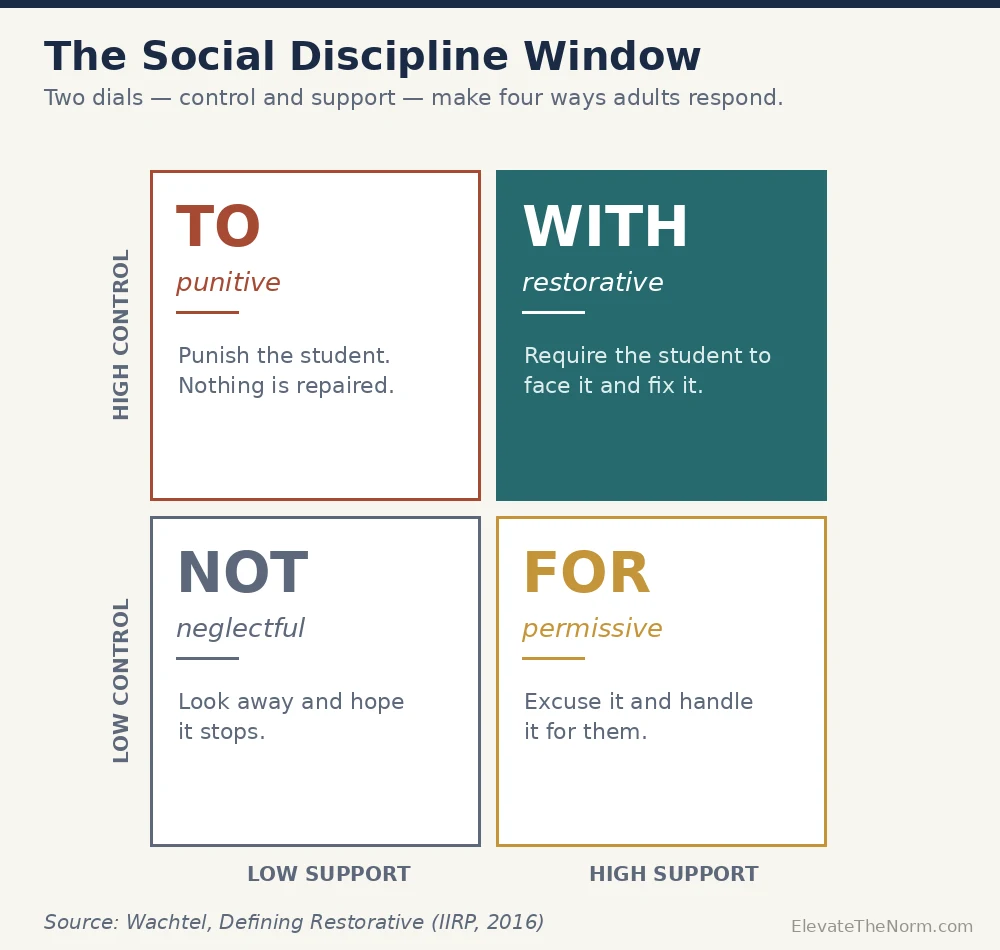
    The social discipline window: restorative practice is the high-support, high-control quadrant, not the permissive one.

    Wachtel’s “social discipline window” is the clearest picture of that idea. Cross high and low control with high and low support and you get four quadrants. TO is high control and low support — punitive. FOR is low control and high support — permissive, doing everything for the student. NOT is low control and low support, which is neglect. WITH is high control and high support, and that is the restorative quadrant.

    That last point is where most staff-room arguments about restorative practice go wrong. People hear “restorative” and picture the FOR box: a teacher who lets things slide, a school where nothing happens after a fight. The framework says the opposite. High control stays. What changes is that the student is required to participate in fixing it instead of just absorbing a penalty.

    The continuum, from two sentences to a formal conference

    Restorative practice is not one event. Wachtel describes a continuum that runs from informal to formal: affective statements, affective questions, small impromptu conferences, groups and circles, and formal conferences. The formal end — the circle with a facilitator and a signed agreement — is the part that gets photographed for district newsletters. It is also the rarest and the most expensive.

    The informal end is where a classroom teacher lives. An affective statement is one sentence naming the effect of a behavior: “When you talk over her, she stops offering answers, and I lose the best thinker in the room.” An affective question asks the student to do that work instead: “Who else is affected when this table doesn’t finish?” Neither takes more than fifteen seconds, and neither requires anyone’s permission.

    What the research on restorative practices actually shows

    Short version: strong and consistent evidence that suspensions fall, promising evidence on racial discipline gaps, weak evidence on climate, and one real warning sign on middle-school achievement. Anyone who tells you the research is settled in either direction has not read it.

    Suspensions go down, and the discipline gap narrows

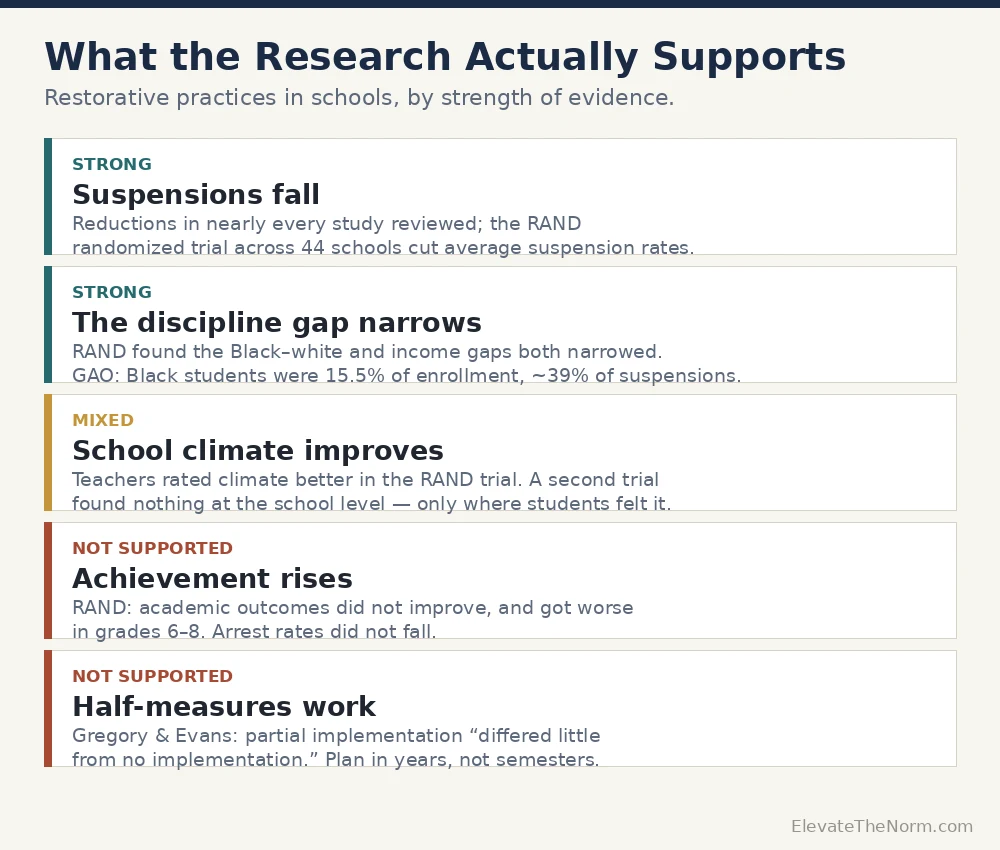
    WestEd’s research review found reductions in exclusionary discipline in nearly every study it examined (Fronius, Darling-Hammond, Persson, Guckenburg, Hurley & Petrosino, 2019). The strongest single piece of evidence is a randomized controlled trial that RAND ran across 44 Pittsburgh schools over the 2015–16 and 2016–17 school years (Augustine et al., 2018). Average suspension rates dropped. The gap between Black and white students narrowed, and so did the gap between lower- and higher-income students. Teachers rated school climate better.

    Chart comparing what restorative practices research supports strongly, partially, and not at all
    What the evidence supports, what it does not, and where the honest gaps are.

    That matters because the disparities are real and documented. The Government Accountability Office found that Black students made up 15.5 percent of public school enrollment but about 39 percent of students suspended from school in 2013–14 (GAO-18-258, 2018). Boys and students with disabilities were also disciplined out of proportion to their share of enrollment. Any approach that shrinks that gap without lowering the standard deserves a serious look.

    The grades 6–8 result nobody quotes

    The same RAND trial found that academic outcomes did not improve — and that they got worse in grades 6–8. Arrest rates did not fall either. RAND did not explain the middle-grades result, and neither will I; a single trial in one district is not a verdict. But if you teach middle school, that is the finding most directly about your students, and you will not usually hear it from a vendor.

    A second randomized trial, run across 13 middle schools with about 2,771 students over two years, found no significant effects at the school level at all (Acosta, Chinman, Ebener, Malone, Phillips & Wilks, 2019). What it did find is more interesting: students who reported actually experiencing restorative practices showed better school connectedness, peer attachment, and social skills, and less cyberbullying victimization. Assignment to the program did nothing. Exposure to the practice did something. That is a fidelity finding wearing a null result’s clothes.

    Half-implemented is barely different from not implemented

    Reviewing what goes wrong in restorative rollouts, Anne Gregory and Katherine Evans concluded that partial implementation “differed little from no implementation” (Gregory & Evans, 2020). They name the common failure patterns: top-down mandates that contradict restorative values, a narrow focus on student behavior while adult behavior stays the same, inadequate training — the “train and hope” approach — and short, under-resourced initiatives. They argue meaningful change should be measured over three to five years, not one.

    Read that next to the two trials and a pattern shows up. The program that was implemented deeply moved suspensions. The program that was assigned but not really lived produced nothing. This is not a practice that rewards a one-day August in-service.

    What restorative practices cannot replace

    A repair conversation is not a substitute for a mandatory procedure, and treating it as one puts students at risk and puts you in real trouble. Your school’s code of conduct and your state’s law decide these, not you and not a circle.

    • Weapons, credible threats, and anything your district defines as a mandatory referral or reportable offense.
    • Assault, sexual harassment, and hazing — these have investigation and notification requirements attached to them.
    • Any disclosure of abuse or neglect. You are a mandated reporter and that obligation does not pause for a restorative process.
    • Situations where a student who was harmed does not want to sit down with the student who harmed them. Requiring that is not restoration; it is a second harm.
    • Documentation. If the incident requires a written referral, write it. A repair conversation can happen alongside the paperwork, not instead of it.

    This is also where restorative practice and ordinary classroom consequences that teach rather than humiliate meet. Restoration answers “what do we do about the harm.” It does not answer “what does the handbook require.” Both questions have to get answered.

    What one teacher can do without a schoolwide program

    Most of the informal continuum needs nothing but your own consistency. You cannot run a whole-school initiative from one room, but you can run the conversation, and the conversation is the part the research suggests students actually have to experience for anything to change.

    The five restorative questions used in a repair conversation with a secondary student
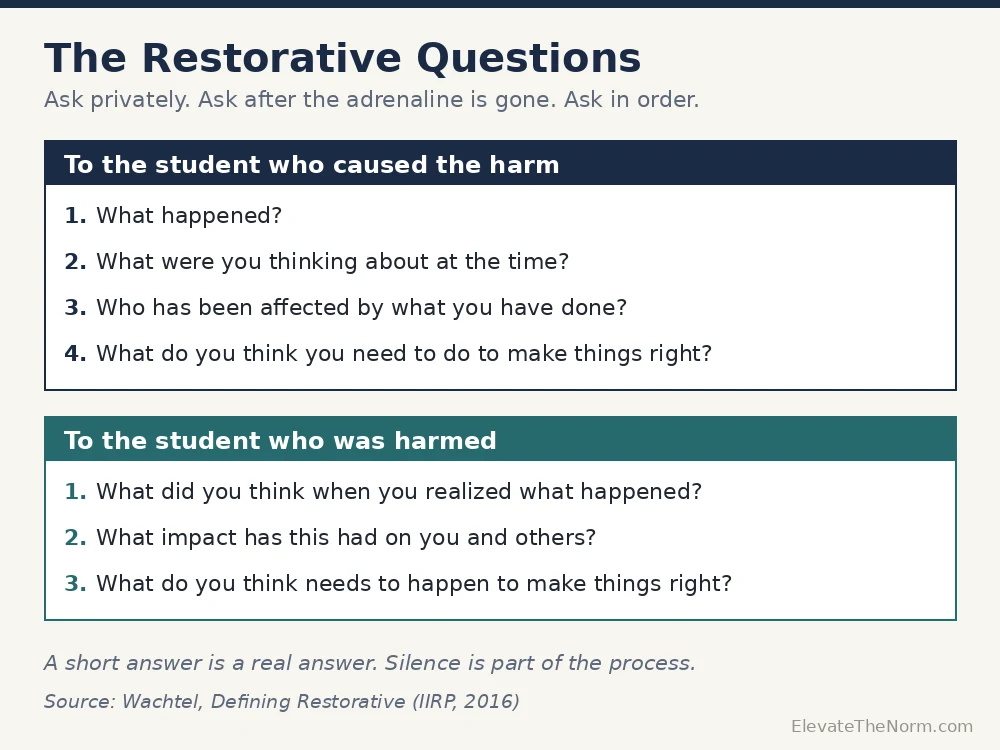
    The restorative questions, in the order that keeps the conversation from turning into an interrogation.

    Wachtel’s restorative questions are the script, and they are short enough to memorize. For the student who caused harm: What happened? What were you thinking about at the time? Who has been affected by what you have done? What do you think you need to do to make things right? For the student who was harmed: What did you think when you realized what happened? What impact has this had on you and others? What do you think needs to happen to make things right?

    Four things make that script work with teenagers rather than sound like a booklet. Ask it privately, not in front of the room. Ask it after the adrenaline is gone, usually the next period or the next day. Ask the questions in order and let the silence sit. And accept a short answer — a fourteen-year-old saying “I wasn’t thinking, I was just mad” is a real answer, not a dodge. This is the same principle behind holding students accountable while still giving them another chance: the goal is a student who can name the harm, not a student who performs remorse well.

    A response ladder that keeps restoration in proportion

    The most common mistake is using a heavy tool on a light problem. A circle for a missed deadline wastes a period and teaches students that the process is theater. Match the response to the size of the harm.

    SituationRestorative responseTime cost
    Side conversation, phone out, off taskAffective statement — name the effect, move on15 seconds
    Group member coasting on a projectAffective question to the group, not the individual1 minute
    Rudeness to you or to another studentSmall impromptu conference, privately, next day4–5 minutes
    Conflict between two students that is still liveSeparate conversations first; joint only if both agree10–15 minutes
    Harm affecting the whole classCircle, with a plan and a follow-up dateHalf a period
    Anything in the mandatory-referral list aboveOffice referral first; repair later, if at allFollow policy

    Notice that the top three rows cover most of a school year. That is deliberate. Restorative practice at the classroom level is mostly small, fast, and unremarkable, which is exactly why it is sustainable — the same reason consequences that connect naturally to the behavior outlast elaborate point systems. When a repair conversation ends with a concrete student commitment, a student accountability sheet gives that agreement a trackable written form for the follow-up conversation.

    How to tell whether it is actually working

    Suspension counts are the easiest number to move and the easiest to fake. A school can cut suspensions by simply declining to write referrals, which improves the spreadsheet and makes teachers feel abandoned. Watch these instead:

    1. Repeat incidents involving the same student. If repair is working, the second conversation should be about something different than the first.
    2. Whether the harmed student came back. Restoration that only serves the student who caused the harm is not restoration.
    3. Teacher referral rates. If referrals collapse while classroom complaints rise, staff have stopped reporting, not stopped having problems.
    4. Who is still being removed. Run the disparity numbers by race, disability status, and grade level. That is the whole point of the intervention.
    5. Whether adults changed anything. Gregory and Evans are blunt that initiatives focused only on student behavior fail. If nothing about adult practice looks different, nothing has been implemented.

    None of that requires a data dashboard. A page in a notebook and a willingness to look honestly will do, which is the same standard I would apply to any discipline approach that promises firm standards without shame.

    Where this leaves you

    Restorative practices in schools are worth using, and they are worth using honestly. The evidence that they reduce suspensions and narrow discipline gaps is about as good as school-level evidence gets. The evidence that they raise achievement is not there, and in the one rigorous trial that looked, middle-grades achievement went the wrong way. Both of those sentences are true at once, and a teacher can hold both.

    So start where the evidence is strongest and the cost is lowest. Learn the seven restorative questions. Use affective statements this week instead of the sigh and the raised eyebrow. Keep writing the referrals your handbook requires. If your school is considering a formal rollout, ask the two questions Gregory and Evans would ask: how many years is the plan, and what is changing about adult practice? If the answers are “one” and “nothing,” the money is better spent elsewhere. And whatever the program, the floor stays the same — respect in the classroom has to run both directions before any of this works.

    Printables for this

    The repair conversation is the hard part to hold onto in the moment, so I wrote mine down. Restorative Conversation Scripts is the follow-up conversation, laid out line by line, and Behavior Reflection Sheets is the written half at two levels. Both are written for teenagers rather than third graders.

    Frequently Asked Questions

    Are restorative practices just a way to avoid disciplining students?

    No. In the framework restorative practice comes from, the restorative response is the high-control, high-support quadrant — the same firmness as a punitive response, with the addition of support and a requirement that the student help repair the harm. A student who has to face the person affected and agree to a fix is doing more work than a student sent home for a day, not less.

    Do restorative practices actually reduce suspensions?

    Yes, and this is the best-supported claim in the whole field. A WestEd review found reductions in exclusionary discipline in nearly every study examined, and a randomized controlled trial across 44 Pittsburgh schools found average suspension rates fell while the gaps between Black and white students and between lower- and higher-income students both narrowed.

    Do restorative practices improve grades or test scores?

    The evidence says no. The Pittsburgh randomized trial found academic outcomes did not improve, and that they got worse in grades 6–8. Arrest rates did not fall either. Restorative practice should be adopted for the discipline and climate outcomes it can support, not sold as an achievement strategy.

    When should a teacher not use a restorative approach?

    Whenever school policy or state law requires something else. Weapons, credible threats, assault, sexual harassment, hazing and any disclosure of abuse go to the office and follow mandated procedures. Also skip it when the student who was harmed does not want to sit down with the student who harmed them — requiring that meeting is a second harm, not a repair.

    How long does a repair conversation take?

    Usually four or five minutes, held privately and after the adrenaline has worn off — typically the next period or the next day. Most classroom-level restorative work is much shorter than that: a one-sentence affective statement naming the effect of a behavior takes about fifteen seconds and covers the majority of daily incidents.

    Can one teacher use restorative practices if the school has no program?

    Yes, for the informal end of the continuum. Affective statements, affective questions and small impromptu conferences need nothing but your own consistency. Schoolwide circles, formal conferences and any change to the discipline code are administrative decisions. Notably, a second randomized trial found that program assignment predicted nothing while students’ actual experience of restorative practice predicted better connectedness and social skills — which suggests one teacher’s practice is not wasted.

    What is the difference between restorative practices and restorative justice?

    Restorative justice is the older criminal-justice concept: responding to an offense by addressing harm and involving those affected. Restorative practices is the broader school-and-community application, and it includes the everyday preventive side — circles, affective language, relationship-building — not just what happens after something goes wrong. In schools the two terms are often used interchangeably.

    Sources


    About Clay Shumate

    Clay Shumate is a certified secondary Social Studies teacher in the public schools of West Alabama, with seven years of classroom experience, a B.A. in History, and an M.Ed. in Secondary Education. He writes about project-based learning, student responsibility, respect, and practical ways to hold young people to a higher standard while giving them room to learn from mistakes. He is a member of the Society of Professional Journalists and writes to its Code of Ethics; this site’s editorial standards and corrections policy are published in full. More about Clay.
  • Student Autonomy: How to Give Students Freedom Without Losing the Room

    Student Autonomy: How to Give Students Freedom Without Losing the Room

    By Clay Shumate

    Student autonomy is a student’s genuine ability to make meaningful decisions about their own learning — what to study, how to demonstrate understanding, when to ask for help, and how to manage their own time — within boundaries an adult has thoughtfully set. It is not freedom without structure. It is freedom because of structure. This guide explains how teachers in grades 6–12 can offer autonomy that increases engagement and responsibility without creating chaos.

    Key Takeaways

    • Autonomy does not mean students do whatever they want. It means they make real decisions within boundaries the teacher has planned.
    • Self-determination theory identifies autonomy, competence, and relatedness as three basic needs that drive genuine motivation in classrooms.
    • Structure and autonomy are not opposites. The research shows they work best together.
    • Autonomy should increase gradually as students demonstrate they can handle it. Start tight, expand deliberately.
    • The biggest risk of student autonomy is not chaos — it is giving choices students are not prepared to make.

    What Student Autonomy Actually Means

    Student autonomy sounds like a simple concept until you try to implement it in a room of twenty-eight teenagers. The word “autonomy” gets used to mean everything from letting students pick their own seats to running an entirely student-directed classroom, and the gap between those two things is enormous. Practical activities that hand students real decisions bridge that gap with structure.

    In research, student autonomy has a specific meaning. Deci and Ryan’s self-determination theory (1985, updated by Ryan & Deci, 2020) defines autonomy as the experience of volition and willingness — acting from one’s own values and interests rather than from external pressure. In a classroom, this means a student who writes an essay because they find the question genuinely interesting is acting autonomously. A student who writes the same essay only because it is graded is not.

    That definition matters because it separates autonomy from permissiveness. A student can experience autonomy within a highly structured environment — as long as the structure makes sense to them, they understand why the expectations exist, and they have some genuine say in how they operate within it.

    Why Student Autonomy Matters for Grades 6–12

    Adolescents are developmentally primed for autonomy. Their brains are building the capacity for independent decision-making, abstract reasoning, and identity formation. When schools respond to this developmental reality by tightening control — more rules, fewer choices, stricter consequences — they create a mismatch between what students need and what the environment provides.

    The research on this point is consistent. A meta-analysis by Vasconcellos et al. (2020) across 144 studies found that autonomy-supportive teaching was associated with higher autonomous motivation, greater engagement, and better academic outcomes across age groups, with effects that held across cultures and subject areas. Jang, Reeve, and Deci (2010) studied 133 high-school classrooms and found that autonomy support and structure were positively correlated — teachers who offered more autonomy also tended to provide more structure — and both predicted students’ observed behavioral engagement. That finding is the usable part of the answer to the student who appears not to care.

    The point is worth emphasizing because it contradicts the most common objection to student autonomy: the fear that giving students choices means giving up control. The evidence suggests the opposite. Autonomy and structure rise and fall together, not inversely.

    The Difference Between Autonomy and Chaos

    This is the section most autonomy guides skip, and it is the section teachers most need.

    Autonomy without preparation is not autonomy. It is abandonment. Handing a student a choice they are not equipped to make — pick any topic, design any project, manage your own time with no checkpoints — does not develop independence. It develops anxiety in the students who care and apathy in the students who have learned that unstructured time means nothing matters.

    Here is what that looks like in practice. A teacher announces that students can research any topic related to the unit. No constraints on scope, no required sources, no checkpoint before the final product. Some students thrive. Most flounder. Several pick topics that cannot be meaningfully researched at a secondary level. A few do nothing at all. The teacher then blames the students for “not being ready for autonomy,” when the truth is the task was not ready for the students.

    The fix is not less autonomy. It is better structure around the autonomy. Define the boundaries. Provide the scaffolding. Check in at defined points. And then let the student make real decisions within that frame.

    Seven Domains of Student Autonomy

    Student autonomy is not a single switch you flip. It is a set of decisions across different parts of the learning experience, and the teacher can offer autonomy in one domain while maintaining control in another. Here are seven domains where autonomy is practical in a secondary classroom.

    Seven numbered domains of student autonomy including pacing topic selection product choice methods help-seeking self-assessment and reflection
    Autonomy is not a single switch. It is a set of decisions across seven domains.

    Pacing

    Let students manage their own time within a defined window. Instead of “everyone moves to step two at 10:15,” try “you have until 10:40 to complete steps one through three — manage your time across those three steps however you need to.” Some students will spend more time on step one. Others will move quickly and spend more time on step three. Both are fine as long as the deadline holds.

    The structure is the deadline. The autonomy is the path to it.

    Topic Selection

    Within a unit, let students choose which specific question they want to investigate. In a unit on the causes of the Civil War, a student might choose to focus on the economics of slavery, the political compromises that failed, or the role of abolitionist media. The unit stays the same. The angle is the student’s.

    The structure is the unit scope and the required evidence. The autonomy is the angle.

    Product Choice

    Students demonstrate understanding through a written argument, a presentation, a recorded analysis, a visual timeline with annotations, or a structured debate. The learning target is fixed. The product is negotiable.

    This domain has a common trap: offering product choices that are not equivalent in rigor. A poster board is not equivalent to a written analysis. If you offer it as an option, the expectation for depth, evidence, and clarity must be just as high.

    Methods and Resources

    Let students decide how they gather information. Some students prefer reading a primary source. Others learn better from a documentary or an interview. The content standards do not require a specific resource type — they require understanding. Let students find the path that gets them there.

    Help-Seeking

    Autonomy in help-seeking means students decide when they need help, what kind of help they need, and who to ask. This sounds minor, but it is one of the most important autonomy skills a student can develop. A student who can accurately assess their own confusion and seek targeted help is a student who will succeed beyond your classroom.

    Build this by making help available without making it mandatory or punitive. In my room, students can come to the whiteboard table for focused small-group instruction whenever they need it. It is not assigned. It is not remediation. It is the best seat in the room — a corner with a lamp, a rug, better chairs, and a surface where we can draw out ideas together. Students ask to work there, which is exactly the point. When the help feels like an opportunity rather than a correction, students seek it out on their own.

    Self-Assessment

    Before turning in work, students evaluate their own product against the rubric and identify one area of strength and one area that could improve. This is not a substitute for teacher assessment — it is preparation for it. A student who can assess their own work accurately is a student who does not need the teacher to be the only source of quality information.

    Reflection

    Let students choose what they reflect on. Not “answer these three reflection questions” but “write about one thing from today’s work that changed how you think about the topic, and explain what changed.” The reflection is required. The content of the reflection is the student’s.

    How to Build Student Autonomy Gradually

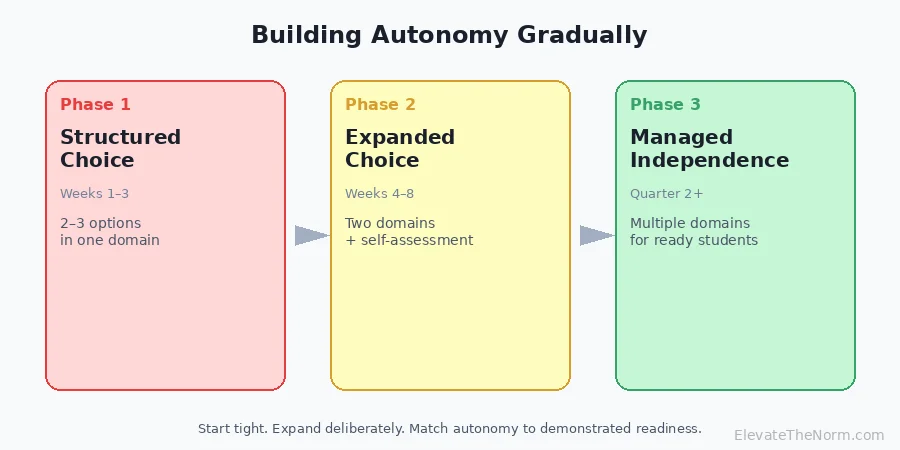
    The most effective approach to student autonomy is progressive. You do not open the semester with full choice in every domain. You start tight and expand deliberately as students demonstrate they can handle it.

    Three-phase framework for building student autonomy from structured choice to expanded choice to managed independence
    Start tight. Expand deliberately. Match autonomy to demonstrated readiness.

    Phase 1: Structured Choice (First Three Weeks)

    Offer two or three options in one domain — typically product or pacing. Keep everything else structured. This teaches students how choice works in your room and establishes that autonomy comes with accountability.

    Phase 2: Expanded Choice (Weeks Four Through Eight)

    Add a second domain. Let students choose both their topic angle and their product. Introduce self-assessment alongside teacher assessment — how students learn to judge their own work is the skill you are actually building here. The check-in structure stays tight — you are circulating, conferencing, and holding students to the timeline.

    Phase 3: Managed Independence (Second Quarter and Beyond)

    Students who have demonstrated responsibility in Phases 1 and 2 can manage multiple domains simultaneously. They propose a topic, choose a method, manage their pacing, and assess their own work before conferencing with you. Students who have not demonstrated that readiness stay in Phase 2 — not as punishment, but because they need more practice with fewer decisions at once.

    This progression is the critical piece most autonomy guides miss. A room where every student has the same level of autonomy regardless of demonstrated readiness is a room that has confused equality with equity. Meeting students where they are means some students have more freedom because they have earned it through consistent, responsible work.

    What Autonomy Support Looks Like in the Classroom

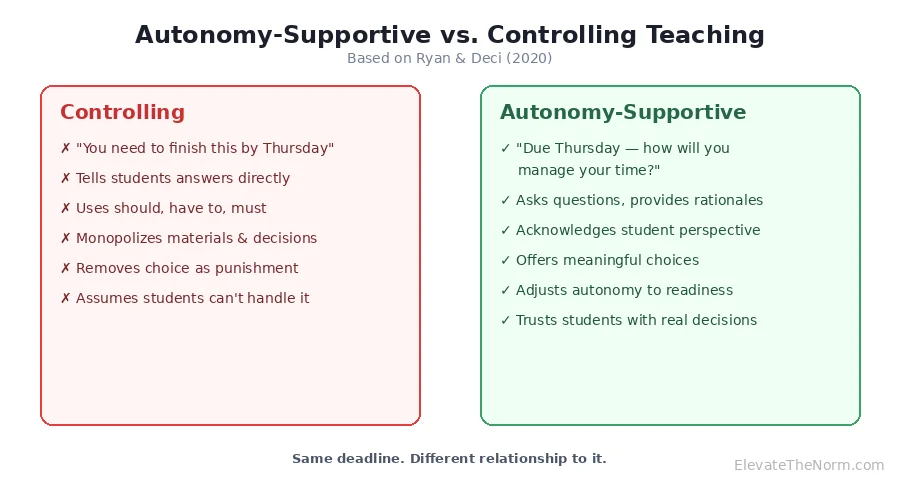
    Ryan and Deci (2020) describe autonomy-supportive teaching through specific, observable behaviors. Autonomy-supportive teachers listen to students, make time for independent work, give students opportunities to speak, acknowledge improvement and mastery, and provide rationales when requiring specific tasks.

    Controlling teachers, by contrast, monopolize learning materials, tell students answers directly, issue directives, and rely on controlling language like “should” and “have to.”

    Comparison of controlling teaching behaviors and autonomy-supportive teaching behaviors based on Ryan and Deci 2020
    Same deadline. Different relationship to it. Based on Ryan and Deci (2020).

    The practical difference is often in language. “You need to finish this by Thursday” is controlling. “This is due Thursday — how are you planning to manage your time?” is autonomy-supportive. The deadline is identical. The relationship to the deadline is different.

    Bloem et al. (2024) found that teachers reported giving students from lower socioeconomic backgrounds less autonomy support and more controlling instruction — and teachers with more biased attitudes toward low-SES students differentiated the most. That finding matters for every school in which I have worked. The students who most need the experience of genuine decision-making are often the students least likely to get it, not because they cannot handle it, but because adults assume they cannot.

    When Student Autonomy Does Not Work

    Autonomy does not work when it is a substitute for planning. A teacher who hands students unstructured time and calls it “student-directed learning” has not given students autonomy. They have given themselves a break.

    Autonomy does not work when the choices are not meaningful. Letting students pick between blue paper and green paper is not autonomy. Letting students choose which essay prompt to respond to when both prompts require the same depth of thinking — that is autonomy.

    Autonomy does not work without a relationship. A student will not take intellectual risks for a teacher they do not trust. Autonomy support and relatedness — the third pillar of self-determination theory — work together. Building the relationship comes first.

    And autonomy does not work when consequences are absent. A student who chooses poorly and faces no consequence has not experienced autonomy. They have experienced permissiveness. Real autonomy includes real accountability — not manufactured stakes, but honest follow-through. If a student chose not to manage their time well, the conversation is not punitive. It is honest: this is what happened, this is what you chose, and this is what you owe now.

    The Repair Conversation — Student Autonomy After a Mistake

    One of the most important moments in building student autonomy is what happens after a student makes a poor choice. The standard school response is a consequence — a zero, a detention, a phone call home. Those responses are sometimes necessary, but they do not teach autonomy. They teach compliance under threat.

    A repair conversation teaches autonomy because it puts the student in the position of identifying what went wrong, who was affected, and what they owe. It is not a lecture. It is a set of questions: What happened? Who was affected by that? What do you think you owe them? When will you do it?

    The student does the thinking. The teacher holds the boundary. That is student autonomy at its most practical — a student making real decisions about how to respond to their own mistake, within a structure where the adult is present and the expectation is clear.

    This is also where the line between autonomy and permissiveness becomes sharpest. Permissiveness lets the mistake pass. Control punishes it without discussion. Autonomy support says: you made a choice, you are capable of evaluating that choice, and here is what accountability looks like. For a ready-to-use tool on this, see a printable seating chart planning pack.

    That same question — how much control students should hold — extends beyond the repair conversation into everyday classroom decisions. For a close look at how that line is drawn across five levels of agency, see student voice and choice in practice.

    Frequently Asked Questions

    What is the difference between student autonomy and letting students do whatever they want?

    Student autonomy means students make genuine decisions within boundaries a teacher has thoughtfully planned. Letting students do whatever they want is not autonomy — it is the absence of teaching. The boundary is what makes the choice meaningful. Without it, students are not exercising autonomy. They are just unsupervised.

    How do I give autonomy to students who are not ready for it?

    Start with structured choice in one domain — two or three options rather than open-ended freedom. Students who are not yet ready for full autonomy are not incapable of making decisions. They need smaller decisions with more support. Expand the choices as they demonstrate readiness. This is a graduated process, not a binary switch.

    Does student autonomy work in tested subjects?

    Yes. The learning targets in a tested subject are fixed. Autonomy applies to how students reach those targets — which resources they use, how they pace their work, what product they create to demonstrate understanding, and how they assess their own readiness. Standards constrain the destination. Autonomy applies to the journey.

    What about students who choose not to work when given freedom?

    A student who stops working when given choice is telling you something about their relationship to the work, the environment, or both. The answer is not to remove the choice for everyone. It is to have a private conversation with that student about what happened, then adjust the level of autonomy for that individual while maintaining it for students who are using it well.

    How does student autonomy affect classroom management?

    Research consistently shows that autonomy support improves classroom behavior, not the reverse. Jang, Reeve, and Deci (2010) found that autonomy support and structure both predicted observed behavioral engagement in 133 high-school classrooms. When students feel their choices matter and the environment is predictable, disruptive behavior decreases — not because it is punished more effectively, but because the underlying need driving it is addressed.

    Can I offer student autonomy in a highly structured school environment?

    Yes. Student autonomy lives inside your classroom, within your lesson plans. Even in schools with rigid bell schedules, required curricula, and standardized assessments, you can offer meaningful choice in how students engage with content, how they demonstrate understanding, and how they manage their time within your class period. Autonomy does not require administrative permission. It requires teacher planning.

    Sources

    1. Ryan, R. M., & Deci, E. L. (2020). “Intrinsic and Extrinsic Motivation from a Self-Determination Theory Perspective.” Contemporary Educational Psychology, 61, 101860.
    2. Jang, H., Reeve, J., & Deci, E. L. (2010). “Engaging Students in Learning Activities: It Is Not Autonomy Support or Structure but Autonomy Support and Structure.” Journal of Educational Psychology, 102(3), 588–600.
    3. Vasconcellos, D., et al. (2020). “Self-Determination Theory Applied to Physical Education: A Systematic Review and Meta-Analysis.” Journal of Educational Psychology, 112(7), 1444–1469.
    4. Niemiec, C. P., & Ryan, R. M. (2009). “Autonomy, Competence, and Relatedness in the Classroom.” Theory and Research in Education, 7(2), 133–144.
    5. Bloem, N., et al. (2024). “Teachers’ Autonomy Support and Control Towards Students from Different Socioeconomic Backgrounds.” Social Psychology of Education, 27, 1247–1270.
    6. Reeve, J. (2012). “A Self-Determination Theory Perspective on Student Engagement.” In S. L. Christenson, A. L. Reschly, & C. Wylie (Eds.), Handbook of Research on Student Engagement (pp. 149–172). Springer.

    About Clay Shumate

    Clay Shumate is a certified secondary Social Studies teacher in the public schools of West Alabama, with seven years of classroom experience, a B.A. in History, and an M.Ed. in Secondary Education. He writes about project-based learning, student responsibility, respect, and practical ways to hold young people to a higher standard while giving them room to learn from mistakes. He is a member of the Society of Professional Journalists and writes to its Code of Ethics; this site’s editorial standards and corrections policy are published in full. More about Clay.
  • Student Engagement Strategies PDF: A Practical Guide for Grades 6–12

    Student Engagement Strategies PDF: A Practical Guide for Grades 6–12

    By Clay Shumate

    Student engagement strategies are practical teaching moves that shift students from passive compliance to genuine thinking during every phase of a lesson — opening, discussion, reading, group work, project-based learning, checking for understanding, and reflection. This guide organizes those strategies by when you actually use them, explains which ones build real intellectual engagement versus surface-level cooperation, and gives you something you can print, keep in a planning binder, and refer to on an ordinary school day.

    Key Takeaways

    • Engagement has three dimensions — behavioral, cognitive, and emotional — and a strategy that targets only one often misses the point.
    • The most effective engagement strategies are low-tech, teacher-led, and built into the lesson plan rather than bolted on as activities.
    • Compliance looks like engagement from across the room. Knowing the difference changes how you plan.
    • Strategies organized by lesson phase — not alphabetically, not by buzzword — are strategies teachers actually use.
    • Student engagement is not something you buy. It is something you build through planning, consistency, and presence.

    What Student Engagement Actually Means

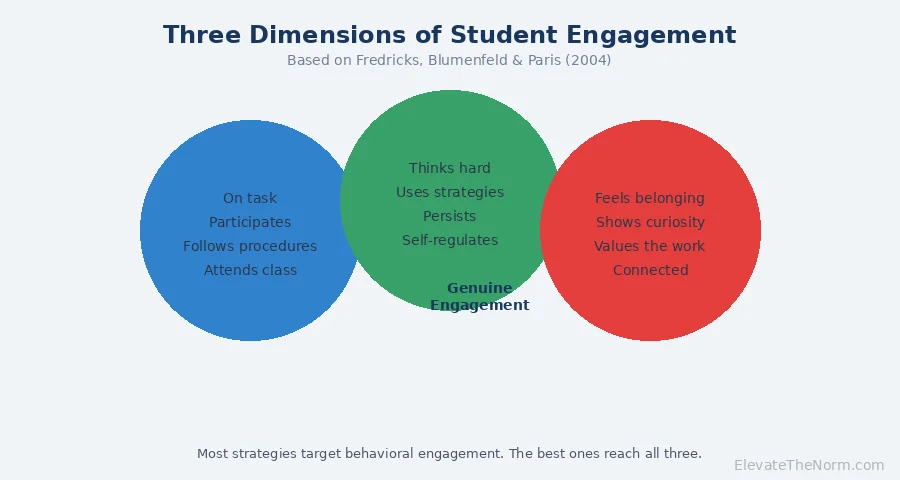
    Researchers Fredricks, Blumenfeld, and Paris (2004) identified three dimensions of student engagement that still hold up: behavioral engagement (participation, attendance, following procedures), cognitive engagement (mental investment — thinking hard about the material, using strategies, persisting through difficulty), and emotional engagement (feelings of belonging, curiosity, and connection to the work).

    Most engagement strategies target behavioral engagement. A student raises a hand. A student writes something on a whiteboard. A student turns to a partner on cue. These are visible, countable, and reassuring for the teacher — but they do not necessarily mean the student is thinking.

    Diagram showing behavioral cognitive and emotional dimensions of student engagement based on Fredricks Blumenfeld and Paris 2004
    Behavioral, cognitive, and emotional engagement based on Fredricks, Blumenfeld, and Paris (2004).

    Genuine engagement is cognitive and emotional. The student is not just doing the task. The student is wrestling with the content, connecting it to something they already know, and caring enough about the outcome to push through when the work gets hard.

    That distinction matters because a room full of compliant students can look engaged from the doorway while learning almost nothing. This guide prioritizes strategies that build real thinking, not just visible participation.

    Compliance Versus Genuine Engagement — Know What You Are Building

    Before organizing strategies by lesson phase, it helps to be honest about a tension most engagement guides skip entirely.

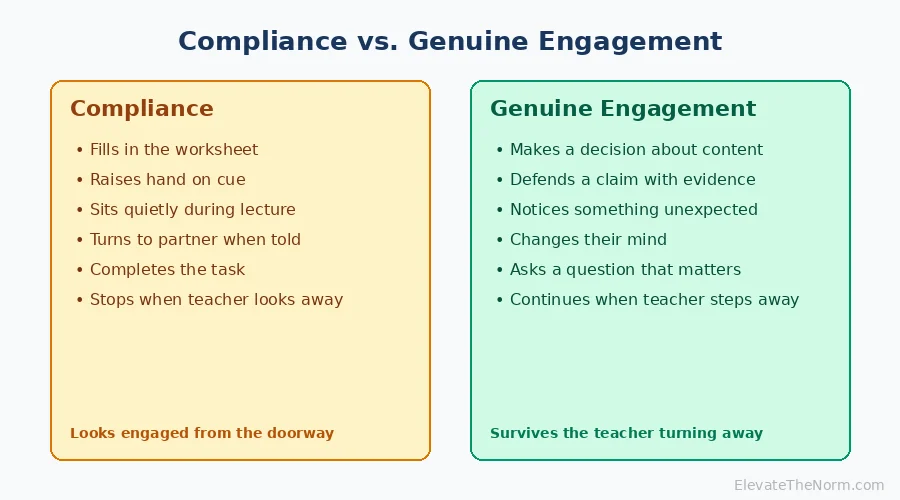
    Some strategies produce compliance. Students do the thing you asked them to do. They fill in the graphic organizer. They complete the sentence starter. They stand up and find a partner. The room is active, the noise level is appropriate, and an observer would mark the lesson as engaging.

    Other strategies produce genuine intellectual engagement. Students make a decision about the content. They defend a claim. They notice something they did not expect. They change their mind.

    Side-by-side comparison of student compliance behaviors versus genuine engagement behaviors
    Compliance looks like engagement from the doorway. Genuine engagement survives the teacher turning away.

    Both have a place. Compliance strategies keep the room running. They are especially useful during transitions, during the first weeks of school, and with material that simply needs to be practiced. But a lesson built entirely on compliance strategies produces students who are very good at following directions and very practiced at not thinking too hard.

    The strategies in this guide are labeled honestly. If a strategy primarily produces compliance, it says so. If it produces genuine thinking, it says why.

    Lesson Opening Strategies (First Five to Ten Minutes)

    The opening is where you win or lose the lesson. A strong opening creates a reason to think. A weak one creates a reason to wait.

    That opening tension is sharpest right after a break in the calendar. If you are planning the Tuesday after a three-day weekend, a game-and-webquest opening built specifically for that day holds attention better than starting cold with notes.

    Bell Ringer with a Decision

    Not a vocabulary review or a worksheet. A question that requires the student to take a position before the lesson begins. “Was the Treaty of Versailles more likely to prevent another war or cause one?” forces a choice. The content instruction that follows has a purpose — the student needs information to evaluate their own answer. There is a whole bank of openings built on that principle if you want twenty of them rather than one.

    What it builds: Cognitive engagement. The student entered the room with an opinion and now has a reason to pay attention.

    The Posted Plan

    Write the entire lesson plan on the board, including times. “10:00–10:12: Source analysis. 10:12–10:25: Partner comparison. 10:25–10:40: Whole-group debrief. 10:40–10:50: Written reflection.” Students know exactly what is coming, how long it will take, and what they will be asked to do. This is not an engagement trick. It is a transparency practice that removes uncertainty, which is one of the biggest barriers to emotional engagement in a secondary classroom.

    I post times on the board every day. If I run behind, I say so out loud and explain why. The students hold me to it, which is exactly the point — the plan is a contract, not a suggestion.

    What it builds: Emotional engagement (predictability and trust) and behavioral engagement (students transition faster when they can see the next segment).

    Low-tech: Whiteboard or chalkboard. No technology required.

    The Pause Before Anything Starts

    There is a version of classroom management advice that says you should start teaching immediately to “capture attention.” I have found the opposite. When the room is not ready, you wait. You do not talk over the noise. You do not begin your opening while three students are still walking to their seats. You stand still, make eye contact, and wait.

    I once held that pause for more than five minutes. It was one of the most awkward moments of my life. That section finished nine minutes behind my other sections, and it is the only time I have ever assigned homework — because they were nine minutes behind and I owed every class the same content. But after that day, the room settled in under thirty seconds for the rest of the year.

    That pause builds engagement because it establishes that what is about to happen matters enough to wait for. If you talk over the noise, you teach students that the noise is acceptable and that your instruction is background.

    What it builds: Behavioral and emotional engagement. Students learn that the room runs on mutual respect, not volume.

    Low-tech: Silence. The cheapest strategy on this list.

    Discussion Strategies

    Discussion is the most commonly faked engagement activity in secondary classrooms. A teacher asks a question. The same four students answer. The other twenty-six sit quietly and wait. The lesson plan says “class discussion,” and the observation form marks participation, but most of the room was not engaged.

    Think-Pair-Share That Actually Works

    Think-Pair-Share fails when “think” means stare at the desk for ten seconds, “pair” means turn to the nearest person and confirm you have the same answer, and “share” means one pair tells the class while everyone else checks out.

    Make it work: give a genuine thinking question (not a recall question), give real think time (sixty seconds minimum, timed and silent), require a written response before pairing, and during the share phase, call on pairs who disagreed with each other. The disagreement is where the thinking lives.

    What it builds: Cognitive engagement when the question demands a position rather than a fact.

    Structured Academic Controversy

    Give two partners the same topic with opposing evidence sets. Each side presents, then they switch — arguing the other side’s position using that side’s evidence. Then they drop the roles and write a joint statement.

    This strategy is harder to set up than a worksheet, but it produces something most discussion strategies do not: students thinking carefully about evidence they personally disagree with.

    What it builds: Cognitive and emotional engagement. The role-switch is the key move — it forces genuine consideration of a position the student did not choose.

    Socratic Seminar with Preparation

    The most common failure of Socratic seminars in secondary classrooms is running one without preparation. Students arrive, sit in a circle, and produce surface-level comments because they have nothing prepared.

    Fix this by requiring a preparation sheet the day before: two claims from the text with page numbers, one question the student genuinely wants answered, and one connection to previous material. The seminar becomes a conversation between students who have something to say. If students struggle to produce that one question, hand them a frame and a bank: there are forty subject-general seminar questions and a way to teach students to write their own.

    What it builds: Cognitive engagement, but only with the preparation step. Without it, you get compliance — students sitting in a circle saying things that sound intellectual but cost nothing.

    Reading Strategies

    Reading engagement in secondary classrooms has one core problem: students do not read. They skim, they copy the person next to them, or they wait for the teacher to summarize. These strategies address that problem directly.

    Annotation with a Purpose

    Do not say “annotate the text.” Say “mark every place the author makes a claim without giving evidence.” Or: “Circle every word you do not know and write what you think it means from context.” Specific annotation tasks produce specific thinking. Open-ended annotation produces highlighting.

    What it builds: Cognitive engagement. The student is reading with a filter, which means they are reading with their brain on.

    Chunked Reading with Partner Checks

    Break a long text into three or four sections. After each section, partners summarize what they read — not what they highlighted, not a vocabulary word, but the central claim or event of that chunk, stated in their own words. If they cannot do it, they reread.

    This is tedious for the teacher to set up, but it catches disengagement at the paragraph level instead of at the end of the reading when it is too late to matter.

    What it builds: Cognitive engagement and a genuine check on whether reading happened.

    Low-tech: Paper text, pencil, and a partner.

    Group Work Strategies

    Group work is either the highest-engagement activity in a lesson or the lowest. The difference is structure.

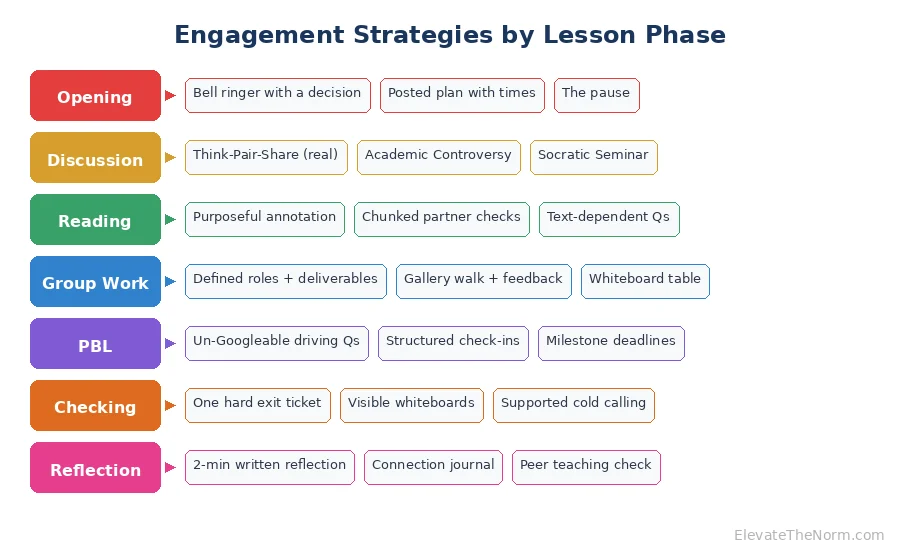
    Chart showing student engagement strategies organized by seven lesson phases from opening to reflection
    Strategies organized by when you actually use them, not by buzzword.

    Defined Roles with Individual Accountability

    Give each group member a specific role that produces a specific, visible product. The recorder writes. The questioner generates two questions from the group’s work. The presenter prepares the group’s statement. The checker verifies every claim against the source material.

    Defined roles work only when each role has an individual deliverable. If the recorder’s notes are the only product, three of four students have no reason to engage.

    What it builds: Behavioral engagement (structure) and cognitive engagement (individual accountability). The individual deliverable is what separates this from compliance.

    Gallery Walk with Feedback

    Groups post their work. Other groups circulate and leave written feedback — not stickers, not checkmarks, but a specific comment: one thing the work does well and one question it does not answer.

    The feedback must be written and signed. Anonymous feedback in secondary classrooms is either useless or cruel. Signed feedback forces the reviewer to be thoughtful because their name is on it.

    What it builds: Cognitive engagement for both the creators and the reviewers, but only when the feedback is specific and signed.

    Low-tech: Chart paper, markers, and sticky notes.

    The Whiteboard Table

    In my room, I pull small groups to a whiteboard table — a table I built with a dry-erase surface, set in a corner with a lamp, a rug, and better chairs. Students ask to go there. It is not the remediation table. It is the best seat in the room, and the work that happens there is focused because the environment signals that what we are about to do matters.

    A whiteboard table is not expensive to build or buy, and the return is significant: students who would never raise a hand in whole-group discussion will talk freely in a small group at a table that feels different from the rest of the room.

    What it builds: Cognitive and emotional engagement. The physical environment removes the public performance anxiety that kills participation for many secondary students.

    PBL (Project-Based Learning) Strategies

    Project-based learning creates engagement through authentic work, real audiences, and meaningful products. But engagement in PBL is not automatic — a poorly structured project produces busy work with better aesthetics.

    Driving Questions That Students Cannot Google

    “What caused World War I?” is a textbook question. “Should the United States have entered World War I, and what would have changed if it hadn’t?” is a driving question. The difference is that the second question requires the student to build an argument using evidence, not retrieve a list.

    If a student can answer the driving question by copying a paragraph from a website, the question is not driving anything.

    What it builds: Cognitive engagement. The question structure makes thinking unavoidable.

    Structured Check-Ins with Deadlines

    The most common PBL failure is checking in at the end. Projects need structured check-ins at defined milestones — research complete, argument drafted, evidence collected, product in progress, and final product. At each check-in, the student explains what they have done, what decisions they made, and what they plan to do next.

    This is where the teacher earns the engagement. Circulating between groups, sitting down with a team, asking “walk me through your reasoning” — that is what makes a project intellectually demanding rather than aesthetically appealing.

    What it builds: Cognitive engagement and accountability. The check-in is the strategy.

    Checking for Understanding Strategies

    If your only check for understanding is asking “does everyone get it?” you are not checking. You are hoping.

    Exit Tickets with One Hard Question

    Not three questions covering the whole lesson. One question that gets at the hardest part of today’s content. If a student can answer it correctly, they understood the lesson. If they cannot, you know exactly what to reteach.

    The exit ticket is useful only if you read every one before the next class. Otherwise it is compliance — students fill out a piece of paper, you collect it, and nothing changes.

    Whiteboards for Visible Thinking

    Every student gets a small whiteboard. You ask a question. They write their answer and hold it up. You see every answer simultaneously and can respond to patterns, misconceptions, or blank boards in real time.

    This is one of the oldest student engagement strategies in teaching and it still works because it solves the core discussion problem: only a few students answer when you call on individuals. Whiteboards make every student’s thinking visible at the same time.

    Low-tech: A $2 whiteboard, a marker, and a sock for an eraser.

    Cold Calling with Support

    Cold calling — randomly selecting a student to answer — gets a bad reputation because it is often done punitively. “Marcus, you don’t look like you’re paying attention. What’s the answer?” That is not a strategy. That is public embarrassment.

    Cold calling works when every student has had time to prepare an answer (through writing or partner discussion first), when the expectation is established from day one, and when the teacher responds to wrong answers with follow-up questions rather than correction. “Interesting — what evidence led you there?” keeps the conversation going. “No, the answer is X” ends it.

    Student Reflection Strategies

    Reflection is where students turn experience into learning. Without it, even an excellent lesson stays an experience — something that happened today and fades by tomorrow.

    Two-Minute Written Reflection

    At the end of class, students write for two minutes answering one question: “What is one thing you understand better now than you did at the start of class, and what made that happen?” The second part — what made that happen — is where the metacognition lives. It forces students to identify the moment or strategy that helped them learn, which makes them more likely to use it again.

    The Connection Journal

    Students keep a running journal — one entry per class — connecting today’s content to something outside of school. Not “this reminded me of a movie” but “this connects to X because Y.” The discipline is the specificity. Over a semester, the journal becomes evidence that the student sees the content as part of a larger world rather than as isolated classroom information.

    Low-tech: A composition notebook. One per student, kept in the room.

    Peer Teaching Check

    After a lesson segment, one student explains the key concept to another student who was absent or who struggled. This is not tutoring — it is a check on the explainer’s understanding. If you can explain it clearly, you understand it. If you cannot, we know where to go back.

    What This Guide Does Not Include

    This guide does not include gamification apps, point systems, prize boxes, or reward charts. Those tools produce compliance. They teach students to perform for a reward rather than engage with content because it matters.

    This guide also does not include strategies that require expensive technology. Every strategy listed above works with paper, a whiteboard, and a classroom where the teacher has planned to the minute and cares enough to circulate.

    Ryan and Deci’s self-determination theory (2000, updated 2020) identifies three basic psychological needs that drive genuine motivation: autonomy (the need to feel ownership over one’s actions), competence (the need to feel capable), and relatedness (the need to feel connected to others). The strategies in this guide that produce real engagement — not just compliance — tend to address at least one of those needs. The ones that address all three tend to be the ones students remember.

    How to Use This Guide

    Print it. Keep it in your planning binder. When you are writing a lesson plan and you get to the discussion section, flip to discussion strategies and choose one. When you are planning a check for understanding, look at this section instead of defaulting to “ask if everyone gets it.”

    The strategies are organized by lesson phase because that is how teachers actually plan. You do not sit down and think “I need a cognitive engagement strategy.” You sit down and think “what am I doing for the first ten minutes?” This guide is built to answer that question. For a ready-to-use tool on this, see a printable student self-assessment pack. When a unit is ending and you want the review to be retrieval rather than re-reading, a review game with a job for every student is the version of this that teenagers volunteer for. For a ready-to-use tool on this, see a printable formative assessment quick-use pack.

    Frequently Asked Questions

    How do I know if students are genuinely engaged or just complying?

    Watch what happens when you stop directing. If students continue working, discussing, or thinking when you step back, they are engaged. If they stop the moment your attention shifts, they were complying. Fredricks, Blumenfeld, and Paris (2004) identified this as the difference between behavioral engagement (doing the task) and cognitive engagement (investing mentally in the task). Genuine engagement survives the teacher turning away.

    Do these student engagement strategies work without technology?

    Every strategy in this guide works with paper, pencils, whiteboards, and a room where students can talk to each other. Technology can enhance some of them, but none of them require it. The most effective engagement strategies are teacher-led and content-driven, not app-dependent.

    How many engagement strategies should I use in one lesson?

    Two to four, matched to the lesson phase. A strong opening strategy, a discussion or reading strategy in the middle, a check for understanding, and a reflection at the end is a full lesson. More than that becomes exhausting for students and unsustainable for the teacher.

    What about students who refuse to participate in engagement activities?

    A student who refuses to engage in a structured strategy is giving you information. They are telling you that something is wrong — with the task, the relationship, the environment, or something outside your classroom entirely. The answer is not a louder strategy. It is a quiet conversation, usually later, usually privately, about what is happening and what they need.

    Do student engagement strategies work for students with learning differences?

    The strategies in this guide are designed to be accessible by default. Written responses before discussion, structured roles in group work, chunked reading, and visible thinking on whiteboards all reduce the barriers that make participation difficult for students who process differently. Autonomy support — offering genuine choice in how students demonstrate understanding — has been shown to benefit all students, with particularly strong effects for students who struggle with traditional formats (Ryan and Deci, 2020).

    How do I get administration to support engagement-focused teaching?

    Document what you do and why. When an administrator walks in and sees students talking in groups, it helps to have a posted lesson plan with times, defined roles for each group member, and a visible product. The plan on the board is your best defense and your best evidence — it shows that the activity is structured, timed, and purposeful.

    What is the difference between engagement and entertainment?

    Entertainment holds attention without requiring thinking. Engagement holds attention because thinking is happening. A funny video is entertainment. A debate where students must use evidence from that video to defend a position is engagement. The content is the same; the cognitive demand is different.

    Sources

    1. Fredricks, J. A., Blumenfeld, P. C., & Paris, A. H. (2004). “School Engagement: Potential of the Concept, State of the Evidence.” Review of Educational Research, 74(1), 59–109.
    2. Ryan, R. M., & Deci, E. L. (2020). “Intrinsic and Extrinsic Motivation from a Self-Determination Theory Perspective.” Contemporary Educational Psychology, 61, 101860.
    3. Niemiec, C. P., & Ryan, R. M. (2009). “Autonomy, Competence, and Relatedness in the Classroom.” Theory and Research in Education, 7(2), 133–144.
    4. Reeve, J. (2012). “A Self-Determination Theory Perspective on Student Engagement.” In S. L. Christenson, A. L. Reschly, & C. Wylie (Eds.), Handbook of Research on Student Engagement (pp. 149–172). Springer.
    5. Hattie, J. (2023). Visible Learning: The Sequel. Routledge.
    6. Center for Innovation in Teaching & Learning, University of Illinois. “Three Dimensions of Student Engagement.”

    About Clay Shumate

    Clay Shumate is a certified secondary Social Studies teacher in the public schools of West Alabama, with seven years of classroom experience, a B.A. in History, and an M.Ed. in Secondary Education. He writes about project-based learning, student responsibility, respect, and practical ways to hold young people to a higher standard while giving them room to learn from mistakes. He is a member of the Society of Professional Journalists and writes to its Code of Ethics; this site’s editorial standards and corrections policy are published in full. More about Clay.
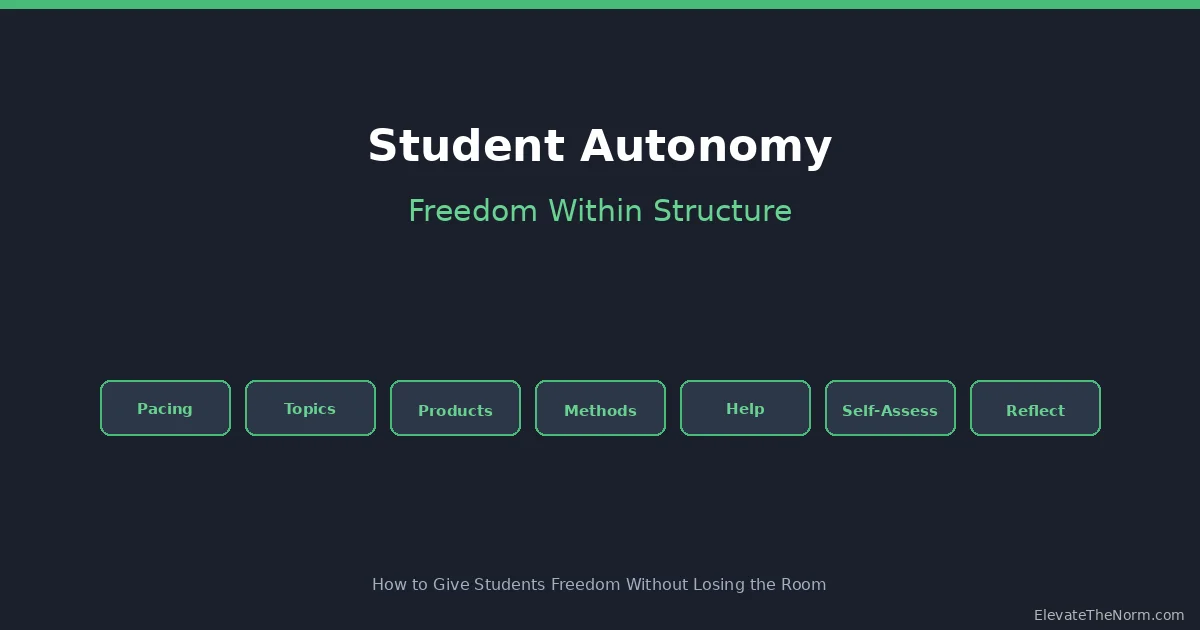
  • Positive Discipline for Teens: Firm Standards Without Shame or Power Struggles

    Positive Discipline for Teens: Firm Standards Without Shame or Power Struggles

    Positive Discipline for Teens: Firm Standards Without Shame or Power Struggles

    By Clay Shumate

    Positive discipline for teens is an approach to behavior guidance that holds firm, clear standards while treating the student as a developing person rather than a problem to control. It replaces shame, yelling, and power struggles with consistency, dignity, and real accountability — without sliding into permissiveness. The goal is not obedience. The goal is a young person who understands what is expected, why it matters, and what to do when they fall short.

    Key Takeaways

    • Positive discipline is not soft discipline. It holds high standards and enforces real consequences — it just does so without humiliation.
    • The approach is rooted in Adlerian psychology and built around belonging, significance, and the connection between how students feel and how they behave.
    • Firm and kind are not opposites. The most effective classroom management research supports doing both at the same time, every time.
    • Public correction escalates conflict with adolescents. Private, close-range redirection keeps the standard intact without handing the student an audience.
    • Positive discipline teaches long-term skills — problem-solving, self-regulation, repair — rather than training short-term compliance.

    What Positive Discipline Actually Means

    The phrase “positive discipline” gets used loosely enough that it needs defining before it can be useful. In its most specific form, it refers to a program developed by educator and psychologist Jane Nelsen in the 1980s, built on the earlier psychological work of Alfred Adler and Rudolf Dreikurs. Adler’s core idea was that human behavior is driven by the need to belong and to feel significant. Dreikurs extended that into parenting and schools, arguing that misbehavior is a discouraged child’s mistaken attempt to find belonging. Nelsen turned those ideas into a practical framework with books, training, and classroom tools (Positive Discipline Association).

    More broadly, “positive discipline” describes any approach to behavior that holds clear limits while respecting the student’s dignity. That is the version this article is about — not one branded program, but the principle underneath all of them: you can be firm and kind at the same time, every time, without either one canceling the other out.

    That distinction matters because some teachers hear “positive discipline” and assume it means letting things slide, going easy, or replacing consequences with conversations. It does not. The firmness is not optional. What changes is the method — not the standard.

    Why Adolescents Respond Differently Than Younger Students

    Positive discipline was originally developed for families with young children. Translating it into a high school hallway requires understanding what makes teenagers different — not harder, but different.

    Adolescents are wired to care about status, autonomy, and peer perception. Yeager, Dahl, and Dweck’s synthesis of adolescent motivational development found that teenagers are strongly driven by concerns about status and respect, and that interventions built on compliance or on distant future consequences tend to fail with them precisely because those approaches ignore what actually motivates adolescent behavior. A correction delivered across a room is not received as information about a behavior. It is received as a public statement about position — and a fifteen-year-old will often defend that position at the cost of everything else.

    This is not defiance for its own sake. It is predictable developmental behavior, and the adult who understands it can work with it instead of against it.

    Darling and Steinberg’s research on parenting styles — which has been replicated extensively in school settings — consistently shows that the authoritative style (high warmth, high expectations) produces the strongest outcomes across behavior, academic achievement, and social competence. Authoritarian approaches (high control, low warmth) produce compliance in the short term but undermine the student’s capacity to self-regulate. Permissive approaches produce neither (Darling & Steinberg, 1993).

    Positive discipline for teens, done right, lives in the authoritative quadrant: clear expectations, consistent follow-through, genuine relationship, and the student’s dignity intact at every step.

    The Five Principles in a Secondary Classroom

    Nelsen’s Positive Discipline framework identifies five criteria for effective discipline. Here is what each one looks like when applied to teenagers in a school building rather than children at a kitchen table.

    1. Build a Sense of Belonging and Significance

    Adolescents need to feel that they matter — not abstractly, but concretely, in this room, with this group, under this adult. When that sense of belonging is missing, the behavior you see is the student’s attempt to find it another way. Dreikurs called those attempts “mistaken goals”: attention, power, revenge, or withdrawal. Each one is a discouraged student trying to answer the question Do I count here?

    In a classroom, belonging is built through small, consistent actions: using names, acknowledging presence, assigning real roles, following through on what you said you would do. It is not built through inspirational posters or one-time activities.

    2. Be Kind and Firm at the Same Time

    Comparison chart showing three discipline approaches: kind only which is permissive, firm only which is authoritarian, and kind plus firm which is authoritative positive discipline
    Based on Darling and Steinberg’s parenting style framework applied to classroom settings

    This is where most teachers get stuck. Kindness without firmness is permissiveness — the student feels cared for but has no structure. Firmness without kindness is authoritarianism — the structure exists but the student feels controlled, not guided.

    In practice, kind and firm looks like walking over to a student who is off task, crouching or sitting to eye level, and saying quietly, “I need you back on this. What do you need to get started?” The expectation is restated. The student’s agency is included. The audience is removed. Nothing about the standard changed — only the delivery.

    I spend most of my class periods on a wheeled stool, circulating between table groups. When I need to redirect someone, I am already close. The correction happens at conversation volume, between the two of us, not from across the room where it becomes a performance. The student hears the expectation. The rest of the class keeps working. Nobody has to choose between compliance and saving face.

    3. Focus on Long-Term Skills, Not Immediate Obedience

    Traditional discipline asks: How do I make this stop? Positive discipline asks: What do I want this student to be able to do next time?

    The difference changes everything about how you respond. If the goal is stopping the behavior, the fastest tool is force — raise your voice, threaten a consequence, remove the student. If the goal is teaching the student to manage themselves the next time, you need a different set of moves: a conversation about what happened and why, a problem-solving process, a plan the student helps build, and a follow-up to see whether it worked.

    This is slower. It is also the only approach that actually produces a student who can function without you standing over them — which is, after all, the point of school.

    Dreikurs four mistaken goals framework showing attention, power, revenge, and withdrawal with appropriate teacher responses for each
    Adapted from Dreikurs’ Adlerian framework for understanding student behavior

    4. Look for What the Behavior Is Telling You

    Dreikurs’ contribution to education was the insight that a student’s misbehavior is a message, not a character flaw. A student who constantly seeks attention may believe she only counts when she is noticed. A student who challenges every direction may believe he only matters when he is in control. A student who has shut down entirely may believe she cannot succeed and has stopped trying.

    None of these beliefs justify the behavior. All of them change how you respond effectively. Punishing the attention-seeking student with isolation confirms her belief that she does not belong. Engaging in a power struggle with the defiant student confirms his belief that control is the only currency that matters. Ignoring the withdrawn student confirms her belief that nobody notices.

    This is not therapy. You are not diagnosing anyone. You are asking a practical question — what would have to change for this student to stop needing this behavior? — and then adjusting the environment, the relationship, or the task accordingly.

    5. Use Encouragement Over Praise

    Praise rewards a result. Encouragement notices effort, progress, and process. The difference sounds minor until you watch what happens over time. A student who is praised only for outcomes learns to perform for approval and to hide struggle. A student who is encouraged through the process learns that effort is valued and that difficulty is not a sign of failure.

    “Great job” after a test tells a student almost nothing. “You stuck with that Reconstruction analysis even when the sources contradicted each other — that is exactly what historians do” tells a student what they did well, why it mattered, and what the skill looks like.

    With teenagers, this distinction is especially important. Adolescents are acutely sensitive to insincerity. Vague, inflated praise — “You’re so smart!” — is often read as empty, and research suggests it can actually backfire with students who are struggling, making them less willing to take risks (Mueller & Dweck, 1998). That study involved fifth graders, not teenagers, and direct non-replications exist, including Glerum et al. (2020) in an adolescent sample. The principle — that process-focused feedback tends to serve students better than person-focused praise — holds across a broader evidence base, but the specific claim should be held lightly.

    What Positive Discipline for Teens Is Not

    Clarity about what this approach excludes is as important as clarity about what it includes.

    It is not the absence of consequences. Positive discipline uses consequences — natural consequences when safe, logical consequences when not. A student who does not complete the lab report does not earn the lab credit. A student who damages shared equipment contributes to the repair or replacement. What positive discipline does not use is punishment designed to hurt, humiliate, or coerce rather than teach.

    It is not negotiating with students about whether rules apply to them. The expectations are not up for debate. What positive discipline does allow is involving students in defining how expectations look in practice, and it allows conversation about why a rule exists — because a student who understands the reason is more likely to follow it when no one is watching.

    It is not ignoring serious behavior. Safety violations, bullying, threats, and repeated defiance still require immediate action, which may include removal from the room. Positive discipline governs how you handle the conversation before, during, and after that action — not whether the action is taken. A student who threatens another student leaves the room. What happens in the conversation that follows is where positive discipline lives.

    It is not a replacement for school discipline policies. Teachers work within systems. Positive discipline informs how you use your professional judgment within those systems — it does not override required reporting, mandated procedures, or administrative decisions.

    Positive Discipline Strategies That Work With Teenagers

    The following strategies translate the principles above into daily classroom practice. None of them requires a program, a purchase, or an overhaul. They require consistency.

    Close-Range, Private Redirection

    Move to the student. Lower your volume. Restate the expectation. Ask what they need. Move on. This is the single most effective change a secondary teacher can make, because it removes the audience that makes compliance feel like surrender. Simonsen and colleagues’ review of evidence-based classroom management practices emphasizes responding to inappropriate behavior along a planned, consistent continuum — and proximity is the lowest-cost, lowest-disruption step on that continuum (Simonsen et al., 2008).

    Curiosity-Based Questions Instead of Lectures

    Nelsen’s framework replaces telling with asking. Instead of “You need to stop talking,” try “What are you working on right now?” Instead of “You know better than that,” try “What happened, and what’s your plan to fix it?”

    The questions are genuine, not rhetorical. Rhetorical questions — “Do you think that’s appropriate?” — are sarcasm with a question mark, and teenagers see through them instantly. A genuine question invites the student to think, which is what you actually want them to do.

    Natural and Logical Consequences

    Natural consequences happen on their own: a student who does not study earns the grade that reflects their preparation. Logical consequences are designed by the adult but connected directly to the behavior: a student who misuses a shared resource loses access to that resource until they demonstrate readiness to use it appropriately.

    What separates a logical consequence from a punishment is the connection. Detention for talking is a punishment — the consequence has nothing to do with the behavior. Losing independent work time and moving to a supervised station for the rest of the period is a logical consequence — it is connected, respectful, and teaches something about the expectation that was not met. For a deeper treatment, see Natural Consequences in the Classroom.

    Repair Conversations After Conflict

    Positive discipline treats mistakes — the adult’s included — as opportunities to rebuild rather than reasons to punish. After a conflict, a repair conversation asks three questions: What happened? What needs to be made right? What will you do differently?

    The repair is not about making the student feel guilty. It is about restoring the relationship and the classroom agreement. When the adult was part of the problem — and sometimes the adult was — the adult repairs too, openly. That modeling is one of the most powerful things positive discipline offers, because it shows students that accountability is a human practice, not something adults impose on children from above.

    Class Meetings and Problem-Solving Circles

    Nelsen’s framework includes regular class meetings where students and the teacher collaboratively discuss problems, generate solutions, and make group agreements. In a secondary classroom, this can look like a five-minute check-in at the start of a week: “What’s working? What’s not? What should we try?” The teacher retains authority over non-negotiable expectations, but the students have genuine input on how the room runs — and genuine investment in the result.

    This works especially well with teenagers because it treats them as people with opinions worth hearing. That is the entire point.

    The Evidence for This Approach

    The evidence base for positive discipline as a specific branded program in secondary settings is still developing. A 2024 meta-analysis published in Early Child Development and Care examined the overall effectiveness of Positive Discipline programs and found meaningful positive effects, though the analysis noted that moderating variables — including age, setting, and implementation quality — matter significantly (Gonzalez et al., 2024).

    The broader evidence for the underlying principles is stronger and longer-established. Simonsen et al.’s review of evidence-based classroom management practices — published in the Journal of Positive Behavior Interventions — found that the most effective approaches share common features: clear expectations, active supervision, consistent responses along a planned continuum, and positive reinforcement of prosocial behavior. These overlap almost entirely with positive discipline’s core principles.

    RAND Corporation’s evaluation of the Pittsburgh Public Schools’ Positive Discipline program — a districtwide implementation across 44 schools — found a 36 percent reduction in suspensions during the implementation period. The study noted that reductions were strongest in schools with the highest implementation fidelity, which is consistent with what every classroom teacher already knows: the approach only works if you actually do it, every day, with every student (RAND Corporation).

    An ERIC literature review on school discipline documented the costs of the alternative: students who are suspended are up to ten times more likely to drop out of high school, and over eleven million days of instruction were lost to out-of-school suspensions in 2017–18 alone (ERIC, 2022). The question is not whether exclusionary discipline causes harm. The question is whether the alternative works — and the evidence says it does, when implemented with fidelity.

    Common Objections — and What the Evidence Actually Says

    “This won’t work with my students.”

    This objection usually means one of two things: either the school context is genuinely difficult, or the speaker assumes that certain students need control rather than relationship. The first concern is legitimate and worth addressing. The second is a bias that the evidence does not support.

    Bloem et al. (2024), published in Social Psychology of Education, found that teachers reported giving lower-socioeconomic-status students less autonomy support and more controlling behavior — and that teachers with more biased attitudes toward low-SES backgrounds differentiated the most. The students who most needed respectful, structured guidance were the ones least likely to receive it. Positive discipline is not more necessary in high-poverty schools. It is necessary everywhere. But the gap between what students need and what they get tends to widen as resources narrow.

    “Students need real consequences, not conversations.”

    They need both. Positive discipline does not replace consequences. It changes how consequences are delivered and what they are designed to accomplish. A consequence without a conversation teaches a student that something is not allowed. A consequence with a conversation teaches a student why it matters, what they could do instead, and how to repair what went wrong. The second student is more likely to change their behavior because they understand it, not because they fear the adult.

    “I don’t have time for this.”

    You do not have time for the alternative. A single escalated power struggle can consume fifteen minutes of class time and two days of relational damage. A thirty-second private redirect at the table takes less time and produces a better outcome. Positive discipline is not an add-on. It is what effective classroom management has always looked like — it just has a name now.

    Three practical steps for starting positive discipline: move corrections close, replace lectures with questions, and follow through every time
    Start with these three changes and build from there

    Getting Started Without an Overhaul

    You do not need to adopt a program, attend a training, or announce to your students that you are doing something new. Start with three changes and build from there.

    First, move your corrections to close range. Stop calling students out from across the room. Walk over. Sit down or crouch. Say what you need at a volume meant for one person, not thirty. This single change will reduce escalation more than any other technique in this article.

    Second, replace one lecture with one question. The next time you catch yourself about to deliver a monologue about a student’s choices, stop and ask instead: “What happened?” Then listen. The student may give you information that changes your response entirely — and even if they do not, the act of asking communicates that you see them as a person with a perspective, not a problem to be managed.

    Third, follow through every time. Consistency is the non-negotiable. A consequence that happens on Tuesday but not on Friday teaches students that the rule depends on the adult’s mood, not on the expectation itself. Decide what you will actually do — not what sounds strong in August — and then do it, every time, for every student. The consequence does not need to be dramatic. It needs to be certain.

    If those three changes work — and they will — add a fourth: a repair conversation after the next conflict you have with a student. Not instead of the consequence. After it. “Here’s what happened. Here’s what needs to be different. What do you need from me?” That conversation is where respect in the classroom stops being a slogan and starts being a practice.

    Conclusion

    Positive discipline for teens is not a softening of standards. It is a refusal to confuse control with teaching. You hold the expectation. You enforce the consequence. You do both without humiliating anyone — because humiliation does not teach. It damages, and a damaged relationship is the one tool you cannot afford to lose with a teenager.

    Start small. Move your body closer before you raise your voice. Ask a question before you deliver a verdict. Follow through with the same consequence for the same behavior, every time, for every student. And when you get it wrong — because you will — say so, repair it, and move on. That is positive discipline. It is also just teaching responsibility by living it.

    Printables for this

    Two of mine on TPT, both built for this. 5 De-escalation Scripts You Can Use Today is free and gives you the exact close-range wording for the moment a redirect could turn into a power struggle. Behavior Reflection Sheets are the written version of the repair conversation — what happened, who it affected, what happens next — at two levels so the sheet matches the incident.

    Frequently Asked Questions

    What is the difference between positive discipline and permissive parenting or teaching?

    Positive discipline holds firm expectations and enforces real consequences. Permissiveness avoids conflict by removing expectations. The difference is visible: a positive-discipline classroom has clear rules, consistent follow-through, and students who know exactly what is expected. A permissive classroom has vague hopes and no reliable structure. Positive discipline is firm and kind simultaneously — it does not sacrifice one for the other.

    Does positive discipline for teens work in schools with serious behavior challenges?

    The evidence says yes, when implemented consistently. RAND’s evaluation of Pittsburgh’s Positive Discipline program across 44 schools — including schools with significant behavioral challenges — found a 36 percent reduction in suspensions. The critical variable was implementation fidelity: schools that applied the approach consistently saw the strongest results. The approach does not eliminate every problem, but it reduces escalation and keeps more students in class.

    How is positive discipline different from restorative practices?

    Positive discipline and restorative practices overlap significantly but are not identical. Positive discipline is a broader behavioral framework emphasizing belonging, kind-and-firm responses, and long-term skill development. Restorative practices are a specific set of tools — circles, conferences, repair agreements — focused on repairing harm after it occurs. Many educators use both. The repair conversation in positive discipline serves a similar function to restorative conferencing, but positive discipline also governs prevention, classroom structure, and daily teacher-student interaction.

    What are natural and logical consequences in positive discipline?

    Natural consequences happen without adult intervention: a student who does not prepare for the presentation gives a weaker presentation. Logical consequences are designed by the teacher but connected directly to the behavior: a student who misuses a device loses device access until demonstrating readiness. Both differ from punishments, which are disconnected from the behavior and designed to cause discomfort. Detention for talking is a punishment. Supervised work time after misusing independent time is a logical consequence. The connection to the behavior is what makes it a teaching tool rather than a penalty.

    Can I use positive discipline without my school adopting it as a program?

    Yes. Positive discipline is a set of principles, not a schoolwide initiative. An individual teacher can apply every principle in this article within their own classroom without administrative approval, additional budget, or program adoption. Close-range redirection, curiosity-based questions, natural and logical consequences, encouragement over inflated praise, and repair conversations are all within any teacher’s professional discretion.

    Is positive discipline evidence-based?

    The specific branded Positive Discipline program has a growing evidence base, including a 2024 meta-analysis examining its effectiveness across settings. The broader principles — authoritative style, consistent expectations, positive reinforcement, close-range correction, and belonging — are supported by decades of research in classroom management, developmental psychology, and school discipline outcomes. Simonsen et al.’s review of evidence-based classroom management practices identifies features that align directly with positive discipline’s core framework.

    How do I handle defiance with positive discipline?

    First, avoid escalating in front of an audience. Move close, speak quietly, and restate the expectation once. If the student refuses, give them a brief window: “I’ll come back in two minutes.” Step away. Most defiance dissolves when the audience disappears. If it does not, follow your planned consequence calmly and without negotiation. After the situation is resolved, hold a repair conversation privately. Defiance is usually a signal about status or discouragement, not about the rule itself — and the repair conversation is where you learn which one.

    Sources


    About Clay Shumate

    Clay Shumate is a certified secondary Social Studies teacher in the public schools of West Alabama, with seven years of classroom experience, a B.A. in History, and an M.Ed. in Secondary Education. He writes about project-based learning, student responsibility, respect, and practical ways to hold young people to a higher standard while giving them room to learn from mistakes. He is a member of the Society of Professional Journalists and writes to its Code of Ethics; this site’s editorial standards and corrections policy are published in full. More about Clay.
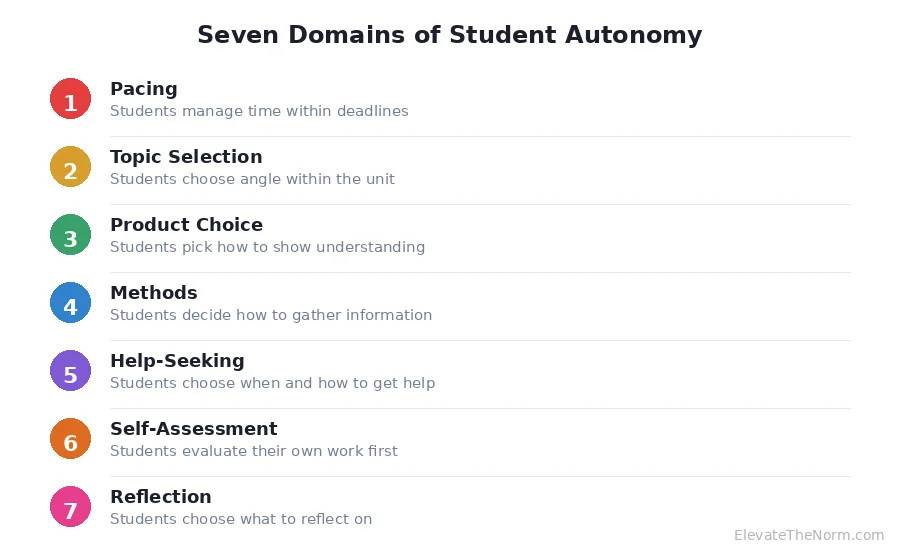
Teacher Emergency Toolkit — practical resources, real classroom support. Shop on TPT.Teacher Emergency Toolkit — practical resources, real classroom support. Shop on TPT.