Category: Relationships & Culture

Building trust with students, and the school culture that follows from it.

  • Student Accountability Sheet: A Free, Non-Childish Classroom Template

    Student Accountability Sheet: A Free, Non-Childish Classroom Template

    A student accountability sheet is a short, structured form a student completes after something went wrong — a missed deadline, a group conflict, a behavior that affected the room. Done right, it takes about five minutes and produces a useful conversation. Done wrong, it is busywork that teaches students nothing except how to fill out busywork. This guide explains the difference, offers a free template in four versions, and shows exactly how to use it in a secondary classroom without humiliating anyone or generating a paper trail for things that do not belong on one.

    Key Takeaways

    • An accountability sheet supports a conversation — it is not a punishment, a replacement for a school referral, or a way to document a student for later.
    • Four versions cover the situations teachers actually face: academic work, group responsibility, behavior, and restoration after a conflict.
    • Students complete the sheet themselves. That is the point. If the teacher is doing the writing, the tool is being used incorrectly.
    • The sheet is not a file. Unless a required school procedure calls for documentation, it lives with the student or gets recycled after the conversation.
    • Any teacher can use this the first week of school. No program, no training, and no administrator approval required.

    What Most Accountability Sheets Get Wrong

    Most accountability sheets found in schools — and most of the printables circulating on teacher resource sites — were designed for elementary students and scaled up by changing the font. They ask students to write “what I did wrong” in a box, then “how I will do better next time” in another box, and they expect that sequence to produce insight. It rarely does, because the sequence assumes the student already has a clear picture of what happened and why. They often do not.

    The other common design flaw is that the sheet exists only as a record. A teacher hands it to a student, the student fills it out, the teacher collects it and puts it in a folder. Nothing happens as a result. The student learns that accountability means paperwork, not change — which is exactly the wrong lesson.

    A well-designed student accountability sheet for grades 6–12 does three things that most forms skip. It separates facts from interpretations, so students can describe what actually happened without being led toward a particular framing. It identifies who, specifically, was affected — not just “the class” in the abstract. And it generates a next step the student can actually take, not a vague commitment to “try harder.”
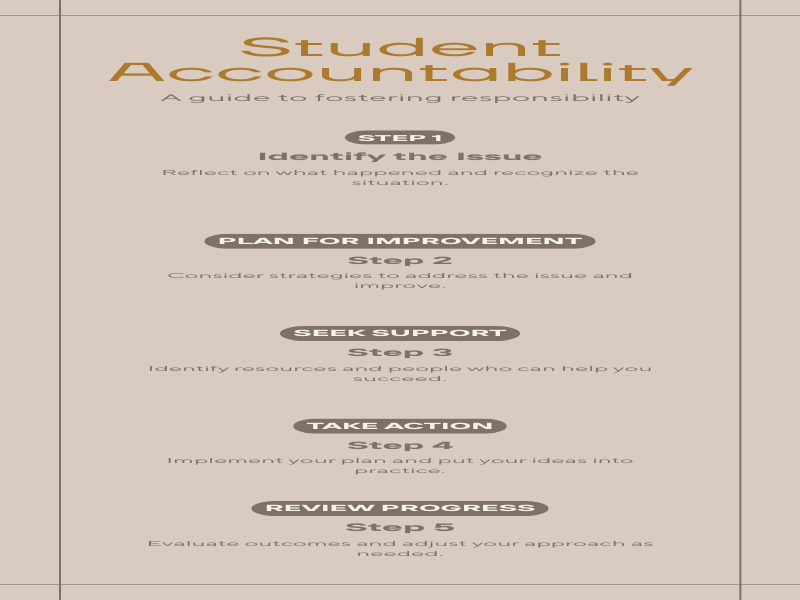
    Classroom accountability sheet template on a student desk in a secondary classroom with warm lamp lighting
    An accountability sheet is a tool for a five-minute conversation, not a substitute for one.

    When to Use an Accountability Sheet

    There are four situations where a short accountability sheet is useful in a secondary classroom. Understanding the difference between them matters, because each version of the sheet asks slightly different questions.

    Academic Work

    A student missed a deadline, submitted incomplete work, or disengaged from a task. The goal of the sheet in this case is not to assign blame but to figure out what actually got in the way. Sometimes the answer is workload. Sometimes it is confusion about the assignment. Sometimes it is something happening at home. The sheet creates space to say so without the conversation becoming a confrontation.

    Group Responsibility

    A student did not hold up their part of a group project. Or a group is in conflict about who did what. The group version of the sheet is filled out individually by each member before the group meets together — which means every voice is already on paper before anyone starts defending themselves out loud. This simple sequencing change reduces the volume of these conversations significantly.

    Behavior

    Something happened in the room — a comment that landed wrong, a refusal, an outburst — that the teacher needs to address before moving on. This version is short by design, because a behavior conversation does not benefit from extended written reflection in the moment. The sheet gives the student a minute to collect their thoughts before speaking, which is often all that is needed to de-escalate the temperature.

    One important note: if the behavior requires a school referral, disciplinary report, or any documentation under your district’s required procedures — do that. The accountability sheet is a classroom tool, not a substitute for mandated process. If you are unsure whether a situation requires official documentation, assume it does and act accordingly. The sheet goes with the student afterward, not instead of the referral.

    Restoration

    Something happened between students — a conflict, an unkind comment, a damaged trust — and the class needs to move forward. The restoration version is the most conversational of the four. It is the one most closely aligned with restorative approaches, and it works best when both students complete their own version before sitting down together. For more on restorative approaches in a school context, see restorative practices in schools.

    The Templates

    Each template below is designed to be reprinted, typed into a shared document, or read aloud and answered verbally depending on the student and the situation. The fields are short. The language is direct. None of it is condescending.
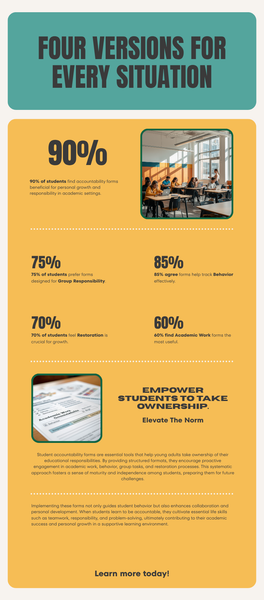
    Four versions of student accountability sheet side by side showing academic work group responsibility behavior and restoration fields
    Four distinct versions of the sheet cover the situations teachers actually face in grades 6–12.

    Version 1 — Academic Work

    Student name: _______________ Date: _______________

    The assignment or task: _______________

    What was supposed to happen? (Describe the expectation — due date, format, what “complete” looked like.)

    What actually happened? (Facts only. Not reasons yet.)

    What got in the way? (This is where reasons belong. Be honest — including “I didn’t prioritize it” is a valid answer.)

    What is one thing you can do in the next 48 hours to move this forward?

    What support, if any, do you need from me?

    Version 2 — Group Responsibility

    Student name: _______________ Project or task: _______________ Date: _______________

    What was your agreed-upon role or task in this group?

    What did you actually complete?

    What did your group expect from you that you did not deliver?

    What happened from your perspective? (State facts and reasons separately.)

    What do you owe the group at this point?

    What is your next step, and when will it be done?

    Version 3 — Behavior

    Student name: _______________ Date: _______________ Period/class: _______________

    Describe what happened. (What you said or did — not what someone else did first.)

    Who was affected by it? (Name the people, not just “everyone.”)

    What do you want those people to know?

    What is one thing you will do differently?

    Note to the teacher: this version is designed for classroom-level situations. If the incident requires a disciplinary referral, complete your school’s required documentation first. This sheet is a follow-up conversation tool, not a replacement for required procedures.

    Version 4 — Restoration

    Student name: _______________ Date: _______________

    What happened between you and the other person? (Your account of it — not what they did, what happened between you.)

    What did the other person lose or experience because of the situation? (This is a perspective-taking question. Answer it honestly even if it is uncomfortable.)

    What do you want to be different going forward?

    Is there something specific you are willing to do or say to move toward that?

    What do you need from me or from the other person to make this work?
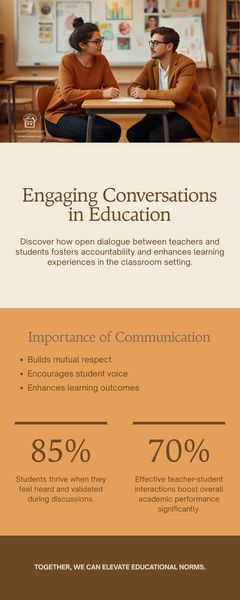
    Teacher and student sitting together at a whiteboard table reviewing an accountability sheet in a secondary classroom
    The sheet starts the conversation — it does not replace it. Five minutes at the whiteboard table is worth more than a folder full of completed forms.

    How to Use the Sheet

    The sheet is not the conversation. It is the preparation for one. A student who fills it out in silence and hands it in has not been held accountable — they have completed a writing assignment. The point of the form is that it gives the teacher and the student a shared document to look at together, which is significantly less confrontational than looking at each other across a desk.

    The sequence that works: hand the student the sheet and give them three to five minutes to complete it, without hovering. Sit down together to review it — ideally somewhere that is not the center of the room. Read it together, ask one or two follow-up questions, and agree on the next step before the student returns to work. That is the whole procedure. If it is taking longer than ten minutes, either the situation is more serious than this tool was designed for, or the conversation has turned into a lecture. Stop the lecture.

    The anchor question in every version is some variation of “what is your next step?” That is the question that determines whether the sheet produced anything useful. A vague next step (“I’ll try harder,” “I’ll be better”) is not a next step. Push for something specific and time-bound: “I’ll finish the introduction section by Thursday,” or “I’ll ask Morgan what I can do to address what happened.” Specificity is what makes accountability concrete rather than performative.

    A Classroom Anchor: Authority Handed and Held

    The accountability sheet works best when students already understand that authority in the room is real and is held to. A clearly visible classroom expectations poster does much of this work passively — it gives students a reference point before anything goes wrong, so the accountability sheet’s first question (“what was supposed to happen?”) lands with specificity rather than guesswork. In my workshop room — where students are almost always working alongside somebody, and I move between groups rather than lecture from the front — the sheet tends to come up most often around group work, and specifically around moments where a student was trusted with a role and did not follow through on it.

    When that happens, I do not announce it to the room. I slide the Version 2 sheet to the student at their table and give them four or five minutes while I circulate. Then I pull them to the whiteboard table — my small-group conferencing area with a rug, better chairs, and a lower lamp, where students know they are being seen carefully and not put on display — and we work through their answers together.

    The conversation is not about catching them in something. It is about naming what happened clearly enough that we can figure out what comes next. Students who have been given real authority over something — their section of a project, their role in a group, a decision that affects others — understand why the accounting matters. It matches the weight of the responsibility they were given. What does not match it is a form that feels like it was designed for a third-grader. The template above is written at the level the student is actually operating at. That is the difference between accountability and humiliation, and it matters.

    This approach connects directly to what student responsibility looks like in the classroom — real responsibility includes real accounting when things go wrong, not manufactured consequences or empty apologies. For the broader case for high expectations paired with the room to learn from mistakes, see high expectations for students.

    What Happens When a Student Doesn’t Follow Through

    A student completes the sheet, agrees to a next step, and then does not take it. This happens. Here is the important thing: that outcome does not mean the sheet failed. It means you now have a second conversation with more information than you had before. You know what the student said they would do. You know they did not do it. The conversation gets more specific, not more punitive.

    The escalation path in this case depends on what the situation actually requires. Some students need more support than a single conversation provides — academic, social, or something else entirely. The sheet is not a substitute for identifying that need and addressing it. If a pattern emerges across multiple sheets and conversations, that is information that may need to go to a counselor, an interventionist, or a parent. At that point the sheet is one piece of a larger picture, not the whole solution.

    For students whose accountability issues involve ongoing behavior challenges, the positive discipline framework for teenagers provides a more structured approach that pairs well with the sheet. For situations involving harm between students, the natural consequences framework and the restoration version of the sheet work together. And for the broader question of how to build a classroom where students actually want to hold themselves accountable, see the site’s overview of student responsibility as a developmental skill, not a character judgment.

    The Research Behind It

    Self-regulated learning research has consistently found that students who can reflect on their own performance — identify what went wrong, name contributing factors, and plan a corrective action — outperform students who receive only external evaluation (Zimmerman, 2002). The accountability sheet is applied self-regulated learning: it scaffolds a reflective process that students build over time.

    Self-determination theory (Deci & Ryan, 2000) adds an important dimension: students are far more likely to take a next step they chose than a consequence that was imposed on them. Every version of the sheet ends with the student naming a next step. That ownership matters for what actually happens afterward. Hattie’s (2009) meta-analysis of over 800 studies identified student self-assessment — including structured reflection on what went wrong — as one of the highest-leverage interventions available to teachers. The accountability sheet is a low-cost, no-training version of exactly that.

    Research on restorative approaches in schools (Morrison & Vaandering, 2012; Skiba & Peterson, 2000) supports the same conclusion from the discipline side: punitive responses to student misbehavior consistently underperform restorative ones on measures of recurrence, school climate, and relationship repair. A sheet that asks students to identify who was affected and what they are willing to do to repair it is grounded in that same framework, without requiring a school-wide program or a trained facilitator.

    Printables for this

    Two of mine on TPT, both built for this. Behavior Documentation Forms are the other half of the picture — the ABC data and MTSS logs you keep when a pattern does need a record, which the sheet above deliberately is not. The Makeup Work System handles the follow-through on the academic version, so “what is your next step” has a process behind it.

    Frequently Asked Questions

    Is a student accountability sheet the same as a disciplinary referral?

    No. A disciplinary referral is a formal school document that enters a student’s record, triggers review by an administrator, and may carry consequences under district policy. An accountability sheet is a classroom tool — a short form that supports a private conversation and a next step. It is not filed, not sent to the office, and not part of the student’s disciplinary record unless you deliberately attach it to a referral as supporting documentation. If a situation requires a referral, complete the referral. The accountability sheet is for situations that do not — which is the majority of what happens in a classroom on any given day.

    What if the student doesn’t fill it out honestly?

    Some students will write what they think you want to hear. That is useful information, too. If the sheet reads like a performance rather than a reflection, say so directly and ask one specific follow-up question: “When you wrote you would try harder — what does that look like for you on Monday?” Most students will either give a more honest answer or reveal that they actually do not know. Both are starting points for a real conversation. The sheet is not a truth test. It is a structure for a conversation, and the conversation is where the real work happens.

    Does this go in the student’s permanent file or record?

    No — not unless your school’s procedures specifically require it for a given type of incident. For most classroom-level situations, the sheet lives with the student or gets recycled after the conversation. If you are using it as part of a required disciplinary process, follow your school’s documentation requirements for that process. Do not create an informal file of completed accountability sheets. That is not what this tool is for, and it can create problems if the file is ever requested.

    Can parents request to see these sheets?

    Parents can request records their child’s school maintains about them under FERPA. If you are collecting and storing completed accountability sheets in any systematic way, you should treat them as education records and handle them accordingly. The simplest way to avoid this issue is to not store them: use the sheet, have the conversation, and let the student keep it or discard it. A brief note in your own records of the conversation and the agreed-upon next step is sufficient documentation for your own use.

    What should I do if the student refuses to fill it out?

    A student who refuses to engage with the sheet is telling you something about their state in that moment. Do not escalate over the sheet itself. Give them a minute, check in quietly, and decide whether this is a moment of genuine distress, a test of your authority, or something else. If it is a test, name what you see calmly: “I’m going to give you two more minutes. I’ll come back.” If it is distress, the sheet can wait. If refusal becomes a pattern, that is a separate conversation — about engagement and trust, not about a form.

    At what grade level does this work best?

    The templates above are designed for grades 6–12. The language is appropriate for middle school and can be used as-is with most high school students. Students in grades 6–8 may need more scaffolding during the conversation — they often have the self-awareness but not yet the vocabulary to name what happened clearly. The teacher’s role in those grades is slightly more coaching than questioning. High school students can generally complete the sheet more independently, though the conversation afterward is equally important at both levels.

    How do I use the group responsibility version fairly when students blame each other?

    Have each student complete their own version of the sheet before anyone talks. This is non-negotiable: if students start talking first, they immediately start building a shared story that may not reflect what each person actually experienced. Once each student has answered the questions in writing, bring them together. Start with what each person wrote about their own contribution — not the other person’s failures. The sheet’s structure forces that sequence because the questions are framed around the student’s own actions. It does not eliminate conflict, but it changes the opening move from accusation to accounting.

    Sources

    • Zimmerman, B. J. (2002). Becoming a self-regulated learner: An overview. Theory Into Practice, 41(2), 64–70. https://doi.org/10.1207/s15430421tip4102_2
    • Deci, E. L., & Ryan, R. M. (2000). The “what” and “why” of goal pursuits: Human needs and the self-determination of behavior. Psychological Inquiry, 11(4), 227–268. https://doi.org/10.1207/S15327965PLI1104_01
    • Hattie, J. (2009). Visible Learning: A Synthesis of Over 800 Meta-Analyses Relating to Achievement. Routledge.
    • Morrison, B. E., & Vaandering, D. (2012). Restorative justice: Pedagogy, praxis, and discipline. Journal of School Violence, 11(2), 138–155. https://doi.org/10.1080/15388220.2011.653322
    • Skiba, R. J., & Peterson, R. L. (2000). School discipline at a crossroads: From zero tolerance to early response. Exceptional Children, 66(3), 335–346. https://doi.org/10.1177/001440290006600303
    About Clay Shumate

    By Clay Shumate — Clay Shumate is a certified secondary Social Studies teacher in the public schools of West Alabama, with seven years of classroom experience, a B.A. in History, and an M.Ed. in Secondary Education. He writes about project-based learning, student responsibility, respect, and practical ways to hold young people to a higher standard while giving them room to learn from mistakes. He is a member of the Society of Professional Journalists and writes to its Code of Ethics; this site’s editorial standards and corrections policy are published in full. More about Clay.

  • What Is Student Responsibility? A Clear Definition for Schools and Families

    What Is Student Responsibility? A Clear Definition for Schools and Families

    By Clay Shumate

    Student responsibility is a student’s capacity to own their choices, meet their obligations, and make things right when they fall short. It covers academic responsibility—showing up, completing work honestly, asking for help—behavioral responsibility like following class agreements and accepting consequences without deflecting, and interpersonal responsibility: being someone your peers can count on when it matters. Responsibility grows through practice, not through lectures about why it matters.

    Key Takeaways

    • Student responsibility has four overlapping dimensions: academic, behavioral, interpersonal, and community
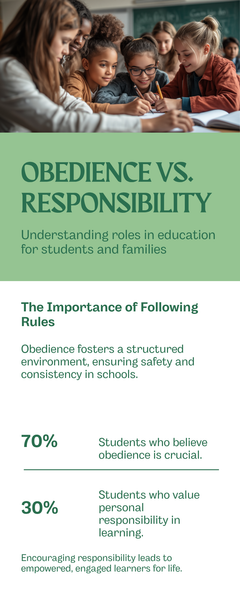
    • Responsibility is not the same as obedience—obedience asks students to comply; responsibility asks them to own
    • Responsibility develops through meaningful choice, honest feedback, proportionate consequences, and a genuine path back after failure
    • Schools and families each control distinct pieces of the picture—neither can do this alone
    • Students trusted with real responsibility tend to rise to it; students denied any meaningful responsibility often check out
    Comparison chart showing the difference between obedience and student responsibility in school settings
    Obedience follows rules because told to. Responsibility owns choices and their outcomes.

    What Is Student Responsibility?

    Student responsibility, at its core, is a student’s ability to manage their own behavior and obligations without constant adult supervision. It is not perfectionism. A responsible student is not one who never makes mistakes—it is one who owns their mistakes, faces the consequence that was promised, and does not wait for an adult to notice and solve every problem for them.

    Damon (1995) distinguishes between compliance and genuine responsibility, arguing that adolescents develop real responsibility only when they internalize the values behind expectations—not when they follow rules out of fear of punishment. That distinction shapes how schools should approach this: punishing non-compliance produces compliance. Building structures where students experience ownership and consequences produces responsibility.

    The Collaborative for Academic, Social, and Emotional Learning (CASEL) places responsible decision-making as one of five core competencies in social-emotional learning, defining it as the ability to make caring and constructive choices about personal behavior and social interactions (CASEL, 2023). This is not a soft skill—it is a teachable, measurable set of practices.

    The Four Dimensions of Student Responsibility

    Responsibility is not one thing. Students can be responsible in some dimensions and not others—and understanding which dimension is the problem is the first step to addressing it.

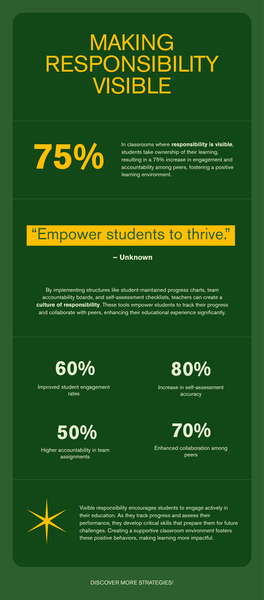
    Classroom structures that make student responsibility visible including progress charts and accountability boards
    Three structures that make responsibility visible: progress charts, accountability boards, and self-assessment checklists.

    Academic Responsibility

    Academic responsibility includes completing assigned work, meeting deadlines, submitting honest work, and asking for help when confused instead of guessing or copying. It also includes managing study time independently and advocating for yourself when you do not understand something.

    Academic responsibility does not mean students work alone all the time. It means that when they work together, they each contribute. A student who coast through group work—contributing nothing while taking credit—is not being academically responsible, even if their final grade does not show it.

    Behavioral Responsibility

    Behavioral responsibility means following class agreements even when the teacher is not watching, accepting consequences proportionately without deflecting blame onto others, and owning mistakes directly. A student who accepts a consequence and then moves on is demonstrating behavioral responsibility. A student who spends more energy disputing the consequence than they spent on the behavior that caused it is not. If you want a think sheet that treats students like young adults, my Behavior Reflection Sheets on TPT come in two levels.

    Interpersonal Responsibility

    Interpersonal responsibility means showing up for group work when you said you would, communicating honestly when something is wrong rather than disappearing, and holding yourself accountable to your peers without waiting for adult intervention. This is where student responsibility in the classroom becomes most visible—and most difficult—because teenagers are still developing the relational skills that make peer accountability possible.

    Community Responsibility

    Community responsibility extends beyond the individual: caring for shared classroom materials, leaving shared spaces as you found them, contributing to class culture rather than just extracting from it. This dimension is often underdeveloped in schools that treat responsibility purely as a compliance matter. A student who only does what serves themselves and ignores what their behavior costs the people around them has not developed full responsibility.

    Responsibility vs. Obedience: A Critical Distinction

    Obedience asks: Do it because I said so. Responsibility asks: Do it because you understand why it matters.

    A student who only acts responsibly when supervised has learned obedience—or at least its performance. A student who checks their own work before turning it in, admits to the group member that they did not pull their weight, and asks the teacher for an extension before missing a deadline rather than after: that student is practicing responsibility. I use the forms in my Makeup Work System on TPT so absent students know exactly what they missed and when it is due.

    This distinction shapes discipline. Teachers who confuse the two often escalate consequences trying to produce responsibility when what they are getting is compliance or its absence. More pressure can produce more compliance—but it rarely produces more ownership. And once a student is under enough pressure, it produces neither.

    For classroom approaches that build genuine responsibility rather than managed compliance, see positive discipline for teens and natural consequences in the classroom.

    How Student Responsibility Actually Grows

    Ryan and Deci (2000), whose self-determination theory has been among the most replicated frameworks in educational psychology, identify three basic psychological needs that support self-regulation: competence (feeling capable), autonomy (having real choices with real consequences), and relatedness (belonging to a community that cares how you act). Responsibility develops when students experience all three.

    A student who has no choices in class and no voice in outcomes has no reason to develop responsibility—they are compliant at best, resistant at worst. The conditions for responsibility must be built before you can expect students to demonstrate it.

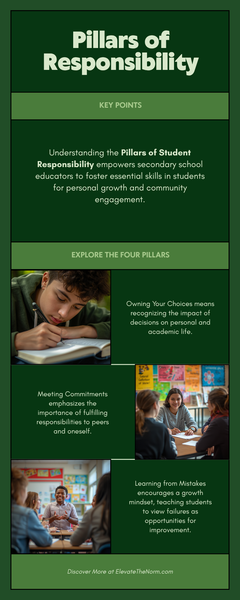
    Four pillars of student responsibility: owning choices, meeting commitments, learning from mistakes, contributing to the group
    The four pillars of student responsibility give students a concrete framework for developing ownership.

    Through Meaningful Choice

    Students cannot develop responsibility for choices they are never allowed to make. This does not mean every class decision is put to a vote. It means giving students real choices within clear boundaries: how they organize their notes, which of three article prompts to respond to, how they divide group roles. Choices with low stakes but genuine consequences—where the student experiences the results of their own decisions—are the practice ground for larger responsibility.

    Through Honest Feedback

    Vague praise tells students nothing useful. “Good work” does not tell a student what to repeat or what to change. Specific, honest feedback—”your argument on page two is clear; the evidence in the third paragraph does not quite support the claim you are making”—gives students something to act on. Feedback that helps students understand the gap between what they did and what was expected builds the self-awareness that responsibility requires.

    Through Proportionate Consequences

    Consequences need to match the behavior and be ones the student can actually learn from. A student who forgets homework and gets a zero learns to hide it next time. A student who forgets homework and has a brief, direct conversation about why—followed by a realistic plan for finishing it—learns something about responsibility. See natural consequences in the classroom for a practical framework for getting this right.

    Through Repair After Failure

    A student who makes a mistake and finds no path back learns to hide mistakes. A student who makes a mistake, owns it, repairs what can be repaired, and still faces the consequence that was agreed upon—that student is learning something real. The repair matters as much as the consequence. Schools that skip repair leave students with the message that once you mess up, you are just in trouble. Schools that include repair leave students with the message that responsibility includes fixing what you broke.

    For a first-person account of letting a consequence stand while keeping the path back open, see Clay’s essay What I Learned the Year I Let Kids Fail, published at The Educator’s Room.

    What Schools Control vs. What Families Control

    Schools control: the structure of the day, the expectations communicated, the consistency with which those expectations are applied, how teachers respond to failure, whether students have any meaningful voice in class decisions, and what happens after a student falls short. Schools decide whether consequences teach something or just punish. They decide whether students get a path back or are simply in trouble.

    Families control: routines at home, how parents model handling their own mistakes, how they talk about school, and whether they support students through consequences or work to eliminate them. A parent who calls in every morning a student misses homework and negotiates the grade is teaching that responsibility is negotiable when someone with enough leverage intervenes. A parent who lets the consequence stand and helps the student think through what went wrong is doing something very different.

    A school that expects families to deliver responsible students and does nothing to build responsibility at school is not doing its job. A family that expects school to do it all while rescuing students from every consequence is not doing theirs either. Responsibility is built in both places—or it struggles in both places.

    Common Misunderstandings About Student Responsibility

    Responsible students do not make mistakes. They do. The goal is not a student who never falls short—it is a student who owns it when they do. Responsibility is about response, not perfection. A student who admits they did not study for a test and accepts the grade is more responsible than a student who argues about why the test was unfair.

    You either have it or you do not. Decades of developmental psychology disagree. Responsibility is a practiced skill that grows through experience, feedback, and appropriately scaled opportunities to make real decisions. Weissberg and colleagues (2015) document clear evidence that social-emotional competencies, including responsible decision-making, are teachable and develop across childhood and adolescence with the right supports.

    Students from low-income or high-poverty backgrounds are less capable of responsibility. This assumption is refuted by the same evidence that shows all students respond to autonomy support and clear, consistent expectations. The conditions that support responsibility—clarity, trust, meaningful choices, and a path back after failure—matter regardless of what a student brings from home. The need is universal. The circumstances that make building it harder are sometimes not.

    Building a Responsible Classroom Culture

    A responsible classroom is built on four things: clear expectations that students help shape, consistent follow-through when those expectations are not met, a genuine path back after failure, and enough trust to give students real responsibility rather than scripted tasks. Battistich (2008) argues that character development—including responsibility—requires students to experience themselves as genuine contributors to a community that cares, not just as rule-followers in an institution.

    Giving students real responsibility does not mean lowering supervision. It means giving them decisions that actually matter and letting the consequences of those decisions be real. A student who manages a class library, chairs a Socratic seminar, or leads a project checkpoint is practicing responsibility in a way that a worksheet about the importance of responsibility simply cannot replicate.

    For activities that build these skills, see activities for teaching responsibility. For how high expectations connect to student responsibility, see high expectations for students. For a concrete tracking tool, the student accountability sheet templates put individual student commitments in writing — four versions covering academic work, group responsibility, behavior, and restoration.

    What to Do Next

    Start with one dimension of responsibility and one concrete practice. If academic responsibility is the gap—deadlines, honesty, asking for help—start with a class conversation about what following through actually looks like and what happens when it does not happen. If interpersonal responsibility is the problem, build a team contract the next time students work in groups and actually enforce it.

    Responsibility does not happen through announcements. It happens through the thousands of small decisions students make each day—and whether the classroom is designed to let them own those decisions, or structured in a way that makes those decisions irrelevant before they ever get a chance to practice.

    Frequently Asked Questions

    Is student responsibility the same as student obedience?

    No. Obedience means following a rule because someone told you to. Responsibility means understanding why the expectation exists and meeting it because you have internalized what is at stake. A student who behaves only when supervised has learned obedience. A student who meets obligations consistently—including when no one is watching—is practicing responsibility. Schools often confuse the two and end up managing compliance rather than building ownership.

    At what age should schools start building student responsibility?

    As early as possible, in age-appropriate ways. By grades 6–12, students are developmentally ready for real responsibility—meaning real choices with real consequences, not just classroom jobs with no stakes. Adolescents who are given meaningful responsibility and supported through mistakes tend to develop stronger self-regulation than those who are either denied responsibility or given it without any guidance or follow-through.

    Can a student be responsible in one area but not another?

    Yes, and this is common. A student might be highly responsible academically—completing every assignment, meeting every deadline—but struggle with interpersonal responsibility: not showing up reliably for group work or deflecting when something goes wrong in a team setting. Recognizing which dimension is the gap helps teachers intervene specifically rather than broadly labeling a student as responsible or irresponsible.

    How can families support responsibility without doing homework for their kids?

    By letting consequences happen. When a student forgets their project at home and a parent drives it to school, the student learns that someone else will fix it. When the student faces the consequence of turning it in the next day—and lives through it—they learn something about ownership. Families can also model responsibility directly: acknowledging their own mistakes, following through on what they say they will do, and talking about how they handle problems honestly.

    What do I do when a student genuinely cannot meet a responsibility?

    Distinguish between cannot and will not—and between a skill gap and a motivation gap. A student who does not know how to manage their time needs direct instruction in time management, not just consequences for missing deadlines. A student who knows how but is not doing it needs a different conversation. In both cases, the next step should include a specific plan, not just a punishment. Responsibility grows when students have a path forward, not just a record of what went wrong.

    How do teachers make responsibility visible rather than just assumed?

    By building structures that make it observable. Team contracts, revision trackers, self-assessment forms, and student-led conferences all make responsibility visible because they create records of what students committed to and what they actually did. When responsibility is only implied—show up, try hard, be good—students cannot develop it systematically. When it is made concrete and specific, students know what it looks like and teachers can respond to it clearly.

    Sources

    • Ryan, R. M., & Deci, E. L. (2000). Self-determination theory and the facilitation of intrinsic motivation, social development, and well-being. American Psychologist, 55(1), 68–78.
    • Damon, W. (1995). Greater expectations: Overcoming the culture of indulgence in our homes and schools. Free Press.
    • Collaborative for Academic, Social, and Emotional Learning (CASEL). (2023). Fundamentals of SEL. CASEL.
    • Weissberg, R. P., Durlak, J. A., Domitrovich, C. E., & Gullotta, T. P. (Eds.). (2015). Social and emotional learning: Past, present, and future. In J. A. Durlak, C. E. Domitrovich, R. P. Weissberg, & T. P. Gullotta (Eds.), Handbook of social and emotional learning: Research and practice. Guilford Press.
    • Battistich, V. A. (2008). Character education, prevention, and positive youth development. In L. Nucci & D. Narvaez (Eds.), Handbook of moral and character education. Routledge.

    About Clay Shumate

    Clay Shumate is a certified secondary Social Studies teacher in the public schools of West Alabama, with seven years of classroom experience, a B.A. in History, and an M.Ed. in Secondary Education. He writes about project-based learning, student responsibility, respect, and practical ways to hold young people to a higher standard while giving them room to learn from mistakes. He is a member of the Society of Professional Journalists and writes to its Code of Ethics; this site’s editorial standards and corrections policy are published in full. More about Clay.

  • Student Voice and Choice: How Much Control Should Students Really Have?

    Student Voice and Choice: How Much Control Should Students Really Have?

    By Clay Shumate

    Student voice and choice means giving students real authority over decisions that change the work, not decoration around decisions a teacher has already made. It runs on a continuum from no choice to student-led decision-making, and it only builds judgment when the choices carry genuine consequences and adults stay in charge of safety, standards, and grading integrity. A mock election that outgrew one classroom is what that looks like when the consequences are real.

    There’s a version of student voice and choice that sounds good in a staff meeting and produces nothing useful in a classroom. A student “chooses” their project topic from a list of four options the teacher already approved, picks their own font, and decides which partner to work with. Then the teacher controls the timeline, the rubric, the sources, the format, the audience, and the final grade. The student made decorating decisions.

    That’s cosmetic choice. It doesn’t develop the judgment, risk tolerance, or ownership that genuine student voice is supposed to build. Worse, students notice it. They learn quickly that “you get to choose” means they get to choose the things that don’t matter.

    This piece is about the real version—where it comes from, where it lives in a grades 6–12 classroom, how to tell the difference between authentic and cosmetic choice, and where students genuinely should not be in charge. The key distinction it explores is different from student autonomy, which focuses on individual freedom within a learning structure; voice and choice here means the actual decisions students make and which of those decisions belong to them.

    What Student Voice and Choice Actually Means

    Student voice is the capacity of students to be heard in decisions that affect their education—what they learn, how they demonstrate it, what rules govern their environment, and what happens when something goes wrong. Student choice is the companion capacity: the actual range of decisions students make, not just the option to express a preference that gets overridden.

    Both rest on a premise that treating students as developing young adults requires. If we believe teenagers are capable of increasing responsibility, we have to give them decisions that require responsibility. Responsibility without authority is not a meaningful practice—it is compliance training. This is the same logic that makes genuine student leadership roles worth building: the decision, the authority, and the accountability have to travel together.

    The research on student motivation supports this. Deci and Ryan’s self-determination theory (1985, 2000) identifies autonomy—the sense that one’s actions reflect genuine choice rather than external control—as a basic psychological need alongside competence and relatedness. When that need is met, intrinsic motivation increases. When it is thwarted by cosmetic choice, students may comply but they disengage from ownership. They do the work; they don’t care about the learning.

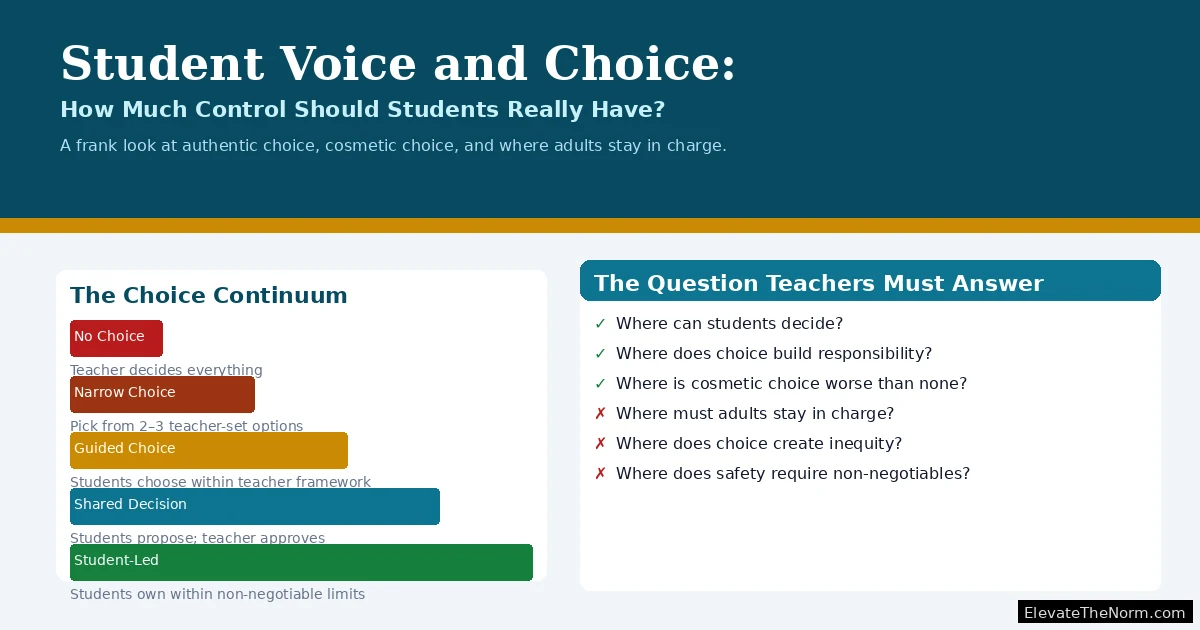
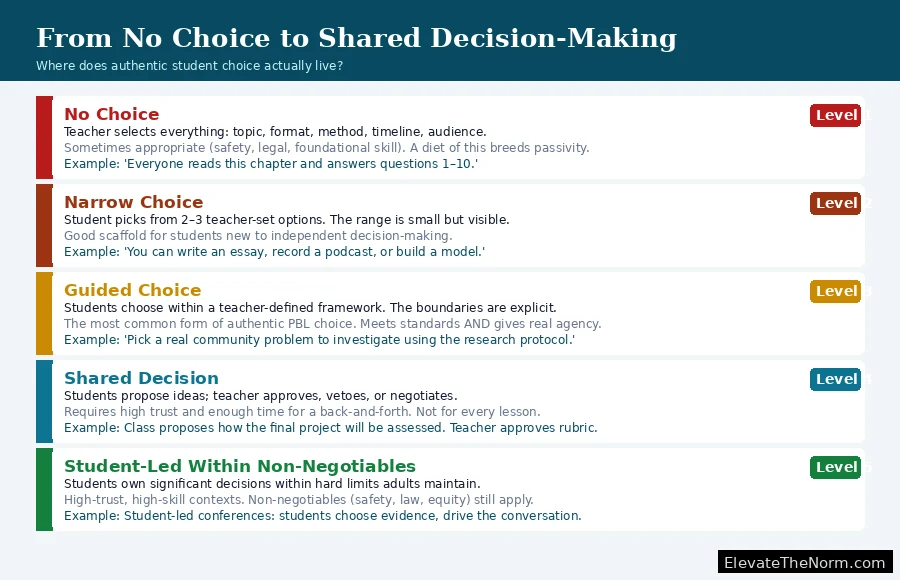
    Five-level continuum diagram showing student voice and choice levels from no choice through narrow choice, guided choice, shared decision, and student-led within non-negotiables, with descriptions and classroom examples for each level
    The five levels of student choice. Most strong PBL units operate at levels three and four, where agency is real but adults hold the framework.

    The Choice Continuum: Five Levels

    Student choice isn’t binary. It runs on a continuum, and most classrooms need to move across it depending on the content, the student population, and the stakes involved.

    Level 1 — No Choice. The teacher decides everything: topic, format, method, timeline, and audience. Sometimes this is appropriate—when the content is foundational, when the class is new to a routine, or when safety is at stake. A diet of Level 1 produces passivity. Students who only experience Level 1 choice don’t develop the judgment that higher levels require.

    Level 2 — Narrow Choice. Students pick from two or three teacher-set options. The range is small but visible. This is a useful scaffold for students who haven’t practiced independent decision-making—they experience real choice while the teacher controls the risk of failure.

    Level 3 — Guided Choice. Students choose within a teacher-defined framework. The boundaries are explicit and non-negotiable, but within them, students make real decisions with real consequences. This is where most strong project-based learning units operate. The driving question narrows the domain; the student’s investigation navigates within it. Named classroom roles sit at this level too — see which leadership roles carry a real decision and which are decoration.

    Level 4 — Shared Decision-Making. Students propose ideas; the teacher approves, vetoes, or negotiates. A class might co-develop a rubric, help set norms for group work, or propose how learning will be demonstrated. This requires enough trust and enough time for a genuine back-and-forth. It is not appropriate for every lesson—but when it works, students own the outcome in a way that Level 3 rarely achieves.

    Level 5 — Student-Led Within Non-Negotiables. Students own significant decisions inside hard limits that adults maintain. A conference the student runs in front of their own family is a clean example: students choose the evidence, drive the conversation, and make the case for their own learning. The teacher sets the non-negotiables (the conference exists, standards are addressed, parents are informed) but doesn’t narrate for the student.

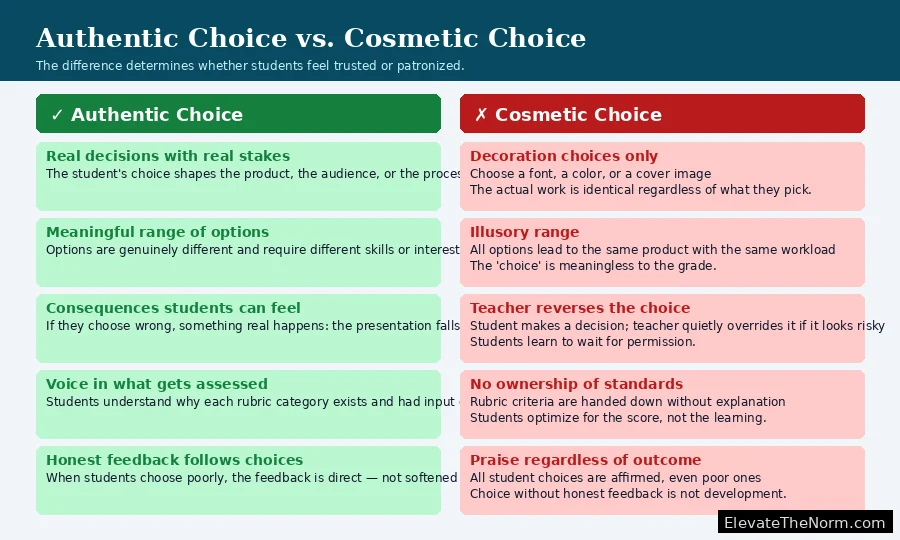
    Authentic Choice vs. Cosmetic Choice

    Side-by-side comparison of authentic student choice versus cosmetic student choice, showing five categories where genuine decision-making differs from superficial options that feel like agency but have no real stakes
    Cosmetic choice produces compliance. Authentic choice produces ownership. The difference is whether the student’s decision actually changes anything that matters.

    The test for authentic choice is simple: does the student’s decision actually change something that matters? If a student’s “choice” of format produces the same product, the same workload, and the same grade regardless of what they chose, it wasn’t a real choice.

    Authentic choice has real stakes. If a student chooses poorly, something real happens—the presentation falls flat, the evidence doesn’t support the claim, the audience walks away unpersuaded. The student who chose a podcast format and hadn’t practiced speaking clearly is now learning something about preparation that no written assignment would have taught.

    Authentic choice offers a meaningful range. The options require genuinely different skills, interests, or investments. “Write an essay or record a podcast” is a real difference if the assessment criteria reflect both fairly. “Use blue or green font” is not a decision that changes learning.

    Authentic choice is followed by honest feedback. When students choose poorly, they hear it directly—not softened to protect them from the consequences of their decision. This is where the principle of high expectations intersects with student voice: genuine respect for a student’s decision-making includes telling them when the decision didn’t work and why.

    Cosmetic choice, by contrast, reverses the teacher’s decision quietly when students choose something risky. Students learn to wait for permission before committing to anything real. “You can choose” means “you can choose as long as you choose what I’d have assigned anyway.”

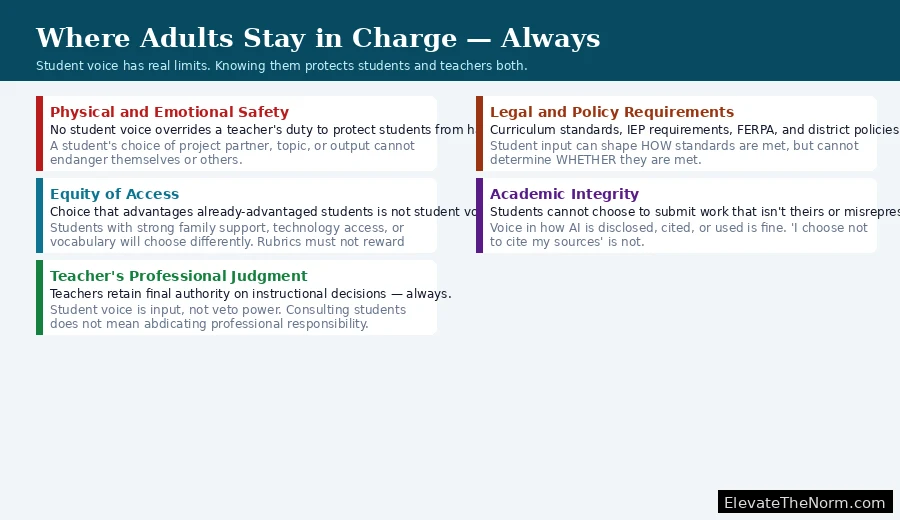
    Where Adults Stay in Charge—Always

    Five categories where adults must retain authority over student voice and choice: physical and emotional safety, legal and policy requirements, equity of access, academic integrity, and teacher professional judgment
    Authentic student voice requires clear limits. Teachers who are honest about what isn’t negotiable are more credible when they offer genuine choice in everything else.

    Expanding student voice doesn’t mean that everything is negotiable. There are five categories where adults retain final authority—not because students can’t be trusted, but because these categories require professional judgment, legal compliance, or protection of the most vulnerable students in the room.

    Physical and emotional safety. No student’s choice of project partner, topic, or output format overrides the teacher’s duty of care. A group project whose subject is deliberately targeting another student isn’t a voice-and-choice issue—it’s a safety issue, and the teacher intervenes immediately and without apology.

    Legal and policy requirements. Curriculum standards, IEP and 504 requirements, FERPA, and district policy are not negotiable. Student input can shape how standards are met, but it cannot determine whether they are met. A student who “chooses” not to address the required standard hasn’t exercised voice—they’ve received inadequate instruction.

    Equity of access. Choice that advantages already-advantaged students is not student voice. It’s a gap-widener. Students with strong family support, technology access, and vocabulary will make different choices than students without those resources. Rubrics that reward the advantages rather than the learning compound existing inequity. Authentic choice requires equivalent access to all options offered.

    Academic integrity. Students cannot choose how to attribute their sources, whether to cite AI tools they used, or whether to submit work that represents someone else’s thinking as their own. These are not choices—they are requirements of the academic and professional community the student is preparing to enter.

    Teacher professional judgment. Student voice is input, not veto power. A class that votes to skip the revision process has expressed a preference; the teacher listens to it and then decides whether to grant it. Consulting students does not mean abdicating the professional responsibility to make decisions in their interest, even when they’d prefer something easier.

    The Classroom in Practice

    Here is where the line between voice and limit becomes concrete.

    A student comes to me during a project work session and says he wants to change his investigation question entirely—three days before the presentation. He has a good reason: he found new evidence that makes his original question less interesting. He wants to pivot. He’s excited about the pivot.

    I step close instead of announcing it across the room. I say, at conversation volume: “Tell me what you have now. Then tell me what you want to pursue. Then we’ll figure out what’s possible.”

    That is not me overriding his voice. That is me taking his voice seriously enough to require him to defend it before I give permission or push back. It is also a quiet conversation—not a lesson for the whole class about what happens when you change your mind too late. His mistake stays between us, which means he can think clearly instead of managing embarrassment.

    Sometimes I approve a modified version. Sometimes I say: “What you found is real and worth writing about—but three days from now, you’re presenting on your original question. Here’s what we can do: add a section at the end that says, ‘What I would investigate next.’” That is not shutting down his voice. It is helping him understand what voice costs when it arrives on day twelve of a fourteen-day project.

    Student responsibility in the classroom includes taking ownership of the choices that got you here—including the timeline. Voice and choice are not escape hatches. They are preparation for the real-world experience of owning your decisions, including the ones you wish you’d made differently.

    How to Build More Genuine Choice Into Your Classroom

    Start with an audit of one current unit. For every major decision point, ask: who is making this decision? If the answer is always “the teacher,” look for one place where the student could make it instead—with real stakes and real feedback.

    Move toward Level 3 (guided choice) before Level 4 (shared decision-making). Students who haven’t practiced choosing within a framework are not ready to help construct the framework. The sequence matters: scaffold up from narrow to guided before you ask students to co-create anything.

    Be honest about what is not negotiable—before the project, not after a student pushes back on a limit. Students who discover the limits by bumping into them feel tricked. Students who know the limits in advance can plan within them. “You can choose anything within these three boundaries” is more respectful of student agency than pretending there are no boundaries and enforcing them when a student crosses one.

    Use self-assessment as a voice tool. When students evaluate their own work before the teacher evaluates it, they are practicing the judgment that real choice requires. They will score themselves wrong sometimes. That’s the point. You can see more of this in action across the documented examples of project-based learning where student-led reflection is embedded throughout the process.

    Frequently Asked Questions

    How is student voice and choice different from student autonomy?

    Student autonomy, as discussed in a related article on this site, focuses on individual freedom within a learning structure—pacing, help-seeking, self-assessment, and the gradual expansion of independent decision-making as students demonstrate readiness. Student voice and choice is broader: it includes how students are heard in group decisions (class norms, rubric design, project topics) and which decisions genuinely belong to them versus which must stay with adults. Autonomy describes an individual disposition; voice and choice describes a set of structural decisions a teacher makes about who holds authority over what.

    Won’t giving students more choice lead to chaos?

    Chaotic classrooms usually reflect unclear expectations, not too much student choice. The most efficient path to chaos is choice without structure—open-ended freedom with no framework, no non-negotiables, and no clear accountability. The continuum in this article is specifically designed to prevent that. Level 3 and 4 choice is not freedom from structure; it is agency inside structure. Students who know exactly what is non-negotiable, who have practiced choosing within a framework, and who understand that their choices carry real consequences are not the students who produce chaos.

    What do I do when a student’s choice is clearly going to fail?

    Let it. With two caveats: the failure must be recoverable (it can’t damage the student’s grade irreversibly before they can revise), and you must be honest with them before the deadline about what you’re seeing. If you reverse every student decision that looks risky, you’re back to cosmetic choice—students learn that ‘choose’ means ‘choose as long as the teacher approves.’ A student who chooses a presentation format they aren’t ready for, hears honest feedback midway through, and scrambles to improve has learned something that a safer, teacher-selected format would never have taught.

    How do I handle students who refuse to choose—or who choose the same thing every time?

    Both patterns are useful data. A student who consistently refuses to choose, or who always picks the lowest-stakes option, may not trust the classroom enough to take real risks—or may have learned from past experience that the choice doesn’t actually matter. Either way, this is a conversation, not a compliance problem. Ask the student directly: ‘What would have to be true for you to try the harder option?’ The answer tells you what’s actually blocking them. A student who always makes the same choice is practicing a real skill in that format; the question is whether the format is serving their growth or just their comfort.

    Can student voice extend to classroom rules and discipline?

    Partially, and with care. Students can have real input into classroom norms—how the room functions, what respect looks like, how group conflicts get resolved. Many teachers who run student-led norm-setting report that students propose rules stricter than the ones the teacher would have assigned. What stays with adults: the consequences when norms are violated, responses to serious misconduct, safety-related procedures, and anything the school or district has already determined by policy. Student input on norms is genuine voice; student veto power over consequences is not something adults can responsibly grant.

    How does student voice work when some students consistently dominate and others go quiet?

    This is the equity problem inside voice and choice, and it’s real. When you ask a class to ‘decide together,’ the students with the most confidence, the most English fluency, and the most social capital usually win. Strategies that prevent this: structured input methods (everyone writes before anyone speaks), anonymous surveys, deliberate small-group deliberation before whole-class decision, and rotating which student presents the group’s position. If your voice-and-choice practice is consistently producing the same voices and the same silence, the method needs to change—not the principle.

    Sources

    • Deci, E. L., & Ryan, R. M. (1985). Intrinsic Motivation and Self-Determination in Human Behavior. Plenum Press.
    • Ryan, R. M., & Deci, E. L. (2000). Self-determination theory and the facilitation of intrinsic motivation, social development, and well-being. American Psychologist, 55(1), 68–78. https://doi.org/10.1037/0003-066X.55.1.68
    • Patall, E. A., Cooper, H., & Robinson, J. C. (2008). The effects of choice on intrinsic motivation and related outcomes. Psychological Bulletin, 134(2), 270–300. https://doi.org/10.1037/0033-2909.134.2.270
    • Fletcher, A. (2017). The Meaningful Student Involvement Handbook. SoundOut. https://soundout.org/meaningful-student-involvement-guide/
    • Hattie, J. (2009). Visible Learning: A Synthesis of Over 800 Meta-Analyses Relating to Achievement. Routledge.
    • Quaglia, R. J., & Corso, M. J. (2014). Student Voice: The Instrument of Change. Corwin Press.

    About Clay Shumate

    Clay Shumate is a certified secondary Social Studies teacher in the public schools of West Alabama, with seven years of classroom experience, a B.A. in History, and an M.Ed. in Secondary Education. He writes about project-based learning, student responsibility, respect, and practical ways to hold young people to a higher standard while giving them room to learn from mistakes.

  • Motivating Students Who Don’t Care Without Lowering the Standard

    Motivating Students Who Don’t Care Without Lowering the Standard

    By Clay Shumate

    Motivating students who don’t care starts with questioning the assumption. Most students labeled “unmotivated” are not indifferent — they are protecting themselves from failure, irrelevance, or a classroom that has already told them they do not belong. The fix is not enthusiasm or entertainment. It is competence, relevance, relationship, and a standard worth rising to.

    What “Not Caring” Actually Means

    A student who puts their head down, turns in nothing, shrugs when you ask a question, or disrupts every transition looks like someone who does not care. That is what makes this problem so frustrating — the visible behavior and the internal reality rarely match.

    Research on learned helplessness, first described by Martin Seligman and now studied specifically in adolescent populations, shows that students who repeatedly experience failure without a clear path to improvement eventually stop trying — not because they lack desire, but because effort has not produced results before and they see no reason to believe it will now. A 2026 longitudinal study by Chang and colleagues, published in the Journal of Research on Adolescence, tracked this trajectory in adolescent students and found that learned helplessness increases over time when students experience controlling rather than autonomy-supportive environments.

    Carol Goodenow’s foundational 1993 research on school belonging found a direct link between students’ sense of belonging in a classroom and their academic motivation. Urban adolescents who felt they did not belong reported lower motivation and engagement strategies even when they had the ability to succeed. The research is clear: belonging is not a soft skill. It is a precondition for effort.

    So when a student looks like they do not care, start with three questions before you decide what to do:

    1. Has this student experienced enough success in your class to believe more is possible?
    2. Does this student see a connection between what you are asking them to do and anything that matters to them?
    3. Does this student believe that you — specifically you — will follow through on what you say?

    If the answer to any of those is no, you have found your starting point. And it is not a motivational speech.

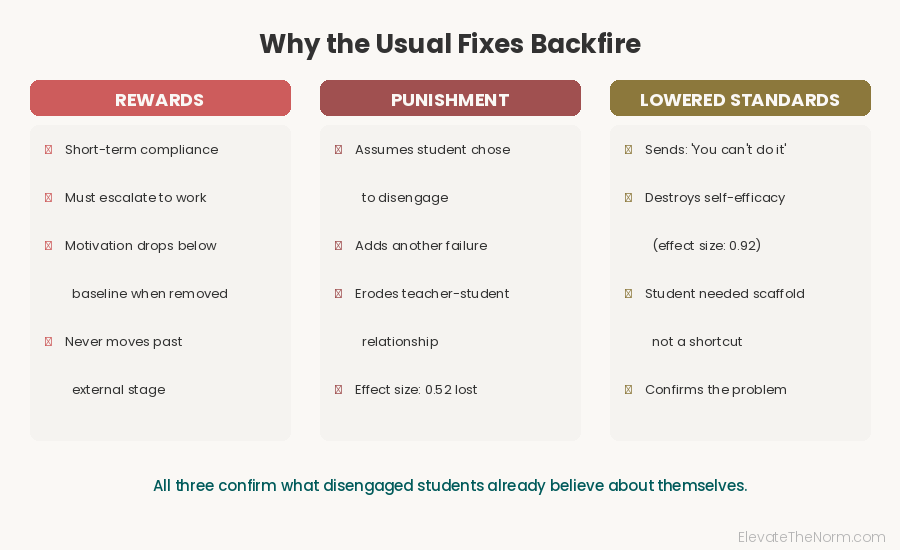
    Why the Usual Fixes Make It Worse

    Rewards Lose Power

    External rewards work in the short term. A pizza party will get homework turned in for a week. But decades of research on self-determination theory, led by Edward Deci and Richard Ryan, demonstrates that extrinsic motivation follows a predictable pattern: the reward must escalate to maintain the same effect, and when it disappears, motivation drops below where it started.

    Deci and Ryan identified four types of extrinsic motivation along a continuum from fully external (doing something to avoid punishment or earn a reward) to integrated (doing something because it aligns with who you are). Most classroom reward systems never move students past the first stage. They produce compliance, not motivation. And compliance disappears the moment the reward does.

    Why rewards punishment and lowered standards backfire for disengaged students showing three columns of failed strategies
    Three common approaches to student disengagement that make the problem worse

    Punishment Backfires

    Punishing a student for not caring — zeroes, detention, calls home, public redirection — assumes the student has chosen not to engage and can be pressured into changing that choice. For a student dealing with learned helplessness, fear of failure, or a home life that makes school feel irrelevant, punishment adds another failure to the pile. John Hattie’s meta-analyses of educational research show that teacher-student relationships carry an effect size of 0.52 on student achievement — a correlation rather than a proven cause, which is how these numbers are best read. Punishment does not build relationships. It erodes them.

    Lowered Standards Confirm the Problem

    This is the trap that well-meaning teachers fall into most often. A student is struggling, so you shorten the assignment, remove the hard parts, or accept work you know is not their best. You do this out of compassion. But the student reads it differently: you do not think I can do it either.

    Hattie’s research on self-efficacy — a student’s belief in their own ability to succeed — shows an effect size of 0.92, one of the highest in the entire database. Lowering the standard does not raise self-efficacy. It destroys it. The student needed a scaffold, not a shortcut.

    What Actually Works: Competence, Relevance, and Relationship

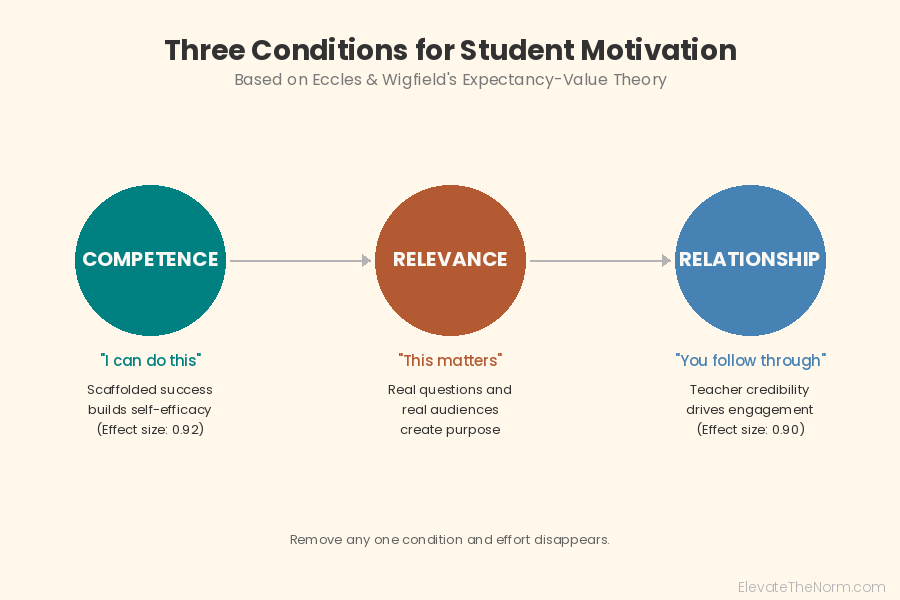
    Eccles and Wigfield’s expectancy-value theory provides a useful framework here. Students are motivated when two conditions are met: they expect they can succeed at the task, and they value the outcome. Remove either one and effort disappears. A student who thinks they can do the work but sees no point will not try. A student who sees the point but believes they will fail will not try either.

    This means motivation is not one fix. It is at least two — and usually three.

    Three conditions for student motivation based on expectancy value theory showing competence relevance and relationship
    Three conditions for student motivation based on Eccles and Wigfield’s expectancy-value theory

    Competence: They Need to Believe They Can

    This comes first because nothing else matters without it. A student who has failed repeatedly in your subject has built a story about themselves: I am not good at this. You cannot talk them out of that story. You have to give them evidence that it is wrong.

    That means:

    • Assign work they can complete successfully today, then raise the bar tomorrow. Not easier work — appropriately scaffolded work. The task stays rigorous. The entry point becomes accessible.
    • Give feedback that points forward, not backward. “This paragraph needs a stronger claim — here is what a strong one sounds like” beats “This is incomplete” every time. Hattie’s data shows feedback carries an effect size of 0.70 when it is specific, timely, and actionable.
    • Let them revise. A student who turns in weak work and gets a permanent grade has no reason to improve. A student who turns in weak work and gets a chance to make it better has a reason to try.

    Relevance: They Need a Reason

    “When will I ever use this?” is not a complaint. It is a genuine question, and if you cannot answer it, the student is right to ask.

    Relevance does not mean every lesson needs a TikTok hook. It means the work connects to something real — a question worth answering, a problem worth solving, a product someone will actually see.

    During project check-ins in my room, I pull students to the whiteboard table one group at a time. They have to show me what they have and explain why they made the choices they made. I am not grading their progress. I am asking them to defend it. And what I have noticed is that the students who checked out during a textbook reading will fight for a project they chose. Not because the project is fun — sometimes it is not — but because it is theirs. They picked the question. They have to stand behind the answer. That ownership changes the math on whether effort is worth it.

    Relationship: They Need an Adult Who Follows Through

    Teacher credibility — whether a student believes you are competent, trustworthy, and caring — carries an effect size of 0.90 in Hattie’s research. That is not a small number. It means a student’s perception of you as a teacher matters almost as much as anything you actually teach.

    But relationship does not mean being liked. It means being consistent. If you say you will look at their work, look at it. If you say there is a consequence, follow through. If you say you believe they can do it, prove it by holding them to the standard instead of quietly lowering it.

    Niemiec and Ryan’s 2009 review of self-determination theory in education found that students assigned to autonomy-supportive teachers — teachers who explained the purpose behind assignments, offered genuine choices, and acknowledged students’ perspectives — showed increased intrinsic motivation, perceived competence, and self-esteem compared to students with controlling teachers. Autonomy support is not a personality trait. It is a set of behaviors. And it can be learned.

    Five Practical Moves for Your Classroom

    Five practical classroom moves for motivating disengaged students including task design feedback and timeline flexibility
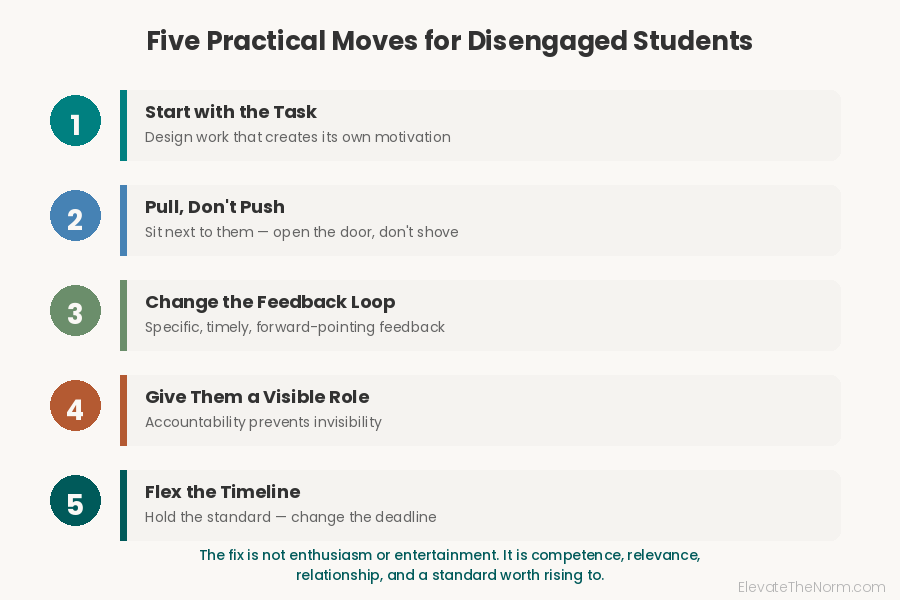
    Five practical moves teachers can use to re-engage students who appear not to care

    1. Start with the Task, Not the Motivation

    Stop trying to motivate students before the work begins. Instead, design work that creates its own motivation. A project with a real audience and a real deadline does not need a pep talk. A worksheet that will be graded and returned does.

    2. Pull Them In — Do Not Push Them Forward

    When a student is disengaged, the instinct is to push: more reminders, louder redirections, calls home. Try pulling instead. Sit next to them. Ask what they are working on. Ask what part is confusing. Ask what they would change about the assignment if they could. You are not lowering the bar. You are opening the door.

    3. Change the Feedback Loop

    If the only feedback a disengaged student receives is a grade, they have no reason to change their behavior. Move feedback earlier in the process and make it specific:

    • “Your first two sentences set up a strong argument. The third one contradicts it — read it again and see if you catch why.”
    • “You have the right data. Your conclusion does not match it yet. Try again.”
    • “This is better than last week. Here is what will make it better than this.”

    4. Give Them a Role They Cannot Disappear From

    In group work, a disengaged student will drift to the margins unless the structure prevents it. Assign specific roles with visible accountability: the person who presents, the person who defends the data, the person who fields questions. When the work has their name on it, invisibility stops being an option.

    5. Separate the Standard from the Timeline

    Some students disengage because they have missed so much that catching up feels impossible. Let them redo work. Let them turn things in late with a conversation about what happened. Hold the quality standard. Flex the timeline. This is not lowering expectations. It is acknowledging that learning does not always follow a schedule.

    A note on this: your school likely has a grading policy, and you need to work within it. If your district has a strict late-work penalty, talk to your administrator about exceptions for specific students before you promise flexibility you cannot deliver. The principle — standard stays, timeline flexes — is sound. How much flex you have depends on your building. Do not make promises your gradebook cannot keep.

    What You Cannot Control — And Why That Matters

    Not every disengaged student is responding to something in your classroom. Poverty, trauma, food insecurity, unstable housing, family conflict, undiagnosed learning differences — these are real, and they affect motivation in ways a well-designed project cannot fix.

    You are not a therapist. You are not a social worker. You are a teacher. Your job is to make your classroom the kind of place where effort makes sense — where the standard is high, the support is real, and the relationship is honest. For some students, that will be enough. For others, it will be one piece of a much larger puzzle that involves counselors, families, community resources, and time.

    Do not blame yourself when a student does not respond. But do not stop trying either. Some turns take weeks. Some take months. Some happen long after they leave your room, and you never hear about it.

    Before You Assume Poverty Means Disengagement

    One more thing. I have worked in high-poverty schools my entire career, and I need to say this plainly: your students’ zip code does not predict their motivation. Research by Bloem and colleagues, published in Social Psychology of Education in 2024, found that teachers in lower-SES schools gave students less autonomy support and more controlling behavior — and that the gap widened among teachers who held biased attitudes toward low-income families. The problem was not the students. It was what the adults assumed about them.

    Students in a Title I school want recognition. They want to be trusted with responsibility. They want to communicate with each other and work on something that matters. The need is universal. The assumption that poor kids need control instead of relationship is not supported by the evidence, and it does real damage.

    Conclusion

    Motivating students who don’t care is not about finding the right trick. It is about diagnosing what killed the motivation in the first place — usually some combination of repeated failure, irrelevant work, and adults who did not follow through — and then rebuilding the conditions that make effort feel worth it. That means scaffolded competence, genuine relevance, honest relationships, and a standard that stays high even when the path to meeting it changes.

    Start with the student in front of you. Find out what they can do today. Show them what they could do tomorrow. And then hold them to it.


    How do I motivate a student who literally will not do any work?

    Start smaller than you think you need to. Find one task they will engage with — even a short one — and build from there. A student who completes one thing successfully is closer to completing two than a student who has completed nothing for weeks. Sit with them. Ask what the barrier is. Sometimes the answer is ‘I do not understand the directions.’ Sometimes it is bigger than that, and you need to loop in a counselor or support team.

    Is it okay to give students a choice in what they work on?

    Yes, and research supports it. Deci and Ryan’s self-determination theory shows that genuine choice — not the illusion of choice between two identical tasks — increases intrinsic motivation. The key word is genuine. Letting students choose their topic within a framework is meaningful. Letting them choose between worksheet A and worksheet B is not.

    Should I call home when a student is disengaged?

    It depends on the relationship and the home situation. For some students, a positive call home — ‘I noticed your child contributed a strong idea today’ — builds a bridge. For others, any call home triggers consequences that make school feel less safe, not more. Know your students before you pick up the phone, and lead with something they did well whenever possible.

    What about students with IEPs or 504 plans who seem disengaged?

    Some disengagement is disability-related, and the strategies here still apply — but with an additional layer. If a student has an IEP or 504, their accommodation plan may already address some of the barriers described in this article. Work with your special education team to make sure your scaffolding, timeline flexibility, and feedback approaches align with the plan rather than duplicating or contradicting it. Disengagement in a student with a learning difference may look identical to disengagement from a student without one, but the causes and appropriate responses can differ. When in doubt, consult the team before changing your approach.

    What if the student is dealing with issues outside school that I cannot fix?

    You cannot fix them, and you should not try to. But you can make your classroom a place where those issues do not get worse. Consistent routines, clear expectations, honest follow-through, and a teacher who does not give up — those things matter even when you cannot see the result immediately. Refer to counselors and support staff when you notice patterns that are beyond your scope.

    Does project-based learning help with disengaged students?

    It can, because PBL creates the conditions research shows drive motivation — autonomy, relevance, public accountability, and visible competence. But PBL alone is not a magic fix. A disengaged student placed in a group project without scaffolding and clear roles will simply disengage from the project instead of the worksheet. The structure matters as much as the format.

    How do I keep my standards high without pushing disengaged students further away?

    Separate the standard from the timeline and the entry point. The quality of work you expect stays the same. The amount of support you provide, the deadline flexibility you offer, and the way you scaffold the first attempt can all change. A student who turns in a rough draft and revises it three times has met the same standard as the student who nailed it the first time — they just took a different path to get there.

    Is student disengagement getting worse?

    National survey data suggests engagement has declined, particularly after 2020. But disengagement is not new — Goodenow was studying it in 1993, and Seligman described learned helplessness decades before that. What has changed is the visibility. Students who once sat quietly and did the minimum now have phones, social media, and more exit ramps. The underlying needs — competence, belonging, relevance — have not changed at all.


    Sources

    1. Deci, E. L., & Ryan, R. M. (2000). “Intrinsic and Extrinsic Motivations: Classic Definitions and New Directions.” Contemporary Educational Psychology, 25(1), 54–67.
    2. Niemiec, C. P., & Ryan, R. M. (2009). “Autonomy, Competence, and Relatedness in the Classroom: Applying Self-Determination Theory to Educational Practice.” Theory and Research in Education, 7(2), 133–144.
    3. Goodenow, C. (1993). “The Psychological Sense of School Membership Among Adolescents: Scale Development and Educational Correlates.” Psychology in the Schools, 30(1), 79–90.
    4. Hattie, J. (2023). Visible Learning: The Sequel. Routledge.
    5. Chang, Y., et al. (2026). “The Longitudinal Trajectory of Learned Helplessness Among Adolescent Students: The Role of Parental Autonomy Support and Control.” Journal of Research on Adolescence.
    6. Bloem, N., et al. (2024). “Teachers’ Autonomy Support and Control Toward Lower- and Higher-SES Students.” Social Psychology of Education.
    7. Eccles, J. S., & Wigfield, A. (2002). “Motivational Beliefs, Values, and Goals.” Annual Review of Psychology, 53, 109–132.

    About Clay Shumate

    Clay Shumate is a certified secondary Social Studies teacher in the public schools of West Alabama, with seven years of classroom experience, a B.A. in History, and an M.Ed. in Secondary Education. He writes about project-based learning, student responsibility, respect, and practical ways to hold young people to a higher standard while giving them room to learn from mistakes. He is a member of the Society of Professional Journalists and writes to its Code of Ethics; this site’s editorial standards and corrections policy are published in full. More about Clay.

  • Chronic Absenteeism: What Actually Brings Students Back to Class

    Chronic Absenteeism: What Actually Brings Students Back to Class

    By Clay Shumate

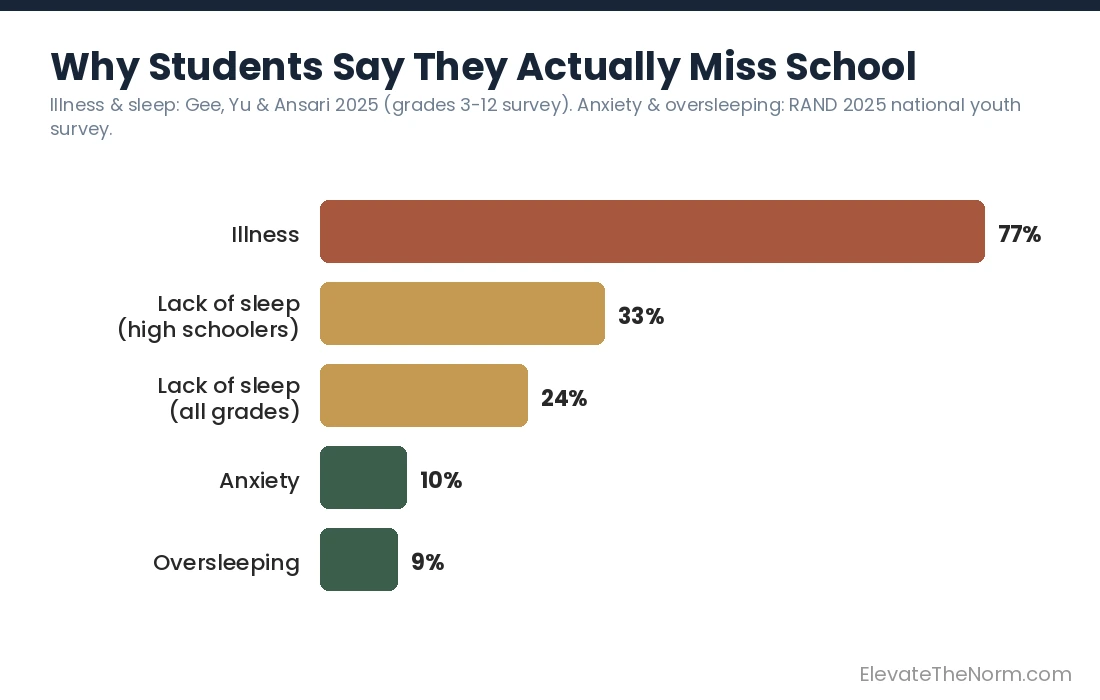
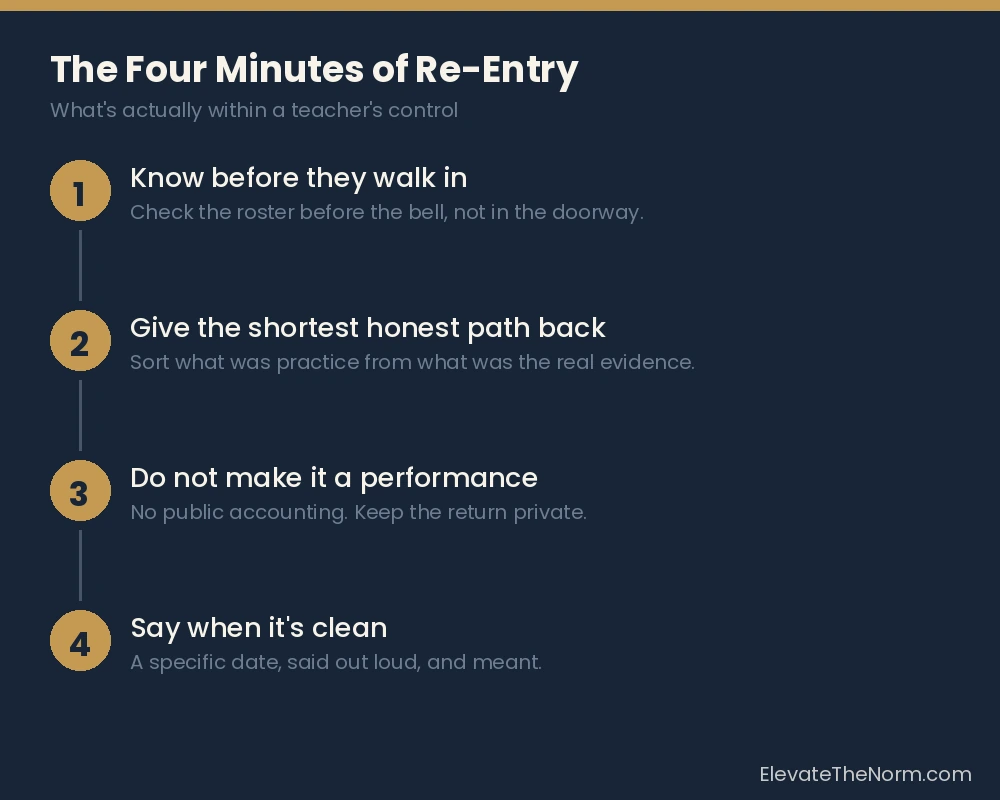
    Chronic absenteeism means missing 10 percent or more of the school year — about eighteen days, excused and unexcused combined — and it’s sitting near a quarter of all U.S. students. Most of that isn’t about your lesson plans: illness and lost sleep outrank boredom by a wide margin. But re-entry, what happens the day a student walks back in, is squarely a teacher’s job, and most classrooms have no plan for it at all.

    Key Takeaways

    • Chronic absenteeism counts a student missing 10 percent or more of enrolled school days, excused and unexcused together — it is not the same thing as truancy, which is specifically about unexcused absences and can trigger legal consequences for a family.
    • The national rate peaked near 28.5 percent in 2022, fell to roughly 23.5–25 percent by 2024, and has stalled — the decline slowed enough in 2024 that a full return to the 15 percent pre-pandemic baseline is no longer guaranteed.
    • When students are asked directly why they missed school, illness and lack of sleep dominate the answers. Boredom and disengagement are real but smaller, and high schoolers actually report fewer disengagement reasons after the pandemic than before.
    • Attendance Works sorts causes into four categories — barriers, aversion, disengagement, and misconceptions — and a classroom teacher has real leverage over only two of them.
    • The best-evidenced classroom-adjacent lever isn’t a lesson plan; it’s what happens on re-entry day, and separately, honest and consistent family communication is one of the few things correlated with meaningfully lower rates.

    What Chronic Absenteeism Actually Means

    Chronic absenteeism is a student missing 10 percent or more of enrolled school days in a year — roughly eighteen days in a standard 180-day calendar, or about two days a month. Every state and most districts now track it because it correlates with weaker outcomes at every level, from third-grade reading to ninth-grade credit accumulation to graduation. The count includes excused and unexcused absences together. A student out with the flu for two weeks, a student with a broken attendance streak from oversleeping, and a student who simply stopped coming all land in the same statistic, and the number alone tells you nothing about which one you’re looking at.

    That combined counting is also what separates chronic absenteeism from truancy, and the two get confused constantly in casual conversation. Truancy is specifically about unexcused absences, and in most states it is a legal category with a defined escalation path — a set number of unexcused absences triggers truant status, repeated truancy can trigger a referral, and in the most severe cases a district attorney can pursue charges against a parent or guardian. Chronic absenteeism carries no such court process on its own. A student who is chronically absent because of documented illness has never been truant a single day. Confusing the two terms is how a school ends up applying a punitive, legal-track response to a problem that is, for most students, not a compliance problem at all.

    How Bad Is It, and Is It Getting Better?

    Nationally, chronic absenteeism held steady around 15 percent through the 2018 and 2019 school years. It jumped to roughly 28.5 percent at its 2022 peak, then eased to about 25.4 percent in 2023 and 23.5 percent in 2024. RAND’s 2024–25 district survey put the most recent figure at approximately 22 percent — nearly 11 million students. The trend line is real improvement, and it is also slowing down. Nat Malkus, who tracks the numbers for the American Enterprise Institute, has written plainly that the deceleration raises “the very real possibility that absenteeism rates might never return to pre-pandemic levels.”

    The average also hides where the actual crisis sits. Low-achieving districts went from about 19 percent chronically absent in 2018 to 35 percent in 2022; high-achieving districts moved from 10 percent to 19 percent over the same stretch — both got worse, but the gap between them widened. RAND found urban districts were five to six times more likely than rural or suburban ones to report extreme chronic absence, meaning 30 percent of students or more. If your school sits in that first group, the national “one in four” statistic is understating your actual room by a wide margin.

    The Four Root Causes — and Which Ones Are Actually Yours

    Attendance Works, the research and policy organization most state departments of education cite on this topic, sorts every reason a student misses school into four categories: barriers, aversion, disengagement, and misconceptions about how much a few absences really matter. It’s a useful framework precisely because it forces an honest answer to the question every overwhelmed teacher eventually asks: which part of this is mine to fix?

    CategoryWhat it looks likeWho actually controls it
    BarriersIllness, unreliable transportation, unstable housing, caregiving duties for a sibling or family memberFamily, school system, community resources — not the classroom teacher
    AversionAnxiety about a specific class or hallway, bullying, a bad experience with a particular adultShared — a teacher can remove one specific aversion, but not the underlying anxiety
    DisengagementThe student sees no point in showing up because the work feels irrelevant or the return is unclearLargely the classroom — relevance, relationship, and clarity are teacher-level moves
    MisconceptionsBelief that a handful of absences “doesn’t really matter” as long as grades hold upShared — a teacher’s re-entry practice and a family’s messaging both shape this
    Four-category chart showing the root causes of chronic absenteeism: barriers, aversion, disengagement, and misconceptions, with who controls each one
    The Attendance Works framework for chronic absenteeism, showing which causes a classroom teacher can actually influence.

    Look at that middle column honestly and the division of labor gets clear fast. Barriers are not solvable from a classroom. No lesson plan fixes a broken car, an undiagnosed illness, or a kid watching a younger sibling because there’s nobody else. Pretending otherwise is how teachers end up carrying blame for outcomes they were never equipped to move, and it’s a big part of why attendance initiatives that live entirely inside individual classrooms tend to disappoint — they’re aimed at maybe half the problem.

    Why Most of It Isn’t About Your Classroom

    When you ask students directly why they missed school, the answer that comes back most is not the one teacher-facing advice usually assumes. A 2025 analysis of Rhode Island survey data covering grades 3–12 found illness reported by roughly three-quarters of students both before and after the pandemic — 77 percent post-pandemic specifically. Lack of sleep came in second at 24 percent overall and a striking 33 percent among high schoolers. Boredom and safety concerns did rise after the pandemic, but from a much smaller base, and — this is the finding that should reshape how engagement gets talked about — high school students actually reported fewer disengagement reasons after the pandemic than before it. RAND’s national youth survey landed in the same place: 67 percent sickness, 10 percent anxiety, 9 percent oversleeping.

    Bar chart showing self-reported reasons students miss school: illness 77 percent, lack of sleep 33 percent among high schoolers and 24 percent overall, anxiety 10 percent, oversleeping 9 percent
    Illness and lost sleep outrank boredom by a wide margin in student-reported reasons for absence.

    That doesn’t mean engagement is irrelevant. It means engagement is not the lever most teacher-facing advice on this topic claims it is. If a school’s entire absenteeism strategy is “make class more interesting,” it is aimed at a real but minority slice of the problem, and it will underdeliver — not because the advice is wrong, but because it was never sized to the actual distribution of causes. For the students where disengagement genuinely is the driver, the deeper diagnosis and fix belong in a companion piece on what actually motivates students once rewards and speeches stop working — this page is about the much larger group whose absence has nothing to do with motivation at all.

    What’s Actually Yours: The Four Minutes That Change the Semester

    Here’s the honest, narrower claim. A classroom teacher cannot fix a transportation gap or an untreated illness. What a classroom teacher controls almost completely is what an absence costs a student once they’re back — and that cost is what determines whether eighteen missed days becomes thirty.

    I check the roster before the bell, not after. When I see a student has been out, I already know before they walk through the door — deciding what they need in the doorway, with the rest of the class watching, guarantees a bad decision made badly. If it’s a longer absence, that student gets pulled to the whiteboard table early — the same table I use for regular small-group work, not a separate “catch-up corner.” Low lamp, rug, better chairs. Students already know that table is where you go to be worked with, not managed. That matters more than it sounds like it should: a student coming back from eighteen missed days is highly sensitive to whether re-entry feels like punishment or like being picked back up.

    Reserve the full version of this for absences that actually need it — three or more days, or a pattern, not a single day for a dentist appointment. And none of what follows replaces your school’s required attendance reporting or truancy referral process. If a student’s pattern of absence raises a safety concern — signs of neglect, abuse, homelessness, or anything that meets your district’s mandated-reporting threshold — that goes to your counselor or administrator through the normal protocol immediately, separate from and before any classroom routine. Re-entry is about what a teacher does with the students in front of them; it is not a substitute for the systems built to catch the more serious cases.

    Four things make re-entry actually work.

    Know before they walk in. Check attendance history before class starts, not during it. A decision made in the doorway, in front of an audience, by a teacher who is also trying to start the lesson, is reliably the worst version of that decision.

    Give the shortest honest path back. Not every missed assignment carries the same weight. Ask yourself which pieces were practice and which ones were the actual evidence that the student learned the standard — the practice can often be waived or condensed; the evidence usually can’t. Sorting the pile down to what genuinely matters is a judgment call only the teacher can make, and it’s the difference between a student who can start today and a student who takes one look at forty backlogged items and shuts down. Better still, ask the student what they think is realistic before you hand them the final list — a plan a student helped build survives contact with a hard week better than one that was simply issued to them. This is student responsibility in its most practical form — the student still owns finishing the list, but the list has to be one a person could actually finish, and building it together is what makes it theirs. For an absence stretching past a week or two, or anything with a doctor’s note attached, loop in a counselor or your 504/IEP team before you finalize the plan alone — some of that catch-up may need to be a formal accommodation, not an informal favor.

    Do not make the return a performance. No public accounting of the absence, no comment in front of the class, no sarcasm at the door, and no requirement that the student explain themselves out loud. Some reasons are private — a medical diagnosis, a family situation, a mental health day — and a teacher doesn’t need the full story to run a fair re-entry process. A teenager who’s been gone is already running the social math on what walking back in will cost. Raise that cost and the cheapest option left is to stay gone. This is the same standard covered in respect in the classroom applied to a specific moment: a student’s absence is not public material, and treating it that way trades a little teacher satisfaction for a much worse attendance problem next month. Apply it the same way to every student, every time — the fastest way to make a re-entry routine feel arbitrary is to run it warmly for some students and coldly for others.

    Say when it’s clean. Give a specific date and a specific list, and when the list is finished, say so out loud and mean it. Open-ended debt is what convinces a student the hole is unclimbable. A defined end is what makes climbing rational.

    In practice this is a thirty-second exchange, not a meeting: “Good to see you back. Here’s what actually matters from the last few days — these three things. Everything else, let it go. Can you have these done by Friday?” That’s the whole script. It names what matters, drops what doesn’t, and ends with a date the student agreed to rather than one you handed down.

    Four-step checklist for helping a student return after an absence: know before they walk in, give the shortest honest path back, do not make it a performance, and say when it is clean
    The four re-entry moves that are genuinely within a classroom teacher’s control after chronic absenteeism.

    None of this is softness. The standard doesn’t move — the work still has to be real and the deadline still has to be a deadline. What moves is how much guesswork a student has to do to find their way back to it, and guesswork is where students who are already behind quietly give up. This is the same logic behind natural consequences instead of punishment: the goal is a consequence that teaches something, not one that simply makes the return more painful.

    Expect it to look worse before it looks better, especially with a student who’s been checked out for a while. A kid who suddenly gets real attention after being invisible will often test whether that attention is real — that’s a normal, predictable phase, not proof the approach isn’t working, and it connects directly to what happens the first few weeks after building a relationship with a student who’s been guarded. Most adults quit right at the point where the testing is actually a good sign.

    What the Research Says Works Beyond Your Classroom

    Honesty about the ceiling matters here too. The best-evidenced attendance interventions in the research aren’t classroom practices — they’re family communication, and the effect sizes are real but modest. Which tool carries that communication matters less than whether families can actually receive it — the questions to ask before adopting a communication app start with reach, not features.

    Rogers and Feller, publishing in Nature Human Behaviour in 2018, tested personalized mailings sent to the parents of 28,080 high-risk K–12 students. The most effective versions reduced chronic absenteeism by 10 percent or more, largely by correcting parents’ underestimates of how many days their child had actually missed — many parents simply didn’t know the number was as high as it was. A smaller trial run by the Regional Educational Laboratory Mid-Atlantic in the School District of Philadelphia found a single October postcard cut absences by a more modest 2.4 percent, with no measurable difference between message variations.

    A 2023 analysis by Harvard researchers Karen Mapp and Todd Rogers, working with Learning Heroes and TNTP across more than 3,000 Illinois schools, found something adjacent and worth taking seriously: schools with strong pre-pandemic family engagement — measured through trust, involvement, and parent influence on school decisions — had chronic absenteeism rates roughly six percentage points lower than similar schools with weak engagement, even after controlling for poverty. Between 2019 and 2022, the strong-engagement schools saw a 39 percent smaller increase in chronic absenteeism than everyone else. This is a correlational finding from one state, not a randomized trial, and the researchers themselves describe it as the first phase of a larger project — it should be read as suggestive, not proof that family engagement alone moves the number. But it lines up with the honest re-entry advice above: families who already trust the school and understand what the classroom is doing are the same families likely to reinforce a re-entry plan rather than fight it. In practice that trust gets built with plain, non-alarmist language rather than a form letter — something closer to “I noticed six absences this month, is there anything the school can help with?” than an automated warning that reads like a legal notice. The first invites a conversation. The second reads like the truancy-court track discussed above, even for a family whose child has never come close to it.

    None of this reaches a transportation gap, an untreated health condition, or a family in crisis, and no classroom teacher should feel responsible for the part of the number that genuinely isn’t theirs. What is genuinely theirs — re-entry, and a habit of honest, non-alarmist communication home — is smaller than the whole problem and still worth doing well, because it’s the piece within reach on a Tuesday afternoon, not a district initiative that takes a year to fund.

    What to Do With This on Monday

    Start with one thing: check the roster before the bell and know, before a returning student walks in, what the shortest honest path back looks like for them. Add the no-performance rule next — it costs nothing and it’s the fastest way to stop making re-entry harder than it needs to be. Everything else on this page — the barriers your school actually controls, the family-communication research, the honest accounting of what disengagement is and isn’t driving — belongs to a bigger conversation about chronic absenteeism than one classroom can solve alone. Your four minutes with a returning student is the part that starts today. For a ready-to-use tool on this, see a printable parent-teacher communication log pack.


    Is chronic absenteeism the same thing as truancy?

    No. Chronic absenteeism counts a student missing 10 percent or more of enrolled school days, whether the absences are excused or unexcused. Truancy is a narrower legal category built specifically from unexcused absences, and in most states it comes with a defined escalation process that can eventually involve a district attorney and consequences for a parent or guardian. A student who is chronically absent because of documented illness has never been truant. Treating the two as interchangeable is how schools end up applying a legal, punitive response to a problem that, for most students, was never about defiance.

    Whose fault is chronic absenteeism — the school, the family, or the student?

    Usually none of the above, at least not in the way the question assumes. National survey data shows the leading reasons students miss school are illness and lost sleep, not defiance or indifference. Framing absence as a fault to assign tends to produce blame instead of a fix. The more useful question is which piece of the problem a given adult actually has leverage over — a classroom teacher, a family, and a school system each control a different slice.

    What can one classroom teacher realistically do about chronic absenteeism?

    Less than district-level interventions, and that’s fine — a teacher’s real leverage is re-entry, not prevention. Checking the roster before class, sorting missed work down to what actually matters, keeping a returning student’s absence private, and giving a clear date when the catch-up is finished are all inside a single teacher’s control and take a few minutes per student. Preventing the absence in the first place usually depends on factors — transportation, health, housing — that sit outside any one classroom.

    Does missing school always mean a student doesn’t care about class?

    No, and the data says the opposite more often than not. When students are asked directly why they were out, illness and lack of sleep dominate the answers, and one national analysis found high schoolers reporting fewer disengagement-related reasons for absence after the pandemic than before it. Assuming apathy is usually wrong, and assuming it out loud to a student who was actually sick or exhausted damages the relationship for no reason.

    How should a teacher handle makeup work without overwhelming a student who’s behind?

    Sort before you hand anything over. Separate what was practice from what was the actual evidence that a student learned the standard, and let most of the practice go. Ask the student what they think is realistic before finalizing the list — a plan they helped build holds up better than one that was simply issued. For anything longer than a week or two, or work tied to a documented medical absence, loop in a counselor or the student’s 504/IEP team rather than solving it alone.

    What if a student’s pattern of absences seems like a sign of something more serious?

    That goes to your school’s counselor or administrator through your normal mandated-reporting and attendance-review process immediately — before, and separate from, any classroom re-entry routine. Signs like a sudden pattern change, indications of neglect or abuse, or signs of homelessness are outside what a classroom-level practice is built to address, and they need the systems your school already has for exactly that purpose.

    Do attendance letters or family outreach actually reduce absences?

    Some forms do, modestly. A large study of personalized parent mailings correcting misperceptions about how many days a child had actually missed reduced chronic absenteeism by roughly 10 percent in its most effective version; a simpler single postcard trial produced a smaller 2.4 percent reduction. The tone matters — plain, non-alarmist language that reads like a conversation (‘is there anything the school can help with?’) is associated with better outcomes than a form letter that reads like a legal warning, even though neither approach comes close to solving the problem on its own.

    What’s a realistic first step for a teacher who wants to get better at this?

    Start with one habit: check attendance before the bell so you already know, before a student walks in, what their shortest honest path back looks like. Add the no-performance rule next — keeping the return private costs nothing and prevents the single most common way teachers accidentally make attendance worse. Everything else on this page is worth knowing, but those two moves are where an ordinary Tuesday actually changes.


    Sources


    About Clay Shumate

    Clay Shumate is a certified secondary Social Studies teacher in the public schools of West Alabama, with seven years of classroom experience, a B.A. in History, and an M.Ed. in Secondary Education. He writes about project-based learning, student responsibility, respect, and practical ways to hold young people to a higher standard while giving them room to learn from mistakes. He is a member of the Society of Professional Journalists and writes to its Code of Ethics; this site’s editorial standards and corrections policy are published in full. More about Clay.

Teacher Emergency Toolkit — practical resources, real classroom support. Shop on TPT.Teacher Emergency Toolkit — practical resources, real classroom support. Shop on TPT.